Jimma Institute of Technology
Department of Civil and Environmental Engineering
Postgraduate Program: construction Engineering & Management
Time, Program, Cost and Cost Overrun: Its Regulation and Management Under MDB-FIDIC
(2010) and PPA (2011) Condition of Contract and the Applicable Law; Special Emphasis to
Delay and Disruption Claim
By: - Fuad Jemal
Advisor: -Alemu Mosisa (Assistant Professor)
Director for Grant, Consultancy and Center of Excellence
ACKNOWLEDGEMENTS
First and foremost, we owe our special thanks to the almighty GOD for empowering and giving us internal courage and strength to accomplish this term paper.
We would like to take this opportunity to express our sincere gratitude to our advisor Ass.Prof. Alemu Mosisa for his patience, motivation, enthusiasm, and immense knowledge. His guidance and support both during lectures and research is very crucial for us in mastering the subject.
Last but not least, our thanks go to all the group members, for their patience and willingness to share what they have and work in cooperation and coordination.
Abstract: Construction projects are characterized by business relationships and commitments that are spread over wide time horizons. Such construction Contracts are usually formulated based on the provisions of General and Particular Conditions prepared by professional associations, financiers, and institutions or as is the case in Ethiopia, by regulatory bodies. The most prevalent forms of such General Conditions are those prepared by Fédération Internationale des Ingénieurs-Conseils (FIDIC), IEC Conditions, Ministries (for example, Ministry of Works and Urban Development), and the like.
This paper includes the written assignment on the main parameters of construction industry which are Time, Program, Cost And Cost Overrun:, Its Regulation And Management Under MDB-FIDIC (2010) And PPA (2011) Condition Of Contract And The Applicable Law; Special Emphasis To Delay And Disruption Claim, and also the above parameters try to imply the effects of these parameters on the construction industry with special emphasis to Delay & Disruption Claims.
Contents
Acknowledgements ... 1
Abstract ... 2
List of figure ... 5
List of table ... 5
Abbreviations ... 5
Chapter One ... Error! Bookmark not defined. 1. Introduction ... 5
1.1 General ... 5
1.2 Goal the project ... 6
1.3 Objectives ... 6
1.3.1 General Objective ... 6
1.3.2 Specific Objective ... 6
1.4 Problem statement ... 7
1.5 Research Questions ... 7
1.6 Methodology ... 7
Chapter Two ... Error! Bookmark not defined. 2. LITERATURE REVIEW ... 7
2.1 Time ... 7
2.1.1 Time management of construction projects ... 8
2.2.1 Programme for building design and construction ... 8
2.2.2 Programmes of works and construction contracts ... 9
2.2.3 Contractor's master programme... 10
2.4 Liquidated Damages ... 10
2.5 Cost ... 11
2.5.1 Definitions and Terminology for Cost ... 12
2.5.2 Estimating Methods ... 12
2.5.3 Cost control in building design and construction ... 13
2.6 Cost overruns in construction ... 14
2.6.1 Causes off Cost Overrun ... 15
2.6.2Provision of Clauses in FIDIC and PPA Standard Conditions of Contract Related to Cost ... 16
2.7 Time extension ... 16
2.7.1 Contractual basis of the entitlement for EOT ... 17
2.7.2 Notice for Extension of time submissions... 18
2.8 Time at Large (Completion of the work within a reasonable Time) ... 18
2.9 Delay in construction ... 18
2.10 Disruption ... 18
Chapter Three ... Error! Bookmark not defined. 3. Delay and Delay Claims Management ... 19
3.1 Delay Definition ... 19
3.2 Time Delays and Overruns ... 19
3.3 Classification of delay ... 19
3.3.1 Classic Delays ... 19
3.3.2 Concurrent delays ... 19
3.3.3 Serial Delays ... 19
3.4 Typical Project Owner Delay Claim Components Include ... 20
3.5 Typical Contractors Delay Damage Components Include ... 21
3.6 Causes of construction delay ... 21
3.7 Delay responsibility ... 24
3.7.1 Delays for which the client is responsible ... 24
3.7.2 Delays for which the client is not responsible ... 24
3.8 Remedial Rights ... 24
3.9 Valid delay claims ... 24
Chapter Four ... Error! Bookmark not defined. 4. Disruption and Disruption claims management ... 25
4.2 Disruption claims in construction ... 25
4.3 Claims ... 26
4.3.1 Definition and Types ... 26
4.3.2 Causes of claims ... 26
4.3.3 Valid claims ... 26
4.3.4 Claim Administration Processes ... 27
Chapter Five ... Error! Bookmark not defined. 5. Relationship between Delay and Disruption Claims ... 27
5.1 Delay and Disruption ... 27
5.2 Understanding delay and disruption claims ... 28
5.2.1 Evaluating Delay Claims ... 28
5.2.2 Evaluating Disruption Claims ... 28
5.3 Similarities between Delay and Disruption ... 28
5.4 Difference between Delay and Disruption ... 29
Chapter Six ... Error! Bookmark not defined. 6. Role of Engineer ... 29
6.1 The role of engineer in construction overview ... 29
6.2 General role of Engineers ... 30
6.2.1 Construction Supervision ... 30
6.2.2.Contract administrator ... 30
6.3 Engineer’s role in the claims process... 31
6.3.1 Engineer as agent of the owner ... 31
6.4 Assessment of claim by the Engineer ... 32
6.5 Engineer as arbitrator ... 32
Chapter Seven ... Error! Bookmark not defined. 7. Case study ... 32
7.1 Case Study one ... 32
Chapter Eight ... Error! Bookmark not defined. 8. Comparative Table & Analysis ... 40
8.1 Comparison Table of MDB- FIDIC (2010), PPA (2011) Condition of construction contract and applicable laws in delay and disruption claims management ... 40
Chapter Nine ... Error! Bookmark not defined. 9. Conclusion and Recommendation... 55
9.1 Conclusions ... 55
9.2 Recommendations ... 55
List of figure
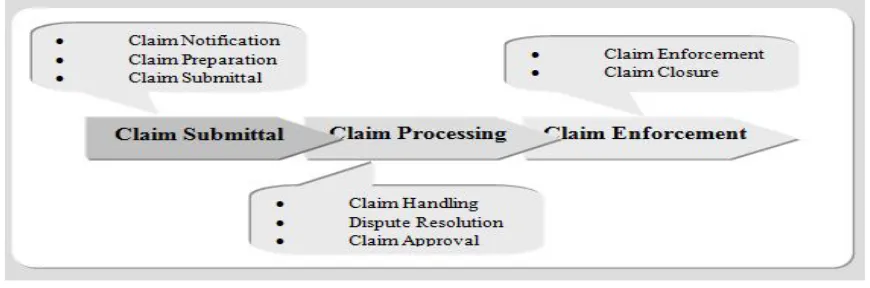
Figure 2 Claim Administration Process ... 27
List of table Table 1 Cause of delay by the parties ... 24
Table 2 shows variations and Excess in quantities ... 33
Table 3 shows change orders ... 33
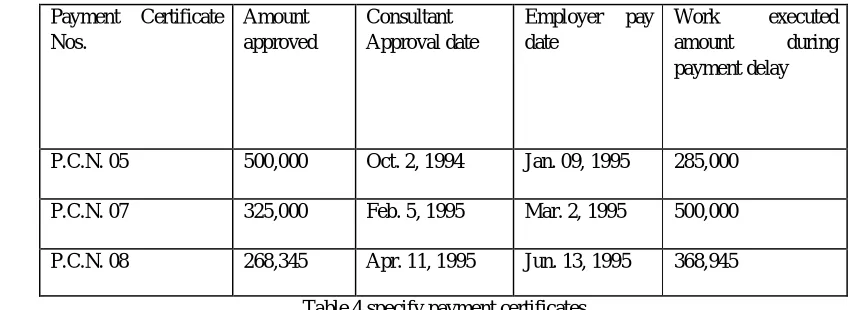
Table 4 specify payment certificates ... 34
Table 5 over all contractor “EOT” request... 35
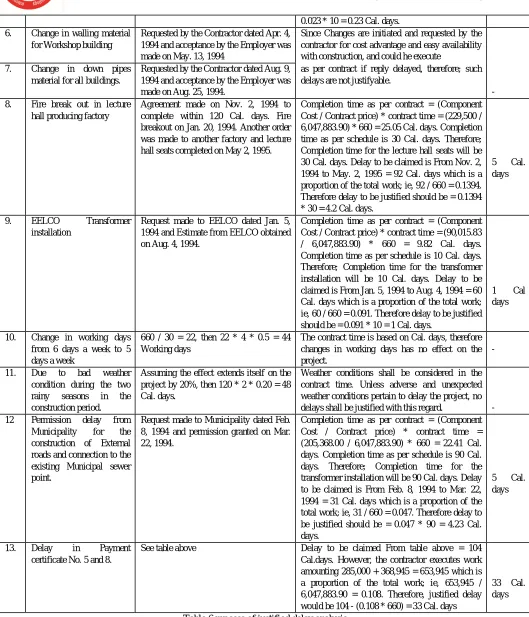
Table 6 process of justified delay analysis ... 38
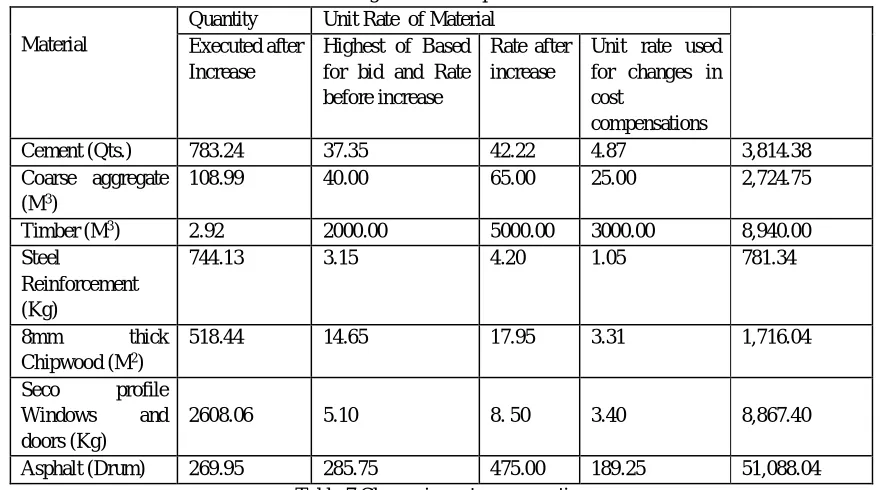
Table 7 Change in cost compensation ... 39
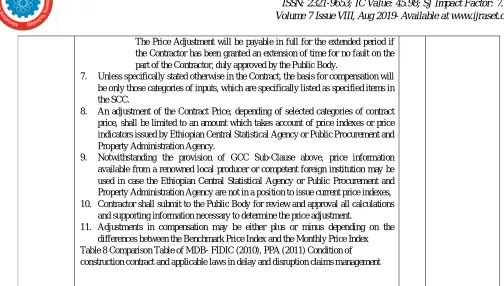
Table 8 Comparison Table of MDB- FIDIC (2010), PPA (2011) Condition of construction contract and applicable laws in delay and disruption claims management ... 55
Abbreviations
FIDIC – Fédération Internationale des Ingénieurs-Conseils
PPA – Public Procurement Agency
CCE – Civil Code of Ethiopia
EOT – Extension of time
CPM – Critical Path method
GCC – General Condition of Contract
LD – Liquidated Damage
MDB – Multilateral Development Banks
SBD – Standard Bidding Document
SSC – Special condition of contract ERA – Ethiopian Roads Authority
I. INTRODUCTION
A. General
Construction projects are characterized by business relationships and commitments that are spread over wide time horizons. Large-scale engineering projects have distant time horizons and require significant up-front commitments, while posing large potential downside losses. (Floricel S, Miller R., 2001)
Such construction Contracts are usually formulated based on the provisions of General and Particular Conditions prepared by professional associations, financiers, and institutions or as is the case in Ethiopia, by regulatory bodies. The most prevalent forms of such General Conditions are those prepared by Fédération Internationale des Ingénieurs-Conseils (FIDIC), IEC Conditions, Ministries (for example, Ministry of Works and Urban Development), and the like.
The competitive bidding system forces contractors to price their work in a way that will give them the best opportunity to be the low bidder. Sometimes, too much attention is placed on getting the work and not enough attention is given to how the work can be done profitably.
1) Project Management: Project management, as defined in Wikipedia, “is the discipline of planning, organizing, securing, managing, leading, and controlling resources to achieve specific goals” (Wikipedia). Its function is to assure the accomplishment of project objectives, in other words, to assure project profits (Nielsen, 2006). The purpose of project management is to predict as many dangers and problems as possible to insure a successful project (Lock,2004).
2) Programmes: Programmes describe the sequence in which tasks must be carried out so that a project (or part of a project) can be completed on time. Contracts may require that the contractor provides a master programme for the construction of the works as soon as possible after the execution of the contract, if it has not been previously provided.
3) Delays and Disruptions: Delay as referred in construction is prolonged construction period and disruptions are events that disturb the construction programme. Delays and disruptions are among the challenges faced in the course of executing construction projects. Delays as well as disruptions are sources of potential risks that current studies are looking into ways to manage.
4) Role of Engineer in the Claims Process: Considering the engineer intimate involvement with a typical project from beginning to end, it is not surprising that engineers become very involved in the claims process. The claims process refers to the process whereby the construction contractor requests additional compensation or other benefits under the contract from the project owner.
B. Goal the project
Discusses and compare about Time, Program, Cost and Cost Overrun under MDB-FIDIC (2010) And PPA (2011) Condition of Contract and specifies the role of engineer.
C. Objectives 1) General Objective
a) Discusses and compare about Time ,Program, Cost And Cost Overrun ; Its Regulation And Management Under MDB-FIDIC (2010) And PPA (2011) Condition Of Contract And The Applicable Law with Special Emphasis To Delay And Disruption Claim
b) Determine the role of engineer on above stated concept.
2) Specific Objective a) Background Related
i) to define time from construction project management perspective;
ii) to define program from construction project management perspective;
iii) to discuss time & program in general including the relevant management tools to that effect;
iv) to define & discuss commencement date; completion date; how & where (under which contract document) to be defined and why? the role of construction program, if any?
v) to define & discuss duration of the project; which constitutes the time scale for the progress of the construction project;
vi) to discuss the effect of having no time in a given construction project; discuss the concept of time at large; factors contributing to or causing time at large; legal effects of time at large on the contractor & on the employer; and so forth;
vii) to define & discuss cost in general & construction cost in particular;
viii) to identify & discuss each categories of cost; the rationale behind such category of cost;
ix) to discuss the contractual & legal importance or implications of categorizing costs as related to claims;
x) to discuss how cost being established in the different phases of a construction project;
b) Delay Related
i) To define & discuss the very concept of delay;
ii) To identify & discuss categories/types of delay;
iii) To identify & discuss the causes for delay;
iv) To identify & discuss method of analysis of delay;
v) To identify & discuss contractual and/or legal effects of delay on the contractor, if the delay were caused by the contractor;
vi) To identify & discuss the contractual and/or legal effects of delay on the employer, if the delay were caused by the employer;
viii) To discuss in case of liquidated damages or delay damages the assessment of same with respect to sectional completion & works (total) completion;
ix) To discuss the concept & management of concurrent delay;
c) Disruption Related
i) To define the very concept of disruption;
ii) To identify & discuss categories/types of disruption;
iii) To identify & discuss the causes for disruption;
iv) To discuss the role of construction program, if any, in any construction project, as related to disruption;
v) To define & discuss duration of the project; which constitutes the time scale for the progress of the construction project under consideration;
vi) To define disruption; treating & analyzing the legal & contractual effects of disruption on the contracting parties i.e. on the employer or the contractor or both, if any;
vii) To discuss method of analysis of disruption by the contractor, what factors to be considered? What constitutes disruption claims of the contractor? Whether or not time alone; cost alone or both time & cost and the reasons or justification for it?
D. Problem Statement
The starting point in any research is the definition of the research issue or the problem statement (Nick Moore, 2000). Or, the first issue is to find a problem to investigate (Burns, 2000). However, this was the most difficult task, specifically, working towards getting the focus of the research.
Powers et al, 1985 quoted in Kumar 1999 stressed that potential research questions may occur to us on a regular basis, but the process of formulating them into a meaningful way is not an easy task.
This study had also passed through the same way. That is, there were fuzzy situations where the ideas were unclear, several doubts meandered, and most of all, there were events considered totally blurred.
This was mainly due to my ambitions to capture the whole and enable to create a better map that thought me the necessity of inter-disciplinary research works for such studies.
Generally there is some confusion in determining the existence of claim focusing sepecialy on time and the role of engineer in MDB-FIDIC (2010) And PPA (2011) Condition of Contract.
E. Research Questions
1) What are the claims arising from time related in the construction industry?
2) Which condition of contract is stated clearly?
3) Who is responsible for setting/pertaining or managing the occurrences of claim?
F. Methodology
1) It more of referring the Condition of Contracts like:-
a) MDB-FIDIC (2010) and PPA (2011)
2) Literature review concerning the concepts of Time, program, its Regulation & Management in the construction projects is conducted.
3) Gathering from different books, construction trade journals and various web sites.
4) If possible Analysis of case studies related to the subject matter
a) For contextual concept development.
II. LITERATURE REVIEW
A. Time
Time is a dimension and measure in which events can be ordered from the past through the present into the future, and also the measure of duration of events and interval between them.
„Time for completion means the time for completing the work or section (as the case may be) under sub clause 8.2 [time for completion], as stated in the contract data (with any extension under sub clause 8.4 [extension of time for completion]), calculated from the commencement date.‟ (FIDIC MDB 2010 clause 1.1.3.3) is the date on which it is intended that the Contractor shall complete the Works. The Intended Completion Date is specified in the Special Conditions of Contract. The Intended Completion Date may be revised only by the Engineer by issuing an extension of time or an acceleration order; (PPA 2011 clause 1.2/U ["Intended Completion Date”])
a) Sectional Completion: If the intention of the parties is that the contract work should be completed and handed over in phases, it is essential that the contract documents make proper provision for this, each with its own time for completion and own related contractual issues (such as insurance, retention, defect liabilities and so on). (FIDIC MDB 2010 clause 10.2) and PPA 2011 provision for partial acceptance: Clause 86 Partial Acceptance
b) Final Completion: As per, Clause 8.2 of MDB FIDIC 2010. Besides, MDB FIDIC 2010 provides tests on completion to be done for the final acceptance (Clause 9). And PPA 2011 also provide such tests to be conducted on completion (Clause 85) For Example: Most of Ethiopian Roads Authority (ERA) projects provide such provisions of sectional/ partial completion (sectional hand over).
1) Time Management Of Construction Projects: Time management is the process of organizing and implementing a strategy related to the time required for work activities on a project. Effective time management is essential to successfully and efficiently meeting budget and programme targets, as well as achieving profitability.
Projects can risk incurring unnecessary costs and delays as a result of ineffective time management, either by failing to allow for the full complexity of a project, or by failing to effectively manage scheduled work or unexpected events.
On large projects, the client may appoint a programme consultant to prepare a detailed programme for the project including an outline programme for construction if a contractor has not been appointed. Once the contractor is appointed, they will take responsibility for programming the construction works, but the programme consultant may continue to develop an overall programme for the client.
During the planning stage, all work activities should be properly understood, and planned in detail to optimize the allocation of resources and reduce the potential for ‘unknowns’. Estimates can then be made of how long each activity will take. This is critical to the setting of milestones and deadlines, for allocation of resources, and for determining the pricing of contracts and cash flow requirements. The concept of 'float' describes the time that an activity can be delayed without changing the overall project duration. The float is obtained by subtracting the duration of activities from the available time. The critical path is determined by all activities were the total float is zero.
The critical activities have to be carried out without delay, any modification in their duration results in change in the project’s duration. The duration of an activity can sometimes be reduced by adding additional resources, but this will also increase its cost.
B. Programme
Programmes describe the sequence in which tasks must be carried out so that a project (or part of a project) can be completed on time.
1) Programme For Building Design And Construction
Programmes will often identify
a) Dates and durations allocated to tasks.
b) A critical path (the sequence of critical tasks upon which the overall duration of the programme is dependent).
c) Tasks which can only be carried out after other tasks have been completed.
d) Tasks which can be carried out simultaneously.
Preparing a programme should not be a paper exercise that simply records what has already happened or what is likely to happen. For a programme to be effective, it must be used as a tool to help plan activities, monitor progress and identify where additional resources may be required.
Programmes can be prepared for a number of different purposes
ii) A design programme scheduling tasks from the appointment of the consultant team to the appointment of the contractor. This might be a simple gantt chart incorporating each consultants planned resources for each stage which is then monitored and reported to the client.
iii) Information release schedules, setting out when the consultant team should issue production information to the contractor in order for the works to progress and when information produced by the contractor (or their sub-contractors) should be issued to the consultant team for comment and integration into the overall design.
A design programme defining deliverables might be incorporated into consultant's agreements, however, this is difficult to enforce (due in part to activities of third parties outside the consultant’s control such as planning authorities, client or stakeholder actions, consultation processes, etc.), and generally, the only recourse the client has is to threaten termination for non-performance in the event of consistent programme failure
2) Programmes of Works And Construction Contracts: Most construction contracts require the contractor to produce a programme of works. This can be a non-contractual reference point for how work will be carried out or it can impose obligations to deliver the works in a certain way and by certain dates. If the programme of works is included in the list of contract documents it will become binding on the parties. There are benefits and risks associated with doing that.
a) Incorporating The Programme As A Contract Document: There is no set form that a construction programme must take. As a minimum the programme should specify the commencement date, the order in which the contractor plans to carry out the contract works and the planned completion date. The contract may stipulate other information to be included in the programme. The programme is not usually listed as a contract document and is therefore not considered binding on the parties. In this case the programme will be used as an indicative tool for the parties, suppliers and consultants for administering the progress of the works. Where the contract lists the programme as a contract document, the programme will be binding on the parties. Any departure from it will constitute a breach of contract entitling the aggrieved party to compensation if they can prove they have incurred additional costs or delay. Employers primarily concerned with completing stages of the works by precise dates may be tempted to include the programme in the list of contract documents. The advantage for the employer is that it will afford him greater control over the manner and order in which the contractor will carry out the works. It will allow him to specify the works that are a priority and oblige the contractor to priorities the same matters. The advantage for the contractor is that he will be aware of what is expected of him from the outset. The same applies to third parties, such as suppliers and consultants, who are often ignorant or left in limbo as to the timing of their own contributions to the works. Where this approach is adopted, the contract should clearly set out which part or parts of the programme are binding. It could be that only the key milestone dates are binding. Conversely, it could be that all dates, the order of the works and the methods employed by the contractor are obligatory
b) Disadvantages Of Making The Programme A Contract Document: Including the programme in the list of contract documents is not without its pitfalls. It could mean:
i) additional obligations for both parties;
ii) an increase to the contractor's price;
iii) an increase in claims;
iv) delay to the commencement date;
v) Delays during the construction period.
If the programme is binding it is not just the contractor who assumes additional responsibilities. The employer will have to ensure he provides the contractor with the facilities to complete the works in accordance with the programme. In practice, this means providing the contractor with site access, design documents and decisions on time to allow the contractor to commence the next phase of the works.
If the employer fails to facilitate the progress of the works the contractor will be entitled to compensation for any resulting lost time and money. This could get particularly complicated in a multi-party project involving numerous contractors. For example, a failure by one contractor to complete a task or to vacate the site on time could mean that the employer is in breach of its obligations under all contracts associated with the project.
Being bound by the programme will reduce considerably the flexibility of the contractor's operations on site and will expose him to the risk of additional claims for breach of contract. Employers insisting on including the programme as a contract document should expect this additional risk to be reflected in the contractors' price. Contractors should clarify whether or not the programme is a contract document as early as possible during the tender stage and in any event before naming their price.
A good programme can be complicated and time-consuming to produce.
Creating a contractually binding programme out of something that has traditionally been used as a project management tool will add to this complexity. Conceiving a programme that is to be contractually binding in isolation and before the project has commenced will raise additional challenges. Consequently, the parties should expect a prolonged pre-contract negotiation period and a potential delay to the commencement date.
An early issue that the parties will face is the question of who is best placed to draft the plan. Lawyers will need to be closely involved to ensure that the programme and any accompanying documents are consistent with the contract. However, lawyers may not have the technical expertise to compile many elements of the programme so it is advisable to allow those who do possess such expertise to own the document. Suppliers and any other interfacing third parties will also need to review the programme to ensure their input is compatible with the requirements of the programme. Again, this could delay the start of the works.
Programmes are usually treated as live documents that are continuously updated in response to events occurring on-site or elsewhere on the project. Amending a contractually binding programme will be an additional administrative burden and could further delay the progress of the works during the construction period.
3) Contractor's Master Programme: Contracts may require that the contractor provides a master programme for the construction of the works as soon as possible after the execution of the contract, if it has not been previously provided. However, as it is produced after the execution of the contract, the programme does not impose any obligation on the contractor beyond those obligations imposed by the contract documents. For clarity, the contract documents should specify the level of detail required by the contractor's master programme, which may include critical paths and other information allowing the contract administrator to interrogate the programme and properly assess its implications. The contract administrator may comment on the contractor's master programme but should not approve it, as approval might be considered to relieve the contractor of liability for programming the works in such a way as to achieve the completion date. In making any comments, the contract administrator may wish to consider whether the master programme properly reflects the requirements of the contract (such as the inclusion of the appropriate milestones), whether it contains errors and whether it will make unrealistic demands on the consultant team to produce or comment on information. The programme may be used as the baseline for a claim for an extension of time by the contractor, and the contractor is generally required to update the master programme as the works proceed to reflect any extensions of time that have been granted.
NB: The completion date indicated on the contractor's master programme may be earlier than the completion date entered into the contract.
C. Liquidated Damages
Regulating, in advance, the potential damages that either of the contracting party may suffer, as the consequence of the other party‟s
failure to perform its contractual obligations, is the order of the day in the construction industry. The contracting parties address this by incorporating a „the Liquidated Damages Clause‟ to that effect. It is believed that the Liquidated Damages Doctrine is used widely in Common Law Countries. Nowadays, however, the Doctrine has received a welcoming arm in the construction contracts including in the Civil Law Countries. In Ethiopia, for example, it is now fully being put in use in all government construction contracts. The Doctrine might have made its entry into the Ethiopian Construction Laws via the FIDIC (Red Book/MDB FIDIC) Form.
Nevertheless, it does not mean that the Civil Law Countries do not have a counterpart doctrine whereby the contracting parties to a contract regulate the amount of damages that will accrue to either of the parties should the other party fail to perform its contractual obligations. It is g
Thus, let us see what the two doctrines look like. A certain author defined „Liquidated Damages‟ as:
… a sum fixed up in advance, which is a fair and genuine pre-estimate of the probable loss that is likely to result from the breach. The same author, „Penalty‟ as follows:
Prof. Kuchaal states that courts in England usually allow „liquidated damages‟ stipulated in the contract without any regard to the
actual loss sustained. He also adds that “Penalty clauses, however, are treated as invalid and the courts in that case calculate damages according to the ordinary principles and allow only reasonable compensation.” India gives its own treatment to the concepts.
In our country, whilst the penalty clause is regulated under the Civil Code Articles 1889-1894, there is no rule, directly or indirectly, regulating the doctrine of liquidated damages clauses. As it has been indicated earlier, the doctrine of Liquidated Damages Clause is generally recognized and applied in the Common Law System. Recent developments in Ethiopia, however, witness that in all major Government Construction Contracts, the liquidated damages clause is incorporated. Therefore, the doctrine is particularly relevant and merits due attention.
Thus, in practice, as the contractor is obliged to produce 10% of the contract price as a performance bond to the Procuring Entity, then, for each day of delay on the part of the contractor in completing the work, 0.1% of the contract price is meted out against the contractor as a penalty until the penalty amounts to 10% of the contract price; that being the Performance Bond. Thus, when the penalty amounts to 10% of the contract price, the employer terminates the contract in addition to the appropriation of the performance bond.
In Ethiopia, it is evident that parties provide for an extremely exaggerated amount of penalty if one of the parties fails to discharge its contractual obligations. Be this as it may, should the courts nullify a liquidated damages clause that slaps an exaggerated amount of money as damages to the non-performing party, considering it as contrary to Ethiopian public policy?
As it can be easily gathered from the Civil Code Article 1889 cum 1892, penalty clauses are not consistent with the idea of applying the liquidated damages clause, in Common Law as a genuine pre-estimate of the loss that may be suffered by the creditor. Articles 1889 and 1892 provide thus:
Art. 1889. — Penalty.
The parties may fix the amount of damages which will be due, should a party fail to discharge his obligations or to discharge them completely and in due time.
Art. 1892. — Actual damage.
1) The penalty shall be due notwithstanding that no actual damage was caused to the creditor.
2) Damages may not be claimed above the amount of the penalty unless non-performance is due to the debtor's intention to cause damage or to his gross negligence or grave fault.
Article 1893 of the Civil Code is also worth mentioning here in light of the discussion above. Art. 1893. — Variation of penalty.
The agreed amount of the penalty due for non-performance may not be reduced by the court unless partial performance has taken place.
D. Cost
Before taking up any construction work for its execution, the owner or builder should have a thorough knowledge about the volume of work that can be completed within the limits of his fund or the probable cost that may be required to complete the contemplated work. It is therefore necessary to prepare the probable cost or estimate for the intended work from its design plan and specifications. Otherwise it may so happen that the work has to be stopped before its completion due to shortage of funds and or materials.
There are many costs associated with construction projects. Some are not directly associated with the construction itself but are important to quantify because they can be a significant factor in whether or not the project goes forward and feasible. These include the initial capital cost and the subsequent operation and maintenance costs. Each of these major cost categories consists of a number of cost components:
a) Land acquisition, including assembly, holding and improvement
b) Planning and feasibility studies
c) Architectural and engineering design
d) Construction, including materials, equipment and labor
e) Field supervision of construction
f) Construction financing including overhead costs
g) Insurance and taxes during construction
h) Owner's general office overhead
j) Inspection and testing
The operation and maintenance cost in subsequent years over the project life cycle includes the following expenses:
a) Land rent, if applicable
b) Operating staff
c) Labor and material for maintenance and repairs
d) Periodic renovations
e) Insurance and taxes and Financing costs
f) Utilities and Owner's other expenses
1) Definitions and Terminology for Cost
a) Construction Costs: valued consumption of goods /material/ and performance /labor work/ of different kind and amount for the purpose of the production.
b) Depreciation/ Depletion Costs: Costs of goods/equipment/ or plant distributed for the whole useful life to compensate its deterioration to the work. Although a nonlinear relationship exists, a linear or a straight line method is often preferred.
c) Interest Value/Rate: Value of goods foregone by not using resources at their best allocation. E.g. Opportunity Cost. An interest rate is accounted for cash deposited in any bank being a compensation granted for not using the money at its best allocation. (e.g. Investment)
d) All-in Material Rate: A rate which includes the cost of material delivered to site, waste, unloading, handling, storage and preparing for use.
e) Basic Material Price/Index: Unit price of the material including transportation, unloading, waste, handling, storage and preparing for use.
f) All-in Labor Rate: A compounded rate which includes payment to operatives and the costs which arise directly from the employment of labor.
g) All-in Plant Rate: A compounded rate which includes the costs originating from the ownership or hire of plant together with operating costs.
h) Direct Costs: Costs directly rendered to the production of the work. It includes, all-in material costs, all-in labor costs and all-in plant costs.
i) Overhead Costs: Costs incurred not to the direct itemized works but indirectly to the overall production and performance of the work.
Such as:-
1. Secretarial services,
2. Transportation facilities,
3. Administrative works,
4. Utility provisions: energy, water, communication, sanitation
2) Estimating Methods
There are four primary methods used to estimate construction costs. Those methods are known as:
a) Project Comparison Estimating or Parametric Cost Estimating: Is often used in early planning stages when little information is known about the program other than overall project parameters. This method is sometimes called a “ preliminary “ or "ballpark" estimate and has no better than 15% to 25% accuracy. Project comparison estimating uses historical information on total costs from past projects of similar building type. For example, the number of beds in a hospital, or number of spaces in a parking garage, or number of courtrooms in a courthouse can form the basis of a project comparison estimate by comparing them to similar scope projects recently done in the same geographic region.
indices, local labor market rates, and interpolation between available cost tables. Further adjustments may be made to account for other unique aspects of the design such as special site conditions or design features being planned. In addition, the estimate can develop overall "core and shell" costs along with build-out costs of different space types, allowing for relative ease of determining the impact of changes to the program. Estimates made with this method can be expected to be within 5% to 15% of accurate.
c) Assembly & Systems Estimates: Are intermediate level estimates performed when design drawings are between 10% and 75% complete. Assemblies or systems group the work of several trades or disciplines and/or work items into a single unit for estimating purposes. For example, a foundation usually requires excavation, formwork, reinforcing, and concrete— including placement and finish— and backfill. An Assembly & Systems estimate prices all of these elements together by applying values available in assemblies cost data guides. Estimates made with this method can be expected to be within 10% of accurate.
d) Unit Price and Schedule Estimating: The work is divided into the smallest possible work increments, and a "unit price" is established for each piece. That unit price is then multiplied by the required quantity to find the cost for the increment of work. This calculation is often called "extending". Finally, all costs are summed to obtain the total estimated cost. For example, the cost to erect a masonry wall can be accurately determined by finding the number of bricks required and estimating all costs related to delivering, storing, staging, cutting, installing, and cleaning the brick along with related units of accessories such reinforcing ties, weep-holes, flashings and the like. This method of estimating provides the most accurate means of projecting construction costs, beyond which accuracy is more likely to be affected by supply and demand forces in the current market.
3) Cost Control In Building Design And Construction: A development budget study is undertaken to determine the total costs and returns expected from the project. A cost plan is prepared to include all construction costs, all other items of project cost including professional fees and contingency.
All costs included in the cost plan will also be included in the development budget in addition to the developer’s returns and other extraneous items such as project insurance, surveys and agent’s or other specialist advisers’ fees.
The purpose of the cost plan is to allocate the budget to the main elements of the project to provide a basis for cost control. The terms budget and cost plan are often regarded as synonymous. However, the difference is that the budget is the limit of expenditure defined for the project, whereas the cost plan is the definition of what the money will be spent on and when.
The cost plan should, therefore, include the best possible estimate of the cash flow for the project and should also set targets for future running costs. The cost plan should cover all stages of the project and will be the essential reference against which the project costs are managed.
The method used to determine the budget will vary at different stages of the project, although the degree of certainty should increase as project elements become better defined. The budget should be based on the client’s business case and should change only if the business case changes. The aim of cost control is to produce the best possible building within the budget
The cost plan provides the basis for a cash flow plan, allocating expenditure and income to each period of the client’s financial year. The expenditures should be given at a stated base-date level and at out-turn levels based upon a stated forecast of inflation.
The objective of cost control is to manage the delivery of the project within the approved budget. Regular cost reporting will facilitate, at all times, the best possible estimate of:
a) Established project cost to date.
b) Anticipated final cost of the project.
c) Future cash flow.
d) In addition cost reporting may include assessments of:
i) Ongoing risks to costs.
ii) Costs in the use of the completed facility.
iii) Potential savings.
Monitoring expenditure to any particular date does not exert any control over future expenditure and, therefore, the final cost of the project. Effective cost control is achieved when the whole of the project team adopts the correct attitude to cost.
Effective cost control will require the following actions to be taken:
2. Encouraging the project team to design within the cost plan at all stages and follow the variation/change and design development control procedures for the project. It is generally acknowledged that 80% of cost is determined by design and 20% by construction. It is important that the project team is aware that no member of the team has the authority to increase costs on its section or element of the work. Increased costs on one item must always be balanced by savings on another.
3. Regularly updating and reissuing the cost plan and variation orders causing any alterations to the brief.
4. Adjusting the cash flow plan to reflect alterations in the target cost, the master schedule or the forecast of inflation.
5. Developing the cost plan in liaison with the project team as design and construction progress. At all times it should comprise the best possible estimate of the final cost of the project and of the future cash flow. Adherence to design freezes will aid cost control. Developing the cost pan also involves adding detail as more information about the work is assembled, replacing cost forecasts with more accurate forecasts or actual costs whenever better information can be obtained.
6. Reviewing contingency and risk allowances at intervals and reporting the assessments is an essential part of risk management procedures. Developing the cost plan should not involve increasing the total cost.
7. Checking that the agreed change management process is strictly followed at all stages of the project. The procedure should only be carried out retrospectively, and then only during the construction phase of the project, when it can be demonstrated that otherwise significant delay, cost or danger would have been incurred by awaiting responses.
8. Arranging for the contractor to be given the correct information at the correct time in order to minimise claims. Any anticipated or expected claims should be reported to the client and included in the regular cost reports.
9. Contingency provisions are based on a thorough evaluation of the risks and are available to pay for events which are unforeseen and unforeseeable. It should not be used to cover; changes in the specification, changes in the client’s requirements or variations resulting from errors or omissions. Should the consultants consider that there is no alternative but to exceed the budget, a written request must be submitted to the client and the correct authorization received?
This must include the following:
1. Details of variations leading to the request.
2. Confirmation that the variations are essential.
3. Confirmation that compensating savings are not possible without having an unacceptable effect on the quality or function of the completed project.
4. Submitting regular, up-to-date and accurate cost reports to keep the client well informed of the current budgetary and cost situation.
5. Ensuring that all parties are clear about the meaning of each entry in the cost report. No data should be incorrectly entered into the budget report or any incorrect deductions made from it.
6. Ensuring that the project costs are always reported back against the original approved budget. Any subsequent variations to the budget must be clearly indicated in the cost reports.
E. Cost Overruns in Construction
In construction, cost overruns are relatively common, occurring when the costs being incurred are in excess of the amounts that have been budgeted for.
There are a number of possible reasons for this:
a) Construction contracts are often tendered and won on the basis of the lowest cost bid. Costs can then increase as contractors attempt to claw back some profit.
b) Construction projects are complex, involving a large number of different parties, components, requirements and so on.
c) They can last a long time, during which costs may change.
d) Deficiencies and inaccuracies in design.
e) Poor project management.
f) Changes in client requirements.
g) Unforeseen costs that only become apparent as the works progress.
h) Poor communication between project team members.
i) Tools and equipment and plant being unavailable, in poor condition, and so on.
j) Skilled workers being unavailable.
k) Inaccurate cost information that leads to incorrect pricing (e.g. material prices).
m) Late or withheld payments.
n) Scope creep.
The different ways in which cost overrun can be described include:
a) As a percentage of the total cost.
b) As a total percentage including the original budget and the overrun amount.
c) As a percentage of the cost overruns to the original budget.
In order to address and manage cost overruns, it is important to identify what the root cause is. While specific events such as extreme weather conditions can cause delays or damage which may result in cost overruns, cost overruns are often the result of more complex project management issues that can be difficult to untangle.
The largest cost overruns tend to occur due to a change in requirements. If, for example, the client needs a space to be 20% larger than originally anticipated, then the cost is likely to increase by at least 20%. It is very important therefore to ensure that the project brief is comprehensive and that all project stakeholders accept it and agree on the specific scope of work and performance requirements.
Pre-construction estimates and careful project planning are then vital in terms of ensuring accuracy and confidence in the project costings, particularly if the project is complex and has the potential to change.
Design and construction issues can be mitigated in some cases by using project-wide project management, cost control software or building information modelling (BIM) as a way of ensuring all stakeholders are using the same up-to-date design information, as well as being able to make real-time adjustments.
Change orders may also be a reason for costs overrunning. A change order is work that is added to or deleted from the original scope of work of a contract, which alters the original contract amount and/or completion date.
If the one of the parties to a contract fails to perform as required by the contract, and these results in costs overrunning, this may constitute a breach of contract. A breach of contract may entitle the innocent party to make a claim for damages for the losses it has suffered. Construction contracts will generally provide for the contractor to claim direct loss and/or expense as a result of the progress of the works being materially affected by relevant matters for which the client is responsible.
1) Causes off Cost Overrun: Angelo and Reina, (2002), stated that cost overrun is a major problem in both developed and developing countries. Several studies of major projects show that cost overruns are common. The causes of cost overrun in construction projects are varied, some are not only hard to predict but also difficult to manage [Morris and Hough, 1991]. According to a study made in Turkey by Arditi, et al, (1985), the important sources for cost overruns were found to be inflationary pressures, increases in material prices and workmen's wages, difficulties in obtaining construction materials, construction delays, deficiencies in cost estimates prepared by public agencies and unexpected sub soil conditions were the most important sources for cost overruns.
In the following section of this research, factors which affect the cost of a construction Project will be dealt in detail.
a) Poor Project Management
b) Unexpected Ground Conditions
c) Shortage of Construction Material’s
d) Change in Foreign Exchange Rates
e) Inappropriate//Inexperienced Contractors
f) Force Majeure
g) Construction Cost Underestimation
h) Change Orders or Variations Orders
i) Inflation
In our project case we try to discuss mostly on Change Orders or Variations Orders Change orders are common in all types of construction projects [O’Briien,, 1998;; Ibbs ett all,, 2001].. Changes in construction projects can cause substantial adjustment to the contract duration and construction cost [Ibbs ett all,, 1998].. Changes can be deleterious in any project and can cause cost overrun,, if not considered collectively by all project participants [Ibbs ett all,, 2001].
i) Additions and/or enhancement required by owners
ii) Accident or damage
iii) Force Majeure
iv) Unforeseen conditions
v) Change in Plans and/or specifications
vi) Value engineering
vii) Acceleration
viii) Delay on completion Time and Delay on Payments
2) Provision of Clauses in FIDIC and PPA Standard Conditions of Contract Related to Cost: The following FIDIC 2010 and PPA 2011 standard conditions of contract clauses are related to costs,, they can consequentially alter the construction cost of projects unless and otherwise they are deleted or replaced by some other sentences in the particular condition of the contract for the specific construction projects.
a) MDB FIDIC 2010 Clauses.
i) Cost incurred by the contractor due to delay of drawings and//or instructions for which notice has been given by the Contractor in accordance with Sub Clause 1.9
ii) Errors in setting out which are based on incorrect written data supplied by the Engineer (Clause 4.7)
iii) Fossils or discovery of things of geological or archeological interest (Clause 4.24)
iv) Suspension of work ordered by the Engineer (Clause 8.8)
v) Additional costs due to variations works (Clause 13)
b) PPA 2011 Clauses
i) Errors in setting out which are based on incorrect written data supplied by the Engineer (Clause 49)
ii) Suspension of work ordered by the Engineer (Clause 20)
F. Time Extension
Construction contracts generally allow the construction period to be extended where there is a delay that is not the contractor's fault. In the United States, this is described as a time extension. The UK equivalent is an extension of time (EOT).
When it becomes reasonably apparent that there is, or that there is likely to be, a delay that could merit a time extension, the contractor gives written notice to the contract administrator identifying the relevant event that has caused the delay. Time extensions are granted based on the contractor being able to demonstrate that the delay was caused by events beyond their control. The contract guidelines typically specify the provision of time extension requests.
There are various circumstances in which time extension requests will be valid, including: Delays are caused by the owner changing the design.
a) A delayed start to the works by request of the owner.
b) Site conditions (e.g. sub-surface conditions) that differ from the project plans.
c) Exceptionally adverse weather.
d) Variations to the original scope or contract required by the owner.
e) Force majeure.
f) Legal issues that affect project completion or the contractor’s performance.
g) The supply of materials and goods by the owner.
There are various circumstances in which time extension requests will be deemed invalid, including:
a) Delays are caused by subcontractors.
b) When the workforce is insufficient.
c) The contractor underperforms, i.e. by procuring long-lead items.
d) Delays caused by normal adverse weather conditions.
e) Where there is inadequate evidence that irrecoverable delays have not been caused by the contractor.
In order for a time extension to be granted it is important that the contractor is transparent and communicative in their dealings with the owner and the project team. The project manager must be informed at the earliest opportunity and, if they deem it valid, they will submit a formal time extension request. For further information, see what should be included in a time extension request?
b) Concurrent delay.
c) Completion date.
d) Culpable delay.
e) Delay damages.
f) Extension of time.
g) How to prepare a claim for an extension of time.
h) Practical completion.
i) Relevant event.
j) Variations.
1) Contractual Basis of the Entitlement for EOT: The contractor should define in a separate section of the claim document the contractual basis of his entitlement for EoT and should state clearly the contract clauses he has referred to in his request such as the different clauses defined by FIDIC or PPA.
a) Extension of Intended Completion Date as per PPA 2011 (Clause 73): 73.1 The Contractor may request an extension of the Intended Completion Date if he is or will be delayed in completing the contract by any of the following causes:
i) Exceptional weather conditions in the Federal Democratic Republic of Ethiopia;
ii) Artificial obstructions or physical conditions which could not reasonably have been foreseen by an experienced Contractor;
iii) Compensation Event occurs or a change order for modification is issued which makes it impossible for completion to be achieved by the Intended Completion Date;
iv) Administrative orders affecting the date of completion other than those arising from the Contractor's default;
v) Failure of the Public Body to fulfill his obligations under the Contract;
vi) Any suspension of the works which is not due to the Contractor's default;
vii) Force majeure;
viii) Any other causes referred to in these GCC which are not due to the Contractor's default.
b) Compensation Events for Allowing Time Extension (PPA2011 Clause 74): 74.1 The following shall be Compensation Events allowing for time extension:
i) The Public Body does not give access to a part of the Site by the Site Possession Date stated in the Contractor’s approved work program;
ii) The Public Body modifies the Schedule of other Contractors in a way that affects the work of the Contractor under the Contract;
iii) The Engineer orders a delay or does not issue Drawings, Specifications, or instructions required for execution of the Works on time;
iv) The Engineer instructs the Contractor to uncover or to carry out additional tests upon work, which is then found to have no Defects;
v) The Engineer unreasonably does not approve a subcontract to be let;
vi) The Engineer gives an instruction for dealing with an unforeseen condition, caused by the Public Body, or additional work required for safety or other reasons.
vii) Other Contractors, public authorities, utilities, or the Public Body do not work within the dates and other constraints stated in the Contract, and they cause delay;
viii) The advance payment is delayed;
ix) The Engineer unreasonably delays issuing Interim Payment Certificates; Other Compensation
x) Events described in the SCC or determined by the Public Body and force majeure. 74.2 If a Compensation Event would prevent the work being completed before the Intended
Completion Date, the Intended Completion Date shall be extended. The Engineer shall decide whether and by how much the Intended Completion Date shall be extended.
2) Notice For Extension Of Time Submissions: The contractor is always required, under the contract clauses, to notify the employer of its intention to make a claim for time and/or money within certain period defined in the contract. Failure by the contractor to abide with the contract requirements for notification makes the entitlement for the claim declined. KhaledAhmed & et.al (2014)
a) As per Standard Conditions of Contract (PPA 2011): The Contractor shall, within 15 days of becoming aware that delay may occur, notify the Engineer of his intention to make a request for extension of the Intended Completion Date to which he may consider himself entitled, and shall, unless otherwise agreed between the Contractor and the Engineer, within 21 days from the notification deliver to the Engineer full and detailed particulars of the request, in order that such request may be investigated at the time. (PPA, 2011 Clause 73.2)If the Contractor has failed to give early notification of a delay or has failed to cooperate in dealing with a delay, the delay by this failure shall not be considered in assessing the new Intended Completion Date.
b) As per civil code of the Empire of Ethiopia (1960)
i) The debtor shall forthwith inform the other party of the reason which prevents him from performing his obligations.
ii) He shall be liable as though non-performance were attributable to him for any damage caused to the other party which could have been avoided, had notice been given.(Civil Code Art. 1797)
G. Time at Large (Completion of the Work Within a Reasonable Time)
Time at large is a very important concept and often missed by the contractors despite that it could help them to avoid the application of liquidated damages or penalties in case of the approval delay by the engineer/employer for the extension of time claims and allows the contractor to complete the work within reasonable time. Daniel Atkinson (April 2007)
An EOT provision is inserted in a construction contract for the benefit of both the employer and the contractor, its insertion is primarily for the advantage of the employer. If there was no EOT provision, once the employer had caused delay to completion of the works, it would no longer be able to reply on the liquidated damages provision in the contract. In such circumstances, the contractor’s obligation would be to complete within a reasonable time in all of the circumstances. (J. R. Knowles, 2005).
1) As per Standard Conditions of Contract (PPA 2011): Within 21 days from receipt of the Contractor's detailed particulars of the request, the Engineer shall, by written notice to the Contractor after due consultation with the Public Body and, where appropriate, the Contractor, grant such extension of the Intended Completion Date as may be justified, either prospectively or retrospectively, or inform the Contractor that he is not entitled to an extension.(PPA, 2011 Clause 73.3)
2) As per civil code of the Empire of Ethiopia (1960): Time: 1. Principle.
Each contracting party shall perform his obligations within the time fixed by the contract. Failing a specific provision in the contract, each contracting party shall perform his obligations within a reasonable time. (Civil Code Art. 3174.)
H. Delay in Construction
Delay on construction projects is a universal phenomenon. They are almost always accompanied by cost and time overruns. Construction project delays have a debilitating effect on all parties (owner, contractor, consultant) to a contract in terms of; growth in adversarial relationships, distrust, litigation, arbitration, cash-flow problems and a general feeling of apprehension towards each other.
1) Definition: A ‘real’ delay may be defined as a period during which a contractor cannot employ his men or machines or staff at their normal intended output, having regard to the nature and amount of work which is available under the agreed program of working or under any rearrangement or that program. “Construction period is the time gap between the commencement date and the completion date” In most construction contracts the contractor is working to a programme for the works, an agreed contract sum and/or an associated set of contract rates, and a set of tender documents upon which these are based.
I. Disruption
Disruption describes loss due to inefficient productivity. It is extremely difficult to assess. Often the most effective approach is to localize the claim to a specific area of breach. Then compare individuals productivity prior to and after the disruption occurred against the productivity during the period of disruption. Generic claims based on statements such as ‘this was the tender price and this is the outturn cost’ are unlikely to succeed.
III. DELAY AND DELAY CLAIMS MANAGEMENT A. Delay Definition
Delay in contraction contracts can be simply defined as a late action in performing contractual obligations. Claim/ Disputes frequently arise in respect of delays. Most construction contracts make provision for extending the time for completion, financial compensation of both. Besides, delay damages are provided in most construction contracts (MDB FIDIC 2010 and PPA 2011). Delay in construction contracts is not an uncommon occurrence, but even the existence of it is not always apparent unless someone is alert to the existence of the situation and it is constantly monitoring progress against program. Failure to issue a drawing after it has been requested, failure to nominate a sub contractor by required date, the impact of variation order altering work actually in progress all these are relatively obvious. With most jobs of any size there are usually periodic progress meeting at which substantive delay maybe apparent but it must not be forgotten that it is necessary to translate instances of delay into terms of
1) whose responsibility they are,
2) Their impact on the work, before one can determine whether a claim is likely to be involved or not. [http/www.com.edu (pdf) publication delay%20]
B. Time Delays and Overruns
Time delays can occur in components of a project or trades of works, but when their cumulative effect makes the actual completion time beyond the contract completion time, it is called time overrun. Contractors in some instances accelerate projects in order to avoid liquidated damages. In this case, though part of the project did delay; it is compensated which makes the delay irrelevant. However, contractors will lose some profit if they depend on accelerating options most often.
C. Classification of Delay
Based on effect in the completion of projects Delays can be divided in to broad categories (a) delay to completion of contract itself, resulting from a delay to work which is on the critical path of the construction program (b) delay to a part of a work which doesn’t cause delay to overall completion. I.e. non-critical delay. Obviously extension of time are concerned with the first type of delay. Based on how they operate contractually
Generally, Time delays can be classified into the following three categories:
1) Classic Delays: Classic delay occurs "when a period of idleness or uselessness is imposed upon contractual work". A classic delay can result from a contractor who is not prepared to accomplish work as planned at a given time, by an owner who has not eliminated all barriers contractually required for a contractor to proceed, or by an outside force which neither party can control.
2) Concurrent Delays: Concurrent delays are delays that occur simultaneously when they were carried out parallelly. Their effect for the project can be assessed using that part of the work which causes longest delay and its consideration are made as such. For instance, if a project owner agreed to supply material and irrespective of its delay, if the project faced adverse weather condition; the project cannot be executed. Therefore, both delays could not be counted as serial delay but concurrent and the one that causes longer delay is considered for time delay computations
3) Serial Delays: Serial delay is a "linkage" or series of delays one after the other, created by one original delay. This is also referred to as the "ripple effect" of construction delays.
a) Justifiable and Non - Justifiable Delays
i) Justifiable delays are delays that occurred due to causes which are beyond the control of project doer. If delays are caused by project owners, the contractor or the consultant or the supplier is directly justified for the effects on delay of the project. Force Majeur will also be one of the causes for justifiable delay.
ii) Non - Justifiable or Non - Excusable Delays are delays that occurred due to negligence to fulfill contractual obligation and are within the control of the contracting parties. Contractors or Consultants or Suppliers will be liable for Non - Justified delays. While Justifiable delays can be either compensable or non compensable; Non - justifiable delays will cause remedial rights (Section 5.3.3) for the project owners.
b) Compensable and Non – Compensable Delays