A M o d e l for M u l t i m o d a l Reference
R e s o l u t i o n
Luis Pineda*
National Autonomous University of
Mexico (UNAM)
Gabriela Garza
An important aspect of the interpretation of multimodal messages is the ability to identify when the same object in the world is the referent of symbols in different modalities. To understand the caption of a picture, for instance, one needs to identify the graphical symbols that are referred to by names and pronouns in the natural language text. One way to think of this problem is in terms of the notion of anaphora; however, unlike linguistic anaphoric inference, in which antecedents for pronouns are selected from a linguistic context, in the interpretation of the textual part of multimodal messages the antecedents are selected from a graphical context. Under this view, resolving multimodal references is like resolving anaphora across modalities. Another way to see the same problem is to look at pronouns in texts about drawings as deictic. In this second view, the context of interpretation of a natural language term is defined as a set of expressions of a graphical language with well-defined syntax and semantics. Natural language and graphical terms are thought of as standing in a relation of translation similar to the translation relation that holds between natural languages. In this paper a theory based on this second view is presented. In this theory, the relations between multimodal representation and spatial deixis, on the one hand, and multimodal reasoning and deictic inference, on the other, are discussed. An integrated model of anaphoric and deictic resolution in the context of the interpretation of multimodal discourse is also advanced.
1. Reference, Spatial Deixis, and Modality
In this paper a model for the resolution of multimodal references is presented. This is the problem of finding the referent of a symbol in one modality using information present either in the same or in other modalities. A model of this kind can be useful both for implementing intelligent multimodal tools (e.g., authoring tools to input nat- ural language and graphics interactively for the automatic construction of tutorials or manuals) and from the point of view of human-computer interaction (HCI) where it can help in the design of computer interfaces in which the interpretation constraints of multimodal messages should be taken into account.
Consider Figure 1 (adapted from Rist [1996]) in which a message is expressed through two different modalities, namely text and graphics. The figure illustrates a kind of reasoning required to understand multimodal presentations: in order to make sense of the message, the interpreter must realize what individuals are referred to by the pronouns he and it in the text. For the sake of argument, it is assumed that the graphical symbols in the figure are understood directly in terms of a graphical lexicon, in the same way that the words he, it, and washed are understood in terms of the textual
Computational Linguistics Volume 26, Number 2
I©c
"He washed it" Figure 1
Instance of linguistic anaphor with pictorial antecedent.
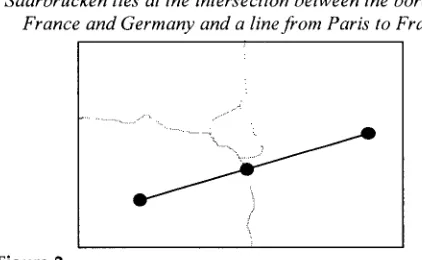
[image:2.468.54.217.59.173.2]"Saarbrficken lies at the intersection between the border between France and Germany and a line f r o m Paris to FrankJhrt. "
Figure 2
Instance of a pictorial anaphor with linguistic antecedent.
lexicon. It can easily be seen that given the graphical context, he should resolve to the man, and it should resolve to the car. However, this inference is not valid since the information inferred is not contained in the overt graphical context and the meaning of the words involved.
[image:2.468.55.266.211.341.2]Pineda and Garza Multimodal Reference Resolution
it is possible to infer that the denotations of the dots to the left, middle, a n d right in the picture are Paris, Saarbr~.icken, a n d Frankfurt, respectively, a n d that the dotted lines denote borders between countries, a n d in particular, the lower segment denotes the border between France a n d Germany. In this example, graphical symbols can be t h o u g h t of as "variables" of the graphical representation or "graphical p r o n o u n s " that can be resolved in terms of the textual antecedent. Here again, the inference is not valid, as the graphical symbols could be given other interpretations or none at all.
The situation in Figure 2 has been characterized as an instance of a pictorial anaphor w i t h linguistic antecedent, a n d further related examples can be f o u n d in Andr6 a n d Rist (1994). This situation, however, cannot be m o d e l e d very easily in terms of K a m p ' s DRT because the " p r o n o u n s " are not linguistic objects, a n d lacking a proper formalization of the graphical information, there is no straightforward w a y to express in a discourse representation structure that a dot representing "a variable" in the graphical d o m a i n has the same denotation as a natural language n a m e or de- scription introduced from text in a DRS. Furthermore, the situation in Figure 1 can be t h o u g h t of as anaphoric only if we ignore the m o d a l i t y of the graphics, as was done above; but if the notion of modality is to be considered at all in the analysis, then the situation in Figure 1 poses the same kinds of problems as the one in Figure 2. In general, graphical objects, functioning as constant terms or as variables, introduced as antecedents or as pronouns, cannot be expressed in a DRS, since the rules constructing these structures are triggered b y specific syntactic configurations of the natural lan- guage in which the information is expressed. However, this limitation can be overcome if graphical information can be expressed in a language w i t h well-defined syntax a n d semantics.
An alternative is to look at these kinds of problems in terms of the traditional linguistic notion of deixis (Lyons 1968). Deixis has to do w i t h the orientational fea- tures of language, which are relative to the spatio-temporal situation of an utterance. Under this view, a n d in connection with the notion of graphical anaphora discussed above, it is possible to mention the deictic category of demonstrative pronouns: w o r d s like this and that permit us to m a k e reference to extralinguistic objects. In Figure 1, for instance, the p r o n o u n s he a n d it can be supported by overt pointing acts at the time the expression he washed it is uttered. Note that the purpose of the pointing act is to provide the referents for the p r o n o u n s directly, greatly simplifying the resolu- tion process. However, the deictic use of a p r o n o u n does not necessarily have to be supported b y a physical gesture, because deictic use is characterized, more generally, b y the identification of the referent in a metalinguistic context. A m b i g u i t y in such words is not unusual, as they can also function as anaphors if they are preceded b y a linguistic context, a n d even as determiners w i t h a deictic component (e.g., this car). Additionally, not only demonstratives a n d p r o n o u n s but also proper names, definite descriptions, a n d even indefinites can be used deictically. As a great variety of con- textual factors are conceivably involved in the interpretation of a deictic expression, gestures, although prominent, should be t h o u g h t of only as one particular kind of contextual factor. In summary, the denotation of a deictic term is the individual that is picked out b y the h u m a n interpreter in relation to the interpretation context. 1 Con- sider that in the same w a y that an anaphoric inference is required for identifying the antecedent of an anaphoric term, an inference process is required for interpreting a term used deictically. We refer to this process as a deictic inference. The inference b y
Computational Linguistics Volume 26, Number 2
which one determines that he and it are the man and the car is, accordingly, a deictic inference.
For our purposes, it is important to investigate the nature of the relation between the notions of deixis and modality, on the one hand, and multimodal reasoning and inference, either deictic or anaphoric, on the other. According to Kamp (1981, 283), the difference between deictic and anaphoric pronouns is that,
deictic and anaphoric pronouns select their referents from certain sets of antecedently available entities. The two pronoun's uses differ with regard to the nature of these sets. In the case of a deictic pronoun the set contains entities that belong to the real world, whereas the selection set for an anaphoric pronoun is made up of constituents of the representation that has been constructed in response to antecedent discourse.
Our concern here is how "the set of entities that belong to the real world" is ac- cessible to the interpreter. In normal deictic spatial situations the referent of a deictic term is perceived directly through the visual modality, and as a result of such a vi- sual interpretation process, the object is represented by the subject. The question is how the information can be expressed in this intermediate "visual" representation. A plausible answer is that there is a coding system and a m e d i u m associated with each particular modality. Our suggestion is that the notion of modality is a representational notion, and not a sensory one as normally assumed in psychological discussion. In our sense, a modality is a formal language, with a lexicon and well-defined syntac- tic and semantic structures, with an associated m e d i u m in which the expressions of the modality are written. Multimodal reasoning is a process involving information expressed in the languages associated with different modalities, and is achieved with the help of a translation relation similar to the relation of translation between natural languages. Performing a multimodal reasoning process is possible if the translation relation between expressions of different modalities is available. However, for particu- lar multimodal reasoning tasks, the translation relation between individual constants of different modalities cannot be stated beforehand and has to be worked out dy- namically through a deictic inferential process, as will be argued in the rest of this paper.
1.1 A Model for Multimodal Representation
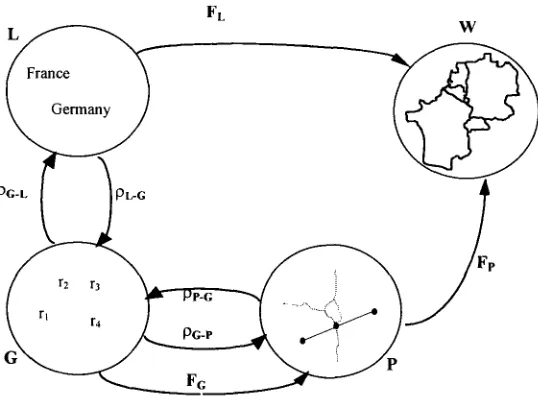
This view of multimodal representation and reasoning can be formalized in terms of Montague's general semiotic program (Dowty, Wall, and Peters 1985). Each modality in the system can be captured through a particular language, and relations between expressions of different modalities can be modeled in terms of translation functions from basic and composite expressions of the source modality into expressions of the target modality. In a system of this kind, interpreting examples in Figures 1 and 2 in relation to the linguistic modality is a matter of interpreting the information ex- pressed through natural language directly when enough information is available, and completing the interpretation process by means of translating expressions of the graph- ical modality into the linguistic one, and vice versa. Consider Figure 3--developing from previous work (Pineda 1989, 1998; Klein and Pineda 1990; Santana 1999)--in which a multimodal representational system for linguistic and graphical modalities is illustrated.
Pineda and Garza Multimodal Reference Resolution
FL
[image:5.468.36.305.60.259.2]L W
Figure 3
Multimodal representational system for linguistic and graphical modalities.
P stands for the set of graphical symbols constituting the graphical modality proper (i.e., the actual symbols on a piece of paper or on the screen). Note that two sets of expressions are considered for the graphical modality: the expressions in G belong to a formal language in which the geometry of pictures is represented and reasoned about, and P contains the overt graphical symbols that can be seen and drawn but cannot be manipulated directly. The functions PL-G and PC-L stand for the translation mappings between the languages L and G, and the functions PP-c and Pc-P stand for the corresponding translations between G and P. The translation function pP-c maps well-defined objects of the graphical modality into expressions of G where the interpretation process is performed. The translation Pc-P, on the other hand, maps geometrical expressions of G into pictures; for every well-defined term of G of a graphical type (e.g., dot, line, etc.) there is a graphical object or a graphical composi- tion that can be drawn or highlighted with the application of geometrical algorithms associated to operators of G in a systematic fashion. The circle labeled W stands for the world and together with the functions FL and Fp constitutes a multimodal system of interpretation. The ordered pair (W,
FL)
defines the model ML for the natural lan- guage, and the ordered pair (W, Fp) defines the model Mp for the interpretation of drawings. The interpretation of expressions in G in relation to the world is defined either by the composition FL°pc_L or, alternatively, by Fp°pG_p. The denotation of the word France in L, for instance, is the same as the denotation of the corresponding region of the map of Europe that denotes France, the country, since both refer to the same individual. The denotation of the symbol rl in G that is related to the wordFrance in L through PG-L, and to a particular region in P through pG-P, is also France, as translation is a meaning-preserving relation between expressions. The interpreta- tion functions FL and Fp relate basic expressions, either graphical or linguistic, to the objects or relations of the world that these expressions happen to represent, and the definition of a semantic algebra for computing the denotation of composite graphical and linguistic expressions is required.
Computational Linguistics Volume 26, Number 2
the drawing represents a country), but on the other, they are also geometrical ob- jects that can be talked about as geometrical entities. The geometrical region of the map representing France, for instance, is itself represented by the constant rl in G. In this second view, geometrical entities are individual objects in the world of geometry, and as such they have a number of geometrical properties that are independent of whether we think of graphical symbols as objects in themselves or as symbols rep- resenting something else. The same duality can be stated from the point of view of the expressions of G, since the set of individual geometrical objects (i.e., P) constitutes a domain of interpretation for the language G. This is to say that expressions of G have two interpretations: they represent geometrical objects, properties, and relations directly, but they also represent the objects of the world (e.g., France, Germany, etc.) indirectly through the translation relation and interpretation of symbols in P taken as a language (i.e., the composition
Fp°pG_p).
The ordered pair (P, F c / d e f i n e s the model M c for the geometrical interpretation of G as geometrical objects; the geometrical in- terpretation function FG assigns a denotation for every constant of G; the denotation of individual constants of G are the graphical symbols themselves, and the denotation of operators and function symbols of G denoting graphical properties and relations will be given by predefined geometrical algorithms commonly used in computational geometry and computer graphics--see, for instance, Shamos (1978). The semantic in- terpretation of composite expressions of G, on the other hand, is defined through a semantic algebra, as will be shown below in Section 2.3.2. The definition of this ge- ometrical interpreter will allow us to perform inferences about the geometry of the drawing in a very effective fashion. Consider that to state explicitly all true and false geometrical statements about a drawing would be a very cumbersome task, as the number of statements that w o u l d have to be made even for small drawings w o u l d be very large. Note also that although a map can be an incomplete representation of the world (e.g., some cities might have been omitted), the geometrical algorithms associated with operators of G will always provide complete information on the map as a geometrical object.1.2 Multimodal interpretation
Pineda and Garza Multimodal Reference Resolution
In situations in which all theoretical elements illustrated in Figure 3 are given, questions about multimodal scenarios can be answered through the evaluation of ex- pressions of a given modality in terms of the interpreters of the languages involved and the translation functions. However, when one is instructed to interpret a multi- modal message, like Figures 1 and 2, not all information in the scheme of Figure 3 is available. In particular, the translation functions PL-G and PG-L of the graphical and linguistic individual constants mentioned in the texts and the pictures of the multi- modal messages are not known, and the crucial inference of the interpretation process has as its goal to find out the definition of these functions (i.e., to establish the rela- tions between names of L and G). It is important to emphasize that in order to find out PL-G and PC-L, the information overtly provided in the multimodal message is usually not enough, and in order to carry out such an interpretation process it will be necessary to consider the grammatical structure of the languages involved, the defi- nition of translations rules between languages, and also conceptual knowledge stored in memory about the interpretation domain.
An additional consideration regarding the scheme in Figure 3 is related to the problem of ambiguity in the interpretation of multimodal messages. In the literature of intelligent multimodal systems, ambiguity is commonly seen from the perspective of human users. A multimodal referring expression constituted by the text the temperature control and a drawing with two switches is said to be ambiguous, for instance, if the human user is not able to tell which one is the temperature control. A well-designed presentation should avoid this kind of ambiguity by providing additional information either in a textual form (e.g., the temperature control is the switch on the left) or by a graphical focusing technique (e.g., highlighting the left switch). An important motivation in the design of intelligent presentation systems like WIP (Wahlster et al. 1993) and COMET (Feiner and McKeown 1993) is to generate graphical and linguistic explanations in which these kinds of ambiguities are avoided. 2 Note, however, that such situations are better characterized as problems of underspecification, rather than as problems of ambiguity, since the expression the temperature control has only one syntactic structure and one meaning, and the referent can be identified in a given context if enough information is available.
Ambiguity in multimodal systems has also been related to the granularity of graphical pointing acts. A map, for instance, can be represented by an expression of G that translates into a graphical composition in P denoting a single individual (e.g., Europe) or by a number of expressions of G that refer to the minimal graphical partitions in P (e.g., the countries of Europe) depending on whether the focus of the interpretation process is the whole of the drawing or its constituent parts. This prob- lem has also been addressed in a number of intelligent multimodal systems like XTRA (Wahlster 1991) and AlFresco (Stock et al. 1993), but the lack of a formalized notion of graphical language (and also a better understanding of indexical expressions), has prevented a deeper analysis of this kind of ambiguity.
These notions of "ambiguity" in multimodal systems contrast with the traditional notion of ambiguity in natural language in which an ambiguous expression has sev- eral interpretations. The formalization of graphical representations through the def- inition of graphical languages with well-defined syntax and semantics allows us to face the problem of ambiguity directly in terms of the relation of translation between natural and graphical languages, and the semantics of expressions of both modal-
Computational Linguistics Volume 26, Number 2
ities. A n interesting question is w h e t h e r the graphical context offers clues that the parser can use to resolve lexical and structural ambiguity. A l t h o u g h w e h a v e yet to explore this issue, there are some a n t e c e d e n t s in this regard. In S t e e d m a n ' s t h e o r y of incremental interpretation in dialogue, for instance, the rules of syntax, seman- tics, a n d processing are v e r y closely linked (Steedman 1986) a n d local ambiguities m a y be resolved b y taking into account their a p p r o p r i a t e n e s s to the context, w h i c h can be graphical. Structural a m b i g u i t y in G can be appreciated, for instance, in rela- tion to the granularity of graphical objects, as the same d r a w i n g will have different syntactic analysis d e p e n d i n g on w h e t h e r it is i n t e r p r e t e d as a w h o l e or as an aggre- gation of parts. It is likely that the resolution of this latter kind of a m b i g u i t y is also influenced b y p r a g m a t i c factors c o n c e r n i n g the p u r p o s e of the task, the interpreta- tion domain, a n d the attentional state of the interpreter, b u t this investigation is also pending.
We do, however, address issues of a m b i g u i t y related to the resolution of spa- tial indexical terms a n d anaphoric references in an i n t e g r a t e d fashion. In Section 3, an incremental constraint satisfaction algorithm for resolving referential terms in relation to the graphical d o m a i n is presented. This algorithm relies o n spatial con- straints of d r a w i n g s a n d general k n o w l e d g e a b o u t the interpretation domain, a n d its c o m p u t a t i o n is p e r f o r m e d d u r i n g the construction of m u l t i m o d a l discourse rep- resentation structures (MDRSs), w h i c h are extensions of DRSs in DRT (Kamp a n d Reyle 1993) as illustrated in Section 4. In the same w a y that DRT m a k e s n o pro- vision for a m b i g u i t y resolution a n d alternative DRSs are constructed for different readings of a sentence, several MDRSs w o u l d h a v e to be constructed in o u r ap- p r o a c h for a m b i g u o u s m u l t i m o d a l messages. 3 H o w e v e r , as natural l a n g u a g e terms in L in o u r simplified d o m a i n refer to graphical objects, indefinites are v e r y un- likely to h a v e specific readings (e.g, "a city" n o r m a l l y refers to a n y city) a n d a sim- ple heuristic in w h i c h indefinites are w i t h i n the scope of definite descriptions a n d p r o p e r n a m e s can be u s e d to obtain the p r e f e r r e d r e a d i n g of sentences such as the one in Figures 2. Nevertheless, e v e n if only this r e a d i n g is considered, a n d the in- terpreter k n o w s that the d r a w i n g is a m a p a n d is a w a r e of the interpretation con- ventions of this kind of graphical representations (i.e., countries are r e p r e s e n t e d b y regions, cities b y dots, etc.), d r a w i n g s can still be a m b i g u o u s . In Figure 2, for instance, there are four possible interpretations for the graphical symbols that are consistent w i t h the text if no k n o w l e d g e of the g e o g r a p h y of E u r o p e is assumed. O u r algo- r i t h m is d e s i g n e d to resolve reference for spatial referential a n d a n a p h o r i c t e r m s in the course of the m u l t i m o d a l discourse interpretation, a n d the graphical a m b i g u i t y is resolved in the course of this process, as will be s h o w n in detail in Sections 3 a n d 4.
To conclude this section, w e believe the formalization of the syntax a n d seman- tics of graphical representations in a f o r m compatible w i t h the syntax a n d semantics of natural language, as in the s c h e m e in Figure 3, m a y be a p o i n t of d e p a r t u r e for investigating h o w the graphical or visual context helps to resolve natural l a n g u a g e ambiguities at different levels of r e p r e s e n t a t i o n a n d processing.
Pineda and Garza Multimodal Reference Resolution
1.3 Multimodal Generation
An important motivation for the study of the interpretation of multimodal mes- sages is the definition of multimodal presentation or explanation systems in which users are able to identify the referent of graphical and linguistic expressions eas- ily. In WIP, for instance, a central concern is whether the human user is able to "activate" the relevant "representations" (presumably in his or her mind) and re- solve the graphical and linguistic ambiguities and anaphors (using WIP's terminol- ogy) present in multimodal messages. This is possible, in general, if the message conveys to the human user explicit interpretation paths from the information that is available overfly to the information that the user is expected to infer. The pro- duction of multimodal referring expressions in this kind of system depends on the use of presentation strategies defined in terms of rhetorical structures and intentional goals--e.g., along the lines of Rhetorical Structure Theory (RST) (Mann and Thomp- son 1988), and its computational implementation (Moore 1995). The use of a partic- ular presentation strategy in a multimodal explanation (e.g., in WIP) depends cru- cially on whether the expressions generated on the basis of such a strategy satisfy the conditions defined to activate the expected representations in the user's mind (an intentional goal). Furthermore, some rhetorical structures are designed explic- itly to provide additional information to activate the expected representations if the conditions for the identification of the referent of an expression are not met. Con- sider again the resolution of the "ambiguity" in the interpretation of the tempera- ture control example in WIP in which the presentation strategy provides the infor- mation required by the human user to identify the referent, either through the text
the temperature control is the switch on the left or highlighting or pointing to the corre- sponding switch in the drawing. WIP is able to tell whether the presentation would be ambiguous for the human user if additional information were not provided be- cause it has a representation of the actual situation and a simple model of the user's beliefs.
Computational Linguistics Volume 26, Number 2
r4
.... c6 ... . ... . , . .
rl
! c3
.! r2
[image:10.468.52.255.59.197.2]C d'..
... (, r3
'..,c2 Ii ~
dl
( cl
Figure 4
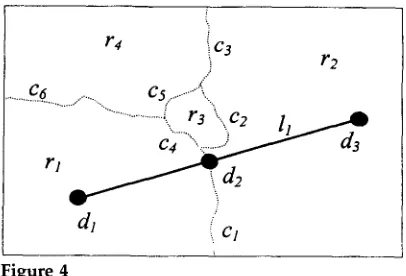
Labeling the graphical objects in Figure ~.
made up of constants and operators that directly describe the geometry of objects and configurations.
Consider the natural language text: Saarbr~cken lies at the intersection between the bor- der between France and Germany and a line from Paris to Frankfurt. This sentence contains the definite description the intersection between tile border between France and Germany and a line from Paris to Frankfurt, which in turn contains the border between France and Germany and a line from Paris to Frankfurt. Finding the graphical referents of these ex- pressions requires the identification of a dot, a curve, and a line on the map (i.e., the corresponding graphical objects). These graphical objects can be referred to directly through language; however, there are additional graphical entities on the map in Fig- ure 2 that have an interpretation but are not mentioned explicitly in the text of the multimodal message. In Figure 4, for instance, Belgium is represented by the region r4, and the curve c6 represents the border between France and Belgium. Once a picture has been interpreted, one would be entitled to ask not only for graphical objects that have been mentioned in the textual part of the message, but also for any meaningful graphical object. So, if one points to the curve c6 in Figure 2 at the time the question What is this? is asked, the answer could be the border between France and Belgium, or alternatively, the indefinite a border. As some graphical objects named by constants of the graphical language do not have a proper name in natural language, the translation function PG-L must associate a basic constant of G with a composite expression of L. The process of Inducing such a translation function is closely related to the process of generating the corresponding natural language descriptions, and this relation will be explored further in Section 3.
Pineda and Garza Multirnodal Reference Resolution
tend Kamp's DRS with multimodal structures. Finally, in Section 5, some concluding remarks and some directions for further work are presented.
2. A Multimodal System of Representation
In this section, we present the definition of the syntax and semantics of languages L, P, and G, illustrating the theory with the multimodal message of Figure 2. Language L is a segment of English designed to produce expressions useful for referring to objects, properties, and relations commonly found in discourse about maps. In particular, the natural language expression of Figure 2 can be constructed in a compositional fashion. The syntactic structure of P, on the other hand, imposes a restriction on the possible geometries of the family of drawings in the interpretation domain. Language G is a logical language in which interpretation and reasoning about geometrical configura- tions can be carried out. It is an interlingua representation for information expressed in both of the modalities.
The definitions of L, P, and G closely follow the general guidelines of Montague's semiotic program. As a first step in the syntactic definition of a language, the set of categories or types is stated. A number of constants--or basic expressions--for each type is defined, and the combination rules for producing composite expressions are stated. For each type of a source language, a corresponding type in the target lan- guage is assigned. Basic expressions of the source language can be mapped either to basic or to composite expressions of the corresponding type in the target language and vice versa. For each syntactic rule of a source language, a translation rule for map- ping the expression formed by the rule into its translation in the target language is defined.
2.1 Definition of Language L
Language L contains the textual part of multimodal messages in the domain of maps. An expression of L is, for instance, Saarbr~icken lies at the intersection between the border between France and Germany and a line from Paris to Frankfurt, which is the natural language part of Figure 2. Constants like France and Germany, and all subexpressions of the former sentence, like the border between France and Germany or a line from Paris to Frankfurt
are also in L. In addition, L contains expressions like France is a country, Frankfurt is a city of Germany or Germany is to the east of France, which express general knowledge required in the interpretation of maps.
2.1.1 Syntactic Definition of L. The set of syntactic categories of L is as follows:
.
2.
The basic syntactic categories of L are t, IV, ADJ, CN, and CN I where t is the category of sentences, IV is the category of intransitive verbs, ADJ is the category of adjectives, and CN and CN' are two categories of common nouns.
If A and B are syntactic categories then A/B is a category. 4
Traditional syntactic categories of natural language like transitive verbs (TV), terms (T), prepositional phrases (PP), and determiners (T/CN) can be derived from the basic categories.
Computational Linguistics Volume 26, Number 2
Constant
Paris, Frankfurt, Saarbriicken, France, Germany
east
bi~
be
be, lie at, be to
S E N T E N C E S
a, the
Category name
city, country, border, line, intersection CN CN' ADJ TV IV/ADJ T/CN PP pp'
Category definition t/IV
CN CN' ADJ IV/(t/IV) IV/ADJ
(t/IV)/CN CN/CN CN/CN'
IV IV
Figure 5
Constants of language L.
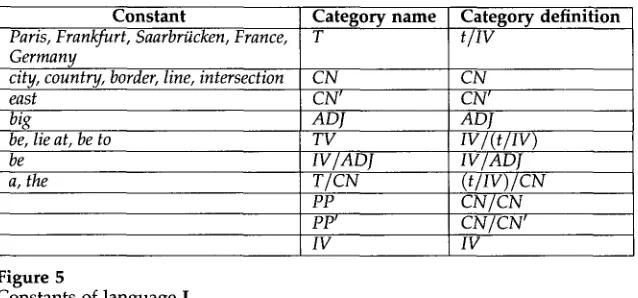
The table in Figure 5 illustrates the constants of L with their category names and category definitions. Common nouns are divided into C N and CNC Expressions of category C N translate into graphical predicates (sets of graphical objects) while ex- pressions of category CN' translate into abstract concepts. For instance, city translates into a set of dots representing cities, but east translates into a geometrical function from regions to zones (e.g., if the region representing France is the argument of this function, the zone to the right of that region is the function value). Prepositional phrases are divided into PP and PP~ due to the classification of common nouns into
CN and CNq There are no basic constants of categories PP, PP~, and IV, as prepo- sitional words are introduced syncategorematically and intransitive verb phrases are always composite expressions in this grammar. Transitive verbs are defined in a stan- dard fashion, and the constant be of category I V / A D J is used to form attributive sentences.
Next, the syntactic rules of L are presented. Each rule is shown in a separate item containing the purpose of the rule, the syntactic rule itself, and some examples of expressions that can be formed with the rule. Following Montague, syntactic rules and syntactic operations for combining symbols (for instance, FL1) associated to each rule are separated. In the following, Pc is the set of expressions of category C.
SIL.
T R A N S I T I V E VERB P H R A S E S
If c~ E PT and fl E PIv, then FL1 (Oz, fl) E Pt, where EL1 (0~, fl) : Olfl*, and fl* is the result of replacing the first verb in fl by its third person singular present form.
Examples: -Paris is a city of France
-Germany is to the east of France -a country is big
-Saarbriicken lies at the intersection between the border between France and Germany and a line from Paris to Frankfurt
S2L. If ~ E PTV and fl E PT, then FL2(Ol, fl) C PIv, where FL2(O~,fl) = O~fl.
Examples: -be a city
[image:12.468.56.375.57.206.2]Pineda and Garza Multimodal Reference Resolution
ATTRIBUTIVE VERB PHRASES
S3L. If c~ E PtV/ADJ a n d fl E PAD], t h e n FL2(OL , fl) E PIV. E x a m p l e s : -be big
TERMS
S4L. If a E PT/CN a n d fl E PCN or PcN,, t h e n FL3(a, fl) E PT, w h e r e
FL3(Ol, fl) = o~*fl, a n d c~* is c~ e x c e p t in t h e case w h e r e a is a a n d t h e first w o r d in fl b e g i n s w i t h a v o w e l ; here, c~* is an.
Examples:
-a city-a city of France
-the border between France and Germany -a line from Paris to Frankfurt
-the east of France
COMMON NOUNS
SSL. If c~ E PCN a n d fl E Ppp, o r c~ E PCN' a n d fl E Ppe,, t h e n FL2(a, fl) E PcN.
Examples:
-city of France -east of France-border between France and Germany
-intersection between the border between France and Germany and a line from Paris to Frankfurt
of PREPOSITIONAL PHRASES 5
S6L. If ~ E PT, t h e n FL4(Oz) C Ppp or Ppp,, w h e r e FL4(O~) --~ Of OL.
Examples:
-of France -of Germany -of a countrybetween PREPOSITIONAL PHRASES
S7L. If ~ , f l E PT, t h e n FLs(c~,fl) E Ppp, w h e r e FLs(c~,fl) ---- between c~ and ft.
Examples:
-between France and Germany -between France and a country-between the border between France and Germany and a line from Paris to Frankfurt
from-to PREPOSITIONAL PHRASES
SBL. If ~ , f l E PT, t h e n FL6(O[,fl) C Ppp, w h e r e FL6(C~,fl) =from ~ to ft.
Example:
-from Paris to Frankfurt5 Although of, between, and from have been introduced syncategorematically in L for simplicity, they
Computational Linguistics Volume 26, Number 2
Constant c~ Paris, Frankfurt, Saarbr~icken, France, Germany
city country border line intersection
east
be, lie at, be to a, the
FL(~)
Paris, Frankfurt, Saarbrficken, France, Germany
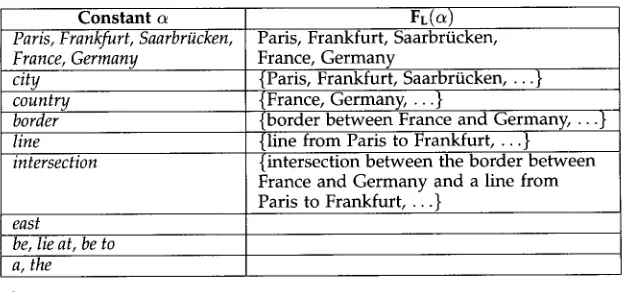
. {Paris, Frankfurt, Saarbrticken . . . . } {France, Germany, ...}
{border between France and Germany, ...} {line from Paris to Frankfurt .. . . }
{intersection between the border between France and Germany and a line from Paris to Frankfurt, ...}
Figure 6
Interpretation of constants of language L.
2.1.2 S e m a n t i c D e f i n i t i o n of L. The semantics of L is given in a model-theoretic fashion as follows: The interpretation domain is the world W = {Paris, Saarbrficken, Frankfurt, France, Germany, the border between France and Germany, ...}. Let Dx be the set of possible denotations for expressions of type x, and for any types A and B, DA/B = D DB (i.e., the set of all functions from DB to DA). Let FL be an interpretation function that assigns to each constant of type A a member of DA. For the example in Figure 3, FL is defined as shown in Figure 6.
Not every constant of L has an interpretation assigned by FL; in particular, words like east, be, lie at, and be to have no interpretation defined directly in L. In principle the definition of these constants could be stated as an object of the appropriate se- mantic type but this is not a straightforward enterprise. Consider, for instance, that the constant east of category C N r is a basic object (a kind of predicate), but the indi- vidual objects in its extension are not overtly defined in the interpretation domain. Furthermore, it is more natural to talk about the interpretation of composite pred- icates, like east of France, of which east is a part. However, even the interpretation of such composite predicates is problematic, as they have a vague spatial mean- ing. For these reasons, the interpretation of these constants is not defined explic- itly as a part of the function FL, but in terms of their translation into G, where a spatial meaning can be formally defined, as will be shown below. A similar strat- egy is used for the interpretation of spatial prepositions; although of, between, and from-to were introduced syncategorematically in the syntax of L, they could have been defined as objects of an appropriate category and their semantics could have been given explicitly through FL or, alternatively, through their translation into in- tensional logic along the lines of PTQ. However, the semantic type of such objects is extraordinarily complex, and the actual definition of these constants is seldom seen in the literature. 6 In our system the interpretation of spatial prepositions will also be given in terms of the translation into G and the interpretation of P. Note also that no interpretation has been defined for the determiners a and the. One strategy for assigning a denotation would be to translate these constants into intensional logic, but this would be required only for a larger fragment of English in which reference
[image:14.468.53.366.56.202.2]Pineda and Garza Multimodal Reference Resolution
to space was not the focus of study. In our approach the determiners will be in- terpreted in terms of their translations into G in which high-order functions can be expressed.
In summary, the semantics of some constants and all composite expressions of L will be given in terms of their translations into G and P. Note that according to the scheme in Figure 3, if the translations between L and G, and G and P are defined, and the semantic interpretation of P is overtly defined, the interpretation of the natural lan- guage expressions can be found. Although the semantics of L is not further discussed in this paper, we consider that the interpretation of linguistic expressions referring to spatial situations could be embedded in a larger fragment of English, and a full semantic interpretation would have to be given by translating English into intensional logic. In such a model the semantic value of spatial prepositions would be left unde- fined, expressions referring to spatial configurations would be translated into G, and the interpretation of expressions of G would be embedded within the interpretation of intensional logic.
2.2 Definition of Language P
In this section, the syntax and semantics of language P are formally defined. The purpose of these definitions is to characterize the family of drawings that can be in- terpreted as maps, and to discriminate these drawings from other kinds of graphical configurations constituted by dots, curves, and regions. This notion of a multimodal system of representation in which objects in the graphical modality are formalized through a well-defined language is similar to the notion of graphical language intro- duced by Mackinlay for the automatic design of graphical presentations (Mackinlay 1987), where a number of graphical languages (e.g., the languages of bar charts, area and position graphs, scatter plots, etc.) are formally specified. In Mackinlay's work, expressions of graphical languages are related to the objects of the world that they represent through an encodes relation with three arguments: the graphical constant or expression performing the representation, the object of the world that is repre- sented through the graphical expression, and the graphical language to which the graphical expression belongs. 7 The formalization of P permits us to define a pre- cise statement of expressiveness of a graphical language, as follows: "a set of facts is expressible in a language (graphical) if the language contains a sentence that en- codes every fact in the set and does not encode any additional facts" (Mackinlay 1987, 54). The formalization additionally allows empirical studies to determine how effec- tively a human user can interpret expressions of a particular graphical language in relation to another in which the same set of facts is encoded. Although all graph- ical languages studied by Mackinlay are conventional and have a precise geomet-
7 Incidentally, a similar e n c o d i n g relation encodes is u s e d in the WIP s y s t e m to relate the r e p r e s e n t a t i o n a l object to the object that it represents, b u t the third a r g u m e n t of this relation in W I P is a c o n t e x t s p a c e that allows u s e of the s a m e p r e s e n t a t i o n in different p e r s p e c t i v e s (e.g., a n e s p r e s s o m a c h i n e m a y refer to a n i n d i v i d u a l m a c h i n e in a context space, or alternatively it can be s e e n as the p r o t o t y p e of e s p r e s s o m a c h i n e s in a different context space). The encodes relation in W I P a n d in M a c k i n l a y is similar to the translation relation b e t w e e n objects of P (or G) a n d L in o u r s y s t e m , a n d w e can t h i n k of a graphical l a n g u a g e as a l a n g u a g e e n c o d i n g the i n f o r m a t i o n that is i n t e n d e d to be c o m m u n i c a t e d . H o w e v e r , it is interesting to n o t e that the s t a t u s of the "linguistic" a r g u m e n t of the encodes relation is different in W I P a n d in M a c k i n l a y ' s s y s t e m . In the former, it is a n "internal r e p r e s e n t a t i o n ' - - a psychological
Computational Linguistics Volume 26, Number 2
Constant Type
d l , d 2 , d 3 , . . . dot
ll, 12,13 . . . . line Clr C2r C3r . • • c u r v e . Y l r r 2 r r 3 , . . . . r e g i o n
Z l ~ z 2 ~ z 3 ~ . . . z o H e
crl, cr2, cr3 . . . . composite_region
O, d S l , d s 2 . . . . dot~et Or IS1, I s 2 , . . • l i n e . s e t m l , m 2 , m 3 , . . . map
Figure 7
Constants of language P.
rical characterization, the notions of expressiveness and effectiveness of graphical languages can be applied to more unruly graphical domains (e.g., maps are ana- logical representations with a diagrammatic conventional component) as long as a formalization for the family of drawings can be approximated. Here, the question of whether arbitrary families of graphical objects can be formalized through a well- defined syntax is left open, and although it is possible to think of many families of drawings with very arbitrary geometries, some important efforts have been made in the characterization of design and other kinds of objects--see, for instance, shape grammars (Stiny 1975). Another related issue that is relevant for the construction of multimodal interactive systems is whether it is possible and useful to input expres- sions of P directly, and to obtain their syntactic structure through graphical parsing techniques (Wittenburg 1998). In summary, the purpose of formalizing P is to be able to talk about maps as a modality, where a modality, in our sense, is a code sys- tem for the symbols expressed in a medium, and a multimodal system of represen- tation relates information expressed through different code systems in a systematic fashion.
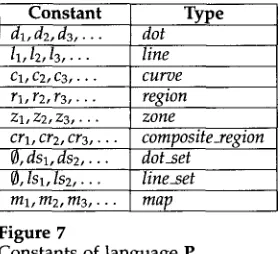
2.2.1 Syntactic Definition of P. The types of P are dot, line, curve, region, zone, compos- ite_region, dot_set, line_set, and map. Let Cs be the set of constants of type s, and Es the set of well-formed expressions of graphical type s. Although the constants of P are the actual graphical marks on the screen or a piece of paper, a number of labels for facilitating the presentation are illustrated in Figure 7.
[image:16.468.53.193.58.185.2]Pineda and Garza Multimodal Reference Resolution
The definition of well-formed expressions of P is as follows:
CONSTANT
S I p . If c~ E Cs then c~ E
Es.
Examples:
-, / , . ...LINE
S2p. If
v~, fl E Edot
thenFpI(o~, fl) C Eline
whereFpI(o~, fl)
is a line from a to ft.Example:
of:' (the resulting graphical expression is only the line)CURVE
S3F. If
~, fl E Eregion
such that a a n d fl are adjacent thenFp2(ol, fl) E Ecurve
where
Fp2(C~,fl)
is the curve between c~ a n d ft.Example:
i ... ~ ... J (the resulting graphical expression is only the curve)INTERSECTION
S4F.
RIGHT
If ~ E
Ecurve
a n dfl E Eti,,e
thenFp3(ol, fl) E Edot
whereFp3(oz, fl)
is the dot in the intersection between o~ a n d ft.Example:
~ \ (the resulting graphical expression is only the dot)S5p. If ~ C
Eregion
then F p 4 ( ~ ) CEzone
whereFp4(a)
is the zone to the right of the region ~ (the interpretation of "right" will be given below in the semantics of language G).Example:
DOT INSIDE A REGION
(the resulting graphical expression is only the gray zone)
S6p. If ~ c
Eregion
then Fp5(C~) CEaot
where Fps(a) is the d r a w i n g of a dot inside c~.i.,.--'...._.~\
Computational Linguistics Volume 26, Number 2
COMPOSITE REGION (1) 8
S7p. If c~, fl E
Cregion
such that a and fl are adjacent thenFp6(oz,
fl) C Ecomposite_region
where Fp6(ct , fl) i s the drawing of a and ft.COMPOSITE REGION (2)
S8p. If c~ E
Cregion
and fl EEcomposite_region
such that a and fl are adjacent thenFp6(oz,
fl) E Ecomposite_region.
SET OF DOTS
S9p. If o~ E
Edot_set
and fl EC~ot
thenFp6(cGfl) C Edot~set.
SET OF LINES
S10p. If o~ E
Eline._set
and fl ECline
thenFp6(oz , fl) E Eline~et.
MAP
S11p. If ~ E
Ecomposite_region, fl E Edot~et
and 6 EEline~et
then Fp7(oz,fl, 6) E Ema p
where Fp7(oz, fl, 6) is the drawing of ~, fl and 6.
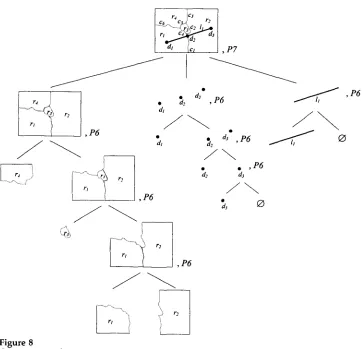
With the help of this grammar it is possible to draw maps like the one illustrated in Figure 2. Note that the basic object in this particular graphical construction is the region. The idea is to successfully construct a map from its constituting regions (i.e., as in a jigsaw puzzle) until the full map is produced. Once the map is constructed, other kinds of objects with conventional meanings, like dots and lines, can be drawn upon the assembly of regions. Consider Figure 8 in which the syntactic structure of the map in Figure 4 is shown. Note that the decision to use regions as basic objects in the graphical composition is not mandatory, and alternative constructions are possible; for instance, we could have designated curves as basic objects and obtained regions as compositions made out of curves. The set of graphical symbols included in a graphical syntactic tree of a map will be called the base. For instance, the base of the map in Figure 8 is the set
{dl, d2,d3,/1,
rl, r2, r3, r4}. The base is just the set of graphical objects that are taken as the atoms of the graphical composition in each particular interpretation task, and different graphical grammars would select different types of graphical objects for the base.The purpose of this grammar is illustrative; we make no claims about what con- stitutes a map. P imposes very few constraints on graphical expressions, and m a n y configurations that can be produced with these rules might not count as maps; in ad- dition, P is not expressive enough to characterize a large number of objects that would be normally interpreted as maps. Another consideration is that graphical objects can be used either as basic building blocks of the construction, or as objects produced by graphical compositions (which we call emergent objects); for instance, in the grammar of P, regions are basic objects but curves are produced by graphical compositions. Ad- ditionally, in some contexts the interpretation of the graphical expression as a whole
Pineda and Garza Multimodal Reference Resolution
J
[image:19.468.32.394.56.405.2]I :. r4 i CJ r c6 ¢£.. 2 ... ,... . ~ rj\c2 I rt c ~ d 3
[ dt ict , P 7
J
... • ... i...~. ... " ~ r2 rl
, P 6
d3 ° "a~ "a, , P 6
Figure 8
Construction of a map.
... . ... \ ... 4..r~. r2
rt
, P 6
... ...,.
rt " " a " i ~ r2 , P 6
rl ")
dj" , P 6
/ \
• , P 6
"a, a,
/ \
, P 6
K \
o
m a y be required but in others only the interpretation of some of the parts m a y be rel- evant; for instance, although curves are not a part of the syntactic tree in Figure 8 they can be generated and translated into G when required through rules S3p and T3p-G as long as the composition is made out of regions included in the base of the map. Had the grammar allowed the generation of composite regions out of regions of the base, these emergent objects could also be used for the generation of curves. Another consideration is that expressions of type m a p are in general ambiguous as they have several syntactic analyses, but since this feature is harmless for the current discussion we do not pursue the issue further. A final remark is that alternative grammars could be defined for characterizing the same class of drawings with different consequences in the syntax and the semantics. One possibilitity, for instance, is to define a syntactic operation that takes two adjacent regions and produces the union of the regions as one single emerging region, instead of the set of the two regions as currently defined. Such a rule would be similar to the rule that combines two regions to produce a curve, and it would be useful in applications like XTRA (Wahlster 1991), in which the ambiguity of pointing to a part or the whole is intended to be resolved.
Computational Linguistics Volume 26, Number 2
Constant a FF(a)
. d l , d 2 , d 3 , . • • . P a r i s , S a a r b r f i c k e n , F r a n k f u r t . . . . . l l , 1 2 , 1 3 , . • • line from Paris to Frankfurt, ...
cl, c2, c3,.., border between France and Germany, ... rl, r2, r3,. • • France, Germany,...
Zl,Z2,Z3,... east of France, east of Germany,... crb cr2, cr3 . . . . region formed by France and Germany, ... O, dSl, ds2 . . . . s e t s o f c i t i e s
O, lsl, Is2 . . . . s e t o f l i n e s
m l , m2, m 3 , • • • m a p s
Figure 9
Semantics of constants of P.
be the set of possible d e n o t a t i o n s for expressions of t y p e x, such that Ddo t = A c i t y , Dline = A l i n e , Dcurve ~- A b o r d e r , Dregion -= A c o u n t r y , Dzone = A z o n e , and, for a n y types a a n d b, D(a,b ) = D G (i.e., the set of all functions f r o m Da to b Db). Let Fp be an interpretation function that assigns to each constant of type a a m e m b e r of Da. The interpretations of the constants are p r e s e n t e d in Figure 9.
Following M o n t a g u e , w e a d o p t the notational c o n v e n t i o n b y w h i c h the semantic v a l u e or d e n o t a t i o n of an expression c~ w i t h respect to a m o d e l M is expressed as
[[a]] M. The semantic rules for interpreting language L are the following:
C O N S T A N T
M1p. If a E Cs t h e n [[a]] M = Fp(c~).
L I N E
M2p. If a, fl E Edot t h e n [[Fpl(a, fl)]] M = is a line f r o m [[a]] M to [[fl]]M.
C U R V E
M3p. I f OZ, fl C Eregion such that a a n d fl are adjacent t h e n [[Fp2(a, fl)]] M is the b o r d e r b e t w e e n [[a]] M a n d [[fl]]M.
I N T E R S E C T I O N
M4p. If a E Ecurve a n d fl E Eline t h e n [[Fp3(a, fl)]] M is the intersection b e t w e e n [[a]] M a n d [[fl]]M.
R I G H T
M5p. If a E Ere#on t h e n [[Fp4(O~)]] M is the east of [Jail M.
D O T I N S I D E A R E G I O N
[image:20.468.54.308.57.169.2]Pineda and Garza Multimodal Reference Resolution
COMPOSITE REGION (1)
M7p. If a, fl E
Cregion
such that c~ a n d fl are adjacent then[[Fps(a, fl)]] M
is the u n i o n of {[[a]] M} a n d {[[fl]]M}.COMPOSITE REGION (2)
M8p. If c~ C
Cregion
a n dfl C Ecomposite_region
such that c~ a n d fl are adjacent then [[Fp5(c~, fl)]]M is the u n i o n of the sets {[[c~]] M} a n d [[fl]]M.SET OF DOTS
M9p. If c~ E
Edot~et
a n dfl E Cdot
then [[FFs(o~,fl)]] M is the u n i o n of the sets [[~]]M a n d {[[fl]]M}.SET OF LINES
M10p. If a E
Eline_set
a n dfl E Cline
then[[Fp5(Ol, fl)]] M
is the u n i o n of the sets [[c~]] M a n d {[[fl]]M}.MAP
M11p. If ~ E
Ecomposite_region,
fl C Edot_set
a n d 5 EEline_set
then [[Fp6(O G fl, 5)]]M is the u n i o n of the sets [[~]]M, [[fl]]M a n d [[6]] M.2.3 Definition of Language G
In this section the syntax a n d semantics of the graphical language G are formally stated. G is defined along the lines of intensional logic, a n d it is expressive e n o u g h to refer to graphical symbols a n d configurations, on the one hand, a n d to express the translation of quantified expressions of L, on the other.
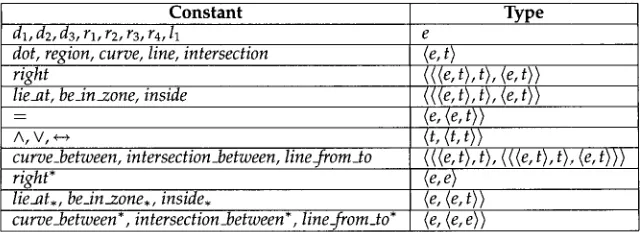
2.3.1 Syntactic Definition of G. The types of the language G are as follows: 9
1.
2. 3. 4.
e is a type (graphical objects). t is a type (truth values).
If a a n d b are a n y types, then (a, b / is a type. 1° Nothing else is a type.
Let Vs be the set of variables of type s, Cs the set of constants of type s, a n d Es the set of well-formed expressions of graphical type s. The constants of G are presented in Figure 10. Note that constants like
right, curve_between,
etc. have an9 A simplifying assumption rests on the consideration that the interpretations of all expressions included in these languages depend only on the current graphical state and no intensional types are included in the system. However, this analysis can be extended along the lines of intensional logic to be able to deal with a more comprehensive fragment of English.
Computational Linguistics Volume 26, Number 2
Constant Type
e
dl, d2, d3, rl, r2, r3, r4, I1
dot, region, curve, line, intersection right
lie3t, be_in-zone, inside
z A, V, *--+
curve_between, intersection_between, linGfrom_to right*
lie_at., be_in_zone., inside.
(e, t}
(((e,t},t),(e,t}} (((e,t),t},(e,t)) (e,(e,t)) (t,(t,t}}
(((e,t),t},(((e,t),t},(e,t}})
(e, e}
le, le, t}) curve_between*, intersection_between*, line_from_to* (e, {e, e} )
Figure 10
Constants of language G.
associated right,, curve_between,, etc. The unsubscripted version of these constants denotes a relation b e t w e e n sets of properties of graphical individuals a n d the sub- scripted version denotes the corresponding geometrical relation b e t w e e n individuals; the type-raised version is used for preserving quantification properties in the trans- lation process from L into G, while the subscripted version is used for c o m p u t i n g the geometry associated w i t h the corresponding relation, as will be s h o w n below in Section 2.3.2.
G is a formal language w i t h constants a n d variables for all types, functional ab- straction a n d application, a n d existential a n d universal quantification. The syntactic rules of G are as follows:
1. I f a c 2. I f # E 3. I f a E 4. I f a c 5. I f # C 6. I f # E
Cs, then a E Es. Vs, then # c Es.
E(a,b) a n d fl E Ea, then a(fl) C Eb. Ea a n d u C Vb, then .ku[a] C E(b,a). Vs a n d fl C Et t h e n 3tt(fl) E Et.
Vs a n d fl E Et t h e n V#(fl) E Et.
G is a very expressive language a n d n o t every well-formed expression has a trans- lation into L as will be further discussed in Section 2.5. Useful translations are, for instance, n a m e s a n d descriptions of geometrical objects a n d configurations. Next, the definition of expressions of G that have a translation into L is presented. For clarity, the abbreviations in Figure 11 are used.
[image:22.468.52.373.60.176.2]Pineda and Garza Multimodal Reference Resolution
Abbreviation
A THE BEa BEb Di Ri OFa Orb BETWEENa
Formal expression
APAQ3x[P(x) A Q(x)]
;~P)~Q3y[Vx[P(x) ~ x = y] A Q(y)]
,kP,kxP(,ky[x = y])
,kP)~xP(x) ,kP[P(di)] AP[P(ri)]
/~X((e,t},t})~y(e,O/~Ze~(Z ) A inside(x)(z)] "~X ( (e,t},t} )~y ( ( (e,t 13},el ~Ze ~y ( X ) (Z)] /~X( (e,t),t) ~y ( (e,t),t) .~Z (e,t) ~Ue
[z(u) A curvedaetween(x)(y)(u)]
BETWEENb .~X((e,t),t).~y((e,t),t)~Z(e,t).~Ue
[z(u) A intersection_between(x) (y)(u)]
FROM_TO Ax ( (e,t),t) ,ky ( (e,t).t) .~Z (e,t) .~Ue
[z(u) A line_from_to(x)(y)(u)]
Type
((e,t),((e,t),t)) ((e,t),((e,t),t)) (((e,t),t),(e,t)) ((e,t),(e,t)) ((e,t),t) ((e,t),t)
(((e,t),t),((e,t),(e,t))) (((e,t),t),((((e,t),t),e),(e,t))) (((e,t),t),(((e,t),t),((e,t),(e,t))))
( ( (e,t),t), ( ( (e,t),t), ( (e,t), (e,t) ) ) )
[image:23.468.28.414.58.221.2](((e, t), t), (((e, t), t), ((e, t), (e, t))))
Figure 11
Shorthand definitions.
T h e r e s t r i c t i o n s for t h e e x p r e s s i o n s of G t h a t c a n b e t r a n s l a t e d i n t o L are g i v e n below. In r u l e s S6G to S8G, Q s t a n d s for e i t h e r the q u a n t i f i e r A or THE.
SENTENCES
SIG. If oz C E((e,t),t ) a n d fl C E(e,t), t h e n FGl(OZ, fl ) E Et, w h e r e FGl(OZ, fl ) ~- o~(fl).
Examples:
- D1 (BEa (A (OFa(R1) (dot))))- R 3 (be_in _zone (THE (OrB(R1) (right))))
- A (region) (BEB(bix))
- D 3 (lie~qt (THE (BETWEENB(THE (BETWEENa(R1) (R3) (curve)))
(A (FROM_TO(D1) (D3) (line)))
(intersection))))
TRANSITIVE VERB PHRASES
$2c. If a E E(((e,t),t),(e,t) ) a n d fl E E((e,t),t ) t h e n FGl(a, fl) C EGO.
Examples:
- BE a (A (dot))- be_in_zone (THE (OFb(R1)(right)))
ATTRIBUTIVE VERB PHRASES
S3G. If a E E((e,t),(e,t) ) a n d fl E E(e,t } t h e n FGl(a, fl) C EGO.
Example:
- BE b (big)TERMS
S4G. If a C E((e,t),((e,t),t))) a n d fl C E(e,t), t h e n FGl(a, fl) E E((e,t),t ).
Examples:
- A (dot)- A (OFa(R1)(dot))
- THE (BETWEENa(R1) (R2) (curve))
Computational Linguistics Volume 26, Number 2
COMMON NOUNS
$5c. If a E
E(<e,t>,(e,0>
a n d fl EE<e,t ),
or a EE<(<(e,0,0,e),<e,0)
a n dfl E E(((e,t),t),e ),
t h e nFGI(OGfl ) E EGO.
Examples:
- OFa(R1)(dot)
- OFb(R1)(right)
- BETWEENa(R1) (R2)
(curve)
- BETWEEN b
(THE(BETWEENa(R1)(R2)(curve)))
(A(FROM_TO(D1)(D3)(line) ) )(intersection )
of
PREPOSITIONAL PHRASESS6G.
If (~ EE((e,t),t)
such that c~ is either Ri orQ(region),
t h e n FG2(a) EE((e,t),(e,O)
a n d FG3(O~) E
E((((e,t),t},<e,t)),<e,t)l,
w h e r e FG2(Oz) ---- OFa(O~) a n d FG3(O~) = OFb(O~)
Examples:
- OFa(R1)- O F b ( R 2 )
- OFa(A(region))
between
PREPOSITIONAL PHRASES$7c. (a) If (~, fl E
E((e,t),t)
such that (~,fl are either Ri orQ(region),
t h e nFG4(O~, fl) E E((e,t),(e,t} I,
w h e r eFG4(Ol , fl) =
BETWEENa(OI)(fl).(b) If c~, fl E
E(<e,t),t }
such that c~ is either ci orQ(curve)
a n d fl is either Li orQ(line),
t h e n Fcs(~, fl) EE( (e,O,<e,t) ),
w h e r e FG5(c~, fl) = BETWEENb(OI)(fl).
Examples:
- BETWEENa(R1) (R2)- BETWEENa(R1)
(A(region))
- BETWEEN b (THE (BETWEENa(R1) (R2)
(curve)))
(A (FROM_TO(D1) (D3)(line)))
from-to
PREPOSITIONAL PHRASESS8G. If a, fl E
E((e,t},t )
such that a, fl are either Di orQ(dot),
thenFG5(Ol, fl) E E((e,t),(e,t) ),
w h e r e FG5(c~,fl) = FROM_TO(o~)(fl)