To Study the Effect of Calcium Chloride on
Laterite Soil
Prof. Dr. Vijay Sharma1, Miss.Sonia G. Upadhyay 2
1
Department of Civil Engg,Matoshri college of engineering,Nashik, pune university.
Abstract: The principle objective of this project is to comparison between laboratory test values and predicted values using MLRA. Many of the study has been done using traditional stabilizer(cement, fly ash, lime etc) on laterite soil ,this study uses non traditional stabilizer(Cacl2 ) which is an electrolyte and has readily dissolvability properties which time and cost saving material
proves beneficiary. This study comprises the experiment results like UCS, CBR on laterite soil by using four percentage (0.5,1.0,1.5,2.5% ) of chemical.
Keywords: MLRA, Traditional Stabilizer, Electrolyte, UCS, CBR.
I. INTRODUCTION
Soil Stabilization has been introduced by many researchers for a long time ago in geotechnical engineering field. Soil stabilization is the process of improving the physical and engineering properties of a soil to obtain the predetermined targets. Soil stabilization can be done by two methods mechanical stabilization and chemical stabilizations. Currently, using chemicals for soil stabilization gets more attention than other soil stabilization methods. This popularity is due to the low cost and convenience of this technique, especially in the geotechnical projects that require a high volume of soil improvement. The objective of this stabilization technique is to increase the strength parameters, enhance the loading capacity, and decrease the settlement of the soil.
Laterite soils are regarded as good foundation material as they are virtually non swelling but laterite soil contains amount of clay minerals that its strength and stability could not be guaranteed especially under presence of water, when Laterite consists of high plastic clay, the plasticity of soil may cause cracks and damage on building foundations, pavement highway or any other construction projects. It is therefore important to understand the behaviour of Laterite soil and thus the method of soil stabilization is figure out.
Among the chemical compounds, using the various combinations such as liquid polymers, resins, acids, silicates, and lignin derivatives is more common than others. But reviews on previous researches, show that the performed analysis on traditional stabilizers such as lime and cement are more common when compared with the researches that are done on non traditional stabilizer. The concept of earth stabilization using calcium chlorides has recently gained a lots of attention by researchers and geotechnical scientists. Calcium Chloride own its advantage of availability, cost effectiveness, eco- friendliness and biodegradability ,earth preservation ,reduced dependency on non- renewed energy and enhanced energy recovery and reproducibility. These factors became the basis for the choice of calcium chloride as a stabilizing material in this paper. The main objective of this paper is focused on the understanding the effect of calcium chloride on the strength of lateritic soil.
In this study multiple linear regression method models is used to depicts the relationship that exists between a set of dependent and independent variable using statistical approaches. soil forms a basis of support for all engineering structures. Of all the methods of pavement design the CBR method has been found as the most reliable means for evaluating the strength of the sub grade and construction material. Therefore by keeping CBR values constant and varying the index properties of soil the MLRA model is prepared.
A. Obectives
1) To check the chemical with its suitability to the strength and properties of laterite soil.
2) To determine the CBR value, UCS with different percentage of chemicals.
3) To study the engineering properties of laterite soil by using chemicals with its varying proportion.
4) To study the MLRA model for analysis point .
1) Laterite soil which is good foundation material but cannot guarantee under the loading. Therefore to study behaviour of laterite soil this study is necessary.
2) The study using CaCl2 on laterite soil has been done only with index properties of soil which shows results of improvement in strength of the soil, therefore to study the mechanical properties of soil i.e. bearing capacity; shear strength etc has been needed for the study.
3) This research aims to implement a similar task but using chemicals additive as a soil stabilizer in road embankment and construction purpose in varying proportions by weight of soil sample.
II. METHODOLOGY
A. Soil sample for investigation is collected from Anjaneri Hill, Nasik.
B. Reference paper related to soil, chemicals should be collected which required for the investigation of study.
C. Developing an adequate experimental program to study the use of chemicals in road embankment.
D. Performing research work on the Laterite soil by using chemical stabilizers.
E. Analysing the experimental output test results to draw Future Scope of the project
III. EXPERIMENTAL WORK
A. Materials used
1) Soil Used For Study: For present study i.e. laterite soil which taken from the Anjaneri hill of Trimbakeshwar in Nasik district. Laterite soil is reddish in colour due to the presence of iron oxide in it. The black cotton soil has a property of high volume change and develops cracks in summer. The laterite soil is good foundation material but cannot guarantee under the heavy load
2) Calcium Chloride (Cacl2): Calcium chloride is derived from limestone as a by product of the Solvay process.Calcium chloride
is used to prevent ice formation and is used to deice. Calcium chloride is relatively harmless to plant and soil. As a de-icing agent, it is more effective at lower temperatures than sodium chloride. Calcium chloride was sprayed on road to prevent the weathering. A concentrated solution keeps a liquid layer on the surface of dirt roads which is suppressing formation of dust. Using calcium chloride reduces the need for grading by as much as 50% and the need for fill in materials as much as 80%.It is produce by the chemical process of high purity limestone and salt brine to produce soda ash and calcium chloride.
CaCO3+ 2 Nacl = Na2CO3 + CaCl2
[image:2.612.139.487.557.718.2]
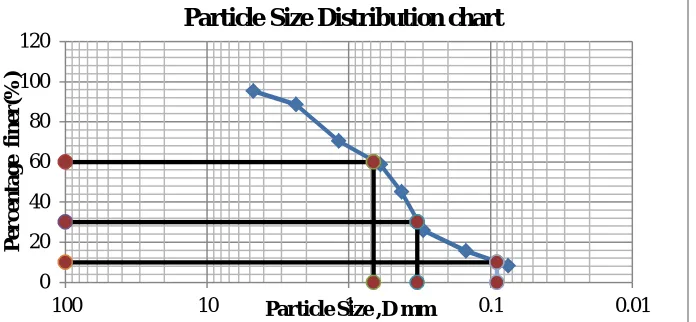
Fig Particle size Distribution curve 0
20 40 60 80 100 120
0.01 0.1
1 10
100
P
e
r
c
e
n
tage
fi
n
e
r
(%
)
Particle Size ,D mm
Table I :Test Carried On the Lateritic Soil
Sr.No Test IS Codes Test Value
1 Specific gravity IS:2720 (part III/sec
1)-1980
2.56
2 Moisture Content 14.23%
3 Particle size distribution Sieving test(IS: 460-1962) CI
4 Atterbergs limit
Liquid limit Plastic limit Plasticity index
IS:2720 (Part V)- 1985
58.735% 15.45%
43.285
5 Modified Proctor test
Maximum Dry Density Optimum moisture content(OMC)
IS: 2720 (Part VIII) 1.68 gm/cc
29.33%
6 Unconfined compression test I.S. 2720 (Part-8) 1964. 0 days= 188kpa
7 days =414kpa 14 days =500kpa 28 days= 588kpa
7 California Bearing ratio (CBR) IS: 2720 (Part 16) – 1979 0 days =16.003
4days=5.89
IV.RESULTSANDDISCUSSION
Modified Proctor Test (for Laterite soil)
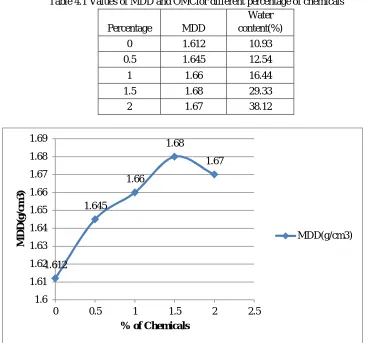
Table 4.1 Values of MDD and OMCfor different percentage of chemicals
Percentage MDD
Water content(%)
0 1.612 10.93
0.5 1.645 12.54
1 1.66 16.44
1.5 1.68 29.33
2 1.67 38.12
Figure 4.1 variation of MDD for laterite soil with different percentage of cacl2 1.612
1.645
1.66
1.68
1.67
1.6 1.61 1.62 1.63 1.64 1.65 1.66 1.67 1.68 1.69
0 0.5 1 1.5 2 2.5
M
D
D
(g/
c
m
3)
% of Chemicals
The MDD of soil decrease with increase in percentage of CaCl2 this due to the immediate reaction between the chemical and soil, which is represented as a flocculation and agglomeration. The present chlorides content in chemical also have an effect on soil structure which also changes particle size distribution of soil. The MDD of laterite soil is maximum for 1.5 percentage of CaCl2 which is 1.68 g/cm3 and then slight decrease in MDD due the behaviour of salt in chemicals. The reverse reaction is seen in addition of increasing percentage due to the salt reaction with soil.
Figure 4.2 variation of OMC and MDD for laterite soil with different percentage of cacl2
The CaCl2 affect the MDD and OMC of the soil. It is increases with the increasing percentage of chemical.it are highest for the 1.5 % of CaCl2. This behaviour is due to the interaction between the soil and CaCl2. The ion exchange is also a factor for the improvement in the soil properties.
[image:4.612.124.490.416.715.2]Unconfined compression test
Table 4.1 Values of UCS for different percentage of chemicals % of
Chemical 7 days 14 days 28 days
0 154 154 154
0.5 200 240 300
1 349 440 519
1.5 414 500 589
2 407 480 520
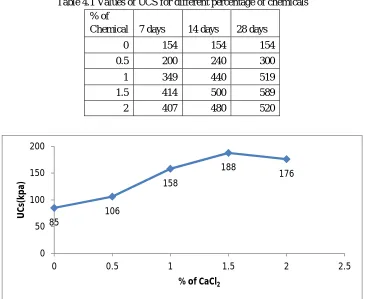
Figure 4.3 variation of 0 days UCS for laterite soil with different % of CaCl2 1.56
1.58 1.6 1.62 1.64 1.66 1.68 1.7 1.72 1.74 1.76
0 10 20 30 40 50
M
D
D
(g/
c
m
3)
Water Content(%)
0% of Cacl2
1.5% of cacl2
2.00% of cacl2
1%0f cacl2
0.5% of cacl2
85
106
158
188
176
0 50 100 150 200
0 0.5 1 1.5 2 2.5
U
C
s(
kp
a
)
1.5 % CaCl2+ Laterite soil gives the maximum the value we can say that optimum % of CaCl2 for laterite soil is 1.5 %. The addition of salt content to the soil causes an increase in the ion concentration of the pore water with contaminant reduction in the double layer thickness and this, in turn causes a reduction in the inter particles repulsions and an increase in the attraction ,resulting increase in cohesion . The compactio effort also effect the strength of the cohesive soil.
[image:5.612.126.495.136.296.2]
Figure 4.4 variation of different days UCS for laterite soil with different % of CaCl2
[image:5.612.161.456.394.709.2]The increase in strength with addition of chemicals may be attributedto the cation exchange of CaCl2 between the minerals layer and due to the formation of silicate gel. The reduction in gel beyond the 1.5 % of CaCl2 may be due to absorption of more moisture at higher CaCl2. The increase in strength of the stabilized soil may be attributed to the physiochemical phenomena namely cation exchange that takes place between lime and negatively charge clay particles together with the flocculation – agglomeration mechanism.
Table 4.1 Values of CBR for different percentage of chemicals
% of cacl2
CBR (%)(unsoaked)
CBR (%) soaked
0 6.664 2.982
0.5 9.872 3.665
1 13.098 4.873
1.5 16.003 5.89
2 14.987 5.23
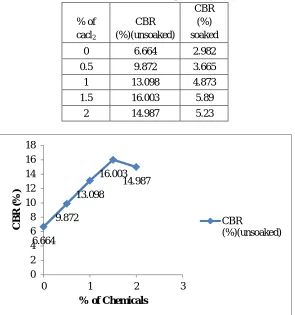
Figure 4.5 variation of unsoaked CBR for laterite soil with different percentage of cacl2 6.664
9.872 13.098
16.003 14.987
0 2 4 6 8 10 12 14 16 18
0 1 2 3
C
B
R
(%
)
% of Chemicals
CBR
(%)(unsoaked)
154 200
349 414 407
168 240
440 500 480
187
300
519 589 520
0 100 200 300 400 500 600 700
0 0.5 1 1.5 2 2.5
U
C
S(
kp
a)
%cacl2
7 days(soaked)
14 days(soaked)
At 1.5% CaCl2+ laterite soil gives the maximum values of i.e 16.003 so we can say that optimum % of CaCl2 for laterite soil is 1.5%. The increase in strength is attributed to the cation exchange of CaCl2 between the minerals layers and due to the formation of silicate gel. The reduction in improvement in CBR beyond 1.5% of CaCl2 may be due to the more absorption of moisture content at higher chemical content.
Figure 4.6 variation of Soaked CBR for laterite soil with different percentage of CaCl2
The results shows the decrease as compare to the unsoaked condition due to the more absorption of moisture. At 1.5 % of cacl2 it gives the highest result after 2% the value of CBR starts decreasing because of the reverse nature of cacl2. After certain percentage of cacl2 the chemical shows the reverse nature due the ions exchange. The increase in the strength with addition of chemicals may be attributed to the cation exchange of CaCl2 between mineral layers and due to the formation of silicate gel.
A. Regression Analysis
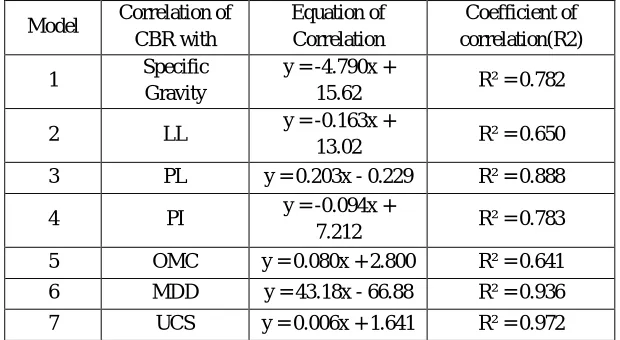
1) Multiple Linear Regression Analysis (MLRA) : The variations in CBR value which is considered as independent variable with Specific Gravity, LL, PL, PI, MDD ,OMC and UCS value which are considered as the dependent variables presented in Fig 4.1 – 4.25 for the Same locations respectively.
Non-linear MLRA was carried out using standard statistical software like Data Analysis Tool Bar of Microsoft Excel in order to derive the relationship statistically. Seven non-linear models have been developed to show the effect of CBR values of soil. The proposed non-linear models for the different soil locations are shown in Figures 4.1 to 4.25. Model 1: CBR vs. Specific Gravity, Model 2: CBR vs. LL, Model 3: CBR vs. PL, Model 4: CBR vs. PI, Model5: CBR vs. OMC and Model 6: CBR vs. MDD, Model 7: CBR vs. UCS. The statistical parameters indicate that models 4.2.2, 4.2.4, 4.2.6, 4.2.8,4.2.10,4.2.12 and 4.2.16 have R- square value (R2) of 0.782,0.650,0.888,0.783,0.641,0.936and 0.972 respectively, which is according to above 50%. This implies that a good relationship exist between the dependent and independent variable of the models. If the R2 for models are less than 50%, therefore they have less influence on CBR values and will not constitute variables for multiple regressions for the respective location.
Table II: Summary results of Multiple Regression Analysis
Model Correlation of
CBR with
Equation of Correlation
Coefficient of correlation(R2)
1 Specific
Gravity
y = -4.790x +
15.62 R² = 0.782
2 LL y = -0.163x +
13.02 R² = 0.650
3 PL y = 0.203x - 0.229 R² = 0.888
4 PI y = -0.094x +
7.212 R² = 0.783
5 OMC y = 0.080x + 2.800 R² = 0.641
6 MDD y = 43.18x - 66.88 R² = 0.936
7 UCS y = 0.006x + 1.641 R² = 0.972
2.982 3.665
4.873
5.89
5.23
0 2 4 6 8
0 0.5 1 1.5 2 2.5
C
B
R
(%
)
% OF cacl2
[image:6.612.151.461.557.727.2]B. Correlation between MDD and soaked CBR
4.4.11Correlation of soaked CBR and MDD Figure 4.17 Correlation of soaked CBR with OMC
Water in the soil acts both as a lubricant and as a binding agent among the soil particle there by influencing the structural stability and strength of soil geologic materials. The correlations between CBR and MDD was found significant ,CBR values are higher when the compacted densities are high and when clay content liquid limit and plasticity index are low. Both figure shows significant increase as the MDD increases. The correlation statistically indicating that as the OMC Increases CBR decreases this is due to the maximum absorption of moisture in the 4 days of soaking. But the value of R- square shows the good relationship between the both values of laboratory test.
C. Correlation between UCS and Soaked CBR
Correlation of soaked CBR with unsoaked UCS(0 days) Correlation of soaked CBR with unsoaked UCS(7 days)
Correlation of soaked CBR with unsoaked UCS(14 days) Correlation of soaked CBR with unsoaked UCS(28 days) y = 43.189x -
66.881 R² = 0.9361 0 1 2 3 4 5 6 7
1.6 1.65 1.7
C B R (% ) MDD(g/cm3)
CBR (%) soaked
Linear (CBR (%) soaked)
y = 0.0804x + 2.8006 R² = 0.6414 0 1 2 3 4 5 6 7
0 20 40 60
C B R (% ) OMC(%)
CBR (%) soaked
Linear (CBR (%) soaked)
y = 0.0262x + 0.796 R² = 0.9868 0 1 2 3 4 5 6 7
0 100 200
C B R (% ) UCS( 0days) CBR (%)(soaked) Linear (CBR (%)(soaked))
y = 0.0096x + 1.5911 R² = 0.962 0 1 2 3 4 5 6 7
0 200 400 600
C
B
R
(%
)
UCS( 7 days)
CBR (%)(soaked)
Linear (CBR (%)(soaked))
y = 0.0068x + 1.6419 R² = 0.9723 0 1 2 3 4 5 6 7
0 500 1000
C B R (% ) UCS(28 days) CBR (soaked) Linear (CBR (soaked))
y = 0.0077x + 1.7196 R² = 0.9639 0 1 2 3 4 5 6 7
0 200 400 600
V. CONCLUSIONS
A. It is observed that by using the chemical stabilizer the property of soil is improved, the use of CaCl2 can be better option for the improvement of structures, road pavement.
B. The CBR value of laterite soil has been increased. The use of chemical concentration at 1.5% gives the effective stabilization result and therefore it is used as stabilization of soil.
C. The R – square values of all the experiments is greater than 50% which indicates the good relationship between properties of
soil.
D. Using data analysis tool for comparing the laboratory test result and predicted values gives the good explainations.
E. Use of CaCl2 can be done as the alternative for the traditional stabilizers ,because of their cost and time saving nature.
VI.ACKNOWLEDGMENT
It gives me an immense pleasure and pride to express my deep sense of gratitude & respect for my teacher and Guide Prof.Dr. Vijay Sharma, Matoshri College of Engineering, Nashik, for his evergreen expertise and inspiring guidance during the period of my entire course, which has enlightened me on the finer skills of dealing with synthetic problems.
I would like to express my sincere thanks to Dr. U.P Naik ,HOD, Department of Civil Engineering and all Staff members of department for encouragement and helping me during my project work. We wish to express our warm and sincere thanks to Dr.Kharate, Principal, Matoshri College of Engineering, Nashik, for making all the facilities available in college.
REFERENCES
[1] A.A. Amadi, A .Okeiyi , Use of quick and hydrated lime in stabilization of lateritic soil.(2017) [2] Afeez Adefemi Bello ,Stabilisation of Lateritic Soils with coconut Husk Ash(2015)
[3] Aginam , C. H,Chidolue,C.A,Geotechnical Properties of Lateritic Soils from Northern Zone of Anambra State,Nigeria.(2014) [4] Ankit singh Negi ,Stabiliation of Expansive soil using Lime.(2013)
[5] Anuar Kasa,Zamri Chik studied” Stabilisation of silty clay soil using chloride compounds.
[6] Bairwa Ramlakhan ,The effect of the lime and fly ash on some basic engineering properties of Black cotton soil.(2013) [7] B.M Das ,Principle of Geotechnical Engineering.
[8] Duotone ,T.O Akinmusuru,Effect of Common Salt On the Engineering Properties of Expansive Soil.(2016) [9] George Rowland Otoko,Use of Salt Compounds for the stabilization Of Nigerian Laterites.(2014) [10] Gyanene Takhelmayun,Laboratory study on Soil Stabilization Using Fly ash.
[11] Habiba Afrin,Stabilization Of Clayey Soils Using Chloride Components(2017)
[12] J.M Raut,Stabilization Of Expansive Soil Using Fly ash and Murrum. ”. International Journal of innovative Research in Science,Engineering and Technology,vol.3, issue , June 2004.
[13] J.R. Oluremi, Stabilization of Lateritic Soil With Casava Peels Ash.(2015)
[14] J.B Oza, Stabilization of Black Cotton Soil using 1. Cement Dust 2. Cement Dust + Lime Powder 3. Lime Powder.(2013) [15] Krishanu Bhaumik ,V.Janani,Effect of strength Characteristic on Lateritic Soil by using Lime and Sugarcane Baggase Ash.(2016)
[16] K.V. Manoj Krishna1and Dr. H.N.Ramesh,” Strength and F O S Performance of Black Cotton Soil Treated with Calcium Chloride” IOSR Journal of Mechanical and Civil Engineering (IOSRJMCE) ISSN: 2278-1684 Volume 2, Issue 6 (Sep-Oct 2012)