FORMULATION AND EVALUATION OF FLOATING TABLETS OF
DRUGS IN COMBINATION FOR SUSTAINED RELEASE ACTION
V. Koushal Kishore*, Dr. P. Arun, P. Shailendra, P. Bhaveshand D. Neelesh
Department of Pharmacy, Shri Ram Group of Institution, Iti Madhotal Jabalpur-482002.
1 ABSTRACT
To developed and prepare a fine Gastroretentive dosage forms
(GRDFs) with fine floating tablets of the combination of the two and
investigate the possibility of those tablets as a delivery system for
controlled release of ondansetron and immediate release of ranitidine.
Gastroretention mode of administration would best achieve the known
pharmacokinetic and pharmacodynamic advantages of CR-DFs of
these drugs. The need for gastro retentive dosage forms (GRDFs) has
led to extensive efforts in both academia and industry towards the
development of such drug delivery systems. Ranitidine is given in
combination with ondansetron A dissolution study shows the release of Ondansetron
Hydrochloride and ranitidine hydrochloride. The Instant layer of ranitidine hydrochloride
release Approx 99.45 percent drug within 15 minutes and control floating layer Ondansetron
Hydrochloride shows release up to 12 Hours Approx 98.23 percent of Drug release in 12
hours. Experiment conclude that Bi-layer tablet is suitable for delivering same drugs with
different release pattern like one layer of drug as immediate release to get quick relief and
second drug as sustained release of drug which gives effect of drug for sufficient long time
and reduce frequency of dose.
KEYWORDS: HPMC K 30, PVP K30, Floating drug delivery system, Gastro retentive drug
delivery system, Combination, Floating lag time.
2. INTRODUCTION
Gastro retentive systems can remain in the gastric region for several hours and hence
significantly prolong the gastric residence time of drugs. Prolong gastric retention improves
bioavailability, reduces drug waste and improves solubility for drugs that are less soluble in
Volume 8, Issue 9, 826-833. Research Article ISSN 2277– 7105
Article Received on 25 May 2019,
Revised on 16 June 2019, Accepted on 06 July 2019
DOI: 10.20959/wjpr20199-15400
*Corresponding Author
V. Koushal Kishore
Department of Pharmacy, Shri
Ram Group of Institution, Iti
new products with new therapeutic possibilities and substantial benefits for patients. One of
the most feasible approaches for achieving a prolonged and predictable drug delivery in the
GIT is to control the Gastric Residence Time (GRT), i.e. Gastro Retentive Dosage Form
(GRDF). Floating systems or hydro dynamically balanced systems are low-density systems
that have sufficiently buoyancy to float over the gastric contents and remain buoyant in the
stomach without affecting the gastric emptying rate for a prolonged period of time and a
better control of the fluctuations in plasma drug concentrations. (Sabale V et. al 2010) Many
buoyant systems have been developed based on granules, powders, capsules, tablets,
laminated films and hallow micro spheres. Floating drug delivery systems are designed to
prolong the study of the dosage form in the gastro intestinal tract and aid in enhancing the
absorption. (M. Rangapriya et. Al 2012).
[image:2.595.68.530.588.736.2]3. MATERIAL AND METHOD
Table No. 1: List of drug and Excipients used.
S. No. Materials SOURCE
1. Ondansetron Hydrochloride Gift sample from Wing’s biotech 2. Ranitidine hydrochloride Gift sample from Wing’s biotech
3. HPMC K 30 Himedia
4. HPMC K 15 Himedia
6. PVP K30 Wing’s biotech
7. Talc Himedia
8. Magnesium sterate Sigma aldrich
9. Sodium bi carbonate Himedia
10. Citric acid Himedia
11. Lactose Himedia
12 Sodium Starch glycolate Sigma aldrich
13 Crospovidone Himedia
14 Microcrystalline cellulose Himedia
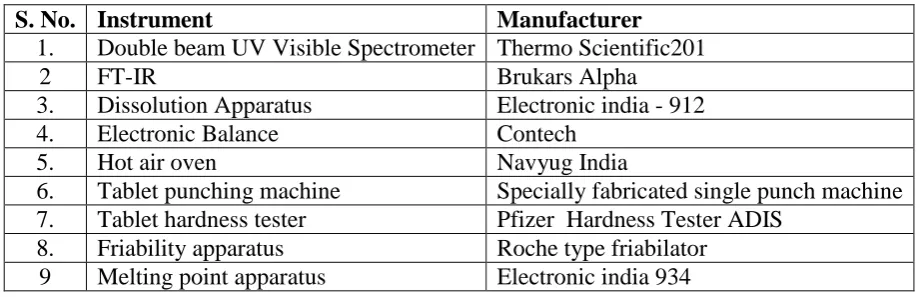
Table No 2: List of instruments used.
S. No. Instrument Manufacturer
1. Double beam UV Visible Spectrometer Thermo Scientific201
2 FT-IR Brukars Alpha
3. Dissolution Apparatus Electronic india - 912
4. Electronic Balance Contech
5. Hot air oven Navyug India
6. Tablet punching machine Specially fabricated single punch machine
7. Tablet hardness tester Pfizer Hardness Tester ADIS
8. Friability apparatus Roche type friabilator
4. FORMULATION DEVELOPMENT
Preparation of Instant Layer of Ranitidine hydrochloride
Fast dissolving tablets of Ranitidine hydrochloride were prepared by direct compression
method after incorporating different super dis-integrants such as, crosscarmellose sodium
(Ac-Di-Sol), crospovidone and sodium starch glycolate in different concentrations. The
ingredients given below were weighed and mixed in geometric progression in a dry and clean
mortar. Then the ingredients were passed through mesh #60. (P.Dinesh Kumar et al 2010).
Magnesium stearate as lubricant and talc as glidant were added in a final step and mixed,
this blend was subjected to analysis of pre-compression parameters which included Angle
of repose, Bulk density, Tap density, Carr’s index and Hausner’s ratio. (Rajesh Kaza. et al
2009).
The Blend was compressed on 8 mm (diameter) fat punches on a ‘single punch compression
machine. Eight formulations of Ranitidine hydrochloride granules were prepared and each
formulation contained one of the three disintegrant in different concentration. Each tablets
weighing 100 mg, were obtained. (M. Ehsanul et. Al).
Table No 3: Composition of Ranitidine hydrochloride Fast Dissolving Tablets.
Ingredients(mg) Formulation code
IF1 IF 2 IF 3 IF 4 IF 5 IF 6 IF 7 IF 8 IF 9 Ranitidine hydrochloride 150 150 150 150 150 150 150 150 150
Sodium Starch glycolate 5 7.5 10 _ _ _ _ _ _
Croscarmellose sodium _ _ _ 5 7.5 10 _ _ _
Crospovidone _ _ _ _ _ _ 5 7.5 10
Microcrystalline cellulose 34 31.5 29 34 31.5 29 34 31.5 29
Talc 5 5 5 5 5 5 5 5 5
Magnesium stearate 6 6 6 6 6 6 6 6 6
Total weight 200 200 200 200 200 200 200 200 200
Method for Preparation of Ondansetron Hydrochloride Floating tablet
Direct compression was followed to manufacture the gas generating floating tablets of
Ondansetron Hydrochloride. Nine different formulations (F1, F2, F3, F4, F5, F6, F7, F8, &
F9) were prepared by direct compression. All the polymers selected, drug and excipients
were passed through sieve no. 40 before using into formulation. The amount and ratio of drug
and polymers were weighed as per given in table No. 4 and all the formulation were used for
Polymers selected for tablets are
HPMC K 30,
HPMC K15,
PVP K30
Optimization of Gastro retentive floating tablets of Ondansetron Hydrochloride
Table No. 4: Various formulations of Ondansetron Hydrochloride Gastro retentive
Floating tablets.
Excipients(mg) F1 F2 F3 F4 F5 F6 F7 F8 F9
Ondansetron Hydrochloride 8 8 8 8 8 8 8 8 8
HPMC K 30 _ _ _ 160 170 180 80 85 90
HPMC K 15 160 170 180 _ _ _ 80 85 90
PVP K30 15 15 15 15 15 15 15 15 15
Citric acid 5 5 5 5 5 5 5 5 5
NaHCO3 20 20 20 20 20 20 20 20 20
Mg(C18H35O2)2 5 5 5 5 5 5 5 5 5
Talc 5 5 5 5 5 5 5 5 5
Lactose 82 72 62 82 72 62 82 72 62
Total Weight 300 300 300 300 300 300 300 300 300
Excipients like Sodium bicarbonate, citric acid anhydrous, Magnesium Stearate were selected
for the study. Sodium bicarbonate and citric acid were used as gas generating agent. Citric
acid was also used as an antioxidant. Steps involved in the manufacture of tablets, first the
drug, polymer and other excipients selected were passed through 40- mesh sieve.
Required quantity of drug, polymer and excipients were weighed properly and transferred
into polyethylene bag and the blend was mixed for at least 15 min. The blend obtained
was then lubricated by adding 1% magnesium stearate and again mixed for another 5min.
5. RESULT AND DISCUSSION
Evaluation of Pre compression for Ranitidine and ondansetron parameter
Angle of repose (θ)
Bulk density
Carr’s Compressibility index
Table No 5: Results of pre-compressional parameters of Ranitidine. Formulation code Parameters Loose Bulk density(gm/ml) Tapped bulk density(gm/ml) Carr’s Index (%) Hausner’s Ratio Angle of Repose
IF1 0.34 0.43 20.93 1.26 42025
IF2 0.33 0.42 21.43 1.27 42025
IF3 0.34 0.43 20.93 1.26 41036
IF4 0.35 0.4 12.50 1.14 42026
IF5 0.34 0.43 20.93 1.26 43015
IF6 0.33 0.41 19.51 1.24 43036
IF7 0.34 0.42 19.05 1.24 40056
IF8 0.35 0.43 18.60 1.23 41026
IF9 0.34 0.41 17.07 1.21 40023
Table No. 6: Result of Pre-Compression Properties of Ondansetron Hydrochloride FGR
Tablets.
Material Angle of
repose(Degree) Bulk density(gm/ml) Tapped density(gm/ml) Compressibility index Hausner ratio Ondansetron Hydrochloride
F1 30.31 0.582±0.002 0.732±0.007 27.33±0.73 0.721±0.01
F2 29.35 0.581±0.008 0.730±0.006 28.33±0.72 0.723±0.01
F3 27.82 0.576±0.002 0.728±0.005 27.30±0.68 0.720±0.01
F4 30.69 0.570±0.007 0.729±0.003 29.30±0.65 0.726±0.03
F5 28.30 0.580±0.003 0.735±0.004 30.30±0.61 0.730±0.04
F6 30.28 0.585±0.003 0.732±0.006 32.80±0.64 0.728±0.06
F7 28.46 0.582±0.004 0.742±0.003 36.24±0.70 0.720±0.03
F8 29.49 0.579±0.002 0.792±0.005 29.72±0.68 0.720±0.04
F9 30.13 0.584±0.004 0.768±0.004 28.52±0.71 0.739±0.03
Formulation development of bilayer tablet
Optimized formulation IF-6 of Instant release layer and optimized formulation of F-8 for
control release used for formulation of Bi-layer tablet. Bi-layered floating tablet were
prepared by direct compression technique using varying concentrations of different grades of
polymer with sodium bicarbonate and citric acid. All the ingredients were accurately weighed
and pass through different mesh sieves. Then except magnesium stearate all other ingredients
were blended uniformly in glass mortar after sufficient mixing of drug as well as other
components, magnesium stearate was added, as post lubricant, and further mixed for
additional 2-3 minutes. The tablets were compressed using rotary tablet machine. The
Evaluation of bilayer tablets
All the tablets were evaluated for following different parameters which includes;
1. Thickness; Thickness and diameter of tablets were determined using Vernier caliper.
Five tablets from each batch were used, and an average value was calculated.
2. Hardness; For each formulation, the hardness of five tablets was determined using the
pfizer hardness tester (adis).
3. Friability; the friability of a sample of 10 tablets was measured using a Friability tester
(Electro Lab). Ten tablets were weighed, rotated at 25 rpm for 4 minutes. Tablets were
reweighed after removal of fines (dedusted) and the percentage of weight loss was
calculated.
4. Drug content Twenty tablets were taken and amount of drug present in each tablet was
determined. The tablets were crushed in a mortar and the powder equivalent to 150 mg of
Ondansetron Hydrochloride was transferred to 100ml standard flask. The powder was
dissolved in 150 ml of 0.1 N HCL and made up to volume with 0.1 N HCL. The sample
was mixed thoroughly and filtered through a 0.45μ membrane filter. The filtered solution
was further diluted 0.1 ml to 10 ml suitably (10 ppm of ranitidine hydrochloride) and
prepare individually 10 ppm solution of Ranitidine hydrochlorideand determine the Conc.
of both drugs using 252 nm for ondansetron Hydrochloride and 298 nm for ranitidine
Hydrochloride respectively.
5. Dissolution rate studies In vitro drug release was performed according to the USP
dissolution apparatus II at 50 rpm and 37±0.5ºC temperature over a 12 hrs period for
Ondansetron Hydrochloride SR and 1 hr for Ranitidine hydrochloride IR, using an
automated paddle dissolution system (Electronic india). A minimum of 6 tablets per batch
were tested. The media used was 0.1N HCl at a pH 1.2 and a volume of 900 ml was
maintained at 37±0.5◦C. Test sample (1ml) was withdrawn at particular time interval and
replaced with fresh dissolution media maintained at the same temperature and the
concentration of dissolved drug was determined using U.V. (Thermo Scientific201)
spectrophotometer at λmax 252 nm for ondansetron Hydrochloride and 298 nm for
ranitidine Hydrochloride respectively.
Evaluation of bilayer tablets
Table No 7: Post-Compressional Parameters of Optimized Formulation.
Formulation code Hardness
test (kg/cm2)
Friability (%)
Thickness (mm)
Drug content
Table No. 8: Results of Drug content analysis.
Formulation Ondansetron Hydrochloride
(% Label Claim)
Ranitidine Hydrochloride (% Label Claim)
In-house Bi-layered tablet 99.56 99.56
Dissolution rate studies of Instant layer
Table No. 9: Results of Dissolution rate studies of Instant layer.
Time (min) % Drug Release of Instant layer
15 99.45 %
Dissolution rate studies of Floating layer
Table No. 10: Results of Dissolution rate studies of Floating layer.
Time (Hour) % Drug Release of Floating layer
0.5 7.98
1 10.65
1.5 18.51
2 25.25
4 36.23
6 52.25
8 76.26
10 85.25
12 98.23
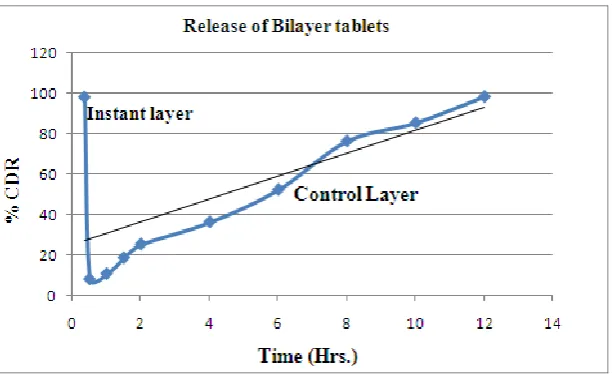
[image:7.595.146.453.471.658.2]Graph of Release of Bilayer tablets
Figure 1: Graph of Release of Bilayer tablets.
SUMMARY
drug within 15 minutes and control floating layer Ondansetron Hydrochloride shows release
up to 12 Hours Approx 98.23 percent of Drug release in 12 hours.
CONCLUSION
Gastroretention helps to provide better availability of new products with suitable therapeutic
activity and substantial benefits for patients. This mode of administration would best achieve
the known pharmacokinetic and pharmacodynamic advantages of CR-DFs of these drugs.
Ranitidine is given in combination with ondansetron. In women with heartburn/acid reflux
and nausea/vomiting of pregnancy, an observational study found that acid-reducing
pharmacotherapy (e.g. antacids, H2 blockers, proton pump inhibitors) combined with
anti-emetic therapy resulted in significant improvement in symptoms and well-being three to four
days after beginning therapy. The aim of the present study is to prepare fine floating tablets
of the combination of the two and investigate the possibility of those tablets as a delivery
system for controlled release of ondansetron and immediate release of ranitidine.A
dissolution study shows the release of Ondansetron Hydrochloride and ranitidine
hydrochloride. The Instant layer of ranitidine hydrochloride release Approx 99.45 percent
drug within 15 minutes and control floating layer Ondansetron Hydrochloride shows release
up to 12 Hours Approx 98.23 percent of Drug release in 12 hours.
REFERENCES
1. Sabale V et. al Formulation and Evaluation of Floating Dosage Forms Sys Rev Pharm.,
Jan-June, 2010; 1(1): 33-39.
2. M. Ehsanul et. al Preparation and evaluation of floating matrix tablets of Ranitidine
Hydrochloride, The Pharma Innovation. ISSN: 2277- 7695, 2012; 1(7): 43-50.
3. Rajesh Kaza. et al Design and Evaluation of Sustained release Floating tablets for the
treatment of Gastric Ulcers /J. Pharm. Sci. & Res., 2009; 1(4): 81-87.
4. Seth et al. Design And Characterization Of Floating Tablets Of Anti-Diabetic Drug
IJRPC, 2013; 3(3). ISSN: 2231-2781.
5. P.Dinesh Kumar et al. Bilayer Floating Tablets Of Ranitidine, 2010; 3(2): 368-374.
6. M. Rangapriya et. al Formulation and Evaluation of Floating Tablets of Pioglitazone
Hydrochloride, Jul-Sep, 2012; 1(3). ISSN: 2277-5005.
7. P. Christina et.al Formulation and Evaluation of Floating tablets of Ondansetron