Learning Adjective Meanings with a Tensor-Based Skip-Gram Model
Jean Maillard University of Cambridge
Computer Laboratory [email protected]
Stephen Clark University of Cambridge
Computer Laboratory [email protected]
Abstract
We present a compositional distributional semantic model which is an implementa-tion of the tensor-based framework of Co-ecke et al. (2011). It is an extended skip-gram model (Mikolov et al., 2013) which we apply to adjective-noun combinations, learning nouns as vectors and adjectives as matrices. We also propose a novel measure of adjective similarity, and show that adjective matrix representations lead to improved performance in adjective and adjective-noun similarity tasks, as well as in the detection of semantically anomalous adjective-noun pairs.
1 Introduction
A number of approaches have emerged for com-bining compositional and distributional seman-tics. Some approaches assume that all words and phrases are represented by vectors living in the same semantic space, and use mathematical op-erations such as vector addition and element-wise multiplication to combine the constituent vectors (Mitchell and Lapata, 2008). In these relatively simple methods, the composition function does not typically depend on its arguments or their syn-tactic role in the sentence.
An alternative which makes more use of gram-matical structure is the recursive neural network approach of Socher et al. (2010). Constituent vec-tors in a phrase are combined using a matrix and non-linearity, with the resulting vector living in the same vector space as the inputs. The matrices can be parameterised by the syntactic type of the com-bining words or phrases (Socher et al., 2013; Her-mann and Blunsom, 2013). Socher et al. (2012) extend this idea by representing the meanings of words and phrases as both a vector and a matrix, introducing a form of lexicalisation into the model.
A further extension, which moves us closer to formal semantics (Dowty et al., 1981), is to build a semantic representation in step with the syntac-tic derivation, and have the embeddings of words be determined by their syntactic type. Coecke et al. (2011) achieve this by treating relational words such as verbs and adjectives as functions in the semantic space. The functions are assumed to be multilinear maps, and are therefore realised as tensors, with composition being achieved through tensor contraction.1 While the framework
speci-fies the “shape” or semantic type of these tensors, it makes no assumption about how the values of these tensors should be interpreted (nor how they can be learned).
A proposal for the case of adjective-noun com-binations is given by Baroni and Zamparelli (2010) (and also Guevara (2010)). Their model represents adjectives as matrices over noun space, trained via linear regression to approximate the “holistic” adjective-noun vectors from the corpus. In this paper we propose a new solution to the problem of learning adjective meaning represen-tations. The model is an implementation of the tensor framework of Coecke et al. (2011), here applied to adjective-noun combinations as a start-ing point. Like Baroni and Zamparelli (2010), our model also learn nouns as vectors and adjectives as matrices, but uses a skip-gram approach with neg-ative sampling (Mikolov et al., 2013), extended to learn matrices.
We also propose a new way of quantifying ad-jective similarity, based on the action of adjec-tives on nouns (consistent with the view that ad-jectives are functions). We use this new measure instead of the naive cosine similarity function ap-plied to matrices, and obtain competitive perfor-mance compared to the baseline skip-gram vec-tors (Mikolov et al., 2013) on an adjective simi-larity task. We also perform competitively on the
1Baroni et al. (2014) have developed a similar approach.
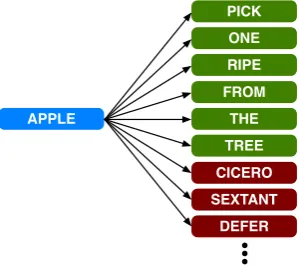
APPLE
PICK ONE RIPE FROM
THE TREE CICERO SEXTANT
[image:2.595.305.534.60.196.2]DEFER
Figure 1: Learning the vector forapplein the con-textpick one ripe apple from the tree. The vector forappleis updated in order to increase the inner product with green vectors and decrease it with red ones, which are negatively sampled.
adjective-noun similarity dataset from Mitchell and Lapata (2010). Finally, the tensor-based skip-gram model also leads to improved performance in the detection of semantically anomalous adjective-noun phrases, compared to previous work.
2 A tensor-based skip-gram model
Our model treats adjectives as linear maps over the vector space of noun meanings, encoded as matri-ces. The algorithm works in two stages: the first stage learns the noun vectors, as in a standard skip-gram model, and the second stage learns the adjec-tive matrices, given fixed noun vectors.
2.1 Training of nouns
To learn noun vectors, we use a skip-gram model with negative sampling (Mikolov et al., 2013). Each nounnin the vocabulary is assigned twod -dimensional vectors: a content vector n, which constitutes the embedding, and a context vector n1. For every occurrence of a nounnin the corpus,
the embeddings are updated in order to maximise the objective function
ÿ
c1PC
logσpn¨c1q ` ÿ
c1PC
logσp´n¨c1q, (1)
whereC is a set of contexts for the current noun, andC is a set of negative contexts. The contexts are taken to be the vectors of words in a fixed win-dow around the noun, while the negative contexts are vectors for kwords sampled from a unigram distribution raised to the power of3{4(Goldberg,
2014). In our experiments, we have setk“5.
UNRIPE APPLE
THE
GREEN
SMALL
TASTED
VERY
SOUR APPLE
UNRIPE X =
SAYS
BRAILLE
OMEN
=
Figure 2: Learning the matrix for unripe in the context the green small unripe apple tasted very sour. The matrix forunripeis updated to increase the inner product of the vector for unripe apple with green vectors and decrease it with red ones.
After each step, both content and context vec-tors are updated via back-propagation. This pro-cedure leads to noun embeddings (content vectors) which have a high inner product with the vectors of words in the context of the noun, and a low inner product with vectors of negatively sampled words. Fig. 1 shows this intuition.
2.2 Training of adjectives
Each adjective a in the vocabulary is assigned a matrixA, initialised to the identity plus uniform noise. First, all adjective-noun phrasespa, nqare
extracted from the corpus. For eachpa, nqpair, the
corresponding adjective matrix A and noun vec-tornare multiplied to compute the adjective-noun vectorAn. The matrixAis then updated to max-imise the objective function
ÿ
c1PC
logσpAn¨c1q `
ÿ
c1PC
logσp´An¨c1q. (2)
The contextsCare taken to be the vectors of words in a window around the adjective-noun phrase, while the negative contextsC are again vectors of randomly sampled words. Matrices are initialised to the identity, while the context vectorsCare the results of Section 2.1.
[image:2.595.107.257.63.196.2]2.3 Similarity measure
The similarity of two vectors nandm is gener-ally measured using the cosine similarity function (Turney and Pantel, 2010; Baroni et al., 2014),
vecsimpn,mq “ n¨m }n} }m}.
Based on tests using a development set, we found that using cosine to measure the similarity of ad-jective matrices leads to no correlation with gold-standard similarity judgements. Cosine similarity, while suitable for vectors, does not capture any in-formation about the function of matrices as linear maps. We postulate that a suitable measure of the similarity of two adjectives should be related to how similarly they transform nouns.
Consider two adjective matrices A and B. If
An and Bn are similar vectors for every noun vectorn, then we deem the adjectives to be simi-lar. Therefore, one possible measure involves cal-culating the cosine distance between the images of all nouns under the two adjectives, and taking the average or median of these distances. Rather than working on every noun in the vocabulary, which is expensive, we instead take the most frequent nouns, cluster them, and use the cluster centroids (obtained in our case using k-means). The result-ing distance function is given by
matsimpA,Bq “median
nPN vecsimpAn,Bnq,
(3) where the median is taken over the set of cluster centroidsN.2
3 Evaluation
The model is trained on a dump of the English Wikipedia, automatically parsed with the C&C parser (Clark and Curran, 2007). The corpus con-tains around 200 million noun examples, and 30 million adjective-noun examples. For every con-text word in the corpus, 5 negative words are sam-pled from the unigram distribution. Subsampling is used to decrease the number of frequent words (Mikolov et al., 2013). We train 100-dimensional noun vectors and 100ˆ100-dimensional adjective
matrices.
3.1 Word Similarity
First we test word, rather than phrase, similarity on the MEN test collection (Bruni et al., 2014),
2We chose the median instead of the average as it is more
resistant to outliers in the data.
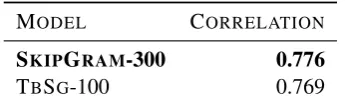
MODEL CORRELATION
SKIPGRAM-300 0.776
[image:3.595.331.504.62.114.2]TBSG-100 0.769
Table 1: Spearman rank correlation on noun simi-larity task.
MODEL CORRELATION
TBSG-100ˆ100 0.645
SKIPGRAM-300 0.638
Table 2: Spearman rank correlation on adjective similarity task.
which contains a set of POS-tagged word pairs to-gether with gold-standard human similarity judge-ments. We use the POS tags to select all noun-noun and adjective-adjective pairs, leaving us with a set of 643 noun-noun pairs and 96 adjective-adjective pairs. For the noun-noun dataset, we are testing the quality of the 100-dimensional noun vectors from the first stage of the tensor-based skip-gram model (TBSG), which is essentially word2vecapplied to just learning noun vectors. These are compared to the 300-dimensional SKIP
-GRAM vectors available from the word2vec
page (which have been trained on a very large news corpus).3
The adjective-adjective pairs are used to test the100ˆ100matrices obtained from our TBSG
model, again compared to the 300-dimensional SKIPGRAM vectors. The Spearman correlations
between human judgements and the similarity of vectors are reported in Tables 1 and 2. Note that for adjectives we used the similarity measure de-scribed in Section 2.3. Table 1 shows that the noun vectors we use are of a high quality, perform-ing comparably to the SKIPGRAM noun vectors
on the noun-noun similarity data. Table 2 shows our TBSG adjective matrices, plus new similarity
measure, to also perform comparably to the SKIP
-GRAMadjective vectors on the adjective-adjective
similarity data.
3.2 Phrase Similarity
The TBSG model aims to learn matrices that act
in a compositional manner. Therefore, a more in-teresting evaluation of its performance is to test how well the matrices combine with noun vectors.
MODEL CORRELATION
TBSG-100 0.50
SKIPGRAM-300 (add) 0.48
SKIPGRAM-300 (N only) 0.43
TBSG-100 (N only) 0.42
REG-600 0.37
[image:4.595.79.287.63.169.2]humans 0.52
Table 3: Spearman rank correlation on adjective-noun similarity task.
We use the Mitchell and Lapata (2010) adjective-noun similarity dataset, which contains pairs of adjective-noun phrases such aslast number – vast majoritytogether with gold-standard human simi-larity judgements. For the evaluation, we calculate the Spearman correlation between non-averaged human similarity judgements and the cosine simi-larity of the vectors produced by various composi-tional models.
The results in Table 3 show that TBSG has
the best correlation with human judgements of the other models tested. It outperforms SKIP
-GRAM vectors with both addition and
element-wise multiplication as composition functions (the latter not shown in that table, as it is worse than addition). Also reported is the baseline perfor-mance of SKIPGRAMand TBSGwhen using only
nouns to compute similarity (ignoring the adjec-tives). It is interesting to note that TBSGalso
out-performs the result of the matrix-vector linear re-gression method (REG-600) of Baroni and
Zam-parelli (2010) as reported by Vecchi et al. (2015) on the same dataset. Their method trains a matrix for every adjective via linear regression to approx-imate corpus-extracted “holistic” adjective-noun vectors, and is therefore similar in spirit to TBSG. 3.3 Semantic Anomaly
Finally, we use the model to distinguish between semantically acceptable and anomalous adjective-noun phrases, using the data from Vecchi et al. (2011). The data consists of two sets: a set of un-observed acceptable phrases (e.g. ethical statute) and one of deviant phrases (e.g. cultural acne). Following Vecchi et al. (2011) we use two indices of semantic anomaly. The first, denoted COSINE,
is the cosine between the adjective-noun vector and the noun vector. This is based on the hypothe-sis that deviant adjective-noun vectors will form a wider angle with the noun vector. The second
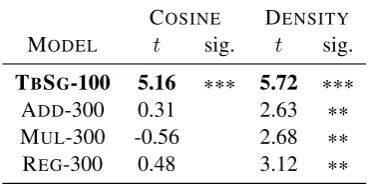
in-COSINE DENSITY
MODEL t sig. t sig. TBSG-100 5.16 ˚˚˚ 5.72 ˚˚˚
ADD-300 0.31 2.63 ˚˚
MUL-300 -0.56 2.68 ˚˚
REG-300 0.48 3.12 ˚˚
Table 4: Correlation on test data for semantic anomalies. Significance levels are marked˚˚˚for pă0.001,˚˚forpă0.01.
dex, denoted DENSITY, is the average cosine
dis-tance between the adjective-noun vector and its 10 nearest noun neighbours. This measure is based on the hypothesis that nonsensical adjective-nouns should not have many neighbours in the space of (meaningful) nouns.4 These two measures are
computed for the acceptable and deviant sets, and compared using a two-tailed Welch’st-test.
Table 4 compares the performance of TBSG
with the results of count-based vectors using addition (ADD) and element-wise multiplication
(MUL) reported by Vecchi et al. (2011), as well as
the matrix-vector linear regression method (REG
-300) of Baroni and Zamparelli (2010). TBSG
ob-tains the highest scores with both measures. 4 Conclusions
In this paper we have implemented the tensor-based framework of Coecke et al. (2011) in the form of a skip-gram model extended to learn higher-order embeddings, in this case adjectives as matrices. While adjectives and nouns are learned separately in this study, an obvious extension is to learn embeddings jointly. We find the tensor-based skip-gram model particularly attractive for the obvious ways in which it can be extended to other parts-of-speech (Maillard et al., 2014). For example, in this framework transitive verbs are third-order tensors which yield a sentence vector when contracted with subject and object vectors. Assuming contextual representations of sentences, these could be learned by the tensor-based skip-gram as a straghtforward extension from second-order (matrices) to third-second-order tensors (and poten-tially beyond for words requiring even higher or-der tensors).
4Vecchi et al. (2011) also use a third index of semantic
[image:4.595.324.510.64.156.2]Acknowledgements
Jean Maillard is supported by an EPSRC Doc-toral Training Grant and a St John’s Scholar-ship. Stephen Clark is supported by ERC Start-ing Grant DisCoTex (306920) and EPSRC grant EP/I037512/1. We would like to thank Tamara Polajnar, Laura Rimell, and Eva Vecchi for useful discussion.
References
Marco Baroni, Roberto Zamparelli 2010. Nouns are vectors, adjectives are matrices: represent-ing adjective-noun constructions in semantic space.
Proceedings of EMNLP, 1183–1193.
Marco Baroni, Raffaela Bernardi, Roberto Zamparelli 2014 Frege in space: A program for compositional distributional semantics. Linguistic Issues in Lan-guage Technologies9(6), 5–110.
Marco Baroni, Georgiana Dinu, Germ´an Kruszewski 2014 Don’t count, predict! A systematic compar-ison of context-counting vs. context-predicting se-mantic vectors.Proceedings of ACL, 238–247.
Elia Bruni, Nam Khanh Tran, Marco Baroni 2014
Multimodal Distributional Semantics. Journal of Artificial Intelligence Research49, 1–47.
Stephen Clark, James R. Curran 2007 Wide-coverage efficient statistical parsing with CCG and log-linear models.Computational Linguistics33(4), 493–552.
Bob Coecke, Mehrnoosh Sadrzadeh, Stephen Clark 2011. Mathematical Foundations for a Composi-tional DistribuComposi-tional Model of Meaning. Linguistic Analysis36 (Lambek Festschrift), 345–384.
David R. Dowty, Robert E. Wall, Stanley Peters 1981
Introduction to Montague semantics.Dordrecht.
Yoav Goldberg, Omer Levy 2014 word2vec Explained: deriving Mikolov et al.’s negative-sampling word-embedding method. arXiv preprint
1402.3722.
Emiliano Guevara 2010 A regression model of adjective-noun compositionality in distributional se-mantics. Proceedings of the ACL GEMS workshop, 33–37.
Karl Moritz Hermann and Phil Blunsom. 2013 The role of syntax in vector space models of composi-tional semantics.Proceedings of ACL, 894–904.
Jean Maillard, Stephen Clark, Edward Grefenstette 2014. A Type-Driven Tensor-Based Semantics for CCG. Proceedings of the EACL 2014 Type Theory and Natural Language Semantics Workshop, 46–54.
Tomas Mikolov, Ilya Sutskever, Kai Chen, Greg Cor-rado, Jeff Dean 2013. Distributed representations of words and phrases and their compositionality.
Proceedings of NIPS, 3111–3119.
Jeff Mitchell, Mirella Lapata 2008 Vector-based mod-els of semantic composition. Proceedings of ACL 08, 263–244.
Jeff Mitchell, Mirella Lapata 2010 Composition in Distributional Models of Semantics. Cognitive sci-ence34(8), 1388–1439.
Richard Socher, Christopher D. Manning, Andrew Y. Ng 2010 Learning continuous phrase represen-tations and syntactic parsing with recursive neural networks. Proceedings of the NIPS Deep Learning and Unsupervised Feature Learning Workshop, 1–9. Richard Socher, Brody Huval, Christopher D. Man-ning, Andrew Y. Ng 2012 Semantic composition-ality through recursive matrix-vector spaces. Pro-ceedings of EMNLP, 1201–1211.
Richard Socher, John Bauer, Christopher D. Manning, Andrew Y. Ng 2013 Parsing with Compositional Vector Grammars.Proceedings of ACL, 455-465. Mark Steedman 2000 The Syntactic Process. MIT
Press.
Peter D. Turney, Patrick Pantel 2010. From fre-quency to meaning: vector space models of seman-tics. Journal of Artificial Intelligence Research37, 141–188.
Eva M. Vecchi, Marco Baroni, Roberto Zamparelli 2011 (Linear) maps of the impossible: Capturing semantic anomalies in distributional space. Pro-ceedings of ACL DISCo Workshop, 1–9.