582
BeamSeg: a Joint Model for Multi-Document Segmentation
and Topic Identification
Pedro Mota
Carnegie Mellon University Pittsburgh, PA, USA
INESC-ID
Instituto Superior T´ecnico Lisboa, Portugal [email protected]
Maxine Eskenazi Carnegie Mellon University
Pittsburgh, PA, USA [email protected]
Lu´ısa Coheur INESC-ID
Instituto Superior T´ecnico Lisboa, Portugal
Abstract
We propose BeamSeg, a joint model for seg-mentation and topic identification of docu-ments from the same domain. The model as-sumes that lexical cohesion can be observed across documents, meaning that segments de-scribing the same topic use a similar lexical distribution over the vocabulary. The model implements lexical cohesion in an unsuper-vised Bayesian setting by drawing from the same language model segments with the same topic. Contrary to previous approaches, we as-sume that language models are not indepen-dent, since the vocabulary changes in consec-utive segments are expected to be smooth and not abrupt. We achieve this by using a dy-namic Dirichlet prior that takes into account data contributions from other topics. BeamSeg also models segment length properties of doc-uments based on modality (textbooks, slides,
etc.). The evaluation is carried out in three datasets. In two of them, improvements of up to 4.8% and 7.3% are obtained in the segmen-tation and topic identifications tasks, indicat-ing that both tasks should be jointly modeled.
1 Introduction
Documents exhibit a content organization that ag-gregates related text passages in topically coher-ent segmcoher-ents. Understanding the documcoher-ent struc-ture at the segment level enables efficient content navigation. This has become more relevant with the number of available documents on the Web. The current information landscape allows access to documents describing the same subject, provid-ing alternative views or complementary informa-tion. This is advantageous in a variety of scenar-ios. For example, students have at their disposal several learning materials and might need to find a particular topic segment that best suits their learn-ing needs. Findlearn-ing such documents is an easy task since search engines are capable of returning
doc-uments conveying related information. However, if search engines are effective in retrieving these documents, the task of putting them into a co-herent picture remains a challenge (Shahaf et al., 2012). Automatically finding document segments – text segmentation – and identifying which ones discuss the same topic – topic identification – ad-dresses this issue (Jeong and Titov,2010).
lever-age topic segmentation algorithms. We also ex-plore the role of modality in the multi-document scenario. Previous approaches treat all documents equally, but it is plausible that we can improve seg-mentation by making assumptions about the ex-pected segment length on a document modality ba-sis. For example, segments in slide presentations are expected to be shorter than in video lectures.
We propose BeamSeg, a Bayesian unsupervised topic modeling approach to breaking documents in coherent segments while identifying similar top-ics. The generative process assumes that segments can share the same topic and, consequently, are generated from the same lexical distribution. Lex-ical cohesion is achieved by having higher seg-mentation likelihoods when the probability mass is concentrated in a narrow subset of words. This is in the same spirit as topic modeling approaches such as Latent Dirichlet Allocation (LDA) (Blei et al.,2003), but here the inherent topics are con-strained to the linear discourse structure. To model interactions between lexical distributions, we use a dynamic prior, which assumes that the word probabilities change smoothly across topics. To model segment length characteristics, we assign prior variables conditioned on document modality. The linear segmentation constraint has been used to make inference tractable by exhaustively exploring the segmentation space to obtain the exact maximum-likelihood estimation (Eisenstein and Barzilay,2008). Given a multi-document set-ting, this is not feasible, as segments can share top-ics. We address this issue using a beam search algorithm, which allows the inference procedure to recover from early mistakes. In our experi-ments, we show that BeamSeg is able to perform well when segmenting learning materials, where previously single-document models obtained bet-ter results (Mota et al.,2018). We also observe that topic identification is more accurately determined in a joint model, as opposed to a pipeline approach (performing the tasks sequentially), indicating that both problems should be modeled simultaneously.
We summarize our contributions as follows:
• A novel joint model for topic segmentation and identification with a dynamic prior.
• An inference procedure based on a beam search algorithm.
• A study on how different modality-based seg-ment length priors influence segseg-mentation.
The source code is available in the following repository:github.com/pjdrm/BeamSeg.
2 Related Work
Following the lexical cohesion theory, segmenta-tion algorithms identify spans of text with promi-nent vocabulary changes. The main difference be-tween algorithms is how lexical cohesion is im-plemented: some resort to lexical similarity; the remaining follow a probabilistic approach.
Lexical approaches rely on a similarity metric between sentences, usually the cosine. A clas-sic method is TextTiling (Hearst,1997), which as-sumes that topic boundaries are found in consec-utive sentences with a low similarity value; sev-eral other works built on this idea (Galley et al., 2003;Balagopalan et al.,2012). C99 (Choi,2000) is another lexical approach, and uses a similar-ity matrix in a divisive clustering to obtain seg-ments. MinCut (Malioutov and Barzilay, 2006) casts segmentation in a minimum cut graph par-titioning problem. The graph has a node for each sentence; edges are weighted using lexical similar-ity. Long-distance textual relationships are mod-eled by connecting all sentences. Affinity Prop-agation Segmentation (Kazantseva and Szpakow-icz,2011) also models such relationships but uses affinity propagation clustering (Frey and Dueck, 2007). The algorithm creates a factor graph and maximizes the segment similarity sum function. Alemi and Ginsparg(2015) proposed the Content Vector Segmentation (CVS) sentence vector rep-resentation based on segment word embeddings. Using this representation in C99 improves bag-of-words results.
Just as we introduced average
velocitywe will now describe
average acceleration. Notice whenvelocitychanges ... over
time. And ... introduce an
average acceleration... The
average accelerationbetween
timet2 ... And the dimension ... secs pertimesquared.
AccelerationWe say ... changingvelocityare
“accelerating”Accelerationis the “Rate of change ofvelocity” You hit the accelerator to speed up ... it’s true you also hit ... friction is slowing ...Average accelerationUnit of
acceleration: (m/s)/s=m/s2
Theaccelerationof a particle ... rate of change ofvelocity...
time. Average acceleration ... is v2 - v1 t2 - t1 ...Acceleration
may be positive, negative or zero. Zeroaccelerationmeans we have constantvelocity. Note that the direction and
accelerationneed not coincide.
Figure 1: Examples of segment excerpts from video, slide presentation, and PDF documents describing the acce-laration topic. Words in bold depict shared vocabulary across segments.
Probabilistic approaches to segmentation fol-low a setup similar to the LDA model: words are assigned to topics such that probability mass is distributed on a small set of topically rele-vant words. In order to adapt this idea to seg-mentation, the model needs to be able to deter-mine if sentences belong to the same topic (or mixture of topics). An example of such adapta-tion is the single-document segmentaadapta-tion model PLDA (Purver et al., 2006), where topic propor-tions are shared by sentences within the same seg-ment. Segmentation is then determined through a binary topic shift sentence variable. Models such as TopicTiling (Riedl and Biemann, 2012), Structured Topic Model (STM) (Du et al.,2013), and NTSeg (Jameel and Lam, 2013) extend this LDA-based approach to segmentation. In all these approaches, topic identification is not possible since all segments are a mixture of topics.
In this paper, we adopt a probabilistic multi-document view on segmentation. Only two other models follow this approach: MultiSeg (Jeong and Titov,2010) and Bayesseg-MD (Mota et al., 2016). MultiSeg uses a two-level LDA model where documents are generated using local and global topics. Local topics are specific to a doc-ument; global topics are shared between docu-ments. Documents are mixtures of topics, but each segment is generated by a single topic, lending it-self to a joint model of segmentation and topic identification. The multi-document aspect of the model stems from topic proportions being inferred from the whole dataset. In the experiments, this joint modeling outperforms a pipeline strategy that performs these tasks sequentially.
The other multi-document model, Bayesseg-MD, is an extension of Bayesseg (Eisenstein and Barzilay, 2008). In Bayesseg, sentences
from the same segment are assigned the same topic. The inference procedure affords an ex-act maximum-likelihood estimation by exploring the segmentation space with a dynamic program-ming algorithm. This approach cannot be ap-plied to multi-document segmentation since the hidden topic variables are integrated out; other single-document models following this approach also have this problem (Eisenstein,2009;Malmasi et al.,2017). Bayesseg-MD sidesteps this problem by using lexically similar sentences from other documents. The word counts of such sentences are added to the segment likelihood estimation to re-duce data sparseness. Despite using all documents for segment likelihood estimations, topic identifi-cation is not available. In this paper, we address these issues by designing an inference algorithm that explicitly tracks segment topic assignments.
3 BeamSeg Model
We implement lexical cohesion in a Bayesian set-ting in a generative process where segments with the same topic are drawn from the same multino-mial language model. Thus, alluutterances with a topic k have their bag-of-words representation
xudrawn from language modelφzu;zuis the hid-den topic variable of u. We constrain the model to yield linear segmentations by having topics oc-curring at most once per document. This induces higher likelihood segmentations to have language models concentrating probability mass on a small subset of the vocabulary. Conversely, low likeli-hood segmentations spread the probability mass on a broad set of words. This modeling behavior is attuned to the lexical cohesion theory. Multi-document segmentation emerges by assuming that topics are shared across documents.
set of language modelsΦand the topic vector as-signment z that maximize the likelihood of the joint distribution of the model. Since we only care about segmentation, this process can be sim-plified by analytically marginalizing out the hid-den language models Φ. This enables search to be carried out only in the segmentation space. Therefore, inference amounts to finding the seg-mentation ˆz = argmaxzp(X|z)p(z). Using the marginalized joint likelihood, an approximation of
ˆzis obtained using a beam search algorithm.
3.1 Language Models
Using the previous setup, we define the joint like-lihood as follows:
p(X|z,Φ) = K
Y
k
p(φk|β) U
Y
u
p(xu|φzu), (1)
where X is the set of all U utterances in the dataset; K is the number language models; and
βare the Dirichlet prior parameters from whichΦ
is drawn.
The marginalization process is performed by appealing to the conjugacy between multinomial language models and the Dirichlet prior. This al-lows the conjugate Dirichlet distribution to inte-grate to one, leaving the marginalized joint likeli-hood expression with the normalizing constants:
p(X|z) =
Z
p(X|z,Φ)p(Φ|β)dΦ (2)
=
Γ(W β)
Γ(β)W
KYK
k=1
QW
w=1Γ(nkU,w+β) Γ(nkU +β) ,
whereW is the vocabulary set;nkU,w is number of times word w is assigned topic k in all U utter-ances of the document collection; nkU is number of times topickappears in U; and the symbolΓ
refers to the Gamma function. The resulting ex-pression in Equation2corresponds to the product of the individual topic likelihoods, comprised of segments from different documents.
3.2 Segment Length Prior
The ˆz = argmaxzp(X|z)p(z) expression we want to maximize to obtain the most likely seg-mentation puts a prior,p(z), on the segment length of documents. Given the approach of searching the segmentation space only during inference, we do not require the mathematical conveniences of
conjugacy for the segment length prior. In this per-spective, we can plug in different distributions to see how they behave during the segmentation task. One of such distribution is the Beta-Bernoulli, which has been used before in a probabilistic ap-proach to segmentation (Purver et al.,2006):
p(z) = Γ(2γ) Γ(γ)2
!D D Y
d=1
Γ(nd1+γ)Γ(nd0+γ) Γ(Ud+ 2γ)
,
(3)
whereDis the number of document in the dataset,
Udis the total number of utterances in documentd, nd1is the number of segments ind,nd0the number of non-segment boundary utterances in d, and γ
the hyperparameter of the Beta distribution. We also propose a Gamma-Poisson distributed segment length prior. In this setup, we assume that the document topic shift probabilities are drawn from a Gamma prior parameterized byαandβ:
p(z) = β α
Γ(α)
!D D Y
d=1
Γ(nd1+α)
(Ud+β)n
d
1+α
(4)
Applying priors based on document modality can be done by assuming they are knowna priori, which is the approach we take. It is only neces-sary to have dedicated hyperparameters for each modality and apply them accordingly when com-puting segmentation likelihood. This means we are encoding in the model our prior beliefs about the segment length of each modality. Nonetheless, if the lexical cohesion in a hypothesized segment is strong enough, the model will identify it even if the length is not inline with the prior.
3.3 Dynamic Language Model Prior
The previous priors assume that language model’s draws are independent of each other, and, thus cannot encode relationships between them. This is not a reasonable assumption in datasets with documents following an overarching subject. We hypothesize that in these cases, language mod-els change smoothly across topics by establishing a dynamic between the previous and the current prior parameters. This time series modeling of topics can be found in other works (Blei and Laf-ferty, 2006b,a; Du et al., 2013; Jahnichen et al., 2018). In BeamSeg, we adopt a similar perspec-tive to topic tracking (Watanabe et al.,2011) for modeling such interactions. We factor the β in
probabilities parameters. Assuming some order-ing between the topics, k indexes the topic pa-rameters, and k0 the parameters of the previous topic. Theαkprecision represents the persistence
of word usage throughout topics; φˆk models the
language model dynamics by assuming that the mean word probabilities atkare the same as those at k0. This entails that there is a single chain of language models, which contrasts with the multi-ple chains in the original topic tracking model.
To compute the likelihood of the joint under this prior, it is necessary to determine the parameters for allk ∈ K. This is a two-fold process, where we first update the αk precision parameter using
the expression derived fromMinka(2000):
αk=αk W
P
w
ˆ
φk0w(Ψ(nkw+αkφˆk0w)−Ψ(αkφˆk0w))
Ψ(nk+αk)−Ψ(αk)
,
(5)
wherenkw is the number of times wordwappear
ink;nkis the total number of words ink; andΨis
the digamma function. Then, we update the mean word probability parameters:
ˆ φkw =
nkw+αkφˆk0w
nk+αk
(6)
The update equations are sequentially applied according to a fixed topic order. By following this process, we model long-range dependencies by taking into account the data contribution at each
k. Finally, we plug-in the obtained prior parame-ters in the join likelihood formula in Equation2.
3.4 Beam Search for Inference
Following Bayesseg (Eisenstein and Barzilay, 2008), inference is viewed as an optimization problem, where the target segmentation maxi-mizes the objective function defined by the joint likelihood. Contrary to Bayesseg, we assume that language models aggregate segments from dif-ferent documents, making an exhaustive explo-ration of the segmentation space intractable. To address this problem we combine beam search and a greedy segmentation procedure. Other considered inference alternatives include Gibbs sampling (Bishop, 2006) and Variational Infer-ence (Ghahramani et al.,2008). The difficulty in applying Gibbs sampling is its slow convergence
to the stationary distribution, due to the tight cou-pling of the variables induced by the linear seg-mentation constraint. A similar problem occurs in the variational inference procedure from Eisen-stein (2009), where variational parameters and segmentation are iteratively estimated.
We define z∗j as the segmentation that maxi-mizes the objective function up to utterance j. Considering the topic assignmentzj = kand the
previous segmentationzj−1, the value for the
ob-jective function is written,
s(k, j,zj−1) =p({x0...xj}|zj−1, zj =k) (7)
Using a recursive definition, we obtain the opti-mal segmentation using:
z∗j = argmax k∈K
s(k, j,z∗j−1) (8)
This is a greedy approach since it makes in-cremental decisions to find the highest likelihood segmentation. This is an error-prone procedure since we should take into account subsequent ut-terances to discover higher likelihood segmenta-tions. Moreover, once a mistake is made, we can-not recover from it. To address this problem, we add a beam search feature to the algorithm. This is achieved by keeping track of all topic assign-ments, instead of just the highest likelihood one. At the end of each recursive step, we prune the top-nsegmentations.
4 Experiments
We now describe the experimental setup and re-port the results for the target tasks.
4.1 Datasets
for the segments. Therefore, we manually anno-tated it with this information. In this context, we made an inter-annotator agreement study for the ‘Introduction to Kinematics’ subject with two an-notators. A 0.69 Fleiss-kappa (Shrout and Fleiss, 1979) agreement value was obtained, showing that annotators had a similar perception of whether segments share the same topic. Most of the dis-agreement cases are due to considering textual and plot-based explanations as different topics.
In addition to the previous datasets, we also used Biography documents fromJeong and Titov (2010). The dataset contains 116 documents re-garding 29 personalities; 4 documents per per-sonality with a total of 240 segments; the num-ber of topics is 405; all documents have the same HTML modality. The Biography domain has dif-ferent topic development characteristics from the previous domains. The documents have fewer and shorter segments when compared with the AVL and Physics domains, leaving less room for topics to be described. All datasets were preprocessed by stemming and stop words were removed.
4.2 Segmentation Experiments
In the experiments, we benchmark syntax simi-larity and probabilistic approaches: C99, CVS, Bayesseg, PLDA, Bayesseg-MD, and MultiSeg. The hyperparameter tuning of the models is done on a development set. In the Biography dataset, we use documents from one of the personalities. For MultiSeg we use the configurations provided by the authors. In the Physics domain, we use ten documents from one of the subjects. The obtained tuning is also used for the AVL trees domain since both datasets have pedagogical content. The Gibbs sampling for PLDA run for 20000 iterations with a burn-in period of 1000 and a lag value of 200. In BeamSeg, we investigate the role of two factors in segmentation: using the dynamicvs. an indepen-dent language model prior, and using a modality-based segment duration prior vs. using a single prior variable. The beam size was set to 200.
To measure performance, we use the standard Window Difference (WD) metric (Pevzner and Hearst, 2002). WD slides a window through a document and penalizes segmentations according to the difference between the number of expected segment boundaries and the predicted ones. This gives partial credit to near-miss situations. The
metric is calculated as follows:
WD= 1
N−k N−k
X
i=1
|ref −hyp| 6= 0, (9)
whereN is the length of the document andkthe window size. WD is a penalty score between 0 (the best value) and 1. For consistency, we take the output segmentations from all systems and evalu-ate it using the same software (the python module
segeval(Fournier,2013)).
[image:6.595.320.511.486.591.2]The WD average results for the baseline are in Table 1. In the Biography dataset, MultiSeg is the best performing model, improving the WD of Bayesseg-MD by 0.05. In the AVL dataset, the best results are obtained by Bayesseg-MD. The difference to the second best result, Bayesseg, is 0.02. For the Physics dataset, the single-document model Bayesseg achieves the best results with a WD difference of 0.01. These results show that the performance of the algorithms varies across the different datasets. This suggests that the dif-ferent modeling approaches do not generalize well to the different characteristics of the datasets. The Biography dataset is characterized by short seg-ments, which does not leave much room for lex-ical cohesion to be observed. This contrasts with the AVL and Physics datasets where the segments are longer and describe an overarching topic.
Table 1: Segmentation baseline average WD results.
Bio AVL Physics
C99 0.61 0.59 0.54 PLDA 0.58 0.55 0.49 CVS 0.54 0.45 0.43 Bayesseg 0.53 0.39 0.42
Bayesseg-MD 0.42 0.37 0.43 MultiSeg 0.37 0.41 0.44
Table 2: BeamSeg average WD results. The SLP column depicts the Beta-Bernoulli (BB), and Gamma-Poisson (GP) distributions. The scope indicates if the SLP is modality-based (M) or if there is one variable for the whole dataset (D). The Biography dataset has one modality, and, thus, only the D scope exists.
LMP SLP Scope Bio AVL Physics
Ind
BB D 0.54 0.39 0.45
M – 0.40 0.42
GP D 0.58 0.40 0.40
M – 0.43 0.42
Dyn
BB D 0.53 0.44 0.54
M – 0.38 0.42
GP D 0.49 0.38 0.47
M – 0.37 0.40
using the modality-based SLP; the results differ-ences are 0.06 and 0.01, respectively. In the Physics dataset, a dynamic LMP combined with the modality-based Gamma-Poisson SLP obtains the best results tied with the independent LMP and dataset-based Gamma-Poisson SLP. It should be noted that the former configuration better gener-alizes across the different datasets since it obtains better results in the Biography and AVL datasets; the WD differences are 0.09 and 0.03, respec-tively. Looking at the scope results of the dynamic LMP, we observe that the Beta-Bernoulli and the Gamma-Poisson perform better when using the modality prior (0.12 and 0.07 improvements).
WD is a metric that assesses the overall quality of a segmentation, accounting for different types of errors. This can make the WD scores of two very different segmentations to be close, which is the case of the previous results. For example, a segmentation that has no segments and another that only has misplaced segments will have sim-ilar WD scores despite being different. To show that the different prior configurations output sig-nificantly different segmentations, we provide the counts of the exact segment boundary matches in Table3. From these results, we can observe that using a dynamic LMP can increase the number of boundary up to 229. A similar observation can be made when comparing the dataset and modality scopes, where the increases are up 27 segments. These increases in exact boundary matches show that despite the small differences in WD the im-pact on how the segmentation looks like is
signifi-Table 3: Number of exact segment boundary matches between hypothesis and reference segmentations.
LMP SLP Scope Bio AVL Physics
Ind
BB D 88 1 16
M – 1 8
GP D 15 1 5
M – 1 20
Dyn
BB D 147 3 34
M – 4 39
GP D 244 2 19
M – 5 46
cant. Therefore, we conclude that using a dynamic LMP with a modality Gamma-Poisson SLP is nec-essary to achieve the best results.
Comparing BeamSeg’s results to the baseline, we see that in the Biography dataset MultiSeg per-forms better by a 0.12 margin. The main dif-ference between the segmentation of the two ap-proaches is that BeamSeg outputs fewer segments, which is a disadvantage since this dataset has a high number of short segments. In the AVL dataset, the performance is similar to Bayesseg-MD. Looking at the individual documents shows that BeamSeg has better results in five out of ten documents, one tie, and two documents where the WD difference is 0.01. This leaves Bayesseg-MD to perform significantly better only in two docu-ments. Therefore, BeamSeg is more consistent in this dataset. In the Physics dataset, BeamSeg improves the Bayesseg baseline by 4.8%. Taking into account the result analysis, we conclude that BeamSeg’s performance depends on the character-istics of the datasets. In datasets where topic de-velopment is prominent across the segments (AVL and Physics), BeamSeg is the model with the most consistent results. This is only possible when using a dynamic LMP and a modality Gamma-Poisson SLP, showing that both modeling aspects are relevant to obtain the best segmentation.
mis-placed. When using dynamic LMP, the behavior changes at the SLP level. The dataset SLP outputs more segments than the modality version. How-ever, most segments do not match the reference. The modality SLP finds fewer segments, but they tend to be more accurate. This makes sense since the over-segmentation of the dataset SLP might be related to the bias towards documents with short segments, and the modality prior is able to adjust to a wider variety of documents.
Sentences
Dyn-GP-D [image:8.595.76.286.214.297.2]Dyn-GP-M Ind-GP-DInd-GP-M Reference
Figure 2: Physics document segmentation using dif-ferent prior configurations in BeamSeg. Bars with the same color represent segments of the same prior con-figuration. The names of the configurations start with the LMP type, followed by the SLP, and its scope.
4.3 Topic Identification Experiments
We use the previous datasets to evaluate topic identification and compare multi-document joint models to a pipeline approach. In the pipeline approach, we evaluate clustering and graph-community detection algorithms. The clustering algorithms take the golden standard segments and identify segments sharing the same topic if they are assigned the same cluster. Several clustering algorithms are surveyed (Aggarwal and Reddy, 2014): DBSCAN, Mean Shift, and NMF. For the graph-community detection approach, word communities are obtained from the segments. Then, based on lexical similarity, segments are assigned to one of the communities (Mota et al., 2018). If two segments are assigned to the same community, they share the same topic. Several graph-community detection algorithms are sur-veyed (Fortunato, 2010): Bigclam, Label Propa-gation, CNM, Walktraps, and Leading Eigenvec-tor. For conciseness, we only report the results of the best algorithms.
To measure the performance, we use the stan-dard B3 clustering metric (Amig´o et al., 2009).
B3 decomposes uses item-wise precision and
re-call. Precision represents how many items in the same cluster belong to its class. Recall represents
how many items from a class appear in the cluster. The finalB3value combines precision and recall:
B3 = 1
0.5(P re1 ) + 0.5(Rec1 ) (10)
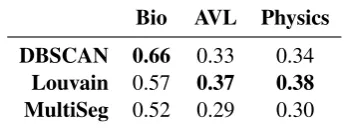
The baseline results are depicted in Table4. In this benchmark, the pipeline approach performs better than the joint model in all datasets. The differences range between 0.04 and 0.14 in B3
score. The DBSCAN clustering approach obtains the best performance in the Biography dataset by a 0.09 margin.The Louvain graph-community de-tection approach obtains the best results in the AVL and Physics datasets with result differences to DBSCAN of 0.04 in both cases.
Table 4: Topic identification baseline results.
Bio AVL Physics
DBSCAN 0.66 0.33 0.34
Louvain 0.57 0.37 0.38 MultiSeg 0.52 0.29 0.30
[image:8.595.329.502.308.372.2]Table5shows the results for different prior con-figurations. In the Biography domain, we observe that the dynamic LMP improves the results of both SLPs; 0.03 and 0.16, for the Beta-Bernoulli and Gamma-Poisson, respectively. In the AVL datasets, three different configurations obtain the best performance. In the Physics dataset, the dy-namic LMP modality Gamma-Poisson SLP per-forms better. In this case, using a modality SLP instead of the dataset affords a 0.11 improvement. Comparing the independent and dynamic LMPs, we see that the former improves the results by 0.05. This shows that both modeling aspects are contributing for the best results.
Table 5: BeamSeg topic identification results.
LMP SLP Scope Bio AVL Physics
Ind
BB D 0.51 0.35 0.36
M – 0.39 0.38
GP D 0.37 0.38 0.35
M – 0.36 0.37
Dyn
BB D 0.54 0.39 0.30
M – 0.32 0.34
GP D 0.53 0.38 0.31
[image:8.595.311.522.615.762.2]Comparing BeamSeg’s best results to the base-line, we observe that it is only outperformed by DBSCAN in the Biography dataset (a 19.7% difference). DBSCAN obtains better results by putting segments it cannot group in individual clusters, which keep the larger clusters clean. In BeamSeg, the number of identified topics (clus-ters) is lower, a 385 difference to DBSCAN, which ends up forcing wrong topic segment assignments. In the AVL dataset, BeamSeg improves the Lou-vain baseline by 5.1%. The topic identification behavior of both approaches is different from the Biography dataset. Louvain only outputs 7 clus-ters whereas the reference has 17 topics. This is related to the topic development aspect across segments, which makes them hard to distinguish. BeamSeg obtains a higherB3 score because it is
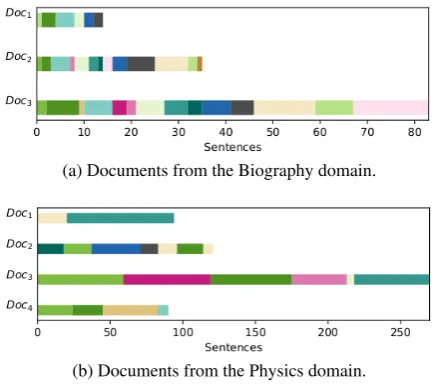
able to identify 15 topics, a number closer to the reference, and, consequently, assign topics more appropriately. In the Physics dataset, BeamSeg improves the baseline by 7.3%. The topic iden-tification patterns are similar to the ones observed in the AVL dataset with BeamSeg outputting more topics than Louvain, 70 and 48 topics, respec-tively. Another observation is that the perfor-mance differences between the Biography and the other datasets are related to the topic structure complexity. In the Biography dataset, there is a tendency for the topic order to persist across docu-ments, whereas in the other datasets the interweav-ing of the topics is not as regular. This is depicted in Figure3, where color changes represent a topic changes and similar topics have the same color. In Figure3a(Biography domain) we can see that the colors sequences in different documents are sim-ilar whereas in Figure3(Physics domain) the se-quence is not constant. Connecting the topic struc-ture differences with the topic order assumptions in BeamSeg explains the performance differences.
5 Conclusions and Future Work
In this work, we propose BeamSeg, an unsuper-vised Bayesian algorithm that jointly segments documents and identifies topical relationships us-ing a beam search procedure to find high likeli-hood segmentations during inference. Relation-ships between topics are modeled using a dynamic prior encoding that word distributions change smoothly in documents with an overarching sub-ject. BeamSeg also models segment length
proper-(a) Documents from the Biography domain.
[image:9.595.308.526.61.257.2](b) Documents from the Physics domain.
Figure 3: Topic identification examples.
ties based on document modality. To evaluate seg-mentation, single and multi-document algorithms were used as a baseline. For topic identification, we compared BeamSeg to MultiSeg, another joint model, as well as a pipeline approach. In both tasks, BeamSeg obtains the best results in two of the datasets used for evaluation. The conclu-sion from the evaluation is that BeamSeg is effec-tive in datasets with prevalent topic development throughout document segments. To achieve the best performance, it is necessary to use a combina-tion of a dynamic LMP with a modality Gamma-Poisson SLP. Therefore, the proposed modeling assumptions fit the data well. This supports the hy-pothesis that lexical cohesion is a cross-document phenomenon and can be used to leverage multi-document segmentation and topic identification.
Regarding future work, one of the concerns is that the proposed inference procedure is a maxi-mum likelihood estimation approach. Ideally, we want to access the full posterior distribution since it finds more accurate parameters. Another con-cern is the raw assumption that there is a shared topic ordering among all documents. We believe that addressing these issues will allow BeamSeg to improve its results and to consistently perform in datasets with different characteristics.
Acknowledgements
References
Charu C. Aggarwal and Chandan K. Reddy, editors. 2014. Data Clustering: Algorithms and Applica-tions. CRC Press.
Alexander A Alemi and Paul Ginsparg. 2015. Text segmentation based on semantic word embeddings.
arXiv e-prints, page arXiv:1503.05543.
Enrique Amig´o, Julio Gonzalo, Javier Artiles, and Felisa Verdejo. 2009. A comparison of extrinsic clustering evaluation metrics based on formal con-straints. Information Retrieval, 12(4):461–486.
Hesam Amoualian, Wei Lu, ´Eric Gaussier, Geor-gios Balikas, Massih-Reza Amini, and Marianne Clausel. 2017. Topical coherence in lda-based mod-els through induced segmentation. InProceedings of the Annual Meeting of the Association for Com-putational Linguistics, pages 1799–1809.
Sebastian Arnold, Rudolf Schneider, Philippe Cudr-Mauroux, Felix A. Gers, and Alexander Lser. 2019. Sector: A neural model for coherent topic segmen-tation and classification. Transactions of the Associ-ation for ComputAssoci-ational Linguistics, 7:169–184.
Arun Balagopalan, Lalitha L. Balasubramanian, Vid-hya Balasubramanian, Nithin Chandrasekharan, and Aswin Damodar. 2012. Automatic keyphrase ex-traction and segmentation of video lectures. In Pro-ceedings of the International Conference on Trans-formations in Engineering Education, pages 152– 162.
Christopher M. Bishop. 2006. Pattern Recognition and Machine Learning. Springer-Verlag, New York.
D. Blei and J. Lafferty. 2006a. Correlated Topic Mod-els. InAdvances in Neural Information Processing Systems, volume 18, pages 147–154. MIT Press.
David M. Blei and John D. Lafferty. 2006b. Dynamic topic models. In Proceedings of the International Conference on Machine Learning, pages 113–120.
David M. Blei, Andrew Y. Ng, and Michael I. Jordan. 2003. Latent dirichlet allocation. Journal of Ma-chine Learning Research, 3:993–1022.
Freddy Y. Y. Choi. 2000. Advances in domain inde-pendent linear text segmentation. InProceedings of the North American Chapter of the Association for Computational Linguistics Conference, pages 26– 33.
Lan Du, Wray L. Buntine, and Mark Johnson. 2013. Topic segmentation with a structured topic model. InProceedings of the North American Chapter of the Association for Computational Linguistics: Human Language Technologies, pages 190–200.
Jacob Eisenstein. 2009. Hierarchical text segmentation from multi-scale lexical cohesion. InProceedings of North American Chapter of the Association for Computational Linguistics, pages 353–361.
Jacob Eisenstein and Regina Barzilay. 2008. Bayesian unsupervised topic segmentation. In Proceedings of the Conference on Empirical Methods in Natural Language Processing, pages 334–343.
Santo Fortunato. 2010. Physics Reports, 486(3-5):75 – 174.
Chris Fournier. 2013. Evaluating text segmentation us-ing boundary edit distance. InProceedings of the Annual Meeting of the Association for Computa-tional Linguistics, pages 1702–1712.
Brendan J. Frey and Delbert Dueck. 2007. Clustering by passing messages between data points. Science, 315(5814):972–976.
Michel Galley, Kathleen McKeown, Eric Fosler-Lussier, and Hongyan Jing. 2003. Discourse seg-mentation of multi-party conversation. In Proceed-ings of the Annual Meeting on Association for Com-putational Linguistics, pages 562–569.
Z. Ghahramani, J. Sung, and S. Bang. 2008. Latent-space variational bayes. IEEE Transactions on Pattern Analysis & Machine Intelligence, 30:2236– 2242.
Michael A.K. Halliday and Ruqaiya Hasan. 1976. Co-hesion in English. Longman, London.
Marti A. Hearst. 1997. Texttiling: Segmenting text into multi-paragraph subtopic passages. Computational Linguistics, 23(1):33–64.
Patrick Jahnichen, Florian Wenzel, Marius Kloft, and Stephan Mandt. 2018. Scalable generalized dy-namic topic models. In Proceedings of the Inter-national Conference on Artificial Intelligence and Statistics, Proceedings of Machine Learning Re-search, pages 1427–1435.
Shoaib Jameel and Wai Lam. 2013. An unsupervised topic segmentation model incorporating word or-der. InProceedings of the International Conference on Research and Development in Information Re-trieval, pages 203–212.
Minwoo Jeong and Ivan Titov. 2010. Multi-document topic segmentation. InProceedings of the Interna-tional Conference on Information and Knowledge Management, pages 1119–1128.
Anna Kazantseva and Stan Szpakowicz. 2011. Linear text segmentation using affinity propagation. In Pro-ceedings of the Conference on Empirical Methods in Natural Language Processing, pages 284–293.
Igor Malioutov and Regina Barzilay. 2006. Minimum cut model for spoken lecture segmentation. In Pro-ceedings of the International Conference on Compu-tational Linguistics and the Annual Meeting of the Association for Computational Linguistics, pages 25–32.
Shervin Malmasi, Mark Dras, Mark Johnson, Lan Du, and Magdalena Wolska. 2017. Unsupervised text segmentation based on native language characteris-tics. InProceedings of the Annual Meeting of the Association for Computational Linguistics, pages 1457–1469. Association for Computational Linguis-tics.
Thomas P. Minka. 2000. Estimating a dirichlet distri-bution. Technical report.
Pedro Mota, Lu´ısa Coheur, and Maxine Esk´enazi. 2018. Efficient navigation in learning materials: An empirical study on the linking process. InArtificial Intelligence in Education, pages 230–235.
Pedro Mota, Maxine Eskenazi, and Lu´ısa Coheur. 2016. Multi-document topic segmentation using bayesian estimation. In Proceedings of the Inter-national Workshop on Semantic Multimedia, pages 443–447.
Koji Murakami, Shouko Masuda, Suguru Matsuyoshi, Eric Nichols, Kentaro Inui, and Yuji Matsumoto. 2009. Annotating semantic relations combining facts and opinions. InProceedings of the Third Lin-guistic Annotation Workshop (LAW III), pages 150– 153. Association for Computational Linguistics.
Lev Pevzner and Marti A. Hearst. 2002. A critique and improvement of an evaluation metric for text seg-mentation. Computational Linguistics, 28(1):19– 36.
Matthew Purver. 2011. Topic segmentation. In Spo-ken Language Understanding: Systems for Extract-ing Semantic Information from Speech, pages 291– 317.
Matthew Purver, Thomas L. Griffiths, Konrad P. K¨ording, and Joshua B. Tenenbaum. 2006. Unsu-pervised topic modelling for multi-party spoken dis-course. InProceedings of the International Confer-ence on Computational Linguistics and the Annual Meeting of the Association for Computational Lin-guistics, pages 17–24.
Dragomir R. Radev, Hongyan Jing, Malgorzata Sty´s, and Daniel Tam. 2004. Centroid-based summariza-tion of multiple documents. Inf. Process. Manage., 40(6):919–938.
Martin Riedl and Chris Biemann. 2012. Topictiling: A text segmentation algorithm based on lda. In Pro-ceedings of Association for Computational Linguis-tics Student Research Workshop, pages 37–42.
Dafna Shahaf, Carlos Guestrin, and Eric Horvitz. 2012. Trains of thought: Generating information maps. In Proceedings of the International Conference on World Wide Web.
Patrick E. Shrout and Joseph L. Fleiss. 1979. Intraclass correlations: Uses in assessing rater reliability. Psy-chological Bulletin.
Liang Wang, Sujian Li, Yajuan Lv, and Houfeng WANG. 2017. Learning to rank semantic coherence for topic segmentation. InProceedings of the Con-ference on Empirical Methods in Natural Language Processing, pages 1340–1344.