E
ff
ect of Shape Memory Heat Treatment on Microstructures and Mechanical
Properties of Powder Metallurgy TiNi Shape Memory Alloy
+1Ryoichi Soba
1,+2, Yukiko Tanabe
1, Takayuki Yonezawa
2, Junko Umeda
2and Katsuyoshi Kondoh
21R&D Center, Terumo Corporation, Ashigarakami-gun, Kanagawa 259-0151, Japan 2Joining and Welding Research Institute, Osaka University, Ibaraki 567-0047, Japan
The shape memory heat treatment effects on the microstructures and mechanical properties of TiNi shape memory alloys fabricated by powder metallurgy (PM) process were investigated in this study. Through the optimization of the shape memory heat treatment conditions, PM TiNi alloy showed a high plateau stress of 454 MPa and good shape recovery of 96.4%in 8%tensile strain applied via the heat treatment at 773 K for 10 min. A longtime heat treatment applied to PM TiNi alloys caused an increase of the amount of Ti3Ni4precipitates in the TiNi matrix, and resulted in the relative decrease of Ni solid solution in the matrix which caused the decrease of the plateau stress.
[doi:10.2320/matertrans.Y-M2018810]
(Received January 29, 2018; Accepted February 13, 2018; Published April 25, 2018)
Keywords: powder metallurgy, TiNi shape memory alloy, precipitation, shape memory heat treatment, martensitic transformation
1. Introduction
As TiNi alloys with superelastic properties have an excellent biocompatibility,1) they are applied to one of the medical devices including guidewires and stents for the cardiac catheterization (Percutaneous Transluminal Coronary Angioplasty).24) The cardiac catheterization is mainly performed by approaching to the treated area via femoral and radial arteries. Trans-radial approaches are sometimes chosen as the invasive treatment,58) because the risk of bleeding complications is possibly reduced comparing with femoral approach and early recovery is postoperatively expected. On the other hand, as the radial artery is thinner than the femoral artery, the downsizings especially for reducing the diameters while maintaining the properties are effective for medical devices including the guidewires and stents. Therefore, the mechanical improvement of the used materials is one of the solutions to downsize the devices. For example, the improved plateau stress of the stents made from TiNi alloys is expected.
In the previous reports, TiNi shape memory alloys were manufactured from pure Ti powder and pure Ni powder by powder metallurgy process.9)In that study, the improvement of mechanical properties such as the plateau stress was reported, and the mechanisms of the high-strengthened expression was elucidated.9)Specifically, the homogenization and solution heat treatment led to more homogeneous structures and compositions, and the shape memory heat treatment resulted in fine Ti3Ni4 precipitates. It was confirmed that precipitation strengthening inhibited slip deformation in TiNi matrix phases during the martensitic transformation, which improved the shape recovery rate compared with TiNi alloys without shape memory heat treatment while the plateau stress decreased comparing with the solution heat-treated materials. In the case of Ti-50.5 at%Ni alloy, the shape recovery rate was 59.6%, which
was not enough to be used as the materials for stents. In addition, the decrease of Ni solution content in the matrix by precipitation of Ni-rich Ti3Ni4 compounds also caused the performance decrement of the devices. Therefore, the precipitation control by the shape memory heat-treated conditions promises to improve both plateau stress and shape recovery rate.
In this study, the TiNi alloys are fabricated by using the pre-mixed TiNi powder, and the effects of the shape memory heat treatment conditions such as the temperature and holding time on the phase transformation behavior, mechanical and super-elastic properties of PM TiNi alloys are investigated through the microstructures evaluation and thermal analysis.
2. Experimental Procedure
In the previous study,9)PM TiNi alloy fabricated by using the elemental mixture of pure Ti and pure Ni powders, having TiNi matrix phases with fine Ti4Ni2O dispersoids, showed dense microstructures without any large pores. In addition, the heat-treated TiNi alloy indicated an enough plateau stress to be possibly used as a shape memory alloy. According to these results, this study also employed the same process conditions used in the previous study9) for spark plasma sintering (SPS), hot extruding, homogenization and solution heat treatment to fabricate the same procedure. The temperature and holding time in the shape memory heat treatment were, however, changed to control the micro-structures by intermetallic compounds precipitation in the matrix. Table 1 shows the average particle diameters and chemical compositions of each pure powder used as the starting materials in this study. To achieve the superelastic properties under room temperature (298 K), Ti-50.5 at%Ni was determined as a standard mixture ratio of Ti powder and Ni powder. The pre-mixed powder was consolidated by SPS at 1323 K for 3.6 ks in vacuum (³6 Pa) by applying 40 MPa pressure. Then, the heat treatment was applied to the sintered billet at 1373 K for 600 s in argon (Ar) gas atmosphere by using an infrared gold image furnace. Hot extrusion process +1This Paper was Originally Published in Japanese in J. Jpn. Soc. Powder
Powder Metallurgy65(2018) 8590.
with an extrusion ratio of 6 was immediately employed to fabricate a full-dense TiNi alloy. The homogenization heat treatment (HHT, temperature at 1273 K and holding time of 720 min in vacuum (³40 Pa), furnace cooling) and the solution heat treatment (SHT, temperature at 1273 K and holding time of 60 min with argon gas flow with 3 l/min, water quenching) were additionally applied to the extruded bars. After these heat treatment processes, the shape memory heat treatment (SMHT, 573 to 773 K of heating temperature, 0 to 240 min of holding time) was finally applied. For the evaluation of the mechanical properties and shape memory characteristics of the above PM TiNi alloys, tension test was performed at room temperature (298«2 K) by using a testing machine (AUTOGRAPH AG-X; Shimadzu Co.). A strain rate of 5.0©10¹4/s was applied, and the round bar test specimens, having 3 mm in diameter and 15 mm in length of the parallel portion, machined along the extrusion direction of the bars were employed. The microstructural observation of the samples was performed by Field Emission Scanning Electron Microscope (FESEM, JSM-6500F; JEOL Ltd.) and Transmission Electron Microscope (TEM, JEM-2100F; JEOL Ltd.). Identification of compound phase and measurement of lattice constant were conducted by using X-ray diffractometer (XRD, XRD-6100; Shimadzu Co.).
3. Results and Discussions
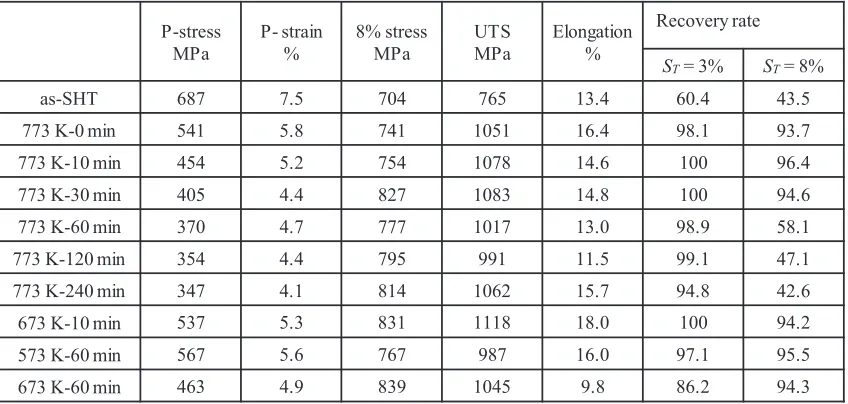
Table 2 shows the mechanical and shape memory properties of PM TiNi alloy after the solution heat treatment and the shape memory heat treatments. The SMHT materials
were applied the holding temperatures 573773 K and the holding time 0240 min. Figure 1 shows the dependence of plateau stress and shape recovery rate on the holding time of the SMHT. After the SMHT temperature at 773 K for 60 min which was the same condition in previous report,9) the plateau stress was 370 MPa. The SMHT condition of the holding time over 60 min led to decrease the plateau stress. On the other hand, the plateau stress on the holding time less than 30 min decreased comparing with the SHT material. But the shorter holding time led to maintain the high plateau stresses. The shape recovery rate on the holding time for 60 min was 58.1%, which was insufficient for application to a stent. The shorter holding time led to improve the shape recovery significantly. After changing the SMHT temperature 573773 K, the plateau stress increased with the lower heat treatment temperature. Therefore, it was confirmed that both the high plateau stress and the high shape recover rate could be achieved by conducting the SMHT at low temperature and in a short time.
[image:2.595.88.512.203.405.2]Figure 2 shows the SEM observation images of PM TiNi alloy after the SMHT at 773 K for the holding time 0 240 min. Under the same condition in previous report,9)the size of Ti3Ni4 precipitates were observed with a length of 50100 nm and an aspect ratio of 816. The amount of Ti3Ni4 precipitates increased with the longer holding time of the SMHT. In the case of the holding time at 240 min, Ti3Ni4 precipitates coarsened with the range of 100950 nm length and 763 aspect ratios. It was considered that increasing the amount of Ti3Ni4 precipitates and coarsening Ti3Ni4 precipitates led to decrease the plateau stress of the SMHT Table 1 Powder characteristics and chemical compositions of pure Ti and pure Ni powders used as starting materials.
materials, because of the decrease of the amount of soluted Ti3Ni4into TiNi matrix. In contrast, Ti3Ni4precipitates were not confirmed by the SEM observation of the material after SMHT on the holding time 030 min, though it was found that both high plateau stress and high shape recovery rate were achieved from the result of hysteresis tests. TEM observation was performed to the PM NiTi alloy after SMHT at 773 K for 10 min. The TEM observation images were shown in Fig. 3. The clear grain boundary was confirmed and ultrafine Ti3Ni4 precipitates with the length 510 nm was observed in this grain boundary. It is conceivable that this small amount of needle-like ultrafine Ti3Ni4precipitates led to improve the shape recovery rate because of suppressing deformation by the slip. Moreover, since the amount of Ti3Ni4 precipitates was very small, the amount of Ni solid solution in matrix phase was maintained. Therefore, the high plateau stresses were obtained. On the other hand, with the material on the holding time 0 min, the precipitation strengthening was not enough because Ti3Ni4 precipitates was small. Thus, both the high plateau stress and the high
shape recovery rate could be achieved by precipitating the needle-like ultrafine Ti3Ni4 under the low temperature and short-time SMHT.
Then, the effect is discussed that the holding time of the SMHT exerted on the plateau stress. The increase of the plateau stress can be attributed to the decrease of martensitic transformation temperature accompanying with increasing the amount of Ni solid solution in the substrate. The relation between the plateau stress (·p) and the martensitic trans-formation temperature (Ms) was described by the Clausius-Clapeyron equation10,11)as the previous report.9)
·P¼µS¾
t ðMSTÞ ð1Þ
Herein, µ, "S and ¾t were density, transformation entropy and transformation strain, respectively. The martensitic transformation temperature (Ms) linearly decreased with the increase of the amount of Ni solid solution and it obtained ¹93.9 K/at%Ni12) per unit the amount of Ni solid solution. Moreover, in this study, when µ"S/¾t equals to 0
100 200 300 400 500 600 700 800
0 100 200 300
Holding time of shape memory heat treatment, t / min
P
lat
eau s
tr
es
s,
σP
/ M
P
a
(a)
As-SHT = 687MPa
䕿773K 䘡673K 䕧573K
0 20 40 60 80 100
0 100 200 300
R
ec
ov
ery
ra
te
,
R
(%
)
Holding time of shape memory heat treatment, t / min (b)
As-SHT = 43.5 %
䕿773K 䘡673K 䕧573K
Fig. 1 Dependence of plateau stress (a) and recovery rate (b) of PM Ti-50.5 at%Ni alloys on holding time of shape memory heat treatment.
(a) (b) (c)
(d) (e) (f)
500 nm 500 nm
500 nm
500 nm
500 nm 500 nm
[image:3.595.95.502.72.240.2] [image:3.595.85.512.287.504.2]¹3.03 MPa/K,11) it can be calculated that the increased amount of the plateau stress per unit the amount of Ni solid solution is 284.5 MPa/at%Ni. The plateau stress of the SHT material decreased to 340 MPa via the SMHT at 773 K for 240 min. Therefore, comparing the theoretical value and the experimental value, it was calculated that the amount of Ni solid solution was decreased by about 1.20 at% via the SMHT. When it was assumed that the amount of decreased Ni solid solution occurred only because of precipitation of Ti3Ni4, it was calculated that the theoretical value related to precipitate Ti3Ni4 was 17.1 vol%. This value shows almost the same amount value of Ti3Ni4 precipitates (13.7 vol%), which was calculated by image analysis (Image-Pro Plus, Media Cybernetics, USA) for the SEM observation of the SMHT material at 773 K and in 240 min shown in Fig. 1. It is conceivable that the decreasing the amount of Ni solid solution in TiNi matrix phase caused by precipitating Ti3Ni4 accompanying with the SMHT.
[image:4.595.87.514.70.209.2]Then, to evaluate the correlation between the SMHT condition and the amount of Ni solid solution in the substrate quantitatively, the relations between the SMHT conditions and the lattice parameter were investigated with XRD. The SHT materials (Ti-50.0³52.0 at%Ni alloys manufactured in previous report) were measured, because it is conceivable that there was no influence of precipitates. The results of diffraction peaks and the lattice parameter calculated by the diffraction peaks are shown in Fig. 4 and Fig. 5, respectively. It was revealed that the diffraction peaks changed to the high-angle peak with the increasing the amount of Ni. The lattice parameter of TiNi matrix phase with the B2 structure was 3.015¡.11) The lattice parameter of TiNi matrix phase showed a linear decreasing with the increasing the amount of Ni solid solution.13)In this study, the slope of the relation between the amount of Ni solid solution and the lattice parameter was approximately ¹0.004¡/at%Ni. From the relational expression of the amount of Ni solid solution and plateau stress ("·P=284.5 MPa/at%Ni), the change amount of the plateau stress per 1¡the lattice parameter was calculated 71.13©103MPa/¡.
Figure 6 and Fig. 7 show the diffraction peaks and the lattice parameter of the SMHT materials at 773 K for various holding times. It was found that the diffraction peaks changed to the low-angle peak with increasing the holding time of SMHT. It was also found that the lattice parameter increased with the holding time of SMHT. In short, it was confirmed
that the amount of Ni solid solution decreased by the SMHT. Moreover, the relation between the lattice parameter of each sample and the plateau stress was shown in Fig. 8. The lattice parameter and the plateau stress have a clear correlation. The slope of the correlation almost agreed with 71.13© 103MPa/¡ calculated from the SMHT materials excluding
10 nm-1
200 nm 10 nm
Grain boundary
(a) (b) (c)
Ti3Ni4
Ti3Ni4(3:4)
Fig. 3 TEM observation images of Ti-50.5 at%Ni alloy after heat treatment at 773 K for 10 min.
(a) (b) (c) (d)
In
te
ns
ity (
a.
u.
)
Diffraction angle, 2θ / degree
41.2 41.6 42.0 42.4 42.8 43.2 43.6
Ti4Ni2O TiNi
Fig. 4 XRD results of Ti-50.0 at%Ni (a), Ti-50.5 at%Ni (b), Ti-51.0 at%Ni (c) and Ti-52.0 at%Ni (d) alloys.
La
tti
ce
p
ar
am
ete
r,
a
/
䊅
3.004 3.006 3.008 3.010
2.998 3.000 3.002
Solute Ni content, [Nis] (at,%)
50 51 52 53 54
[image:4.595.320.534.252.436.2] [image:4.595.334.517.491.663.2]the holding time 240 min. About the SMHT material for 240 min, it was confirmed that there was a martensite phase at room temperature accompanying with decreasing the amount of Ni solid solution from above-mentioned Fig. 5. In the other words, it was conceivable that the plateau stress of the SMHT material for 240 min was not the stress-induced by martensite but the stress to be demanded in rearranging
variants in a martensite phase. From these results, it was concluded that the plateau stress decreased in the region without a martensite phase by the SMHT, because the amount of Ni solid solution relatively decreased in TiNi matrix phase by precipitating Ti3Ni4. Table 3 shows the results of the mean free path, the particle density of Ti3Ni4 precipitates and the shape recovery rate after applying the holding temperature at 773 K and the holding time 60240 min. The mean free path and the particle density were measured by the SEM observation and the shape recovery rate was obtained from the result of the hysteresis test. Increasing the holding time led to an increase of the mean free path of Ti3Ni4precipitates. For instance, the mean free path of the SMHT materials for 240 min shows 75.1 nm. The shape recovery rate was under 95%at 3%strain applied by hysteresis test. This result shows that the slip deformation occurred in the TiNi matrix phase. From these results, the shape recovery rates were decreased by applying the long time heat treatment (more than 60 min), because a mean free path of Ti3Ni4 precipitates was increased. In short, it is conceivable that the slip deformation was occurred, because increasing the mean free path resulted in decreasing the critical stress for the slip.
4. Conclusion
The evaluation of the phase transformation behavior, microstructures and mechanical properties of PM TiNi alloys using pre-mixed powder were carried out to clarify the effects of the temperature and times in the shape memory heat treatment on their mechanical properties. The summaries of this study are shown as follows;
(1) The increase in the holding times of the shape memory heat treatment caused the amount of Ti3Ni4precipitates and their coarsening of PM TiNi alloys.
(2) The increase in the holding times of the shape memory heat treatment caused the amount of Ti3Ni4precipitates and their coarsening of PM TiNi alloys.
(3) The plateau stress decreased with increasing the holding time of SMHT because of the relative decrease of Ni solid solution content in the TiNi matrix due to Ni-rich Ti3Ni4 precipitates. It was also found that the plateau stress was proportional to a lattice constant of TiNi matrix phase.
Acknowledgments
A part of this study was financially supported by development program promoted by Japan Science and Technology Agency (JST), Japan and strategic promotion of innovative research and development (S-innovation), Japan. (a) (b) (c) (d) (e) (f) (g) In te ns ity ( a. u. )
41.2 41.6 42.0 42.4 42.8 43.2 43.6 44.0
Diffraction angle, 2θ / degree
TiNi (B19’) Ti4Ni2O TiNi (B2) Ti3Ni4
Fig. 6 XRD results of Ti-50.5 at%Ni alloy; as-solution heat treatment (a), shape memory heat treatment at 773 K for 0 min (b), 10 min (c), 30 min (d), 60 min (e), 120 min (f ) and 240 min (g).
Holding time, t / min
L at tic e p ara m et er, a /
䊅
SHT 0 10 30 60 120 240
3.004 3.006 3.008 3.010 3.012 3.014
Fig. 7 Lattice parameter of shape memory heat treated TiNi alloys at 773 K with different holding times.
0 100 200 300 400 500 600 700 800 900
3.000 3.005 3.010 3.015
P la te au st re ss, σP / M P a
Lattice parameter, a/ Å 240min
σp= 54.32㽢103MPa/Å+163850
R2= 0.8403
[image:5.595.63.274.72.234.2]Fig. 8 Relationship lattice parameter between plateau stress of shape memory heat treated TiNi alloys.
[image:5.595.305.550.107.172.2] [image:5.595.77.261.290.444.2] [image:5.595.69.268.495.659.2]REFERENCES
1) D.J. Wever, A.G. Veldhuizen, J. de Vries, H.J. Busscher, D.R.A. Uges and J.R. van Horn:Biomaterials19(1998) 761769.
2) T. Duerig, A. Pelton and D. Stockel:Mater. Sci. Eng.273275(1999) 149160.
3) J. Khalil-Allafi, B.A. Ahmadi and M. Zare:Mater. Sci. Eng.30(2010) 11121117.
4) P. Filip, J. Lausmaa, J. Musialek and K. Mazanec:Biomaterials 22 (2001) 21312138.
5) O.F. Bertrand, S.V. Rao, S. Pancholy, S.S. Jolly, J. Rodés-Cabau, É. Larose, O. Costerousse, M. Hamon and T. Mann: Cardiovascular Interventions3(2010) 10221031.
6) D.N. Feldman, R.V. Swaminathan, L.A. Kaltenbach, D.V. Baklanov, L.K. Kim, S.C. Wong, R.M. Minutello, J.C. Messenger, I. Moussa,
K.N. Garratt, R.N. Piana, W.B. Hillegass, M.G. Cohen, I.C. Gilchrist and S.V. Rao:Circulation127(2013) 22952306.
7) Y. Louvard, T. Lefevre, A. Allain and M.C. Morice: Catheter. Cardiovasc. Interv.52(2001) 181187.
8) A.P. Amin, J.A. House, D.M. Safley, A.K. Chhatriwalla, H. Giersiefen, A. Bremer, M. Hamon, D.V. Baklanov, A. Aluko, D. Wohns, D.W. Mathias, R.A. Applegate, D.J. Cohen and S.P. Marso:Cardiovascular Interventions6(2013) 827834.
9) R. Soba, Y. Tanabe, T. Yonezawa, J. Umeda and K. Kondoh:J. Jpn. Soc. Powder Powder Metallurgy64(2017) 589594.
10) K. Otsuka and X. Ren:Prog. Mater. Sci.50(2005) 511678.
11) W. Tang:Metall. Mater. Trans.28(1997) 537544.
12) Y. Shugo, K. Yamauchi, R. Miyagawa and T. Honma: Bull. Res. Inst. Miner. Dress. Metall. (Tohoku Univ.)38(1982) 1120.