A Discriminative Graph-Based Parser
for the Abstract Meaning Representation
Jeffrey Flanigan Sam Thomson Jaime Carbonell Chris Dyer Noah A. Smith
Language Technologies Institute Carnegie Mellon University Pittsburgh, PA 15213, USA
{jflanigan,sthomson,jgc,cdyer,nasmith}@cs.cmu.edu
Abstract
Abstract Meaning Representation (AMR) is a semantic formalism for which a grow-ing set of annotated examples is avail-able. We introduce the first approach to parse sentences into this representa-tion, providing a strong baseline for fu-ture improvement. The method is based on a novel algorithm for finding a maxi-mum spanning, connected subgraph, em-bedded within a Lagrangian relaxation of an optimization problem that imposes lin-guistically inspired constraints. Our ap-proach is described in the general frame-work of structured prediction, allowing fu-ture incorporation of additional feafu-tures and constraints, and may extend to other formalisms as well. Our open-source sys-tem, JAMR, is available at:
http://github.com/jflanigan/jamr
1 Introduction
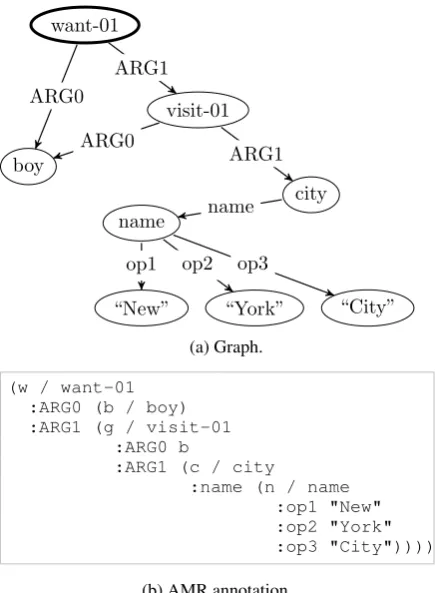
Semantic parsing is the problem of mapping nat-ural language strings into meaning representa-tions. Abstract Meaning Representation (AMR) (Banarescu et al., 2013; Dorr et al., 1998) is a semantic formalism in which the meaning of a sentence is encoded as a rooted, directed, acyclic graph. Nodes represent concepts, and labeled di-rected edges represent the relationships between them–see Figure 1 for an example AMR graph. The formalism is based on propositional logic and neo-Davidsonian event representations (Parsons, 1990; Davidson, 1967). Although it does not encode quantifiers, tense, or modality, the set of semantic phenomena included in AMR were se-lected with natural language applications—in par-ticular, machine translation—in mind.
In this paper we introduce JAMR, the first pub-lished system for automatic AMR parsing. The
system is based on a statistical model whose pa-rameters are trained discriminatively using anno-tated sentences in the AMR Bank corpus (Ba-narescu et al., 2013). We evaluate using the Smatch score (Cai and Knight, 2013), establishing a baseline for future work.
The core of JAMR is a two-part algorithm that first identifiesconceptsusing a semi-Markov model and then identifies the relations that ob-tain between these by searching for themaximum spanning connected subgraph(MSCG) from an
edge-labeled, directed graph representing all pos-sible relations between the identified concepts. To solve the latter problem, we introduce an appar-ently novelO(|V|2log|V|)algorithm that is
sim-ilar to the maximum spanning tree (MST) algo-rithms that are widely used for dependency pars-ing (McDonald et al., 2005). Our MSCG
algo-rithm returns the connected subgraph with maxi-mal sum of its edge weights from among all con-nected subgraphs of the input graph. Since AMR imposes additional constraints to ensure seman-tic well-formedness, we use Lagrangian relaxation (Geoffrion, 1974; Fisher, 2004) to augment the
MSCG algorithm, yielding a tractable iterative
al-gorithm that finds the optimal solution subject to these constraints. In our experiments, we have found this algorithm to converge 100% of the time for the constraint set we use.
The approach can be understood as an alterna-tive to parsing approaches using graph transduc-ers such as (synchronous) hyperedge replacement grammars (Chiang et al., 2013; Jones et al., 2012; Drewes et al., 1997), in much the same way that spanning tree algorithms are an alternative to us-ing shift-reduce and dynamic programmus-ing algo-rithms for dependency parsing.1 While a detailed
1To date, a graph transducer-based semantic
parser has not been published, although the Bolinas toolkit (http://www.isi.edu/publications/ licensed-sw/bolinas/) contains much of the neces-sary infrastructure.
want-01
boy
visit-01
city name
“New” “York” “City” ARG0
ARG1
ARG0 ARG1
name
op1 op2 op3
(a) Graph.
(w / want-01 :ARG0 (b / boy) :ARG1 (g / visit-01
:ARG0 b
:ARG1 (c / city
:name (n / name :op1 "New" :op2 "York" :op3 "City"))))
[image:2.595.72.290.60.357.2](b) AMR annotation.
Figure 1: Two equivalent ways of representing the AMR parse for the sentence, “The boy wants to visit New York City.”
comparison of these two approaches is beyond the scope of this paper, we emphasize that—as has been observed with dependency parsing—a diver-sity of approaches can shed light on complex prob-lems such as semantic parsing.
2 Notation and Overview
Our approach to AMR parsing represents an AMR parse as a graphG = hV, Ei; vertices and edges are given labels from sets LV and LE, respec-tively. G is constructed in two stages. The first stage identifies theconceptsevoked by words and phrases in an input sentencew = hw1, . . . , wni, eachwia member of vocabularyW. The second stage connects the concepts by addingLE-labeled edges capturing the relations between concepts, and selects a root inGcorresponding to thefocus of the sentencew.
Concept identification (§3) involves segmenting w into contiguous spans and assigning to each span a graph fragment corresponding to a concept from a concept set denoted F (or to ∅ for words that evoke no concept). In §5 we describe how
F is constructed. In our formulation, spans are contiguous subsequences ofw. For example, the
words “New York City” can evoke the fragment represented by
(c / city
:name (n / name :op1 "New" :op2 "York" :op3 "City"))))
We use a sequence labeling algorithm to identify concepts.
The relation identification stage (§4) is similar to a graph-based dependency parser. Instead of finding the maximum-scoring tree over words, it finds the maximum-scoring connected subgraph that preserves concept fragments from the first stage, links each pair of vertices by at most one edge, and is deterministic2 with respect to a
spe-cial set of edge labels L∗
E ⊂ LE. The set L∗E consists of the labels ARG0–ARG5, and does not include labels such as MOD or MANNER, for
ex-ample. Linguistically, the determinism constraint enforces that predicates have at most one semantic argument of each type; this is discussed in more detail in§4.
To train the parser, spans of words must be la-beled with the concept fragments they evoke. Al-though AMR Bank does not label concepts with the words that evoke them, it is possible to build an automatic aligner (§5). The alignments are used to construct the concept lexicon and to train the concept identification and relation identifica-tion stages of the parser (§6). Each stage is a discriminatively-trained linear structured predic-tor with rich features that make use of part-of-speech tagging, named entity tagging, and depen-dency parsing.
In §7, we evaluate the parser against gold-standard annotated sentences from the AMR Bank corpus (Banarescu et al., 2013) under the Smatch score (Cai and Knight, 2013), presenting the first published results on automatic AMR parsing.
3 Concept Identification
The concept identification stage maps spans of words in the input sentence w to concept graph fragments fromF, or to the empty graph fragment
∅. These graph fragments often consist of just one labeled concept node, but in some cases they are larger graphs with multiple nodes and edges.3
2By this we mean that, at each node, there is at most one
outgoing edge with that label type.
3About 20% of invoked concept fragments are
Concept identification is illustrated in Figure 2 us-ing our runnus-ing example, “The boy wants to visit New York City.”
Let the concept lexicon be a mapping clex : W∗ → 2F that provides candidate graph frag-ments for sequences of words. (The construc-tion ofF andclex is discussed below.) Formally, a concept labeling is (i) a segmentation of w into contiguous spans represented by boundaries b, giving spanshwb0:b1,wb1:b2, . . .wbk−1:bki, with b0 = 0 and bk = n, and (ii) an assignment of each phrasewbi−1:bi to a concept graph fragment ci ∈clex(wbi−1:bi)∪ ∅.
Our approach scores a sequence of spansband a sequence of concept graph fragmentsc, both of arbitrary lengthk, using the following locally de-composed, linearly parameterized function:
score(b,c;θ) =Pki=1θ>f(w
bi−1:bi, bi−1, bi, ci)
(1) wherefis a feature vector representation of a span and one of its concept graph fragments in context. The features are:
• Fragment given words: Relative frequency es-timates of the probability of a concept graph fragment given the sequence of words in the span. This is calculated from the concept-word alignments in the training corpus (§5).
• Length of the matching span (number of to-kens).
• NER:1 if the named entity tagger marked the span as an entity,0otherwise.
• Bias:1for any concept graph fragment fromF
and0for∅.
Our approach finds the highest-scoring b and c using a dynamic programming algorithm: the zeroth-order case of inference under a semi-Markov model (Janssen and Limnios, 1999). Let
S(i) denote the score of the best labeling of the firstiwords of the sentence,w0:i; it can be calcu-lated using the recurrence:
S(0) = 0 S(i) = max
j:0≤j<i, c∈clex(wj:i)∪∅
n
S(j) +θ>f(w
j:i, j, i, c)
o
The best score will be S(n), and the best scor-ing concept labelscor-ing can be recovered usscor-ing back-pointers, as in typical implementations of the Viterbi algorithm. Runtime isO(n2).
clex is implemented as follows. Whenclex is called with a sequence of words, it looks up the sequence in a table that contains, for every word sequence that was labeled with a concept fragment in the training data, the set of concept fragments it was labeled with. clex also has a set of rules for generating concept fragments for named entities and time expressions. It generates a concept frag-ment for any entity recognized by the named entity tagger, as well as for any word sequence matching a regular expression for a time expression. clex
returns the union of all these concept fragments.
4 Relation Identification
The relation identification stage adds edges among the concept subgraph fragments identified in the first stage (§3), creating a graph. We frame the task as a constrained combinatorial optimization problem.
Consider the fully dense labeled multigraph
D = hVD, EDi that includes the union of all la-beled vertices and lala-beled edges in the concept graph fragments, as well as every possible labeled edgeu−→` v, for allu, v∈VDand every`∈LE.4 We require a subgraphG = hVG, EGithat re-spects the following constraints:
1. Preserving: all graph fragments (including la-bels) from the concept identification phase are subgraphs ofG.
2. Simple: for any two verticesuandv∈VG,EG includes at most one edge betweenuandv. This constraint forbids a small number of perfectly valid graphs, for example for sentences such as “John hurt himself”; however, we see that<1% of training instances violate the constraint. We found in preliminary experiments that including the constraint increases overall performance.5
3. Connected: Gmust be weakly connected (ev-ery vertex reachable from ev(ev-ery other vertex, ig-noring the direction of edges). This constraint follows from the formal definition of AMR and is never violated in the training data.
4. Deterministic: For each nodeu ∈VG, and for each label`∈L∗
E, there is at most one outgoing edge inEGfromuwith label`. As discussed in
§2, this constraint is linguistically motivated. 4To handle numberedOPlabels, we pre-process the
train-ing data to convertOPNtoOP, and post-process the output by
numbering theOPlabels sequentially.
5In future work it might be treated as a soft constraint, or
The boy wants to visit New York City
ø boy want-01 ø visit-01
city
name
“New”
“York”
“City” name op2op1
[image:4.595.72.498.65.155.2]op3
Figure 2: A concept labeling for the sentence “The boy wants to visit New York City.”
One constraint we do not include is acyclicity, which follows from the definition of AMR. In practice, graphs with cycles are rarely produced by JAMR. In fact, none of the graphs produced on the test set violate acyclicity.
Given the constraints, we seek the maximum-scoring subgraph. We define the score to decom-pose by edges, and with a linear parameterization:
score(EG;ψ) =Pe∈EGψ>g(e) (2)
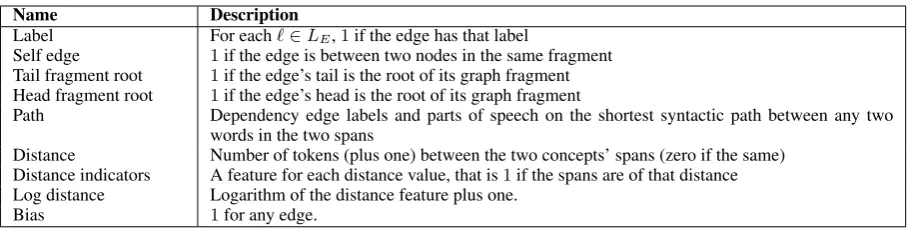
The features are shown in Table 1.
Our solution to maximizing the score in Eq. 2, subject to the constraints, makes use of (i) an al-gorithm that ignores constraint 4 but respects the others (§4.1); and (ii) a Lagrangian relaxation that iteratively adjusts the edge scores supplied to (i) so as to enforce constraint 4 (§4.2).
4.1 Maximum Preserving, Simple, Spanning, Connected Subgraph Algorithm
The steps for constructing a maximum preserving, simple, spanning, connected (but not necessar-ily deterministic) subgraph are as follows. These steps ensure the resulting graph G satisfies the constraints: the initialization step ensures the pre-serving constraint is satisfied, the pre-processing step ensures the graph is simple, and the core al-gorithm ensures the graph is connected.
1. (Initialization) Let E(0) be the union of the
concept graph fragments’ weighted, labeled, di-rected edges. LetV denote its set of vertices. Note thathV, E(0)iis preserving (constraint 4),
as is any graph that contains it. It is also sim-ple (constraint 4), assuming each concept graph fragment is simple.
2. (Pre-processing) We form the edge setEby in-cluding just one edge from ED between each pair of nodes:
• For any edgee=u−→` vinE(0), includeein E, omitting all other edges betweenuandv.
• For any two nodesu andv, include only the highest scoring edge betweenuandv. Note that without the deterministic constraint, we have no constraints that depend on the label of an edge, nor its direction. So it is clear that the edges omitted in this step could not be part of the maximum-scoring solution, as they could be replaced by a higher scoring edge without vi-olating any constraints.
Note also that because we have kept exactly one edge between every pair of nodes,hV, Eiis sim-ple and connected.
3. (Core algorithm) Run Algorithm 1, MSCG, on
hV, Ei and E(0). This algorithm is a (to our
knowledge novel) modification of the minimum spanning tree algorithm of Kruskal (1956). Note that the directions of edges do not matter forMSCG.
Steps 1–2 can be accomplished in one pass through the edges, with runtimeO(|V|2). MSCG
can be implemented efficiently inO(|V|2log|V|)
time, similarly to Kruskal’s algorithm, using a disjoint-set data structure to keep track of con-nected components.6The total asymptotic runtime
complexity isO(|V|2log|V|).
The details ofMSCGare given in Algorithm 1.
In a nutshell,MSCGfirst adds all positive edges to
the graph, and then connects the graph by greedily adding the least negative edge that connects two previously unconnected components.
Theorem 1. MSCG finds a maximum spanning, connected subgraph ofhV, Ei
Proof. We closely follow the original proof of cor-rectness of Kruskal’s algorithm. We first show by induction that, at every iteration of MSCG, there
exists some maximum spanning, connected sub-graph that containsG(i)=hV, E(i)i:
6For dense graphs, Prim’s algorithm (Prim, 1957) is
Name Description
Label For each`∈LE,1if the edge has that label
Self edge 1if the edge is between two nodes in the same fragment Tail fragment root 1if the edge’s tail is the root of its graph fragment Head fragment root 1if the edge’s head is the root of its graph fragment
Path Dependency edge labels and parts of speech on the shortest syntactic path between any two words in the two spans
Distance Number of tokens (plus one) between the two concepts’ spans (zero if the same) Distance indicators A feature for each distance value, that is1if the spans are of that distance Log distance Logarithm of the distance feature plus one.
[image:5.595.72.528.60.176.2]Bias 1for any edge.
Table 1: Features used in relation identification. In addition to the features above, the following conjunctions are used (Tail and Head concepts are elements ofLV): Tail concept∧Label, Head concept∧Label, Path∧Label, Path∧Head concept, Path∧ Tail concept, Path∧Head concept∧Label, Path∧Tail concept∧Label, Path∧Head word, Path∧Tail word, Path∧Head word∧Label, Path∧Tail word∧Label, Distance∧Label, Distance∧Path, and Distance∧Path∧Label. To conjoin the distance feature with anything else, we multiply by the distance.
input : weighted, connected graphhV, Ei
and set of edgesE(0) ⊆Eto be
preserved
output: maximum spanning, connected subgraph ofhV, Eithat preserves
E(0)
letE(1)=E(0)∪ {e∈E|ψ>g(e)>0}; create a priority queueQcontaining
{e∈E |ψ>g(e)≤0}prioritized by scores;
i= 1;
whileQnonempty andhV, E(i)iis not yet
spanning and connecteddo
i=i+ 1;
E(i)=E(i−1);
e= arg maxe0∈Qψ>g(e0);
removeefromQ;
ifeconnects two previously unconnected components ofhV, E(i)ithen
addetoE(i)
end end
returnG=hV, E(i)i;
Algorithm 1:MSCGalgorithm.
Base case: ConsiderG(1), the subgraph
contain-ingE(0) and every positive edge. Take any
maxi-mum preserving spanning connected subgraphM
of hV, Ei. We know that such an M exists
be-cause hV, Ei itself is a preserving spanning con-nected subgraph. Adding a positive edge to M
would strictly increaseM’s score without discon-necting M, which would contradict the fact that
M is maximal. ThusM must containG(1).
Induction step: By the inductive hypothesis, there exists some maximum spanning connected
subgraphM =hV, EMithat containsG(i). Letebe the next edge added toE(i)byMSCG.
Ifeis inEM, thenE(i+1)=E(i)∪ {e} ⊆EM, and the hypothesis still holds.
Otherwise, since M is connected and does not containe,EM∪ {e}must have a cycle containing
e. In addition, that cycle must have some edgee0 that is not in E(i). Otherwise,E(i) ∪ {e} would
contain a cycle, andewould not connect two un-connected components of G(i), contradicting the
fact thatewas chosen byMSCG.
Sincee0is in a cycle inEM ∪ {e}, removing it will not disconnect the subgraph, i.e.(EM∪{e})\
{e0}is still connected and spanning. The score of
eis greater than or equal to the score of e0, oth-erwise MSCGwould have chosene0 instead ofe.
Thus,hV,(EM∪ {e})\ {e0}iis a maximum span-ning connected subgraph that containsE(i+1), and
the hypothesis still holds.
When the algorithm completes,G = hV, E(i)i
is a spanning connected subgraph. The maximum spanning connected subgraph M that contains it cannot have a higher score, because G contains every positive edge. HenceGis maximal.
4.2 Lagrangian Relaxation
If the subgraph resulting fromMSCGsatisfies
con-straint 4 (deterministic) then we are done. Oth-erwise we resort to Lagrangian relaxation (LR). Here we describe the technique as it applies to our task, referring the interested reader to Rush and Collins (2012) for a more general introduction to Lagrangian relaxation in the context of structured prediction problems.
bi-nary variable ze = 1{e ∈ EG}, where 1{P}is the indicator function, taking value1if the propo-sitionP is true,0otherwise. The collection ofze form a vectorz∈ {0,1}|ED|.
Determinism constraints can be encoded as a set of linear inequalities. For example, the con-straint that vertexuhas no more than one outgoing ARG0 can be encoded with the inequality:
X
v∈V
1{u−−−→ARG0 v∈EG}=
X
v∈V
z
u−−−→ARG0 v ≤1.
All of the determinism constraints can collectively be encoded as one system of inequalities:
Az≤b,
with each rowAiinAand its corresponding entry
bi inb together encoding one constraint. For the previous example we have a row Ai that has 1s in the columns corresponding to edges outgoing fromuwith label ARG0 and 0’s elsewhere, and a corresponding elementbi= 1inb.
The score of graph G (encoded as z) can be written as the objective functionφ>z, whereφe = ψ>g(e). To handle the constraintAz≤b, we in-troduce multipliersµ ≥ 0 to get the Lagrangian relaxation of the objective function:
Lµ(z) = maxz(φ>z+µ>(b−Az)),
z∗
µ= arg maxzLµ(z). And the dual objective:
L(z) = min
µ≥0Lµ(z),
z∗ = arg maxzL(z).
Conveniently,Lµ(z)decomposes over edges:
Lµ(z) = maxz(φ>z+µ>(b−Az))
= maxz(φ>z−µ>Az) = maxz((φ−A>µ)>z).
So for anyµ, we can find z∗
µ by assigning edges the new Lagrangian adjusted weights φ−A>µ and reapplying the algorithm described in §4.1. We can findz∗ by projected subgradient descent, by starting with µ = 0, and taking steps in the direction:
−∂Lµ
∂µ (z∗µ) =Az∗µ.
If any components ofµare negative after taking a step, they are set to zero.
L(z) is an upper bound on the unrelaxed ob-jective function φ>z, and is equal to it if and only if the constraints Az ≤ b are satisfied. If
L(z∗) = φ>z∗, thenz∗ is also the optimal solu-tion to the constrained solusolu-tion. Otherwise, there exists a duality gap, and Lagrangian relaxation has failed. In that case we still return the sub-graph encoded by z∗, even though it might vio-late one or more constraints. Techniques from in-teger programming such as branch-and-bound or cutting-planes methods could be used to find an optimal solution when LR fails (Das et al., 2012), but we do not use these techniques here. In our experiments, with a stepsize of 1 and max number of steps as 500, Lagrangian relaxation succeeds 100% of the time in our data.
4.3 Focus Identification
In AMR, one node must be marked as the focus of the sentence. We notice this can be accomplished within the relation identification step: we add a special concept noderootto the dense graphD, and add an edge fromrootto every other node, giving each of these edges the label FOCUS. We
require thatroothave at most one outgoingFO -CUS edge. Our system has two feature types for
this edge: the concept it points to, and the shortest dependency path from a word in the span to the root of the dependency tree.
5 Automatic Alignments
In order to train the parser, we need alignments be-tween sentences in the training data and their an-notated AMR graphs. More specifically, we need to know which spans of words invoke which con-cept fragments in the graph. To do this, we built an automatic aligner and tested its performance on a small set of alignments we annotated by hand.
The automatic aligner uses a set of rules to greedily align concepts to spans. The list of rules is given in Table 2. The aligner proceeds down the list, first aligning named-entities exactly, then fuzzy matching named-entities, then date-entities, etc. For each rule, an entire pass through the AMR graph is done. The pass considers every concept in the graph and attempts to align a concept fragment rooted at that concept if the rule can apply. Some rules only apply to a particular type of concept fragment, while others can apply to any concept. For example, rule 1 can apply to anyNAME
for a sequence of words that exactly matches its
OPchildren and aligns them to the NAMEandOP
children fragment.
Concepts are considered for alignment in the or-der they are listed in the AMR annotation (left to right, top to bottom). Concepts that are not aligned in a particular pass may be aligned in subsequent passes. Concepts are aligned to the first match-ing span, and alignments are mutually exclusive. Once aligned, a concept in a fragment is never re-aligned.7 However, more concepts can be attached
to the fragment by rules 8–14.
We use WordNet to generate candidate lemmas, and we also use a fuzzy match of a concept, de-fined to be a word in the sentence that has the longest string prefix match with that concept’s la-bel, if the match length is≥4. If the match length is<4, then the concept has no fuzzy match. For example the fuzzy match forACCUSE-01 could be
“accusations” if it is the best match in the sen-tence. WordNet lemmas and fuzzy matches are only used if the rule explicitly uses them. All to-kens and concepts are lowercased before matches or fuzzy matches are done.
On the 200 sentences of training data we aligned by hand, the aligner achieves92% preci-sion,89% recall, and90%F1 for the alignments. 6 Training
We now describe how to train the two stages of the parser. The training data for the concept identifi-cation stage consists of(X, Y)pairs:
• Input: X, a sentence annotated with named entities (person, organization, location, mis-ciscellaneous) from the Illinois Named Entity Tagger (Ratinov and Roth, 2009), and part-of-speech tags and basic dependencies from the Stanford Parser (Klein and Manning, 2003; de Marneffe et al., 2006).
• Output: Y, the sentence labeled with concept subgraph fragments.
The training data for the relation identification stage consists of(X, Y)pairs:
7As an example, if “North Korea” shows up twice in
the AMR graph and twice in the input sentence, then the first “North Korea” concept fragment listed in the AMR gets aligned to the first “North Korea” mention in the sentence, and the second fragment to the second mention (because the first span is already aligned when the second “North Korea” concept fragment is considered, so it is aligned to the second matching span).
1.(Named Entity)Applies tonameconcepts and their
opnchildren. Matches a span that exactly matches its
opnchildren in numerical order.
2.(Fuzzy Named Entity)Applies tonameconcepts and theiropn children. Matches a span that matches the fuzzy match of each child in numerical order.
3.(Date Entity) Applies todate-entityconcepts and their day, month, year children (if exist). Matches any permutation of day, month, year, (two digit or four digit years), with or without spaces.
4.(Minus Polarity Tokens)Applies to-concepts, and matches “no”, “not”, “non.”
5. (Single Concept) Applies to any concept. Strips off trailing ‘-[0-9]+’ from the concept (for example
run-01 → run), and matches any exact matching word or WordNet lemma.
6. (Fuzzy Single Concept) Applies to any concept. Strips off trailing ‘-[0-9]+’, and matches the fuzzy match of the concept.
7.(U.S.)Applies tonameif itsop1child isunited
and its op2 child is states. Matches a word that matches “us”, “u.s.” (no space), or “u. s.” (with space). 8.(Entity Type)Applies to concepts with an outgoing
name edge whose head is an aligned fragment. Up-dates the fragment to include the unaligned concept. Ex: continent in (continent :name (name :op1 "Asia"))aligned to “asia.”
9.(Quantity)Applies to.*-quantityconcepts with an outgoing unit edge whose head is aligned. Up-dates the fragment to include the unaligned concept. Ex:
distance-quantityin(distance-quantity :unit kilometer)aligned to “kilometres.” 10. (Person-Of, Thing-Of) Applies to person and
thingconcepts with an outgoing.*-ofedge whose head is aligned. Updates the fragment to include the unaligned concept. Ex: person in (person :ARG0-of strike-02)aligned to “strikers.” 11.(Person)Applies topersonconcepts with a sin-gle outgoing edge whose head is aligned. Updates the fragment to include the unaligned concept. Ex:
person in (person :poss (country :name (name :op1 "Korea")))
12. (Goverment Organization) Applies to concepts with an incoming ARG.*-of edge whose tail is an alignedgovernment-organizationconcept. Up-dates the fragment to include the unaligned concept. Ex:
govern-01 in (government-organization :ARG0-of govern-01)aligned to “government.” 13. (Minus Polarity Prefixes)Applies to - concepts with an incomingpolarityedge whose tail is aligned to a word beginning with “un”, “in”, or “il.” Up-dates the fragment to include the unaligned concept. Ex: -in (employ-01 :polarity -)aligned to “unemployment.”
14. (Degree) Applies to concepts with an incoming
degree edge whose tail is aligned to a word ending is “est.” Updates the fragment to include the unaligned concept. Ex: most in (large :degree most)
aligned to “largest.”
• Input:X, the sentence labeled with graph frag-ments, as well as named enties, POS tags, and basic dependencies as in concept identification.
• Output: Y, the sentence with a full AMR parse.8
Alignments are used to induce the concept label-ing for the sentences, so no annotation beyond the automatic alignments is necessary.
We train the parameters of the stages separately using AdaGrad (Duchi et al., 2011) with the per-ceptron loss function (Rosenblatt, 1957; Collins, 2002). We give equations for concept identifica-tion parameters θ and features f(X, Y). For a sentence of length k, and spansblabeled with a sequence of concept fragmentsc, the features are:
f(X, Y) =Pki=1f(wbi−1:bi, bi−1, bi, ci)
To train with AdaGrad, we process examples in the training data ((X1, Y1), . . . ,(XN, YN))one at a time. At timet, we decode (§3) to getYˆtand compute the subgradient:
st=f(Xt,Yˆt)−f(Xt, Yt)
We then update the parameters and go to the next example. Each componentiof the parameter vec-tor gets updated like so:
θt+1
i =θti−qPtη t0=1sti0
st i
η is the learning rate which we set to 1. For relation identification training, we replace θ and
f(X, Y)in the above equations withψand
g(X, Y) =Pe∈EGg(e).
We ran AdaGrad for ten iterations for concept identification, and five iterations for relation iden-tification. The number of iterations was chosen by early stopping on the development set.
7 Experiments
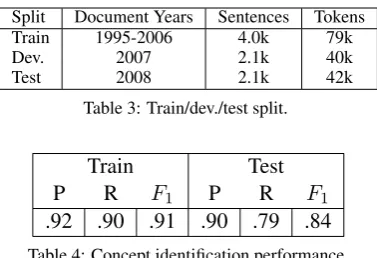
We evaluate our parser on the newswire section of LDC2013E117 (deft-amr-release-r3-proxy.txt). Statistics about this corpus and our train/dev./test splits are given in Table 3.
8Because the alignments are automatic, some concepts
may not be aligned, so we cannot compute their features. We remove the unaligned concepts and their edges from the full AMR graph for training. Thus some graphs used for training may in fact be disconnected.
Split Document Years Sentences Tokens
Train 1995-2006 4.0k 79k
Dev. 2007 2.1k 40k
Test 2008 2.1k 42k
Table 3: Train/dev./test split.
Train Test
P R F1 P R F1
[image:8.595.322.511.59.188.2].92 .90 .91 .90 .79 .84
Table 4: Concept identification performance.
For the performance of concept identification, we report precision, recall, andF1of labeled spans
using the induced labels on the training and test data as a gold standard (Table 4). Our concept identifier achieves 84%F1 on the test data.
Pre-cision is roughly the same between train and test, but recall is worse on test, implicating unseen con-cepts as a significant source of errors on test data.
We evaluate the performance of the full parser using Smatch v1.0 (Cai and Knight, 2013), which counts the precision, recall andF1of the concepts
and relations together. Using the full pipeline (concept identification and relation identification stages), our parser achieves 58% F1 on the test
data (Table 5). Using gold concepts with the re-lation identification stage yields a much higher Smatch score of80%F1. As a comparison, AMR
Bank annotators have a consensus inter-annotator agreement Smatch score of83%F1. The runtime
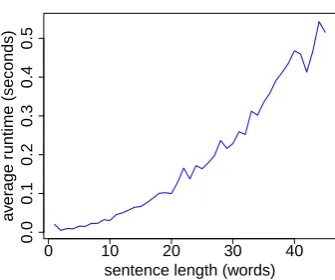
of our system is given in Figure 3.
The large drop in performance of22%F1when
moving from gold concepts to system concepts suggests that joint inference and training for the two stages might be helpful.
8 Related Work
Our approach to relation identification is inspired by graph-based techniques for non-projective syn-tactic dependency parsing. Minimum span-ning tree algorithms—specifically, the optimum branching algorithm of Chu and Liu (1965) and Edmonds (1967)—were first used for dependency parsing by McDonald et al. (2005). Later
ex-Train Test
concepts P R F1 P R F1
[image:8.595.313.520.687.745.2]gold .85 .95 .90 .76 .84 .80 automatic .69 .78 .73 .52 .66 .58
0 10 20 30 40
0.0
0.1
0.2
0.3
0.4
0.5
sentence length (words)
a
v
er
age r
[image:9.595.98.266.76.216.2]untime (seconds)
Figure 3: Runtime of JAMR (all stages).
tensions allow for higher-order (non–edge-local) features, often making use of relaxations to solve the NP-hard optimization problem. Mcdonald and Pereira (2006) incorporated second-order features, but resorted to an approximate algorithm. Oth-ers have formulated the problem as an integer lin-ear program (Riedel and Clarke, 2006; Martins et al., 2009). TurboParser (Martins et al., 2013) uses AD3 (Martins et al., 2011), a type of augmented
Lagrangian relaxation, to integrate third-order fea-tures into a CLE backbone. Future work might ex-tend JAMR to incorporate additional linguistically motivated constraints and higher-order features.
The task of concept identification is similar in form to the problem of Chinese word segmenta-tion, for which semi-Markov models have success-fully been used to incorporate features based on entire spans (Andrew, 2006).
While all semantic parsers aim to transform nat-ural language text to a formal representation of its meaning, there is wide variation in the mean-ing representations and parsmean-ing techniques used. Space does not permit a complete survey, but we note some connections on both fronts.
Interlinguas (Carbonell et al., 1992) are an im-portant precursor to AMR. Both formalisms are intended for use in machine translation, but AMR has an admitted bias toward the English language. First-order logic representations (and exten-sions using, e.g., the λ-calculus) allow variable quantification, and are therefore more power-ful. In recent research, they are often associ-ated with combinatory categorial grammar (Steed-man, 1996). There has been much work on sta-tistical models for CCG parsing (Zettlemoyer and Collins, 2005; Zettlemoyer and Collins, 2007; Kwiatkowski et al., 2010,inter alia), usually using
chart-based dynamic programming for inference. Natural language interfaces for querying databases have served as another driving applica-tion (Zelle and Mooney, 1996; Kate et al., 2005; Liang et al., 2011, inter alia). The formalisms used here are richer in logical expressiveness than AMR, but typically use a smaller set of concept types—only those found in the database.
In contrast, semantic dependency parsing—in which the vertices in the graph correspond to the words in the sentence—is meant to make semantic parsing feasible for broader textual domains. Al-shawi et al. (2011), for example, use shift-reduce parsing to map sentences to natural logical form.
AMR parsing also shares much in common with tasks like semantic role labeling and frame-semantic parsing (Gildea and Jurafsky, 2002; Pun-yakanok et al., 2008; Das et al., 2014,inter alia). In these tasks, predicates are often disambiguated to a canonical word sense, and roles are filled by spans (usually syntactic constituents). They consider each predicate separately, and produce a disconnected set of shallow predicate-argument structures. AMR, on the other hand, canonical-izes both predicates and arguments to a common concept label space. JAMR reasons about all con-cepts jointly to produce a unified representation of the meaning of an entire sentence.
9 Conclusion
We have presented the first published system for automatic AMR parsing, and shown that it pro-vides a strong baseline based on the Smatch eval-uation metric. We also present an algorithm for finding the maximum, spanning, connected sub-graph and show how to incorporate extra con-straints with Lagrangian relaxation. Our feature-based learning setup allows the system to be easily extended by incorporating new feature sources.
Acknowledgments
References
Hiyan Alshawi, Pi-Chuan Chang, and Michael Ring-gaard. 2011. Deterministic statistical mapping of sentences to underspecified semantics. InProc. of ICWS.
Galen Andrew. 2006. A hybrid markov/semi-markov conditional random field for sequence segmentation. InProc. of EMNLP.
Laura Banarescu, Claire Bonial, Shu Cai, Madalina Georgescu, Kira Griffitt, Ulf Hermjakob, Kevin Knight, Philipp Koehn, Martha Palmer, and Nathan Schneider. 2013. Abstract meaning representation for sembanking. InProc. of the Linguistic Annota-tion Workshop and Interoperability with Discourse.
Shu Cai and Kevin Knight. 2013. Smatch: an eval-uation metric for semantic feature structures. In
Proc. of ACL.
Jaime G. Carbonell, Teruko Mitamura, and Eric H. Ny-berg. 1992. The KANT perspective: A critique of pure transfer (and pure interlingua, pure trans-fer, . . . ). InProc. of the Fourth International Con-ference on Theoretical and Methodological Issues in Machine Translation: Empiricist vs. Rationalist Methods in MT.
David Chiang, Jacob Andreas, Daniel Bauer, Karl Moritz Hermann, Bevan Jones, and Kevin Knight. 2013. Parsing graphs with hyperedge replacement grammars. InProc. of ACL.
Y. J. Chu and T. H. Liu. 1965. On the shortest arbores-cence of a directed graph. Science Sinica, 14:1396– 1400.
Michael Collins. 2002. Discriminative training meth-ods for hidden Markov models: Theory and ex-periments with perceptron algorithms. In Proc. of EMNLP.
Dipanjan Das, Andr´e F. T. Martins, and Noah A. Smith. 2012. An exact dual decomposition algorithm for shallow semantic parsing with constraints. InProc. of the Joint Conference on Lexical and Computa-tional Semantics.
Dipanjan Das, Desai Chen, Andr´e F. T. Martins, Nathan Schneider, and Noah A. Smith. 2014. Frame-semantic parsing. Computational Linguis-tics, 40(1):9–56.
Donald Davidson. 1967. The logical form of action sentences. In Nicholas Rescher, editor,The Logic of Decision and Action, pages 81–120. Univ. of Pitts-burgh Press.
Marie-Catherine de Marneffe, Bill MacCartney, and Christopher D. Manning. 2006. Generating typed dependency parses from phrase structure parses. In
Proc. of LREC.
Bonnie Dorr, Nizar Habash, and David Traum. 1998. A thematic hierarchy for efficient generation from lexical-conceptual structure. In David Farwell, Lau-rie Gerber, and Eduard Hovy, editors, Machine Translation and the Information Soup: Proc. of AMTA.
Frank Drewes, Hans-J¨org Kreowski, and Annegret Ha-bel. 1997. Hyperedge replacement graph gram-mars. InHandbook of Graph Grammars, pages 95– 162. World Scientific.
John Duchi, Elad Hazan, and Yoram Singer. 2011. Adaptive subgradient methods for online learning and stochastic optimization. Journal of Machine Learning Research, 12:2121–2159, July.
Jack Edmonds. 1967. Optimum branchings. National Bureau of Standards.
Marshall L. Fisher. 2004. The Lagrangian relaxation method for solving integer programming problems.
Management Science, 50(12):1861–1871.
Arthur M Geoffrion. 1974. Lagrangean relaxation for integer programming. Springer.
Daniel Gildea and Daniel Jurafsky. 2002. Automatic labeling of semantic roles. Computational Linguis-tics, 28(3):245–288.
Jacques Janssen and Nikolaos Limnios. 1999. Semi-Markov Models and Applications. Springer, Octo-ber.
Bevan Jones, Jacob Andreas, Daniel Bauer, Karl Moritz Hermann, and Kevin Knight. 2012. Semantics-based machine translation with hyper-edge replacement grammars. InProc. of COLING.
Rohit J. Kate, Yuk Wah Wong, and Raymond J. Mooney. 2005. Learning to transform natural to formal languages. InProc. of AAAI.
Dan Klein and Christopher D. Manning. 2003. Accu-rate unlexicalized parsing. InProc. of ACL.
Joseph B. Kruskal. 1956. On the shortest spanning subtree of a graph and the traveling salesman prob-lem. Proc. of the American Mathematical Society, 7(1):48.
Tom Kwiatkowski, Luke Zettlemoyer, Sharon Goldwa-ter, and Mark Steedman. 2010. Inducing probabilis-tic CCG grammars from logical form with higher-order unification. InProc. of EMNLP.
Percy Liang, Michael I. Jordan, and Dan Klein. 2011. Learning dependency-based compositional seman-tics. InProc. of ACL.
Andr´e F. T. Martins, Noah A. Smith, Pedro M. Q. Aguiar, and M´ario A. T. Figueiredo. 2011. Dual decomposition with many overlapping components. InProc. of EMNLP.
Andr´e F. T. Martins, Miguel Almeida, and Noah A. Smith. 2013. Turning on the turbo: Fast third-order non-projective Turbo parsers. InProc. of ACL. Ryan Mcdonald and Fernando Pereira. 2006. Online
learning of approximate dependency parsing algo-rithms. InProc. of EACL, page 81–88.
Ryan McDonald, Fernando Pereira, Kiril Ribarov, and Jan Hajiˇc. 2005. Non-projective dependency pars-ing uspars-ing spannpars-ing tree algorithms. In Proc. of EMNLP.
Terence Parsons. 1990.Events in the Semantics of En-glish: A study in subatomic semantics. MIT Press. Robert C. Prim. 1957. Shortest connection networks
and some generalizations. Bell System Technology Journal, 36:1389–1401.
Vasin Punyakanok, Dan Roth, and Wen-tau Yih. 2008. The importance of syntactic parsing and inference in semantic role labeling. Computational Linguistics, 34(2):257–287.
Lev Ratinov and Dan Roth. 2009. Design challenges and misconceptions in named entity recognition. In
Proc. of CoNLL.
Sebastian Riedel and James Clarke. 2006. Incremental integer linear programming for non-projective de-pendency parsing. InProc. of EMNLP.
Frank Rosenblatt. 1957. The perceptron–a perceiving and recognizing automaton. Technical Report 85-460-1, Cornell Aeronautical Laboratory.
Alexander M. Rush and Michael Collins. 2012. A tutorial on dual decomposition and Lagrangian re-laxation for inference in natural language process-ing. Journal of Artificial Intelligence Research, 45(1):305—-362.
Mark Steedman. 1996.Surface structure and interpre-tation. Linguistic inquiry monographs. MIT Press. John M. Zelle and Raymond J. Mooney. 1996.
Learn-ing to parse database queries usLearn-ing inductive logic programming. InProc. of AAAI.
Luke S. Zettlemoyer and Michael Collins. 2005. Learning to map sentences to logical form: Struc-tured classification with probabilistic categorial grammars. InProc. of UAI.