C o m b i n i n g Trigram and W i n n o w in Thai O C R Error Correction
Surapant M e k n a v i n
National Electronics a n d C o m p u t e r Technology C e n t e r
73/1
R a m a VI Road, R a j t h e v i , Bangkok, T h a i l a n ds u r a p a n @ n e c t e c . o r . t h
B o o n s e r m K i j s i r i k u l , A n a n l a d a C h o t i m o n g k o l a n d C h o l w i c h N u t t e e D e p a r t m e n t of C o m p u t e r E n g i n e e r i n g
C h u l a l o n g k o r n University, T h a i l a n d [email protected]
A b s t r a c t
For languages that have no explicit word bound- ary such as Thai, Chinese and Japanese, cor- recting words in text is harder than in English because of additional ambiguities in locating er- ror words. The traditional m e t h o d handles this by hypothesizing that every substrings in the input sentence could be error words and trying to correct all of them. In this paper, we pro- pose the idea of reducing the scope of spelling correction by focusing only on dubious areas in the input sentence. Boundaries of these dubious areas could be obtained approximately by ap- plying word segmentation algorithm and finding word sequences with low probability. To gener- ate the candidate correction words, we used a modified edit distance which reflects the charac- teristic of Thai O C R errors. Finally, a part-of- speech trigram model and Winnow algorithm are combined to determine the most probable correction.
1
I n t r o d u c t i o n
Optical character recognition (OCR) is useful in a wide range of applications, such as office a u t o m a t i o n and information retrieval system. However, O C R in Thailand is still not widely used, partly because existing Thai OCRs are not quite satisfactory in terms of accuracy. Re- cently, several research projects have focused on spelling correction for many types of errors in- cluding those from O C R (Kukich, 1992). Nev- ertheless, the strategy is slightly different from language to language, since the characteristic of each language is different.
Two characteristics of Thai which make the task of error correction different from those of
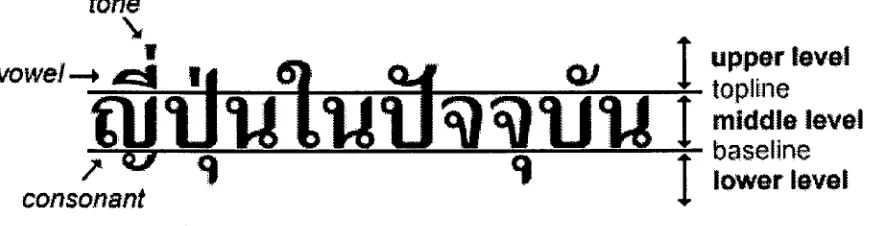
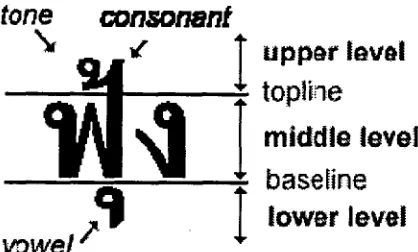
other languages are: (1) there is no explicit word boundary, and (2) characters are written in three levels; i.e., the middle, the u p p e r and the lower levels. In order to solve the prob- lem of O C R error correction, the first task is usually to detect error strings in the input sen- tence. For languages that have explicit word boundary such as English in which each word is separated from the others by white spaces, this task is comparatively simple. If the tok- enized string is not found in the dictionary, it could be an error string or an unknown word. However, for the languages that have no ex- plicit word boundary such as Chinese, Japanese and Thai, this task is much more complicated. Even without errors from OCR, it is difficult to determine word boundary in these languages. T h e situation gets worse when noises are intro- duced in the text. T h e existing approach for correcting the spelling error in the languages that have no word boundary assumes that all substrings in input sentence are error strings, and then tries to correct t h e m (Nagata, 1996). This is computationally expensive since a large portion of the input sentence is correct. T h e other characteristic of Thai writing system is that we have many levels for placing Thai char- acters and several characters can occupy more than one level. These characters are easily con- nected to other characters in the u p p e r or lower level. These connected characters cause diffi- culties in the process of character segmentation which then cause errors in Thai OCR.
tone
w
! upper level
middle level
baseline
? @.I
I
lower level
consonant
Figure 1: No explicit word delimiter in Thai
feature-based approaches are very effective for solving this problem.
In this paper, a hybrid m e t h o d for Thai O C R error correction is proposed. The m e t h o d com- bines the part-of-speech (POS) trigram model with a feature-based model. First, the POS tri- gram model is employed to correct non-word as well as real-word errors. In this step, the num- ber of non-word errors are mostly reduced, but some real-word errors still remain because the POS trigram model cannot capture some use- ful features in discriminating candidate words. A feature-based approach using Winnow algo- r i t h m is t h e n applied to correct the remaining errors. In order to overcome the expensive com- p u t a t i o n cost of the existing approach, we pro- pose the idea of reducing the scope of correc- tion by using word segmentation algorithm to find the approximate error strings from the in- put sentence. T h o u g h the word segmentation algorithm cannot give the accurate b o u n d a r y of an error string, m a n y of t h e m can give clues of u n k n o w n strings which m a y be error strings. We can use this information to reduce the scope of correction from entire sentence to a more nar- row scope. Next, to capture the characteristic of Thai O C R errors, we have defined the modi- fied edit distance and use it to enumerate plau- sible candidates which deviate from the word in question within k-edit distance.
2 Problems of Thai O C R
T h e problem of O C R error correction can be defined as : given the string of characters S = c l c 2 . . . c n produced by OCR, find the word sequence W -- w l w 2 . . , w~ t h a t maximizes
the probability P ( W I S ). Before describing the methods used to model P ( W I S ) , below we list some main characteristics of T h a i that poses dif- ficulties for correcting Thai O C R error.
• Words are written consecutively without word b o u n d a r y delimiters such as white space characters. For example, the phrase "r~u~u~lJU" ( J a p a n at present) in Figure 1, actually consists of three words: "~du" (Japan), '%" (at), and " ~ u " (present). Therefore, Thai O C R error correction has to overcome word b o u n d a r y ambiguity as well as select the most probable correction candidate at the same time. This is similar to the problem of Connected Speech Recog- nition and is sometimes called Connected Text Recognition (Ingels, 1996).
[image:2.612.85.521.95.208.2]tone
consonant
=i
vowel
2
I upper
toplhe
I middle level
baseline
I lower level
Figure 2: Three levels for placing Thai charac- ters
3 O u r M e t h o d s
3.1 T r i g r a m M o d e l
To find W that maximizes
P(WIS),
we can use the P O S trigram model as follows.arg mwax
P(WIS )
= argmwaxP(W)P(SlW)/P(S )
(1)= argmwaxP(W)P(S[W )
(2)T h e probability
P(W)
is given by the lan- guage model and can be estimated by the tri- gram model as:P(W) = P(W, T) = H P(ti] ti-2,ti-1)P(wilti)
(3)
P(SIW )
is the characteristics of specific OCR, and can be estimated by collecting sta- tistical information from original text and the text produced by OCR. We assume that given the original word sequence W composed of char- actersvlv2... Vm,
O C R produces the sequence as stringS (= ctc2.., an)
by repeatedly apply- ing the following operation: substitute a char- acter with another; insert a character; or delete a character. Let Si be the /-prefix of S that is formed by first character to t h e / - c h a r a c t e r ofS (= clc2...ci),
and similarly Wj is the j- prefix of W ( =vlv2.., vj).
Using dynamic pro- gramming technique, we can calculateP(SIW )
(=
P(SnlWm))
by the following equation:P(SiIWj) = max(P(Si_llWj) * P(ins(ci)),
P(SilWj_I) • P(del(vj)),
P(Si-llW -l)
• P(cilv )) (4)
where
P(ins(c)), P(del(v))
andP(clv )
are the probabilities that letter c is inserted, letter v is deleted and letter v is substituted with c, re- spectively.One m e t h o d to do O C R error correction us- ing the above model is to hypothesize all sub- strings in the input sentence as words (Nagata, 1996). Both words in the dictionary that ex- actly match with the substrings and those that approximately match are retrieved. To cope with unknown words, all other substrings not matched must also be considered. T h e word lattice is then scanned to find the N - b e s t word sequences as correction candidates. In general, this m e t h o d is perfectly good, except in one as- pect: its time complexity. Because it generates a large number of hypothesized words and has to find the best combination among them, it is very slow.
3.2 S e l e c t i v e T r i g r a m M o d e l
To alleviate the above problem, we try to reduce the number of hypothesized words by generat- ing t h e m only when needed. Having analyzed the O C R output, we found that a large por- tion of input sentence are correctly recognized and need no approximation. Therefore, instead of hypothesizing blindly through the whole sen- tence, if we limit our hypotheses to only dubious areas, we can save considerable a m o u n t of time. Following is our algorithm for correcting O C R output.
.
.
F i n d d u b i o u s areas: Find all substrings in the input sentence that exactly match words in the dictionary. Each substring may overlap with others. T h e remaining parts of sentence which are not covered by any of these substrings are considered as dubious areas.
M a k e h y p o t h e s e s for n o n w o r d s a n d u n k n o w n words:
[image:3.612.87.296.95.221.2]case, the unknown word and its sur- rounding known words are combined together, resulting in "in/ormatjon" as
a new unknown string.
(b) For each unknown string obtained form 2(a), apply the candidate genera- tion routine to generate approximately matched words within k-edit distance. The value of k is varied proportionally to the length of candidate word.
(c) All substrings except for ones that violate Thai spelling rules, i.e., lead by non-leading character, are hypoth- esized as unknown words.
3. F i n d g o o d w o r d s e q u e n c e s : Find the N-best word sequences according to equation (2). For unknown words, P(wilUnknown word) is computed by us- ing the unknown word model in (Nagata, 1996).
4. M a k e h y p o t h e s e s for r e a l - w o r d er- r o r : For each word wi in N-best word sequence where the local probabilities
P ( w i - 1 , wi, wi+l,
ti-1,
ti, ti+l) are below a threshold, generate candidate words by ap- plying the process similar to step 2 except that the nonword in step 2 is replaced with the word wi. Find the word sequences whose probabilities computed by equation (2) are better t h a n original ones.5. F i n d t h e N - b e s t w o r d s e q u e n c e s : From all word sequences obtained from step 4, select the N-best ones.
T h e candidate generation routine uses a mod- ification of the standard edit distance and em- ploys the error-tolerant finite-state recognition
algorithm (Oflazer, 1996) to generate candidate words. T h e modified edit distance allows ar- bitrary number of insertion a n d / o r deletion of upper level and lower level characters, but al- lows no insertion or deletion of the middle level characters. In the middle level, it allows only k substitution. This is to reflect the characteristic of Thai O C R which, 1. tends to merge several characters into one when the character which spans two levels are adjacent to characters in the upper and lower level, and 2. rarely causes insertion and deletion errors in the middle level. For example, applying the candidate generation
routine with 1 edit distance to the string " ~ " gives the set of candidates { ~ . ~ , ~ . ~ , ~,~, ~ ,
From our experiments, we found that the se- lective trigram model can deal with nonword errors fairly well. However, the model is not enough to correct real-word errors as well as words with the same part of speech. This is because the POS trigram model considers only coarse information of POS in a fixed restricted range of context, some useful information such as specific word collocation may be lost. Using word N-gram could recover some word-level in- formation but requires an extremely large cor- pus to estimate all parameters accurately and consumes vast space resources to store the huge word N-gram table. In addition, the model losses generalized information at the level of POS.
For English, a number of methods have been proposed to cope with real-word errors in spelling correction (Golding, 1995; Golding and Roth, 1996; Golding and Schabes, 1993; Tong and Evans, 1996). Among them, the feature- based methods were shown to be superior to other approaches. This is because the methods can combine several kinds of features to deter- mine the appropriate word in a given context. For our task, we adopt a feature-based algo- rithm called Winnow. There are two reasons why we select Winnow. First, it has been shown to be the best performer in English context- sensitive spelling correction (Golding and Roth, 1996). Second, it was shown to be able to han- dle difficult disambiguation tasks in Thai (Mek- navin et al.~ 1997).
Below we describe Winnow algorithm that is used for correcting real-word error.
3.3 W i n n o w A l g o r i t h m 3.3.1 T h e a l g o r i t h m
A Winnow algorithm used in our experiment is the algorithm described in (Blum, 1997). Win- now is a multiplicative weight updating and in- cremental algorithm (Littlestone, 1988; Golding and Roth, 1996). The algorithm is originally de- signed for learning two-class (positive and neg- ative class) problems, and can be extended to multiple-class problems as shown in Figure 3.
Let V h . . . , vm be the values of the target concept to be learned, and xi be the prediction of the /-specialist.
1. Initialize the weights w x , . . . , Wn of all the specialists to 1. 2. F o r E a c h example x = { x l , . . . , Xn} D o
(a) Let V be the value of the target concept of the example.
(b) O u t p u t ~)j = arg maxvie{vl,...,v,,,} ~'~i:xi=v i Wi (c) If the algorithm makes a mistake (~)j ~ V), then:
i. for each xi equal to V, wi is u p d a t e d to wi • o~
ii. for each xi equal to ¢~j, wi is u p d a t e d to wi •
where, c~ > 1 a n d / 3 < 1 are promotion parameter and demotion parameter, and are set to 3/2 and 1/2, respectively.
Figure 3: The Winnow algorithm for learning multiple-class concept.
predicts xi as the value of the target concept. T h e basic idea of the algorithm is t h a t to ex- tract some useful unknown features, the algo- r i t h m asks for opinions from all specialists, each of w h o m has his own specialty on one feature, and t h e n makes a global prediction based on a weighted m a j o r i t y vote over all those opinions as described in Step 2-(a) of Figure 3. In our ex- periment, we have each specialist examine one or two attributes of an example. For example, a specialist m a y predict the value of the target concept by checking for the pairs " ( a t t r i b u t e l ---- valuel) and (attribute2 = value2)". These pairs are candidates of features we are trying to extract.
A specialist only makes a prediction if its con- dition " ( a t t r i b u t e l = valuel)" is true in case of one attribute, or b o t h of its conditions "(at- t r i b u t e l -- value1) and (attibute2 -- value2)" are true in case of two attributes, and in that case it predicts the most popular outcome out of the last k times it had the chance to predict. A specialist m a y choose to abstain instead of giv- ing a prediction on any given example in case t h a t it did not see the same value of an attribute in the example. In fact, we m a y have each spe- cialist examines more t h a n two attributes, but for the sake of simplification of preliminary ex- periment, let us assume t h a t two attributes for each specialist are enough to learn the target concept.
T h e global algorithm updates the weight wi
of a n y specialist based on the vote of t h a t spe- cialist. T h e weight of any specialist is initialized
to 1. In case that the global algorithm predicts incorrectly, the weight of the specialist t h a t pre- dicts incorrectly is halved and the weight of the specialist that predicts correctly is multiplied by 3/2. This weight u p d a t i n g m e t h o d is the same as the one used in (Blum, 1997). T h e advan- tage of Winnow, which m a d e us decide to use for our task, is t h a t it is not sensitive to e x t r a irrelevant features (Littlestone, 1988).
3.3.2 Constructing Confusion Set and Defining Features
To employ Winnow in correcting O C R er- rors, we first define k-edit distance confusion set. A k-edit distance confusion set S = {c, w l , w 2 , . . . , Wn} is composed of one centroid word c and words w l , w 2 , . . . , Wn generated by applying the candidate generation routine with m a x i m u m k modified edit distance to the cen- troid word. If a word c is p r o d u c e d by O C R o u t p u t or by the previous step, t h e n it m a y be corrected as w l , w 2 , . . . , W n or c itself. For ex- ample, suppose t h a t the centroid word is know,
then all possible words in 1-edit distance con- fusion set are {know, knob, knop, knot, knew, enow, snow, known, now}. Furthermore, words with probability lower t h a n a threshold are ex- cluded from the set. For example, if a specific O C R has low probability of substituting t with
presence of a particular word within ÷ / - M words of the target word, and collocations test for a pattern of up to L contiguous words and/or part-of-speech tags around the target word. In our experiment M and L is set to 10 and 2, respectively. Examples of features for discrimi- nating between s n o w and k n o w include:
(1) I {know, snow}
(2) winter within ÷10 words
where (1) is a collocation that tends to imply
know, and (2) is a context-word that tends to imply snow. Then the algorithm should extract the features ("word within ÷10 words of the target word" = "winter") as well as ("one word before the target word" -- 'T') as useful features by assigning them with high weights.
3.3.3 U s i n g t h e N e t w o r k t o R a n k S e n t e n c e s
After networks of k-edit distance confusion sets are learned by Winnow, the networks are used to correct the N-best sentences received from POS trigram model. For each sentence, every real word is evaluated by the network whose the centroid word is that real word. The network will then output the centroid word or any word in the confusion set according to the context. After the most probable word is determined, the confidence level of that word will be calculated. Since every specialist has weight voting for the target word, we can consider the weight as con- fidence level of that specialist for the word. We define the confidence level of any word as all weights that vote for that word divided by all weights in the network. Based on the confidence levels of all words in the sentence, the average of them is taken as the confidence level of the sentence. The N-best sentences are then re- ranked according to the confidence level of the sentences.
4 E x p e r i m e n t s
We have prepared the corpus containing about 9,000 sentences (140,000 words, 1,300,000 char- acters) for evaluating our methods. The corpus is separated into two parts; the first part con- taining about 80 % of the whole corpus is used as a training set for both the trigram model and Winnow, and the rest is used as a test set. Based on the prepared corpus, experiments were conducted to compare our methods. The results
Type Non-word Error l~al-word Error
Total
Error
18.37% 3.60% 21.97%
Table 1: The percentage of word error from OCR
Type
Non-word Error Real-word Error Introduced Error
Trigram
82.16% 75.71% 1.42%
Trigram + Winnow
90.27% 87.60% 1.56%
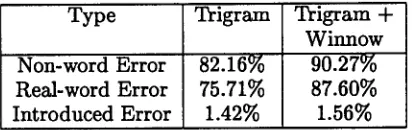
Table 2: The percentage of corrected word er- rors after applying Trigram and Winnow
are shown in Table 1, and Table 2.
Table 1 shows the percentage of word errors from the entire text. Table 2 shows the percent- age of corrected word errors after applying Tri- gram and Winnow. The result reveals that the trigram model can correct non-word and real- word, but introduced some new errors. By the trigram model, real-word errors are more diffi- cult to correct than non-word. Combining Win- now to the trigram model, both types of errors are further reduced, and improvement of real- word error correction is more acute.
[image:6.612.321.527.217.282.2]5 C o n c l u s i o n
We have examined the application of the modi- fied edit distance, POS trigram model and Win- now algorithm to the task of Thai OCR error correction. The experimental result shows that
o u r proposed method reduces both non-word er- rors and reai-word errors effectively. In future work, we plan to test the method with much more data and to incorporate other sources of information to improve the quality of correc-
tion. It is also interesting to examine how
the method performs when applied to human- generated misspellings.
A c k n o w l e d g e m e n t
We would like to thank Paisarn Charoenporn- sawat who helps us run experiment with Win- now. This work was partly supported by the Thai Government Research Fund.
R e f e r e n c e s
Avrim Blum. 1997. Empirical support for win- now and weighted-majority algorithm: Re-
sults on a calendar scheduling domain.
Ma-
chine Learning,
26.Andrew R. Golding and Dan Roth. 1996. Ap- plying winnow to context-sensitive spelling
correction. In
Proceedings of the Thirteenth
International Conference on Machine Learn-
ing.
Andrew R. Golding and Yves Schabes. 1993. Combining trigram-based and featured-based methods for context-sensitive spelling cor- rection. Technical Report TR-93-03a, Mit- subishi Electric Research Laboratory.
Andrew R. Golding. 1995. A bayesian hybrid method for context-sensitive spelling correc-
tion. In
Proceedings of the Third Workshop
on Very Large Corpora.
Peter Ingels. 1996. Connected text recognition using layered HMMs and token passing. In
Proceedings of the Second Conference on New
Methods in Language Processing.
Karen Kukich. 1992. Techniques for automati-
cally correction words in text.
A CM Comput-
ing Surveys,
24(4).Nick Littlestone. 1988. Learning quickly when irrelevant attributes abound: A new linear-
threshold algorithm.
Machine Learning, 2.
Surapant Meknavin, Paisarn Charoenporn-
sawat, and Boonserm Kijsirikul. 1997.
Feature-based Thai word segmentation. In
Proceedings of Natural Language Processing
Pacific Rim Symposium '97.
Masaaki Nagata. 1996. Context-base spelling
correction for Japanese OCR. In
Proceedings
of COLING '96.
Kemai Oflazer. 1996. Error-tolerant finite-state recognition with applications to morphologi-
cai analysis and spelling correction.
Compu-
tational Linguistics,
22(1).Xiang Tong and David A. Evans. 1996. A statistical approach to automatic OCR error
correction in context. In