JOHN MACCORMICK1, CHANDU THEKKATH, MARCUS JAGER,
KRISTOF ROOMP, LIDONG ZHOU Microsoft Research
RYAN PETERSON Cornell University
The task of consistently and reliably replicating data is fundamental in distributed systems, and numerous existing protocols are able to achieve such replication efficiently. When called on to build a large-scale enterprise storage system with built-in replication, we were therefore surprised to discover that no existing protocols met our requirements. As a result, we designed and deployed a new replication protocol calledNiobe. Niobe is in the primary-backup family of protocols, and shares many similarities with other protocols in this family. But we believe Niobe is significantly morepracticalfor large-scale enterprise storage than previously-published protocols. In particular, Niobe is simple, flexible, has rigorously-proven yet simply-stated consistency guarantees, and exhibits excellent performance. Niobe has been deployed as the backend for a commercial Internet service; its consistency properties have been proved formally from first principles, and further verified using the TLA+ specification language. We describe the protocol itself, the system built to deploy it, and some of our experiences in doing so.
Categories and Subject Descriptors: H.3.4 [Information Storage and Retrieval]: Systems and Software—Distributed systems
General Terms: Reliability, Verification, Algorithms
Additional Key Words and Phrases: Replication, enterprise storage
1. INTRODUCTION
This paper describes our experience with designing and deploying a storage backend for large scale web services. The backend was designed to replace an existing backend that had been functioning well for some years, and a key objective was to substantially reduce the system’s operations and hardware costs. Although the new system was built with the existing web services in mind, the design principles (especially the replication protocol) are more generally applicable and are not tied to any proprietary service. The overall experience with our design choices in a commercial environment serving customer data has so far been favorable.
The storage backend consists of three inter-related components: a high-performance
1Current institution: Department of Mathematics and Computer Science, Dickinson College, Carlisle, Pennsylvania.
...
Permission to make digital/hard copy of all or part of this material without fee for personal or classroom use provided that the copies are not made or distributed for profit or commercial advantage, the ACM copyright/server notice, the title of the publication, and its date appear, and notice is given that copying is by permission of the ACM, Inc. To copy otherwise, to republish, to post on servers, or to redistribute to lists requires prior specific permission and/or a fee.
c
full-text indexing and query engine, a flat storage subsystem, and a policy module that uses the mechanisms provided by the storage subsystem to implement policies specific to the service (e.g., controlling the degree of replication for classes of users). In this paper, we will focus on the details of the storage subsystem. To aid in un-derstanding, we provide sufficient detail about the indexing engine, which is fairly conventional in design, and the policy module, which is specific to our particular deployment.
A key component of our backend is a scalable replicated storage subsystem called Niobeand the associated protocols.2 A primary objective of this paper is to describe
the design of Niobe. We have found our design to be sufficiently simple, yet efficient and reliable to be deployed at scale in data centers serving real commercial work-loads. In addition, we have proved certain correctness properties of the protocol from first principles, and verified some related properties using TLA+ [Lamport 2002], a formal specification language. This gives us a precise understanding of what guarantees the system can provide to its clients, which in turn enables us to offer meaningful service level agreements (SLAs) to customers.
When we set out to design the storage backend, we were not trying to invent new replication protocols. Indeed, three of the authors had substantial prior experience in designing replication protocols [Lee and Thekkath 1996; Chang et al. 2002; Mac-Cormick et al. 2004] and we believed we could use one of these designs that had proven successful in the past. However, on closer evaluation, we discovered that none of these (or other published protocols we were aware of) provided the features we needed:
—Support for a flexible number of replicas (two or more).
—Strict consistency in the presence of network, disk, and machine failures: reads and writes to a given data item must be atomic and reads must return the last completed write.
—Efficient common case read and write operations without requiring potentially expensive two- or three-phase commit protocols.
—Simplicity (must be easy to implement, deploy, and maintain; and have con-sistency properties that are simply stated): these requirements were important because our principal goal was deployment at scale by a sizable engineering team, rather than a proof-of-concept implementation by a small group of researchers. Because of the nature of our environment, we were able to make a few simplifying assumptions:
—Single administrative domain. Since all replicas were expected to reside in data centers owned and operated by a single company, there was little motivation to deal with the complexities of data in multiple administrative domains.
—Non-byzantine failures. While we recognize that byzantine faults do occur in systems, our experience with the existing deployment suggested that this type of failure need not be the primary concern for the first release of the new system.
2We hope our system will be as successful at replication as the Niobe of Greek mythology, a mortal woman who had 14 children. It should be noted, however, that Niobe’s children were all slain by Apollo and Artemis after she boasted about her fecundity. We will therefore try to avoid exaggerated claims about the Niobe storage system and replication protocol.
The rest of the paper is structured as follows. We first provide an overview of the system in the next section. Subsequent sections describe the details of the Niobe protocol. We then describe our usage experience with deploying this system and offer some conclusions based on our experience.
2. SYSTEM DESCRIPTION
This section provides a high-level system overview of Niobe and some of the related components with which it interacts. The system provides facilities to store, index, and retrieve data, while managing the data storage in a scalable, cost-effective way in the face of failures and load imbalances.
External entities interact with the system via front ends that act as clerks and provide connection management and caching facilities. For example, the external entity might be an end-user’s browser, while the front ends might be application servers interacting with the end-user’s data (such as Web pages, blog posts, instant messages or e-mail messages) that happens to be stored in Niobe. From Niobe’s perspective, front ends and external entities are outside the system; we will not describe them any further in this paper. In particular, we do not describe the details of how external entities locate an appropriate front end for their data.
Niobe software consists of three major pieces: an indexing and query engine, a replicated storage substrate, and a policy manager as shown in Figure 1. A Niobe installation consists of multiple machines (typically on the order of a few hundreds) that act in concert to index, store, and retrieve data. Each machine runs an instance of an indexing and retrieval engine, a distributed policy manager, and a distributed storage subsystem. In addition to the machines hosting the indexer, policy manager, and the storage system, we have a small number of machines (less than 10) that run aglobal state manager (GSM) module. The GSM module uses a consensus service (e.g., Paxos [Lamport 1998]) to reliably store critical global state used by the storage and the policy manager subsystems.
The indexing machinery indexes received content and retrieves content based on received queries. The indexing engine uses the facilities of the distributed storage system to store its data and indices. The design of the indexing engine, though challenging, follows established ideas from the literature [Barroso et al. 2003; Risvik et al. 2003] and is not the focus of this paper.
The policy manager is distributed. It consists of a central service and a compo-nent that runs on each machine, which works in concert with other instances on other machines to implement service specific policies. The primary purpose of the policy manager is to determine when and where a replica should be relocated (i.e., on which physical machine). Relocations can occur as a result of a failure or a load imbalance. Therefore, the policy manager uses sub-components for detecting failures and load imbalances. These are known as the failure detector service and the load monitoring service, respectively. In addition, the policy manager includes a controller service, which makes decisions on, and initiates, replica relocations, based on inputs from the failure detector and load monitoring services.
The distributed storage subsystem works in concert with other instances of itself on other machines to implement replicated, scalable, fault-tolerant storage. The rest of the paper describes the details of the distributed storage system and the
Distributed Policy Manager
Distributed Storage Subsystem Stateless Index and Query
Engine Machine Global State Manager Machine Distributed Policy Manager Distributed Storage Subsystem Stateless Index and Query
Engine Machine Distributed Policy Manager Distributed Storage Subsystem Stateless Index and Query
Engine Machine Distributed Policy Manager Distributed Storage Subsystem Stateless Index and Query
Engine Machine Global State Manager Machine Global State Manager Machine Global State Manager Machine
Fig. 1. Overview of the Niobe System Architecture
global state manager. For now, we will merely highlight Niobe’s basic replication strategy and semantics and defer a fuller treatment until later.
In Niobe, every data item is replicated on multiple machines. The degree of replication is a configurable parameter of the system. At any time, precisely one of these replicas is designated the primary. All writes as well as reads are fielded by the primary (in contrast to strategies such as chained declustering [Hsiao and DeWitt 1990]) and uniform loading is achieved by having each machine act as the primary for a roughly equal number of frequently accessed data items.
When a write is sent to a primary, it ensures, before declaring the write successful and returning to the client, that a configurable number of replicas reliably store a copy of the data, and that any replicas which may have failed to store the data are declared dead. Reads of data items sent to the primary replica are immediately satisfied. Read or writes sent to secondary replicas result in an error return to the
Fig. 2. Layout of data items or “slices”
caller.
The truth about the identity of the primary and which secondaries are up and which are down is maintained in the global state manager (GSM) module. Status changes in the replica set (e.g., takeover of a primary or the reincarnation of a dead replica) are reliably recorded by the GSM before any new requests are accepted.
Normal case reads and writes do not require the services of the GSM. As a result, they are efficient. Failures can cause in-flight writes to a data item not to be applied at some replicas. Niobe uses a recovery mechanism based on a dirty-region log, and the GSM ensures data is consistent before clients are allowed access to the affected data item.
Niobe offers a data model that is very simple, straightforward, and adequate for clients to implement a variety of complex semantics. Niobe provides access to a non-hierarchical collection of data items, much like a disk. It offers single-copy semantics on each data item, but does not offer any ordering guarantees between concurrent writes to different items. If a write to a data item does not succeed, the data item is guaranteed to have either the old value or the new value. In the absence of a successful return from Niobe, a client has no way of knowing if a write succeeded or failed except by successfully reading the value of the data item. 3. THE NIOBE PROTOCOL
This section describes the Niobe replication protocol. For simplicity, the description will assume only one “data item” is being replicated, on some small fixed set ofN
machines (say,N = 2 or 3). At any one time, one of these machines is the primary and the others are the secondaries. In practice, an implementation of Niobe involves at least tens, if not hundreds, of machines, with thousands of separate data items being replicated—each machine acts as either the primary or a secondary for many different data items at once, and the assignment of primary and secondary replicas to individual data items is done in any suitable manner. In our deployment, for example, replicas are assigned pseudo-randomly subject to the constraint that the replicas of any one data item must be hosted by machines connected to distinct network switches and power distribution units (PDUs). This ensures all data items remain available after the failure of a switch or PDU. We refer to our data items as “slices” of data; a possible layout is shown in Figure 2.
It would be impractical for every file, web page, blog post, or e-mail message in the system to be a separate data item because we would have to keep global state (to be described in the next section) about each of them in the GSM. Instead, we aggregate data belonging to a fixed large collection of users into a “slice” to keep the amount of data stored in the GSM manageable. Although we have found in practice that a single GSM can support a large number of slices, it would be trivial
to extend the system to multiple GSMs (using a fixed mapping of slices to GSMs) if necessary.
3.1 The Niobe state machine
As already noted, the protocol description will restrict attention to a single data item, so we may focus on only theNreplicasof this data item, denotedR1, R2, . . . , RN. The other entities participating in the protocol are the GSM and the front-end ma-chines. The entities can send messages to one another, which can be arbitrarily delayed, dropped or reordered. The entities are not malicious. They may operate arbitrarily slowly (except for their clocks) and may halt or “reboot” (defined be-low) at any time. The entities possess clocks whose drift is bounded by a known constant factor. We assume every entity possesses two types of storage: “memory”, which is lost on reboot, and “stable storage” which survives reboot. We formally definereboot for replicas as follows: when a replica reboots, it executes theReset() algorithm of Section 4.1 using only its stable storage as input. Every entity uses standard techniques3to apply mutations to its stable storage atomically.
Formally, the protocol maintains a replicated state machine comprising:
—a vector of health bits H = (h1, h2, . . . , hN), with each bit hi taking values in {Alive,Dead}
—anepoch number E, which is a nonnegative integer —aprimary ID P, taking values in{1,2, . . . , N}
—adata value D, taking values in some set of possible data valuesD.
An informal interpretation of this state is as follows. The health bits signify which replicas are currently faulty or out-of-date. The epoch number is incremented every time any change to the health bits occurs (so replicas can use it to check that their view of the other replicas’ health is up-to-date). ReplicaRP is known as the primary, and the other replicas are called secondaries. The data value D is the current value of the data being replicated on behalf of the customers.
In contrast to many other implementations of replicated state machines, the entire state is not stored at every entity participating in the protocol. In Niobe, only the GSM stores the health bits, epoch number and primary ID in stable storage. The replicas cache values of these quantities in memory, but need never commit them to stable storage. The replicas store the data valueDin stable storage – we’ll sometimes refer to this stored value as the replica’slocal data value, to distinguish it from the etherealDthat resides in the replicated state machine. The GSM never stores the data value, even in memory.
The state machine maintains the invariant that the primary is always alive i.e.
hP =Alive. The only permissible changes in the state machine are:
—“kill or reincarnate a secondary”: flip one of the non-primary health bits and increment the epoch number i.e. atomically flip hr for some r 6= P, and set
E←E+ 1
—“reassign the primary, killing old primary”: change the identity of the primary to some other replica that is alive, and kill the old primary i.e. atomically set
P ←r, for somer6=P such thathr=Alive, sethP =Dead, and setE←E+ 1. —“update the data item”: setD←D0for someD0∈ D. There may be
implementation-specific restrictions on what updates are permissible. For example, our deploy-ment is optimized for appends and deletions. However, the protocol is useful and efficient for arbitrary updates, including atomic “compare-and-swap” mutations in which the new data value depends on the old one.
The GSM module ensures that all changes to the health bits, epoch number and primary ID are serialized, legal, and atomic. We refer to any such change as a GSM decree.
3.2 The Niobe services
It’s convenient to think of each Niobe replica running some subset of four indepen-dent processes4, called the clerk process, the maintenance process, the coordinator
process and the reset process. The coordinator process is active only on replicas that believe they are the primary; the maintenance process is active only on replicas that believe they are secondaries; the clerk process is active on all replicas. The reset process runs only at startup and during reconfiguration.
We can describe Niobe as comprising 4 distinct client-server services: the data service,clerk service,liveness service, andhealth service. For each service, the client is either a front-end or one of the above four processes, while the server is either the GSM or one of the above four processes. Figure 3 gives a diagrammatic overview of the services and their API functions, and Figure 4 gives further details.
Niobe entities (front-ends, replicas, and the GSM) communicate with each other via messages. Each message is either a request or response, and has a type that is one of the eight API functions listed in Figure 4. It is essential that the data service places Updateand Readrequests in a single FIFO queue, processing them in the order received. ConsecutiveReadrequests may be processed in parallel, but Updates must be processed in isolation: any Reads received before a givenUpdate
u must be completed or aborted before u is processed, and any Reads received after umay be processed only after uis completed or aborted. This behavior can be implemented using a standard reader-writer lock. (In fact, these serialization requirements can be substantially relaxed: requests that affect disjoint parts of the data item can be reordered, but a detailed discussion of this would take us too far afield here.)
4. NIOBE ALGORITHMS
This section gives complete descriptions of all algorithms used in the Niobe protocol. The appendix gives additional formal details, including pseudocode.
4Of course, these do not have to be conventional processes; in our deployment, they are separate threads executing in a single address space.
GSM clerk process reset process coordinator process front-end
Data service
(Update, Read)Clerk service
(ApplyUpdate, Reconcile) maintenance process Heartbeat SetGSMInfo SetGSMInfo GetGSMInfoHealth
service
primary replica secondary replica resetting replica
InitiateReconciliation
Liveness service
Fig. 3. The four services of the Niobe protocol: data, clerk, liveness and health. Service name
and API
Clients Servers Primary purpose
Data service (Update, Read)
Front-ends Coordinators Read and write data for front-ends
Clerk service (ApplyUpdate, Reconcile)
Coordinators Clerks Persist or reconcile lo-cal copy of data for co-ordinator
Liveness service (InitiateReconcilia-tion,
Heartbeat)
Maintenance Coordinator Initiate recovery of a dead secondary; re-spond to heartbeats Health service (SetGSMInfo, GetGSMInfo) Maintenance, Coordina-tors, Reset
GSM Update and/or
dissem-inate replica health in-formation
Fig. 4. Descriptions of Niobe services. 4.1 Resetting
A Niobe replica begins operations, or restarts after encountering a problem, by executing an algorithm calledReset, which uses only the contents of stable storage. Replica R performs aReset by first canceling any pending requests (the requests are simply eliminated – no responses need be sent), and doing local recovery to ensure that any partially-complete updates to its local data value are rolled back.
ThenRcontacts the GSM to find out the current state of the Niobe state machine. From this point, there are three possibilities: R could be a live primary, a live secondary, or a dead secondary.
IfRis a live primary, it firstreconciles with all secondaries it believes are alive. The objective of reconciliation is to ensure that every live secondary agrees with
R’s current local data value D. This can be achieved by an extremely simple approach, such as sendingDto each live secondary, or by using a more sophisticated rsync-like reconciliation protocol that transmits only the differences betweenDand a secondary’s data value. In any case, the outcome is eventually that each live secondary has stably storedD as its local data value. Any secondary that fails to achieve this in a timely fashion gets killed: R passes a GSM decree transitioning the unresponsive secondary into theDeadstate. Once reconciliation is complete,R
begins its normal operations as a primary: it responds toUpdateandReadrequests from front-ends, and to heartbeat messages from secondaries.
IfRis a live secondary, it listens forApplyUpdaterequests from the primary, and also periodically sends heartbeat messages to the primary. Heartbeats are tagged with increasing sequence numbers, and at most one can be outstanding: R never sends a new heartbeat until the primary has acknowledged the previous one (retries with the same sequence number are permitted, however). These heartbeats, which are sent at least everyHeartbeatPeriod, serve a dual purpose in the Niobe protocol. First, each heartbeat implicitly grants aread lease to the primary, permitting the primary to performReadoperations on its local copy of the data without verifying that the secondaryR agrees – see the read algorithm described in Section 4.3 for details on this. The second purpose of the heartbeats is to maintain liveness in the face of a failed primary: if the primary becomes unresponsive and fails to respond to a heartbeat,Rwill attempt to kill it and take over as primary itself. The details of this takeover procedure are crucial for maintaining data consistency, and are described below in Section 4.5.
If R is a dead secondary, it requests reconciliation from the current primary. This results in the primary first suspending the processing of update requests, then sending its latest data value to R (with the obvious optimizations of (i) sending only the differences using a variant of the dirty region log, and (ii) delaying the suspension of updates untilR’s data value is almost perfectly up-to-date). OnceR
has stably stored the primary’s data value, the primary passes a decree with the GSM which reincarnates the dead secondary. The dead secondaryR thenResets, and will come back up as a live secondary. Processing of update requests can now resume on the primary; they will now be replicated to the newly reincarnated secondary as well as the other live replicas.
Every message from one replica to another replica or the GSM is stamped with the sender’s cached epoch number. IfR receives a message whose epoch number is higher than its own, R knows that its GSM information is out of date, and performs aReset. On the other hand, ifR or the GSM receives a message whose epoch number is lower than its own, it responds with a special BadEpoch value which will cause the sender toReset.
4.2 Updates
Suppose a replica R receives an Updaterequest from a front-end, requesting that some mutation Mis applied to the data value. R first checks that it believes itself to be the primary. If not, R responds with a hint suggesting the correct identity of the primary. Otherwise, R acquires a write lock, guaranteeing that no other Read or Update requests are being processed, then enters the core of the update algorithm. In parallel,Rsends anApplyUpdate(M)request to the clerk service on every replica (including itself) that it believes to be alive. Secondaries should check that they agree withR’s epoch number (andResetthemselves if not), then apply the mutation to their stable storage and return a success code toR.
Any secondary that fails to respond successfully gets killed: R passes a GSM decree transitioning the unresponsive secondary into the Dead state. As with the reconciliation and heartbeat messages,ApplyUpdate requests are tagged withR’s cached epoch number, and if R receives a BadEpoch response from any of these requests or from a GSM decree, itResets itself.
IfR, the primary, cannot get a timely and successful response from its own clerk service,Rdoes not attempt to kill itself via a GSM decree. Rather, it stops respond-ing to heartbeats. This has the effect that one of the live secondaries will notice a missing heartbeat response, and execute the takeover algorithm of Section 4.5. After waiting for a suitable period,RthenResets.
Once every live replica has performed the update successfully (or alternatively, been successfully killed via a GSM decree),R can respond to the front-end. In the normal case,R will returnSuccess, indicating that the mutation has been applied to at leastQreplicas, where Q≥1 is a configuration parameter set by the system administrator, expressing the minimum number of replicas on which a data item must be stored. If there are excessive simultaneous failures and the mutation was applied to fewer thanQreplicas, RreturnsFailure.
Thus, the following invariant is maintained: a completed update operation, whether successful or not, was applied successfully to the stable storage of every replica believed to be alive by the primary at the end of the operation.
4.3 Reads
If a replicaR receives a Readrequest from a front-end, it first acquires a lock for reading, guaranteeing that no Update requests are being processed. (Other Read requests may be processed in parallel, however.) Then, R checks that it believes itself to be the primary, and if not, replies with an appropriate hint. Otherwise, it checks that it holds a read lease from every secondaryS it believes is alive, as follows. The leasing mechanism employs a parameter GracePeriod, which is the maximum amount of network or other delay that is permitted before we consider a fault has occurred. (Note that the value chosen forGracePeriodaffects performance, but not correctness.) We define thelease period L by
L=HeartbeatPeriod+GracePeriod. (1)
If the primaryR has received a heartbeat from secondaryS within the last lease period, its lease from S is still valid. IfR has a valid lease from every secondary it believes to be alive,R simply reads its local data value from stable storage and
returns it to the front-end.
On the other hand, suppose the read lease from some live secondaryShas expired. ThenRattempts to killS, by passing a GSM decree. Obviously, if the decree fails with a BadEpoch response, R Resets itself. Otherwise, R succeeds in killing all secondaries whose leases have expired, and it can return its local data value to the front-end.
Note that the following invariant therefore holds for successful read operations: for every secondary S that the primary believes to be alive at the end of the operation, the primary held a valid read lease fromS at some instant during the operation.
4.4 Heartbeat processing at the primary
Recall that heartbeat requests are tagged with increasing sequence numbers by the secondary that sends them, so a primary R that receives a heartbeat request from some secondary S first checks this sequence number and rejects the request if it is older than a previously-received request. Otherwise, R checks to see if the time elapsed since the last heartbeat was received is less than the lease period L
(Equation 1). If so, the heartbeat is on time andR responds with a success code to S. Otherwise, the heartbeat has arrived too late and R attempts to killS by passing a GSM decree. As usual,RResets itself if the decree fails with aBadEpoch. 4.5 Takeover
As described in Section 4.1, a live secondary S ensures that it sends a heartbeat request to its primary everyHeartbeatPeriod. If the primary does not send a timely and successful response,Sattempts to kill the existing primary and take over as the new primary. This “takeover” algorithm employs a parameterMaxClockDrift, which expresses the maximum factor by which two clocks in the system can disagree, when measuring an interval of real time. The key step in the takeover algorithm that guarantees correctness is thatSwaits for thelease expiry time∆ before attempting to kill the primary, where the lease expiry time is given by
∆ = 2×L×MaxClockDrift. (2)
After waiting for time ∆,S submits a GSM decree killing the current primary and appointing itself as the new primary. Whether or not this decree succeeds,S then Resets itself.
The appendix shows rigorously how the value of ∆ in (2) leads to consistent behavior; we summarize the argument here. Recall that there is only ever one heartbeat outstanding betweenSand the primary, and heartbeats employ sequence numbers to prevent out-of-order delivery. So ifSsent its most recent heartbeathat timet, no earlier heartbeat fromSis accepted at the primary aftert. There are two cases: (i)harrives beforet+L, and (ii)harrives aftert+L. In case (i), we know the primary receives no heartbeat messages in the interval [t+L, t+2L]. In case (ii), the primary receives no heartbeat messages in the interval [t, t+L]. Thus, by waiting for at least two lease periods (1) without sending a heartbeat request,S guarantees that the primary experiences at leastonelease period without receiving a heartbeat fromS. The primary, having experienced a whole lease period without a heartbeat from S, will never respond to a Readrequest without first successfully killing S –
! " # $ %& '( ) * + & ,*-& ./0 1 22 33 4 ( ) 1 22 33 ! " # 56 $ ' () 7 ( 8 ∆ 9 : ; 4 () # 56 * $ %& ' () * $ <& $ =& >? 8@ * + & ,*-& ./0 A ( ) -B " 2$ ! " # $ <& '( ) *-& ./0 C(8 ?1 D 42 " 2 8 ? 1 22 33 E F G
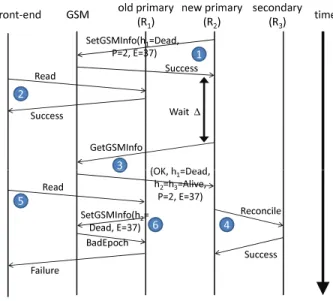
Fig. 5. A possible takeover sequence.Communication betweenR1(the current primary) and R2(a secondary) has broken down. (1)R2notices a missing heartbeat response from the primary and tries to kill it via a GSM decree, which succeeds. (2) Meanwhile, the old primaryR1 can continue serving reads from the front-ends until its read leases expire. (3) After waiting the lease expiry time ∆,R2canReset, which begins by getting the latest GSM information. (4) The new primaryR2 must reconcile with any live secondaries (in this caseR3) before beginning to serve read and update requests. (5) Meanwhile, the old primary’s read lease fromR2 has expired, so if the old primary receives a read request, it (6) tries to killR2 – in this case the attempt fails becauseR1’s epoch number is out of date.
either during the processing of a heartbeat (Section 4.4) or read (Section 4.3). Of course this discussion assumed that clocks on the primary and secondary advance at the same rate; the extra factor ofMaxClockDriftin (2) allows for differing clock rates.
Figure 5 shows a possible sequence of events involving the takeover algorithm. 5. PERFORMANCE PROPERTIES
This section analyzes the cost of Niobe operations under normal, failure-free condi-tions. We measure two types of cost,resource cost andlatency cost, and conclude that Niobe’s costs are optimal in several respects according to some simple defini-tions of these costs. Caching effects are ignored for this worst-case analysis.
Latency is measured in terms ofmessage delays andstorage delays. A message delay is the time for a message to be transmitted from one Niobe replica to another. A storage delay is the time for a replica to read or update its data item. We define the latency of an operation to be the number of delays of each type that must occur between the arrival of the front-end’s request and the departure of the reply to the front-end.
Resource cost is measured in terms of the number of messages, and the number of stable storage accesses. We define the resource cost of an operation to be the number of messages and storage accesses that must occur between the arrival of
the front-end’s request and the departure of the reply to the front-end.
First consider update operations. Under failure-free conditions, there is one mes-sage delay forApplyUpdaterequests from the primary to the secondaries, one stor-age delay for the secondaries to apply the update, and one messstor-age delay for the secondaries to send anApplyUpdate response to the primary. So the total latency cost of an update is two message delays and one storage delay. The resource cost is easily seen to be 2(N−1) messages andN storage accesses, when there areN
replicas alive.
Read operations are even easier to analyze, since under failure-free conditions, the primary simply reads its local data value and returns it to the front-end. The latency cost is zero message delays and one storage delay; the resource cost is zero messages and one storage access.
Clearly, the simplistic cost modeling above is not appropriate for all purposes. One obvious improvement would be to acknowledge that messages transmitting data (as opposed to just acknowledgments) are far more costly if the data size is large. In this case one could distinguish between “data messages” and “regular messages”. The latency cost of an update would then be one data message delay, one regular message delay and one storage delay; its resource cost would beN−1 data messages, N −1 regular messages, and N storage accesses. For reads, the costs would be unchanged.
We claim the above costs are optimal for reads, and optimal in terms of storage delays and accesses for updates: this claim follows trivially from the fact that the cost is exactly 1 storage delay or access in each case, and any other protocol must also access the stable storage before it can return or update the data value. On the other hand, Niobe is not optimal in terms of resource cost. For example, Chain Replication [van Renesse and Schneider 2004] achieves resource cost ofN−1 messages and N storage accesses. However, the storage accesses are serialized in Chain Replication, resulting in a latency ofN storage delays.
6. CONSISTENCY GUARANTEES
The software engineers who maintain a replicated storage service, and those who write client software for it, are unlikely to be experts on the theory of distributed al-gorithms. But it is precisely these engineers who must understand the properties of the system so that they can use it correctly. Therefore, this section attempts to give accurate but comprehensible guarantees on Niobe’s consistency properties, without relying on the subtle distinctions between such notions as linearizability [Herlihy and Wing 1990], sequential consistency [Lamport 1979], or one-copy serializabil-ity [Papadimitriou 1979]. Section 6.1 explains a simple analogy between Niobe’s properties and those of a hard drive. Section 6.2 gives mathematically rigorous statements of Niobe’s properties, using language that we hope offers useful insights to systems researchers and practioners. Section 6.3 compares with the established notions of linearizability and strict linearizability. Section 6.4 describes our ef-forts to verify the correctness of Niobe using the TLA+ specification language. A complete description of the formal consistency guarantees is given in the appendix.
6.1 “Just like a disk” consistency
The simplest way of describing Niobe’s consistency properties is that the system behaves “just like a disk”: requests appear to be processed in the real-time order in which they are received by the system. In particular, a read request reflects the effects of all update requests received earlier. This guarantee applies even to update requests that either (i) returnedFailure, or (ii) did not return a value (i.e. are still pending). In both cases, one may assume the failed or pending update request either had the requested effectin its place in the real-time ordering, or had no effect at all. The only way to determine which of these possibilities actually occurred is to issue a read request after the failed or pending update. Alternatively, one can eliminate the uncertainty by issuing another update request that, if successful, will overwrite the uncertain existing data value. Note that this behavior is indeed “just like a disk”: when a disk write returns a disk error, the only way to be sure about the disk contents is to read it or overwrite it.
6.2 Formal Mathematical Guarantees
Anoperation ois a request-response pair of messages (oreq, oresp), resulting from a front-end’sUpdate orRead request.5 Each of these messages arrives at, or leaves,
some Niobe replica machine at a particular instant in time. Let τ(oreq) be the wall-clock time at whichoreqis received by its destination, andτ(oresp) be the time
at whichoresp is sent by its source.
Update and Read responses include a special Success code if they completed successfully. Successful Read responses also include the data value that was read, of course. For a completedUpdateoperation that requested a mutationM, we define thepost-value of the update to be the local data of the primary that coordinated the update, after the mutationMwas applied.
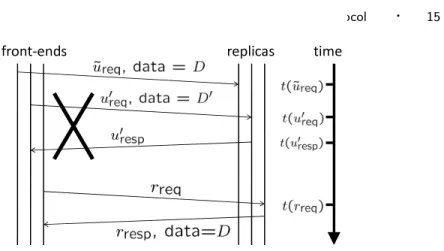
Equipped with these definitions, we can now state the first important consistency property of Niobe, termed causality: read requests only return values that were previously written, and were not subsequently overwritten. Figure 6 depicts the statement of the theorem graphically.
Theorem 6.1. (Causality property) “Every value read was written, but not
over-written.” Suppose the system’s history includes a read operation r = (rreq, rresp) that returns (Success, D). Then there exists an update operation u˜ that “wrote”
D, and there does not exist an update operationu0 that “overwrote”D. Formally, there existsu˜= (˜ureq,uresp˜ )such that
—the post-value ofu˜ isD
—the write arrived before the read:
τ(˜ureq)< τ(rreq) (3) —there does not exist an update operation u0 = (u0
req, u0resp)such that
—u0 returnsSuccess
—the post-value ofu0 isD0 for someD06=D
5For any request that does not receive a response in a given finite history of the system, we can insert an artificial timeout response at the end of the history, so it is safe to assume that all operations do indeed consist of a pair of messages.
Fig. 6. Theorem 6.1 says that if a requestrsuccessfully reads a data valueD, then some update ˜
umust have previously writtenD, and no intervening updateu0overwroteD – even if all such requests originate from and arrive at distinct front ends and distinct replicas.
—u0 is received afteru˜and completed before ris received:
τ(˜ureq)< τ(u0
req) (4)
and
τ(u0resp)< τ(rreq). (5)
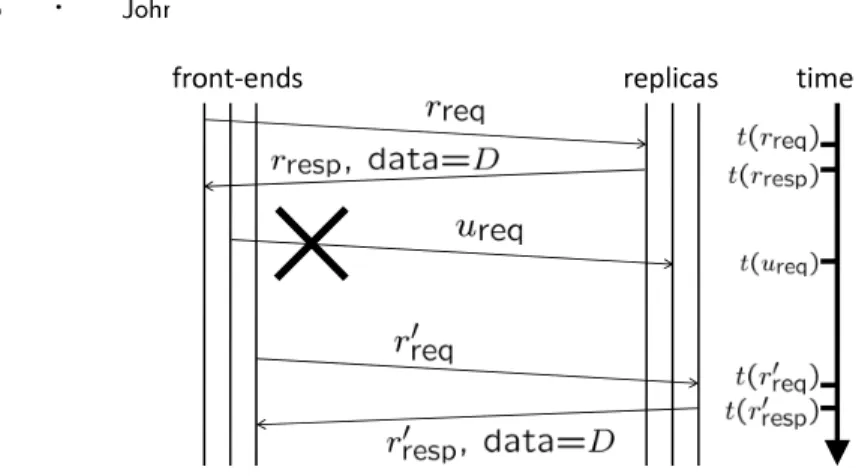
The next theorem states a second consistency property of Niobe: written values arepersistent. Figure 7 depicts this graphically.
Theorem 6.2. (Persistence property) “Written values are persistent: two reads
return the same value if there are no intervening or pending writes.” Let r = (rreq, rresp)andr0 = (r0
req, r0resp)be two read operations that return(Success, D)and
(Success, D0)respectively. Suppose that rcompletes before r0 begins:
τ(rresp)< τ(r0
req). (6)
Suppose further that there are no intervening writes: there does not exist an update operation u= (ureq, uresp)with
τ(rreq)< τ(ureq)< τ(r0
resp). (7)
Finally, suppose there are no pending writes whenrbegins: there does not exist an update operation6 u= (ureq, uresp)with
τ(ureq)< τ(rreq)< τ(uresp). (8) ThenD=D0.
Notice that the “persistent write” property of Theorem 6.2 does not hold when there are pending updates. In principle, a pending update could be applied at any future time, thus destroying any reasonable notion of persistence. Niobe has some much stronger guarantees that eliminate this possibility, which are stated below. Details and rigorous proofs are given in the appendix.
6Recall that for any actual, finite history of the system we can appendFailureresponses for any unmatched request.
Fig. 7. Theorem 6.2 says that two read requestsrandr0 read the same valueDprovided there are no intervening updatesu– even if all such requests originate from and arrive at distinct front ends and distinct replicas.
The first guarantee tells us that anysuccessful read or update operation perma-nently cancels any currently pending updates:
Theorem 6.3. (Operation Cancellation Effect) The value returned by any read
operation received after the completion of a successful read or update operationois not affected by pending updatesureceived beforeo: we may assume some response
urespwas sent before oreq was received.
The second guarantee tells us that if a resetting primary successfully completes its reconciliation phase, currently pending updates are again permanently canceled:
Theorem 6.4. (Reconciliation Cancellation Effect) The value returned by any
read operation received after the completion of a primary’s reconciliation phase is not affected by pending updates u received before the primary started the Reset
algorithm: we may assume some responseurespwas sent before Reset started.
The proofs of Theorems 6.1-6.4 are given in the appendix, but it is easy to gain intuition for why they hold. The theorems hold trivially during periods when the primary’s identity is undisputed, since the primary serializes all reads and updates. The GSM acts like a single, centralized process, ensuring that exactly one secondary takes over as a new primary in any given epoch. Our lease mechanism (Section 4.5) ensures the old primary will cease replying to all requests before the new one starts processing new requests.
Note the guarantees given here all hold in the presence of network partitions. Replicas in the same partition as a majority of GSM servers will continue to func-tion, and any others will be killed off. Progress will cease altogether if no partition contains a GSM majority.
Finally, note that as with any storage system that makes no assumptions about the external network, the guarantees are given in terms of messages entering and leaving the system (in this case, Niobe replica machines). Clients and front-ends must implement reliable FIFO channels between themselves and Niobe machines in order to push guarantees out to the clients. In practice, using TCP or standard sequence number techniques would achieve this.
6.3 Comparison with linearizability
Linearizability [Herlihy and Wing 1990] is a commonly-accepted notion for consis-tency in replication protocols. However, as others have pointed out [Aguilera and Frølund 2003], systems that support linearizability can, in principle, allow behavior that may be counter-intuitive to users. Aguilera and Frølund [2003] give a power-ful example of this. Consider an Automatic Teller Machine (ATM) that supports linearizability. It might dispense money after checking a customer’s account for sufficient funds, but encounter a fault before debiting the account. The account is eventually debited after the fault is repaired, but it could be that the user does not have sufficient funds at that time because of other successful withdrawals in the interim. The ATM’s behavior is linearizable, but probably does not accord with the account holder’s intuition. A standard solution of this problem is to use database-style transactions, but this is too heavy-weight for a storage service such as Niobe. Instead, Niobe’s guarantees resemblestrict linearizability [Aguilera and Frølund 2003], a stronger form of linearizability that includes the notion of op-erations aborting before a customer could observe counter-intuitive effects. Theo-rems 6.3 and 6.4 are the machinery that upgrades Niobe from regular linearizability to a stricter form.
6.4 Verification with TLA+
Experience has shown that hand-crafted, conventional mathematical proofs about the properties of distributed algorithms almost always contain errors. Model-checking is a powerful tool that can be used in these situations to increase one’s confidence about the properties of a distributed algorithm. Therefore, we speci-fied Niobe in the formal specification language TLA+ [Lamport 2002], and checked some of its properties using the model-checker TLC.
The specification consists of about 400 lines of TLA+, and results in a model with approximately 250 million distinct states, which takes about 2 days to check on a single-CPU machine. As with most specifications, it differs in some respects from the ideal protocol. In our case, the specification does not permit out-of-order message delivery and does not model the reincarnation of secondaries whose data value is out-of-date. The specification does not model real time, so the read lease mechanism is not incorporated – as will be seen below, this has some interesting consequences. In order to restrict the state space to a reasonable size, onlyN = 3 replicas and two distinct data values are permitted.
It was impractical to store a history of all requests in the model, so we could not directly verify Theorems 6.1 and 6.2, since both make statements about the entire history of requests. Nevertheless, the model-checker was able to verify some useful and encouraging invariants. For example, it was proved that the replicas remain in sync:
Invariant 6.5. If there are no updates being processed, the stable storage of
every Alivereplica possesses the same local data value.
We were also able to prove that updates appear persistent to front-ends which perform their reads at the “true” primary (i.e. the replica which is currently primary according to the GSM):
Invariant 6.6. If there are no updates being processed, a read at the true pri-mary returns the post-value of the most recent successful update.
The fact that the read lease mechanism is not modeled means that more general “persistence” invariants do not hold in the specified system. For example, it is not true that all reads return the post-value of the most recent successful update. Consider the following counterexample, which can result in what we call a “stale read”. Replica R1 is the primary and R2 a secondary. The value D is written on
R1 andR2because of an update request to R1. Then communication betweenR1
andR2breaks down;R2notices a missing heartbeat, killsR1and becomes the true primary. The valueD0is then written onR2because of an update request toR2(it need not replicateD0 toR1, as R1 is believed dead). Then a read request arrives at R1, which happily returns the stale valueD. Of course, this cannot happen in the real Niobe protocol: R2 must wait for a lease to expire before taking over as primary, in which caseR1will notice the expiry of the lease before returning a stale read value.
Despite the fact that the specification could not model leases, it gave us some important guidance on this issue of stale reads, by encouraging us to carefully scru-tinize the leasing mechanism and the mathematical arguments for its correctness. 7. EXPERIENCE AND RESULTS
Niobe is currently deployed, and serving real customer data. In this section we provide details showing Niobe is efficient and effective in practice. The deployment uses typical server-class rack-mounted machines, connected by a combination of 100 Mb and Gigabit ethernet in a data center. Each machine possesses multiple processors, a modest amount of memory, and several terabytes of attached storage in one or two disk arrays.
Two different hardware configurations are both attractive for our environment. In one, the disk arrays employ RAID-5; in the other, they are configured in JBOD (“just a bunch of disks”) mode. Specifically, RAID-5 with two replicas of each data item (2xRAID-5), and JBOD with three replicas of each data item (3xJBOD), both met our requirements in terms of mean time to data loss based on manufacturers’ specficiations. 2xRAID-5 is cheaper since it consumes less storage, but its perfor-mance can be significantly worse for small writes and during the rebuild of a failed drive. The first set of Niobe users opted for 2xRAID-5, but 3xJBOD deployments are also likely in the future. This is one reason for the requirement that Niobe should be flexible, offering excellent performance and guarantees for N = 2,3 or more.
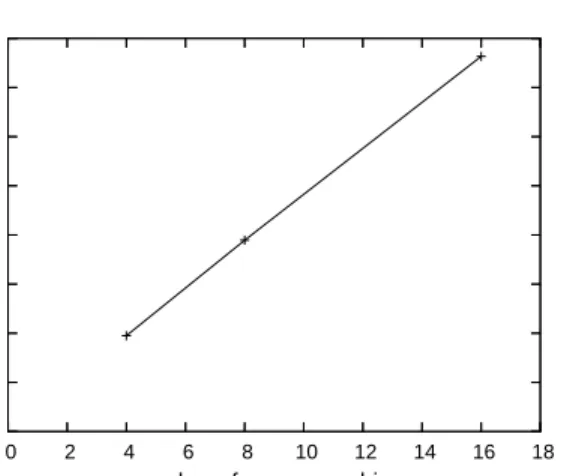
Because the vast majority of operations can proceed in parallel without any cen-tralized bottleneck, we expected that Niobe exhibit near-perfect scalability. Fig-ure 8 demonstrates this unsurprising, but reassuring, result on our test cluster. The experiment uses a simulated workload whose distribution of data sizes, updates, and reads is identical to one of our major customers. The average data size of read and write requests is 30 kB, but with huge variability from 500 bytes to about 50 MB. This workload was run against Niobe clusters of 4, 8, and 16 back-end machines re-spectively, using the 2xRAID-5 configuration described above. In particular, there are N = 2 replicas for each data item, so each machine acts as the primary for
0 1000 2000 3000 4000 5000 6000 7000 8000 0 2 4 6 8 10 12 14 16 18
operations per second
number of server machines
Fig. 8. Throughput scalability of Niobe
approximately half of the data it stores. In each case, sufficient front-end machines are used to saturate the back-ends (it turns out that over 30 front-end machines are required when there are 16 back-ends), and each run takes between 1 and 4 hours to complete. Figure 8 shows the average number of operations per second achieved in each run. It is clear that the throughput scalability is very close to linear.
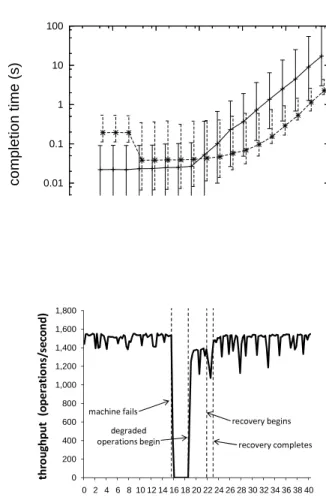
Figure 9 shows the latencies for read and write operations broken down according to the data size of the operation. The workload and 2xRAID-5 configuration are the same as in the scalability experiment, but now run on a minimal cluster of 2 back-ends. Figure 9 graphs the median latency for operations in a given size range, with error bars representing the 5th and 95th percentiles respectively. There is a painfully obvious performance cliff for writes below 4 kB in size: writes smaller than this take around 200 ms to complete, whereas larger writes can take as little as 40 ms. This is not the well-known “small write” performance issue with RAID-5, as our RAID stripe size is 128 kB. Rather, this cliff may be due to additional read-modify-writes being performed for write requests below the filesystem block size of 4 kB. For both reads and writes, the fixed cost of accessing the disk dominates for data sizes less than about 50 kB, but the cost eventually becomes linear in the data size (at around 100 kB for reads and 2 MB for writes). Large writes are significantly faster than large reads. One possible reason for this is the use of NVRAM cache in the RAID controllers: the reads in this workload are random and derive little benefit from the cache, whereas large writes can safely return as soon as the data is stored in NVRAM.
Figure 10 shows the performance of the same two-machine system over time, as it undergoes a machine failure and subsequent recovery. At minute 16, one of the machines is brought down, and all affected slices (i.e. all slices in this two-machine system) must fail over, either killing off an unresponsive secondary or killing off an unresponsive primary and promoting the secondary to primary. For technical rea-sons that are irrelevant to the present discussion, the deployment currently enforces a 2.5-minute delay before failover, so single-replica (or “degraded”) operations be-gin in minute 19, with throughput quickly climbing to about 10% less than before
0.001 0.01 0.1 1 10 100
100 1000 10000 100000 1e+006 1e+007 1e+008
completion time (s)
data size (bytes)
read write
Fig. 9. Niobe latencies
200 400 600 800 1,000 1,200 1,400 1,600 1,800 ! " # ! " # 0 0 2 4 6 8 10 12 14 16 18 20 22 24 26 28 30 32 34 36 38 40 $%&'($ )*+,$-, +. /*$(0
Fig. 10. Throughput during failure and recovery.
the failure. We expect some drop in performance during degraded operation, since the surviving machine is now acting as primary for all of its slices, and primaries do more work than secondaries. (Primaries serve read and write requests, whereas secondaries are impacted only by writes.) At minute 22, the failed machine is brought back online. Normal operations continue during recovery, approximately 20% slower. The system returns to the original level of throughput at minute 23, when recovery completes.
8. COMPARISON WITH EXISTING PROTOCOLS
Many of the techniques used in Niobe are adapted from previous work. For example, Niobe uses the “primary-backup” or “primary copy” paradigm for fault-tolerance (in which a primary receives an update from a customer, sends it to one or more secondaries, and then replies to the customer). Primary-backup techniques have been studied since at least the 1970s [Alsberg and Day 1976], are employed in nu-merous commercial products, and many variants have been proposed and analyzed (e.g. [Budhiraja et al. 1993]). The use of the GSM for ensuring the existence of
exactly one legal primary at all times is strongly reminiscent of the “witness” used by HARP [Liskov et al. 1991] the “auxiliary processor(s)” in Cheap Paxos [Lamport and Massa 2004], the “global state module” in Petal [Lee and Thekkath 1996], the “master” in Chain Replication [van Renesse and Schneider 2004], and has similar-ities to the Chubby lock service as used in several of Google’s services [Burrows 2006]. GSM epochs are closely related to the “viewstamps” in Viewstamped Repli-cation [Oki and Liskov 1988], and the “sessions” in Dynamic Voting [Dolev et al. 1997]. (Dynamic Voting is particularly relevant because the replication scheme in Federated Arrays of Bricks (FAB) [Saito et al. 2004]—a relatively recent system with goals similar to Niobe—is based on it.) Further, HARP and Chain Repli-cation employ a read lease scheme similar to Niobe’s, permitting the primary to perform most reads without contacting any secondary. Finally, our technique of using the GSM to kill and reincarnate secondaries, while using all live replicas (but not the GSM) for performing updates, is mathematically equivalent to the “wheel” quorum system studied extensively in the quorum system literature (e.g. [Hassin and Peleg 2006]).
So what is new and interesting about Niobe? In a nutshell, we believe Niobe is morepractical for large-scale data storage than previously-published replication protocols that we are aware of. Our definition of “practical” comprises: simplicity, flexibility, consistency and performance. We address each of these in turn.
Simplicity: Because Niobe is deployed commercially, we know that software engi-neers and data center operators can implement, maintain, and write client software for a Niobe-based system without any specialized knowledge of distributed systems algorithms. This contrasts with many published replication protocols which may appear simple, but in fact require one or more building blocks (for example, dis-tributed leadership election, reconciliation, or reconfiguration algorithms) that are not completely specified, and in themselves require considerable distributed sys-tems experience for correct implementation or maintenance. Niobe avoids this by using a centralized GSM to store and update the system configuration. Since the GSM need not itself be extremely efficient or scalable (it is only accessed when a component fails), we regard this as a previously-solved problem. One can use either a commercial database, or a distributed consensus algorithm such as Paxos running on afixed set of nodes (dynamic quorums are not required). Chain Replica-tion [van Renesse and Schneider 2004] also uses a GSM-like entity, and is arguably even simpler than Niobe: the chained replica structure results in simple, elegant reconfiguration algorithms with a clear proof of strong consistency. However, the significant extra latency of the chain structure for large writes precludes the use of this design for our application.
Flexibility: Reliability is important, but so is continuous service. Storage system administrators should have the flexibility to determine what is most important. Niobe delivers this flexibility, since the administrator can set both N, the number of replicas on which data is stored during failure-free operation, andQ, the mini-mum number of replicas on which data may be stored, even in the face of failures. This covers a particularly important special case which has perhaps been given insufficient attention in the literature: in some cases, cost is of such critical impor-tance thatN = 2 is the best choice. But in this case, many previously-published
protocols will prevent any updates during a failure, since with only one remaining replica, it is not possible to update a majority of the replicas. (It appears that viewstamped replication and FAB both suffer from this problem, for example.) In contrast, if the system administrators value continuous service highly enough that the risk of single-replica updates is worth it, they can set Q= 1, and Niobe can happily proceed to perform updates on the one remaining replica during a failure. Consistency: Niobe has simply-stated consistency properties (Theorems 6.1 and 6.2) which have been proved correct, and some additional properties have been verified using formal model-checking tools. In the notoriously buggy world of dis-tributed algorithms, such correctness arguments constitute an important feature of a protocol. FAB, Chain Replication, and Viewstamped Replication are examples of other protocols that also provide clear statements and proofs of their consistency guarantees, so Niobe is by no means unique in this respect.
Performance: As argued in Section 5, the cost of Niobe operations in the absence of failures is optimal in certain important respects. This optimality is clearly irrele-vant in many cases: if the data size dominates other messages, then extra rounds of messages and/or piggybacking techniques result in indistinguishable performance for non-optimal protocols. For example, it was recently shown that voting-based reads, which require accessing a majority of replicas rather than just the primary, can be efficient in practice despite the extra messages required [Saito et al. 2004]. However, there are situations in which the optimality of Niobe makes an important difference, especially when the data items being stored are small. The performance of protocols which use two-phase commit for updates, such as viewstamped repli-cation and HARP, will suffer in such cases; the same applies to protocols which contact more than one replica for reads, such as FAB. Chain Replication, as al-ready mentioned, suffers a significant latency penalty for large writes, since each replica in the chain must complete its write before forwarding the request to the next replica.
It should be emphasized that some of the simplicity and flexibility of Niobe is due to the deliberately limited read/update interface offered to the customers. Many other replication protocols are more powerful: for example, viewstamped replication and all commercial replicated databases permit arbitrary transactions on multiple data items. On the other hand, designers of replicated file systems have sometimes opted for weaker consistency than Niobe (e.g. the Google file system [Ghemawat et al. 2003], Bayou [Petersen et al. 1997], Coda [Kistler and Satyanarayanan 1992]), which is not appropriate for our customers. The previous work most similar to Niobe is probably Chain Replication, which showed that a storage service can provide high throughput and availability without sacrificing strong consistency. Niobe shows that one can in addition achieve low latency, without sacrificing on throughput, availability, or consistency; and Niobe further offers empirical proof that the protocol is practical at scale.
As already stated, we believe the primary contribution of Niobe lies in tastefully combining previously-published techniques to produce an extremely practical pro-tocol. However, another possible source of novelty is the first detailed description of a decentralized read lease mechanism with multiple replicas. The Google Accounts service [Perl and Seltzer 2006] appears to use a similar approach, but does not
spec-ify the duration of the leases required for correct operation, nor provide a proof of this correctness. Another difference between Niobe and the Google Accounts ser-vice is that Google Accounts relies on communication with a majority of replicas, rather than the more flexible possibility of killing all unresponsive secondaries. The basic technique of decentralized read leases is perhaps also implicit in HARP, but the HARP paper describes the details of read leases only in the case of a single secondary. And this case is degenerate: because there is only a single outstand-ing lease, it is equivalent to the well-known centralized lease scheme of Gray and Cheriton [1989]. In contrast, Niobe uses the fact that every live secondary grants its own lease to the primary, which performs a read only if it succeeds in killing any live secondary whose lease has expired. There is no need for a central lease server or lock server.
9. CONCLUSION
Niobe is a protocol and system for building large-scale replicated storage services in practice. It follows the primary-backup paradigm, and separates reconfiguration activity into a separate, highly-reliable Global State Manager module. Niobe has simply-stated, rigorously-proven strong consistency properties which are of practi-cal use to its clients. Reads and writes have optimal storage latency in theory, and excellent performance in practice. Niobe is currently deployed as the backend of a commercial Internet service. We hope it can serve as a useful model for building storage services in the future.
APPENDIX
A. CLIENT-SIDE ALGORITHM DESCRIPTIONS
The next four subsections describe the API functions of the four Niobe services from the point of view of their clients. A following section (Appendix B) describes the algorithms used by the servers to implement the API functions. The services and API functions described here are summarized in Figures 3 and 4.
The coordinator process employs a local, in-memory reader-writer lock (Read-WriteLock), which will permit multiple parallel reads when held for reading, but guarantees that when held for writing, only a single write and no reads are in-flight. Recall that the coordinator maintains a FIFO queue of ReadandUpdaterequests, and it is essential that ReadWriteLock is acquired on behalf of these requests in this FIFO order. Finally, the coordinator also maintains maintains a local binary variable in memory: Fitness, whose value can be eitherGoodor Bad.
A.1 Data service
A coordinator process exports 2 data service API functions to the customers: UpdateandRead.
Update(Mutation M). The customer calls this function to update the data value according to some mutationM. The mutation can be any operation that can be im-plemented atomically by a replica on its stable storage. Some obvious possibilities are: (i) overwriting the data value, (ii) appending to the data value, or (iii) per-forming a compare-and-swap on the data value. A Niobe implementation could permit one or more of these possibilities.
Updates can be sent to any replica, but they will fail unless sent to a replica that believes it is the primary. Customers can cache their own belief about the primary’s identity, and update it using the hint supplied whenever their belief is wrong (see below).
TheUpdateoperation can return one of the 4 values Success,Failure, Invalid, or (NotPrimary,hint=r). The interpretation of these return values is as follows: —Success: the update operation was successfully applied to the Niobe state
ma-chine. Formal guarantees will be given later, but informally, this means that the update reached stable storage on allAlivereplicas, and that the number of such replicas is at least the minimum update replication factorQ.
—Failure: the update operation may or may not have been applied to the Niobe state machine, but consistency is nevertheless maintained. This “consistency” is most easily explained as being “just like a disk” (see Section 6.1); a formal definition and proofs are given in Appendix D.
—Invalid: the update operation was not permissible, and therefore wasn’t applied. For example, perhaps a compare-and-swap operation returned false from its “compare” phase.
—(NotPrimary,hint=r): the replica to which the update request was sent does not believe it is the primary, and suggests trying replicarinstead.
Customers can treat a timeout the same as aFailure, except that they might also consider retrying at a different replica.
Read(). The customer calls this function to read the current data valueD. As withUpdate, the call should be sent to the primary. The possible return values are (Success,Dval), Failure, or (NotPrimary,hint =r). Informally, Success means that Dvalis equal to the latest value ofD that was written; a formal definition is given Appendix D. Failuregives the client no information; it can only retry, perhaps at a different replica. NotPrimaryhas the same interpretation as forUpdate.
A.2 Clerk service
The clerk process on each replica exports 2 clerk service API functions to the coordinator processes: ApplyUpdate, and Reconcile. A coordinator process will only issue these requests if it resides on a replica that believes it’s the primary.
ApplyUpdate(Epoch e, Mutation M). A coordinator process on a primary replica sends this request to the clerk process on any replica (let’s call it the “target replica”) in order to apply the mutation Mto the target replica’s local data value. The possible return values areSuccess,Failure, andBadEpoch. Successmeans that the target replica has applied to the requested mutation and stored its result in stable storage. Failuremeans that the mutation may or may not have been applied (but recall that all replicas use standard techniques to make their mutations atomic, so the target replica’s local data value is guaranteed to either be the old value or the correct new value). BadEpochmeans that the target replica’s cached epoch num-ber is greater than the primary’s cached epoch numnum-bere—so the primary should perform aReset().
Reconcile(Epoch e, Data d). A coordinator process on a primary replica sends this request to the clerk process on a secondary replica (let’s again call it the “tar-get replica”), in order to overwrite the tar“tar-get replica’s local data value with the given datad. Note that this operation is an overwrite, not a general mutation: the intention is that primary sends its own local data value as the parameterd, so on successful completion, the secondary will be “reconciled” with the primary (and can be brought back to life, if it wasDead). The possible return values areSuccess, Failure, andBadEpoch; the interpretations of these values are very similar to those in theApplyUpdatefunction above.
Note that in a practical implementation, the data value might be very large, so for efficiency, the reconciliation process might be achieved via an rsync-like proto-col that transmits only the differences between primary and secondary local data values. But the final effect of a more sophisticated reconciliation protocol would be the same as the simple overwrite described above.
A.3 Liveness service
The coordinator process exports two liveness service API functions: Initiate-Reconciliation(exported to the reset process), andHeartbeat(exported to the maintenance process).
InitiateReconciliation(Epoch e). The reset process on a replica that be-lieves itself dead sends this request to the primary when it’s ready to begin rec-onciliation. The possible return values are Success, Failure, and BadEpoch, which have very similar interpretations to the two functions above.
Heartbeat(Epoch e, Counter c). The maintenance process on a replica that believes itself to be a secondary sends this request to the primary periodically. More precisely, heartbeat messages are sent whenever necessary to ensure that the primary and each secondary never allow more thanHeartbeatPeriod to elapse without exchanging a heartbeat (or alternatively, taking some remedial action). The possible return values areSuccess,Failure, andBadEpoch. Successmeans that the primary’sFitness variable equals Good—so the primary is not aware of any problems with its own operations. Failure means the primary’s Fitness equals Bad—so the primary has encountered problems and is hoping that another replica will take over as primary. BadEpoch has the same interpretation as above—the requesting replica shouldReset()itself. A timeout is treated like a Failure. A.4 Health service
The GSM exports two health service API functions to the other processes on the replicas: GetGSMInfo, and SetGSMInfo.
GetGSMInfo(). The maintenance process on a replica sends this request to the GSM to update the replica’s cached copy of the epoch number, health bits and pri-mary ID. The return values are either (Success,epoch=e,health= [h1, h2, . . . , hn],
primaryID=p) orFailure. Both are self-explanatory.
SetGSMInfo(newEpoch, newHealth, newPrimaryID). The maintenance process on a replica (let’s call it the “source replica”) sends this request to achieve one of the permitted transitions in the Niobe state machine by altering the GSM’s epoch