G r o w i n g S e m a n t i c G r a m m a r s
M a r s a l G a v a l d h a n d A l e x W a i b e l I n t e r a c t i v e S y s t e m s L a b o r a t o r i e s
C a r n e g i e M e l l o n U n i v e r s i t y P i t t s b u r g h , P A 1 5 2 1 3 , U . S . A .
marsal@cs, c m u . edu
Abstract
A critical path in the development of natural language understanding ( N L U ) modules lies in the difficulty of defining a mapping from words to semantics: Usually it takes in the order of years of highly-skilled labor to de- velop a semantic mapping, e.g., in the form of a semantic grammar, that is comprehensive enough for a given do- main. Yet, due to the very nature of h u m a n language, such mappings invariably fail to achieve full coverage on unseen data. Acknowledging the impossibility of stat- ing a priori all the surface forms by which a concept can be expressed, w e present GsG: an empathic computer system for the rapid deployment of N L U front-ends and their dynamic customization by non-expert end-users. Given a n e w domain for which an N L U front-end is to be developed, two stages are involved. In the author- ing stage, GSQ aids the developer in the construction of a simple domain model and a kernel analysis gram- mar. Then, in the run-time stage, GSG provides the end- user with an interactive environment in which the kernel grammar is dynamically extended. Three learning meth- ods are employed in the acquisition of semantic mappings from unseen data: (i) parser predictions, (ii) hidden un- derstanding model, and (iii) end-user paraphrases. A baseline version of GsG has been implemented and pre- llminary experiments show promising results.
1 Introduction
T h e mapping between words and semantics, be it in the form of a semantic g r a m m a r , t or of a set of rules t h a t transform syntax trees onto, say, a frame-slot structure, is one of the m a j o r bottlenecks in the de- velopment of natural language understanding (NLU) systems. A parser will work for any domain but the semantic mapping is domain-dependent. Even after the domain model has been established, the daunting task of trying to come up with all the possible surface forms by which each concept can
1 Semantic grammars are grammars whose non-terminals correspond to semantic concepts (e.g., [greeting] or
[ s u g g e s t . t i m e ] ) rather than to syntactic constituents (such
as Verb or WounPhrase). They have the advantage that t h e
s e m a n t i c s o f a s e n t e n c e c a n b e directly read off its parse t r e e ,
and the disadvantage t h a t a new grammar must be developed
for each domain.
be expressed, still lies ahead. Writing such map- pings takes in the order of years, can only be per- formed by qualified humans (usually computational linguists) and yet the final result is often fragile and non-adaptive.
Following a radically different philosophy, we pro- pose rapid (in the order of days) deployment of NLU modules for new domains with on-need basis learn- ing: let the semantic g r a m m a r grow automatically when and where it is needed.
2 G r a m m a r d e v e l o p m e n t
If we analyze the traditional m e t h o d of developing a semantic g r a m m a r for a new domain, we find that the following stages are involved.
1. Data collection. Naturally-occurring d a t a from the d o m a i n at hand are collected.
2. Design of the domain model. A hierarchical structuring of the relevant concepts in the do- main is built in the form of an ontology or do- main model.
3. Development of a kernel grammar. A g r a m m a r t h a t covers a small subset of the collected d a t a is constructed.
4. Expansion of grammar coverage. Lengthy, ar- duous task of developing the g r a m m a r to extend its coverage over the collected d a t a and beyond. 5. Deployment. Release of the final g r a m m a r for
the application at hand.
T h e GsG system described in this paper aids all but the first of these stages: For the second stage, we have built a simple editor to design and analize the Domain Model; for the third, a semi-automated way of constructing the Kernel G r a m m a r ; for the fourth, an interactive environment in which new semantic mappings are dynamically acquired. As for the fifth (deployment), it advances one place: after the short initial authoring phase (stages 2 and 3 above) the final application can already be launched, since the semantic g r a m m a r will be extended, at run-time, by the non-expert end-user.
3 S y s t e m a r c h i t e c t u r e
authoring stage
run.~me s t a g e
. . .. . . . .. . . .. . . .. . . . .. . . .. . . .. . . . .. . . .. . . .
Figure 1: System architecture of GSG.
Kernel Grammar Editor, for the authoring stage, and the SouP parser and the IDIGA environment, for the run-time stage.
3.1 A u t h o r i n g s t a g e
In the authoring stage, a developer s creates the Do- main Model (DM) with the aid of the DM Editor. In our present formalism, the DM is simply a di- rected acyclic graph in which the vertices correspond to concept-labels and the edges indicate concept- subconcept relations (see Fig. 2 for an example).
Once the DM is defined, the Kernel Grammar Ed- itor drives the development of the Kernel Grammar by querying the developer to instantiate into gram- mar rules the rule templates derived from the DM. For instance, in the DM in Fig. 2, given that con- cept {suggest_time} requires subconcept [time], the rule template
[suggest_time]
<[time]
is generated, which the developer can instantiate into, say, rule (2) in Fig. 3.The Kernel Grammar Editor follows a concrete- to-abstract ordering of the concepts obtained via a topological sort of the DM to query the developer, after which the Kernel Grammar is complete 3 and
2 U n d e r s t o o d here as a qualified person (e.g., knowledge engineer or software developer) who is familiar with t h e do- main at h a n d and has access to some sample sentences t h a t t h e NLU front-end is supposed to understand.
3We say t h a t g r a m m a r G is complete with respect to do- main model D M if and only if for each arc from concept i to concept j in D M there is at least one g r a m m a r rule headed by concept i t h a t contains concept j . This ensures t h a t any idea expressible in D M has a surface form, or, seen it from a n o t h e r angle, t h a t any in-domain utterance has a p a r a p h r a s e
452
[ g r e e t i n g ] [ f a r e w e l l ] - . o-
[namel
{ s u g g e s t i o n l [rejectionl [ a c c e p t a n c e ]
T v ~
[ s u g g e s t _ t i m e l [ r e j e c t eime] { a c c e p t _ t i m e l
[ t i m e }
[ i n t e r v a l } •
{ s t a r t _ p o i n t } [ e n d . . p o i n t } ',
{ p o i n t }
[ d a y _ o f week } [ t ime_o f _ d a y I
Figure 2: Fragment of a domain model for a schedul- ing task. A dashed edge indicates optional subconcept (default is required), a dashed angle indicates inclusive subconcepts (default is exclusive).
(1) [suggestion] ~-- {suggest_time}
(2) {suggest_time} ~-- how about [time]
(3)
[time]
~ [point](4) [point] 4---- *on {day_of_week} *{time_of_day}
(5) {day_of_week} ~--- Tuesday
(6) {time_of_day} 6--- afternoon
Figure 3: Fragment of a grammar for a scheduling task. A '*' indicates optionality.
the NLU front-end is ready to be deployed.
It is assumed that: (i) after the authoring stage the DM is fixed, and (ii) the communicative goal of the end-user is expressible in the domain.
3.2 R u n - t i m e s t a g e
Instead of attempting "universal coverage" we rather accept the fact that one can never know all the sur- face forms by which the concepts in the domain can be expressed. What GsG provides in the run-time stage are mechanisms that allow a non-expert end- user to "teach" the meaning of new expressions.
The tight coupling between the SouP parser 4 and the IDIGA s environment allows for a rapid and multi- faceted analysis of the input string. If the parse, or rather, the paraphrase automatically generated by GSG 6, is deemed incorrect by the end-user, a learn- ing episode ensues.
t h a t is covered by G.
4Very fast, stochastic top-down chart parser developed by the first a u t h o r incorporating heuristics to, in this order, max- imize coverage, minimize tree complexity and maximize tree probability.
5Acronym for interactive, distributed, incremental gram- mar acquisition.
[image:2.612.75.307.80.300.2] [image:2.612.325.549.83.224.2]By bringing to bear contextual constraints, Gso can make predictions as to what a sequence of un- parsed words might mean, thereby exhibiting an "empathic" behavior toward the end-user. To this aim, three different learning methods are employed: parser predictions, hidden understanding model, and end-user paraphrases.
3.2.1 L e a r n i n g
Similar to Lehman (1989), learning in GsQ takes place by the dynamic creation of grammar rules that capture the meaning of unseen expressions, and by the subsequent update of the stochastic models. Ac- quiring a new mapping from an unparsed sequence of words onto its desired semantic representation in- volves the following steps.
1. Hypothesis formation and filtering. Given the context of the sentence at hand, Gsc constructs hypotheses in the form of parse trees that cover the unparsed sequence, discards those hypothe- ses that are not approved by the DM r and ranks the remaining by likelihood.
2. Interaction with the end-user. The ranked hy- potheses are presented to the end-user in the form of questions about, or rephrases of, the original utterance.
3. Dynamic rule creation. If the end-user is sat- isfied with one of the options, a new grammar rule is dynamically created and becomes part of the end-user's grammar until further notice. Each new rule is annotated with the learning episode that gave rise to it, including end-user ID, time stamp, and a counter that will keep track of how many times the new rule fires in successful parses, s
3.2.2 P a r s e r p r e d i c t i o n s
As suggested by Kiyono and Tsujii (1993), one can make use of parse failures to acquire new knowledge, both about the nature of the unparsed words and about the inadequacy of the existing grammar rules. GsG uses incomplete parses to predict what can come next (i.e. after the partially-parsed sequence
7I.e., parse trees containing concept-subconcept relations t h a t are inconsistent with t h e stipulations of the DM.
SThe degree of generalization or level o.f abstraction t h a t a new rule should exhibit is an open question but currently a Principle of Maximal A b s t r a c t i o n is followed:
(a) Parse the lexical items of the new rule's right-hand-side with all concepts g r a n t e d top-level status, i.e., able to s t a n d at t h e root of a parse tree.
(b) If a word is not covered by any tree, take it as is into the final r i g h t - h a n d side. Else, take the root of the parse tree with largest span; if tie, prefer t h e root t h a t ranks higher in t h e DM.
For example, with t h e DM in Fig. 2 and the g r a m m a r in Fig. 3,
W h a t about T u e s d a y f is a b s t r a c t e d to the maximally general
what about [ t i m e ] (as o p p o s e d to what about [day_of_week] or what about [ p o i n t ] ) .
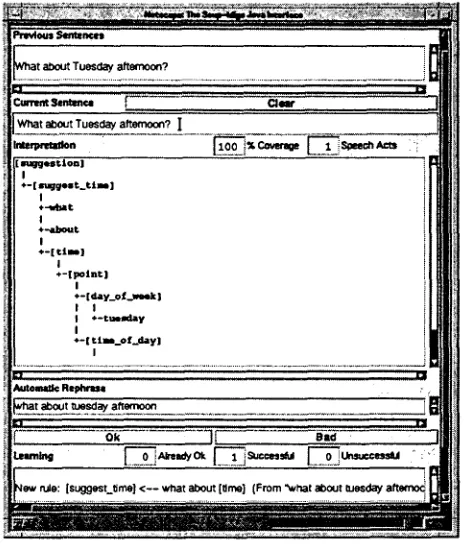
Figure 4: Example of a learning episode using parser predictions. Initially only the temporal expression is un- derstood...
in left-to-right parsing, or before the partially-parsed sequence in right-to-left parsing). This allows two kinds of grammar acquisition:
1. Discovery of expression equivalence. E.g., with the grammar in Fig. 3 and input sentence What about Tuesday afternoon? GsQ is able to ask the end-user whether the utterance means the same as How about Tuesday afternoon? (See Figs. 4, 5 and 6). That is because in the pro- cess of parsing What about Tuesday afternoon? right-to-left, the parser has been able to match rule (2) in Fig. 2 up to about, and thus it hypothesizes the equivalence of what and how since that would allow the parse to complete. 9 2. Discovery of an ISA relation. Similarly, from
input sentence How about noon? GsG is able to predict, in left-to-right parsing, that noon is
a [time].
3.2.3 H i d d e n u n d e r s t a n d i n g m o d e l
As another way of bringing contextual information to bear in the process of predicting the meaning
[image:3.612.307.536.87.358.2]Y N NO :"; - " " "<i
Figure 5: ...but a correct prediction is made...
P m d o e s .Sin~ n ¢ ~
~Vhat about T u e s d a y aftar~ooo?
What ~ t Tuesaay aftemo~? I
I
*-[ s u : J g o s L t t l ] I
+ - - , l s i t I ÷ - a b o u t
I + - [ t l m ]
I + - [ p o l n t l
I
÷ - [ d a y _ o f _ w o e k l I I I +-ttmlday I
4.-[ t i i . . e l _ d a y ] I
l l u t o m l ~ R e f i l l
a, hat i ~ u t ~ue~l~ aftemoon i i
ok If 8,a ---q
L... Z..J ... ;
lst~a~LlJ,'~ } < - - ",,mat about [ume] {I
Figure 6: ...and a new rule is acquired.
of unparsed words, the following stochastic models, inspired in Miller et al. (1994) and Seneff (1992), and collectively referred to as hidden understanding model (HUM), are employed.
• Speech-act n-gram. Top-level concepts can be
seen as speech acts of the domain. For instance, in the DM in Fig. 2 top-level concepts such
as [greeting], Cfarewell] or [suggestion],
correspond to discourse speech acts, and in normally-occurring conversation, they follow a distribution that is clearly non-uniform. 1°
• Concept-subconcept HMM. Discrete hidden
Markov model in which the states correspond
l°Needless to say, speech-act transition distributions are empirically estimated, but, intuitively, t h e s e q u e n c e < [ g r e e t i n g ] , [ s u g g e s t i o n ] > is more likely t h a n the se- quence < [greeting], [ f a r e w e l l ] > .
to the concepts in the DM (i.e., equivalent to grammar non-terminals) and the observations to the embedded concepts appearing as imme- diate daughters of the state in a parse tree. For example, the parse tree in Fig. 4 contains the following set of <state, observation> pairs:
{< [time], [point] >, < [point], [day_of_week] >, < [point], [time_of_day] >}.
• Concept-word HMM. Discrete hidden Markov
model in which the states correspond to the con- cepts in the DM and the observations to the em- bedded lexical items (i.e., grammar terminals) appearing as immediate daughters of the state in a parse tree. For example, the parse tree in Fig. 4 contains the pairs: {<[day_of_week],
tuesday>, < [time_of_day], afternoon>}.
The HUM thus attempts to capture the recurring patterns of the language used in the domain in an
asynchronous mode, i.e., independent of word order
(as opposed to parser predictions that heavily de- pend on word order). Its aim is, again, to provide predictive power at run-time: upon encountering an unparsable expression, the HUM hypothesizes possi- ble intended meanings in the form of a ranked list of the most likely parse trees, given the current state in the discourse, the subparses for the expression and the lexical items present in the expression.
Its parameters can be best estimated through training over a given corpus of correct parses, but in order not to compromise our established goal of rapid deployment, we employ the following tech- niques.
1. In the absence of a training corpus, the HUM parameters are seeded from the Kernel Gram- mar itself.
2. Training is maintained at run-time through dy- namic updates of all model parameters after each utterance and learning episode.
3 . 2 . 4 E n d - u s e r p a r a p h r a s e s
If the end-user is not satisfied with the hypotheses presented by the parser predictions or the HUM, a third learning method is triggered: learning from a paraphrase of the original utterance, given also by the end-user. Assuming the paraphrase is understood, 11 GsG updates the grammar in such a fashion so that the semantics of the first sentence are equivalent to those of the paraphrase. 12
11 Precisely, the requirement t h a t the g r a m m a r be complete ( s e e n o t e 3} ensures the existence of a suitable paraphrase for any u t t e r a n c e expressible in the domain. In practice, however, it may take too many a t t e m p t s to find an a p p r o p r i a t e para- phrase. Currently, if the first p a r a p h r a s e is not u n d e r s t o o d , no f u r t h e r requests are made.
[image:4.612.78.306.81.157.2] [image:4.612.75.307.205.479.2]Perfect Ok Bad
Expert before 55.41 17.58 27.01
Expert after 75.68 10.81 13.51
A +£0.£7 --6.77 --13.50
End-user1 before 58.11 18.92 22.97
End-user1 after 64.86 22.97 12.17
A +6.75 +.~.05 --10.80
End-user2 before 41.89 16.22 41.89
End-user2 after 48.64 28.38 22.98
A +6.75 +1£.16 --18.91
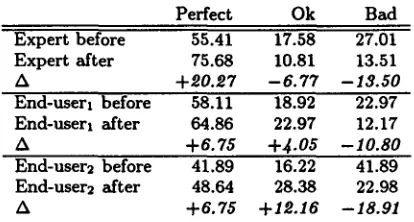
Table 1: Comparison of parse grades (in %). Expert using traditional method vs. non-experts using GSG.
4
Preliminary results
We have conducted a series of preliminary exper- iments in different languages (English, G e r m a n and Chinese) and domains (scheduling, travel reserva- tions). We present here the results for an experiment involving the comparison of expert vs. non-expert g r a m m a r development on a spontaneous travel reser- vation task in English. T h e g r a m m a r had been de- veloped over the course of three m o n t h s by a full- time expert g r a m m a r writer and the experiment con- sisted in having this expert develop on an unseen set of 72 sentences using the traditional environment and asking two non-expert users is to "teach" G s 6 the meaning of the same 72 sentences through in- teractions with the system. Table 1 compares the correct parses before and after development.
It took the expert 15 minutes to add 8 rules and reduce bad coverage from 27.01% to 13.51%. As for the non-experts, end-user1, starting with a sim- ilar g r a m m a r , reduced bad parses from 22.97% to 12.17% through a 30-minute session 14 with GsG that gave rise to 8 new rules; end-user2, starting with the smallest possible complete g r a m m a r , reduced bad parses from 41.89% to 22.98% through a 35-minute session 14 t h a t triggered the creation of 17 new rules. 60% of the learning episodes were successful, with an average n u m b e r of questions of 2.91. T h e unsuc- cessful learning episodes had an average n u m b e r of questions of 6.19 and their failure is mostly due to unsuccessful paraphrases.
As for the nature of the acquired rules, they dif- fer in t h a t the expert makes use of optional and re- peatable tokens, an expressive power not currently available to GSG. On the other hand this lack of generality can be compensated by the Principle of Maximal Abstraction (see note 8). As an example, to cover the new construction A n d your last name?,
the expert chose to create the rule:
[requestmame] ~ *and your last name
tSUndergraduate students not majoring in computer sci- ence or linguistics.
14 Including a 5-minute introduction.
whereas both end-user1 and end-users induced the automatic acquisition of the rule:
[requostmame] ~ CONJ POSS [last] name. 15
5
Discussion
Although preliminary and limited in scope, these results are encouraging and suggest t h a t g r a m m a r development by non-experts through GsG is indeed possible and cost-effective. It can take the non- expert twice as long as the expert to go through a set of sentences, but the main point is that it is possible at all for a user with no background in computer sci- ence or linguistics to teach G s o the meaning of new expressions without being aware of the underlying machinery.
Potential applications of GSG are many, most no- tably a very fast development of NLU components for a variety of tasks including speech recognition and NL interfaces. Also, the IDIGA environment enhances the usability of any system or application that incorporates it, for the end-users are able to eas- ily "teach the c o m p u t e r " their individual language patterns and preferences.
Current and future work includes further develop- ment of the learning m e t h o d s and their integration, design of a rule-merging mechanism, comparison of individual vs. collective grammars, distributed g r a m m a r development over the World Wide Web, and integration of GSG's run-time stage into the JANUS speech recognition system (Lavie et al. 1997).
A c k n o w l e d g e m e n t s
The work reported in this paper was funded in part by a grant from ATR Interpreting Telecommunications Re- search Laboratories of Japan.
R e f e r e n c e s
Kiyono, Masaki and Jun-ichi Tsujii. 1993. "Linguistic knowledge acquisition from parsing failures." In Pro- ceedings of the 6th Conference of the European Chap- ter of the A CL.
Lavie, Alon, Alex Waibel, Lori Levin, Michael Finke, Donna Gates, Marsal Gavaldh, Torsten Zeppenfeld, and Puming Zhan. 1997. "JANus IIh speech-to- speech translation in multiple languages." In Proceed-
ings of ICASSP-97.
Lehman, Jill Fain. 1989. Adaptive parsing: Self-
extending natural language interfaces. Ph.D. disserta-
tion, School of Computer Science, Carnegie Mellon University.
Miller, Scott, Robert Bobrow, Robert Ingria, and Richard Schwartz. 1994. "Hidden understanding mod- els of natural language." In Proceedings of ACL-9$.
Seneff, Stephauie. 1992. "TINA: a natural language sys- tem for spoken language applications." In Computa-
tional Linguistics, vol. 18, no. 1, pp. 61-83.
[image:5.612.75.282.71.182.2]R e s u m
Un dels camins critics en el desenvolupament de mbduls de comprensi6 del llenguatge natural passa per la dificultat de definir la funci6 que assigna, a una seqii~ncia de mots, la representaci6 sem~ntica desitjada. Els m~todes tradicionals per definir aquesta correspond~ncia requereixen l'esforq de lingiiistes computacionals, que dediquen mesos o ~dhuc anys construint, per exemple, una gram~tica sem~ntica (formalisme en el qual els s~mbols no ter- minals de la gram~tica corresponen directament als conceptes del domini de l'aplicaci6 determinada), i, tanmateix, degut precisament a la prbpia natura del llenguatge hum~, la gram~tica resultant mai no 4s capaq de cobrir tots els mots i expressions que ocor- ren naturalment al domini en qiiesti6.
Reconeixent per tant la impossibilitat d'establir a priori totes les formes superficials amb qu~ un con- cepte pot ser expressat, presentem en aquest tre- ball GsG: un sistema computacional emp~tic per al r~pid desplegament de mbduls de comprensi6 del llenguatge natural i llur adaptaci6 din&mica a les particularitats i prefertncies d'usuaris finals inex- perts.
El proc4s de construcci6 d'un mbdul de com- prensi6 del llenguatge natural per a un nou domini pot set dividit en dues parts. Primerament, durant la fase de
composici5,
GsG ajuda el desenvolupador expert en l'estructuraci6 dels conceptes del domini (ontologia) i en l'establiment d'una gram&tica mi- nimal. Tot seguit, durant la fased'execuci5,
Gs~ forneix l'usuari final inexpert d'un medi interactiu en qu& la gram&tica 4s augmentada din&micament.Tres m~todes d'aprenentatge autom&tic s6n uti- litzats en l'adquisici6 de regles gramaticals a partir de noves frases i construccions: (i) prediccions de l'analitzador (GSG empra an&lisis incompletes per conjecturar quins roots poden apar&ixer tant
desprds
de l'arbre d'anMisi incomplet, en anMisi d'esquerra a dreta, cornabans
de l'arbre d'anMisi incomplet, en anMisi de dreta a esquerra),(ii)
cadenes de Markov (m~todes estochstics que modelen, independentment de l'ordre dels mots, la distribuci6 dels conceptes i llurs transicions, emprats per calcular el concepte global m4s probable donats un context i uns arbres d'anMisi parcials determinats), i(iii)
par&frasis (em- prades per assignar llur representaci6 sem&ntica a la frase original).Hem implementat una primera versi6 de GsG i els resultats obtinguts, per b4 que preliminars, s6n ben encoratjadors car demostren que un usuari inexpert pot "ensenyar" a GsG el significat de noves expres- sions i causar una extensi6 de la gram&tica compa- rable a la d'un expert.
Actualment estem treballant en la millora dels m&todes autom&tics d'aprenentatge i llur inte- graci6, en el disseny d'un mecanisme de corn-
binaci6 autom~tica de regles gramaticals, en la comparaci6 de gram&tiques individuals amb gram&tiques col.lectives, en el desenvolupament distribu'it de gram~tiques a trav4s de la World
Wide Web, i en la integraci6 de la fase
d'execuci6 de GsG en el sistema de reconeixe- ment de la parla i traducci6 autom~tica JANUS.