ICARUS – An Extensible Graphical Search Tool
for Dependency Treebanks
Markus G¨artner Gregor Thiele Wolfgang Seeker Anders Bj¨orkelund Jonas Kuhn
Institut f¨ur Maschinelle Sprachverarbeitung University of Stuttgart
Abstract
We present ICARUS, a versatile graphi-cal search tool to query dependency tree-banks. Search results can be inspected both quantitatively and qualitatively by means of frequency lists, tables, or depen-dency graphs. ICARUS also ships with plugins that enable it to interface with tool chains running either locally or remotely.
1 Introduction
In this paper we present ICARUS1 a search and visualization tool that primarily targets depen-dency syntax. The tool has been designed such that it requires minimal effort to get started with searching a treebank or system output of an auto-matic dependency parser, while still allowing for flexible queries. It enables the user to search de-pendency treebanks given a variety of constraints, including searching for particular subtrees. Em-phasis has been placed on a functionality that makes it possible for the user to switch back and forth between a high-level, aggregated view of the search results and browsing of particular corpus instances, with an intuitive visualization of the way in which it matches the query. We believe this to be an important prerequisite for accessing anno-tated corpora, especially for non-expert users.
Search queries in ICARUS can be constructed either in a graphical or a text-based manner. Build-ing queries graphically removes the overhead of learning a specialized query language and thus makes the tool more accessible for a wider audi-ence. ICARUS provides a very intuitive way of breaking down the search results in terms of fre-quency statistics (such as the distribution of part-of-speech on one child of a particular verb against the lemma of another child). The dimensions for
1Interactive platform for Corpus Analysis and Research
tools, University of Stuttgart
the frequency break-down are simply specified by using grouping operators in the query. The fre-quency tables are filled and updated in real time as the search proceeds through the corpus – allow-ing for a quick detection of misassumptions in the query.
ICARUS uses a plugin-based architecture that permits the user to write his own plugins and in-tegrate them into the system. For example, it comes with a plugin that interfaces with an exter-nal parser that can be used to parse a sentence from within the user interface. The constraints for the query can then be copy-pasted from the resulting parse visualization. This facilitates example-based querying, which is particularly helpful for inexpe-rienced users – they do not have to recall details of the annotation conventions outside of their fo-cus of interests but can go by what the parser pro-vides.2
ICARUS is written entirely in Java and runs out of the box without requiring any installation of the tool itself or additional libraries. This makes it platform independent and the only requirement is that a Java Runtime Environment (JRE) is in-stalled on the host system. It is open-source and freely available for download.3
As parsers and other Natural Language Pro-cessing (NLP) tools are starting to find their way into other sciences such as (digital) humanities or social sciences, it gets increasingly important to provide intuitive visualization tools that integrate seamlessly with existing NLP tools and are easy to use also for non-linguists. ICARUS interfaces readily with NLP tools provided as web services by CLARIN-D,4 the German incarnation of the European Infrastructure initiative CLARIN.
2This is of course only practical with rather reliable
auto-matic parsers, but in our experience, the state-of-the-art qual-ity is sufficient.
3www.ims.uni-stuttgart.de/forschung/
ressourcen/werkzeuge/icarus.en.html
4http://de.clarin.eu
The remainder of this paper is structured as fol-lows: In Section 2 we elaborate on the motivation for the tool and discuss related work. Section 3 presents a running example of how to build queries and how results are visualized. In Section 4 we outline the details of the architecture. Section 5 discusses ongoing work, and Section 6 concludes.
2 Background
Linguistically annotated corpora are among the most important sources of knowledge for empir-ical linguistics as well as computational modeling of natural language. Moreover, for most users the only way to develop a systematic understanding of the phenomena in the annotations is through a process of continuous exploration, which requires suitable and intuitive tools.
As automatic analysis tools such as syntactic parsers have reached a high quality standard, ex-ploration of large collections of auto-parsed cor-pus material becomes more and more common. Of course, the querying problem is the same no matter whether some target annotation was added manu-ally, as in a treebank, or automatically. Yet, the strategy changes, as the user will try to make sure he catches systematic parsing errors and develops an understanding of how the results he is deal-ing with come about. While there is no guaran-teed method for avoiding erroneous matches, we believe that an easy-to-use transparent querying mechanism that allows the user to look at the same or similar results from various angles is the best possible basis for an informed usage: frequency tables breaking down the corpus distributions in different dimensions are a good high-level hint, and the actual corpus instances should be only one or two mouse clicks away, presented with a con-cise visualization of the respective instantiation of the query constraints.
Syntactic annotations are quite difficult to query if one is interested in specific constructions that are not directly encoded in the annotation labels (which is the case for most interesting phenom-ena). Several tools have been developed to enable researchers to do this. However, many of these tools are designed for constituent trees only.
Dependency syntax has become popular as a framework for treebanking because it lends itself naturally to the representation of free word order phenomena and was thus adopted in the creation of treebanks for many languages that have less strict
word order, such as the Prague Dependency Tree-bank for Czech (Hajiˇc et al., 2000) or SynTagRus for Russian (Boguslavsky et al., 2000).
A simple tool for visualization of dependency trees is What’s wrong with my NLP? (Riedel, 2008). Its querying functionality is however lim-ited to simple string-searching on surface forms. A somewhat more advanced tool isMaltEval (Nils-son and Nivre, 2008), which offers a number of predefined search patterns ranging from part-of-speech tag to branching degree.
On the other hand, powerful tools such as PML-TQ(Pajas and ˇStˇep´anek, 2009) orINESS(Meurer, 2012) offer expressive query languages and can facilitate cross-layer queries (e.g., involving both syntactic and semantic structures). They also accommodate both constituent and dependency structures.
In terms of complexity in usage and expressiv-ity, we believe ICARUS constitutes a middle way between highly expressive and very simple visu-alization tools. It is easy to use, requires no in-stallation, while still having rich query and visual-ization capabilities. ICARUS is similar to PML-TQ in that it also allows the user to create queries graphically. It is also similar to the search tool GrETEL(Augustinus et al., 2012) as it interfaces with a parser, allowing the user to create queries starting from an automatic parse. Thus, queries can be created without any prior knowledge of the treebank annotation scheme.
As for searching constituent treebanks, there is a plethora of existing search tools, such as TGrep2 (Rohde, 2001), TigerSearch (Lezius, 2002),MonaSearch(Maryns, 2009), andFangorn (Ghodke and Bird, 2012), among others. They im-plement different query languages with varying ef-ficiency and expressiveness.
3 Introductory Example
Before going into the technical details, we show an example of what you can do with ICARUS. Assume that a user is interested in passive con-structions in English, but does not know exactly how this is annotated in a treebank. As a first step, he can use a provided plugin that interfaces with a tool chain5 to parse a sentence that contains a passive construction (thus adopting the example-based querying approach laid out in the
introduc-5using mate-tools by Bohnet (2010); available at
tion). Figure 1 shows the parser interface. In the lower field, the user entered the sentence. The other two fields show the output of the parser, once as a graph and once as a feature value description.
Figure 1: Parsing the sentence”Mary was kissed by a boy.”with a predefined tool chain.
In the second step, the user can then mark parts of the output graph by selecting some nodes and edges, and have ICARUS construct a query struc-ture from it, following the drag-and-drop scheme users are familiar with from typical office soft-ware. The automatically built query can be man-ually adjusted by the user (relaxing constraints) and then be used to search for similar structures in a treebank. The parsing step can of course be skipped altogether, and a query can be constructed by hand right away. Figure 2 shows the query builder, where the user can define or edit search graphs graphically in the main window, or enter them as a query string in the lower window.
Figure 2: Query builder for constructing queries.
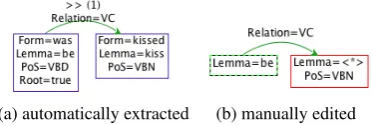
For the example, Figure 3 shows the query as it is automatically constructed by ICARUS from the partial parse tree (3a), and what it might look like after the user has changed it (3b). The modified query matches passive constructions in English, as
annotated in the CoNLL 2008 Shared Task data set (Surdeanu et al., 2008), which we use here.
[image:3.595.321.508.107.170.2](a) automatically extracted (b) manually edited
Figure 3: Search graphs for finding passive con-structions. (a) was constructed automatically from the parsed sentence, (b) is a more general version.
[image:3.595.73.292.128.270.2]The search returns 6,386 matches. Note that the query (Figure 3b) contains a<*>-expression. This grouping operator groups the results accord-ing to the specified dimension, in this case by the lemma of the passivized verb. Figure 4 shows the result view. On the left, a list of lemmas is presented, sorted by frequency. Clicking on the lemma displays the list of matches containing that particular lemma on the right side. The match-ing sentences can then be browsed, with the active sentence also being shown as a tree. Note that the instantiation of the query constraints is highlighted in the tree display.
Figure 4: Passive constructions in the treebank grouped by lemma and sorted by frequency.
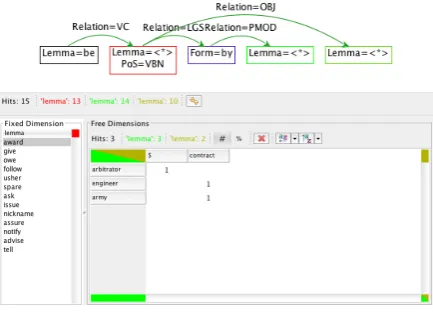
[image:3.595.308.529.422.525.2] [image:3.595.74.290.523.659.2]Figure 5: Search graph and result view for passive constructions with overt logical subjects, grouped by lemma of the verb and the lemma of the logical subject.
[image:4.595.73.290.398.555.2]Finally, we can add a third grouping operator. Figure 6 shows a further refined query for passives with an overt logical subject and an object. In the results, the user is presented with a list of values for the first grouping operator to the left. Clicking on one item in that list opens up a table on the right presenting the other two dimensions of the query.
Figure 6: Search graph and result view for passive constructions with an overt logical subject and an object, grouped by lemma of the verb, the logical subject, and the object.
This example demonstrates a typical use case for a user that is interested in certain linguistic constructions in his corpus. Creating the search graph and interpreting the results does not re-quire any specialized knowledge other than fa-miliarity with the annotation of the corpus being searched. It especially does not require any pro-gramming skills, and the possibility to graphically build a query obviates the need to learn a special-ized query language.
4 Architecture
This section goes into more details about the in-ner workings of ICARUS. A main component is the search engine, which enables the user to quickly search treebanks for whatever he is inter-ested in. A second important feature of ICARUS is the plugin-based architecture, which allows for the definition of custom extensions. Currently, ICARUS can read the commonly used CoNLL de-pendency formats, and it is easy to write exten-sions in order to add additional formats.
4.1 Search Engine and Query Builder
ICARUS has a based search engine for tree-banks, and includes a graphical query builder. Structure and appearance of search graphs are sim-ilar to the design used for displaying dependency trees (cf. Figure 1), which is realized with the open-source library JGraph.6 Queries and/or their results can be saved to disk and later reloaded for further processing.
Defining a query graphically basically amounts to drawing a partial graph structure that defines the type of structure that the user is interested in. In practice, this is done by creating nodes in the query builder and connecting them by edges. The nodes correspond to words in the dependency trees of the treebank. Several features like word iden-tity, lemma, part of speech, etc. can be specified for each node in the search graph in order to re-strict the query. Dominance and precedence con-straints over a set of nodes can be defined by sim-ply linking nodes with the appropriate edge type. Edges can be further specified for relation type, distance, direction, projectivity, and transitivity. A simple example is shown in Figures 2 and 3. The search engine supports regular expressions for all string-properties (form, lemma, part of speech, re-lation). It also supports negation of (existence of) nodes and edges, and their properties.
As an alternative to the search graph, the user can also specify the query in a text-based format by constructing a comma separated collection of constraints in the form of key=value pairs for a single node contained within square brackets. Hi-erarchical structures are expressed by nesting their textual representation. Figure 7 shows the text-based form of the three queries used in the exam-ples in Section 3.
Query 1: [lemma=be[pos=VBN,lemma=<*>,rel=VC]]
Query 2: [lemma=be[pos=VBN,lemma=<*>,rel=VC[form=by,rel=LGS[lemma=<*>,rel=PMOD]]]] Query 3: [lemma=be[pos=VBN,lemma=<*>,rel=VC[form=by,rel=LGS[lemma=<*>,rel=PMOD]]
[lemma=<*>,rel=OBJ]]]
Figure 7: Text representation of the three queries used in the example in Section 3.
A central feature of the query language is the
grouping operator (<*>), which will match any value and cause the search engine to group result entries by the actual instance of the property de-clared to be grouped. The results of the search will then be visualized as a list of instances to-gether with their respective frequencies. Results can be sorted alphabetically or by frequency (ab-solute or relative counts) . Depending on the num-ber of grouping operators used (up to a maximum of three) the result is structured as a list of fre-quencies (cf. Figure 4), a table of frefre-quencies for pairs of instances (cf. Figure 5), or a list where each item then opens up a table of frequency re-sults (cf. Figure 6). In the search graph and the result view, different colors are used to distinguish between different grouping operators.
The ICARUS search engine offers three differ-ent search modes:
Sentence-based. Sentence based search stops at the first successful hit in a sentence and returns every sentence on a list of results at most once.
Exhaustive sentence-based. The exhaustive sentence-based search mode extends the sentence based search by the possibility of processing mul-tiple hits within a single sentence. Every sentence with at least one hit is returned exactly once. In the result view, the user can then browse the different hits found in one sentence.
Hit-based. Every successful hit is returned sepa-rately on the corresponding list of results.
When a query is issued, the search results are displayed on the fly as the search engine is pro-cessing the treebank. The sentences can be ren-dered in one of two ways: either as a tree, where nodes are arranged vertically by depth in the tree, or horizontally with all the nodes arranged side-by-side. If a tree does not fit on the screen, part of it is automatically collapsed but can be expanded again by the user.
4.2 Extensibility
ICARUS relies on the Java Plugin Framework,7 which provides a powerful XML-based
frame-7http://jpf.sourceforge.net/
work for defining plugins similarly to the engine used by the popular Eclipse IDE project. The
plugin-based architecturemakes it possible for anybody to write extensions to ICARUS that are specialized for a particular task. The parser inte-gration of mate-tools demonstrated in Section 3 is an example for such an extension.
The plugin system facilitates custom extensions that make it possible to intercept certain stages of an ongoing search process and interact with it. This makes it possible for external tools to pre-process search data and apply additional annota-tions and/or filtering, or even make use of exist-ing indices by usexist-ing search constraints to limit the amount of data passed to the search engine. With this general setup, it is for example possible to eas-ily extend ICARUS to work with constituent trees. ICARUS comes with a dedicated plugin that enables access to web services provided by CLARIN-D. The project aims to provide tools and services for language-centered research in the hu-manities and social sciences. In contrast to the in-tegration of, e.g., mate-tools, where the tool chain is executed locally, the user can define a tool chain by chaining several web services (e.g., lemmatiz-ers, part-of-speech taggers etc.) together and ap-ply them to his own data. To do this, ICARUS is able to read and write the TCF exchange for-mat (Heid et al., 2010) that is used by CLARIN-D web services. The output can then be inspected and searched using ICARUS. As new NLP tools are added as CLARIN-D web services they can be immediately employed by ICARUS.
5 Upcoming Extensions
An upcoming release includes the following ex-tensions:
• Currently, treebanks are assumed to fit into
memory consuming chunks, thus keeping the system responsive when access is requested.
• The search engine is being extended with an operator that allows disjunctions of queries. This will enable the user to aggregate fre-quency output over multiple queries.
6 Conclusion
We have presented ICARUS, a versatile and user-friendly search and visualization tool for depen-dency trees. It is aimed not only at (computa-tional) linguists, but also at people from other dis-ciplines, e.g., the humanities or social sciences, who work with language data. It lets the user create queries graphically and returns results (1) quantitatively by means of frequency lists and ta-bles as well as (2) qualitatively by connecting the statistics to the matching sentences and allowing the user to browse them graphically. Its plugin-based architecture enables it to interface for exam-ple with external processing pipelines, which lets the user apply processing tools directly from the user interface.
In the future, specialized plugins are planned to work with different linguistic annotations, e.g. cross-sentence annotations as used to annotate coreference chains. Additionally, a plugin is in-tended that interfaces the search engine with a database.
Acknowledgments
This work was funded by the Deutsche Forschungsgemeinschaft (DFG) via the SFB 732 “Incremental Specification in Context”, project D8, and by the Bundesministerium f¨ur Bildung und Forschung (BMBF) via project No. 01UG1120F, CLARIN-D center Stuttgart. The authors are also indebted to Andr´e Blessing and Heike Zinsmeister for reading an earlier draft of this paper.
References
Liesbeth Augustinus, Vincent Vandeghinste, and Frank Van Eynde. 2012. Example-based Treebank Querying. InProceedings of the Eight International Conference on Language Resources and Evaluation (LREC’12), Istanbul, Turkey. ELRA.
Igor Boguslavsky, Svetlana Grigorieva, Nikolai Grig-oriev, Leonid Kreidlin, and Nadezhda Frid. 2000. Dependency Treebank for Russian: Concept, Tools,
Types of Information. In COLING 2000, pages 987–991, Saarbr¨ucken, Germany.
Bernd Bohnet. 2010. Top Accuracy and Fast Depen-dency Parsing is not a Contradiction. In COLING 2010, pages 89–97, Beijing, China.
Sumukh Ghodke and Steven Bird. 2012. Fangorn: A System for Querying very large Treebanks. In COL-ING 2012: Demonstration Papers, pages 175–182, Mumbai, India.
Jan Hajiˇc, Alena B¨ohmov´a, Eva Hajiˇcov´a, and Barbora Vidov´a-Hladk´a. 2000. The Prague Dependency Treebank: A Three-Level Annotation Scenario. In
Treebanks: Building and Using Parsed Corpora, pages 103–127. Amsterdam:Kluwer.
Ulrich Heid, Helmut Schmid, Kerstin Eckart, and Er-hard Hinrichs. 2010. A Corpus Representation For-mat for Linguistic Web Services: The D-SPIN Text Corpus Format and its Relationship with ISO Stan-dards. InProceedings of the Seventh International Conference on Language Resources and Evaluation (LREC’10), Valletta, Malta. ELRA.
Wolfgang Lezius. 2002. Ein Suchwerkzeug f¨ur syn-taktisch annotierte Textkorpora. Ph.D. thesis, IMS, University of Stuttgart.
Hendrik Maryns. 2009. MonaSearch – A Tool for Querying Linguistic Treebanks. In Proceedings of TLT 2009, Groningen.
Paul Meurer. 2012. INESS-Search: A Search System for LFG (and Other) Treebanks. In Miriam Butt and Tracy Holloway King, editors, Proceedings of the LFG2012 Conference. CSLI Publications.
Jens Nilsson and Joakim Nivre. 2008. MaltEval: an Evaluation and Visualization Tool for Dependency Parsing. In Proceedings of the Sixth International Conference on Language Resources and Evaluation (LREC’08), Marrakech, Morocco. ELRA.
Petr Pajas and Jan ˇStˇep´anek. 2009. System for Query-ing Syntactically Annotated Corpora. In Proceed-ings of the ACL-IJCNLP 2009 Software Demonstra-tions, pages 33–36, Suntec, Singapore. Association for Computational Linguistics.
Sebastian Riedel. 2008. What’s Wrong With My NLP?
http://code.google.com/p/ whatswrong/.
Douglas L.T. Rohde. 2001. TGrep2 the next-generation search engine for parse trees.
http://tedlab.mit.edu/˜dr/Tgrep2/.