Universal Dependency Annotation for Multilingual Parsing
Ryan McDonald† Joakim Nivre†∗ Yvonne Quirmbach-Brundage‡ Yoav Goldberg†? Dipanjan Das† Kuzman Ganchev† Keith Hall† Slav Petrov† Hao Zhang†
Oscar T¨ackstr¨om†∗ Claudia Bedini‡ N´uria Bertomeu Castell´o‡ Jungmee Lee‡
Google, Inc.† Uppsala University∗ Appen-Butler-Hill‡ Bar-Ilan University? Contact:[email protected]
Abstract
We present a new collection of treebanks with homogeneous syntactic dependency annotation for six languages: German, English, Swedish, Spanish, French and Korean. To show the usefulness of such a resource, we present a case study of cross-lingual transfer parsing with more reliable evaluation than has been possible before. This ‘universal’ treebank is made freely available in order to facilitate research on multilingual dependency parsing.1
1 Introduction
In recent years, syntactic representations based on head-modifier dependency relations between words have attracted a lot of interest (K¨ubler et al., 2009). Research in dependency parsing – com-putational methods to predict such representations – has increased dramatically, due in large part to the availability of dependency treebanks in a num-ber of languages. In particular, the CoNLL shared tasks on dependency parsing have provided over twenty data sets in a standardized format (Buch-holz and Marsi, 2006; Nivre et al., 2007).
While these data sets are standardized in terms of their formal representation, they are still hetero-geneous treebanks. That is to say, despite them all being dependency treebanks, which annotate each sentence with a dependency tree, they sub-scribe to different annotation schemes. This can include superficial differences, such as the renam-ing of common relations, as well as true diver-gences concerning the analysis of linguistic con-structions. Common divergences are found in the
1Downloadable at https://code.google.com/p/uni-dep-tb/.
analysis of coordination, verb groups, subordinate clauses, and multi-word expressions (Nilsson et al., 2007; K¨ubler et al., 2009; Zeman et al., 2012). These data sets can be sufficient if one’s goal is to build monolingual parsers and evaluate their quality without reference to other languages, as in the original CoNLL shared tasks, but there are many cases where heterogenous treebanks are less than adequate. First, a homogeneous represen-tation is critical for multilingual language tech-nologies that require consistent cross-lingual anal-ysis for downstream components. Second, consis-tent syntactic representations are desirable in the evaluation of unsupervised (Klein and Manning, 2004) or cross-lingual syntactic parsers (Hwa et al., 2005). In the cross-lingual study of McDonald et al. (2011), where delexicalized parsing models from a number of source languages were evalu-ated on a set of target languages, it was observed that the best target language was frequently not the closest typologically to the source. In one stun-ning example, Danish was the worst source lan-guage when parsing Swedish, solely due to greatly divergent annotation schemes.
In order to overcome these difficulties, some cross-lingual studies have resorted to heuristics to homogenize treebanks (Hwa et al., 2005; Smith and Eisner, 2009; Ganchev et al., 2009), but we are only aware of a few systematic attempts to create homogenous syntactic dependency anno-tation in multiple languages. In terms of auto-matic construction, Zeman et al. (2012) attempt to harmonize a large number of dependency tree-banks by mapping their annotation to a version of the Prague Dependency Treebank scheme (Hajiˇc et al., 2001; B¨ohmov´a et al., 2003). Addition-ally, there have been efforts to manually or semi-manually construct resources with common
tactic analyses across multiple languages using al-ternate syntactic theories as the basis for the repre-sentation (Butt et al., 2002; Helmreich et al., 2004; Hovy et al., 2006; Erjavec, 2012).
In order to facilitate research on multilingual syntactic analysis, we present a collection of data sets with uniformly analyzed sentences for six lan-guages: German, English, French, Korean, Span-ish and SwedSpan-ish. This resource is freely avail-able and we plan to extend it to include more data and languages. In the context of part-of-speech tagging, universal representations, such as that of Petrov et al. (2012), have already spurred numer-ous examples of improved empirical cross-lingual systems (Zhang et al., 2012; Gelling et al., 2012; T¨ackstr¨om et al., 2013). We aim to do the same for syntactic dependencies and present cross-lingual parsing experiments to highlight some of the bene-fits of cross-lingually consistent annotation. First, results largely conform to our expectations of which target languages should be useful for which source languages, unlike in the study of McDon-ald et al. (2011). Second, the evaluation scores in general are significantly higher than previous cross-lingual studies, suggesting that most of these studies underestimate true accuracy. Finally, un-like all previous cross-lingual studies, we can re-port full labeled accuracies and not just unlabeled structural accuracies.
2 Towards A Universal Treebank
The Stanford typed dependencies for English (De Marneffe et al., 2006; de Marneffe and Man-ning, 2008) serve as the point of departure for our ‘universal’ dependency representation, together with the tag set of Petrov et al. (2012) as the under-lying part-of-speech representation. The Stanford scheme, partly inspired by the LFG framework, has emerged as a de facto standard for depen-dency annotation in English and has recently been adapted to several languages representing different (and typologically diverse) language groups, such as Chinese (Sino-Tibetan) (Chang et al., 2009), Finnish (Finno-Ugric) (Haverinen et al., 2010), Persian (Indo-Iranian) (Seraji et al., 2012), and Modern Hebrew (Semitic) (Tsarfaty, 2013). Its widespread use and proven adaptability makes it a natural choice for our endeavor, even though ad-ditional modifications will be needed to capture the full variety of grammatical structures in the world’s languages.
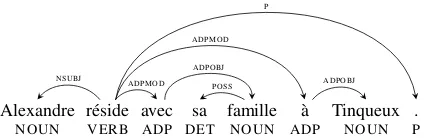
Alexandre r´eside avec sa famille `a Tinqueux .
NOUN VERB ADP DET NOUN ADP NOUN P
NSUBJ ADPMOD ADPOBJ
POSS ADPMOD
[image:2.595.312.526.71.140.2]ADPOBJ P
Figure 1: A sample French sentence.
We use the so-called basicdependencies (with punctuation included), where every dependency structure is a tree spanning all the input tokens, because this is the kind of representation that most available dependency parsers require. A sample dependency tree from the French data set is shown in Figure 1. We take two approaches to generat-ing data. The first is traditional manual annotation, as previously used by Helmreich et al. (2004) for multilingual syntactic treebank construction. The second, used only for English and Swedish, is to automatically convert existing treebanks, as in Ze-man et al. (2012).
2.1 Automatic Conversion
Since the Stanford dependencies for English are taken as the starting point for our universal annota-tion scheme, we begin by describing the data sets produced by automatic conversion. For English, we used the Stanford parser (v1.6.8) (Klein and Manning, 2003) to convert the Wall Street Jour-nal section of the Penn Treebank (Marcus et al., 1993) to basic dependency trees, including punc-tuation and with the copula verb as head in cop-ula constructions. For Swedish, we developed a set of deterministic rules for converting the Tal-banken part of the Swedish Treebank (Nivre and Megyesi, 2007) to a representation as close as pos-sible to the Stanford dependencies for English. This mainly consisted in relabeling dependency relations and, due to the fine-grained label set used in the Swedish Treebank (Teleman, 1974), this could be done with high precision. In addition, a small number of constructions required struc-tural conversion, notably coordination, which in the Swedish Treebank is given a Prague style anal-ysis (Nilsson et al., 2007). For both English and Swedish, we mapped the language-specific part-of-speech tags to universal tags using the map-pings of Petrov et al. (2012).
2.2 Manual Annotation
guidelines; 2) a set of English sentences with Stan-ford dependencies and universal tags (as above); and 3) a large collection of unlabeled sentences randomly drawn from newswire, weblogs and/or consumer reviews, automatically tokenized with a rule-based system. For German, French and Span-ish, contractions were split, except in the case of clitics. For Korean, tokenization was more coarse and included particles within token units. Annota-tors could correct this automatic tokenization.
The annotators were then tasked with producing language-specific annotation guidelines with the expressed goal of keeping the label and construc-tion set as close as possible to the original English set, only adding labels for phenomena that do not exist in English. Making fine-grained label dis-tinctions was discouraged. Once these guidelines were fixed, annotators selected roughly an equal amount of sentences to be annotated from each do-main in the unlabeled data. As the sentences were already randomly selected from a larger corpus, annotators were told to view the sentences in or-der and to discard a sentence only if it was 1) frag-mented because of a sentence splitting error; 2) not from the language of interest; 3) incomprehensible to a native speaker; or 4) shorter than three words. The selected sentences were pre-processed using cross-lingual taggers (Das and Petrov, 2011) and parsers (McDonald et al., 2011).
The annotators modified the pre-parsed trees us-ing the TrEd2tool. At the beginning of the
annota-tion process, double-blind annotaannota-tion, followed by manual arbitration and consensus, was used itera-tively for small batches of data until the guidelines were finalized. Most of the data was annotated using single-annotation and full review: one an-notator annotating the data and another reviewing it, making changes in close collaboration with the original annotator. As a final step, all annotated data was semi-automatically checked for annota-tion consistency.
2.3 Harmonization
After producing the two converted and four an-notated data sets, we performed a harmonization step, where the goal was to maximize consistency of annotation across languages. In particular, we wanted to eliminate cases where the same label was used for different linguistic relations in dif-ferent languages and, conversely, where one and
2Available at http://ufal.mff.cuni.cz/tred/.
the same relation was annotated with different la-bels, both of which could happen accidentally be-cause annotators were allowed to add new labels for the language they were working on. Moreover, we wanted to avoid, as far as possible, labels that were only used in one or two languages.
In order to satisfy these requirements, a number of language-specific labels were merged into more general labels. For example, in analogy with the nnlabel for (element of a) noun-noun compound, the annotators of German addedaafor compound adjectives, and the annotators of Korean addedvv for compound verbs. In the harmonization step, these three labels were merged into a single label compmodfor modifier in compound.
In addition to harmonizing language-specific la-bels, we also renamed a small number of relations, where the name would be misleading in the uni-versal context (although quite appropriate for En-glish). For example, the label prep (for a mod-ifier headed by a preposition) was renamed adp-mod, to make clear the relation to other modifier labels and to allow postpositions as well as prepo-sitions.3 We also eliminated a few distinctions in
the original Stanford scheme that were not anno-tated consistently across languages (e.g., merging complmwithmark,numberwithnum, andpurpcl withadvcl).
The final set of labels is listed with explanations in Table 1. Note that relative to the universal part-of-speech tagset of Petrov et al. (2012) our final label set is quite rich (40 versus 12). This is due mainly to the fact that the the former is based on deterministic mappings from a large set of annota-tion schemes and therefore reduced to the granu-larity of the greatest common denominator. Such a reduction may ultimately be necessary also in the case of dependency relations, but since most of our data sets were created through manual annotation, we could afford to retain a fine-grained analysis, knowing that it is always possible to map from finer to coarser distinctions, but not vice versa.4
2.4 Final Data Sets
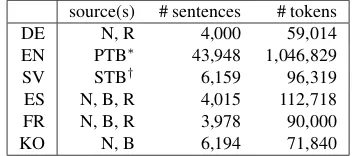
Table 2 presents the final data statistics. The num-ber of sentences, tokens and tokens/sentence vary
3Consequently,pobjandpcompwere changed toadpobj
andadpcomp.
4The only two data sets that were created through
Label Description acomp adjectival complement
adp adposition
adpcomp complement of adposition adpmod adpositional modifier
adpobj object of adposition advcl adverbial clause modifier advmod adverbial modifier
amod adjectival modifier appos appositive
attr attribute
aux auxiliary
auxpass passive auxiliary
cc conjunction
ccomp clausal complement
Label Description compmod compound modifier
conj conjunct
cop copula
csubj clausal subject csubjpass passive clausal subject
dep generic
det determiner
dobj direct object expl expletive infmod infinitival modifier
iobj indirect object
mark marker
mwe multi-word expression
neg negation
Label Description nmod noun modifier nsubj nominal subject nsubjpass passive nominal subject
num numeric modifier
p punctuation
parataxis parataxis partmod participial modifier
poss possessive prt verb particle rcmod relative clause modifier
rel relative
[image:4.595.72.528.62.228.2]xcomp open clausal complement
Table 1: Harmonized label set based on Stanford dependencies (De Marneffe et al., 2006).
source(s) # sentences # tokens
DE N, R 4,000 59,014
EN PTB∗ 43,948 1,046,829
SV STB† 6,159 96,319
ES N, B, R 4,015 112,718
FR N, B, R 3,978 90,000
KO N, B 6,194 71,840
Table 2: Data set statistics. ∗Automatically con-verted WSJ section of the PTB. The data release includes scripts to generate this data, not the data itself. †Automatically converted Talbanken sec-tion of the Swedish Treebank. N=News, B=Blogs, R=Consumer Reviews.
due to the source and tokenization. For example, Korean has 50% more sentences than Spanish, but
∼40k less tokens due to a more coarse-grained
to-kenization. In addition to the data itself, anno-tation guidelines and harmonization rules are in-cluded so that the data can be regenerated.
3 Experiments
One of the motivating factors in creating such a data set was improved cross-lingual transfer eval-uation. To test this, we use a cross-lingual transfer parser similar to that of McDonald et al. (2011). In particular, it is a perceptron-trained shift-reduce parser with a beam of size 8. We use the features of Zhang and Nivre (2011), except that all lexical identities are dropped from the templates during training and testing, hence inducing a ‘delexical-ized’ model that employs only ‘universal’ proper-ties from source-side treebanks, such as part-of-speech tags, labels, head-modifier distance, etc.
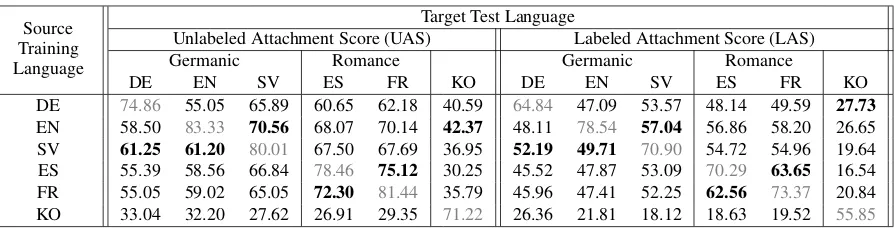
We ran a number of experiments, which can be seen in Table 3. For these experiments we
ran-domly split each data set into training, develop-ment and testing sets.5 The one exception is
En-glish, where we used the standard splits. Each row in Table 3 represents a source training guage and each column a target evaluation lan-guage. We report both unlabeled attachment score (UAS) and labeled attachment score (LAS) (Buch-holz and Marsi, 2006). This is likely the first re-liable cross-lingual parsing evaluation. In partic-ular, previous studies could not even report LAS due to differences in treebank annotations.
We can make several interesting observations. Most notably, for the Germanic and Romance tar-get languages, the best source language is from the same language group. This is in stark contrast to the results of McDonald et al. (2011), who ob-serve that this is rarely the case with the heteroge-nous CoNLL treebanks. Among the Germanic languages, it is interesting to note that Swedish is the best source language for both German and English, which makes sense from a typological point of view, because Swedish is intermediate be-tween German and English in terms of word or-der properties. For Romance languages, the cross-lingual parser is approaching the accuracy of the supervised setting, confirming that for these lan-guages much of the divergence is lexical and not structural, which is not true for the Germanic lan-guages. Finally, Korean emerges as a very clear outlier (both as a source and as a target language), which again is supported by typological consider-ations as well as by the difference in tokenization. With respect to evaluation, it is interesting to compare the absolute numbers to those reported in McDonald et al. (2011) for the languages
[image:4.595.92.268.269.347.2]Source Training Language
Target Test Language
Unlabeled Attachment Score (UAS) Labeled Attachment Score (LAS)
Germanic Romance Germanic Romance
DE EN SV ES FR KO DE EN SV ES FR KO
DE 74.86 55.05 65.89 60.65 62.18 40.59 64.84 47.09 53.57 48.14 49.59 27.73
EN 58.50 83.33 70.56 68.07 70.14 42.37 48.11 78.54 57.04 56.86 58.20 26.65
SV 61.25 61.20 80.01 67.50 67.69 36.95 52.19 49.71 70.90 54.72 54.96 19.64
[image:5.595.77.524.60.174.2]ES 55.39 58.56 66.84 78.46 75.12 30.25 45.52 47.87 53.09 70.29 63.65 16.54 FR 55.05 59.02 65.05 72.30 81.44 35.79 45.96 47.41 52.25 62.56 73.37 20.84 KO 33.04 32.20 27.62 26.91 29.35 71.22 26.36 21.81 18.12 18.63 19.52 55.85 Table 3: Cross-lingual transfer parsing results. Bolded are the best per target cross-lingual result.
mon to both studies (DE, EN, SV and ES). In that study, UAS was in the 38–68% range, as compared to 55–75% here. For Swedish, we can even mea-sure the difference exactly, because the test sets are the same, and we see an increase from 58.3% to 70.6%. This suggests that most cross-lingual parsing studies have underestimated accuracies.
4 Conclusion
We have released data sets for six languages with consistent dependency annotation. After the ini-tial release, we will continue to annotate data in more languages as well as investigate further au-tomatic treebank conversions. This may also lead to modifications of the annotation scheme, which should be regarded as preliminary at this point. Specifically, with more typologically and morpho-logically diverse languages being added to the col-lection, it may be advisable to consistently en-force the principle that content words take func-tion words as dependents, which is currently vi-olated in the analysis of adpositional and copula constructions. This will ensure a consistent analy-sis of functional elements that in some languages are not realized as free words or are not obliga-tory, such as adpositions which are often absent due to case inflections in languages like Finnish. It will also allow the inclusion of language-specific functional or morphological markers (case mark-ers, topic markmark-ers, classifimark-ers, etc.) at the leaves of the tree, where they can easily be ignored in appli-cations that require a uniform cross-lingual repre-sentation. Finally, this data is available on an open source repository in the hope that the community will commit new data and make corrections to ex-isting annotations.
Acknowledgments
Many people played critical roles in the pro-cess of creating the resource. At Google,
Fer-nando Pereira, Alfred Spector, Kannan Pashu-pathy, Michael Riley and Corinna Cortes sup-ported the project and made sure it had the re-quired resources. Jennifer Bahk and Dave Orr helped coordinate the necessary contracts. Andrea Held, Supreet Chinnan, Elizabeth Hewitt, Tu Tsao and Leigha Weinberg made the release process smooth. Michael Ringgaard, Andy Golding, Terry Koo, Alexander Rush and many others provided technical advice. Hans Uszkoreit gave us per-mission to use a subsample of sentences from the Tiger Treebank (Brants et al., 2002), the source of the news domain for our German data set. Anno-tations were additionally provided by Sulki Kim, Patrick McCrae, Laurent Alamarguy and H´ector Fern´andez Alcalde.
References
Alena B¨ohmov´a, Jan Hajiˇc, Eva Hajiˇcov´a, and Barbora Hladk´a. 2003. The Prague Dependency Treebank: A three-level annotation scenario. In Anne Abeill´e, editor,Treebanks: Building and Using Parsed Cor-pora, pages 103–127. Kluwer.
Sabine Brants, Stefanie Dipper, Silvia Hansen, Wolf-gang Lezius, and George Smith. 2002. The TIGER Treebank. InProceedings of the Workshop on Tree-banks and Linguistic Theories.
Sabine Buchholz and Erwin Marsi. 2006. CoNLL-X shared task on multilingual dependency parsing. In
Proceedings of CoNLL.
Miriam Butt, Helge Dyvik, Tracy Holloway King, Hiroshi Masuichi, and Christian Rohrer. 2002. The parallel grammar project. In Proceedings of the 2002 workshop on Grammar engineering and evaluation-Volume 15.
Dipanjan Das and Slav Petrov. 2011. Unsupervised part-of-speech tagging with bilingual graph-based projections. InProceedings of ACL-HLT.
Marie-Catherine de Marneffe and Christopher D. Man-ning. 2008. The Stanford typed dependencies rep-resentation. In Coling 2008: Proceedings of the workshop on Cross-Framework and Cross-Domain Parser Evaluation.
Marie-Catherine De Marneffe, Bill MacCartney, and Chris D. Manning. 2006. Generating typed depen-dency parses from phrase structure parses. In Pro-ceedings of LREC.
Tomaz Erjavec. 2012. MULTEXT-East: Morphosyn-tactic resources for Central and Eastern European languages. Language Resources and Evaluation, 46:131–142.
Kuzman Ganchev, Jennifer Gillenwater, and Ben Taskar. 2009. Dependency grammar induction via bitext projection constraints. InProceedings of ACL-IJCNLP.
Douwe Gelling, Trevor Cohn, Phil Blunsom, and Joao Grac¸a. 2012. The pascal challenge on grammar in-duction. InProceedings of the NAACL-HLT Work-shop on the Induction of Linguistic Structure. Jan Hajiˇc, Barbora Vidova Hladka, Jarmila Panevov´a,
Eva Hajiˇcov´a, Petr Sgall, and Petr Pajas. 2001. Prague Dependency Treebank 1.0. LDC, 2001T10. Katri Haverinen, Timo Viljanen, Veronika Laippala,
Samuel Kohonen, Filip Ginter, and Tapio Salakoski. 2010. Treebanking finnish. In Proceedings of The Ninth International Workshop on Treebanks and Linguistic Theories (TLT9).
Stephen Helmreich, David Farwell, Bonnie Dorr, Nizar Habash, Lori Levin, Teruko Mitamura, Florence Reeder, Keith Miller, Eduard Hovy, Owen Rambow, and Advaith Siddharthan. 2004. Interlingual anno-tation of multilingual text corpora. InProceedings of the HLT-EACL Workshop on Frontiers in Corpus Annotation.
Eduard Hovy, Mitchell Marcus, Martha Palmer, Lance Ramshaw, and Ralph Weischedel. 2006. Ontonotes: the 90% solution. InProceedings of NAACL. Rebecca Hwa, Philip Resnik, Amy Weinberg, Clara
Cabezas, and Okan Kolak. 2005. Bootstrapping parsers via syntactic projection across parallel texts.
Natural Language Engineering, 11(03):311–325. Dan Klein and Christopher D. Manning. 2003.
Accu-rate unlexicalized parsing. InProceedings of ACL. Dan Klein and Chris D. Manning. 2004. Corpus-based
induction of syntactic structure: models of depen-dency and constituency. InProceedings of ACL. Sandra K¨ubler, Ryan McDonald, and Joakim Nivre.
2009.Dependency Parsing. Morgan and Claypool.
Mitchell P. Marcus, Mary Ann Marcinkiewicz, and Beatrice Santorini. 1993. Building a large anno-tated corpus of English: the Penn treebank. Compu-tational Linguistics, 19(2):313–330.
Ryan McDonald, Slav Petrov, and Keith Hall. 2011. Multi-source transfer of delexicalized dependency parsers. InProceedings of EMNLP.
Jens Nilsson, Joakim Nivre, and Johan Hall. 2007. Generalizing tree transformations for inductive de-pendency parsing. InProceedings of ACL.
Joakim Nivre and Be´ata Megyesi. 2007. Bootstrap-ping a Swedish treebank using cross-corpus harmo-nization and annotation projection. InProceedings of the 6th International Workshop on Treebanks and Linguistic Theories.
Joakim Nivre, Johan Hall, Sandra K¨ubler, Ryan Mc-Donald, Jens Nilsson, Sebastian Riedel, and Deniz Yuret. 2007. The CoNLL 2007 shared task on dependency parsing. In Proceedings of EMNLP-CoNLL.
Slav Petrov, Dipanjan Das, and Ryan McDonald. 2012. A universal part-of-speech tagset. InProceedings of LREC.
Mojgan Seraji, Be´ata Megyesi, and Nivre Joakim. 2012. Bootstrapping a Persian dependency tree-bank. Linguistic Issues in Language Technology, 7(18):1–10.
David A. Smith and Jason Eisner. 2009. Parser adap-tation and projection with quasi-synchronous gram-mar features. InProceedings of EMNLP.
Oscar T¨ackstr¨om, Dipanjan Das, Slav Petrov, Ryan McDonald, and Joakim Nivre. 2013. Token and type constraints for cross-lingual part-of-speech tag-ging. Transactions of the ACL.
Ulf Teleman. 1974. Manual f¨or grammatisk beskrivn-ing av talad och skriven svenska. Studentlitteratur.
Reut Tsarfaty. 2013. A unified morpho-syntactic scheme of stanford dependencies. Proceedings of ACL.
Daniel Zeman, David Marecek, Martin Popel, Loganathan Ramasamy, Jan ˇStep´anek, Zdenˇek ˇZabokrtsk`y, and Jan Hajic. 2012. Hamledt: To parse or not to parse. InProceedings of LREC.
Yue Zhang and Joakim Nivre. 2011. Transition-based dependency parsing with rich non-local features. In
Proceedings of ACL-HLT.