Revisiting the impact of different annotation schemes on PCFG parsing:
A grammatical dependency evaluation
Adriane Boyd Department of Linguistics The Ohio State University
1712 Neil Avenue Columbus, Ohio 43210, USA [email protected]
Detmar Meurers Seminar f¨ur Sprachwissenschaft
Universit¨at T¨ubingen Wilhelmstrasse 19 72074 T¨ubingen, Germany [email protected]
Abstract
Recent parsing research has started addressing the questions a) how parsers trained on differ-ent syntactic resources differ in their perfor-mance and b) how to conduct a meaningful evaluation of the parsing results across such a range of syntactic representations. Two Ger-man treebanks, Negra and T¨uBa-D/Z, consti-tute an interesting testing ground for such re-search given that the two treebanks make very different representational choices for this lan-guage, which also is of general interest given that German is situated between the extremes of fixed and free word order. We show that previous work comparing PCFG parsing with these two treebanks employed PARSEVAL and grammatical function comparisons which were skewed by differences between the two corpus annotation schemes. Focusing on the grammatical dependency triples as an essen-tial dimension of comparison, we show that the two very distinct corpora result in compa-rable parsing performance.
1 Introduction
Syntactically annotated corpora have been produced for a range of languages and they differ significantly regarding which language properties are encoded and how they are represented. Between the two ex-tremes of constituency treebanks for English and de-pendency treebanks for free word order languages such as Czech lie languages such as German, for which two different treebanks have explored differ-ent options for encoding topology and dependency, Negra (Brants et al., 1999) and T¨uBa-D/Z (Telljo-hann et al., 2005).
Recent research has started addressing the ques-tion of how parsers trained on these different syntac-tic resources differ in their performance. Such work must also address the question of how to conduct a meaningful evaluation of the parsing results across such a range of syntactic representations. In this pa-per, we show that previous work comparing PCFG parsing for the two German treebanks used represen-tations which cannot adequately be compared using the given PARSEVAL measures and that a grammat-ical dependency evaluation is more meaningful than the grammatical function evaluation provided.
We present the first comparison of Negra and T¨uBa-D/Z using a labeled dependency evaluation based on the grammatical function labels provided in the corpora. We show that, in contrast to previ-ous literature, a labeled dependency evaluation es-tablishes that PCFG parsers trained on the two cor-pora give similar parsing performance. The focus on labeled dependencies also provides a direct link to recent work on dependency-based evaluation (e.g., Clark and Curran, 2007) and dependency parsing (e.g., CoNLL shared tasks 2006, 2007).
1.1 Previous work
The question of how to evaluate parser output has naturally already arisen in earlier work on parsing English. As discussed by Lin (1995) and others, the PARSEVAL evaluation typically used to analyze the performance of statistical parsing models has many drawbacks. Bracketing evaluation may count a sin-gle error multiple times and does not differentiate between errors that significantly affect the interpre-tation of the sentence and those that are less crucial.
It also does not allow for evaluation of particular syntactic structures or provide meaningful informa-tion about where the parser is failing. In addiinforma-tion, and most directly relevant for this paper, PARSE-VAL scores are difficult to compare across syntactic annotation schemes (Carroll et al., 2003).
At the same time, previous research on PCFG parsing using treebank training data present PAR-SEVAL measures in comparing the parsing per-formance for different languages and annotation schemes, reporting a number of striking differences. For example, Levy and Manning (2003), K¨ubler (2005), and K¨ubler et al. (2006) highlight the sig-nificant effect of language properties and annotation schemes for German and Chinese treebanks. In re-lated work, parser enhancements that provide a sig-nificant performance boost for English, such as head lexicalization, are reported not to provide the same kind of improvement, if any, for German (Dubey and Keller, 2003; Dubey, 2004; K¨ubler et al., 2006).
Previous work has compared the similar Negra and Tiger corpora of German to the very different T¨uBa-D/Z corpus. K¨ubler et al. (2006) compares the Negra and T¨uBa-D/Z corpora of German using a PARSEVAL evaluation and an evaluation on core grammatical function labels that is included to ad-dress concerns about the PARSEVAL measure.1 Us-ing the Stanford Parser (Klein and MannUs-ing, 2002), which employs a factored PCFG and dependency model, they claim that the model trained on T¨uBa-D/Z consistently outperforms that trained on Ne-gra in PARSEVAL and Ne-grammatical function evalu-ations. Dubey (2004) also includes an evaluation on grammatical function for statistical models trained on Negra, but obtains very different results from K¨ubler et al. (2006).2
In recent related work, Rehbein and van Genabith (2007a) demonstrate using the Tiger and T¨uBa-D/Z
1
The evaluation is based only on the grammatical function; it does not identify the dependency pair that it labels.
2
While the focus of K¨ubler et al. (2006) is on comparing parsing results across corpora, Dubey (2004) focuses on im-proving parsing for Negra, including corpus-specific enhance-ments leading to better results. This difference in focus and additional differences in experimental setup mean that a fine-grained comparison of the results is inappropriate – the rele-vant point here is that the gap between the results (23% for sub-jects, 35% for accusative objects) warrants further attention in the context of comparing parsing results across corpora.
corpora of German that PARSEVAL is inappropri-ate for comparisons of the output of PCFG parsers trained on different treebank annotation schemes be-cause PARSEVAL scores are affected by the ratio of terminal to non-terminal nodes. A dependency-based evaluation on triples of the form word-POS-head shows better results for the parser trained on Tiger even though the much lower PARSEVAL scores, if meaningful, would predict that the out-put for Tiger is of lower quality. However, their dependency-based evaluation does not make use of the grammatical function labels, which are pro-vided in the corpora and closely correspond to the representations used in recent work on formalism-independent evaluation of parsers (e.g., Clark and Curran, 2007).3
Addressing these issues, we resolve the apparent discrepancy between K¨ubler et al. (2006) and Dubey (2004) and establish a firm grammatical function comparison of Negra and T¨uBa-D/Z. We also ex-tend the evaluation to a labeled dependency evalu-ation based on grammatical relevalu-ations for both cor-pora. Such an evaluation, which abstracts away from the specifics of the annotation schemes, shows that, in contrast to the claims made in K¨ubler et al. (2006), the parsing results for PCFG parsers trained on these heterogeneous corpora are very similar.
2 The corpora used
As motivated in the introduction, the work discussed in this paper is based on two German corpora, Ne-gra and T¨uBa-D/Z, which differ significantly in the syntactic representations used – thereby offering an interesting test bed for investigating the influence of an annotation scheme on the parsers trained.
2.1 Negra
The Negra corpus (Brants et al., 1999) consists of newspaper text from theFrankfurter Rundschau, a German newspaper. Version 2 of the corpus contains 20,602 sentences. It uses the STTS tag set (Schiller et al., 1995) for part-of-speech annotation. There are 25 non-terminal node labels and 46 edge labels.
The syntactic annotation of Negra combines fea-tures from phrase structure grammar and
depen-3
dency grammar using a tree-like syntactic structure with grammatical functions labeled on the edges of the tree. Flat sentence structures are used in many places to avoid attachment ambiguities and non-branching phrases are not used.
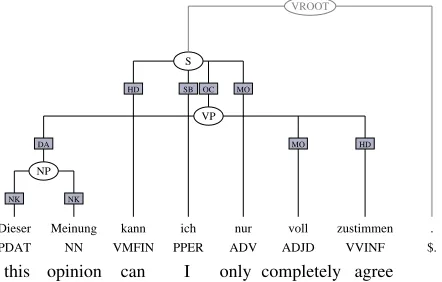
The annotation scheme emphasizes the use of the tree structure to encode grammatical dependencies, representing a head and all its dependents within a local tree regardless of whether a dependent is real-ized near its head or not, e.g., because it has been extraposed or fronted. Since traditional syntax trees do not permit the crossing branches needed to li-cense discontinuous constituents, Negra uses a “syn-tax graph” data structure to represent the annotation. An example of a syntax graph with a discontinuous constituent (VP) due to a fronted dative object (NP) is shown in Figure 1.
Dieser PDAT
Meinung NN
kann VMFIN
ich PPER
nur ADV
voll ADJD
zustimmen VVINF
. $.
NK NK
NP
DA MO HD
VP
OC
HD SB MO
S
VROOT
[image:3.612.74.295.302.443.2]this opinion can I only completely agree
Figure 1: Negra tree for ‘I can only agree with this opin-ion completely.’
Negra uses flat NP and PP annotation with no marked heads. For example, bothDieserand Mein-ungin Figure 1 have the grammatical function label “NK”. Since unary branching is not used in Negra, a bare noun or pronoun argument is not dominated by an NP node, as shown by the pronounichabove.
A verbal head in Negra is always marked with the edge label “HD” and its arguments are its sisters in the local tree. The subject is always the sister of the finite verb, which is a daughter of S. If the finite verb is the main verb in the clause, the objects are also its sisters, i.e., the finite verb, subject and objects are all daughters of S. If the main verb is an auxiliary governing a non-finite main verb, the non-finite verb and its objects and modifiers form a VP where the objects are sisters of the non-finite verb as in
Fig-ure 1. The VP is then a sister of the finite verb. The finite verb in a German declarative clause ap-pears in the so-called verb-second position, immedi-ately following the fronted constituent. As a result, the VP in Negra is discontinuous whenever one of its children has been fronted, as in the common word orders exemplified in (1a) and (1b).
(1) a. Die
the
T ¨ur
door hat has
Anna Anna
wieder
again
zugeschlagen. slammed-shut ‘Anna slammed the door shut again.’ b. Wieder
again hat has
Anna Anna
die
the
T ¨ur
door
zugeschlagen. slammed-shut ‘Anna slammed the door shut again.’
The sentence we saw in Figure 1 contains a dis-continuous VP with a fronted dative object (Dieser Meinung). The dative object and a modifier (voll) form a VP with the non-finite verb (zustimmen).
2.2 T ¨uBa-D/Z
The T¨uBa-D/Z corpus, version 2, (Telljohann et al., 2005) consists of 22,091 sentences of newspaper text from the German newspaperdie tageszeitung. Like Negra, it uses the STTS tag set (Schiller et al., 1995) for part-of-speech annotation. Syntactically it uses 27 non-terminal node labels and 47 edge labels. The syntactic annotation incorporates a topologi-cal field analysis of the German clause (Reis, 1980; H¨ohle, 1986), which segments a sentence into topo-logical units depending on the position of the finite verb (first, second, last). In a verb-first and verb-second sentence, the finite verb is the left bracket (LK), whereas in a verb-last subordinate clause, the subordinating conjunction occupies that field. In all clauses, the non-finite verb cluster forms the right bracket (VC), and arguments and modifiers can appear in the middle field (MF) between the two brackets. Extraposed material is found to the right of the right bracket, and in a verb-second sentence one constituent appears in the fronted field (VF) pre-ceding the finite verb. By specifying constraints on the elements that can occur in the different fields, the word order in any type of German clause can be concisely characterized.
example sentence from T¨uBa-D/Z is shown in Fig-ure 2, where the topological fields VF, LK, MF, and VC are visible under the SIMPX clause node.
Dafür PROP
wird VAFIN
Andrea NE
Fischer NE
wenig PIAT
Zeit NN
haben VAINF
. $. HD
PX
HD
VXFIN
-
-NX
- HD
NX
HD
VXINF
OA-MOD
VF
HD
LK
-EN-ADD
OV
VC
ON OA
MF
- - -
-SIMPX
VROOT
[image:4.612.319.533.56.114.2]for it will Andrea Fischer little time have
Figure 2: T¨uBa-D/Z tree for ‘Andrea Fischer will have little time for it.’
Edge labels are used to mark heads and gram-matical functions, even though it can be nontrivial to figure out which grammatical function belongs to which head given that heads and their arguments often are in separate topological fields. For exam-ple, in Figure 2 the subject noun chunk (NX) has the edge label ON (object - nominative) and the ob-ject noun chunk has the edge label OA (obob-ject - ac-cusative); both are realized within the middle field (MF), while the finite verb (VXFIN) marked as HD (head) is in the left sentence bracket (LK). This is-sue becomes relevant in section 3.4.2, discussing an evaluation based on labeled dependency triples.
Where Negra uses discontinuous constituents, T¨uBa-D/Z uses special edge labels to annotate gram-matical relations which are not locally realized. For example, the fronted prepositional phrase (PX) in Figure 2 has the edge label OA-MOD which needs to be matched with the noun phrase (NX) with label OA that is found in the MF field.
2.3 Comparing Negra and T ¨uBa-D/Z
To give an impression of how the different anno-tation schemes affect the appearance of a typical tree in the two corpora, Table 1 provides statistics on average sentence length and the number of non-terminals per sentence.
[image:4.612.75.296.108.293.2]Negra T¨uBa-D/Z No. of Sentences 20,602 22,091 Terminals/Sentence 17.2 17.3 Non-terminals/Sentence 7.0 20.7
Table 1: General Characteristics of the Corpora
While the sentences in Negra and T¨uBa-D/Z on average have the same number of words, the average T¨uBa-D/Z sentence has nearly three times as many non-terminal nodes as the average Negra sentence. This difference is mainly due to the extra level of topological fields annotation and the use of more contoured structures in many places where Negra uses flatter structures.
3 Experiments
The goal of the following experiments is a compar-ison of parsing performance across different types of evaluation metrics for parsers trained on Negra (Ver. 2) and T¨uBa-D/Z (Ver. 2).
3.1 Data Preparation
Following K¨ubler et al. (2006), only sentences with fewer than 35 words were used, which results in 20,002 sentences for Negra and 21,365 sentences for T¨uBa-D/Z. Because punctuation is not attached within the sentence in the corpus annotation, punc-tuation was removed.
To be able to train PCFG parsing models, it is nec-essary to convert the syntax graphs encoding trees with discontinuities in Negra into traditional syntax trees. Around 30% of sentences in Negra contain at least one discontinuity. To remove discontinuities, we used the conversion program included with the Negra corpus annotation tools (Brants and Plaehn, 2000), the same tool used in K¨ubler et al. (2006), which raises non-head elements to a higher tree un-til there are no more discontinuities. For example, for the discontinuous tree with a fronted object we saw in Figure 1, the PP containing the fronted NP
Dieser Meinungis raised to become a daughter of
the top S node.4
Additionally, the edge labels used in both corpora need to be folded into the node labels to become a
4An alternate method that avoids certain problems with this
part of context-free grammar rules used by a PCFG parser. In the Penn Treebank-style versions of the corpora appropriate for training a PCFG parser, each edge label is joined with the phrase or POS label on the phrase or word immediately below it. Both corpora include edge labels above all phrases and words. However the flatter structures in Negra result in 39 different edge labels on words while T¨uBa-D/Z has only 5.
Unlike K¨ubler et al. (2006), which ignored edge labels on words, we incorporate all edge labels present in both corpora. As a consequence of this, providing a parser with perfect lexical tags would also provide the edge label for that word. T¨uBa-D/Z does not annotate grammatical functions other than HD on words, but Negra includes many grammati-cal functions on words. Including edge labels in the perfect lexical tags would artificially boost the re-sults of a grammatical function evaluation for Negra since it amounts to providing the correct grammati-cal function for the 38% of arguments in Negra that are single words.
To avoid this problem, we introduced non-branching phrasal nodes into Negra to prevent the correct grammatical function label from being pro-vided with the perfect lexical tag in the cases of single-word arguments, which are mostly bare nouns and pronouns. We added phrasal nodes above all single-word subject, accusative object, dative ob-ject, and genitive object5 arguments, with the cate-gory of the inserted phrase depending on the POS tag on the word. The introduced phrasal node is given the word’s original grammatical function la-bel; the grammatical function label of the word itself becomes NK for NPs and HD for APs and VPs. In total, 14,580 nodes were inserted into Negra in this way. T¨uBa-D/Z has non-branching phrases above all single-word arguments, so that no such modification was needed.6
3.2 Experimental Setup
We trained unlexicalized PCFG parsing models us-ing LoPar (Schmid, 2000). Unlexicalized models
5
Genitive objects are modified for the sake of consistency among arguments even though there are too few genitive objects to provide reliable results in the evaluation.
6The addition of edge labels to terminal POS labels results
in 337 lexical tags for Negra and 91 for T¨uBa-D/Z.
were used to minimize the impact of other corpus differences on parsing. A ten-fold cross validation was performed for all experiments.7
3.3 PARSEVAL Evaluation
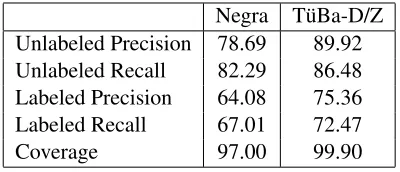
As a reference point for comparison with previous work, the PARSEVAL results8are given in Table 2.
[image:5.612.327.527.165.251.2]Negra T¨uBa-D/Z Unlabeled Precision 78.69 89.92 Unlabeled Recall 82.29 86.48 Labeled Precision 64.08 75.36 Labeled Recall 67.01 72.47 Coverage 97.00 99.90
Table 2: PARSEVAL Evaluation
The parser trained on T¨uBa-D/Z performs much better than the one trained on Negra on all labeled and unlabeled bracketing scores. As we saw in section 2, Negra and T¨uBa-D/Z use very different syntactic annotation schemes, resulting in over 2.5 times as many non-terminals per sentence in T¨uBa-D/Z as in Negra with the additional unary nodes. As mentioned previously, Rehbein and van Genabith (2007a) showed that PARSEVAL is affected by the ratio of terminal to non-terminal nodes, so these re-sults are not expected to indicate the quality of the parses. The comparison with grammatical function and dependency evaluations we turn to next show-cases that PARSEVAL does not provide a meaning-ful evaluation metric across annotation schemes.
3.4 Dependency Evaluation
Complementing the issue of the ratio of terminals to non-terminals raised in the last section, one can question whether counting all brackets in the sen-tence equally, as done by the PARSEVAL metric, provides a good measure of how accurately the ba-sic functor-argument structure of the sentence has been captured in a parse. Thus, it is useful to
per-7Our experimental setup is designed to support a
compari-son between Negra and T¨uBa-D/Z for the three evaluation met-rics and is intended to be comparable to the setup of K¨ubler et al. (2006). For Negra, Dubey (2004) explores a range of pars-ing models and the corpus preparation he uses differs from the one discussed in this paper so that a discussion of his results is beyond the scope of the corpus comparison in this paper.
8
form an evaluation based on the grammatical func-tion labels that are important for determining the functor-argument structure of the sentence: subjects, accusative objects, and dative objects.9 The first step in an evaluation of functor-argument structure is to identify whether an argument bears the correct grammatical function label.
3.4.1 Grammatical Function Label Evaluation
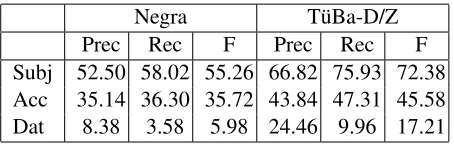
K¨ubler et al. (2006) present the results shown in Ta-ble 3 for the parsing performance of the unlexical-ized model of the Stanford Parser (Klein and Man-ning, 2002). In this grammatical function label eval-uation, T¨uBa-D/Z outperforms Negra for subjects, accusative objects, and dative objects based on an evaluation of phrasal arguments.
[image:6.612.314.540.190.259.2]Negra T¨uBa-D/Z Prec Rec F Prec Rec F Subj 52.50 58.02 55.26 66.82 75.93 72.38 Acc 35.14 36.30 35.72 43.84 47.31 45.58 Dat 8.38 3.58 5.98 24.46 9.96 17.21
Table 3: Grammatical Function Label Evaluation for Phrasal Arguments from K¨ubler et al. (2006)
Note that this grammatical function label evalua-tion is restricted to labels on phrases; grammatical function labels on words are ignored in training and testing. This results in an unbalanced comparison between Negra and T¨uBa-D/Z since, as discussed in section 2, T¨uBa-D/Z includes unary-branching phrases above all single-word arguments whereas Negra does not. In effect, single-word arguments in Negra – mainly pronouns and bare nouns – are not considered in the evaluation from K¨ubler et al. (2006). The result is thus a comparison of word arguments in Negra to both single- and multi-word arguments in T¨uBa-D/Z. Recall from section 3.1 that this is not a minor difference: single-word arguments account for 38% of subjects, accusative objects, and dative objects in Negra.
As discussed in the data preparation section, Ne-gra was modified for our experiment so as not to
9
Genitive objects are also annotated in both corpora, but they are too infrequent to provide meaningful results. As dis-cussed in Rehbein and van Genabith (2007b), labels such as subject (SB for Negra, ON for T¨uBa-D/Z) are not necessarily comparable in all instances, but such cases are infrequent.
provide the parser with the grammatical function la-bels for single word phrases as part of the perfect tags provided. This evaluation handles multiple cat-egories of arguments, not just NPs, so it focuses solely on the grammatical function labels, ignoring the phrasal categories. For example, in Negra an NP-OA in a parse is considered a correct accusative ob-ject even if the OA label in the gold standard has the category MPN. The results are shown in Table 4.
[image:6.612.73.300.281.354.2]Negra T¨uBa-D/Z Prec Rec F Prec Rec F Subj 69.69 69.12 69.42 65.74 72.24 68.99 Acc 48.17 50.97 49.57 41.37 46.81 44.09 Dat 20.93 15.22 18.08 21.40 11.51 16.46
Table 4: Grammatical Function Label Evaluation
In contrast to the results for NP grammatical func-tions of K¨ubler et al. (2006) we saw in Table 3, Ne-gra and T¨uBa-D/Z perform quite similarly overall, with Negra slightly outperforming T¨uBa-D/Z for all types of arguments.
These results also form a clear contrast to the PARSEVAL results we saw in Table 2. Contrary to the finding in K¨ubler et al. (2006), the PAR-SEVAL evaluation does not echo the grammatical function label evaluation. In keeping with the re-sults from Rehbein and van Genabith (2007a), we find that PARSEVAL is not an adequate predictor of performance in an evaluation targeting the functor-argument structure of the sentence for comparisons between PCFG parsers trained on corpora with dif-ferent annotation schemes.
3.4.2 Labeled Dependency Triple Evaluation
While determining the grammatical function of an element is an important part of determining the functor-argument structure of a sentence, the other necessary component is determining the head of each function. To evaluate whether both the functor and the argument have been correctly found, an eval-uation of labeled dependency triples is needed. As in the previous section, we focus on the grammatical function labels for arguments of verbs. To complete a labeled dependency triple for each argument, we additionally need to locate the lexical verbal head.
heads are only marked for a subset of the phrase cat-egories: S, VP, AP, and AVP.10This subset includes the phrase categories that contain verbs and their ar-guments, S and VP. In our experiment, the parser finds the HD grammatical function labels with a very high f-score: 99.5% precision and 96.5% recall. If the sister with the label HD is a word, then that word is the lexical head for the purposes of this depen-dency evaluation. If the sister with the label HD is a phrase, then a recursive search for heads within that phrase finds a lexical head. In 3.2% of cases in the gold standard, it is not possible to find a lexical head for an argument. Further methods could be ap-plied to find the remaining heads heuristically, but we avoid the additional parameters this introduces for this evaluation by ignoring these cases.
For T¨uBa-D/Z, finding the head is not as simple because the verbal head and its arguments are in dif-ferent topological fields. To create a parallel com-parison to Negra, the finite verb from the local clause is chosen as the head for all subjects. The (finite or non-finite) main full verb is designated as the head for the accusative and dative objects. It is possible to automatically find an appropriate head verb for all but 2.7% of subjects, accusative objects, and dative objects.11 As with Negra, only cases where a head verb can be found in the gold standard are consid-ered in the evaluation.
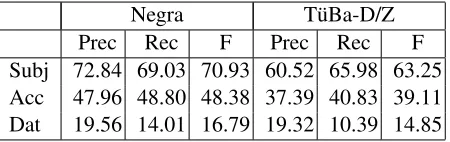
As in the grammatical function evaluation in the previous section, only the grammatical function la-bel, not the phrase category is considered in the uation. The results for the labeled dependency eval-uation are shown in Table 5. The parser trained on Negra outperforms the one trained on T¨uBa-D/Z for all types of arguments.
4 Discussion of Results
Comparing PARSEVAL scores for a parser trained on the Negra and the T¨uBa-D/Z corpus with a gram-matical function and a labeled dependency
evalua-10However, some strings labeled as S and VP do not contain
a head and thus lack a daughter with a HD function label.
11The relative numbers of instances where a lexical head is
not found are comparable for Negra and T¨uBa-D/Z. Heads are not found for approximately 4% of subjects, 1% of accusative objects, and 1% of dative objects. These instances are fre-quently due to elision of the verb in headlines and coordinated clauses.
[image:7.612.316.541.57.128.2]Negra T¨uBa-D/Z Prec Rec F Prec Rec F Subj 72.84 69.03 70.93 60.52 65.98 63.25 Acc 47.96 48.80 48.38 37.39 40.83 39.11 Dat 19.56 14.01 16.79 19.32 10.39 14.85
Table 5: Labeled Dependency Evaluation
tion, we confirm that the PARSEVAL scores do not correlate with the scores in the other two evalua-tions, which given their closeness to the semantic functor argument structure make meaningful targets for evaluating parsers.
Shifting the focus to the grammatical function evaluation, we showed that a grammatical function evaluation based on phrasal arguments as provided by K¨ubler et al. (2006) is inadequate for compar-ing parsers trained on the Negra and T¨uBa-D/Z cor-pora. By introducing non-branching phrase nodes above single-word arguments in Negra, it is possi-ble to provide a balanced comparison for the gram-matical function label evaluation between Negra and T¨uBa-D/Z on both phrasal and single-word argu-ments. The models trained on both corpora perform very similarly in the grammatical function evalua-tion, in contrast to the claims in K¨ubler et al. (2006). When the grammatical function label evaluation is extended into a labeled dependency evaluation by finding the verbal head to complete the labeled de-pendency triple, the parser trained on Negra outper-forms that trained on T¨uBa-D/Z. The more signifi-cant drop in results for T¨uBa-D/Z compared to the grammatical function label evaluation may be due to the fact that a verbal lexical head in T¨uBa-D/Z is not in the same local tree as its dependents, whereas it is in Negra. The presence of intervening topolog-ical field nodes in T¨uBa-D/Z may make it difficult for the parser to consistently identify the elements of the dependency triple across several subtrees.
argu-ments. For a constituent-based corpus annotation scheme to lend itself to a thorough labeled depen-dency evaluation, heads should be marked clearly for all phrase categories and all non-head elements need to have marked grammatical functions.
The presence of topological field nodes in T¨uBa-D/Z deserves more discussion in relation to a gram-matical dependency evaluation. The corpus con-tains two very different types of nodes in its syntac-tic trees: nodes such as NP and PP that correspond to constituents and nodes such as VF (Vorfeld) and MF (Mittelfeld) that correspond to word order do-mains. Constituents such as NP have grammatical relations to other elements in the sentence and have identifiable heads within them, whereas nodes en-coding word order domains have neither.12 While constituents and word order domains sometimes co-incide, such as the Vorfeld normally consisting of a single constituent, this is not the general case. For example, the Mittelfeld often contains multiple con-stituents which each stand in different grammatical relations to the verb(s) in the left and right sentence brackets (LK and VC).
Returning to the issue of finding dependencies be-tween constituents, the intervening word order do-main nodes can make it non-trivial to determine these relations in T¨uBa-D/Z. For example, word or-der domain nodes will always intervene between a verb and its arguments. In order to have all gram-matical dependencies directly encoded in the tree-bank, it would be preferable for corpus annotation schemes to ensure that a homogeneous constituency representation can be easily obtained.
5 Future Work
An evaluation on arguments of verbs is just a first step in working towards a more complete labeled dependency evaluation. Because Negra and T¨uBa-D/Z do not have parallel uses of many grammatical function labels beyond arguments of verbs, a more detailed evaluation on more types of dependency re-lations will require a complex dependency conver-sion method to provide comparable results.
12While the focus in this work is on unlexicalized parsing,
this also calls into question the effect of head lexicalization for a corpus that contains elements that by their nature are not the types of elements that have heads.
Since previous work on head-lexicalized pars-ing models for German has focused on PARSEVAL evaluations, it would also be useful to perform a la-beled dependency evaluation to determine what ef-fect head lexicalization has on particular construc-tions for the parsers. Because of the concerns dis-cussed in the previous section and the difference in which types of clauses have marked heads in Negra and T¨uBa-D/Z, the effect of head lexicalization on the parsing results may differ for the two corpora.
6 Conclusion
Addressing the general question of how to compare parsing results for different annotation schemes, we revisited the comparison of PCFG parsing results for the Negra and T¨uBa-D/Z corpora. We show that these different annotation schemes lead to very sig-nificant differences in PARSEVAL scores for un-lexicalized PCFG parsing models, but grammatical function label and labeled dependency evaluations for arguments of verbs show that this difference does not carry over to measures which are relevant to the semantic functor-argument structure. In contrast to K¨ubler et al. (2006) a grammatical function evalua-tion on subjects, accusative objects, and dative ob-jects establishes that Negra and T¨uBa-D/Z perform similarly when all types of words and phrases ap-pearing as arguments are taken into consideration. A labeled dependency evaluation based on grammati-cal relations, which links this work to current work on formalism-independent parser evaluation (e.g., Clark and Curran, 2007), shows that the parsing per-formance for Negra and T¨uBa-D/Z is comparable.
References
Adriane Boyd, 2007. Discontinuity Revisited: An Im-proved Conversion to Context-Free Representations. InProceedings of the Linguistic Annotation Workshop (LAW). Prague, Czech Republic.
Thorsten Brants and Oliver Plaehn, 2000. Interactive Corpus Annotation. InProceedings of the Second In-ternational Conference on Language Resources and Evaluation (LREC). Athens, Greece.
Thorsten Brants, Wojciech Skut and Hans Uszkoreit, 1999. Syntactic Annotation of a German Newspaper Corpus. InProceedings of the ATALA Treebank Work-shop. Paris, France.
Stephen Clark and James Curran, 2007. Formalism-Independent Parser Evaluation with CCG and Dep-Bank. InProceedings of the 45th Annual Meeting of the Association of Computational Linguistics (ACL). Prague, Czech Republic.
Amit Dubey, 2004. Statistical Parsing for German: Mod-eling Syntactic Properties and Annotation Differences. Ph.D. thesis, Universit¨at des Saarlandes.
Amit Dubey and Frank Keller, 2003. Probabilistic Pars-ing UsPars-ing Sister-Head Dependencies. InProceedings of the 41st Annual Meeting of the Association for Com-putational Linguistics (ACL). Sapporo, Japan.
Tilman H¨ohle, 1986. Der Begriff “Mittelfeld”, An-merkungen ¨uber die Theorie der topologischen Felder. InAkten des Siebten Internationalen Germanistenkon-gresses 1985. G¨ottingen, Germany.
Dan Klein and Christopher D. Manning, 2002. Fast Exact Inference with a Factored Model for Natural Language Parsing. InAdvances in Neural Information Process-ing Systems 15 (NIPS). Vancouver, British Columbia, Canada.
Sandra K¨ubler, 2005. How do treebank annotation schemes influence parsing results? Or how not to com-pare apples and oranges. InProceedings of the Con-ference on Recent Advances in Natural Language Pro-cessing (RANLP). Borovets, Bulgaria.
Sandra K¨ubler, Erhard W. Hinrichs and Wolfgang Maier, 2006. Is it really that difficult to parse German? In
Proceedings of the Conference on Empirical Methods in Natural Language Processing (EMNLP). Sydney, Australia.
Roger Levy and Christopher Manning, 2003. Is it harder to parse Chinese, or the Chinese Treebank? In Pro-ceedings of the 41st Annual Meeting of the Association for Computational Linguistics (ACL).
Dekang Lin, 1995. A Dependency-based Method for Evaluating Broad-Coverage Parsers. In Proceedings of the International Joint Conference on Artificial In-telligence (IJCAI). Montreal, Quebec, Canada.
Ines Rehbein and Josef van Genabith, 2007a. Treebank Annotation Schemes and Parser Evaluation for Ger-man. InProceedings of the Joint Conference on Em-pirical Methods in Natural Language Processing and Computational Natural Language Learning. Prague, Czech Republic.
Ines Rehbein and Josef van Genabith, 2007b. Why is it so difficult to compare treebanks? TIGER and T¨uBa-D/Z revisited. In Proceedings of the Workshop on Tree-banks and Linguistic Theories (TLT). Bergen, Norway.
Marga Reis, 1980. On Justifying Topological Frames: ‘Positional Field’ and the Order of Nonverbal Con-stituents in German. Documentation et Recherche en Linguistique Allemande Contemporaine Vincennes (DRLAV), 22/23.
Anne Schiller, Simone Teufel and Christine Thielen, 1995. Guidelines f¨ur das Tagging deutscher Textcor-pora mit STTS. Technical report, Universit¨at Stuttgart, Universit¨at T¨ubingen, Germany.
Helmut Schmid, 2000. LoPar: Design and Implemen-tation. Arbeitspapiere des Sonderforschungsbereiches 340 No. 149, Universit¨at Stuttgart.