T h r e e Generative, Lexicalised M o d e l s for Statistical P a r s i n g
M i c h a e l
Collins*
D e p t . of C o m p u t e r a n d I n f o r m a t i o n S c i e n c e U n i v e r s i t y o f P e n n s y l v a n i a
P h i l a d e l p h i a , P A , 19104, U . S . A . mcollins~gradient, cis. upenn, edu
A b s t r a c t
In this paper we first propose a new sta- tistical parsing model, which is a genera- tive model of lexicalised context-free gram- mar. We then extend the model to in- clude a probabilistic treatment of both sub- categorisation and wh-movement. Results on Wall Street Journal text show that the parser performs at 88.1/87.5% constituent precision/recall, an average improvement of 2.3% over (Collins 96).
1 Introduction
Generative models of syntax have been central in linguistics since they were introduced in (Chom- sky 57). Each sentence-tree pair (S,T) in a lan- guage has an associated top-down derivation con- sisting of a sequence of rule applications of a gram- mar. These models can be extended to be statisti- cal by defining probability distributions at points of non-determinism in the derivations, thereby assign- ing a probability 7)(S, T) to each (S, T) pair. Proba- bilistic context free grammar (Booth and Thompson 73) was an early example of a statistical grammar. A PCFG can be lexicalised by associating a head- word with each non-terminal in a parse tree; thus far, (Magerman 95; Jelinek et al. 94) and (Collins 96), which both make heavy use of lexical informa- tion, have reported the best statistical parsing per- formance on Wall Street Journal text. Neither of these models is generative, instead they both esti- mate 7)(T] S) directly.
This paper proposes three new parsing models. M o d e l 1 is essentially a generative version of the model described in (Collins 96). In M o d e l 2, we extend the parser to make the complement/adjunct distinction by adding probabilities over subcategori- sation frames for head-words. In M o d e l 3 we give a probabilistic treatment of wh-movement, which This research was supported by ARPA Grant N6600194-C6043.
is derived from the analysis given in Generalized Phrase Structure Grammar (Gazdar et al. 95). The work makes two advances over previous models: First, Model 1 performs significantly better than (Collins 96), and Models 2 and 3 give further im- provements - - our final results are 88.1/87.5% con- stituent precision/recall, an average improvement of 2.3% over (Collins 96). Second, the parsers in (Collins 96) and (Magerman 95; Jelinek et al. 94) produce trees without information about wh- movement or subcategorisation. Most NLP applica- tions will need this information to extract predicate- argument structure from parse trees.
In the remainder of this paper we describe the 3 models in section 2, discuss practical issues in sec- tion 3, give results in section 4, and give conclusions in section 5.
2 T h e T h r e e P a r s i n g M o d e l s 2.1 M o d e l 1
In general, a statistical parsing model defines the conditional probability, 7)(T] S), for each candidate parse tree T for a sentence S. The parser itself is an algorithm which searches for the tree, Tb~st, that maximises 7~(T I S). A generative model uses the observation that maximising 7V(T, S) is equivalent to maximising 7~(T ] S): 1
Tbe,t = argm~xT~(TlS) = argmTax ?~(T,S)
~(s)
= arg m~x 7~(T, S) (1)
7~(T, S) is then estimated by attaching probabilities to a top-down derivation of the tree. In a PCFG, for a tree derived by n applications of context-free re-write rules L H S i ~ RHSi, 1 < i < n,
7~(T,S) = H 7)(RHSi I L H S i ) (2)
i = l . . n
The re-write rules are either internal to the tree, where L H S is a non-terminal and R H S is a string
7~(T,S)
TOP i S(bought)
N P ( w ~ o u g h t )
t V B / ~ N p m
JJ NN NNP
I I I ooks)
L a s t week Marks I 1
bought N N P
f
Brooks
TOP -> S(bought) S(bought) -> NP(week)
NP(week) -> JJ(Last) NP (Marks) -> NNP (Marks) VP (bought) -> VB (bought) NP (Brooks) -> NNP (Brooks)
NP(Marks) VP(bought)
NN(week)
NP(Brooks)
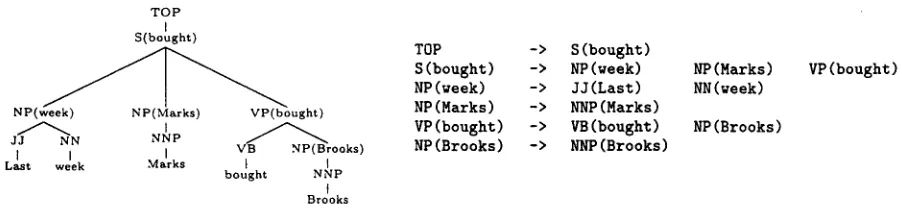
Figure 1: A lexicalised parse tree, and a list of the rules it contains. For brevity we omit the P O S tag associated with each word.
of one or more non-terminals; or lexical, where L H S is a p a r t of speech t a g and R H S is a word.
A P C F G can be lexicalised 2 by associating a word w and a part-of-speech (POS) tag t with each non- terminal X in the tree. Thus we write a non- terminal as X(x), where x = (w,t), and X is a constituent label. Each rule now has the form3:
P(h) -> Ln(In)...ni(ll)H(h)Rl(rl)...Rm(rm) (3)
H is the head-child of the phrase, which inherits the h e a d - w o r d h from its parent P. L1...L~ and R1...Rm are left and right modifiers of H. Either n or m m a y be zero, and n = m = 0 for u n a r y rules. Figure 1 shows a tree which will be used as an example t h r o u g h o u t this paper.
T h e addition of lexical heads leads to an enormous n u m b e r of potential rules, making direct estimation of ? ) ( R H S { L H S ) infeasible because of sparse d a t a problems. We decompose the generation of the RHS of a rule such as (3), given the LHS, into three steps - - first generating the head, then making the inde- pendence assumptions t h a t the left and right mod- ifiers are generated by separate 0th-order markov processes 4:
1. G e n e r a t e the head constituent label of the phrase, with probability 7)H(H I P, h).
2. G e n e r a t e modifiers to the right of the head with probability 1-Ii=1..m+1 ~n(Ri(ri) { P, h, H). R,~+l(r,~+l) is defined as S T O P - - the S T O P symbol is added to the vocabulary of non- terminals, and the model stops generating right modifiers when it is generated.
2We find lexical heads in Penn treebank data using rules which are similar to those used by (Magerman 95; Jelinek et al. 94).
SWith the exception of the top rule in the tree, which has the form TOP --+ H(h).
4An exception is the first rule in the tree, T0P -+ H (h), which has probability Prop (H, hlTOP )
3. Generate modifiers to the left of the head with probability rL=l..n+ l ?) L ( L~( li ) l P, h, H), where Ln+l (ln+l) = S T O P .
For example, the probability of the rule S ( b o u g h t ) -> NP(week) NP(Marks) Y P ( b o u g h t ) w o u l d be es- t i m a t e d as
7~h(YP I S,bought) x ~l(NP(Marks) I S,YP,bought) x
7~,(NP(week) { S,VP,bought) x 7~z(STOP I S,VP,bought) x
~r(STOP I S, VP, bought)
W e have m a d e the 0 th order markov assumptions
7~,(Li(li) { H, P, h, L1 (ll)...Li-1 (/i-1)) =
P~(Li(li) { H , P , h ) (4) P r (Ri (ri) { H, P, h, R1 (rl)...R~- 1 ( r i - 1 )) =
?~r(Ri(ri) { H, P, h) (5)
b u t in general the probabilities could be conditioned on any of the preceding modifiers. In fact, if the derivation order is fixed to be depth-first - - t h a t is, each modifier recursively generates the sub-tree below it before the next modifier is generated - - then the model can also condition on any structure below the preceding modifiers. For the m o m e n t we exploit this by making the approximations
7~l( Li(li ) { H, P, h, Ll ( ll )...Li_l (l~_l ) ) = ?)l(ni(li) l H, P,h, distancez(i - 1)) (6) ?)r( ai(ri) ] H, P, h, R1 (rl)...Ri-1 (ri-l ) ) =
?~T(Ri(ri) [ H , P . h , distancer(i - 1)) (7)
[image:2.612.74.525.70.176.2]verb? (Allowing the model to learn a preference for modification of the most recent verb). (3) Does the string contain 0, 1, 2 or > 2 commas? (where a c o m m a is anything tagged as "," or ":").
P(h)
d i s t a n c e -I
Figure 2: T h e next child, Ra(r3), is generated with probability 7~(R3(r3)
[ P,H, h, distancer(2)).
Thedistance
is a function of the surface string from the word after h to the last word of R2, inclusive. In principle the model could condition on any struc- ture dominated by H, R1 or R2.2.2 M o d e l 2: T h e c o m p l e m e n t / a d j u n c t
d i s t i n c t i o n a n d s u b c a t e g o r i s a t i o n The tree in figure 1 is an example of the importance of the complement/adjunct distinction. It would be useful to identify "Marks" as a subject, and "Last week" as an adjunct (temporal modifier), but this distinction is not made in the tree, as both NPs are in the same position 5 (sisters to a VP under an S node). From here on we will identify complements by attaching a "-C" suffix to non-terminals - - fig- ure 3 gives an example tree.
TOP
1
S(bought)
N P ( w ~ o u g h t ) Last week Marks
VBD NP-C(Brooks)
I l
bought Brooks
Figure 3: A tree with the "-C" suffix used to identify complements. "Marks" and "Brooks" are in subject and object position respectively. "Last week" is an adjunct.
A post-processing stage could add this detail to the parser output, but we give two reasons for mak- ing the distinction while parsing: First, identifying complements is complex enough to warrant a prob- abilistic treatment. Lexical information is needed 5Except "Marks" is closer to the VP, but note that "Marks" is also the subject in "Marks last week bought Brooks".
- - for example, knowledge that "week '' is likely to be a temporal modifier. Knowledge about subcat- egorisation preferences - - for example that a verb takes exactly one subject - - is also required. These problems are not restricted to NPs, compare "The spokeswoman said (SBAR that the asbestos was dangerous)" vs. "Bonds beat short-term invest- ments (SBAR because the market is down)", where an SBAR headed by "that" is a complement, but an SBAI:t headed by "because" is an adjunct.
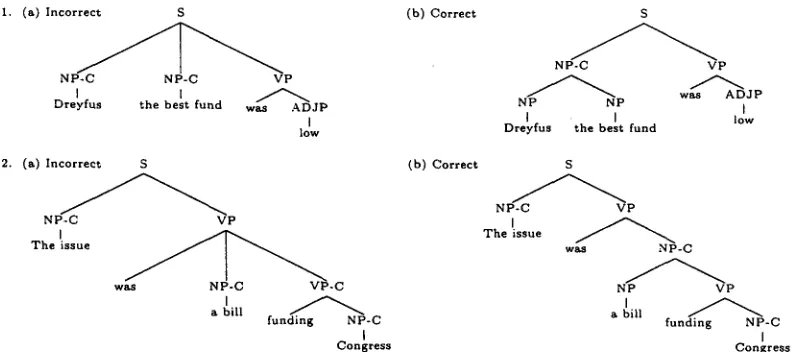
The second reason for making the comple- m e n t / a d j u n c t distinction while parsing is that it may help parsing accuracy. The assumption that complements are generated independently of each other often leads to incorrect parses - - see figure 4 for further explanation.
2.2.1 I d e n t i f y i n g C o m p l e m e n t s a n d A d j u n c t s in t h e P e n n T r e e b a n k We add the "-C" suffix to all non-terminals in training data which satisfy the following conditions: 1. The non-terminal must be: (1) an NP, SBAR, or S whose parent is an S; (2) an NP, SBAR, S, or VP whose parent is a VP; or (3) an S whose parent is an SBAR.
2. The non-terminal must
not
have one of the fol- lowing semantic tags: ADV, VOC, BNF, DIR, EXT, LOC, MNR, TMP, C L R or PRP. See (Marcus et al. 94) for an explanation of what these tags signify. For example, the NP "Last week" in figure 1 would have the T M P (tempo- ral) tag; and the SBAR in "(SBAR because the market is down)", would have the ADV (adver- bial) tag.In addition, the first child following the head of a prepositional phrase is marked as a complement. 2.2.2 P r o b a b i l i t i e s o v e r S u b c a t e g o r i s a t i o n
F r a m e s
The model could be retrained on training data with the enhanced set of non-terminals, and it might learn the lexical properties which distinguish complements and adjuncts ("Marks" vs "week", or "that" vs. "because"). However, it would still suffer from the bad independence assumptions illustrated in figure 4. To solve these kinds of problems, the gen- erative process is extended to include a probabilistic choice of left and right subcategorisation frames:
[image:3.612.103.274.107.178.2] [image:3.612.84.277.426.520.2]I. (a) Incorrect S (b) Correct S
N P - C V P N P - C N P - C VP
I I ~ f ~ . was A D J P
N P N P
Dreyfus the best fund was ADJP [
I I I low
low Dreyfus the best fund
2. (a) Incorrect S (b) Correct S
N P - C V P
N P - C V P l
I ~ The issue / ~
The issue was NP-C
w -C N P V P
a bill a bill
funding NP-C funding NP-C
I I
Congress C o n g r e s s
Figure 4: Two examples where the assumption that modifiers are generated independently of each other leads to errors. In (1) the probability of generating both "Dreyfus" and "fund" as sub- jects, 7~(NP-C(Dreyfus) I S,VP,was) * T'(NP-C(fund) I S,VP,was) is unreasonably high. (2) is similar: 7 ~ (NP-C (bill), VP-C (funding) I VP, VB, was) = P(NP-C (bill) I VP, VB, was) * 7~(VP-C (funding) I VP, VB, was) is a bad independence assumption.
P r c ( R C I P , H,h ). Each subcat frame is a multiset 6 specifying the complements which the head requires in its left or right modifiers. 3. Generate the left and right modifiers with prob-
abilities 7)l(Li, li I H, P, h, distancet(i - 1), LC) and 7~r (R~, ri I H, P, h, distancer(i - 1), RC) re- spectively. Thus the subcat requirements are added to the conditioning context. As comple- ments are generated they are removed from the appropriate subcat multiset. Most importantly, the probability of generating the S T O P symbol will be 0 when the subcat frame is non-empty, and the probability of generating a complement will be 0 when it is not in the subcat frame; thus all and only the required complements will be generated.
The probability of the phrase S ( b o u g h t ) - > NP(week) NP-C(Marks) VP(bought)is now: 7)h(VPIS,bought) x
to({NP-C} I S,VP,bought) x t S,VP,bought) ×
7~/(NP-C(Marks) IS ,VP,bought, {NP-C}) x
7:~I(NP(week) I S ,VP ,bought, {}) x
7)l(STOe I S ,ve ,bought, {}) ×
Pr(STOP I S, VP,bought, {})
Here the head initially decides to take a sin- gle NP-C (subject) to its left, and no complements
~A rnultiset, or bag, is a set which may contain du- plicate non-terminal labels.
to its right. NP-C(Marks) is immediately gener- ated as the required subject, and NP-C is removed from LC, leaving it empty when the next modi- fier, NP(week) is generated. The incorrect struc- tures in figure 4 should now have low probabil- ity because
~Ic({NP-C,NP-C}
[ S,VP,bought) and "Prc({NP-C,VP-C} I VP,VB,was) are small.2.3 M o d e l 3: T r a c e s a n d W h - M o v e m e n t Another obstacle to extracting predicate-argument structure from parse trees is wh-movement. This section describes a probabilistic treatment of extrac- tion from relative clauses. Noun phrases are most of- ten extracted from subject position, object position, or from within PPs:
E x a m p l e 1 The store (SBAR which TRACE bought Brooks Brothers)
E x a m p l e 2 The store (SBAR which Marks bought TRACE)
E x a m p l e 3 The store (SBAR which Marks bought Brooks Brothers/tom TRACE)
[image:4.612.82.478.65.241.2]NP(store)
N P ( s t o r e ) SBAR(that)(+gap) The store
WHNP(that) WDT
I that
(i) NP -> NP
(2) SBAR(+gap)
-> WHNP (3) S(+gap) -> NP-C (4) VP(+gap) -> VBS(bought )(-}-gap)
N P - C ( ~ h t ) (--{-gap)
I B ~ w
Marks
V eek)
I I
bought last week
SBAR(+gap) S-C(+gap) VP(+gap) TRACE NP
Figure 5: A +gap feature can be added to non-terminals to describe NP extraction. The top-level NP initially generates an SBAR modifier, but specifies that it must contain an NP trace by adding the +gap
feature. The gap is then passed down through the tree, until it is discharged as a T R A C E complement to the right of bought.
played with a ball and a bat)"), and it is not un- common for extraction to occur through several con- stituents, (e.g., "The changes (SBAR that he said the government was prepared to make TRACE)").
The second reason for an integrated treatment of traces is to improve the parameterisation of the model. In particular, the subcategorisation proba- bilities are smeared by extraction. In examples 1, 2 and 3 above 'bought' is a transitive verb, but with- out knowledge of traces example 2 in training d a t a will contribute to the probability of 'bought' being an intransitive verb.
Formalisms similar to G P S G (Gazdar et al. 95) handle NP extraction by adding a gap feature to each non-terminal in the tree, and propagating gaps through the tree until they are finally discharged as a trace complement (see figure 5). In extraction cases the Penn treebank annotation co-indexes a T R A C E with the W H N P head of the SBAR, so it is straight- forward to add this information to trees in training data.
Given that the LHS of the rule has a gap, there
are 3 w a y s that the g a p can be passed d o w n to the
R H S :
H e a d The gap is passed to the head of the phrase, as in rule (3) in figure 5.
L e f t , R i g h t The gap is passed on recursively to one of the left or right modifiers of the head, or is discharged as a trace argument to the left/right of the head. In rule (2) it is passed on to a right modifier, the S complement. In rule (4) a trace
is generated to the right of the head VB.
We specify a parameter 7~c(GIP, h, H) where G is either H e a d , L e f t or R i g h t . The generative pro- cess is extended to choose between these cases after generating the head of the phrase. T h e rest of the phrase is then generated in different ways depend- ing on how the gap is propagated: In the H e a d case the left and right modifiers are generated as normal. In the L e f t , R i g h t cases a gap require- ment is added to either the left or right SUBCAT variable. This requirement is fulfilled (and removed from the subcat list) when a trace or a modifier non-terminal which has the +gap feature is gener- ated. For example, Rule (2), SBAR(that) (+gap) -> WHNP(that) S - C ( b o u g h t ) (+gap), has probability ~h (WHNP I SBAR, that) × 7~G (Right I SBAR, WHNP, that) x
T~LC({} I SBAR,WHNP,that) x T'Rc({S-C} [ SBAR,WHNP, that) x
7~R (S-C (bought) (+gap) [ SBAR, WHNP, that, {S-C, +gap}) x 7~R(STOP I SBAR,WHNP,that, {}) x
PC (STOP I SBAR, WHNP, that, { })
Rule (4), VP(bought) (+gap) -> VB(bought) TRACE NP (week), has probability
7~h(VB I VP,bought) x PG(Right I VP,bought,VB) x PLC({} I VP,bought,VB) x ~PRc({NP-C} I vP,bought,VB) x 7~R(TRACE I VP,bought,VB, {NP-C, +gap}) x
PR(NP(week) I VP,bought ,VB, {}) × 7)L(STOP I VP,bought,VB, {}) x 7~R (STOP I VP ,bought ,VB, {})
In rule (2) Right is chosen, so the +gap requirement
[image:5.612.94.495.72.211.2](a) H ( + ) =~ P(-)
• H(+)
Prob = X Pr£b = X'X~H(HIP,... )
(b) P(-) + Ri(+) =~
H R1
Prob -= X Prob = Y
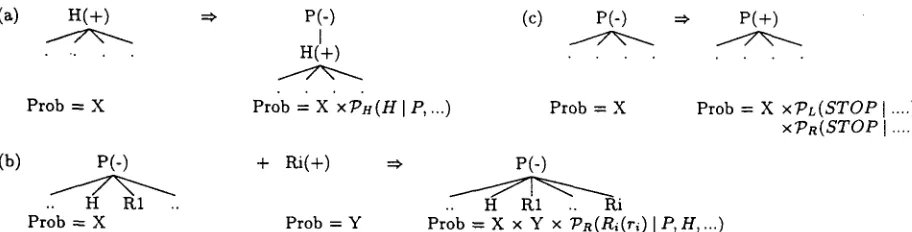
Figure 6: T h e life of a constituent in the chart.
(c) P(-) =~ P(+)
Prob = X Prob = X X'PL(STOP I .... ) x P R ( S T O P I .... ) P(-)
• . H R1 Ri
Prob = X x Y x ~R(Ri(ri) I P,H,...)
(+) means a constituent is complete (i.e. it includes the stop probabilities), ( - ) means a constituent is incomplete. (a) a new constituent is started by projecting a complete rule upwards; (b) the constituent then takes left and right modifiers (or none if it is unary). (c) finally, S T O P probabilities are added to complete the constituent.
Back-off "PH(H I"-) P a ( G I ...) PL~(Li(It,) I..-)
Level
PLc(LC t ...)
Pm(Ri(rti) I...)7)Rc(RC I ...)
1 P, w, t P, H, w, t P, H, w, t, A, LC
2 P, t P, H, t P, H, t, A, LC
3 P P, H P, H, &, LC
4 - -
PL2(lwi l ...) PR2(rwi I ...)
Li, Iti, P, H, w, t, A, LC L,, lti, P, H, t, A, LC
LI, lti It~
Table 1: T h e conditioning variables for each level of back-off. For example, T'H estimation interpolates el = ~°H(H I P, w, t), e2 = 7~H(H I P, t), and e3 = P H ( H I P). A is the distance measure.
:ulfills b o t h the S-C and +gap requirements in RC. In rule (4) R i g h t is chosen again. Note t h a t gen- eration of trace satisfies b o t h the NP-C and +gap s u b c a t requirements.
3 P r a c t i c a l I s s u e s
3.1 S m o o t h i n g a n d U n k n o w n W o r d s
Table 1 shows the various levels of back-off for each t y p e of p a r a m e t e r in the model. Note that we de- compose "PL(Li(lwi,lti) I P, H , w , t , ~ , L C ) (where lwi and Iti are the word and P O S tag generated with non-terminal Li, A is the distance measure) into the p r o d u c t 79L1(Li(lti) I P, H , w , t , Zx,LC) x 7~ L2(lwi ILi, lti, 19, H, w, t, A, LC), and then s m o o t h these two probabilities separately (Jason Eisner, p.c.). In each case 7 the final estimate is
e----Ale1 + (1 - &l)(A2e2 + (1 - &2)ea)
where ex, e2 and e3 are m a x i m u m likelihood esti- mates with the context at levels 1, 2 and 3 in the table, and ,kl, ,k2 and )~3 are smoothing parameters where 0 _< ,ki _< 1. All words occurring less than 5 times in training data, and words in test d a t a which
rExcept cases L2 and R2, which have 4 levels, so that e = ~ l e t + (1 -- *X1)()~2e2 + (1 - ,~2)(&3e3 + (1 - ~ 3 ) e 4 ) ) .
have never been seen in training, are replaced with the " U N K N O W N " token. This allows the model to robustly handle the statistics for rare or new words.
3.2 P a r t o f S p e e c h T a g g i n g a n d P a r s i n g
P a r t of speech tags are generated along with the words in this model. W h e n parsing, the P O S tags al- lowed for each word are limited to those which have been seen in training d a t a for t h a t word. For un- known words, the o u t p u t from the tagger described in ( R a t n a p a r k h i 96) is used as the single possible t a g for t h a t word. A C K Y style dynamic p r o g r a m m i n g chart parser is used to find the m a x i m u m probability tree for each sentence (see figure 6).
4 R e s u l t s
T h e parser was trained on sections 02 - 21 of the Wall Street Journal portion of the Penn Treebank (Mar- cus et al. 93) (approximately 40,000 sentences), and tested on section 23 (2,416 sentences). We use the PAR.SEVAL measures (Black et al. 91) to compare performance:
L a b e l e d P r e c i s i o n =
[image:6.612.74.530.71.187.2] [image:6.612.125.486.253.328.2]MODEL
(Magerman 95) (Collins 96)
Model 1 Model 2 Model 3
~ c e ~ ) 2 CBs
84.6% 84.9% 1.26 56.6% 81.4% 84.0% 84.3% 1.46 54.0%
85.8% 86.3% 1.14 59.9% 83.6% 85.3% 85.7% 1.32 57.2%
87.4% 88.1% 0.96 65.7% 86.3% 86.8% 87.6% 1.11 63.1%
88.1% 88.6% 0.91 66.5% 86.9% 87.5% 88.1% 1.07 63.9%
88.1% 88.6% 0.91 66.4% 86.9% 87.5% 88.1% 1.07 63.9%
78.8% 80.8% 84.1% 84.6% 84.6%
Table 2: Results on Section 23 of the WSJ Treebank. L R / L P = labeled recall/precision. C B s is the average number of crossing brackets per sentence. 0 C B s , < 2 C B s are the percentage of sentences with 0 or < 2 crossing brackets respectively.
Labeled Recall -~
number o / correct constituents in proposed parse number o f constituents in treebank parse
C r o s s i n g B r a c k e t s ---- number of con- stituents which violate constituent boundaries with a constituent in the treebank parse.
For a constituent to be 'correct' it must span the same set of words (ignoring punctuation, i.e. all to- kens tagged as commas, colons or quotes) and have the same label s as a constituent in the treebank parse. Table 2 shows the results for Models 1, 2 and 3. The precision/recall of the traces found by Model 3 was 93.3%/90.1% (out of 436 cases in section 23 of the treebank), where three criteria must be met for a trace to be "correct": (1) it must be an argu- ment to the correct head-word; (2) it must be in the correct position in relation to that head word (pre- ceding or following); (3) it must be dominated by the correct non-terminal label. For example, in figure 5 the trace is an argument to b o u g h t , which it fol- lows, and it is dominated by a V P . Of the 436 cases, 342 were string-vacuous extraction from subject po- sition, recovered with 97.1%/98.2% precision/recall; and 94 were longer distance cases, recovered with 76%/60.6% precision/recall 9
4.1 C o m p a r i s o n t o p r e v i o u s w o r k
Model 1 is similar in structure to (Collins 96) - - the major differences being that the "score" for each bigram dependency is 7't(L{,liIH, P, h, distancet)
8(Magerman 95) collapses ADVP and PRT to the same label, for comparison we also removed this distinction when calculating scores.
9We exclude infinitival relative clauses from these fig- ures, for example "I called a plumber TRACE to fix the sink" where 'plumber' is co-indexed with the trace sub- ject of the infinitival. The algorithm scored 41%/18% precision/recall on the 60 cases in section 23 - - but in- finitival relatives are extremely difficult even for human annotators to distinguish from purpose clauses (in this case, the infinitival could be a purpose clause modifying 'called') (Ann Taylor, p.c.)
rather than Pz(Li, P, H I li, h, distancel), and that there are the additional probabilities of generat- ing the head and the S T O P symbols for each con- stituent. However, Model 1 has some advantages which may account for the improved performance. The model in (Collins 96) is deficient, that is for most sentences S, Y~T 7~( T ] S) < 1, because prob- ability mass is lost to dependency structures which violate the hard constraint that no links may cross. For reasons we do not have space to describe here, Model 1 has advantages in its treatment of unary rules and the distance measure. The generative model can condition on any structure that has been previously generated - - we exploit this in models 2 and 3 - - whereas (Collins 96) is restricted to condi- tioning on features of the surface string alone.
(Charniak 95) also uses a lexicalised genera- tive model. In our notation, he decomposes P ( R H S i l LHSi) as "P(R,~...R1HL1..Lm ] P,h) x 1-L=I..~ 7~(r~l P, Ri, h) x I-L=l..m 7)(lil P, Li, h). The Penn treebank annotation style leads to a very large number of context-free rules, so that directly estimating 7~(R .... R1HL1..Lm I P, h) may lead to sparse data problems, or problems with coverage (a rule which has never been seen in training may be required for a test data sentence). The com- plement/adjunct distinction and traces increase the number of rules, compounding this problem.
[image:7.612.87.540.49.134.2]suggestions may be close to our models 1 and 2, but he does not fully specify the details of his model, and doesn't give results for parsing accuracy. (Miller et al. 96) describe a model where the RHS of a rule is generated by a Markov process, although the pro- cess is not head-centered. They increase the set of non-terminals by adding semantic labels rather than by adding lexical head-words.
(Magerman 95; Jelinek et al. 94) describe a history-based approach which uses decision trees to estimate 7a(T[S). Our models use much less sophis- ticated n-gram estimation methods, and might well benefit from methods such as decision-tree estima- tion which could condition on richer history than just surface distance.
There has recently been interest in using dependency-based parsing models in speech recog- nition, for example (Stolcke 96). It is interesting to note that Models 1, 2 or 3 could be used as lan- guage models. The probability for any sentence can be estimated as P(S) = ~~.TP(T,S), or (making a Viterbi approximation for efficiency reasons) as 7)(S) .~ P(Tb~st, S). We intend to perform experi- ments to compare the perplexity of the various mod- els, and a structurally similar 'pure' PCFG 1°.
5
Conclusions
This paper has proposed a generative, lexicalised, probabilistic parsing model. We have shown that lin- guistically fundamental ideas, namely subcategori- sation and wh-movement, can be given a statistical interpretation. This improves parsing performance, and, more importantly, adds useful information to the parser's output.
6
Acknowledgements
I would like to thank Mitch Marcus, Jason Eisner, Dan Melamed and Adwait Ratnaparkhi for many useful discussions, and comments on earlier versions of this paper. This work has also benefited greatly from suggestions and advice from Scott Miller.
References
H. Alshawi. 1996. Head Automata and Bilingual Tiling: Translation with Minimal Representa- tions. Proceedings of the 3~th Annual Meeting of the Association for Computational Linguistics, pages 167-176.
E. Black et al. 1991. A Procedure for Quantita- tively Comparing the Syntactic Coverage of En- glish Grammars. Proceedings of the February 1991 DARPA Speech and Natural Language Workshop. 1°Thanks to one of the anonymous reviewers for sug- gesting these experiments.
T. L. Booth and R. A. Thompson. 1973. Applying Probability Measures to Abstract Languages. IEEE Transactions on Computers, C-22(5), pages 442- 450.
E. Charniak. 1995. Parsing with Context-Free Gram- mars and Word Statistics. Technical Report CS- 95-28, Dept. of Computer Science, Brown Univer- sity.
N. Chomsky. 1957. Syntactic Structures, Mouton, The Hague.
M. J. Collins. 1996. A New Statistical Parser Based on Bigram Lexical Dependencies. Proceedings o/ the 34th Annual Meeting o/ the Association for Computational Linguistics, pages 184-191. J. Eisner. 1996. Three New Probabilistic Models for
Dependency Parsing: An Exploration. Proceed- ings o/ COLING-96, pages 340-345.
G. Gazdar, E.H. Klein, G.K. Pullum, I.A. Sag. 1985. Generalized Phrase Structure Grammar. Harvard University Press.
F. Jelinek, J. Lafferty, D. Magerman, R. Mercer, A. Ratnaparkhi, S. Roukos. 1994. Decision Tree Pars- ing using a Hidden Derivation Model. Proceedings o/ the 1994 Human Language Technology Work- shop, pages 272-277.
D. Magermaa. 1995. Statistical Decision-Tree Mod- els for Parsing. Proceedings o/ the 33rd Annual Meeting o] the Association for Computational Linguistics, pages 276-283.
M. Marcus, B. Santorini and M. Marcinkiewicz. 1993. Building a Large Annotated Corpus of En- glish: the Penn Treebank. Computational Linguis- tics, 19(2):313-330.
M. Marcus, G. Kim, M. A. Marcinkiewicz, R. MacIntyre, A. Bies, M. Ferguson, K. Katz, B. Schasberger. 1994. The Penn Treebank: Annotat- ing Predicate Argument Structure. Proceedings of
the 1994 Human Language Technology Workshop, pages 110~115.
S. Miller, D. Staliard and R. Schwartz. 1996. A Fully Statistical Approach to Natural Language Interfaces. Proceedings o/ the 34th Annual Meeting of the Association for Computational Linguistics, pages 55-61.
A. Ratnaparkhi. 1996. A Maximum Entropy Model for Part-Of-Speech Tagging. Conference on Em- pirical Methods in Natural Language Processing. A. Stolcke. 1996. Linguistic Dependency Modeling.