Explorations in the History of the Semitic Component in Yiddish
Vol. 1
ACKNOWLEDGMENTS
I entered the field of Yiddish Linguistics during the years I was privileged to study wider Professor Mikhl Herzog at Columbia University. I am profoundly grateful to
Professor Herzog f or his continuous help, guidance and inspiration, during both my undergraduate enrolment at
Columbia University in New York arid my postgraduate residence at University College
London.
I would ask Professor Herzog to regard this thesis as a provisional progress report and outline for further research.I have been fortunate to benefit from the intellectual
environment
of University College London while preparing the work reported In the thesis, and. most especially from the dedicated help, expert criticism and warm hospitality of my three supervisors, Professor Chimen Abrainsky and Professor Raphael Loewe of the Department of Hebrew and Jewish Studies, and. Dr. Richard A. Hudson of the Department ofPhonetics
and.Linguistics. Professor Loewe and Dr. Hudson generously gave of their time to spend many hours discussing with me the
issues and problems of the thesis. They both read the entire manuscript and made many valuable suggestions f or Improvement.
Most have been incorporated into the text as submitted to the University of London. I hope to elaborate upon the remainder
in future work. Professor Abramsky provided superb guidance in the fields of literary history and bibliography and
generously made available to me numerous rare volumes from his magnificent private library. Needless to say, full
responsibility for the proposals herein and. for errors and shortcomings lies squarely with the author.
I am indebted to my friend, Mr. David Djanogly,
founder of the Arenski Gallery, London, f or his invaluable advice auring the preparation of the thesis.
I have had the honour and good fortune to benefit from active correspondence with a number of the greatest living Yiddish linguists, including Solomon A. Birnbaum
(Toronto), Hartog Beem (Hilversum, later The Hague), Jechiel Bin-Nun (Jerusalem) and Florence Guggenheim-Griinberg (Zurich).
My friends and, colleagues Mr. Hermann Sass (Munich) and Mr. Ruben Rosenfeld (FIrth) photocopied on my behalf a huge number of rare texts to be found in German collections.
I am deeply thankful to both of them for their selfless help.
Mr. Sass very kindly allowed. me to quote from Meelfflhrer's (1607) description of Yiddish, which he discovered, and which I am happy to say is now published in Süss (1982).
M g . Terry McGoldrick Rackal, in charge of reprography
at University College London, with great kind.ness and patience
assisted in the photocopying of hundreds of items. Mr. Reg
IDenham, Chief Binder at University College and his staff
- Christine Walker, Brian Anderson arid Rose Hutton - were always prepared to arrange for the swift binding of many of these materials.
This work was supported, in part, by grants from the Natjol Foundation for Jewish Culture (New York) and. the Nemoria]. Foundation for Jewish Culture (New York).
My parents, Menke and. Rivke, have provided unending
inspiratl on.
ABSTRACT
Yiddish arose in Central Europe. Nevertheless, the language includes a Semitic Component comprising thousands of lexical items that is synchronically fused with the Germanic Component within Yiddish. Theories from the sixteenth
century to the present have contended that Seniitisms
entered a previously (nearly) wholly Germanic language from sacred Hebrew and. Aramaic texts used in the traditional Yiddish speaking civilization known as Ashkenaz.
The thesis challenges the text tbeor. The
alternative proposed is the cntiuua]. tcn tbeor claiming that the Semitic Component entered Europe in the vernacular of the original settlers who were, retroactively speaking, the first Ashkenazim. ' Questions concerning the origin of the Semitic Component are also relevant to the determination of the relative age of Yiddish and to the contested status of the protolanguage within historical linguistics.
The Semitic Component of all known Yiddish dialects is characterized by a system of long and short vowels in open syllables, reduced to a system of short vowels only in closed syllabic position. The resulting morphophonemic alternations and unique segmental distribution are shared
neither by the Germanic Component nor the relevant varieties of traditional Hebrew and Aramaic. Nearly all nineteenth and twentieth century theories submit that an erstwhile system of five short vowels expanded in consequence of open syllable lengthening, a sound change triggered by the
analogous German development.
The standard theories are challenged by internal aM comparative reconstruction as well as the results of transcomponent reconstruction, a method proposed for use with fusion languages such as Yiddish. Phonological proofs put forward, demonstrate that the Semitic Component entered Yiddish with its unique vocalism, including the later
attested morphophonemic alternations, and can derive
exclusively from a prelanguage. Moreover, Yiddish provides evidence f or the recovery of a lost Northwest Semitic
vowel system midway between the known Tiberian arid Palestinian varieties.
vi
CONTENTS
1. Fusion Languages and Historical Linguistics...1
1 .1. Need for a Model.
... ...
11.2. Language Mixture and the Nontransferability Hypothesis. . ... . . .. .3
1.3. Mixed Languages and the Neogramrnarian Controversy... . ... . ...7
Language Mixture as a Key Factor in The on e s of Cha.nge . . ... . . . 9
1.5. TwentiethCenturyModels...1li. 2. YiddishasaFusionLanguage... ... 2.1. Approaches to Yiddish as a F1ti sion I.arigua.ge ... . . . . 18
2.2. Fusion and the Sociology of Yiddish...214.
2 . 3 . Interest for General Linguistics... .26
2i4.. TheComponentsofYiddish...,27
3. ¶r}ie Issues ... ... . . . •. . . .32
3.1. Origins of the Semitic Component Ix,. Yiddish. . . 32
3 .2. TheAgeofYidd.ish...39
3.3. The Viability of Proto Yiddish.... ... .L1.9 Zi. An Outline of Pan Yiddish Vocalisrn... ...52
11.1. The Systematization of Pan Yiddish Vocaljsm...,..,... ... ... 11. 2. Phonological Criteria for the Classification of Yiddish Dialects. ...62
k.3 . Phonological Criteria for the Periodization of the History of Yiddish. . . .. . . .75
vii
5. Synchronio Evidence. . . 86
5.1. The Synchronic Semitic Component...86
5.2. 5.3. Word. Classes. . . .. . . ... . . • 1 • . . 1.1.88 5.11.. Morohological Specificities. ... .89
5,5. Semantic Characteristics.... ...93
5.6.. Phonological Specificities...9k 5.6.1. Stress Assignment...911.
5.6.2. Posttonic Reduction... ... .98
5.6.3. Systematic Vocalic Alteation. . . .99
5.6.11. . Segmental Distribution. . .. . .10k 5.7. Historicallnferences.... ...108
6. The Semitic Component and Ashkeriazic...111
6.1. TheNotionAshkenazic...111
6.2. AshkenazicasaContinuum...113
6.3. TheReadingSystem...11i1.
6.11. . The Semitic Component i Ashkenazic.. .. .120
6.k:i. Stress Assigrirnent...121
6. 11,2. Posttonic Reduction. . ...121
6.k.T3. Systematic Vocalic Alteaton. . . 121
6.11.11.. Segmental Distribution... .1.126 6.5. Historical Inferences. •1• •, ... . . .131
7. The Semitic Component and Germanic Impact. .. . . 135
7.1. The Notion of Transcomponent Reconstruction. . . 135
7.2. German and Germanic Component Impact. . . ... . • ... . .136 7 . 3 . Stress Assignment. . ... . . .. . . . .... ... . . .111.0 7.11. Posttonic Reduction.... II • •,.•. .. .. .111.6 7.5. Systematic Vocalic Alternation and
Segmental Distribution....11.11.1 ... .111.7
vi. ii
8. Major Theories of Semitic Component
Vocalism. . . •... . . •. . . • • • • • • , , • • • • • 1k9 8.1. Theoretical Frainework... . ... . 1J.9
8.2. Premodern Notes and Comments...151
8.3.
Data Base... •... •... .155
8.Li.. Development of Standard Theory...171
8.Zi..1. The Preconfiguration rFieor'r. . . •... •... .171
8.4. . 2. The Lebensolmian Theory.. .. .171
8.L1..3. Corroborative Germanic Evidence...,...175
8.11.4. Corroborative Hebrew Manuscri p t Evidence... ....177
8.4.5.
Proposed Scenarios... .178
9. Reconstruction of Semitic Component Vocalism. . . .182
9 . 1 . Methodology. . . 182
9.2. Internal Reconstruction... ...,... 183
9.2.1. Vowels 41 aM Li.2...186
9.2.2. Vowels2land22...191
9.2.3.
Vowe].sllandl2...1989.2.4. The High Vowels (31/32; 51/52)... . . . .. . . .207
9.2.41. Vowels 31 and.
32. . ..211
9.2. 11.2. Vowels 51 and 52... ... ... ...2111.
9.2.5. Results of Internal Reconstruction.. . . ... .218
9.3.
Limited Comparative Reconstruction.. .. .221
9.3.1. Correctives to Internal Reconstruction... . . ... . . .222
9.3.2. Vowelslflandk2...235
9.3.3.
Vowels 21, 22 and
25...2369.3.11..
Vowels 11, 12 and 13b...211.8
9.3.5.Vowels3land32...259
9.3.6. Vowels5land52...,260
9.3.7. Results of Limited
Comparative
Reconstruction... .... .. .261
ix
9.
11. Transcornponent Reconstruction... . . .. .263 9.Li..1. Stress as a Conditioning
and Causative Factor...263 9.11.2. Lengthening-Blocking
Consonants . . . 267
9. Li. . 3 .
Fusion of Germanic and
Semitic Component Vowels. . . .270
9.5.
Interd.ialectal Reconstruction and
the Viability of Proto Yiddish...283 9.5 .1. Interd.ialecta].
Reconstruction.... ... .283 9.5.2. Parallel Fusion... .. .. .2811.
9.5.3.
DisparIty of Concrete
Realization... .285 9
5•11.Parallel Anomalies.. .... .. . .287 9.5.5. Implications for
Proto Yiddish. . . .... .. . . .293 9.6. Proto Vocalism of the Semitic
Component in Yiddish... . . ... .29k 9.6.1. Segmental Phonology of
the Proto Semitic
Component . . . 29k 9.6.2. Dynamic Phonology of
the Proto Semitic
Cornp orient . . . 295 9.6.3. Primary Secondary
Semitic Component
Diaphonemes...302 9.7. Historical Inferences...3011.
9.7.1. Summary of Phonological
Development. . . ... . . .. .
30k9.7.2. The Semitic Component and
Ashkec , . • • • • . . . 310 9.7 . 3. The Semitic Component and.
Northwest Semitic
Vowel Sy-stems...310 9.7.11.. Vernacular Origins... . . .. . . .311
10. References. ... .. ... ...•... . . .,.. .315
TABLES
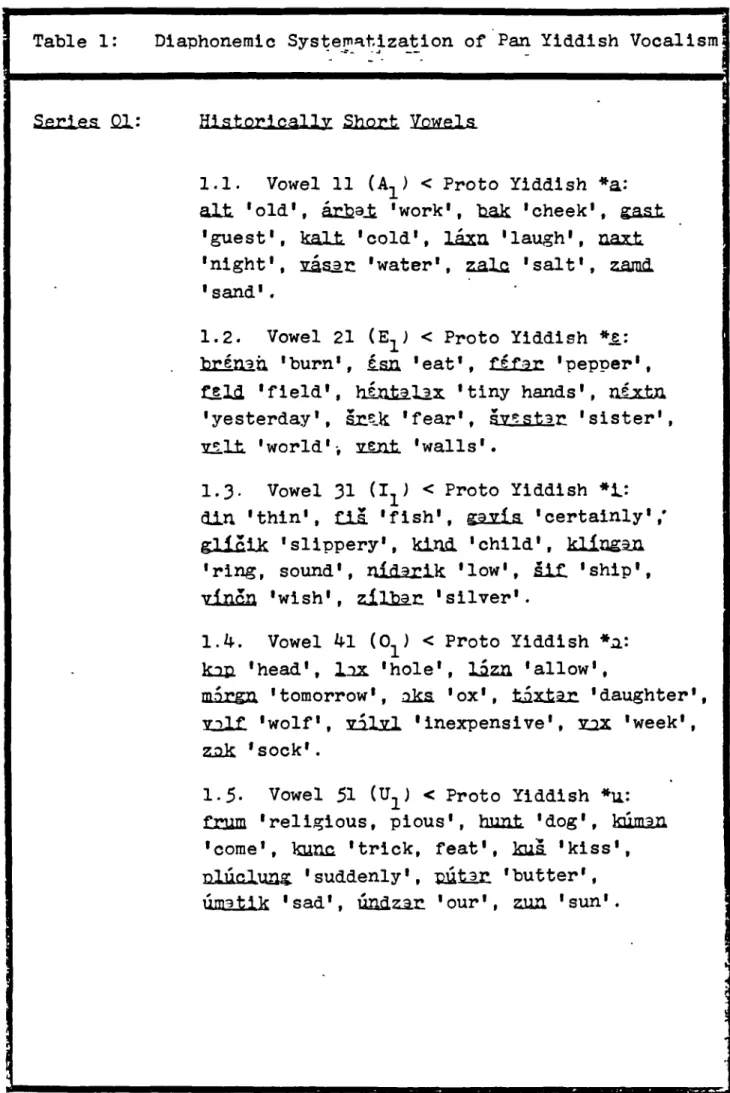
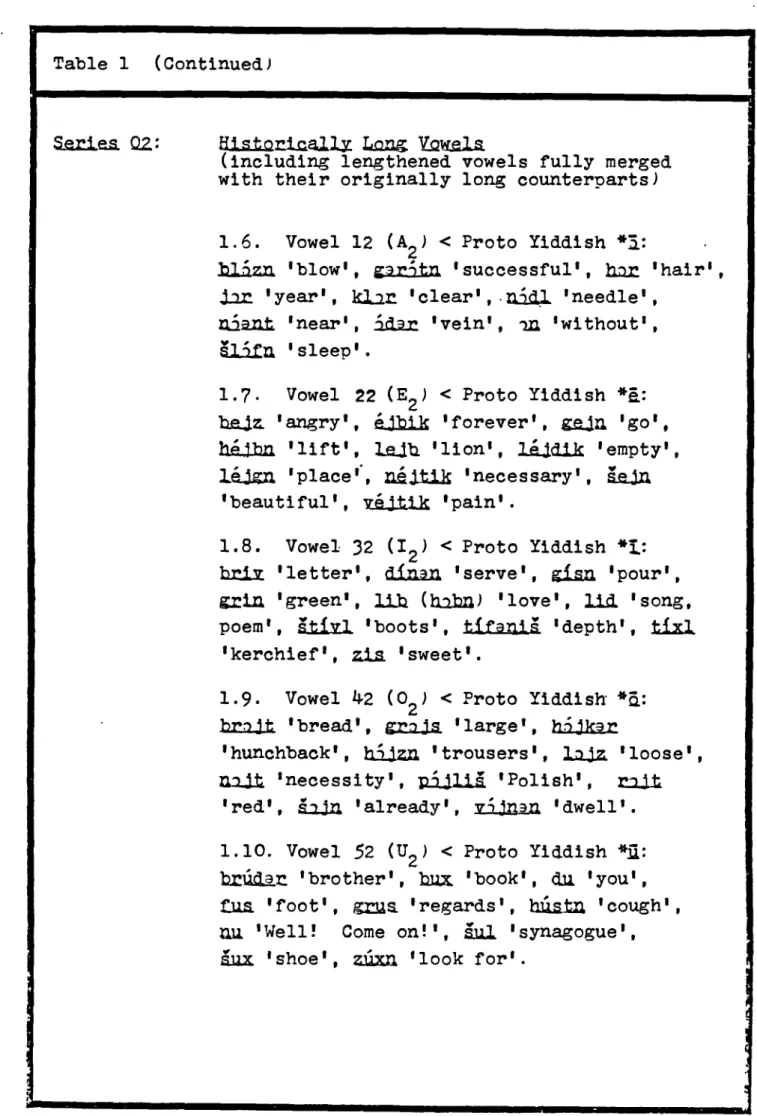
1. Diaphonemic Systematization of Pan Yiddish
V
ocali Sm. . . 582. Proposals for the Classification of Yiddish Dialects . . . , . . .
653. Northwestern Yiddish Vocalism. . . ... .. ... .68
1.. Midwestern Yiddish Vocalism. .... ... ... . . . .
.695. Southwestern
YiddishVocalism. . ... . . .,. .70
6. Northeastern Yiddish Vocalism.. . ... . .... .71
7. Mjd.eastern Yiddish Vocalism...., ... . ...72
8. Southeastern Yiddish Vocalism...73
9. Standard Yiddish Vocalism. ... ... ... .711.
10. Proto Yiddish Voca].igm... . ... . .. . .76
11. Open Syllable Lengthening... . . 12. The Great Yiddish Vowel Shift (First Stage)...79
13. The Great Yiddish Vowel Shift (Second Stage)...80
111.. The Primary Split.-.... ... . . . ... ...82
15. Proto Western Yiddish Vocallsm...83
16. ProtoEasternYiddishVocalism... ...811.
17. Sample Nominal Paradigms in the Semitic Component: Illustrative Corpus.... . .. . . ... 18. Synthetic and Analytic Semitic Component Verbs: Illustrative Corpus... . . ... 19. Semitic Component Adverbs and. Prepositions: Illustrative Corpus . . . 92
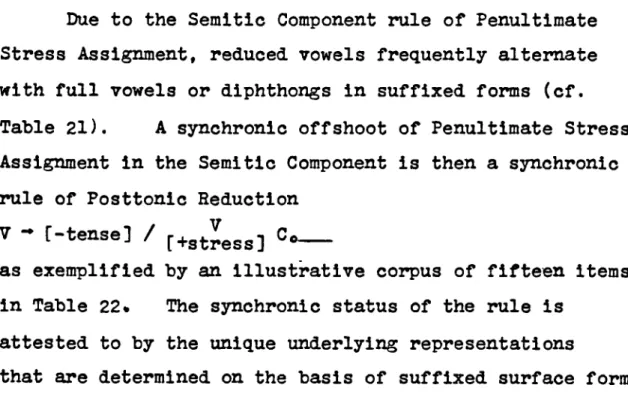
20. Stress Assignment in the Germanic Component...96
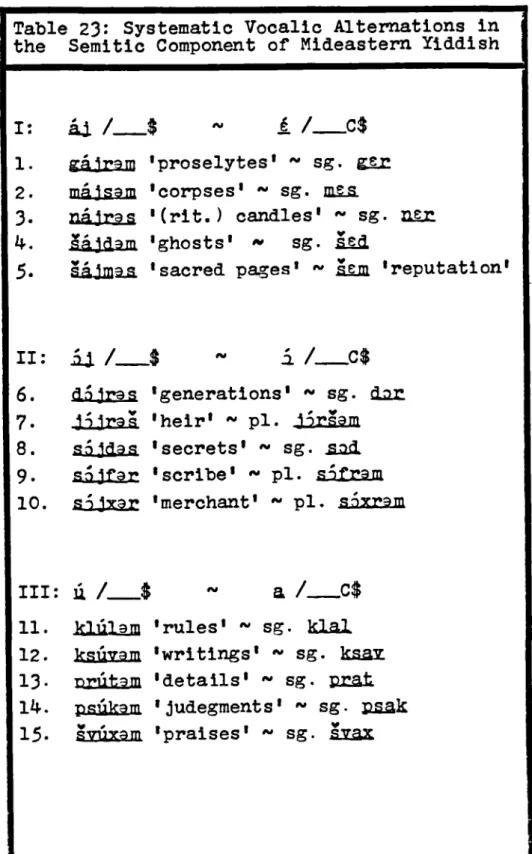
21. Posttonic Reduction in the Semitic Component....97 22. Stress Assignment in the Semitic Component...100 23. Systematic Vocalic Alternations in the
Semitic Component of Mid.eastern Yiddish. ... .. ...102 2!.. Systematic Vocalic Alternations in the Semitic
Component: Northeastern, Midwestern and.
Northwestern Yiddish. .... ... • .... .•, • .. ,. , ,,, . . 103 25. Distributional Specificities in the Semitic
Component of Mideastern Yiddish.. . ... . . .106 26. Distributional Specificities in the Semitic
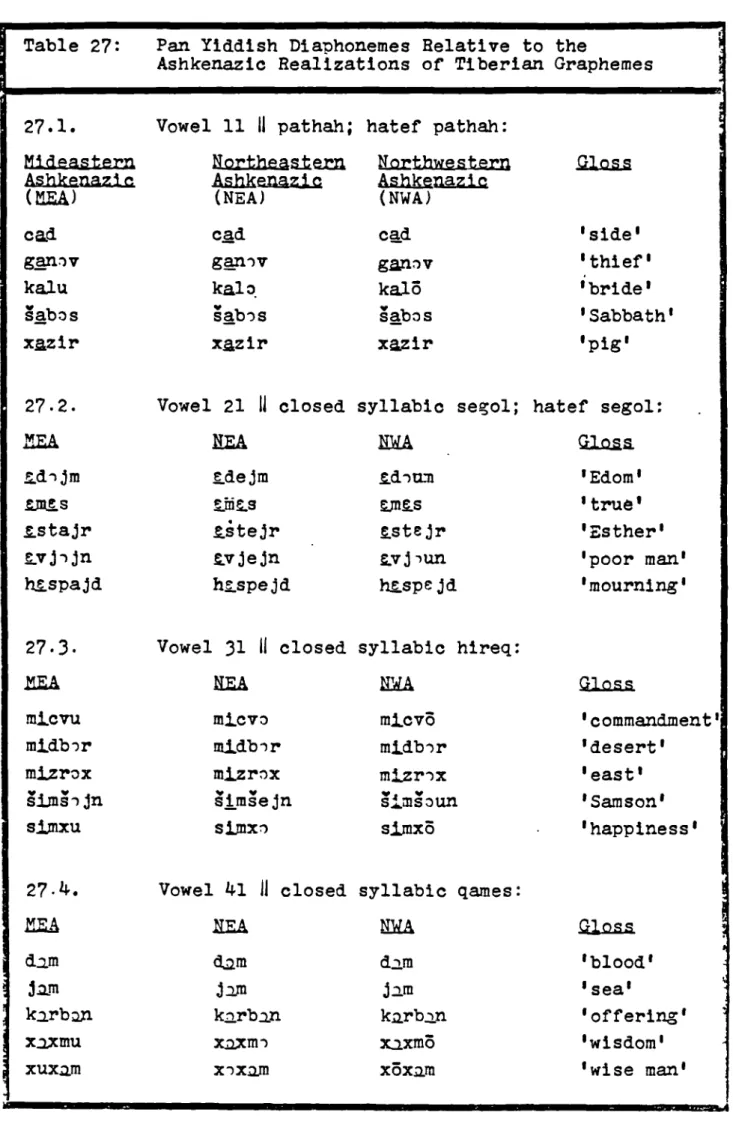
Component of Northwestern Yiddish.. .... .... .... .107 27. Pan Yiddish Diaphonemes Relative to the
Ashkenazjc Realizations of Tiberian Graphemes...116 28. Stress Assignment: Mideastern Ashkenazic i
Mideastern Yiddish, Northeastern Ashkenazic Northeastern Yiddish, Northwestern Ashkenazic
Northwestern Yiddish...,...,...122 29. Posttonic Reduction: Mideastern Ashkenazic
Mjdeag tern Yiddish, Northeastern Ashkenazic I
Northeastern Yiddish, Northwestern Ashkenazic
i. Northwestern Yiddish...,.,...,.,,,..,.123 30. Cognates in Ashkenazic of Semitic Component
Sets Exhibiting Open i Closed Syllabic
Vocalic Alternation. . • • • • • • • • • • , . . • • . . , . . . 125 31. Ashkenazjc 22 Semitic Component 21 in
Mideastérn, Northeastern and Northwestern
Ashkenazic and Yiddish. • ••.... •• ... .128 32. Ashkenazio Zi.2 Semitic Component Li.1 in
Mideastern, Northeastern and Northwestern
Ashkenazic and Yiddish...,...,...,129 33. Ashkenazic 11. 1 I Semitic Component 11 in
Mideastern, Northeastern and Northwestern
- Ashkenazic and Yiddish. . . • • , • • • • , • , • , , • , . • . . . 130
3k.
Distributional Specificities of MideasternAshkexia,zio Vocall.sm. . . • . . . 132 35. Distributional Specificities of Northwestern
Ashkeria.zic V ocalism . . . , • . . ... . . . 133
36. Comparative, Internal and. Transcoinponent
Reconstrtictiori. . . 137 37. Theoretical Paths of Germanic Impact upon the
Semitic Component and Ashkenazio.. .. ... .. .... .. .139 38. Evidence of Historical Stress Shift in the
Semitic Component: Vowels 21 and 25 in Open Syllabic Position and their Cognates in
Ashkenic... ... •1I. ...1143 39. Summary of Wagenseil's (1699) Comparative
Observations on Ashkenazic and Christian
Sephardic Phonology. ... . . . 153 14.0. Summary of Schud.t's (171L.-1718) Comparative
Observations on the Semitic Component and
Christian Sephardic Phonology. . ... .. .. . . 1521.
li.1. Mideastern Ashkenazic Vocalism... . . . . .. . 156 112.
Northeaster'n Ashkenazic Vocalism... ... . 157
21.3.
Northwestern Ashkenazic Vocalism.. .. ... .. . . .158
11.21..
Vocalism of the Semitic Component of
Nideastern Yidd.ish. . . 159
21.5. Vocalism of the Semitic Component of
Northeastern Yiddish. . . 160 Lf6. Vocalism of the Semitic Component of
Northwestern Yiddish. . . ... . .... . . . .. .. . .... ... . . 161 11.7. The Seven Vowel Interpretation of
Tiberian Vocalism. . . •. . . . ... . . . 163 11.8. The Kimchian Interpretation of
Tiberian Vocalism. . . 165 11.9. The Qualitative-Quantitative Interpretation of
Tiberia. Voca]_isin. . ... . •.•.... • . . •.. . . . •.. .166 50. The Babylonian Vowel System....
51. The Vocalism of Sephardic and of the Palestinian and Palestinian-Tiberian
Pointing Systems. . . • . . . 170 52. Experimental Rule: 14.1 - 21.2 /__3: Open
Syllable Lengthening in the Semitic Component
of Nideastern Yiddish. ... .. .... . ....•.... . 187
53. Experimental Rule: 11.2 11.1 /_...C$: Closed Syllable Shortening in the Semitic Component
of Mideastern Yiddish. . . ... .... ... .11.189 5L. Experimental Rule: 144 142 /_$: Open
Syllable Lengthening in the Semitic Component
of Northeastern Yiddish.. .. •••• • • ... .. . . ..190 55. Experimental Rule: 112 11. 1 /....C$: Closed
Syllable Shortening in the Semitic Component
of Northeastern Yiddish. . .. .. ... . .... .192 56. Experimental Rule: 14.1 — 11. 2 /..j: Open
Syllable Lengthening in the Semitic Component
of Northwestern Yiddish. ... . ... ... 1.193 57. Experimental Rule: 11.2 1.1 /C$: Closed
Syllable Shortening in the Semitic Component
of Northwester'n Yiddish...,...,. ... .1914.
58. Experimental Rule: 21 -. 22
L._$:
OpenSyllable Lengthening in the Semitic Component
of Mid.eastern Yiddish.. • .. . . • •... . . . . .1.195 59. Experimental Rule: 22 — 21 /...C$: Closed
Syllable Shortening in the Semitic Component
of Mideastern Yiddish. . . ... ... .. .... .197 60. Experimental Rule: 21 -. 22 /_$: Open
Syllable Lengthening in the Semitic Component
of Northeastern Yiddish. .. • ... . . . . 199 61. Experimental Rule: 22 -. 21 /...._C$: Closed
Syllable Shortening in the Semitic Component
of Northeastern Yiddish. ... ... 1e .1.200 62. Experimental Rule: 21 22 /_$: Open
Syllable Lengthening in the Semitic Component
of Northwestern Yiddish... ... . ... .201 63. Experimental Rule: 22 -' 21 /...C$: Closed
Syll able Shortening in the Semitic Component
of Northwestern Yiddish.. ...
...
.2026L. . Experimental Rule: 11 —, 12
Ij:
OpenSyllable Lengthening in the Semitic Component
ofMideastern Yiddish. .. .. ... .. . . . . 2014.
65. Experimental Rule: 12 11 /.C: Closed Syllable Shortening in the Semitic Component
ofMldeasternYlddj.sh..,.... ... ...205 66. Experimental Rule: 11 12 /_$: Open
Syllable Lengthening in the Semitic Component
of Northeastern Yiddish... • ... . .206
97. Dynamic Phonology of the Proto Vocalism
of the Semitic Component...300 98. Synchronic Sources of the Proto Semitic
Component Short Vowe]s... ...301 99. Summary of the Phonological History of
the Semitic Component in Yiddish. .. ... .. . ... .305
100. Primary Fusion and Secondary Enrichment... .313
Vol. II
SUPPLEMENTARY MATERIAL
comprising papers completed during residence at University College London
CONTENTS
1. The Wavering Yiddish Segolate: A Problem of Sociolinguistic Reconstruction [=
I.ute rnational Journal Q 2ociogy
o.r. I.ar'guge, 214.: 5-27).. ... •.I. • •IS....s . .359 2. Der semitisher kheylek in yidish: A
yerushe fun kadmoynim. Metodn un
rneglekhkaytn [ paper placed before the First International Conference on
Research in Yiddish Language and.
Literature at Oxford, August 1979).. . .. ... ... . 14.13 3. ReconstructIon of the Stress System in
the Semitic Component of Yiddish [ paper submitted to the John Marshall Competition, University College
London] . . . • . . . 506
Yiddish Dialectology [forthcoming in
DIaltologi. Rni1i ziiz d.eiit.ahi
uni D lktfrshim (
______ zuz aprach- und. im.ikationa-
winsrthaft, I), Walter de Gruyter:
Berlin & New York). . . 552
SYMBOLS
[1
I I
< >
//
*
>
II
#
C V
enclose broad phonetic representations / phonetic features
enclose synchronically underlying / morphophonemi o representations
enclose orthographic / graphetnic representations
enclose phonemic representations underscores cited form
precedes reconstructed form precedes spurious form
(synchronically) becomes
(synchronically) derives from (historically) became
(historically) derived from cognate with
(morphophonernically) alternating with clitic / stem boundary
word boundary syllable boundary consonant
vowel
marks rimary wordstress
1. Fusion Languages and Historical Linguistics
1.1. Need, for a Model
Yiddish is a language that was born and developed in the depths of Europe. Yet it contains thousands of forms of obvious Semitic origin, items with cognates in attested
varieties of Hebrew and Jewish Aramaic. The native Yiddish speech territory of Central and later also of Eastern Europe is by no stretch of the imagination coterritorial or even contiguous with any Semitic soeaking community, let alone a community of speakers of the relevant varieties of Hebrew or Ararnaic. We wish to explore questions concerning the origin of the Semitic Component in Yiddish, with special reference to historical phonology. How, when and from where did. Semitisms flow into Yiddish?
The investigator of a problem of this kind who wishes to avoid atomistic chaos direly requires broadly speaking a theoretical framework and. narrowly speaking a model capable of handling the history and description of a language
exhibiting two or more genealogically disparate elements.
Such languages are traditionally called mixed. (or hybrid.) languages. A full treatment of the concept of the mixed language within modern historical linguistics deserves to be the target of a special monograph. Here we propose to sketch briefly a few of the major trends of thought.
Recent decades boast considerable achievements in the related areas of bilingualism (e.g. U. Weinreich 1953; Paradis 1978), study of pidgins and creoles (e.g. Hymes 1971; Vald.man 1977) and the phenomena studied by sociolinguistics under the rubric of mixture of varieties (e.g. Hudson 1980: 56-71). Under the heading of borrowing, Haugen (1950) distinguishes the
notions loanwords, loanbiends and loanshifts. Acknowledging the traditional importance of borrowing for historical
linguists, he proposes, very reasonably, that borrowing "be studied for its own sake", a study he calls bilingual
description (195 11. : 9).
Nearly all the recent work in these fields concerns the phenomenon of language mixture synchronically, that is to say borrowing in progress or in the recent past, and from the viewpoint of po1e, that is to say the occurrence and results of borrowing for observed speakers. The student of historical linguistics, besides his obvious need for a diachronic model, needs to cope with the synchronic structure of the mixed language as a fait accompli (as opposed to the synchronic state of
affairs at the time of borrowing or mixture). Often observing a language from the perspective of a great span of time, and.
concerned with comparison and. reconstruction, he will also require a model oriented more towards langue than parole.
That is not to say that a historical linguist working on the history of a language of diverse genetic affiliation would be wise to be oblivious either to bilingualism or to the social
environment of the distant past when the mixture actually
occurred. It is just that given the frequent paucity of
evidence at his disposal and his disinclination to excessive thought experiments, his emphasis will in the nature of things turn to the sources where the evidence lies -
the documented and reconstructed older stages of the target language, the attested cognates in other languages and. the empirical evidence provided by study of the modern dialects.
1.2. Language Mixture and the Nontransferabl].ity Hypothesis Seventeenth century orientalist Job Ludoif is generally credited with being the first to argue that genetic affiliation between languages cannot be established on the basis of shared vocabulary alone but must rest also upon salient affinity in grammatical structure (of. Benfey
1869
:236).
Closer to the nineteenth century period of the rise of modern historicallinguistics, forerunner Christian Jacob Kraus
(1787: 5)
insistedthat language material be conceptually disentangled from
language structure. Concluding that similar vocabulary items may result from borrowing, he stressed the primacy of - grammatical structure in the determination of genetic relationships. Carrying his thinking a stage further, he
posits the dichotomy of TM original' vs. "mixed" languages (15).
Founding father Rasmus Rask
([1818] 1967: 31)
likewise stressed the superior value of grammatical agreement because "one finds that a language which is mixed with another very rarely or never takes over changes of form or inflection".It thus happened that one of the very advances that enabled modern comparative linguistics to rise, the study of cognate language structure rather than comparison of word lists,
produced as a byproduct the theory that grammatical structure cannot be transferred from one language to another. We shall
refer to this theory as the Q}jj1. It
was carried to the extreme of an axiom by Max Muller (1861: 69- 71) who categorically pronounced that 'languages are never
mixed' because the grammar, the blood and, soul of the language is as pure and unmixed in English as spoken in the British
Isles, as it was when spoken on the shores of the German ocean by the Angles, Saxons, and Juts of the continent'. A more
moderate form of the nontransferability hypothesis was formulated.
by A. H. Sayce (187Li. : 173), notably that it is not possible
"for a people to mix its grammar in the same way that it can mix its lexicon". Sayce grants that "foreign influences may occasion the adaptation of existing formative machinery to new uses" (81) and, even allows that an analytic language may
"borrow from its neighbours not only the form of the deolension, but even the words which compose this form" (186). H. Lepsius
(1880: lxxxv) sharply rejected nontransferability, on the grounds that African linguistics proves it to be no more than a prejudice of European scholars.
Not all ninetent}1 century scholars had a .ef1nite yes or no answer to the question of nontransferability of grammar.
There were some who approached the question with an open mind., and, perhaps more importantly, there were those willing to see aspects of mixed. language theory not directly related. to
nontransferability. Max Grnbaum
(1885)
for example, published a survey of language mixture and mixed languages in which he sought to establish a quantitative criterion for distinguishingbetween the two (211.). The two most structured and coherent nonpartisan surveys of the issue are perhaps those of W. D. Whitney (1881) and Hermann Paul
(1886).
Whitney, noting the polarically opposed positions of M!ller and Lepsius, sought to steer an intermediate course.
proposing that 'the grammatical apparatus merely resists intrusion most successfully, in virtue of its being the
least material and the most formal part of the language. In a scale of constantly increasing difficulty it occupies the extreme case' (1k). At the other end of Whitney's scale is the most transferable part of language, the noun (19). Because of the strong constraints on mixture of grammar 'languages never meet and mingle their grammar on equal terms' (16).
Foreshadowing Saussure's synchrony, Whitney notes that
borrowed material 'becomes an integral part of that language, undistinguished, except to reflective and learned study' (16).
Once 'assimilated' (26), imported formatives could well become secondarily productive, e.g. English prefixal j , dis-, . and suffixal
-able, -ative, -j.gm, -ist, -ize
and. -ment(16-17).
It is symptomatic of the rising consciousness of
--langziage mixture among Eropeanhistorical 'iingu{èts in the
1880s
that Paul
(1886: 337-31i.9)
added a chapter on language mixture to the second edition of his rincipjeji. He differentiates between a wider sense of mixture as a part of the history of all languages and the more restricted sense of observed mixture which he subolassifles into five situations: where thelanguages involved are unrelated; where they are related but have vastly diverged; where they are contiguous dialects of one language; reintroduction of archaisms, and finally,
influence exerted. by the written form of the language
(337-338).
Seeking to meaningfully correlate and, reconcile the notions of bilingualism with the existence of mixed languages, Paul
characterizes mixed languages as the result of a shift in society from bilingualism to monolingualisin. Like Whitney, Paul recognizes the native synchronic status of borrowings which are "from the point of view of the instinct of language no longer foreign at all" (3L.0). Rejecting the normative criticisms of purists concerning the validity of Greek and.
Latin borrowings into modern Eu"opean languages, he contends that once assimilated they are "neither Latin nor Greek" but creations within the modern languages themselves (311.6).
On the actual issue of nontransferability, more modern scholarship has shown that while certain types of borrowing may be exceedingly rare, none seems to be impossible. Even the
"invincible" number system has passed from Spanish into the Chamorro of Guam and the Marianas (Hall
196k:
370). Mbugu, spoken in Tanzania, has the numbers one through six from one source and the rest from another (Hudson1980:
60).It is a curious footnote to the history of the issue that it concerned even Stalin
(1950:
21) who held that when languages meet "a cross does not result in some new, thirdlanguage; one of the languages persists, retains its grammatical system and basic word stock and is able to develop in
accordance with its inherent laws of development". As if to surprise his readers, Stalin's example is the Russian language
"with which, in the course of historical development, the
languages of a number of other peoples crossed and which always emerged the victor". Explaining that Stalin must have been misunderstood, Petráek (1951: 613) concedes that "mixing of languages is one of the important laws governing language
development N•
The general openmind.edness of the twentieth century on nontransferability may be summarized by Bloomfield.'s
( 1933 : 11.68)
pronouncement that it is conceivable that a conflict might end in the survival of a mixture so evenly balanced that the historian could not decide which phaseto regard as the main stock of habit and which as the borrowed admixture".
1.3.
Mixed Languages and the Neograznmarian Controversy The neogrammarians did. not deny the existence of language mixture or borrowing. It Is simply that for them both phenomena were nuisances that disturbed the regular operation of sound law and, the discreet classifications of genealogical relations among languages according to the family tree. August Schlelcher was one of the first torigorously formulate the regularity hypothesis and he deeply influenced the younger generation of neograininarians (cf.
Schmidt 1887). His reconstruction of a Proto Ind,o-European.
fable (1868: 207) was at once the most romantic and the most controversial accomplishment of nineteenth century comparativism. Nevertheless, Schleicher
(181
1.8: 27) granted that even the oldest languages experienced mixture.Language mixture, albeit couched in terms of diffusion of waves, played an important role In Schmidt's
(1872)
refutation of Schleicher's stammbaum. Schmidt's nine lists of illustrative lexical Items demonstrating the existence of groupof items common to different combinations of languages
(36-68)
serve at the same time to demonstrate the phenomenonof mixture among the older classical languages.
Once the doctrine of the exceptionless power of sound laws was proclaimed by Leskien
(1876:
xxviii, 2) and.Osthoff and Bruginann
(1878:
xiii), language mixture figured as a key argument against the neograrninarian hypothesis.Hugo Schuchardt's
(1885)
high powered reply to theneograinmarians contended that the intersection of sound.
changes with other sound changes, the effects of conceptual
associations and, language mixture all rendered the neograinmarlan tenet untenable (34.).
In Schuchardt' s thinking, language mixture countered the neogrammarians in two ways. Firstly, he postulated an infinite mixture of speech in language that goes hand in hand.
with the infinite differentiation of speech (10). In
consequence of this Schuchardt assumed language mixture even within the most homogeneous speech community (16). Ee
was thus able to debunk the neogramniarian model of linear language change coming upon a homogeneous speech community.
Secondly, Schuchard.t held language mixture responsible not only for language differentiation but equally f or the very levelling of speech so high cherished by the neogrammarians (10-li). For them language mixture upset the normal
operation of sound laws, while for Schuchard.t it was itself the norm rather than the exception in language. For the neograxnmaria.ns, "levelling 11 is.a force working, as it were,
on behalf of sound laws whereas mixture Is parasitic. For Schuchard,t both are parts of one and the same process, of mixture at different levels.
For twentieth century historical linguists working within the comparativist tradition, borrowing, ergo language mixture, has not proven to be a theoretical barrier. The question, however, never did quite disappear. Bloomfield.
(1932: 229-230) found it necessary to make the point that borrowing is not a logical contradiction to the regularity hypothesis. Malkiel (l96 L. : 180) attempted to reconcile snd change and language mixture by recognizing a "state of extra- low predictability" which he called "weak phonetic change", a phenomenon considered "by no means incompatible with the
assumption of regular phonological change In a stable, homogeneous society". This last notion has of course been
rejected, largely in consequence of the advances made by empirical studies of language in society, especially by Weinreich, Labov and Herzog's (1968: 150-188) proof of the
inherent heterogeneity of the speech community.
i. 1i. Language Mixture as a Key Factor in Theories of Change From the inception of modern historical linguistics, there has been a trend of thought deeming mixture to be a
vital factor in the understanding of the mechanism of linguistic change. For scholars espousing this view, language mixture
is more than an argument for or against exceptionless sound laws. It is a pivotal issue to be studied for its inherent interest and value.
Wilhelm von Humboldt, in his historic address before
the Historical-Philological Section of the Royal Prussian Academy of Sciences, delivered on 29 June 1820, proclaimed the confluence of multiple varieties of language to be one of the foremost forces in the rise of new languages (1822: 241- 242). For Humboldt, language mixture is one of three basic causes of language differentiation (1822: 2 14.2_243; [1827-1829]
1907: 276). The other two are the passage of time and its consequences, and a change of habitat (migration). Of these three causes, the mixture of nations speaking different
languages is the mightiest ([1827-18291 1907: 280). On the issue of classification of languages - an issue closely tied to the genealogical relationship between languages - Humboldt was well aware of the primacy of structure over lexicon,
citing for example the affiliation of Persian with Indo- European on structural grounds notwithstanding its vast Arabic element (257). Yet he was broadminded enough to cite the counterexample of English where he d.iserned a dual system of structure where each part is based on its origin, resulting In the proclivity of certain morphological endings to affix to roots of the same origin. But here again Humboldt found the exceptions to
hisrule to be noteworthy, the possibility of items of diverse origin combining, citing in this connection
drinkable., dukedom and plentiful..
Way ahead of his time, and with much more open a mind than many of the scholars who were to follow, Humboldt
(2 8 3 ) conceded the difficulty
indetermining the extent to which grammatical structure may be mixed. He postulated that
there are grammatical influences In cases of language mixture,
but these do not penetrate deeply into the grammatical structure
of the recepient language. Grammatical impact in Humboldt's
thinking usually stops at the point where it would upset the inherent true form of the receiving language on a deep level. The more structurally similar two languages are, the less threat there is to the true inner form and the greater the propensity for mixture (c Havrê.nek 1966 &2).
Hurnbold.t (280-281) rejects the limiting of mixture studies to creoles such as the Lingua franca and. insists on the importance of mixture as a cause for the birth of languages in general, including the "high cu1tuie languages".
It is indeed, to be regretted that so many of Humboldt's fertile ideas were not explored for so long a time.
The great theoretician of language mixture whose Ideas were instrumental in winning a wider appreciation of the
importance of the field was Hugo Schuchard.t (cf. Spitzer
l9k3 : kl7).
To Muller's (1861: 69) "languages are never mixed", Schuchardt (188k: 5) replied that there Is no completely unmixed language. Language mixture is for
Schuchardt far more than ammunition against the neogrammarians' exceptionless sound laws or Muller's denial of the mixed
language existing. He held that there is no question of greater importance for linguistics (3).
Paralleling U. Welnreich's (1953) findings that there are no limits to potential interference between the linguistic systems of bilinguals, Schuchard.t (188k: 6) claims that
language mixture has no limit. Paralleling Labov's (1971:
11. 22- 11. 23) unifortnitarian principle that change in progress functions in ways similar to change in the past, Schuchard,t
(188k: 6), finding that no modern dialect is entirely free
of mixture, claims that what is true f or the trestop
of the stammbaum would be equally valid f or its bygone
generations. In fact, the boughs and twigs of the staninibaum are so intertwined by countless horizontal lines that it ceases to be a stammbaum. Extending his observations to the idiolect, Schuchardt notes that these lines become even more entangled as each speaker modifies his or her language
in contact with many other individuals. This Intimate
mixture has the power of restraining the rise of potential change by force of its levelling power. Thus for Schuchardt, language mixture contributes to our understanding of both
language change and the levelling which results in the limited degree of homogeneity that does exist.
On the related issue of language classification,
Schuchardt
(1917: 526)
proposes that instead of arguing whether a certain language belongs to this or to that family, It would be wise f or adherents of each of the theories to see it as representing an intermediate position between both candidate groups. Language mixture thus serves as evidence against discreet classifications and contributes to a classification more in concord with reality. Incorporating language mixtureinto his wider ideas on the development of language, Schuchardt
(1919: 716)
suggests that to some extent all the world's languages are related, not by common ancestry, but by virtue of mixture and levelling.For van der Gabelentz
(1891: 267),
language history goes hand in hand with language mixture and each speaker is opento the influence of everything he hears. Rejecting the various proposed limitations on mixture, van der Gabelentz contends
that the possibilities of mixture are infinite, ranging
all the way from the adoption of loanword.s in the native
language to the utter discarding of the native language
(272).
Debruziner
(1918: 436)
makes the strong point that all languages are by definition mixed languages, including those known to us in their most ancient form. He puts' forward the claim that the term 'mixed, language" only means that wehappen by chance of history to know the parts of the mixture in their other guise, that of self-contained languages.
It need be no surprise that language mixture held
great theoretical significance for the neolinguists, who placed so much emphasis on dialect geography. Although Bonfante's
(1947)
vigorous defense of the neolinguists against Hall's(1946)
scathing attack is constructed as a reply to theneograznmarians, the overall neolinguistic position accounts for mixed languages in a positive way. For Bonfante
(1947:
350-351),
the very existence of mixed languages represents a "theoretical capitulation' for supporters of the stammbauin.As for the nontransferability hypothesis, Bonfante remarks that "some say the numerals, some the kinship ternis, some the pronouns, some the conjunctions, some phonetics, and some - the majority - morphology In general". Bonfante's position is that "None of this is true", and he proceeds to bring
couxiterexaznples. In the final analysis, the neolinguists reject the very dichotomy of "inherited" vs. "borrowed"
because "from the day we are born we imitate, we learn new words - that is, we bzw them (as the clumsy word goes) from a source outside ourselves. All words are borrowed from
one generation to the next. Every word, whether it comes to Manhattan (say) from Brooklyn, Boston, or China, is a foreign word, a borrowing".
1.5. Twentieth Century Models
Generally speaking, mixed languages have not been the focus of attention, at least as objects of theory, that they were in parts of the nineteenth. That is not to say that
the controversies and problems of the last century have been solved. They were rather left behind, and Humboldt's idea of mixture as a fundamental concept in a model of historical linguistics has still not been explored to its full potential.
Nevertheless, great progress has been made. As in.
so many other areas, Ferdinand de Saussure's structural principles invested the concept of the mixed language with new conceptual clarity. For Saussure (1916: Ll3), a loanword.
is not a loanword when regarded as part of the synchronic system In which it exists. A language In which thixture is obvious to the philologist is synchronically speaking no less a unitary system than one where historical mixture is less evident.
On the specific relationship between bilingualism In its widest sociolinguistic sense on the one hand, and the rise of new languages on the other, Uriel Weinreich (1953: lOk-106) proposes that degree of difference, stability of form, breadth of function and speakers' own rating be considered as four
determining criteria. For Weinreich, Labov and Herzog
(1968: 155-159) "languages and. dialects in contact" are an important part of the synchronic orderly heterogeneity characterizing all language, a heterogeneity from which language change emerges - "Not all variability and
heterogeneity in language structure involves change; but all change involves variability and heterogeneity" (188).
At least two scholars have proposed a paradigm specifically designed for the study of mixed languages.
They are N. H. Roberts (1939)
and..PIaxWeinrelch (19 11.0; 1973).
Both introduce the term ru1, although for different
reasons. Roberts distinguishes three chronological stages:
first bilingualism, second fusion and finally mixture.
Fusion denotes the process while mixture is reserved for the resulting situation (1939: 31-32). Roberts presents numerous possible scenarios of interaction between historical, social and structural factors, although the social aspects tend to oversimplification. In Roberts' model, bilingualism may be subordinative (one language is the vernacular, the other restricted) or coordinative (both are in equipoise).
Subordinative bilingualism results in the process of affusion (subdivided into infusion, suffusion and superfusion) and leads to admixture. Coordinative bilingualism results in the process of interfusion (subdivided into diffusion, circumfusion and
retrofusion) and, leads to intermixture. Notwithstanding the confusing plethora of terms, Roberts' model is a major
contribution allowing order to be imposed upon a mass of facts.
It deserves to be tested against a s'izable corpus of
documented case histories.
Although primarily concerned with the history of Yiddish, Max Weinreich
(1911.0: 511.;
1 973: III, 23)proposes
a genera]. model for the structure and development of a language of diverse origins. He contends that the only proper
application of the term mixed language is to macaronic texts and. other situations where mixture is conscious and, willful.
Weinreich replaces mixture - both as process and state - by
fu.stQu.While all languages are characterized by some degree of fusion, -in some it is particularly conspicuous.
These Weinreich calls
fu j 1auae(Yiddish mlcraxn).
The cognate German root a nilz, had been previously used in this vein, both in reference to Yiddish by Solomon A.
Birnbaum ('Das Jidd.ische besteht. der Hauptsache nach aus drei zu einer Einheit verschmolzenen E1ementen -
1922: 11.)and in a wider sense by Humboldt ("Wenn man hierin die
lateinisohen T6chtersprachen und die Englische mit d.er Per
glschen vergleicht, so ist in demselben der Grad der Verschmelzung der fremden wid einheimischen Elemente in der hier beobachten Folge dieser Sprachen geringer" - [
1827-1829] 19 07: 257).
Weinreich's (1973: I, 32-33) paradigm for fusion languages is in brief this. The languages from which the
fusion language draws are the
atock iguae g(rnlcvarzDraxnj.
Those forms of the stock languages which by reason of historical
time and space (cotemporality and coterritoriality) could have
entered the fusion language are the (dterminntn).
Those forms from the repertoire of the determinants that did. in point of fact become synchronically part of the
fusion language are Its
monenta
(komponnti). Weinreich(1973:
III, 23) rejects the term "element' on the grounds that it suggests dividing a language into parts while componentsuggests part of a system and, a wholeness. For Birnbaum
(1979:
82) however, the connotations are reversed: "Thewords and taken from chemistry, seem
to provide a suitable metaphor for the linguistic processes in question. Thus 'element' is preferable to the term
'component', which was introduced some time ago as a substitute.
However, compoflentS suggests things placed side by side without interaction".
We shall be using Weinreich's terms, partly because they have already become standard In the field of Yiddish and partly because his model Is ideally suited for an enquiry of this kind - exploring the origins of the
Semitic Component in Yiddish. We shall be sharply disagreeing with many of N. Welnreich's conclusions in the history of
Yiddish, especially with respect to the Semitic Component. It is a tribute to the elegant simplicity and conceptual precision of the Weinreich model that it can be used to disagree with Its author's views as easily as to support them. RobertsT t modi..
looks through the eyes of the observer and it sees a wide
scene of history, sociology and the status arid structure of all the languages involved.. Welnreich's model looks through the eyes of the analyzed. language itself. A future model taking both into account and providing a theoretical framework arid
a paradigm will be of immeasurable value for historical linguistic
2. Yiddish as a Fusion Language
2 .1. Approaches to Yidc].ish as a Fusion Language
The combining of the several historically diverse languages discernible in Yiddish has always been one of the first characteristics of the language to attract the attention of scholars. The fusion character of Yiddish was noted and discussed by Elias Schadeus (1592: 1111.0-lkl]), Johann
Mee1fhrer (1607: 265), Johann Buxtorf (1609: 657-658) and, by a number of Buxtorf's followers in Yiddish language studies, including Andreas Sennert (1666: 61465), August Pfeiffer (1680: 525), Johann Christof Wagenseil (1699: 88) and Franciscus Haselbauer (17 14.2: 211.1-211.2).
Johann Heinrich Callenberg ( 1733: [1]), the missionary who established the first known university course in Yiddish, was also apparently the first to attempt a philological
definition of Yiddish. He called Yiddish 'a mixed language, which to be sure consists mostly of German., but also to a considerab3e degree of Hebrew words". Attempting to gauge
the mixture, Callenberg called Yiddish "an appreciable mixture"
noting that for him "a slight mixture would not constitute a separate language'.
Callenberg's pupil, Wilhelm Christian Just Chrysander, one of the greatest Yiddish scholars of the eighteenth century, penetrated deeper into the nature of the fusion process in Yiddish. Chrysand,er (l750b: 5) sought to determine whether
the Jews of other lands spoke an analogous fusion of the
national language and. Hebrew. He took as one of his examples the sample Yiddish sentence <Nit ahn Amhorez hob ich kn koved. mefa1p!1 zu seih> 'It is beneath my dignity to engage in debate with an ignoramus', in which his italics mark the items of Hebrew derivation [ (modern) Standard Yiddish s'iz iniz iitt. k k3.yad ml. svak jax zajn zDi a, amr a].
Chrysander proceeds to enquire whether the English Jew says
<With a Amhorez 2. haue not koved to bee xnefalp'l>, the French Jew <avec un rrorz je n'ai point de koved d'être mefalp'l>.
Citing as his evidence the testimony of travellers who have been tar and wide, Chrysand.er concludes that there is no evidence that eighteenth century Jews of England, France, Italy, Spain, Portugal and Holland have any such systematic
fusion in their language. He even cites
6) su2'ce -
to demonstrate that the Jews of China spoke the language of the land. Notwithstanding Chrysander's ignorance of Judezmo
(Lad.ino), the language of Sephardi Jewr his appreciation of the unique status of Yiddish was a feat for Its time.
Chrysand.er was interested. in the fusion of Germanic and. Semitic in Yiddish as a systematic process although as a child. of his time he lacked the sophisticated descriptive machinery to frame his views coherently.
Giehrl (1829: vI-vii) distinguiëhed in a primitive way between Hebrew per se on the one hand and the Hebrew within YIdd.is on the other. Gjehrl noted that while speakers of the early
nineteenth century varieties of Western Yiddish with whom he was familiar used, a huge number of Hebraisms in their speech, they were unable to read a Hebrew book. In modern times this distinction has been meticulously developed and explored by Max Weinreich (e.g. 195L1.a: 85-86) as wh1
brew vs. ged bew, a conceptual dichotomy that has proven itself Of immense value to students of other Jewish languages and Jewish interlingülstics (e.g. Wexier 1981:
120). In the work at hand, limited to the history of the Yiddish language, this opposition will be expressed as Azhl (a cover term for both the Hebrew and Ararnaic of traditional Ashkenaz which were in extensive use f or liturgical and academic purposes, strictly as written or recited rather than spoken languages) vs. the
ouent (those parts tn Yiddish of Hebrew or Aramaic origin)..
During the nineteenth and early twentieth century, there were two sociohistorical forces working from different angles tO cause scholars to minimize the fusion aspect of Yiddish. The firstwas the theoretical predominance of the classic comparative model which envisages lineal development of daughter languages from parent languages. It is within
the period of the heyday of this model that Yiddish linguistics went through a crucial phase. The most noted monograph written along strict neograznmarian lines and ignoring the non-Germanic parts of Yiddish was Jacob Gerzon's (1902) Heidelberg
dissertation comparing the sounds of Northeastern Yiddish with classical Middle High German. A second force was German
patriotism of German Jewish and non-Jewish scholars alike who
wished to see the speakers of Yiddish as the carriers of German ct1ture into the Slavonic speaking lands (of.
Hildebrarid
1869;
GMemaxin1888: 295).
Attitudes began to change around the turn of the century. The key transition figure on a number of crucial issues was Leo Wiener, an East European born professor of Slavonics at Harvard University. Remaining faithful to ideas that were on their way out, Wiener
(1898:
2) held that the non-Germanic parts of Yiddish "in no way disguise the German form of the language". But on the very same page he remarks that "the influence of the Slavic intellectualatmosphere" and. the "rigid adherence to the Mosaic ritual and [...] Hebrew training" results in a "most extraordinary mixture of Germanic, Slavic and. Semitic elements, such as it probably not to be found elsewhere on the globe
1
. Wiener's(1899: 15)
account of the fusion character of Yiddish laid special stress on the religious factor, and. he held that those non-Semitic languages impacted by Islam, such as Turkish,Persian and Hindustani, were better analogies to Yiddish than was a language such as English.
The conceptualization of Yiddish as purely a Germanic language was crumbling quickly. Pioneer Yiddish linguist Alfred Landau
(19011. : 262)
was perhaps the first to openly state that any philologist 'wishing to investigate Yiddish seriously ha to equip himself to deal with three whollydissimilar language groups - Germanic, Slavonlo and Hebraic.
By the early twentieth century, even German-Jewish scholars were criticizing such efforts as Gerzon's (1902) for
disregarding the non-Germanic aspects of Yiddish (cf. H.
Loewe 190L1. : kLi.).
One of the first scholars to actually attempt an analysis of the fusion of the several parts of Yiddish into an integrated system was Matisyohu Mieses (1908: 157).
Examining a number of near-synonymous pairs of lexical Items where each is of different historical stock, Mieses
concluded that fusion could make f or subtle semantic and.
styli stic differentiations and contributes to the expressive potential of the language. This idea, that Yiddish enjoys an inherent proclivity to delicate semantic nuance in
consequence of often being able to draw upon items historically synonymous from different components within the language, has been put forward by scholars of widely disparate orientations, including Christian theologians (Strack 1916: iii),
German-Jewish scholars (Perles 1918 : 196) and Yiddish linguists (Borokhov 1913a : 11, 16; Birnbaum 1911.3: 599).
Like so many other issues in Yiddish linguistics, the groundwork for the present paradigm of fusion was laid by the founder of modern Yiddish linguistics, Ber Borokhov.
Writing a few years before the posthumous publication of
Saussure's (1916) celebrated dichotomies, Borokhov ( 1 9l3a : 9) insisted upon the nativized synchronic status of the several components: "German, Hebrew and Slavic elements, as soon as they enter the vernacular, cease to be German, Hebrew,
Slavic - they shed their erstwhile status
and, assume a new one: they become Yiddish. Their pronunciation is suited to Yiddish phonetics, their affixation to Yiddish morphology, their declination to
Yiddish etymology, their position in the sentence to Yiddish syntax". These ideas were further developed and. systematized by Max Weinreich who introduced the dichotomy of detii vs.
nc.t
(of. l.5).A number of twentieth century Yiddish scholars have regarded the fusion of several components into a unitary
system as the decisive factor in the rise of Yiddish (e.g.
Falkovitsh 1911.0: 8). As a powerful device capable of
descriptive and explanatory adequacy in diachronic Yiddish studies, fusion has been the central theme of the writings of Max Weinreich (e.g. 1936: 533, 537-538). For Weinreich, the fusion between the determinants that gave rise to Yiddish continues as a synchronic process of fusion between the
components that continues long after the actual materials have entered the language. In Weinrelch's mOdel, the history of Yiddish is primarily a study of the "interpenetration,
readjustment I and] reinterpretation" of the several components (1953: 51 11. ). In his investigations of many highly specialized difficult points in Yiddish historical linguistics, Weinreich frequently seeks explanations in terms of the mutual influences between the components and of each component upon the whole (e.g. 1958a: 117). His
magnum opus is his four volume history of the Yiddish language (1973; partially translated as N. Weinreich 1980). Unlike conventional language histories proceeding from prehistory to
the present more or less chronologically, Weinreich's
concentrates on-the cultural and historical framework, the stock languages and the paths connecting them with the determinants and components of Yid.d.ish and most centrally, the fusion of the components. Welnreich is thereby able to emphasize the factors of selectivity and specificity of Yiddish with respect to the cognate languages. As
summarized by his son Urlel Weinreich (1971: 792), the fusion model for the history of Yiddish maintains that "the complex fusion of the several stocks and the rise of purely internal innovation is as important a principle in the formation of Yiddish vocabulary as the multiplicity of its origins".
2.2. Fusion and the Sociology of Yiddish
The fusion character of Yiddish has played a pivotal role in the historical sociology of Yiddish. The ease with which even the naive observer could discern the multiplicity of the origins of the language due to continuing
familiarity with contemporary stages of the stock languages continually resulted in attacks upon the legitimacy of the language. The detractors of the language on the basis of
"bastardization" have included anti-Semites (e.g. Gottfried.
1 753 : 3),
German-Jewish scholars (e.g. Zunz 1832: 11.38-14.39) and. atiherents of the movement to revive Hebrew (e.g. Tavyov 1903 :
128). A number of scholars not directly involved in the social debates over Yiddish have none the less expressed conflicting sentiments on the issue (e.g. Andree 1881: 105).Supporters of the social status of Yiddish have in turn made the fusion character of Yiddish one of the focal points of their own arguments. Pioneering Yiddish
lexicographer Y. M. Lifshlts (1863: 326) asked of other, supposedly pure languages, "Were they then given on Mount Sinai? Like our own language, they too arise from other languages". In his spirited defence of Yiddish,
written incidentally in Hebrew, Mieses (1907: 270) pointed out that such languages as French, Italian, Spanish and English were also characterized by fusion. In his classic address before the Tshernovits Language Conference of 1908, which played an Immeasurably important role In the sociological history of the language, Mieses (1908: 165) noted that even ancient languages could lay no claim to purity; that only languages developed in isolation from general civilization preserved their genetic purity "as kosherly as during the
six days of Creation" (150); that it was only linguistic self-hatred that caused some Yiddish speakers to despise their native language on account of its mixedness (l9-150);
and. finally that the multiplicity of sources is an asset in terms of expressive potential (157). Responding to the cries of "Jargon" of the movements antagonistic towaM Yiddish, Borokhov (1913a: 8), citing English, Japanese and Persian as parallels, noted that "there are in fact beautiful, powerful languages which are even more mixed than Yiddish, but nobody will call them 'dirty Jargon' on account of it". A full account of the importance of fusion in the sociolinguistic
history of Yiddish deserves to be the topic of a special monograph.
2.3. Interest for Genera]. Linguistics
Fusion has been the chief point of contact between general linguistics and Yiddish studies.
MaxGrnbaum
(1885: 32- 11.1) integrated his study of Yiddish with his survey of fusion languages. It is clear from a personal letter of Alfred Landau of 8 October 1892 that Hugo
Schuchardt's writings on fusion languages were a great
source of inspiration for his work (of. Gininger 1938: 288).
Schuchard.t in turn felt that Yiddish was promising
territory f or the testing and development of his own theories of language mixture. In fact, Schuchardt encouraged Landau's lonely work in Yiddish linguistics both in print (1886: 3211.) and in persona]. correspondence (cf. Ginj.ger 193 8: 290-291;
19514.: 1511-l55).
The potential interest of Yiddish studies for
general hiBto'icaL.and. descriptive linguistics on the issues of the development and the structure of fusion languages has been repeatedly noted (e.g. M. Weinreich 1937; 19 14. Ob : 105;
Aithaus 1972: 13 14.9) . With the exception of Gray's (1979:
220-221) recent efforts to counter Whitney's proposed
constraints on language mixture (or .--I
^),us-ing evideioe
from the fusion of Slavonic aspect and Germanic morphemes
jr. Yiddish, little has yet been done in the way of reaxaminingfusion process in Yiddish from the vantage point of general linguistics.
2.11. The Components of Yiddish
Chrysander (175 0a: [1]; 1750b: LI. ) analyzed the Yiddish lexicon into four elements: firstly, German, even if in altered form; secondly Hebrew and Chald.aic 1 Aramaic];
thirdly, combined German and. Hebrew, i.e. Hebrew or Arainaic stems Inflected by German affixes; finally, uniquely Yiddish words. This final category is defined as comprising forms of German origin lost in the German with which Chrysander was familiar but preserved in the Yiddish laiown to him, and, items of Latin and Polish origin (l750a: [8-10]).
If Chrysander's third category is set aside and two of the three subcategories of his fourth group are reclassified as separate categories, we are left with the present day standard classification, as advocated by, among others,
Max WeinreIch (1973: I, 32). The Weinreich scheme analyzes Yiddish into four' components: Hebrew-Aramaic, Laazic ( Jewish correlates of Old French and Old. Italian), German and Slavonic.
Between Chrysander and. Weinreich there have been a number of variations in the classification. Friedrich (17811:
fxIIl-xlv)) analyzed Yiddish Into three elements: German, wholly Hebrew and fused Hebrew stems and German affixes.
Zuxiz (1832: 14.39-kkl)
counted four elements: Hebrew; fused Hebrew and German (of which he distinguished four types);German; and finally a category comprising everything left.
Avé-Lallemant
(1858-1862: III, 198-199)
devised a classification comprising two Semitic elements, the first preservingoriginal morphology and. flection and the second inflected.
Germaxiically. Thus, Avé-Lallernant's second type of Semitism corresponds with the Chrysander-Friedrich-Zunz category of combined Germanic and Hebraic.
It is obvious that the number of components in Yiddish depends on how the reckoning is done and what counts as
a component depends on the criteria employed. Jechiel
Fischer
(1936: 110-ill 1 =
Bin-Nun 1973:ilO
r.wiiii), th present Bin-Nun strongly underlines the importance of differentiating between element in the wider sense, which can include any attested. items of whatever quantity, spread and structural significance and. a more restricted technical sense in which the parts of Yiddish cognate with stock languages are termede1wt only
by virtue of meeting five criteria. Bin-Nun's criteria are firstly that the candidate set of items be more or less common to all of Yiddish. secondly, that it played a role in the birth and development of Yiddish; thirdly that it have impact in all areas of grammar; fourthly that it beof quantitatively substantial importance; and finally, that its qualitative import not be negligible. By his own criteria Bin-Nun arrives at three elements: German, Hebrew and Slavic, with a qualification that the few Romance vestiges can be
inôluded if desired, in which case there are four elements.
In the work at hand. we shall be using the term in the Weinreichiaxi sense of language material that is synchronioally Yiddish (cf. §1.5), but with the following three more stringent criteria. A component in Yiddish must be
(a) geographically of Pan-Yiddish distribution;
(b) temporally of Pan-Yiddish distribution;
(c) of unquestionable lexical and structural consequence.
By these qualifications there can be no more than two components In Yiddish: the and, the
Within Eastern Yiddish, three components can be
reckoned with, Germanic, Semitic and Slavonic. The Slavonic Component is prominentlyi represented in the phonology, lexicon and, syntax of Eastern Yiddish. In as much as all Yiddish
spoken today is Eastern Yiddish, it is quite correct to
describe modern Yiddish as
containing
three components by c alone.However, the now defunct but once massive speech Conimuity of Western Yiddish had, no Slavonic component. At most, Western Yiddish has a handful of lexical borrowings from Eastern Yiddish. In any enquiry concerning the whole of
the speech territory of Yiddish and the entirety of the history of Yiddish, there are but two components - Germanic and
Semitic - meeting the three criteria. It cannot, however, .be stressed too strongly that the issue of the number of