http://wrap.warwick.ac.uk
Original citation:Bazerli, G., Bean, T., Crandall, A., Coutin, M., Kasindi, L., Procter, Robert N., Rodger, S., Saber, D., Slachmuijlder, L. and Trewinnard, T. (2015) Humanitarianism 2.0. Global Policy Journal.
Permanent WRAP url:
http://wrap.warwick.ac.uk/72973
Copyright and reuse:
The Warwick Research Archive Portal (WRAP) makes this work of researchers of the University of Warwick available open access under the following conditions.
This article is made available under the Creative Commons Attribution-NonCommercial-NoDerivatives 4.0 International (CC BY-NC-ND 4.0) and may be reused according to the conditions of the license. For more details see http://creativecommons.org/licenses/by-nc-nd/4.0/
A note on versions:
The version presented in WRAP is the published version, or, version of record, and may be cited as it appears here.
Contents
Biographies 3
Introduction
by Sam Rodger
5
Bridging the digital deficit in the
Democratic Republic of Congo
by Search for Common Ground
(contributors: Lena Slachmuijlder, Laurent Kasindi, Marie Coutin and Guillaume Bazerli)
13
Care for the future
by Theresa Bean
29
Twitter and the 2011 riots in England
by Rob Procter
50
Uchaguzi Kenya 2013
by Angela Crandall and Rhoda Omenya
69
Checkdesk
by Dr Dima Saber In collaboration with Tom Trewinnard
86
Published 2015. ISBN 978-0-9933536.
This report was prepared by the Humanitarianism 2.0 project (http://www.inplaceofwar.net/humanitarianism-2-dot-0-h20) through funding from the UK Arts and Humanities Research Council. The views expressed are those of the authors.
Humanitarianism 2.0 Biographies
Biographies
• Inés Soria-Donlan is a cultural manager and creative practitioner based in Manchester, UK. Brought up in a bilingual English/Spanish speaking family, she gained a BA(Hons) in French & Linguistics from University of Manchester in 2008, an MA in French Cultural Studies from University of Nottingham in 2010 and returned to Manchester to complete a PGDip in Arts Management, Policy & Practice in 2012. Prior to working at In Place of War, Inés worked with a range of cultural and creative organisations as a project and events manager and research assistant including New Art Exchange (Nottingham, UK), Contact (Manchester, UK) and the British Council, as well as managing a number of projects as a freelance creative practitioner. She is currently Digital Manager of In Place of War and Training and Research Coordinator at immersive space company 4D creative. Her wider work focuses on creative learning, cultural activism and international collaboration.
Contact: [email protected]
• James Thompson is Professor of Applied and Social Theatre and Associate Vice President for Social Responsibility at the University of Manchester. He is founder and co-director of In Place of War - a project researching and developing arts projects in conflict zones. He has written widely on the field of ‘applied theatre’ and is author of Drama Workshops for Anger Management and Offending Behaviour (1999), Applied Theatre (2003), Digging Up Stories (2005), Performance Affects (2009), Humanitarian Performance (2014) and with Jenny Hughes and Michael Balfour, Performance In Place of
War (2009).
• Rob Procter is Professor of Social Informatics in the Department of Computer Science, University of Warwick and research director of the Warwick Institute for the Science of Cities (WISC). His broad research interests lie in the inter-disciplinary study of factors that shape the adoption and use of
• Samuel Rodger is a writer and researcher based in Manchester, UK, working primarily with charities and research projects. Sam gained a BA (Hons) in English Literature with a focus on post-colonial literature and diasporic narratives. He went on to complete an MA in Humanitarianism and Conflict Response at the University of Manchester with a focus on the interplay between humanitarianism and international politics. Since finishing this degree, Sam has been working with In Place of War as a researcher, identifying and applying for funding opportunities as well as researching potential partners. He also works with an independent charity, Born to Thrive, raising funds to help children in Rwanda and Kenya receive an education.
In the future, Sam looks to work with refugee communities in attempting to understand the effect of statelessness on culture.
• Rhoda Omenya’s work pulls from extensive research experience in the field of community development. She focuses on spurring citizen participation in the tech scene, specifically, local tech solutions that empower communities. Rhoda was the lead of the monitoring and evaluation of Uchaguzi Kenya 2013. She currently manages Operations at iHub Research where the key
function of her role is ensuring financial sustenance to all research projects. She also oversees the creation of research outputs including policy briefs and tailored outputs for start-ups to consume. Rhoda studied Environmental Studies (Community Development) at Kenyatta University
(Nairobi, Kenya).
• Theresa Bean is a social researcher for Agencia/ In Place of War. She is currently involved in the development of the IPOW educational programme, a university certificated course specifically designed for creative practitioners in sites of conflict, social upheaval or post conflict. Her research interests include arts as a form of social mobilization, digital and cultural policy and hip hop movements in Latin America. She holds a BA in Spanish and Politics from Goldsmiths, University of London and a Masters of Arts by Research from the University of Leeds. Prior to joining Agencia/In Place of War, she was a project manager for the grassroots music event, Un-Convention in Latin America.
https://leeds.academia.edu/TheresaBean
• Lena Slachmuijlder is Vice President of Programs for Search for Common Ground. She led SFCG’s media strategy in the DRC between 2001 and 2011. Lena has 25 years of experience using media, arts and culture and other creative
approaches for peace building and social change. • Laurent Kasindi is Director of Programs for SFCG
in the DRC, where he has worked since 2006 engaging with journalists, producers and radio stations across the country. Laurent has wide experience in media and arts and culture as a practitioner, trainer and facilitator.
• Dr. Dima Saber is a Senior Researcher in Media for Social Change at the Birmingham Centre for Media and Cultural Research at Birmingham City University. She is responsible for leading and delivering projects in citizen journalism in the Arab region, with a focus on the role of digital media in fostering social change and in altering the work of political activists in post-revolution countries such as Egypt, Tunisia and Syria. She is also co-founder of AltCity.me, building the first media/tech start-up support space in Beirut, Lebanon.
• Ruth Daniel is a cultural producer, activist and entrepreneur. She has worked across the world making change through music and creativity. She founded Un-Convention in 2008, a global grassroots music event and community with a presence in 25 countries delivering 60 music infrastructure development events in 5 years. Ruth is Co-Director of In Place of War based at The University of Manchester, that works with creativity in sites of armed conflict. Ruth is the Director of multifaceted creative organisation AGENCIA, which has offices in UK and Africa, working internationally to harness creativity to make change. Most recently Ruth has been creating cultural spaces in some of the most challenged and under resourced communities in the world.
• iHub, Nairobi’s Innovation Hub for the technology community, is an open space for technologists, investors, tech companies and hackers in the area. The research arm of the *iHub_ focuses on technology and its uses in East Africa and facilitates local knowledge creation towards improved
decision making by technology stakeholders in the region. Past clients include the World Bank, Google, Refugees United, Internews, Hivos,
Care for the future introduction –
Global Policy
by Sam Rodger
It is difficult to overstate the importance of trust in a world where global networks facilitate the constant flow of contradictory information. The search for verifiable leads and trusted sources is a central facet of daily communication and is becoming more so as our connections with one another become more decontextualised, geographically distant and, increasingly entirely virtual. The swell of internet connection rates across the world has meant an explosion of interaction and allowed new opportunities for global collective action. Whilst countless words have been written exploring the dangers of this global network and the threats that “new media” represents to social structures and moral fabrics, this collection seeks to explore the role that new social technologies are having in the world of humanitarianism and conflict response.
The marriage of new media and humanitarianism is one loaded with challenges, restricted by physical and logistical shortcomings, and open to manipulation, but an era has arrived where user-generated responses to crises and conflict are becoming increasingly viable. An additional asset comes in the form of massive swathes of data left in the wake of this new generation of social movements. The projects explored in this collection have, in addition to their various humanitarian goals, unearthed great archives of data, the potential of which are only just being tapped as we learn how to make sense of them.
Furthermore, the essays in this collection variously unpack the power of public and private institutions in tackling a variety of social and economic challenges. Whilst focussing each on a specific geographical location, the collection as a whole shows some of the ways in which new social media is being used to respond to risk and political unrest in often different, but sometimes worrying similar, socio-political contexts. The reports make recommendations on local and international policies that can harness the power of people through social media for common good.
The five reports that make up this collection are variously concerned with humanitarian aid, social and cultural evolution, crisis response, the mitigation of cultural divides, and political unrest. The themes that bind them are an international movement towards public safety; a trust-based relationship between states and citizens; community led social development; and the capacity of social media and big data to make use of, and amplify, the thoughts and voices of under-represented elements of society.
Importantly, the reports also begin to question the influence these violent contexts are having on the development of social media, where communities in crises utilise and shape these new technologies though real-time engagement. The potential of these media is being maximised to such an extent that these platforms are under strain, and developers are increasingly learning how to adapt to the needs of a variety of audiences in volatile contexts.
Humanitarianism 2.0
The project that spawned this collection of reports, Humanitarianism 2.0, explores the role that digital resources and massively networked communities can play in social and political interactions. In particular, it looked to explore the relationships between state powers and citizenry; between mainstream media and citizen journalism; between traditional means of information dispersal and the new user-generated, organically verified world of social media. Perhaps most importantly, the project sought to understand the role that interactive, user-led technologies were playing, and would come to play, in the world of humanitarianism and social reform. Taking as a starting point MB Anderson’s (1999) idea that aid does harm, the project was devised to take a magnifying glass to the interaction between the ‘users’ and ‘suppliers’ of
humanitarian aid, and to find what change, if any, had been enacted by the internet and its role in bridging this overwhelming gap.
New media and
public good
Among the common strands that bind these case studies together is the use of new media for a public good, either to renovate existing social structures or to build a brand new infrastructure of citizen communication. The latter is especially true of the work carried out by Search For Common Ground (SFCG) in the Democratic Republic of Congo. Launched in 2001, SFCG existed to fill the communication gulf keeping Congolese citizens in the dark during peace talks. In a country with no truly national television broadcaster or mobile telephone network, ordinary people found it difficult to find accurate information on the convoluted peace negotiations. Existing initially to produce daily bulletins and printed leaflets to keep people abreast of peace process developments, the organisation quickly diversified into radio broadcasts, creating joint east-west productions, shows targeted at the demobilization of child soldiers, and a number of radio dramas geared towards exploring difficult and unspoken social issues.
The report on SFCG, Bridging the Digital Deficit in the Democratic Republic of Congo (Traore et al, 2013), explores the mission of its founders to promote dialogue between the people on the ground by creating shows that aligned themselves not politically but pan-culturally, in order to undercut existing divisions. The aim of the dramas, as the report explores, is to ‘offer people a way to deal peacefully with the conflicts that they face in their daily lives’, through both allegorical and explicit situational drama (Traore et al, 2013). The project pioneered a means of communicating with the people of the DRC en masse, using SMS to allow listeners the opportunity to interact with the characters in the dramas, and take part in debates surrounding social and political grievances. The technology created an unprecedented dialogue for the country, and allowed a step to be made towards SFCG’s aim of strengthening inter-community understanding in DRC.
This ambition, to communicate with a population by means of cultural and creative activity, can also be found in South America, informing a new wave of Colombian cultural policy. In the city of Medellin, a
The idea that culture can serve as a form of social and political movement is central to the study of Medellin. ‘Music is a strong social fabric,’ suggests the Colombian Sub-Secretary for Culture, ‘an element that brings people together, that allows expression, to construct a reality, a life’ (Bean, 2013). In the same way that SFCG radio shows served as a rallying point for discussion and debate, the digital development of Medellin looked to make the government accessible to its citizens. As Bean argues, ‘connectivity serves as a tool of participatory citizenship in which individuals and communities, through the uptake of technology, are empowered to transform their lives’ (2013). The report does, however, question the extent to which lives are transformed, and suggests that the digital policy equally serves to legitimise and strengthen the role of the government. Increased connectivity means increased transparency, suggesting a government structure open to its citizenry, even if its transparency betrays a system anxious for stability.
Transparency, trust
and verification
Across the globe in Kenya, Crandall and Omenya’s (2013) research into the work of Ushahidi explores the difficulty that can be encountered in striving for such transparency. The report unpacks the power of crowdsourced technology in spreading news and charting trends during the 2013 elections. In the DRC, SFCG used the data pulled from SMS surveys to direct their programming and respond first hand to the concerns of its listeners. In Kenya, Ushahidi built upon its crowdsourced disaster intelligence platform to create a geographical and temporal map of the election process, designed to evolve at pace with real world events. Crandall and Omenya write of crowdsourced information as a democratic microcosm, focussing a collective will into a digital hub. They argue that ‘if executed well, crowdsourcing can be a great point of democracy and, by extension, social and economic development of a nation and its citizenry’ (2013). In this way, the will and behaviour of the digital crowd can have real world policy ramifications.
dissemination, Uchaguzi worked to disrupt the flow of information, and to restate and reinforce the importance of social and political engagement to a generation at risk of becoming disinvested in its own future. Secondly, the report suggests a fundamental need for verification, and stresses the importance of knowing where information is coming from. The complex system of verification and information triangulation enacted in the Uchaguzi process builds upon a trend identified elsewhere in the collection. That is, the utilisation of an ad-hoc fact checking process that exists organically in social media.
In Checkdesk: Sorting, Developing and Disseminating Citizen Reporting in the MENA region (2013), Dima Saber begins by discussing the difficulty faced by journalists when being bombarded by conflicting information, particularly where poor infrastructure and volatile political situations ensure that, if information is at all forthcoming, it is sporadic and contradictory. Checkdesk is a system developed by Birmingham City University and US/Egyptian non-profit company, Meedan, to digitally and collaboratively ascertain the veracity and validity of news reports in the MENA region. In partnership with six Arab media outlets across the region, the Checkdesk project sought to build a verification system, ‘designed to encourage questions and to replicate the common ad hoc fact-checking activities taking place on Twitter and Facebook’ (Saber, 2013).
The project exists as an answer to two separate problems. Firstly, it made a step towards stemming the rise of polemic and misinformation being spread through social media outlets. Secondly, it looked to answer the question: ‘how do you draw a coherent narrative from such a rich but fragmented stream of information?’ (Saber, 2013). By allowing the onslaught of social media output to be categorised, verified and thus, in part, controlled, the Checkdesk system allowed those most severely affected by post-Arab Revolt violence to access information that, even if mediated, was mediated through a transparent and user-led system.
The project, and the findings of this report are telling of the profound importance of a robust fact-checking process during conflict situations. The importance of verifiable fact is never so great as during periods of widespread uncertainty. At times of civil or sectarian conflict, or where citizens find themselves in opposition to the state, the resolution of
riots as his focus, Procter highlights the same system of self-correction identified in the Checkdesk study in the MENA area. The report
creates a taxonomy of rumour and, from here, focuses on the manner in which rumours rise to prominence and are then, just as quickly, dispelled through referral to logic, counter-claims and, eventually, to the mainstream media. Procter’s recommendations follow in a similar spirit to the Checkdesk project, arguing that a case exists for looking to amplify this self-correcting system in a way that eradicates misinformation before it has time to do damage.
Big data
The idea of bounded audiences is just one of the challenges that these reports identify and stumble upon in examining the use of Web 2.0 technologies in engaging with humanitarian crises, war, political unrest and social development. How, for example, can we hope to sustain the longevity of these initiatives? How can such vast amounts of data ever truly be harnessed or understood? What can we take from this data and apply to informing policy?
Ensuring longevity relies upon using these reports, the projects on which they’re based, and the data they produce to inform future attitudes towards information and digital cooperation. The Checkdesk project goes beyond verification software, and seeks, through educational programmes, to ‘model a culture of critical inquiry that could benefit both citizen and mainstream journalists […] through supporting them to deploy media literacy and critical thinking skills, and to examine and repair information flows in their countries’ (Saber 2013). By empowering future generations, we may look to mitigate the risk of taking for granted the potential of the internet and massively interactive information sources.
Similarly, the work of Search for Common Ground looks to continue work in Sub-Saharan Africa. Among their newest endeavours, the radio show Great Lakes Generation seeks to appeal to youth listeners in Burundi, Rwanda and the DRC to build unity across, and in defiance of, geographical borders. What’s more, they have created vast data sets through listener surveys and community interaction, which may hold the key to strengthening the social cohesion of a divided continent, assuming that a strategy can be developed for comprehending and
Community led
development
Finally, these reports identify a key challenge in looking to utilise these technologies as a viable and mainstream asset of humanitarian and social reform. Without user investment, the technologies will be, at best, extremely short term. The Ushahidi report identifies the necessity of a ‘user buy-in’, without which the platform will become redundant. Whilst operating entirely on user content and interaction is essential to the project’s outputs, it also makes its existence fragile. The same is true for all five case studies, and this trend demonstrates the need for an ongoing drive towards maximising the potential of digital resources. If applied correctly, the lessons of these reports could inform policy development around the world.
In Medellin, Bean argues, there is pressure on the government to encourage greater levels of participatory citizenship by continuing to develop and enrich their digital and cultural projects in a community ‘not accustomed to a culture of state intervention’ (2013). The true measure of success for Medellin, the report concludes, will be when organisations encouraging participatory citizenship ‘cease to exist as circumstances do not warrant the necessity’ (Bean, 2013).
In London too, Procter identifies a gap in the government response to the role Twitter played during the 2011 riots. There is potential, he argues, for the police and the state to use this tool as a means for gathering and disseminating information, but that its structure and utility must first be understood. In the same vein, Crandall and
The future
The reports collected here are grappling with a versatile beast that is evolving in unpredictable ways, and all seem to accept that its true nature cannot be ascertained through these projects alone. The potential benefits of the technologies laid out here are dizzying, but teeter on the edge of failure in their reliance on user investment. In striving variously towards ideals of verification, transparency, interconnectivity and social unity, these conclusions find their greatest barrier to real change in the same place. There is a need not only to understand the potential benefits of user-generated, real-time responses to humanitarian crises and conflict, but also to fruitfully involve those best placed to champion its development and uptake.
This relationship is not merely beneficial for the victims of conflict and humanitarian crises. Questions are answered in these reports – and many more asked – about the influence that war and social upheaval can have on the way we conceive of new media and its ongoing development. The issues encountered in these case studies - the unpredictability of riots, the disconnections of communities affected by violence in Medellin, the threat of violence in Kenya, the untrusted traditional media in many Middle Eastern countries – all benefit from different aspects of Web 2.0 technology. These technologies are selected in moments of desperation by their ability to fulfil an urgent need and, as such, come away from these engagements irreversibly altered in the eyes of their users. Much more can be learnt therefore, not only about how humanitarian initiatives can benefit from technology, but also how violence and war shape technological development and the potential of digital communities.
Bridging the digital deficit in the
Introduction
It was 11.30 pm when Destin rubbed his eyes and groggily answered his phone. On the other end was an enthusiastic, yet slightly frantic voice. “Hello, Mopila? Is that you? When are you going to come to our town? We need your help here too!” Destin sat up, turned on the light, and searched for his notebook. But there were two problems here: firstly, Destin was not Mopila, and secondly, Mopila was not a real person.
The caller was one of the millions of listeners to the ‘Mopila’ radio drama program, produced by Search for Common Ground (SFCG) in the Democratic Republic of Congo. Wildly popular, this eight-minute radio drama program revolves around the fictional ‘Mopila,’ a funny yet insightful taxi driver who gets himself in and out of adventures in each episode. He, like millions of Congolese, tries to navigate through a dangerously fragile transition from war to peace, through a delicate evolution towards democratic governance. Week after week, Mopila comes face to face with stories that resonate with people in towns and villages everywhere: political leaders manipulating young people to take up arms for their party, soldiers extorting market
sellers, civil servants demanding bribes, and university students striking. In each situation, the humble yet wise Mopila finds a way to ask the right questions, dispel the rumors, and remind people that through dialogue and understanding, not more violence, we can build a strong, prosperous and peaceful Congo.
Destin, a SFCG staffer responsible for carrying the SFCG cell phone containing the telephone number cited at the end of SFCG’s radio and television programs, politely explained that he wasn’t Mopila (but he would convey the caller’s request to Mopila), and jotted down the caller’s point of view. He knew that listening to this, and thousands of other listeners, was important to our mission of promoting dialogue. This paper shares the experience of Search for Common Ground in tackling the digital deficit in the Democratic Republic of Congo, by using a combination of media and communications tools to raise awareness, encourage dialogue, and support peaceful ways of responding to violent conflict. It explores how SFCG designed its initial communications programming in the DRC in 2001, and how the use of radio, text messaging and internet-based approaches provide a platform for engagement and interaction with the Congolese audiences.
Context
The Democratic Republic of Congo, formerly Zaire, has been the theatre of centuries of genocide, war and instability. Since 1996, the country has not known peace, starting with the First Congo War in 1996, when Ugandan and Rwandan forces united with Laurent Désiré Kabila, becoming the Alliance des Forces Démocratiques pour la Libération du Congo-Zaïre (AFDL). In 1997, the AFDL topped long standing dictator Mobutu Sese Seko, and Kabila declared himself President.
Less than 18 months later, Kabila’s coalition with Rwanda and Uganda turned sour. Uganda and Rwanda each backed rebel movements, dividing the country into three, and sparking the intervention of a total of nine African armies on Congolese soil. Known as the Second Congo War, this violent conflict raged until the assassination of Laurent Desire Kabila in 2001. Peace talks eventually put in place a transitional government with Kabila’s 29-year old son, Joseph, named President, with four Vice Presidents from the various rebel and political opposition camps.
The UN peacekeeping mission for Congo (MONUC) began in April 2001, and by June 2003 all foreign armies, except that of Rwanda, had pulled out of Congo.
A transitional government was set up until the election was over. A constitution was approved by voters, and on 30 July 2006 DRC held its first multi-party elections, with Joseph Kabila as the victor. This was repeated in 2011 when Congo’s second democratic elections were held, with Kabila claiming victory in a much disputed but finally accepted election.
The toll of these wars on the Congolese population has been devastating. More people have died from violence, disease and starvation in Congo than anywhere on the planet since World War II. Reports in 2010 cited more than 5.4 million deaths, with millions more displaced internally as well as seeking refuge in neighboring countries.2
Yet two democratic elections have not brought peace, particularly in the eastern provinces, with violent clashes between the Congolese army and several rebel groups. Violence against civilians by armed groups, bandits as well as members of the army and police remain a daily occurrence.
Humanitarianism 2.0 Bridging the digital deficit in the Democratic Republic of Congo
“The UN
peacekeeping
mission for
Congo (MONUC)
began in April
© UN Photos, Marie Frechon
Methodology
This case study was compiled through interviews with several SFCG staff members who managed the media program during these years, complemented by information from documents and reports of its media programs, and monthly feedback reports from its media audiences. Additional fieldwork was conducted in July 2013 through interviews with radio station directors, and interviews and focus groups with audience members who listened to the programs and engaged with SFCG through calls and text messages.
Designing a
media strategy
for Congo
Search for Common Ground’s work in the DRC was launched in 2001, a time when the country’s sovereignty was at risk, with more than half of the country controlled by rebel forces opposing the Kinshasa-based
government. There was no national radio or television broadcaster reaching all parts of the country. Neither was there any cellular telephone company with ‘national’ coverage. In meetings with civil society or government officials, an array of bulky cell phones would line their desks, each with network coverage from the neighboring countries’ cellular phone providers.
By necessity, SFCG began its work in DRC with two offices, one in Kinshasa and one in the eastern city of Bukavu. Travel between the two cities was possible only through a United Nations flight, or by travelling via Kenya or other neighboring countries.
The Inter-Congolese Dialogue peace negotiations were underway, but were happening outside of the DRC. Congolese living in the DRC struggled to get accurate information about the discussions, the agenda, and the decisions as they dragged on for months on end. Yet it became immediately evident that not only were
the Congolese not in dialogue with their various peace process representatives in South Africa and later Ethiopia, but they were also disconnected from each other.
The challenge faced by SFCG was to use media and communications tools to bridge these divides. This was done with a series of initiatives during the first year:
1. Production of a daily bulletin on the peace talks.
By sending a SFCG journalist to cover the peace talks, SFCG was able to record audio reports to share with Congolese radio stations around the country. These were recorded by telephone and then sent out on CD to SFCG’s partner radio stations, with direct phone-in reports to some partner radio stations. Longer reports were then edited upon the return of the journalist.
2. Production of regular print updates on the peace process.
SFCG compiled information from the SFCG journalists as well as other reporters and news outlets, printed them out, photocopied them and distributed them to dozens of radio stations,
newspapers and civil society networks with informal information distribution channels. In some instances, these packets of print materials were taken by bicycle, motorbike and even on foot to reach more distant locations. Enabling people, including armed groups camped out in remote locations, to have access to information about the peace talks was a critical part of enabling the peace process to gather credibility.
3. Production of joint east-west radio programs.
[image:17.595.40.272.291.384.2]Humanitarianism 2.0 Bridging the digital deficit in the Democratic Republic of Congo
4. Production of a children-led radio program, Sisi Watoto (We the Children).
This program was aimed at encouraging the demobilization of child soldiers. By training a group of youth reporters, all under the age of 18 and including a former child soldier, this SFCG program was able to highlight information about the efforts to demobilize and reintegrate children. Dozens of children, having heard the radio programs, managed to escape or seek assistance from the United Nations and local non-governmental organizations, with many coming first to SFCG’s Bukavu studios to seek guidance of how to access the demobilization and reintegration support.
5. Production of a radio drama highlighting ways of addressing everyday conflict without violence.
Entitled ‘Jirani ni Ndugu’ (My Neighbour is my Brother), this radio program was modeled on the hugely successful radio drama with a similar approach produced by SFCG in Burundi since 1996. With a diverse cast of characters, this drama quickly became SFCG’s most popular radio program in the east, resonating with people’s struggles and daily challenges in navigating violent conflict, lawlessness, injustice and the ingrained prejudice and stereotypes born from the years of war.
6. Production of a ‘Peace Builders’ radio program.
This programme highlighted cases of ordinary Congolese who were risking their lives and demonstrating extraordinary courage to save lives and mediate violent conflict.
Over the next 12 years, SFCG’s menu of radio, print and television productions grew in number and diversity. We introduced innovative formats such as a ‘live game show’ and Congo’s first ever ‘reality television’ show. As radio drama proved popular, SFCG launched the Mopila radio drama, produced in four Congolese languages and French in 2004. Its shorter eight-minute format was quickly popular with the partner radio stations, who often broadcast its various language versions several times per week before or after their news bulletins. The drama touched on current events, but sought to translate the larger, often impenetrable, debates into ordinary people’s language and situations. Jokes, irony and even satire nourished the Congolese appetite for laughter, whilst offering clarity on weighty issues such as the elections, the constitutional referendum, and the decentralization efforts. Feedback as that described in the opening
“Over the
In 2007, SFCG launched a third radio drama, Lobi Mokolo ya Sika (Tomorrow is a New Day) to support the security sector reform process. In 2010 a fourth radio drama was launched, Tuonane Sokoni (Let’s meet at the Market), broadcast in Congo, Rwanda and Burundi, aimed at cross-border relationships in particular traders and customs agents.
These radio drama productions were supported by complementary outreach activities. Comic books illustrating ‘Mopila’ began in the run-up to the 2006 elections, and have continued in multiple versions run-up to 2013. The Tomorrow is a New Day program also included comic books illustrating the notorious army, police and civilian characters from the radio drama, distributed specifically into the hands of policemen and women and soldiers.
In addition, in 2005 SFCG launched its Participatory Theatre for Conflict Transformation under the auspices of Jirani ni Ndugu (My Neighbour is my Brother). This offered the millions of listeners to this highly popular radio drama an opportunity to engage with live theatre in a way which reflected even more closely their lived conflicts. The participatory theatre took the power of the dramatic format, but localized it to resonate even more powerfully with people’s lived conflicts. Through the participatory theatre methodology, audience members were offered the opportunity to seek collaborative, non-violent solutions to the conflicts in their daily lives. Equally important was SFCG’s identification of radio station partners across the country. It was clear that with the ruined infrastructure and lack of permanent electricity in many semi-urban and rural areas, that radio was the most pervasive and effective channel through which to reach the population. From an initial partnership pool of 24 radio station partners, SFCG’s partnerships grew to more than 100 before being honed down to 85, with radio stations in all provinces, in all provincial capitals. In 2008, a mapping of SFCG’s radio partners found that 65 per cent of all Congolese lived within 150 kilometers of a SFCG partner radio station. Since
Humanitarianism 2.0 Bridging the digital deficit in the Democratic Republic of Congo
Connecting with
our audience
Aiming to learn more about the viewpoints of our audience, SFCG included a telephone number in the announcements before and after its radio programs since the productions began in 2001. Initially, SFCG staffers in Kinshasa and Bukavu held onto the phone with the telephone number, responded to callers, and shared anecdotally the questions, feedback and suggestions. In 2004, SFCG recognized the opportunity to more effectively learn from and adapt to this feedback, and began to improve its system of capturing this feedback by text message (SMS).
This system represented a further evolution in DR Congo media programming, allowing for closer interaction between shows and their audiences in spite of the many logistical barriers to communication in the war-ravaged DR Congo context. Considering the communication challenges in DR Congo, cellular phones offered a unique platform for engaging with radio listeners. Over the last decade, the use of this technology has grown dramatically, far outstripping internet usage. This system enabled SFCG a critical feedback loop to ensure that their programming was staying relevant and addressing the citizens’ main concerns. Thus, the SMS system was used as a practical tool for program quality monitoring, improvement of programming, and addressing key conflict drivers. With the integration of the SMS feedback system, radio content and format also became more responsive to listener needs.
Use of SMS Feedback
At the end of every radio or television program, a telephone number is provided for audiences to register their comments and opinions. This number is monitored by SFCG staff members, who track calls and text messages from listeners. Each month, audiences use this line to send text messages, to call in, or to ‘beep’ the line. ‘Beeping’ means that the caller will call the line but hang up immediately in order not to use credit. In other cases, a text message is sent to the number with the text ‘call me back’, also used when the caller has no telephone credit to call or text the number.
“DR Congo is an
enormous country, in
which many areas are
difficult to access. Even
just sending out the
radio broadcasts that
SFCG produced two
times each month was
logistically daunting…
we saw that having our
listeners connect with
us by mobile phone
was by far the most
reliable method for
maintaining contact
with those who listen to
our programs.”
Sosthene Nsimba,
Using Frontline SMS software, this information is organized in a database which enables SFCG to learn key answers to the following questions:
• Who is calling? (Name, age, gender and profession)
• Where do they live?
• Which radio station do they listen to?
• Which SFCG program were they listening to when they decided to contact SFCG?
• Why were they motivated to contact SFCG?
• What is their specific feedback about the SFCG program?
Over time, SFCG was able to refine the data collection and analysis. We categorized the type of audience feedback to better understand the fundamental reasons that were motivating people to contact SFCG
as follows:
Encouragement and messages of support:
These listeners contact us to let us know how much they appreciated the program. Very often these listeners tell us that our programs play a key role in educating the Congolese population, giving voice to ordinary citizens, and offering people a way to deal peacefully with the conflicts that they face in their daily lives.
Point of view or opinion on the issue:
These listeners contact us to share their opinion on the issue being addressed in the program. They comment on issues as diverse as the new constitution, the ways in which tribalism was threatening social cohesion, or the role of traditional authorities in managing conflicts.
Question for clarity or more information:
These listeners contact SFCG seeking more specific information about the subject being addressed in the program. This might relate to the listener facing the same problem as was being tackled in the program and seeking redress. In other instances, particularly around the demobilization or elections process, listeners had questions about how to access certain services or enroll effectively for the elections process.
Suggestion for future programming:
Often after offering support, a point of view or asking a question, the listeners offer suggestions for the angle or new issue that they would like to see addressed in
upcoming SFCG programs. This can include focusing on the issue more deeply, differently, or in a different geographic area.
Technical question or suggestion:
These listeners contact SFCG around issues related to the broadcast quality or scheduling of the SFCG programs. For example, listeners often request that the SFCG programs be broadcast according to a regular schedule. This often related to challenges in partner radio station management, electricity problems, or difficulties related to the logistics of sending the CDs to the 85 stations around the country, particularly those in very remote locations.
Below are some examples from the April 2011 monthly report of listeners:
Commentary or opinion:
I’ve just listened to Live and Love on ‘arranging justice’ after a rape. Thanks a lot for this information. But how come the law preventing sexual violence doesn’t permit this type of agreement? Don’t you think that justice is dividing people instead of resolving the problems?
I just listed to Tomorrow is a New Day, the one talking about fighting impunity. You’re doing a good job. The military extort the population, because they think they are above the law.
Suggestion and critique:
I just listened to Jirani ni Ndugu, but I didn’t like this episode about the ‘5 chantiers’ (slogan of the ruling party). In this program, we appreciate the advice, but please don’t turn this into a political program. We know that the 5 chantiers is not advancing. Focus on raising awareness so that we have elections soon.
Support message:
Please continue with this theme, about the love relationship between a young girl and a married man. This is pure rape. Why doesn’t this program air more frequently? Thanks for the good work that you’re doing.
I am in Tanzania, since 10 years now. I just listened to Jirani ni Ndugu about sexual violence. I send my greetings to all the Jirani actors. I really want to return to my country. Keep up the good work!
Humanitarianism 2.0 Bridging the digital deficit in the Democratic Republic of Congo
Technical question:
I’ve listened to ‘We all Meet Again’. Why doesn’t the UNHCR start with the repatriation of the Rwandans and Burundians who are on Congolese soil? Keep up the good work with your programs.
I just listened to your program on the voter registry. I’m a loyal listener to your programs. My question is about those who did not lose their old voter registration card, what do we need to do to obtain the new one?
This feedback is a precious and pertinent resource for SFCG’s media production teams. With an estimated radio listenership audience as large as 30 million, it can be very challenging for media producers to be ‘in tune’ with the perspectives and information needs of the audience. This feedback was thus compiled into a monthly report and shared with the journalists, writers and producers during their editorial planning meetings. The listener feedback enabled SFCG to have a good sense of which programs were more successfully resonating with the target audience, which region or province’s listeners more strongly identified with certain themes that were being addressed, as well as
identifying issues that required further attention in future programming.
The monthly report was also useful for the management and logistics staff, who would be able to identify cities or towns whose radio station partners had been consistently absent from the database. This often meant that the CDs were not arriving at the station, or that there were internal management challenges preventing them from being broadcast regularly or according to schedule.
When listeners phone in with specific questions, or to seek avenues for redress or assistance, the SFCG staffer responsible for monitoring the feedback will direct the listener or viewer to the appropriate resource, or answer the query himself if it concerns publicly available information. In instances where SFCG is collaborating with specific communication campaigns, or working in partnership with, for example, the national elections commission, SFCG can also highlight the need for more clarity in communication to these bodies to improve their overall outreach.
During the month of July of 2013, SFCG sought to understand more deeply the motivating factors driving listeners to pick up their phone and text or ‘beep’ the SFCG number. SFCG contacted a sample group of 20 listeners who had already connected with SFCG through sending in text messages. It also reached out to another 10 listeners who, while listening to the programs on the radio, had stopped communicating with SFCG via text message. SFCG also organized a focus group in the eastern city and North Kivu provincial capital of Goma who, while identifying themselves as active listeners of SFCG programming, had not engaged via text message with SFCG. This closer examination enabled us to understand some of the dynamics around the motivation behind the listeners’ participation via text message.
1. It confirmed that the listeners that were more likely to send a text message were men. This is reflected in the monthly reports of feedback since their inception.
2. People more likely to send text messages had at least completed secondary school, with 96 per cent having completed this level of education.
3. Young people were more likely to send in text messages, with 82 per cent of them being under 35 years old.
4. The listeners were more enthusiastic about sending text messages for three programs in particular: the radio drama Jirani ni Ndugu (My Neighbour is my Brother): Duel des Jeunes Democrats (a youth ‘game show’ about democracy and citizenship) and Uishe na Upende (Live and Love, a magazine program about youth, relationships, and the prevention of sexual and gender based violence between young men and women).
5. The listeners were particularly motivated to share their feedback because the programs were being broadcast on their most favorite local radio station. 6. The following predominant reasons motivating the decision to contact SFCG by text message were a) The issue was pertinent (100 per cent
b) The issue was similar to what I experience in my daily life (96%)
c) The issue is helpful in our efforts to build peace (96%)
d) The programs of SFCG help to strengthen Congo’s moral fabric (96%)
What were the factors dissuading others from also sending in their feedback?
For the most part, those that identified themselves as ‘fans’ of SFCG programs and yet were not sending in messages identified technical reasons as the main obstacle. In other words, they cited that sometimes they did not have network coverage, nor a working cell phone, nor credit to send the text message or call. While some of them, even though they had not contacted SFCG, had recorded the number in their phones, others recommended that SFCG remind listeners more frequently of the number to contact to offer their feedback. Several suggested that offering incentives, such as quizzes and prizes would encourage people to offer feedback more regularly. That the number does not offer the opportunity for audience members to speak live on the radio is a further factor dissuading some from texting or calling. Others suggested that SFCG seek to broadcast its radio programs on even more radio stations, as well as using social networks (particularly Facebook) to highlight its programming.
Humanitarianism 2.0 Bridging the digital deficit in the Democratic Republic of Congo
Evolution of the interaction
with listeners
Over the last two years, SFCG has undertaken several new initiatives to more actively engage its audience. As part of the outreach around the television episodic drama ‘The Team”, SFCG introduced an “SMS quiz” system, designed to help audiences interact more closely with its media programming. Using Frontline SMS software, SFCG regularly sent out quiz questions to its database of more than 3,500 contacts based on themes raised in radio shows, TV series and comic books. Listeners submitted their answers by SMS, and winners were eligible to receive prizes.
The SMS quiz format serves a variety of functions. First, it motivates audiences to participate and engage directly with SFCG broadcasts. In addition, by reviewing how audiences respond to particular questions, SFCG is able to better understand whether programs are being received in the intended manner.
SMS quizzes are another important component of SFCG’s program monitoring system, allowing the organization to see how listeners use and apply the themes of its media programming to a variety of situations. In October 2012, SFCG began piloting SMS marketing for one of its most popular radio shows, “Uishi na Upende (Live and Love)”. With its existing database of SMS contacts, SFCG created groups based on listener location and preferred radio station. Then, it sent text messages to hundreds of listeners reminding them to tune in and send feedback after the program. This effort produced immediate results; in the two weeks following the launch of the marketing campaign, SFCG received almost 200 audience messages related to Uishi na Upende, compared to approximately 40 messages received during a two week period the previous month. Further analysis of the messages revealed that the feedback came from an expanded range of listeners, rather than repeated SMS senders.
Thus, SMS marketing has not only helped increase the volume of audience feedback, but it has also expanded the scope of listeners interacting with SFCG media.
“I’ve made huge strides
with FrontlineSMS!
Congo is a huge
country, with more
than 60 million people…
Tracking our audience
is thus a hugely
difficult but necessary
task! When it is time
to report on our
activities and results
software programs
really helps us to
monitor audiences,
evaluate whether
we are responding
to population
expectations, and
provide reliable
and trustworthy
information…Finally,
we try to keep our
use of technology
user-friendly, taking
into account the
general population’s
ICT capacities. Our
marketing and quiz
campaigns using SMS
and calls are very
accessible.”
David Keeka,
Great Lakes
Generation:
Combining radio, telephone and internet
for a regional dialogue
Humanitarianism 2.0 Bridging the digital deficit in the Democratic Republic of Congo
Challenges
and future
perspectives
While SFCG managed to bridge the digital divide during the first phase of its media for peace building work, SFCG has identified several shortcomings with its current system of collecting and utilizing feedback. Additionally, with the rising access of Congolese to the internet, particularly social media platforms such as Facebook, SFCG in DRC needs to reinforce its strategy of interaction with its audience.
The following challenges have been identified:
1) Insufficient quantity of feedback to render the feedback data credible to project trends in listenership across the multitude of broadcasters. During 2013, SFCG has been sending out
approximately 2,000 text messages per month, but only receiving back approximately 400 responses. This sample is not statistically significant enough to reflect the perception and the comprehension by the audience of the programs.
2) Difficulty to disaggregate audience feedback by SMS by location, due to the lack of geographical area codes with cell phone numbers in DRC. 3) Uneven audience penetration rates, due to
irregular respect of the broadcast schedule of SFCG programs by the partner radio and television stations.
4) Inadequate marketing and promotion of the broadcast of our programs on radio and television through SMS campaigns, partially due to reasons cited in points 2 and 3.
5) Poverty and a resultant low level of telephone credit by SFCG listeners, who hesitate in sending in a text, or phoning, particularly when the SFCG program is not live and interactive.
6) Challenges in dispatching 14 radio programs and three television programs to 85 radio stations and 12 television stations throughout the DRC. Challenges in ensuring that the programs are received, and then that they are broadcast at the agreed-upon times.
The following recommendations are currently being pursued based to respond to these challenges:
1) Do more consistent and regular outreach via text message to promote the broadcast hours of the radio and television programming. This will entail a better filtering of the existing database to enable the recipients to be classified according to location and relevant media outlet.
2) Create toll-free feedback numbers for each of the major cellular phone networks in order to make the feedback more affordable for the audience. These numbers should be announced in each of our radio and television programs, with an accent on ‘free text message’.
3) Work with cellular phone companies to send out bulk text messages to specific subscribers (filtered from the SFCG database housed in the excel sheet generated by SMS Frontline). These messages would target locations where SFCG seeks to know more about its audience, and where it seeks to learn more about the reactions to its radio and television programs.
4) Enter into a contract with cellular phone companies to ‘buy’ up to 20,000 numbers, to whom SFCG would be able to send messages to stimulate listenership and viewership to SFCG programs.
5) Insert questions at the end of each program, in order to incite listeners and viewers to respond by text message and offer their feedback. These questions also will serve to better measure the degree of comprehension by the audiences of the programs.
Humanitarianism 2.0 Bridging the digital deficit in the Democratic Republic of Congo
7) Use Facebook to promote the broadcast information of the programs, as well as seeking to engage more effectively with listeners and viewers across the country and in the diaspora. While this is currently being used in GGL, it is not used in other programs in a systematic manner. It may be necessary to have a Facebook page for each of SFCG’s radio programs to best facilitate this discussion. This would require staff attention to the facilitation of the discussion around these programs and the relevant themes under discussion.
8) Seek out strategies to distribute the SFCG radio programs via internet, equipping radio stations with internet connections on smart phones.
9) Seek out opportunities to engage with listeners through direct phone-in programs, such as GGL. Listeners are more motivated to use their phone credit if they feel that their voice will be heard on air.
10) Do more consistent follow-up with SFCG’s broadcast partners to ensure that they respect the broadcast schedule for SFCG programs. Negotiate broadcast time for the promotion of SFCG programs, through integrating spots and publicity into the station’s program schedule.
11) Offer incentives for the feedback, including comic books. Strategies to encourage more interaction with female listeners are particularly needed.
12) Explore opportunities to offer SFCG programs as podcasts for download to cell phones and computers via internet.
13) Pilot an initiative whereby a more rigorous methodology would be used to receive, disaggregate and analyze the feedback from listeners to derive an estimated listenership rate. This would entail recording the quantity of text messages or ‘beeps’ received, and then phoning back a significant sample size in order to capture qualitative data as per the categories of the database.
14) Pilot the use of text message interaction to do snap polling with SFCG’s database of listeners, coding the responses in a way to measure the responses of the audience on key questions related to the various themes and issues raised in the programs.
Conclusion
In 2001, SFCG in the DRC managed to address the digital deficit by crafting a media for peace building strategy composed of diverse technologies. From its initial years of distributing photocopied bulletins from the peace talks, to identifying radio program broadcasting as the most powerful channel to integrating texting and now social media, SFCG’s approaches continue to evolve.
Not being an actual broadcaster, SFCG’s link with the audience is one step removed, and thus in many ways a greater challenge. However, the power of its dramatic, engaging and interactive media formats have captured millions of Congolese viewers and listeners. Its radio drama characters are legendary, and the credibility of the advice that these characters bring into the homes and lives of millions of Congolese is invaluable.
Over the next five years, it is crucial for SFCG in DRC to understand the opportunities and limitations of social media as a platform for engagement. However, the penetration of internet will likely remain more limited than access to cellular networks, thus SMS engagement must remain a priority. Seeking out arrangements for toll-free numbers and sponsorship deals with private companies may be another way to engage with SFCG’s audience and overcome the technical and resource-driven constraint faced by many viewers and listeners.
Finally, SFCG in DRC is challenged to find the right combination of technologies to reach the widest possible audience for its programming, and encourage the widest and most accessible platforms for dialogue with its audience. More than ever before, media is no longer produced in one place and consumed in another. SFCG in DRC and around the world continues to use technology as an ally in building bridges of understanding, trust, and dialogue.
1. This article was compiled with input by Issaka Traore, Guillaume Bazerli, Lena Slachmuijlder and Marie Coutin. 2. http://www.rescue.org/special-reports/special-report-congo-y
3. http://www.itu.int/ITU-D/ict/statistics/explorer/index.html
Care
for the
future
Cultural and digital strategies
Acknowledgements
The author wishes to thanks Jez Collins from Birmingham City University and Ruth Daniel co-Director of In Place of War, University of Manchester for their assistance in conducting interviews and field research for this paper. The author would also like to thank Dr. Kevin Bean for his very helpful comments on this paper whilst it was in draft form. Finally, the author is grateful to the participants and community organisations in Medellin that willingly shared their projects for the purposes of this research paper.
“…It works because art changed me.
I was part of the conflict and after art
gave me the opportunity to do positive
things that contribute.”
Maurizio Cortez, artist, Comuna 13, Medellín.Introduction
In recent years Medellín has been recognised internationally for its successful urban development and social transformation. In the past two decades the city has evolved from once being known as the most violent city in the world, to being awarded the title of the innovative city by the Urban Land Institute. Given this, its public policies have become a test case for politicians, academics and commentators alike. Culture and digital policy has been one of the most important features in the evolution of urban development in the poorer areas of the city.Firstly, this paper will seek to understand the role art and digital technologies play in the context of the transformation of Medellín as a city emerging from sustained periods of violence and still experiencing armed conflict. Through a series of interviews with a wide range of local actors, this paper will explore how art and digital initiatives have emerged. Secondly, it will assess these policies as a vehicle for addressing issues of inequality and poverty with an understanding that limited life chances are often triggers for involvement in illicit activity. By assessing these themes, it will suggest that this policy trajectory
is the state’s attempts to reassert its legitimacy as it endeavours to evade a legacy of corruption, political violence and withdrawal. Thus adopting this premise begs the question — to what extent this can be considered genuine policy or political rhetoric. To compliment this, the paper also deals with community cultural and digital responses to armed conflict. Particular attention will be paid to the emergence of grassroots initiatives, stressing the importance of context and the interaction between the state and the community. The themes of resistance, prevention, historical memory, and human rights abuses, common amongst communities emerging from and still experiencing conflict, will be examined.
In examining both formal and informal cultural and digital initiatives, the paper will conclude that these policies serve to facilitate social and civic stability with a view to repair the state´s authority. Furthermore, it will illustrate that this is an uncomfortable convergence between local government policy and grassroots community projects. The continuing presence and apparent necessity of cultural and digital community organisations dealing with effects of conflict
demonstrate the sustained failing of the state to effectively perform its most vital functions.
Methodology
As part of this project, semi-structured interviews were undertaken during a research visit to the city of Medellín in July 2013. Interviews were conducted with a variety of arts organisations covering music, audio visual art,
literature plastic art, new social media/citizen journalism, radio and broadcasting. In terms of geographical reach, the interviews were conducted with community arts organisations and individual artists operating in Comunas 4, 5, 6, 8, 13 and 15 (see figure 2). Research involved interviews with local government agencies and formal stakeholders in the city, including representatives of the Ministry of Culture for the Mayor’s Office, Medellín Digital, Ruta N, the EPM (Public companies Medellín) and the Association for Cooperation and Investment (ACI).
Concurrently, an examination of primary and secondary data has also been undertaken to support the interviews. Data such as literature, websites and social media, music and photographs have been studied to facilitate a greater understanding of the role of digital and art in Medellín.
Political and social context:
Medellín’s legacy
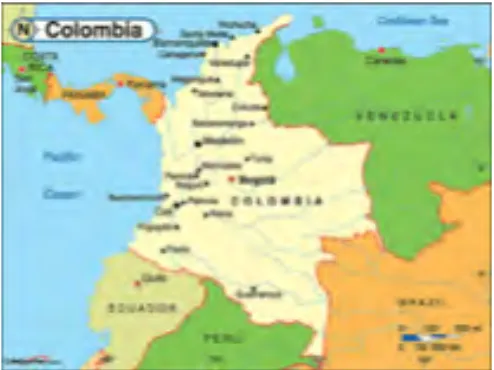
[image:33.595.39.286.472.657.2]The study will focus on the geographical region of the metropolitan area of Medellín, capital of the province of Antioquia, Colombia. According to 2011 census data, Medellín has a population of 2,933,094. Medellín is Colombia’s second city, both in terms of population and economic activity, with the city contributing 8% of the country’s GDP in 2012. Medellín is divided into 16 Comunas or boroughs and within the Comunas are barrios or districts. Henceforth, the term Comuna and barrio will be used in the document when referring to parts of the city.
[image:33.595.312.557.480.653.2]Humanitarianism 2.0 Care for the future... The case of Medellín, Colombia.
It would be impossible to explore the role of digital and art in Medellín without understanding the city’s turbulent past. For over 60 years Colombia has been plighted by a series of enmeshed conflicts characterised by civil war, and on-going Guerrilla conflicts and drug cartel violence. Throughout these conflicts the city of Medellín has been a protagonist; a battle ground for drug cartels and paramilitaries or as a host receiving rural communities fleeing from the fighting. The levels and nature of conflict that Colombia has experienced clearly demonstrate the weakness and instability of state apparatus and the absence of normalised democratic processes.
The complex development of many creative initiatives can be best understood as a product of the city’s troubled and violent history, alongside local government policy, and, most significantly, local community activism over the last 30 years.
In the mid-twentieth century Medellín had a thriving textile, food and chemical sectors and, as such, was referred to as “Colombia’s industrial city”. This period (1950-1970s) in Colombia was characterised by political stability under the Liberal/Conservative coalition “Frente National” and the city enjoyed a period of economic growth evident in the construction of new buildings and an airport (Alcaldía de Medellín, 2011, P37).
However, the 1980s sharply contrasted with the previous decades’ prosperity due to political instability, industrial decline and the rising dominance of drug cartels, criminal and paramilitary groups. The surge of drug gangs, and right wing paramilitaries coupled with political corruption and clientelism in the city resulted in the weakening of state authority, especially in terms of justice and law and order. The resulting withdrawal of the state meant that the state apparatus was almost non-existent in the poorer barrios on the outskirts
As Pilar Riaño Alcala remarks during this period, Medellín: “…was transformed by the infiltration
of nacrotrafficking into all areas of its social and institutional life” (Riaño 2010, P3). As a result,
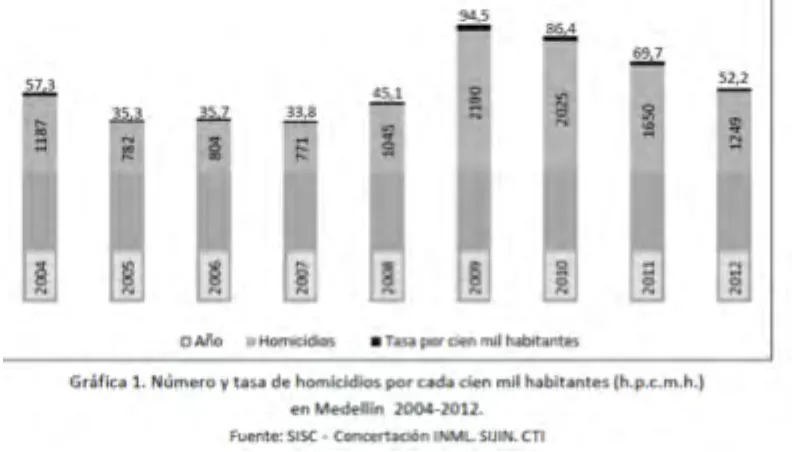
since the early 1990s more than 40,000 young people (aged 14-26) have been murdered in Medellín, peaking in 1991 with 6349 deaths, making the city one of the most violent in the world (Yarce, 2007).
Constitutional reforms in 1991 sought to strengthen balances and checks on political power and introduce the election of Mayors by popular vote. Mayors had previously been nominated by the President and thus, had little autonomy to effectively govern (Cárdenas, Junguito, & Pachón, 2006). Locally, the fall of the Medellín cartel in 1992 and the shooting of the country’s most powerful drug cartel leader, Pablo Escobar, by Colombian forces in 1993 shifted the balance of power. The collapse of the Medellín cartel resulted in the emergence of new conflicts and changed the nature of militia gangs. In 1995 two of the larger militia gangs agreed to a peace deal with the national government and by 1997 the remaining militias’ authority had been weakened by rival gangs and the presence of community self-defence organisations that protected the community against the militias. This chain of events helped to initiate Medellín’s transition to a degree of political and social stability (Riaño, 2010, P3). Nationally, the Colombian government attempted to end a long-running civil war through peace talks with the left wing FARC guerrilla group during the late 1990s and early 2000s.