http://wrap.warwick.ac.uk/
Original citation:Fehrler, Sebastian and Hughes, Niall (2014) How transparency kills information
aggregation : theory and experiment. Working Paper. Coventry: University of Warwick. Department of Economics. Warwick economics research papers series (TWERPS), Volume 2015 (Number 1057). (Unpublished)
Permanent WRAP url:
http://wrap.warwick.ac.uk/66208
Copyright and reuse:
The Warwick Research Archive Portal (WRAP) makes this work of researchers of the University of Warwick available open access under the following conditions. Copyright © and all moral rights to the version of the paper presented here belong to the individual author(s) and/or other copyright owners. To the extent reasonable and practicable the material made available in WRAP has been checked for eligibility before being made available.
Copies of full items can be used for personal research or study, educational, or not-for-profit purposes without prior permission or charge. Provided that the authors, title and full bibliographic details are credited, a hyperlink and/or URL is given for the original metadata page and the content is not changed in any way.
A note on versions:
The version presented here is a working paper or pre-print that may be later published elsewhere. If a published version is known of, the above WRAP url will contain details on finding it.
How Transparency Kills Information Aggregation:
Theory and Experiment
Niall Hughes and Sebastian Fehrler
No 1057
WARWICK ECONOMIC RESEARCH PAPERS
Theory and Experiment
Sebastian Fehrler
University of Konstanz,
University of Zurich, and IZA
Niall Hughes
University of Warwick
December 2014
Abstract
We investigate the potential of transparency to influence committee decision-making. We present a model in which career concerned committee members receive private information of different type-dependent accuracy, deliberate and vote. We study three levels of transparency under which career concerns are predicted to affect behavior differently, and test the model’s key predictions in a laboratory experiment. The model’s predictions are largely borne out - transparency negatively affects infor-mation aggregation at the deliberation and voting stages, leading to sharply different committee error rates than under secrecy. This occurs despite subjects revealing more information under transparency than theory predicts.
Keywords: Committee Decision-Making, Deliberation, Transparency, Career Con-cerns, Information Aggregation, Experiments, Voting, Strategic Communication.
JEL Classification Numbers: C92, D71, D83.
“Secrecy is the first essential in affairs of state.” (Cardinal Richelieu)
1.
Introduction
Transparency in decision-making is a recurring and controversial topic in public debate.
A recent exemplary case is that of FIFA, soccer’s governing body, where its executive
committee’s decision to hand the 2022 World Cup to Qatar - amid allegations of bribing
- spurred calls for more transparency from soccer fans worldwide.1 Another prominent
example is the discussion on how transparent decision-making in monetary policy
com-mittees such as the Federal Open Market Committee (FOMC) should be (e.g., Williams
(2012)). Here, the argument has been made that too much transparency could be
harm-ful (Meade and Stasavage(2008);Swank et al. (2008);Swank and Visser(2013)). This
debate over transparency is not a recent phenomenon. In the early 19th century Jeremy
Bentham([1816] 1999) argued for more transparency in parliamentary decision-making,
while reservations had long been voiced by influential thinkers like Thomas Hobbes and
John Stuart Mill (seeStasavage(2007)).
The supposed boon of transparency is accountability; by making the decision-making
process more transparent, this should align the incentives of the agents with those of the
principals.2 The downside of transparency is that if agents care about their reputations,
they may pander to the principal, choosing an action which makes them appear smart but
which is not necessarily in the principal’s interest (Prat (2005); Fox and Van Weelden
(2012)). Indeed, recent theoretical literature has shown that reputational concerns
in-fluence committee behaviour differently under secrecy and transparency in the case of
political committees (e.g. Stasavage (2007)), corporate boards (Malenko (2013)), and
monetary policy committees (Levy(2007);Visser and Swank(2007);Swank and Visser
(2013);Swank et al.(2008);Meade and Stasavage(2008);Gersbach and Hahn(2008)).
In the studies that allow for deliberation - an obviously realistic assumption for most
1See, e.g.,
http://www.theguardian.com/football/2014/sep/24/michael-garcia-fifa-investigation-public-world-cup.
2A positive case for transparency is also made in the deliberative democracy literature (e.g.,Habermas
committees - strategic communication is the key driver of these effects. However, recent
experimental literature shows for a variety of settings that subjects are too truthful and too
trusting as compared to theoretical ‘cheap talk’ predictions (Cai and Wang(2006);Wang
et al.(2010); Battaglini and Makarov(2014)) and that a substantial fraction of subjects
display psychological costs of lying (Gneezy(2005);Gneezy et al.(2013);Fischbacher
and Föllmi-Heusi (2013)). In a study on committee voting, Goeree and Yariv (2011)
even find that open deliberation leads to perfect information sharing in a set-up where
committee members have private values regarding the committee decision and thus a
clear incentive to keep their information private. These findings cast some doubt on the
predictions from the theoretical literature on the role of career concerns in committees.
Unfortunately, empirical evidence on the effects of transparency on career concerned
committee members is scarce and does not identify the mechanisms through which
be-havior is affected. Both Meade and Stasavage (2008) and Swank et al. (2008) present
evidence of changes in deliberation in the FOMC after the decision to publish minutes
of their meetings, but they present the same data as supporting evidence for their
differ-ent career concerns models.3 The difficulty of identifying mechanisms is not surprising
given the shortcomings of using field data to study the role of transparency in committee
decision-making. Firstly, it is almost certainly impossible to observe the level of
abil-ity, prior information and biases which committee members may have. To the extent
that transparency may be interacting with these unobserved variables, it is impossible to
identify the mechanism through which transparency affects behavior. Secondly, a
con-trolled comparison of institutions is always very difficult as their different elements, e.g.
the committee’s voting rule, deliberation protocol and other factors are endogenous. For
these reasons, we believe a laboratory experiment provides the cleanest way of
approach-ing the important and so far unanswered questions of whether and how transparency
af-fects the behavior of career concerned committee members. By carefully controlling the
information players have and varying the level of transparency, effects and mechanisms
can be clearly identified.
3Another study is presented byCross(2013), who does not test a particular model but compares
Instead of testing one of the existing models we construct and test a new model in
which career concerns play out very differently under three levels of transparency. This
set-up allows us to study how subjects react to the changing opportunities to act smart
both at the deliberation and the voting stages of the decision process. As in most career
concerns models, there are two types of committee members: high and low ability. First,
committee members receive either a fully informative or a noisy signal about the true
state of the world, depending on their ability. Then they have the opportunity to
delib-erate, and finally vote for or against changing the status quo in favor of an alternative
option. A change of the status quo requires a unanimous vote of the committee. The first
deliberation stage consists of a non-binding straw poll in which subjects can exchange
information about their signals. This is followed by a second stage in which they can
exchange information about their type, i.e. the signal strength. A committee member’s
utility depends on the principal’s belief that he is of high ability. We study three
differ-ent transparency regimes - secrecy, where votes and communication are secret and the principal only learns the committee decision, transparency, where both communication and individual votes are public, and the intermediate case of mild transparency, where individual votes are made public but deliberation is secret. Mild transparency thus
re-flects a committee practice of publishing individual voting records but not transcripts of
the deliberation. This corresponds to the practice of the FOMC before 1993 (seeMeade
(2005)).4 We implement the three transparency regimes in a laboratory experiment in
which the principal’s belief about an agent’s type is elicited with a proper scoring rule.
This stated belief directly affects the agent’s payoff. As free form communication has
been shown to matter greatly for the level of strategic deliberation inGoeree and Yariv
(2011), we implement the second deliberation stage as an open chat.
The following key insights from the model are corroborated in the experimental data.
Firstly, in the most informative equilibrium committee members truthfully share all their
information with each other under secrecy, but fail to do so under transparency. When
4Mild Transparency also reflects the main structure of a scenario in which deliberation is nominally
the principal is watching, nobody wants to admit to being a low type, so information
ag-gregation is incomplete. Secondly, incorrect group decisions are more prevalent under
transparency than secrecy. This occurs for two reasons: (a) members are less truthful
under transparency and thus aggregate poorer information, and (b) low ability members
have an incentive to vote according to their private information even if they believe it to
be wrong. This effect stems from the fact that if members change their position between
the deliberation and voting stages, the principal can infer that they are a low ability type.
Thirdly, a principal biased in favour of the status quo can actually be better off under
transparency than secrecy. The failure of committee members to share information under
transparency means they find it difficult to vote unanimously against the status quo. This
means more mistakes when they should change the status quo, but less mistakes when
they shouldn’t. This asymmetry of errors appeals to a principal who is very concerned
about wrongly changing the status quo. Here, transparency aids the principalbecauseit hinders information aggregation. Finally, while the most informative equilibrium under
mild transparency predicts behavior as under secrecy, the experiment shows aggregate
level results quite similar to the transparency case. However, these result from quite
dif-ferent individual level behavior. Mild transparency leads to a significant level of deception
at the first deliberation stage, whereas under transparency information aggregation breaks
down at the second deliberation stage and at the voting stage. Under mild transparency,
there are equilibria in which high types do not truthfully reveal their signals. This makes
them easier to separate from low types in the voting stage, resulting in a more favorable
belief of the principal regarding their type.5 Our results suggest that the existence of
these equilibria leads a number of high types to deliberate non-truthfully and thus to very
different aggregate outcomes than predicted by the most informative equilibrium.
We also observe a number of deviations from our theoretical predictions regarding
individual level behavior. Principals are on average too optimistic in their assessment of
committee members. However, they update their beliefs in the correct direction to all
pieces of information they receive. Most committee members play a best response to
5A structurally similar situation is described inSobel(2013), section 2, in which he calls for experiments
the stated beliefs of the principals under secrecy and mild transparency, while many of
them fail to best respond under transparency, where belief updating is more complicated
and therefore also more complicated to anticipate for committee members. Also under
transparency, open chat deliberation is more truthful and informative than predicted. This
suggests that some subjects do indeed face psychological costs of lying, and confirms
results from previous experimental studies. However, despite this truth-telling preference,
the level of truth-telling varies greatly between treatments. This suggests that Goeree and
Yariv’s (2011) result on the power of open chat to moderate institutional differences does
not extend to the case of transparency versus secrecy.
In the next section, we present and solve the model. We proceed with the experimental
design and theoretical predictions for the chosen parameter values before discussing the
aggregate and individual level results. We conclude with a discussion of the main results
and their implications for the literature on career concerns in committees and cheap talk
games, and for debates about the optimal level of transparency.
2.
The Model
A committee of two members must make a decisionD ∈ {B(lue), R(ed)}on behalf of a principal.6 There are two equally likely states of the worldS ∈ {B, R}. The utility of the principal in each state is
Uprincipal(D=B|S=B) = x Uprincipal(D=R|S =B) = Uprincipal(D =B|S =R) = 0
Uprincipal(D=R|S =R) = 1−x
withx ∈(0.5,1). That is, the principal gets higher utility from a correct group decision when the state isB.7 The group decision is made by unanimity rule, whereby optionRis
6We present a two member model for clarity and simplicity, as we run two member games in the lab.
In annmember committee players’ behaviour would not change, though the probability of incorrect group decisions would.
7Equivalently we could say that the utility from a correct decisions is the same across states but a
implemented only if both members vote for it, otherwise the status quoB is upheld. Committee members are not perfectly informed of the state of the world. Instead, each
member gets an informative signal about the true state, where the level of informativeness
depends on his ability. Each memberiis either of high or low ability. Accordingly, there are four types of committee member {hb, hr, lb, lr}, where, for example, hb refers to someone of high ability who receives a signal b. With a slight abuse of terminology we will refer to {hb, hr} as high types and {lb, lr} as low types; ti ∈ {h, l}, where P r(ti = h) = q ∈ (0,1). The accuracy of the signalssit ∈ {b, r}are given byP r(sih =
b|S = B) = P r(si
h =r|S = R) = 1andP r(sil = b|S = B) = P r(sil =r|S = R) = σ ∈(0.5,1)respectively.8
Abilities and signals are private information. However, once nature has chosen
mem-ber’s ability levels and signals have been received, members can communicate with each
other. In modelling communication we want to capture the key features of real world
committees while still giving clear predictions to test in the laboratory. First, in a simple
straw poll, each member simultaneously announces a messagemi ∈ {m
b, mr, m∅}, i.e.
he can raise his hand in favor ofB orR or can abstain. Next, each member simultane-ously announces a messageτi ∈ {τh, τl, τ∅}, i.e. he can announce that he is of low type,
high type or can remain silent.9 After these two stages of communication, committees
have access to a coordination device - a publicly observable random draw from a
uni-form distribution u[0,1]which allows them to coordinate on a group decision. Finally, after both rounds of communication, each member casts a vote vi ∈ {v
B, vR}.10 We
model communication in two stages because we want players to be able to communicate
in open chat in the experiment, as members in a real committee are. However, we want to
avoid any effects of sequencing which may occur. For example, one player copying the
announcement of another, or both players rushing to make the first announcement. The
8We could allow for imperfect high type signals; the strategy of committee members in the most
infor-mative equilibria would remain largely unchanged. The only change is that there could now be a committee of two high types with conflicting signals. Under secrecy or mild transparency such a group would imple-ment each state with probability0.5.
9We could collapse all communication into one simultaneous round or could have the second stage of
communication be sequential rather than simultaneous - the theoretical predictions would not change.
10We could also allow for abstention in the final voting stage but it would not change equilibrium
problem is solved by splitting the lab communication into two stages: first, players can
simultaneously announce their signalsmi, then they can communicate in open chat about their ability levels and can decide on a group strategy if necessary. This second stage of
communication differs slightly between the model and the experiment because a message
space and a sequence has to be fixed for the model. However, the only sensible way
sub-jects can make use of the open chat is to share info on their ability and to coordinate. To
also allow for coordination in the model we add the coordination device.
Committee members’ primary concern is not in making the correct decision for the
principal but rather in advancing their own individual careers or reputations. The payoff
of a committee member is simply the principal’s posterior belief that he is of high ability,
given byqˆ∈ [0,1]. This is standard in models of career concerns (seePrat(2005);Fox and Van Weelden(2012);Levy(2007)).11 Before the game starts, the principal’s prior for
each member isP r(ti =h) = q.
A committee member’s strategy consists of a communication strategy and a voting
strategy. A communication strategy is a pair(mi, τi), wheremi is mapping from a pair
(si, ti) into a probability distribution over messages {m
b, mt, m∅}and τi is a mapping
from (si, ti) and messages exchanged in the straw poll into a probability distribution over announcements{τh, τh, τ∅}. A voting strategy is a mapping from signal, ability and
messages exchanged in both communication rounds into a probability distribution over
votesvi ∈ {vB, vR}.
Once votes are cast, the true state is revealed and utilities are realized. The principal
updates her prior beliefs as best she can, where this ability depends on how much of the
decision-making process she observes, i.e. on the level of transparency. We compare three
different regimes. Our primary interest is in comparingsecrecy, where the principal only observes the group decision D, withtransparency, where she witnesses each member’s messages mi, τi, and final vote vi. Subsequently, we also examine mild transparency, where the principal observes only the group decision and how each individual votes.
11In line with the career concerns literature mentioned, we ignore the possible benefits to the principal
We study symmetric perfect Bayesian equilibria under the three transparency regimes.
As is standard in voting games, we restrict attention to strategies which are not weakly
dominated.12 As committee members’ payoffs depend on the principal’s beliefs and
be-cause talk is cheap, there will be many equilibria in each of the three settings. We employ
some restrictions to reduce the set of equilibria. Firstly, we restrict attention to equilibria
in which h types vote in line with their private signal. Though other equilibria do ex-ist, we focus on these equilibria as: (a) it seems reasonable that with perfect knowledge
h types will vote for the true state (especially as the principal knows they have perfect knowledge); (b) we can test whether focusing on these equilibria is sensible. Indeed,
in the laboratory h types vote to signal 98.2% of the time, rising to 100% in the final 5 periods.13 Secondly, we follow the cheap talk literature (Crawford and Sobel (1982);
Ottaviani and Sørensen (2001); Chen et al. (2008)) in focusing on the most
informa-tive equilibrium. That is, in each setting we consider the equilibrium where the greatest
possible amount of information is shared across the two communication stages.14 As is
standard, we ignore equilibria with inverted language; for example where a messagemR
is interpreted as “I have a signal in favor of stateB” or an announcementτhis interpreted
as “I am of low ability”.
2.1.
Equilibrium
We can now compare the behavior of two person committees under our different
trans-parency regimes. A useful benchmark to consider is what the principal would do if she
could observe the two signals and their strengths directly. If either of the signals were
from a htype, i.e. fully revealing, she would obviously choose that decision. With two low signals she would choose B whenever there is a tie or both signals favour B. Fi-nally, when she observes two low signals in favour of R she would choose R only if (1−σσ)2 > x
1−x, that is, if the evidence in favor ofRis strong enough to overturn her bias
12In our setting this prevents cases where each player votes v
B simply because he expects the other player to do so, and so no vote is pivotal.
13Alternatively, we could restrict attention to responsive and monotone strategies as in Fox and Van
Weelden(2012).
forB.
Secrecy As the principal can only see the group decision, she must hold the same
pos-teriorqˆfor each individual. For this reason committee members have a common interest in making the correct group decision.
Proposition 1. In the most informative equilibrium under secrecy, all members truthfully reveal their signal and ability, and then jointly implement the policy with the highest posterior probability of matching the state. The probability of a group mistake in each state is(1−q)2(1−σ). Each member earns an evaluation of zero if the group decision
is wrong and an evaluation 1−(1−qq)2(1−σ) if the group decision is correct.
Proof. See Appendix
It is not surprising that sharing all their information is an equilibrium for players with
a common interest;Coughlan(2000) shows that allowing communication between
play-ers with a common interest can lead to full aggregation. There are of course other, less
informative, equilibria in which players babble in one or both stages of communication,
howeverGuarnaschelli et al.(2000) andGoeree and Yariv(2011) show that in the
labora-tory players with a common interest are overwhelmingly truthful. Regardless of the level
of communication, two things are worth noting about the most informative equilibrium
under secrecy: firstly, the voting rule plays no role. The voting outcome would be the
same regardless of whether the rule was stacked in favor ofB orRor neutral. Secondly, we saw in the benchmark case that the principal trades off the evidence against her bias.
Here, however, committee members face no such trade-off - they simply want to choose
the most likely state, regardless of the principal’s bias.
Transparency Under this regime, the principal sees all stages of communication that
occur and observes each individual’s vote.
in stateB is(1−q)2(1−σ)2, while the (much larger) probability of a mistake in stateR
is1−(q+ (1−q)σ)2. Each member earns an evaluation of zero if their individual vote doesn’t match the state, and an evaluation q+(1q−q)σ if it does.
Proof. See Appendix
Here, in the most informative equilibrium, members reveal their signals truthfully
in the straw poll but cannot credibly reveal their ability. This is because l types will mimic the strategy ofhtypes in the open chat in an effort to appear competent in front of the principal. Information aggregation is incomplete when compared to secrecy: while
signals are shared, players cannot differentiate the quality of those signals. Interestingly,
even though some information is aggregated, players ignore this when deciding how to
vote. Anlbtype who sees amr message in the straw poll will believeR to be the most
likely state. However, this lb player will be better off voting vB in the final vote. The
same holds for anlrtype who sees ambmessage in the straw poll. Why is this? Ahtype
would never vote against his signal, therefore anyltype who switches his choice between the straw poll and the final vote can be identified by the principal.15 This means that l
types will stick to their straw poll announcement in the final vote even when they believe
it is the wrong state.
Mild Transparency In this section, we look at an intermediate case of transparency
where the principal cannot observe any communication, but she does observe the
indi-vidual votes of committee members as well as the final group decision. This corresponds
to many real world cases where voting records are released but discussions are kept
se-cret, as was the case for the FOMC before 1993. Furthermore, mild transparency reflects
the settling where an attempt to introduce transparency leads to the emergence of
pre-meetings in which members can discuss what to do before they are under the watchful
eye of the principal. Swank and Visser (2013) have shown that pre-meetings can undo
the benefits of transparency in their setting, while similarly Alan Greenspan noted that
in-15This equilibrium is sustained by beliefs that any member who switches in the final vote is of typel.
troducing transparency into Federal Open Market Committees would mean “a tendency
would arise for one-on-one pre-meeting discussions, with public meetings merely
an-nouncing already agreed-upon positions or each participant to enter the meeting with a
final position not subject to the views of others” (quoted inMeade and Stasavage(2008)).
The following proposition shows that the most informative equilibrium under mild
trans-parency gives the same outcomes as under secrecy.
Proposition 3. In the most informative equilibrium under mild transparency communi-cation, evaluations and the probability of mistakes are the same as under secrecy. In the voting stage, each member votes for the policy with the highest posterior probability of matching the state.
Proof. See Appendix
The only difference between the most informative equilibrium under secrecy and mild
transparency is that under mild transparency each member must vote for the project most
likely to match the state, while under secrecy it is only the group implementation that
mat-ters. This makes no difference to the probability of mistakes. This implies that, if players
do indeed play the most informative equilibrium, the emergence of pre-meetings would
actually lead to more information aggregation and less mistakes than would otherwise be
the case.16
Optimal Transparency A natural question is which transparency regime would the
principal prefer ex anteassuming the most informative equilibria are played. We focus here on secrecy and transparency, as the intermediate case of mild transparency predicts
the same outcome as secrecy. A principal who is “not too biased” will prefer secrecy to
transparency. The superior information aggregation ensures a lower probability of
mis-takes. Meanwhile, a principal who is sufficiently biased in favor ofB will prefer trans-parency to secrecy exactly because information aggregation breaks down under trans-parency.
16There are other equilibria with less information sharing under mild transparency which are preferred
Proposition 4. There always exists an x∗ such that if x < x∗ the principal is ex ante better off under secrecy than under transparency and if x > x∗ then transparency is preferred.
Proof. See Appendix
A transparent committee, voting according to their own signals, will make the
unan-imous decision needed to implement R less often. Such a committee will, thus, make more mistakes in state R but less in B when compared to secrecy. A principal with a high value of x will be more wary of losses in state B and so will prefer transparency to secrecy. Indeed, this is that case for the parameter values we bring to the lab. With
σ = 0.55andx= 0.75the principal would prefer transparency to secrecy.
3.
Experiment
To test the main predictions of the model, we ran a laboratory experiment with three
treatments - one for each level of transparency. In a slight departure from the model, in
which we had to specify the message space for the second deliberation stage, we allow for
free form communication in the second deliberation stage in the experiment. As subjects
can now coordinate through communication, we did not implement the correlation device.
Note, that the equilibria that we have characterized in the previous section are unaffected
by this change. Given the effects of free-form communication in Goeree and Yariv’s
(2011) study and the fact that open deliberation takes place in most real world committees,
we decided that it is better to test the theoretical predictions in this setting rather than in
a setting with completely structured communication. To control for possible effects of
the sequence of messages we chose to implement the first deliberation stage, in which
the sequence would matter under transparency, exactly as it is in the model, i.e. as a
simultaneous straw poll. For the second deliberation stage the sequence of messages
3.1.
Experimental Design
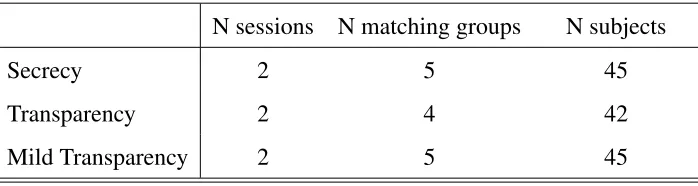
We ran six sessions, two for each transparency regime (see Table1). Each session
con-sisted of 20 rounds with random matching of subjects into groups. In the first round of
the experiment, subjects were randomly assigned to matching groups of nine people.17
In every period, new groups of three were randomly formed within the matching groups
to avoid the emergence of reciprocal behavior and at the same time provide independent
matching groups. In each group and round, one member was randomly assigned the role
of the principal (called the “observer” in the instructions) and the other two were assigned
the role of committee members (called “voters” in the instructions).18 With probability
q = 0.25a committee member was of type h (“well-informed voter”), with probability 1−q = 0.75of type l (“informed voter”). The task of the committee members was to vote on the true color of a randomly selected jar.19 The blue jar (S = B) contained 11 blue and 9 red balls, the red jar (S = R) contained 11 red and 9 blue balls. Jars were chosen with equal probability. Typeh committee members received a ball with the true color of the jar (the perfectly accurate signal), typel committee members received a ball that was drawn from the selected jar (a signal of accuracyσ = 0.55). We chose a low signal accuracy for the low type to make equilibrium predictions sufficiently different
across treatments which would allow us to distinguish them statistically in the data in
case behavior resembles equilibrium predictions.
On the first screen, the principal learned that she is a principal, while committee
mem-bers were informed about their type and the color of their ball. Committee memmem-bers then
had to simultaneously send a message {red, blue, not specified} to the other committee
member in their group. On the next screen, committee members saw the message from
their partner and had the opportunity to chat with him for 90 seconds.20 In the
trans-parency treatment, the principal could see the committee members’ messages and follow
17In one session we had only 15 subjects and therefore only one matching group. 18Screenshots and instructions are in the online appendix.
19This has become the standard task in information aggregation experiments (e.g.Guarnaschelli et al.
(2000);Battaglini et al.(2009);Goeree and Yariv(2011);Bhattacharya et al.(2014);Bouton et al.(2014)).
20The timeout was not strictly enforced. When the time was up a message appeared on the screen asking
Table 1: Experimental sessions
N sessions N matching groups N subjects
Secrecy 2 5 45
Transparency 2 4 42
Mild Transparency 2 5 45
Note: All sessions were run at the DeSciL Lab at the ETH Zurich in May 2013 with 132 students (48% female) studying various majors at the ETH or the University of Zurich. Psychology students were not recruited.
the chat on her second screen. In the other two treatments the principal could not. On
the third screen, the committee members could review the communication and then make
their final decision by voting for red or blue. Votes were then aggregated to the group
decision. For a decision for red (D=R) two votes were required, for a decision for blue (D=B) only one. After the voting stage, the principal received information on her next screen that varied between treatments. In the secrecy treatment, she could only see the
group decision and the true color of the jar. In the mild transparency treatment, she could,
in addition, see the individual votes of the committee members. In the transparency
treat-ment, she could also review the whole communication (messages and chat) between the
committee members. On this screen, the principal had to indicate her belief about the
probability that the committee members are of typeh, by entering this probability in per cent. In the secrecy treatment, in which both committee members are indistinguishable
to the principal, she had to evaluate one randomly chosen committee member from her
group, in the other two treatments she had to evaluate both committee members in her
group. On the final screen of each round, subjects received feedback information
regard-ing the types of the committee members in their group, the group decision, the true color
of the jar and their pay-offs.
Subjects earned points in each round. The points of a committee member in one round
was twice the probability that he was a high type, as entered in per cent by the principal,
e.g., if the principal entered 30% the committee member’s payoff was 60 points. The
blue and 1 point for a correct group decision if the true state was red, i.e. the principal’s
bias is given byx = 0.75. In addition, the principal earned a number of points between 0 and 100 for accurate evaluation of the committee members’ types. In the transparency
and mild transparency treatments, the evaluation of one of the two committee members
(committee member i) was randomly selected and a principal j’s earnings were deter-mined by the following quadratic scoring rule (under secrecy the principal evaluated only
one memberi).
Points=
100− 1
100(100−P rj(ti =h))
2 if committee memberiis of typehand
100− 1
100(P rj(ti =h))
2 if committee memberiis of typel
where P rj(ti = h) denotes the probability that committee member i is of type h,
as entered by principal j, in per cent. This rule makes it optimal for expected pay-off maximizing subjects to truthfully enter their beliefs (see, e.g., Nyarko and Schotter2003)
and subjects were directly told so in the instructions.21 To keep potential effects of social
preferences of committee members toward the principal limited, we kept the principal’s
payoff from correct group decisions low relative to the payoff from accurate evaluations.
Four rounds were randomly chosen at the end of the session and the points earned in
these rounds converted to Swiss Francs at a rate of 1 point= CHF 0.15 (at the time of the
experiment CHF 1 was worth USD 1.04). Subjects spend about 2 hours in the lab and
earned, on average, CHF 47 in addition to their show-up fee of CHF 10. Earnings per
hour are comparable to an hourly wage for student jobs in Zurich.
3.2.
Equilibrium Predictions
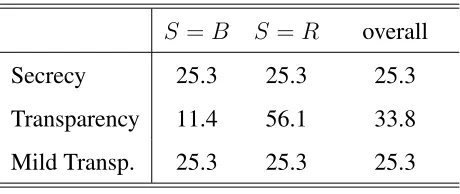
Ex anteequilibrium error rates are reported in Table2. In this section, whenever we say
21More complicated belief elicitation procedures have been proposed in the literature for risk averse
equilibrium predictions we refer to the most informative equilibrium.
Table 2: Ex anteequilibrium error rates (in %)
S =B S =R overall
Secrecy 25.3 25.3 25.3
Transparency 11.4 56.1 33.8
Mild Transp. 25.3 25.3 25.3
Note: In the experimentS =B (S =R) corresponds to the case of the blue (red) jar.
Table3reports the principal’s predicted evaluation of player types after observing the
true state of the world, the group decision and, in case of transparency, the individual
de-cisions. In the same table we also report theex anteexpected evaluations forhandltype committee members, i.e. the expected evaluation before the realization of the state of the
world and the signals. Typel committee members are predicted to do best under secrecy and mild transparency and typehcommittee members under transparency. The reason is that principals are predicted to be better able to tell them apart under transparency.
Table 3: Principal’s equilibrium beliefs about members’ typesP r(ti =h)in %
Eq. evaluation after cor-rect and wrong decisions
Eq. expected ex ante
evaluation for committee members
dec. corr. dec. wr. typeh typel
Secrecy(group decision) 33.5 0 33.5 22.2
Transparency(individual decision) 37.7 0 37.7 20.8
Mild Transp.(ind./group decision) 33.5 0 33.5 22.2
Note: In equilibrium under secrecy the principal only takes the group decision into account for her evaluation, under transparency she looks at messages and individual decisions (which are predicted to be the same). Under mild transparency she looks at individual decisions which are the same as the group decision in equilibrium.
informa-tion under secrecy and mild transparency but fail to do so under transparency. Under
se-crecy and mild transparency all committee members are expected to truthfully announce
their signal in the straw poll and their type in the chat. Under transparency committee
members are also predicted to share information about their signal truthfully in the straw
poll but the second deliberation stage is predicted to be uninformative. Moreover, all
committee members are predicted to vote according to their signal and straw poll
mes-sage, which are identical, in the voting stage. Furthermore, our restriction on equilibria in
which high types always vote according to their signal is a testable assumption that will
also be addressed.
3.3.
Experimental Results
Aggregate Behavior
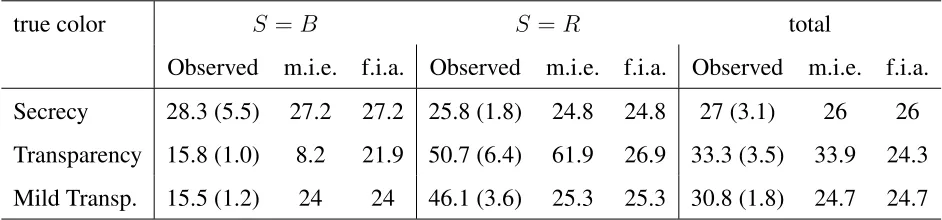
Table 4 summarizes the observed error rates and, for comparison, the ex post equilib-rium predictions, i.e. the predictions after realization of the true state of the world, the
types, and the signals. It also contains a column with the hypothetical full information
aggregation benchmark case, i.e. the case where committee members share all of their
[image:20.612.94.565.509.619.2]information and implement the decision that matches the more likely state.
Table 4: Observed,ex postequilibrium, and full information aggregation error rates by state and in total
true color S =B S =R total
Observed m.i.e. f.i.a. Observed m.i.e. f.i.a. Observed m.i.e. f.i.a.
Secrecy 28.3 (5.5) 27.2 27.2 25.8 (1.8) 24.8 24.8 27 (3.1) 26 26
Transparency 15.8 (1.0) 8.2 21.9 50.7 (6.4) 61.9 26.9 33.3 (3.5) 33.9 24.3
Mild Transp. 15.5 (1.2) 24 24 46.1 (3.6) 25.3 25.3 30.8 (1.8) 24.7 24.7
Note: m.i.e. = most informative equilibrium, f.i.a. = full information aggregation. Equilibrium error rates areex posterror rates. Standard errors of the observed error rates (in parentheses) are adjusted for clustering in matching groups.
transparency treatment. Under transparency the error rate is higher in stateB and lower in state R than the model predicts. Nonetheless the key predicted difference between transparency and secrecy is borne out in the lab: when compared to secrecy, the
transpar-ent committees performed significantly and substantially worse in stateRat conventional levels (Wald-test, p < 0.001) but better in stateB (Wald-test, p = 0.024). In contrast to the theoretical predictions, this is also true for the error rates under mild transparency
(Wald-tests,p <0.001forS =R, andp= 0.023forS =B) which are statistically not different from those under transparency (Wald-tests,p= 0.526forS =R, andp= 0.894 forS =B). Even though the total error rate is higher under transparency than under se-crecy, principals earned minimally more points from the group decisions (0.11 points on
average) in the two transparency treatments because, given their bias, correct decisions in
stateB are more valuable to them. However, this difference is not statistically significant (t-test,p= 0.235).
The most likely source of the differences between the treatments are (a) differences
in information aggregation and (b) coordination behavior of groups consisting only of
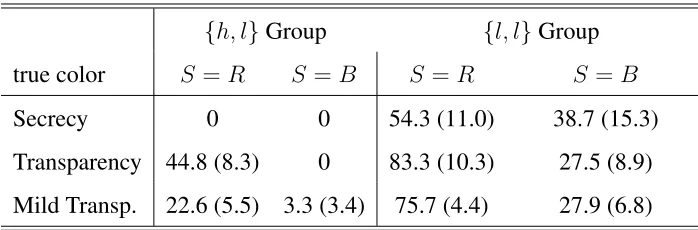
low types. Information aggregation helps if there is one typeh committee member and one typel committee member in a group, they have conflicting signals and the true state is red. In this scenario all groups in the secrecy treatment aggregated information
suc-cessfully (see Table5), while the error rate is substantially and significantly higher in the
transparency treatment (Wald-test, p < 0.001). However, the error rate is much lower than its predicted value of 100% (Wald-test, p < 0.001). There is a significant differ-ence between the error rate for these groups under the two forms of transparency. Under
mild transparency the error rate is significantly lower than under transparency (Wald-test,
p= 0.026) but still significantly higher than under secrecy (Wald-test,p <0.001). If the true state of the world is blue, groups with conflicting signals and one high type
always choose the right decision in all regimes with the exception of one observation
under mild transparency. This is not surprising because it must be the high type that
received the blue signal and only one vote for blue is required.
However, we see in Table5that this is not the case; mistakes occur in stateB 27.5% of the time and only 83.3% of the time in stateR, so some coordination on implementing
R does take place. The error rates are similar and not statistically different under mild transparency. Under secrecy, we expect such a group to implement each state with equal
[image:22.612.130.479.230.345.2]probability, giving us an error rate of 50%, and indeed the data is relatively close to this.22
Table 5: Error rates in groups with conflicting signals
{h, l}Group {l, l}Group true color S =R S =B S =R S=B
Secrecy 0 0 54.3 (11.0) 38.7 (15.3)
Transparency 44.8 (8.3) 0 83.3 (10.3) 27.5 (8.9)
Mild Transp. 22.6 (5.5) 3.3 (3.4) 75.7 (4.4) 27.9 (6.8)
Note: Standard errors of the observed error rates (in parentheses) are adjusted for clustering in matching groups.
Interestingly, not all groups with two signals in the same direction vote for that
alter-native because communication is not always truthful and leads some low types to switch
in the wrong direction, as we will see in the next section. As a consequence, the error
rates of these groups are not 100% if their signals go in the wrong direction (but range
from 82.4% in the mild transparency treatment to 95.6% under secrecy, with 93.3% under
transparency) but also not 0% if they go in the right direction (and range from 4.7% under
secrecy to 13.6% under mild transparency, with 7.4% under transparency, instead).23
22Note that none of the differences in error rates between secrecy and the transparency treatments in
these groups is statistically significant at the 5% level. In stateR, however, the differences between secrecy and transparency (p = 0.084) and between secrecy and mild transparency (p = 0.06) are significant at the 10% level (Wald-tests). The differences in error rates between the two transparency regimes are not statistically significant even at the 10% level.
23The error rates after two correct signals are all significant at the 5% level (Wald-tests). However, only
Individual Behavior
Deliberation We start our analysis of individual behavior with the deliberation stage. In
the straw poll, we observe that under secrecy there is almost completely truthful revelation
of signals by both high and low types, consistent with equilibrium predictions (Table6).
Under transparency, high types are also almost always truthful and reveal their signal.
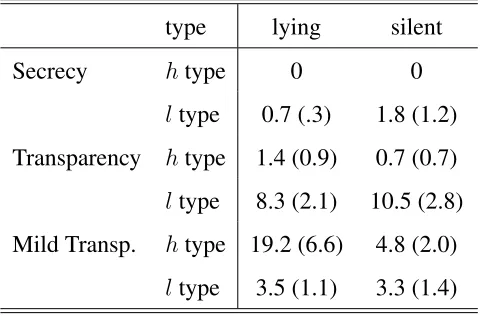
However, there are 8.3% low types that lie about their signal and another 10.5% who
stay silent, which goes against our predictions.24 Note that lying is not very costly in
expectation as σ-signals are not very informative. Staying silent might be motivated by the hope to learn more about the true state and then vote accordingly without being
punished for the behavior in the deliberation stage. When we turn to the principals’
reactions, we will see whether this strategy pays off or not.
Table 6: (Non-)truthful straw poll messages from different types
type lying silent
Secrecy htype 0 0
l type 0.7 (.3) 1.8 (1.2) Transparency htype 1.4 (0.9) 0.7 (0.7)
l type 8.3 (2.1) 10.5 (2.8) Mild Transp. htype 19.2 (6.6) 4.8 (2.0)
l type 3.5 (1.1) 3.3 (1.4)
Note: Percentage of non-truthful messages (lying) and “not specified” messages (silent). Standard errors of the observed error rates (in parentheses) are adjusted for clus-tering in matching groups.
Under mild transparency, 19.2% of the high types lie about their signal and another
4.8% stay silent which is against our prediction of truthful communication, while the low
types are almost always truthful and reveal their signal.25 The degree of lying from high
24Both percentages are significantly larger than zero (Wald-tests,p <0.001).
25All percentages of incorrect messages or abstentions are significantly larger than zero under mild
[image:23.612.187.427.374.532.2]types is significantly higher than in the other treatments (Wald-tests,p < 0.001). Out of 26 subjects who were high type committee members under mild transparency in at least
3 rounds, 15 never lied, 1 always lied, and the remaining 8 lied in some periods and told
the truth in others. The share of high type lies is lower (16.9% as compared to 21.7%)
in the last ten periods than in the first ten but the difference is not statistically significant
[image:24.612.157.456.274.433.2](Wald-test,p= 0.375). Throughout the 20 rounds, the degree of lying is not high enough to make the straw poll uninformative for low types.
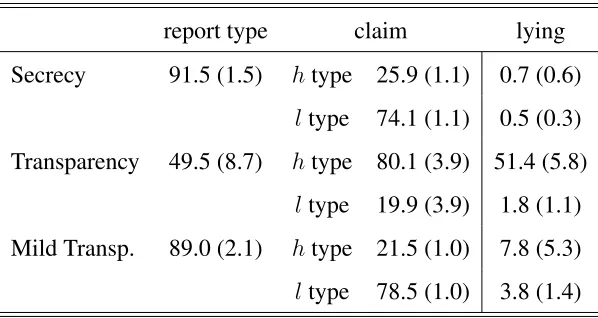
Table 7: Chat messages about type
report type claim lying
Secrecy 91.5 (1.5) htype 25.9 (1.1) 0.7 (0.6)
ltype 74.1 (1.1) 0.5 (0.3) Transparency 49.5 (8.7) htype 80.1 (3.9) 51.4 (5.8)
ltype 19.9 (3.9) 1.8 (1.1) Mild Transp. 89.0 (2.1) htype 21.5 (1.0) 7.8 (5.3)
ltype 78.5 (1.0) 3.8 (1.4)
Note: The second column reports the fraction of committee members who report a type, the third the fraction of low and high type claims out of those reports and the fourth the fraction of lies out of these claims. Standard errors (in parentheses) are adjusted for clustering in matching groups.
Next, we turn to communication in the chat. After exchanging information about
signals in the straw poll the only relevant information left to talk about is the type.26
Con-sequently, we coded whether a type was announced in the chat, and if so, what type was
announced. Overall, 77.3% of the committee members announce a type in the chat with
substantial differences between the treatments (Table 7). Under transparency many low
types stay silent, possibly due to an aversion to lying or because they believe the
princi-pal would ignore the chat. Under secrecy and mild transparency most subjects announce
a type. While announced types are almost always truthful under secrecy, 51.4% of the
claims to be a high type are lies under transparency and 7.8% under mild transparency.
The level of lying of high types is significantly higher under transparency than under
secrecy or mild transparency (Wald-tests,p <0.001).
Voting Now we turn to the voting stage and first study whether high types really vote
according to their signal as our refinement assumes. Indeed, high types vote according
to their signal 98.2% of the time across all treatments which is not statistically different
from 100% (Wald-test,p = 0.097). Next, we turn to information aggregation again and study how many of the committee members who might update their beliefs after receiving
a low quality blue signal and seeing the other committee member send the message “red”
[image:25.612.94.519.366.455.2]vote against their signal in the final vote (Table8).
Table 8: Percentage of low types voting against their blue signal when other committee member reports a red signal
overall other’s claim: h other’s claim: l no claim
Secrecy 56.2 (6.5) 100 42.4 (11.3) 50.0 (36.7 / 2 obs.)
Transparency 41.9 (6.0) 47.2 (5.9) 44.4 (9.4 / 9 obs.) 37.5 (10.6)
Mild Transp. 45.9 (2.9) 91.3 (4.5) 32.9 (1.9) 50.0 (12.2 / 6 obs.)
Note: Standard errors of the observed error rates (in parentheses) are adjusted for clustering in matching groups. Number of observations are reported if less than 10.
Low types always vote against their signal under secrecy when it matters most, i.e.
when the other group member is a high type, which is facilitated by the truthfulness of
announcements of types in the chat. As announcements of types and signals are also often
truthful under mild transparency, low types also switch very often under this regime when
the other group member is a high type. However, because of the more frequent lies of
high types regarding their signal under mild transparency, aggregate error rates stay much
higher than under secrecy as we have seen in the previous section. The number of subjects
voting against their signal is surprisingly high for the transparency treatment where voting
according to signal is predicted. Still it is substantially and significantly lower for the case
regimes (Wald-tests,p < 0.001).
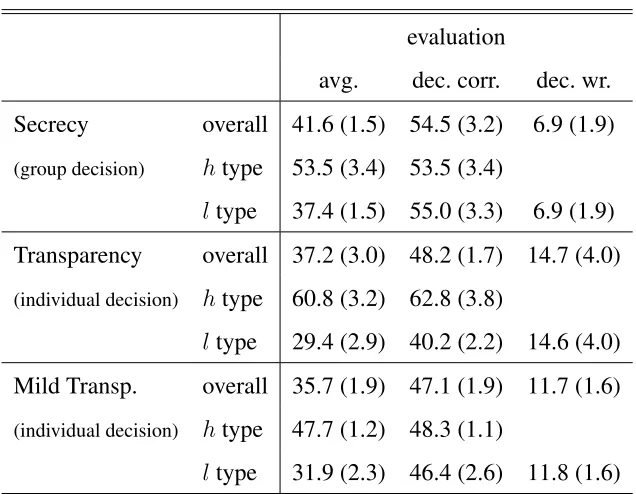
Evaluations Next, we study how the principals evaluate. A first look at their
evalua-tions shows that they are well able to distinguish between low types and high types (Table
[image:26.612.148.466.224.471.2]9).
Table 9: Evaluations
evaluation
avg. dec. corr. dec. wr.
Secrecy overall 41.6 (1.5) 54.5 (3.2) 6.9 (1.9)
(group decision) htype 53.5 (3.4) 53.5 (3.4)
ltype 37.4 (1.5) 55.0 (3.3) 6.9 (1.9)
Transparency overall 37.2 (3.0) 48.2 (1.7) 14.7 (4.0)
(individual decision) htype 60.8 (3.2) 62.8 (3.8)
ltype 29.4 (2.9) 40.2 (2.2) 14.6 (4.0) Mild Transp. overall 35.7 (1.9) 47.1 (1.9) 11.7 (1.6)
(individual decision) htype 47.7 (1.2) 48.3 (1.1)
ltype 31.9 (2.3) 46.4 (2.6) 11.8 (1.6)
Note: Standard errors (in parentheses) are adjusted for clustering in matching groups.
As predicted, low types do best under secrecy and high types under transparency.
However, average evaluations are too high in all treatments and even significantly
posi-tive after wrong decisions (t-tests,p < 0.01). However, the incentives to make a correct group decision under secrecy and a correct individual decision under (mild) transparency
are about as strong as in our theoretical predictions and deciding correctly entails an
eval-uation that is, on average, at least 33.5 percentage points higher than after a wrong
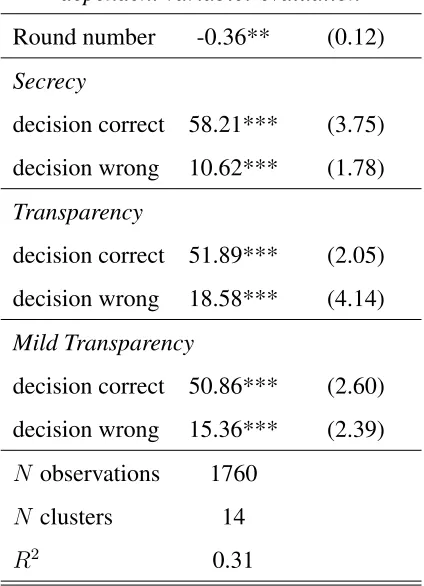
deci-sion in all treatments. Regressing the evaluation on the round number of the experiment,
controlling for the treatment and correctness of decisions gives a significant but small
suggesting that behavior moves slowly in the direction of the theoretical predictions.
Un-der transparency, principals are able to distinguish high and low types very well even if
the individual decision is correct. The evaluations do not differ significantly between the
two states of the world (t-test,p >0.99).
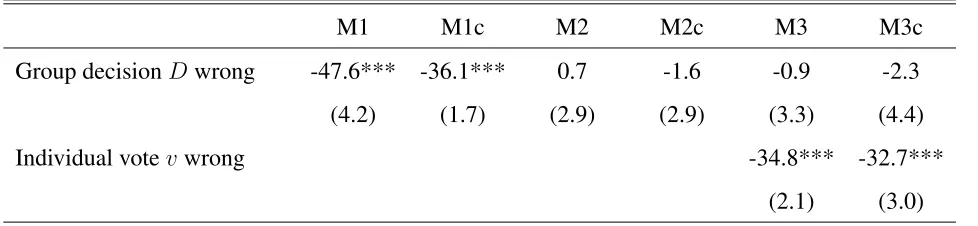
Regressing the evaluations on the pieces of information that the principal sees before
evaluating, shows that making the wrong group decision has a big effect on the evaluation
under secrecy but no effect under mild transparency, where she also sees the individual
votes and the accuracy of these votes has the biggest influence on the evaluation (Table
10, models M1 and M3). Under transparency, the evaluation is negatively influenced by
a wrong individual vote, by a wrong message or staying silent in the straw poll, and if
the committee member communicates her type to be l in the chat (Table10, M2). It is positively influenced if the committee member communicates her type to beh.
(Best) Responses In the final part of the results section we study in how far the
individ-ual behavior is a best response to the behavior of the other players.
We start with the principals. We have already seen that the evaluation levels they
choose are too high, on average, to maximize their pay-offs and even positive after wrong
decisions. This might be due to social preferences toward the committee members, as
their payoff directly depends on the evaluation, or due to flawed belief updating. The
high evaluations after correct decisions suggests that principals do not correctly take the
low prior probability for being a high type into account and the regression results, which
show that they lower their evaluations over time (Table OA1, online appendix), suggest
that they are learning. However, the positive evaluations after wrong decisions make it
also appear likely that social preferences play a role, as the updating problem is simple
in this case. More important, however, is the questions whether principals react in the
right direction after reviewing the different bits of information in the three treatments.
This question can be best answered by comparing models M1-M3 with linear
probabil-ity models with the same explanatory variables but a binary variable indicating a high
type as the dependent variable (models M1c-M3c in Table 10). We see that while the
Table 10: Evaluation responses
M1 M1c M2 M2c M3 M3c
Group decisionDwrong -47.6*** -36.1*** 0.7 -1.6 -0.9 -2.3 (4.2) (1.7) (2.9) (2.9) (3.3) (4.4)
Individual votevwrong -34.8*** -32.7***
(2.1) (3.0)
Combinations ofmandv, reference category: message and vote are correct
v wrong, mwrong -34.0*** -34.4*** (4.9) (3.5)
v wrong, mright -31.3*** -19.3
(3.9) (10.1)
v right, mwrong -20.6** -27.9*** (3.8) (3.0)
v right, silent in straw poll -15.5** -30.3*** (4.6) (3.7)
v wrong, silent in straw poll -40.6*** -32.3*** (5.2) (3.0)
Claimed to be typehin chat 15.3*** 29.7*** (2.1) (2.4)
Claimed to be typel in chat -17.5* -7.5 (5.9) (3.8)
Constant 54.5*** 36.1*** 46.2*** 28.2*** 47.1*** 35.5***
(3.4) (1.7) (2.2) (3.6) (1.9) (2.5)
N observations 600 600 560 560 600 600
N clusters 5 5 4 4 5 5
R2 0.49 0.13 0.29 0.33 0.31 0.14
differences in the constants, evaluations are influenced by all pieces of information in the
right directions and most of the time but not always, as we will see, with quite accurate
magnitudes.
Next, we turn to the behavior of committee members. Under secrecy low types clearly
best respond by switching between the straw poll message and the final vote when the
other committee member reports to be a high type and a conflicting signal. Truthful
communication is a best response of high types to this behavior. All committee members
act in order to maximize the probability of a correct group decision almost all the time,
and a correct committee decision leads to a substantially higher evaluation than a wrong
decision which means that subjects are best responding.
Under mild transparency the low types best respond by switching in case of
conflict-ing straw poll messages and a second committee member that claims to be a high type.
The level of information sharing by high types is high enough to make switching optimal
in order to vote in the right direction, and correct individual votes lead to substantially
higher evaluations than wrong individual votes. As the accuracy of the group decision
does not influence the evaluation any level of information sharing is a (weakly) best
re-sponse by high types.
Under transparency, we see a substantial fraction of low types who do not best
re-spond. This is most obvious for those who claim to be a low type in the chat instead of
announcing to be a high type. The accuracy of the group decision, which is positively
influenced by this honesty, does not affect the evaluation of the principal and evaluations
are substantially lower for these subjects. As a consequence, the number of committee
members who claim to be a low type goes down from 12.9% in the first ten to 6.8% in
the last ten rounds and this difference is statistically significant (Wald-test, p = 0.031). However, a substantial fraction of subjects also stays silent about their type in the chat
which also leads to a lower evaluation than claiming to be a high type, although not as low
as claiming to be a low type. Interestingly, the fraction of subjects staying silent about
their type increases significantly from 45.7% in the first ten rounds to 55.3% in the last
and Föllmi-Heusi(2013);Gneezy et al.(2013)).
Behavior in the straw poll and the voting stage requires a more detailed analysis. The
vast majority of high types clearly best responds by announcing their signal and type
truthfully and voting for the true state of the world. Low types face a more difficult
task. If they send a message, it is clearly better to announce the signal truthfully, as it
matches the true state with a probability higher than one half and announcing a wrong
message leads to a lower evaluation (Table 10, M2). If the other committee member
announces the same message or stays silent it is also obvious that the best choice is to
vote according to your signal because this maximizes the probability of being right and
all subjects who switch in these cases (Table8) are not best responding. However, if the
other member reports a conflicting signal which is correct, your expected payoff would
be higher if you switch than if you do not. If the other member’s message is wrong,
though, your expected payoff from switching is far lower than from not switching. So,
it makes only sense to switch if you know with a high probability that the other member
is a high type, as high types know the true state and report their signal truthfully most
of the time (Table 6). However, roughly half of the claims to be a high type are lies
(Table7). As a consequence, there is a chance of roughly one quarter that you are wrong
if you switch. Comparing the evaluations of low types who switch in this scenario, i.e.
after observing the other committee member announce a conflicting signal and claiming
to be high type, with those who do not switch, shows that those who switch are slightly
better off and only the 47.2% who do switch (Table8) are thus best responding.27 Note
that this results from too optimistic evaluations of switchers by the principals. A look
at Table 10 reveals that evaluators give too much credit for correct votes after wrong
messages. This is because high types almost always announce their signal truthfully and,
as a consequence, switching between the straw poll and the voting stage reveals that you
are a low type with a very high probability.
What about the low types that stay silent in the straw poll? To assess whether they
are best responding we compare them to low types who announce their signal truthfully
27The difference in evaluations is 6.2 percentage points and is not statistically different from zero (t-test,
and do not switch. The latter group receives an average evaluation of 61.5 percentage
points if they are right, i.e. with probability 0.55, and a payoff of 27.5 if they are wrong,
i.e. with probability 0.45, which gives and expected payoff of 46.2.28 If you stay silent in
the straw poll, it is optimal to vote according to your own signal if the other committee
member claims to be a low type (or stays silent in the straw poll as well). In this case your
payoff would be 46 if you are right and 20.9 if you are wrong with a slightly lower (equal)
probability for the good outcome as above. The best you can hope for after staying silent
in the straw poll is to be in a group in which the other member has a conflicting signal
and claims to be a high type. As we have seen, this claim is true with probability 0.486,
which results in a probability of being right after voting against your signal of slightly
less than three quarters and an expected payoff of 39.5. So, even in the best case the
expected payoff is lower than from announcing your signal truthfully and not switching.
Thus the subjects who stay silent in the straw poll do not play a best response.
Career concerns play out in a more subtle way under transparency than in the other
two regimes. So, it is not surprising to see more subjects not playing a best response
here. Despite these deviations from our theoretical predictions, information aggregation
is still far worse than under secrecy, as predicted, which is driven by a substantial fraction
of subjects who do not switch if the other member announces to be a high type and
a conflicting signal, and by the high degree of lying with respect to types, i.e. signal
strengths.
4.
Discussion
In this paper we constructed a model of committee decision-making in which members
are career concerned. We examined how the incentives of committee members to share
their private information varies with the level of transparency i.e. how much of the
deci-sion process the principal observes. The mechanisms through which transparency harms
efficiency involve strategic communication of committee members, and a number of
ex-28Here, we are using the regression results from model M2 and assume for simplicity that the low type
perimental studies have shown for various settings that subjects communicate far less
strategically than theoretically predicted. As such, we were eager to empirically test our
model. By bringing it to the laboratory, we gained a number of insights.
First, under transparency committee members are more truthful than the model’s most
informative equilibrium allows. While it is somewhat startling that players tell the truth
when it is optimal to lie, this is in line with previous experimental results which show that
people are often overly truthful and apparently face a cost of lying. This suggests that the
negative effect of transparency on group decision-making, though important, may not be
as severe as theory suggests.
Second, under mild transparency play is significantly less truthful than the most
infor-mative equilibrium. This seems to stand in sharp contrast to our previous point. However,
as we show in the appendix, under secrecy and transparency the most informative
equilib-rium coincides with the best equilibequilib-rium for high ability players (those with the most
in-formation to share). Under mild transparency, however, the most informative equilibrium
is payoff-dominated for high ability types; they prefer equilibria in which no information
is shared. It is perhaps unsurprising, therefore, that there is a large degree of deception
from high ability types under mild transparency. As a result, group errors and player
evaluations here are much closer to the transparency case than to secrecy, casting doubt
on the predictive power of the most informative equilibrium. This is a finding which is
relevant beyond this particular context. Sobel(2013) called for experimental tests of the
predictive power of the most informative equilibrium in cheap talk games in which other
equilibria exist which are preferred by at least one type of player. What does this tell
us about the desirability of pre-meetings? Swank and Visser(2013) show in their model
that, when players do not know their own abilities, pre-meetings can undo the benefit of
transparency. In our setting, where players know their abilities, pre-meetings can reduce
the probability of mistakes if players share information while if no information is credibly
shared pre-meetings will simply have no effect.
Finally, despite some deviations from theoretical predictions, we find large
differ-ences in behavior between the three regimes: information aggregation is successful under
trans-parency. This results in fewer mistakes under secrecy than the two other treatments and
suggests that the level of transparency is a highly important element of institutional design
- setting it wrong might indeed have considerable negative consequences for a principal.
The difference in the level of truth-telling between treatments contrasts sharply with the
results ofGoeree and Yariv(2011). They find that free-form communication greatly
di-minishes institutional differences; players are overwhelmingly truthful regardless of the
voting rule. Our results show that the degree of transparency in a committee strongly
affects members’ behavior even with open chat. This suggests that the level of openness
may be a more important institutional choice than that of the voting rule.
References
BATTAGLINI, M.ANDU. MAKAROV(2014): “Cheap talk with multiple audiences: An
experimental analysis,”Games and Economic Behavior, 83, 147–164.
BATTAGLINI, M., R. B. MORTON, AND T. R. PALFREY (2009): “The Swing Voter’s
Curse in the Laboratory,”Review of Economic Studies, 77, 61–89.
BENTHAM, J. ([1816] 1999): Political Tactics, Oxford: Oxford University Press.
BHATTACHARYA, S., J. DUFFY, ANDS.-T. KIM(2014): “Compulsory versus voluntary
voting: An experimental study,”Games and Economic Behavior, 84, 111–131.
BOUTON, L., M. CASTANHEIRA, AND A. LLORENTE-SAGUER (2014): “Divided
Ma-jority and Information Aggregation: Theory and Experiment,”Mimeo.
CAI, H. AND J. T.-Y. WANG (2006): “Overcommunication in strategic information
transmission games,”Games and Economic Behavior, 56, 7–36.
COHEN, J. (1996): “Deliberation and Democratic Legitimacy,” inDeliberative Democ-racy: Essays on Reason and Politics, ed. by J. Bohman and W. Rehg, Cambridge, MA: MIT Press, 67–92.
COUGHLAN, P. (2000): “In Defense of Unanimous Jury Verdicts : Mistrials ,
Communi-cation , and Strategic Voting,”American Political Science Review, 94, 375–393.
CRAWFORD, V.ANDJ. SOBEL(1982): “Strategic information transmission,”
Economet-rica, 50, 1431–1451.
CROSS, J. P. (2013): “Striking a pose: Transparency and position taking in the Council
of the European Union,”European Journal of Political Research, 52, 291–315.
FISCHBACHER, U. AND F. FÖLLMI-HEUSI(2013): “Lies in Disguise-an Experimental
Study on Cheating,”Journal of the European Economic Association, 11, 525–547.
FOX, J. ANDR. VANWEELDEN(2012): “Costly Transparency,”Journal of Public
Eco-nomics, 96, 142–150.
GERSBACH, H.ANDV. HAHN(2008): “Should the Individual Voting Records of Central
Bankers be Published?”Social Choice and Welfare, 30, 655–683.
GNEEZY, U. (2005): “Deception: The role of consequences,”The American Economic Review, 95, 384–394.
GNEEZY, U., B. ROCKENBACH, AND M. SERRA-GARCIA (2013): “Measuring lying
aversion,”Journal of Economic Behavior & Organization, 93, 293–300.
GOEREE, J. K.AND L. YARIV(2011): “An Experimental Study of Collective
Delibera-tion,”Econometrica, 79, 893–921.
GUARNASCHELLI, S., R. D. MCKELVEY, AND T. R. PALFREY (2000): “An
Experi-mental Study of Jury Decision Rules,”American Political Science Review, 94, 407.