warwick.ac.uk/lib-publications
Original citation:
Balogh, G. D., Reguly, Istvan Z. and Mudalige, Gihan R. (2017) Comparison of parallelisation
approaches, languages, and compilers for unstructured mesh algorithms on GPUs. In: 8th
IEEE International Workshop on Performance Modeling, Benchmarking and Simulation of
High Performance Computer Systems (PMBS17), Denver CO. US, 13 Nov 2017. Published in:
Lecture Notes in Computer Science, 10724 (10724). pp. 22-43.
Permanent WRAP URL:
http://wrap.warwick.ac.uk/97297
Copyright and reuse:
The Warwick Research Archive Portal (WRAP) makes this work by researchers of the
University of Warwick available open access under the following conditions. Copyright ©
and all moral rights to the version of the paper presented here belong to the individual
author(s) and/or other copyright owners. To the extent reasonable and practicable the
material made available in WRAP has been checked for eligibility before being made
available.
Copies of full items can be used for personal research or study, educational, or not-for-profit
purposes without prior permission or charge. Provided that the authors, title and full
bibliographic details are credited, a hyperlink and/or URL is given for the original metadata
page and the content is not changed in any way.
Publisher’s statement:
“The final publication is available at Springer via
https://doi.org/10.1007/978-3-319-72971-8_2”
A note on versions:
The version presented here may differ from the published version or, version of record, if
you wish to cite this item you are advised to consult the publisher’s version. Please see the
‘permanent WRAP URL’ above for details on accessing the published version and note that
access may require a subscription.
Comparison of Parallelisation Approaches,
Languages, and Compilers for Unstructured
Mesh Algorithms on GPUs
G. D. Balogh1, I. Z. Reguly1, and G. R. Mudalige2
1 Faculty of Information Technology and Bionics, Pazmany Peter Catholic
University, Budapest, Hungary,
[email protected], [email protected],
2
Department of Computer Science, University of Warwick, Coventry, United [email protected]
Abstract. Efficiently exploiting GPUs is increasingly essential in scien-tific computing, as many current and upcoming supercomputers are built using them. To facilitate this, there are a number of programming ap-proaches, such as CUDA, OpenACC and OpenMP 4, supporting different programming languages (mainly C/C++ and Fortran). There are also several compiler suites (clang, nvcc, PGI, XL) each supporting different combinations of languages. In this study, we take a detailed look at some of the currently available options, and carry out a comprehensive analy-sis and comparison using computational loops and applications from the domain of unstructured mesh computations. Beyond runtimes and per-formance metrics (GB/s), we explore factors that influence perper-formance such as register counts, occupancy, usage of different memory types, in-struction counts, and algorithmic differences. Results of this work show how clang’s CUDA compiler frequently outperform NVIDIA’s nvcc, per-formance issues with directive-based approaches on complex kernels, and OpenMP 4 support maturing in clang and XL; currently around 10% slower than CUDA.
Keywords: compilers, CUDA, OpenACC, OpenMP, GPU, benchmark-ing
1
Introduction
existing applications to use CUDA or OpenCL is a substantial undertaking that require significant effort and considrable changes to the design of the programe and the source code. Furthermore, getting good performance can entail detailed work in orchestrating parallelism.
To simplify the adoption of GPUs, particularly for existing codes, high-level directive based programming abstractions were introduced. OpenACC [3] in-troduced in 2011 was one of the first supporting GPUs. Subsequetly OpenMP standard introduced support for accelerators starting from version 4 [4], with refinements in 4.5 and 5.0. Of particular note is that the evolution of directive based approaches being driven by the acquisition of large US DoE systems such as Titan and the upcoming Summit and Sierra systems. To be able to efficiently utilize these systems it was necessary that existing codes be modified to support GPUs with relative ease. Many of these codes are written in Fortran and as such there is now compiler support for writing CUDA, OpenACC, and OpenMP with Fortran in various compilers.
It is generally agreed that the best performance can be achieved by using CUDA, but the difference between CUDA and directive-based approaches vary significantly based on a multitude of factors. Primarily these include the type of computation being parallelized, as well as the language being used (C or Fortran), and the compiler. This motivates the present study: for a number of parallel loops, coming from the domain of unstructured mesh computations, we wanted to get an idea of what performance looks like on different GPUs, different languages, and different compilers. Given the available systems and compilers, we would like to acertain what the state-of-th-art is with regard to utilizing GPU based systems for this class of applications.
We evaluate some of the most commonly used compilers and parallelization approaches. We explore the performance of CUDA C, compiled with nvcc, as well as with Google’s recent clang based compiler [5]. We also explore the performance of the compilers by Portland Group (PGI, now owned by NVIDIA) which has had support for wirting CUDA applications in Fortran [6], [7]. Additionally, as part of a recent push by IBM, preparing for the Summit and Sierra machines there has been support for CUDA Fortran with the XL compilers since v15.1.5 [8]. We also explore XL compiler performance in this paper. For OpenACC we use the PGI compilers which support both C and Fortran. There is also good support for OpenACC by the Cray compilers, however we did not have access to such a machine and therefore will not be part of this analysis. For OpenMP 4 there are two compilers developed by IBM directed at developing applications using C: the XL compilers (since v13.1.5), and an extension to Clang [9]. There is also support for writing OpenMP 4 parallizations in Fortran applications using the XL compilers (since v15.1.5).
in-depth study trying to explain the differences with the help of instruction counters and the inspection of low-level code. Specifically, we make the following contributions:
1. Using a representative CFD application called Airfoil, we run the same al-gorithms on NVIDIA K40 and P100 GPUs, with CUDA, OpenMP 4, and OpenACC parallelizations written in both C and Fortran, compiled with a number of different compilers.
2. We carry out a detailed analysis of the results with the help of performance counters to help identify differences between algorithms, languages, and com-pilers.
3. We evaluate these parallelizations and compilers on two additional appli-cations, Volna (C) and BookLeaf (Fortran) to confirm the key trends and differences observed on Airfoil.
The rest of the paper is structured as follows: Section 2 discusses some related work, Section 3 briefly introduces the applications being studied, then Section 4 presents the test setup, compilers and flags. Section 5 carries out the bench-marking of parallelizations and the detailed analysis, and finally Section 6 draws conclusions.
2
Related Work
There is a significant body of existing research on performance engineering for GPUs, and compiler engineering, as well as some comparisons between paral-lelization approaches - the latter however is usually limited in scope due to the lack of availability of multiple implementations of the same code. Here we cite some examples, to show how this work offers a wider look at the possible com-binations.
Support in compilers for OpenMP 4 and GPU offloading is relatively new [16] and there are only a handful of papers evaluating their performance: Martineau et. al. [17] present some runtimes of basic computational loops in C compiled with Cray and clang, and comparisons with CUDA. Karlin et. al [18] port three CORAL benchmark codes to OpenMP 4.5 (C), compile them with clang, and compare them with CUDA implementations - the analysis is focused on runtimes and register pressure. Hart el. al. [19] compare OpenMP 4.5 with Cray to Ope-nACC on Nekbone, however the analysis here is also restricted to runtimes, the focus is more on programmability. We are not aware of academic papers studying the performance of CUDA Fortran or OpenMP 4 in the IBM XL compilers aside from early results in our own previous work [20]. There is also very little work on comparing the performance of CUDA code compiled with nvcc and clang.
Thus we believe that there is a significant gap in current research: a compar-ison of C and Fortran based CUDA, OpenACC, and OpenMP 4, the evaluation of the IBM XL compilers, the maturity of OpenMP 4 compared to CUDA in terms of performance and a more detailed investigation into the reasons for the performance difference between various languages, compilers, and parallelization approaches. With the present study, we work towards filling this gap.
3
Applications
The applications being studied in this work come from the unstructured mesh computations domain solving problems in the areas of computational fluid dy-namics, shallow-water simulation and Lagrangian hydrodynamics. As such, they consist of parallel loops over some set in the mesh, such as edges, cells or nodes, and on each set element some computations are carried out, while accessing data either directly on the iteration set, or indirectly via a mapping to another set. Our applications are all written using the OP2 domain specific language [21] embedded in C and Fortran, targeting unstructured mesh computations. For OP2, the user has to give a high level description of the simulation using the OP2 API. Then the OP2 source-to-source translator generates all parallelized versions from the abstract description [22]. While OP2 is capable of many things, its relevant feature for this work is that it can generate different parallelizations such as CUDA, OpenACC, and OpenMP4, based on the abstract description of parallel loops.
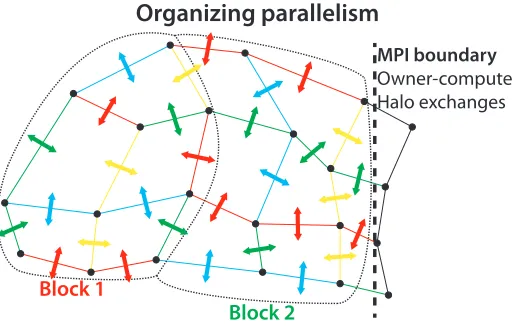
all edges in a mini-partition so that no two edges with the same color update the same cell. Such a coloring is shown in figure 1. Here, we first calculate the increment of every thread in the block, then we iterate through the colors and add the increment to the cell with synchronization between each color. The ben-efit of such an execution scheme is that there is a possibility that the data we loaded from the global memory can be reused within a block, which can lead to a performance increase due to fewer memory transactions. This technique is referred to as hierarchical coloring in the paper.
MPI boundary
Owner-compute Halo exchanges
Block 1
Block 2
[image:6.612.171.430.300.464.2]Organizing parallelism
Fig. 1.Illustration for hierarchical coloring on a computation on edges that write data on the cells. The blocks are colored so that there is no neighboring blocks with the same color and inside the blocks threads colored so that no two threads with the same color write the same data.
set. We assign colors to each thread in a way that no two edges of the same color update the same cell and threads from the same color can run parallel in a separate CUDA kernel with synchronization between the kernels. This however excludes the possibility of the reuse of the data of the cells.
3.1 Airfoil
Airfoil is a benchmark application, representative of large industrial CFD appli-cations. It is a non-linear 2D inviscid airfoil code that uses an unstructured grid and a finite-volume discretisation to solve the 2D Euler equations using a scalar numerical dissipation. The algorithm iterates towards the steady state solution, in each iteration using a control volume approach, meaning the change in the mass of a cell is equal to the net flux along the four edges of the cell, which re-quires indirect connections between cells and edges. Airfoil is implemented using OP2, where two versions exists, one implemented with OP2’s C/C++ API and the other using OP2’s Fortran API [21], [24].
The application consists of five parallel loops:save soln,adt calc,res calc,
bres calc and update [22]. The save soln loop iterates through cells and is
a simple loop accessing two arrays directly. It basically copies every four state variables of cells from the first array to the second one. The adt calc kernel also iterates on cells and it computes the local area/timestep for every single cell. For the computation it reads values from nodes indirectly and writes in a direct way. There are some computationally expensive operations (such as square roots) performed in this kernel. Theres calc loop is the most complex loop with both indirect reads and writes; it iterates through edges, and computes the flux through them. It is called 2000 times during the total execution of the application and performs about 100 floating-point operations per mesh edge.
Thebres calc loop is similar tores calc but computes the flux for boundary
edges. Finally updateis a direct kernel that includes a global reduction which computes a root mean square error over the cells and updates the state variables. All test are executed with double precision on a mesh containing 2.8 million cells and with SOA data layout described in [22].
3.2 Volna
Volna is a shallow water simulation capable of handling the complete life-cycle of a tsunami (generation, propagation and run-up along the coast) [25]. The simulation algorithm works on unstructured triangular meshes and uses the fi-nite volume method. Volna is written in C/C++ and converted to use the OP2 library[21]. For Volna we examined the top three kernels where most time is pent: computeFluxes,SpaceDiscretization andNumericalFluxes. In the
computeFluxes kernel there are indirect reads and direct writes, in
Numer-icalFluxes there are indirect reads with direct writes and a global reduction
for calculating the minimum timestep and in SpaceDiscretization there are indirect reads and indirect increments.
3.3 BookLeaf
BookLeaf is a 2D unstructured mesh Lagrangian hydrodynamics application from the UK Mini-App Consortium [26]. It uses a low order finite element method with an arbitrary Lagrangian-Eulerian method. Bookleaf is written en-tirely in Fortran 90 and has been ported to use the OP2 API and library. Bookleaf has a large number of kernels with different access patterns such as indirect increments similar to increments inside res calc in Airfoil. For test-ing we used the SOD testcase with a 4 million element mesh. We examined the top five kernels with the highest runtimes which are getq christiensen1,
getq christiensen q, getacc scatter, gather, getforce visc. Among these
there is only one kernel (getacc scatter) with indirect increments (where col-oring is needed), the gatherand getq christiensen1 have indirect reads and direct writes asadt calc in Airfoil, and the other two kernels have only direct reads and writes.
4
Test setup
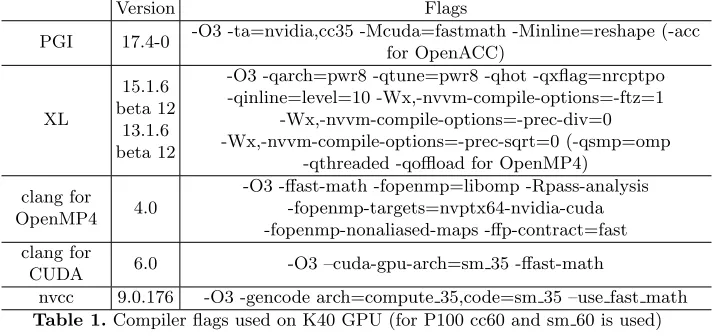
For testing we used NVIDIA K40 and P100 GPUs in IBM S824L systems (both systems has 2*10 cores) with Ubuntu 16.04. We used nvcc in CUDA 9.0 and clang 6.0.0 (r315446) for compiling CUDA with C/C++. For compiling CUDA Fortran, we used PGI 17.4 compilers and IBM’s XL compiler 15.1.6 beta 12 for Power systems. For OpenMP4, we tested clang version 4.0.0 (commit 6dec6f4 from the clang-ykt repo), and the XL compilers (13.1.6 beta 12). Finally, for OpenACC, we used the PGI compiler version 17.4. The specific compiler ver-sions and flags are shown in Table 1.
Version Flags
PGI 17.4-0 -O3 -ta=nvidia,cc35 -Mcuda=fastmath -Minline=reshape (-acc for OpenACC)
XL
15.1.6 beta 12
13.1.6 beta 12
-O3 -qarch=pwr8 -qtune=pwr8 -qhot -qxflag=nrcptpo -qinline=level=10 -Wx,-nvvm-compile-options=-ftz=1
-Wx,-nvvm-compile-options=-prec-div=0 -Wx,-nvvm-compile-options=-prec-sqrt=0 (-qsmp=omp
-qthreaded -qoffload for OpenMP4)
clang for OpenMP4 4.0
-O3 -ffast-math -fopenmp=libomp -Rpass-analysis -fopenmp-targets=nvptx64-nvidia-cuda -fopenmp-nonaliased-maps -ffp-contract=fast clang for
CUDA 6.0 -O3 –cuda-gpu-arch=sm 35 -ffast-math
[image:8.612.134.495.419.587.2]nvcc 9.0.176 -O3 -gencode arch=compute 35,code=sm 35 –use fast math
Table 1.Compiler flags used on K40 GPU (for P100 cc60 and sm 60 is used)
5
Benchmarking
5.1 Airfoil
hierarchical coloring scheme have the best performance, due to the huge per-formance gains inres calc thanks to data reuse. The main differences between versions with the same coloring strategy is in the run times of theres calcand
adt calckernels, where most of the computation is performed. In the following,
[image:9.612.175.440.187.561.2]we examine performance in detail on all five kernels.
Fig. 2.Measured run times of versions on the K40 and P100 GPU
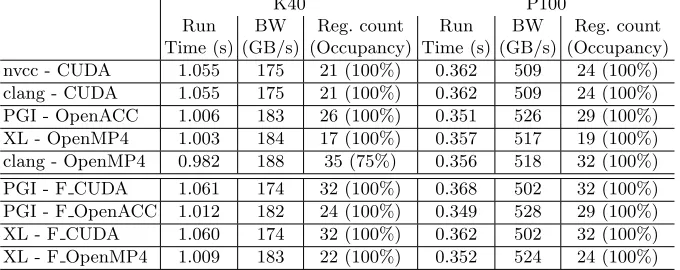
save soln :save solnis a really simple kernel with only direct reads and writes.
the same performance. The bandwidth values shown in the table are the useful bandwidth from the users perspective, that is the sum of the moved simulation data and mappings for the kernel divided by the run time of the kernel. In case of C/C++, OpenMP4 and OpenACC versions have about 5−7% better run-times and bandwidth than CUDA versions (even though the OpenMP4 version compiled with clang on the K40 GPU is the only version that have only 75% occupancy). If we run one thread per cell and delete the loop from the kernel the performance of CUDA matches the performance of OpenMP4. The results shows that in a simple case such as save solnFortran performs about as well as the C/C++ versions, and the high level approaches such as OpenMP4 and OpenACC can reach the performance of CUDA.
K40 P100
Run Time (s)
BW (GB/s)
Reg. count (Occupancy)
Run Time (s)
BW (GB/s)
Reg. count (Occupancy) nvcc - CUDA 1.055 175 21 (100%) 0.362 509 24 (100%) clang - CUDA 1.055 175 21 (100%) 0.362 509 24 (100%) PGI - OpenACC 1.006 183 26 (100%) 0.351 526 29 (100%) XL - OpenMP4 1.003 184 17 (100%) 0.357 517 19 (100%) clang - OpenMP4 0.982 188 35 (75%) 0.356 518 32 (100%)
[image:10.612.139.479.257.392.2]PGI - F CUDA 1.061 174 32 (100%) 0.368 502 32 (100%) PGI - F OpenACC 1.012 182 24 (100%) 0.349 528 29 (100%) XL - F CUDA 1.060 174 32 (100%) 0.362 502 32 (100%) XL - F OpenMP4 1.009 183 22 (100%) 0.352 524 24 (100%)
Table 2.Measured run time, bandwidth, register count and occupancy values in case of save soln
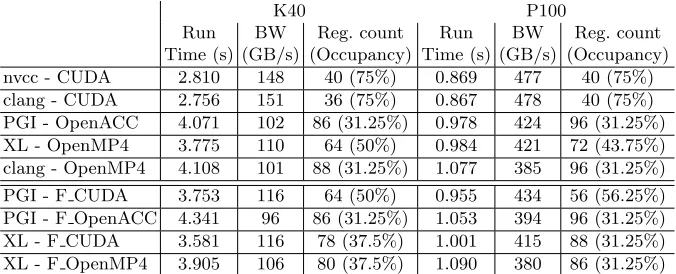
adt calc :
of the key reasons for the 30% lower performance on the K40 GPU (on the P100 GPU the difference is about 10-15%), also Fortran versions use about 50% more integer instructions than C/C++ versions. The directive based approaches per-form within 20% of CUDA Fortran’s perper-formance and the with the PGI compiler the versions execute twice as many integer instructions than other versions.
K40 P100
Run Time (s)
BW (GB/s)
Reg. count (Occupancy)
Run Time (s)
BW (GB/s)
Reg. count (Occupancy) nvcc - CUDA 2.810 148 40 (75%) 0.869 477 40 (75%) clang - CUDA 2.756 151 36 (75%) 0.867 478 40 (75%) PGI - OpenACC 4.071 102 86 (31.25%) 0.978 424 96 (31.25%) XL - OpenMP4 3.775 110 64 (50%) 0.984 421 72 (43.75%) clang - OpenMP4 4.108 101 88 (31.25%) 1.077 385 96 (31.25%)
[image:11.612.139.477.202.339.2]PGI - F CUDA 3.753 116 64 (50%) 0.955 434 56 (56.25%) PGI - F OpenACC 4.341 96 86 (31.25%) 1.053 394 96 (31.25%) XL - F CUDA 3.581 116 78 (37.5%) 1.001 415 88 (31.25%) XL - F OpenMP4 3.905 106 80 (37.5%) 1.090 380 86 (31.25%)
Table 3.Measured run time, bandwidth, register count and occupancy values in case of adt calc
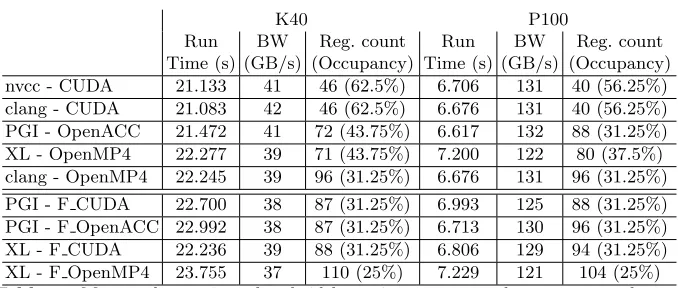
res calc : In the case of res calc we have indirect updates, therefore we need
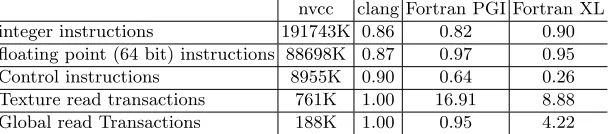
coloring to avoid race conditions. The runtime and bandwidth results are shown in Table 4 for hierarchical coloring, and for global coloring in Table 5. In this kernel there is a lot of indirectly read and written data, therefore the runtime can be significantly improved with the hierarchical coloring approach due to data reuse. However, hierarchical coloring leads to higher register counts and arithmetic instruction counts, but the impact of these factors are smaller than the gain from better memory usage. As we saw it inadt calcfor CUDA versions clang performs better than nvcc in terms of integer and floating point instruction counts (clang has 2-5% lower instruction counts on both GPUs). The OpenMP4 and OpenACC versions have 2-5% higher run time because of low occupancy (caused by register pressure) and the OpenMP4 versions don’t use the texture caches as much (or at all in case of clang) as other versions which lead to 3 times as much global loads and high number of integer instructions. The results are shown in Table 6 and Table 7.
K40 P100 Run
Time (s) BW (GB/s)
Reg. count (Occupancy)
Run Time (s)
BW (GB/s)
[image:12.612.147.471.117.195.2]Reg. count (Occupancy) nvcc - CUDA 13.118 67 53 (56.25%) 3.727 235 50 (56.25%) clang - CUDA 12.537 70 56 (56.25%) 3.721 235 51 (56.25%) PGI - F CUDA 16.880 72 69 (43.75%) 4.425 198 78 (37.5%) XL - F CUDA 16.235 54 72 (43.75%) 3.968 221 70 (43.75%)
Table 4. Measured run time, bandwidth, register count and occupancy values of
res calcin case of hierarchical coloring
K40 P100
Run Time (s)
BW (GB/s)
Reg. count (Occupancy)
Run Time (s)
BW (GB/s)
Reg. count (Occupancy) nvcc - CUDA 21.133 41 46 (62.5%) 6.706 131 40 (56.25%) clang - CUDA 21.083 42 46 (62.5%) 6.676 131 40 (56.25%) PGI - OpenACC 21.472 41 72 (43.75%) 6.617 132 88 (31.25%) XL - OpenMP4 22.277 39 71 (43.75%) 7.200 122 80 (37.5%) clang - OpenMP4 22.245 39 96 (31.25%) 6.676 131 96 (31.25%)
PGI - F CUDA 22.700 38 87 (31.25%) 6.993 125 88 (31.25%) PGI - F OpenACC 22.992 38 87 (31.25%) 6.713 130 96 (31.25%) XL - F CUDA 22.236 39 88 (31.25%) 6.806 129 94 (31.25%) XL - F OpenMP4 23.755 37 110 (25%) 7.229 121 104 (25%)
Table 5. Measured run time, bandwidth, register count and occupancy values of
res calcin case of global coloring
bres calc : Thebres calckernel also has indirect reads and writes, so we need
[image:12.612.138.477.223.367.2]nvcc clang Fortran PGI Fortran XL integer instructions 191743K 0.86 0.82 0.90 floating point (64 bit) instructions 88698K 0.87 0.97 0.95 Control instructions 8955K 0.90 0.64 0.26 Texture read transactions 761K 1.00 16.91 8.88 Global read Transactions 188K 1.00 0.95 4.22
Table 6.Average number of instructions and transactions performed inres calckernel with hierarchical coloring (absolute values for nvcc and for other versions relative to nvcc) on k40 GPU
fp (64 bit) integer control Texture read transaction
Global read transaction nvcc - CUDA 93555K 94994K 1439K 2175K 334K
clang - CUDA 0.98 0.94 1.00 1.01 1.04
PGI - OpenACC 1.03 1.38 1.00 0.98 1.00
XL - OpenMP4 1.00 1.50 1.00 0.28 3.53
[image:13.612.142.475.240.365.2]clang - OpenMP4 0.97 1.26 1.00 0.00 3.42 PGI - fortran CUDA 1.03 1.80 2.00 1.05 13.47 PGI - fortran OpenACC 1.03 1.55 1.00 3.73 3.73 XL - fortran CUDA 1.00 2.20 2.00 3.74 3.73 XL - fortran OpenMP4 1.00 1.82 1.00 3.77 3.73
Table 7.Average number of instructions and transactions performed inres calckernel with global coloring (absolute values for nvcc and for other versions relative to nvcc) on K40 GPU
K40 P100 Run Time (s) BW (GB/s) Reg. count (Occupancy) Run Time (s) BW (GB/s) Reg. count (Occupancy) nvcc - CUDA 0.064 32 44 (62.5%) 0.032 64 48 (62.5%) clang - CUDA 0.064 32 44 (62.5%) 0.032 64 46 (62.5%) PGI - F CUDA 0.082 25 53 (56.25%) 0.029 71 72 (43.75%) XL - F CUDA 0.061 33 48 (62.5%) 0.035 59 64 (50%)
Table 8.Measured run time, bandwidth, register count and occupancy values in case of bres calcin case of hierarchical coloring
[image:13.612.137.483.415.671.2]K40 P100 Run Time (s) BW (GB/s) Reg. count (Occupancy) Run Time (s) BW (GB/s) Reg. count (Occupancy) nvcc - CUDA 0.072 28 44 (62.5%) 0.035 58 42 (62.5%) clang - CUDA 0.071 29 38 (75%) 0.034 59 37 (75%) PGI - OpenACC 0.072 28 71 (43.75%) 0.034 60 56 (56.25%) XL - OpenMP4 0.084 24 72 (43.75%) 0.037 55 80 (37.5%) clang - OpenMP4 0.079 26 88 (31.25%) 0.039 52 94 (31.25%) PGI - F CUDA 0.096 21 56 (56.25%) 0.038 54 72 (43.75%) PGI - F OpenACC 0.073 28 102 (25%) 0.036 57 88 (31.25%) XL - F CUDA 0.078 26 70 (43.75%) 0.037 55 80 (37.5%) XL - F OpenMP4 0.078 26 94 (31.25%) 0.035 57 80 (37.5%)
Fortran OpenACC version has as low register count as the CUDA versions on the C/C++ side.
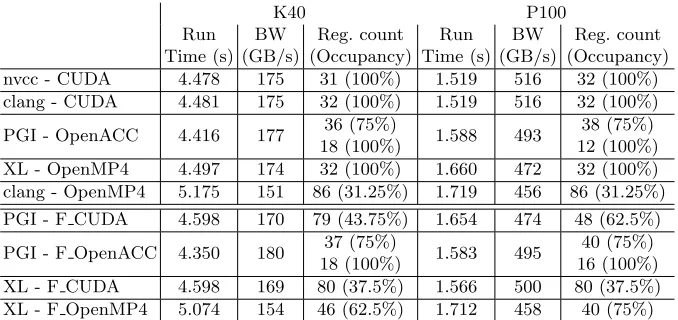
update :
The CUDA Fortran versions have lower occupancy because of the high reg-ister usage (the OpenACC version has a separate kernel for reduction thus have lower register count for the bulk of the kernel and the OpenMP4 version per-forms about the same as the C/C++ versions). All of the Fortran versions ended up with about 4 times more texture read (except OpenMP4 which doesn’t use texture cache, but has 12 times more global loads), global load and store trans-actions than CUDA with nvcc. CUDA Fortran versions also have spilled registers (which introduce about 10k-20k local load and store transactions).
K40 P100
Run Time (s)
BW (GB/s)
Reg. count (Occupancy)
Run Time (s)
BW (GB/s)
Reg. count (Occupancy) nvcc - CUDA 4.478 175 31 (100%) 1.519 516 32 (100%) clang - CUDA 4.481 175 32 (100%) 1.519 516 32 (100%)
PGI - OpenACC 4.416 177 36 (75%)
18 (100%) 1.588 493
38 (75%) 12 (100%) XL - OpenMP4 4.497 174 32 (100%) 1.660 472 32 (100%) clang - OpenMP4 5.175 151 86 (31.25%) 1.719 456 86 (31.25%)
PGI - F CUDA 4.598 170 79 (43.75%) 1.654 474 48 (62.5%)
PGI - F OpenACC 4.350 180 37 (75%)
18 (100%) 1.583 495
[image:14.612.139.478.275.435.2]40 (75%) 16 (100%) XL - F CUDA 4.598 169 80 (37.5%) 1.566 500 80 (37.5%) XL - F OpenMP4 5.074 154 46 (62.5%) 1.712 458 40 (75%)
Table 10.Measured run time, bandwidth, register count and occupancy values in case of update(for OpenACC versions the second register count belongs to the reduction kernel, the run times are the sum of the two kernels)
Effect of tuning the number of registers per thread In case of the
we cannot reach better occupancy by further reducing the maximum register count (reducing the count to 48 would lead to 62.5% and to 40 would lead to 75% occupancy). On the P100 GPU shared memory requirement maximizes the occupancy at 94% thanks to more available shared memory. For most language-compiler combinations, limiting the register count only affects the adt calc,
res calc and bres calc kernels. In the OpenMP4 - clang, Fortran OpenMP4
[image:15.612.141.475.221.351.2]- XL, and Fortran CUDA - PGI combinations, update is also affected by the limiting because of the high register count as shown in Table 10.
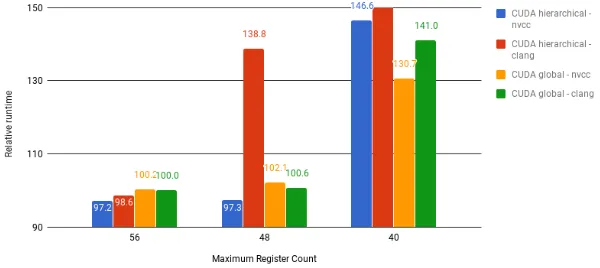
Fig. 3.Runtime of C OpenACC/OpenMP4 and Fortran versions with limited register per thread relative to original versions measured on K40. Lower is better.
Fig. 4.Runtime of CUDA C versions with limited register per thread relative to original versions measured on K40. Lower is better.
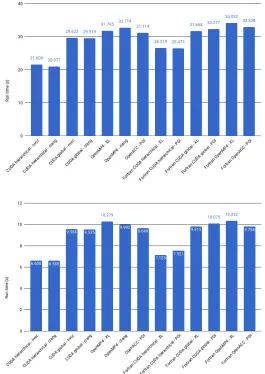
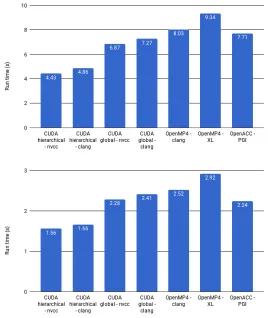
[image:15.612.158.458.424.558.2]Fig. 5.Measured run times of Volna versions on the K40 and P100 GPU
limited to 72). The reason for the loss of performance is the increasing number of spilled registers, and the latency introduced by the usage of these registers.
The main differences lie in the run times of res calc and adt calc. For
res calcon C/C++ side limiting the register count increases the performance by
2-5% in case of CUDA with hierarchical coloring, the OpenMP4 XL compiler and the Fortran versions also get better run times by 1-2% but the OpenACCversion performs the same, while the OpenMP4 clang versions get 2% higher run time thus get higher total run time despite of the 5% performance increase inupdate
and adt calc. For Fortran CUDA with XL and Fortran OpenACC with PGI
nvcc CUDA clang CUDA nvcc CUDA global clang CUDA global clang OpenMP4 XL OpenMP4 PGI OpenACC
compute Fluxes 1.336 1.693 1.323 1.734 2.186 1.613 1.623
Space Discretization
1.758 1.834 4.150 4.134 3.973 6.261 4.762
Numerical Fluxes
0.431 0.431 0.507 0.511 0.549 0.528 0.496
Evolve Values RK2 2
0.312 0.313 0.326 0.325 0.416 0.300 0.302
Evolve Values RK2 1
[image:17.612.134.485.102.429.2]0.371 0.372 0.366 0.365 0.648 0.383 0.338
Table 11.Run times of the five most time consuming Volna kernels on the K40 GPU nvcc CUDA clang CUDA nvcc CUDA global clang CUDA global clang OpenMP4 XL OpenMP4 PGI OpenACC compute Fluxes 56 (56.25%) 60 (56.25%) 22 (100%) 22 (100%) 93 (31.25%) 78 (37.5%) 77 (37.5%) Space Discretization 32 (100%) 36 (75%) 28 (100%) 25
(100%) 64 (50%) 30 (100%) 30 (100%)
Numerical Fluxes 28 (100%) 16 (100%) 45 (62.5%) 46
(62.5%) 40 (75%) 30 (100%)
33 (75%) 12 (100%) Evolve Values RK2 2 26 (100%) 24 (100%) 26 (100%) 24 (100%) 80
(37.5%) 25 (100%) 28 (100%)
Evolve Values RK2 1 28 (100%) 27 (100%) 28 (100%) 27 (100%) 86
(31.25%) 32 (100%) 33 (75%)
Table 12. Register counts and occupancy of the five most time consuming Volna kernels on the K40 GPU (for OpenACC the second register count belongs to the reduction kernel)
5.2 Volna
For Volna theSpaceDiscretizationkernel has a huge impact on runtime (half of the time is spent in this kernel when using global coloring), and so the hi-erarchical coloring leads to significant overall performance gain as shown on Figure 5 (the measurements are in single precision because Volna requires only single precision to get correct results). However the presence of the local reads
in computeFluxes in case of clang CUDA leads to 20% performance loss in
Table 11. In terms of occupancy the OpenMP4 with XL reach about the same occupancy in most cases as CUDA, while OpenMP4 clang and OpenACC have high register counts as shown in Table 12. In terms of instruction counts in case of Volna the directive based approaches performed the same as in Airfoil. The OpenMP4 versions don’t use texture caches (in case of XL the texture cache us-age is about 15% of nvcc’s) and all directive based approach have higher global read transactions and about 30% higher integer instruction counts.
5.3 BookLeaf
Considering that in BookLeaf most of the time is spent in direct kernels or indi-rect read kernels, there is not as much difference between hierarchical and global coloring versions in total run time, as shown in Figure 6. However in case of
getacc scatter, which is the only kernel with indirect increments among the
top five most time consuming kernels, the runtime of the hierarchical coloring is at least 50% better than that of the global coloring versions. All versions are within 7% of the performance of the best version which is Fortran CUDA with hierarchical coloring compiled with the XL compiler on the K40, while on the P100 machine the PGI compiler performance is about 10% lower than the per-formance of the versions compiled with the XL compiler. As we saw in Airfoil, the CUDA versions have high register count in the most cases, but OpenACC and OpenMP4 reach better occupancy as shown in Table 14 which leads even better runtime than in case of CUDA versions as shown in Table 13.
CUDA -PGI
CUDA global -PGI
OpenACC CUDA -XL
CUDA global -XL
OpenMP4
getq christiensen1 0.937 0.937 1.033 0.979 0.987 0.866
getq christiensen q 0.933 0.934 0.975 0.888 0.889 0.751
getacc scatter 0.457 0.450 0.917 0.497 0.785 0.769
gather 0.526 0.526 0.525 0.523 0.523 0.542
[image:18.612.136.481.398.641.2]getforce visc 0.493 0.493 0.484 0.421 0.421 0.390
Table 13.Run times of the five most time consuming BookLeaf kernel on K40 GPU CUDA
-PGI
CUDA global -PGI
OpenACC CUDA -XL
CUDA global -XL
OpenMP4
getq christiensen1 78
(37.5%) 78 (37.5%) 77 (37.5%) 144 (18.75%) 86 (31.25%) 78 (37.5%)
getq christiensen q 86
(31.25%) 86 (31.25%) 143 (18.75%) 126 (25%) 126 (25%) 70 (43.75%)
getacc scatter 75
(37.5%) 79
(37.5%) 28 (100%) 96 (31.25%)
54
(56.25%) 23 (100%)
gather 30
(100%) 30
(100%) 23 (100%) 32 (100%)
32
(100%) 23 (100%)
getforce visc 44
(62.5%) 40 (75%) 32 (100%) 56 (56.25%)
56
(56.25%) 32 (100%)
Fig. 6.Measured run times of BookLeaf versions on K40 and P100 GPU
6
Conclusions
In this paper we have carried out a detailed study of some of the most popu-lar parallelization approaches, programming languages, and compilers used to program GPUs, on a number of parallel loops coming from the domain of un-structured mesh computations. OpenMP4 and OpenACC are high level models using directives on loops in order to utilize GPUs, while CUDA use a lower level Single Instruction Multiple Threads model.
whereas with lower-level models (CUDA) it is possible to apply a “two-level” coloring approach permitting better data reuse.
In case of Fortran, the CUDA versions with global coloring and OpenACC versions are within 10% of each other’s performance. However the OpenMP4 versions use higher number of registers per thread in some cases, leading to low occupancy, as well as lower performance executing reductions. Directive based approaches also use higher numbers of integer and control instructions.
On the C/C++ side, CUDA code compiled with the clang compiler performs 2-5% better in terms of runtime and in most cases can outperform nvcc in the optimization of computations thus perform 20% fewer integer and floating point instructions compared to nvcc. The higher level approaches currently using more registers (even for simple kernels in case of OpenMP4 with the clang compiler) which leads to lower occupancy that lowers the performance. Also these versions now executing 30% more integer instructions than CUDA, but in some cases they performs within 5% of nvcc’s performance. Since the support for OpenMP4 is relatively new there are still some issues that lowers performance, such as the more infrequent use of the texture cache and the lower performance when performing reductions. Also the OpenACC and OpenMP4 with the XL compiler currently have problems with computations with multiple increment of the same data as inadt calcwhere these versions write back all intermediate result to the global memory introducing the gap between the their performance and CUDA’s.
We have also shown that using CUDA one can handle race conditions more efficiently thanks to block-level synchronization; this in turn enables an execu-tion approach with much higher data reuse. Kernels with indirect increments using hierarchical coloring have significantly better performance than the ver-sions using global coloring; in case of Airfoil hierarchical coloring leads to about 35% better overall performance, for Volna the difference is about 50% and with BookLeaf about 3%.
Acknowledgements
The authors would like to thank the IBM Toronto compiler team, and Rafik Zurob in particular, for access to beta compilers and help with performance tuning, and Michal Iwanski and J´ozsef Sur´anyi at IBM for access to a Minsky system. Thanks to Carlo Bertolli at IBM TJ Watson for help with the clang OpenMP 4 compiler. This paper was supported by the J´anos B´olyai Research Scholarship of the Hungarian Academy of Sciences. The authors would like to acknowledge the use of the University of Oxford Advanced Research Computing (ARC) facility in carrying out this workhttp://dx.doi.org/10.5281/zenodo. 22558. The research has been supported by the European Union, co-financed by the European Social Fund (EFOP-3.6.2-16-2017-00013).
References
[1] J. Nickolls, I. Buck, M. Garland, and K. Skadron, “Scalable parallel pro-gramming with cuda,” Queue, vol. 6, no. 2, pp. 40–53, Mar. 2008,issn: 1542-7730. doi: 10 .1145 / 1365490 .1365500. [Online]. Available: http : //doi.acm.org/10.1145/1365490.1365500.
[2] J. E. Stone, D. Gohara, and G. Shi, “Opencl: A parallel programming standard for heterogeneous computing systems,”IEEE Des. Test, vol. 12, no. 3, pp. 66–73, May 2010,issn: 0740-7475.doi:10.1109/MCSE.2010.69. [Online]. Available: http://dx.doi.org/10.1109/MCSE.2010.69. [3] S. Wienke, P. Springer, C. Terboven, and D. an Mey, “Openacc: First
experiences with real-world applications,” in Proceedings of the 18th In-ternational Conference on Parallel Processing, ser. Euro-Par’12, Rhodes Island, Greece: Springer-Verlag, 2012, pp. 859–870,isbn: 978-3-642-32819-0. doi: 10 . 1007 / 978 - 3 - 642 - 32820 - 6 _ 85. [Online]. Available: http : //dx.doi.org/10.1007/978-3-642-32820-6_85.
[4] OpenMP 4.5 specification, http : / / www . openmp . org / wp - content / uploads/openmp-4.5.pdf.
[5] J. Wu, A. Belevich, E. Bendersky, M. Heffernan, C. Leary, J. Pienaar, B. Roune, R. Springer, X. Weng, and R. Hundt, “Gpucc: An Open-source GPGPU Compiler,” in Proceedings of the 2016 International Symposium on Code Generation and Optimization, ser. CGO ’16, Barcelona, Spain: ACM, 2016, pp. 105–116,isbn: 978-1-4503-3778-6.doi:10.1145/2854038. 2854041.
[6] The Portland Group,http://www.pgroup.com.
[7] G. Ruetsch and M. Fatica,Cuda fortran for scientists and engineers: Best practices for efficient cuda fortran programming. Elsevier, 2013.
[8] Getting Started with CUDA Fortran programming using XL Fortran for Little Endian Distributions,http://www-01.ibm.com/support/docview. wss?uid=swg27047958&aid=11.
[10] C. L. Ledur, C. M. Zeve, and J. C. dos Anjos, “Comparative analysis of openacc, openmp and cuda using sequential and parallel algorithms,” in
11th Workshop on parallel and distributed processing (WSPPD), 2013. [11] J. Herdman, W. Gaudin, S. McIntosh-Smith, M. Boulton, D. A.
Beck-ingsale, A. Mallinson, and S. A. Jarvis, “Accelerating hydrocodes with openacc, opencl and cuda,” inHigh Performance Computing, Networking, Storage and Analysis (SCC), 2012 SC Companion:, IEEE, 2012, pp. 465– 471.
[12] T. Hoshino, N. Maruyama, S. Matsuoka, and R. Takaki, “Cuda vs openacc: Performance case studies with kernel benchmarks and a memory-bound cfd application,” in 2013 13th IEEE/ACM International Symposium on Cluster, Cloud, and Grid Computing, May 2013, pp. 136–143. doi: 10 . 1109/CCGrid.2013.12.
[13] M. Norman, J. Larkin, A. Vose, and K. Evans, “A case study of cuda fortran and openacc for an atmospheric climate kernel,” Journal of com-putational science, vol. 9, pp. 1–6, 2015.
[14] L. Kuan, J. Neves, F. Pratas, P. Tom´as, and L. Sousa, “Accelerating phylo-genetic inference on gpus: An openacc and cuda comparison.,” inIWBBIO, 2014, pp. 589–600.
[15] J. Gong, S. Markidis, E. Laure, M. Otten, P. Fischer, and M. Min, “Nek-bone performance on gpus with openacc and cuda fortran implementa-tions,” The Journal of Supercomputing, vol. 72, no. 11, pp. 4160–4180, 2016.
[16] S. F. Antao, A. Bataev, A. C. Jacob, G.-T. Bercea, A. E. Eichenberger, G. Rokos, M. Martineau, T. Jin, G. Ozen, Z. Sura,et al., “Offloading support for openmp in clang and llvm,” in Proceedings of the Third Workshop on LLVM Compiler Infrastructure in HPC, IEEE Press, 2016, pp. 1–11. [17] M. Martineau, J. Price, S. McIntosh-Smith, and W. Gaudin, “Pragmatic
performance portability with openmp 4.x,” inOpenMP: Memory, Devices, and Tasks: 12th International Workshop on OpenMP, IWOMP 2016, Nara, Japan, October 5-7, 2016, Proceedings, N. Maruyama, B. R. de Supin-ski, and M. Wahib, Eds. Cham: Springer International Publishing, 2016, pp. 253–267,isbn: 978-3-319-45550-1.doi: 10.1007/978-3-319-45550-1 _ 10.1007/978-3-319-45550-18. [Online]. Available: https : / / doi . org / 10 . 1007 / 978 3 319 -45550-1_18.
[19] A. Hart, “First experiences porting a parallel application to a hybrid su-percomputer with openmp4.0 device constructs,” inIWOMP, 2015. [20] I. Z. Reguly, A.-K. Keita, R. Zurob, and M. B. Giles, “High performance
computing on the ibm power8 platform,” in International Conference on High Performance Computing, Springer, 2016, pp. 235–254.
[21] OP2 github repository,https://github.com/OP2/OP2-Common.
[22] G. Mudalige, M. Giles, I. Reguly, C. Bertolli, and P. Kelly, “Op2: An active library framework for solving unstructured mesh-based applications on multi-core and many-core architectures,” inInnovative Parallel Computing (InPar), 2012, IEEE, 2012, pp. 1–12.
[23] M. B. Giles, G. R. Mudalige, Z. Sharif, G. Markall, and P. H. Kelly, “Per-formance analysis and optimization of the op2 framework on many-core architectures,” The Computer Journal, vol. 55, no. 2, pp. 168–180, 2011. [24] M. Giles, G. Mudalige, and I. Reguly, “Op2 airfoil example,” 2012. [25] D. Dutykh, R. Poncet, and F. Dias, “The volna code for the numerical