A Thesis Submitted for the Degree of PhD at the University of Warwick
http://go.warwick.ac.uk/wrap/77132
This thesis is made available online and is protected by original copyright. Please scroll down to view the document itself.
A DIFFERENT KIND OF FAILURE:
Towards a model of experimental theatre as
transdisciplinary performance
Jonathan Heron
A thesis submitted in partial fulfillment of the requirements
for the degree of
Doctor of Philosophy in Theatre and Performance Studies
School of Theatre, Performance and Cultural Policy Studies
University of Warwick
Table of Contents
Acknowledgments 6 Declaration 7
Abstract 8
Introduction 9
I. A Different Kind of Failure
II. From Play to Discords III.From ToC to Endlessness
IV.From Fun Palace to Fail Better Fragments V. PaR, Methodology and Entanglement
Chapter 1 36
I. Organic Machines: on ‘re-humanising’ Beckett II. ‘What do you take me for, a something machine?’ III. ‘What do you take me for, a research machine?’
i. Exploring ‘theatre machines’ (Phase 1) ii. Devising ‘organic machinery’ (Phase 2) iii. Reviving a ‘mechanical organism’ (Phase 3) iv. ‘Corporeal laboratories’ (Overview)
IV. ‘Corporeal hereditaments’: on repeating Play
Chapter 2 70
III. ‘Watch us at play’: theatrical experiments i. Theatre being scientific (Phase 1) ii. Science being theatrical (Phase 2) iii. Neither science nor theatre (Phase 3) iv. ‘Postdramatic’ performance (Overview) IV. ‘Kindly watch us at play’: performance experiments
Chapter 3 109
I. Science Playgrounds: on ‘evolving’ Laban
II. ‘A university of the streets’: Littlewood’s laboratory III.PaR efforts: Fail Better’s playground
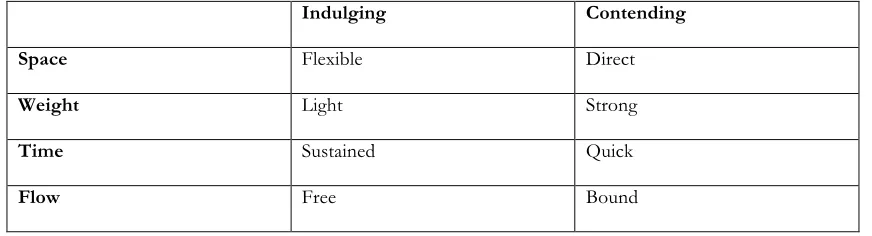
i. SPACE (Phase 1) ii. TIME (Phase 2) iii. WEIGHT (Phase 3) iv. FLOW (Overview)
IV. ‘A laboratory of fun’: experimental playgrounds
Conclusion 146
I. Three problems in performance
i. Kinds of failure ii. Varieties of play iii. Forms of embodiment II. Historiographical PaR: three examples
III. From Playfulness to Flow IV. PaR as ‘not-yet-knowing’
Bibliography 177
Documentation CD-Rom
[20 digital photographs, 3 archival videos, 1 edited video, 2 script files and 1 design file]
Notes on Documentation:
The reader is invited to intersperse each chapter with digital documentation from the PaR experiments. The primary video documentation comprises three archival static recordings showing each PaR project in performance, plus one edited short film. These can be found on the CD-Rom accompanying this thesis and can be viewed as follows:
Between Intro & C1: Discords at Warwick Arts Centre, January 2011 Between C1 & C2: Endlessness at Pegasus Oxford, October 2011 Between C2 & C3: Fail Better Fragments at Warwick, April 2012 (silent) Between C3 & Conc: Fail Better Fragments at Warwick, April 2012 (edit)
In addition to this, 20 digital photographs illustrate the thesis (in the Introduction and Chapters 1–3, as embedded Figures references within the text). Additional archival material (such as script and design work) can be found within the digital appendices (CD-Rom).
Figures and Tables
Figures
0.1 Play Without A Title photograph (2008) 9
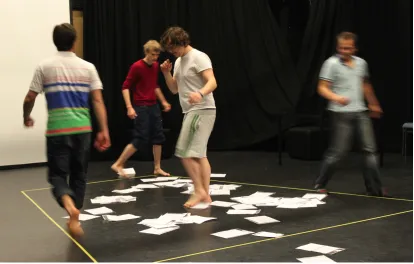
1.1–1.2 BeckettLab photographs (2009) 49
1.3 BeckettLab photograph (2009) 50
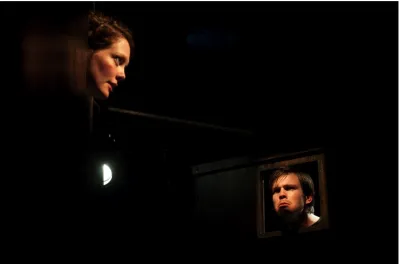
1.4 Discords photograph (2010) 53
1.5 Discords photograph (2010) 54
1.6 Discords photograph (2011) 57
2.1–2.4 Endlessness ‘process’ photographs (2011) 91–92
2.5–2.6 Endlessness ‘performance’ photographs (2011) 94
2.6 Endlessness ‘audience’ photograph (2011) 97
3.1 Fail Better Fragments photograph (2012) 124
3.2 Fail Better Fragments photograph (2012) 127
3.3–3.4 Fail Better Fragments photographs (2012) 129
3.5 Fail Better Fragments photograph (2012) 132
3.6 Post-FBF ‘event’ photograph (2012) 135
4.1 Play matrix (after Connor, 2011) 152
Tables
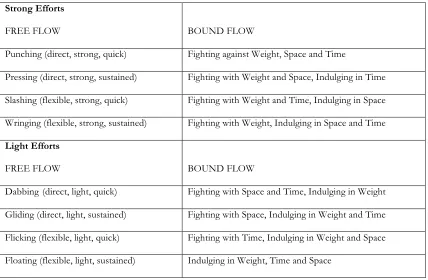
3.1 ‘Actions in effort’ (McCaw, 2011: 200–1) 111
3.2 ‘Concept of effort’ (McCaw, 2011: 199) 123
Acknowledgments
With the help of your good hands…
Thanks and acknowledgements are also due to many, but particularly to my supervisor and prophet Baz Kershaw; to my co-supervisor and mentor Nadine Holdsworth; to my many colleagues including Elizabeth Barry, Susan Brock, Carol Chillington Rutter, Jim Davis, Tony Howard, Rachel King, Eileen John, Nicholas Monk, Jonothan Neelands, Paul Prescott, Peter Sadler and Nicholas Whybrow (Warwick); Matthew Broome, Chris Ponting, Rosemary Pountney and Kirsten Shepherd-Barr (Oxford); Yasmin Sidhwa and the Creative Learning Team (Pegasus); Nicholas Johnson and Sam Slote (TCD); Mark Nixon and Dirk Van Hulle (JOBS); Annette Arlander and Emma Meehan (IFTR); and everyone at IATL. I would also like to acknowledge the support of librarians and archivists,
including Gavin Clarke (NT), Steven Dryden (BL) and the Shakespeare Birthplace Trust; and the environmental support of Pauline Pears and Ian Litton at 14a Kenilworth Road.
Finally, I dedicate this thesis to the performers and practitioners who helped me think: the Student Ensemble (at least fifty Warwick students who have flowed through this practice over the past seven years), the Fail Better Associates (including Jonathan Broke, David Tanqueray, Christopher Tester, Dave Thwaites and Ric Watts) and, in particular, Company Designer Nomi Everall (‘My brave spirit’).
Declaration
This thesis is my own work and it has not been submitted for a degree elsewhere.
The use of materials and documentation from the work of Fail Better Productions Ltd. (Registered Office: 139 Reliance Way, Oxford, OX4 2FW) appears with the full approval of both directors of the company (Jonathan Heron and Nomi Everall).
All photographs are by Peter Marsh/ashmorevisuals except: Figures 1.1–1.3 by Wei-Jean Cheah/Darkling Images;
Figures 2.1–2.4 by Jonathan Heron/Fail Better Productions;
IATL Student Ensemble member Ed Davis (now of RADA) edited the videos.
During the period of registration, I contributed to the following academic publications, which deal with some of the PaR projects, but from different perspectives:
• Monk N with Chillington-Rutter C, Neelands J and Heron J (2011) Open-space
Learning: A Study in Transdisciplinary Pedagogy, London: Bloomsbury Academic.
• Barry E, Broome M and Heron J (2014) ‘Not I’: Beckett and Psychiatry –
Psychiatry in Literature, British Journal of Psychiatry, 204: 239.
• Heron J and Johnson N (eds) (2014) ‘The Performance Issue’, Journal of Beckett
Studies 23:1, Edinburgh: Edinburgh University Press.
• Heron J (2015) ‘Shakespearean Laboratories and Performance-as-Research’ in
Hartley A (ed), Shakespeare on the University Stage, Cambridge: Cambridge University Press.
I made a deliberate choice not to recycle this material within the thesis, but some phrases or sentences may have accidently migrated from one text to another.
Abstract
This thesis draws on practice-as-research (PaR) and its documentation to investigate experimental theatre as transdisciplinary performance. I include case studies from my practice with Fail Better Productions and consider multi-/inter-/trans-disciplinary methods in theatre studies. Examples of twentieth-century experimental theatre are studied to define ‘three problems’ in performance: the organic/mechanical, theatrical/scientific
and playful/experimental. The concept of ‘entanglement’ further develops my understanding of PaR methodology.
In Chapter 1, Samuel Beckett’s later dramatic works are explored as ‘theatre machines’, with a particular focus on George Devine’s 1964 production of Play. Following an analysis of the Fail Better’s Discords (2010), Beckettian embodiment is articulated as ‘organic machinery’. The chapter concludes with a discussion of Beckett’s ‘corporeal hereditaments’ and ‘plasticity’ in performance. Chapter 2 investigates Artaudian ‘theatre laboratories’, in particular Peter Brook’s 1964 Theatre of Cruelty experiments. This is compared with Fail Better’s interdisciplinary project Endlessness (2011). The final section develops an analysis of ‘scientific’ theatre and experimentation–as–performance, focusing particularly on forms of ‘reflexivity’. Chapter 3 examines participatory performance, specifically focusing on corporeal movement within installations such as Fail Better Fragments (2012). Joan Littlewood’s experimental performance practices are analyzed, specifically her Fun Palace project (c.1961–8), for the influence of Rudolf Laban upon her work. The potential for community engagement within these ‘experimental playgrounds’ will be explored in relation to ‘permeability’ in performance and Laban’s ‘effort attitude’ of flow.
Finally, the thesis re-articulates the ‘three problems’ in terms of play and discipline, which are interrogated via the concepts of failure, ludus, and embodiment. I will demonstrate how a historiographical approach to PaR can re-invigorate methodology, before considering transdisciplinary performance in relation to ‘playfulness’ and
Introduction
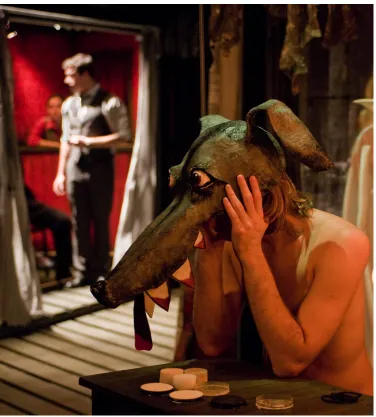
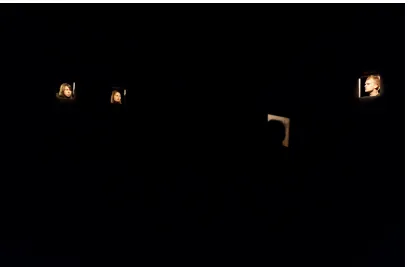
Figure 0.1: Play Without a Title (2008)
[See FBF video (edit) at 00m 45s on CD-Rom]
This is not the theatre.
(Garcia Lorca, Play Without a Title, 2008 [1936])
Trying to learning to use words, and every attempt / Is a wholly new start, and a different kind of failure (Eliot, East Coker, 1963 [1940])
We are ourselves that performance; we perform and are performed every moment.
I. A Different Kind of Failure
My research began with a ‘formless hunch’ (Brook, 1987: 3) rather than the framing of a question. In response to Baz Kershaw’s definition of PaR as ‘a method and
methodology in search of results across disciplines: a collection of
transdisciplinary research “tools”’ (2009: 5), I conducted practical experiments that crossed
disciplinary boundaries (including the arts, humanities, sciences and philosophy). My argument therefore engages with experimental theatre practice in order to address performance per se, specifically in relation to transdisciplinarity. While theatre has been one of the greatest resources for multidisciplinary and interdisciplinary encounters between the arts and the sciences (Shepherd-Barr, 2006), it has also failed to be systematically transdisciplinary. As I will demonstrate below, British theatre in the late modernist period has tended towards a disciplinarity that foregrounds mechanical, scientific and experimental process, while performance practice facilitated an organic, theatrical and playful approach to epistemology. Instead, performance ‘irritates’ theatre (Read, 2013), contesting disciplinarity through radical failure (Kershaw, 1999; Bailes, 2011) while paradoxically asserting ‘the challenge to perform—or else’ (McKenzie, 2001: 139). I will discuss the re-valorization of failure within ludic practice alongside PaR on Beckett, Artaud and Laban, which will allow the thesis to move beyond a straightforward distinction between theatre and performance.
For Alan Read: ‘The canonization of performance as all that is “good”… was undoubtedly a necessary step to unsettle all that was normative in the orthodoxies of a dominant culture’ (2013: xvi). I will argue that both performance and transdisciplinarity enable cultural and epistemological transgressions through their focus upon practitioner knowledge, problem solving and failure as a form of resistance. As Sara Jane Bailes notes in Performance Theatre and the Poetics of Failure (2011): ‘Failure challenges the cultural
imagine and manufacture the world’ (2). With Bailes, I will use Beckett’s ‘failure’ as an example of radical failure from a performance studies perspective, but I will extend this notion to include arguments concerning failure within the construction of scientific facts and the reflexivity of laboratory experiments. In doing so, I will draw more carefully upon earlier observations about Beckett’s practice that foregrounded the corporeality of his theatrical embodiments (Pountney, 1976; Chabert, 1982) as well as more recent scholarship in Beckett studies (Maude, 2009; McMullan, 2010).
Within this thesis, I will trace an experimental corporeality even further back to the performance cultures of late modernism (e.g. Artaud c.1932, Laban c.1947 or Blin c.1953) by taking a historiographical approach to the PaR methodology. I will discuss some 1960s experimental theatres as a ‘scientific’ turn in performance practice, paradoxically combining ludic processes with laboratory reflexivity. I am therefore re-reading the ‘theatre laboratories’ of the 1960s as a locus of exchange between modernist cultures and the contemporary technological age. In doing so, I am re-orientating my own practice in relation to this legacy and contributing to a process of historicizing PaR (Riley and Hunter, 2009; Fleishman, 2012). This line of inquiry will be particularly concerned with what constitutes a ‘laboratory’ after Grotowski’s influence, which for Riley: ‘can be seen as an attempt to theorize (perhaps legitimize – perhaps protect) theatre arts from a modern scientific perspective’ (2009: 140).
Another line of inquiry will concern the paradoxical qualities of performance, which emerge within the thesis as ‘three problems’. Each problem exposes a
transdisciplinary phenomenon: the organic/mechanical, the theatrical/scientific and
(Chapter 3 and the Conclusion). I am therefore using transdisciplinarity as an evolving epistemological position which, for Robert Frodeman: ‘[is] actually a more crucial term than interdisciplinarity in understanding our current situation’ (2014: 7). For Julie Thompson Klein:
Transdisciplinarity was defined as a common system of axioms that transcends the narrow scope of disciplinary worldviews through an overarching synthesis, such as anthropology construed as the science of humans… Piaget treated it as a higher state in the epistemology of interdisciplinary relationships based on reciprocal assimilations (Thompson Klein in Frodeman et al., 2010: 24)
Thompson Klein goes on to introduce ‘four major trendlines’ that anatomize transdisciplinarity. Firstly: ‘the contemporary version of the historical quest for
systematic integration of knowledge’ (24), from ancient Greek philosophy to ‘unification theories’ in Physics. Secondly, ‘Transdisciplinarity is not just “transcendent” but
“transgressive”… more often as a label for knowledge formations imbued with a critical imperative, fostering new theoretical paradigms [e.g. cultural studies]’ (25). Thirdly: ‘overarching synthetic paradigms… that transcend the narrow scope of disciplinary worldviews [e.g. sociobiology or phenomenology]’ and finally: ‘trans-sector problem solving [in, for example] contexts of environmental research’ (25).
Within this context, my PaR specifically engages with the locality of the Warwick campus environment, via three strands of inquiry: a) experimental theatre, b)
transdisciplinary performance and, more generally, c) ludic practice. Each of these areas will be addressed in detail within the thesis, especially the ways in which they concern human embodiment. Specifically, these areas operate upon an inter-relationship between the disciplinary and the ludic, which I will articulate in terms of ‘flow experience’ (cf. Csikszentmihalyi, 1975). Ultimately, I will be interested in how these modes of human embodiment produce ‘flow experiences’ that challenge logo-centric epistemologies.
My thesis will argue that PaR enacts ‘a productive not-yet-knowing’ (Borgdorff, 2012: 194) which I will articulate via three modes of human embodiment:
a) Experimental theatre of the 1960s, including the practices of George Devine, Peter Brook and Joan Littlewood (in particular, their productive failures relating to theatrical aesthetics);
b) Transdisciplinary performance processes influenced by Samuel Beckett, Antonin Artaud and Rudolf Laban (examples will be drawn from both the 1960s and contemporary practice); c) Ludic practice as a research method in PaR experiments conducted by Fail Better Productions
in the 2010s (three projects that re-iterate the historiographical problems identified above).
On the wider subject of failure, I will mobilize two academic traditions which can be broadly distinguished as ‘the philosophical’ (on failure and epistemology) and ‘the
tended to view failure as progressive, deploying ‘falsifiability’ within scientific discourse and regarding ‘trial and error’ as central its research processes.
In a counter – though not unrelated – tradition, performance studies scholars have drawn upon the avant-garde practices of late modernism to establish an aesthetic interest in failure as a subject of study and a critical strategy that foregrounds counter-hegemonic cultural experience. In a 1990s movement known playfully as ‘failure studies’, scholars and practitioners (e.g. Tim Etchells, Matthew Goulish, Adrian Heathfield, Sara Jane Bailes) emphasized performance events that privileged – and possibly encouraged – failure as a phenomenon in its own right. My argument brings these two traditions together, via Beckett, whose failure was ‘ever failed’ and ‘better worse’, as he wrote in his prose poem Worstward Ho (1983). I will conclude with a reflection upon laboratory processes (whether artistic, scientific or both) by developing Borgdorff’s ‘not-yet-knowing’ (2012: 194)1 towards a model of experimental theatre as transdisciplinary performance.
Each chapter of this thesis will therefore identify an experimental problem that will be explored through laboratory practice. The ‘theatre laboratory’ emerges as a core process for this thesis, in which mechanical rehearsal (Play/Discords), experimental practice (Endlessness/Theatre of Cruelty) and participatory performance (Fun Palace/Fail Better Fragments) will collectively be explored as laboratories. As Mirella Schino informs us
in Alchemists of the Stage: Theatre Laboratories in Europe (2009):
Theatre laboratories were a significant innovation of twentieth-century European theatre. This innovation was however merely a new face of the much older and more remote zone of theatrical
1 Borgdorff explains how ‘things we want to know (epistemic things) [can] at other times be objects through
creation: the space that exists between art and life, between the craft and the person. Right from the start, theatre laboratories were something of a paradox. (7)
This paradox will be further elaborated via my three problems – the organic/mechanical, the theatrical/scientific and the playful/experimental – across the three chapters that I will now
introduce, before a final section on methodology.
II. From Play to Discords
Chapter 1 investigates two specific instances of Beckettian experimentation, Devine’s British premiere of Play in 1964 and Fail Better Productions’ Discords in 2010. It will respond to W2’s question in Samuel Beckett’s Play, articulating the performing body in terms of a reflexive mechanism, and M’s body as ‘a something machine’ (Beckett, 1964: 12). This metaphor will be recycled across the chapter, to illustrate ensembles in rehearsal as ‘theatre machines’ and PaR scholars as ‘research machines’. In doing so, the enduring ephemeral/material binary will be examined in relation to scholarly materials including Diana Taylor’s The Archive and the Repertoire (2003). This discursive process will take account of theatre history (specifically Devine’s early productions of Beckett’s plays) and new performance experiments (specifically my own Fail Better projects). The
methodology for this approach adapts the ‘textual genetics’ represented by critical studies such as Stanley Gontarski’s The Intent of Undoing (1985) and Rosemary Pountney’s Theatre of Shadows (1988), into a new model for Beckett Studies as ‘performance genetics’.
biomechanical body in performance, before a consideration of Beckettian rehearsal within this lineage. I am especially aware that ‘rehearsal in Beckett suggests a paradox’ (McCarthy, 1996: 150), a paradox first articulated by Anna McMullan as a tension between ‘authority and failure’ (1994), and elaborated upon by Jane Goodall: ‘Beckett’s plays don’t require a dry academic correctness of their interpreters, but they do demand this level of discipline and intensity. The paradox must enter the actor’s bones’ (in Gontarski and Ullman, 2006: 195). Writing more recently, McMullan revisits the Beckettian body ‘not as a stable historical entity’ (2010: 5), but rather as an embodied psychoanalytical and phenomenological subject. Her argument builds upon Edmund Husserl, Martin Heidegger, Jean-Paul Sartre, and most notably Maurice Merleau-Ponty, to develop a new understanding of embodiment, inter-corporeality and ‘ontological doubleness’ (13). For McMullan, the body in Beckett: ‘is presented as both sign and site, engine or matrix of production (of stories, semblances, voice, footfalls or hiccups) and fabric to be composed and recomposed with limited materials’ (2010: 125). Viewing the body as ‘itself a matrix of embodiments… a site of production’ (126) has enabled my thesis to treat human embodiment as an experimental process, rather than a stable entity.
light of his vitalistic materialism… [the synthesis of] the vitalistic and mechanistic explanations of the actor’s body’ (1993: 117). Comparably, my specific inquiry into Beckett’s practice, via the archive and through the body in rehearsal, will alight upon Brook’s ‘theatre machines’ and Foucault’s ‘disciplinary mechanisms’. Roach’s treatment of Diderot is especially useful here: ‘he alternatively sustained and provoked both parties by using metaphors derived equally from machinery and organisms’ (117).
There will follow here a meditation upon both mechanisms and organisms in order to introduce both the corporeality of Beckett’s Play (in the 1964 rehearsal process) and the materiality of Discords (in the 2010 devising process). Both processes explored the body as a pre-determined and behavioural entity, which Roach would call ‘a biological machine’ (160). In this sense both Beckett and his theatrical collaborators, as well as our experimental ensemble, were responding to modernist paradigms of theatrical
embodiment, such as this notable example from Roach: ‘in The Actor and the Ubermarionette of 1908, Edward Gordon Craig insisted that the normal human body had utterly failed as the instrument of theatrical art’ (160). Roach also positions this work in relation to the late writings of Charles Darwin on human emotion (177), and Craig’s admiration for the rigour of rehearsal at the Moscow Art Theatre (194). Rehearsal in this model emerges as a highly disciplinary practice, routinely making use of experts in specific aspects of production (voice, movement, direction), conditioning the performer to enact prescribed actions, sometimes with instruction from a variety of disciplinary specialists.
For Roach, ‘modern biology’ for Stanislavski and Craig, as much as for Diderot and Darwin before them, promised to finally resolve ‘the mystery of the player’s passion’ (1993: 194). Here, it can be argued that, in a parallel tradition, Artaud, Blin and Brook – practitioners of both cruel and holy theatres – seek to distill rather than decode this
rather than a disciplinary mechanism. I will argue that the network of practice identified by Roach (from Diderot to Meyerhold) continued to evolve throughout the late
modernist and contemporary periods of theatre. I will position my own practice as a way of constructing the body through its practical applications, with special reference to Beckett whose: ‘mimes and… dramatic fragments constituted laboratories in which [he] tried out the possibilities of staging the body or a series of bodies’ (McMullan, 2010: 57).
These ‘laboratories’ create a process of embodied damage and repair, especially through the mechanisms of experimental theatre practice. If the body for Diderot and Roach enacted a metaphor of both ‘machinery and organism’ then this argument must also consider the modernist legacies of early neurology, when Santiago Ramon y Cajal identified the nervous system as ‘organic machinery’ (1904) as well as the influence of contemporary neurologists such as Antonio Demasio and philosophers of neuroscience such as Catherine Malabou. It is from these perspectives that I will position Beckettian performance practices as multidisciplinary (where many disciplines inform cultural practices).
As I stated earlier, a paradoxical feature of the theatre laboratory (a tension between the theatrical and the scientific) will be explored in Chapter 2; however, I have found a comparable tension in Beckett’s ‘theatre machines’. Within the theatre machine, the body is ‘a matrix of embodiments… a site of production’ (McMullan, 2010: 126) where
III. From Theatre of Cruelty to Endlessness
Chapter 2 investigates Brook’s practice during the ToC experiments (also 1964), as an example of the interdisciplinary theatrical/scientific problem. I will re-consider this problem through my PaR project Endlessness (2011) and make special reference to the influence of Artaud upon experimental theatre about science. I will compare and contrast two ‘theatre laboratories’: an archival process, using production materials held at the Shakespeare Birthplace Trust (SBT), and published texts by Marowitz and Brook; and a practical process, using experimental methods, digital documentation and audience feedback. The chapter will describe both laboratory processes in detail, so as to articulate
interdisciplinary issues concerning the exploration of ‘scientific’ ideas in performance. Brook’s own ‘scientific research’ re-interpreted Artaud’s ‘Theatre of Cruelty’ (1932) as strictness, self-discipline and elimination.
Brook made several attempts to highlight the importance of total subsidy for experiments of this nature (see Williams, 1988; Brook, 1998; Kustow, 2005). In the ToC programme note, the company positions its work as follows: ‘As with a scientific
I will be particularly interested in the ‘scientific’ orientation of Brook’s
performances within an experimental context. In an essay in their programme, Brook and Marowitz write: ‘ToC is a collage, a form of surrealist revue composed of shots in the dark, shots at distant targets… Our hope is that this season will provide the conditions for experiment and trial-or-error [sic].’ (SMT/PROG/1964/40). ‘Contributors to
experimental group presentations’ included Paul Ableman, John Arden, Antonin Artaud, Ray Bradbury, Peter Brook, Cyril Connolly, Jean Genet, Alfred Jarry, Charles Marowtiz, Alain Robbe-Grillet, William Shakespeare and, satirically, the Lord Chamberlain.
However, the influence of Artaud on the event was deeply significant. Brook and Marowitz suggest ‘Artaud’s longing for a rediscovery of the terror and awesomeness of the original semi-religious theatre [was] a desperate attempt to find a way in which theatre could once more become necessary, an urgent presence in our lives’ (40). They propose to restore this necessity through experimentation, drawing upon the
‘Elizabethan Example’:
From one point of view, Artaud’s ‘cruelty’ can be seen as an attempt to recover the
Shakespearean variety of expression by other means, and this Royal Shakespeare experiment, using Artaud’s work as a springboard rather than a model for slavish reconstruction, can also be viewed as a search for a theatre-language as agile and penetrating as the Elizabethans created. (SMT/PROG/1964/40)
The young Brook would have heard about Artaud in his trips to Paris in the 1950s, when in avant-garde circles Artaud had cast himself as a revolutionary martyr in the cause of modern art – Artaud Agonistes, surfacing from months of electro-shock therapy to write his late, hectoring texts and to have his final radio play, An End to the Judgment of God, banned by French state radio. (2005: 138)
As I will show in Chapter 2, Kimberley Jannarone (2010) and others have disputed Brook’s faithfulness to Artaud. As Read notes: ‘Artaud and Grotowski cannot be blamed for the use of their work since the time they wrote it’ (2008: 58-9). He continues: ‘Instead of a “Theatre of Cruelty”, a question of cruelty, its distribution and arrangements might be posed; instead of aesthetically mimicking Towards a Poor Theatre, a question of poverty, its means and effects might be at issue’ (67). Borrowing this approach, I draw a
distinction between Artaud’s theatre and Artaudian theatre, as I did earlier between Beckett’s theatre and Beckettian theatre. This allows me to consider how Artaud and Beckett’s projects are re-performed in the work of other practitioners, and how that may impact upon subsequent performance research. In order to identify these differences, I explore the specific material circumstances of theatre practice. For example, take Kustow’s account of the ToC experiments:
This description identifies a problem that I explore in the second chapter. The difficult relationship between the scientific and theatrical will emerge as a paradox that characterizes theatre laboratories in particular. This ‘scientific’ turn in theatre practice can be traced back to the 1920s studios of Russian modernism, but its apotheosis was in the
experimental theatre practices of mid- to late twentieth-century Europe.2 However,
Brook’s laboratory was clearly a place where ‘purely formal experiments’ failed to convey the theatricality of Artaud that fascinated him. Brook had to find alternative ways of sharing the experiments with an audience. As Kustow also tells us: ‘Sometimes Brook and Marowitz went on stage to discuss why they were doing the whole thing, or Brook rehearsed a Shakespeare scene – one night a scene from Richard III’ (141). The founding principles of laboratory science (of making ‘things’ speak) may be betrayed if the
experimenter feels the need to explain himself. As I will show with my own Endlessness experiments, the urge to explain the conditions of the laboratory can overwhelm the process of rigorous testing.
The PaR experimentation discussed in this chapter contrasts Brook’s notion of ‘elimination’ (2013) alongside Artaudian ‘cruelty’ in order to address the possibility of conducting ‘scientific research’ in performance. I will compare both the archival and the practical processes in order to explore the notion that a PaR methodology is ‘quasi-scientific’ (in the sense that it mobilizes a discourse without its methods). I will also consider the ways in which the PaR makes use of scientific terminology and technical vocabulary in a performative, rather than epistemic, mode. I will also address the criticism that PaR privileges techne by considering the hybridity of its praxis and its
paradoxical relationship with the scientific method (cf. Nelson, 2013). Within the context of twenty-first century ‘science theatre’, Chapter 2 will also develop ideas from
2See for example ‘The Laboratory Theatre Network’ of the Centre for Performance Research
performance scholars including Sue-Ellen Case (2006) and Helen Nicholson (2011) to construct a more nuanced understanding of ‘scientific’ performance. This analysis will also draw upon ideas of ‘science on stage’ (Shepherd-Barr, 2006) and earlier accounts of the arts and sciences as ‘two cultures’ (C.P. Snow, 1959). These issues will be explored through my PaR project Endlessness (2011), especially its attempt to use scientific source material as stimulus for contemporary devised theatre.
In their discussion about theatre laboratories, on the occasion of the fortieth anniversary for Odin Teatret, Schino et al. posed the question: ‘Why a theatre
laboratory?’3 They have various answers: ‘Of course a laboratory theatre is different from
a simple experimental theatre’ (2009: 28); ‘the laboratory, we said, is a parallel dimension of the theatre’ (29); ‘a theatre laboratory is a protected milieu where time is plentiful’ (29); ‘a laboratory is a place of pure research’ (30); ‘thus a laboratory is a theatre that says no to performance’ (30). However, Brook and Marowitz characterized their laboratory very differently indeed:
Why are we showing this experiment to an audience? Because no theatre experience is complete without that third element, because we need their reactions, we want to see how far we stir their ideas. We need them to test their reactions just as much as we test our actions.
(SMT/PROG/1964/40)
The ToC laboratory was incomplete without an audience, and this element informed my own Endlessness project, although inviting observers into an experiment introduced yet more complexity into the process. As we shall see, the observation of phenomena affects the very same phenomena. For Henk Borgdorff: ‘an artistic “fact”, like a scientific, social, or historical fact, is what we make real with our epistemological undertakings’ (2012:
3 A conference on the same theme was sub-titled ‘Risks and Innovations in Europe 1898–1999’ and took
195). As he reminds us that: ‘Artistic and scientific research is about something real, while simultaneously transforming it into what it could be’ (196). In doing so, he reveals the interdisciplinary – arguably transdisciplinary – problem of practical experimentation, which is shared between the arts and sciences. His writing on the provisionality of experimental knowledge is drawn upon the work of others, from Bruno Latour to Hans-Jorg Rheinberger. I will consider various ‘science studies’ perspectives in Chapter 2, but I would like to return to PaR here. For Borgdorff: ‘The condition of art as research is a condition of contingency. The openness of art is what invites us, again and again, to see things differently’ (196). He also positions artistic practice as ‘unfinished thinking’ (194), which is something that I will return to later. Endlessness will emerge as the strongest example of this ‘unfinished thinking’, where the theatrical and the scientific coalesce in ‘work-in-progress’ performance. This will allow me to position my PaR experiments as critically interdisciplinary, especially when they exemplify the reflexivity of performance.
IV. From Fun Palace to Fail Better Fragments
definitions of ‘the archive and the repertoire’ (see Taylor, 2003), as well as Littlewood’s appropriation of university, laboratory and play spaces for the future of performance.
It is important to my argument that the Fun Palace project is understood in relation to Littlewood’s later practice regarding playgrounds. This builds upon the research of Nadine Holdsworth, who begins her final chapter of Joan Littlewood’s Theatre (2011) with an anonymous Stratford Express article from 1967, quoting Littlewood: ‘I’ve finished with putting on plays. I don’t like the theatre… at the moment I’m more interested in my children’s playground’ (234). Having established that: ‘throughout the 1960s, Littlewood battled to raise awareness of, interest in and financial support for the Fun Palace Project that Price estimated would cost two and a half to three million pounds’ (226), Holdsworth concludes that ‘her willingness to contemplate “spatial play” and her ethical concern with how cultural and educational processes might be activated within the community’ (233) still inform cultural practices in the twenty-first century. I will also draw upon the work of Robert Leach, who describes this period as follows:
Littlewood herself had become increasingly excited by the possibility of creating what she called a ‘Fun Palace’, a kind of twentieth-century equivalent to the eighteenth-century pleasure gardens, but contained within an extraordinary changeable and changing building designed by the visionary architect, Cedric Price. (Leach, 2006: 201)
As Mary Louise Lobsinger informs us: [when Littlewood met Price] ‘he was teaching at the Architectural Association, socializing within a circle of young aspiring architects with a penchant for technology, and was acquainted with the architectural critic Reymer Banham’ (2000: 119).4 Lobsinger variously describes the Fun Palace concept as ‘a machine
capable of adapting to the needs of users… the quintessential anti-architectural project’ (120) and ‘a barrier-free venue for experimental theater’ (122). My focus in Chapter 3 will
be on the Fun Palace as ‘a “university of the streets” with a strong community link’ (Leach, 2006: 201) as I will argue that the emphasis on learning through play is a Laban-like aspect of Littlewood’s practice. While ‘the very word “fun”, deliberately used to be provocative by Littlewood, may have doomed the project’ (201), Laban’s generic focus on human movement as an inclusive practice, and his specific focus on human effort as an interpretative tool, allows ‘fun’ to be educative. His focus on playful movement as a human intelligence, positions the ludic impulse as pedagogically, and even
philosophically, significant (see A Vision of Dynamic Space, Ullmann, 1984).
As Dick McCaw notes: ‘Laban was not interested in the externally observed movement but rather the meaning – ethical, aesthetic, pedagogical – of that moment in relation to the person who is moving’ (2011: 333).5 While Laban’s influences on
Littlewood’s theatre practice was well documented by Leach and others, less impact is noted regarding her ludic projects, other than in Holdsworth’s account. However, a strong connection between play and meaning can also be found by focusing on the flowing movement enabled by effort work. For Laban: ‘the flow of effort from the weightless, timeless, spaceless centre to the matter shaped and moved around is the binding link which carries life’ (Ullmann, 1984: 24). I return to flow later in the thesis.
I will also make critical use the autobiographical Joan’s Book (1994), where Laban is the practitioner Littlewood turns to most readily; Stanislavski and Brecht are hardly mentioned at all. Across its copious pages, she demonstrates the indispensability of Laban and his teachings, although the chronology is sometimes confusing. Nonetheless, Laban clearly informs her practice from her brief spell at RADA to her final work on playgrounds. She seems impressed by Laban’s early years as ‘a crystallographer and a Dadaist’ (69) and concerned about his flight from Nazi-Germany, ‘what had happened to
5 Laban’s ‘ethical, aesthetic, pedagogic’ understanding of movement has a parallel with Cedric Price’s
Rudolf Laban?’ (120). Following their first meetings after the war in Manchester and Blackburn – ‘the industrial north appealed to Laban’ (181) – she recalls the introduction of ‘Laban’s dancing star, Jean Newlove’ (215) to Littlewood’s company, who soon became ‘our new dancing mistress’ (219). The book also contains Gerry Raffles’ proposal for a new theatre school in Liverpool (‘Joan would head the project, assisted by Laban’, 307) and Harry Corbett’s comment that Theatre Workshop was ‘the only company that trains’, leading to him being sent ‘on a Laban crash course’ (454) with Ullmann. In these memories of Theatre Workshop, Laban’s ‘mastery of movement’ is clearly one guiding principle (see Ullmann, 1984: 6). Howard Gooney, writing about the period 1948–50, states that: ‘many hard and useful movement classes were held in the Arts of Movement Studio in Oxford Road [Manchester] – the Laban Studios, run by Lisa Ullmann and Sylvia Bodmer, some of the classes being taken by Rudolf Laban himself’ (1981: 66). From these reflections, it can be safely assumed that Laban and his associates profoundly influenced the movement practice of Theatre Workshop and Littlewood’s subsequent projects.
In Laban they had a found a researching practitioner who understood that: ‘Man’s body-engine is constructed in a manner that in principle all imaginable effort-combinations can be performed with relative ease and balance’ (Laban in McCaw, 2011: 224). This compression of playful/experimental effort as one, allows practices discussed in Chapter 3 to inform my Conclusion, so as to elucidate theories of play and their
I will explore playful experimentation and experimental play through my PaR project Fail Better Fragments (2012) when we explored free-flow and bound-flow in performance.
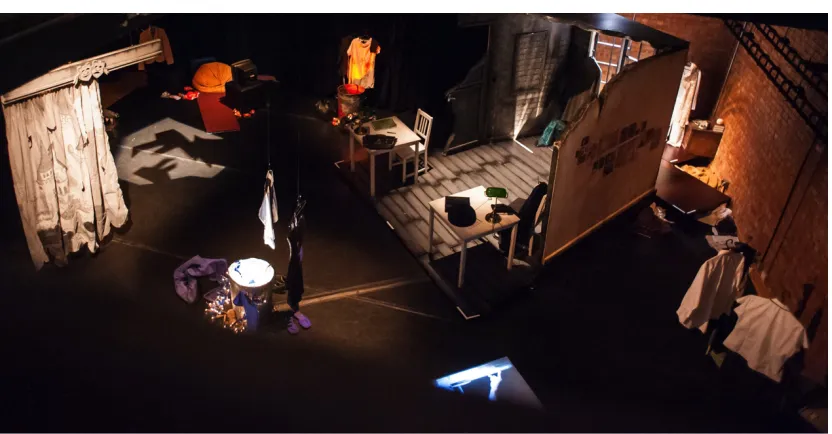
Like the 1960s Fun Palace (designed by Cedric Price), our structure (designed by Nomi Everall) created a performance installation for participation. Both Laban’s ‘flow’, Littlewood’s ‘fun’ and Fail Better’s ‘fragments’ combined to enable transdisciplinary research, especially when the permeability of performance extended playfulness. In Chapter 3, I will introduce a comparison between the experience of flow in playful behavior and the use of free/bound ‘flow’ in movement analysis.
V. PaR, Methodology and Entanglement
I will use this final section to articulate the reflexivity of PaR by developing my key terms and concepts in preparation for the chapters themselves. I will briefly explore how recent scholarly models have failed to move beyond the notion of ‘crossroads’ in theatre and performance studies (e.g. Pavis, 1992; Conquergood, 2002; Fischer-Lichte, 2003) and trouble binary separations between theoretical/practical, historical/contemporary, and artistic/scientific. By moving towards an understanding of PaR as transdisciplinary, I will argue that established metaphors confuse research methods in both problematic (e.g. ‘crossroads’) and transformative (e.g. ‘entanglement’) ways. I will challenge metaphors that globalise theatre and performance studies, and instead develop a specific and localised imagery that articulates PaR through its specificity. This argument will
performance (three concepts further developed in the chapters) can emerge from practical
research methods through the analysis of their documentation as a discursive inquiry. Theatre studies has deployed the ‘crossroads’ metaphor for some time now (it has been waiting at this intersection for at least twenty years). If a metaphor is: ‘the application of a name or descriptive term or phrase to an object or action to which it is imaginatively but not literally applicable’ (OED, 1998: 856), then this example promotes inaction and indecision. When Dwight Conquergood urged us to refuse: ‘the deeply entrenched division of labor, apartheid of knowledges, that plays out inside the academy as the difference between thinking and doing, interpreting and making, conceptualising and creating’, he insisted that ‘our radical move is to turn, and return, insistently, to the crossroads’ (2002: 154). At the turn of the millennium, it seemed that PaR already had a response to this disciplinary problem:
Conquergood’s full-frontal assault on the modernist traditions of knowledge-making may be an overstatement, but it does suggest something of what could be at stake through practice as research, and not just in performance studies. In all the disciplines represented here, we may be at a watershed, the negotiation of which might well determine their place and purposes in university for decades to come. (Kershaw and Piccini, 2004: 87)
I suggest that PaR has responded to this problem over the last decade in two ways. Firstly, the expectation that PaR would trouble ‘knowledge production’ has been exemplified by its impact upon new doctoral programmes, modes of scholarly
reflexivity with regard to the epistemological, ontological and procedural dimensions of
PaR, consequent upon its potentially radical approach to questions of knowledge
production in the universities’ (2004: 87). Writing in connection with the PARIP project
(2000-2006), they looked forward in the new century to when practice-based research
may have equal status with theoretical-analytical models. They state: ‘PaR knowledges
may – like all good research – be best conceived as context-specific and relational, in the
sense of being created at the intersections of existing forms, through response to previous
iterations within specific (and identifiable) webs of citation’ (89, emphasis added). PaR
practitioner-scholars often emphasized the intersectional nature of their work, recalling
Conquergood (2002) and deploying the metaphor of the ‘crossroads’ repeatedly (Pavis,
1992; Conquergood, 2002; Fischer-Lichte, 2003; Brady and Walsh, 2009; Freeman, 2010; and ‘Practice and research at the crossroads’ at ResCen, Middlesex University, 2014). For example, Fintan Walsh and Sara Brady have argued for ‘the phenomenological value of being between states that is of special interest to performance studies’ (2009: 2) in relation to its ‘crossroads’ within Irish culture. This disciplinary obsession with the crossroads has emerged as one of its greatest clichés, which sometimes prevents scholars from engaging with specific flows and particular material conditions. I suggest that the ‘intersection’ itself is a fairly unremarkable aspect of PaR and performance research.
Secondly, PaR has opened up more unpredictable outcomes since Kershaw and
Piccini first acknowledged: ‘the contested role of documentation [for PaR] in the demand
for an archive-friendly artefact from the funders of creative practices, rooted in the
politics of accountability and transparency’ (2004: 89). PaR communities have focused
their methodological discussions on the details of documentation (e.g. IFTR PaR
Working Group, discussed below). This has proven, perhaps, to be the only shared
concern of a very diverse community of researchers working across multiple media and
problem since the late twentieth century. David Whitton, for example, has complained
that PaR is solipsistic: ‘rather than constituting an identifiable methodology, PaR actually
denotes an expansion in multiple directions simultaneously, in other words an expansion of the range of possibilities open to researchers’ (2009: 86). Whitton misses the point, I think, that this ‘expansion’ actually mimics the hybridity of theatre and performance studies since they began. In line with shifts toward interdisciplinary sciences and transdisciplinary practices, PaR represents a break from the false choice between
theoretical and archival methods. It resists binary formulations (practice vs. research) and
two-way traffic (‘at the crossroads’). Instead, it embraces a new conception of
epistemology, which I will define as entanglement.
Entanglement can be interpreted as both metaphor and method in that it represents
the knotted complexity of the routes (and ‘roots’) towards knowledge, while also being
available as a research strategy. To entangle is to twist together, to complicate or simply to
become tangled. A tangle, from the Middle English or Scandinavian, is ‘a confused mass of intertwined threads’ or ‘a confused and complicated state’ (OED, 1998: 1423).
However, I offer the method-metaphor of entanglement in the specific and local example of my own PaR, rather than as a global metaphor for methodology itself. I am aware that I entangled my original practice, by documenting, discussing and disseminating it as research. That process created a ‘confused mass of intertwined threads’ that eventually led to a thesis about creative practice in performance. These knots have taken three years to tie and three more years to loosen. The ‘roots’ of practice and the ‘branches’ of research have therefore grown as one, through an entangled rhizomatic system.
In particular, Russell’s theory of logical types, or the paradox of self-reference, caught Bateson’s attention’ (2012: 47). There is not space here to explore ‘entanglement’ across the disciplines but, importantly, it may constitute an emerging transdisciplinary field.6 For
example, Karen Barad’s Meeting the Universe Halfway: Quantum Physics and the Entanglement of Matter and Meaning (2007) explains that: ‘To be entangled is not simply to be interwined
with another, as in the joining of separate entities, but to lack an independent, self-contained existence’ (iv). This thinking recallsBateson’s work on mind and nature:
Epistemology is always and inevitably personal. The point of the probe is always in the heart of the explorer: What is my answer to the question of the nature of knowing? I surrender to the belief that my knowing is a small part of a wider integrated knowing that knits the entire biosphere or creation. (2002: 82)
Chiew notes that this is ‘an expanded notion of temporality and spatial awareness’ in which the individual: ‘is not simply bounded and located as a separate being from other beings. She is a general system of entangled relationality’ (2012: 48). For the PaR scholar, practice becomes a series of interrelated tangles, experienced as a network or web. I will extend this model of the PaR methodology by briefly considering the IFTR Performance-as-Research working group, which has nurtured aspects of this thesis at five separate meetings (2009–14). Mark Fleishman, a former convenor of this group, emphasizes the ‘difference of PaR’ as: ‘a series of embodied repetitions in time, on both micro (bodies, movements, sounds, improvisations, moments) and macro (events, productions, projects, installations) levels’ (2012: 30). Fleishman’s two scales highlight the importance of using media and materials that can document micro- and macro-PaR. While this approach recalls the ‘multiple directions’ of PaR that alarmed Whitton, it also
6 Recent examples include Chris Salter’s Entangled: Technology and the Transformation of Performance (2010) and
supports Kershaw and Piccini’s earlier emphasis on documentation. If we disentangle practical experiments, then digital (or analogue) documentation is crucial to achieving a method for explicating research. The IFTR working group devised a ‘participatory laboratory’7 as a form that could contain the complexity of diverse PaR presentations.
This initiative drew upon the experimental histories and theatre laboratories discussed in this thesis, as a basis for re-iteration of the participants’ research through reflexive practice. The approach can involve workshops, installations, performances and interventions, with each being carefully framed analytically and documented by the group. The point of this participatory laboratory is not only to disseminate research, but also to entangle one’s work with that of others. In this (sometimes difficult) process, ideas are challenged and practice is critiqued, while new nodes in one’s epistemological
network may be fused. To extend my method-metaphor, the knot is untied but then knotted again. On its own history, the group has reported that: ‘Jacqueline Martin (2002) and Baz Kershaw (2005) identified the need for a working group dealing with PaR given the increasing interest within the discipline in combining practice and research inquiry.’ (Barton et al., 2013: 1).Meeting for the first time in Helsinki (2006), this group has since evolved an intercultural model of scholarship that evokes collaborative performances:8
So while other projects and processes like PARIP and the Artistic Research debate in Europe (led by Henk Borgdorff and others) have provided in-depth thinking on the subject, the discussion at the various meetings of this working group have occurred amongst a much wider range of international participants from a diversity of contexts, and in this sense the ramifications and resonances have extended well beyond Europe. The inclusion of African, Asian, Australasian and Latin American voices articulating different experiences in the discussions have challenged and enriched the mainstream Euro-American discourse on PaR. (2013: 1)
7 Devised by Baz Kershaw (with Anna Birch and Mark Fleishman) in 2009.
8 ‘For the purposes of the Group, “performance” is understood to include a range of media, from theatre
This description provides clear sources for entangled practices and the ‘laboratory’
functions as a venue for dis-entanglement and re-entanglement. As I have discussed elsewhere (e.g. Heron, 2015), PaR can be understood as a process of ‘dislocation’ (Kershaw, 2011) and ‘ontogenesis’ (Fleishman, 2012), but each of these method-metaphors generates new complexity in the realm of practice. As noted above, it is largely through the
documentation of practice and its discursive analysis as research wherein original knowledge can emerge. For example, in Chapter 1, I initiate a theatre laboratory on Beckett’s drama (informed by archival materials); I then re-iterate this practice in the creation of new Beckettian performance, before using digital documentation of this practice as part of a scholarly writing process. I aim to demonstrate this procedure in each chapter, over three iterations of research through practice, and to conclude with a revised understanding of experimental theatre as transdisciplinary performance. I am particularly interested in how such experimental procedures can be shared with a wider public and with disciplines beyond the theatre. I conclude this Introduction with a brief reflection upon that cycle, by returning to Borgdorff’s The Conflict of the Faculties (2012).
So, I will argue that the PaR practitioner-scholar is always already entangled. Thus Borgdorff, discussing the indeterminacy of experimental processes – where we don’t yet know what we don’t yet know – draws upon the writings of Hans-Jorg Rheinberger (2006) to consider ‘artworks as epistemic things’ (193).
I return to this statement repeatedly throughout the thesis, and ultimately reflect upon an ontology that Borgdorff calls ‘a productive not-yet-knowing’ (194); but I would emphasize here the significance of this ‘unfinished thinking’ to my own methods. I drew upon both PaR networks and ‘artistic research’ publications to inform specific methods of my own, using documentation to access the ‘unfinished thinking’ of performance practice.
Alongside this process I have searched for the ‘unfinished thinking’ in theatre history through its material archive and critical traditions. Borgdorff’s notion of ‘art as research – creates room for what is unthought and unexpected’ (196) and my own PaR have
functioned in the same way. Therefore, I no longer locate its methodology at a crossroads; rather it inhabits a dense tissue of entanglements between performance cultures and research methods. Regarding my own thought processes, which have been more ecological than technological, and therefore broadly ‘posthumanist’ (cf. Hassan, 1977), I consider entanglement a useful metaphor for the reader of this thesis. The ensuing ‘tangle’ of practice and research – as well as historiography and theatre making – is both deliberately designed and circumstantial, yet my aim throughout is to disentangle
Chapter 1
If you could see your way to re-humanising the text a little…
(Tynan, 1964: 293)
I. Organic machines: on ‘re-humanising’ Beckett
This chapter will address occasions when theatrical rehearsal breaks down, allowing the organic/mechanical problem to emerge through experimental performance. I will explore particular moments of breakdown in relation to Samuel Beckett’s drama.
Beckett’s theatre will be considered as a mechanical practice, something that Tynan wanted ‘re-humanising’ (1994: 293). In his riposte to Tynan, Devine described rehearsal as ‘an organic process’ (1964). As explained in my Introduction, the organic/mechanical problem
has it origins within the modernist period, especially through biomechanics and
neurology. In the four sections (I-IV) of this chapter, I first extend this analysis to 1960s British theatre practice then give a detailed example using Play (1964), followed by PaR materials relating to Discords (2010). The Section IV focuses on multidisciplinary
perspectives for investigation on the organic/mechanical problem. Ultimately, I will discuss Beckett’s plays in performance as producing an experimental mode of human
embodiment, specifically as ‘theatre machines’ (Brook, 1990: 65).
As I will show below, the London reviewers of Play and critical writing of the period frequently describe Beckettian production as a theatre of machines. In describing Beckett’s plays as ‘theatre machines’, Brook positions them alongside the theatres of Artaud and Grotowski, as examples of Holy Theatre: ‘pure inventions, fresh images sharply defined – and they stand on the stage as objects’ (Brook 1990: 65). Brook insists that these ‘objects’ refuse to mean something but only coming into being during
performance, where they remain ‘critic proof’ (65). In positioning Beckett’s work in this way, Brook was partially recalling his own theatre-going in the late 1940s: ‘a theatre of colour and movement, of fine fabrics, of shadows, of eccentric, cascading words, of leaps of thought and of cunning machines, of lightness and of all forms of mystery and
surprise’ (48). While Brook has a tendency to over-simplify Beckett’s writing in this essay, he more accurately positions it in a European tradition of performance traceable to the Parisian symbolists and, inspired by Jan Kott’s Shakespeare Our Contemporary (1965), to the early modern period. However, it is important to emphasize that Brook is interpreting the theatre of the 1960s as part of a wider network of contemporary performance, uncomplicated by political or temporal distinctions and taking place in new experimental forms, from Beckettian ‘machines’ to Artaudian ‘happenings’.
Brook is particularly interested in Happy Days (1962), the first Beckett play he directed (in 1995), and this informs most of his writing on Beckett. In The Empty Space (1990 [1968]) he discusses Happy Days as an example of the ‘poetry, nobility, beauty and magic’ (66) that Beckett is bringing back to the theatre. Brook then describes how the play in performance works upon the audience in the same ways as it treats its
casting a stage picture, a stage relationship, a stage machine from his most intense experience that in a flash, inspires, exists, stands there complete in itself, not telling, not dictating, symbolic without symbolism’ (Brook 1987: 31). Brook admires the
objectification of subjectivity in Beckett’s drama and the creation of the ‘stage object’ as a total mechanization of the theatrical event. What seems absent from Brook’s engagement with Beckett is the ‘organic process’ that Devine emphasized when directing Play.
Written within two years of each other, Happy Days and Play, are both ‘face plays’ (see Pilling, 2006) in which the human body is dehumanized and disembodied in order to emphasize the corporeality of the head. Whether buried up to the neck in sand or
clamped at the neck in an urn, the performer in the second act of Happy Days and the only act of Play will experience stillness and stasis. In both cases, Beckett then restricts the expressivity of the face, eyes and mouth – ‘voices toneless and faces impassive throughout’ in Play – and in Happy Days he controls movement even more: ‘Her head, which she can no longer turn, nor bow, nor raise, faces front motionless throughout act. Movements of eyes
as indicated. (Beckett, 1986: 160). In Play, there is the additional requirement to have three
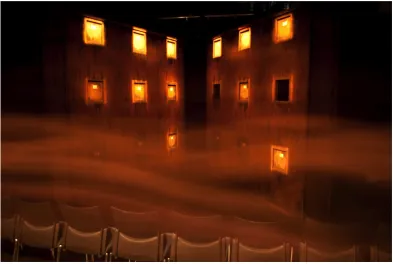
cabinet, with vents that opened to reveal their heads. The opening of these vents in the cabinet would simulate the same interrogative atmosphere as the light in Play. While the characters seemed initially unaware of the mechanism they were trapped within, the ensemble and the audience reported that the ‘machine’ presented an overall narrative for each head that would emerge and re-emerge at pace during the piece.
I would like to recall Anna McMullan’s recent work on Beckett’s late theatre, where the body ‘is presented as both sign and site, engine or matrix of production (of stories, semblances, voice, footfalls or hiccups) and fabric to be composed and recomposed with limited materials’ (2010: 125), we can view the co-existence of mechanical and organic forms of embodiment with Beckettian performances. She continues, the body is ‘itself a matrix of embodiments . . . a site of production, Murphy’s “matrix of surds”’(126). This organic distribution of embodiment over a series of mechanized performance events has been articulated by many of Beckett’s later collaborators in a variety of ways. For example, what McMullan characterizes as ‘the extraordinary physical and vocal discipline needed for such an approach’ has has been expressed as ‘double vision’ by Frank Neumann or ‘spiraling inward’ by Billie Whitelaw (128). Phillip Zarrilli’s notion of ‘bodymind’ (cf. 2001: 2) evokes Pierre Chabert’s extended work on Beckett and practice, where: ‘The body becomes the sensitive receptacle upon which the voice engraves itself, a kind of human tape recorder.’ (1982: 28). In most oral histories on practicing Beckett,
Dark stage. From the shadows gleam three urns with a head visible above each rim. Potted scare-crows [sic.]. Or turnips. Or coconuts to shy at. Whatever the contents, they have rotted. Pause. The mouths open not to speak, hardly to enunciate, but to bleep like electronic machines.
(RNT/PR/4/1/4)
This description provides a comical yet complex way of framing the condition of embodiment experienced by Rosemary Harris, Robert Stephens and Billie Whitelaw at the Old Vic. Turnips in pots, rotting contents, bleeping machines; these are bizarre images of Beckett’s ‘theatre machines’. Audience responses to Fail Better’s ‘machines’ are equally surreal; for example, ‘lovely cogs of man-machine’ and ‘reminds me of Beckett’ (Warwick, 2012). The following detailed analysis of the 1964 production aims to articulate a much fuller account of the organic/mechanical problem.
II. ‘What do you take me for, a something machine?’9
This section will consider archival materials relating to Devine’s staging of Play in 1964 in order to consider Beckett’s presence in the rehearsal process, and the
controversy this prompted at the National Theatre. Following a brief exposition of the collaboration between Beckett and Devine, it will focus on Beckett’s attempts to mechanise the performers. This involved the rapid delivery of text and toneless acting voices. The style was fully supported by Devine, which prompted an urgent request from Tynan: ‘If you could see your way to re-humanising the text a little, I’ll bet that the actors and the audience will thank you – even if Beckett doesn’t!’ (Tynan, 1994: 293). Laurence Olivier (then Artistic Director of the National Theatre) described this event as ‘a
9 W2 in Play: ‘Anything between us, he said, what do you take me for, a something machine? And of course
detonation with an alarming sound-off’ (294) in a memo to Tynan where he also noted an extreme lack of tact from his literary manager.
Since the late 1950s, Devine had emerged as one of the playwright’s trusted collaborators and ‘believed Beckett was the best guide to staging the plays’ (Wardle, 1978: 207). As a result of Roger Blin struggling to fund the first staging of Fin de Partie, ‘the E.S.C. set about acquiring this production to open the 1957 season and dispatched Devine to negotiate the world premiere’ with Beckett (1978: 204). Devine documented this first meeting – ‘half an hour with him in his flat in Paris’ – in almost religious terms: ‘I felt I was in touch with all the great streams of European thought and literature from Dante onwards. The man seemed to have lived and suffered so that I could see’ (204). In Beckett, Devine had discovered ‘another master as austerely incorruptible as Michael Saint-Denis’ (204) and found another mentor in the process. The French language world premiere of Fin de Partie opened at the Royal Court as planned in 1957, soon followed by the English language version (with Devine himself as Hamm), for which ‘Beckett
supervised the last two week’s rehearsals’ (206). This second production established Devine’s faith in the author’s creation, and as a performer ‘he was exceptionally nervous of his responsibilities towards it’ (206).
Play had started life for Beckett as ‘a face play’ in 1961, when he wrote to Herbert
Myron ‘that How It Is is still awaiting revision, but that he has had an idea for a new act, one hour, three faces (mouths) and lights’ (Pilling, 2006: 159). He was invited to the world premiere rehearsals in Germany in the summer of 1963, the year of the play’s
In 1962 Beckett had travelled to London to help Devine on the Royal Court production of Happy Days, which included a last minute casting change resulting in Brenda Bruce playing Winnie. Beckett wrote to his friend Avigdor Arikha that: ‘It didn’t start any too well – voice and inflections wrong. But it’s already much better… She catches on very quickly and works very hard. Devine is very kind and there’s an excellent working atmosphere’ (Knowlson, 1996: 500). However, as Knowlson explains:
A fortnight after his arrival, he wrote to friends that the production was heading for disaster and that he could do nothing to remedy the situation. In fact, the modest, insecure Brenda Bruce needed praise and encouragement, not criticism. And she was so shaken by Beckett’s reactions and by her inability to get it right in his terms, that she finally broke down in floods of tears. (501)
Seeking a mechanically perfect rhythm from the actress, and prepared to go to any lengths to achieve it, his introduction of a metronome to rehearsal exemplified a
paradoxical rift between ‘discipline and sensitivity’ (McCarthy in Oppenheim and Buning, 1996: 150) in a Beckett rehearsal; it also indicated the insensitive and unsustainable methods he practiced at this time. A performer breaking down under the pressure of over-mechanized practice, something Whitelaw would later experience in 1973, represents a ‘stochastic’ moment in the process, where failure creates a feedback loop within the system of production (see Bateson, 1972: 266–7; McKenzie, 2001: 71). Within this context, the author in rehearsal was limiting the actor’s learning process, so Brenda Bruce could only proceed without Beckett in rehearsal. As Knowlson documents:
Herbert’s intervention recognized the delicate balance of what Devine would later call ‘the organic process’ of rehearsal in contrast to the mechanical pressures of production. In 1962 Beckett was still serving his apprenticeship in theatrical production (he would not direct his plays alone until 1966–7 by which time he had observed both Blin and Devine on several occasions). However, Beckett stated simply ‘I’ve been kicked out of rehearsals’ and, according to Knowlson, ‘the damage had already been done’ (502). In Wardle’s account, ‘Devine had stopped directing and virtually handed the show over to the author. Jocelyn Herbert saw a disastrous run-through and gently suggested that Miss Bruce needed some time to herself’ (1978: 207).
There is an important parallel to be drawn between Bruce’s experiences in 1962 and Devine’s own nervousness during rehearsals for his 1957 Endgame. Conditioning bodies for the intense disciplinary rigor of performance, Beckett was not only providing the necessary material circumstances for production, but also discounting the special emotional needs of the actors and, as Tynan would later suggest (1994: 263), the
audience’s experience too. In this period, before Beckett found the confidence to direct production processes in his own right, his presence in rehearsal was somewhere between an avant-garde autocrat and, at least for Bruce’s co-star Peter Dugaid, ‘a meddling amateur’ (Wardle, 1978: 207). Beckett’s next collaboration with Devine crystallized these problems, when the newly formed National Theatre brought author-director
collaborations from the Royal Court to the Old Vic. Devine would direct Beckett’s Play in a double-bill with William Gaskill’s production of Seneca’s Philoctetes (adapted by Keith Johnstone). The Beckett-half of this double bill caused huge controversy in rehearsal.