warwick.ac.uk/lib-publications
A Thesis Submitted for the Degree of PhD at the University of Warwick
Permanent WRAP URL:
http://wrap.warwick.ac.uk/97978
Copyright and reuse:
This thesis is made available online and is protected by original copyright.
Please scroll down to view the document itself.
Please refer to the repository record for this item for information to help you to cite it.
Our policy information is available from the repository home page.
On Reducing the Data Sparsity in Collaborative
Filtering Recommender Systems
by
Xin Guan
Thesis
Submitted to the University of Warwick
for the degree of
Doctor of Philosophy
Department of Computer Science
Contents
Abstract iv
Acknowledgments vi
Declarations vii
List of Tables 1
List of Figures 2
Chapter 1 Introduction 1
1.1 Recommender Systems Techniques . . . 1
1.2 Active Learning in Recommender Systems . . . 4
1.3 Cross-domain Recommender Systems . . . 6
1.4 Datasets . . . 7
1.5 Evaluation . . . 10
1.6 Chanllenges . . . 12
1.6.1 Cold Start . . . 12
1.6.2 Sparsity . . . 12
1.7 Research Questions . . . 13
1.8 Outline . . . 14
2.1 Collaborative Filtering Algorithms for Recommender Systems . . . . 16
2.1.1 Memory-Based Collaborative Filtering . . . 17
2.1.2 Model-Based Collaborative Filtering . . . 21
2.1.3 Memory-Based VS Model-Based . . . 27
2.2 Active Learning in Collaborative Filtering Recommender Systems . . 28
2.3 Cross-domain Collaborative Filtering for Recommender Systerms . . 32
2.3.1 Aggregating Knowledge . . . 33
2.3.2 Transferring Knowledge . . . 36
2.4 Summary . . . 40
Chapter 3 Matrix Factorization with Ratings Completion 42 3.1 Problem Statement and Motivation . . . 42
3.2 Matrix Factorization for Collaborative Filtering . . . 44
3.2.1 Regularized SVD . . . 44
3.2.2 SVD++ . . . 45
3.3 The ProposedEnhanced SVD (ESVD) Model . . . 46
3.3.1 Classic Active Learning Algorithms . . . 46
3.3.2 The Proposed Item-oriented Approach . . . 48
3.3.3 The Proposed User-oriented Approach . . . 49
3.3.4 Evaluation . . . 56
3.3.5 The Proposed ESVD++ . . . 60
3.4 The ProposedMultilayer ESVD (MESVD) . . . 60
3.4.1 Experimental Results . . . 62
3.5 The Proposed Extensions ofESVD . . . 65
3.5.1 The Proposed Item-wise ESVD (IESVD) . . . 65
3.5.2 The Proposed User-wise ESVD . . . 67
3.5.3 Experimental Results . . . 69
Chapter 4 A Generalized Framework of System-Driven Active Learn-ing in Collaborative FilterLearn-ing Recommender Systems 76
4.1 Problem Statement and Motivation . . . 76
4.2 Traditional Active Learning in Collaborative Filtering . . . 78
4.3 The System-DrivenActiveLearning in Collaborative Filtering . . . . 80
4.3.1 The Proposed Generalized Framework . . . 81
4.3.2 Active Learning Strategies . . . 84
4.4 Evaluations of the Proposed Framework . . . 87
4.4.1 Datasets and Experimental Setup . . . 87
4.4.2 Performance Analyses . . . 89
4.4.3 Comparison with Traditional Active Learning . . . 95
4.5 Summary . . . 98
Chapter 5 Active Learning in Cross-Domain Collaborative Filtering for Sparsity Reduction 100 5.1 Problem Statement and Motivation . . . 100
5.2 Related Work . . . 102
5.3 Rating-Matrix Generative Model (RMGM) . . . 104
5.4 Active Learning for Multi-Domain Recommendations . . . 106
5.5 Evaluations of the Proposed Framework . . . 108
5.5.1 Datasets and Experimental Setup . . . 108
5.5.2 Evaluation Strategies . . . 109
5.5.3 Performance Analyses . . . 110
5.6 Summary . . . 116
Chapter 6 Conclusion 117 6.1 Thesis Summary . . . 117
6.2 Contribution . . . 117
Abstract
A recommender system is one of the most common software tools and tech-niques for generating personalized recommendations. Collaborative filtering, as an effective recommender system approach, predicts a user’s preferences (ratings) on an item based on the previous preferences of other users. However, collaborative filtering suffers from the data sparsity problem, that is, the users’ preference data on items are usually too few to understand the users true preferences, which makes the recommendation task difficult.
This thesis focuses on approaches to reducing the data sparsity in collab-orative filtering recommender systems. Active learning algorithms are effective in reducing the sparsity problem for recommender systems by requesting users to give ratings to some items when they come in. However, this process focuses on new users and is often based on the assumption that a user can provide ratings for any queried items, which is unrealistic and costly. Take movie recommendation for example, to rate a movie that is generated by an active learning strategy, a user has to watch it. On the other hand, the user maybe be frustrated when asked to rate a movie that he/she has not watched. This could lower the customer’s confidence and expecta-tion of the recommender system. Instead, an ESVD algorithm is proposed which combines classic matrix factorization algorithms with ratings completion inspired by active learning, allowing the system to ’add’ ratings automatically through learning. This general framework can be incorporated with different SVD-based algorithms such asSVD++by proposing theESVD++method. The proposedEVSD model is further explored by presenting theMESVD approach, which learns the model itera-tively, to get more precise prediction results. Two variants ofESVD model: IESVD
and UESVD are also proposed to handle the imbalanced datasets that contains
framework. Specifically, it focuses on the elicitations of the past users instead of the new users and considers a more general scenario where users repeatedly come back to the system instead of during the sign-up process. In the proposed framework the ratings are elicited by combining the user-focused active learning with item-focused active learning, for the purpose of improving the performance of the whole system. A variety of active learning strategies are evaluated on the proposed framework. Experimental results demonstrate its effectiveness on reducing the sparsity, and then enables improvements on the system performance.
Acknowledgments
First and foremost, I would like to take this opportunity to express my deepest
gratitude and respect to my supervisor Prof. Chang-Tsun Li, who constantly gave
me support during my Phd time at the University of Warwick. His great
person-ality, unlimited patience and tolerance have educated me a lot more than scientific
research.
My parents, Dr. Huaimin Guan, Mrs. Cuihua Wang and my brother, Dr.
Yu Guan also deserve my cordial gratitude. Their love, support and encouragement
have always been the source of my strength and the reason I have progressed this
far.
I wish to express my sincere thankfulness to my annual progress panel
mem-bers Dr. Victor Sanchez, Dr. Abhir Bhalerao and Dr. Nathan Griffiths for their
guidance and valuable suggestions on my PhD progress.
I would also like to thank the colleagues at the department, Dr. Alaa
Kha-didos, Dr. Ruizhe Li, Dr. Xin Lu, Dr. Xingjie Wei, Dr. Yi Yao, Dr. Xufeng Lin,
Mr. Ning Jia, Mr. Roberto Leyva, Mr. Qiang Zhang, Mr. Bo Wang, Mr. Shan Lin,
Mr. Ching-Chun Chang, Mr. Yi Hao and Mr. Yijun Quan for their kindness and
support.
Last but not least, many thanks to my friends, Dr. Tinghua Duan, Dr. Jiang
Wang, Mr. Xiaopeng Cai, Mr. Cheng Li, Mr. Jianxiong Tie, Mr. Lidou Hao, Mr.
Guang Chen, Mr. Boyang Peng and Mr. Chengyu Yu, for sharing in my happiest
Declarations
I hereby declare that the work presented in this thesis entitledOn Reducing the Data
Sparsity in Collaborative Filtering Recommender Systems is an original work and
has not been submitted to any college, university or any other academic institution
List of Tables
1.1 An example of a rating matrix . . . 2
1.2 An example of cross-domain recommender system . . . 6
1.3 Comparison of different datasets of recommender systems . . . 9
1.4 An example of the cold start problem . . . 12
1.5 Sparsity of different datasets of recommender systems . . . 13
3.1 RMSE ofESVD onMovielens 100K (The Density-Oriented Approach) 58 3.2 RMSE of ESVD onNetflix (The Density-Oriented Approach) . . . . 58
3.3 RMSE of MESVD on Movielens 100K . . . 64
3.4 RMSE of MESVD on Netflix . . . 65
3.5 Experimental datasets . . . 69
3.6 Comparison of the proposed methods onMI (6040×263) . . . 70
3.7 Comparison of the proposed methods onMU (401×3952) . . . 70
3.8 Comparison of the proposed methods onNI (6800×500) . . . 70
List of Figures
1.1 An example of active learning . . . 4
1.2 Active learning procedure . . . 5
3.1 The number of ratings each item has received (popularity) in Movie-lens 100K . . . 48
3.2 Procedures of Item-oriented Approach . . . 49
3.3 The number of ratings each user has rated (activity) inMovielens 100K 51 3.4 Procedures of User-oriented Approach . . . 53
3.5 Procedures ofESVD . . . 55
3.6 Movielens: RMSE comparisons of proposed methods based on SVD 57 3.7 Netflix: RMSE comparisons of proposed methods based on SVD . . 57
3.8 Procedures ofMultilayer ESVD . . . 61
3.9 Procedures of Item-wiseESVD . . . 66
3.10 Procedures of User-wise ESVD . . . 68
3.11 RMSE of the proposed methods onMI (6040×263) . . . 72
3.12 RMSE of the proposed methods onMU (401×3952) . . . 72
3.13 RMSE of the proposed methods onNI (6800×500) . . . 73
3.14 RMSE of the proposed methods onNU (955×3561) . . . 73
4.1 SystemRMSE evolution based on the learning process onMovielens
100K . . . 90
4.2 System RMSE evolution based on the learning process on Netflix . . 90
4.3 Elicited ratings evolution onMovielens 100K . . . 92
4.4 Elicited ratings evolution onNetflix . . . 92
4.5 System RMSE evolution versus the number of elicited ratings on
Movielens 100K . . . 94
4.6 SystemRMSE evolution versus the number of elicited ratings onNetflix 94
4.7 System RMSE comparison onMovielens 100K . . . 96
4.8 System RMSE comparison onNetflix . . . 97
5.1 System RMSE evolution onNetflix+Movielens+Book-Crossing with
elicitations fromMovielens . . . 111
5.2 System RMSE evolution onNetflix+Movielens+Book-Crossing with
elicitations fromNetflix . . . 111
5.3 System RMSE evolution onNetflix+Movielens+Book-Crossing with
elicitations fromBook-Crossing . . . 112
5.4 System RMSE evolution onNetflix+Movielens+Book-Crossing with
elicitations from all three datasets . . . 112
5.5 System RMSE evolution on Netflix+Movielens+Book-Crossing
ver-sus the number of elicited ratings fromMovielens . . . 114
5.6 System RMSE evolution on Netflix+Movielens+Book-Crossing
ver-sus the number of elicited ratings fromNetflix . . . 114
5.7 System RMSE evolution on Netflix+Movielens+Book-Crossing
ver-sus the number of elicited ratings fromBook-Crossing . . . 115
5.8 System RMSE evolution on Netflix+Movielens+Book-Crossing
Chapter 1
Introduction
1.1
Recommender Systems Techniques
Recommender systems have become increasingly common recently and are used by
many internet providers. Examples include movie recommendation by Netflix [1],
web page ranking by Google [2], related product recommendation by Amazon [3],
social recommendation by Facebook [4], etc. They provide users with personalized
suggestions by predicting the rating or preference that the users would give to an
item, and typically apply techniques and methodologies from other neighboring
areas such as Human Computer Interaction or Information Retrieval. In addition,
Data Mining plays a vital role in recommender systems since the core algorithms
in most of these systems can be understood as a particular case of a Data Mining
technique [5].
As one of the most common software tools and techniques, recommender
systems are used for generating recommendations to users, usually in one of the
following ways:
- Collaborative filtering [6] [7] [8] predicts other items the current users might
like based on the past knowledge about preferences (usually expressed in
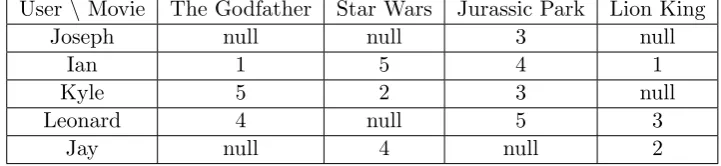
Table 1.1: An example of a rating matrix
User \Movie The Godfather Star Wars Jurassic Park Lion King
Joseph null null 3 null
Ian 1 5 4 1
Kyle 5 2 3 null
Leonard 4 null 5 3
Jay null 4 null 2
is that people who agreed in the past will also agree in the future [9]. Pure
collaborative filtering approaches take a user-item rating matrix (Table 1.1)
as the only input, for predicting how users in the system like a certain items
or generating a list of top-N recommendations for users to choose.
- Content-based algorithms [10] produce recommendations based on items
de-scriptions which can be automatically extracted or manually created, or (and)
user profiles that represent the users’ interests on items. This type of
approach-es must rely on the information about items and user preferencapproach-es, such as genre
of a movie, author of a book. However, a large collective of rating history is not
required compared with collaborative filtering. Content-based filtering is
of-ten used by incorporating with other techniques such as collaborative filtering
when additional information is supplied, such as music recommendation [11].
- Knowledge-based algorithms [12] generate recommendations by exploiting
ex-plicit user requirements and detailed domain knowledge about item features,
reasoning about what items meet the users needs. There are two types of
knowledge-based algorithms: Case-based algorithms [13] determine
recom-mendations based on the similarity metrics, trying to find out those
descrip-tions best match the users query, such as the service of personal shopper [14];
constraint-based algorithms [15] make decision on recommendations by
ex-ploiting predefined recommender knowledge bases that contain explicit
con-straints about how to relate a user’s requirements with item properties, which
content-based recommender systems, knowledge-based systems rely mainly on
externally provided information about the available items.
- Hybrid approaches [18] generate recommendations by combining several
algo-rithms or recommendation components, which are based on the above three
base approaches: collaborative filtering and content-based and
knowledge-based algorithms. The three main recommendation approaches exploit
dif-ferent sources of information: collaborative filtering algorithms are based on
user preferences (i.e. ratings); content-based approaches rely on item features
and textual descriptions; knowledge-based exploit external knowledge as the
logical rules that map the users requirements onto item features. When
multi-ple sources of information are supplied, building hybrid systems that combine
the strengths of different algorithms leads to the improvement of the overall
accuracy.
This thesis focuses on collaborative filtering recommender systems because
the collaborative filtering algorithm is considered the most important technique,
and is widely used in industry, especially in online retail sites to customize the
needs for customer, in order to promote additional items and increase sales [1].
In particular, the user-item rating matrix (matrices) is considered to be the only
source of information in this thesis. The task is to predict the users’ preferences
on a specific item, which can be defined as: given a rating matrix R∈Rm×n that
consists of m users and n items where each rating rij represents the preference of
user i to item j, fill the missing values in R so that the recommender system can
recommend the items with the highest predicted ratings in the row Ri,: to the user
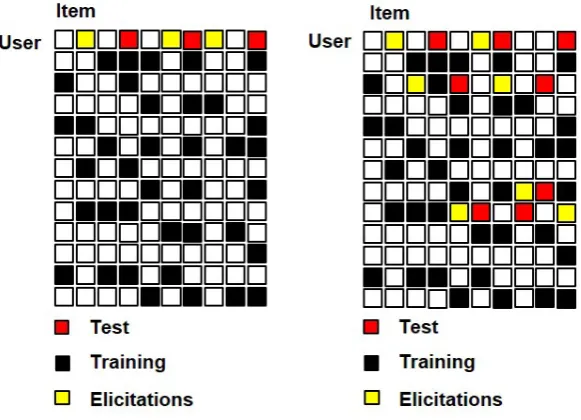
(a) Active learning for new user (new user problem)
[image:16.595.179.470.112.322.2](b) Active learning for all the users
Figure 1.1: An example of active learning
1.2
Active Learning in Recommender Systems
Most collaborative filtering algorithms suffer from the new user problem. That is,
when a new user comes in, there is not enough knowledge about this user. As a
result, the system will fail to generate proper recommendations given the
circum-stance. Active learning [19] for recommender systems has been initially proposed
for tackling the new user problem. In real-life scenarios, most recommender
sys-tems would only ask the user to rate a limited number of isys-tems (elicitations) during
the sign-up process [20], for better predicting the preferences of the target user (as
shown in Figure 1.1(a)).
Apart from the sign-up process, users can give elicitations whenever he or
she is motivated, based on the assumption that users would come back to the system
regularly [21]. Under this setting, ratings could be elicited (elicitations) from both
new users (without training data) and existing users (with training data) in the
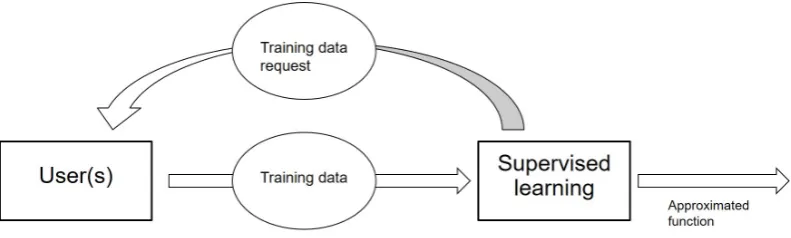
Figure 1.2: Active learning procedure
In both scenarios, the knowledge of the user (or the system) are extended by
requesting users for more data (a.k.a. ratings), and then affects the recommendation
accuracy for the target users (as shown in Figure 1.2). However, the usefulness of
each rating may vary significantly, special techniques (a.k.a. active learning
strate-gies) can be used to intelligently obtain data that better reflects user’s preferences
and enables to produce better recommendations.
In the review work of [22], a variety of active learning strategies have been
analyzed and classified with respect to two distinct dimensions: personalization and
hybridization.
- Personalization: personalized strategies query different user for different items
based on the characteristics each user has, while non-personalized strategies
request all the users to rate the same items.
- Hybridization: single-heuristic strategies are based on one heuristic by utilizing
the unique selection rule for both items and users, while combined-heuristic
strategies implement multiple selection rules for items and users by aggregating
and combining a number of single-heuristic strategies, in order to achieve a
range of objectives.
It should be noted that, with more and more ratings being elicited by active
learning, not only the cold start problem is addressed, the sparsity problem is also
Table 1.2: An example of cross-domain recommender system
Domains Joseph Ian Kyle Leonard Jay Xin
Book Harry Potter 3 5 4
The Hobbit 1 3 5
Movie The Godfather 2 3 5 2
Star Wars 5 1 2 5
Music Let It Be 2 4 2
Hey Jude 1 3 3
Domains no overlap overlap between domains
the queried users, along with the performance of the whole system.
1.3
Cross-domain Recommender Systems
Traditional recommender systems suggest items belonging to a single domain.
Ex-amples include movies in Netflix, books in Book-Crossing, songs in Last.fm, etc.
Nowadays, users provide feedback for items of different types (e.g. books, DVDs,
etc.) and express their opinions on different social media and different providers
(e.g. Amazon, Netflix, etc.). Instead of treating each domain independently,
knowl-edge could be transfered from the source domain to the target domain for better
prediction accuracy based on the assumption that information overlap between users
and/or items across different domains (Table 1.2), which is referred as cross-domain
recommendations.
A domain is a particular field of thought, activity or interest. In the literature
[23] researchers have considered distinct notions of domain at four levels:
- Attribute level: same types of items with different values of certain attribute
(e.g. comedy and thriller in movie genres).
- Type level: similar types of items, sharing some attributes (e.g. movie and
TV shows in Amazon).
- Item level: different types of items (e.g. books in Book-Crossing and movies
- System level: same type of items on different systems (e.g. movies inNetflix
andMovielens)
The goal of cross-domain recommendation is to utilize the knowledge derived
from the auxiliary domain(s) with sufficient ratings to alleviate the data sparsity
in the target domain. A special case of cross-domain recommendation is
multi-domain recommendation that utilize the shared knowledge across multiple multi-domains
to alleviate the data sparsity in all domains, when all domains suffer from the data
sparsity problem [24].
In this work, the multi-domain recommendation, which utilizes the shared
knowledge across multiple domains, is considered at the item level (books in
Book-Crossing and movies inMovielens&Netflix).
1.4
Datasets
In collaborative filtering algorithms, recommendations are generated by exploiting
ratings as the source of information. Ratings are collected by asking user’s opinion
about items on a rating scale, usually in a variety of forms [8]:
- Numerical ratings: such as the 1-5 stars provided in the movie or book
rec-ommender systems.
- Binary ratings: that model choices the user to an item, in which the user is
simply asked to decide if a specific item is good or bad.
- Ordinal ratings: expressed as the levels of perferences such as [strongly agree,
agree, neutral, disagree, strongly disagree], in which the user is asked to select
the term that indicates his or her opinions to an item.
- Unary ratings: usually expressed in explicit way, such as purchase, assess,
Datasets are formed as a collection of ratings, then are used as benchmarks
to evaluate new recommendation algorithms and to compare with other existing
algorithms. Datasets are important for training and testing recommender systems,
therefore some commonly used datasets are introduced includingMovieLens,Netflix,
EachMovie,Book-Crossing,Jester and Yahoo! Music.
- MovieLensDataset [25]: a classic recommender system that recommends films
to users through collaborative filtering algorithms. There are three datasets
of different sizes that are collected by Grouplens Research. The 100K and
1M datasets contain demographic information about the users (age, gender,
occupation, zip), while in 10M dataset only user ID is given. The 100K dataset
collects 100,000 ratings from 943 users on 1,682 movies. The 1M dataset
contains 1,000,209 entered by 6,040 users for 3,900 different movies. The
10M dataset consists of 10,000,054 ratings with 95,580 tags to 10,682 movies
provided by 71,567 users. For all three datasets, each user has rated at least
20 movies, and each rating is an integer ranging from 1 to 5 which represents
the interests the user has to this movie.
- Netflix Dataset [1]: the world’s largest online DVD rental service company,
that released their dataset collected between October 1998 and December 2005.
It consists of over 100 million 5-star ratings of 480,189 users and 17,770 movies.
- EachMovie Dataset [26]: a movie recommender system that contains 2.8
mil-lion numeric ratings entered by 72,916 users for 1,628 films and video. Each
rating ranges from 1 to 6, representing the preferences of the user to the movie.
- Book-Crossing Dataset [27]: a book rating dataset containing 1.1 million
ex-plicit (expressed on a scale from 1 to 10) and imex-plicit (expressed by 0)
rat-ings from 278,858 users on 271,379 books. In particular, demographic data
(location, age) is provided for the users if available, and some content-based
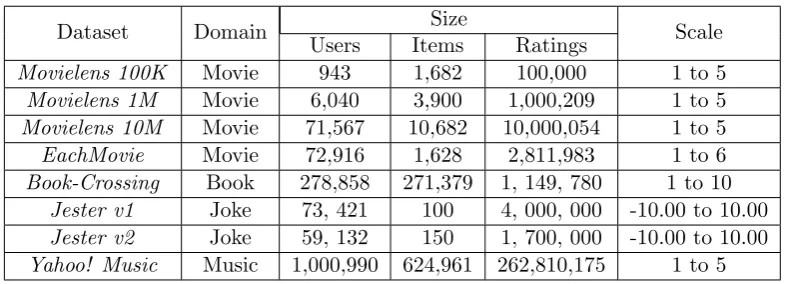
Table 1.3: Comparison of different datasets of recommender systems
Dataset Domain Size Scale
Users Items Ratings
Movielens 100K Movie 943 1,682 100,000 1 to 5
Movielens 1M Movie 6,040 3,900 1,000,209 1 to 5
Movielens 10M Movie 71,567 10,682 10,000,054 1 to 5
EachMovie Movie 72,916 1,628 2,811,983 1 to 6
Book-Crossing Book 278,858 271,379 1, 149, 780 1 to 10
Jester v1 Joke 73, 421 100 4, 000, 000 -10.00 to 10.00
Jester v2 Joke 59, 132 150 1, 700, 000 -10.00 to 10.00
Yahoo! Music Music 1,000,990 624,961 262,810,175 1 to 5
- Jester Dataset [28]: a web-based joke recommender system, developed at
U-niversity of California, Berkeley. The first Jester dataset contains over 4.1
million continuous ratings (-10.00 to +10.00) of 100 jokes from 73,421
user-s: collected between April 1999 - May 2003, and the second dataset collects
over 1.7 million continuous ratings (-10.00 to +10.00) of 150 jokes from 59,132
users: collected between November 2006 - May 2009.
- Yahoo! Music Dataset [29]: a personalized internet music recommender
sys-tem. The dataset consists 262,810,175 ratings of 624,961 music songs by
1,000,990 users collected during 1999-2010. The ratings include one-minute
resolution timestamps, allowing refined temporal analysis. Each item and
each user have at least 20 ratings in the whole dataset.
Overall, the datasets in real-world recommender systems often consist of
large number of ratings that represents users’ preferences on items in the form of
different ratings scales. This thesis mainly utilizesMovielensandNetflix datasets for
training and test the proposed collaborative filtering algorithms and active learning
algorithms in Chapter 3 and Chapter 4. For exploring cross-domain collaborative
filtering techniques in Chapter 5, theMovielens,Netflix andBook-Crossing datasets
1.5
Evaluation
The quality of a recommender system can be decided based on the results of
eval-uation. Metric selection depends on the type of collaborative filtering applications.
A majority of the work has focused on the evaluation of a recommender systems
accuracy, which is also the main task of collaborative filtering recommender
sys-tems. To compare the accuracy of different collaborative filtering algorithms, the
metrics must be predefined. An accuracy metric empirically measures the difference
between a recommender system’s predicted ratings and the user’s true ratings for
a specific item, or between the predicted ranking of items for a user and the user’s
true ranking of perference: the less, the better. Accordingly, recommendation
accu-racy metrics are typically classified into three classes: predictive accuaccu-racy metrics,
classification accuracy metrics and rank accuracy metrics.
- Predictive accuracy metrics are used for measuring how close a recommender
system’s predictions are to the users true ratings for each movie. Commonly
used metrics include Mean Absolute Error (MAE) [30] and its variations.
- Classification accuracy metrics measure the frequency with which a
recom-mender system recommends relevant or irrelevant items for a given user,
ex-amples includePrecision [31],Recall [31],Mean Average Precision (MAP)[6]
and Receiver Operating Characteristic (ROC) [6], which of metrics are often
used for the top-N recommendation, i.e. the recommender system produce a
number of recommendations once a time for the user.
- Rank accuracy metrics extend classification accuracy metrics by taking items
relative position in recommendation lists into account. It measures the ability
of a collaborative filtering algorithm to produce a ranked recommendation lists
for a user that matches the user’s ordering of the same items, usually by
Sometimes even if a recommender system is able to correctly rank users’
preferences on items, the system could fail to predict the ratings. On the other
hand, the predicted ratings can be used for creating an ordering across the items,
for measuring the ability of a recommender system to rank items with respect to
user preference. Therefore this thesis is mainly focusing on the collaborative filtering
recommendations in terms of prediction task, the commonly used predictive
accu-racy metrics are introduced. For other collaborative filtering evaluation metrics, see
the work of Herlocker et al. in [6] as well as the work of Shani et al. in [33].
Mean Absolute Error (MAE)and Root Mean Square Error (RMSE)are two
most commonly used predictive accuracy metrics. Given a recommender system, in
where rij is the rating that the ith user gives to the jth item, ˜rij is the predicted
ratings accordingly, andTis the total number of test samples. MAE [30] is defined
as:
MAE =
P
(i,j∈T estSet)
|rij−˜rij|
T (1.1)
MAE measures the average absolute deviation between a predicted rating and the
users true rating. RMSE [1] is defined as:
RMSE =
v u u t
P
(i,j∈T estSet)
(rij−˜rij)2
T (1.2)
RMSE amplifies the contributions of the absolute errors between the
pre-dictions and the true values, therefore the result has more emphasis on large errors
when compared withMAE.
This thesis mainly adopts RMSE as the evaluation metric for measuring
Table 1.4: An example of the cold start problem
User\Movie The Godfather Star Wars Jurassic Park Fast & Furious 8 Lion King
Joseph null null 3 null null
Xin null null null null null
Ian 1 5 4 null 1
Kyle 5 2 3 null null
Leonard 4 null 5 null 3
Jay null 4 null null 2
1.6
Chanllenges
1.6.1 Cold Start
Most collaborative filtering algorithms suffer from the cold start problem, which
occurs when a new user or item has just entered the system. Since there is no
information for the target user or item, the collaborative filtering will fail to generate
recommendations. Cold start problem is also known as new user problem (e.g. user
Xin in Table 1.4) or new item problem (e.g. movie Fast & Furious 8 in Table
1.4). Most of the research utilizes the hybrid recommendation approach [34], which
combines content-based and collaborative filtering, to tackle the cold start problem.
However, building model based on hybrid approach is usually complicated, while the
improvements is limited. One of the effective solutions is to apply active learning
techniques that query the users to rate some specific items during the sign-up process
[20].
1.6.2 Sparsity
The sparsity of a rating matrix is defined as [35]:
Sparsity= 1− #ratings
#users×#items (1.3)
where # denotes the total number.
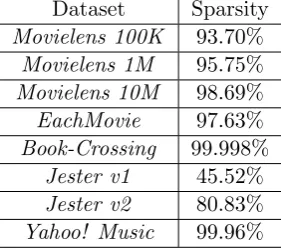
The sparsity problem is the major bottleneck for collaborative filtering
Table 1.5: Sparsity of different datasets of recommender systems
Dataset Sparsity
Movielens 100K 93.70%
Movielens 1M 95.75%
Movielens 10M 98.69%
EachMovie 97.63%
Book-Crossing 99.998%
Jester v1 45.52%
Jester v2 80.83%
Yahoo! Music 99.96%
user is usually very small compared to the number of available items in the dataset
since users are typically reluctant to rate a large amount of items. Therefore the
user-item rating matrix used for collaborative filtering will be extremely sparse (as
shown in Table 1.5). While most research in the field of recommender systems focus
on improving prediction algorithms, even the best algorithm will fail without
suffi-cient data. Take movie recommendation as an example, the movies that have been
rated with only few ratings would be recommended rarely, even with high ratings.
Also, users with special tastes for movies usually suffer from poor recommendations
since similar users are rare in the system.
In this thesis, the cold start problem is not the priority to be concerned
since it only arises when a new user or item is added into the systems. Instead,
the techniques that tackle the sparsity problem are focused because it happens
universally in collaborative filtering recommender systems.
1.7
Research Questions
This thesis addresses the sparsity problem of collaborative filtering
algo-rithms in three aspects, which leads to three research objectives, respectively.
- Recommender systems often apply active learning to handle the cold start and
col-laborative filtering recommender systems, I propose to extend the traditional
collaborative filtering algorithm (i.e. matrix factorization) with ratings
com-pletion. In the proposed method, systems automatically ’add’ ratings based
on a variety of rules in the framework of matrix factorization algorithm. With
the extra generated ratings, the sparsity problem is alleviated and the
perfor-mance of the recommender system is improved.
- Active learning algorithms enrich the dataset by querying users to label items,
often focusing on single user or users, without considering the benefits of the
whole system. In the field of active learning collaborative filtering, I propose a
general system-driven framework for applying active learning in recommender
systems. In the proposed framework, the system queries specific users to rate
specific items based on combined rating elicitation strategies. Results suggest
its effectiveness in handling the sparsity problem.
- Cross-domain collaborative filtering techniques alleviate the sparsity problem
by exploiting knowledge from auxiliary (source) domains. A novel
multi-domain active learning framework is proposed by incorporating active learning
techniques with cross-domain collaborative filtering algorithms in the
multi-domain scenarios. Therefore in each single-multi-domain the sparsity problem can
be alleviated by querying users for ratings, aggregating them will further
han-dle the sparsity problem, resulting in further improvements of the prediction
accuracy.
1.8
Outline
The rest of this thesis is organized as follow:
Chapter 2 reviews the traditional collaborative filtering algorithms, such
as memory-based and model-based collaborative filtering algorithms. Then active
summarized based on the characteristics of the elicitation strategies. The
state-of-the-art cross-domain collaborative filtering algorithms are presented as well.
Chapter 3 first briefly introduces the collaborative filtering task. Then the
matrix factorization method [36] is presented as one of the most commonly used
collaborative filtering algorithms in recent years. Based on this framework, the
proposed Enhance SVD method and its variations are introduced by exploiting
ratings completion, along with the corresponding experimental analysis. A summary
of the proposed algorithms is provided at last.
Chapter 4 introduces the active learning techniques used in collaborative
filtering recommender systems and their limitations. The proposed active learning
framework is shown by adding constraints to the users. Performance analysis and
comparison with traditional active learning are demonstrated at last.
Chapter 5 first introduces the cross-domain techniques, especially the
R-MGM model that used in domain scenario. Then active learning for
multi-domain recommendations is introduced by incorporating active learning techniques
withRMGM model. Comprehensive evaluations demonstrate the advantages of the
proposed framework.
Chapter 6 summarizes the achievements of this thesis and presents some
Chapter 2
Literature Review
2.1
Collaborative Filtering Algorithms for Recommender
Systems
Collaborative filtering is a method that makes recommendations by using ratings
given to items by users as the only source of information. It was first proposed by
Goldberg el at. [9]. They built a collaborative filtering system that allowed users
to annotate messages for filtering emails. This work was proved to be effective
by involving human activity in the filtering process in contrast to content based
filtering. Later collaborative filtering algorithms have been used widely because of
its applicability in many domains. Examples include:
- Hill et al. [37] compared the user’s ratings of videos with others to find people
with similar interests and gave recommendations based on the ratings that
similar people have rated in the video recommendation.
- Shardanand et al. [38] used collaborative filtering for providing suggestions to
the user based on similarities between the interest profile of that user and those
of other users. Based on this technique they designed a system called Ringo
- Grouplens group [39] designed a collaborative filtering system forUsernet news
to allow user to rate articles. They demonstrated that collaborative filtering
could be implemented for predicting ratings to each user.
In recent years collaborative filtering has become the most prominent approach to
generating recommendations. Various algorithms have been proposed and
evalu-ated on real-world and artificial test data. Empirical studies such as [34] and [30]
categorized the collaborative filtering algorithms into two classes: memory-based
al-gorithms and model-based alal-gorithms, as detailed in the following two subsections.
2.1.1 Memory-Based Collaborative Filtering
Memory-based algorithms [30] [40] predict ratings for the user based on the entire
collection of previously rated items by the users. Therefore prediction is computed as
an aggregation of the ratings regarding other users that are usually chosen based on
the similarity for the same items. Early research on the algorithms of recommender
systems were focused on the neighbourhood models [38] [39] [41]. Neighbourhood
models give predictions based on the similarity relationships among either users or
items. Generally, they select a number of similar users or items based on a certain
similarity measure. Then the prediction is computed based on the ratings of their
neighbours. Memory-based algorithms can be classified as user-based or item-based
depending on whether the process of searching for neighbours focuses on users or
items.
2.1.1.1 User-Based Algorithms
Because some users are likely to prefer the same items with the same taste,
user-based methods only consider those users similar to the target user instead of using
information from all users. User-based algorithm were first proposed by Resnick
et al. in [41], and they used Pearson correlation coefficient as the similarity
of Neighbours strategy was proposed for neighbour selection, i.e. a number of the
most similar users are selected as the neighbours of the target user. A large number
of the neighbours tend to introduce too much noise because the users with small
correlations are also chosen as neighbours, while a small number of neighbours is
also likely to result in poor prediction accuracy because highly correlated users are
excluded from the neighbours. The prediction was calculated by the aggregation of
each neighbour which is weighted by his/her similarity with the active user.
Subse-quently, another neighbourhood selection strategy was proposed by Shardanandi et
al. [38]. They named itCorrelation Threshold strategy, which only selects the users
by thresholding the similarities. It limits the neighbour to contain good correlations.
However, only a small number of the neighbours will be chosen for some target users
who have less high correlated neighbours.
Most research on user-based collaborative filtering algorithms are focused on
various approaches to computing the similarity measure between users. Shardanand
et al. [42] proposed to use Mean Squared Difference as the similarity measure
be-tween users based on the mean difference of the items that both users have rated.
Later the same authors [38] took into consideration that the ratings consisting of
both positive numbers and negative numbers, and proposed the Constrained
Pear-son that uses the median of ratings instead of the mean rating in the Pearson
correlation coefficient as the similarity measure. Another very common measure is
cosine similarity which measures the cosine between the vectors of two users [30].
Cosine similarity is normally used in information retrieval and text mining, and
has been shown to produce better results in item-based recommender systems
com-pared with user-based recommender systems. Herlock et al. [43] further improved
the accuracy of user-based algorithms by adding fine-grained neighbor weighting
factors. They [44] also proposed the Z-score Normalization which adds a
normal-ization function before weighting the user’s ratings according to similarity because
Recent research takes side information into account in more complicated
scenarios to explore the further potential of the user-based algorithms. Melville et al.
[7] applied prediction by content-based algorithms (based on the content of the items
and user profiles) to convert a sparse user rating matrix into a full rating matrix,
and employed user-based collaborative filtering for recommendation. Results showed
that the accuracy of recommendation is improved by extending collaborative filtering
with content information of items. To alleviate the sparsity problem of rating matrix
where finding similar users is often failed, Massa et al. in [45] and [46] proposed to
propagate trust over the trust social network and inferred the trust weight instead
of the similarity weight, respectively. In [47], the geo-tags were used for improving
the user-based collaborative filtering. Specifically, the similarity between two users
were calculated by their geo-tag distributions based onGaussian kernel convolution.
The geo-tags of the most similar users were chosen, then combined to re-rank the
popular locations in the target city for personalized location prediction. [48] used
both social network and the user-contributed tags as the side information to generate
the similarities between users for ratings prediction.
2.1.1.2 Item-based Algorithms
In contrast to user-based methods, item-based algorithms use similar items instead
of users as neighbors for the aggregation. Most similarity measures used in
user-based methods work for item-user-based algorithms. Cosine similarity [30] or adjusted
cosine similarity [49] are commonly used and have been proved to be effective in
item-based scenarios.
In previous works, weights were often calculated by arbitrary similarity
func-tions, mainly through trial and error. Bell and Koren [50] pointed out that the
tra-ditional neighborhood-based methods do not account for interactions among
neigh-bors. Take a movie recommendation for example, a series of movies (such as Harry
similarity of these movies when determining their interpolation weights, may end
up essentially multiple counting the information provided by the group. They [50]
proposed to apply optimization to find the weights by minimizing the squared error
between an item’s rating and ratings of its neighbours. It was considered to be not
only a more principled approach, but by deriving weights simultaneously, interaction
effects was overcame. Subsequently, Koren [51] further proposed a more accurate
neighbourhood model by considering what the user rated as explicit information,
but also what he or she did not rate as implicit information. Because both latent
factor model and neighbourhood model have their own merits and drawbacks, by
combining them together, they obtained an integrated model by allowing them to
enrich each other [51].
Side information was also studied when collaborating with the item-based
al-gorithms. TrustWalker [52] has been proposed by integrating a random walk model
into item-based collaborative filtering with trust information. In the work of [18],
the authors used semantic ratings obtained from the knowledge-based part
(knowl-edge of how these items meet a user’s needs) of the system to improve collaborative
filtering for the purpose of recommending restaurants. Tso et al. [53] proposed to
compute the similarities between items using the combination of attribute
informa-tion and rating based similarities. In [54], Firan et al. introduced an algorithm that
uses tags to recommend users’ interested songs and studied the difference between
collaborative filtering recommendations based on tag profiles and
recommendation-s barecommendation-sed on recommendation-song/track profilerecommendation-s (content-barecommendation-sed). Later Trecommendation-so et al. [55] proporecommendation-sed a
similarity fusion algorithm that calculates the user-user (or item-item) similarity
based on both tags and ratings within memory-based collaborative filtering.
Tag-ommenders [56] were proposed as a group of tag-based recommendation algorithms
that predict users’ preferences for items based on their inferred preferences for tags.
Liang et al. [57] extracted the semantic meaning of each tag by exploring the
based on the semantic meaning of each tag in the traditional memory-based
frame-work. In addition to tags, geo-tags have also been exploited. Users’ frequented
shops were employed as input to the item-based collaborative filtering algorithm for
shop recommendation [58]; Horozov et al. [59] made use of location information as
a key criterion for restaurant recommendation. Studies showed that incorporating
side information would enhance the recommendation quality of the memory-based
collaborative filtering algorithms.
2.1.1.3 User-Based vs Item-Based
Both user-based and item-based methods need to identify the nearest neighbours to
the target sample based on a certain similarity measure either by user’s or item’s
perspective. The choice of user-based or item-based algorithms depends on the
characteristics of the domain. For most recommender systems, there typically are
many more users than items, and new users come in much more frequently than
new items, so it is easier to compute all pairs of item-item similarities. Another
consideration is that item-based algorithms can be helpful in offering an explanation
as to why an item was recommended, since similar users have purchased an item is
less persuasive than arguing that a given item is recommended because it is similar
to other items purchased in the past. However, in some domains such as the context
of news, the item dimension changes much faster than the user based, therefore the
system should favour the user-based approach.
2.1.2 Model-Based Collaborative Filtering
Another category of collaborative filtering is model-based methods. Model-based
algorithms predict ratings based on the models which are learnt from the collection
of ratings. Recent studies showed that a lot of model-based algorithms are related
to machine learning. Examples include:
Decom-position (SVD) to predict ratings for recommender systems.
- In [62] and [63], clustering was applied for generating recommendations.
- Billsus et al. [60] predicted items for users based onNeural Networks.
- In the work of [30], Breese et al. concluded the empirical collaborative
fil-tering algorithms, and employed Bayes Networks to model the conditional
probability between items for recommendation.
- In addition, Aggarwal et al. [64] proposed a new graph-based approach to
collaborative filtering.
- Principal Component Analysis(PCA) was also applied to facilitate
dimension-ality reduction and rapid computation for rating predictions [28].
- In [65], probabilistic factor analysis model for collaborative filtering was
pre-sented.
Apart from the traditional machine learning methods,Latent Semantic
Anal-ysis (LSA) [66] has been widely used in natural language processing for analyzing
relationships between documents, which is also deeply exploited in collaborative
fil-tering scenarios. Hofmann et al. [67] introduced a statistical method to collaborative
filtering which employ latent class models that based on observed preference
behav-iors for predicting user preferences. Subsequently, the same authors also proposed a
statistical algorithm called Probabilistic Latent Semantic Analysis (PLSA) [68] for
the analysis of two-mode and co-occurrence data (user-item pairs). This technique
was later employed and proved to be effective in collaborative filtering scenarios
by [69]. Popescul et al. [70] extendedPLSAto incorporate three-way co-occurrence
data among users, items, and item content. They showed that combining
collab-orative filtering and content-based filtering in this manner generate better quality
semantic analysis calledM-LSA, which conducts LSAby incorporating all pairwise
co-occurrences among multiple types of objects. M-LSA identifies the most salient
concepts among the co-occurrence data and represents all the objects in a unified
semantic space, showed its effectiveness in utilizing all the information on a
multiple-type graph. Later, Wetzker et al. [72] further extendedPLSAby integrating item-tag
relations with the rating matrix for item recommendation. Likewise, Rattenbury et
al. [73] exploited place semantics from tags associated with geo-tagged images on
social media likeFlickr (an image hosting and video hosting website) based on the
frame work ofPLSA. In [74], Yin et al. concluded various geographical topic and
proposed an algorithm called latent geographical topic analysis by integrating
loca-tion, text or both for discovering the topics representing a region. Hong et al. [75]
presented a new algorithm to discover geographical topics from geo-tagged Twitter
messages for location recommendation.
Recently, latent foctor model such as Matrix Factorization (MF) techniques
have widely spread due to the promising performances they achieves and the good
scalability which can be extended to incorporate additional information into
rec-ommender systems. Simon Funk [76] proposed regularized SVD for collaborative
filtering onNetflix data. It decomposes the original rating matrix into the products
of the side feature matrices, therefore each user’s rating is composed of the sum of
preferences about the various latent factors of that movie. Since its publication,
several improvements ofSVD algorithms have been proposed in this same context.
Peterek [77] improved regularized SVD by adding user and item biases, and also
post-processed results fromSVD withKNN and kernel ridge regression. Koren [51]
proposed theSVD++ where the implicit feedback (modeled as the items a user has
rated) is taken into account. He also merged matrix factorization model with an
improved neighborhood model which proved to be effective [51]. Apart from matrix
factorization,Restricted Boltzmann Machines (RBM)was used for collaborative
incorporating item content features into the model by Gunawardana et al. [79].
Ko-ren also has successfully combined the matrix factorization algorithms with RBM
in [80]. The early research on time-dependent collaborative filtering was done by
Ding et al. [81]. Later Koren [82] integrated the time information into the matrix
factorization model for better prediction performance. Subsequently Liu et al. [83]
further proposed an incremental version of this work for online recommendation
over time.
Another category of research based on matrix factorization is focused on joint
factorization with side information instead of factorizing solely U-I matrix. Singh et
al. [84] presentedCollective Matrix Factorization (CMF) which simultaneously
fac-torizes multiple related matrices including the U-I matrix and matrices containing
the side information. In early research Salakhutdinov et al. [85] proposed the
Prob-abilistic Matrix Factorization (PMF) model which scales linearly with the number
of observations, Ma et al. [86] jointly factorized U-I matrix and social trust network
based on the same framework. Later Ma et al. [87] implemented joint factorization
on U-I matrix, social trust network and social distrust network (by adding penalties
to users who are similar to their distrustees). In [88] the same authors proposed
a novel probabilistic factor analysis framework, which takes into account of both
the users’ tastes and their trusted friends’ favors together. Later they [89] extended
their previous work from only exploiting social trust relationship to exploiting both
explicit and implicit social relationships. Social networks and social tags were also
exploited by them [90] though a factor analysis approach based on probabilistic
ma-trix factorization. In [91], Ma et al. presented a mama-trix factorization framework with
social regularization which adds social constraints on social-based recommender
sys-tems. Apart from social network with matrix factorization listed above, other types
of information have also been exploited for improving performance of recommender
systems. Zhen et al. [92] proposed joint factorization of the U-I matrix and the tag
et al. [93] jointly factorized the U-I matrix and the mood-specific movie
similari-ty matrix for generating mood-specific movie recommendations. They also jointly
factorized the user-landmark matrix and the category-landmark matrix by utilizing
geo-tags from photo sharing sites for personalized landmark recommendation [94].
In the work of [95], Zheng et al. proposed an algorithm which jointly factorizes the
user’s activity correlation matrix, the location correlation matrix, and the
location-activity matrix for both location recommendation and location-activity recommendation. In
summary,CMF-based models discover the latent representations of different entities
by decomposing the relations of each paired entities, which generate more precise
recommendations than single factorization models.
Regression-based latent factor models, which was proposed by Agarwal et
al. [96], has also been widely used for collaborative filtering. It integrates attributes
of both users and items with U-I preference data into a generalized linear model for
preference prediction. Later social trust relationship of users were also integrated
into the same framework of regression-based latent factor models by Jamali et al.
[97]. fLDAproposed by Agarwal et al. [98] appliedLatent Dirichlet allocation (LDA)
[99] to regularize the matrix factorization model where side information can be
represented in the form of a bag of words (i.e., with statistics of the occurrences
of individual words). Agarwal et al. also proposed Localized Matrix Factorization
(LMF) [100] which makes use of different types of side information by employing
local latent factors for each entity. The authors showed that LMF overcomes the
drawback of CMF [84] that uses only global latent factors for each entity, which
often results in severe bias due to unbalanced information sources.
Another category of algorithms make use ofTensor Factorization (TF) [101]
for recommender systems, which has been widely used in the field of signal
pro-cessing, computer vision, graph analysis, etc. InTensor Factorization, the data are
taken in the form of [user, item, interaction context, rating] instead of [user, item,
(CP)model are two most commonly used Tensor Factorization models [101]. Tucker
model decomposes a tensor into a core tensor multiplied by a factor matrix with each
mode, whileCP model decomposes a tensor as a sum of rank-one tensors [101]. Tag
information has been integrated into the Tucker model with U-I matrix for the
pur-pose of item recommendation by Xu et al. [102], tag recommendation by Symeonidis
et al. [103] and both by the same authors [104]. Rendle et al. [105] also proposed
an algorithm for tag recommendation based on Tucker model with a pairwise
rank-ing criterion that optimize the latent factor of users, items and tags. Subsequently
thePairwise Interaction Tensor Factorization (PITF)model was proposed by
mod-eling the pairwise interactions between users, items and tags in the Tucker model
framework for tag recommendation. Xiong et al. [106] proposedProbabilistic Tensor
Factorization (PTF)model which combinesPMF [85] withCP model for integrating
time information into U-I matrix for the purpose of item recommendation. Similar
to this work, Moghaddam et al. [107] proposedExtended Tensor Factorization
(ET-F)model that combinePMF [85] with theTucker model for view recommendation.
Overall, tensor factorization methods discover the latent representations of different
entities by decomposing the relations of all entities simultaneously, which suits to
the case of incorporating interaction-associated information that are directly related
to the event of a user interacting with an item [108].
Apart fromTensor Factorization,Factorization Machines (FM) proposed by
Rendle [109] has also drawn a lot of attention. It models all interactions between
variables with factorized parameters, therefore combines the advantages ofSupport
Vector Machines (SVM) and factorization models. In [110], the same author
mod-eled contextual information and provided context-aware rating predictions based
on the same framework of FM. In addition, Rendle [111] showed that FM can
re-cover many other models just by feature engineering, such as theNearest Neighbor
Models [50], the SVD++ model [51] thePITF model [112], regression-based latent
algo-rithm based on FM for context-aware recommendation using Gaussian processes.
Loni et al. [114] employed FM for Cross-Domain Collaborative Filtering (CDCF)
by allowing interaction information from an auxiliary domain to inform
recommen-dation in a target domain. In contrast to TF [101], FM allows the modeling of
higher-order interactions in a way different from TF and thus provides another
promising framework for incorporating multiple interaction-associated information
to learn recommender system models.
So the commonly used model-based collaborative filtering algorithms are
summarized based on how the recommendation model is learned. In next section
the advantages and disadvantages of memory-based and model-based algorithms are
discussed.
2.1.3 Memory-Based VS Model-Based
Memory-based and model-based algorithms are compared based on three aspects:
1. Explanation: memory-based algorithms such as neighbourhood methods
con-centrate on the relationship between items or users. So they are good at
detecting localized relationships, which can be used as the explainations of
the recommendations for users in the systems. While model-based algorithms
such as latent factor models try to explain each user’s rating by the latent
fac-tors of items. Although they give an intuitive rationale for recommendations,
the explainations are less compelling.
2. Scalability: memorey-based algorithms have better scalability for handling
the cold start problem that the database keeps growing as new users or items
continue to be added, but the scalability is limited for large datasets. Most
model-based algorithms have to re-train the parameters to the model, and
they have trade-off between prediction performance and scalability.
for dense datasets, the performance decrease when data are sparse. And it
cannot recommend for new users and items. In most recommender systems
where ratings matrices are extremely sparse, model-based approaches such as
matrix factorization algorithms better address the sparsity and achieve more
promising performance.
2.2
Active Learning in Collaborative Filtering
Recom-mender Systems
The quality of the prediction algorithms affect the accuracy and efficiency of
col-laborative filtering recommender systems given a certain amount of data, hence the
collaborative filtering algotihms are summarized in Section 2.1. Apart from the
prediction algorithms, the accuracy of collaborative filtering recommender systems
also rely on the knowledge that users provided to items (e.g. ratings). Generally,
the more informative ratings are obtained, the better performance recommender
systems can achieve. However, most recommender systems suffer from the sparsity
problem, i.e. the rating matrices are extremely sparse since users are often reluctant
to rate a large amount of items. Another challenge of recommender systems is the
new-user problem: when a user comes in, it is difficult to give proper suggestions
since the system has little knowledge about the target user. Therefore, active
learn-ing is widely used for tackllearn-ing the problem of obtainlearn-ing high quality data that better
represents the preferences of users.
Early research on active learning in collaborative filtering recommender
sys-tems focused on reducing the uncertainty of user’s opinions. Merialdo et al. [115]
first proposed to useEntropy andVariance as the elicitation strategies based on the
framework of neighbourhood algorithm. In their work, the items with the largest
entropy or variance were selected for the new users to rate, for the purpose of
calculated based on the neighbourhood method with rating elicitations in the
train-ing set. And the performance was evaluated by the improvement of Mean Absolute
Error (MAE) against the number of training ratings overRandomselection strategy.
It showed that through this smart selection the recommender system could achieve
better performance for a certain amount of ratings required from the user, or reduce
the amount of elicitations to reach to the given performance when compared with
random selection. Later Boutilier et al. [116] proposed acquiring ratings based on
the expected value of information to find the most informative items. Rashid et
al. [117] further explored theEntropy strategy by proposing theEntropy0 strategy,
where the missing values are considered be 0 as a single category. Uncertain-Based
strategies such asVariance,Entropy orEntropy0 select items with controversial or
diverse ratings. However these strategies only reduce the uncertainty of the selected
item, Rubens et al. [118] proposed anInfluence-Based strategy which selects items
with the highest influence that reduce the uncertainty over all items (based on the
sum of prediction difference between the target item and all the items). Likewise,
later in the work of [119], Impact-Based strategy was proposed which selects items
that have the highest impact on the prediction of other ratings (based on the number
of influenced predictions through four-node path in graph-based representation).
Another group of strategies focused on selecting items that are more likely
to be familiar to the target user. Such as Popularity proposed by Rashid et al.
[20], where items with the largest number of ratings are preferred. And
Item-Item Personalized [20] which presents movies using any strategies until the user has
given at least one rating, then selects items that the user is likely to have seen by
computing similarity between items. Golbandi et al. [120] introduced theCoverage
strategy. It selects items with the largest coverage, which is defined as the total
number of users who co-rated both the selected item and any other items. In the
work of [121], Elahi et al. proposed theBinary Prediction strategy that transforms
and unknown ratings are set to be 0. And the items with the highest prediction score
are elicited, which are supposed to have the highest probability to be rated by the
user. Later in [122], the same authors extended the Binary Prediction strategy to
thePersonality-Based Binary Prediction strategy by incorporating side information
such as gender, age group and the scores for theBig Five personality traits.
Active learning strategies that improve the prediction accuracy of the
rec-ommendations are also discussed. Golbandi et al. [120] proposed theGreedyExtend
strategy, and the items that minimize the RMSE of the predictions on the
train-ing set are selected. The Highest and Lowest Predicted strategies: items with the
highest or lowest predicted ratings are chosen. The motivation behind is that the
items with the highest or lowest ratings are supposed to be the most liked or disliked
movies for this user, which may also influence the user to rate them [123]. In [117],
Information Gain through Clustered Neighbours (IGCN)was proposed based on
de-cision trees where each node is labelled by a particular item. Users are clustered
into groups with similar profiles and items with the largest information gain are
elicited in different stages: the first one is non-personalized step, where item with
the largest information gain computed by considering all users are elicited by the
new user until he or she has rated to a threshold number of items; and the second
one is personalized step, where only the best neighbours of the target users are used
to compute the information gain as the new criteria for rating elicitation. That is
to say, the items that provided the highest information gain for correctly classifying
the users in the right cluster are selected. Golbandi et al. [124] extended this work
by proposing an adaptive strategy based on decision trees. Specifically, each node is
labelled by a particular item and users are divided into three groups based on their
possible evaluations on the target item: Lovers,Haters andUnknowns. Then items
that minimize the squared error of splitting subsets are selected as rating
elicitation-s. Later Zhou et al. [125] combined the decision-tree based interview model and the
which has been proved to be effective. Liu et al. [126] presented the
Representative-Based strategy that selects a subset of items that represents the whole catalogue
based on a certain error criteria.
Some strategies hybridize single strategies in order to achieve a range of
ob-jectives. In [20], Rashid et al. proposed the Popularity*Entropy strategy, which
considers both popularity and entropy; and the Log(Popularity)*Entropy strategy,
which takes the log of the ratings that linearized popularity, making it a better
match for entropy. The same authors further extended their work by proposing
the Harmonic mean of Entropy and Logarithm of rating Frequency (HELF)
strat-egy [117], which finds items that are familiar by others and with high variability.
Likewise, Golbandi et al. [120] introduced theSqurt(Popularity)*Variance strategy
that finds items with diverse and a large number of ratings. TheVoting strategy,
which considers the overall effect of previous methods, was also proposed by the
same authors [120].
Another group of approaches elicited ratings for items based on the prediction
model. [127] used Bayesian analysis for active learning in Bayesian Networks. Based
on this work, Jin et al. [128] proposed to model active learning for collaborative
filtering as Bayesian process by taking into account of the posterior distribution in
the framework of aspect model. Previous work are based on the assumption that a
user can provide rating for any quired items, Harpale et al. [129] further extended
Jin et al.’s work [128] by incorporating an estimate of the probability that a user
is able to provide rating based on the same framework of aspect model. Matrix
Factorization has drawn a lot of attentions recently. Based on this framework,
Karimi et al. [130] introduced theMinNormstrategy, which obtains latent vector of
each item byMatrix Factorization approach and selects items whose corresponding
vectors have the minimumEuclidean norm. Therefore, the rating elicitations try to
avoid large change of the latent factors, which can keep the prediction model stable.