Integrated pest management in
vegetable production: A guide
for extension workers in West Africa
B. James, C. Atcha-Ahowé, I. Godonou,
H. Baimey, G. Goergen, R. Sikirou and M. Toko
PM
Integrated Pest ManagementIITA is supported by the Consultative Group on International Agricultural Research (CGIAR; www.cgiar.org). This publication was part funded by the ACP-EU Technical Centre for Agricultural and Rural Cooperation (CTA). CTA was established in 1983 under the Lomé Convention between the ACP (African, Caribbean and Pacific) Group of States and the European Union Member States. Since 2000, it has operated within the framework of the ACP-EU Cotonou Agreement. CTA’s tasks are to develop and provide products and services that improve access to information for agricultural and rural development, and to strengthen the capacity of ACP countries to acquire, process, produce and disseminate information in this area. CTA is financed by the European Union.
www.cta.int
IITA is an Africa-based international research-for-development organization, established in 1967, and governed by a board of trustees. It’s vision is to be one of Africa’s leading research partners in finding solutions for hunger and poverty. It has more than 100 international scientists based in various IITA stations across Africa. This network of scientists is dedicated to the development of technologies that reduce producer and consumer risk, increase local production, and generate wealth.
www.iita.org
INRAB, Cotonou, Benin was created in 1992 and has the following aims: • to contribute to the development of a national policy of research in Benin
• to conceive, and carry out the research programmes and related studies which are of concern to the agricultural sector, either at its own initiative, or at the request of the government
• to ensure the transfer of research outputs to end-users
• to ensure in general all research activities leading to the development of agricultural sciences and their application • to coordinate at national level all agricultural research activities
• to contribute to training in agricultural research and in development
• to publish and disseminate the results of its work and more generally, to contribute to the development of scientific information.
SP-IPM is a global partnership that draws together the diverse IPM research, knowledge and expertise of the international agricultural research centres and their partners to build synergies in research outcomes and impacts, and to respond more effectively to the needs of farmers in developing countries. SP-IPM fosters collaborative research to: 1) adapt IPM to climate change; 2) manage food, feed and environmental contaminants; and 3) improve agroecosystem resilience. These research areas are further strengthened by expanding knowledge on innovative IPM technologies through capacity building at the national agricultural research system level. SP-IPM expects to achieve rapid progress by overcoming the fragmentation of research and development efforts and by following innovative science pathways. Specifically, SP-IPM promotes:
• inter-institutional partnerships for increased research effectiveness • holistic and ecological approaches to the development of IPM technologies • effective communication among stakeholders for informed IPM decision-making • farmers’ uptake of IPM technologies for larger, healthier harvests
• public awareness of IPM and its impact on sustainable agriculture. www.spipm.cgiar.org
Integrated pest management in
vegetable production:
A guide
for extension workers in West Africa
B. James, C. Atcha-Ahowé, I. Godonou,
H. Baimey, G. Goergen, R. Sikirou and M. Toko
PM
Integrated Pest ManagementISBN 978-131-344-7
© 2010 International Institute of Tropical Agriculture (IITA), PMB 5320, Ibadan, Oyo State, Nigeria
www.iita.org
All rights reserved. The publisher encourages fair use of this material provided proper citation is made. No reproduction, copy or transmission of this report may be made without written permission of the publisher.
Correct citation:
James, B., Atcha-Ahowé, C., Godonou, I., Baimey, H., Goergen, H., Sikirou, R. and Toko, M. 2010. Integrated pest management in vegetable production: A guide for extension workers in West Africa. International Institute of Tropical Agriculture (IITA), Ibadan, Nigeria. 120 pp.
Email: [email protected]
Cyprien Atcha-Ahowé, Beninois, IPM Trainer
International Institute of Tropical Agriculture, Cotonou, Benin. Email: [email protected]
Ignace Godonou, Beninois, Entomopathologist
International Institute of Tropical Agriculture, Cotonou, Benin. Email: [email protected]
Hugues Baimey, Beninois, Nematologist
International Institute of Tropical Agriculture, Cotonou, Benin. Email: [email protected]
Georg Goergen, German, Taxonomist
International Institute of Tropical Agriculture, Cotonou, Benin. Email: [email protected]
Rachidatou Sikirou, Beninois, Phytopathologist
Institut National des Recherches Agricoles du Bénin, Cotonou, Benin. Email: [email protected]
Muaka Toko, Congolese, Entomologist
International Institute of Tropical Agriculture, Cotonou, Benin. Email: [email protected]
Contributors
Chigozie Asiabaka, Nigerian, Agricultural Economist
Federal University of Technology, Owerri, Imo State, Nigeria. Email: [email protected]
Alexis Onzo, Beninois, Acarologist
University of Parakou, Parakou, Benin. Email: [email protected]
Danny Coyne, British, Nematologist
International Institute of Tropical Agriculture, Dar Es Salaam, Tanzania. Email: [email protected]
iii
Contents
Foreword
v
Acknowledgements
vi
Introduction
1
Vegetable agroecosystems
3
Field diagnoses
21
Techniques for collecting biotic specimens
29
Pest fact sheets
41
IPM options
77
Learning IPM
87
Conclusion
91
Appendices
93
1. Vegetable site profile – focus group interviews result, Cotonou, Benin 93 2. Economics of vegetable production – a format for use in focus group interviews 94 3. Pests of the African garden eggplant in Benin 95
4. Pests of amaranth in Benin 96
5. Pests of cabbage in Benin 97
6. Pests of lettuce in Benin 98
7. Pests of tomato in Benin 99
8. Pests of vegetables in Benin 100
9. Distribution of pests of vegetables in Benin 102
Bibliograpy
103
List of Figures
1. Vegetable production at a peri-urban site in Benin 1
2. Irrigation at a peri-urban vegetable site in Benin 4
3. Aphid Lipaphis erysimi, a cabbage pest 4
4. Predatory mite on pest mite – called a phyoseiid 4
5. The African garden eggplant, a leafy vegetable 5
6. Amaranth, a leafy vegetable 5
7. Cabbage, a leafy vegetable 5
8. Lettuce, a leafy vegetable 5
9. Tomato, a fruit vegetable 6
10. Pepper, a fruit vegetable 6
11. Carrot, a root vegetable 6
12. Yield types and causes of yield loss 7
13. Tomato planted on flat land 8
14, Lettuce planted on ridges 8
15. Vegetables planted on flat land, lettuce and onion intercropped 9 16. Adult of the cotton bollworm, Helicoverpa armigera, female 12
17. Red mites, Tetranychus spp. 12
18. The fungus, Colletotrichum fuscum, on vegetable leaf 12 19. Female of the root-knot nematode, Meloidogyne sp. 12
20. Adult parasitoids of aphid pests 14
21. Parasitoid ‘mummies’ of aphid pests 14
22. Adults of the predatory ladybird beetle, Cheilomenes sp. 14 23. Larva of the predatory ladybird beetle, Cheilomenes sp. 14
24. Adult of the predatory hoverfly, Ischiodon sp. 15
25. Larva of the predatory hoverfly, Ischiodon sp. 15
26. ‘Mummy’ of the parasitoid Cotesia sp., natural enemy of diamond back moth, Plutella xylostella 15 27. ‘Mummy’ of the entomopathogen Beauveria bassiana, on larva of diamond back moth,
Plutellaxylostella 15
28. Pesticide application at a vegetable production site 19
29. Key informant farmer interview 22
30. A GPS receptor 25
31. Inspecting vegetable plants for pest damage 26
32. Techician with vegetable farmer viewing mites under a microscope 26
33. Diseased lettuce leaves 31
34. Diseased and non-diseased lettuce leaves 31
35. Larva of diamond back moth and ‘mummy’ of the entomopathogous fungus Beauveria
bassiana with white mycelia of the fungus 33
36. Normal size of diamond back moth caterpillars and size of the caterpillars of the same
age killed by virus disease 34
37. Galls caused by root-knot nematode damage to vegetable roots 36 38. Reduced root mass caused by root-knot nematode damage to vegetable seedling 36 39. Patterns showing locations for sample collection in systematic sampling 36 40. Pattern showing locations for sample collection in random sampling 36
41–43. Steps 1–3 in soil sampling 37
44–47. Nematode extraction from roots, steps 1–4 39
44b–47b. Nematode extraction from soil, steps 1–4 39
Integrated pest management in vegetable production
v Contents
49. Female and male of the root-knot nematode 43
50. Healthy lettuce roots and damaged by root-knot nematodes 43 51. Lettuce plants damaged by the bacterium Erwinia carotona 44 52. Tomato plants damaged by the bacterium Ralstonia solanacearum 45 53. V-shaped lesion on tip (top left) of cabbage leaf caused by the bacterium Xanthomonas
campestris pv. campestris 46
54. Cabbage leaf drying and defoliation caused by the bacterium Xanthomonas campestris
pv. campestris 46
55. Tomato leaf blighting caused by the fungus Fusarium oxysporum 47 56. Amaranth plants with ‘damping-off disease’ symptoms of the fungus Phytophtora spp. 48 57. Pepper plants attacked by the fungus Sclerotium rolfsii 49 58. Basal stem of pepper plants showing white mat (mycelia) of the fungus Sclerotium rolfsii 49 59. Mycelia (white mat) of the fungus Sclerotium rolfsii on pepper 49 60. Basal stem and roots of pepper killed by the fungus Sclerotium rolfsii 49
61. Adult of the beet webworm, Spoladea recurvalis 50
62. Amaranth leaves damaged by caterpillars of the beet webworm, Spoladea recurvalis 50 63. Characteristic leaf shelters of leaf caterpillar, Phycita melongenae 51
64. Adult of the leaf caterpillar, Selepa docilis 52
65. Caterpillar of Selepa docilis on the African eggplant 52 66. Leaves of the African eggplant skeletonized by caterpillar of Selepa docilis 52
67. Caterpillar of Psara basalis on amaranth 53
68. Amaranth leaves folded and damaged by caterpillars of Psara basalis 53 69. Amaranth plant damaged by caterpillars of Psara basalis 53 70. Adult of the diamond back moth, Plutella xylostella 54 71. Papery leaf epidermis damage symptoms caused by diamond back moth, Plutella xylostella,
on cabbage 54
72. Cabbage plants destroyed by caterpillars of the diamond back moth, Plutella xylostella 54 73. Multiple heads of cabbage caused by the cabbage worm, Hellula undalis 55 74. Wingless adult of the false cabbage aphid, Lipaphis erysimi 56 75. Winged adults of the false cabbage aphid, Lipaphis erysimi 56 76. Colonies of the false cabbage aphid, Lipaphis erysimi 56 77. Cabbage plot damaged by the false cabbage aphid, Lipaphis erysimi 56
78. Adult of leaf miner fly, Liriomyza sp. 57
79. Tunnels caused by leaf miner fly, Liriomyza sp., on lettuce leaf 57 80. Tunnels caused by leaf miner fly, Liriomyza sp., on pumpkin leaf 57 81. Adults of the whitefly, Bemisia tabaci, as seen under a microscope 58 82. Nymphs of the whitefly, Bemisia tabaci, as seen under a microscope 58
83. Adult of Helopeltis schoutedeni 59
84. Green stink bug, Nezara viridula 60
85. Swollen and puctured basal stems of amaranth caused by grubs of the beetle, Gasteroclisus
rhomboidalis 61
86. Ladybird beetle, Epilachna elaterii 62
87. Weevil, Hypolixus nubilosis 63
88. Leaf tapering caused by the broad mite, Polyphagotarsonemus latus, on the African eggplant 64 89. The red mite, Tetranychus spp., on amaranth leaf 65 90. Damage symptoms of the red mite, Tetranychus spp., on amaranth leaf 65 91. Cabbage heads damaged by the fungus Sclerotinia sclerotiorum 66
92. Colletotrichum capsici on African eggplant 67
List of Tables
1. Planting and soil fertilization practices in vegetable production in Benin 11
2. Pests of vegetables 12
3. Tasks and skills in field diagnoses 22
4. Field inspections tasks during diagnostic surveys 27
5. Insect and mite collection techniques 30
6. Damage symptoms caused by plant pathogens and techniques for their collection 32 7. Disease symptoms caused by common groups of entomopathogens 33 8. Frequency of infection by root-knot nematode pests of vegetables in Benin 80 9. Parasitoids that benefit from reduced pesticide use in conservation biological control 82
10. Example of a presentation summarizing AESA results 89
List of Boxes
1. Components of vegetable agroecosystems 3
2. Natural enemies of pests 13
3. Techniques for collecting entomopathogens 35
4. Baermann tray technique for extracting nematodes from root and soil samples 38
5. Pest management options 78
6. General features of biological pest control 81
7. Potentially useful entomopathogens against vegetable pests in West Africa 83 94. African garden eggplant fruits and flower buds damaged by caterpillars of Scrobipalpa
ergasima 69
95. Flower bud caterpillars, Scrobipalpa ergasima, inside young fruits of the African garden
eggplant 69
96. Caterpillar of the cotton bollworm, Helicoverpa armigera 70 97. Tomato fruit with damage holes caused by caterpillars of the cotton bollworm, Helicoverpa
armigera 70
98. Adult female of the fruit fly Dacus ciliatus 71
99. Tomato leaves with damage symptoms of the tomato mite, Aculops lycopersici 72 100. Tomato fruit with damage symptoms of the bacterium Xanthomonas campestris sp. 73
101. Spear grass, Imperata cylindrica 74
102. Bermuda grass, Cynodon dactylon 74
103. The sedge Mariscus alternifolius 74
104. Goat weed, Ageratum conyzoides 75
105. Tridax, Tridax procumbens 75
106. Rhizomes of spear grass, Imperata cylindrica 76
107. Tubers of the purple nut sedge, Cyperus rotundus 76
108. Farmer showing stolon length of Bermuda grass, Cynodon dactylon 76
109. Vegetable field plot study by farmers 87
Integrated pest management in vegetable production
vii
Indigenous and exotic vegetables are central to most nutrition, food security and poverty reduction programmes around the world. However, in most of West Africa, the economic opportunities offered by vegetables are often undermined by production and trade constraints (i.e. pest damage, inappropriate pesticide usage, absence of environmental safeguard policies and/or stringent food safety standards). Extension workers and, in places, farmers groups and local community organizations, are working towards helping farmers to increase their yields in sustainable ways that create wealth and reduce the risks to productivity.
All too often, extension workers do not know the cause of common pest problems in the crops they work with. Pest problems usually arise when the biological, ecological and sociological processes which underpin agriculture are disrupted. This guide helps to fill that information gap. It is one of many responses by the International Institute of Tropical Agriculture (IITA) which enables such workers to develop and use technologies. It focuses on accurate identification and better understanding of biodiversity in the development and application of Integrated Pest Management (IPM) options against vegetable pests. IPM is a knowledge-intensive approach to enhance profitability of agricultural systems, while minimizing threats to human health and the environment.
The technical knowledge and skills in this guide can be used to look for, develop and apply effective vegetable IPM options. The IPM options outlined here are in harmony with the environment, sustainable, simple to apply, and cheap to maintain. The guide addresses IITA’s strategic aim of increasing the quality and usefulness of IPM research in support of reducing food security and poverty. It draws heavily on IITA’s experiences in Africa, with a particular emphasis on vegetable agroecosystems in Benin. Given the substantial economic costs of pest infestations in vegetable agroecosystems, the use of this guide in Africa is expected to improve incomes and overall agricultural productivity in the long-term.
Peter Hartmann Director General
International Institute of Tropical Agriculture March 2010
Acknowledgements
The guide is based on the practical experiences of staff working on a vegetable pest management project at the International Institute of Tropical Agriculture (IITA). This project was a partnership between IITA, the Swiss Agency for Development and Cooperation (SDC) and national agricultural research and extension systems (NARS), including local non-governmental organizations (NGOs) in Benin. The project:
• Trained vegetable growers in urban and peri-urban areas to correctly identify and control major vegetable pest and disease problems
• Developed biologically-based vegetable pest control options for use in integrated pest management (IPM) programmes
• Strengthened local IPM capacity of extension workers and farmers to better understand and manage vegetable pest problems.
Many thanks to:
• The Swiss Agency for Development and Cooperation (SDC) which funded the project
• Professor Chigozie Asiabaka, Agricultural Economist at Federal University of Technology, Owerri, Imo State, Nigeria; Dr Danny Coyne, Nematologist at the International Institute of Tropical Agriculture, Dar Es Salaam, Tanzania; Katherine Lopez and Rose Umelo, at the International Institute of Tropical Agriculture, Ibadan, Nigeria; and Dr Alexis Onzo, Acarologist at the University of Parakou, Parakou, Benin for contributing information and advice in the preparation of this guide
• Vegetable farmers who willingly participated in the project activities
• The ACP-EU Technical Centre for Agricultural and Rural Cooperation (CTA) for supporting the publication of this guide.
Integrated pest management in vegetable production
1
Introduction
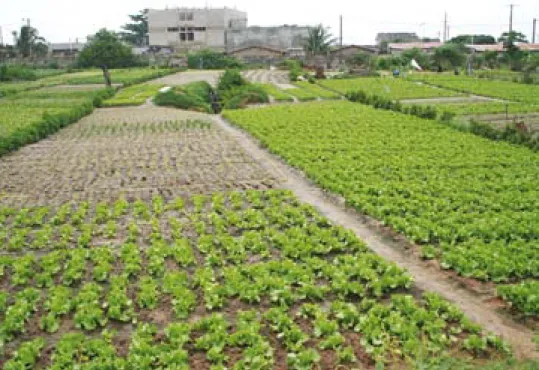
Figure 1. Vegetable production at a peri-urban site in Benin. (Photo: B. James/IITA) Vegetables are important components of daily diets in Africa and important sources of income, especially in urban and peri-urban areas. As many as twenty different types of indigenous and exotic vegetables are grown at major vegetable production sites around West Africa (Figure 1). These crops provide a cheap source of proteins, vitamins and other elements essential for human health and wellbeing. In West Africa, vegetables are commonly grown in the rainfed upland ecologies and in lowland ecologies such as bolilands, riverine grasslands and inland valley swamps. Agroecosystems in these various ecologies offer great opportunities for commercial production of vegetables in West Africa.
Vegetable production for urban and peri-urban areas in West Africa is popular in rainfed upland ecologies. Rainfed upland ecologies occur on hillsides, usually above
The specific examples in this guide are for Benin, but the methodologies and general information are applicable to other vegetable production sites in West Africa. Other countries can adapt the methodologies and develop similar country-specific information.
floodlines and have well-drained soils which are not usually covered by standing water. The vegetation is dominated by bushes of perennial shrubs and trees, with minimal grass cover. Vegetables are usually planted early in the rainy season, either by direct seeding or transplanting of seedlings. They are frequently intercropped with other staple food crops (e.g. rice), or planted as sole crops following the harvest of any other crop. Commercial farmers use irrigation systems that allow year-round production in upland ecologies, while smallholder farmers rely on rain and soil water to water their seasonally-grown crops.
Bolilands are large pan-like depressions of land which are naturally flooded by rainwater and freshwater streams. The soil is often clay loam with silt deposits and usually has a large amount of humus on the surface. The vegetation is dominated by grasses. In bolilands, rice is planted either by direct seeding just before the soil is flooded in the rainy season, or by transplanting after the soil is flooded. Vegetables are planted on small mounds left on the bolilands after the rice is harvested at the end of the rainy season.
Inland valley swamps are flooded by overflow from freshwater rivers or streams and rainwater runoff from surrounding hills. The intensity of flooding depends on the duration of the rainfall, the season and on the type of topography. The water level can be artificially controlled so vegetables can be grown on the bunds which separate the plots of rice in these swamps.
Riverine grasslands are alluvial plains which run along the lower parts and mouths of freshwater rivers, and tend to be flooded to significant depths during the rainy season. The natural vegetation is dominated by grasses. The rice plants which are transplanted before flooding grow as floating plants in the waterlogged conditions. In the months prior to flooding, these alluvial plains are important vegetable production sites.
Integrated pest management in vegetable production
3
Abiotic components
• Soil and water (Figure 2) – provide the germinating media for seeds and general growth conditions for vegetables and other plants
• Sunlight, day length, temperature and humidity – provide the additional conditions necessary for healthy plant growth and high yields – influence the development of insects, mites, fungi, bacteria and weeds
• Wind – helps to disperse insects, mites, fungi, bacteria and weeds • Mineral fertilizers – promote plant growth and increase yields • Chemical pesticides – are applied to kill pests.
Biotic components
• Vegetables and other crops in the field
• Weeds – compete with vegetable crops for light, water and nutrients - serve as alternative hosts and sources of pest spread – provide specialized food e.g. nectar for pollinators and adults of other insects
• Insects (Figure 3) – mites, fungi, bacteria and viruses which damage crops
• Insects – mites, nematodes, fungi, bacteria and viruses which feed on and kill other insects and mites • Insects and mites – which pollinate plants.
Interactions
• Intraspecific competition between individuals of the same species for sunlight, water, food, mates and shelter • Interspecific competition between individuals of different species for sunlight, water, food and shelter • Feeding by insects, mites, fungi, bacteria, and viruses on vegetables, other crops and weeds
• Feeding by insects and mites on other insects and mites (Figure 4)
• Infection of plants, insects and mites by bacteria, fungi and viruses, which cause diseases in plants and animals • Influences of abiotic factors on the development and spread of insects, mites and disease-causing agents • Crop cultivation and management methods and their agronomic implications
• Beneficial and adverse effects of agrochemicals on the environment.
Vegetable agroecosystems
Vegetable agroecosystems comprise a dynamic mix of biotic (living) components, abiotic (non-living) components and the interactions within and between them. Any change in one component or interaction is likely to affect another component or interaction. The reactions of agroecosystems to change can potentially be disastrous to farming communities, and may not be entirely predictable. In order to achieve good vegetable pest management, the vital components of agroecosystems should be correctly identified, their interrelationships fully understood, and the agroecosystem treated as a functional unit (Box 1).
Figure 2. Irrigation at a peri-urban vegetable site in Benin. (Photo: B. James/IITA)
Figure 3. Aphid Lipaphis erysimi, a cabbage pest. (Photo: G. Goergen/IITA)
Figure 4. Predatory mite (left) on pest mite (right) – called a phyoseiid. (Photo: G. Goergen/IITA)
Integrated pest management in vegetable production
5 Vegetable agroecosystems
Crop types
The vegetable plant is the central component of the agroecosystem. Vegetables can be grouped according to the part of the plant that is consumed and/or sold.
Leafy vegetables
The common leafy vegetables grown in West Africa are the African garden eggplant, amaranth, cabbage and lettuce. There are two common types of African garden eggplant, which are both indigenous to Africa. One is
Solanum macrocarpon (Figure 5), whilst the other is
S. aethiopicum. Solanum macrocarpon is grown mainly for its succulent leaves, but in some communities the bitter fruits are also eaten. S. aethiopicum is mainly cultivated for its fruits. The edible parts of both
S. macrocarpon and S. aethiopicum are nutritious and contain carbohydrate, cellulose and calcium, fat, protein and water.
Amaranth, Amaranthus cruentus (Figure 6), is grown for its leaves which are rich in beta-carotene, calcium, iron, protein, vitamin C and water. Cabbage, Brassica oleracea (Figure 7), is native to temperate regions of the world. It is called the head cabbage because the immature leaves cluster up into a spherical ball or ‘head’, which is the part normally marketed and consumed. The leaves contain some carbohydrates, proteins and various essential elements e.g. calcium, iron and vitamin C as well as water. Lettuce, Lactuca sativa (Figure 8), is indigenous to the Mediterranean region and occurs in four groups of varieties. The plant is cultivated for its succulent leaves which are used in salads. Lettuce leaves contain a high proportion of water with some calcium, proteins and vitamins.
Figure 5. The African garden eggplant, a leafy vegetable. (Photo: B. James/IITA)
Figure 6. Amaranth, a leafy vegetable. (Photo: B. James/IITA)
Figure 7. Cabbage, a leafy vegetable. (Photo: B. James/IITA)
Figure 8. Lettuce, a leafy vegetable. (Photo: B. James/IITA)
Fruit vegetables
The most popular fruit vegetables grown in West Africa are the tomato, pepper and aubergine. Tomato,
Lycopersicum esculentum (Figure 9), which originates from the Andes in South America, is grown for its fruits. The shape of the fruit differs according to the variety. Tomato fruits can be consumed raw or cooked. Tomato fruits contain a lot of water with calcium, carbohydrate, carotene, iron, niacin, riboflavin, thiamine, protein and vitamins.
The sweet pepper or pepper, Capsicum annuum (Figure 10), is native to Central America. It occurs in two groups of varieties. Unlike most vegetables, pepper is a relatively long duration crop. Both immature and fully mature fruits are marketed and consumed. The fruit contains plenty of water with some carbohydrates, protein, minerals and vitamin C.
Root vegetables
Carrot, Daucus carota (Figure 11), a crop native to Asia, is the most common root vegetable grown across West Africa. It is cultivated for its swollen roots, which are rich in beta-carotene. The roots also contain a large amount of water as well as carbohydrates, minerals and protein.
Figure 11. Carrot, a root vegetable. (Photo: B. James/IITA)
Figure 10. Pepper, a fruit vegetable. (Photo: B. James/IITA)
Figure 9. Tomato, a fruit vegetable. (Photo: B. James/IITA)
Integrated pest management in vegetable production
7 Vegetable agroecosystems
Vegetable plant production
Depending on market demand and availability of water to irrigate plots, vegetables can be grown all year round. The crops are grown in monocrops, intercrops and crop rotation schemes. Commercial production sites are commonly located near to markets, e.g. in urban and peri-urban areas.
Crop yield
Depending on the vegetable crop type, the leaves, fruits, and roots constitute the yield and provide both food and income to farmers. Field workers and farmers need to be aware of two different types of yield in order to fully understand the purpose of crop production and pest management measures. The two types of yield are maximum or potential attainable yield, and actual yield (Figure 12).
Maximum attainable yield is the yield obtained from crops grown in experimental plots and field conditions with the full use of improved technologies and inputs. It is the highest yield possible from a particular variety cultivated under the ideal conditions.
Actual yield is the yield obtained from crops cultivated under farmers’ conditions using the same varieties used in experimental plots. Actual yields are often less than attainable yields.
The difference between attainable and actual yield is due to a variety of environmental factors which include soil type, crop variety, agronomic practices, weather and pests. Agricultural research, extension and training activities aim to find ways to increase actual yields towards attainable yields, for example by manipulating field and environmental factors which reduce yields. The overall objective of vegetable pest management is therefore to prevent, reduce and maintain the effect of pests at levels where they cease to act as constraints to the achievement of higher actual yields (Figure 12). It is in this way that pest management interventions ‘increase’ yields. • Bad weather • Poor soil • Bad seeds • Bad varieties • Poor agronomy • Pests and diseases • Weeds • Ignorance Caused by: Potential Actual Yield loss Yield
Land and seed bed preparation
The most suitable sites for vegetable production are flat and sunny areas with light, well-drained soil which is rich in humus and not prone to water logging. These conditions help to promote the establishment of good nurseries and seedling health for excellent vegetable crop growth. Farmers break and loosen up the soil by ploughing, and remove stones and debris to allow sufficient aeration, moistening and drainage of the soil. This promotes good root growth. Removal of plant debris also helps to limit the occurrence of weeds and other pests which are carried over from the previous season.
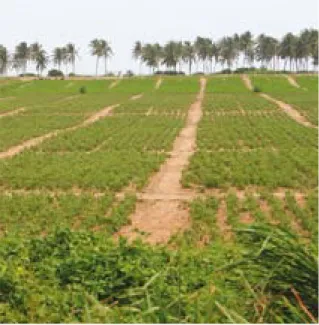
Vegetables are often planted on flat land (Figure 13) in areas that are unlikely to be waterlogged or flooded. Planting on flat land is also common where the soil is rich in nutrients. In areas that are likely to be waterlogged, or where the soil is poor in nutrients, farmers heap the top soil into mounds or ridges on which they plant vegetables. The mounds of soil raised above ground level are commonly referred to as ‘beds’ (Figure 14).
Figure 14. Lettuce planted on ridges. (Photo: B. James/IITA)
Figure 13. Tomato planted on flat land. (Photo: B. James/IITA)
Integrated pest management in vegetable production
9 Vegetable agroecosystems
Planting
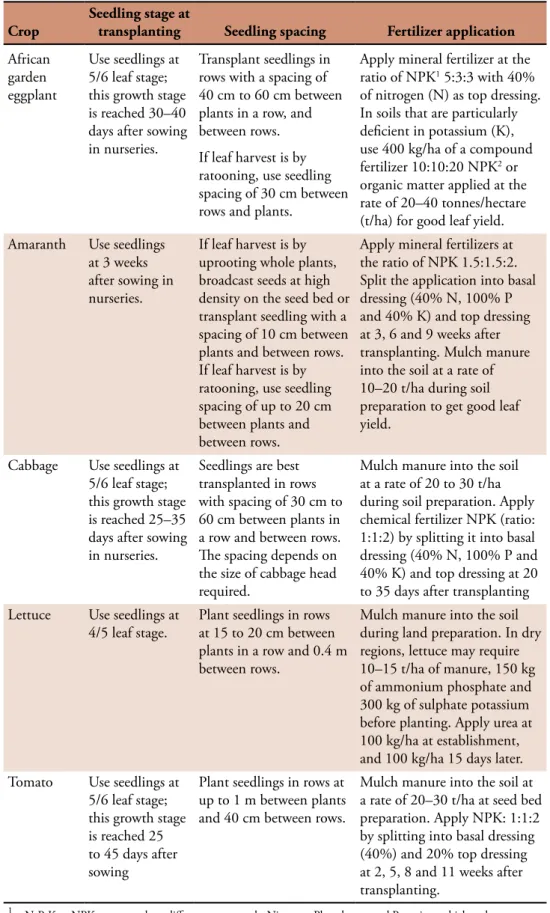
Except for exotic vegetables, (e.g. beetroot, cabbage, carrot, cucumber and lettuce), most farmers produce their own vegetable seeds from their fields or they collect seeds from other farmers’ fields. Large-scale farmers do not self-supply and buy certified seeds from seed companies and national seed services. Vegetables are planted by direct sowing of seeds (e.g. amaranth and carrot) or by transplanting seedlings from nurseries (e.g. African garden eggplant, cabbage, lettuce and tomato). In direct sowing, seeds are broadcast on seed beds and harrowed in, or sprinkled in rows and covered up with soil, and left undisturbed to germinate. In transplanting, farmers select vigorous and disease-free seedlings at the right growth stage and transplant them. Table 1 summarizes vegetable planting and soil fertilisation practices in Benin. If the crop is harvested by uprooting of whole plants (e.g. in amaranth, carrot and radish), the seedlings are usually transplanted closer to each other than when the crop will be harvested by ratooning. Planting dates are usually adjusted in response to market demands e.g. in readiness for festive seasons. Planting during the peak of the rainy seasons is uncommon so as to avoid flooding of vegetable beds.
Intercropping
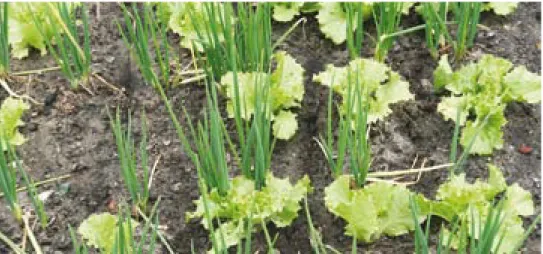
Farmers frequently intercrop vegetables on the same bed (Figure 15). A single bed can hold as many as five different vegetables. Intercrops can be economically more profitable than sole crop vegetables. Intercropping increases farmers’ income per unit of land and labour and helps to maintain good soil moisture and reduce the incidence of weeds and other pests on vegetables.
Figure 15. Vegetables planted on flat land, lettuce and onion intercropped. (Photo: B. James/IITA)
Ratooning is a method which leaves the lower parts of the plant along with the root uncut at the time of harvesting to give the ratoon or the stubble crop. The main benefit of ratooning is that the crop matures earlier in the season. Ratooning can also decrease the cost of preparing the field and planting.
Crop rotation
Crop rotation enables farmers to maintain land under continuous cultivation by planting with one crop after another in successive seasons. The practice also helps farmers respond to seasonal market demands for certain crops. Where a rotation crop is a non-host plant of a pest that damaged a previous crop, crop rotation helps to control that pest by breaking its life cycle. Good knowledge of crop susceptibility to pests is therefore essential in the use of crop rotation for pest management. This is particularly the case with species of root-knot nematodes which attack a wide range of vegetables including the most economically important crops grown in many localities. The wide range of host plants of the root-knot nematode makes it difficult to identify suitable crop rotation schemes for this pest, especially at sites under year-round vegetable production.
Soil fertility
Soils nourish vegetables with mineral nutrients for vigorous, succulent and healthy growth; but continuous production of vegetables can deplete soil nutrients at production sites. Vegetable farmers use organic and mineral fertilizers to help soils to recover from nutrient losses, and in some cases, reduce pest problems. Both organic (composed of decayed plant/animal material), and inorganic fertilizers (composed of chemicals and minerals), improve soil fertility by adding nutrients to the soil, and are used in a number of different ways.
Mulching, for example, involves mixing plant materials into the soil during land preparation, or covering the bases and rows of the crops with dry grass or plastic sheets after planting. Dry grass or plastic sheets serve as physical barriers between the soil and the environment so the plant residues rot into the soil and increase its organic matter content. Plant foliage mixed into the soil help conserve moisture, suppress weeds, and reduce the spread of plant pathogen spores onto vegetable foliage through water or soil splashes.
Farmers use farmyard manure or humus from compost of plant residues as organic fertilizers. They avoid scorching of the plants by first thoroughly mixing the farmyard manure with soil or water. Where soils are poor, leafy vegetables such as African garden eggplant, amaranth, cabbage, and lettuce will require additional levels of nitrogen and potassium (provided by inorganic fertilizers). High levels of nitrogen delay the onset of flowering and thereby favours leaf production. Table 1 summarizes the type, quantity and application timing of organic and mineral fertilizers.
Integrated pest management in vegetable production
11 Vegetable agroecosystems
Crop Seedling stage at transplanting Seedling spacing Fertilizer application
African garden eggplant
Use seedlings at 5/6 leaf stage; this growth stage is reached 30–40 days after sowing in nurseries.
Transplant seedlings in rows with a spacing of 40 cm to 60 cm between plants in a row, and between rows. If leaf harvest is by ratooning, use seedling spacing of 30 cm between rows and plants.
Apply mineral fertilizer at the ratio of NPK1 5:3:3 with 40%
of nitrogen (N) as top dressing. In soils that are particularly deficient in potassium (K), use 400 kg/ha of a compound fertilizer 10:10:20 NPK2 or
organic matter applied at the rate of 20–40 tonnes/hectare (t/ha) for good leaf yield. Amaranth Use seedlings
at 3 weeks after sowing in nurseries.
If leaf harvest is by uprooting whole plants, broadcast seeds at high density on the seed bed or transplant seedling with a spacing of 10 cm between plants and between rows. If leaf harvest is by ratooning, use seedling spacing of up to 20 cm between plants and between rows.
Apply mineral fertilizers at the ratio of NPK 1.5:1.5:2. Split the application into basal dressing (40% N, 100% P and 40% K) and top dressing at 3, 6 and 9 weeks after transplanting. Mulch manure into the soil at a rate of 10–20 t/ha during soil preparation to get good leaf yield.
Cabbage Use seedlings at 5/6 leaf stage; this growth stage is reached 25–35 days after sowing in nurseries.
Seedlings are best transplanted in rows with spacing of 30 cm to 60 cm between plants in a row and between rows. The spacing depends on the size of cabbage head required.
Mulch manure into the soil at a rate of 20 to 30 t/ha during soil preparation. Apply chemical fertilizer NPK (ratio: 1:1:2) by splitting it into basal dressing (40% N, 100% P and 40% K) and top dressing at 20 to 35 days after transplanting Lettuce Use seedlings at
4/5 leaf stage. Plant seedlings in rows at 15 to 20 cm between plants in a row and 0.4 m between rows.
Mulch manure into the soil during land preparation. In dry regions, lettuce may require 10–15 t/ha of manure, 150 kg of ammonium phosphate and 300 kg of sulphate potassium before planting. Apply urea at 100 kg/ha at establishment, and 100 kg/ha 15 days later. Tomato Use seedlings at
5/6 leaf stage; this growth stage is reached 25 to 45 days after sowing
Plant seedlings in rows at up to 1 m between plants and 40 cm between rows.
Mulch manure into the soil at a rate of 20–30 t/ha at seed bed preparation. Apply NPK: 1:1:2 by splitting into basal dressing (40%) and 20% top dressing at 2, 5, 8 and 11 weeks after transplanting.
1 N-P-K or NPK represent three different compounds: Nitrogen, Phosphorus, and Potassium which make up
the fertilizer.
2 The three numbers listed on fertilizer labels correspond to the percentage of these materials found in the fertilizer.
Vegetable plant protection
At vegetable production sites, crop diversity, cropping patterns, and certain plant production practices attract a wide range of organisms (bacteria, fungi, insects, mites, parasitic nematodes and viruses) which can be beneficial or harmful to the plant.
Pests
A pest is any organism that injures or damages crops, livestock and people to cause food and income losses and diseases. The term ‘pest’ refers to the role of any organism to aggravate hunger, poverty and disease. The term ‘pest’ is, therefore, more socioeconomic than biological, as it relates mainly to the social and economic aspects of human activities. An organism is not a
pest in its natural habitat (e.g. insects in wild grasses and natural vegetation), but as soon as it comes into conflict with people and peoples’ interests (e.g. insects in cultivated crops), it is treated as a pest. Table 2 lists groups of organisms which can be pests of crops or of stored produce.
The term ‘pest’ is usually reserved for arthropods and other animal groups. The term ‘vector’ is used to describe pests that transmit disease-causing organisms to crops, humans and livestock. Microorganisms which cause diseases in plants are usually referred to as ‘plant pathogens’. Weeds are pests that are normally considered to cause agronomic problems.
Table 2. Pests of vegetables.
Arthropods – insects (Figure 16) and mites (Figure 17) which feed on plants and/or transmit disease- causing microbes
Microorganisms – fungi, bacteria and viruses which cause diseases in plants (Figure 18)
Molluscs – snails and slugs which feed on plants
Plant parasitic nematodes – which feed on roots and other plant parts (Figure 19)
Vertebrates – rodents and birds which feed on plants
Weeds – compete with crops for space, soil moisture, soil nutrients and sunlight needed for healthy growth of plants
Figure 16. Adult of the cotton bollworm, Helicoverpa armigera, female. (Photo: G. Goergen/IITA)
Figure 17. Red mites, Tetranychus spp. (Photo: G. Goergen/IITA)
Figure 18. The fungus, Colletotrichum fuscum, on vegetable leaf. (Photo: G. Goergen/IITA)
Figure 19. Female of the root-knot nematode,
Integrated pest management in vegetable production
13 Vegetable agroecosystems
Generally, in this guide, the term ‘pest’ refers to any organism that damages crops, livestock, and people to cause food and income losses and diseases. The focus of this guide is on pests that are insects, mites, plant pathogens, plant-parasitic nematodes to weeds in the field. Where emphasis is needed, this guide specifies non-arthropod pests as plant pathogens, vectors and weeds.
Natural enemies
Many organisms found on vegetables prey and/or reproduce on other species. They are known as natural enemies (Figures 20 to 27). Common natural enemies of pests are parasitoids, predators and entomopathogens (Box 2).
Parasitoids. Parasitoids are natural enemies that kill and control pests by living and growing inside them. Parasitoids are mainly tiny wasps (Figure 20) or flies which lay their eggs inside or on the pests. The eggs hatch into larvae which eat the internal tissues of the pest organism, grow inside and kill the pest. The body of the dead pest does not rot, but becomes hard. This hardened body is called a ‘mummy’ (Figures 21 and 26). The adult parasitoids hatch out of the mummy and kill more pests by laying eggs into them.
Predators. Predators are natural enemies that kill and control pests by attacking and feeding on them. Most predators of insect and mite pests are usually other insects and mites, e.g. ladybird beetles (Figures 22 and 23), hoverflies (Figures 24 and 25), and predatory mites called phytoseiids (Figure 4).
Entomopathogens. Entomopathogens are natural enemies which kill and control insects and mites by causing diseases in them. When the host insect or mite dies, the cadaver is in the form of a ‘mummy’ (Figure 27). Examples of entomopathogens are species of certain bacteria, fungi, nematodes, protozoa or viruses. Entomopathogens are the active ingredients in commercial biopesticides. Biopesticides consisting of bacterial or fungal spores are the most commonly available products. Biopesticides are often applied in a similar way to chemical pesticides; but the ‘live’ ingredients (e.g. fungi) in the biopesticides reproduce, so they provide continuous pest control and therefore don’t require further applications.
Figure 23. Larva of the predatory ladybird beetle,
Cheilomenessulphurea. (Photo: A. Staverløkk/Bioforsk) Figure 22. Adults of the predatory ladybird beetle,
Cheilomenes sulphurea. (Photo: A. Staverløkk/Bioforsk)
Figure 21. Parasitoid ‘mummies’ of aphid pests. (Photo: A. Staverløkk/Bioforsk) Figure 20. Adult parasitoids of aphid pests. (Photo: A. Staverløkk/Bioforsk)
Integrated pest management in vegetable production
15 Vegetable agroecosystems
Figure 24. Adult male of the predatory hoverfly, Ischiodonaegyptius. (Photo: A. Staverløkk/Bioforsk)
Figure 25. Larva of the predatory hoverfly, Ischiodonaegyptius. (Photo: A. Staverløkk/ Bioforsk)
Figure 26. ‘Mummy’ of the parasitoid Cotesia sp., natural enemy of diamond back moth, Plutella xylostella. (Photo: G. Goergen/IITA)
Figure 27. ‘Mummy’ of the entomopathogen Beauveria bassiana, on larva of diamond back moth, Plutella xylostella. (Photo: G. Goergen/IITA)
Crop damage
Extension workers and farmers often regard crop damage as equal to yield loss. Crop damage refers to harm or injury to the plant, but the injury may, or may not, lead to yield loss. Crop damage by pests can be direct or indirect.
• Direct damage – injury of plant parts that are harvested for consumption and/or sale, (e.g. leaves of leafy vegetables), which causes yield losses.
• Indirect damage – injury of plant parts that are not consumed or sold (e.g. leaves of root vegetables). The effect of indirect damage on yield loss is unpredictable and is often not as serious as that of direct damage. Depending on the type and age of crop and the timing of the pest attack, a defoliated plant can actually recover from damage by producing new or replacement leaves.
Yield loss
Yield loss is the partial or total loss of consumable or marketable plant parts of the crop. The loss can be in quantity or quality. In vegetables, quantity losses are easier to spot and appreciate than are quality losses. Quality losses are due to a reduction in the nutritional value or marketability of the produce. Quality losses tend to be overlooked under poor socio-economic conditions but are nonetheless very important in the vegetable trade. There is a wide range of quality factors which can lead to rejection of the produce by traders, especially on international markets:
• Blemished fruits
• Deformed and discoloured leaves • Damaged storage roots
• Appearance of living and dead organisms (e.g. insects, mites) • Appearance of quarantine pests
• Pesticide residues.
Pest abundance and yield loss
High levels of pest damage can often lead to total yield losses within the period between planting and harvest. Pest abundance and levels of crop damage may not always be an indicator of the level of yield loss to expect. This can result in poor pest management decisions. For certain pests, (e.g. leaf feeding pests of leafy vegetables), higher infestation leads to higher losses. In other cases (e.g. insect vectors of plant diseases), even light infestations can cause high yield losses. For certain other types of pests, high pest infestations, which can cause an alarming amount of defoliation on the plants, may not necessarily lead to high yield losses. The relationship between abundance of pests and yield loss is complex and depends on many factors which include the:
• Timing of pest attack
• Plant age and growth stage at the time of attack • Developmental stage of the attacking organisms • Growing conditions/agronomy of the crop • Duration of pest, disease and weed infestation.
Integrated pest management in vegetable production
17 Vegetable agroecosystems
Economic threshold
There is usually a cut-off level of pest infestation or crop damage above which further damage is unacceptable, because experience shows that further damage will lead to significant yield loss. Damage is usually acceptable below this level, because experience shows that below that level, the plants can tolerate some damage, and the damage observed will not cause economic loss in yield. Controlling pests whose infestation or crop damage is below the level where they will cause economic damage is not necessary. In other words, a certain amount of pest damage of the crop cannot prevent the achievement of high yields. Farmers need to work out the pest density or crop damage level that can be tolerated as a guideline in their decisions about how to manage pests on their crop.
The term ‘economic threshold’ (ET) is used to refer to the pest population or damage level below which control measures are unnecessary. The economic threshold is also sometimes called the ‘action threshold’ as it represents the point at which a control action is started. The economic or action threshold is very dynamic and flexible and usually:
• Applies to use of pesticides to reduce pest abundance from high to low levels • Does not apply to use of natural enemies which prevent pest abundance from
increasing to high levels
• Does not apply to cultural practices which help to prevent or limit pest infestations from increasing to damaging levels
• Varies from pest to pest, and is high for pests that cause indirect damage, but low for those which cause direct damage
• Varies from farmer to farmer, even in the same neighbourhood and for the same crop variety, and depends on consumer standards. Farmers adopt more stringent pest management measures if they aim to sell their produce in markets for high income societies. Contamination of the produce by fragments and frass of pests can also dictate stringent pest management measures. These conditions will translate into low economic thresholds for the pest. On the other hand, higher economic thresholds prevail if farmers aim to sell their produce in markets where low income societies predominate. Low income customers are often market outlets for damaged goods, but the same poor quality produce would be rejected by high income societies with higher consumer standards. Generally therefore, economic thresholds decrease as the value of the crop increases; and economic thresholds are often high for subsistence farmers and low for commercial farmers
• Varies from location to location, since the agroecological conditions that affect populations differ between locations
• Varies from season to season, since temperature, rainfall and humidity conditions that affect populations differ between seasons.
The determination of the economic threshold is, therefore, complex and difficult and is mostly left to researchers to investigate. Farmers usually rely on their experience with previous infestations, and not ETs, to decide whether or not to treat current infestations. Extension workers should exercise caution in introducing the concept of economic threshold to farmers.
Frass: Debris or excrement produced by insects.
Pest monitoring
Vegetables are generally short duration crops. Cabbage, for example is harvested three months after transplanting while amaranth leaves are harvested three weeks after transplanting, if harvesting is by uprooting whole plants. When amaranth is harvested by ratooning, the first of successive harvests begins about 40 days after transplanting, followed by harvests at 10-day intervals. Most of the pest damage – sometimes equivalent to 100% crop loss – can occur within the short period between planting and harvest. Vegetable production therefore requires farmers to monitor their farms/plots regularly and assess changes in plant health, pest status and crop damage. Through frequent field inspections, farmers can identify pest problems in time and act quickly to prevent pests from spreading and causing further damage to crops. The chapter on field diagnoses advises extension workers and farmers on the key tasks, knowledge and skills essential for pest monitoring.
Farmers’ coping strategies
Chemical control is a common coping strategy used by farmers to protect their investment in vegetables (Figure 28). However, the list of pesticides currently used against vegetable pests in West Africa includes products that are banned for use or are extremely toxic, according to the WHO classification of pesticides. Chemical pest control is so frequently used in vegetables that crops such as African eggplant, cabbage, pepper and tomato have become indicator crops of inappropriate pesticide regimes in many vegetable agroecosystems. Cabbage producers apply pesticides every 3 to 4 days within a 3-month period before harvesting, in order to control caterpillars on the crop. Farmers also apply 18 applications of pesticides on pepper within 10 weeks of crop growth to control aphids, mites and whiteflies; and 12 applications of pesticides on the African garden eggplant within 10 weeks of crop growth to control mites and root-knot nematodes.
Various field training programmes promote botanical pesticides as alternatives to chemical pesticides for many vegetable pests in West Africa. Leaf and seed extracts of the neem tree Azadirachta indica are the most popular botanical pesticides against foliage feeding pests. Farmers often self-supply the plants from wild areas or grow them in their neighbourhoods. Biopesticides have the potential to limit inappropriate pesticide use in the sub-region. In some countries, such as Ghana, farmers have been introduced to commercial formulations of biopesticides to control foliage feeding caterpillars on vegetables, but they are not commonly available in West African markets.
Under traditional farming conditions and on small vegetable plots, weeds are controlled by labour and time-intensive slashing and hand/hoe weeding. Agronomic practices such as close plant spacing and intercropping are also used to produce thick leaf canopies that act in the same way as cover crops by minimizing weed germination and growth. The use of herbicides in vegetable production is rare in many West African countries.
Integrated pest management in vegetable production
19 Vegetable agroecosystems
Integrated pest management
Integrated pest management (IPM) is the science of combining different options and practices to achieve long-lasting control of pests. The approach frequently blends technologies from research with traditional farming practices, to reduce crop losses in a sustainable manner. The success of IPM depends largely on farmers’ knowledge and understanding of biological and ecological processes that affect pest status. The extent to which farmers use that knowledge in the choice of introduced options to blend with their farming practices also affects how well IPM works. Implementing IPM causes minimum damage to humans and the environment, and helps to increase the food and income value at harvest. Participatory research and learning approaches, facilitated by extension workers, help to increase farm-level literacy in IPM and promote utilization of IPM to solve pest problems. The rest of this guide is devoted to the need to provide agricultural extension workers with knowledge and skills required to plan and promote IPM in vegetable production. The key areas covered are:
• Field diagnosis to detect and monitor pests and natural enemies, assess crop damage severity, and develop vegetable pest lists
• Field and laboratory techniques to collect, preserve, and send pest and natural enemy specimens to experts for identification
• Pest facts sheets that assist extension workers and farmers to rapidly identify and understand pests
• IPM options including guidelines on appropriate use and handling of pesticides • Experiential learning and dissemination of IPM.
Figure 28. Pesticide application at a vegetable production site. (Photo: A. Staverløkk/ Bioforsk) Experiential learning is the process of learning from direct experience. It is ‘learning-by-doing.’
21
Diagnostic surveys aim to gather and analyse information on vegetable production, plant protection, market practices, status, problems and opportunities. The surveys help agricultural extension workers to specify farmers’ needs, identify key problems needing attention, and advise on the kinds of support required to address the problems encountered. Generally, diagnostic surveys cover extensive areas, diverse vegetable agroecosystems, and a large number and wide range of farmers. This allows researchers and extension workers to discover and describe problems and opportunities faced by farmers in different localities. Results of field diagnosis help to promote informed decision-making in the development and use of pest management options.
Survey tasks and skills
Table 3 lists the tasks and skills required for diagnostic surveys which usually involve:
• Community consultation: Participatory diagnostic surveys involve talking with and listening to farmers and other stakeholder groups, and discussing and analysing emerging issues with them. At most vegetable production sites, there
Field diagnosis
Tasks Skills required
• Specify relative importance of vegetable crops.
• Detect pests, develop and update pest lists.
• Detect new, introduced and quarantine pests.
• Identify pests of economic importance. • Identify and collect natural enemies. • Note changes in pest and natural enemy populations.
• Estimate crop damage severity. • Note plant protection practices by farmers.
• Note effects of pest management practices.
• Appropriate sampling and survey techniques.
• Pests and natural enemy collection and identification.
• Spotting life cycle stages of organisms. • Linking crop damage to specific pests. • Linking pest density to potential yield loss.
• Experience in combining various options in an IPM system to achieve long-term control.
• Spotting harmful effects of pest management practices on crops, environment and people.
Figure 29. Key informant farmer interview. (Photo: B. James/IITA)
are usually a number of farmers, each cultivating more than one vegetable crop on small plots. The farmers often share similar vegetable production problems and lack appropriate pest management information. Where the farmers work in organized groups, extension workers and representatives of these groups can work with researchers to jointly conduct diagnostic surveys. The participatory approach enables extension workers and researchers to focus their attention on farmers’ felt needs.
• Field inspections: Sampling crops and pests, collecting specimens for identification.
• Reporting: Developing and/or updating information on lists of pests and their associated natural enemies, economic status of pests, and distribution maps of pests.
In participatory diagnostic surveys, survey teams should ideally be split into two sub-teams. One sub-team conducts community consultation with farmers’ groups (Figure 29), while the other sub-team with a farmer representative inspects vegetable plots to specify field problems and opportunities faced by farmers at the locality. It is advisable to inspect fields at same sites once in the dry season and once in the rainy season. Dry season conditions, coupled with poor irrigation of vegetable plots can promote a rapid increase in the abundance of certain pests, and thereby aggravate the damage caused by these pests. Wet season conditions, on the other hand, may result in expression of damage symptoms caused by certain plant pathogens.
Integrated pest management in vegetable production
23 Field diagnosis
Focus group interviews
Focus group interviews provide a forum to discuss and agree on various issues, such as plant production practices, pest problems, plant protection practices, marketing, and other socioeconomic issues at the localities visited. The survey team uses a questionnaire which would have been pre-tested in the field prior to its use, to guide the discussions.
Questionnaire design
In designing the questionnaire, it is advisable to group questions that address common issues together under specific sub-sections. The questionnaire should start with a sub-section containing ‘soft’ questions to help relax the atmosphere and the interviewees. Questions relating to financial matters and other personal issues are best covered in the last sub-sections of the questionnaire. The questionnaire can contain ‘factual’ questions to which respondents can state if they ‘agree’, ‘disagree’, ‘don’t know’ or ‘neither agree nor disagree’. Similarly, factual questions can relate to practices for which the survey team would like to assess respondents’ awareness (either they have heard, or not heard, about the issues raised), level of understanding (good, average, or weak/poor), and adoption (percentage of respondents who say they have adopted the practice).
The questionnaire should be of reasonable length so as to retain the interest of respondents, who will certainly have other things to do on the day of the interview. The questionnaire needs to be in a format that allows for quick and easy data entry and analyses. The contents of a focus group interview questionnaire can be organized into five main parts:
1. Overview:
• Total number of respondents (indicate women and men) in the focus group • Membership of respondents in farmers’ groups or associations
• Position of focus group members in farmers’ groups or associations
• Number of respondents (indicate women and men) who grow vegetables at the site
• List of the most important vegetables grown by the respondents
• Vegetable production seasons in the locality, e.g. year round; dry season only; wet season only (specify which important vegetables are grown in which season).
2. Plant production practices:
• Area under vegetables (specify crop) • Size of vegetable bed
• Number of vegetable beds per crop per farmer
• Number of vegetable plants per bed per vegetable –in sole crops (note plant spacing during field inspection)
• Seed germination test (probe farmers to describe methods used, if any) • Fertilizer used (inorganic or organic fertilizer, crop treated, type and name of
fertilizer used on the crop, source of the fertilizer, quantity/volume, method and frequency of application of the fertilizer
• Weeding (probe farmers to describe method and frequency).
3. Plant protection practices:
• Knowledge of pests/diseases
• Ability to identify and link pests/diseases to their respective damage symptoms • Knowledge of natural enemies
• Ability to identify and link natural enemies to particular pests
• Plant protection products used, e.g. chemical pesticides, biopesticides,
botanicals (probe farmers to specify crop treated, type, source, quantity/volume, method and frequency of application of the plant protection product)
• Factors that influence the choice of plant protection products, e.g. cost, availability, efficacy, safety, advice from extension staff or other farmers or dealers of plant protection products
• Knowledge of the side effects of plant protection products (probe to learn farmers’ knowledge, awareness and perceptions of the effects of plant protection products that they use against pests)
• Nature of crop damage caused by plant protection products
• Storage methods used for chemical pesticides, biopesticides or botanical pesticides (probe farmers to specify the place and method of storage; e.g. at home, on the farm, in special stores)
• Use of empty pesticide containers (probe to find out the disposal method used, e.g. bury in a hole; use at home).
4. Public awareness:
• Previous training e.g. number of respondents (indicate women and men), who were previously trained in vegetable production and plant protection
• Knowledge of alternatives to chemical pesticides
• Sources of information on alternatives to chemical pesticides (e.g. training, other farmers, extension, researchers, dealers of agrochemicals, radio/TV, etc.) • Source of information on seeds, organic fertilizers, inorganic fertilizers,
chemical pesticides, biopesticides and botanical pesticides (e.g. training, other farmers, extension/researchers, dealers of agrochemicals, radio/TV, etc.).
5. Costs and benefits of production:
• Source of funds for growing the crop (name the crop – probe to discover if funds were obtained through self-financing, borrowing, grants, etc.)
• Market outlets for farmers who sell vegetable produce (probe to learn who buys directly from the farmers e.g. traders, local markets, international markets, hotels, restaurants etc.)
• Cost of production and benefits from sales – see Appendices 1 and 2 for calculation of costs and benefits – encourage the group to estimate the lowest and highest costs or price for each line item. Farmers may cost and price estimates in terms of traditional units such as ‘price per bed of vegetables’, ‘price per sack load of vegetables’, ‘price basket load of vegetables’, which the survey
Integrated pest management in vegetable production
25 team can later convert to standard units (income per hectare)
• Income per year from all vegetables (encourage the group to state the lowest and highest income per year from their vegetable farms)
• Annual household income from other enterprises (encourage the group to state the lowest and highest income; the survey team can later work out the percentage of total household income that comes from the sale of vegetables).
Questionnaire delivery
Focus group interviews are ideally conducted by a team of three (team leader, recorder and translator). The team leader should
be a good communicator with experience in community consultation skills. At each site, the team member uses a GPS receptor (Figure 30) to record the longitude, latitude and altitude of the location visited. In the delivery of the questionnaire, the team leader should explain each sub-section to the respondents, so as to promote group understanding of the relevance of questions that will be raised for discussion. For any question raised for discussion, there will be diverse responses from focus group members. The survey team should therefore encourage respondents to explain their responses clearly. The second team member (a recorder), as well as other team members, should listen attentively, especially to identify areas where the focus group members are unsure of their responses. During the discussions, the recorder records
farmers’ responses. Additionally, the recorder would need a notebook to enter other observations and relevant remarks. Instructions to the recorder should be clear and unambiguous, so that s/he records what is agreed upon on the questionnaire sheets. The third member of the team, ideally a field agent based in the locality, assists with local language translations. Appendices 1 and 2 summarize results from a focus group interview with a vegetables farmers’ group in a peri-urban area of Benin.
Field inspections
Many different kinds of pests, natural enemies and plant production practices occur in vegetable agroecosytems. Some of the pests have a wide host crop range whilst others have a narrow host crop range. Some of the pests are native pests i.e. they have always been in the region, whilst others are introduced pests. In the absence of effective natural enemies, introduced pests adapt, multiply and spread widely in new regions. Introduced pests that spread rapidly in new regions are often called ‘alien invasive species’. Field inspection enables survey teams to specify these and other features of vegetable plant production in the farmers’ fields.
Field diagnosis
Figure 30. A GPS receptor. (Photo: C. Atcha-Ahowé/IITA)
Introduced pests
are those that have been imported (accidentally) into a new region without their associated natural enemies.
Whilst the focus group interview is being conducted, a second survey team comprising plant production expert(s) and plant protection expert(s) inspect(s) the vegetable plots/farms with the farmer (or his or her representative) (Figures 31 and 32). The experts and the farmer jointly gather information on priority crops, pests, crop damage, natural enemies, plant production and plant protection practices on the farm. In order to have a representative summary of the field situation at the survey site three to five different farmers’ plots per crop at the locality of the focus group interview should be inspected. Table 4 summarizes activities suggested for each farm/plot. The next chapter covers specimen collection techniques.
Figure 31. Inspecting vegetable plants for pest damage. (Photo: C. Atcha-Ahowé/IITA)
Figure 32. Technician (left) with vegetable farmer (right) viewing mites under a microscope. (Photo: B. James/IITA)