warwick.ac.uk/lib-publications
A Thesis Submitted for the Degree of PhD at the University of Warwick
Permanent WRAP URL:
http://wrap.warwick.ac.uk/103415
Copyright and reuse:
This thesis is made available online and is protected by original copyright.
Please scroll down to view the document itself.
Please refer to the repository record for this item for information to help you to cite it.
Our policy information is available from the repository home page.
Dataflow methods
in HPC, visualisation and analysis
by
John A. Biddiscombe
Thesis
Submitted to the University of Warwick
for the degree of
Doctor of Philosophy
Warwick Manufacturing Group
Contents
Acknowledgments iii
Declarations iv
Abstract x
Chapter 1 Introduction 1
1.1 Dataflow . . . 3
1.1.1 Information in Dataflow Systems . . . 5
1.2 In-Situ Visualisation and Computational Steering . . . 9
1.2.1 MPI – one rank per node, one rank per process . . . 12
1.3 Load-balancing, rendering and information . . . 15
1.3.1 Particle data . . . 17
1.4 Task based programming . . . 17
1.4.1 Dataflow through futurization . . . 18
1.4.2 HPX . . . 18
1.4.3 Task based visualisation pipelines of the future . . . 19
1.4.4 Future work . . . 23
1.5 Contribution . . . 24
Chapter 2 Time Dependent Processing in a Parallel Pipeline
Archi-tecture 26
Chapter 3 Parallel Computational Steering for HPC Applications
using HDF5 Files in Distributed Shared Memory 35
Chapter 4 Practical parallel rendering of detailed neuron simulations 50
Chapter 5 High-Performance Mesh Partitioning and Ghost Cell
Chapter 6 Zero Copy Serialization using RMA in the Distributed
Task-Based HPX Runtime 70
Bibliography 79
Acknowledgments
“Only the mediocre are always at their best” Jean Giraudoux
The author would like to thank
CSCS, the Swiss National Supercomputing Centre
for the opportunity to work on the topics presented here.
Kurt Debattista and Alan Chalmers
for helping to prepare and supervise this work.
All of the co-authors of the papers presented in this thesis
for their valuable collaboration and input.
Mum and Dad
for everything you’ve done for me.
Olgypops
for her endless patience, cooperation and understanding
Declarations
This thesis consists of work that has been conducted in collaboration with several
other authors who have given their consent to reproduce their material here.
The publication rights and copyright for each of the included papers is the
property of the journal or proceedings for each of the respective articles, a copyright
statement for each is included at the start of each chapter where the paper appears.
Statements have been made testifying to the contributions made by each
Written statement of attribution regarding contributions to
“
Zero copy serialization using RMA in the HPX distributed task-based runtime
”
,
14th International Conference on Applied Computing 2017,
J. Biddiscombe, T. Heller, A. Bikineev, H. Kaiser.
In support of the application to submit a PhD by Published work by
Warwick Manufacturing Group
University of Warwick
Coventry CV4 7AL
UK
John Biddiscombe
CSCS, Swiss National Supercomputing Centre
Via Trevano 131
Lugano 6900
Switzerland
We, the undersigned, hereby acknowledge that the following information is an accurate description
of the contributions by each of the authors.
The paper describes the design of the zero-copy serialization layer in the HPX runtime;
The serialization layer in HPX and chunk based archive design was the work of Kaiser,
Bikineev and Heller and others not included here.
The extension of the serialization benchmarking application to include HPX and the
generation of the serialization benchmark figures was the work of Bikineev.
The extension of the archive to support RMA chunks was the work of Biddiscombe.
The one sided zero-copy network implementation using libfabrics was the work of
Biddiscombe, with help from Heller.
The implementation of rma_object and rma_vector was the work of Biddiscombe.
Abstract
The processing power available to scientists and engineers using supercomputers over the last few decades has grown exponentially, permitting significantly more sophisticated simulations, and as a consequence, generating proportionally larger output datasets. This change has taken place in tandem with a gradual shift in the design and implementation of simulation and post-processing software, with a shift from simulation as a first step and visualisation/analysis as a second, towards in-situ on the fly methods that provide immediate visual feedback, place less strain on file-systems and reduce overall data-movement and copying. Concurrently, processor speed increases have dramatically slowed and multi and many-core architectures have instead become the norm for virtually all High Performance computing (HPC) machines. This in turn has led to a shift away from the traditional distributedone rank per node model, toone rank per process, using multiple processes per multicore node, and then back towards one rank per node again, using distributed and multi-threaded frameworks combined.
This thesis consists of a series of publications that demonstrate how software de-sign for analysis and visualisation has tracked these architectural changes and pushed the boundaries of HPC visualisation using dataflow techniques in distributed environments. The first publication shows how support for the time dimension in parallel pipelines can be im-plemented, demonstrating how information flow within an application can be leveraged to optimise performance and add features such as analysis of time-dependent flows and com-parison of datasets at different timesteps. A method of integrating dataflow pipelines with in-situ visualisation is subsequently presented, using asynchronous coupling of user driven GUI controls and a live simulation running on a supercomputer. The loose coupling of anal-ysis and simulation allows for reduced IO, immediate feedback and the ability to change simulation parameters on the fly.
A significant drawback of parallel pipelines is the inefficiency caused by improper load-balancing, particularly during interactive analysis where the user may select between different features of interest, this problem is addressed in the fourth publication by integrat-ing a high performance partitionintegrat-ing library into the visualization pipeline and extendintegrat-ing the information flow up and down the pipeline to support it. This extension is demonstrated in the third publication (published earlier) on massive meshes with extremely high complex-ity and shows that general purpose visualization tools such as ParaView can be made to compete with bespoke software written for a dedicated task.
Chapter 1
Introduction
Visualisation and analysis go hand in hand with simulation; without graphs, images and videos made from the results generated by scientific simulations there would be significantly less discovery and insight in scientific computing. Unfortunately, gener-ation of images from scientific data is not always a straightforward task, particularly so as the size of datasets generated by scientists has been growing consistently over the years, in line with the growing compute power that has followed Moore’s law and in turn driven the IT and Big Data revolution that we are living through.
The problems associated with large dataset visualisation are a combination of those that occur in distributed computing with those associated with parallel rendering and stem from the following underlying causes:
• When datasets exceed the size of memory on a single workstation or the re-sources required to generate a pleasing image exceed the capabilities of a single node, it becomes necessary to process the data in parallel using multiple nodes in a cluster or supercomputer.
• Processing data in parallel requires communication and synchronization be-tween nodes that significantly complicates software.
• As data becomes larger, it (generally) becomes more difficult to find regions of interest because the ratio ofinteresting toaverage numbers (or features) in the data becomes smaller.
• Increasing data sizes place more strain on filesystems that are impacted both by the simulation, and again by the visualisation during later post processing.
In-Situ Methods
Optimisation
Dataflow
IO
Networking
Parallel Rendering
and Visualisation
HPC
Simulation
Chapter 2 Chapter 4 Chapter 5
Computational
Steering
Chapter 3
Future
Task Based Systems
Chapter 6
Chapter 3
[image:14.595.127.516.170.496.2]Chapter 6
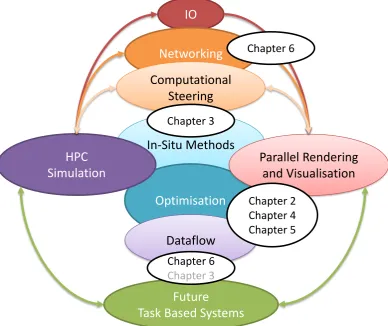
Figure 1.1: An illustration of how the main themes of the chapters of this thesis fit into the broader picture of simulation, visualisation and analysis. (It is not possible to confine each chapter to a single position since they all deal with optimisation and dataflow in some capacity).
These problem areas can be collected into broad categories as shown in figure 1.1, which illustrates how the chapters of this thesis overlap with those areas of research.
the network layer itself is the subject of Chapter 6.
• IOhas become a major bottleneck in the simulation-analysis workflow; huge datasets, saved to disk (then reloaded later), may add minutes or hours to compute runs. In-Situ analysis (Chapter 3) is one of the solutions to the IO problem, by analysing data at the point of creation, extracting useful infor-mation from it and only saving that which is necessary the total time spent on scientific discovery is dramatically reduced.
• Computational steering(Chapter 3) takes the principle of in-situ analysis one step further by allowing changes to the simulation to be made whilst it is still running and providing immediate feedback to the user.
• Dataflowrepresents the algorithmic building blocks and the connections be-tween them, that are used when turning one piece of data into another, whether that data be initial boundary conditions, geometric/topological descriptions or any other methodological parameters. Dataflow represents the single bind-ing theme of this thesis where all work intersects and it is theOptimisation
of those building blocks and how they connect that each chapter explores.
• Future computer systems will have more cores, more accelerators, and be built with more heterogeneous components that in turn require more complex synchronization, thread control and scheduling between algorithmic dataflow blocks that subdivide work into Tasks that execute asynchronously. The optimisation of task communication over the network is the subject of Chapter 6.
1.1
Dataflow
et al. [2016]) and more recently Google’s Cloud Dataflow (Akidau et al. [2015]) have been widely adopted for large scale data processing due to their flexibility and appli-cability to a wide range of problems. In the field of AI, libraries such as TensorFlow (Abadi et al. [2016]) are built around the concept of dataflow graphs in exactly the same way and are revolutionising the software landscape and placing powerful learning tools in the hands of the masses.
At the heart of the dataflow principle is the idea that many small tasks that perform a limited or well defined function, may be chained together and combined to solve more complex problems (see Johnston et al. [2004] for a good introduction). One of the requirements (and great strengths) of this approach is that it encourages the adoption of a manageably small number of well defined data types to represent the intermediate states of the computation (graph edges) so that pipelines can be constructed from reusable code blocks (graph nodes) and each new algorithm or method added, increases the problem space that can be explored in a combinatorial way. Modular design of software is not new or revolutionary and the principles behind dataflow methods originate from the more fundamental realm of functional programming, where every operation (cf. filter) is a transformation of some input data/arguments and the resulting new data is produced as an output. Functional programming itself has seen a revival in popularity over recent years, in large part due to the changes in microprocessor architectures towards more cores per chip, which in turn leads to stronger thread safety requirements in programs. Functional programs should ideally have no external state – no global mutable variables – one of the principal requirements of robust thread-safe programming, however the adoption of thread-safe programming techniques in large libraries such as VTK has been slow due to the size and complexity of those libraries; their design and much of their implementation was already in place before the need for thread safety became necessary.
information in this context may be considered as meta-data about the data being processed, the following section describes why it is useful and needed.
1.1.1 Information in Dataflow Systems
The concept of dataflow is straightforward, data is taken in by some filter or func-tion, modified in some way and exported, where it is then consumed by another filter and the process repeats, with fan-out and fan-in of data paths producing a network of connections that form a graph. Generally (at least in visualisation), the graphs are acyclic and are referred to as Directed Acyclic Graphs (DAGs). In a visualisa-tion pipeline, the sources that form the initial nodes of the graph are readers (or in-situ data generators) and the sinks that terminate the graph are renderers (or IO writers). Cyclic feedback loops within the graph are used frequently in AI systems such as TensorFlow, as they allow for concepts such as memory and feedback to be introduced, but in more traditional data-processing pipelines they introduce ambi-guity and can trigger unwanted re-execution of the algorithms in the graph nodes if not treated specially.
The problem with a simple graph is that all data must be transmitted along the graph edges connecting the nodes, and thetype of that data must conform to what is expected at the inputs to that node. A contour filter (for example) may expect a regular grid such as an image as input, but will generate an unstructured grid/mesh as output. A second filter expecting a regular grid cannot accept the unstructured data since the cells of the mesh in most systems will be represented by a differenttype than the cells in the image – an image requires only an x and y
dimensions, origin and spacing between pixels, whereas the mesh requires explicit connectivity array to map vertices onto coordinates – very different definitions. A renderer may turn the mesh geometry back into a 2D image and return the type back to a regular grid once more – such transformations are common with filter pipelines. Within a powerful high-level programming language such as C++, the datatypes that represent the geometrictypes may be part of a class hierarchy that allows one to construct higher abstractions that hide some of these type transformations or provide automatic conversion from one type to another, removing some restrictions from the composability of the nodes within the graph and therefore making their construction more straightforward. All these considerations are taken into account in the design of a library such as VTK, but problems arise when the representation ofparameters are included, in particular,conditional parameters.
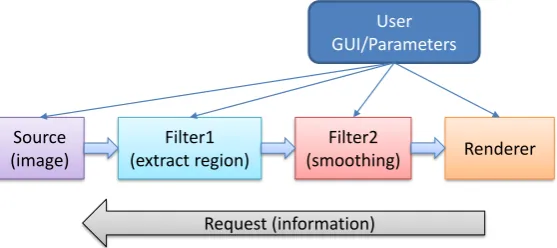
Source (image) Filter1 (extract region) Filter2 (smoothing) Renderer User GUI/Parameters Request (information)
Figure 1.2: Each of the source nodes, or filters/renderers may have a large number of parameters, which may change the input or output requirements, or even data types. When the user interacts with a filter, information passing enables filters to modify themselves or their behaviour accordingly.
may update/modify the information (even adding new information keys and values) depending upon its own needs before the main data update stage. Information flow is initiated via arequest that is generated by theexecutors responsible for updating the pipeline when new data is required (such as when the user refreshes the screen to update the display).
The solution implemented in VisIt (Childs et al. [2005]) uses acontract struc-ture that holds fields for any dataset attributes or values that might be useful to other filters and each one may update the values in the contract prior to execution of the pipeline. The contract system is not as trivially generalizable as the one in ParaView that allows any key/value pair to be added to the information by any fil-ter (or graph node) but it permits essentially the same kind of modifications to take place in the pipeline. It is important to note that the addition of extra messages flowing (sometimes bidirectionally) between nodes of the graph does not change the essential structure of the graphs into cyclic or undirected graphs since the main flow of data is unchanged – however, the communication between nodes adds tremendous flexibility and give them the opportunity to perform optimisations (data reduction for example) based on information supplied from others.
Chapter 2 presents the paper “Time Dependent Processing in a Parallel Pipeline Architecture” (Biddiscombe et al. [2007]) that explores this topic in more detail and uses the technique to extend the capabilities of ParaView to handle time dependent datasets in a consistent manner. The developments outlined in this paper allowed the creation of a series of filters that are still used today as part of the backbone of the pipeline in ParaView. The ability to modify time requests, create branches of pipelines with different timesteps and cache data between times is used in the comparative visualisation features as well as the animation controls provided by the ParaView front-end GUI. The implementation details of these features are generally hidden from the user, however some of the more visible developments are used actively – the best known of which is probably the vector field particle stream tracer that is used worldwide by researchers on a daily basis for visualisation of time dependent flows in areas of engineering and science from CFD to astrophysics.
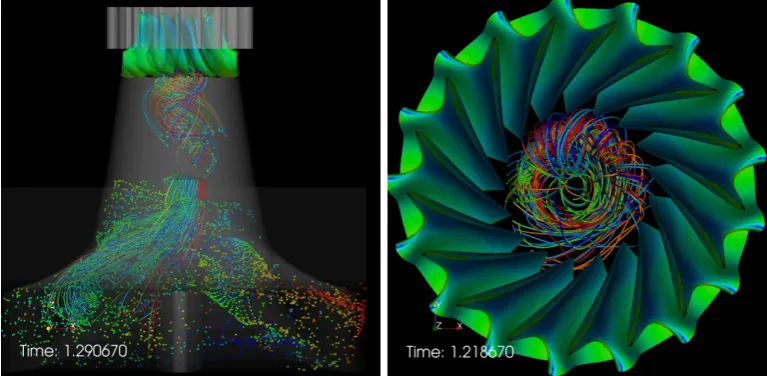
(a) Turbulent flow in Francis turbine (b) Close-up of vortex
Figure 1.3: Snapshots of pathlines generated in time dependent flow fields in a Francis turbine. (a) The turbulence below the main turbine blades causes uneven outflow that in turn reduces the efficiency of the turbine. Some particles are seeded midway through the flow to better show the asymmetrical flow. (b) A stable vortex forming right below the main turbine blades.
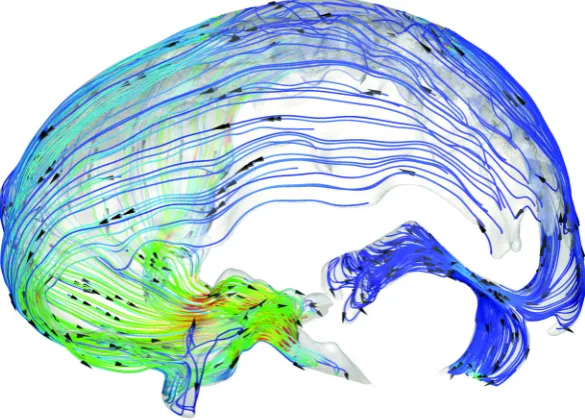
a stationary to a rotating block during an integration step and could not be done prior to the developments of Chapter 2. No other off the shelf software available at the time was able to produce images and videos of this kind from the datasets used. The particle tracer was also used to create visualisations of flow in cere-brospinal fluid (CSF) to accompany the co-authored paper (Gupta et al. [2010]) which contains many images created using the new ParaView capabilities. Figure 1.4 shows a still image of the flow of CSF around the brain that when animated re-veals the periodic motion of the fluid, synchronized to the heart beat, that transports chemicals around the brain and can be used in the modelling of drug delivery.
appli-Figure 1.4: Flow visualisation of cerebrospinal fluid between the skull and brain and in the subarachnoid space. The beating heart causes pressure changes in blood flow and expansion/contraction of the brain tissue that triggers circulation of the fluid, transporting metabolites and hormones in the process.
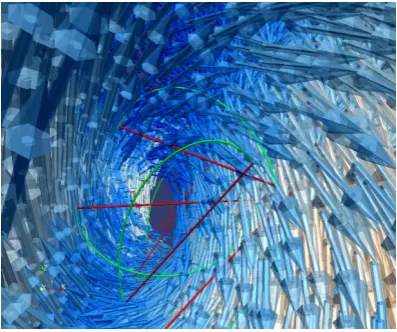
cation specific operations, figure 1.5 shows the striking difference between the linear and hermitian interpolation scheme used.
1.2
In-Situ Visualisation and Computational Steering
The size of computer simulations in the field of HPC has been, and still is, con-tinually growing as processors become more powerful and clusters/supercomputers increase in capabilities correspondingly. Managing the torrent of data produced by simulations has become one of the major challenges in the simulation community. In-situ analysis is the term used to refer to the generation of output statistics, plots or images that are derived from simulation results using the tools conventionally reserved for post processing data. The central idea being to reduce IO from simula-tion to file system, and then back again from file system to visualisasimula-tion, as well as increasing the frequency at which analysis can be performed, since IO is frequently performed after N time steps rather than at every one to reduce IO needs. Over time, the approaches used for in-situ analysis have become known by the terms
[image:21.595.173.466.117.327.2]Figure 1.5: Illustration of cubic interpolation of particle paths. Arrows indicate positions and velocities of all particles and show a region of air under a wave rolling over. Red lines mark linearly interpolated paths of some of the particles, while green curves indicate the corresponding cubically interpolated paths. (Image cIEEE. Reprinted, with permission)
separate nodes reserved for analysis to be further processed.
• Tightly coupled, where data remains on the same nodes on which it has been generated and is then processed in a second stage by analysis code.
• Hybrid coupled, some data reduction or initial processing may take place on
compute nodes and the remaining data is then forwarded on to others for further processing.
Each strategy has its own advantages and disadvantages;
• Loose coupling places a minimal burden on the simulation which can continue unaffected – but it forces the user to make a possibly expensive copy of the data on analysis nodes which must be allocated in addition to the compute nodes.
• Tightly coupled methods may require the simulation to stop whilst post pro-cessing takes place and may cause excessive memory requirement on the com-pute nodes and impact performance through contention for system resources. This problem is particularly notable if the analysis code does not scale as well as the original simulation code, resulting in resources being wasted.
The first major work in this area for the HPC community was the loose coupling framework DataStager (Abbasi et al. [2009]), it was built upon a number of other libraries including the Adaptable IO Services (ADIOS, Lofstead et al. [2008]) that were not used widely outside of the US national labs where they were developed. A much more widely adopted parallel IO library is the Hierarchical Data Format, HDF5 (The HDF Group [2000-2017]) and this was used as the basis for a loosely coupled interface between simulation and ParaView (Biddiscombe et al. [2011]), this paper was later extended and published as Chapter 3, “Parallel Computational Steering for HPC Applications using HDF5 Files in Distributed Shared Memory” (referred to as DSM henceforth) (Biddiscombe et al. [2012]) – the paper introduces a DSM based approach to reroute file IO into memory instead of disk and expose the memory as a file to the application. In the same year as the initial paper, the VisIt community released a tightly coupled in-situ library libsim (Whitlock et al. [2011]) and a few year later a tightly coupled in-situ ParaView library was released calledCatalyst (Ayachit et al. [2015]).
The work of Chapter 3 differs from libsim and Catalyst and is important for several reasons:
• The ParaView/DSM interface is built on top of a custom HDF5 file driver implying that any simulation that uses the HDF5 IO library can be integrated into the in-situ visualisation framework without requiring any modifications to the code – only relinking to a modified HDF5 lib is needed.
• Since only a linking step is needed, Fortran, C, C++ based simulation codes can all be accommodated equally well (other languages could be supported but have not been tested).
• The HDF5 file exposed by the DSM file driver (H5FDDSM) behaves exactly like a high speed file on a parallel filesystem and so can be read from or written to by either side of the communication link – this permits computational steering as well as visualisation since commands and data can be sent back from the ParaView GUI and read by the application.
• Custom GUI interfaces to control steerable objects or define visualisable ones can be built for the simulation using a simple XML syntax.
DSM
Source Filter1 ...Filters... Renderer
User GUI/Parameters
Simulation
[image:24.595.123.516.105.242.2]DSM Writer DSM
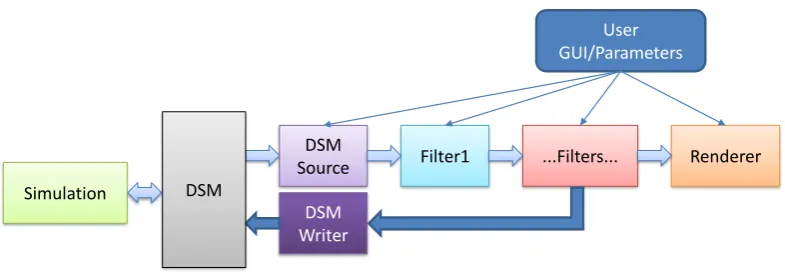
Figure 1.6: The DSM is a bi-directional module in the pipeline, it permits dataflow from simulation to user, and also allows steering commands and data to be returned.
Figure 1.6 shows how the pipeline of figure 1.2 is modified by the presence of the DSM, forming a bridge between the simulation and the conventional visualisation.
ParaView has been used as an interface for a user to control the simulation by taking outputs from the simulation, combining them with user parameters from controls, then generating new geometries that are fed back to the simulation to steer it, experiments involved the steering of boats, control of wave generator geometries and the design of turbine blades and buckets – principally using SPH solvers that are well suited to handling adaptive/dynamic meshes. In figure 1.7 is an example of the steering framework being used to control a pelton turbine simulation. The design of the bucket shape is critical to minimize the splash from the water jet rebounding and colliding with the incoming jet as this perturbs the shape and reduces momentum. This plot shows the change in velocity and torque from the turbine as the water flow is increased.
Several difficulties arose when controlling simulations in this way – the main one was that the time steps output in simulation time are typically tiny, of the order of milli or microseconds and are generated in seconds or tens of seconds of user time – this makes it very difficult for interactive (human operated) controls to be used to directly steer a simulation and instead it was found that connecting scripted python routines to outputs and animating variables using the time dependent controls dis-cussed previously gave more consistent and predicable behaviour.
1.2.1 MPI – one rank per node, one rank per process
Figure 1.7: A snapshot of the steering system in use whilst monitoring and con-trolling a simulation of a pelton turbine. The user increased the water discharge in steps and measured the velocity of the turbine and torque produced.
using MPI communication internally. Allowing an entirely asynchronous shared memory file with parallel access that can be opened and closed arbitrarily by either simulation or analysis, required a complex (parallel) locking mechanism to ensure that only one side of the link could modify the file contents at a time and a complex message scheduling algorithm to distribute pieces of the file in an MxN fashion (since the number of simulation nodes might not match the number of analysis nodes and random access of the file is permitted and enforced by using random or block cyclic access). This in turn required a multi-threaded design to allow efficient handling of many messages coming from a large number of nodes in arbitrary ordering.
Node
Single core processor 1 MPI rank
(a) 1 single-threaded rank per node
Node
Multi-core N processors
1 MPI rank 1 MPI rank
1 MPI rank 1 MPI rank
(b) N single-threaded ranks per node
Node
Many-cores M processors
1 MPI rank 1 Thread 1 Thread
1 Thread 1 Thread
[image:26.595.142.500.109.257.2](c) 1 multi-threaded rank per node
Figure 1.8: Illustration of the relationship between nodes, ranks, threads and cores. (a) A single core node with a single MPI rank, the simplest configuration and the dominant usage mode for older processors. (b) A multicore node may have 1 rank assigned to each core, each rank represents a separate process with an independent memory space. (c) A multicore node may be assigned a single rank or process with the rank using multi-threading in a single address space shared between all threads.
becoming more complex, the trend in software design is moving away from many ranks on a node towards a single MPI rank/process consisting of many threads of execution on each node. This tends to increase the complexity of the software due to thread safety issues, but allows a much easier sharing of data between cores on the same node, where previously they would have been different ranks and had to communicate using the MPI interface. Figure 1.8 gives a simple illustration of the evolution from a single rank per node, to many and then back to one again.
of this topic will be revisited in the final part of this introduction and Chapter 6. The next section looks instead at another of the problems that arise during interactive visualisation.
1.3
Load-balancing, rendering and information
When interacting with large datasets, a common operation is to extract regions by dragging a selection area on screen, or selecting one or more blocks of data from many by some attribute or threshold. When this happens the data that might have originally been well load-balanced across processes, may become wildly imbalanced with some processes holding no data and others containing 1/Nth of the data (as originally allocated). In many cases (for example, when the number of analysis nodes is small anyway and some wasted CPU cycles can be ignored), an imbalance is of little consequence, however there are many occasions when maintaining load-balance for either analysis or rendering is important. The work of Chapter 4 and Chapter 5 was motivated by these requirements. Chapter 4 presents “Practical parallel rendering of detailed neuron simulations” that used an early implementation of the work described in Chapter 5 “High-Performance Mesh Partitioning and Ghost Cell Generation for Visualisation Software” most significantly, the load-balancing of very large meshes to improve interactive visualisation particularly when transparency of those meshes made sort-last compositing the most favourable rendering mode (the full text of Chapter 4 discusses the trade-offs between sort-first and sort-last for transparency).
The question in need of an answer in the paper of Chapter 4 was, “could a general purpose visualisation tool (eg. ParaView), designed to work with almost any data and many workflows, compete with a custom built, single-purpose visualisation tool?” (in this case RTNeuron, Hernando et al. [2008], and Hernando [2011]): with the secondary question being “how much effort would be required to do it?”. The answer turned out to be “yes”, the ParaView implementation of neuron rendering was able to perform as well as RTNeuron for most cases, though RTNeuron had many options for neuron visualisation that were not available to ParaView (they can be implemented if so desired).
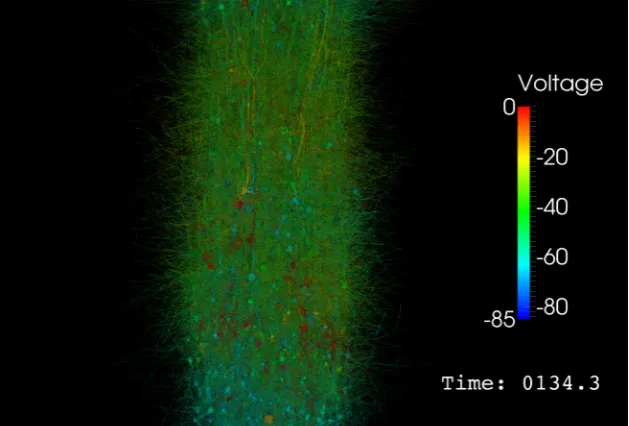
Figure 1.9: 5K neuron circuit rendered with per vertex transparency showing elec-trical activity (in millivolts) - regions that are not active are transparent, allowing active regions to be seen more easily through the dense mesh.
The solution to this problem was to make use of information flow in the pipeline to pass the geometric bounding boxes of individual process pieces of data down the rendering pipeline and then modify the rendering layer to use the information to order the compositing of pieces and give correct transparent blending. Transparent rendering of surfaces requires ordered (back-to-front usually) rendering, or depth peeling of data to give the correct results, and this ordering includes the compositing of individual images from nodes that have been rendered correctly individually.
1.3.1 Particle data
The development of the Zoltan based load-balancing filter was driven partly by the desire to handle large neuron meshes, and also by the need to handle very large particle based datasets. One problem was that there was no capability in ParaView to generate ghost cells for particle data which was necessary when analysing huge (tens of billions of cells) datasets on distributed processes. The data distribution filter in ParaView can generate ghost cells for unstructured meshes, but not for particle data, and this is essential when one wishes to interpolate between points to compute resampled density, mass or other properties between particles when those particles overlap process boundaries. Chapter 5 presents work that took the initial implementation used for neuron rendering and made it more robust, more feature complete and tightly integrated into the ParaView framework.
Some of the analysis operations on particle data (eg. SPH) requires finding
N nearest neighbours and computing a weighted sum of their contributions which can be a time consuming and compute intensive task – the ability to extract regions of interest from load-balanced data, then perform a second load-balancing step to redistribute the new data where it can be processed in parallel by all nodes in the job (and not just those on which the interesting data was first loaded) dramatically increases the speed of analysis.
1.4
Task based programming
separate thread and return a std::futurethat is a thread synchronisation primi-tive for a result that has not yet been generated – enablingtasksto be spawned that perform computations in the background, on separate threads, whilst the function that launched it continues with other work.
1.4.1 Dataflow through futurization
Limitations in the C++11 definition of future make it difficult to use for task based programming directly, however a number of additions have been proposed for C++20 and beyond that extend the features of futures significantly by using
continuations;futures are monadic data structures, they can be composed together and used to chain operations in the following manner:
future_2 = future_1.then(new_function, arg1, arg2, ...);
This permits a style of programming known as Continuation Passing Style (CPS – Appel and Jim [1989]) where futures may be used as inputs to other func-tions that themselves return futures. The beauty of this system is that the contin-uations attached to futures via the future.then function are not executed until the firstfuturehas completed, making non-blocking asynchronous multi-threaded code straightforward and simple to write with an easy to learn syntax. A number of other functions such asfuture.when,future.when_all,future.when_any, and ashared_future, make it possible to build up arbitrary dataflow graphs from the futures. A shared_futuremay be used to connect one task to several others, and the future.when(...) constructs allow the joining of several futures into one so that only when all required tasks have completed can the next one begin. CPS ensures that tasks that have data dependencies do not start executing until all their dependencies are satisfied and this approach has been shown to reduce unnecessary waiting and avoid latency (Syme et al. [2011]).
1.4.2 HPX
tasks to be launched on remote nodes and returnfutureresults from those nodes. Objects may be held locally as normal C++ data structures, or may be registered (using a unique name) with AGAS and then accessed remotely via the AGAS Ids. This means that code designed to run on a single node using multiple threads may easily be extended to run on multiple nodes and multiple threads using the same API.
The VTK-m filter framework is designed in such a way that multiple imple-mentations may be created as backends on which to execute code using a Device Adaptor abstraction that hides implementation details of the threading layer from the filter designer. Versions already exist for GPU execution using CUDA (Nickolls et al. [2008]) and on the CPU using a serial implementation and multi-threaded using Thread Building Blocks (TBB – Reinders [2007]). This author has implemented an HPX backend that implements theDevice Adaptor using thehpx::versions of the
std::parallelalgorithms and permits all visualisation filters to be executed using the HPX runtime. However, developing high performance asynchronous distributed VTK-m style filters in HPX that can pass datasets and pieces around, requires a high performance network layer within HPX and this is what is presented in the paper of Chapter 6.
Source Filter1 Filter2 Renderer
Source Filter1 Filter2 Renderer
Source Filter1 Filter2 Renderer
Client
[image:31.595.144.499.420.529.2]N copies of pipeline in parallel
Figure 1.10: ParaView relies on N copies of each pipeline - one per process, syn-chronisation is explicit and enforced at the filter level (when filters use MPI) and all data/information requests are mirrored on all ranks.
1.4.3 Task based visualisation pipelines of the future
The traditional filter pipeline that has existed in VTK/ParaView for the last 15-20 years (as shown in figure 1.10) is built upon N copies of the pipeline being instantiated and coordinated by a server instance running on each rank. The client communicates requests to each server synchronously and each server delivers the
there are problems with this design arising from the need to load-balance the filters and to keep CPU/GPU resources fully occupied. One of the goals of this thesis is to outline a design of visualisation pipelines for the next generation of software that can address these problems.
With distributed task based visualisation filters, there is no longer any need forN parallel pipelines with identical copies of each filter running in synchronized steps on each node. They may instead be replaced by a single instance of each filter that acts as a coordinator for that particular algorithmic module in the workflow. This coordinating filter-task can spawn as many or as few sub-tasks as needed on whichever nodes are holding the data of interest – those sub-tasks are still instances of the filter in question, but instead of communicating with the client/server mech-anism directly, they communicate with the master copy of the relevant filter, the flow of information occurs through the filter-tasks of the main pipeline rather than through all sub-tasks. An operation on a large dataset that spans all nodes can spawn tasks on all nodes, whereas an operation on a smaller subset, needs only to create a reduced set of sub-tasks on the nodes that have the data of interest. The decision about how many tasks to create should be based based on the number of
pieces required (or available) to process a particular dataset and not decided up front by the server based on the initial job size alone. In the case of an in-situ visualisation, we can assume that every node will initially contains some data, but the filters instantiated at later parts of the pipeline may not span all nodes if data reduction has taken place, and dynamic redistribution may modify the nodes doing work as the simulation progresses and changes. Most importantly, work can move to where the data is when it is more efficient than moving the data to free resources. The HPX AGAS system, operating as a key value store, provides a mecha-nism to find pieces of data and send work to them, or to retrieve a piece of data and send it as a parameter to a function located elsewhere. It also provides a mechanism to query how much work lies in the queues of any node to see which are idle and which are oversubscribed (see Grubel et al. [2016]), this allows dynamic load bal-ancing based on the actual work being done rather than always using a fixed set of nodes, as is the case in the current ParaView implementation. The only requirement to make this possible is that each node producing data registers it with AGAS to give it a handle (Id) that can be passed around the system and accessed by any task on any node using the handle identifier.
Filters distributed unevenly across nodes using thread pools on each node Common thread pool on one Node
Renderer Client
GUI Render
tasks
Data Filter A Filter B
[image:33.595.126.514.114.319.2]Filter B tasks Filter A tasks Source tasks Simulation Tasks Analysis Tasks Visualisation Tasks Rendering Tasks
Figure 1.11: Using a task based approach, there is not necessarily any need for a copy of the pipeline on each node. A single filter, source or renderer task can coordinate as many or as few sub tasks as required to perform an operation. The pipeline itself needs only to existonceand distributed operation and synchronisation of each filter is local only to that filter. There is no need for a server to directly coordinate all branches of the pipeline individually.
pipeline are now only communicated along a single path of principal filter-tasks that in turn coordinate the activities of each of the sub-tasks that they are responsible for. Placement and numbers of sub-tasks may vary for each filter depending upon needs.
As well as providing a much more flexible approach to dataflow, a task based design using a work-stealing runtime allows seamless integration of in-situ processing with the simulation providing the simulation is written using the same runtime as the analysis. Simulation tasks and analysis tasks share the same work queues and
continue and the user may control the priority of analysis tasks to minimize their impact.
Figure 1.12 shows an example of a task based simulation that creates many thousands of sub-tasks on each iteration of its solver, however, at the end of each iteration, the amount of work to be done decreases and cores begin to sit idle waiting for additional work. during these idle moments, visualisation tasks can be spawned to make use of the wasted resources. On each individual node, analysis tasks can even be placed on the queues of the cores that have generated the data they require, improving data-locality by cache reuse as well as correct placement on the desired node.
There is a further advantage to thread aware pipelines (using an HPX style dataflow) that interplays with the scheduling (or execution) of individual nodes of the graph and is demonstrated very clearly in Vo et al. [2011]. A pull driven pipeline (ie. one that executes filters by traversing from sink back to source) cannot easily execute two branches of a fork-join graph simultaneously because the execution trigger is made from the downstream filter to its upstream source. Since each filter passes its execution trigger upstream to its parent, multiple threads are required causing a race as the two triggers progress on the two paths back to the (common, in this example) source of the pipeline where they both wait for a filter to execute and then trigger their respective pipeline branches to execute. With a push driven pipeline, as soon as a filter completes, it can trigger it’s downstream dependencies directly – executing on N threads for N branches of the pipeline becomes trivial. The HPX dataflow execution model using CPS triggering naturally follows this pattern and can easily be integrated into thread pools and schedulers to minimize wasted CPU waits and to steal work from idle cores as need be.
The development therefore of a high speed serialization and network layer that can handle the passing of large datasets (using RMA), in distributed multi-threaded pipelines with low latency information exchange for HPX is a major step towards making this not only possible, but feasible.
1.4.4 Future work
It is clear that the vision of a task-based visualisation pipeline operating in parallel in a distributed setting requires considerable development before it can be fulfilled. The next steps towards this goal are
pass through shared memory within the node. Only synchronization messages (using MPI) pass between nodes. In a distributed pipeline, these informational messages may pass between nodes since there is no longer any guarantee that connected filters are on the same node. The hpx::async messaging will be used for this.
• Distributed filters. With individual filters as distributed objects, the
synchro-nization and update mechanism of the pipeline, will flow in a tree like pattern rather than as a series of linear parallel updates. Together with the removal of explicit synchronization between nodes participating in the pipeline, asyn-chrony is introduced to the update phase and each connected part of the pipeline will need to passfutureobjects rather than datasets directly.
• Load-balancing. Currently there do not exist any task-based counterparts to the Zoltan partitioning software. To enable truly dynamic pipelines, this will need to be developed.
• Compositing and rendering. Compositing of images using the HPX distributed run time has been tested (in Biedert et al. [2017]), but does not make use of the improved network capabilities implemented here. This work will need to be extended and integrated with the ideas presented.
There are a great many opportunities for new research and development in the field of task-based visualisation beyond those stated above. Whilst the VTK-m design of filters using parallel primitives opens up the door to easy implementation with libraries such as HPX, the filters themselves are not always optimal and can be further improved with better task based designs.
1.5
Contribution
In this thesis, a collection of papers have been presented that demonstrate ways of optimising the performance of dataflow based visualisation, analysis and simulation software in the HPC community. The contributions of this work are:
• To provide an interface between information flow and a high-quality mesh partitioning library, that can be used to improve load balancing of parallel pipelines in the VTK/ParaView environment.
• To combine the load balancing mechanism with the rendering engine so that high depth complexity meshes can be rendered with full transparency in par-allel without duplicating the geometry on every node.
• To also provide a mechanism to generate ghost cells for parallel distributed algorithms using the load balancing pipeline and leveraging the information flow techniques.
• To show how to loosely couple a traditional visualisation pipeline with a live simulation using in-memory files that can be implemented without changes to the simulation software and can additionally be used to steer the software interactively if the simulation is modified accordingly.
• To improve the speed of data transmission and remote function invocation in a distributed dataflow based runtime using RMA and a novel serialization strategy to minimize data duplication and movement.
Chapter 2
Time Dependent Processing in
a Parallel Pipeline Architecture
The following paper
Time Dependent Processing in a Parallel Pipeline Architecture
Published in
IEEE Transactions on Visualization and Computer Graphics
Volume 13 Issue 6, November 2007
c
Chapter 3
Parallel Computational Steering
for HPC Applications using
HDF5 Files in Distributed
Shared Memory
The following paper
Parallel Computational Steering for HPC Applications using HDF5 Files in Distributed Shared Memory
Published in
IEEE Transactions on Visualization and Computer Graphics
Volume: 18, Issue: 6, June 2012
c
Chapter 4
Practical parallel rendering of
detailed neuron simulations
The following paper
Practical parallel rendering of detailed neuron simulations
Published in the proceedings of the
Eurographics Symposium on Parallel Graphics and Visualization 2013
c
Eurographics Association 2013
Chapter 5
High-Performance Mesh
Partitioning and Ghost Cell
Generation for Visualization
Software
The following paper
High-Performance Mesh Partitioning and Ghost Cell Generation for Visualization Software
Published in the proceedings of the
Eurographics Symposium on Parallel Graphics and Visualization 2016
c
Eurographics Association 2016
Chapter 6
Zero Copy Serialization using
RMA in the Distributed
Task-Based HPX Runtime
The following paper
Zero Copy Serialization using RMA in the Distributed Task-Based
HPX Runtime
Published in the proceedings of the
14th International Conference on Applied Computing 2017
c
IADIS – International Association for Development of the Information Society
Bibliography
Thesis Introduction
Martin Abadi, Paul Barham, Jianmin Chen, Zhifeng Chen, Andy Davis, Jef-frey Dean, Matthieu Devin, Sanjay Ghemawat, GeofJef-frey Irving, Michael Isard, Manjunath Kudlur, Josh Levenberg, Rajat Monga, Sherry Moore, Derek G. Murray, Benoit Steiner, Paul Tucker, Vijay Vasudevan, Pete War-den, Martin Wicke, Yuan Yu, and Xiaoqiang Zheng. Tensorflow: A system for large-scale machine learning. In 12th USENIX Symposium on Operating
Systems Design and Implementation (OSDI 16), pages 265–283, 2016. URL
https://www.usenix.org/system/files/conference/osdi16/osdi16-abadi.pdf.
Hasan Abbasi, Matthew Wolf, Greg Eisenhauer, Scott Klasky, Karsten Schwan, and Fang Zheng. DataStager: scalable data staging services for petascale applications. InHPDC ’09: Proceedings of the 18th ACM international symposium on High per-formance distributed computing, pages 39–48, New York, NY, USA, 2009. ACM. ISBN 978-1-60558-587-1. doi: http://doi.acm.org/10.1145/1551609.1551618.
James Ahrens, Charles Law, Will Schroeder, Ken Martin, Kitware Inc, and Michael Papka. A parallel approach for efficiently visualizing extremely large, time-varying datasets. Technical report, Los Alamos National Laboratory, 2000.
James Ahrens, Berk Geveci, and Charles Law. Paraview: An end-user tool for large data visualization. The Visualization Handbook, 717, 2005.
Tyler Akidau, Robert Bradshaw, Craig Chambers, Slava Chernyak, Rafael J. Fern´andez-Moctezuma, Reuven Lax, Sam McVeety, Daniel Mills, Frances Perry, Eric Schmidt, and Sam Whittle. The dataflow model: A practi-cal approach to balancing correctness, latency, and cost in massive-spracti-cale, un-bounded, out-of-order data processing. Proc. VLDB Endow., 8(12):1792– 1803, August 2015. ISSN 2150-8097. doi: 10.14778/2824032.2824076. URL
A. W. Appel and T. Jim. Continuation-passing, closure-passing style. In POPL ’89: Proceedings of the 16th ACM SIGPLAN-SIGACT symposium on Principles
of programming languages, pages 293–302, New York, NY, USA, 1989. ACM.
ISBN 0-89791-294-2.
Utkarsh Ayachit, Andrew Bauer, Berk Geveci, Patrick O’Leary, Kenneth Moreland, Nathan Fabian, and Jeffrey Mauldin. Paraview catalyst: En-abling in situ data analysis and visualization. In Proceedings of the First Workshop on In Situ Infrastructures for Enabling Extreme-Scale Analysis
and Visualization, ISAV2015, pages 25–29, New York, NY, USA, 2015.
ACM. ISBN 978-1-4503-4003-8. doi: 10.1145/2828612.2828624. URL
http://doi.acm.org/10.1145/2828612.2828624.
Tim Biedert, Kilian Werner, Bernd Hentschel, and Christoph Garth. A Task-Based Parallel Rendering Component For Large-Scale Visualization Applications. In Alexandru Telea and Janine Bennett, editors, Eurographics Symposium on Par-allel Graphics and Visualization. The Eurographics Association, 2017. ISBN 978-3-03868-034-5. doi: 10.2312/pgv.20171094.
Erik Boman, Karen Devine, Robert Heaphy, Bruce Hendrickson, Vitus Leung, Lee Ann Riesen, Courtenay Vaughan, Umit Catalyurek, Doruk Bozdag, William Mitchell, and James Teresco. Zoltan 3.0: Parallel Partitioning, Load Balancing, and Data-Management Services; Developer’s Guide. Sandia National Laborato-ries, Albuquerque, NM, 2007. Tech. Report SAND2007-4749W.
Hank Childs, Eric S. Brugger, Kathleen S. Bonnell, Jeremy S Meredith, Mark Miller, Brad J Whitlock, and Nelson Max. A contract-based system for large data visu-alization. InProceedings of IEEE Visualization 2005, pages 190–198, 2005.
Jeffrey Dean and Sanjay Ghemawat. Mapreduce: simplified data processing on large clusters. Communications of the ACM, 51(1):107–113, 2008.
P. Grubel, H. Kaiser, K. Huck, and J. Cook. Using intrinsic performance coun-ters to assess efficiency in task-based parallel applications. In 2016 IEEE Inter-national Parallel and Distributed Processing Symposium Workshops (IPDPSW), pages 1692–1701, May 2016. doi: 10.1109/IPDPSW.2016.115.
Juan B. Hernando, Felix Sch¨urmann, Henry Markram, and Pedro de Miguel. RT-Neuron, an application for interactive visualization of detailed cortical column simulations. XVIII Jornadas de Paralelismo, Spain, 2008.
Wesley M. Johnston, J. R. Paul Hanna, and Richard J. Millar. Ad-vances in dataflow programming languages. ACM Comput. Surv., 36(1):1– 34, March 2004. ISSN 0360-0300. doi: 10.1145/1013208.1013209. URL
http://doi.acm.org/10.1145/1013208.1013209.
Hartmut Kaiser, Thomas Heller, Daniel Bourgeois, and Dietmar Fey. Higher-level parallelization for local and distributed asynchronous task-based programming. In Proceedings of the First International Workshop on Extreme Scale
Program-ming Models and Middleware, ESPM ’15, pages 29–37, New York, NY, USA,
2015. ACM. ISBN 978-1-4503-3996-4. doi: 10.1145/2832241.2832244. URL
http://doi.acm.org/10.1145/2832241.2832244.
Hartmut Kaiser, Bryce Adelstein-Lelbach, Thomas Heller, Agustin Berge, and John Biddiscombe et.al. HPX V1.0: The C++ Standards Library for Parallelism and Concurrency, 2017. http://dx.doi.org/10.5281/zenodo.4455628.
C. Law, W. Schroeder, and K. Martin. A multi-threaded streaming pipeline archi-tecture for large structured data sets. InProceedings of IEEE Visualization 1999, pages 225–232. ACM Press, 1999.
Li-ta Lo, Christopher Sewell, and James Ahrens. PISTON: A Portable Cross-Platform Framework for Data-Parallel Visualization Operators. In Hank Childs, Torsten Kuhlen, and Fabio Marton, editors,Eurographics Symposium on Parallel Graphics and Visualization. The Eurographics Association, 2012. ISBN 978-3-905674-35-4. doi: 10.2312/EGPGV/EGPGV12/011-020.
Jay F. Lofstead, Scott Klasky, Karsten Schwan, Norbert Podhorszki, and Chen Jin. Flexible IO and integration for scientific codes through the adaptable IO system (ADIOS). In CLADE ’08: Proceedings of the 6th international workshop on Challenges of large applications in distributed environments, pages 15–24, New York, NY, USA, 2008. ACM. ISBN 978-1-60558-156-9. doi: http://doi.acm.org/10.1145/1383529.1383533.
and Visualization. The Eurographics Association, 2012. ISBN 978-3-905674-35-4. doi: 10.2312/EGPGV/EGPGV12/021-030.
K. Moreland, C. Sewell, W. Usher, L. t. Lo, J. Meredith, D. Pugmire, J. Kress, H. Schroots, K. L. Ma, H. Childs, M. Larsen, C. M. Chen, R. Maynard, and B. Geveci. Vtk-m: Accelerating the visualization toolkit for massively threaded architectures.IEEE Computer Graphics and Applications, 36(3):48–58, May 2016. ISSN 0272-1716. doi: 10.1109/MCG.2016.48.
Kenneth Moreland, Utkarsh Ayachit, Berk Geveci, and Kwan-Liu Ma. Dax toolkit: A proposed framework for data analysis and visualization at extreme scale. In
Large Data Analysis and Visualization (LDAV), 2011 IEEE Symposium on, pages 97–104. IEEE, 2011.
MPI Forum. MPI: A Message-Passing Interface Standard. Version 3, September 4th 2012. available at: http://www.mpi-forum.org (Dec. 2009).
John Nickolls, Ian Buck, Michael Garland, and Kevin Skadron. Scal-able parallel programming with cuda. Queue, 6(2):40–53, March 2008. ISSN 1542-7730. doi: 10.1145/1365490.1365500. URL
http://doi.acm.org/10.1145/1365490.1365500.
James Reinders. Intel Threading Building Blocks. O’Reilly & Associates, Inc., Sebastopol, CA, USA, first edition, 2007. ISBN 9780596514808.
W. Schroeder, K.W. Martin, and B. Lorensen.The Visualization Toolkit: An Object-oriented Approach to 3D Graphics. The Visualization Toolkit: An Object-oriented Approach to 3-D Graphics. Prentice Hall PTR, 1996. ISBN 9780131998377. URL
https://books.google.ch/books?id=MrCiQgAACAAJ.
Don Syme, Tomas Petricek, and Dmitry Lomov. The f# asynchronous programming model. In Proceedings of the 13th International Conference
on Practical Aspects of Declarative Languages, PADL’11, pages 175–189,
Berlin, Heidelberg, 2011. Springer-Verlag. ISBN 978-3-642-18377-5. URL
http://dl.acm.org/citation.cfm?id=1946313.1946334.
The C++ Standards Committee. ISO International Standard ISO/IEC 14882:2011, Programming Language C++. Technical report, Geneva, Switzerland: International Organization for Standardization (ISO)., 2011.
The C++ Standards Committee. ISO/IEC Draft International Standard 14882, Programming Language C++. Technical report, Geneva, Switzerland: Interna-tional Organization for Standardization (ISO)., 2017.
The HDF Group. Hierarchical data format version 5, 2000-2017. URL
http://www.hdfgroup.org/HDF5.
H. T. Vo, J. L. D. Comba, B. Geveci, and C. T. Silva. Streaming-enabled parallel data flow framework in the visualization toolkit. Computing in Science Engineer-ing, 13(5):72–83, Sept 2011. ISSN 1521-9615. doi: 10.1109/MCSE.2011.88.
Brad Whitlock, Jean M. Favre, and Jeremy S. Meredith. Parallel in situ coupling of simulation with a fully featured visualization system. In Torsten Kuhlen, Renato Pajarola, and Kun Zhou, editors, Eurographics Symposium on Parallel Graphics and Visualization, pages 101–109. Eurographics Association, 2011. ISBN 978-3-905674-32-3. doi: 10.2312/EGPGV/EGPGV11/101-109.
Matei Zaharia, Reynold S. Xin, Patrick Wendell, Tathagata Das, Michael Arm-brust, Ankur Dave, Xiangrui Meng, Josh Rosen, Shivaram Venkataraman, Michael J. Franklin, Ali Ghodsi, Joseph Gonzalez, Scott Shenker, and Ion Sto-ica. Apache spark: A unified engine for big data processing. Commun. ACM, 59(11):56–65, October 2016. ISSN 0001-0782. doi: 10.1145/2934664. URL
Author Bibliography
Journal
John Biddiscombe, Berk Geveci, Ken Martin, Kenneth Moreland, and David S. Thompson. Time dependent processing in a par-allel pipeline architecture. IEEE Trans. Vis. Comput. Graph., 13(6):1376–1383, 2007. doi: 10.1109/TVCG.2007.70600. URL
http://dx.doi.org/10.1109/TVCG.2007.70600.
John Biddiscombe, David Graham, and Pierre Maruzewski. Visualization and anal-ysis of sph data. Ercoftac Bulletin, 76(LMH-ARTICLE-2008-006):9–12, 2008.
John Biddiscombe, J´erome Soumagne, Guillaume Oger, David Guibert, and Jean-Guillaume Piccinali. Parallel computational steering for HPC applica-tions using HDF5 files in distributed shared memory. IEEE Trans. Vis.
Comput. Graph., 18(6):852–864, 2012. doi: 10.1109/TVCG.2012.63. URL
http://dx.doi.org/10.1109/TVCG.2012.63.
Sumeet Gupta, Michaela Soellinger, Deborah M. Grzybowski, Peter Boesiger, John Biddiscombe, Dimos Poulikakos, and Vartan Kurtcuoglu. Cerebrospinal fluid dynamics in the human cranial subarachnoid space: an overlooked mediator of cerebral disease. i. computational model. Journal of The Royal Society Inter-face, 7(49):1195–1204, 2010. ISSN 1742-5689. doi: 10.1098/rsif.2010.0033. URL
http://rsif.royalsocietypublishing.org/content/7/49/1195.
Guillaume Oger, David Le Touz´e, David Guibert, Matthieu De Leffe, John Biddis-combe, J´erome Soumagne, and Jean-Guillaume Piccinali. On distributed mem-ory mpi-based parallelization of SPH codes in massive HPC context. Computer Physics Communications, 200:1–14, 2016. doi: 10.1016/j.cpc.2015.08.021. URL
http://dx.doi.org/10.1016/j.cpc.2015.08.021.
Using transponders with the ers-1 and topex altimeters to measure orbit altitude to 3 cm. Advances in Space Research, 13(5):61 – 67, 1993. ISSN 0273-1177. doi: http://dx.doi.org/10.1016/0273-1177(93)90528-J. URL
http://www.sciencedirect.com/science/article/pii/027311779390528J.
Benjamin Schindler, Raphael Fuchs, John Biddiscombe, and Ronald Peik-ert. Predictor-corrector schemes for visualization of smoothed particle hy-drodynamics data. IEEE Transactions on Visualization and Computer
Graphics, 15(6):1243–1250, 2009. doi: 10.1109/TVCG.2009.173. URL
http://dx.doi.org/10.1109/TVCG.2009.173.
Refereed Conference
J. A. Biddiscombe. Modelling line of sight availability for high frequency urban radio networks. In 1999 IEEE MTT-S International Topical Symposium on Technolo-gies for Wireless Applications (Cat. No. 99TH8390), pages 105–110, Feb 1999. doi: 10.1109/MTTTWA.1999.755137.
John Biddiscombe. High-Performance Mesh Partitioning and Ghost Cell Genera-tion for VisualizaGenera-tion Software. In Enrico Gobbetti and Wes Bethel, editors, Eu-rographics Symposium on Parallel Graphics and Visualization. The Eurographics Association, 2016. ISBN 978-3-03868-006-2. doi: 10.2312/pgv.20161181.
John Biddiscombe, J´erome Soumagne, Guillaume Oger, David Guibert, and Jean-Guillaume Piccinali. Parallel computational steering and analysis for HPC ap-plications using a paraview interface and the HDF5 DSM virtual file driver. In Torsten Kuhlen, Renato Pajarola, and Kun Zhou, editors, Eurographics Symposium on Parallel Graphics and Visualization, EGPGV 2011, Llandudno, Wales, UK, 2011. Proceedings, pages 91–100. Eurographics Association, 2011. ISBN 978-3-905674-32-3. doi: 10.2312/EGPGV/EGPGV11/091-100. URL
http://dx.doi.org/10.2312/EGPGV/EGPGV11/091-100.
John Biddiscombe, Thomas Heller, Anton Bikineev, and Hartmut Kaiser. Zero Copy Serialization using RMA in the Distributed Task-Based HPX runtime. In14th In-ternational Conference on Applied Computing. IADIS, International Association for Development of the Information Society, 2017.
cel-lular systems. In Tenth International Conference on Antennas and Propaga-tion (Conf. Publ. No. 436), volume 2, pages 383–386 vol.2, Apr 1997. doi: 10.1049/cp:19970405.
Stefan Eilemann, Fabien Delalondre, Jon Bernard, Judit Planas, Felix Sch¨urmann, John Biddiscombe, Costas Bekas, Alessandro Curioni, Bernard Metzler, Peter Kaltstein, Peter Morjan, Joachim Fenkes, Ralph Bellofatto, Lars Schneidenbach, T. J. Christopher Ward, and Blake G. Fitch. Key/value-enabled flash mem-ory for complex scientific workflows with on-line analysis and visualization. In
2016 IEEE International Parallel and Distributed Processing Symposium, IPDPS
2016, Chicago, IL, USA, May 23-27, 2016, pages 608–617. IEEE Computer
Society, 2016. ISBN 978-1-5090-2140-6. doi: 10.1109/IPDPS.2016.23. URL
http://dx.doi.org/10.1109/IPDPS.2016.23.
Juan Hernando, John Biddiscombe, Bidur Bohara, Stefan Eilemann, and Felix Sch¨urmann. Practical parallel rendering of detailed neuron simu-lations. In Fabio Marton and Kenneth Moreland, editors,
Eurograph-ics Symposium on Parallel GraphEurograph-ics and Visualization, Girona, Spain,
2013. Proceedings, pages 49–56. Eurographics Association, 2013. ISBN
978-3-905674-45-3. doi: 10.2312/EGPGV/EGPGV13/049-056. URL
http://dx.doi.org/10.2312/EGPGV/EGPGV13/049-056.
Mark L. Sawley, John Biddiscombe, and Jean M. Favre. Advanced visualization of large datasets for discrete element method simulations. In Discrete Element Methods (DEM) ’07, Brisbane, Australia, 26-29 August 2007, 2007.
Felix Sch¨urmann, Fabien Delalondre, Pramod S. Kumbhar, John Biddiscombe, Miguel Gila, Davide Tacchella, Alessandro Curioni, Bernard Metzler, Peter Mor-jan, Joachim Fenkes, Michele Franceschini, Robert S. Germain, Lars Schneiden-bach, T. J. Christopher Ward, and Blake G. Fitch. Rebasing I/O for scientific com-puting: Leveraging storage class memory in an IBM bluegene/q supercomputer. In Julian Martin Kunkel, Thomas Ludwig, and Hans Werner Meuer, editors, Su-percomputing - 29th International Conference, ISC 2014, Leipzig, Germany, June 22-26, 2014. Proceedings, volume 8488 of Lecture Notes in Computer Science, pages 331–347. Springer, 2014. ISBN 978-3-319-07517-4. doi: 10.1007/978-3-319-07518-1 21. URL http://dx.doi.org/10.1007/978-3-319-07518-1 21.
In Mitsuhisa Sato, Satoshi Matsuoka, Peter M. A. Sloot, G. Dick van Al-bada, and Jack Dongarra, editors, Proceedings of the International Con-ference on Computational Science, ICCS 2011, Nanyang Technological
Uni-versity, Singapore, 1-3 June, 2011, volume 4 of Procedia Computer
Sci-ence, pages 479–488. Elsevier, 2011. doi: 10.1016/j.procs.2011.04.050. URL
http://dx.doi.org/10.1016/j.procs.2011.04.050.
J´erome Soumagne, John Biddiscombe, and Jerry Clarke. An HDF5 MPI vir-tual file driver for parallel in-situ post-processing. In Rainer Keller, Edgar Gabriel, Michael M. Resch, and Jack Dongarra, editors, Recent Advances in the Message Passing Interface - 17th European MPI Users’ Group Meet-ing, EuroMPI 2010, Stuttgart, Germany, September 12-15, 2010. Proceedings, volume 6305 of Lecture Notes in Computer Science, pages 62–71. Springer, 2010. ISBN 978-3-642-15645-8. doi: 10.1007/978-3-642-15646-5 7. URL
http://dx.doi.org/10.1007/978-3-642-15646-5 7.
J´erome Soumagne, John Biddiscombe, and Aur´elien Esnard. Data redistribu-tion using one-sided transfers to in-memory HDF5 files. In Yiannis Cotronis, Anthony Danalis, Dimitrios S. Nikolopoulos, and Jack Dongarra, editors, Re-cent Advances in the Message Passing Interface - 18th European MPI Users’ Group Meeting, EuroMPI 2011, Santorini, Greece, September 18-21, 2011. Pro-ceedings, volume 6960 of Lecture Notes in Computer Science, pages 198–207. Springer, 2011. ISBN 978-3-642-24448-3. doi: 10.1007/978-3-642-24449-0 23. URLhttp://dx.doi.org/10.1007/978-3-642-24449-0 23.
David Le Touz´e, John Biddiscombe, Andrea Colagrossi, Erwan Jacquin, Fran-cis Leboeuf, Jean-Christophe Marongiu, Nathan J. Quinlan, Andrea Amicarelli, Matteo Antuono, Daniel A. Barcarolo, Mihai Basa, Joelle Caro, Matthieu De Leffe, Nicolas Grenier, Pierre-Michel Guilcher, Matthieu Kerhuel, Fang Le, Libor Lobovsk´y, Salvatore Marrone, Adam Marsh, Guillaume Oger, Etienne Parkinson, and J´erome Soumagne. Next-generation multi-mechanics simulation engine in a highly interactive environment. In Elisabeth Giacobino and Rolf Pfeifer, editors,
Proceedings of the 2nd European Future Technologies Conference and Exhibition, FET 2011, Budapest, Hungary, May 4-6, 2011, volume 7 of Procedia Computer Science, pages 292–293. Elsevier, 2011. doi: 10.1016/j.procs.2011.09.077. URL