Original citation:
Yao, F. F., Dobkin, D. P., Edelsbrunner, H. and Paterson, Michael S. (1988) Partitioning space for range queries. University of Warwick. Department of Computer Science. (Department of Computer Science Research Report). (Unpublished) CS-RR-118
Permanent WRAP url:
http://wrap.warwick.ac.uk/60814
Copyright and reuse:
The Warwick Research Archive Portal (WRAP) makes this work by researchers of the University of Warwick available open access under the following conditions. Copyright © and all moral rights to the version of the paper presented here belong to the individual author(s) and/or other copyright owners. To the extent reasonable and practicable the material made available in WRAP has been checked for eligibility before being made available.
Copies of full items can be used for personal research or study, educational, or not-for-profit purposes without prior permission or charge. Provided that the authors, title and full bibliographic details are credited, a hyperlink and/or URL is given for the original metadata page and the content is not changed in any way.
A note on versions:
Research re-port 118
PAR11110NING SPACE FOR RANGE QUERIES
by
F. Frances Yaol
David P. Dobkin2
Herbert Edelsbrunner3
Michael S. Paterson4
(RR 118)
Abstract
It is shown that, given a set S of n points in R3, one can always find three planes that form an
eight-partition of S, that is, a eight-partition where at most n/8 points of S lie in each of the eight open regions.
This theorem is used to define a data structure, called an octant tree, for representing any point set in R 3. An octant tree for n points occupies 0(n) space and can be constructed in polynomial time. With this data structure and its refinements, efficient solutions to various range query problems in 2 and 3 dimensions can be obtained, including (1) half-space queries: find all points of S that lie to one side of any given plane; (2) polyhedron queries: find all points that lie inside (outside) any given polyhedron; and (3) circular queries in R2: for a planar set S, find all points that lie inside (outside) any given circle. The 'retrieval time for all these queries is T(n)=O(na + m) where a= 0.8988 (or 0.8471 in case (3)) and m is the size of the output. This performance is the best currently known for linear-space data structures which can be deterministically constructed in polynomial time.
Department of Computer Science
University of Warwick
Coventry, CV4 7AL, England
April 1988
1Xerox Palo Alto Research Center, Palo Alto, California.
Partitioning Space for Range Queries
F. Frances Yaol
David P. Dobkin2 Herbert Edelsbrunner3
Michael S. Paterson4
Abstract
It is shown that, given a set S of n points in R.3, one can always find three planes that form an eight-partition of S, that is, a partition where at most n/8 points of S lie in each of the eight open regions. This theorem is used to define a data structure, called an octant tree, for representing any point set in R.3. An octant tree for n points occupies 0(n) space and can be constructed in polynomial time. With this data structure and its refinements, efficient solutions to various range query problems in 2 and 3 dimensions can be obtained, including (1) half-space queries: find all points of S that lie to one side of any given plane; (2) polyhedron queries: find all points that lie inside (outside) any given polyhedron; and (3) circular queries in R2 : for a planar set
S, find all points that lie inside (outside) any given circle. The retrieval time for
all these queries is T(n) = 0(n' m) where a = 0.8988 (or 0.8471 in case (3)) and m is the size of the output. This performance is the best currently known for linear-space data structures which can be deterministically constructed in polynomial time.
1 Xerox Palo Alto Research Center, Palo Alto, California.
2 Department of Computer Science, Princeton University, Princeton, New Jersey.
Department of Computer Science, University of Illinois, Urbana, Illinois.
4 Department of Computer Science, University of Warwick, Coventry, UK. This author
1. Introduction
Consider a database that contains a collection of records with multi-dimensional keys.
Given a range query, which is specified by certain constraints on the value of the multi-dimensional key, the database is expected to return the set of all records (or some function of
the set of all records) whose keys satisfy those constraints. Efficient solutions to range queries
are important both in themselves and also as subroutines for solving other multi-dimensional
search problems. In this paper we will consider solutions to range queries that use only linear
space for data structure storage.
There is an extensive literature on efficient algorithms for handling orthogonal queries,
that is, queries with constraints of the form a l. < k i < b1., , ad < kd < bd , where the key is
(k1, , k d ). Relatively little is known about solving queries of more general types, such as
half-space queries where the constraints are linear inequalities a1 k1 + • • • + adkd < c. Willard
[W] was the first to consider half-space queries for d = 2, and gave a solution with linear space
and sublinear query time 0(n") where a 0.774. Edelsbrunner and Welzl [EW] improved
a to log, "i+1 0.695. Both of these results are based on the fact that a set of n points in
R2 can be partitioned by two lines so that each open quadrant contains at most n/4 points.
For d = 3, the first nontrivial time bound was 0(n") for a 0.98 by Yao [Y]. The
data structure is based on a partition of any point set by three planes into eight regions with
the property that no seven regions together contain more than 23/24 of the points. Such a
partition was obtained by making use of the concept of a centerpoint of a set (see [YB]).
In this paper, we prove a stronger result on partitions in R3 by using the Borsuk- Ulam
Theorem of topology. It is shown that, given a set S of n points in R3, one can always find
three planes that form an eight-partition of S, that is, a partition where at most n/8 points of
S lie in each of the eight open regions. This theorem is used to define a data structure, called
an octant tree, for representing any point set in R3. Efficient solutions to various range query
problems in R2 and R3 can be obtained by using this data structure and its refinements. For
example, one can solve in time O(n°•3933 + m), where m is the size of the output,
(1) half-space queries: find all points that lie to one side of a query plane;
(2) polyhedron .queries: find all points that lie inside (outside) a query polyhedron; and
(3) circular queries in R2 : given a planar set, find all points that lie inside (outside) a query
circle.
An octant tree for n points occupies 0(n) space and can be constructed in 0(7/6 log n)
pre-processing time.
The paper contains five sections. In Section 2 we define the concepts necessary for
contains the proof of the main theorem of the paper. In Section 4 we present and analyze several data structures based on the main theorem for representing point sets. Finally we comment on open problems and related results in Section 5.
2. Preliminaries
We use Sd-1 to denote the unit sphere { (x1, , xd) I xi + + + xd = 1}
in Rd. An oriented hyperplane (or hyperplane for short) h in Rd with normal vector v = (vi , , vd) E Sd-1 is defined by an equation
> vi xi =
t. If v has length 1, then the real number t is the distance of h from the origin; it is the unique scalar for which the point t • v lies on h. The hyperplane h separates Rd into a positive half-space h+ defined byE v, xa >
t and a negative half-space h — defined byE vi ii <
t. When we consider continuous functions defined on the collection of hyperplanes in Rd, we assume that the latter is endowed with the topology of Sd-1 x R through the representation of h by (v,t). Corresponding to h = (v,t) we let —h denote the hyperplane (—v, —t); thus, —h is a hyperplane defined by the same equation as h but with opposite orientation.We shall limit our discussions to Rd with d < 3 in this paper. A hyperplane in R3 will simply be called a plane. For a set S of n points in R3, we are interested in finding three planes h1, h2 , h3 so that at most n/8 points lie in each of the eight open regions defined by the three planes. Such a triple (h1 , h2, h3) is termed an eight-partition of S. We shall prove the existence of an eight-partition for any finite point set by first transforming the problem to a continuous framework. Thus, let A be a positive density function defined on some bounded, connected region in R3, and let an eight-partition of A be a triple of planes (h1, h2, h3) that partitions A into eight parts of equal mass.
Lemma 2.1. If every positive density function over a bounded connected region in R3 has an eight-partition, then every finite point set in R3 has an eight-partition.
Proof. We replace a set S of n points with a density function A by placing at each point
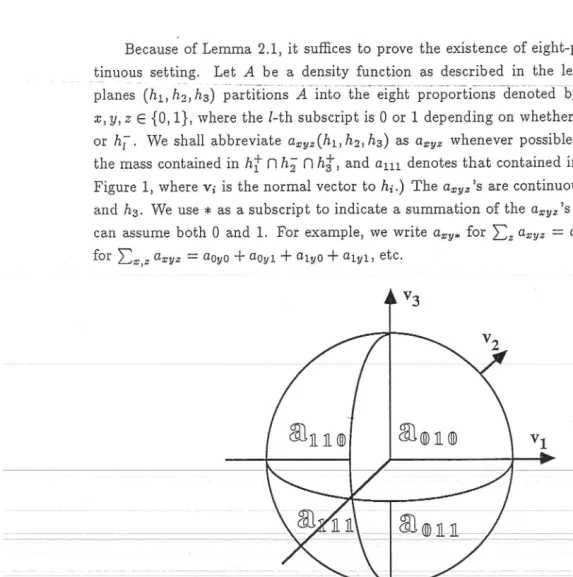
Because of Lemma 2.1, it suffices to prove the existence of eight-partitions in the con-tinuous setting. Let A be a density function as described in the lemma. Any triple of planes (h1, h2, h3) partitions A into the eight proportions denoted by h,, h3) for x, y, z E {0, 1 }, where the 1-th subscript is 0 or 1 depending on whether the region lies in hi
or hi. We shall abbreviate a,yz (hi, h2, h3) as %, whenever possible. Thus, aolo denotes
[image:7.842.18.592.83.660.2]the mass contained in hi n n h3 , and a111 denotes that contained in hr n n h3 . (See
Figure 1, where vi is the normal vector to hi.) The %,'s are continuous functions of h1, and h3. We use * as a subscript to indicate a summation of the aryz 's where that subscript can assume both 0 and 1. For example, we write %* for
Ez a„z = a„0 +
%0, and a.y* forEz , a,yz = aoyo
aoy1 aly0 aly1, etc.Figure 1
Definitions. Let A be a positive density function on R3, and consider the a,yz 's defined by three planes (hi, h2, h3). We say that
1) h1 is a bisector of A if a, = 1/2 for x E {0, 1};
2) the pair (h1, h2) forms a four-partition of A if %* = 1/4 for all s,
y
E {0 , 1 },3) the triple (h1, h2, h3) forms an eight-partition of A if %, = 1/8 for all x, y, z E {0,1}. In order to achieve a,yz = 1/8 for all x, y, z, it is convenient to form eight linear com-binations of the %,'s as follows. Let fijk = Exyz eTiYaryz where ETI: = (-1)b with b = (i, j, k) • (x, y, z) = ix jy kz. For example,
hoo =
a._ 1, 1100 = ao** — al**, andThe fiik 's, like the %z 's, are continuous functions of h1, h2 and h3. Note that 'filo is symmetric in the first and the second arguments: fllo(h i , h2, h3) = f11o(h2, h1, h3). Also, when we flip the sign of an argument h1 , the function f,yz either changes sign or not de-pending on whether the corresponding subscript in f. yz is 1 or 0. For example, for 1 = 1,
f110(—h1,h2,h3) —fiio (hi,h2,h3); while for I = 3, filo (h i , h 2 , —h3) = fno(hi, h2, h3). We
state these symmetry properties in the next lemma. Lemma 2.2.
1) fijk(hi, h2, h3) = fjik(h2, h1, h3).
2) fijk(— hl, h2, h3) = (-1)i fijk(hi,h2,h3).
Proof. Immediate from the definition of fijk. 0
In seeking an eight-partition for A, we shall make use of the following characterization in terms of the fijk's.
Lemma 2.3.
1) h1 is a bisector of A iff fioo = 0.
2) The pair (h1, h2) forms a four-partition of A if fioo = fol.() = filo = 0.
3) The triple (hi, h2, h3) forms an eight-partition of A if fijk = 0 for all (i, j, k) 0 (0,0,0). Proof. 1) ao.. =
2) Note that
= 1/2 if ifloo
foio fllo fo
\
f000 ) /\
— 1 1 1 1 1 —1 —1 1=
f100=
0 since ao** + al*. = f000 1.—1 —1 aoo* 1 —1 aci* —1 1 aio* •
) 1 1 aii*
If aoo* = an* = au)* = an. = 1/4, then fioo = kw = filo = 0 and f000 E 1. Since the 4 x 4 matrix is nonsingular, indeed orthogonal, the converse is also true.
3) We show that the matrix of the coefficients -Kin is orthogonal, and so nonsingular. Since
xyz xyz
c_ ijk eiTki (-1)(z ,Y
,k+k i )
xyz xyz
=0 unless i = j = j' and
k = ,
the inner product of any two distinct rows of the matrix is zero. 0 3. Eight
-
Partition in R3Lemma 3.1. (Four-Partition) Let Ao and A l be two positive density functions on the
plane whose domains are bounded, connected and separable by a line L. There is a unique
(unoriented) line L' that bisects Ao and Al simultaneously.
Proof. For any point p on L, let tip and rp be the (unique) lines that go through p and bisect
Ao and Al respectively. We can assume that L is vertical and that Al is to the right of L. As
p moves up L from bottom to top, the slope of rp decreases continuously and monotonically
from oo to —oo, while that of tp increases continuously and monotonically from —co to oo.
Hence there is a unique p for which 4 and rp coincide, giving the desired L'. ❑
We next consider four-partitions in R3.
Lemma 3.2. Let Ao and A l be two positive density functions in R3 whose domains are
hounded, connected and separable by a plane h. Let Sh = S1 denote the set of unit vectors
in R3 that are parallel to h. Then,
1) for any u E Sh there is a unique plane p(u) parallel to u which bisects Ao and Al
simul-taneously and has an orientation induced by u;
2) the mapping f : Sh S2 which maps u E Sh to the normal vector of p(u) gives a
continuous antipodal mapping of Sh into S2, i.e., f(—u) = — f(u) for all u E Sh.
Proof. For any u E Sh, a plane p(u) parallel to u bisects Ao and A l simultaneously if and
only if the projection of p(u) along the direction u (onto a plane normal to u) gives a line
that bisects the projections of Ao and Al simultaneously. The intersection of h and p(u) is
a line parallel to u. The orientation of u gives it a natural orientation which can be used to
define the left and right half-planes of h with respect to this line. The orientation of p(u) is
chosen so that these lie respectively in the positive and negative half-spaces determined by
p(u): By Lemma 3.1, p(u) is unique.
It is easy to see that the function f defined in (2) is continuous and antipodal. ❑
We shall make use of the d = 2 case of the following topological theorem in proving that
every density function A in R3 can be eight-partitioned.
Theorem. (Borsuk-Ulam) Let f : Sd Rd be a continuous, antipodal map, i.e., f(—p) =
— f(p) for p E Sd . Then there is a point p E Sd such that f(p) = 0.
A proof of the Borsuk-Ulam theorem can be found in textbooks on algebraic topology
such as Munkres [Mu]. The theorem does not extend in general to mappings defined on direct
on the torus S1 x S1 which satisfy certain additional symmetry properties. This leinma is sufficient, as we shall see, for establishing the existence of eight-partitions in R3.
Lemma 3.3. Let f : S1 x S1 R2 be a continuous map such that 1) f is symmetric, i.e., f (u, v) = f (v, u),
2) f is antipodal in each argument, i.e. f(u,—v)= f(—u,v)= — f(u, v), and 3) f is constant on the the diagonal {(u, u) I u E 54}.
Then there is a point p E S1 x Si such that f(p) , 0.
B
2
icIC
0
0
TC2
ic [image:10.842.112.387.227.444.2]Figure 2
Proof. We can represent 51 x S1 by the square Q = [0, 27r] x [0, 27r] with opposite sides identified. Consider the rectangle P = { (u, v) Ir <u+v< 37r, u < v < u 7r } contained in Q with vertices A = (7r/2, r/2), B = (0, 7r), C = (37r/2, 37r/2) and D = (7r, 2r) (Figure 2). Note that f is constant on side AC by property (3), constant on side BD since f (u, u + 7r) =
—f(u, u) by (2), and defined identically on AB and CD since f(u,v) = f(u + 7r, v 7r). The involution (u, v) (v, u 7r) maps square ABFE to FECD and vice versa, while f(v, u 7r) = —f(v,u) = —f(u, v). Consider any map a : P S2 which identifies sides AB
and CD, contracts BD and AC to points, and maps every pair of points of the form (u, v) and (v, u 7r) in 7, to a pair of antipodal points (p, —p) on S2 . Such an a yields an induced continuous function f' : R2 where f' (a(p)) = f (p) for p E P. Since f' is an antipodal map, it follows from the Borsuk-Ulam Theorem that f', and hence f, must map some point onto the origin of R2 . D
Proof. By Lemma 2.3, this is equivalent to finding h1, h2, h3 such that fijk(hi, h2, h3) = 0 for all (i,j, k) 0 (0, 0, 0). Since h1, h2 and h3 must be bisectors for A, and for any u E S2 there is a unique bisector hu for A with normal vector u, we can define functions gijk
S2 X S2 X S 2 R by
gijk(U) V) = fijk(hu)hv)hw)• (1)
The giik 's are obviously continuous. It suffices to find uo and vo such that gum = gioi =
9011 = 9111 = 0 at (uo, vo, wo). We can limit the choice of uo (or vo) to the set {u} (or {v}) for which (hu , kJ (respectively (hp, [two )) forms a four-partition, i.e.,
gio1(u,v,w0) = 0 and golf (u, v, wo) = 0. (2)
By Lemma 3.2, the set of (u, v) that satisfy (2) is homeomorphic to S1 x S1. Our goal is thus
to find a point (uo, vo) E S1 x S1 where both of the functions
Go (u'
V) def = 9110(U, V, WO) and Gi(u,v) def gm(u,v,wo)
are zero. Let G (Go, : 51 x S1 1--* R2 . Note that G is symmetric in its two arguments
and antipodal on each S1 by Lemma 2.2 and (1):
G(u, v) = G(v,u),
G(u, —v) = —G(u, v).
Furthermore it is easy to verify that on the diagonal we have
G(u,u) = (1,0).
It follows from Lemma 3.3 that there exists (uo , vo) E 51 x S1 such that G(uo, vo) = (0, 0). We conclude that (huo , !Ivo , yields the desired eight-partition. CI
Lemma 3.4. Consider a partition of R3 into eight open regions by three mutually
inter-secting planes. Any plane h in R3 can intersect at most seven of these eight regions.
Proof. Define the origin 0 to be the point where the three planes meet, and axes X, Y,
and Z to be the lines where pairs of planes intersect. Then 0 divides each axis into two
half-axes {X+, {Y+,Y-} and {Z+,Z- }. Without loss of generality, assume that h
intersects the half-axes X+,Y+ and Z+. Then h does not intersect the open region bounded
by X-, Y- and 0
The Borsuk-Ulam theorem also leads to the following well-known corollary (see, e.g. [E]),
which we shall employ in defining a data structure in Section 4.2. We state it in the discrete
Theorem. (Ham-Sandwich Cut) Let Si , 82, Sd be d finite point sets in Rd . There exists
a hyperplane which simultaneously bisects S1, 57, . • • ,Sd•
4. Data Structures and Algorithms
Let S be a finite set of points in R3. We will describe several tree structures for
rep-resenting S, based on partitions of S by planes. These partitions are obtained by recursive
applications of the theorems proved in the last section, and the resulting tree structures are
suitable for the purpose of half-space retrieval and related searches on S.
We first present a recursive partition scheme based on the main theorem, giving a data
structure termed an octant tree. Two variations of this basic scheme are derived by applying
recursion in more intricate ways. The retrieval time is analyzed for each scheme, with the
last variant achieving a retrieval time of (n°•3933) for half-space query.
4.1. Octant Tree
An octant tree is a recursively defined structure for storing a finite set S of points in
R3. If S is empty the octant tree is the special node NIL, otherwise the root of the octant
tree contains a plane h, and its left, middle and right children represent the subsets S fl h — ,
S nh and Sn h+ respectively. More precisely, the middle child points to a 2-dimensional data
structure for Sn h (such as a polygon tree [W] or a conjugation tree [EW]), while the left and
right children point to the root nodes of octant trees for S fl h — and S fl h+ respectively. We
define the domain of any node v, denoted by dom(v), to be the intersection of the 'regions'
on the path from the root to v. That is, the domain of the root is the whole space, and if v
is a child of w and h is the plane stored at w, then dom(v) is the intersection of dom(w) with
h — , h or h+, depending on whether v is the left, middle or right child of w. The set stored at v, denoted by S(v), is S n dom(v).
The plane h at each node v of the octant tree is chosen so that both IS(v) fl h — I and
Ism nh+ I are at most IS(v)I/2. There is no difficulty in finding planes with this property, but,
without further conditions, such a data structure would have poor worst-case performance
for half-space retrieval. (For example, Q-D trees [B] require 0(n) time in the worst case.) In
the schemes to be described, we achieve better performance by appropriately grouping the
tree nodes so that all nodes within a group can share a common plane. For this purpose, we
build octant trees recursively from small primitive trees and define the grouping among the
nodes of a primitive tree. The data structures pointed to by middle children represent the
corresponding two-dimensional sets efficiently for a retrieval time of 0(t 5 ) for a set of size t,
Ivhere 0.6 9 5 [EW]. These substructures are ignored in the recursive structures described
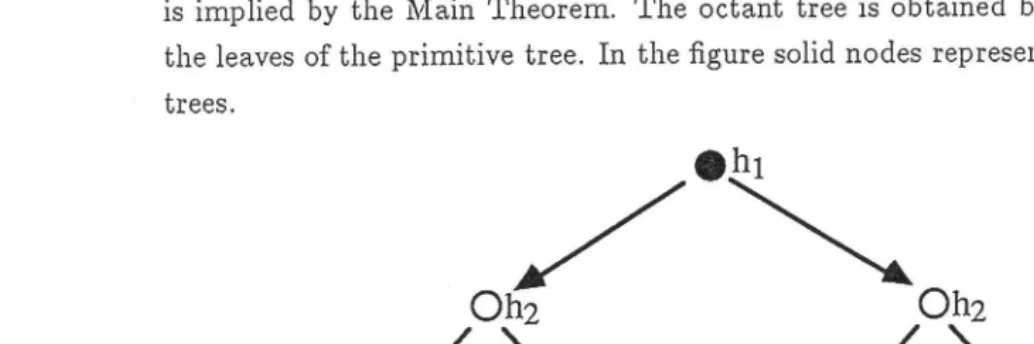
Octant Tree A. In this basic scheme, the primitive tree is of height 3 and all nodes on the same level share the same plane. (See Figure 3.) The existence of such primitive trees is implied by the Main Theorem. The octant tree is obtained by applying recursion at the leaves of the primitive tree. In the figure solid nodes represent the roots of primitive trees.
• hi
Ohl
_h2
\
Oh3
Oh3
Oh3
Oh3
1L 1L lL
i<
[image:13.842.59.576.172.344.2]• • • • • • • •
Figure 3
A search algorithm for the octant tree can be derived recursively from a search algorithm for the corresponding primitive tree. The general search strategy for primitive trees, with respect to a query plane q, is to identify those leaves in the primitive tree which need not be searched further. More precisely, a leaf v can be excluded from future search if dom(v) lies completely in a half-space of q, since the entire set S(v) can then be either reported or discarded. A leaf satisfying this condition is said to be free with respect to q.
By Lemma 3.4, the primitive tree has at least one free leaf with respect to any query q. Furthermore, the time required to identify the free leaves is bounded by a constant. Thus the search time for the derived octant tree is proportional to the total number of nodes visited. The'recurrences below yield upper bounds for the search time. The reporting time, which is always linear in the size of the result, is not included here. Let f (n) denote the maximum number of nodes visited in an octant tree for a set of 71 points. The constant 6 arising from
the two-dimensional subtrees has value at most 0.695.
Lemma 4.1.
f(n) satisfies the recurrence relationf(n) < 7 + 7 f ( —n8 ) + 0(n5 ),
which gives a search time of 0(1(n)) = 0(n") for a = logs 7 0.9358.
0 h2
\
• h3 •h3
Oh?
• h
3
•h3
The total number of nodes visited from middle children is at most 0(n6 ) since 6 <'1. The linear recurrence relation is solved by standard techniques (see, e.g., Knuth [K]). ❑
4.2. Refined Octant Trees
Octant Tree
B.
In this variant of the basic scheme, we apply recursion to the four sets at level 2, while requiring that the same h3 be used as the first plane for all four sets. The primitive tree is of depth two. (See Figure 4.) Here we take advantage of the strength of the Main Theorem, which allows one of the three partitioning planes to be an arbitrary bisector./ \A
OhLt 0114 Oh5 Oh5
\
Oh6 Oh6 Ohl 0117
Figure 4
To estimate the search time for Scheme B, let f (n) (and g(n)) denote the maximum num-ber of nodes searched for any query, when the search starts at a root-level (and, respectively, second-level) node v of the primitive tree with S(v) = n.
Lemma 4.2. An) and g(n) satisfy the recurrence relations f(n) < 4 + 3 f ( T-i) + g ( 28 ) + 0 (n5),
g(n) < 1 + 2f( 72-1) + 0 (n6 ) ,
which give a search time under Scheme B of 0(f(n)) = 0(nP) where
0
0.9163.Proof. Suppose without loss of generality that the rightmost of the eight lowest nodes, r, is free. The algorithm visits the three upper nodes and the parent of r, then recurses from the root level in the three left subtrees. In the fourth subtree, since r is free the search can begin at the second-level node which is r's sibling. This yields the first inequality. For the second, a search begun at a second-level node searches that node and recurses on its children, which are root-level nodes. Substituting the second inequality into the first, we have
The recurrence yields f (n) = 0 (nO ) where )3 ^s 0.9163. ❑
• hi
O
h2 h2Oh3
0 h3
0 h3
• h3
• h4
•h5 • h4
•h4 0 0
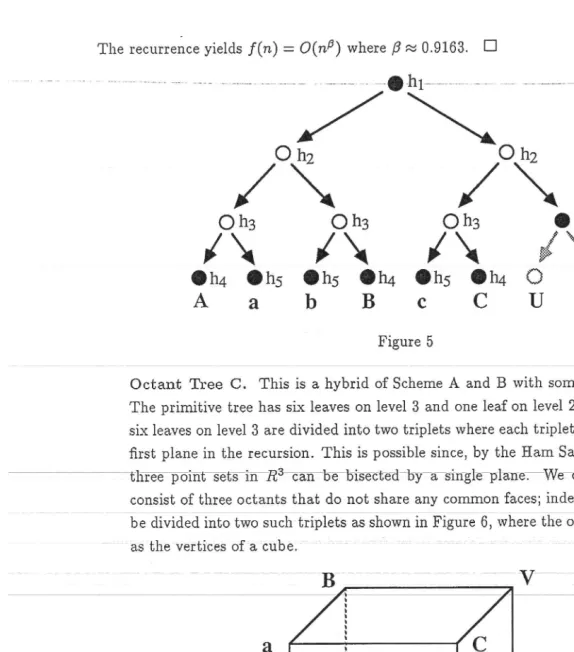
[image:15.842.16.590.82.733.2]A a b B c C U V
Figure 5
Octant Tree C. This is a hybrid of Scheme A and B with some further refinements. The primitive tree has six leaves on level 3 and one leaf on level 2. (See Figure 5.) The six leaves on level 3 are divided into two triplets where each triplet is to share a common first plane in the recursion. This is possible since, by the Ham Sandwich Theorem, any three point sets in R3 can be bisected by a single plane. We choose each triplet to consist of three octants that do not share any common faces; indeed the six octants can be divided into two such triplets as shown in Figure 6, where the octants are represented as the vertices of a cube.
Figure 6
Lemma 4.3. Under Scheme C,
f (n)
satisfies the recurrence relationf (n) < 10 + f (—
n
4 ) + 4 f ( 2
8 ) +
4f (a) 0 (n 5)_,
which gives a search time under of
0(f
(n)) =0 (7-17 )
for y 0.8988.Proof. There are a number of cases to consider depending on which of the eight nodes is
free.
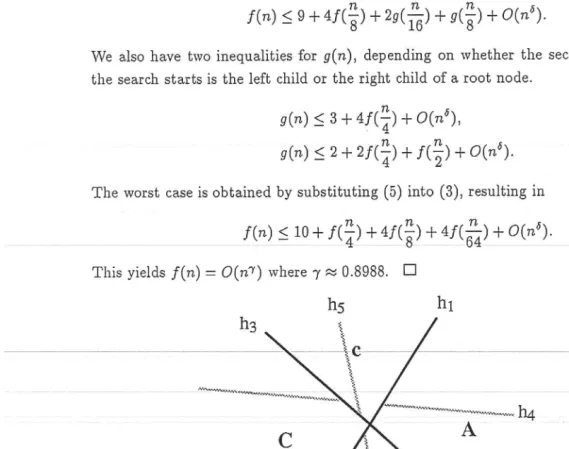
If A is free then the intersection of the query plane
q
with the other domains will besimilar to Figure 7. The domains
A, B
andC
are bisected by h4 , while h5 bisects a,b
andc.
In the worst case,
q
will intersect both halves ofB
andC
but, by our choice of the triplets,q
cannot intersect both halves of a,b
and c. (In Figure 7, the intersections ofq
with a,b
andc
form three regions which cannot be simultaneously intersected by the line representingthe intersection of
q
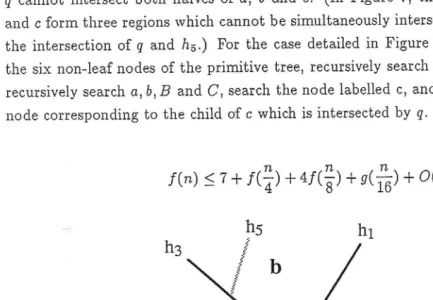
and h5.) For the case detailed in Figure 7, our algorithm is to searchthe six non-leaf nodes of the primitive tree, recursively search from the parent of
U
andV,
recursively search a,
b, B
andC,
search the node labelled c, and search from the second-levelnode corresponding to the child of
c
which is intersected byq.
This yields the inequalityf (n) 5 7 +
f 4f ( ii)g( 1 -
6 ) +
0 (n°
(3)Figure 7
If
U
is free the intersection withq
is similar to Figure 8. Here at most two of A,B
and [image:16.842.94.527.381.681.2]C
AV
h3B
intersected by q. For the case detailed in Figure 8, our algorithm is to search the upper
seven nodes, search the nodes labelled B and b, recursively search a, c, A and C, recursively
search the single children of B and b which are intersected by q—and - recursively search V.
The corresponding inequality is
f(n) < 9 +
+
2g( —1718 ) g( —8 ) 0(n5). (4)We also have two inequalities for g(n), depending on whether the second-level node where
the search starts is the left child or the right child of a root node.
g(n) < 3 + 4f (—n4 ) + (n5 ), (5)
g(n) < 2 + 2 f (-4 ) + f (-2 ) + 0 (n5 ). (6)
The worst case is obtained by substituting (5) into (3), resulting in
f(n) < 10 + f ( 24 ) + 4f ( ri) + 4f ( 1-6.-/z) + 0 (n5 ).
This yields An) = 0(n1") where y 0.8988. D
[image:17.842.19.588.202.651.2]h5 h1
Figure 8
4.3. Preprocessing Cost
We look at the time it takes to construct an octant tree for a set S of n points. First
consider the computation of an eight-partition (h1, h2, h3) for S. The first bisector h1 can be
found in 0(n) time by a median-finding algorithm. We may assume that h 2 and h3 are each
determined by three points of S. For each of the 0(n6 ) possible choices of (h. , h 3) , we decide
in 0(n) time whether it forms an eight-partition together with h1 by explicitly counting the
number of points in each octant. This amounts to a total time of 0(n7) with linear space.
The time can be reduced to 0(n6 ) by lowering the—cost- due- to counting as follows. For atiy
two fixed points a, b of S, order the remaining points as c1, c2 , ... by projecting the points of S onto a plane perpendicular to ab and sorting them radially. Coplanar sets of more than
three points introduce some complication but no significant difficulty. With such orderings
imposed on h3 during the search, the task of counting associated with each pair (h2 , h3)
becomes that of doing simple updates, with constant cost per pair on average. The total cost
for finding an eight-partition, with sorting included, is thus 0(n6) time using 0(n3) storage.
The storage could be made 0(n) by repeating the sorting operations whenever needed, but
at a cost of 0(n6 log n) time.
The octant trees of schemes A and B can be constructed by applying the above procedure
recursively, in total time 0(n6 ) for n points with linear space. The same bounds hold for
scheme C since a 'ham-sandwich cut' can be computed in 0(n3 log n) time.
4.4. Circular queries
The problem of finding all points (x, y) in a planar set S which lie inside a query circle
C with center (a, b) and radius r can be transformed to a 3-dimensional half-space problem
in the following way. Since
(x, y) lies inside C < (x — a)2 (y < r2
—2ax — 2by (x2 H._ y2 ) < r2 _ a 2 _ b2 ,
if we represent each point (x, y) E S as a 3-vector v = (x, y, x 2 + y2) then the query with
respect to circle C can be expressed by the half-space query:
(-2a, —2b, 1) • v < (r2 — a2 — b2 ).
A gebmetrical interpretation of this is that, when the xy-plane is projected upwards onto the
paraboloid z = x 2 + y2 , the image of any circle in the plane is the intersection of the paraboloid
with a suitable plane. The same technique is applicable to other 'algebraic' queries, but the
dimension required is the number of degrees of freedom of the defining polynomial.
Rather than transforming the circle query problem to three dimensions we can also
recast our three-dimensional results in two dimensions. An 8-partition of the n points on the
paraboloid can be projected down to the xy-plane yielding a partition by three circles. Our
main theorem implies the following.
Corollary 4.4. For any finite point set and any bisecting circle in the plane, there are two
circles such that each open region defined by the three circles contains at most one eighth of
As observed by Marshall Bern, a query circle intersects at most 6 of the 8 regions.since it
meets the three circles in at most 6 points. Using (the two-dimensional projection of) octant
- - -- -
tree A we therefore get 0(f(n)) query time, where
f (n) < 7 + 6 f (
—
n
8
) + 0(log n) = 0(n"),for a = logs 6 0.8617. Here the 0(log n) term takes care of the one-dimensional queries
needed for points lying on the partitioning circles.
We get the same worst-case time using scheme C, but using octant tree B yields a slight
improvement. The query time is 0(1(n)) where
f(n) < 7 + 2 f (L.:1 ) + 4 f(-16 ) + 0(log n),
f5-2 +
which solves to f(n) = 0(71.0 ), with f3 = log., 1 0.8471.
4.5. Polyhedron queries
Based on our half-space query schemes, we may derive a generalization to queries for
convex polyhedra defined by the intersection of r hyperplanes. For fixed r, the query time will
be of the same order as for half-space queries, but the constant increases with r. Since every
(not necessarily convex) polyhedron can be decomposed into (possibly unbounded) tetrahedra
(see, e.g., [Ch]), it would suffice to consider at most tetrahedral queries, i.e., r < 4.
Let fr (n) be the number of nodes of the data structure for n points which may be
searched in a query with a polyhedron
C
which is the intersection of r half-spaces, where wehave already by our Scheme C above that fi (n) = 0(717) for some
7 <
0.8988. We prove byinduction on r that fr (n) = 0(n7 ) for all r.
Suppose fr _ i (n) = 0(n7 ) and consider a query with respect to the intersection of r
half-spaces. In the case that some level 3 node is free with respect to all r planes, the
recurrence relations considered above hold for fr . In the alternative case, there are two level
3 nodes each free with respect to some plane or planes. Now the recurrence terms in
fr
arediminished and so correspond to some exponent
-
y' < 7, while the remaining terms are of size0(fr,_ 1)
= 0(n7). The result is that f (n) = 0(n7 ) and the induction is complete.Of course the same general argument is valid for any similar scheme in any finite
dimen-sion.
5. Conclusion and Related Results
We showed that an eight-partition with three planes exists for any finite point set in
R3. It was brought to the authors' attention that a continuous version of this theorem was
proved earlier by H. Hadwiger with a more complicated argument [H]. As far as generalization
to higher dimensions is concerned, David Avis [A] showed that 2d-partitions are not always
possible in dimen sions d > 5. A different and simpler p Oof-iS -as folIoivs (stated -here for
d = 5 but adaptable to any larger d). Take thirteen small balls of equal mass and place them
in general position so that no hyperplane in R5 can intersect more than five of the balls. Now,
in any 25-partition, each ball must be cut by at least two hyperplanes, otherwise some orthant
will contain at least one half of a ball, with at least 1/26 of the total mass, which is larger than
the 1/32 required. Therefore, for all thirteen balls, at least 26 instances of hyperplane-ball
intersections are needed. Since the balls are in general position, five hyperplanes can provide
at most 25 such instances and we have a contradiction.
The case of d = 4 still remains an intriguing open question, that is, given any finite point
set in R4, whether one can always partition it with four hyperplanes such that each orthant
contains at most 1/16 of the points. Our proof for d = 3 makes use of the Borsuk-Ulam
Theorem of algebraic topology; the case of d = 4 is likely to draw further upon classical
mathematics for its resolution.
Generalizations of eight-partition to higher dimensions have also been studied along a
different line, by relaxing the number of hyperplanes used in the partition (see Cole [Co] and
Yao and Yao [Y.)1 ). Deterministic partition schemes in three dimensions that are different
from those described in this paper can be found in [EH]. Their main construction is based
on the existence of a 6-partition for every planar point set, that is, a partition by three
concurrent lines so that every wedge contains at most one sixth of the points. The best such
scheme achieves O(na) query time, where a ti 0.9089.
Haussler and Welzl [HIV] used random sampling to demonstrate the existence of
parti-tions in Rd which afford the best query time currently known. In particular, for d = 3 their
scheme gives query time 0(e) for a 0.857. As their algorithms are probabilistic, it is
an interesting open question to find deterministic algorithms for constructing partitions to
realize similar or even better query time in Rd .
Chazelle [Ch2] established a lower bound under a rather general model for range search
in d dimensions. His bound in three dimensions assuming 0(n) space is C2(0) query time.
References
[A] D. Avis, Non-partitionable point sets, Inf. Proc. Letters 19 (1984), 125-129.
[B] J. L. Bentley, Multidimensional binary search trees used for associative searching, CA CM
[Ch1] B. Chaielle, Convex partitions of polyhedra: a lower bound and worst-case algorithm,
SIAM J. on Computing 13 (1984), 488
-
507.[Ch2] B. Chazelle, Polytope range searching and integral geometry, Proc. 28th Ann. IEEE
Sympos. Found. Comput. Sci. (1987), 1
-
10.[Co] R. Cole, Partitioning point sets in arbitrary dimensions, Report 184, Dept. of Computer Science, New York University, New York, NY.
[DE] D. P. Dobkin and H. Edelsbrunner, Space searching for intersecting objects, J. of
Algo-rithms 8 (1987), 348-361.
[E] H. Edelsbrunner, Algorithms in Combinatorial Geometry, Springer-Verlag (1987). [EH] H. Edelsbrunner and F. Huber, Dissecting sets of points in two and three dimensions,
Report F 138, Inst. Informationsverarb., Techn. Univ. Graz, Austria, 1984.
[EW] H. Edelsbrunner and E. We1z1, Halfplanar range serch in linear space and 0(71' 5) query time, Inf. Proc. Letters (1986).
[H] H. Hadwiger, Simultane Vierteilung zweier Korper, Arch. Math. (Basel) 17 (1966), 274- 278.
[HW] D. Haussler and E. Welzl, c—nets and simplex range queries, Discrete and Computational
Geometry 2 (1987), 127-151.
[K] D. E. Knuth, Fundamental Algorithms: The Art of Computer Programming I Addison- Wesley, Reading, MA, 1968.
[Me] .N. Megiddo, Partitioning with two lines in the plane, J. of Algorithms 3 (1985), 430-433. [Mu] J. R. Munkres, Elements of Algebraic Topology, Addison-Wesley, 1984.
[W] D. E. Willard, Polygon retrieval, SIAM J. on Computing 11 (1982), 149-165.
.[YB] I. M. Yaglom and V. G. Bolyanski, Convex Figures, (English translation) Holt, Rinehart and Winston, New York, NY (1961).
[Y] F. F. Yao, A 3-space partition and its applications, Proc. 15th Ann. ACM Sympos. on
Theory of Computing (1983), 258
-
263.[YY A. C. Yao and F. F. Yao, A general approach to d
![Proof. We can represent 5Figure 2 1 x S1 by the square Q = [0, 27r] x [0, 27r] with opposite sides](https://thumb-us.123doks.com/thumbv2/123dok_us/9876996.488903/10.842.112.387.227.444/proof-represent-figure-s-square-q-opposite-sides.webp)