Object-Oriented
Model Representation
for Control Systems Analysis
Wolfgang Kreutzer
Technical Report COSC 5/88Object-Orientea Afoae{
~presentation
for Contro{ Systems Jlna{ysis
X..ar{-Jofian Ylstroem
Dept. of Automatic Control - Univ. of Lund, Sweden &
'Wolfgang go-eutzer
Dept. of Computer Science - Univ. of Canterbury, New Zealand
Abstract:
1
'Tfie representation af systems is a ~y issue in system tlieory ana computer-aiiea contro{ engineering. 'Tfiis paper aiscusses iifferent ways to represent systems ana suggests an approacfi 6asei on o6ject-orientei programming wfiicfi aimits fiierarcfiica{ iescriptions
ef
system structure ana 6efiaviour . .91 prototype iinp{ementationef
tfiese Meas, fiastei 6y a so ca{{et{ 'j{avour system' far o6ject orientei programming is iescri6ei togetfier witfi some e;i:periences in using it.1. Introduction
The notion of systems is an essential element of control theory, and it is also a key issue in computer-aided control engineering (CACE). Systems can be represented in many different ways. There are graphical representations like block diagrams, signal flow diagrams and bond graphs. There are also mathematical representations like state space models and input-output relations which come in many different forms, matrix fractions, impulse responses, frequency responses. When working with control systems it is frequently helpful to use several different representations of a system.
Only fairly primitive ways of system representation are used in current CACSD systems. Typical examples are the MatfiLa6 derivatives where systems are described by matrices. A slightly more sophisticated representation is used in the simulation language Simnon. This representation recognizes that a system has properties such as inputs, outputs and states. Simnon also allows a system to be described as an interconnection of subsystems, with the restriction that only "flat" interconnections are permitted.
This paper presents a more flexible way to describe systems, which is based on the methodology of object-oriented programming. It is shown that a general structural description of hierarchically connected systems can be constructed from simple ingredients, by making a system an object with properties such as name, inputs, outputs and subsystems.
can then inherit both structural and bahavioural aspects. Behaviour can be characterised in many different ways. A state description is one of the simpler alternatives. This can be covered by introducing the object StateBehaviour with
properties states, stateTransitionMap and outputMap. The behavioural descriptions should also allow a given system to be defined by models of different complexity. Apart from a detailed quantitative description it is also useful to be able to deal with qualitative descriptions of behaviour.
The paper describes a small prototype implementation of these ideas, which is written in Scheme and admits hierarchical system representation and symbolic manipulation of system descriptions. Our experiments with this prototype program indicate that this approach is a feasible means to implement powerful CACE systems.
The paper is organized as follows. Some system representations in current CACSD packages are described in section 2. Requirements on system representations are given in section 3. Sections 4 and 5 deal with representation of system structure and behaviour. The prototype implementation itself is described in section 6, together with an example of its application. Some conclusions are drawn in section 7, and the appendices contain a summary of the flavour system's functionality as well as the prototype's source code.
2. Examples
Some typical examples of system representations used in current CACSD packages are given in this chapter.
Matrix languages
Linear time-invariant systems can adequately be described by using arrays. Such systems are therefore conveniently handled in some matrix language like M.91.'TL.91!13 [Moler 1981] or its derivatives Matrk,X [Walker et al. 1982] and CI'l\,£.C [Little et al. 1984]. A system is represented as a matrix quadruplet in CI'l\,L·C. In Matri;OC it is represented as a system matrix and an integer giving the system's order. It is, however, clear that it is not sufficient to only have matrices. A detailed discussion of this is given by Astroem (1984). There are a few additional data types, such as polynomials and transfer functions in 'B(aise [Delebecque & Steer 1985],
Impact [Rimvall & Cellier (1984)] and 'F,ag(es [Gavel et al. 1986]. A more
3
Simnon
The system description used in the simulation language Simnon [Elmqvist 1977], includes system descriptions for continuous and discrete time systems. A continuous system corresponds to state models described by an ordinary differential equation like
(1)
~~
= f(x,u,
t)y
=
g(x, u, t)where xis the state vector, u the input vector and y the output vector. The corresponding Sittman representation is
CONTINUOUS SYSTEM <system identifier> INPUT <list of inputs>
OUTPUT <list of outputs> ST ATE <list of states> DER <list of derivatives> TIME <variable>
Computation of outputs Computation of derivatives Parameter assignment Initial value assignment END
The standard state space model for a discrete time system is
(2) x(tk+l)
=
f(xk, Uk, t0 y(tk) = g(Xk, Uk, tk)where { tk} is a sequence of sampling points. In Simnon such a system is described as
DISCRETE SYSTEM <system identifier> INPUT <list of inputs>
OUTPUT
<list of outputs> ST A TE <list of states> NEW <list of new states> TIME <variable>TSAMP <variable> Computation of outputs
Computation of new state values Update the TSAMP-variable
Initial value assignment
END
Notice that this description is analogous to continuous systems. There is, however, a new variable (TSAMP ... ) which gives the next time that the system should be sampled. In Simnon it is also possible to connect subsystems by using a connecting system, which is described by
CONNECTING SYSTEM <system identifier>
TIME <variable>
Computation of inputs
Parameter assignment
END
The Simnon notation is very natural for a control engineer. Long experience of using it has also shown that it is very easy to teach and use.
Discussion
The matrix based languages lack a proper system concept. This means that it is difficult to implement operations which are naturally viewed as operations on a system. We cannot make the natural abstractions used in system theory and low level matrix operations have to be used instead. Simnon has a notion of systems. However, a drawback with its perspective is that it admits flat interconnections only. Particularly when dealing with large systems it would be desirable to allow for hierarchical interconnections. One possible approach has been suggested in Astroem (1985), and a more flexible solution is proposed in this paper.
3. Requirements
We will now briefly discuss some key issues in system representation. An important requirement is that the descriptions we introduce should admit hierarchical system representations. Another is that it should be convenient to express systems composed of regular patterns of similar components in a convenient way ..
To discuss suitable system descriptions we must also know how they are typically used. Typical operations on a system may seek to:
• Combine several subsystems into a new subsystem. • Expand a system into its subsystems.
• Find interconnected loops.
• Compute steady state operating points. • Compute steady-state input-output operations. • Simulate.
• Linearize.
'WOL!f(j!ll!J{{j '1($.'J!U'l'Z'E'll_
• Compute system inverses. • Compute sensitivity functions.
• Compute well-conditioned linear representations. • Find linear characteristics, such as
poles and zeros, transfer functions, frequency curves.
• Transform between alternative system representations. • Perform and validate control design.
• Make model reductions.
• Fit parameters to experimental data. • Find graphical representations.
5
Some of these operations are conveniently done numerically. Others require formula manipulation. It is therefore essential that the system can support numerical as well as formal calculations.
To describe systems it is thus necessary to have a rich structure which makes it possible to describe hierarchical interconnections of subsystems, where each subsystem is in tum composed of subsystems of its own. The subsystems may be of different types. They may be described in terms of state models, or as input-output relations like impulse responses or transfer functions. We also have a need for descriptions of different complexity.
4. System Structure
Closed-Loop System
sp
~I
RegulatorI
cv uI
ProcessI
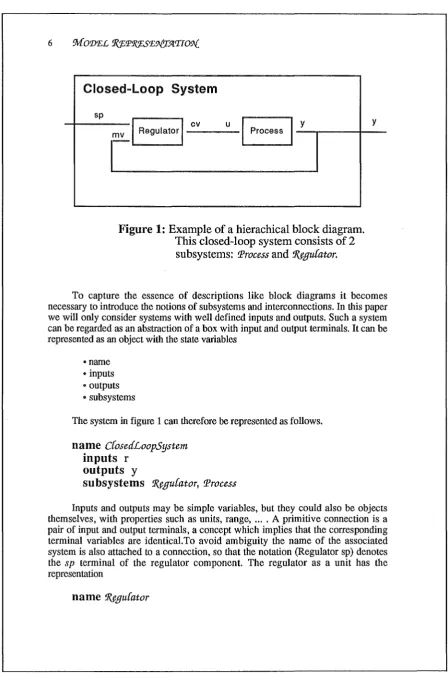
yFigure 1: Example of a hierachical block diagram.
This closed-loop system consists of 2
subsystems:
Processand
'1<.f,gufator.y
To capture the essence of descriptions like block diagrams it becomes necessary to introduce the notions of subsystems and interconnections. In this paper we will only consider systems with well defined inputs and outputs. Such a system can be regarded as an abstraction of a box with input and output terminals. It can be represented as an object with the state variables
•name •inputs •outputs • subsystems
The system in figure 1 can therefore be represented as follows.
name
C(osea£oopSysteminputs
routputs y
subsystems
'1<.f,gu(ator, ProcessInputs and outputs may be simple variables, but they could also be objects themselves, with properties such as units, range, .... A primitive connection is a pair of input and output terminals, a concept which implies that the corresponding terminal variables are identical.To avoid ambiguity the name of the associated system is also attached to a connection, so that the notation (Regulator sp) denotes the sp terminal of the regulator component. The regulator as a unit has the
representation
[image:7.595.73.522.82.756.2]inputs mv, sp
outputs cv
subsystems
nif
7
It has thus two inputs: mv (the measured value) and sp (the set point). It has one output: the controlled variable cv. The regulator has no subsystems. The process of figure 1 has the representation
name
Processinputs u
outputs
y
subsystems
ni{This notation is simple, natural and quite powerful.
Methods
A system structure has a number of associated operations. Examples of basic low level constructor and mutator functions are
:Ma/(eSystem, fllc{c{Jnputs, '}Je{etelnputs, ...
Basic query and selector functions of the type
Inputs?, Inputs, ...
are also needed to work with a system structure, The function lnputs?retums true if the subsystem has inputs and Inputs will return all inputs to a given subsystem. There are also primitive display functions like
sfiow
and a system editor which admits structured editing of system descriptions.
These functions operate on a single level only. For systems with subsystems it is also of interest to find all attributes of the system and all its associated subsystems. This is achieved through the functions
fJL{{Jnputs, fllffOutputs, fJL{[Su6systems, fllffConnections
Sometimes it is desirable to show these attributes in correspondence to the subsystem hierarchy.
J-fierarcliyOflnputs, %erarcfiyOjOutputs,
serve that purpose. Several functions explore system structure.
InputsConnected'To
and
OutputsConnected'Toreturn the systems connected to the input and output terminals of a given system.
Containedln
returns all systems in which a given subsystem is a component. A "loop" is a closed path which may be obtained by scanning a connection of subsystems in the direction defined by input-output causality. The functions
Loop?, Loop, .91.f(Loops
9
5. System Behaviour
Only topological properties of a system, i.e. structure and interconnections, have been discussed so far. To adequately describe dynamic systems it is also necessary to specify how they behave.System behaviour is a very rich field. Examples of some relevant categories of behaviour are
• Statiic • Qualitative •State Space
• Stochastic State Space •Stochastic Input Output • Linear State Space • Transfer Function • Transient Response • Describing Function
All of these categories can be described as objects. The static behaviour, for example, may be defined by a nonlinear function, and several methods are needed to work with static behaviour:
J'inaOutput, J'indlnput, Linearize, 9vfa?(fjain, 9vfin(jain,
'lJegreeOf Linearity, Operatingl({utge, ...
are some example of relevant functions. Qualitative behaviour attempts to describe some gross properties of a system, such as gain, time constants, and estimates of largest dynamic gain, some measure of nonlinearity, and some measure of how deterministic a system may be. We also need methods to obtain these properties from the more detailed representations. The ideas developed for automatic tuning of regulators are quite useful for this purpose [see Astroem & Haegglund (1984)]. It is important to also allow qualitative descriptions, because it permits qualitative reasoning about system properties. In large systems with many subsystems, for example, we may choose to neglect an interconnection if a system with a very low gain is connected in parallel with a system with a very high gain. In a simulation which explores phenomena at a time scale of minutes we may be justified to use static models for subsystems whose time constants are less than one tenth of a second. It would also be useful to attach a ValidityRange property to a
model. This could be described as a subset of the product of input and state spaces. With such a feature it becomes possible to write simulation programs which raise an exception condition if the state of a system moves outside its region of validity.
nonlinear stae space behaviour.
6. A Prototype Implementation
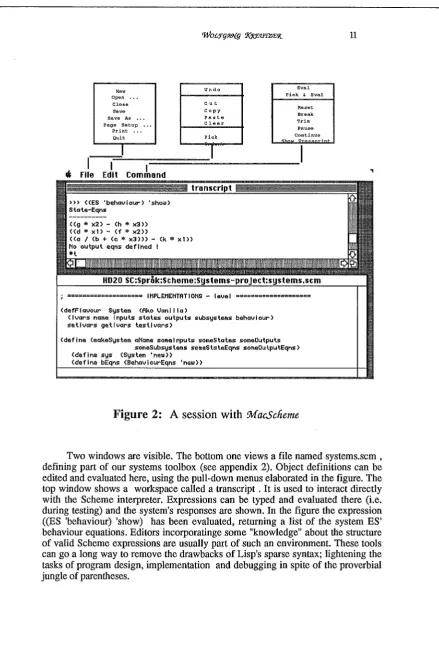
A small prototype was used to test some of the ideas described in the previous sections. This program was written in Scheme on an Apple Macintosh computer, augmented by a so called "flavour system" to support an object-oriented style of program development. Our main goal was to experiment with descriptions of system structure, with some formula manipulation as a secondary objective.
At this stage our prototype handles only simple continuous time state behaviour, and little effort has gone into streamlining its user interface. We assume that all interactions occur within a Scheme workspace. Eventually we intend to provide a window-based, mouse and menu driven environment built around a simple model browser. Such an implementation is currently underway and uses the MacScheme+ Toolsmith programming system [Semantic Microsystems (1986)].
The Scheme Programming Language.
New Undo Ev al Pick & Ev al
Open ...
Cut Close
Reset Copy
Save
Save As
...
PastePage Setup ... Clear Print
Quit Pick
I
I
I
I•
File Edit Commondtronscript >>> ((ES 'behaviour> 'show)
State-Eqns
((g
*
x2> - (h*
x3))((d *xi> - (f * x2))
«a I (b + (c
*
x3))) - (k*
x1»No output eqns def lned ! Cit Break Trim Pause Continue oc
HD20 SC:Sprok:Scheme:Systems-project:systems.scm
; ==================== IMPLEMENTATIONS - level ==================== (defFlavour System <Ako Vanll la)
(lvars name Inputs states outputs subsystems behaviour) setlvars getlvars testlvars)
<define <makeSystem aName somelnputs someStates someOutputs someSubsystems someStateEqns someOutputEqns) (define sys (System 'new>>
<define bEqns <BehavlourEqns 'new>>
Figure 2: A session with
AfacSclieme11
.,
[image:12.595.78.518.88.746.2]Flavour Systems and Object Oriented Programming.
Well designed programs should be built in layers. Such a methodology draws on sound principles of engineering design and helps to constrain the complexity of any large software system. After identifying a relevant layer, all primitive objects and operations at that level should be defined, possibly drawing on concepts bound at lower levels. These primitives may be provided through data structures and functions to create objects, select components, modify representations, evaluate predicates and display state information.
By encapsulating and localizing information as tightly as possible, object orientation [see, for example, Cox (1986)] carries this idea one step further. It seems a particularly appropriate metaphor for modelling applications, with may advantages over traditional methodologies. Most importantly, it changes our perception of programming towards viewing it as simulation of micro worlds, populated by autonomous objects which interact through message passing. Compared with traditional methodologies this new perspective on the programming process leads to a much closer correspondence between system specifications and
implementations. ·
The key concepts of object oriented programming are the notions of closure, message passing, classification and inheritance. Its strongly modular object encapsulation encourages more transparent, more reliable, and more easily modifyable programs, whereas the penalties for object oriented system development are mainly rooted in their resource requirements.
The idea of structuring data into classes of objects was originally pioneered by the Simula programming language [Birtwistle et. al. (1973)] and has more recently been popularized through Smalltalk [Goldberg & Robson (1983)]. An object oriented program can be compared to a script for a play. It comprises a definition of all actors (classes of objects ), as well as descriptions of their properties and behaviour in response to external stimuli (messages ).The play (computation) itself may then be conceived as a sequence of interactions between the cast. In an object oriented program each relevant concept is therefore described in terms of three aspects:
• its (local) state, defined through its instance variables , • the stimuli it will respond to, defined by methods , • the kinds of objects it inherits from, defined by its
'WoL!f(jM{(j X'Ji.'f/ll'I'Z'FJII.. 13
All instance variables are completely encapsulated, so that they can only be accessed or modified through methods local to the class in which they are defined. While some languages, like Simula or C++, require that a class definition is recompiled each time a method is added, modified or deleted, so called flavour systems permit such changes to occur dynamically. Flavour systems are available as extensions to many dialects of Lisp. In order to support an object oriented programming style for our prototype, a flavour system for Scheme was designed and implemented at the University of Canterbury [Kreutzer & Stairmand 1989). The following examples briefly illustrate its use. Appendix 1 shows a more detailed list of relevant features.
Suppose that we would like to implement a concept called "System", encapsulating information about its input, output and state, each represented by a list of symbols. We would like to be able to test whether instances of such a kind of system have a non-empty state, input pr output; to return their current state, input or output; provide a new state, input or output; and print it in a more pleasing form. The following specification in Scheme+Flavours will provide these features:
(defFlavour System (ako Vanilla ) (ivars state input output) setivars getivars testivars)
This expression defines the System flavour, with instance variables called state , input and output.. Use of the optional keywords setivars , getivars , testivars then instructs the flavour system to create access methods for these instance variables. This causes the creation of methods state! , input! , output! , state ; state, input, output; and state?., input? , output? . Vanilla is predefined by the flavour system and serves as the top of our inheritance network.
We can now explicitely defined additional methods; i.e. show.
(defMethod (show System ) ()
(display "Components of this system are: ") (newline)
(display "States : ") (self 'state) (display "Inputs : ") (self 'input) (display "Outputs : ") (self 'output) nil)
(makelnstance (Model System)
( (state '(x1 x2)) (input '(c)) (output '(y)) ) ) (makelnstance (Regulator System)
( (state '(i d)) (input '(r y)) (output '(u)) ) )
creates a Model and a Regulator object, with appropriately initialized instance variables. We can now send messages to these objects
(Model 'state) ; (x1 x2)
(Regulator 'input?)
; #t
(Regulator 'show)
; Components of this system are: ; States: (i d)
Inputs: (r y) Outputs: (u)
()
(Model 'state! nil) ; ()
(Model 'state?)
; #f
Please note the Scheme convention under which methods with a"!" suffix change values ("side-efects"), whereas a"?" indicates predicates returning #t (for true ) or #f (for false). Methods without suffix are used to non-destructively access and return information.
To demonstrate inheritance, let us now define ActiveSystem as a subflavour of System. Additional to all aspects of a generic system it will require a list of equations describing its behaviour .
(defFlavour ActiveSystem (ako System ) (ivars behaviour) getivars testivars)
(defMethod (behaviour? ActiveSystem ) ()
(display "No information I") (newline))
15
We still want to be able to print such a flavour, but now this should include the value of its behaviour list. We will therefore redefine the show method. Because we are lazy, however, we want to make use of our previously defined show method for "ordinary" systems and just add the part for printing the behaviour equations. self is a so called "pseudo variable", bound to the currently executing instance of the flavour containing it. It can therefore be used by objects to pass messages to themselves. Unfortunately we can not send 'show directly. Using it in that way within the body of our new show would create an infinite recursion, since we have "shadowed" the inherited "original" meaning. It can, however, be retrieved by sending show to our superflavours.
(defMethod (show ActiveSystem ) ()
(self 'sendToSuperFlavours 'show nil)
(display "This system's behaviour equations are:") (newline)
(for-each (lambda (anEquation)
(display anEquation) (newline)) (self 'behaviour))
nil )
We can test this scenario again by making a flavour and sending some messages:
(makelnstance (Model ActiveSystem)
((behaviour '( ((w * x2) (((- w * x1 ))
(Model 'output)
; (y)
(Model 'behaviour?)
; No information I
- (2 * (w * x2))) + (w * c)) )) )
(Model 'behaviour! '(x))
; Sorry, I don't know how to "behaviour!"
(Model 'behaviour)
; (((w * x2) (((- w * x1 )) - (2 * (w * x2))) + (w * c)))
(Model 'show)
; Components of this system are: ; States: (x1 x2)
; Inputs: (c) ; Outputs: (y)
; This model'sbehaviour equations are:
((w * x2) (((- w * x1)) - (2 * (w * x2))) + (w * c))
An Example
'WoL![(jM{.lj 'X'li'J','ll'IZ/E'l{_ 17
(methods to query ( ... ?), access ( ... ) and change ( ... !) Instance variables are automatically provided for all flavours)
[
8ystem-
Behc:wt.oi..i·Eqn.sname inputs states outputs stateEqns outputEqns
--
subs~sterns behaviourmakeSystem ... addStateEqnl ... addlnputsl ... addOutputEqnl ... clearlnputsl show
addStatesl ... clearStatesl
-(
Expresst.on.)
addOutputsl ...
clearOutputsl ... addSubsystemsl ...
clearSubsystemsl
-.
:Pl'ef t.x:ExpclearBehaviourl
...
connections? toinfix ... connections derive ... linearize,_
show
showHierarchy
...
-
'tn.f t.x.Exp -allSubsystems...
nameAllSubsystems toPrefix ... allStates derive ...
-
Behc:wt.ou.rTabl:eI
Coe ff t.ct.en.trtatrt.xsystemMatrix inputDistMatrix
shape rneasurernentMatrix
addMatrixl ... addRowl ... show addCoefficientl
...
show Row show
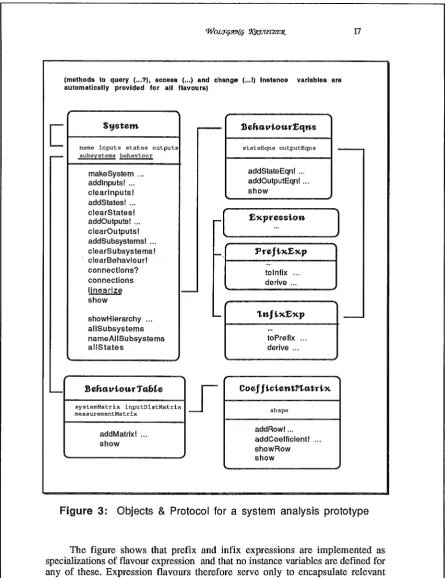
Figure 3: Objects & Protocol for a system analysis prototype
[image:18.595.74.520.92.671.2]various methods in the system. The figure also shows that a system's subsystems are stored as a list of system objects and that that its behaviour is encapsulated by an object of flavour BehaviourEqns . Behaviour equations contain expressions for state and output equations. The system method linearize returns a BehaviourTable , with its 3 matrices as instances of flavour CoefficientMatrix .
Each system contains six named components (slots):
<name, inputs, states, outputs, su6systems, 6efiaviour>.
The prototype contains simple constructor, query, selector and display methods to manipulate such systems' properties. "Higher level" functions include methods to produce all subsystms for specific systm instances. Operations to explore system stucture and tools for linearization of system behaviour are also provided. A system's behaviour is characterized in terms of functions f and g in equation (1). The function f defines the rate of change of the system's state and g is is output map. Currently both have to be encoded as fully parenthesized expressions.
19
S1
u
OD
yS2
u
I
ModelI
y
[}f]-"
0-u
·I
Proo
I
y(x1 x2)
I
- (id) (X1 x2) Iy
I
Sensor
I
u
(x)
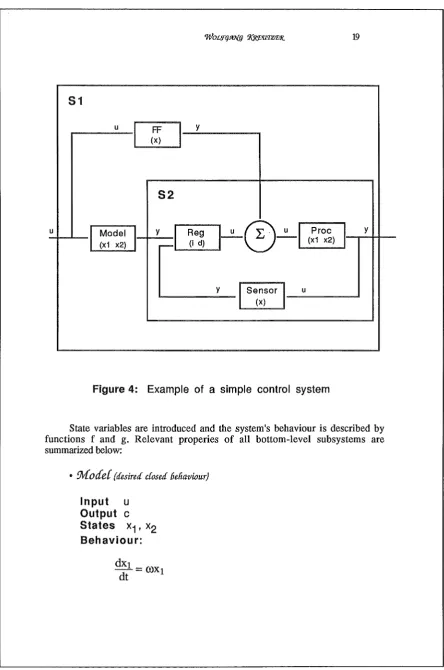
Figure 4: Example of a simple control system
State variables are introduced and the system's behaviour is described by functions f and g. Relevant properies of all bottom-level subsystems are summarized below:
• Af
ocle[ {tfesiretf cCosetf 6efiaviour)Input u Output c States x1, x2 Behaviour:
[image:20.595.74.519.86.757.2]y=x1
• g:g:
(feer£f orwarr£ compensation)Input u Output
y
State
x
Behaviour:
dx = -ax+(b-a)x
dt
y = k(x+u)
• 'R..f-g
(simp(e P['JJ regu(ator}Input r, y
Output u
States i,
d
Behaviour:
dd
=
N (y-d)dt
Tddi
=J-<r-y)
dt
Ti
u = k(r-y+i+N(d-y))
• Process
(process dynamics)Input u Output
y
States x1 , x2
Behaviour:
dxi = -affi+ bu
dt
~t
2• Sensor {Sensor tfynamic.s)
Input u Output y
State x Behaviour:
dx =-1(u-x)
dt T
y=-x-l+x2
21
It was already mentioned that we have not yet put much effort into the user interface for this prototype. We are simply evaluating ordinary Scheme expressions. Our program will therefore need to specify this system in a somewhat tedious way; i.e. looking like this:
(define Model
(makeSystem 'model '(c) '(x1 x2) '(y) nil '((w * x2) (((- w * x1))
(define FF
- (2 * (w * x2))) + (w * c)) '(x2) ))
(makeSystem 'ff '(u) '(x) '(y) nil
(define Reg
'(((- (B * x)) + ((a - b) * u))) '((k
*
(x + u))) ))(ma keSystem 'reg '(r y) '(i d) '(u) nil
(define Proc
'(((1 I Ti) * (r - y)) ((NI Td) * (d + y)))
'((K * (((r - y) + i) + (N * (d - y)))))))
(makeSystem 'proc '(u) '(x1 x2) '(y) nil
'( ((- (a * (xi ** (1 I 2)))) + (b * u)) ((a* (x1 ** (1 I 2)))
(define Sensor
(makeSystem 'sensor '(u) '(x) '(y) nil '(((u - x) I T))
'((x I (1 + (x * x)))) )) (define
82
(ma keSystem 's2 '(r u) nil '(y) (list reg proc sensor) nil nil))
(define 81
(makeSystem 's1 '(c) nil '(y) (list s2 model ff) nil nil))
A Sample Dialog
The simple dialogue below gives a flavour of how the prototype can be used. Assuming that the example model in figure 4 has been properly instantiated and initialized (see appendix 2), the expression (S1 'show) would create the follwing summary description:
==============================
SYSTEM: s1
==============================
Inputs : (c) Outputs : (y) States : ()
*** Subsystems ***
s2 model ff
++++++++++
*** Connections *** +++++++++++ (c
Y ())
*** Behaviour *** +++++++++ No state eqns defined I No output eqns defined I # t
There are several tools to explore a system's structure.
23
(S1 'allSubsystems) therefore returns (S2 Model FF Reg Proc Sensor). Details about an object's component structure can be obtained by sending the message "showHierarchy". For example,
(S1 'showHierarchy 3) would provide:
++++++++++++++++++++++++++++++++++++ SUBSYSTEMS of: s1
++++++++++++++++++++++++++++++++++++ s2
reg proc sensor model ff
( )
(Pi'oc 'behaviour) returns a BehaviourEqns object. This can be printed in a readable fashion by ((Proc 'behaviour) 'show), which generates:
State-Eqns
((a * (x1 ** (1 I 2))) - (a * (x2 ** (1 I 2)))) ((a * (x1 ** (1 I 2))) + (b * u))
Output-Eqns
( x
2)( )
The message sequence ((Proc 'behaviour) 'stateEqns) returns function f, which defines the rate of state transformations, i.e.
(((a * (x1 ** (1 I 2))) (a * (x2 ** (1 I 2)))) ((a * (x1 ** (1 I 2))) + (b * u)))
The output map, g, of Proc can be obtained by
((Proc ' behaviour) 'outputEqns), which will return
Finally, a system can be linearized by sending the message "linearize", which generates a list of linearized equations stored in an object of class BehaviourTable. This can then be displayed as a set of 3 CoefficientMatrices, containing expressions.
((Proc 'linearize) 'show) therefore returns
*
*
*
System Matrix (a
*
((1 I 2) * (x1 **0
(a * ((1 I 2) * (x1 ** (- (a * ((1 I 2) * (x2
b 0
Input-Distribution
( ( 1 I 2) 1 ) ) ) )
( ( 1 I 2) 1)))) ** ((1 I 2) - 1 )))))
Matrix
Measurement Matrix () ()
Please note the dots which are printed by this method. Each of these indicates the completion of a differentiation to compute one of the coefficients. This scheme offers the user some limited feedback on the method's progress during its time consuming execution.
8. Conclusions
The main purpose of this paper has been to explore new ways to describe interconnected systems, using object oriented programming as a structuring metaphor. It is relatively easy to implement and experiment with systems like the above prototype in Lisp. This ease of implementation is greatly aided by a powerful exploratory programming environment and an inheritance mechanism such as the one offered by the Canterbury Flavours system.
25
References
Abelson, H., Sussman, J. (with J. Sussman) (1985). Structure and Interpretation of
Computer Programs. Cambridge (Mass.): MIT Press
Allen, R. & Kreutzer, W. (1988). 'STRESS - A Smalltalk Rule Based Expert System Shell'. Proceedings 3rd New Zealand Conference on Expert Systems. Wellington
Astroem, K.J. (1983): "Computer Aided Modelling, Analysis and Design of Control Systems - A perspective," IEEE Control Systems Magazine, Vol. 3, May 1983, 4-16.
Astroem, K.J. & Hagglund, T. (1984): "Automatic Tuning of Simple Regulators with Specifications on Phase and Amplitude Margins," Automatica 20, No. 5, 645-651..
Astroem, K.J. (1985): "Computer Aided Tools for Control System Design - A perspective," in M. Jamshidi and C.J. Herget (Eds): Computer-Aided Control
Systems Engineering, North Holland.
Astroem, K.J. & Kreutzer, W. (1988). 'System Representation'. Report
-Department for Automatic Control, Lund Institute of Technology. Lund (Sweden) 1988
Bell, P.C. & O'Keefe, R.M. (1987). 'Visual Interactive Simulation - History, recent developments, and major issues'. Simulation Vol.49(3); 109-116
Delebecque, F. & S. Steer (1985): "The Interactive System Blaise for Control Engineering," CADCE '85, 3rd IFAC!IFIP Symposium on Computer Aided Design
in Control and Engineering Systems, Lyngby, Denmark.
Elmqvist, H. ((1975): "SIMNON - User's Manual," Report CODEN: LUTFD2/TFRT-3091, Department of Automatic Control, Lund Institute of
Technology, Lund, Sweden.
Elmqvist, H. (1978): "A Structured Model Language for Large Continuous Systems," Report CODEN: LUTFD2/TFRT-1015, Department of Automatic
Control, Lund Institute of Technology, Lund, Sweden.
Elmqvist, H. (1985): "LICS - Language for Implementation of Control Systems", Report CODEN: LUTFD2/TFRT-3179, Department of Automatic Control, Lund
Institute of Technology, Lund, Sweden.
Elmqvist, H. & Mattson, S.E. (1985): "A Simulator for Dynamical Systems Using Graphics and Equations for Modelling," Proc. of the IEEE Control Systems
Society Third Symposium on Computer-Aided Control System Design (CACSD ),
Gavel, D.T., C.J. Herget, AND Lawyer, B.S. (1986): "The M Language - An Interactive Tool for Manipulating Matrices, Systems and Signals," Dynamics and Controls Group, Engineering Research Division, Lawrence Livermore National Laboratory, Livermore, California.
Goldberg, A. and Robson, D. (1983). SMALLTALK-BO The Language and its Implementation. Reading(Mass.): Addison Wesley
Integrated Systems Inc. (1984): "Matrix-X User's Guide, Matrix-X Reference Guide, Matrix-X Training Guide, Command Summary and On-line Help," Integrated Systems, Inc. 101 University Avenue, Palo Alto, California.
Kreutzer, W. (1986). System Simulation. Programming Styles and Languages.
Reading(Mass.): Addison Wesley
Kreutzer (1988). 'A Modeller's Workbench - Simulation based on the desktop metaphor'. Proceedings Artificial Intelligence and Simulation. SanDiego. 43-48
Kreutzer, W. & McKenzie, BJ. (1989). AI Progamming. Tools & Metaphors.
Reading(Mass.): Addison Wesley
Lawyer, B. & Poggiio, P. (1985): "EAGLES Requirements," Computer Systems Research Group, Engineering Research Division, Lawrence Livermore National Laboratory, Livermore, California.
Little, J.N., A. Emami-Noeini, and Bangert, S.N. (1984): "CTRL-C and Matrix Environments for the Computer-Aided Design of Control Systems," in Bensoussan and Lions (Eds.): Analysis and Optimization of Systems, Lecture Notes in Control and Information Sciences, Springer-Verlag, Berlin, Also in Jamshidi, M. and CJ. Herget (eds) Computer-Aided Control Systems Engineering, North-Holland, Amsterdam, TheNetherlands, 111-124.
Minsky, M. (1985). 'Communication with Alien Intelligence'. BYTE (April 1985), 127-138
Moler, C.B. (1980): "MATLAB - User's Guide," Department of Computer Science, University of New Mexico, Albuquerque, U.S.A.
Rimvall, M. (1983): "IMPACT, Interactive Mathematical Program for Automatic Control Theory, User's Guide," Department of Automatic Control, Swiss Federal Institute of Technology, ETH-Zentrum, Zurich, Switzerland.
Rimvall, M. & Cellier, F. (1984): "IMPACT Interactive Mathematical Program for Automatic Control Theory," in Bensoussan and Lions (Eds.): Analysis and Optimization of Systems, Springer Lecture Notes in Control and Information
Rimvall, M. & Cellier, F. (1985): "A Structural Approach to CACSD,"
Computer-Aided Control Systems Engineering, North-Holland, Amsterdam, The Netherlands, pp. 149-158, In Jamshidi, M. and C.J. Herget (Eds).
Shah, S.C., Floyd, M.A. & Lehman, L.L. (1985): 'MATRIX-X: Control and Model Building CAB Capability," in Jamshidi, M. and C.J. Herget (Eds.):
Computer-Aided Control Systems Engineering, North-Holland, Amsterdam, The Netherlands, pp. 181-207.
Stairmand, M. & Kreutzer, W. (1988). 'POSE: A Process-Oriented Simulation Environment'. Simulation Vol.50(4); 143-153
Stefik, M. & Bobrow, D.G. (1985). Object-Oriented Programming: Themes and Variations. The Al Magazine. 40-62
Systems Control Technology (1984): "CTRL-C A Language for the Computer-Aided Design of Multivariable Control Systems, Users Guide," Systems Control
Technology, 1801 Page Mill Road, Palo Alto, CA.
Vanbegin, M. & van Dooren, P. (1985): "MATLAB-SC, Appendix B: Numerical Subroutines for Systems and Control Problems," Technical Note N168, Philips
Research Laboratories, Bosvoorde, Belgium.
Walker, R., Gregory, C. Jr. & Shah, S. (1984): "MATRIX-X: A Data Analysis, System Identification, Control Design and Simulation Package," Integrated
Systems, Inc., Palo Alto, California.
Walker, R., Shah, S. & Gupta, N.K. (1984): "Computer-Aided Engineering (CAB) for System Analysis," Proc. of the IEEE. 72, No. 12, 1732-1745.
Appendix 1:
'Ifie ·canter6ury !f{avours· System - a Summary
A.
Definition
Macros
• new flavour definition (classes of objects)
(defFlavour aName (ako super-flavour ) (ivars aName ... )
testivars getivars setivars)
• definition of methods {this can occur "on the fly" without recompilation of the corresponding flavour - if instance variables are changed, however, then the flavour and all related (via aka ... ) flavours must be recompiled !!!
(defMethod (aName aF/avour ) (arguments ) expressions ... )
• instance creation
(makelnstance (aName aF/avour)
• message passing
(list of (aName aValue)
pairs for all instance variables which should not be initialized to nil) )
(anlnstance 'aMessageName 'someArgument ... )
B.
some relevant messages to flavours
(inherited from flavo.ur "flavour")
addlvars '(aName ... ) ; adds new instance variables (recompile flavours !)
describe ; lists all ivars and methods (including inherited ones) akoTree ; shows class/subclass relations new '( (aName aValue ) ... ) ; creates a new instance of the
receiver (initialized as given)
C.
some relevant messages to flavour
instances (inherited from flavour "vanilla")
returns the instance's flavour flavour
flavourName returns the name of the instance's flavour permits access to "shadowed" methods encapsulated in a flavour's superflavours
sendToSuperFlavours 'aMethodName 'anArgument or:
'(aMethodName aF/avourName) 'anArgument ...
in case of multiple inheritance
Appendix 2: Listing of 'Ioo{6ot(