University of Warwick institutional repository:
http://go.warwick.ac.uk/wrap
A Thesis Submitted for the Degree of PhD at the University of Warwick
http://go.warwick.ac.uk/wrap/61725
This thesis is made available online and is protected by original copyright.
Please scroll down to view the document itself.
ASPECTS
QE
SELF-ADAPTIVE CONTROL
USING
PARAMETER
PERTURBATION
TECHNIQUES
by A.J.R. Pawley, B.A. (Oxon)
April
1969
...
,
BEST COpy
.
,
•
, .AVAILABLE'
.
(1)
ABSTRACT
ASPECTS
OF SELF-ADAPTIVE
CONTROL USING
PARAMETER
PERTURBATION
TECHNIQUES
This thesis is concerned with the performance
of a method of
simultaneous identification and optimization of a control system,
employing a parameter perturbation techniQue.
The work is divided into four parts:
(i)
The evaluation of several techniQues for the identification
and gain-estimation
of plants having one "input" and one
"output", in the presence of noise, where the "input is a
controllable parameter, and the "output" is a criterion of
the cost of the plant, which is some function of the plant
variables.
The slope of the cost-function
is then given
by the "gain" of
¥'El
plant.
(ii)
The optimization of plants having more than one dynamic
path between input and output.
(iii)
The optimization of multi-parameter
plants.
(iv)
A general consideration
of optimization strategies.
The first part of the thesis is based on the well known
technique of obtaining the step response of a plant by applying a
pse~do-random binary seQuence (or "chain-code") at the input,
cross-correlating this with the ou.tput, and integrating.
A techniQue
equival~nt to this, using a multiplier
and running-averager,
is
(1i)
identification process are chosen so as to reduce the variance of the
gain-estimate to a minimum, the error due to d.c.-bias may be large.
Practical results are given, which support the theory.
An alternative scheme is considered which enables the d.c.
eDTor to be effectively removed.
Various methods of implementing
this scheme in practice are proposed for use with and without a digital
process-control computer.
The scheme is analysed under the same noise
conditions as before.
The signal and noise components of the
gain-estimate are evaluated in terms of the parameters of the system, and a
design procedure for the choice of optimal values for these parameters
is formulated.
A method of gain-estimation using sine-wave perturbations
is then analysed under similar noise conditions, and compared with the
Chain-code method.
The second part of the work is devoted to the optimization of
plants having more than one dynamic path between input and output, with
a different cost-functi.on in each path.
It is shown that the estimated
position of the optimum varies with perturbation frequency when using
sine-wave perturbation,
l!!§il'OOA teo tpue epHHllJ'ffl ~s
femld T.vlssl'ned~
ot'chain-cod.es.
The theory is supported by the experimental anaIyad.s of
a simplified model based on a steam-generating plant.
In the third part, various methods of identification of
multi-channel plants are conSidered, based on the use of chain-codes.
The
extent of croBs-coupling between channels is examined, and ways of
reducing this are evaluated.
It is found that the best solution
],Sto
use time-shifted versions of the same chain-code, applied to the different
inputs of the plante
Practical methods of implementing this are discussed,
and a multi-channel optimization program is built up for use with an
(ii
i)without compensation
for the effect that previous changes in parameter
have on the estimate of the gradient of the cost-function.
In the last part of the thesis, the basic limitations on speed
of pptimizaUon
a+,e inve!:)tigated.
Various strategies for rapid
hill-climbing are discussed, and a technique
for minimizing the number of
optimization
steps ~s developed •
( tv)
ACKNOWLEDGEMENTS
The work described in this thesis was carried out at the
University
of Warwick from October
1965
until September
1968,
under
a Science Research Council Research Studentship
grant.
LIST OF SYMBOLS
Certain symbols used only locally are not listed here.
In some cases they duplicate the symbols below, but the local
definitions make the meanings clear.
The last column below
indicates the sections in which the symbols are defined.
§¥!nbol
a a sA
n Bc( t)
c .(
t)
J C C a
et
d d eDefinition
chain-code amplitude scale factor
amplitude of sine-wa~e
amplitude of Fou~ier components of m
scaled-expression
for variance
unit chain-code (amplitude
=±1)
j-th chain-code in multi-parameter
system
co-variance function
cost of aotions applied to a system
cost index for a process at time t
vector of disturbances
error in d.c. estimate
D
standard deviation of gain estimate using chain-code
D Cl D s D z
E [ ]
f(K)
f
j(K)
fN
fs
t;v
and d.c. compensation
scaled version of D
s
standard deviation of gain estimate using chain-code
and no doco compensation
standard deviation of gain estimate using sine-wave
expected value of bracketed
terms
performance
function of single-path plant
performance
function of j-th parallel path
normalized frequency of·sine-wa.ve
frequency of sine-wave
double-integral
used in evaluating D2
( v)
Section
2.2 5.22.4(a)
2.4(b)
2.2 .7.2
4·5
1.
2( b)
1.2(b)
1.
2( a)
4.4(
a)2.4(a)
5. 3(a)
4.2
6.
2(
a)
6.
2(
a)
6. 3(
b)
Symbol
f(19 f1(19 ft(10
FjF(w)
Definition
function relating Pt to ~
function ~elating Ca to k
fUnction relating Vt to k
value of
F(w)
for j-th parallel path
ratio of gain estimate to true gain using sine-wave
true gain
estimate of gain using chain-code
total error in estimate of gain
gain error due to periodicity
gain error due to d.c. bias estimation
gain error due to non~finite plant settling time
estimate of gain
u·sing
sine-wave
(~)t
slope of performanoe function in i-th direction
at time
·th( "t)
h(-r, t)
hj(
e)
/\
hj(a)
AI
hj(s)
hr("'t)
Hr(
jW)[H]
1-f[ ]
i
kimpulse response of plant
time-dependent
impulse response of plant
impulse response of j-th parallel path
primary estimate of h.(s)
J
secondary estimate of hj(s)
impulse response of running summer
power spectrum of running averager
mat'rix of transfer functions
Heaviside function
(=0
if
[J~
0, .. [ ] otherwise)
vector of intermediate variables of process
number of bits averaged for d.c. estimation
vector of plant parameters
i-th parameter of plant
plant parameter
(vi)
Section
1. 2( b) 1.2(b)1.2(b)
6. 2( a)
5.2
4.4( a)
4.4( a)
4.4( a)
4.4( a)
4.4(a)
4.4(a)
5.2
1.2(b) 2.2 2.26. 2( a)
7.3
7.3
A2.2
A2.21.2'a)
4.3(
a)
1. 2(
a)
3.2
1.2( a)
Symbol
K e K n K o Kopt
/\ Kopt
n c n o pPi
Pq_
P(t)'P
t A p(t)
q( t)
q_av(t)
q, ~
(t)
r( t)
R R s$ (w)
e
(vii)
Definition
error in estimate of K
op
t
value of
Kat n-th clock time
10.2
present value of
K 1.2(c)
6.3(b)
6. 3(b)
opti.mum value of
K
estimated value of
Kt
op
number of test steps/operative
step
1.42.
3( a)
2.4( a)
7.4
1. 2( b)
8.3
output of multiplier
noise component of output of multiplier
number of bits in a chain-code
(*N)
number of parameters
of plant
ordinate at start of q_-th impulse response
number of shift-register
stages
ALI
ordinate of impulse response reduced to zero
4.4(b)4.4(b)
7.4
2.3(a)
6.2(a)
8.3
first zero-crossing
of impulse response
number of ohannels of system
number of bits corresponding
to T
r
output of i-th performance
function
ordinate of step response
6f q_-th ohannel
performance
index at time t
1.2estimate of pet)
1.2(c)2.3(a.)
2.4(a)
2.4( a)
2.3( a)
2.4(b)
5 •
.3( b)
6.3(b)
6.3(b)
output of basic identifioation
system
average value of q_
i(t)
noise component
of q_(t)
running average of chain-code
ratio of power of noise to power of chain-code
ratio of power of noise to power of sine-wave
slope of performance
curve at K
t
op
normalized
slope-error
( viU)
SymbOl
Definition
/'.
~(t)
estimate of step response using chain-code
A$c(t)
correction term due to periodicity
/\$d(t)
step response estimate without d.c. correction
$e(t)
true step r~eponse with d.c. error
$j(p)
step response estimate due to j-th path
$N
normalized slope error
~~(Pq)
step response estimate of q-th ch~nnel
Al
Sq(Pq,j) step response estimate of q-th channel at j-th
clock interval
Section
2.2
2.3(b)
2.3(
b) 2.3(
d)6.2(b)
6.3(b)
8.3
/\
$~(t)
noise component of gain estimate
/\
Sl(t)
step response estimate due to one period
T
chain-code period
T 4
noise time constant
4.2
2.
3(
b)l.5
2.
3( a)
6.3(b)
7.4
2.3( a)
2.3(0)
2.4(b)
T.
integrator time constant
1
T.
time constant of j-th path
J
T}
settling time of j-th channel
T
running-averager period
r
T
system time constant
su(t)
scaled version of chain-code
(m
ac(t))
u_2
("1:' )
unit ramp function
U(-c)
triangular function composed of ramp functions
2.2
Al.l
Al.I
Vt
value of products
Vee()
scaled expression for variance
x
vector of plant in~uts
xI(t)
perturbation applied to plant parameter
x2(t)
signal to be correlated with plant output
1.2
ll..
vector of plant outputs
yet)
plant output
A
yet)
estimated plant output
l.2
2.2
Symbol
y.( t)
JYn
ZjZ('l')
'"'l/v
~r:
~rf
)-<-i
;«-q,
rr
~sDefinition
output of j-th path
value of
yat n-th clock time
gradient estimate due to j-th path
output of sample-and-hold using sine-wave
ratio of
Tvto
Tratio of T
to T
r
constant in variance formula
delta funcUon
(area
= Iifl=
0,zero otherwise)
averaging period for d.c. estimation
step-change in parameter
scale factor for stoep-response
bias-error ratio
signal-to-noise ratio for system of Ch.2
'signal-to-noise ratio for system of Ch.4
impulse-shape error
periodicity-error
ratio
signal-to-noise ratio for sine-wave system
ratio of signal-to-noise
ratios
<"'integration-time error
ratio of variances
clock-interval
of·chain-code
scale faotor for step response
scale factor for covariance
feedback scale factor
~cale
factor
scale factor for system output using ohain-code
gain of the running averager
scale factor for system outp~t using sine~wave
( i:x:)
Section
6. 2( a)
2.4(b)
2.4(b)
4. 3(
b)
Al.I
3.2
1. 2(
c)
3. 3( a)
2.
3(
d)2.4(c)
4.4( c)
2.
3(
d) 2.3(
d)503(a)
5.4
2.
3(
d)5.4
10.2
7.3
2.
3(
b)
2. 3( a)
( x)
S;)'!I1bol
~ (t)
Definition
noise at output of plant
2
.4( a)
4.5
3. 3( a)
.3.
3( a)
2.4(b)
4.4(a)
2
.4(
a)105
2.2
weighting function
;-0
Tr,6 (t) compound running sum
€i
(q:r)
running sum of o from q to r
o~i2
(mean-squared) power of noise
/\
¢
estimate of impulse response
¢n
phase of FO~ier
components of my(t)
¢cc(iC)
auto-correlation function of chain-code
¢Cy(iC)
cross-correlation function of c and
yif
power/unit bandwidth of noise
L(
w)
,etc.
power apectr-umof chain-code, etc.
c*
convolution operator
A2.2
(xi)
CONTENTS
Page_!l:!!!!}be,!.
List of Symbols
( L)
( rv)
( v)
Abstract
Acknowledgements
Chapter 1. Introduction
1.1
The General Problem
1-1
1.2
The Concepts of Performance and Cost
1-2
(a)
The Parameter-Controlling
loop
(b)
Indices of Performance and Cost
(c)
Dynamio Representation
of the Parameter Path
1-2
1.3
Optimal and Self-Adaptive Control
1-4
1-6
1-8
1.4
Types of Salf-Adaptive Control Systams
1-10
1.5
C~ain-Codes
1-12
1-13
1-14
106
The Experimental Facilities Used
1. 7
A':'~s a~d
Co",t-,l~btJ'~o",~ cl- -t;he. Tht!s~PART I
Single-Parameter Ide~tificati6n
Chapter 2.
Single-Parameter ~dentification using
Chain-Codes, with and without noise present
2.1
Introduction
2-1
2.2
The Basic Principle
2-2
2.3
Analysis of the Running Averages TechniQue under
Noise-free Conditions
2-4
2-4
2-5
2-7
2-8
(a)
General Principles
(b)
The Exact Solution
(c)
Application to a Particular Problem
(d)
The Magnitude of the Errors
(e)
Experimental Results
2.4
The Behaviour of the System under Noisy Conditions
(xii)
Page n~.!.
(a)
Derivation of the Variance formula in
the General Case
(b)
Variance of Estimate for Band-limited Noise
(c)
The Choice of Parameter Values
(d)
Experimental Results
2.5
Conclusions
Chapter
3.
Modified Methods of System Identificati.on
3.1
Introduction
3.2
Analysis of the D.C. Bias Elimination Problem
3.3
Practical Methods of Bias Elimination
(a)
General 'I'echnd.quea
(b)
Experi,mental Eva luatd on of Gain without using
a Digital Computer
(c)
The Validity of the Estimation Methods
3.4
Conclusions
2-12
2-14
2-152-17
2-17
3-1
3-1
3-2
}-»3
3--4
3-5
3,-6
Chapter
4.
Noise Analysis of Estimatio~Methods,
of Chapter
3.
4.1
Introduction
4-1
4.2
Derivation of the Variance Formula in the General Case
4-1
4.3
Evaluation of Variance for Particular Cases
(a)
Band-limited Noise
(b)
White Noise
4.4
Choice of Parameter Values for the Identifioation
System
(a)
The Noise-free Estimate of Gain
(b)
Compari.son of Estimation Methods with and
without D.C. Removal, under Noise-Free Conditions
4-7
(c)
The Estimate of Gain Under Noisy Conditions
4-9
(d)
Analysis of a Partioular Plant
4-10
(e)
Analytic Procedure for a General Plant
4-11
4-2
4-2
4-4
4-6
(x i i i )
4.5
The Shortcomings of Methods of Averacing Step ResponseEstimates
4.6
Conclusion::;Lj·-12
4-14
Chapter
5.
Noise Analysis of a Gain-~stimation System Using Sine-'ilave Perturbation5.1
Introduction5-1
5.2 The Hoise-Free .::,stimateof Gain
5-1
5.3
The Behaviour of the System under Noisy Conditions5-3
Ca) Derivation of variance Formula in General Case
5-3
(b) Variance of .c;stimatcfor Band-Limited Noise
5-4
Cc) Variance of Estimate for lJhite 1;oise
5-5
5-5
Cd) Analysis of a Particular Plant
5.4
Comparison with the Chain-Code Perturbation Nethod5-7
5-8
5.5 Conclusions
PART II. Parallel-Path Optimization
Chapter
6.
Optir.::ization of Plants ,,[ithParallel Perfor;:1anceFunction Paths
6.1
Introduction6-1
6-1
6.2
Analysis of the Optimizing MethodsCa) System with Sine-Wave Perturbation
6-2
lb) System with Chain-Code Pertu~bation
6-4
Cc) Physical Explanation of the Errors
6-5
Cd) The Use of Phase Compensation and :Dynamic Compensation
6-5
6.3
Application to a Particular ProblemCa) The Plant Hodel
(b) The Estimated Op~imum
6.4
Practical Results(a) The Experimental Configurations
lb) The Tests Carried Out
'6.5
Conclusions6-6
6-6
6-7
6-11
6-11
6-12
(xtv)
Cj
"
~e
number
PART III
Multi-Parameter Identification and Optimizaj1on
Chapter
1.
Mu1 ti-Parameter Identifi,cation Systems
7.1
Introduction
1.3
Compensation Techni~ues
7-1
7-1
7-3
1~5
7-9
7.2
The Interaction Problem
7.4
Uncorrelated Perturbation Signals
7.5
Conclusions
Chapter8.
The Development of Multi-Parameter
Systems using Shifted Codes
8.1
Introduction
8-1
8.2
Assessment of the D.C. Bias
8-1
8.3
Assessment of the Step Responses
8-1
8.4
Hardware for Multi-Parameter Identifioation
8-2
8.5
Computer Software for Multi-Parameter Identification
8-4
8.6
Conclusions
8-5
9.4
Conclusions
9-11
Chapter
90
An On-Line Computer Program for
Multi-Parameter Optimization
9.3
Experimental Results
9-1
9-1
9-7
9.1
Introduction
9.2
The Multi-Channel Optimization Program
Chapter
10. A.Survey of Indentification Methods al!£.
Optimization Strategies
10.1 Introduction
10-1
10.2 The Available Techni~ues
10-210.3 Conclusions
10-3
Suggestions for Future Work
Appendices
Al.l
Properties of chain-codes
A2.l
Experimental configuration for System Identification
A2.2
Power spectrum analysis
A2.3
Auto-correlation
function of a product
A2.4
Auto-correlation
function of the output of the
running averager
A2.5
The Noise Generator
A3.l
Effect of d.c. on the estimate of impulse response
A3.2
Derivation of running sum method of identification
A3.3
Relationship between successive step response estimates
A3.4
Alternative
expression for compound running sum
A4.l
Auto-correlation
funotion of the output of the
compound running summer
A4.2
Variance due to noise, in terms of auto-correlation
functions
A4.3
Evaluation of a partioular double integral
A4.4
Evaluation of e~uation (4.4) for band-limited noise
A9.1
Facilities available on the G.E.C.92 computer
A9.2
Program Storage Allocation and Listing
References
(x0
Page number
1-1
CHAPl'ER 1
INTRODUCTION
1.1 THE GENERAL PROBLEMMany industrial plants, such as chemical works,l steam-generating
boilers2,3 and paper-making mills, require constant supervision of the
output materials to ensure that the plant is working within allowable
tolerances, and, if not, control action must be applied to oorrect any
deficiencies.
The ideal control system continuously examines the whole
plant, assesses the performance
in terms of overal1 cost and makes any
adjustments necessary to bring the system to the optimum s'tateat which
the financial return on investment is greatest.
A straightforward feedback system
4
compares the outpu
of the
in the ambient conditions, and so on.
~t is therefore desirable to design
plant with some desired state, and adjusts the plant-parameters to reduce
-the error to a minimum.
For such a sys't
em the de
sf.r-edstate must be
decided before-hand.
In an industrial process, this state will not
coincide with the optimum state in gene aL, due to fluo·tuations in the
properties of the raw-materials,
ageing of components, lea~ages, changes
a supervisory system that evaluates the optimum state for the conditions
prev~iling at any time and drives the parameters towards this state.
By continually repeating this process, the opti.mum state can be r-eaohed,
and'ma:!,ntained,despite changes in the operating conditions due to
This process is known as self-ad~ptive oontrol,
and is the dominant subjeot of this thesis.
uncontrolled
influences.
.
In order to optimize a system it is neceaeary to assess the
characteristics
of the plant, by a process known as identifioation.
1-2
and investigating the effect these perturbations have on the overall
pe~formance of the plant.
In this way, the slope of the curve of
performance against parameter value can be evaluated for each parameter.
This then enables the mean value of each parameter to be changed py an
amount dependent on the appropriate estimate of slope.
This is
repeated until a state is reached where no further improvement in
performance can be obtained.
A great deal of theory of self-adaptive control systems has
a~peared in the literature in recent years.
It is the purpose of this
t~esis to examine several aspects of adaptive control, and to develop
criteria for the design and evaluation of a class of adaptive systems,
using periodic-perturbation
techniques.
Considerable attention has
beep paid to practical details, to enable potential users to develop
their own systems for use with or without on-line computing facilities.
In this chapter several basic topics will be introduced:
(i)
The concepts of performance and cost functions, with referenoe
to practical processes.
(ii)
The distinction between optimal and self-adaptiv~ control.
(iii) The olassification
of adaptive systems.
(iv)
The properties of pseudo-ranqom binary sequenoes.
(v)
The experimental facilities available at the University of
Warwick.
1.2.THE CONCEPrS OF PERFORMANCE AND COST
In this section, the conoepts of performance and cost will be
examined with reference to general and particular processes.
1.2{a) The Parameter-controlling
LQop
r---·---·---·-1
<J1
~
~ Vl
cz
tj)0-
W
IJ~ (I:
"5
0~
VI
J
tfl VI t.f)
0
W l> V'\
<l
f_.) ~
:J
V -
l1J
z
z
0
f
c:(
w
6
dl
g
-
z
~
...J
<t
J
0-~
~
P-
-El
0-4:
be liquids or gases, and a set of applied actions, such as heat.
The control engineer is interested in maintaining
the b~st properties of
the products for the least overall cost.
The optimization
problem is
therefore to design a system which controls some or all of the applied
actions, to maintain optimum performance
despite fluctuations in the
properties of the ingoing materials and uncontrollable
fluctuations
of
the environmental
conditionq.
It is customary to consider the problem of parameter optimization
in one of two ways:
(i)
To describe the system in straightforward
terms as shown
in figure 1.2, where~,
Z,
£,
and ~
are vectors of the
inputs, outputs, parameters and disturbances respectively,
and
P(i)
is a measure of the performance of the system
known as the performance
index.
(i1)
To describe the system in terms of the transfer funotions
between the parameters and the outputs, as shown in
figure
1.3,
where
[H)
denotes the matrix of such transfer
functions.
The performance
index can then be considered
as the output of the overall system, and the parameters are
considered as the inputs.
~ and ~
can then both be
thought of as disturbances,
for they are both subjeot to
fluotuations that are not controlled by the optimizing
system.
(It 1s assumed that any controlled pr0perties
of the ingoing materials are included in the parameter
set k ).
r---,
~~ ~
'. L
I-::
"-~~ <
v:)
:>
r
...JE~
-c
..d.I ~0
1."
--~ W 4J v ..._.. "Zo,
1.1..1«
tJ
L
cL
~0 )(
w
L
Z
1-<]
-01
~o
li-b
VI·
I
ZZ
~~\-JI<:{
xl
\:...
.dl
·..JI
IJ. 11~\
rf)
\-z
~
~ ~
z
8
I~1
.Jil
7>1
\.-d
>
.•- I\-.- I
-;~ .,
"7"
J:_._
et
\.U
~.-._J
<C
z
<C
••
l-4
In general there will be limits on the ranges over whioh the
parameters can be varied, and there may also be limits on the permissible
range~ of intermediate variables,
i, such as maximum temperature or
.
-pressure limits, and acoount must be taken of these Qonstraints when
designing the system.
In partioular, it must be oh,oked that no
oontrolled parameter will obvio~sly take on its maximum value at the
optimum regardless of the values of other parameters, for then a loop to
Qontrol
th1i parameter 1, oltarlY' _orthle",
Suob.
11tuat1on
ari•••
~D~r.otioe whenever tbe pertormanoe
ot
the .,.te. i•••
'e.4111 iDore••
~nc
tunotion of
anyparameter.
A
fUnotion
ot
th1.
kiDd ..,
not b. 41.ooyer.~
until the optimizer has been op.rat1na,
1t 18 then olearl, advt••bIe to
switch out the appropriate locp and,
tU:the parameter valve at it. maxilll\.UD,
to avoid unneoessary time spent s-.&roh1ngfor the optimum value of thil
parameter.
1,2(b) Indices of Pertormance.and Cost
Consider a system with one oontrolled parameter and ,one produc1;.
At anyone
time, the properties of the product w111 have some definite
relationship with the oontrol1ed parameter, and we can therefore define a
valuEr-parameter cw;-verelating tl1e finanoial va~\1ecf the product to the
magnitude of the parameter, as shown in figure 1.4.
'l'h;l.s
curve will depencl
on the ambient environment, and will therefore be influenced by any
fluctuations in the system.
Extending the concept to n
parameters, we
can express the value as
Vt •
ft(k)
•• , ••••••••••••••••••••••••••••••••••••••••••••••••
(1.1)
where ft denotes the function relating the financial value qf the product
to the para.eters, ~, at a time t.
'This fUnotion will be bounded within
a usable r~e
of values, but due tc oonstraints on the P'orameters, impoled
~
---,---~
L.,t\(Io1:ld
""'3
H..L
.::10
~
w
tJ
2:
~&
w
~11-
J
uJ
J _jui~
~ c!J. ~ ~ \-(i~ ,i
~ ~.J
t
z
:J l-
a
\1.- 1: W""""' V1
l.I.I ~ QJ ~ Z
Vl .t Z -
W
:J
3d ~
~p
'"
"l-A
3
W
)0-,
0_.
_-
..·.J.-cct~ III 4:.~ J~
4:~
~~«
je
~.
'"'
W
ci
:J<.b
.-lL
1-5
An illustration of a value curve is provided by the production
of stainless steel, in which ordinary steel is impregnated with chromium
to give ~t the requi~ed charaoteristics.
The finanoial value of the
stainless steel wiP
depend on the proportion of chromium used.
There
will be a proportion for which the steel has it~ maximum value, and on
either side of this the value will decrease until the proportion reaohes
an upper or lower limit, beyond which
thesteel will be worthless and will
have to be retreated.
So far we have not considered the cost of the parameters, which will
in genera~ vary ~ith their magnitudes;
power oonsumptio~ and raw material
costs are examples of this.
In the stainless steel process the cost of the
chromium. and theoost
of Bupp~ying heat would have to be taken into account.
A
parameter oost function, fl, will therefore be defined, such that the oost,
~
of the applied actions is given by
Ca '"
fl(~ •••••.••••••••••••••••••••••••• ,•••••••••••••••••••• (1.2)
The net value of the process is then given by Bubtracting the oost
of the paramete~s from the value of the produots.
This oan be used as a
oriterion of performance for the process.
The 'performance index' oan
then be defined as
""
v - ca
8 •••••••••••••••••••••••••••••••••••••••••••• • • • • • (1.3)
t
Alternatively,
a 'oost index' could be defined as
C
t '"C
a-
V
t •••••••••••••••••••••••••••••••••••••••••••~••••••(1.4)
The opti~:l,za~ionpro~lem involves m~imizing
1;h~ performanoe index
or min~m~zing the oost index.
1-6
The topics discussed in this thesis are applicable to either of
the types of performance index mentioned above~ In either case, the
performance index can be written in terms of the parameters as
\;
Pt = f(~) ••••••••••••••••••••••••••••••••••••••• (1
.5)
at anyone time t. The slope of the perfor~ance surface in the direction
of the i-th parameter, k., is then
-J..
....•.•... (1.6)
The optimmn value of P is then given by the point where g.=O for all
J..
parameters, and the matrix of partial derivatives is negative definite.
If several such points exist, the absolute maximum of these will Give
the optimum value. (The corresponding equations are denoted (1-7).)
1.2(c)Dynamic Representation of the Parameter Path
It will now be shown how the overall transfer function of the
system from parameter to estimated performance index is related to
the gradient of the performance hill.
Consider a process-control plant with a single controlled parameter.
In any practical system the dynamics of the path from parameter to
estimated performance index will be distributed in some way throughout
the plant. In many cases there is no means of assessin6 this distribution,
and in such a case it is difficult to obtain a realistic model of the
plant. Monk
5
has shown how the estimate of the slope of the hillusing a parameter perturbation technique depends on the relative
positions of the hill and the dynamics. Some idea of the performance
function of a plant can however be gleaned from the somewhat
over-simplified model, adopted in much of the literature
6,7
of a performancefunction followed by lumped dynamics, as represented in Fieure 1.5,
A
where pet) is the true performance index at time
t,
pet) i~ thel~ /"'\ -+l <:»
<P-I
Ul ~ 0tJ
2:
-:»
~ ~z
A
III _j r\W
-W
§
'-..) {:L2:
ulZ
z
u
0
0
z
-tJ
.( b
,..-,
23
~ <:»Z
t2
LL
~ '--hL.L.
a:
IW
W
0-\,) ~z
«
r'\&
-tJ
<:»a
~ ~z
~ 0 ~ ~<
et..
'+i'
? <:»&
-1:'
X u.I~ CL
-<:I
l()
~.
~ d1 ZI-NP-
uJ
Vl -
uJ
et.
-::l.
~ ~ ~ :J ,<1
t
LL
<:.!J0
0
Y!..
---1-1
response of the system to a unit impulse.
Errors arising from using
this model may severely hamper attempts to optimize a practical system
5,8;
the extent of the errors can only be found experimentally, as the result
of a pilot s¥~,me applied to the actual system.
From the model of Figure 1.5, the output of the performance function
g~nerator is given by
p( t )
f [la
+6.
I
+xl (
t) ]
•...••••••.•.••••.••...•....
(
1
.8)
where la is the previous value of the parameter I, ~K
is the change in
parameter as a result of the latest optimization step, and xl(t) is a
perturbation applied to the parameter.
If we assume the performance function can be considered linear over
a small range about K
=la, then p(t) can be represented by a truncated
Taylor series
9
as
p(t) ~
f(K )
+('Of) .
[AI
+xl(t)]
•••••.••••••••••••••..•.•
(1.9)
o 'OK K ID K
o
If the effect of the previous step change in parameter
issmall, and
the effect of any d.e. bias on the parameter can be eliminated in the
identification process, p(t) can be approximated as
p(t)....f\...
(1!)
xl(t)
•••••••••••••••••••••••••••••••••••••
(1.10)
:'dK K
=
I oHence the overall relationship
from parameter perturbation to
estimated performance index is
~(t)
•
p(t)
*
h('l:) ~
x1(t)
*
[@OK'
Ko h('1:~
(1.11)
where
t~tdenotes oonvolut10~.
For a multi-parameter
system, a similar relationship holds for
any o~e par~meter, providing t~e other parameters are held oonstant.
The problem when all the parameters are perturbed simultaneouslY
is
1-8
From equation (1.11) we can see that the slope of the performance
function is equivalent to the gain of the path from the parameter to the
e6t~mated performance index.
Therefore the (~)t
terms of equation (1.6)
correspond exactly to the gains of the parameter paths.
It is the
purpose of this thesis to examine various ways of estimating the gains,
and to use these estimates to bring the system towards the optimum.
It is not intended to consider capital and maintenance oosts in
this work, beyond noting that these are influenced by suoh oonsiderations
as the maximum values of intermediate variables, such as temperature, pr~ssure
and flow rate.
At the design stage these factors must be considered, a~d
the limits on the parameters must be chosen, bearing in mind the likely
performanoe characteristics of the plant, assessed from pilot sohemes or
by experience.
1.3.0ptimal and Self-Adaptive Control
In the past few years, control engineer's have devel
opedtheories along
two distinct tracks, termed optimal control and self-adaptive control.
Both these techniques are referred to as optimization, whioh can lead to
great confusion.
We will now oonsider what these terms have come to mean,
and what the basic differences are.
Figure 1.6 shows the basic olassification.
Optimal control is the computation of the control system configuration
and parameter values that will result in a given plant operating in a region
as olose to the optimum state as possible, under given environmental
conditions.
In terms of the performance function, this ~mplies an
[§---.---~
~zation
of controlSy~~
optimal control
~elf-adaptive control
(Qff~line computatio~
(continuous hi~l-cl~mbing)
9f 'best' system)
\
on-line
(c~emical plants, etc.)
off-line
(structural designs
etc.)
1-9
Self-adaptive control, on the other hand, is a technique where the
slope of the performance
'hill' is continuously assessed and steps are taken
to drive the parameters towards their optimum values, that is, to the state
where the slope of the hill is zero in all parameter directions.
Self-adaptive systems are also referred to as hill-climbing
systems,
self-adjusting systems, extremum-seeking
systems, or, in certain cases,
parameter~cking
systems.
For such a system, any prior knowledge
of the performance function and the system dynamics can be used to advantage
to design an efficient optimizing system, but such knowledge is not
essential, apart from an overall appreciation
of the likely settling times
and parameter magnitudes.
A self-adaptive technique should always be used on-line to the
process to be optimized, whenever it is economically and physically feasible.
An example of on-line oontrol is the continuous optimization of a
steam-generating boiler2
,3,
where the problem is to maintain the maximum effioienoy
at all times, despite natural changes in steam flow rate, fuel quality,
leakage of air and other uncontrolled
factors.
Off-line self-adaptive
analysis can be applied to such problems as the design of portal-frame
structures to give maximum load-bearing capacity for minimum oost.
~y
calculating the changes in permissible load due to changes in the dimensions
of the frame members, the optimum state can be found.
This type of problem
does not lend itself to on-line analysis, for physical reasons.
Insuch
circumstances,
the mathematical
equations of the structure can be simulated
on a digital oomputer, and a variational hill-climbing technique employed to
find the optimum.
This type of analysis has two basic differences oompared
with the on-line self-adaptive procedure, namely:
1-10
(ii) there are no dynamic factors.
For these reasons optimization by performance index gradient
e$timation can be performed using step changes in the parameters, rather
than sophisticated
statistical techniques, and the gradient can be assessed
without having to wait for the system to settle down.
The on-line control problem is the aspect of self-adaptive control
to be mainly considered in this thesis.
1.4 TYpes of Self-Adaptive Control Systems
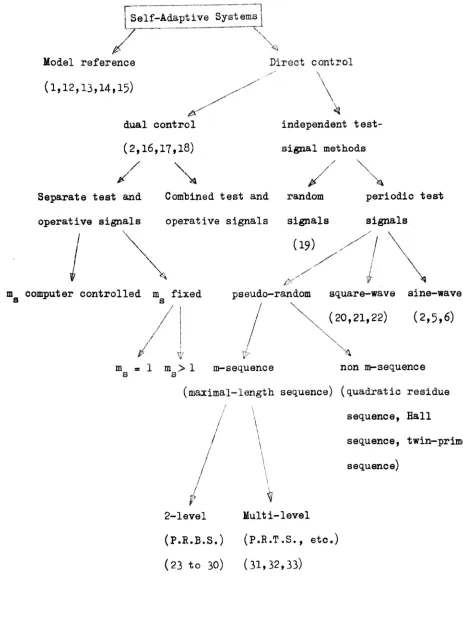
10 11
There are many types of self~adaptive systems
'
, and these can
be classified in several different ways.
One class~fication
scheme is
outlined in figure
1.1.
To avoid confusion, the relationship bet-ween
parameters and performance index will be referred to as the 'plant', the
external controller being the 'system'.
Self-adaptive
systems can be divided into two main types:
Model reference
systems:,12,13,14,15.
These involve a two-fold
process:
(a)
Model building, in which a model of the plant is
constructed,
either from variable analogue components
or as data in a digital computer.
The complexity of
the model is decided from an overall consideration of
the plant, and the values for the parameters are chosen
either offiline or by an on-line self-adaptive technique
~o give a performanoe as olose to that of the plant
as possible.
(b)
Pl~nt oontrol, in which the optimum values for the
parameters are calculated from the model, so that any
hill-climbing
is undertaken on the model and not
directly on the plant.
The plant parameters oan then
be adjusted accordingly.
The set-up is shown
---1
r:Lself-Adaptive
Systems \
//--
'",IP
~
Model reference
Direct control
\
41
independent
test-(1,12,13,14,15)
_//
//.
b
dual control
(2,16,17,18)
signal methods
//
""~
Separate teat and
Combined test and
random
periodic test
operative signals
operative signals
J~
signals
signals
m
computer controlled
m
fixed
S
Ii!
~
m
>
Is
pseudo-random
s~uare-wave
sine-wave
/
~
(20,21,22)
(2,5,6)
I
""
v,? ~
ID
=
1s
m-se~uence
non m-se~uence
(maximal-length se~uence) (~uadratic residue
\
sequence, Hall
\
se~uence, twin-prime
\
sequence)\
I
\
[image:36.556.64.527.63.706.2]2-1evel
Multi-level
(P.R.B.S. ) (P.R.T .S.,etc.)
(23 to 30)
(31,32,33)
-·---1
rI-A ..
\.Ll :Jt;~
)--:) VI 0 Jr'r
J
w
«
\-.
uJ
VIet
r-VI
+~tC/\"
~
_
-- ~\U
v
o:
1:11 ~Z
_j0
l.w
\
LJ
L
«
_J,q
0
;l
::>
S
2:
~-
tf
j
-'
l
-
1-11
(ii) Direct Control Systems, in which no model of the plant is
explicitly used. Instead, the hill-qlimbing process is applied
directly to the plant, by perturbing the parameters, deciding
whether this improves the performance or not, and changing the
operating point of the plant accordingly.
Direct control can be divided into two categories:
2 16 17 18
Dual-control' , , : in this case the test signal (the
exploratory parameter perturbation) is a step change, usually of
fixed magnitude, and the operative signal (the parameter change found
necessary to take the plant towards the optimum) is also a step, of
fixed or variable size. The method involves applying the test signal,
noting the change it produces in the performance, and choosing an
operative step accordingly. Each operative step can be used as
the subsequent test step, or the test and operative steps can be
distinct. In the latter Qase, the number of test steps to each
operative step, tn , Qan either be predetermined or be
computer-s
controlled during the QP~imization.
(i~
Independent test signal methods; in these systems, the test signalis not a step, but is a signal with known statistical properties.
SU9h signals are classified in figure 1.7. These techniques are
all well-known, although the amount of comparative study work appearing
in the literature is small. For the most part, this thesis considers
methods using two types of test perturbation:
(a) sine-wave pertupbation2,5,6: the noise analysis of a sine-wave
~dentification techpique is given in Chapter
5.
(b) pseudo-random binary eequence
(P.R.B.S.,
or 'chain-code')pert4D~ation23,24: the noise analysis of two
P.R.B.S.
identif-ication techniques is given in Chapters 2, 3 and 4, and the
design and performance of multi-parameter optimization systems
1-12
The optimization of plants having more than one dynamic path between
parameter and performance index is examined in Chapter
6
for both sine-waveand chain-code perturbation systems. The performance of systems using
other oontrol techniques is disoussed in Chapter 10, where their relative
~erits are examined, and various strategies for rapid hill-climbing are
considered.
~.5
Chain-CodesA brief description of the most signifioant properties of chain-codes
will now be given. A binary chain-code is a periodic signal which possesses
at any one time one of two states, and can switch from one state to the
other only at multiples of a basic interval,
>- ,
known as the clock-interval,olock-time, or bit-interval. A chain~oode
is
oharacterized by the natureof its auto-correlation funotion, defined by
¢cc('1:')==
J:
c(t) c(t -'t:)
dt •••••••••••••••••••••••••••••••• (1.13)
where c(t) is the chain-code, T is its period, and ~ is the shift of one
code relative to the other. The 'pseudo-random' property of the
chain-oode implies that ¢cc(rr.) approximates to the auto-oorrelation function of
white noise, which is an impulse at zero shift. In fact
¢
(rr) consistsco
of a train of approximate impulses at intervals of T.
It is well-known that white noise can be applied to the input of a
plant as a test signal without it being correlated with other signals
occurring in the plant, and that the result of correlating the output of
the plant with the white noise gives the impulse response of the plant.
Using a chain-code as the test signal instead of the white noise yields
almos~ the same result, but has the advantage that the averaging time
needed for the oorrelation is finite, namely the chain-code period T.
1-13
1.6 The Experimental Facilities Used
The experimental work for this thesis was aided by the use of
three computing facilities:
(i) a G.E.C. 92 digital process-control computer
(ii) a Solartron 247 analogue computer
(iii) an Elliott 4130 digital data processing computer.
The G.E.C. 92 computer enables on-line computing to be carried out
on practical systems, or on models thereof. It has a memory of '8,000
l2-bit words; the most significant bit of each word is used to denote
sign, negative numbers being stored in two's complement form. The
word-length is adequate for most cont~ol problems, but double-length working can
be used if greater accuracy is required. The memory cycle time is
1.11~~
sec. Dig1tal-to-analogue and analogue-ta-digital converters are provided,
which can be switched to appropriate analogue lines by the programmer.
These lines come up on an interface connection panel, where they can either
be routed to other parts of the building, such as the engine test calls or
the fatigue laboratory, or linked directly to the analogue computer. Such
lines cap also be used for monitoriag purposes, using an oscilloscope or
graph~plotter.
The Solartron 241 Analogue Computer is used for simUlation of
praotical systems. It has facilities for multiplication and non-linear
function generating in addition to normal summing and integrating elements.
Facilities for iterative computation are provided, whereby successive
switching between the 'problem check', 'compute' and 'hold' modes can be
performed continuously, under the control of the internal timer or of
1-1 ~.
The Elliott 4130 computer is a high-speed data processing computer
for off-line calculations. The memory cycle-time has recently been
upgraded to
v=:
and the main-store capacity to 64,000 wo r-ds of24-bits. There is also a magnetic tape backing store facility and a
graph--plot tar.
All these computing facilities have come into being during the
course of the work described in this thesis, some of which was compleied
before the computers became available. Some of the methods described
in the early part of the thesis can now be performed in the department
in a much simpler manner using the computers, but the methods are still
applicable in an environment where computers are not available or are
considered uneconomic for solving such problems. Considerable time
could however be saved, by replacing the tranGistori~ed circuits, such
as chain-code generators and running summers, by their integrated
circuit equivalents. Commercial ready-made equipment has come onto
the market recently which can perform some of the tasks of
code-generation and cross-correlation, but this equipment is very expensive
at present.
1.7 Aims and Contributions of the Thesis
When the work described in this thesis was started, the author
was invited to study two aspects of self-adaptive control using
chain-codes:
(i) The performance in the presence of noise of a particular
single-parameter system postulated in the literature.
(ii) The development of a multi-parameter optimizer which, it
was thought, might overcome the problems of interactions
between parameter paths, by using on-line esti~ates of the
interactions as correctionc for the gain estimates.
1-15
postulated could yield serious errors due to d.c. bias, even with no
noise present. As a result, an improved system was developed and
anslysed. Following on from this, an optimizer using sine-waves was
.analysed under noisy conditions and cbmpared with the chain- code
system. The application of each system to plants with single and
multiple dynamic paths between parameter and output was then examined.
Investigation into (ii) above showed that the suggested
compen-sation techniques will not work, and any similar methods would also
fail. Effort was then turned to the choice of multi-parameter optinizer
to give the best performance, in terms of short identification time,
small interaction errors and ease of implementation.
The contributions of this thesis can be summarized as:
(i) An exact mathematical analysis, supported by experimental
evidence, of the basic chain-code system, with and without
noise, with an assessment of the errors, and a design
procedure for choosing the parameters of the identification
Bystem.
(ii) The derivation of an improved system that overcomes the
major error of the original one •
.
(iii) Discussion of methods of implementing the improved system,
with and without recourse to a process-control computer.
(iv) Detailed analysis of the improved system, with and without
noise, yielding design criteria for the system, and showing
that the inherent errors in the system are not large enough
to prevent the system from being used as part of an optimizer.
Cv) .Analysis of the sine-wave system in the presence of noise,
and quantitative comparison with the improved chain-code system,
showing the benefits to be gained from each type of system.
1-16
show that errors arise in estimating the optimum of a plant
with parallel dynamic paths between parameter and output when
using sine-wave or chain-code perturbations.
"'~
(vii) Analysis of various compensation techniques for
multi-parameter identification, and a physical explanation of why
all such methods will fail.
,
(viii) A critical comparison of the methods described in the literature
for multi-parameter optimization.
(ix) Development of a method using shifted versions of one code
as parameter perturbations, for use with and without a
process-control computer.
(x) Realization of an on-line computer program for optimization
using shifted codes and a proportional-to-gradient optimization
strategy, with application to four-parameter plant moaels.
(xi) An analysis of the errors arising during optimization due
to the chanGing d.c. level of the plant output and to the
changing magnitude of the envelope of plant output values.
(xii) A survey of several of the available identification and
optimization techniques.
Although this thesis has been primarily concerned with
chain-code methods of optimization, it is not suggested that these are always
better than other techniques. In the last chapter it is shown that
some of the advantages of using chain-codes claimed in the literature,
such as good noise rejection and short identification time, do not
always survive after close examination. A quantitative comparison of
PART I
2-1
PART I:
SINGLFr-PARAMErER IDENTIFICATION
CRAnER
2
SINGLE-PARAMErER
IDENTIFICATION
USING CHAIN-CODES,
WITH AND WITHOUT NOISE PRESENT
2.1Introduction
In this chapter the performance of an identification system using
. 12 23 to 28
chain-oodes w11l be analysed ' • The system is based on the
well-known result (an extension of the Wiener-Hopf relation14) that states
that if a chain-code is applied to the input of a plant and cross-correlated
with the output, the resulting function, when scaled suitably, is
approximately the same as the impulse response of the plant. The
technique may be used to evaluate the gradient of the performance function
in an optimization loop47. In such a case, the parameter to be controlled
can be considered as the tinput' to the 'plant', and the output of the
performance function generator as the 'output' of the 'plant'. The gradi ent
of the performance function is then given by the gain from 'input' to 'output'
which can be deduced by integrating the impulse response to give the step
respon~e, and choosi.ng a value of this which is representative of its value
after an infinite time.
Th~ basic principle is described in Section 2.2. An alternative
method, using a running s~er (or averager), multiplier and integrator,
is desoribed and analysed under noise-free conditions in Section 2.3.
The practical implementation of the method is discussed, and experimental
results are given to support the theory. The behaviour of the system
under noisy conditions is ex~ined in Section 2.4. from theoretical and
2-2
2.2.The Basic Principle
It has been seen in Chapter 1 how a two-level chain-code is
charact~rised by having an auto-correlation function that approximates
to an impulse. If the code is applied to the input of a control system
and cross-correl~ted with the output,14,37,38,39 as shown in Figure
2.1,
the result is
¢
c/ 'l) =.f
J:
c(t - '"t') Y(t)
dt •••••••••••••••••••••••• (2.1)where c(t) is a 'unit chain-code', that is, one having levels of + 1.
The convolution integral gives
y(t ) =
r:
u(
t -s)
e
h(
s) ds •••••••••••••••••••••••••••••••• (2.2)
where u(t)
=
ac(t), 'a' being a sgaling factor dictated by practicalconsiderations of the particular system to be identified. ('
s
I I.S c:.l.u ...tnj val"LQ.bk'(Implicit in equation
(2.2)
is the assumption that h(~) is constantwith respect to time. For the present it will be assumed that the
charac~eristics of the plant are static.
If
this is not so, gh(~) mustbe replaced by g(t)h('l:',t),making equation
(2.2)
difficult to manipulate.)Substituting for yet) in equation
(2.1),
and l.nterchanging the orderof integration, gives
¢c/"l
=
~g [¢
cc('1:"-s) h(s) ds •••••••••••••••••••••• (2.3)This is an exact relation. It will now be shown that, by making certain
approximations about
¢
("t),
¢
("'t') is proportional to the impulsecc cy
response of the plant, h(s).
The approx~mation to be used is that given by equation
(Al.l.3)
of Appendix A1.l.
We
then haveN+l" [
a - Ag
N
0S("'t"
-8)
h(a) ds-.~-.-
---
..---.,--..._-•..-....-~~.--."---_
..,-
...~.--. ,-~-~-~'---iI
I
I '
I
1\ " __,,~~tj'
7)
-s:'
I
i
\
I
j /~'\
t~
I
i
I
__
~.
~__
l
---_,,.._---_._-_.__
..
_-tJ
I
~~
(! ,
z.
I
:T oJ
\1.\
r'-
I
<...P
I
z
r-dl
'VI~ 0
I; )
I
"---"'
\
v')
V1
{l
U
\.d
cl
::J
\,1)
L_L
2-3
(Note that
LT
6('1:) d'1:' •t.
ai nce the impulse can then be consideredto straddle the lower limit of integration, being equally disposed about it.
Sqme researchers have presented results where the first point of
¢ (~)
cy
has twice the value given above, which leads one to suspect their
technique, unless they have taken steps to double the value of
¢
(0)
cy
automatically. The resulting error in step response estimate is of course
very small.)
¢Cy
(L)
of the· plant.
is therefqre roughly proportional to the impulse response
An estimate of the step response at time T is given by
r
.i~tegrating this,
1\
S(Tr) ...
and scaling appropriately, so that
r
¢
("'t)a-r ...•..
(2.5)
cy
N
whereas the true step response is
S(T
r)
•
t
Tr
s
h('t)
d't(2.6)
The true gain of the system is given by
g :=
S(()C))
.•....•...
(2.7)
so that an estimate of gain is
. g = N
¢
oy ('t") d"t"If the impulse response has almost died away to zero in one period of
the cbam-code ,
foT
JI
h('t) d~~l •••••••••••••••••••••••••••••••••••••••••••••'2.8)
80 ~hat ~ ::!:!::-' g •••••••••••••••••••••••••• ' ••••••••••••••••••••••••••••• (
2.9)
If the impulse response ~as a long settling time compared with the
ohain-code period, equation (2.8) cannot be deemed to hold. In addition
to this, errors will be brought forward from previous periods of the