A Study of Oral Stereognostic Proficiency in
Dentulous and Edentulous Persons
Keywords: Proprioception, Articulation, Speech, Tactile sensation, Motor and sensory ability
Maya Veersingh DalayaIntRoductIon
Oral perception of a person could play a vital role and provide information to the dentist which can be utilized for successful prosthesis. Oral stereognostic tests can provide information related to oral discriminating skill of a patient. These tests can be performed in a short period of time and required no specialized training by the dentist.
The dentist can use this information to be more aware of what he/ she can expect in term of patient response during and after each treatment.
Stereognosis or recognition of shape involves, ’the most elaborate function subserved by the parietal cortex of the brain’. This function necessitates perfect reception of the impulses set by the stimuli from the object. The sensations produced are synthesized in the cortex and compared with previous similar sensory memories [1]. Oral stereognosis involves a certain amount of motor activity, manipulating the object within the mouth and feeling its surfaces with lips, tongue, teeth and palate. The information obtained must be associated with oral sensory memories derived from visual and tactile experiences [2].
Grasso RE et al., studied oral sensory ability of stereognosis, in both young and old subjects with and without palatal coverage. According to them, there are no significant differences in oral stereognostic ability between subjects with and without full palatal coverage. However they suggested that age plays an important role in oral stereognostic ability. In older subjects oral stereognostic score was lower than younger and had slightly longer recognition time [3]. Very few studies have been carried out so far to evaluate the normal and individual level of oral perception and its relation to the success of prosthodontic treatment [2].
The ability to anticipate patient’s performance with complete dentures remains elusive, no matter which approach and grade of clinical skill is applied to the fabrication of prosthesis [4].
AIms And objectIves
To determine oral stereognostic levels of different age group 1.
persons having full complement of teeth.
Dentistry
s
ection
To determine oral stereognostic levels amongst totally 2.
edentulous persons wearing complete denture and totally edentulous persons not wearing complete dentures.
To determine the level of denture satisfaction of above referred 3.
denture wearers.
To compare and correlate the various data obtain from above 4.
three evaluations.
mAteRIAls And methods
In this study, oral stereognosis was tested with the aid of small metallic pellets referred to as test-forms. The test-forms were cast
Abst
RAc
t
Stereognosis means the ability of a person to recognize the shape and surface characters of an object using tactile sensations, without looking at them. The purpose of this study was to determine and compare the oral stereognostic levels of different age groups having full complement of teeth, for edentulous patients with and without prosthesis and also for denture satisfaction.
In this study, oral stereognosis was tested with the aid of small metallic pellets referred as test forms, which had surface alterations as well as alterations in basic shape. The seven test forms were cube forms of 5mm x 5mm x 5mm & plaster replicas of these forms were five times larger which served as visual aid to the patient during tests. To start, each subject was given sufficient time to get acquainted with general shapes and surface characters of test form by visual inspection of plaster replicas. One of the metallic test form was randomly selected & placed on the subject’s tongue and asked to indicate the identification by pointing at the appropriate plaster replica.
In this study, inverse relationship was found between stereognostic level and age of the subject. The stereognostic scores of dentulous subjects were higher than edentulous. There were no significant differences in edentulous persons with or without denture. Stereognostic score was low in most satisfied denture wearers and was high in dissatisfied denture wearers.
[table/Fig-1]: seven test forms in metal with shape and surface alterations
s. no. Test form i Test form ii Test form iii Test form iV Test form V Test form Vi Test form Vii sum stereognostic scores percentage
1 1 0 0 0 0 0 1 2 28.6
2 1 1 1 1 1 1 1 7 100.4
3 1 1 1 1 1 0 0 5 71.4
4 0 1 0 1 1 1 1 5 71.4
5 1 0 0 1 1 0 0 3 42.9
6 1 1 1 1 1 1 1 7 100.0
7 1 1 1 0 1 1 1 6 85.7
8 0 1 1 1 0 0 1 4 57.1
9 1 1 1 0 1 0 1 5 71.4
10 1 1 1 0 1 1 1 6 85.7
11 1 1 1 1 1 1 0 6 85.7
12 1 1 1 1 1 1 1 7 100.0
13 1 1 1 0 1 0 1 5 71.4
14 1 1 1 1 1 1 1 7 100.0
15 1 1 1 1 1 0 0 5 71.4
16 1 1 0 1 1 0 0 4 57.1
17 1 1 1 1 0 1 0 5 71.4
18 1 1 1 1 1 0 1 6 85.7
19 1 1 0 1 1 1 1 6 85.7
20 1 1 1 1 1 1 0 6 85.7
s. no. Test form i Test form ii Test form iii Test form iV Test form V Test form Vi Test form Vii sum stereognostic scores percentage
1 1 0 0 1 1 1 1 5 71.4
2 1 1 1 0 1 0 1 5 71.4
3 1 1 1 0 1 0 1 5 71.4
4 1 1 1 0 0 1 1 5 71.4
5 1 1 1 0 1 1 1 6 85.7
6 1 1 0 1 0 1 0 4 57.1
7 1 1 0 0 1 1 0 4 57.1
8 1 0 1 0 1 1 0 4 57.1
9 1 0 1 0 0 1 0 3 42.9
10 1 0 0 0 1 1 1 4 57.1
11 1 0 0 1 1 0 0 3 42.9
12 1 1 0 0 1 1 0 3 42.9
13 1 1 1 0 1 1 0 4 57.1
14 1 0 1 0 1 1 0 3 42.9
15 1 0 0 0 1 1 0 2 28.6
16 1 1 1 0 1 0 0 4 57.1
17 1 1 1 0 1 1 1 6 85.7
18 1 0 0 1 1 1 0 4 57.1
19 1 1 1 0 1 1 0 5 71.4
20 0 1 1 0 1 0 1 4 57.1
[table/Fig-3]: Showing stereognostic scores of dentulous subjects in 20 to 40 years age group. Mean = 76.42, Standard deviation =19.26 Key : 1 = positive identification; 0 = Negative identification
[table/Fig-4]: Showing stereognostic scores of dentulous subjects in 40 to 70 years age group. Mean = 59.27, Standerd deviation =14.84 Key : 1 = positive identification; 0 = Negative identification
from a dental technique alloy. The test-form had surface alteration as well as alteration in basic shape [Table/Fig-1].
Wax pattern for test-forms were developed from wax cubes of 5 mm x 5mm x 5mm. four pieces were retained in their cubical form but subjected to surface alterations as follows:
In one cube 9 shallow pits were carved out in 3 rows on all the 1.
6 surfaces, each at equal distance from the other.
On the second cube, one continuous groove was made which 2.
passed along the middle of four surfaces.
The third test-form had 3 continuous grooves made at equal 3.
distances, covering four surfaces of the cube. The fourth cube was without any surface alteration. 4.
The remaining three wax cubes were modified into three 5.
age and second group of 20 dentulous subjects were between 40 to 60 years of age [Table/Fig-3]. For the second part of the study subject consisted of 40 complete denture wearers of 30 to 70 years age group [Table/Fig-4]. The period of experience with dentures varied amongst the subjects. Stereognostic tests were done on each edentulous subject with complete denture as well as without wearing the denture. Both tests were performed during one and same test sitting.
stereognostic test procedure
To start, each subject was given sufficient time to get acquainted with the general shape and surface characters of the test-forms by careful visual inspection of plaster replicas. The metallic test-Cylindrical.
•
Parabolic in cross-section.
•
Quarter circle in cross-section.
•
After casting, the pellets were given a smooth finish. Plaster replicas of the seven test-forms were also prepared. These were five times larger than the metallic test-forms. They served as visual aids to the patients during the tests [Table/Fig-2].
The persons who participated in the study were explained about the nature and purpose of the study. For the first part of the study 40 dentulous persons of two different age groups formed the sample. One group of 20 persons was between 20 to 40 years of
Without Dentures stereognostic scores Test Form number With Dentures stereognostic scores Test Form number
s. no. i ii iii iV V Vi Vii i ii iii iV V Vi Vii
1 1 1 1 1 0 0 0 1 0 1 0 0 0 1
2 0 1 0 0 0 0 1 0 0 0 0 0 0 0
3 1 1 0 1 1 1 1 1 1 1 0 1 0 0
4 0 0 0 1 0 0 1 0 0 0 0 0 0 1
5 0 1 1 0 0 0 1 0 1 1 1 0 0 0
6 0 0 1 0 1 0 1 0 0 0 0 1 0 1
7 1 0 0 1 0 0 1 1 0 0 0 1 0 1
8 0 1 0 0 1 0 0 0 1 1 1 1 0 1
9 1 1 1 1 1 0 1 1 1 1 1 1 1 1
10 0 0 0 0 1 0 0 0 0 0 0 0 0 0
11 0 0 1 1 0 0 1 0 0 0 1 0 0 1
12 1 1 0 0 0 0 1 1 0 0 0 1 0 0
13 1 1 1 1 1 1 1 0 1 0 0 0 0 1
14 1 1 0 0 0 0 0 1 0 0 0 0 1 0
15 1 0 0 1 0 0 0 1 1 0 0 0 0 0
16 1 1 1 0 0 0 0 1 0 0 0 0 0 0
17 0 1 1 1 1 0 0 1 0 0 0 1 0 0
18 1 1 1 0 0 0 0 1 0 0 1 0 0 0
19 0 1 1 1 1 1 0 1 1 0 0 0 0 0
20 0 0 1 1 0 0 0 1 0 0 0 1 1 0
21 1 1 1 0 1 1 1 1 0 0 1 0 0 0
22 1 1 0 0 1 1 0 1 0 0 0 0 0 1
23 1 1 0 0 0 0 0 1 0 0 0 1 0 0
24 1 0 0 0 1 1 1 1 0 0 0 1 0 0
25 1 0 1 0 1 0 1 1 0 0 0 1 0 0
26 1 0 0 0 0 1 0 1 0 0 0 1 0 0
27 0 1 1 0 1 0 1 1 0 0 0 0 1 0
28 1 0 0 0 1 0 0 0 0 0 0 1 0 1
29 1 1 1 0 0 0 1 1 0 0 1 0 0 0
30 0 1 1 0 0 0 0 1 1 0 1 0 0 0
31 1 1 1 0 1 1 1 1 1 0 1 1 1 0
32 1 0 0 0 1 1 0 1 1 0 0 0 0 1
33 1 1 1 0 1 1 1 1 1 1 0 0 1 1
34 1 0 0 0 0 1 0 0 0 0 0 0 0 0
35 1 1 0 0 1 1 0 0 0 0 0 1 1 1
36 1 0 1 1 0 0 0 0 0 1 1 0 0 0
37 1 0 0 1 1 1 1 1 0 1 0 1 1 1
38 0 1 1 0 0 0 0 1 0 0 0 1 0 0
39 1 0 0 1 0 0 0 0 1 0 1 1 0 0
40 1 1 0 0 1 1 0 0 1 1 0 1 1 0
[table/Fig-5]: Showing stereognostic scores of edentulous subjects with and without dentures as a direct comparison
s. no. sum of scores Percentage sum of scores Percentage absolute difference grading level
1 4 57.1 3 42.9 14.2 +++
2 2 28.6 0 0 28.6 +++
3 6 85.7 4 57.1 28.6 0
4 2 28.6 1 14.3 14.3 +++
5 3 42.9 3 42.9 0 ++
6 3 42.9 2 28.6 14.3 +++
7 3 42.9 3 42.9 0 ++
8 2 28.6 5 71.4 42.8 +++
9 6 85.7 7 100.0 14.3 0
10 1 14.3 0 0 14.3 +++
11 3 42.9 2 28.6 14.3 +++
12 3 42.9 2 28.6 14.3 +++
13 7 100.0 2 28.6 71.4 0
14 2 28.6 2 28.6 0 +++
15 2 28.6 2 28.6 0 +++
16 3 42.9 1 14.3 28.6 ++
17 4 57.1 2 28.6 28.5 ++
18 3 42.9 2 28.6 14.3 ++
19 5 71.4 2 28.6 42.8 0
20 2 28.6 3 42.9 14.3 +++
21 6 85.7 2 28.6 57.1 0
22 4 57.1 2 28.6 28.5 ++
23 2 28.6 2 28.6 0 +++
24 4 57.1 2 28.6 28.5 ++
25 4 57.1 2 28.6 28.5 ++
26 2 28.6 2 28.6 0 +++
27 4 57.1 2 28.6 28.5 ++
28 2 28.6 2 28.6 0 +++
29 4 57.1 2 28.6 28.5 ++
30 2 28.6 3 42.9 14.3 0
31 6 85.7 5 71.4 14.3 +++
32 3 42.9 3 42.9 0 ++
33 6 85.7 5 71.4 14.3 0
34 2 28.6 0 0 28.6 +++
35 4 57.1 3 42.9 14.2 ++
36 3 42.9 2 28.6 14.2 ++
37 5 71.4 5 71.4 0 0
38 2 28.6 2 28.6 0 +++
39 2 28.6 3 42.9 14.3 +++
40 4 57.1 4 57.1 0 ++
Mean= 48.94 Mean= 36.9 Mean difference= 12.85
Standard deviation= 21.41 Standard deviation= 20.45 S.e.of mean difference= 3.26
Without denture With denture
[table/Fig-6]: Showing stereognostic scores, absolute differences between stereognostic scores and grading level of denture satisfaction in edentulous subjects forms were also shown to the subjects before actual tests. After the
subject was familiarized with the plaster replicas, the metallic test-forms were kept concealed from the subjects. One of the metallic test-forms was randomly selected and placed on the subject’s tongue. The person was allowed to move the test-form around in the mouth without any limitations in order to feel it and identify it. The subject was to indicate the identification by pointing out at the appropriate plaster replica [2].
If the person could identify the test-form correctly then one point was recorded on the observation chart. If the person cannot identify
the test-form correctly then ‘zero’ point was awarded. In this way all the seven forms were tested and points awarded [Table/Fig-5]. The oral stereognostic score for that person is the percentage of correct responses in the seven tests.
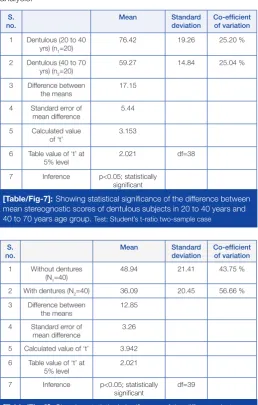
s. no. Mean standard deviation Co-efficient of variation
1 Dentulous (20 to 40 yrs) (n1=20)
76.42 19.26 25.20 %
2 Dentulous (40 to 70
yrs) (n2=20) 59.27 14.84 25.04 %
3 Difference between
the means 17.15
4 Standard error of mean difference
5.44
5 Calculated value of ‘t’
3.153
6 Table value of ‘t’ at
5% level 2.021 df=38
7 Inference p<0.05; statistically significant s. no. Mean standard deviation Co-efficient of variation
1 Without dentures (N1=40)
48.94 21.41 43.75 %
2 With dentures (N2=40) 36.09 20.45 56.66 %
3 Difference between the means
12.85
4 Standard error of
mean difference 3.26
5 Calculated value of ‘t’ 3.942
6 Table value of ‘t’ at 5% level
2.021
7 Inference p<0.05; statistically
significant df=39
s.
no. Mean standard deviation Co-efficient of variation
1 Dentulous subjects (n1=40)
67.84 19.06 28.10 %
2 Edentulous subjects (n2=40)
48.94 21.41 43.75 %
3 Difference between
the means 18.90
4 Standard error of
mean difference 4.53
5 Calculated value of ‘t’ 4.172
6 Table value of ‘t’ at
5% level 2.000 df=78
7 Inference p<0.05; statistically significant
[table/Fig-8]: Showing statistical significance of the difference between mean stereognostic scores of edentulous subjects without and with dentures
[table/Fig-9]: Showing statistical significance of the difference between mean stereognostic scores of dentulous and edentulous subjects (without dentures). Test: Student’s t-ratio for correlated samples
grading level of denture satisfaction number of subjects Percentage of total subjects
Mean absolute difference in stereognostic scores
+++ 18 45% 12.70
++ 14 35% 17.31
0 8 20% 30.35
[table/Fig-10]: Showing distribution of edentulous subjects in the categories of grading level of denture satisfaction and their mean difference in stereognostic scores with and without dentures.
Test: Student’s t-ratio two- sample case [table/Fig-7]: Showing statistical significance of the difference between
mean stereognostic scores of dentulous subjects in 20 to 40 years and 40 to 70 years age group. Test: Student’s t-ratio two-sample case
dIscussIon
Recent advances in technology, materials and basic biological phenomenon related to prosthetic dentistry had been mainly in the field of fixed prosthesis. In particular, conventional complete denture prosthesis has shown very little progress. Yet, it is a fact that treatment of edentulous patients is associated with unpredictability of its outcome both in terms of objective evaluation of the dentist and patient satisfaction [5]. Repetitions, improvisation and frequent adjustments are common features of complete denture treatment. The movable nature of the prosthesis, utilization of mucosal support, total loss of the primary organs of the masticatory apparatus along with their sensory mechanism creates a grossly unnatural situation when complete dentures are inserted in the mouth as prosthesis [6]. If majority of complete denture wearers are happily adapted to the prosthesis, they are fortunately able to do so because of the high adaptability of the mouth [7].
This adaptation of the mouth to a foreign body includes the motor and sensory mechanisms. The motor skills and sensory acuteness show variation from individual to individual. They are also affected by age [8].
Evaluating oral stereognostic levels in subjects of different age groups and in subjects with and without dentures may not only provide useful information about sensory ability of the denture subjects but may also aid in relating age to the success of the denture [9]. The stereognostic tests as employed in this study do not require any complicated equipment. They are easy to carry out, do not require much time and are not objectionable to the patients [10]. Whereas this test can be employed as routine procedure, they would be particularly useful in studying complete denture cases with history of repeated failures [11].
The result of this study supports data gathered in previous studies (According to Grasso RE et al., JPD, 1979) regarding relation to age to levels of oral stereognosis. An inverse relationship is seen, that is, decrease in stereognostic levels as age increases [12]. When dentulous and edentulous subjects were compared the mean stereognostic scores of dentulous subjects were found to be
Results
Oral Stereognostic Tests can provide information related to the oral discriminatory skill of the patient. Hence the dentist can use this information to be more aware of what he or she can expect in term of patient response during and after the treatment.
Out of 40 subjects, 18 subjects has no complaints and is satisfied with dentures (+++); 14 subjects has few complaints and satisfied with dentures (++) and eight has many complaints and totally dissatisfied with the dentures (0) [Table/Fig-6].
Oral stereognostic level was lower in satisfied denture wearers in contrast to the subjects who expressed lowest level of denture satisfaction in which the oral stereognostic level was higher [Table/ Fig-7].
According to this study, oral stereognostic level of completely edentulous subjects was higher than subjects with denture wearers [Table/Fig-8]. The age is a factor that accounts for the differences in stereognostic ability of dentulous and edentulous subjects.
Palatal coverage does not have effect on stereognostic ability, since both the young and older subjects showed no change in abilities after the palate was covered (denture wearers).
Oral perception score was higher in edentulous subjects who showed lowest level of satisfaction and greatest degree of post insertion problems.
stAtIstIcAl AnAlYsIs
[image:5.595.36.295.370.776.2] [image:5.595.123.557.435.801.2]ParTiCUlars OF COnTriBUTOrs:
1. Professor, Department of Prosthodontics, Bharati Vidyapeeth Deemed University, Dental College and Hospital, Navi, Mumbai, India.
naMe, aDDress, e-Mail iD OF The COrresPOnDing aUThOr:
Dr. Maya Veersingh Dalaya,
C-1, Halima Apartment, Morland Road, Mumbai Central, Mumbai-400008, India. Phone: 9619163780, E-mail: [email protected]
FinanCial Or OTher COMPeTing inTeresTs: None.
Date of Submission: Mar 10, 2014
Date of Peer Review: apr 05, 2014
Date of Acceptance: apr 10, 2014
Date of Publishing: May 15, 2014 higher than that of edentulous subjects [Table/Fig-9]. No significant
difference was seen in edentulous subjects with and without dentures [13,14] [Table/Fig-10].
summARY
Very little work had been carried out to evaluate the oral stereognostic level of individuals and its relation to satisfaction with prosthetic treatment.
In this study oral stereognostic levels were evaluated in subjects of different age groups, dentulous and edentulous subjects and in subjects with and without dentures. Three dimensional metallic test-forms were placed in the mouth to assess the subject’s ability to identify forms by tactile sensation and without aid of vision. A study was also made of levels of denture satisfaction in order to correlate it with stereognostic level. Inverse relationship was found between stereognostic levels and age of the subject. It is concluded
that-The oral stereognostic level was highest in younger dentulous 1.
age group and decreased as the age increases.
The oral stereognostic level was higher in dentulous subjects 2.
than edentulous subjects.
The oral stereognostic level of totally edentulous subjects 3.
(without denture) was higher than subjects of complete denture wearer.
The oral stereognostic level was higher in subjects who 4.
expressed lowest level of denture satisfaction and oral stereognostic level was lower in satisfied denture wearers, in general.
Questionnaire
Do you experience any discomfort or difficulty while chewing 1.
food with the dentures?
Do the dentures move or lift up or unseat upon performing 2.
various movements of tongue?
Are you able to speak clearly and fluently without any difficulty 3.
with the dentures?
Based on answers to above questions the level of denture satisfaction of each subject was graded as follows:
Subject has no complaints and is satisfied with the dentures
•
+++.
Subject has few complaints and satisfied with dentures ++.
•
Subject has many complaints and totally dissatisfied with the
•
dentures 0.
ReFeRences
[1] Wright Samson. Textbook of applied physiology. 10th ed.: Oxford medical publication.
[2] Grasso RE, et al.The effects of age and full palatal coverage on oral stereognostic ability. Journal of prosthetic dentistry. 1979; 41: 215-19.
[3] Owall B. Oral tactility during chewing. Scand J Dent. 1970; 73: p. 431.
[4] Bambaradeniya and Thiagendran, An investigation into oral stereognosis.
Ceylon Dent J. 1975; 6(13).
[5] Berry, DC and Mahood M. Oral stereognosis and its ability in relation to prosthetic treatment. British Dental Journal. 1966; 120(4): 179-85.
[6] Chatterjee CC. Text book of human physiology calcutta: medical allied agency.
[7] Grossman RC. Method for evaluating oral surface sensation. J Dent Res. 1964; 43(301).
[8] Laine P, et al. Oral and manual stereognosis and two point tactile discrimination.
Acta Odontol Scand. 1971; 29(197).
[9] Landt H, et al. Oral muscular ability. JPD. 1979; 41(2): 215-19.
[10] Litvak H,et al. Oral stereognosis in dentulous and edentulous subjects. JPD.
1971; 25(139).
[11] Manly RS, et al. Oral sensory thresholds of persons with natural and artificial dentitions. J Dent Res. 1952; 31: 305-12.
[12] Mason RM. Studies of oral perception involving with alterations in anatomy and physiology. JPD. 1979; 41(2): 215-19.
[13] Michas BA. Effect of covering the palate on identification of forms in oral cavity.
JPD. 1979; 41(2): 215-19.