Proceedings of the 2019 Conference on Empirical Methods in Natural Language Processing 313
Cross-lingual Structure Transfer for Relation and Event Extraction
Ananya Subburathinam1*, Di Lu1* , Heng Ji2, Jonathan May3, Shih-Fu Chang4, Avirup Sil5, Clare Voss6
1Computer Science Department, Rensselaer Polytechnic Institute 2Computer Science Department, University of Illinois at Urbana-Champaign
3University of Southern California Information Sciences Institute 4Electrical Engineering Department, Columbia University
5IBM T.J. Watson Research Center 6Army Research Laboratory
Abstract
The identification of complex semantic struc-tures such as events and entity relations, al-ready a challenging Information Extraction task, is doubly difficult from sources written in under-resourced and under-annotated lan-guages. We investigate the suitability of cross-lingual structure transfer techniques for these tasks. We exploit relation- and event-relevant language-universal features, leveraging both symbolic (including part-of-speech and depen-dency path) and distributional (including type representation and contextualized representa-tion) information. By representing all entity mentions, event triggers, and contexts into this complex and structured multilingual common space, using graph convolutional networks, we can train a relation or event extractor from source language annotations and apply it to the target language. Extensive experiments on cross-lingual relation and event transfer among English, Chinese, and Arabic demon-strate that our approach achieves performance comparable to state-of-the-art supervised mod-els trained on up to 3,000 manually annotated mentions: up to 62.6% F-score for Relation Extraction, and 63.1% F-score for Event Ar-gument Role Labeling. The event arAr-gument role labeling model transferred from English to Chinese achieves similar performance as the model trained from Chinese. We thus find that language-universal symbolic and distribu-tional representations are complementary for cross-lingual structure transfer.
1 Introduction
[image:1.595.309.526.221.282.2]Advanced Information Extraction (IE) tasks entail predicting structures, such as relations between en-tities, and events involving entities. Given a pair of entity mentions,Relation Extractionaims to iden-tify the relation between the mentions and clas-sify it by predefined type. Event Extractionaims to identify event triggers and their arguments in
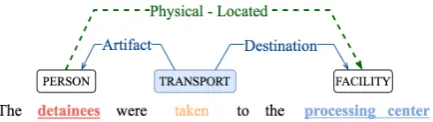
Figure 1: Information Network example constructed by Event (blue) and Relation (green dashed) Extraction.
unstructured texts and classify them respectively by predefined types and roles. As Figure 1 il-lustrates, both tasks entail predicting an informa-tion network (Li et al., 2014) for each sentence, where the entity mentions and event triggers are nodes, and the relations and event-argument links are edges labeled with their relation and argument roles, respectively.
There are certain relations and events that are of primary interest to a given community and so are reported predominantly in the low-resource language data sources available to that commu-nity. For example, though English language news will occasionally discuss the Person Aung San Suu Kyi, the vast majority of Physical-Located
relations and Meeting events involving her are only reported locally in Burmese news, and thus, without Burmese relation and event extraction, a knowledge graph of this person will lack this available information. Unfortunately, publicly-available gold-standard annotations for relation and event extraction exist for only a few languages (Doddington et al.,2004;Getman et al.,2018), and Burmese is not among them. Compared to other IE tasks such as name tagging, the annotations for Relation and Event Extraction are also more costly to obtain, because they are structured and require a rich label space.
Tree Representations
Graph Convolutional Networks Encoder Max-pooling
Softmax
Common Space Structural Representations
f
f f f
hm1 ht hsent hm2
TRANSPORT
(event)
Origin-Arg Artifact-Arg PHYS-LOCATED
(relation)
Concatenation
DET
AUX
ADP
DET
VERB nsubj:pass
det
obl
aux:pass
amod case
det
VERB
NOUN (PER)
NOUN (FAC)
Команды врачей были замечены в упакованных отделениях скорой помощи
(teams of doctors were seen in packed emergency rooms) NOUN
AUX
ADP
NOUN
VERB nsubj:pass
nmod
obl
aux:pass
amod case
nmod
VERB
NOUN (PER)
NOUN (FAC)
amod multilingual wordembedding
part-of-speech embedding entity-type embedding ADJ
f
f f f
hm1 ht hsent hm2
PHYS-LOCATED
(relation)
The detainees were taken to a
processing center
[image:2.595.72.521.64.486.2]dependency embedding
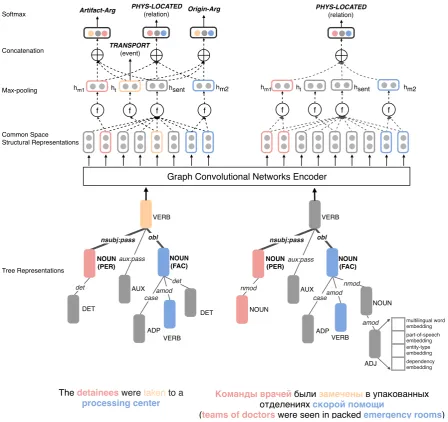
Figure 2: Multilingual common semantic space and cross-lingual structure transfer.
that the consistency in patterns observed across languages can be used to improve relation extrac-tion. Inspired by their results, we exploit language-universal features relevant to relation and event ar-gument identification and classification, by way of both symbolic and distributional representa-tions. For example, language-universal POS tag-ging and universal dependency parsing is avail-able for 76 languages (Nivre et al., 2018), en-tity extraction is available for 282 languages (Pan et al.,2017), and multi-lingual word embeddings are available for 44 languages (Bojanowski et al., 2017;Joulin et al.,2018). As shown in Figure2, even for distinct pairs of entity mentions (colored pink and blue, in both English and Russian), the structures share similar language-universal sym-bolic features, such as a common labeled
depen-dency path, as well as distributional features, such as multilingual word embeddings.
as the relations and events involving those entities, so we canshare structural representationsacross multiple languages.
Then we construct a novel cross-lingual struc-ture transfer learning framework to project source language (SL) training data and target language (TL) test data into the common semantic space, so that we can train a relation or event extractor from SL annotations and apply the resulting extractor to TL texts. We adopt graph convolutional net-works (GCN) (Kipf and Welling,2017; Marcheg-giani and Titov,2017) to encode graph structures over the input data, applying graph convolution operations to generate entity and word represtations in a latent space. In contrast to other en-coders such a Tree-LSTM (Tai et al.,2015), GCN can cover more complete contextual information from dependency parses because, for each word, it captures all parse tree neighbors of the word, rather than just the child nodes of the word. Using this shared encoder, we treat the two tasks of re-lation extraction and event argument role labeling as mappings from the latent space to relation type and to event type and argument role, respectively. Extensive experiments on cross-lingual relation and event transfer among English, Chinese, and Arabic show that our approach achieves highly promising performance on both tasks.
2 Model
2.1 Overview
Our cross-lingual structure transfer approach (see Figure2) consists of four steps: (1) Convert each sentence in any language into a language-universal tree structure based on universal dependency pars-ing. (2) For each node in the tree structure, cre-ate a representation from the conccre-atenation of multilingual word embedding, language-universal POS embedding, dependency role embedding and entity-type embedding, so that all sentences, inde-pendent of their language, are represented within one shared semantic space. (3) Adopt GCN to generate contextualized word representations by leveraging information from neighbors derived from the dependency parsing tree, and (4) Using this shared semantic space, train relation and event argument extractors with high-resource language training data, and apply the resulting extractors to texts of low-resource languages that do not have any relation or event argument annotations.
2.2 Tree Representations
Most previous approaches regard a sentence as a linear sequence of words, and incorporate language-specific information such as word or-der. Unlike sequence representations, tree repre-sentations such as constituency trees and depen-dency trees are typically constructed following a combination of syntactic principles and annotation guidelines designed by linguists. The resulting structures, such as the verb – subject relation and theverb–objectrelation, are found across languages. In this paper, we choose dependency trees as the sentence representations because the community has made great efforts at developing language-universal dependency parsing resources across 83 languages (Nivre et al.,2016).
We define the dependency-based tree represen-tation for a sentence as G = (V, E), where
V = {v1, v2, ..., vN}is a set of words, and E = {e1, e2, ..., eM}is a set of language-universal
syn-tactic relations. N is the number of words in the sentence andM is the number of dependency re-lations between words. To make this tree repre-sentation language-universal, we first convert each tree node into a vector which is a concatenation of three language-universal representations at word-level: multilingual word embedding, POS embed-ding (Nivre et al., 2016), entity-type embedding, and dependency relation embedding. More details are reported in Section3.2.
2.3 GCN Encoder
Structural information is important for relation ex-traction and event argument role labeling, thus we aim to generate contextualized word representa-tions by leveraging neighbors in dependency trees for each node.
Our GCN encoder is based on the monolingual design by Zhang et al. (2018b). The graphical sentence representation obtained from dependency parsing of a sentence withN tokens is converted into an N ×N adjacency matrixA, with added self-connections at each node to help capture infor-mation about the current node itself, as inKipf and Welling(2017). Here,Ai,j = 1denotes the
pres-ence of a directed edge from nodeito nodejin the dependency tree. Initially, each node contains dis-tributional information about theithword, includ-ing word embeddinclud-ingxw
i , embeddings for symbolic
We represent this initial representationh0i as fol-lows:
h(0)i =xwi ⊕xpi ⊕xdi ⊕xei
Then, at thekthlayer of convolution, the hidden representation is derived from the representations of its neighbors at the(k−1)th layer. Thus, the hidden representation at thekth layer for the ith
node is computed as:
h(k)i =ReLU
( N
∑
j=0
AijW(k)h
(k−1) j di+b(k)
)
whereW is the weight vector, bis the bias term, anddi represents the degree of theithnode. The denominator in the equation denotes the normal-ization factor to neutralize the negative impact of node degree (Zhang et al.,2018b). The final hid-den representation of each node after thekthlayer is the encoding of each wordh(k)i in our language universal common space, and incorporates infor-mation about neighbors up tokhops away in the dependency tree.
2.4 Application on Relation Extraction
The GCN encoder generates the final hidden rep-resentation,h(k)i ,for each of thennodes. We per-form max-pooling over these final node represen-tations to obtain a single vector representation for the sentence,hs.Similar to previous work (Zhang et al.,2018b), we also use the following recipe to obtain relation type classification results for each mention pair in a sentence: (1) max-pooling over the final representations of the nodes represent-ing entity mentions, to get a srepresent-ingle vector repre-sentation for each mention in a pair under con-sideration, hm1 andhm2, (2) a concatenation of three results of max-pooling: ([hm1;hs;hm2])to combine contextual sentence information with en-tity mention information (Santoro et al., 2017; Lee et al., 2017; Zhang et al., 2018b), (3) a lin-ear layer to generate a combined representation of these concatenated results, and (4) a Softmax out-put layer for relation type classification. The ob-jective function used here is as follows:
Lr= N ∑
i=1 Li
∑
j=1
yij log(σ(Ur·[hm1i ;hsij;hm2j ]))
(1)
whereUris a weight matrix.
2.5 Application on Event Argument Role Labeling
Event argument role labeling distinguishes ments from non-arguments and classifies argu-ments by argument role. To label the role of an argument candidate (xaj) for an event trigger (xti), we first generate the sentence representation hs, argument candidate representationha, and trigger representationhtby applying pooling on sentence, argument candidatexajand event triggerxti respec-tively, which is the same as that for relation extrac-tion. The mapping function from the latent space to argument roles is composed of a concatenation operation ([ht;hs;ha]), a linear layer (Ua) and a
Softmax output layer:
La= N ∑
i=1 Li
∑
j=1
yij log(σ(Ua·[hti;hsij;haj])) (2)
where N is the number of event mentions, Li
is the number of argument candidates forithevent mention andσis the Sigmoid function.
3 Experiments
3.1 Data and Evaluation Metrics
Relation Mentions
Event Mentions
Event Arguments
English 8,738 5,349 9,793
Chinese 9,317 3,333 8,032
[image:4.595.307.526.426.500.2]Arabic 4,731 2,270 4,975
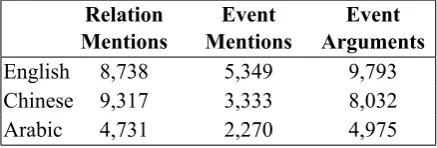
Table 1: Data statistics.
Straková, 2017) for Arabic tokenization. We use UDPipe1for POS tagging and dependency parsing for all three languages.
We follow the following criteria in previous work (Ji and Grishman,2008;Li et al., 2013;Li and Ji,2014) for evaluation:
• A relation mention is considered correct if its relation type is correct, and the head offsets of the two related entity mention arguments are both correct.
• An event argument is correctly labeled if its event type, offsets, and role label match any of the reference argument mentions.
3.2 Training Details
We use the multilingual word embeddings released by (Joulin et al.,2018) which are based on aligning monolingual embeddings learned by fastText ( Bo-janowski et al.,2017) from Wikipedia. We adopt the universal POS tag set (17 word categories) and 37 categories of dependency relations defined by theUniversal Dependenciesprogram (Nivre et al., 2016), and seven entity types defined in ACE: per-son, geopolitical entity, organization, facility, lo-cation, weapon and vehicle. Table2shows the hy-perparameters of our model.
Hyperparameter Value
word embedding size 300
POS embedding size 30
entity embedding size 30
dependency relation embedding size 30
hidden dimension size 200
dropout 0.5
number of layers 2
pooling function max pooling
mlp layers 2
learning rate 0.1
learning rate decay 0.9
batch size 50
[image:5.595.72.289.446.638.2]optimization SGD
Table 2: GCN hyperparameters.
3.3 Overall Performance
In order to fully analyze the cross-lingual learn-ing capabilities of our framework, we assess its
1Universal Dependencies 2.3 models:
english-ewt-ud-2.3-181115.udpipe, chinese-gsd-ud-2.3-181115.udpipe, arabic-padt-ud-2.3-181115.udpipe
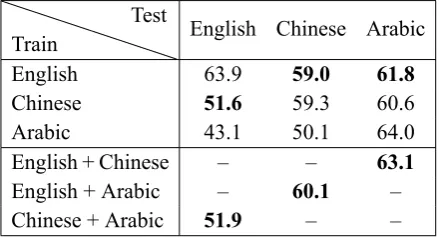
performance by applying models trained with var-ious combinations of training and test data from these three languages, as shown in Tables 3 and 4. We can see that the results are promising. For both tasks, the models trained from English are best, followed by Chinese, and then Arabic. We find that extraction task performance degrades as the accuracy of language-dependent tools (for sentence segmentation, POS tagging, dependency parsing) degrades.
Using English as training data, our cross-lingual transfer approach achieves similar performance on Chinese event argument role labeling (59.0%), compared to the model trained from Chinese an-notations (59.3%), which is much higher than the best reported English-to-Chinese transfer result on event argument role labeling (47.7%) (Hsi et al., 2016).
We also show polyglot results for event argu-ment role labeling in Table4, by combing the train-ing data from multiple languages. We observe that our model benefits from the combination of training data of multiple languages. The polyglot transfer learning does not provide further gains to relation extraction because the model converges quickly on a small amount of training data.
Train
Test
English Chinese Arabic
English 68.2 42.5 58.7
Chinese 62.6 69.4 54.0
[image:5.595.306.526.447.521.2]Arabic 58.6 35.2 67.4
Table 3: Relation Extraction: overall performance (F-score %) using perfect entity mentions.
Train
Test
English Chinese Arabic
English 63.9 59.0 61.8
Chinese 51.6 59.3 60.6
Arabic 43.1 50.1 64.0
English + Chinese – – 63.1
English + Arabic – 60.1 –
Chinese + Arabic 51.9 – –
[image:5.595.307.527.594.713.2]Feature Chinese Arabic
Multilingual Word Embedding 40.2 53.8
+ POS Embedding 40.1 54.9
+ Entity Embedding 40.8 56.9
[image:6.595.75.291.62.120.2]+ Dependency Relation Embedding 42.5 58.7
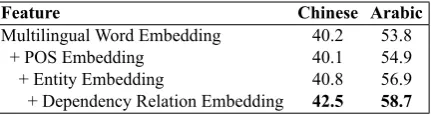
Table 5: Relation Extraction: Contribution of adding each language-universal feature consecutively for rela-tion extracrela-tion on Arabic and Chinese test sets, using the model trained on English (F1 scores (%)).
3.4 Ablation Study
Tables5and6show the impact of each feature cat-egory. We can see that all categories help except Chinese POS features for Relation Extraction and Arabic POS features for Event Argument Role La-beling.
Many Chinese word segmentation errors oc-cur on tokens involved in names. For example, “总统(NOUN, president) 萨姆(PROPN, Samuel)
·(PUNCT) 努乔马(PROPN, Nujoma)” is
mis-takenly tagged as “总(NOUN) 统萨姆(PROPN)
·(PUNCT)努乔(NOUN)马(NOUN)”.
In Arabic, sometimes one word is a combination ofNoun andVerb. For example, the single word “ﻲﻠﻴﺋﺍﺮﺳﺈﻟﺍ” means“Israeli conflict”in English, in-cluding both a trigger and an argument, which are not separated by our tokenizer. In contrast, two en-tity mentions are unlikely to be combined into one word in Arabic, thus Relation Extraction does not suffer from tokenization errors and corresponding POS features.
Feature Chinese Arabic
Multilingual Word Embedding 52.4 56.6
+ POS Embedding 57.1 37.8
+ Entity Embedding 58.3 41.4
[image:6.595.321.500.598.641.2]+ Dependency Relation Embedding 59.0 61.8
Table 6: Event Extraction: Contributions of adding each language-universal feature consecutively for event argument role labeling on Arabic and Chinese test datasets, using a model trained on English (F1 scores (%)).
3.5 Comparison with Supervised Approach
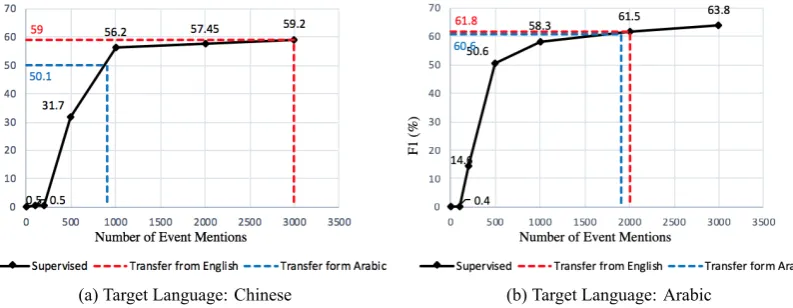
We also compare the results with supervised monolingual models trained from manual anno-tations in the same language. Figures 3 and 4 show the learning curves of these supervised mod-els. For event argument role labeling, we can see that without using any annotations for the tar-get language, our approach achieves performance comparable to the supervised models trained from
more than 3,000 manually annotated event ar-gument mentions, which equal to approximately 1,326 Chinese sentences and 1,141 Arabic sen-tences based on the statistics of ACE data.
Our model performs particularly well on relation types or argument roles that require deep understanding of wide contexts involv-ing complex syntactic and semantic struc-tures, such as PART-WHOLE:Artifact, PART-WHOLE:Geographical, GEN-AFF:Org-Location
andORG-AFF:Employmentrelations, andInjure: Victim argument role. Despite only having 14
training instances, our model achieves near 100% F-score on PART-WHOLE:Artifact rela-tions when transferred from English to Chinese. Our model achieves 86% F1 score on PART-WHOLE:Geographicalrelations when transferred from English to Arabic, and 73% and 79% F1
scores on GEN-AFF:Org-Location relations
when transferred from English to Chinese and to Arabic, respectively. In an Injure event, a
Personcan either be anAgentor aVictim. Surface lexical embedding features are often not sufficient to disambiguate them. Our model is effective at transferring structural information such as dependency relations between words, and obtains 72.97% F1 score on labelingInjure: Victimwhen transferred from English to Chinese, and 75.43 % from English to Arabic.
In addition, our model achieves very high per-formance on event argument roles for which entity type is a strong indicator. For example, aweapon
is much more likely to play as anInstrumentrather than a Target in an Attack. Our model achieves
89.9% F1 score onAttack: Instrumentand91.4% F1 score onPersonnel: POSITIONargument roles when transferred from English to Chinese.
3.6 Using System Extracted Name Mentions
Target Language F1 score
Chinese 56.9
Arabic 60.1
Table 7: Event Argument Role Labeling results (F1 %) on Chinese and Arabic using English as training data (with system generated entity mentions)
(a) Target Language: Chinese (b) Target Language: Arabic
Figure 3: Relation Extraction: Comparison between supervised monolingual GCN model and cross-lingual transfer learning.
(a) Target Language: Chinese (b) Target Language: Arabic
Figure 4: Event Argument Role Labeling: Comparison between supervised monolingual GCN model and cross-lingual transfer learning.
thus decrease the performance of the model, but the overall results are still promising.
4 Related Work
A large number of supervised machine learning techniques have been used for English event ex-traction, including traditional techniques based on symbolic features (Ji and Grishman, 2008; Liao and Grishman, 2011), joint inference models (Li et al., 2014; Yang and Mitchell, 2016), and re-cently with neural networks (Nguyen and Grish-man,2015a;Nguyen et al.,2016;Chen et al.,2015; Nguyen and Grishman,2018;Liu et al.,2018b;Lu and Nguyen,2018;Liu et al.,2018a;Zhang et al., 2018a, 2019). English relation extraction in the early days also followed supervised paradigms (Li and Ji, 2014;Zeng et al.,2014;Nguyen and Gr-ishman, 2015b; Miwa and Bansal, 2016; Pawar et al., 2017; Bekoulis et al., 2018; Wang et al., 2018b). Recent efforts have attempted to reduce annotation costs using distant supervision (Mintz
et al.,2009;Surdeanu et al.,2012;Min et al.,2013; Angeli et al., 2014;Zeng et al.,2015;Quirk and Poon,2017;Qin et al.,2018;Wang et al.,2018a) through knowledge bases (KBs), where entities and static relations are plentiful. Distant super-vision is less applicable for the task of event ex-traction because very few dynamic events are in-cluded in KBs. These approaches, however, incor-porate language-specific characteristics and thus are costly in requiring substantial amount of anno-tations to adapt to a new language (Chen and Vin-cent,2012;Blessing and Schütze,2012;Li et al., 2012;Danilova et al.,2014;Agerri et al.,2016;Hsi et al.,2016;Feng et al.,2016).
[image:7.595.100.497.267.421.2]trans-fer rely on bilingual dictionaries (Hsi et al.,2016), parallel data (Chen and Ji,2009;Kim et al.,2010; Qian et al.,2014) or machine translation (Faruqui and Kumar,2015;Zou et al.,2018). Recent meth-ods (Lin et al., 2017;Wang et al., 2018b) aggre-gate consistent patterns and complementary infor-mation across languages to enhance Relation Ex-traction, but they do so exploiting only distribu-tional representations.
Event extraction shares with Semantic Role La-beling (SRL) the task of assigning to each event ar-gument its event role label, in the process of com-pleting other tasks to extract the full event struc-ture (assigning event types to predicates and more specific roles to arguments). Cross-lingual transfer has been very successful for SRL. Early attempts relied on word alignment (Van der Plas et al.,2011) or bilingual dictionaries (Kozhevnikov and Titov, 2013). Recent work incorporates universal de-pendencies (Prazák and Konopík,2017) or multi-lingual word embeddings for Polyglot SRL ( Mul-caire et al.,2018). Liu et al.(2019) andMulcaire et al. (2019) exploit multi-lingual contextualized word embedding for SRL and other Polyglot NLP tasks including dependency parsing and name tag-ging. To the best of our knowledge, our work is the first to construct a cross-lingual structure transfer framework that combines language-universal sym-bolic representations and distributional represen-tations for relation and event extraction over texts written in a language without any training data.
GCN has been successfully applied to sev-eral individual monolingual NLP tasks, includ-ing relation extraction (Zhang et al., 2018b), event detection (Nguyen and Grishman, 2018), SRL (Marcheggiani and Titov,2017) and sentence classification (Yao et al.,2019). We apply GCN to construct multi-lingual structural representations for cross-lingual transfer learning.
5 Conclusions and Future Work
We show how cross-lingual relation and event ar-gument structural representations may be trans-ferred between languages without any training data for the target language, and conclude that language-universal symbolic and distributional representations are complementary for cross-lingual structure transfer. In the future we will explore more language-universal representations such as visual features from topically-related im-ages and videos and external background
knowl-edge.
Acknowledgement
This research is based upon work supported in part by U.S. DARPA LORELEI Program HR0011-15-C-0115, the Office of the Director of Na-tional Intelligence (ODNI), Intelligence Advanced Research Projects Activity (IARPA), via con-tract FA8650-17-C-9116, and ARL NS-CTA No. W911NF-09-2-0053. The views and conclusions contained herein are those of the authors and should not be interpreted as necessarily represent-ing the official policies, either expressed or im-plied, of DARPA, ODNI, IARPA, or the U.S. Gov-ernment. The U.S. Government is authorized to reproduce and distribute reprints for governmen-tal purposes notwithstanding any copyright anno-tation therein.
References
Rodrigo Agerri, Itziar Aldabe, Egoitz Laparra, Ger-man Rigau Claramunt, Antske Fokkens, Paul Hui-jgen, Rubén Izquierdo Beviá, Marieke van Erp, Piek Vossen, Anne-Lyse Minard, et al. 2016. Multilin-gual event detection using the newsreader pipelines. InProceedings of International Conference on Lan-guage Resources and Evaluation 2016.
Waleed Ammar, George Mulcaire, Yulia Tsvetkov, Guillaume Lample, Chris Dyer, and Noah A Smith. 2016. Massively multilingual word embeddings.
arXiv preprint arXiv:1602.01925.
Gabor Angeli, Julie Tibshirani, Jean Wu, and Christo-pher D Manning. 2014. Combining distant and par-tial supervision for relation extraction. In Proceed-ings of the 2014 Conference on Empirical Methods in Natural Language Processing.
Giannis Bekoulis, Johannes Deleu, Thomas Demeester, and Chris Develder. 2018. Adversarial training for multi-context joint entity and relation extrac-tion. In Proceedings of the 2018 Conference on Empirical Methods in Natural Language Process-ing, pages 2830–2836, Brussels, Belgium. Associ-ation for ComputAssoci-ational Linguistics.
Andre Blessing and Hinrich Schütze. 2012. Crosslin-gual distant supervision for extracting relations of different complexity. In Proceedings of the 21st ACM international conference on Information and knowledge management.
Chen Chen and Ng Vincent. 2012. Joint modeling for Chinese event extraction with rich linguistic fea-tures. InProceedings of the 24th International Con-ference on Computational Linguistics.
Yubo Chen, Liheng Xu, Kang Liu, Daojian Zeng, and Jun Zhao. 2015. Event extraction via dynamic multi-pooling convolutional neural networks. In Proceed-ings of the 53rd Annual Meeting of the Association for Computational Linguistics and the 7th Interna-tional Joint Conference on Natural Language Pro-cessing (Volume 1: Long Papers).
Zheng Chen and Heng Ji. 2009. Can one language bootstrap the other: a case study on event extraction. InProceedings of the NAACL HLT 2009 Workshop on Semi-Supervised Learning for Natural Language Processing.
Vera Danilova, Mikhail Alexandrov, and Xavier Blanco. 2014. A survey of multilingual event extrac-tion from text. InProceedings of the International Conference on Applications of Natural Language to Data Bases/Information Systems.
George R Doddington, Alexis Mitchell, Mark A Przy-bocki, Lance A Ramshaw, Stephanie M Strassel, and Ralph M Weischedel. 2004. The automatic content extraction (ACE) program-tasks, data, and evalua-tion. In Proceedings of the Fourth International Conference on Language Resources and Evaluation.
Manaal Faruqui and Chris Dyer. 2014.Improving vec-tor space word representations using multilingual correlation. InProceedings of the 14th Conference of the European Chapter of the Association for Com-putational Linguistics.
Manaal Faruqui and Shankar Kumar. 2015. Multilin-gual open relation extraction using cross-linMultilin-gual pro-jection. InProceedings of the 2015 Conference of the North American Chapter of the Association for Computational Linguistics: Human Language Tech-nologies.
Xiaocheng Feng, Lifu Huang, Duyu Tang, Heng Ji, Bing Qin, and Ting Liu. 2016. A language-independent neural network for event detection. In
Proceedings of the 54th Annual Meeting of the As-sociation for Computational Linguistics (Volume 2: Short Papers).
Jeremy Getman, Joe Ellis, Stephanie Strassel, Zhiyi Song, and Jennifer Tracey. 2018.Laying the ground-work for knowledge base population: Nine years of linguistic resources for TAC KBP. InProceedings of the Eleventh International Conference on Language Resources and Evaluation (LREC-2018).
Andrew Hsi, Yiming Yang, Jaime Carbonell, and Ruochen Xu. 2016. Leveraging multilingual train-ing for limited resource event extraction. In Pro-ceedings of COLING 2016, the 26th International Conference on Computational Linguistics: Techni-cal Papers.
Lifu Huang, Heng Ji, and Jonathan May. 2019. Cross-lingual multi-level adversarial transfer to enhance low-resource name tagging. InProceedings of the 2019 Conference of the North American Chapter of the Association for Computational Linguistics: Hu-man Language Technologies, Volume 1 (Long and Short Papers).
Heng Ji and Ralph Grishman. 2008.Refining event ex-traction through cross-document inference. In Pro-ceedings of the 46th Annual Meeting of the Associ-ation for ComputAssoci-ational Linguistics: Human Lan-guage Technologies.
Armand Joulin, Piotr Bojanowski, Tomas Mikolov, Hervé Jégou, and Edouard Grave. 2018. Loss in translation: Learning bilingual word mapping with a retrieval criterion. InProceedings of the 2018 Con-ference on Empirical Methods in Natural Language Processing.
Seokhwan Kim, Minwoo Jeong, Jonghoon Lee, and Gary Geunbae Lee. 2010. A cross-lingual annota-tion projecannota-tion approach for relaannota-tion detecannota-tion. In
Proceedings of the 23rd International Conference on Computational Linguistics.
Thomas N. Kipf and Max Welling. 2017. Semi-supervised classification with graph convolutional networks. InInternational Conference on Learning Representations.
Mikhail Kozhevnikov and Ivan Titov. 2013. Cross-lingual transfer of semantic role labeling models. In
Proceedings of the 51st Annual Meeting of the Asso-ciation for Computational Linguistics.
Angeliki Lazaridou, Georgiana Dinu, and Marco Ba-roni. 2015. Hubness and pollution: Delving into cross-space mapping for zero-shot learning. In Pro-ceedings of the 53rd Annual Meeting of the Associ-ation for ComputAssoci-ational Linguistics and the 7th In-ternational Joint Conference on Natural Language Processing (Volume 1: Long Papers).
Kenton Lee, Luheng He, Mike Lewis, and Luke Zettle-moyer. 2017. End-to-end neural coreference resolu-tion. InProceedings of the 2017 Conference on Em-pirical Methods in Natural Language Processing.
Peifeng Li, Guodong Zhou, Qiaoming Zhu, and Libin Hou. 2012.Employing compositional semantics and discourse consistency in chinese event extraction. In
Proceedings of the 2012 Joint Conference on Empir-ical Methods in Natural Language Processing and Computational Natural Language Learning.
Qi Li and Heng Ji. 2014.Incremental joint extraction of entity mentions and relations. InProceedings of the 52nd Annual Meeting of the Association for Compu-tational Linguistics (Volume 1: Long Papers).
Qi Li, Heng Ji, HONG Yu, and Sujian Li. 2014.
Constructing information networks using one single model. InProceedings of the 2014 Conference on Empirical Methods in Natural Language Process-ing.
Shasha Liao and Ralph Grishman. 2011. Acquiring topic features to improve event extraction: in pre-selected and balanced collections. InProceedings of the International Conference Recent Advances in Natural Language Processing 2011.
Yankai Lin, Zhiyuan Liu, and Maosong Sun. 2017.
Neural relation extraction with multi-lingual atten-tion. InProceedings of the 55th Annual Meeting of the Association for Computational Linguistics (Vol-ume 1: Long Papers).
Ying Lin, Shengqi Yang, Veselin Stoyanov, and Heng Ji. 2018. A multi-lingual multi-task architecture for low-resource sequence labeling. In Proc. The 56th Annual Meeting of the Association for Compu-tational Linguistics.
Jian Liu, Yubo Chen, Kang Liu, and Jun Zhao. 2018a.
Event detection via gated multilingual attention mechanism. In Proceedings of the Thirty-Second AAAI Conference on Artificial Intelligence.
Nelson F. Liu, Matt Gardner, Yonatan Belinkov, Matthew E. Peters, and Noah A. Smith. 2019. Lin-guistic knowledge and transferability of contextual representations. InProceedings of the Conference of the North American Chapter of the Association for Computational Linguistics.
Xiao Liu, Zhunchen Luo, and Heyan Huang. 2018b.
Jointly multiple events extraction via attention-based graph information aggregation. InProceedings of the 2018 Conference on Empirical Methods in Nat-ural Language Processing.
Ang Lu, Weiran Wang, Mohit Bansal, Kevin Gimpel, and Karen Livescu. 2015. Deep multilingual corre-lation for improved word embeddings. In Proceed-ings of the 2015 Conference of the North American Chapter of the Association for Computational Lin-guistics: Human Language Technologies.
Weiyi Lu and Thien Huu Nguyen. 2018. Similar but not the same: Word sense disambiguation improves event detection via neural representation matching. InProceedings of the 2018 Conference on Empirical Methods in Natural Language Processing.
Christopher Manning, Mihai Surdeanu, John Bauer, Jenny Finkel, Steven Bethard, and David McClosky. 2014. The Stanford CoreNLP natural language pro-cessing toolkit. InProceedings of 52nd annual meet-ing of the Association for Computational Lmeet-inguis- Linguis-tics: system demonstrations.
Diego Marcheggiani and Ivan Titov. 2017. Encoding sentences with graph convolutional networks for se-mantic role labeling. In Proceedings of the 2017 Conference on Empirical Methods in Natural Lan-guage Processing.
Stephen Mayhew, Chen-Tse Tsai, and Dan Roth. 2017.
Cheap translation for cross-lingual named entity recognition. InProceedings of the 2017 Conference on Empirical Methods in Natural Language Process-ing.
Tomas Mikolov, Quoc V Le, and Ilya Sutskever. 2013.
Exploiting similarities among languages for machine translation.arXiv preprint arXiv:1309.4168.
Bonan Min, Ralph Grishman, Li Wan, Chang Wang, and David Gondek. 2013. Distant supervision for relation extraction with an incomplete knowledge base. InProceedings of the 2013 Conference of the North American Chapter of the Association for Com-putational Linguistics: Human Language Technolo-gies.
Mike Mintz, Steven Bills, Rion Snow, and Dan Juraf-sky. 2009. Distant supervision for relation extrac-tion without labeled data. InProceedings of the Joint Conference of the 47th Annual Meeting of the ACL and the 4th International Joint Conference on Natu-ral Language Processing of the AFNLP.
Makoto Miwa and Mohit Bansal. 2016.End-to-end re-lation extraction using LSTMs on sequences and tree structures. InProceedings of the 54th Annual Meet-ing of the Association for Computational LMeet-inguistics (Volume 1: Long Papers).
Phoebe Mulcaire, Jungo Kasai, and Noah A. Smith. 2019. Polyglot contextual representations improve crosslingual transfer. In Proceedings of the 2019 Conference of the North American Chapter of the Association for Computational Linguistics: Human Language Technologies, Volume 1 (Long and Short Papers).
Phoebe Mulcaire, Swabha Swayamdipta, and Noah A. Smith. 2018. Polyglot semantic role labeling. In
Proceedings of the 56th Annual Meeting of the As-sociation for Computational Linguistics (Volume 2: Short Papers).
Thien Huu Nguyen, Kyunghyun Cho, and Ralph Grish-man. 2016. Joint event extraction via recurrent neu-ral networks. InProceedings of the 2016 Conference of the North American Chapter of the Association for Computational Linguistics: Human Language Tech-nologies.
Thien Huu Nguyen and Ralph Grishman. 2015a.Event detection and domain adaptation with convolutional neural networks. InProceedings of the 53rd Annual Meeting of the Association for Computational Lin-guistics and the 7th International Joint Conference on Natural Language Processing (Volume 2: Short Papers).
Thien Huu Nguyen and Ralph Grishman. 2018. Graph convolutional networks with argument-aware pool-ing for event detection. InThirty-Second AAAI Con-ference on Artificial Intelligence.
Joakim Nivre, Mitchell Abrams, Željko Agić, Lars Ahrenberg, Lene Antonsen, Katya Aplonova, Maria Jesus Aranzabe, Gashaw Arutie, Masayuki Asahara, Luma Ateyah, Mohammed Attia, Aitziber Atutxa, Liesbeth Augustinus, Elena Badmaeva, Miguel Ballesteros, Esha Banerjee, Sebastian Bank, Verginica Barbu Mititelu, Victoria Basmov, John Bauer, Sandra Bellato, Kepa Bengoetxea, Yevgeni Berzak, Irshad Ahmad Bhat, Riyaz Ah-mad Bhat, Erica Biagetti, Eckhard Bick, Rogier Blokland, Victoria Bobicev, Carl Börstell, Cristina Bosco, Gosse Bouma, Sam Bowman, Adriane Boyd, Aljoscha Burchardt, Marie Candito, Bernard Caron, Gauthier Caron, Gülşen Cebiroğlu Eryiğit, Flavio Massimiliano Cecchini, Giuseppe G. A. Celano, Slavomír Čéplö, Savas Cetin, Fabricio Chalub, Jinho Choi, Yongseok Cho, Jayeol Chun, Silvie Cinková, Aurélie Collomb, Çağrı Çöltekin, Miriam Connor, Marine Courtin, Elizabeth David-son, Marie-Catherine de Marneffe, Valeria de Paiva, Arantza Diaz de Ilarraza, Carly Dickerson, Peter Dirix, Kaja Dobrovoljc, Timothy Dozat, Kira Droganova, Puneet Dwivedi, Marhaba Eli, Ali Elkahky, Binyam Ephrem, Tomaž Erjavec, Aline Etienne, Richárd Farkas, Hector Fernandez Al-calde, Jennifer Foster, Cláudia Freitas, Katarína Gajdošová, Daniel Galbraith, Marcos Garcia, Moa Gärdenfors, Sebastian Garza, Kim Gerdes, Filip Ginter, Iakes Goenaga, Koldo Gojenola, Memduh Gökırmak, Yoav Goldberg, Xavier Gómez Guino-vart, Berta Gonzáles Saavedra, Matias Grioni, Normunds Grūzītis, Bruno Guillaume, Céline Guillot-Barbance, Nizar Habash, Jan Hajič, Jan Hajič jr., Linh Hà Mỹ, Na-Rae Han, Kim Harris, Dag Haug, Barbora Hladká, Jaroslava Hlaváčová, Florinel Hociung, Petter Hohle, Jena Hwang, Radu Ion, Elena Irimia, Ọlájídé Ishola, Tomáš Jelínek, Anders Johannsen, Fredrik Jørgensen, Hüner Kaşıkara, Sylvain Kahane, Hiroshi Kanayama, Jenna Kanerva, Boris Katz, Tolga Kayadelen, Jessica Kenney, Václava Kettnerová, Jesse Kirch-ner, Kamil Kopacewicz, Natalia Kotsyba, Simon Krek, Sookyoung Kwak, Veronika Laippala, Lorenzo Lambertino, Lucia Lam, Tatiana Lando, Septina Dian Larasati, Alexei Lavrentiev, John Lee, Phương Lê Hồng, Alessandro Lenci, Saran Lertpradit, Herman Leung, Cheuk Ying Li, Josie Li, Keying Li, KyungTae Lim, Nikola Ljubešić, Olga Loginova, Olga Lyashevskaya, Teresa Lynn, Vivien Macketanz, Aibek Makazhanov, Michael Mandl, Christopher Manning, Ruli Manurung, Cătălina Mărănduc, David Mareček, Katrin Marhei-necke, Héctor Martínez Alonso, André Martins, Jan Mašek, Yuji Matsumoto, Ryan McDonald, Gustavo Mendonça, Niko Miekka, Margarita Misir-pashayeva, Anna Missilä, Cătălin Mititelu, Yusuke Miyao, Simonetta Montemagni, Amir More, Laura Moreno Romero, Keiko Sophie Mori, Shinsuke Mori, Bjartur Mortensen, Bohdan Moskalevskyi,
Kadri Muischnek, Yugo Murawaki, Kaili Müürisep, Pinkey Nainwani, Juan Ignacio Navarro Horñiacek, Anna Nedoluzhko, Gunta Nešpore-Bērzkalne, Lương Nguyễn Thị, Huyền Nguyễn Thị Minh, Vitaly Nikolaev, Rattima Nitisaroj, Hanna Nurmi, Stina Ojala, Adédayọ̀ Olúòkun, Mai Omura, Petya Osenova, Robert Östling, Lilja Øvrelid, Niko Partanen, Elena Pascual, Marco Passarotti, Ag-nieszka Patejuk, Guilherme Paulino-Passos, Siyao Peng, Cenel-Augusto Perez, Guy Perrier, Slav Petrov, Jussi Piitulainen, Emily Pitler, Barbara Plank, Thierry Poibeau, Martin Popel, Lauma Pretkalniņa, Sophie Prévost, Prokopis Prokopidis, Adam Przepiórkowski, Tiina Puolakainen, Sampo Pyysalo, Andriela Rääbis, Alexandre Rademaker, Loganathan Ramasamy, Taraka Rama, Carlos Ramisch, Vinit Ravishankar, Livy Real, Siva Reddy, Georg Rehm, Michael Rießler, Larissa Rinaldi, Laura Rituma, Luisa Rocha, Mykhailo Romanenko, Rudolf Rosa, Davide Rovati, Valentin Ro�ca, Olga Rudina, Jack Rueter, Shoval Sadde, Benoît Sagot, Shadi Saleh, Tanja Samardžić, Stephanie Samson, Manuela Sanguinetti, Baiba Saulīte, Yanin Sawanakunanon, Nathan Schneider, Sebastian Schuster, Djamé Seddah, Wolfgang Seeker, Mojgan Seraji, Mo Shen, Atsuko Shimada, Muh Shohibussirri, Dmitry Sichinava, Natalia Silveira, Maria Simi, Radu Simionescu, Katalin Simkó, Mária Šimková, Kiril Simov, Aaron Smith, Isabela Soares-Bastos, Carolyn Spadine, Antonio Stella, Milan Straka, Jana Strnadová, Alane Suhr, Umut Sulubacak, Zsolt Szántó, Dima Taji, Yuta Takahashi, Takaaki Tanaka, Isabelle Tellier, Trond Trosterud, Anna Trukhina, Reut Tsarfaty, Francis Tyers, Sumire Uematsu, Zdeňka Urešová, Larraitz Uria, Hans Uszkoreit, Sowmya Vajjala, Daniel van Niekerk, Gertjan van Noord, Viktor Varga, Eric Villemonte de la Clergerie, Veronika Vincze, Lars Wallin, Jing Xian Wang, Jonathan North Washington, Seyi Williams, Mats Wirén, Tsegay Woldemariam, Tak-sum Wong, Chunxiao Yan, Marat M. Yavrumyan, Zhuoran Yu, Zdeněk Žabokrtský, Amir Zeldes, Daniel Zeman, Manying Zhang, and Hanzhi Zhu. 2018. Universal dependencies 2.3. LINDAT/CLARIN digital library at the Institute of Formal and Applied Linguistics (ÚFAL), Faculty of Mathematics and Physics, Charles University.
Joakim Nivre, Marie-Catherine De Marneffe, Filip Ginter, Yoav Goldberg, Jan Hajic, Christopher D Manning, Ryan T McDonald, Slav Petrov, Sampo Pyysalo, Natalia Silveira, et al. 2016. Universal de-pendencies v1: A multilingual treebank collection. In Proceedings of the Tenth International Confer-ence on Language Resources and Evaluation.
Sachin Pawar, Pushpak Bhattacharyya, and Girish K. Palshikar. 2017. End-to-end relation extraction us-ing neural networks and Markov logic networks. In
Proceedings of the 15th Conference of the European Chapter of the Association for Computational Lin-guistics.
Lonneke Van der Plas, Paola Merlo, and James Hen-derson. 2011.Scaling up automatic cross-lingual se-mantic role annotation. InProceedings of the 49th Annual Meeting of the Association for Computa-tional Linguistics: Human Language Technologies.
Ondrej Prazák and Miloslav Konopík. 2017. Cross-lingual SRL based upon universal dependencies. In
Proceedings of the International Conference Recent Advances in Natural Language Processing, RANLP 2017.
Longhua Qian, Haotian Hui, Ya’nan Hu, Guodong Zhou, and Qiaoming Zhu. 2014. Bilingual active learning for relation classification via pseudo par-allel corpora. In Proceedings of the 52nd Annual Meeting of the Association for Computational Lin-guistics (Volume 1: Long Papers).
Pengda Qin, Weiran Xu, and William Yang Wang. 2018. Dsgan: Generative adversarial training for distant supervision relation extraction. In Proceed-ings of the 56th Annual Meeting of the Association for Computational Linguistics (Volume 1: Long Pa-pers).
Chris Quirk and Hoifung Poon. 2017. Distant super-vision for relation extraction beyond the sentence boundary. InProceedings of the 15th Conference of the European Chapter of the Association for Compu-tational Linguistics: Volume 1, Long Papers.
Sascha Rothe, Sebastian Ebert, and Hinrich Schütze. 2016. Ultradense word embeddings by orthogonal transformation. InProceedings of the 2016 Confer-ence of the North American Chapter of the Associ-ation for ComputAssoci-ational Linguistics: Human Lan-guage Technologies.
Adam Santoro, David Raposo, David G Barrett, Ma-teusz Malinowski, Razvan Pascanu, Peter Battaglia, and Timothy Lillicrap. 2017. A simple neural net-work module for relational reasoning. In Proceed-ings of Advances in Neural Information Processing Systems.
Samuel L Smith, David HP Turban, Steven Hamblin, and Nils Y Hammerla. 2017. Offline bilingual word vectors, orthogonal transformations and the inverted softmax.arXiv preprint arXiv:1702.03859.
Milan Straka and Jana Straková. 2017. Tokenizing, POS tagging, lemmatizing and parsing UD 2.0 with UDPipe. InProceedings of the CoNLL 2017 Shared Task: Multilingual Parsing from Raw Text to Uni-versal Dependencies.
Mihai Surdeanu, Julie Tibshirani, Ramesh Nallapati, and Christopher D. Manning. 2012. Multi-instance multi-label learning for relation extraction. In Pro-ceedings of the 2012 Joint Conference on Empirical Methods in Natural Language Processing and Com-putational Natural Language Learning.
Kai Sheng Tai, Richard Socher, and Christopher D. Manning. 2015. Improved semantic representations from tree-structured long short-term memory net-works. InProceedings of the 53rd Annual Meeting of the Association for Computational Linguistics and the 7th International Joint Conference on Natural Language Processing (Volume 1: Long Papers).
Christopher Walker, Stephanie Strassel, Julie Medero, and Kazuaki Maeda. 2006. Ace 2005 multilin-gual training corpus. Linguistic Data Consortium, Philadelphia, 57.
Guanying Wang, Wen Zhang, Ruoxu Wang, Yalin Zhou, Xi Chen, Wei Zhang, Hai Zhu, and Huajun Chen. 2018a. Label-free distant supervision for rela-tion extracrela-tion via knowledge graph embedding. In
Proceedings of the 2018 Conference on Empirical Methods in Natural Language Processing.
Xiaozhi Wang, Xu Han, Yankai Lin, Zhiyuan Liu, and Maosong Sun. 2018b. Adversarial multi-lingual neural relation extraction. In Proceedings of the 27th International Conference on Computational Linguistics.
Chao Xing, Dong Wang, Chao Liu, and Yiye Lin. 2015.
Normalized word embedding and orthogonal trans-form for bilingual word translation. InProceedings of the 2015 Conference of the North American Chap-ter of the Association for Computational Linguistics: Human Language Technologies.
Bishan Yang and Tom M. Mitchell. 2016.Joint extrac-tion of events and entities within a document context. InProceedings of the 2016 Conference of the North American Chapter of the Association for Computa-tional Linguistics: Human Language Technologies.
Liang Yao, Chengsheng Mao, and Yuan Luo. 2019. Graph convolutional networks for text classification. InProceedings of the Thirty-Third AAAI Conference on Artificial Intelligence.
Daojian Zeng, Kang Liu, Yubo Chen, and Jun Zhao. 2015.Distant supervision for relation extraction via piecewise convolutional neural networks. In Pro-ceedings of the 2015 Conference on Empirical Meth-ods in Natural Language Processing.
Daojian Zeng, Kang Liu, Siwei Lai, Guangyou Zhou, and Jun Zhao. 2014. Relation classification via con-volutional deep neural network. InProceedings of the 25th International Conference on Computational Linguistics.
Jingli Zhang, Wenxuan Zhou, Yu Hong, Jianmin Yao, and Min Zhang. 2018a. Using entity relation to im-prove event detection via attention mechanism. In
Tongtao Zhang, Heng Ji, and Avirup Sil. 2019. Joint entity and event extraction with generative adversar-ial imitation learning. Data Intelligence Vol 1 (2).
Yuan Zhang, David Gaddy, Regina Barzilay, and Tommi S Jaakkola. 2016. Ten pairs to tag-multilingual pos tagging via coarse mapping be-tween embeddings.InProceedings of the 2016 Con-ference of the North American Chapter of the Asso-ciation for Computational Linguistics: Human Lan-guage Technologies.
Yuhao Zhang, Peng Qi, and Christopher D. Manning. 2018b. Graph convolution over pruned dependency trees improves relation extraction. InProceedings of the 2018 Conference on Empirical Methods in Nat-ural Language Processing.