Proceedings of the 2019 Conference on Empirical Methods in Natural Language Processing 421
EntEval: A Holistic Evaluation Benchmark for Entity Representations
Mingda Chen3∗ Zewei Chu1∗ Yang Chen2 Karl Stratos4† Kevin Gimpel3
1University of Chicago, IL, USA 2Ohio State University, OH, USA
3Toyota Technological Institute at Chicago, IL, USA 4Rutgers University, NJ, USA
{mchen,kgimpel}@ttic.edu,[email protected],[email protected],[email protected]
Abstract
Rich entity representations are useful for a wide class of problems involving entities. De-spite their importance, there is no standard-ized benchmark that evaluates the overall qual-ity of entqual-ity representations. In this work, we propose EntEval: a test suite of diverse tasks that require nontrivial understanding of enti-ties including entity typing, entity similarity, entity relation prediction, and entity disam-biguation. In addition, we develop training techniques for learning better entity represen-tations by using natural hyperlink annorepresen-tations in Wikipedia. We identify effective objectives for incorporating the contextual information in hyperlinks into state-of-the-art pretrained lan-guage models (Peters et al.,2018a) and show that they improve strong baselines on multiple EntEval tasks.1
1 Introduction
Entity representations play a key role in numer-ous important problems including language mod-eling (Ji et al., 2017), dialogue generation (He et al., 2017), entity linking (Gupta et al., 2017), and story generation (Clark et al.,2018). One suc-cessful line of work on learning entity representa-tions has been learningstaticembeddings: that is, assign a unique vector to each entity in the train-ing data (Gupta et al.,2017;Yamada et al.,2016, 2017). While these embeddings are useful in many applications, they have the obvious drawback of not accommodating unknown entities. Another limiting factor is the lack of an evaluation bench-mark: it is often difficult to know which entity rep-resentations are better for which tasks.
∗
Equal contribution. Listed in alphabetical order.
†
Work done while the author was at Toyota Technologi-cal Institute at Chicago.
1Data processing and evaluation scripts are available at https://github.com/ZeweiChu/EntEval
We introduce EntEval: a carefully designed benchmark for holistically evaluating entity repsentations. It is a test suite of diverse tasks that re-quire nontrivial understanding of entities, includ-ing entity typinclud-ing, entity similarity, entity relation prediction, and entity disambiguation. Motivated by the recent success of contextualized word rep-resentations (henceforth: CWRs) from pretrained models (McCann et al.,2017;Peters et al.,2018a; Devlin et al., 2018;Yang et al.,2019;Liu et al., 2019b), we propose to encode the mention context or the description to dynamically represent an en-tity. In addition, we perform an in-depth compar-ison of ELMo and BERT-based embeddings and find that they show different characteristics on dif-ferent tasks. We analyze each layer of the CWRs and make the following observations:
• The dynamically encoded entity representations show a strong improvement on the entity dis-ambiguation task compared to prior work using static entity embeddings.
• BERT-based entity representations require fur-ther supervised training to perform well on downstream tasks, while ELMo-based represen-tations are more capable of performing zero-shot tasks.
• In general, higher layers of ELMo and BERT-based CWRs are more transferable to EntEval tasks.
2 Related Work
EntEval and the training objectives considered in this work are built on previous works that involve reasoning over entities. We give a brief overview of relevant works.
Entity linking/disambiguation. Entity linking is a fundamental task in information extraction with a wealth of literature (He et al., 2013;Guo and Barbosa,2014;Ling et al.,2015;Huang et al., 2015;Francis-Landau et al., 2016;Le and Titov, 2018;Martins et al.,2019). The goal of this task is to map a mention in context to the correspond-ing entity in a database. A natural approach is to learn entity representations that enable this map-ping. Recent works focused on learning a fixed embedding for each entity using Wikipedia hyper-links (Yamada et al.,2016;Ganea and Hofmann, 2017; Le and Titov, 2019). Gupta et al. (2017) additionally train context and description embed-dings jointly, but this mainly aims to improve the quality of the fixed entity embeddings rather than using the context and description embeddings di-rectly; we find that their context and description encoders perform poorly on EntEval tasks.
A closely related concurrent work by (Lo-geswaran et al.,2019) jointly encodes a mention in context and an entity description from Wikia to perform zero-shot entity linking. In contrast, here we seek to pretrain a general purpose entity rep-resentations that can function well either given or not given entity descriptions or mention contexts.
Other entity-related tasks involve entity typ-ing (Yaghoobzadeh and Sch¨utze, 2015; Murty et al.,2017;Del Corro et al.,2015;Rabinovich and Klein,2017;Choi et al.,2018;Onoe and Durrett, 2019;Obeidat et al.,2019) and coreference reso-lution (Durrett and Klein, 2013;Wiseman et al., 2016;Lee et al.,2017;Webster et al.,2018; Kan-tor and Globerson,2019).
Evaluating pretrained representations. Re-cent work has sought to evaluate the knowledge acquired by pretrained language models (Shi et al., 2016;Adi et al.,2017;Belinkov et al.,2017; Pe-ters et al.,2018b;Conneau et al.,2018;Conneau and Kiela, 2018; Wang et al., 2018; Liu et al., 2019a;Chen et al.,2019a,inter alia). In this work, we focus on evaluating their capabilities in model-ing entities.
Part of EntEval involves evaluating world knowledge about entities, relating them to fact
checking (Vlachos and Riedel,2014;Wang,2017; Thorne et al., 2018; Yin and Roth, 2018; Chen et al.,2019b), and commonsense learning (Angeli and Manning,2014;Bowman et al.,2015;Li et al., 2016;Mihaylov et al., 2018;Zellers et al.,2018; Trinh and Le, 2018; Talmor et al., 2019; Zellers et al.,2019;Sap et al.,2019;Rajani et al.,2019). Another related line of work is to integrate entity-related knowledge into the training of language models (Logan et al., 2019; Zhang et al., 2019; Sun et al.,2019).
Contextualized word representations. Con-textualized word representations and pre-trained language representation models, such as ELMo (Peters et al., 2018a) and BERT (Devlin et al.,2018), are powerful pretrained models that have been shown to be effective for a variety of downstream tasks such as text classification, sentence relation prediction, named entity recog-nition, and question answering. Recent work has sought to evaluate the knowledge acquired by such models (Shi et al., 2016; Adi et al., 2017; Belinkov et al.,2017;Conneau et al.,2018; Con-neau and Kiela, 2018;Liu et al., 2019a). In this work, we focus on evaluating their capabilities in modeling entities.
3 EntEval
We are interested in two approaches: contextu-alized entity representations (henceforth: CER) and descriptive entity representations (henceforth: DER), both encoding fixed-length vector represen-tations for entities.
The contextualized entity representations en-codes an entity based on the context it appears re-gardless of whether the entity is seen before. The motivation behind contextualized entity represen-tations is that we want an entity encoder that does not depend on entries in a knowledge base, but is capable of inferring knowledge about an entity from the context it appears.
As opposed to contextualized entity represen-tations, descriptive entity representations do rely on entries in Wikipedia. We use a model-specific function f to obtain a fixed-length vector repre-sentation from the entity’s textual description.
follow-Logic was established as a disciplineby Aristotle, who established its fundamental place in philosophy.
Wisdom University Philosophy
… Accident
Figure 1: An example taken from ET. Targeted entity mention is bold. Candidate categories are on the right. Gold standard categories are in gray.
ing tasks. Unless otherwise noted, when the task involves a pair of entities, the input to the classifier are the entity representationsx1 andx2,
concate-nated with their element-wise product and abso-lute difference: [x1, x2, x1x2,|x1 −x2|]. This
input format has been used in SentEval (Conneau and Kiela,2018).
The datasets used in EntEval tasks are summa-rized in table1. It shows the number of instances in train/valid/test split for each dataset, and the number of target classes if this is a classification task. We describe the proposed tasks in the fol-lowing subsections.
3.1 Entity Typing (ET)
The task of entity typing (ET) is to assign types to an entity given only the context of the en-tity mention. ET is context-sensitive, making it an effective approach to probe the knowledge of context encoded in pretrained representations. For example, in the sentence “Bill Gates has do-nated billions to eradicate malaria”, “Bill Gates” has the type of “philanthropist” instead of “inven-tor” (Choi et al.,2018). In this task, we will con-textualized entity representations, followed by a linear layer to make predictions. We use the anno-tated ultra-fine entity typing dataset ofChoi et al. (2018) with standard data splits. As shown in Fig-ure1, there can be multiple labels for an instance. We use binary log loss for training using all posi-tive and negaposi-tive entity types, and reportF1score.
Thresholds are tuned based on validation set accu-racy.
3.2 Coreference Arc Prediction (CAP)
Given two entities and the associated context, the task is to determine whether they refer to the same entity. Solving this task may require the knowl-edge of entities. For example, in the sentence “Revenues of $14.5 billion were posted by Dell1.
The company1 ...”, there is no prior context of
“Dell”, so having known “Dell” is a company in-stead of the people “Michael Dell” will surely
ben-efit the model (Durrett and Klein,2014). Unlike other tasks, coreference typically involves longer context. To restrict the effect of broad context, we only keep two groups of coreference arcs from smaller context. One includes mentions that are in the same sentence (“same”) for examining the model capability of encoding local context. The other includes mentions that are in consecutive sentences (“next”) for the broader context. We cre-ate this task from the PreCo dataset (Chen et al., 2018), which has mentions annotated even when they are not part of coreference chains. We fil-ter out instances in which both mentions are pro-nouns. All non-coreferent mention pairs are con-sidered to be negative samples.
To make this task more challenging, for each in-stance we compute cosine similarity of mentions by averaging GloVe word vectors. We group the instances into bins by cosine similarity, and ran-domly select the same number of positive and neg-ative instances from each bin to ensure that models do not solve this task by simply comparing simi-larity of mention names.
We use the contextualized entity representations of the two mentions to infer coreference arcs with supervised training and report the averaged accu-racy of “same” and “next”.
3.3 Entity Factuality Prediction (EFP)
The entity factuality prediction (EFP) task in-volves determining the correctness of statements regarding entities. We use the manually-annotated FEVER dataset (Thorne et al.,2018) for this task. FEVER is a task to verify whether a statement is supported by evidences. The original FEVER dataset includes three classes, namely “Supports”, “Refutes”, and “NotEnoughInfo” and evidences are additionally available for each instance. As our purpose is to examine the knowledge encoded in entity representations, we discard the last cate-gory (“NotEnoughInfo”) and the evidence. In rare cases, instances in FEVER may include multiple entity mentions, so we randomly pick one. We randomly sample 10000, 2000, and 2000 instances for our training, validation, and test sets, respec-tively.
be-CAP CERP EFP ET KORE WikiSRS ERT Rare CoNLL
same next Rel Sim
#train 3982 3982 10000 10000 1998 N/A N/A N/A 3130 10000 18538 #valid 3806 3828 2000 2000 1998 N/A N/A N/A 6260 4000 4790
[image:4.595.96.501.64.134.2]#test 3938 3850 2000 2000 1998 20×20 688 688 6260 4000 4481 #classes 2 2 2 10331 N/A N/A N/A 626 4 up to 30
Table 1: Statistics of datasets used in EntEval tasks. CAP: coreference arc prediction, CERP: contexualized entity relationship prediction, EFP: entity factuality prediction, ET: entity typing, ESR: entity similarity and relatedness, ERT: entity relationship typing, NED: named entity disambiguation, Rare: rare entity prediction, CoNLL: CoNLL-YAGO named entity disambiguation.
REFUTES: TheNew York City Landmarks Preserva-tion Commissionconsists of zero commissioners.
SUPPORTS:TD Gardenhas held Bruins games.
Figure 2: Two examples from the EFP.
TRUE:Gin and vermouthcanmake a martini
FALSE:Connecticutis nota state
Figure 3: Examples from the CERP.
cause these statements are more similar to descrip-tions than entity mendescrip-tions. As shown in Figure2, without providing additional evidences, solving this task requires knowledge of entities encoded in representations. We directly use entity representa-tions as input to the classifier.
3.4 Contexualized Entity Relationship Prediction (CERP)
The task of contexualized entity relationship pre-diction (CERP) modeling determines the con-nection between two entities appeared in the same context. We use sentences from Con-ceptNet (Speer et al., 2017) with automatically parsed mentions and templates used to construct the dataset. We filter out non-English concepts and relations such as ‘related’, ‘translation’, ‘syn-onym’, and ‘likely to find’ since we seek to eval-uate more complicated knowledge of entities en-coded in representations. We further filter out non-entity mentions and entities with type ‘DATE’, ‘TIME’, ‘PERCENT’, ‘MONEY’, ‘QUANTITY’, ‘ORDINAL’, and ‘CARDINAL’ according to SpaCy (Honnibal and Montani, 2017). After fil-tering, we have 13374 assertions.
Negative samples are generated based on the following rules:
1. For each relationship, we replace an entity with similar negative entities based on cosine simi-larity of averaged GloVe embeddings (Penning-ton et al.,2014).
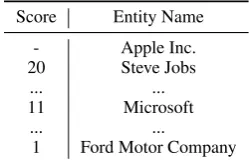
Score Entity Name - Apple Inc. 20 Steve Jobs
... ... 11 Microsoft
... ...
1 Ford Motor Company
Table 2: An example from KORE. The task is to rank the candidate entities by similarity.
2. We change the relationship in positive samples from affirmation to negation (e.g., ‘is’ to ‘is not’). These serve as negative samples.
3. We further sample positive samples from (1) in an attempt to prevent the ‘not’ token from being biased towards negative samples. Therefore, for negative samples we get from (1), we change the relationship from affirmation to negation as in (2) to get positive samples.
For example, let ‘A is B’ be the positive sam-ple. (1) changes it to ‘C is B’ which serves as a negative sample and (2) changes it to ‘A is not B’ as another negative sample. (3) changes it to ’C is not B’ as a positive example. In the end, we randomly sample 7000 instances from each class. This ends up yielding a 10000/2000/2000 train/dev/test dataset. As shown in Figure3, this task cannot be solved by relying on surface form of sentences, instead it requires the input repre-sentations to encode knowledge of entities based on the context.
We use contextualized entity representations in this task.
3.5 Entity Similarity and Relatedness (ESR)
[image:4.595.353.478.205.286.2]Wik-iSRS (Newman-Griffis et al.,2018) datasets in this task. Since the original datasets only provide en-tity names, we automatically add Wikipedia de-scriptions to each entity and manually ensure that every entity is matched to a Wikipedia descrip-tion. We use Spearman’s rank correlation coeffi-cient between our computed cosine similarity and the gold standard similarity/relatedness scores to measure the performance of entity representations. As KORE does not provide similarity scores of entity pairs, but simply ranks the candidate entities by their similarities to a target entity, we assign scores from 20 to 1 accordingly to each entity in the order of similarity. Table2shows an example from KORE. The fact that “Apple Inc.” is more related to “Steve Jobs” than “Microsoft” requires multiple steps of inference, which motivates this task. Since the predictor we use is cosine simi-larity, which does not introduce additional param-eters, we directly use encoded representations on the test set without any supervised training.
3.6 Entity Relationship Typing (ERT)
As another popular resource for common knowl-edge, we consider using Freebase (Bollacker et al., 2008) for probing the encoded knowledge by classifying the types of relations between pair of entities. First, we extract entity relation tuples (entity1, relation, entity2) from Freebase and then filter out easy tuples based on training a classifier using averaged GloVe vectors of entity names as input, which leaves us 626 types of relations, including “internet.website.owner”, “film.film art director.films art directed”, and “comic books.comic book series.genre”. We randomly sample 5 instances for each relation type to form our training set and 10 instances per type the for validation and test sets. We use Wikipedia descriptions for each entity in the pair whose relation we are predicting and we use descriptive entity representations for each entity with supervised training.
3.7 Named Entity Disambiguation (NED)
Named entity disambiguation is the task of link-ing a named-entity mention to its correspondlink-ing instance in a knowledge base such as Wikipedia. In this task, we consider CoNLL-YAGO (CoNLL; Hoffart et al., 2011) and Rare Entity Predic-tion (Rare;Long et al.,2017).
For CoNLL-YAGO, following Hoffart et al. (2011) and Yamada et al. (2016), we used the
SOCCER - JAPAN GET LUCKY WIN, CHINA IN SURPRISE DEFEAT.
China_PR_national _football_team China
China_men's_nationa l_basketball_team Porcelain
China is a country in East Asia and the world's most populous country …
The Chinese men's national basketball team represents the People's Republic of China and …
The Chinese national football team recognized as China PR by FIFA …
Porcelain is a ceramic material made by heating materials, generally including …
Figure 4: An example from CoNLL-YAGO. Only four candidates are shown due to space constraints. The target mention is underlined. Sentences in gray are Wikipedia descriptions. The gold standard is bold-faced.
27,816 mentions with valid entries in the knowl-edge base. For each entity mention m in its context, we generate a set of (at most) its top 30 candidate entities Cm = {cj} using
Cross-Wikis (Spitkovsky and Chang,2012). Some gold standard candidates c are not present in Cross-Wikis, so we set the prior probabilitypprior(y)for
those to 1e-6 and normalize the resulting priors for the candidate entities. When adding Wikipedia descriptions, we manually ensure gold standard mentions are attached to a description, however, we discard candidate mentions that cannot be aligned to a Wikipedia page. We use contextual-ized entity representations for entity mentions and use descriptive entity representations for candidate entities. Training minimizes binary log loss us-ing all negative examples. At test time, we use arg maxc∈Cm[pprior(c)+pclassifier(c)]as the
tion. We note that directly using prior as predic-tions yields an accuracy of 58.2%.
Long et al. (2017) introduce the task of rare entity prediction. The task has a similar format to CoNLL-YAGO entity linking. Given a docu-ment with a blank in it, the task is to select an entity from a provided list of entities with descrip-tions. Only rare entities are used in this dataset so that performing well on the task requires the abil-ity to effectively represent entabil-ity descriptions. We randomly select 10k/4k/4k examples to construct train/valid/test sets. For simplicity, we only keep instances with four candidate entities.
Figure 4 shows an example from
Practically, we encode the context using CER to bex1, and encode each entity description using
DER to bex2, and pass[x1, x2, x1x2,|x1−x2|]
to a linear model to predict whether it is the correct entity to fill in. The model is trained with cross entropy loss.
4 Methods
We first describe how we define encoders for contextualized entity representations (Sec-tion 4.1) and descriptive entity representations (Section4.2), then we discuss how we train new encoders tailored to capture information from the hyperlink structure of Wikipedia (Section4.3).
4.1 Encoders for Contextualized Entity Representations
For defining these encoders, we assume we have a sentence s = (w1, . . . , wT) where
span (wi, . . . , wj) refers to an entity mention.
When using ELMo, we first encode the sentence: (c1, . . . , cT) = ELMo(w1,· · · , wT), and we use
the average of contextualized hidden states corre-sponding to the entity span as the contextualized entity representation. That is,fELMo(w1:T, i, j) =
Pj k=ick
j−i+1 .
With BERT, following Onoe and
Dur-rett (2019), we concatenate the full sen-tence with the entity mention, starting with [CLS] and separating the two by [SEP], i.e., [CLS], w1, . . . , wT,[SEP], wi, . . . , wj,[SEP].
We encode the full sequence using BERT and use the output from the[CLS]token as the entity mention representation.
4.2 Encoders for Descriptive Entity Representations
We encode an entity description by treating the en-tity description as a sentence, and use the average of the hidden states from ELMo as the entity de-scription representation. With BERT, we use the output from the [CLS] token as the description representation.
4.3 Hyperlink-Based Training
An entity mentioned in a Wikipedia article is often linked to its Wikipedia page, which provides a use-ful description of the mentioned entity. The same Wikipedia page may correspond to many different entity mentions. Likewise, the same entity men-tion may refer to different Wikipedia pages
de-France won the match 4–2 to claim their second World Cup title.
The France national football team represents France in international foot ball
Figure 5: An example of hyperlinks in Wikipedia. “France” is linked to the Wikipedia page of “France national football team” instead of the country France.
pending on its context. For instance, as shown in Figure5, based on the context, “France” is linked to the Wikipedia page of “France national foot-ball team” instead of the country. The specific en-tity in the knowledge base can be inferred from the context information. In such cases, we be-lieve Wikipedia provides valuable complementary information to the current pretrained CWRs such as BERT and ELMo.
To incorporate such information during train-ing, we automatically construct a hyperlink-enriched dataset from Wikipedia that we will re-fer to as WIKIENT. Prior work has used similar resources (Singh et al.,2012;Gupta et al.,2017), but we aim to standardize the process and will re-lease the dataset.
The WIKIENT dataset consists of sentences with contextualized entity mentions and their cor-responding descriptions obtained via hyperlinked Wikipedia pages. When processing descriptions, we only keep the first 100 word tokens at most as the description of a Wikipedia page; similar trun-cation has been done in prior work (Gupta et al., 2017). For context sentences, we remove those without hyperlinks from the training data and du-plicate those with multiple hyperlinks. We also re-move context sentences for which we cannot find matched Wikipedia descriptions. These process-ing steps result in a trainprocess-ing set of approximately 92 million instances and over 3 million unique en-tities.
lossllang(x1:Tx) +llang(y1:Ty)in ELMo where
llang(u1:T) =− T
X
t=1
logp(ut+1|u1, . . . , ut)+
logp(ut−1|ut, . . . , uT)
andpis defined by the ELMo parameters. In addi-tion, we define the two bag-of-words reconstruc-tion losses:
lctx=− X
t
logq(xt|fELMo([BOD]y1:Ty,1, Ty))
ldesc=− X
t
logq(yt|fELMo([BOC]x1:Tx, i, j))
where [BOD] and [BOC] are special symbols prepended to sentences to distinguish descriptions from contexts. The distributionqis parameterized by a linear layer that transforms the conditioning embedding into weights over the vocabulary. The final training loss is
llang(x1:Tx) +llang(y1:Ty) +lctx+ldesc (1) Same as the original ELMo, each log loss is ap-proximated with negative sampling (Jean et al., 2015). We write EntELMo to denote the model trained by Eq. (1). When using EntELMo for con-textualized entity representations and descriptive entity representations, we use it analogously to ELMo.
5 Experiments
5.1 Setup
As a baseline for hyperlink-based training, we train EntELMo on the WIKIENT dataset with only a bidirectional language model loss. Due to the limitation of computational resources, both variants of EntELMo are trained for one epoch (3 weeks time) with smaller dimensions than ELMo. We set the hidden dimension of each direc-tional long short-term memory network (LSTM; Hochreiter and Schmidhuber, 1997) layer to be 600, and project it to 300 dimensions. The result-ing vectors from each layer are thus 600 dimen-sional. We use 1024 as the negative sampling size for each positive word token. For bag-of-words reconstruction, we randomly sample at most 50 word tokens as positive samples from the the tar-get word tokens. Other hyperparameters are the same as ELMo. EntELMo is implemented based on the official ELMo implementation.2
2Our implementation is available at https: //github.com/mingdachen/bilm-tf
As a baseline for contextualized and descriptive entity representations, we use GloVe word averag-ing of the entity mention as the “contextualized” entity representation, and use word averaging of the truncated entity description text as its descrip-tion representadescrip-tion. We also experiment two vari-ants of EntELMo, namely EntELMo w/olctx and
EntELMo withletn. For second variant, we replace
lctx with letn, where we only decode entity
men-tions instead of the whole context from descrip-tions. We lowercased all training data as well as the evaluation benchmarks.
We evaluate the transferrability of ELMo, Ent-ELMo, and BERT by using trainable mixing weights for each layer. For ELMo and EntELMo, we follow the recommendation fromPeters et al. (2018a) to first pass mixing weights through a softmax layer and then multiply the weighted-summed representations by a scalar. For BERT, we find it better to just use unnormalized mixing weights. In addition, we investigate layer per-formance for both models in Section6.
5.2 Results
Table3shows the performance of our models on the EntEval tasks. Our findings are detailed below:
• Pretrained CWRs (ELMo, BERT) perform the best on EntEval overall, indicating that they capture knowledge about entities in contextual mentions or as entity descriptions.
• BERT performs poorly on entity similarity and relatedness tasks. Since this task is zero-shot, it validates the recommended setting of finetun-ing BERT (Devlin et al.,2018) on downstream tasks, while the embedding of the[CLS]token does not necessarily capture the semantics of the entity.
• BERT Large is better than BERT Base on av-erage, showing large improvements in ERT and NED. To perform well at ERT, a model must either glean particular relationships from pairs of lengthy entity descriptions or else leverage knowledge from pretraining about the entities considered. Relatedly, performance on NED is expected to increase with both the ability to ex-tract knowledge from descriptions and by start-ing with increased knowledge from pretrainstart-ing. The Large model appears to be handling these capabilities better than the Base model.
CAP CERP EFP ET ESR ERT NED Average GloVe 71.9 52.6 67.0 10.3 50.9 40.8 41.2 47.8 BERT Base 80.6 65.6 74.8 32.0 28.8 42.2 50.6 53.5 BERT Large 79.1 66.9 76.7 32.3 32.6 48.8 54.3 55.8 ELMo 80.2 61.2 75.8 35.6 60.3 46.8 51.6 58.8
EntELMo baseline 78.0 59.6 71.5 31.3 61.6 46.5 48.5 56.7 EntELMo 76.9 59.9 72.4 32.2 59.7 45.7 49.0 56.5 EntELMo w/olctx 73.5 59.4 71.1 33.2 53.3 44.6 48.9 54.9
[image:8.595.136.464.63.171.2]EntELMo w/letn 76.2 60.4 70.9 33.6 49.0 42.9 49.3 54.6
Table 3: Performances of entity representations on EntEval tasks. Best performing model in each task is boldfaced. CAP: coreference arc prediction, CERP: contexualized entity relationship prediction, EFP: entity factuality predic-tion, ET: entity typing, ESR: entity similarity and relatedness, ERT: entity relationship typing, NED: named entity disambiguation. EntELMo baseline is trained on the same dataset as EntELMo but not using the hyperlink-based training. EntELMo w/letnis trained with a modified version oflctx, where we only decode entity mentions instead
of the whole context.
Rare CoNLL ERT Des. Name Des. Name Des. Name ELMo 38.1 36.7 63.4 71.2 46.8 31.5 BERT Base 42.2 36.6 64.7 74.3 42.2 34.3 BERT Large 48.8 44.0 64.6 74.8 48.8 32.6
Table 4: Accuracies (%) in comparing the use of de-scription encoder (Des.) to entity name (Name).
tasks but suffers on others. The hyperlink-based training helps on CERP, EFP, ET, and NED. Since the hyperlink loss is closely-associated to the NED problem, it is unsurprising that NED performance is improved. Overall, we believe that hyperlink-based training benefits contextu-alized entity representations but does not ben-efit descriptive entity representations (see, for example, the drop of nearly 2 points on ESR, which is based solely on descriptive representa-tions). This pattern may be due to the difficulty of using descriptive entity representations to re-construct their appearing context.
6 Analysis
Is descriptive entity representation necessary? A natural question to ask is whether the entity description is needed, as for humans, the entity names carry sufficient amount of information for a lot of tasks. To answer this question, we ex-periment with encoding entity names by the de-scriptive entity encoder for ERT (entity relation-ship typing) and NED (named entity disambigua-tion) tasks. The results in Table4show that encod-ing the entity names by themselves already cap-tures a great deal of knowledge regarding entities, especially for CoNLL-YAGO. However, in tasks like ERT, the entity descriptions are crucial as the
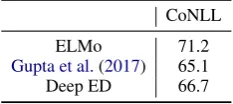
CoNLL ELMo 71.2
[image:8.595.358.475.265.317.2]Gupta et al.(2017) 65.1 Deep ED 66.7
Table 5: Accuracies (%) on CoNLL-YAGO with static or non-static entity representations.
names do not reveal enough information to cate-gorize their relationships.
Table 5 reports the performance of different descriptive entity representations on the CoNLL-YAGO task. The three models all use ELMo as the context encoder. “ELMo” encodes the entity name with ELMo as descriptive encoder, while bothGupta et al.(2017) and Deep ED (Ganea and Hofmann,2017) use their trained static entity em-beddings. 3 AsGupta et al.(2017) and Deep ED have different embedding sizes from ELMo, we add an extra linear layer after them to map to the same dimension. These two models are designed for entity linking, which gives them potential ad-vantages. Even so, ELMo outperforms them both by a wide margin.
Per-Layer Analysis. We evaluate each ELMo and EntELMo layer, i.e., the character CNN layer and two bidirectional LSTM layers, as well as each BERT layer on the EntEval tasks. Figure6 reveals that for ELMo models, the first and second LSTM layers capture most of the entity knowledge from context and descriptions. The BERT layers show more diversity. Lower layers perform better on ESR (entity similarity and relatedness), while
3We note that the numbers reported here are not strictly
0
2
ELMo
0
2
EntELMo Baseline
0
2
EntELMo
0
11
BERT Base
CAP CERP EF ET ESR ERT NED
0
23
BERT Large
[image:9.595.76.294.66.387.2]Low High
Figure 6: Heatmap showing per-layer performances for ELMo, EntELMo baseline, EntELMo, BERT Base, and BERT Large.
for other tasks higher layers are more effective.
7 Conclusion
Our proposed EntEval test suite provides a stan-dardized evaluation method for entity representa-tions. We demonstrate that EntEval tasks can ben-efit from the success of contextualized word repre-sentations such as ELMo and BERT. Augmenting encoding-decoding loss leveraging natural hyper-links from Wikipedia further improves ELMo on some EntEval tasks. As shown by our experimen-tal results, the contextualized entity encoder bene-fits more from this hyperlink-based training objec-tive, suggesting future works to prioritize encod-ing entity description from its mention context.
Acknowledgments
This research was supported in part by a Bloomberg data science research grant to K. Stratos and K. Gimpel.
References
Yossi Adi, Einat Kermany, Yonatan Belinkov, Ofer Lavi, and Yoav Goldberg. 2017. Fine-grained anal-ysis of sentence embeddings using auxiliary predic-tion tasks. InICLR.
Gabor Angeli and Christopher D. Manning. 2014. Nat-uralLI: Natural logic inference for common sense reasoning. InProceedings of the 2014 Conference on Empirical Methods in Natural Language Pro-cessing (EMNLP), pages 534–545, Doha, Qatar. As-sociation for Computational Linguistics.
Yonatan Belinkov, Llu´ıs M`arquez, Hassan Sajjad, Nadir Durrani, Fahim Dalvi, and James Glass. 2017.
Evaluating layers of representation in neural ma-chine translation on part-of-speech and semantic tagging tasks. In Proceedings of the Eighth In-ternational Joint Conference on Natural Language Processing (Volume 1: Long Papers), pages 1–10, Taipei, Taiwan. Asian Federation of Natural Lan-guage Processing.
Kurt Bollacker, Colin Evans, Praveen Paritosh, Tim Sturge, and Jamie Taylor. 2008. Freebase: a collab-oratively created graph database for structuring hu-man knowledge. In Proceedings of the 2008 ACM SIGMOD international conference on Management of data, pages 1247–1250. AcM.
Samuel R. Bowman, Gabor Angeli, Christopher Potts, and Christopher D. Manning. 2015. A large anno-tated corpus for learning natural language inference. In Proceedings of the 2015 Conference on Empiri-cal Methods in Natural Language Processing, pages 632–642, Lisbon, Portugal. Association for Compu-tational Linguistics.
Hong Chen, Zhenhua Fan, Hao Lu, Alan Yuille, and Shu Rong. 2018. PreCo: A large-scale dataset in preschool vocabulary for coreference resolution. In Proceedings of the 2018 Conference on Empiri-cal Methods in Natural Language Processing, pages 172–181, Brussels, Belgium. Association for Com-putational Linguistics.
Mingda Chen, Zewei Chu, and Kevin Gimpel. 2019a. Evaluation benchmarks and learning criteriafor discourse-aware sentence representations. InProc. of EMNLP.
Sihao Chen, Daniel Khashabi, Wenpeng Yin, Chris Callison-Burch, and Dan Roth. 2019b. Seeing things from a different angle:discovering diverse perspectives about claims. In Proceedings of the 2019 Conference of the North American Chapter of the Association for Computational Linguistics: Hu-man Language Technologies, Volume 1 (Long and Short Papers), pages 542–557, Minneapolis, Min-nesota. Association for Computational Linguistics.
for Computational Linguistics (Volume 1: Long Pa-pers), pages 87–96, Melbourne, Australia. Associa-tion for ComputaAssocia-tional Linguistics.
Elizabeth Clark, Yangfeng Ji, and Noah A. Smith. 2018. Neural text generation in stories using en-tity representations as context. InProceedings of the 2018 Conference of the North American Chapter of the Association for Computational Linguistics: Hu-man Language Technologies, Volume 1 (Long Pa-pers), pages 2250–2260, New Orleans, Louisiana. Association for Computational Linguistics.
Alexis Conneau and Douwe Kiela. 2018. Senteval: An evaluation toolkit for universal sentence representa-tions. InProceedings of the Eleventh International Conference on Language Resources and Evaluation (LREC-2018).
Alexis Conneau, Germ´an Kruszewski, Guillaume Lample, Lo¨ıc Barrault, and Marco Baroni. 2018.
What you can cram into a single $&!#* vector: Probing sentence embeddings for linguistic proper-ties. InProceedings of the 56th Annual Meeting of the Association for Computational Linguistics (Vol-ume 1: Long Papers), pages 2126–2136, Melbourne, Australia. Association for Computational Linguis-tics.
Luciano Del Corro, Abdalghani Abujabal, Rainer Gemulla, and Gerhard Weikum. 2015. FINET: Context-aware fine-grained named entity typing. In
Proceedings of the 2015 Conference on Empirical Methods in Natural Language Processing, pages 868–878, Lisbon, Portugal. Association for Compu-tational Linguistics.
Jacob Devlin, Ming-Wei Chang, Kenton Lee, and Kristina Toutanova. 2018. Bert: Pre-training of deep bidirectional transformers for language understand-ing. arXiv preprint arXiv:1810.04805.
Greg Durrett and Dan Klein. 2013. Easy victories and uphill battles in coreference resolution. In Proceed-ings of the 2013 Conference on Empirical Methods in Natural Language Processing, pages 1971–1982, Seattle, Washington, USA. Association for Compu-tational Linguistics.
Greg Durrett and Dan Klein. 2014. A joint model for entity analysis: Coreference, typing, and linking.
Transactions of the Association for Computational Linguistics, 2:477–490.
Matthew Francis-Landau, Greg Durrett, and Dan Klein. 2016. Capturing semantic similarity for en-tity linking with convolutional neural networks. In
Proceedings of the 2016 Conference of the North American Chapter of the Association for Computa-tional Linguistics: Human Language Technologies, pages 1256–1261, San Diego, California. Associa-tion for ComputaAssocia-tional Linguistics.
Octavian-Eugen Ganea and Thomas Hofmann. 2017.
Deep joint entity disambiguation with local neural
attention. InProceedings of the 2017 Conference on Empirical Methods in Natural Language Process-ing, pages 2619–2629, Copenhagen, Denmark. As-sociation for Computational Linguistics.
Zhaochen Guo and Denilson Barbosa. 2014. Robust entity linking via random walks. InProceedings of the 23rd ACM International Conference on Confer-ence on Information and Knowledge Management, CIKM ’14, pages 499–508, New York, NY, USA. ACM.
Nitish Gupta, Sameer Singh, and Dan Roth. 2017. En-tity linking via joint encoding of types, descriptions, and context. InProceedings of the 2017 Conference on Empirical Methods in Natural Language Pro-cessing, pages 2681–2690, Copenhagen, Denmark. Association for Computational Linguistics.
He He, Anusha Balakrishnan, Mihail Eric, and Percy Liang. 2017. Learning symmetric collaborative dia-logue agents with dynamic knowledge graph embed-dings. InProceedings of the 55th Annual Meeting of the Association for Computational Linguistics (Vol-ume 1: Long Papers), pages 1766–1776, Vancouver, Canada. Association for Computational Linguistics.
Zhengyan He, Shujie Liu, Mu Li, Ming Zhou, Longkai Zhang, and Houfeng Wang. 2013. Learning entity representation for entity disambiguation. In Pro-ceedings of the 51st Annual Meeting of the Associa-tion for ComputaAssocia-tional Linguistics (Volume 2: Short Papers), pages 30–34, Sofia, Bulgaria. Association for Computational Linguistics.
Sepp Hochreiter and J¨urgen Schmidhuber. 1997. Long short-term memory. Neural computation, 9(8):1735–1780.
Johannes Hoffart, Stephan Seufert, Dat Ba Nguyen, Martin Theobald, and Gerhard Weikum. 2012. Kore: keyphrase overlap relatedness for entity dis-ambiguation. InProceedings of the 21st ACM inter-national conference on Information and knowledge management, pages 545–554. ACM.
Johannes Hoffart, Mohamed Amir Yosef, Ilaria Bor-dino, Hagen F¨urstenau, Manfred Pinkal, Marc Span-iol, Bilyana Taneva, Stefan Thater, and Gerhard Weikum. 2011. Robust disambiguation of named entities in text. InProceedings of the Conference on Empirical Methods in Natural Language Process-ing, pages 782–792. Association for Computational Linguistics.
Matthew Honnibal and Ines Montani. 2017. spacy 2: Natural language understanding with bloom embed-dings, convolutional neural networks and incremen-tal parsing. To appear.
S´ebastien Jean, Kyunghyun Cho, Roland Memisevic, and Yoshua Bengio. 2015. On using very large target vocabulary for neural machine translation. In Proceedings of the 53rd Annual Meeting of the Association for Computational Linguistics and the 7th International Joint Conference on Natural Lan-guage Processing (Volume 1: Long Papers), pages 1–10, Beijing, China. Association for Computa-tional Linguistics.
Yangfeng Ji, Chenhao Tan, Sebastian Martschat, Yejin Choi, and Noah A. Smith. 2017. Dynamic entity representations in neural language models. In Pro-ceedings of the 2017 Conference on Empirical Meth-ods in Natural Language Processing, pages 1830– 1839, Copenhagen, Denmark. Association for Com-putational Linguistics.
Ben Kantor and Amir Globerson. 2019. Coreference resolution with entity equalization. In Proceed-ings of the 57th Annual Meeting of the Association for Computational Linguistics, pages 673–677, Flo-rence, Italy. Association for Computational Linguis-tics.
Phong Le and Ivan Titov. 2018. Improving entity link-ing by modellink-ing latent relations between mentions. InProceedings of the 56th Annual Meeting of the As-sociation for Computational Linguistics (Volume 1: Long Papers), pages 1595–1604, Melbourne, Aus-tralia. Association for Computational Linguistics.
Phong Le and Ivan Titov. 2019. Boosting entity linking performance by leveraging unlabeled documents. In Proceedings of the 57th Annual Meeting of the Association for Computational Linguistics, pages 1935–1945, Florence, Italy. Association for Compu-tational Linguistics.
Kenton Lee, Luheng He, Mike Lewis, and Luke Zettle-moyer. 2017. End-to-end neural coreference reso-lution. InProceedings of the 2017 Conference on Empirical Methods in Natural Language Process-ing, pages 188–197, Copenhagen, Denmark. Asso-ciation for Computational Linguistics.
Xiang Li, Aynaz Taheri, Lifu Tu, and Kevin Gimpel. 2016. Commonsense knowledge base completion. InProceedings of the 54th Annual Meeting of the As-sociation for Computational Linguistics (Volume 1: Long Papers), pages 1445–1455, Berlin, Germany. Association for Computational Linguistics.
Xiao Ling, Sameer Singh, and Daniel S. Weld. 2015.
Design challenges for entity linking. Transactions of the Association for Computational Linguistics, 3:315–328.
Nelson F. Liu, Matt Gardner, Yonatan Belinkov, Matthew E. Peters, and Noah A. Smith. 2019a. Lin-guistic knowledge and transferability of contextual representations. InProceedings of the Conference of the North American Chapter of the Association for Computational Linguistics: Human Language Tech-nologies.
Yinhan Liu, Myle Ott, Naman Goyal, Jingfei Du, Man-dar Joshi, Danqi Chen, Omer Levy, Mike Lewis, Luke Zettlemoyer, and Veselin Stoyanov. 2019b. Roberta: A robustly optimized bert pretraining ap-proach. arXiv preprint arXiv:1907.11692.
Robert Logan, Nelson F. Liu, Matthew E. Peters, Matt Gardner, and Sameer Singh. 2019. Barack’s wife hillary: Using knowledge graphs for fact-aware lan-guage modeling. InProceedings of the 57th Annual Meeting of the Association for Computational Lin-guistics, pages 5962–5971, Florence, Italy. Associa-tion for ComputaAssocia-tional Linguistics.
Lajanugen Logeswaran, Ming-Wei Chang, Kenton Lee, Kristina Toutanova, Jacob Devlin, and Honglak Lee. 2019. Zero-shot entity linking by reading en-tity descriptions. InProceedings of the 57th Annual Meeting of the Association for Computational Lin-guistics, pages 3449–3460, Florence, Italy. Associa-tion for ComputaAssocia-tional Linguistics.
Teng Long, Emmanuel Bengio, Ryan Lowe, Jackie Chi Kit Cheung, and Doina Precup. 2017. World knowledge for reading comprehension: Rare entity prediction with hierarchical lstms using external de-scriptions. InProceedings of the 2017 Conference on Empirical Methods in Natural Language Pro-cessing, pages 825–834.
Pedro Henrique Martins, Zita Marinho, and Andr´e F. T. Martins. 2019. Joint learning of named en-tity recognition and enen-tity linking. InProceedings of the 57th Annual Meeting of the Association for Computational Linguistics: Student Research Work-shop, pages 190–196, Florence, Italy. Association for Computational Linguistics.
Bryan McCann, James Bradbury, Caiming Xiong, and Richard Socher. 2017. Learned in translation: Con-textualized word vectors. In I. Guyon, U. V. Luxburg, S. Bengio, H. Wallach, R. Fergus, S. Vish-wanathan, and R. Garnett, editors,Advances in Neu-ral Information Processing Systems 30, pages 6294– 6305. Curran Associates, Inc.
Todor Mihaylov, Peter Clark, Tushar Khot, and Ashish Sabharwal. 2018. Can a suit of armor conduct elec-tricity? a new dataset for open book question an-swering. InProceedings of the 2018 Conference on Empirical Methods in Natural Language Process-ing, pages 2381–2391, Brussels, Belgium. Associ-ation for ComputAssoci-ational Linguistics.
Shikhar Murty, Patrick Verga, Luke Vilnis, and Andrew McCallum. 2017. Finer grained entity typing with typenet.arXiv preprint arXiv:1711.05795.
Rasha Obeidat, Xiaoli Fern, Hamed Shahbazi, and Prasad Tadepalli. 2019. Description-based zero-shot fine-grained entity typing. In Proceedings of the 2019 Conference of the North American Chapter of the Association for Computational Linguistics: Hu-man Language Technologies, Volume 1 (Long and Short Papers), pages 807–814, Minneapolis, Min-nesota. Association for Computational Linguistics.
Yasumasa Onoe and Greg Durrett. 2019. Learning to denoise distantly-labeled data for entity typing. In
NAACL-HLT.
Jeffrey Pennington, Richard Socher, and Christo-pher D. Manning. 2014. Glove: Global vectors for word representation. InEmpirical Methods in Nat-ural Language Processing (EMNLP), pages 1532– 1543.
Matthew Peters, Mark Neumann, Mohit Iyyer, Matt Gardner, Christopher Clark, Kenton Lee, and Luke Zettlemoyer. 2018a. Deep contextualized word rep-resentations. In Proceedings of the 2018 Confer-ence of the North American Chapter of the Associ-ation for ComputAssoci-ational Linguistics: Human Lan-guage Technologies, Volume 1 (Long Papers), pages 2227–2237, New Orleans, Louisiana. Association for Computational Linguistics.
Matthew Peters, Mark Neumann, Luke Zettlemoyer, and Wen-tau Yih. 2018b. Dissecting contextual word embeddings: Architecture and representation. In Proceedings of the 2018 Conference on Em-pirical Methods in Natural Language Processing, pages 1499–1509, Brussels, Belgium. Association for Computational Linguistics.
Maxim Rabinovich and Dan Klein. 2017. Fine-grained entity typing with high-multiplicity assignments. In
Proceedings of the 55th Annual Meeting of the As-sociation for Computational Linguistics (Volume 2: Short Papers), pages 330–334.
Nazneen Fatema Rajani, Bryan McCann, Caiming Xiong, and Richard Socher. 2019. Explain yourself! leveraging language models for commonsense rea-soning.arXiv preprint arXiv:1906.02361.
Maarten Sap, Hannah Rashkin, Derek Chen, Ronan LeBras, and Yejin Choi. 2019. Socialiqa: Com-monsense reasoning about social interactions. arXiv preprint arXiv:1904.09728.
Xing Shi, Inkit Padhi, and Kevin Knight. 2016. Does string-based neural MT learn source syntax? In Pro-ceedings of the 2016 Conference on Empirical Meth-ods in Natural Language Processing, pages 1526– 1534, Austin, Texas. Association for Computational Linguistics.
Sameer Singh, Amarnag Subramanya, Fernando Pereira, and Andrew McCallum. 2012. Wikilinks: A large-scale cross-document coreference corpus la-beled via links to Wikipedia. Technical Report UM-CS-2012-015.
Robert Speer, Joshua Chin, and Catherine Havasi. 2017. Conceptnet 5.5: An open multilingual graph of general knowledge. InThirty-First AAAI Confer-ence on Artificial IntelligConfer-ence.
Valentin I. Spitkovsky and Angel X. Chang. 2012.
A cross-lingual dictionary for English Wikipedia concepts. In Proceedings of the Eighth Interna-tional Conference on Language Resources and Eval-uation (LREC-2012), pages 3168–3175, Istanbul, Turkey. European Language Resources Association (ELRA).
Yu Sun, Shuohuan Wang, Yukun Li, Shikun Feng, Xuyi Chen, Han Zhang, Xin Tian, Danxiang Zhu, Hao Tian, and Hua Wu. 2019. Ernie: Enhanced rep-resentation through knowledge integration. arXiv preprint arXiv:1904.09223.
Alon Talmor, Jonathan Herzig, Nicholas Lourie, and Jonathan Berant. 2019. CommonsenseQA: A ques-tion answering challenge targeting commonsense knowledge. InProceedings of the 2019 Conference of the North American Chapter of the Association for Computational Linguistics: Human Language Technologies, Volume 1 (Long and Short Papers), pages 4149–4158, Minneapolis, Minnesota. Associ-ation for ComputAssoci-ational Linguistics.
James Thorne, Andreas Vlachos, Christos Christodoulopoulos, and Arpit Mittal. 2018. Fever: a large-scale dataset for fact extraction and verification. InProceedings of the 2018 Conference of the North American Chapter of the Association for Computational Linguistics: Human Language Technologies, Volume 1 (Long Papers), pages 809–819.
Trieu H Trinh and Quoc V Le. 2018. A simple method for commonsense reasoning. arXiv preprint arXiv:1806.02847.
Andreas Vlachos and Sebastian Riedel. 2014. Fact checking: Task definition and dataset construction. InProceedings of the ACL 2014 Workshop on Lan-guage Technologies and Computational Social Sci-ence, pages 18–22, Baltimore, MD, USA. Associa-tion for ComputaAssocia-tional Linguistics.
Alex Wang, Amanpreet Singh, Julian Michael, Fe-lix Hill, Omer Levy, and Samuel Bowman. 2018.
GLUE: A multi-task benchmark and analysis plat-form for natural language understanding. In Pro-ceedings of the 2018 EMNLP Workshop Black-boxNLP: Analyzing and Interpreting Neural Net-works for NLP, pages 353–355, Brussels, Belgium. Association for Computational Linguistics.
William Yang Wang. 2017. “liar, liar pants on fire”: A new benchmark dataset for fake news detection. In
Kellie Webster, Marta Recasens, Vera Axelrod, and Ja-son Baldridge. 2018. Mind the GAP: A balanced corpus of gendered ambiguous pronouns. Transac-tions of the Association for Computational Linguis-tics, 6:605–617.
Sam Wiseman, Alexander M. Rush, and Stuart M. Shieber. 2016. Learning global features for coref-erence resolution. InProceedings of the 2016 Con-ference of the North American Chapter of the Asso-ciation for Computational Linguistics: Human Lan-guage Technologies, pages 994–1004, San Diego, California. Association for Computational Linguis-tics.
Yadollah Yaghoobzadeh and Hinrich Sch¨utze. 2015.
Corpus-level fine-grained entity typing using con-textual information. In Proceedings of the 2015 Conference on Empirical Methods in Natural Lan-guage Processing, pages 715–725, Lisbon, Portugal. Association for Computational Linguistics.
Ikuya Yamada, Hiroyuki Shindo, Hideaki Takeda, and Yoshiyasu Takefuji. 2016. Joint learning of the em-bedding of words and entities for named entity dis-ambiguation. InProceedings of The 20th SIGNLL Conference on Computational Natural Language Learning, pages 250–259, Berlin, Germany. Asso-ciation for Computational Linguistics.
Ikuya Yamada, Hiroyuki Shindo, Hideaki Takeda, and Yoshiyasu Takefuji. 2017. Learning distributed rep-resentations of texts and entities from knowledge base. Transactions of the Association for Compu-tational Linguistics, 5(1):397–411.
Zhilin Yang, Zihang Dai, Yiming Yang, Jaime Car-bonell, Ruslan Salakhutdinov, and Quoc V Le. 2019. Xlnet: Generalized autoregressive pretrain-ing for language understandpretrain-ing. arXiv preprint arXiv:1906.08237.
Wenpeng Yin and Dan Roth. 2018. TwoWingOS: A two-wing optimization strategy for evidential claim verification. InProceedings of the 2018 Conference on Empirical Methods in Natural Language Pro-cessing, pages 105–114, Brussels, Belgium. Asso-ciation for Computational Linguistics.
Rowan Zellers, Yonatan Bisk, Roy Schwartz, and Yejin Choi. 2018. Swag: A large-scale adversarial dataset for grounded commonsense inference. arXiv preprint arXiv:1808.05326.
Rowan Zellers, Ari Holtzman, Yonatan Bisk, Ali Farhadi, and Yejin Choi. 2019. HellaSwag: Can a machine really finish your sentence? In Proceed-ings of the 57th Annual Meeting of the Association for Computational Linguistics, pages 4791–4800, Florence, Italy. Association for Computational Lin-guistics.
Zhengyan Zhang, Xu Han, Zhiyuan Liu, Xin Jiang, Maosong Sun, and Qun Liu. 2019. ERNIE: En-hanced language representation with informative