A Comparison between Count and Neural Network Models Based on
Joint Translation and Reordering Sequences
Andreas Guta, Tamer Alkhouli, Jan-Thorsten Peter, Joern Wuebker, Hermann Ney
Human Language Technology and Pattern Recognition Group RWTH Aachen University
Aachen, Germany
{surname}@cs.rwth-aachen.de
Abstract
We propose a conversion of bilingual sentence pairs and the corresponding word alignments into novel linear se-quences. These are joint translation and reordering (JTR) uniquely defined sequences, combining interdepending lexical and alignment dependencies on the word level into a single framework. They are constructed in a simple manner while capturing multiple alignments and empty words. JTR sequences can be used to train a variety of models. We investigate the performances of n -gram models with modified Kneser-Ney smoothing, feed-forward and recur-rent neural network architectures when estimated on JTR sequences, and com-pare them to the operation sequence model (Durrani et al., 2013b). Evalua-tions on the IWSLT German→English, WMT German→English and BOLT Chinese→English tasks show that JTR models improve state-of-the-art phrase-based systems by up to 2.2 BLEU.
1 Introduction
Standard phrase-based machine translation (Och et al., 1999; Zens et al., 2002; Koehn et al., 2003) uses relative frequencies of phrase pairs to esti-mate a translation model. The phrase table is ex-tracted from a bilingual text aligned on the word level, using e.g. GIZA++(Och and Ney, 2003).
Al-though the phrase pairs capture internal dependen-cies between the source and target phrases aligned to each other, they fail to model dependencies that extend beyond phrase boundaries. Phrase-based decoding involves concatenating target phrases. The burden of ensuring that the result is linguisti-cally consistent falls on the language model (LM).
This work proposes word-based translation models that are potentially capable of capturing long-range dependencies. We do this in two steps: First, given bilingual sentence pairs and the asso-ciated word alignments, we convert the informa-tion into uniquely defined linear sequences. These sequenecs encode both word reordering and trans-lation information. Thus, they are referred to as
joint translation and reordering(JTR) sequences. Second, we train an n-gram model with modi-fied Kneser-Ney smoothing (Chen and Goodman, 1998) on the resulting JTR sequences. This yields a model that fuses interdepending reordering and translation dependencies into a single framework. Although JTR n-gram models are closely re-lated to the operation sequence model (OSM) (Durrani et al., 2013b), there are three main dif-ferences. To begin with, the OSM employs min-imal translation units (MTUs), which are essen-tially atomic phrases. As the MTUs are extracted sentence-wise, a word can potentially appear in multiple MTUs. In order to avoid overlapping translation units, we define the JTR sequences on the level of words. Consequently, JTR se-quences have smaller vocabulary sizes than OSM sequences and lead to models with less sparsity. Moreover, we argue that JTR sequences offer a simpler reordering approach than operation se-quences, as they handle reorderings without the need to predict gaps. Finally, when used as an additional model in the log-linear framework of phrase-based decoding, ann-gram model trained on JTR sequences introduces only one single fea-ture to be tuned, whereas the OSM additionally uses 4 supportive features (Durrani et al., 2013b). Experimental results confirm that this simplifica-tion does not make JTR models less expressive, as their performance is on par with the OSM.
Due to data sparsity, increasing then-gram or-der of count-based models beyond a certain point becomes useless. To address this, we resort to
ral networks (NNs), as they have been successfully applied to machine translation recently (Sunder-meyer et al., 2014; Devlin et al., 2014). They are able to score any word combination without re-quiring additional smoothing techniques. We ex-periment with feed-forward and recurrent trans-lation networks, benefiting from their smoothing capabilities. To this end, we split the linear se-quence into two sese-quences for the neural transla-tion models to operate on. This is possible due to the simplicity of the JTR sequence. We show that the count and NN models perform well on their own, and that combining them yields even better results.
In this work, we apply n-gram models with modified Kneser-Ney smoothing during phrase-based decoding and neural JTR models in rescor-ing. However, using a phrase-based system is not required by the model, but only the initial step to demonstrate the strength of JTR models, which can be applied independently of the underlying de-coding framework. While the focus of this work is on the development and comparison of the models, the long-term goal is to decode using JTR mod-els without the limitations introduced by phrases, in order to exploit the full potential of JTR mod-els. The JTR models are estimated on word align-ments, which we obtain using GIZA++in this
pa-per. The future aim is to also generate improved word alignments by a joint optimization of both the alignments and the models, similar to the train-ing of IBM models (Brown et al., 1990; Brown et al., 1993). In the long run, we intend to achieve a consistency between decoding and training using the introduced JTR models.
2 Previous Work
In order to address the downsides of the phrase translation model, various approaches have been taken. Mari˜no et al. (2006) proposed a bilingual language model (BILM) that operates on bilin-gual n-grams, with an own n-gram decoder quiring monotone alignments. The lexical re-ordering model introduced in (Tillmann, 2004) was integrated into phrase-based decoding. Crego and Yvon (2010) adapted the approach to BILMs. The bilingual n-grams are further advanced in (Niehues et al., 2011), where they operate on non-monotone alignments within a phrase-based trans-lation framework. Compared to our JTR models, their BILMs treat jointly aligned source words as minimal translation units, ignore unaligned source
words and do not include reordering information. Durrani et al. (2011) developed the OSM which combined dependencies on bilingual word pairs and reordering information into a single frame-work. It used an own decoder that was based onn -grams of MTUs and predicted single translation or reordering operations. This was further advanced in (Durrani et al., 2013a) by a decoder that was capable of predicting whole sequences of MTUs, similar to a phrase-based decoder. In (Durrani et al., 2013b), a slightly enhanced version of OSM was integrated into the log-linear framework of the Moses system (Koehn et al., 2007). Both the BILM (Stewart et al., 2014) and the OSM (Durrani et al., 2014) can be smoothed using word classes.
Guta et al. (2015) introduced the extended trans-lation model (ETM), which operates on the word level and augments the IBM models by an addi-tional bilingual word pair and a reordering opera-tion. It is implemented into the log-linear frame-work of a phrase-based decoder and shown to be competitive with a 7-gram OSM.
The JTR n-gram models proposed within this work can be seen as an extension of the ETM. Nevertheless, JTR models utilize linear sequences of dependencies and combine the translation of bilingual word pairs and reoderings into a sin-gle model. The ETM, however, features separate models for the translation of individual words and reorderings and provides an explicit treatment of multiple alignments. As they operate on linear se-quences, JTR count models can be implemented using existing toolkits forn-gram language mod-els, e.g. the KenLM toolkit (Heafield et al., 2013). An HMM approach for word-to-phrase align-ments was presented in (Deng and Byrne, 2005), showing performance similar to IBM Model 4 on the task of bitext alignment. Feng et al. (2013) propose several models which rely only on the in-formation provided by the source side and pre-dict reorderings. Contrastingly, JTR models in-corporate target information as well and predict both translations and reorderings jointly in a sin-gle framework.
MTUs, similar to the OSM described above. Recently, neural machine translation has emerged as an alternative to phrase-based decod-ing, where NNs are used as standalone models to decode source input. In (Sutskever et al., 2014), a recurrent NN was used to encode a source sequence, and output a target sentence once the source sentence was fully encoded in the network. The network did not have any explicit treatment of alignments. Bahdanau et al. (2015) introduced soft alignments as part of the network architecture. In this work, we make use of hard alignments instead, where we encode the alignments in the source and target sequences, requiring no mod-ifications of existing feed-forward and recurrent NN architectures. Our feed-forward models are based on the architectures proposed in (Devlin et al., 2014), while the recurrent models are based on (Sundermeyer et al., 2014). Further recent research on applying NN models for extended context was carried out in (Le et al., 2012; Auli et al., 2013; Hu et al., 2014). All of these works focus on lexical context and ignore the reordering aspect covered in our work.
3 JTR Sequences
The core idea of this work is the interpretation of a bilingual sentence pair and its word alignment as a linear sequence ofKjoint translation and re-ordering (JTR) tokensgK
1. Formally, the sequence gK
1(f1J,eI1,bI1)is a uniquely defined interpretation
of a given source sentencefJ
1, its translationeI1and
the inverted alignment bI
1, where bi denotes the
ordered sequence of source positions jaligned to target positioni. We drop the explicit mention of
(fJ
1,eI1,bI1)to allow for a better readability. Each
JTR token is either an aligned bilingual word pair hf,eior a reordering class∆j0j.
Unaligned words on the source and target side are processed as if they were aligned to the empty wordε. Hence, an unaligned source word f gener-ates the tokenhf,εi, and an unaligned target word
ethe tokenhε,ei.
Each word of the source and target sentences is to appear in the corresponding JTR sequence ex-actly once. For multiply-aligned target words e, the first source word f that is aligned toe gener-ates the token hf,ei. All other source words f0,
that are also aligned toe, are processed as if they were aligned to the artificial wordσ. Thus, each of these f0 generates a token hf0,σi. The same
approach is applied to multiply-aligned source
Algorithm 1JTR Conversion Algorithm
1: procedureJTRCONVERSION(f1J,eI1,bI1) 2: gK
1←/0
3: //last translated source position j0 4: j0←0
5: fori←1toIdo 6: ifeiis unalignedthen
7: //align eito the empty wordε 8: APPEND(gK
1,hε,eii) 9: continue
10: //eiis aligned to at least one source word 11: j←first source position inbi
12: ifj= j0then
13: //eiis aligned to the same fjas ei−1 14: APPEND(gK
1,hσ,eii) 15: continue
16: ifj6= j0+1then
17: //alignment step is non-monotone
18: REORDERINGS(f1J,bI1,gK1, j0, j) 19: // 1-to-1translation: fjis aligned to ei 20: APPEND(gK
1,hfj,eii) 21: j0← j
22: //generate all other fjthat are also 23: //aligned to the current target word ei 24: for allremainingjinbido
25: APPEND(gK1,hfj,σi) 26: j0←j
27: //check last alignment step at sentence end
28: if j06=Jthen
29: //last alignment step is non-monotone
30: REORDERINGS(fJ
1,bI1,gK1,j0,J+1) 31: returngK
1 32:
33: //called when a reordering class is appended
34: procedureREORDERINGS(fJ
1,bI1,gK1,j0, j) 35: //check if the predecessor is unaligned
36: if fj−1is unalignedthen 37: //get unaligned predecessors
38: fjj0−1←unaligned predecessors offj 39: //check if the alignment step to the first
40: //unaligned predecessor is monotone
41: ifj06=j0+1then
42: //non-monotone: add reordering class
43: APPEND(gK 1,∆j0,j0)
44: //translate unaligned predecessors byε 45: forf←fj0to fj−1do
46: APPEND(gK 1,hf,εi) 47: else
48: //non-monotone: add reordering class
49: APPEND(gK1,∆j0,j)
words. Similar to Feng and Cohn (2013), we clas-sify the reordered source positions j0andjby∆
j0j:
∆j0j=
step backward(←), j= j0−1
jump forward(y), j> j0+1 jump backward(x), j< j0−1.
j i−1
i
j0
(a) step backward(←)
j i−1
i
j0
(b) jump forward(y)
j0
i−1 i
j
[image:4.595.114.480.72.170.2](c) jump backward(x)
Figure 1: Overview of the different reordering classes in JTR sequences.
3.1 Sequence Conversion
Algorithm 1 presents the formal conversion of a bilingual sentence pair and its alignment into the corresponding JTR sequence gK
1. At first, gK1 is
initialized by an empty sequence (line 2). For each target positioni=1,...,Iit is extended by at least one token. During the generation process, we store the last visited source position j0 (line 4). If a
tar-get wordeiis
• unaligned, we align it to the empty word ε and appendhε,eiito the currentgK1 (line 8),
• if it is aligned to the same fjasei−1, we only
addhσ,eii(line 14),
• otherwise we appendhfj,eii(line 20) and
• in case there are more source words aligned toei, we additionally appendhfj,σifor each
of these (line 24).
Before a token hfj,eii is generated, we have to
check whether the alignment step from j0 to jis
monotone (line 16). In case it is not, we have to deal with reorderings (line 34). We define that a token hfj−1,εi is to be generated right before
the generation of the token containing fj. Thus,
if fj−1 is not aligned, we first determine the
con-tiguous sequence of unaligned predecessors fjj−0 1
(line 38). Next, if the step from j0 to j
0 is not
monotone, we add the corresponding reordering class (line 43). Afterwards we append allhfj0,εi
tohfj−1,εi. If fj−1is aligned, we do not have to
process unaligned source words and only append the corresponding reordering class (line 49).
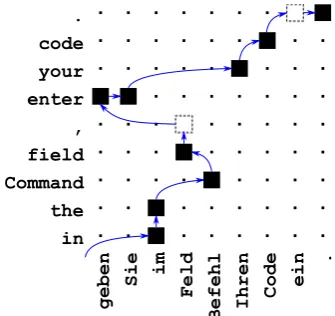
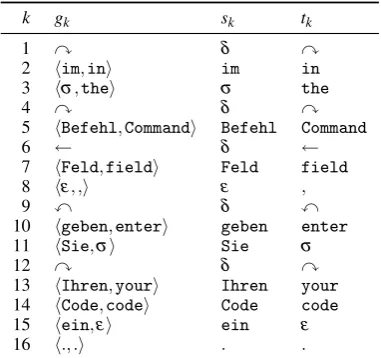
Figure 2 illustrates the generation steps of a JTR sequence, whose result is presented in Ta-ble 1. The alignment steps are denoted by the ar-rows connecting the alignment points. The first dashed alignment point indicates the hε,,i token that is generated right after thehFeld,fieldi to-ken. The second dashed alignment point indicates the hein,εi token, which corresponds to the un-aligned source wordein. Note, that thehein,εi
in the Command field , enter your code .
geben
Sie im
Feld
Befehl Ihren Code ein
[image:4.595.332.500.212.370.2].
Figure 2: This example illustrates the JTR se-quence gK
1 for a German→English sentence pair
including the word-to-word alignment.
token has to be generated right before h.,.i is generated. Therefore, there is no forward jump from hCode,codei to h.,.i, but a monotone step tohein,εifollowed byh.,.i.
3.2 Training of Count Models
As the JTR sequencegK
1 is a unique interpretation
of a bilingual sentence pair and its alignment, the probabilityp(fJ
1,eI1,bI1)can be computed as: p(f1J,eI1,bI1) =p(gK1). (1) The probability of gK
1 can be factorized and
ap-proximated by ann-gram model.
p(gK 1) =
K
∏
k=1
p(gk|gk−k−n1+1) (2)
Within this work, we first estimate the Viterbi alignment for the bilingual training data using GIZA++(Och and Ney, 2003). Secondly, the
con-version presented in Algorithm 1 is applied to ob-tain the JTR sequences, on which we estimate an
n-gram model with modified Kneser-Ney smooth-ing as described in (Chen and Goodman, 1998) us-ing the KenLM toolkit1(Heafield et al., 2013).
k gk sk tk
1 y δ y
2 him,ini im in
3 hσ,thei σ the
4 y δ y
5 hBefehl,Commandi Befehl Command
6 ← δ ←
7 hFeld,fieldi Feld field
8 hε,,i ε ,
9 x δ x
10 hgeben,enteri geben enter
11 hSie,σi Sie σ
12 y δ y
13 hIhren,youri Ihren your
14 hCode,codei Code code
15 hein,εi ein ε
[image:5.595.86.277.62.241.2]16 h.,.i . .
Table 1: The left side of this table presents the JTR tokens gk corresponding to Figure 2. The right
side shows the source and target tokenssk andtk
obtained from the JTR tokensgk. They are used
for the training of NNs (cf. Section 4).
3.3 Integration into Phrase-based Decoding
Basically, each phrase table entry is annotated with both the word alignment information, which also allows to identify unaligned source words, and the corresponding JTR sequence. The JTR model is added to the log-linear framework as an additionaln-gram model. Within the phrase-based decoder, we extend each search state such that it additionally stores the JTR model history.
In comparison to the OSM, the JTR model does not predict gaps. Local reorderings within phrases are handled implicitly. On the other hand, we rep-resent long-range reorderings between phrases by the coverage vector and limit them by reordering constraints.
Phrase-pairs ending with unaligned source words at their right boundary prove to be a prob-lem during decoding. As shown in Subsection 3.1, the conversion from word alignments to JTR se-quences assumes that each token corresponding to an unaligned source word is generated immedi-ately before the token corresponding to the closest aligned source position to its right. However, if a phrase ends with an unaligned fj as its rightmost
source word, the generation of thehfj,εitoken has
to be postponed until the next word fj+1 is to be
translated or, even worse, fj+1 has already been
translated before.
To address this issue, we constrained the phrase table extraction to discard entries with unaligned source tokens at the right boundary. For IWSLT
De→En, this led to a baseline weaker by 0.2 BLEU
than the one described in Section 5. In order to have an unconstrained and fair baseline, we there-after removed this constraint and forced such dele-tion tokens to be generated at the end of the se-quence. Hence, we accept that the JTR model might compute the wrong score in these special cases.
4 Neural Networks
Usually, smoothing techniques are applied to count-based models to handle unseen events. A neural network does not suffer from this, as it is able to score unseen events without additional smoothing techniques. In the following, we will describe how to adapt JTR sequences to be used with feed-forward and recurrent NNs.
The first thing to notice is the vocabulary size, mainly determined by the number of bilingual word pairs, which constituted atomic units in the count-based models. NNs that compute probabil-ity values at the output layer evaluate a softmax function that produces normalized scores that sum up to unity. The softmax function is given by:
p(ei|ei−1 1) = e oei(ei−1
1 )
∑|V|w=1eow(ei−1
1 ) (3)
whereoei andoware the raw unnormalized output
layer values for the words ei andw, respectively,
and|V| is the vocabulary size. The output layer is a function of the context ei−1
1 . Computing the
denominator is expensive for large vocabularies, as it requires computing the output for all words. Therefore, we split JTR tokens gk and use
indi-vidual words as input and output units, such that the NN receives jumps, source and target words as input and outputs target words and jumps. Hence, the resulting neural model is not a LM, but a trans-lation model with different input and output vo-cabularies. A JTR sequence gK
1 is split into its
source and target partssK
1 andt1K. The
construc-tion of the JTR source sequence sK
1 proceeds as
follows: Whenever a bilingual pair is encountered, the source word is kept and the target word is dis-carded. In addition, all jump classes are replaced by a special tokenδ. The JTR target sequencetK
1 is
Due to the design of the JTR sequence, pro-ducing the source and target JTR sequences is straightforward. The resulting sequences can then be used with existing NN architectures, without further modifications to the design of the net-works. This results in powerful models that re-quire little effort to implement.
4.1 Feed-forward Neural JTR
First, we will apply a feed-forward NN (FFNN) to the JTR sequence. FFNN models resemble count-based models in using a predefined limited context size, but they do not encounter the same smooth-ing problems. In this work, we use a FFNN similar to that proposed in (Devlin et al., 2014), defined as:
p(t1K|sK1)≈
∏
Kk=1p(tk|t k−1
k−n,skk−n). (4)
It scores the JTR target wordtk at position k
us-ing the current source wordsk, and the history of nJTR source words. In addition, thenJTR target words precedingtkare used as context. The FFNN
computes the score by looking up the vector em-beddings of the source and target context words, concatenating them, then evaluating the rest of the network. We reduce the output layer to a short-list of the most frequent words, and compute word class probabilities for the remaining words.
4.2 Recurrent Neural JTR
Unlike feed-forward NNs, recurrent NNs (RNNs) enable the use of unbounded context. Following (Sundermeyer et al., 2014), we use bidirectional recurrent NNs (BRNNs) to capture the full JTR source side. The BRNN uses the JTR target side as well as the full JTR source side as context, and it is given by:
p(t1K|sK1) =
∏
Kk=1p(tk|t k−1
1 ,sK1) (5)
This equation is realized by a network that uses forward and backward recurrent layers to capture the complete source sentence. By a forward layer we imply a recurrent hidden layer that processes a given sequence from left to right, while a back-ward layer does the processing backback-wards, from right to left. The source sentence is basically split at a given positionk, then past and future represen-tations of the sentence are recursively computed by the forward and backward layers, respectively. To include the target side, we provide the forward
layer with the target input tk−1 as well, that is,
we aggregate the embeddings of the input source wordskand the input target wordtk−1before they
are fed into the forward layer. Due to recurrency, the forward layer encodes the parts(t1k−1,sk
1), and
the backward layer encodessK
k, and together they
encode(t1k−1,sK
1), which is used to score the
out-put target word tk. For the sake of comparison
to FFNN and count models, we also experiment with a recurrent model that does not include future source information, this is obtained by replacing the term sK
1 with sk1 in Eq. 5. It will be referred
to as the unidirectional recurrent neural network (URNN) model in the experiments.
Note that the JTR source and target sides include jump information, therefore, the RNN model described above explicitly models reorder-ing. In contrast, the models proposed in (Sunder-meyer et al., 2014) do not include any jumps, and hence do not provide an explicit way of includ-ing word reorderinclud-ing. In addition, the JTR RNN models do not require the use of IBM-1 lexica to resolve multiply-aligned words. As discussed in Section 3, these cases are resolved by aligning the multiply-aligned word to the first word on the op-posite side.
The integration of the NNs into the decoder is not trivial, due to the dependence on the target context. In the case of RNNs, the context is un-bounded, which would affect state recombination, and lead to less variety in the beam used to prune the search space. Therefore, the RNN scores are computed using approximations instead (Auli et al., 2013; Alkhouli et al., 2015). In (Alkhouli et al., 2015), it is shown that approximate RNN inte-gration into the phrase-based decoder has a slight advantage over n-best rescoring. Therefore, we apply RNNs in rescoring in this work, and to al-low for a direct comparison between FFNNs and RNNs, we apply FFNNs in rescoring as well.
5 Evaluation
We perform experiments on the large-scale IWSLT 20132 (Cettolo et al.,
2014) German→English, WMT 20153
German→English and the DARPA BOLT Chinese→English tasks. The statistics for the bilingual corpora are shown in Table 2. Word alignments are generated with the GIZA++ toolkit
IWSLT WMT BOLT
German English German English Chinese English
Sentences 4.32M 4.22M 4.08M
[image:7.595.115.486.65.142.2]Run. Words 108M 109M 106M 108M 78M 86M Vocabulary 836K 792K 814K 773K 384K 817K
Table 2: Statistics for the bilingual training data of the IWSLT 2013 German→English, WMT 2015 German→English, and the DARPA BOLT Chinese→English translation tasks.
(Och and Ney, 2003). We use a standard phrase-based translation system (Koehn et al., 2003). The decoding process is implemented as a beam search. All baselines contain phrasal and lexical smoothing models for both directions, word and phrase penalties, a distance-based reordering model, enhanced low frequency features (Chen et al., 2011), a hierarchical reordering model (HRM) (Galley and Manning, 2008), a word class LM (Wuebker et al., 2013) and an n-gram LM. The lexical and phrase translation models of all baseline systems are trained on all provided bilingual data. The log-linear feature weights are tuned with minimum error rate training (MERT) (Och, 2003) on BLEU(Papineni et al., 2001). All
systems are evaluated withMultEval(Clark et al., 2011). The reported BLEU scores are averaged
over three MERT optimization runs.
All LMs, OSMs and count-based JTR models are estimated with the KenLM toolkit (Heafield et al., 2013). The OSM and the count-based JTR model are implemented in the phrasal decoder. NNs are used only in rescoring. The 9-gram FFNNs are trained with two hidden layers. The short lists contain the 10k most frequent words, and all remaining words are clusterd into 1000 word classes. The projecton layer has 17×100 nodes, the first hidden layer 1000 and the sec-ond 500. The RNNs have LSTM architectures. The URNN has 2 hidden layers while the BRNN has one forward, one backward and one addi-tional hidden layer. All layers have 200 nodes, while the output layer is class-factored using 2000 classes. For the count-based JTR model and OSM we tuned then-gram size on the tuning set of each task. For the full data, 7-grams were used for the IWSLT and WMT tasks, and 8-grams for BOLT. When using in-domain data, smallern-gram sizes were used. All rescoring experiments used 1000-best lists without duplicates.
5.1 Tasks description
The domain of IWSLT consists of lecture-type talks presented at TED conferences which are also available online4. All systems are optimized on
the dev2010 corpus, named dev here. Some of the OSM and JTR systems are trained on the TED portions of the data containing 138K sen-tences. To estimate the 4-gram LM, we addi-tionally make use of parts of the Shuffled News, LDC English Gigaword and 109-French-English
corpora, selected by a cross-entropy difference cri-terion (Moore and Lewis, 2010). In total, 1.7 bil-lion running words are taken for LM training. The BOLT Chinese→English task is evaluated on the “discussion forum” domain. The 5-gram LM is trained on 2.9 billion running words in total. The in-domain data consists of a subset of 67.8K sen-tences and we used a set of 1845 sensen-tences for tun-ing. The evaluation settest1contains 1844 and
test2 1124 sentences. For the WMT task, we used the target side of the bilingual data and all monolingual data to train a pruned 5-gram LM on a total of 4.4 billion running words. We concate-nated thenewstest2011andnewstest2012
corpora for tuning the systems.
5.2 Results
We start with the IWSLT 2013 German→English task, where we compare between the different JTR and OSM models. The results are shown in Ta-ble 3. When comparing the in-domain n-gram JTR model trained using Kneser-Ney smoothing (KN) to OSM, we observe that the n-gram KN JTR model improves the baseline by 1.4 BLEU
on both test and eval11. The OSM model performs similarly, with a slight disadvantage on
eval11. In comparison, the FFNN of Eq. (4) im-proves the baseline by 0.7–0.9 BLEU, compared to
the slightly better 0.8–1.1 BLEU achieved by the
URNN. The difference between the FFNN and the
data dev test eval11
baseline full 33.3 30.8 35.7
+OSM TED 34.5 32.2 36.8
+FFNN TED 34.0 31.7 36.4
+URNN TED 34.2 31.9 36.5
+BRNN TED 34.4 32.1 36.8
+KN TED 34.6 32.2 37.1
+BRNN TED 35.0 32.8 37.7
+OSM full 34.1 31.6 36.5
+FFNN full 33.9 31.5 36.0
+KN full 34.2 31.6 36.6
+KN TED 34.9 32.4 37.1
+FFNN TED 35.2 32.7 37.2
+FFNN full 35.1 32.7 37.2
+BRNN TED 35.5 33.0 37.4
[image:8.595.71.292.66.307.2]+BRNN TED 35.4 33.0 37.3
Table 3: Results measured in BLEUfor the IWSLT
German→English task.
train data test1 test2
baseline 18.1 17.0
+OSM indomain 18.8 17.2
+FFNN indomain 18.6 17.6
+BRNN indomain 18.6 17.6
+KN indomain 18.8 17.5
+OSM full 18.5 17.2
+FFNN full 18.4 17.4
+KN full 18.8 17.3
+KN indomain 19.0 17.7
+FFNN full 19.2 18.3
+RNN indomain 19.3 18.4
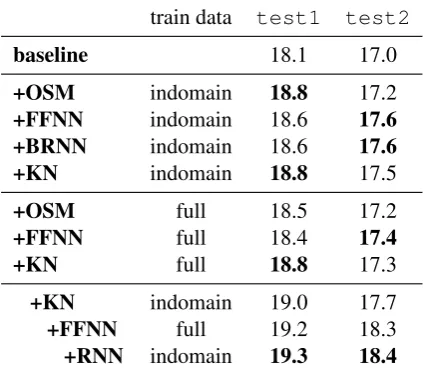
Table 4: Results measured in BLEUfor the BOLT
Chinese→English task.
URNN is that the latter captures the unbounded source and target history that extends until the be-ginning of the sentences, giving it an advantage over the FFNN. The performance of the URNN can be improved by including the future part of the source sentence, as described in Eq. (5), resulting in the BRNN model. Next, we explore whether the models are additive. When rescoring then-gram KN JTR output with the BRNN, an additional im-provement of 0.6 BLEUis obtained. There are two
reasons for this: The BRNN includes the future
part of the source input when scoring target words. This information is not used by the KN model. Moreover, the BRNN is able to score word com-binations unseen in training, while the KN model uses backing off to score unseen events.
When training the KN, FFNN, and OSM mod-els on the full data, we observe less gains in parison to in-domain data training. However, com-bining the KN models trained on in-domain and full data gives additional gains, which suggests that although the in-domain model is more adapted to the task, it still can gain from out-of-domain data. Adding the FFNN on top improves the com-bination. Note here that the FFNN sees the same information as the KN model, but the difference is that the NN operates on the word level rather than the word-pair level. Second, the FFNN is able to handle unseen sequences by design, without the need for the backing off workaround. The BRNN improves the combination more than the FFNN, as the model captures an unbounded source and target history in addition to an unbounded future source context. Combining the KN, FFNN and BRNN JTR models leads to an overall gain of 2.2 BLEUon bothdevandtest.
Next, we present the BOLT Chinese→English results, shown in Table 4. Comparing n-gram KN JTR and OSM trained on the in-domain data shows they perform equally well ontest1, im-proving the baseline by 0.7 BLEU, with a slight
ad-vantage for the JTR model ontest2. The feed-forward and the recurrent in-domain networks yield the same results in comparison to each other. Training the OSM and JTR models on the full data yields slightly worse results than in-domain train-ing. However, combining the two types of training improves the results. This is shown when adding the in-domain KN JTR model on top of the model trained on full data, improving it by up to 0.4 BLEU. Rescoring with the feed-forward and the
recurrent network improves this even further, sup-porting the previous observation that the n-gram KN JTR and NNs complement each other. The combination of the 4 models yields an overall im-provement of 1.2–1.4 BLEU.
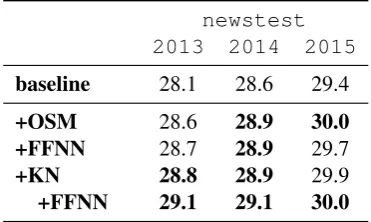
Finally, we compare KN JTR and OSM models on the WMT German→English task in Table 5. The two models perform almost similar to each other. The JTR model improves the baseline by up to 0.7 BLEU. Rescoring the KN JTR with the
FFNN improves it by up to 0.3 BLEUleading to an
[image:8.595.75.287.365.551.2]newstest 2013 2014 2015
baseline 28.1 28.6 29.4
+OSM 28.6 28.9 30.0
+FFNN 28.7 28.9 29.7
+KN 28.8 28.9 29.9
[image:9.595.88.274.63.174.2]+FFNN 29.1 29.1 30.0
Table 5: Results measured in BLEUfor the WMT
German→English task.
5.3 Analysis
To investigate the effect of including jump infor-mation in the JTR sequence, we trained a BRNN using jump classes and another excluding them. The BRNNs were used in rescoring. Below, we demonstrate the difference between the systems:
source: wir kommen sp¨ater noch auf diese Leute zur¨uck . reference: We’ll come back to these people later . Hypothesis 1:
JTR source: wir kommen δ zur¨uckδ sp¨ater noch auf diese Leuteδ.
JTR target: we comeybackxlaterσto these people y.
Hypothesis 2:
JTR source: wir kommen sp¨ater noch auf diese Leute zur¨uck .
JTR target: we come laterσon these guys back .
Note the German verb “zur¨uckkommen”, which is split into “kommen” and “zur¨uck”. German places “kommen” at the second position and “zur¨uck” towards the end of the sentence. Unlike German, the corresponding English phrase “come back” has the words adjacent to each other. We found that the system including jumps prefers the correct translation of the verb, as shown in Hy-pothesis 1 above. The system translates “kom-men” to “come”, jumps forward to “zur¨uck”, translates it to “back”, then jumps back to continue translating the word “sp¨ater”. In contrast, the sys-tem that excludes jump classes is blind to this sep-aration of words. It favors Hypothesis 2 which is a strictly monotone translation of the German sen-tence. This is also reflected by the BLEUscores,
where we found the system including jump classes outperforming the one without by up to 0.8 BLEU.
6 Conclusion
We introduced a method that converts bilingual sentence pairs and their word alignments into joint translation and reordering (JTR) sequences. They combine interdepending lexical and alignment de-pendencies into a single framework. A main ad-vantage of JTR sequences is that a variety of mod-els can be trained on them. Here, we have esti-matedn-gram models with modified Kneser-Ney smoothing, FFNN and RNN architectures on JTR sequences.
We compared our count-based JTR model to the OSM, both used in phrase-based decoding, and showed that the JTR model performed at least as good as OSM, with a slight advantage for JTR. In comparison to the OSM, the JTR model operates on words, leading to a smaller vocabulary size. Moreover, it utilizes simpler reordering structures without gaps and only requires one log-linear fea-ture to be tuned, whereas the OSM needs 5. Due to the flexibility of JTR sequences, we can ap-ply them also to FFNNs and RNNs. Utilizing two count models and applying both networks in rescoring gains the overall highest improvement over the phrase-based system by up to 2.2 BLEU,
on the German→English IWSLT task. The com-bination outperforms OSM by up to 1.2 BLEUon
the BOLT Chinese→English tasks.
The JTR models are not dependent on the phrase-based framework, and one of the long-term goals is to perform standalone decoding with the JTR models independently of phrase-based systems. Without the limitations introduced by phrases, we believe that JTR models could per-form even better. In addition, we aim to use JTR models to obtain the alignment, which would then be used to train the JTR models in an iterative manner, achieving consistency and hoping for im-proved models.
Acknowledgements
This work has received funding from the Euro-pean Union’s Horizon 2020 research and innova-tion programme under grant agreement no645452
References
Tamer Alkhouli, Felix Rietig, and Hermann Ney. 2015. Investigations on phrase-based decoding with recur-rent neural network language and translation mod-els. In Proceedings of the EMNLP 2015 Tenth Workshop on Statistical Machine Translation, Lis-bon, Portugal, September. to appear.
Michael Auli, Michel Galley, Chris Quirk, and Geof-frey Zweig. 2013. Joint Language and Translation Modeling with Recurrent Neural Networks. In Con-ference on Empirical Methods in Natural Language Processing, pages 1044–1054, Seattle, USA, Octo-ber.
Dzmitry Bahdanau, Kyunghyun Cho, and Yoshua Ben-gio. 2015. Neural machine translation by jointly learning to align and translate. InInternational Con-ference on Learning Representations, San Diego, Calefornia, USA, May.
Peter F. Brown, John Cocke, Stephan A. Della Pietra, Vincent J. Della Pietra, Fredrick Jelinek, John D. Lafferty, Robert L. Mercer, and Paul S. Rossin. 1990. A Statistical Approach to Machine Transla-tion. Computational Linguistics, 16(2):79–85, June. Peter F. Brown, Stephan A. Della Pietra, Vincent J. Della Pietra, and Robert L. Mercer. 1993. The Mathematics of Statistical Machine Translation: Pa-rameter Estimation. Computational Linguistics, 19(2):263–311, June.
Mauro Cettolo, Jan Niehues, Sebastian St¨uker, Luisa Bentivogli, and Marcello Federico. 2014. Report on the 11th iwslt evaluation campaign, iwslt 2014. In
International Workshop on Spoken Language Trans-lation, pages 2–11, Lake Tahoe, CA, USA, Decem-ber.
Stanley F. Chen and Joshuo Goodman. 1998. An Empirical Study of Smoothing Techniques for Lan-guage Modeling. Technical Report TR-10-98, Com-puter Science Group, Harvard University, Cam-bridge, MA, August.
Boxing Chen, Roland Kuhn, George Foster, and Howard Johnson. 2011. Unpacking and transform-ing feature functions: New ways to smooth phrase tables. InMT Summit XIII, pages 269–275, Xiamen, China, September.
Jonathan H. Clark, Chris Dyer, Alon Lavie, and Noah A. Smith. 2011. Better hypothesis test-ing for statistical machine translation: Controlltest-ing for optimizer instability. In 49th Annual Meet-ing of the Association for Computational LMeet-inguis- Linguis-tics:shortpapers, pages 176–181, Portland, Oregon, June.
Josep Maria Crego and Franc¸ois Yvon. 2010. Improv-ing reorderImprov-ing with lImprov-inguistically informed bilImprov-ingual n-grams. InProceedings of the 23rd International Conference on Computational Linguistics (Coling 2010: Posters), pages 197–205, Beijing, China.
Yonggang Deng and William Byrne. 2005. Hmm word and phrase alignment for statistical machine transla-tion. InProceedings of Human Language Technol-ogy Conference and Conference on Empirical Meth-ods in Natural Language Processing, pages 169– 176, Vancouver, British Columbia, Canada, October.
Jacob Devlin, Rabih Zbib, Zhongqiang Huang, Thomas Lamar, Richard Schwartz, and John Makhoul. 2014. Fast and Robust Neural Network Joint Models for Statistical Machine Translation. In 52nd Annual Meeting of the Association for Computational Lin-guistics, pages 1370–1380, Baltimore, MD, USA, June.
Nadir Durrani, Helmut Schmid, and Alexander Fraser. 2011. A joint sequence translation model with in-tegrated reordering. InProceedings of the 49th An-nual Meeting of the Association for Computational Linguistics: Human Language Technologies, pages 1045–1054, Portland, Oregon, USA, June.
Nadir Durrani, Alexander Fraser, and Helmut Schmid. 2013a. Model with minimal translation units, but decode with phrases. In Proceedings of the 2013 Conference of the North American Chapter of the Association for Computational Linguistics: Human Language Technologies, pages 1–11, Atlanta, Geor-gia, June.
Nadir Durrani, Alexander Fraser, Helmut Schmid, Hieu Hoang, and Philipp Koehn. 2013b. Can markov models over minimal translation units help phrase-based smt? InProceedings of the 51st An-nual Meeting of the Association for Computational Linguistics (Volume 2: Short Papers), pages 399– 405, Sofia, Bulgaria, August.
Nadir Durrani, Philipp Koehn, Helmut Schmid, and Alexander Fraser. 2014. Investigating the useful-ness of generalized word representations in smt. In
COLING, Dublin, Ireland, August.
Yang Feng and Trevor Cohn. 2013. A markov
model of machine translation using non-parametric bayesian inference. In51st Annual Meeting of the Association for Computational Linguistics, pages 333–342, Sofia, Bulgaria, August.
Minwei Feng, Jan-Thorsten Peter, and Hermann Ney. 2013. Advancements in reordering models for sta-tistical machine translation. In Annual Meeting of the Assoc. for Computational Linguistics, pages 322–332, Sofia, Bulgaria, August.
Yang Feng, Trevor Cohn, and Xinkai Du. 2014. Fac-tored markov translation with robust modeling. In
Proceedings of the Eighteenth Conference on Com-putational Natural Language Learning, pages 151– 159, Ann Arbor, Michigan, June.
Empirical Methods in Natural Language Process-ing, EMNLP ’08, pages 848–856, Stroudsburg, PA, USA. Association for Computational Linguistics. Andreas Guta, Joern Wuebker, Miguel Grac¸a, Yunsu
Kim, and Hermann Ney. 2015. Extended translation models in phrase-based decoding. In Proceedings of the EMNLP 2015 Tenth Workshop on Statistical Machine Translation, Lisbon, Portugal, September. to appear.
Kenneth Heafield, Ivan Pouzyrevsky, Jonathan H. Clark, and Philipp Koehn. 2013. Scalable modi-fied Kneser-Ney language model estimation. In Pro-ceedings of the 51st Annual Meeting of the Associa-tion for ComputaAssocia-tional Linguistics, pages 690–696, Sofia, Bulgaria, August.
Yuening Hu, Michael Auli, Qin Gao, and Jianfeng Gao. 2014. Minimum translation modeling with recur-rent neural networks. In Proceedings of the 14th Conference of the European Chapter of the Associ-ation for ComputAssoci-ational Linguistics, pages 20–29, Gothenburg, Sweden, April.
P. Koehn, F. J. Och, and D. Marcu. 2003. Statisti-cal Phrase-Based Translation. InProceedings of the 2003 Meeting of the North American chapter of the Association for Computational Linguistics (NAACL-03), pages 127–133, Edmonton, Alberta.
Philipp Koehn, Hieu Hoang, Alexandra Birch, Chris Callison-Burch, Marcello Federico, Nicola Bertoldi, Brooke Cowan, Wade Shen, Christine Moran, Richard Zens, Chris Dyer, Ondˇrej Bojar, Alexandra Constantine, and Evan Herbst. 2007. Moses: Open Source Toolkit for Statistical Machine Translation. pages 177–180, Prague, Czech Republic, June. Hai Son Le, Alexandre Allauzen, and Franc¸ois Yvon.
2012. Continuous Space Translation Models with Neural Networks. InConference of the North Amer-ican Chapter of the Association for Computational Linguistics: Human Language Technologies, pages 39–48, Montreal, Canada, June.
Jos´e B Mari˜no, Rafael E Banchs, Josep M Crego, Adri`a de Gispert, Patrik Lambert, Jos´e A R Fonollosa, and Marta R Costa-juss`a. 2006. N-gram-based Machine Translation. Comput. Linguist., 32(4):527–549, De-cember.
R.C. Moore and W. Lewis. 2010. Intelligent Selection of Language Model Training Data. In ACL (Short Papers), pages 220–224, Uppsala, Sweden, July. Jan Niehues, Teresa Herrmann, Stephan Vogel, and
Alex Waibel, 2011. Proceedings of the Sixth Work-shop on Statistical Machine Translation, chapter Wider Context by Using Bilingual Language Mod-els in Machine Translation, pages 198–206. Franz J. Och and Hermann Ney. 2003. A
System-atic Comparison of Various Statistical Alignment Models. Computational Linguistics, 29(1):19–51, March.
Franz J. Och, Christoph Tillmann, and Hermann Ney. 1999. Improved Alignment Models for Statistical Machine Translation. InProc. Joint SIGDAT Conf. on Empirical Methods in Natural Language Pro-cessing and Very Large Corpora, pages 20–28, Uni-versity of Maryland, College Park, MD, June. Franz Josef Och. 2003. Minimum Error Rate Training
in Statistical Machine Translation. In Proc. of the 41th Annual Meeting of the Association for Compu-tational Linguistics (ACL), pages 160–167, Sapporo, Japan, July.
Kishore Papineni, Salim Roukos, Todd Ward, and Wei-Jing Zhu. 2001. Bleu: a Method for Automatic Evaluation of Machine Translation. IBM Research Report RC22176 (W0109-022), IBM Research Di-vision, Thomas J. Watson Research Center, P.O. Box 218, Yorktown Heights, NY 10598, September. Darelene Stewart, Roland Kuhn, Eric Joanis, and
George Foster. 2014. Coarse split and lump bilin-gual languagemodels for richer source information in smt. InAMTA, Vancouver, BC, Canada, October. Martin Sundermeyer, Tamer Alkhouli, Wuebker Wue-bker, and Hermann Ney. 2014. Translation Model-ing with Bidirectional Recurrent Neural Networks. In Conference on Empirical Methods on Natural Language Processing, pages 14–25, Doha, Qatar, October.
Ilya Sutskever, Oriol Vinyals, and Quoc V. V Le. 2014. Sequence to sequence learning with neural networks. InAdvances in Neural Information Pro-cessing Systems 27, pages 3104–3112.
Christoph Tillmann. 2004. A unigram orientation model for statistical machine translation. In Pro-ceedings of HLT-NAACL 2004: Short Papers, HLT-NAACL-Short ’04, pages 101–104, Stroudsburg, PA, USA.
Joern Wuebker, Stephan Peitz, Felix Rietig, and Her-mann Ney. 2013. Improving statistical machine translation with word class models. InConference on Empirical Methods in Natural Language Pro-cessing, pages 1377–1381, Seattle, USA, October. Richard Zens, Franz Josef Och, and Hermann Ney.
2002. Phrase-Based Statistical Machine Transla-tion. In25th German Conf. on Artificial Intelligence (KI2002), pages 18–32, Aachen, Germany, Septem-ber.