Multi-modular domain-tailored OCR post-correction
Sarah Schulz and Jonas Kuhn
Institute for Natural Language Processing (IMS) University of Stuttgart
Abstract
One of the main obstacles for many Dig-ital Humanities projects is the low data availability. Texts have to be digitized in an expensive and time consuming pro-cess whereas Optical Character Recogni-tion (OCR) post-correcRecogni-tion is one of the time-critical factors. At the example of OCR post-correction, we show the adap-tation of a generic system to solve a spe-cific problem with little data. The system accounts for a diversity of errors encoun-tered in OCRed texts coming from differ-ent time periods in the domain of litera-ture. We show that the combination of dif-ferent approaches, such as e.g. Statisti-cal Machine Translation and spell check-ing, with the help of a ranking mecha-nism tremendously improves over single-handed approaches. Since we consider the accessibility of the resulting tool as a crucial part of Digital Humanities col-laborations, we describe the workflow we suggest for efficient text recognition and subsequent automatic and manual post-correction.
1 Introduction
Humanities are no longer just the realm of schol-ars turning pages of thick books. As the worlds of humanists and computer scientists begin to in-tertwine, new methods to revisit known ground emerge and options to widen the scope of research questions are available. Moreover, the nature of language encountered in such research attracts the attention of the NLP community (Kao and Juraf-sky (2015),Milli and Bamman (2016)). Yet, the basic requirement for the successful implemen-tation of such projects often poses a stumbling
block: large digital corpora comprising the textual material of interest are rare. Archives and individ-ual scholars are in the process of improving this situation by applying Optical Character Recog-nition (OCR) to the physical resources. In the Google Books1 project books are being digitized
on a large scale. But even though collections of literary texts like Project Gutenberg2 exist, these
collections often lack the texts of interest to a spe-cific question. As an example, we describe the compilation of a corpus of adaptations of Goethe’s Sorrows of the young Wertherwhich allows for the analysis of character networks throughout the pub-lishing history of this work.
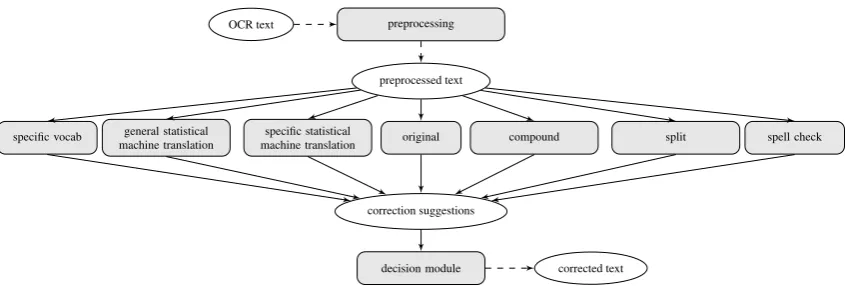
The success of OCR is highly dependent on the quality of the printed source text. Recognition er-rors, in turn, impact results of computer-aided re-search (Strange et al.,2014). Especially for older books set in hard-to-read fonts and with stained paper the output of OCR systems is not good enough to serve as a basis for Digital Humanities (DH) research. It needs to be post-corrected in a time-consuming and cost-intensive process. We describe how we support and facilitate the manual post-correction process with the help of informed automatic post-correction. To account for the problem of relative data sparsity, we illus-trate how a generic architecture agnostic to a spe-cific domain can be adjusted to text spespe-cificities such as genre and font characteristics by including just small amounts of domain specific data. We suggest a system architecture (cf. Figure1) with trainable modules which joins general and specific problem solving as required in many applications. We show that the combination of modules via a ranking algorithm yields results far above the per-formance of single approaches.
1https://books.google.de/, 02.04.2017. 2http://www.gutenberg.org, 14.04.2017.
preprocessing OCR text
preprocessed text
original specific statistical
machine translation general statistical
machine translation
specific vocab compound split spell check
correction suggestions
[image:2.595.88.511.60.203.2]decision module corrected text
Figure 1: Multi-modular OCR post-correction system.
We discuss the point of departure for our research in Section 2 and introduce the data we base our system on in Section4. In Section5, we illustrate the most common errors and motivate our multi-modular, partly customized architecture. Section6
gives an overview of techniques included in our system and the ranking algorithm. In Section 7, we discuss results, the limitations of automatic post-correction and the influence the amount of training data takes on the performance of such a system. Finally, Section8describes a way to effi-ciently integrate the results of our research into a digitization work-flow as we see the easy accessi-bility of computer aid as a central point in Digital Humanities collaborations.
2 Related work
There are two obvious ways to automatically im-prove quality of digitized text: optimization of OCR systems or automatic post-correction. Com-monly, OCR utilizes just basic linguistic knowl-edge like character set of a language or reading direction. The focus lies on the image recognition aspect which is often done with artificial neural networks (cf.Graves et al.(2009),Desai(2010)). Post-correction is focused on the correction of er-rors in the linguistic context. It thus allows for the purposeful inclusion of knowledge about the text at hand, e.g. genre-specific vocabulary. Neverthe-less, post-correction has predominantly been tack-led OCR system agnostic as outlined below. As an advantage, post-correction can also be applied when no scan or physical resource is available. There have been attempts towards shared datasets for evaluation.Mihov et al.(2005) released a cor-pus covering four different kinds of OCRed text comprising German and Bulgarian. However, in 2017 the corpus was untraceable and no recent
re-search relating to the data could be found.
OCR post-correction is applied in a diversity of fields in order to compile high-quality datasets. This is not merely reflected in the homogeneity of techniques but in the metric of evaluation as well. While accuracy has been widely used as evalu-ation measure in OCR post-correction research,
Reynaert (2008a) advocates the use of precision and recall in order to improve transparency in eval-uations. Dependent on the paradigm of the applied technique even evaluation measures like BLEU score can be found (cf.Afli et al.(2016)).
Since shared tasks are a good opportunity to estab-lish certain standards and facilitate the compara-bility of techniques, the Competition on Post-OCR Text Correction3 organized in the context of
IC-DAR 2017 could mark a milestone for more uni-fied OCR post-correction research efforts.
Regarding techniques used for OCR post-correction, there are two main trends to be mentioned: statistical approaches utilizing error distributions inferred from training data and lex-ical approaches oriented towards the comparison of source words to a canonical form. Combina-tions of the two approaches are also available. Techniques residing in this statistical domain have the advantage that they can model specific distributions of the target domain if training data is available. Tong and Evans (1996) approach post-correction as a statistical language modeling problem, taking context into account. P´erez-Cortes et al.(2000) employ stochastic finite-state automaton along with a modified version of the Viterbi Algorithm to perform a stochastic error correcting parsing. Extending the simpler stochastic context-sensitive models, Kolak and
3https://sites.google.com/view/
Resnik(2002) apply the first noisy channel model, using edit distance from noisy to corrected text on character level. In order to train such a model, manually generated training data is required. Rey-naert(2008b) suggests a corpus-based correction method, taking spelling variation (especially in historical text) into account. Abdulkader and Casey(2009) introduce an error estimator neural network that learns to assess error probabilities from ground truth data which in turn is then suggested for manual correction. This decreases the time needed for manual post-correction since correct words do not have to be considered as candidates for correction by the human corrector.
Llobet et al. (2010) combine information from the OCR system output, the error distribution and the language as weighted finite-state transducers.
Reffle and Ringlstetter (2013) use global as well as local error information to be able to fine-tune post-correction systems to historical documents. Related to the approach introduced by
P´erez-Cortes et al. (2000), Afli et al. (2016) use statistical machine translation for error correction using the Moses toolkit on character level. Volk et al.(2010) merge the output of two OCR systems with the help of a language model to increase the quality of OCR text. The corpus of yearbooks of the Swiss Alpine Club which has been manually corrected via crowdsourcing (cf. Clematide et al.
(2016)) is available from their website.
Lexical approaches often use rather generic distance measures between an erroneous word and a potential canonical lexical item. Strohmaier et al. (2003) investigate the influence of the coverage of a lexicon on the post-correction task. Considering the fact that writing in historical documents is often not standardized, the success of such approaches is limited. Moreover, systems based on lexicons rely on the availability of such resources. Historical stages of a language – which constitute the majority of texts in need for OCR post-correction – often lack such resources or pro-vide incomplete lexicons which would drastically decrease performance of spell-checking-based systems. Ringlstetter et al. (2007) address this problem by suggesting a way to dynamically collect specialized lexicons for this task. Taka-hashi et al. (1990) apply spelling correction with preceding candidate word detection. Bassil and Alwani (2012) use Google’s online spelling suggestions for as they draw on a huge lexicon
based on contents gathered from all over the web. The human component as final authority has been mentioned in some of these projects. Visual support of the post-correction process has been emphasized by e.g. Vobl et al. (2014) who describe a system of iterative post-correction of OCRed historical text which is evaluated in an application-oriented way. They present the human corrector with an alignment of image and OCRed text and make batch correction of the same error in the entire document possible. They can show that the time needed by human correctors considerably decreases.
3 Evaluation metrics
We describe and evaluate our data by means of word error rate (WER) and character error rate (CER). The error rates are a commonly used met-ric in speech recognition and machine translation evaluation and can also be referred to as length normalized edit distance. They quantify the num-ber of operations, namely the numnum-ber of inser-tions, deletions and substituinser-tions, that are needed to transform the suggested string into the manually corrected string and are computed as follows:
WER = word insertions + word substitutions + word deletions# words in the reference
CER = char insertions + char substitutions + char deletions# characters in the reference
4 Data
As mentioned in the introduction, errors found in OCRed texts are specific to time of origin, quality of scan and even the characteristics of a specific text. Our multi-modular architecture paves the way for a solution taking this into account by in-cluding general as well as specific modules. Thus, we suggest to include domain specific data as well as larger, more generic data sets in order to en-hance coverage of vocabulary and possible error classes. The data described hereafter constitutes parallel corpora with OCR output and manually corrected text which we utilize for training statis-tical models.
4.1 The Werther corpus
1 Berichtigung der Geschichte des jungen Werthers H. von Breitenbach 1775 2 Schwacher jedoch wohlgemeynter Tritt vor dem Riss, neben oder hinter Herren Pastor Goeze,
gegen die Leiden des jungen Werthers und dessen ruchlose Anh¨anger anonymous 1775
3 Lorenz Konau David Iversen 1776
4 Werther der Jude Ludwig Jacobowski 1910
5 Eine r¨uhrende Erz¨ahlung aus geheimen Nachrichten von Venedig und Cadir (first letter) Joseph Codardo und Rosaura Bianki 1778 6 Afterwerther oder Folgen jugendlicher Eifersucht A. Henselt 1784 7 Der neue Werther oder Gef¨uhl und Liebe Karl P. Bonafont 1804
[image:4.595.97.500.64.133.2]8 Leiden des modernen Werther Max Kaufmann 1901
Table 1: Werther texts included in our corpus from different authors and times of origin.
collected texts from this target domain. To be able to train a specialized system, we manually corrected a small corpus of relevant texts (cf. Table2). We use the output of Abbyy Fine Reader 7 for several Werther adaptations (Table 1) all based on scans of books with German Gothic lettering.
4.2 The Deutsches Textarchive (DTA) corpus Even though manual OCR post-correction is a vital part of many projects, only very little de-tailed documentation of this process exists. Das Deutsche Textarchiv (The German Text Archive) (DTA) is one of the few projects providing de-tailed correction guidelines along with the scans and the text corrected within the project (Geyken et al., 2012). This allows the compilation of a comprehensive parallel corpus of OCR output and corrected text spanning a period of four centuries (17th to 20th) in German Gothic lettering. For OCR, we use the open source softwaretesseract4
(Smith and Inc,2007) which comes with recogni-tion models for Gothic font.
4.3 Gutenberg data for language modeling Since the output of our system is supposed to con-sist of well-formed German sentences, we need a method to assess the quality of the output lan-guage. This task is generally tackled by language modeling. We compiled a collection of 500 ran-domly chosen texts from Project Gutenberg5
com-prising 28,528,078 tokens. With its relative close-ness to our target domain it constitutes the best approximation of a target language. The language model is trained with the KenLM toolkit (Heafield,
2011) with an order of 5 on token level and 10 on character level followingDe Clercq et al.(2013).
4Considering the open source aspect of our resulting
sys-tem, we decided to use the open source OCR software tesser-act and move away from Abbyy some time after our project started:https://github.com/tesseract-ocr.
5Project Gutenberg. Retrieved January 21, 2017, from www.gutenberg.org.
5 Why OCR post-correction is hard
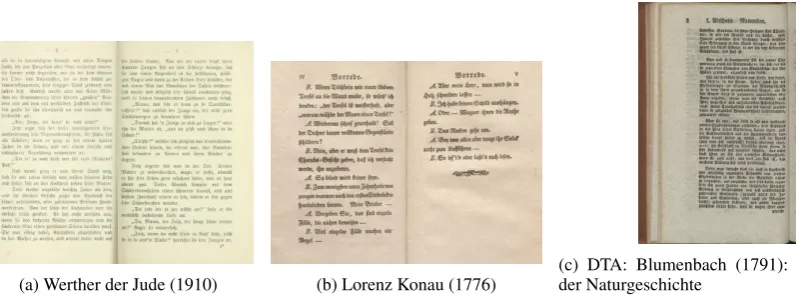
In tasks like the normalization of historical text (Bollmann et al., 2012) or social media, one can take advantage of regularities in the deviations from the standard form that appear throughout an entire genre or in case of social media e.g. dialect region (Eisenstein, 2013). Errors in OCR, how-ever, depend on the font and quality of the scan as well as the time of origin which makes each text unique in its composition of features and errors. In order to exemplify this claim, we analyzed three different samples: Lorenz Konau(1776),Werther der Jude(1910) and a sample from the DTA data. Figure 2 (a-c) illustrate the point that the qual-ity of scan is crucial for the OCR success. Fig-ure2a shows a text from the 20th century where the type setting is rather regular and the distances between letters is uniform as opposed to Figure2b. Figure 2c shows how the writing from the back of the page shines through and makes the script less readable. Thus, we observe a divergence in the frequency of certain character operations be-tween those texts: the percentage of substitutions range between 74% forLorenz Konauand 60% for Werther der Judeand 18% and 30% of insertions, respectively. The varying percentage of insertions might be due to the fact that some scans are more “washed out” than others. Successful insertion of missing characters, however, relies on the precon-dition that a system knows a lot of actual words and sentences in the respective language and can-not be resolved via e.g. character similarity like in the substitution fromltot.
(a) Werther der Jude (1910) (b) Lorenz Konau (1776) (c) DTA: Blumenbach (1791): Handbuchder Naturgeschichte Figure 2: Scans of three different texts from our corpora. Emphasizes differences in quality of scan and differences in type setting, font and genre (e.g. drama).
der Jude (WER 10.0, CER 2.4) the number of errors in general is much lower than for Konau (WER: 34.7, CER: 10.9). These characteristics in-dicate that subcorpus-specific training of a system is promising.
6 Specialized multi-modular post-correction
In order to account for the nature of errors that can occur in OCR text, we apply a variety of modules for post-correction. The system proceeds in two stages and is largely based on an architecture sug-gested by Schulz et al.(2016) for normalization of user-generated contents. In the first stage, a set of specialized modules (Section6.1) suggest cor-rected versions for the tokenized6 OCR text lines.
Those modules can be context-independent (work on just one word at a time) or context-dependent (an entire text line is processed at a time). The second stage is the decision phase. After the collection of various suggestions per input token, these have to be ranked to enable a decision for the most probable output token given the context. We achieve this by assigning weights the differ-ent modules with the help of Minimal Error Rate Training (MERT) (Och,2003).
6.1 Suggestion modules
In the following, we give an outline of techniques included into our system.
6.1.1 Word level suggestion modules
• Original: the majority of words do not con-tain any kind of error, thus we want to have
6Tokenizer of TreeTagger (Schmid,1997).
Figure 3: Irregular type setting in German Gothic lettering. sind and insgemein are two separate words but yet written closely together.
the initial token available in our suggestion pool
• Spell checker: spelling correction sugges-tion for misspelled words with hunspell7
• Compounder: merges two tokens into one token if it is evaluated as an existing word by hunspell
• Word splitter: splits two tokens into two words using compound-splitter module from the Moses toolkit (Koehn et al.,2007)
• Text-Internal Vocabulary: extracts high-frequent words from the input texts and sug-gests them as correction of words with small adjusted Levenshtein distance8
The compound and word split techniques react to the variance in manual typesetting, where the dis-tances between letters vary. This means that the word boundary recognition becomes difficult (cf. Figure3).
A problem related to the spell-checking approach is the limited coverage of the dictionary since it uses a modern German lexicon. Related to this is the difficulty of out-of-vocabulary words above average for literature text. Archaic words from e.g. the 17th century or named entities cannot be found in a dictionary and can therefore not be cov-ered with any of the approaches mentioned above.
7https://github.com/hunspell/hunspell.
8OCR-adjusted Levenshtein distance taking frequent
However, especially named entities are crucial for the automatic or semi-automatic analysis of narra-tives e.g. with the help of network analysis. Our Text-Internal Vocabulary technique is designed to find frequent words in the input text, following the assumption that errors would not be regular enough to distort those frequencies. We compile a list from those high-frequency words. Subse-quently, erroneous words can be corrected cal-culating an OCR-adjusted Levenshtein distance. In this way misspelled words likeLoveuzo could be resolved to Lorenzo if this name appears fre-quently. Since the ranking algorithm relies on a language model which will most probable not contain those suggestions, we insert the high-frequency words into the language modeling step. 6.1.2 Sentence level suggestion modules As has been suggested by Afli et al. (2016), we include Phrase-basedStatistical Machine Trans-lation (SMT) into our system. We treat the post-correction as a translation problem translat-ing from erroneous to correct text. Like in stan-dard SMT, we train our models on a parallel cor-pus, the source language being the OCRed text and the target language being manually corrected text. We train models on token level as well as on character-level (unigram). This way, we aim at correcting frequently mis-recognized words along with frequent character-level errors. We train four different systems:
• token level
– domain specific data (cf. Section4.1) – general data (cf. Section4.2)
• character level
– domain specific data (cf. Section4.1) – general data (cf. Section4.2)
The models are trained with the Moses toolkit (Koehn et al., 2007). Moreover, we use a subse-quent approach by forwarding the output of the character-based SMT model to the token-based SMT.
6.1.3 Additional feature
The information whether a word contains an er-ror can help to avoid the incorrect alternation of an initially correct word (overcorrection). In order to deliver this information to the decision module without making a hard choice for each word, we
include the information whether a word has been found either in combination with the word before or after in a corpus (cf. Section4.3) into the de-cision process in form of a feature that will be weighted along with the other modules. This naive language modeling approach allows for a context-relevant decision of the correctness of a word. 6.2 Decision modules: the ranking
mechanism
Since the recognition errors appearing in a text are hard to pre-classify by nature, we run all modules on each sentence of the input, returning sugges-tions for each word. Since the output of some of our modules are entire sentences, input sentence and output sentence have to be word-aligned in or-der to be able to make suggestions on word level. The word alignment between input and output sen-tence is done with the Needleman-Wunsch algo-rithm (Needleman and Wunsch, 1970), an algo-rithm originally developed in bioinformatics. From all corrected suggestions the most proba-ble well-formed combination has to be chosen. To solve the combinatorial problem of deciding which suggestion is the most probable candidate for a word, the decision module makes use of the Moses decoder.
As in general SMT, the decoder makes use of a language model (cf. Section 4.3) and a phrase table. The phrase table is compiled from all in-put words along with all possible correction sug-gestions. In order to assign weights to the single modules and the language model, we tune on the phrase tables collected from a run on our devoverall set, following the assumption that suggestions of certain modules are more reliable than others and expect their feature weights to be higher after tun-ing.
7 Experiments
7.1 Experimental Setup
To guarantee diversity, we split each of texts 1-4 (cf. Table 1) into three parts and combined the respective parts: 80% train (train), 10% develop-ment (devSMT) and 10% test (testinit).
set # tokens (OCR) # tokens (corr) WER CER
train 70,159 68,608 15.7 5.5
trainext 133,457 131,901 12.9 4.0
devSMT 12,464 12,304 13.9 3.5
devoverall 13,663 13,396 16.75 4.6
testinit 17,443 17,367 9.4 2.5
testunk 13,286 13,304 31.2 9.2
Table 2: Werther specific parallel corpus of OCR text and corrected text showing the number of to-kens before and after post-correction along with WER and CER
set # tokens (OCR) # tokens (corr) WER CER train 3,452,922 3,718,712 41.6 13.2
[image:7.595.305.532.62.132.2]dev 663,376 836,974 30.4 9.1
Table 3: DTA parallel corpus of OCR text and corrected text showing the number of tokens be-fore and after post-correction along with WER and CER
constitution. It constitutes an evaluation in which no initial manual correction as support for the au-tomatic correction is included in the workflow. We henceforth call this unknown settestunk(text 6).
In contrast, the second set contains parts of the same texts as the training, thus specific vocabulary might have been introduced already. The results for this test set give a first indication of the extent to which pre-informing the system with manually correcting parts of a text could assist the automatic correction process. Since this scenario can be de-scribed as a text-specific initiated post-correction, we henceforth refer to this test set astestinit.
We further on experiment with an extended training set trainext(train with texts 7 and 8) to as-sess the influence of the size of the specific train-ing set on the overall performance. The sizes of the datasets before and after correction along with WER and CER are summarized in Table 2. The sizes for the general dataset before and after cor-rection along with WER and CER are summarized in Table3.
7.2 Evaluation
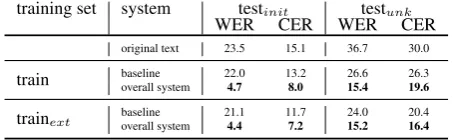
In the following we concentrate on the compari-son of WER and CER before and after automatic post-correction. As a baseline for our system we chose the strongest single-handed module (SMT on character-level trained on Werther data).
training set system testinit testunk
WER CER WER CER
original text 23.5 15.1 36.7 30.0
train baseline 22.0 13.2 26.6 26.3 overall system 4.7 8.0 15.4 19.6
trainext baselineoverall system 21.14.4 11.77.2 24.015.2 20.416.4
Table 4: WER and CER for both test sets be-fore and after automatic post-correction for the system trained with the small training set (train) and the larger training set (trainext). Baselines: the original text coming from the OCR system and the character-level SMT system trained on the Werther data.
Overall performance As indicated previously, our test sets differ with respect to their similarity to the training set. The results for both test scenar-ios for systems trained on our two training sets are summarized in Table4. The results from testinit and testunk show that our system performs con-siderably better than the baseline and can improve quality of the OCR output considerably.
For testunk, the system improves the quality by almost 20 points of WER from 36.7 to 15.4 and over 10 points in CER from 30.0 to 19.6. For testinit, our system improves the quality of the text with a reduction of approximately 20 points of WER from 23.5 to 4.7 and 7 points in CER from 15.1 to 8.0. It is not surprising that the decrease in WER is stronger than the decrease in CER. This is due to the fact that many words contain more than one error and require more than one charac-ter level operation to get from the incorrect to the correct string.
Just slight improvement can be shown by adding training material to the Werther-specific parts of the system (cf. trainextrow of Table 4). Merely the CER can be improved whereas the WER stays about the same. The improvement in testunkis higher than for testinit.
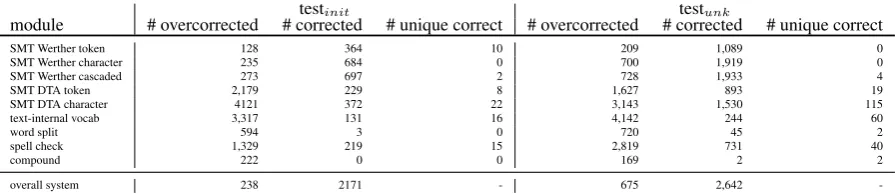
testinit testunk
module # overcorrected # corrected # unique correct # overcorrected # corrected # unique correct
SMT Werther token 128 364 10 209 1,089 0
SMT Werther character 235 684 0 700 1,919 0
SMT Werther cascaded 273 697 2 728 1,933 4
SMT DTA token 2,179 229 8 1,627 893 19
SMT DTA character 4121 372 22 3,143 1,530 115
text-internal vocab 3,317 131 16 4,142 244 60
word split 594 3 0 720 45 2
spell check 1,329 219 15 2,819 731 40
compound 222 0 0 169 2 2
overall system 238 2171 - 675 2,642
-Table 5: Number of overcorrected, corrected and uniquely corrected words per module out of 17,367 tokens in testinit(2,726 erroneous words) and 13,304 tokens in testunk(4,141 erroneous words)
to the overall performance of this system (cf. Table 5). For testunk the number of corrected tokens along with the number of overcorrections is higher than for testinit throughout all modules. Clearly, for testinit the Werther-specific modules are strongest. The more general modules prove useful for testunk. The number of corrected words increases for the SMT module trained on DTA data on character-level. The usefulness of the module extracting specific words (text-internal vocab) as well as the general SMT model and the spell checker becomes evident in terms of unique suggestions contributed by those modules. The analysis of the output of the individual modules and their contribution to the overall system uncovers an issue: those modules that produce a high number of incorrect suggestions, thus overcorrecting actually correct input tokens, are at the same time those modules that are the only ones producing correct suggestions for some of the incorrect input words. Consequently, those uniquely suggested corrections are not chosen in the decision modules due to an overall weak performance of this module. These suggestions are often crucial to the texts like the suggestions by the special vocabulary module which contain named entities or words specific to the time period. For our testunk set, the text-internal vocabulary module yields around 60 unique sug-gestions, out of which 15 are names (Friedrich, Amalia) or words really specific to the text (Auftrit spelled with one t instead of two).
Challenges In the context of literature OCR post-correction is a challenging problem since the texts themselves can be considered non-standard text. The aim is not to bring the text at hand to an agreed upon standard form but to digitize exactly what was contained in the print version. This can be far from the standard form of a language. In one
of our texts, we find a character speaking German with a strong dialect. Her speech contains a lot of words that are incorrect in standard German, how-ever, the goal is it to preserve this “errors” in the digital version. Thus, correction merely on the ba-sis of the OCR text without consulting the printed version or an image-digitized facsimile, can essen-tially never be perfect. It follows, that the integra-tion of automatic post-correcintegra-tion techniques into the character recognition process could lead to fur-ther improvements.
7.3 Adaptability
Reusability as a key concept in NLP for DH origi-nates in the time limitations given in such projects. Since DH projects do not evolve around the devel-opment of tools but the analysis performed with the help this tools in order to answer a specific question, the tools are expected to be delivered in an early phase of collaborative projects. From-scratch development easily exceeds this time lim-its. We show that our OCR post-correction system is modular enough to be adjusted to correct texts from other languages by training it for two other languages, English and French, with data released in the OCR post-correction competition organized in the context of ICDAR 20179. The texts
origi-nate from the the last four centuries and come from different collections and therefore have been dig-itized using different OCR systems. The data is summarized in Table610.
We adjust our system to the language by retrain-ing the SMT models and includretrain-ing spell-checkers for the respective languages. Due to the modular architecture these adjustments can be made
eas-9https://sites.google.com/view/
icdar2017-postcorrectionocr/home, 3.07.2017.
10The test set does not comply with the official shared task
[image:8.595.73.521.61.158.2]language trainocr traingold dev1ocr dev1gold dev2ocr dev2gold testocr testgold English 309,080 282,738 71,049 65,480 13,000 11,966 14,302 12,859 French 805,438 783,371 167,473 163,373 9,566 9,216 12,289 11,780
Table 6: Number of tokens in the English and French corpus provided by the competition on OCR-postcorrection.
ily and with a low expenditure of time. Since the datasets are compilation of a variety of texts, we use all modules but the domain-specific SMT models. We solely include one token-level and character-level SMT module for each language.
language system WER CER
English originalSMT Cascaded 29.422.7 28.423.6 overall system 22.1 24.5
French original textSMT Cascaded 13.39.9 25.020.0 overall system 8.7 21.5
Table 7: The results reported in word error rate (WER) and character error rate (CER) for the En-glish and French test set.
The strongest unique module for these two languages is the subsequent combination of the character-level SMT and the token-level SMT models (Cascaded). For English it performs just slightly worse on WER and even outperforms the overall system on the CER. For French, the over-all system is clearly stronger than the Cascaded SMT system with more than 1 percent improve-ment of WER but also performs worse in terms of CER by 1.5 percent. Generally, the OCR post-correction system achieves about 25% reduction of WER for English and over 30% reduction in WER for French.
8 Digitization workflow
We integrate the automatic OCR process with tesseract and our automatic post-correction system into a workflow which results in an hocr file, an XML format which is readable by PoCoTo (Vobl et al., 2014) a tool for supporting manual post-correction of OCRed text through alignment of image and digitized text. The upload of scans or images is provided online via a webapplication11.
This shields the user from the technicalities of the
11http://clarin05.ims.uni-stuttgart.de/ ocr/, for access please contact the author.
correction process and provides them with the in-put for the PoCoTo tool.
The implementation of an easy-to-handle work-flow is an often underemphasized aspect of DH. It needs to be intuitive enough to not absorb the time ion has been saved via automation. Since the final post-correction step requires that the human corrector compares the digitized version with the scan, presenting both next to each other is an ideal scenario. This functionality is one of the main strengths of PoCoTo, a visual correction tool, sup-porting manually initiated correction operations and batch correction of the same error.
9 Conclusion
We can show that the enhancement of a general, adaptable architecture by including small but spe-cific data sets can improve results within a spespe-cific domain. Moreover, the combination of different techniques for of OCR post-correction is signif-icantly superior to single techniques. Especially the integration of SMT models on token level and character level contributes to the overall success of the system. Due to the complexity of OCR post-correction, there cannot be a general solution. Even though the ranking algorithm achieves large improvement, further potential lies in the inclusion of fine-tuned language models since the decision process highly depends upon it. The intrinsic char-acteristic of literature as beingnon-standard com-plicates the task. However, techniques that focus on these features like our module that is special-ized on extracting text-specific vocabulary show promising results for e.g. named entity correction.
10 Acknowledgements
References
Ahmad Abdulkader and Mathew R. Casey. 2009. Low Cost Correction of OCR Errors Using Learning in a Multi-Engine Environment. In10th International Conference on Document Analysis and Recognition, ICDAR 2009, Barcelona, Spain, 26-29 July 2009, pages 576–580.
Haithem Afli, Zhengwei Qiu, Andy Way, and Praic Sheridan. 2016. Using SMT for OCR Error Correc-tion of Historical Texts. InProceedings of the Tenth International Conference on Language Resources and Evaluation (LREC 2016), Paris, France. Euro-pean Language Resources Association (ELRA).
Youssef Bassil and Mohammad Alwani. 2012. OCR Post-Processing Error Correction Algorithm Using Google’s Online Spelling Suggestion. Journal of Emerging Trends in Computing and Information Sci-ences, 3(1):90–99.
Marcel Bollmann, Julia Krasselt, and Florian Petran. 2012. Manual and semi-automatic normalization of historical spelling Case studies from Early New High German. In Proceedings of KONVENS 2012 (LThist 2012 workshop, pages 342–350.
Simon Clematide, Lenz Furrer, and Martin Volk. 2016. Crowdsourcing an OCR Gold Standard for a Ger-man and French Heritage Corpus. InProceedings of the Tenth International Conference on Language Resources and Evaluation LREC 2016, Portoroˇz, Slovenia, May 23-28, 2016.
Orph´ee De Clercq, Bart Desmet, Sarah Schulz, Els Lefever, and Veronique Hoste. 2013. Normalization of Dutch user-generated content. InProceedings of Recent Advances in Natural Language Processing, pages 179–188. INCOMA.
Apurva A. Desai. 2010. Gujarati Handwritten Numeral Optical Character Reorganization Through Neural Network. Pattern Recogn., 43(7):2582–2589.
Jacob Eisenstein. 2013. What to do about bad language on the Internet. InProceedings of the 2013 Confer-ence of the North American Chapter of the Associ-ation for ComputAssoci-ational Linguistics: Human Lan-guage Technologies, pages 359–369, Atlanta, Geor-gia. Association for Computational Linguistics.
Alexander Geyken, Susanne Haaf, Bryan Jurish, Matthias Schulz, Christian Thomas, and Frank Wie-gand. 2012. TEI und Textkorpora: Fehlerklassi-fikation und Qualittskontrolle vor, whrend und nach der Texterfassung im Deutschen Textarchiv. In
Jahrbuch f¨ur Computerphilologie, page online.
Alex Graves, Marcus Liwicki, Santiago Fern´andez, Roman Bertolami, Horst Bunke, and J¨urgen Schmidhuber. 2009. A Novel Connectionist System for Unconstrained Handwriting Recognition. IEEE Trans. Pattern Anal. Mach. Intell., 31(5):855–868.
Kenneth Heafield. 2011. KenLM: Faster and smaller language model queries. InProceedings of the Sixth Workshop on Statistical Machine Translation. Justine T. Kao and Dan Jurafsky. 2015. A
computa-tional analysis of poetic style: Imagism and its in-fluence on modern professional and amateur poetry.
Linguistic Issues in Language Technology, 12(3):1– 31.
Philipp Koehn, Hieu Hoang, Alexandra Birch, Chris Callison-Burch, Marcello Federico, Nicola Bertoldi, Brooke Cowan, Wade Shen, Christine Moran, Richard Zens, Chris Dyer, Ondˇrej Bojar, Alexandra Constantin, and Evan Herbst. 2007. Moses: Open Source Toolkit for Statistical Machine Translation. In Proceedings of the 45th Annual Meeting of the ACL on Interactive Poster and Demonstration Ses-sions, ACL ’07, pages 177–180, Stroudsburg, PA, USA. Association for Computational Linguistics. Okan Kolak and Philip Resnik. 2002. OCR Error
Cor-rection Using a Noisy Channel Model. In Pro-ceedings of the Second International Conference on Human Language Technology Research, HLT ’02, pages 257–262, San Francisco, CA, USA. Morgan Kaufmann Publishers Inc.
Rafael Llobet, Jose-Ramon Cerdan-Navarro, Juan-Carlos Perez-Cortes, and Joaquim Arlandis. 2010. OCR Post-processing Using Weighted Finite-State Transducers. InProceedings of the 2010 20th Inter-national Conference on Pattern Recognition, ICPR ’10, pages 2021–2024, Washington, DC, USA. IEEE Computer Society.
Stoyan Mihov, Klaus U. Schulz, Christoph Ringlstet-ter, Veselka Dojchinova, and Vanja Nakova. 2005. A Corpus for Comparative Evaluation of OCR Soft-ware and Postcorrection Techniques. InEighth In-ternational Conference on Document Analysis and Recognition (ICDAR 2005), 29 August - 1 Septem-ber 2005, Seoul, Korea, pages 162–166.
Smitha Milli and David Bamman. 2016. Beyond Canonical Texts: A Computational Analysis of Fan-fiction. InProceedings of the 2016 Conference on Empirical Methods in Natural Language Process-ing, EMNLP 2016, Austin, Texas, USA, November 1-4, 2016, pages 2048–2053.
Saul B. Needleman and Christian D. Wunsch. 1970. A general method applicable to the search for simi-larities in the amino acid sequence of two proteins.
Journal of Molecular Biology, 48(3):443 – 453. Franz Josef Och. 2003. Minimum Error Rate Training
in Statistical Machine Translation. InProceedings of the 41st Annual Meeting on Association for Com-putational Linguistics - Volume 1, ACL ’03, pages 160–167, Stroudsburg, PA, USA. Association for Computational Linguistics.
Stochastic Error-Correcting Parsing for OCR Post-Processing. In 15th International Conference on Pattern Recognition, ICPR’00, Barcelona, Spain, September 3-8, 2000, pages 4405–4408.
Ulrich Reffle and Christoph Ringlstetter. 2013. Unsu-pervised Profiling of OCRed Historical Documents.
Pattern Recogn., 46(5):1346–1357.
Martin Reynaert. 2008a. All, and only, the Errors: more Complete and Consistent Spelling and OCR-Error Correction Evaluation. InProceedings of the Sixth International Language Resources and Eval-uation (LREC’08), Marrakech, Morocco. European Language Resources Association (ELRA).
Martin Reynaert. 2008b. Non-interactive OCR Post-correction for Giga-scale Digitization Projects. In
Proceedings of the 9th International Conference on Computational Linguistics and Intelligent Text Pro-cessing, CICLing’08, pages 617–630, Berlin, Hei-delberg. Springer-Verlag.
Christoph Ringlstetter, Klaus U. Schulz, and Stoyan Mihov. 2007. Adaptive Text Correction with Web-crawled Domain-dependent Dictionaries. ACM Trans. Speech Lang. Process., 4(4).
Helmut Schmid. 1997. Probabilistic Part-of-Speech Tagging Using Decision Trees. In Daniel Jones and Harold Somers, editors,New Methods in Language Processing, Studies in Computational Linguistics, pages 154–164. UCL Press, London, GB.
Sarah Schulz, Guy De Pauw, Orph´ee De Clercq, Bart Desmet, V´eronique Hoste, Walter Daelemans, and Lieve Macken. 2016. Multimodular Text Normal-ization of Dutch User-Generated Content. ACM Trans. Intell. Syst. Technol., 7(4):61:1–61:22.
Ray Smith and Google Inc. 2007. An overview of the Tesseract OCR Engine. InProc. 9th IEEE Intl. Conf. on Document Analysis and Recognition (ICDAR), pages 629–633.
Carolyn Strange, Daniel McNamara, Josh Wodak, and Ian Wood. 2014. Mining for the Meanings of a Mur-der: The Impact of OCR Quality on the Use of Dig-itized Historical Newspapers. Digital Humanities Quarterly, 8(1).
Christian M. Strohmaier, Christoph Ringlstetter, Klaus U. Schulz, and Stoyan Mihov. 2003. Lexical Postcorrection of OCR-Results: The Web as a Dy-namic Secondary Dictionary? In7th International Conference on Document Analysis and Recognition (ICDAR 2003), 2-Volume Set, 3-6 August 2003, Ed-inburgh, Scotland, UK, pages 1133–1137.
Hiroyasu Takahashi, Nobuyasu Itoh, Tomio Amano, and Akio Yamashita. 1990. A spelling correction method and its application to an OCR system. Pat-tern Recognition, 23(3-4):363–377.
Xiang Tong and David A. Evans. 1996. A Statisti-cal Approach to Automatic OCR Error Correction in Context. InFourth Workshop on Very Large Cor-pora, pages 88–100.
Thorsten Vobl, Annette Gotscharek, Uli Reffle, Christoph Ringlstetter, and Klaus U. Schulz. 2014. PoCoTo - an Open Source System for Efficient In-teractive Postcorrection of OCRed Historical Texts. In Proceedings of the First International Confer-ence on Digital Access to Textual Cultural Heritage, DATeCH ’14, pages 57–61, New York, NY, USA. ACM.