Exploiting Conversation Structure in Unsupervised Topic Segmentation for
Emails
Shafiq Joty and Giuseppe Carenini and Gabriel Murray and Raymond T. Ng
{rjoty, carenini, gabrielm, rng}@cs.ubc.ca Department of Computer Science
University of British Columbia Vancouver, BC, V6T 1Z4, Canada
Abstract
This work concerns automatic topic segmen-tation of email conversations. We present a corpus of email threads manually annotated with topics, and evaluate annotator reliabil-ity. To our knowledge, this is the first such email corpus. We show how the existing topic segmentation models (i.e., Lexical Chain Seg-menter (LCSeg) and Latent Dirichlet Alloca-tion (LDA)) which are solely based on lex-ical information, can be applied to emails. By pointing out where these methods fail and what any desired model should consider, we propose two novel extensions of the models that not only use lexical information but also exploit finer level conversation structure in a principled way. Empirical evaluation shows that LCSeg is a better model than LDA for segmenting an email thread into topical clus-ters and incorporating conversation structure into these models improves the performance significantly.
1 Introduction
With the ever increasing popularity of emails and web technologies, it is very common for people to discuss issues, events, agendas or tasks by email. Effective processing of the email contents can be of great strategic value. In this paper, we study the problem of topic segmentation for emails, i.e., grouping the sentences of an email thread into a set of coherent topical clusters. Adapting the stan-dard definition of topic (Galley et al., 2003) to con-versations/emails, we consider a topic is something about which the participant(s) discuss or argue or
express their opinions. For example, in the email thread shown in Figure 1, according to the major-ity of our annotators, participants discuss three top-ics (e.g., ‘telecon cancellation’, ‘TAG document’, and ‘responding to I18N’). Multiple topics seem to occur naturally in social interactions, whether syn-chronous (e.g., chats, meetings) or asynsyn-chronous (e.g., emails, blogs) conversations. In multi-party chat (Elsner and Charniak, 2008) report an average of 2.75 discussions active at a time. In our email cor-pus, we found an average of 2.5 topics per thread.
Topic segmentation is often considered a pre-requisite for other higher-level conversation analy-sis and applications of the extracted structure are broad, encompassing: summarization (Harabagiu and Lacatusu, 2005), information extraction and or-dering (Allan, 2002), information retrieval (Dias et al., 2007), and intelligent user interfaces (Dredze et al., 2008). While extensive research has been con-ducted in topic segmentation for monologues (e.g., (Malioutov and Barzilay, 2006), (Choi et al., 2001)) and synchronous dialogs (e.g., (Galley et al., 2003), (Hsueh et al., 2006)), none has studied the problem of segmenting asynchronous multi-party conversa-tions (e.g., email). Therefore, there is no reliable an-notation scheme, no standard corpus, and no agreed-upon metrics available. Also, it is our key hypothe-sis that, because of its asynchronous nature, and the use of quotation (Crystal, 2001), topics in an email thread often do not change in a sequential way. As a result, we do not expect models which have proved successful in monologue or dialog to be as effective when they are applied to email conversations.
Our contributions in this paper aim to remedy
these problems. First, we present an email corpus annotated with topics and evaluate annotator agree-ment. Second, we adopt a set of metrics to mea-sure the local and global structural similarity be-tween two annotations from the work on multi-party chat disentanglement (Elsner and Charniak, 2008). Third, we show how the two state-of-the-art topic segmentation methods (i.e., LCSeg and LDA) which are solely based on lexical information and make strong assumptions on the resulting topic models, can be effectively applied to emails, by having them to consider, in a principled way, a finer level struc-ture of the underlying conversations. Experimen-tal results show that both LCSeg and LDA benefit when they are extended to consider the conversa-tional structure. When comparing the two methods, we found that LCSeg is better than LDA and this advantage is preserved when they are extended to incorporate conversational structure.
2 Related Work
Three research areas are directly related to our study: a) text segmentation models, b) probabilistic topic models, and c) extracting and representing the con-versation structure of emails.
Topic segmentation has been extensively studied both for monologues and dialogs. (Malioutov and Barzilay, 2006) uses the minimum cut model to seg-ment spoken lectures (i.e., monologue). They form a weighted undirected graph where the vertices repre-sent repre-sentences and the weighted links reprerepre-sent the similarity between sentences. Then the segmenta-tion problem can be solved as a graph partisegmenta-tioning problem, where the assumption is that the sentences in a segment should be similar, while sentences in different segments should be dissimilar. They op-timize the ‘normalized cut’ criterion to extract the segments. In general, the minimization of the nor-malized cut criterion is NP-complete. However, the linearity constraint on text segmentation for mono-logue allows them to find an exact solution in poly-nomial time. In our extension of LCSeg, we use a similar method to consolidate different segments; however, in our case the linearity constraint is ab-sent. Therefore, we approximate the optimal solu-tion by spectral clustering (Shi and Malik, 2000). Moving to the task of segmenting dialogs, (Galley
et al., 2003) first proposed the lexical chain based unsupervised segmenter (LCSeg) and a supervised segmenter for segmenting meeting transcripts. Their supervised approach uses C4.5 and C4.5 rules binary classifiers with lexical and conversational features (e.g., cue phrase, overlap, speaker, silence, and lex-ical cohesion function). Their supervised approach performs significantly better than LCSeg. (Hsueh et al., 2006) follow the same approaches as (Galley et al., 2003) on both manual transcripts and ASR output of meetings. They perform segmentation at both coarse (topic) and fine (subtopic) levels. For the topic level, they achieve similar results as (Gal-ley et al., 2003), with the supervised approach out-performing LCSeg. However, for the subtopic level, LCSeg performs significantly better than the suvised one. In our work, we show how LCSeg per-forms when applied to the temporal ordering of the emails in a thread. We also propose its extension to leverage the finer conversation structure of emails.
The probabilistic generative topic models, such as LDA and its variants (e.g., (Blei et al., 2003), (Steyvers and Griffiths, 2007)), have proven to be successful for topic segmentation in both mono-logue (e.g., (Chen et al., 2009)) and dialog (e.g., (Georgescul et al., 2008)). (Purver et al., 2006) uses a variant of LDA for the tasks of segmenting meet-ing transcripts and extractmeet-ing the associated topic labels. However, their approach for segmentation does not perform better than LCSeg. In our work, we show how the general LDA performs when ap-plied to email conversations and describe how it can be extended to exploit the conversation structure of emails.
3 Corpus and Evaluation Metrics
There are no publicly available email corpora anno-tated with topics. Therefore, the first step was to develop our own corpus. We have annotated the BC3 email corpus (Ulrich et al., 2008) with top-ics1. The BC3 corpus, previously annotated with sentence level speech acts, meta sentence, subjectiv-ity, extractive and abstractive summaries, is one of a growing number of corpora being used for email re-search. The corpus contains40 email threads from the W3C corpus2. It has3222sentences and an av-erage of 5 emails per thread.
3.1 Topic Annotation
Topic segmentation in general is a nontrivial and subjective task (Hsueh et al., 2006). The conver-sation phenomenon called ‘Schism’ makes it even more challenging for conversations. In schism a new conversation takes birth from an existing one, not necessarily because of a topic shift but because some participants refocus their attention onto each other, and away from whoever held the floor in the parent conversation and the annotators can disagree on the birth of a new topic (Aoki et al., 2006). In the example email thread shown in Figure 1, a schism takes place when people discuss about ‘responding to I18N’. All the annotators do not agree on the fact that the topic about ‘responding to I18N’ swerves from the one about ‘TAG document’. The annota-tors can disagree on the number of topics (i.e., some are specific and some are general), and on the topic assignment of the sentences3. To properly design an effective annotation manual and procedure we per-formed a two-phase pilot study before carrying out the actual annotation. For the pilot study we picked five email threads randomly from the corpus. In the first phase of the pilot study we selected five uni-versity graduate students to do the annotation. We then revised our instruction manual based on their feedback and the source of disagreement found. In
1
The BC3 corpus had already been annotated for email sum-marization, speech act recognition and subjectivity detection. This new annotation with topics will be also made publicly available at http://www.cs.ubc.ca/labs/lci/bc3.html
2
http://research.microsoft.com/en-us/um/people/nickcr/w3c-summary.html
3
The annotators also disagree on the topic labels, however in this work we are not interested in finding the topic labels.
the second phase we tested with a university postdoc doing the annotation.
For the actual annotation we selected three com-puter science graduates who are also native speakers of English. They annotated 39threads of the BC3 corpus4. On an average they took seven hours to an-notate the whole dataset.
BC3 contains three human written abstract sum-maries for each email thread. With each email thread the annotators were also given an associated human written summary to give a brief overview of the cor-responding conversation. The task of finding topics was carried out in two phases. In the first phase, the annotators read the conversation and the associated summary and list the topics discussed. They spec-ify the topics by a short description (e.g., “meeting agenda”, “location and schedule”) which provides a high-level overview of the topic. The target number of topics and the topic labels were not given in ad-vance and they were instructed to find as many top-ics as needed to convey the overall content structure of the conversation.
In the second phase the annotators identify the most appropriate topic for each sentence. However, if a sentence covers more than one topic, they were asked to label it with all the relevant topics according to their order of relevance. If they find any sentence that does not fit into any topic, they are told to label those as the predefined topic ‘OFF-TOPIC’. Wher-ever appropriate they were also asked to make use of two other predefined topics: ‘INTRO’ and ‘END’. INTRO (e.g., ‘hi’, ‘hello’) signifies the section (usu-ally at the beginning) of an email that people use to begin their email. Likewise, END (e.g., ‘Cheers’, ‘Best’) signifies the section (usually at the end) that people use to end their email. The annotators car-ried out the task on paper. We created the hierar-chical thread view (‘reply to’ relation) using ‘TAB’s (indentation) and each participant’s name is printed in a different color as in Gmail.
Table 1 shows some basic statistics computed on the three annotations of the 39 email threads5. On
4
The annotators in the pilot and in the actual study were dif-ferent so we could reuse the threads used in pilot study. How-ever, one thread on which the pilot annotators agree fully, was used as an example in the instruction manual. This gives39 threads left for the actual study.
‘IN-average we have26.3 sentences and2.5 topics per thread. A topic contains an average of 12.6 sen-tences. The average number of topics active at a time is 1.4. The average entropy is 0.94 and cor-responds (as described in detail in the next section) to the granularity of the annotation. These statistics (number of topics and topic density) indicate that the dataset is suitable for topic segmentation.
Mean Max Min Number of sentences 26.3 55 13 Number of topics 2.5 7 1 Avg. topic length 12.6 35 3 Avg. topic density 1.4 3.1 1
[image:4.612.84.288.172.259.2]Entropy 0.94 2.7 0
Table 1: Corpus statistics of human annotations
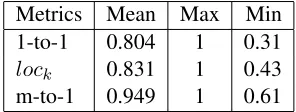
Metrics Mean Max Min 1-to-1 0.804 1 0.31
lock 0.831 1 0.43
[image:4.612.111.259.304.360.2]m-to-1 0.949 1 0.61
Table 2: Annotator agreement in the scale of 0 to 1
3.2 Evaluation Metrics
In this section we describe the metrics used to com-pare different human annotations and system’s out-put. As different annotations (or system’s output) can group sentences in different number of clusters, metrics widely used in classification, such as theκ
statistic, are not applicable. Again, our problem of topic segmentation for emails is not sequential in na-ture. Therefore, the standard metrics widely used in sequential topic segmentation for monologues and dialogs, such as Pk andW indowDif f(W D), are
also not applicable. We adopt the more appropri-ate metrics 1-to-1, lock and m-to-1, introduced
re-cently by (Elsner and Charniak, 2008). The 1-to-1 metric measures the global similarity between two annotations. It pairs up the clusters from the two annotations in a way that maximizes (globally) the total overlap and then reports the percentage of over-lap.lockmeasures the local agreement within a
con-TRO’ and ‘END’. In all our computation (i.e., statistics, agree-ment, system’s input) we excluded the sentences marked as ei-ther ‘INTRO’ or ‘END’
text ofksentences. To compute theloc3metric for
the m-th sentence in the two annotations, we con-sider the previous3sentences: m-1, m-2 and m-3, and mark them as either ‘same’ or ‘different’ de-pending on their topic assignment. The loc3 score
between two annotations is the mean agreement on these ‘same’ or ‘different’ judgments, averaged over all sentences. We report the agreement found in 1-to-1 andlock in Table 2. In both of the metrics we
get high agreement, though the local agreement (av-erage of 83%) is little higher than the global agree-ment (average of 80%).
If we consider the topic of a randomly picked sen-tence as a random variable then its entropy measures the level of detail in an annotation. If the topics are evenly distributed then the uncertainty (i.e., entropy) is higher. It also increases with the increase of the number of topics. Therefore, it is a measure of how specific an annotator is and in our dataset it varies from0 6to2.7. To measure how much the annota-tors agree on the general structure we use the m-to-1 metric. It maps each of the source clusters to the single target cluster with which it gets the highest overlap, then computes the total percentage of over-lap. This metric is asymmetrical and not a measure to be optimized7, but it gives us some intuition about specificity (Elsner and Charniak, 2008). If one an-notator divides a cluster into two clusters then, the m-to-1 metric from fine to coarse is 1. In our corpus by mapping from fine to coarse we get an m-to-1 average of0.949.
4 Topic Segmentation Models
Developing automatic tools for segmenting an email thread is challenging. The example email thread in Figure 1 demonstrates why. We use different col-ors and fonts to represent sentences of different top-ics8. One can notice that email conversations are different from written monologues (e.g., newspaper) and dialogs (e.g., meeting, chat) in various ways. As a communication media Email is distributed (un-like face to face meeting) and asynchronous (un(un-like
6
0 uncertainty happens when there is only one topic found
7hence we do not use it to compare our models. 8
chat), meaning that different people from different locations can collaborate at different times. There-fore, topics in an email thread may not change in sequential way. In the example, we see that topic 1 (i.e., ‘telecon cancellation’) is revisited after some gaps.
The headers (i.e., subjects) do not convey much information and are often misleading. In the exam-ple thread, participants use the same subject (i.e., 20030220 telecon) but they talk about ‘responding to I18N’ and ‘TAG document’ instead of ‘telecon cancellation’. Writing style varies among partici-pants, and many people tend to use informal, short and ungrammatical sentences. These properties of email limit the application of techniques that have been successful in monologues and dialogues.
LDAandLCSegare the two state-of-the-art
mod-els for topic segmentation of multi-party conversa-tion (e.g., (Galley et al., 2003), (Hsueh et al., 2006), (Georgescul et al., 2008)). In this section, at first we describe how the existing models of topic segmen-tation can be applied to emails. We then point out where these methods fail and propose extensions of these basic models for email conversations.
4.1 Latent Dirichlet Allocation (LDA)
Our first model is the probabilistic LDA model (Steyvers and Griffiths, 2007). This model relies on the fundamental idea that documents are mixtures of topics, and a topic is a multinomial distribution over words. The generative topic model specifies the fol-lowing distribution over words within a document:
P(wi) = T
X
j=1
P(wi|zi =j)P(zi =j)
WhereTis the number of topics. P(wi|zi=j)is
the probability of wordwiunder topicjandP(zi=
j)is the probability thatjth topic was sampled for the ith word token. We refer the multinomial dis-tributions φ(j) = P(w|zi = j) and θ(d) = P(z)
as topic-word distribution and document-topic dis-tribution respectively. (Blei et al., 2003) refined this basic model by placing a Dirichlet (α) prior on θ. (Griffiths and Steyvers, 2003) further refined it by placing a Dirichlet (β) prior onφ. The inference problem is to find φ and θ given a document set. Variational EM has been applied to estimate these
two parameters directly. Instead of estimatingφand
θ, one can also directly estimate the posterior distri-bution overz = P(zi = j|wi) (topic assignments
for words). One efficient estimation technique uses Gibbs sampling to estimate this distribution.
This framework can be directly applied to an email thread by considering each email as a doc-ument. Using LDA we get z = P(zi = j|wi)
(i.e., topic assignments for words). By assuming the words in a sentence occur independently we can esti-mate the topic assignments for sentences as follows:
P(zi=j|sk) =
Y
wi∈sk
P(zi=j|wi)
where, sk is the kth sentence for which we can
assign the topic by:j∗ =argmaxjP(zi=j|sk).
4.2 Lexical Chain Segmenter (LCSeg)
Our second model is the lexical chain based seg-menter LCSeg, (Galley et al., 2003). LCSeg as-sumes that topic shifts are likely to occur where strong term repetitions start and end9. LCSeg at first computes ‘lexical chains’ for each non-stop word based on word repetitions. It then ranks the chains according to two measures: ‘number of words in the chain’ and ‘compactness of the chain’. The more compact (in terms of number of sentences) and the more populated chains get higher scores.
The algorithm then works with two adjacent anal-ysis windows, each of a fixed sizek which is em-pirically determined. For each sentence boundary, LCSeg computes the cosine similarity (or lexical co-hesion function) at the transition between the two windows. Low similarity indicates low lexical cohe-sion, and a sharp change signals a high probability of an actual topic boundary. This method is similar to TextTiling (Hearst, 1997) except that the similar-ity is computed based on the scores of the ‘lexical chains’ instead of ‘term counts’. In order to apply LCSeg on email threads we arrange the emails based on their temporal relation (i.e., arrival time) and ap-ply the LCSeg algorithm to get the topic boundaries.
9
From: Brian To: rdf core Subject: 20030220 telecon Date: Tue Feb 17 13:52:15
[a]
!"
# !
From: Jeremy To: Brian Subject: Re: 20030220 telecon Date: Wed Feb 18 05:18:10
$% # !
I think that means we will not formally respond to I18N on the charmod comments, shall I tell them [d] that we do not intend to, but that the e-mail discussion has not shown any disagreement.
e.g. I have informed the RDF Core WG of your decisions, and no one has indicated unhappiness [e] - however we have not formally discussed these issues; and are not likely to.
From: Brian To: Jeremy Subject: Re: 20030220 telecon Date: Wed Feb 18 13:16:21
> I think that means we will not formally respond to I18N on the charmod comments, shall > I tell them that we do not intend to, but that the e-mail discussion has not shown any disagreement. Ah. Is this a problem. Have I understood correctly they are going through last call again anyway. [f] > e.g. I have informed the RDF Core WG of your decisions, and no one has indicated unhappiness > - however we have not formally discussed these issues; and are not likely to.
When is the deadline? I'm prepared to decide by email so we can formally respond by email. [g]
From: Pat To: Brian Subject: Re: 20030220 telecon Date: Wed Feb 18 16:56:26
[h] $
& ' #
From: Jeremy To: Brian Subject: Re: 20030220 telecon Date: Thu Feb 19 05:42:21
> Ah. Is this a problem.
> Have I understood correctly they are going through last call again anyway.
Yes - I could change my draft informal response to indicate that if we have any other formal [j] response it will be included in our LC review comments on their new documents.
> When is the deadline?
> I'm prepared to decide by email so we can formally respond by email.
Two weeks from when I received the message ....i.e. during Cannes [k] -I suspect that is also the real deadline, in that I imagine they want to make their final decisions at Cannes.
I am happy to draft a formal response that is pretty vacuous, for e-mail vote. [l]
From: Brian To: Pat Subject: Re: 20030220 telecon Date: Thu Feb 19 06:10:53
>Likewise, whether or not anyone else in the WG agrees with any of my own personal comments, …[m]
! "# " # $ %
&
From: Brian To: Jeremy
Subject: Re: 20030220 telecon Date: Thu Feb 19 10:06:57
> I am happy to draft a formal response that is pretty vacuous, for e-mail vote.
Please do. [o]
[image:6.612.307.531.58.185.2]Figure 1: Sample thread from the BC3 corpus. Each dif-ferent color/font indicates a difdif-ferent topic. Right most column specifies the fragments (sec 4.4).
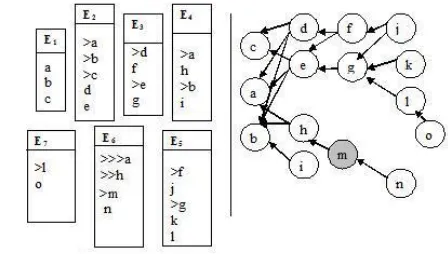
Figure 2: Fragment Quotation Graph for emails
4.3 Limitation of Existing Approaches
The main limitation of the two models discussed above is that they take the bag-of-words (BOW) assumption without considering the fact that an email thread is a multi-party, asynchronous conver-sation10. The only information relevant to LDA is term frequency. LCSeg considers both term fre-quency and how closely the terms occur in a docu-ment. These models do not consider the word order, syntax and semantics. However, several improve-ments of LDA over the BOW approach have been proposed. (Wallach, 2006) extends the model be-yond BOW by considering n-gram sequences. (Grif-fiths et al., 2005) presents an extension of the topic model that is sensitive to word-order and automat-ically learns the syntactic as well as semantic fac-tors that guide word choice. (Boyd-Graber and Blei, 2010) describes another extension to consider syn-tax of the text. As described earlier, one can also incorporate lexical semantics (i.e., synonym, hyper-nym, hyponym) into the LCSeg model. However, we argue that these models are still inadequate for finding topics in emails especially when topics are closely related (e.g., ‘extending the meeting’ and ‘scheduling the meeting’) and distributional varia-tions are subtle. To better identify the topics in an email thread we need to consider the email specific conversation features (e.g., reply-to relation, usage of quotations). As can be seen in the example (Fig-ure 1), people often use quotations to talk about the same topic. In fact in our corpus we found an av-erage quotation usage of6.44per thread. Therefore,
10
we need to leverage this useful information in a prin-cipled way to get the best out of our models. Specif-ically, we need to capture the conversation structure at the fragment (quotation) level and to incorporate this structure into our models.
In the next section, we describe how one can cap-ture the conversation struccap-ture at the fragment level in the form of Fragment Quotation Graph (hence-forth, FQG). In Section 4.5 and 4.6 respectively, we show how the LDA and LCSeg models can be ex-tended so that they take this conversation structure into account for topic segmentation.
4.4 Extracting Conversation Structure
We demonstrate how to build a FQG through the ex-ample email thread involving7emails shown in Fig-ure 1. For convenience we do not show the real con-tent but abbreviate them as a sequence of fragments. In the first pass by processing the whole thread we identify the new (i.e., quotation depth 0) and quoted (i.e., quotation depth >0) fragments based on the usage of quotation (>) marks. For instance, email E3 contains two new fragments (f, g), and
two quoted fragments(d, e)of depth 1.E2 contains
abcandde. Then in the second step, we compare the fragments with each other and based on the overlap we find the distinct fragments. If necessary we split the fragments in this step. For example,deinE2is
divided intodandedistinct fragments when com-pared with the fragments ofE3. This process gives
15 distinct fragments which constitute the vertices of the FQG. In the third step, we compute the edges, which represent referential relations between ments. For simplicity we assume that any new frag-ment is a potential reply to its neighboring quoted fragments. For example, for the fragments ofE4we
create two edges fromh ((h,a),(h,b)) and one edge fromi((i,b)). We then remove the redundant edges. InE6 we found the edges (n,h), (n,a) and (n,m). As
(h,a) is already there we exclude (n,a). The FQG with all the redundant edges removed is shown at the right in Figure 2. If an email does not contain quotes then the fragments of that email are connected to the fragments of the source email to which it replies.
The advantage of the FQG is that it captures the conversation at finer granularity level in contrast to the structure found by the ‘reply-to’ relation at the email level, which would be merely a sequence from
E1 to E7 in this example. Another advantage of
this structure is that it allows us to find the ‘hidden fragments’. Hidden fragments are quoted fragments (shaded fragmentm in fig 2 which corresponds to the fragment made bold in fig 1), whose original email is missing in the user’s inbox. (Carenini et al., 2007) study this phenomenon and its impact on email summarization in detail.
4.5 Regularizing LDA with FQG
The main advantage of the probabilistic (Bayesian) models is that they allow us to incorporate multiple knowledge sources in a coherent way in the form of priors (or regularizer). We want to regularize LDA in a way that will force two sentences in the same or adjacent fragments to fall in the same topical cluster. The first step forwards this aim is to regularize the topic-word distribution with a word network such that two connected words get similar topic distribu-tions. Then we can easily extend it to fragments. In this section, at first we describe how one can regu-larize the LDA model with a word network, then we extend this by regularizing LDA with FQG.
Assume we are given a word network as an undi-rected graph with nodes (V) representing the words and the edges (E) representing the links between words. We want to regularize the LDA model such that two connected words u, v have similar topic-word distributions (i.e.,φ(ju) ≈φj(v)forj = 1. . . T). Note that the standard conjugate Dirichlet prior on
φis limited in that all words share a common vari-ance parameter, and are mutually independent ex-cept normalization constraint (Minka, 1999). There-fore it does not allow us to encode this knowledge. Very recently, (Andrzejewski et al., 2009) shows how to encode ‘must-link’ and ‘cannot-link’ (be-tween words) into the LDA model by using a Dirich-let Forest prior. We reimplemented this model; how-ever, we only use its capability of encoding ‘must-links’. Therefore, we just illustrate how to encode ‘must-links’ here. Interested readers can see (An-drzejewski et al., 2009) for the method of encoding ‘cannot-links’.
Instead of representing a multinomial sample as the outcome of a K-sided die, in this representation we represent a sample as the outcome of a finite stochas-tic process. The probability of a leaf is the product of branch probabilities leading to that leaf. The words constitute the leaves of the tree.
DT distribution is the distribution over leaf prob-abilities. Letωnbe the DT edge weight leading into node n, C(n) be the children of noden, L be the leaves of the tree, I the internal nodes, and L(n) be the leaves in the subtree under n. We gener-ate a sample φk from Dirichlet Tree(Ω) by draw-ing a multinomial at each internal nodei ∈ I from Dirichlet(ωC(i)) (i.e., the edge weights from i to its children). The probability density function of DT(φk|Ω) is given by:
DT(φk|Ω)≈Q l∈Lφk
ωl−1
l
Q i∈I
P
j∈L(i)φkj ∆(i)
Here ∆(i) = ωi −P
j∈C(i)ωj (i.e., the
differ-ence between the in-degree and out-degree of inter-nal nodei. Note that if∆(i) = 0for alli∈I, then the DT reduces to the typical Dirichlet distribution.
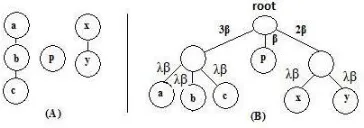
Suppose we have the following (Figure 3(A)) word network. The network can be decomposed into a collection of chains (e.g., (a,b,c), (p), and (x,y)). For each chain having number of elements more than one (e.g., (a,b,c), (x,y)), we have a subtree (see Figure 3(B)) in the DT with one internal node (blank in figure) and the words as leaves. We assign
λβas the weights of these edges whereλis the reg-ularization strength andβ is the hyperparameter of the symmetric Dirichlet prior onφ. The root node of the Dirichlet tree then connects to the internal nodei
with weight|L(i)|β. The other nodes (words) which form single element chains (e.g, (p)) are connected to the root directly with weightβ. Notice that when
[image:8.612.92.274.609.673.2]λ = 1 (i.e., no regularization), ∆(i) = 0 and our model reduces to the original LDA. By tuningλwe control the strength of regularization.
Figure 3: Incorporating word network into DT
To regularize LDA with FQG, we form the word network where a word is connected to the words in the same or adjacent fragments. Specifically, if word
wi ∈ f ragxand wordwj ∈ f ragy (wi 6= wj), we
create a link(wi, wj)ifx=yor(x, y)∈E, where
Eis the set of edges of the FQG. Implicitly by doing this we want two sentences in the same or adjacent fragments to have similar topic distributions, and fall in the same topical cluster.
4.6 LCSeg with FQG
If we examine the FQG carefully, different paths (considering the fragments of the first email as root nodes) can be interpreted as subconversations. As we walk down a path topic shifts may occur along the pathway. We incorporate FQG into the LCSeg model in three steps. First, we extract the paths of a FQG. We then apply LCSeg algorithm on each of the extracted paths separately. This process gives the segmentation decisions along the paths of the FQG. Note that a fragment can be in multiple paths (e.g.,
f,g, in Figure 2) which will cause its sentences to be in multiple segments found by LCSeg. There-fore, as a final step we need a consolidation method. Our intuition is that sentences in a consolidated seg-ment should fall in same segseg-ments more often when we apply LCSeg in step 2. To consolidate the seg-ments found, we form a weighted undirected graph where the verticesV represent the sentences and the edge weightsw(u, v)represent the number of times sentenceuandvfall in the same segment. The con-solidation problem can be formulated as aN-mincut
graph partitioning problem where we try to optimize
theNormalized Cutcriterion:
N cut(A, B) = cut(A, B)
assoc(A, V)+
cut(B, A)
assoc(B, V)
where cut(A, B) = Σu∈A,v∈Bw(u, v) and
assoc(A, V) = Σu∈A,t∈Vw(u, t) is the total
con-nection from nodes in partition A to all nodes in the graph andassoc(B, V) is similarly defined. How-ever, solving this problem turns out to be NP-hard. Hence, we approximate the solution following (Shi and Malik, 2000) which has been successfully ap-plied to image segmentation in computer vision.
Avg. Topic LDA LDA +FQG LCSeg LCSeg +FQG Speaker Block 5
Number 2.10 1.90 2.2 2.41 4.87 5.69
Length 13.3 15.50 13.12 12.41 5.79 4.60
Density 1.83 1.60 1.01 1.39 1.37 1.00
[image:9.612.119.495.55.127.2]Entropy 0.98 0.75 0.81 0.93 1.88 2.39
Table 3: Corpus statistics of different system’s annotation
5 Experiments
We ran our four systemsLDA, LDA+FQG, LCSeg,
and LCSeg+FQG on the dataset11. The statistics
of these four annotations and two best performing baselines (i.e., ‘Speaker’ and ‘Block 5’ as described below) are shown in Table 3. For brevity we just mention the average measures. Comparing with Ta-ble 1, we see that these fall within the bounds of the human annotations.
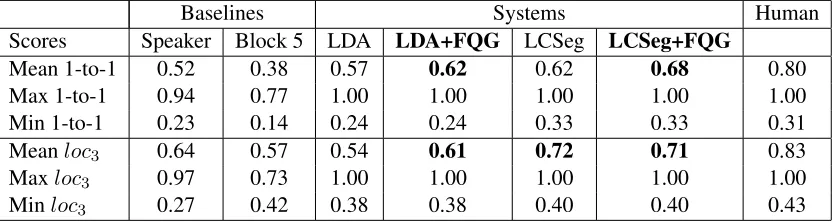
We compare our results in Table 4, where we also provide the results of some simple baseline systems. We evaluated the following baselines and report the best two in Table 4.
All different:Each sentence is a separate topic.
All same:The whole thread is a single topic.
Speaker: The sentences from each participant
constitute a separate topic.
Blocks of k(= 5,10,15): Each consecutive
group ofksentences is a topic.
Most of these baselines perform rather poorly.
All differentis the worst baseline with mean
1-to-1 score of 0.10 (max: 0.33, min: 0.03) and mean
loc3 score of 0.245 (max: 0.67, min: 0). Block 10has mean 1-to-1 score of 0.35 (max: 0.71, min: 0.13) and mean loc3 score of 0.584 (max: 0.76,
min: 0.31). Block 15 has mean 1-to-1 score of 0.32 (max: 0.77, min: 0.16) and mean loc3 score
of0.56(max: 0.82, min: 0.38).All sameis optimal for threads containing only one topic, but its perfor-mance rapidly degrades as the number of topics in a thread increases. It has mean 1-to-1 score of0.28 (max: 112, min: 0.11) and meanloc3 score of0.54
11For a fair comparison of the systems we set the same topic
number per thread for all of them. If at least two of the anno-tators agree on the topic number we set that number, otherwise we set the floor value of the average topic number.λis set to 20 in LDA+FQG.
12
The maximum value of 1 is due to the fact that for some threads some annotators found only one topic
(max: 1, min: 0.34).
As shown in Table 4,SpeakerandBlocks of5are two strong baselines especially for theloc3. In
gen-eral, our systems perform better than the baselines, but worse than the gold standard. Of all the systems, the basic LDA model performs very disappointingly. In the local agreement it even fails to beat the base-lines. A likely explanation is that the independence assumption made by LDA when computing the dis-tribution over topics for a sentence from the distribu-tion over topics for the words causes sentences in a local context to be excessively distributed over top-ics. Another possible explanation for LDA’s disap-pointing performance is the limited amount of data available for training. In our corpus, the average number of sentences per thread is26.3(see table 1) which might not be sufficient for the LDA models.
If we compare the performance of the regularized LDA (in the table LDA+FQG) with the basic LDA we get a significant (p=0.0002 (1-to-1), p=9.8e-07 (loc3)) improvement in both of the measures13. This
supports our claim that sentences connected by ref-erential relations in the FQG usually refer to the same topic. The regularization also prevents the lo-cal context from being overly distributed over topics. A comparison of the basic LCSeg with the basic LDA reveals that LCSeg is a better model for email topic segmentation (p=0.00017 (1-to-1), p<2.2e-16 (loc3)). One possible reason is that LCSeg extracts
the topics keeping the local context intact. An-other reason could be the term weighting scheme employed by LCSeg. Unlike LDA, which considers only ‘repetition’, LCSeg also considers how tightly the ‘repetition’ happens. When we incorporate the conversation structure (i.e., FQG) into LCSeg (in the table LCSeg+FQG), we get a significant improve-ment in the 1-to-1 measure over the basic LCSeg (p=0.0014). Though the local context (i.e.,loc3)
Baselines Systems Human Scores Speaker Block 5 LDA LDA+FQG LCSeg LCSeg+FQG
Mean 1-to-1 0.52 0.38 0.57 0.62 0.62 0.68 0.80
Max 1-to-1 0.94 0.77 1.00 1.00 1.00 1.00 1.00
Min 1-to-1 0.23 0.14 0.24 0.24 0.33 0.33 0.31
Meanloc3 0.64 0.57 0.54 0.61 0.72 0.71 0.83
Maxloc3 0.97 0.73 1.00 1.00 1.00 1.00 1.00
[image:10.612.99.516.55.166.2]Minloc3 0.27 0.42 0.38 0.38 0.40 0.40 0.43
Table 4: Comparison of Human, System and best Baseline annotations
fers a bit, the decrease in performance is minimal and it is not significant. The fact that LCSeg is a better model than LDA is also preserved when we incorporate FQG into them (p=2.140e-05 (1-to-1), p=1.3e-09 (loc3)). Overall, LCSeg+FQG is the best
model for this data.
6 Future Work
There are some other important features that our models do not consider. The ‘Speaker’ feature is a key source of information. A participant usu-ally contributes to the same topic. The best base-line ‘Speaker’ in Table 4 also favours this claim. Another possibly critical feature is the ‘mention of names’. In multi-party discussion people usually mention each other’s name for the purpose of dis-entanglement (Elsner and Charniak, 2008). In our corpus we found175instances where a participant mentions other participant’s name. In addition to these, ‘Subject of the email’, ‘topic-shift cue words’ can also be beneficial for a model. As a next step for this research, we will investigate how to exploit these features in our methods.
We are also interested in the near future to transfer our approach to other similar domains by hierarchi-cal Bayesian multi-task learning and other domain adaptation methods. We plan to work on both syn-chronous (e.g., chats, meetings) and asynsyn-chronous (e.g., blogs) domains.
7 Conclusion
In this paper we presented an email corpus annotated for topic segmentation. We extended LDA and LC-Seg models by incorporating the fragment quotation graph, a fine-grain model of the conversation, which is based on the analysis of quotations. Empirical
evaluation shows that the fragment quotation graph helps both these models to perform significantly bet-ter than their basic versions, with LCSeg+FQG be-ing the best performer.
Acknowledgments
We are grateful to the6 pilot annotators,3test an-notators and to the3anonymous reviewers for their helpful comments. This work was supported in part by NSERC PGS award, NSERC BIN project, NSERC discovery grant and Institute for Comput-ing, Information and Cognitive Systems (ICICS) at UBC.
References
James Allan, 2002. Topic detection and tracking: event-based information organization, pages 1–16. Kluwer Academic Publishers, Norwell, MA, USA.
David Andrzejewski, Xiaojin Zhu, and Mark Craven. 2009. Incorporating domain knowledge into topic modeling via dirichlet forest priors. In Proceedings of the 26th Annual International Conference on Ma-chine Learning (ICML’09), pages 25–32, New York, NY, USA. ACM.
Paul M. Aoki, Margaret H. Szymanski, Luke D. Plurkowski, James D. Thornton, Allison Woodruff, and Weilie Yi. 2006. Where’s the ”party” in ”multi-party”?: analyzing the structure of small-group socia-ble talk. InProceedings of the 2006 20th anniversary conference on Computer supported cooperative work (CSCW ’06), pages 393–402, New York, NY, USA. ACM.
David M. Blei, Andrew Y. Ng, and Michael I. Jordan. 2003. Latent dirichlet allocation. JMLR, 3:993–1022. Jordan L. Boyd-Graber and David M. Blei. 2010.
Syn-tactic topic models.CoRR, abs/1002.4665.
of the 16th international conference on World Wide Web, pages 91–100. ACM New York, NY, USA. Harr Chen, S. R. K. Branavan, Regina Barzilay, and
David R. Karger. 2009. Global models of document structure using latent permutations. In NAACL’09, pages 371–379, Morristown, NJ, USA. ACL.
Freddy Y. Y. Choi, Peter Wiemer-Hastings, and Johanna Moore. 2001. Latent semantic analysis for text seg-mentation. InIn Proceedings of EMNLP, pages 109– 117, Pittsburgh, PA USA.
Freddy Y. Y. Choi. 2000. Advances in domain inde-pendent linear text segmentation. In Proceedings of the 1st North American chapter of the Association for Computational Linguistics conference, pages 26–33, San Francisco, CA, USA. Morgan Kaufmann Publish-ers Inc.
David Crystal, 2001. Language and the Internet. Cam-bridge University Press.
Ga¨el Dias, Elsa Alves, and Jos´e Gabriel Pereira Lopes. 2007. Topic segmentation algorithms for text summa-rization and passage retrieval: an exhaustive evalua-tion. In AAAI’07: Proceedings of the 22nd national conference on Artificial intelligence, pages 1334– 1339. AAAI Press.
Mark Dredze, Hanna M. Wallach, Danny Puller, and Fer-nando Pereira. 2008. Generating summary keywords for emails using topics. In IUI ’08, pages 199–206, New York, NY, USA. ACM.
Micha Elsner and Eugene Charniak. 2008. You talking to me? a corpus and algorithm for conversation dis-entanglement. InProceedings of ACL-08: HLT, pages 834–842, Ohio, June. ACL.
Michel Galley, Kathleen McKeown, Eric Fosler-Lussier, and Hongyan Jing. 2003. Discourse segmentation of multi-party conversation. InACL ’03: Proceedings of the 41st Annual Meeting on Association for Compu-tational Linguistics, pages 562–569, Morristown, NJ, USA. Association for Computational Linguistics. M. Georgescul, A. Clark, and S. Armstrong. 2008. A
comparative study of mixture models for automatic topic segmentation of multiparty dialogues. In ACL-08:HLT, pages 925–930, Ohio, June. ACL.
Thomas L. Griffiths and Mark Steyvers. 2003. Predic-tion and semantic associaPredic-tion. InAdvances in Neural Information Processing Systems. MIT Press.
Thomas L. Griffiths, Mark Steyvers, David M. Blei, and Joshua B. Tenenbaum. 2005. Integrating topics and syntax. In In Advances in Neural Information Pro-cessing Systems, pages 537–544. MIT Press.
Sanda Harabagiu and Finley Lacatusu. 2005. Topic themes for multi-document summarization. InSIGIR ’05:, pages 202–209, New York, NY, USA. ACM.
Marti A. Hearst. 1997. Texttiling: segmenting text into multi-paragraph subtopic passages. Comput. Lin-guist., 23(1):33–64, March.
Pei Hsueh, Johanna D. Moore, and Steve Renals. 2006. Automatic segmentation of multiparty dialogue. In
Proceedings of the European Chapter of the Associ-ation for ComputAssoci-ational Linguistics (EACL), Trento, Italy. ACL.
Igor Malioutov and Regina Barzilay. 2006. Minimum cut model for spoken lecture segmentation. In Pro-ceedings of the ACL’06, pages 25–32, Sydney, Aus-tralia, July. ACL.
T. Minka. 1999. The dirichlet-tree distribution. Techni-cal report, Justsystem Pittsburgh Research Center. Matthew Purver, Konrad P. K¨ording, Thomas L. Griffiths,
and Joshua B. Tenenbaum. 2006. Unsupervised topic modelling for multi-party spoken discourse. In Pro-ceedings of the ACL’06, pages 17–24, Sydney, Aus-tralia. ACL.
Jianbo Shi and Jitendra Malik. 2000. Normalized cuts and image segmentation. IEEE Trans. Pattern Anal. Mach. Intell., 22(8):888–905.
M. Steyvers and T. Griffiths, 2007. Latent Semantic Analysis: A Road to Meaning, chapter Probabilistic topic models. Laurence Erlbaum.
J. Ulrich, G. Murray, and G. Carenini. 2008. A publicly available annotated corpus for supervised email sum-marization. In EMAIL-2008 Workshop, pages 428– 435. AAAI.