Master Thesis
How to teach reflective writing? Studying the contribution of autobiographic reflection in social work education.
Julia Rickers Student number: 1349996
University of Twente
Faculty of Behavioral, Management and Social Sciences Psychology
Supervision: Dr. Stans Drossaert
Abstract
Reflection is an important part of social work education and its benefits for social workers are far-reaching. Yet, despite the benefits, students struggle to write proper reflections with the currently often-used core-reflection method. Thus, adaption in reflective education is needed. Autobiographic reflection was tested to have a positive influence on the professional development of social work students. Research suggests that the method of autobiographic reflection can have a positive effect on the professional development of social students. Therefore, this study aims to test the contribution that autobiographic reflection can bring to reflective writing capacity of social work students at Saxion University of Applied Sciences. Applying a quasi-experimental research design, second-year students were divided according to their classes in either the experimental condition (a combination of core and autobiographic reflection training) or the control condition (core reflection training only). After the respective training, students wrote a reflective essay which was permitted by them to be used for this study. Eventually, 98 essays were analyzed with regard to the reflective writing capacity on the basis of the NARRA. No significant differences between the two conditions have been found. Neither have age or gender been of influence on the effectiveness of the training program. It was noticed that the overall reflective writing skills of the students were low. Students receiving eight lessons on core reflection perceived significantly more helpfulness than students receiving four lessons on autobiographic reflection. This study indicates that an incorporation of autobiographic reflection training does not have a positive effect on the reflective writing skills. More research is needed to get more insight into the additional benefits of autobiographic reflection, like professional growth and increased self-perception. This study provides the first step into an adaptation of reflective education for social work students.
How to teach reflective writing? Studying the contribution of autobiographic reflection in social work education.
Reflection becomes a more and more crucial part of modern education. Especially social work students benefit from the advantages reflection can bring up. Unfortunately, students keep struggling with writing proper reflective essays (Engelbertink, 2014). This study aims to test the additional value that autobiographic reflection training can bring into reflective education in order to increase the reflective writing skills in social work students. In the following, the term reflection is going to be defined in the context of professional development, followed by highlighting the benefits, and thereby pointing out the importance of reflection for social work students.
Although reflection is a fuzzy term that is difficult to define because of its vagueness (Vos & Vlas, 2000; Mansvelder-Logaroux, 2006), there is much research conducted in this field, and with this, just as many definitions exist. One recent definition comes from Mittendorff (2014) who describes reflection as “the procession of significant experiences, focused on new insights and entailed actions in the future”. Applied on the field of profession progress, reflection can be seen as an examination of capacities and motivation which are important for the career where present work-skills and personal values are central topics (Luken, 2010).
social skills, namely, empathy, communication, collaboration, and advocacy, which certainly are essential characteristics in the social occupational area. Ringel (2003) further supports these findings. According to her, social work can only be successful if there is a good working relationship (i.e. collaboration) between the client and the social worker, which in turn, underlies the importance of reflective ability in social work students.
Additionally, Ringel (2003) found reflection to have a positive influence on social work ethics and values. Social work values hereby include professionalism, client empowerment and self-determination (Allen, 1993). Again, these are surely crucial characteristics for the success of social work projects. As expected, reflection also helps raising awareness for one’s own personal and social biases such as stereotypes or intolerance of ambiguity (Davis & Sherman, 1987), which again, can lead to a more culture-fair practice. This becomes even more important in times of globalization as well as refugee movements.
Summing up, reflection can potentially increase a) cognitive abilities (i.e. critical thinking and decision making), b) social skills, c) one’s understanding of social work ethics and values, and d) the awareness for one’s own biases. But, despite these advantages reflection is rarely used in a proper way. Students keep struggling with writing suitable reflection (Benammar, 2005). For several reasons, adequate reflection within the normal curriculum is problematic. For example, Korthagen (2011) states that there is simply a lack of time, which leads to reflections barely scratching the surface. In line with that, Benammar (2005) found out that students mainly evaluate experiences, rather than identifying their meaning. According to him, students focus too much on personal problems, instead of reflecting on their professional development.
but on the other hand, students and educational programs seem to fail to apply them correctly. Several studies (cf. e.g. Karkabi, Wald & Cohen, 2014) indicate that reflective writing is a skill that can be taught – rather than an inherent ability. Therefore, it is important that teachers learn to adequately and effectively teach their students how to reflect on their own thoughts and actions, even though this might be one of their greatest challenges (Tsingos-Lucas et al., 2017).
Reflection is often an obligatory part of social work study programs. But without visible benefits, this obligation might become a double-edged sword. Students might perceive it as nothing more than a bothersome or boring task which is done out of obligation. This obligation manifests in the finding, that there is a difference between what students write as an honest reflection with no grading following-up and what they write when they expect to be graded (Tsingos-Lucas et al., 2017). The student’s attempt to write what they expect to be good for their grades limits the effectiveness and compromises the quality even more. The problem occurring subsequently, is addressed by Kelchtermans (2007). He states that students do not easily achieve the highest level of reflection, which was also labeled ‘critical reflection’ by Manen (1977). The effect is that reflection deteriorates all value in the students’ eyes since they cannot consider reflection to be an addition that is useful in their education. Therefore, it is important to teach students how to reflect properly to let them perceive the added value, reflection brings into their education. In order to achieve a higher level of reflective skills, it should be defined what students are expected to write and how a critical reflection should look like.
students describe their value judgments with nuances and with emotions. The reflection should also contain prior beliefs about oneself, the context and the profession. These beliefs and ideas should be connected to the experience and consequently evaluated and (if necessary) adapted. Questions and hypotheses should help challenging these prior beliefs. Eventually, new goals should be transformed into concrete learning objectives and at the end of the reflection, the implementation of these learning objectives should be discussed (Alsina, 2017). The study at hand focusses on the improvement of reflective skills in students through an adaptation of reflective education and the currently used methods.
decisiveness. These core qualities show accordance with the exact same social skills that reflection can improve.
But there are downsides of core reflection as well. Although core reflection is an adequate method to detect (hidden) core qualities and to influence the deepest levels of Bateson’s onion model students keep struggling at striking those deeper levels. Apart from that, social work students often encounter problems which are related to the outer levels, like their own behavior or competences. Korthagen (2010) adds, that students keep struggling when it comes to differentiating between which level should be reflected on. Students either try to go on deep levels when problems only regard outer levels, or they do not go deep enough. In turn, positive effects can be diminished. Moreover, it is relatively easy to improve behavior and competences on the basis of this method, but reflecting on deeper levels in order to get insight into the students’ own (professional) identity is hardly achieved by social work students. But according to Beauchamp and Thomas (2009), an awareness for the importance of a professional identity as well as building a professional identity should be part of the educational process. So, to enable students developing a professional identity ideally by improving their reflective writing skills, the method of teaching reflection has to be extended and adapted.
to make it more applicable for social work students and named it ‘uit je verhaal’ (‘express your story). Autobiographic reflection follows consequently the process of autobiographic writing (i.e. writing about an experience or memory). After that, autobiographic reflection takes place, thus students reflect on their written stories. They ought to wonder about what this specific experience tells them about their identity or professional identity in a work-related experience. Adopting creative writing can improve the ability to write autobiographically as well. Instead of writing a story, students are offered the possibility to draw a painting or to write poetry.
Writing life stories has a number of positive effects for the writer. Not only can it help to cope with difficult experiences, since writing is one possibility to regulate emotions, but it also leads to more insight into one’s motivations. Looking at experiences with a more distant view, autobiographical writing leads to more self-perception, well-being for the individual, and last but not least, growth. This is underpinned by Engelbertink (2014), who found that the adapted intervention was beneficial for social work students. She stressed that students participating in an autobiographic reflection course, reported growth in their professional development and an increase in self-confidence, but also limited these results by stressing there was no control group. Participants also reported that they experience a better self-perception after this intervention and that this had a positive effect on their work-related competences.
autobiographic reflection focusses on past experiences in the form of stories, without discussing a specific action and by that strengthening the (professional) identity in order to adapt future behavior. Autobiographic reflection also encourages students to tangle the deepest two levels of Bateson’s onion model, thus the level of identity and the level of mission. Therefore, both reflective methods try to enable students to reflect as deeply as possible.
This paper deals with the following main research question: To what extend does autobiographic reflection training contribute to the level of reflective writing skills of second-year
social work students from Saxion University of Applied Sciences? Autobiographic reflection might
be a fitting addition to the currently used core reflection method, with regard to the proven positive effect on social work students and their professional identity. Given the positive effect of both reflective methods and the multitude of addressable situations, we expect students receiving core reflection training as well as autobiographic reflection training to slightly outperform students who only receive core reflection training. Moreover, we expect ‘prior conceptions and beliefs’ to be more explicit when students received autobiographic reflection training. In addition, we investigate whether there are differences between gender or age-groups when it comes to the extent of benefits. Two sub-questions can be derived: How does the gender affect the contribution that autobiographic reflection brings to reflective writing skills? How does age affect the contribution
autobiographic reflection brings to reflective writing skills? We expect female students to have
see whether gender or age do have an influence on the reflective writing skills in general. The third and last sub-question concerned the perceived helpfulness of the students with regard to the two methods. Thus, the third question is: which reflective method is perceived to be more helpful with regard to the student’s professional development? Although we expect students to rate autobiographic reflection training highly helpful, we see it to be likely that the control group will consider core reflection more helpful, since they receive the double amount of lessons on this method.
Method
A quasi-experimental study with two arms was set up in order to examine the reflective writing capacity of social work students at Saxion University of Applied Sciences. The first arm was the experimental condition where students receive autobiographic reflection as well as core reflection training, the second arm is the control condition where students only receive core reflection training. The main outcome variable was the result of the content analyses of the reflective essays written by the students. Asking students about their age, their gender and their subjective perception of the helpfulness with regard to their professional development gives three additional variables, concerning the sub-questions of this paper.
Sampling and allocation
decided to have 7 classes participating in the control condition and 7 classes taking part in the autobiographic condition. In total, nine teachers were interested, of which seven were randomly chosen by the researcher team to give autobiographic reflection training. These seven teachers were then given the task to each choose one other teacher of the 17 remaining ones, one that resembles themselves in regard to didactical style, which would result in 14 participating teachers. Nevertheless, one teacher refused to participate in the control condition to spare the students from the reflective essay and the extra work load coming along. Therefore, we had 13 participating teachers, which makes 13 participating classes, seven in the experimental group and six in the control group. Thus, students were assigned to one of the two conditions according to the choice of their teachers. After following the training, all students were obligatorily assigned to write a reflection and students from the participating classes were asked whether they want to participate anonymously in this study. Eventually, students were able to fill in an informed consent, in case they agreed on participating (see Appendix B). For this study in particular, the researcher team randomly collected seven reflective essays per class in the experimental condition and eight reflective essays per class in the control condition, thus 49 and 48, which makes a total of 97 reflective essays. To round it up, one additional essay was randomly picked from the autobiographic condition and two essays were picked from the control condition, so that eventually 100 reflective essays were collected.
Intervention
to write about their a) childhood, b) adolescence, c) work and care, d) love and friendship, e) art of life or f) lessons of life as a homework and thereafter, reflect on what they wrote. Besides, Blackboard provided the possibility of sharing the added value a student perceived with other students. They also had the possibility to ask other students for feedback about their reflection.
When writing the final reflective essay, students from both conditions had to write this essay on the basis of six questions: a) Describe the situation. What happened precisely? b) Which consequences had this experience for you? c) How do you see yourself in this situation? Did you come to your own? d) What had this situation in common with other meaningful situations with regard to the development of your professional identity? e) What can you do in the next two weeks to strengthen your professional identity? What do you need in order to achieve this? How are you going to test your improvement? and f) Regarding the awareness and/or strengthening of your professional identity, what effect had this reflection? All questions are based on Korthagen’s circle of reflection, but especially questions c and d aimed to bring benefits to students from the experimental conditions. The reflective essay was required to be about the students’ professional identity (but could also have taken place in a private setting) and could be both, positive or negative. But in any case, the situation had to have an impact on the student.
Variable measurement
the following called NARRA (cf. Appendix C; Alsina, et al., 2017). The gender of the students was noted and the age of the students was measured continuously, and post-hoc divided into two age-groups, splitting them at the mean age. Eventually, the variable ‘perceived helpfulness’ was assessed. After finishing the obligatory writing assignment, all participating students were asked if the respective method (or both), were helpful for them with regard to the development of their professional identity. This question could be answered with a) yes, b) to some degree, or c) no. This means, the experimental group had to answer that question twice, for the core reflection lessons as well as for the autobiographic reflection lessons separately. This makes a total of three measurements (i.e. 8 lessons on core reflection, 4 lessons on core reflection and 4 lessons on autobiographic reflection).
Coding
but not least, element 4 contains the transformation. The student was supposed to set concrete learning objectives and future action plans and approaches to initiate a new reflective cycle. This element again is divided into two indicators, namely 4.1. the specification, argumentation and transformation of new learning goals and 4.2. the implementation and argumentation of new action plans (see also Appendix C).
The coding of the 100 reflective essays was executed by two independent coders who were blind to the condition. In order to get a sufficient inter-rater reliability, 10 essays were evaluated openly together, then compared and discussed. This process was repeated with independent evaluations until the inter-rater reliability exceeds 70% and was therefore sufficient. The first round consisted of 16 essays, followed by a second round evaluating 10 essays and the final round with 6 essays. After three rounds of evaluation and discussion, the inter-rater reliability was 72.2% on the basis of the joint-probability of agreement (Appendix D). When facing disagreement, the two raters discussed the controversy and adapted the format to prevent from the occurrence of further misunderstandings.
Data analysis
included three newly formed age groups. In order to investigate gender differences between the two conditions a chi-square test was used. The same was done for age with the help of a Mann-Whitney-U test.
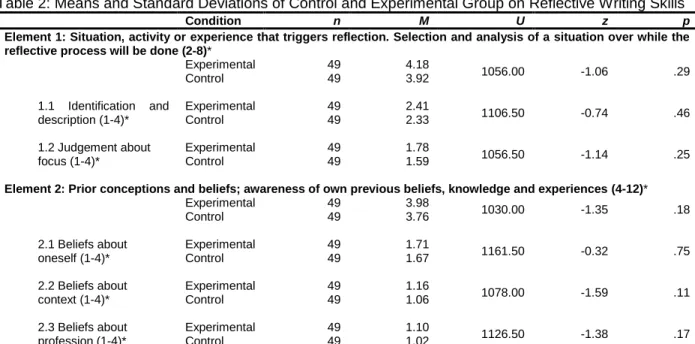
In order to compare the effectiveness of the course, a non-parametric test for two independent groups was executed. On the basis of the Mann-Whitney U test, all scores, the indicators, the elements and the total score were compared between the two conditions. To get insight into the influence of the gender and the age of the participants on a) the effectiveness of the two conditions and b) the obtained reflective writing skills, a two-way analysis of variance was executed. Finally, a one-way analysis of variance was executed in order to look at the perceived helpfulness with regard to their professional development. For all statistical tests, an alpha value of p = .05 was applied.
Results
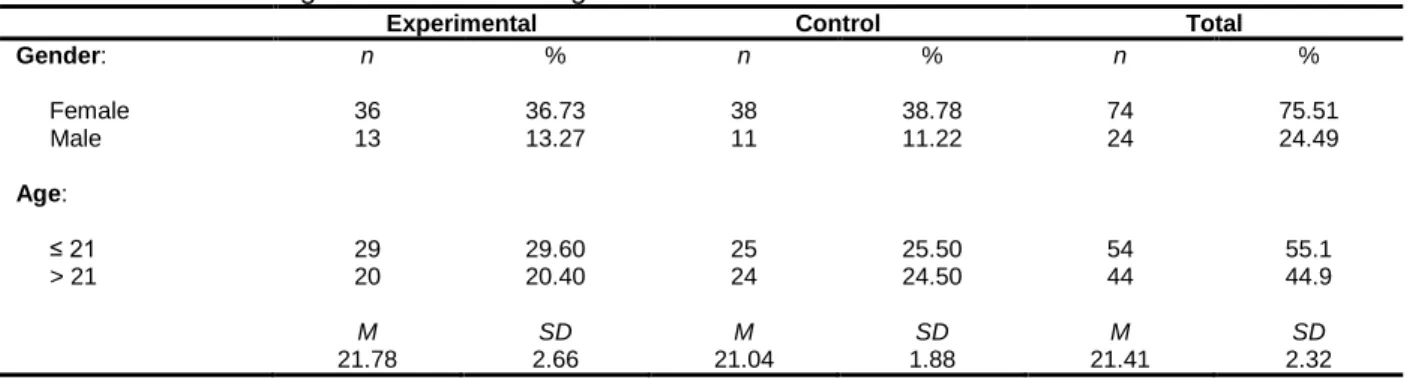
In total, 98 essays (N) were applicable for analysis. One student rejected the task to reflect by considering himself unable to think of a situation to reflect on and one participant refused to give full particulars about his person, including age, gender and satisfaction with his or her professional development during the course. This leaves a sample of 49 essays per condition. Most of the participants were female (75.5%) and the majority of the students were around 22 years old (M = 21.4, SD = 2.3). On the basis of the mean age, two age groups were formed. Group 1 included every participant younger than 22. Group 2 consists of every participant older than 21 (see also table 1). A chi-square test of goodness-of-fit was performed to demonstrate that the distribution of gender was equal among the two conditions (χ2 (1) = 0.22, p = .64). Likewise, there were no
Table 1: Gender and age distribution among the two conditions for N = 98
Experimental Control Total
Table 2: Means and Standard Deviations of Control and Experimental Group on Reflective Writing Skills
Condition n M U z p
Element 1: Situation, activity or experience that triggers reflection. Selection and analysis of a situation over while the reflective process will be done (2-8)*
Experimental Control
49 49
4.18
3.92 1056.00 -1.06 .29 1.1 Identification and
description (1-4)* Experimental Control 49 49 2.41
2.33 1106.50 -0.74 .46 1.2 Judgement about
focus (1-4)* Experimental Control 49 49 1.78
1.59 1056.50 -1.14 .25
Element 2: Prior conceptions and beliefs; awareness of own previous beliefs, knowledge and experiences (4-12)* Experimental
Control
49 49
3.98
3.76 1030.00 -1.35 .18 2.1 Beliefs about
oneself (1-4)* Experimental Control 49 49 1.71
1.67 1161.50 -0.32 .75 2.2 Beliefs about
context (1-4)* Experimental Control 49 49 1.16
1.06 1078.00 -1.59 .11 2.3 Beliefs about
profession (1-4)* Experimental Control 49 49 1.10
1.02 1126.50 -1.38 .17
Element 3: Inquiring and/or focusing: Investigating possible actions of students through focusing and questions and hypotheses (2-8)*
Experimental Control
49 49
3.27
3.27 1172.00 -0.23 .82 3.1 Inquiries about focus
(1-4)* Experimental Control 49 49 2.16
2.00 1032.50 -1.42 .16 3.2 Inquiries about
context (1-4)* Experimental Control 49 49 1.10
1.27 1026.50 -1.88 .06
Element 4: Transformation: Set concrete learning goals and future action plans and approaches to initiate a new reflective cycle. Paradigm shift. Argumentation of these changes or the need for them (2-8)*
Experimental Control
49 49
2.98
3.02 1188.00 -0.10 .92 4.1 Specification of
learning goals (1-4)*
Experimental Control
49 49
1.86
1.80 1123.00 -0.69 .49 4.2 Implementation of
action plans (1-4)*
Experimental Control
49 49
1.12
1.22 1099.50 -1.12 .26 Total score (9-36)* Experimental
Control
49 49
14.41
13.96 1077.00 -0.89 .38
Results of a Mann-Whitney U test executed with a significance level of p = .05; * possible range of the score
Gender
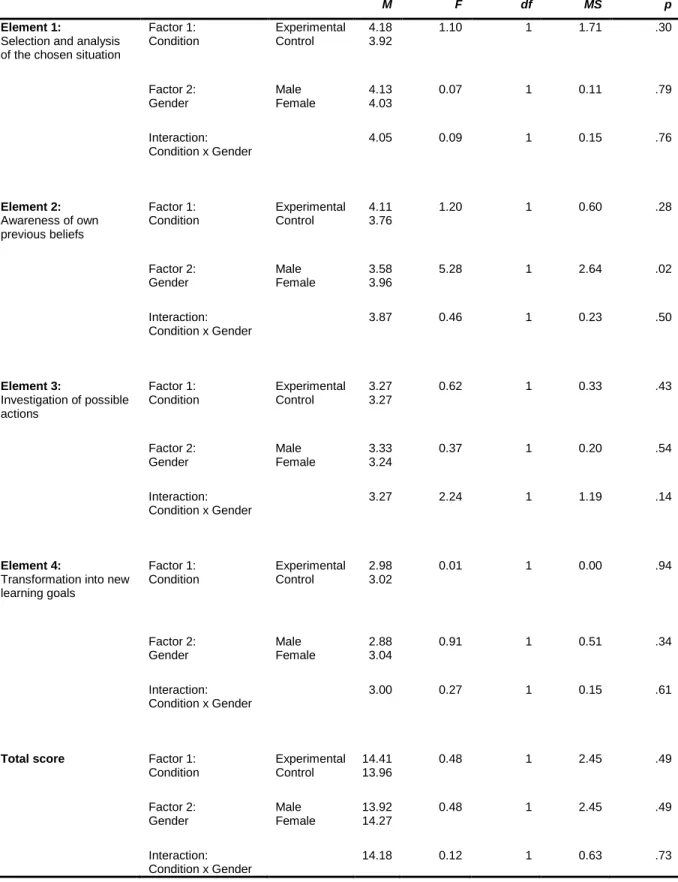
Table 3: Analysis of Variance on the Impact (of the Interaction) of Gender and Condition on the Effectiveness of the Respective Reflective Training Condition, Denoted as Reflective Writing Skills in the Total Score as well as on the Elements and Indicators of the NARRA
M F df MS p
Element 1:
Selection and analysis of the chosen situation
Factor 1: Condition Experimental Control 4.18 3.92
1.10 1 1.71 .30
Factor 2: Gender Male Female 4.13 4.03
0.07 1 0.11 .79
Interaction: Condition x Gender
4.05 0.09 1 0.15 .76
Element 2:
Awareness of own previous beliefs Factor 1: Condition Experimental Control 4.11 3.76
1.20 1 0.60 .28
Factor 2: Gender Male Female 3.58 3.96
5.28 1 2.64 .02
Interaction: Condition x Gender
3.87 0.46 1 0.23 .50
Element 3:
Investigation of possible actions Factor 1: Condition Experimental Control 3.27 3.27
0.62 1 0.33 .43
Factor 2: Gender Male Female 3.33 3.24
0.37 1 0.20 .54
Interaction: Condition x Gender
3.27 2.24 1 1.19 .14
Element 4:
Transformation into new learning goals Factor 1: Condition Experimental Control 2.98 3.02
0.01 1 0.00 .94
Factor 2: Gender Male Female 2.88 3.04
0.91 1 0.51 .34
Interaction: Condition x Gender
3.00 0.27 1 0.15 .61
Total score Factor 1: Condition
Experimental Control
14.41 13.96
0.48 1 2.45 .49
Factor 2: Gender Male Female 13.92 14.27
0.48 1 2.45 .49
Interaction: Condition x Gender
Neither was there a significant interaction effect of gender and condition on the reflective writing skills. When taking a look at the main effect of gender on the sub-elements, we can see that gender had a main effect on the element ‘awareness of own previous beliefs’, thus element 2 (F(1, 94) = 5.28, p = 0.02). This main effect indicates that women do perform better when it comes to the ‘awareness of one’s own previous beliefs’, compared to their male counterparts. This finding is independent of the training the participant received. An interaction effect of gender and condition on one of the elements was not apparent, suggesting that gender has no impact on the effectiveness of the training.
Age
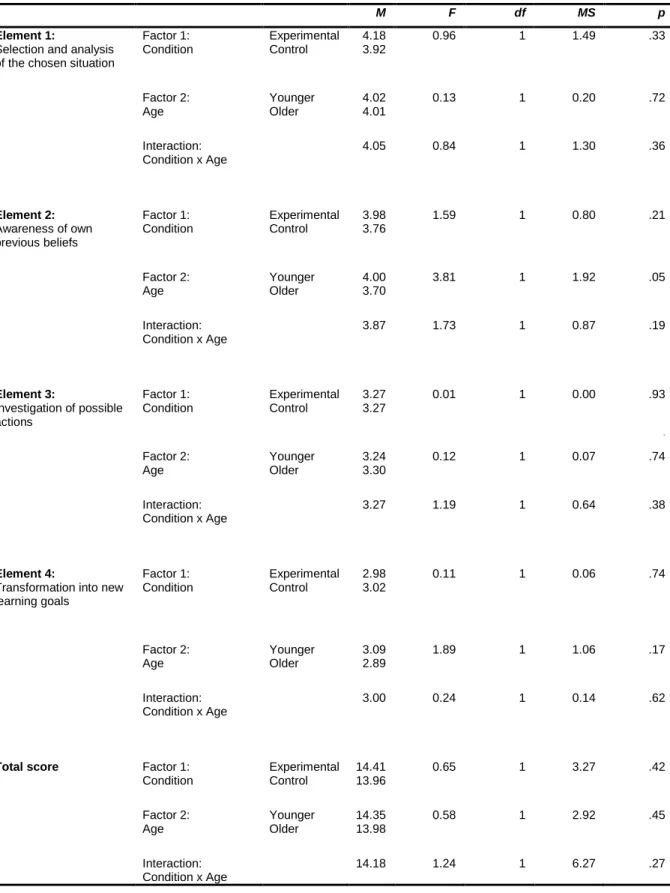
Another two-way analysis of variance was conducted to compare the main effect of the age group and the interaction effect of age group and condition on reflective writing skills and its elements. There was no main effect of the age group on reflective writing skills to be found (cf. table 4). Neither were there any significant main effect of age on one of the four elements. Moreover, there was no interaction effect of age group and condition on the reflective writing skills and likewise, there was no interaction effect of age group and condition on one of the four elements. Perceived helpfulness
Table 4: Analysis of Variance on the Impact (of the Interaction) of Age Groups and Condition on the Effectiveness of the Respective Reflective Training Condition, Denoted as Reflective Writing Skills in the Total Score as well as on the Elements and Indicators of the NARRA
M F df MS p
Element 1:
Selection and analysis of the chosen situation
Factor 1: Condition Experimental Control 4.18 3.92
0.96 1 1.49 .33
Factor 2: Age Younger Older 4.02 4.01
0.13 1 0.20 .72
Interaction: Condition x Age
4.05 0.84 1 1.30 .36
Element 2:
Awareness of own previous beliefs Factor 1: Condition Experimental Control 3.98 3.76
1.59 1 0.80 .21
Factor 2: Age Younger Older 4.00 3.70
3.81 1 1.92 .05
Interaction: Condition x Age
3.87 1.73 1 0.87 .19
Element 3:
Investigation of possible actions Factor 1: Condition Experimental Control 3.27 3.27
0.01 1 0.00 .93
. Factor 2: Age Younger Older 3.24 3.30
0.12 1 0.07 .74
Interaction: Condition x Age
3.27 1.19 1 0.64 .38
Element 4:
Transformation into new learning goals Factor 1: Condition Experimental Control 2.98 3.02
0.11 1 0.06 .74
Factor 2: Age Younger Older 3.09 2.89
1.89 1 1.06 .17
Interaction: Condition x Age
3.00 0.24 1 0.14 .62
Total score Factor 1: Condition
Experimental Control
14.41 13.96
0.65 1 3.27 .42
Factor 2: Age Younger Older 14.35 13.98
0.58 1 2.92 .45
Interaction: Condition x Age
In order to get more insight into the way the respective training method influences the level of perceived helpfulness, post hoc comparisons were executed, using the test ‘Least Significant Difference’ (LSD). This test indicates that participants receiving eight lessons of core reflection (M = 1.82, Sd = 0.63) considered the method to be significantly more helpful than people who received four lessons on autobiographic reflection (M = 2.20, Sd = 0.61). However, there was no significant difference to be found between eight lessons on core reflection (M = 1.82, Sd = 0.63) and four lessons on core reflection (M = 2.00, Sd = 0.50). Participants tend to be more satisfied with receiving four lessons on core reflection (M = 2.00, Sd = 0.50) than with receiving four lessons on autobiographic reflection (M = 2.20, Sd = 0.61), this difference however, was not statistically significant.
Discussion
the other three elements. Taking a look at previous research, females, on average score higher on reflective capacity (Ottenberg, Pasalic, Bui & Pawlina, 2015). These findings cannot be confirmed in this study. The second sub-question includes the interaction effect of age and condition as well as the main effect of age on the reflective writing skills and its components. We found neither significant interaction effects, nor significant main effects to report. Agreeing with our results, Naber and Wyatt (2014) found no differences in age regarding reflective capacity. Unfortunately, results regarding the interaction effect cannot be compared with other studies, since, to our knowledge, the incorporation of autobiographic reflection was not tested earlier. Finally, we can report a significant difference in perceived helpfulness when comparing the eight lessons on core reflection training and four lessons on autobiographic reflection training in favor of the core reflection training.
This study implies that the reflective writing skills do not decline when adding autobiographic reflective classes, although core reflection classes have been cut in half. This indicates that autobiographic reflection in combination with core reflection is at least as beneficial for students than core reflection training alone. However, the question remains why autobiographic reflection was less effective than expected.
focusses solely on the reflective writing capacity (Alsina et al., 2017), which is precisely what needed to be measured for this study, but the benefits of autobiographic reflection might exceed reflective writing skills. This means that the added value of autobiographic reflection not only lies in enhancing reflective writing skills but in the personal and professional development (Saxion, 2016). During a training conducted at Saxion University, students were able to gain more insight into their personality and identity. This knowledge about themselves is an essential part of reflective education and of the construction of a professional identity (Beauchamp & Thomas, 2009) and it leads to another point to discuss. The enhancement of personal and professional development was observed among 4th year social work students, suggesting that either age or study
experience might be of impact on the effectiveness of autobiographic reflection training. This study suggests that age does not affect the effectiveness of the training. So further research needs to be conducted, examining study experience as a possible mediator predicting the effectiveness of autobiographic reflection training.
The last sub-question dealt with the perceived helpfulness. We found that students considered eight lessons of core reflection training more helpful than four lessons of autobiographic reflection. There was no significant difference in perceived helpfulness between four lessons of autobiographic reflection and four lessons of core reflection. Since previous research (Engelbertink, 2014) report autobiographic reflection to be perceived more helpful than this study found, it is suggested that there are other factors influencing the perceived helpfulness. First, the difference in study experience might be of influence. Engelbertink’s study included only 4th year students, while this study included only 2nd year students. Secondly, this study applied
argues for this hypothesis is the fact, that there was no significant difference found between core and autobiographic reflection when they both consisted of four lessons. In conclusion, this measurement needs to be replicated on a longer term, with more lessons. Furthermore, different years should be tested, including 2nd year social work students, 3rd year social work students and
4th year social work student.
Limitations
This study combined two methods of reflective training in order to increase reflective capacities in social work students. To our knowledge, the concept of trying to increase a) core qualities and b) the professional identity and self-awareness simultaneously has never been done before. Therefore, this study offers unique insights into an important matter. Noteworthy is the natural setting of data collection. Since students have lessons on core reflection anyway, barely anything changed in the eyes of the students. They could just follow their usual curriculum in their familiar college environment.
scale does not provide sufficient differentiation. Lastly, it is noteworthy that inter-rater reliability barely reached the needed threshold with 72.2%.
Rubric for Narrative Reflection Assessment. As a recently published instrument, the NARRA not only brings advantages but also disadvantages for the researcher. Influenced by years of research, the NARRA is scientifically underpinned. Unfortunately, no studies were published, using this rubric. Therefore, no means can be compared and it is not specified, if and which specific reflective methods do not fit the evaluation of the NARRA. Sharing experiences, we made, the NARRA still needs some improvements. Starting at the inter-rater reliability, we had some issues when it comes to the description of the indicators and their specific levels. Some essays and a lot of discussion was needed in order to achieve a barely sufficient inter-rater reliability of 72.2%. Thus, especially the format of the NARRA needs major improvements to increase the usability. Moreover, the scoring of the NARRA showed in this sample mainly low scores with scores between level 1 and level 2. Although there is no mean to compare with, we expected second year students to score higher on reflective writing skills. Besides these difficulties, the NARRA covers major indicators for reflective writing skills and underpins this scientifically. Concluding the work with the NARRA, it seems to be an adequate instrument in its infancy. With some adjustments, it is a promising rubric to not only evaluate reflective essays, but also a helpful tool for students to improve their skills.
Implications
be considered to be influential variables that future reflective education programs need to take into account. This means that when developing education programs to promote reflective capacity, designers can focus purely on its content rather than having to consider these demographic variables. Additionally, this study has found the NARRA to be an appropriate means to its ends. Likewise, this study showed potential pitfalls when it comes the coding of reflective essays, like vague descriptions of the respective levels. Therefore, this study shows an effective way to use and improve on the NARRA in the future.
Conclusion
This study sheds light on an important topic. Increasing reflective capacities can lead to long-term positive effects for social workers and their clients. This study took the first step into the direction of combining different concepts and aspects of reflection. Even though this study was not able to find the expected increase of reflective writing skills in the experimental condition, no differences actually imply that autobiographic reflection is as effective as core reflection.
References
Allen, J. A. (1993). The contructivist paradigm: Value and ethics. In: Joan Laird (Ed.), Revisioning social work education: A social contructionist approach, pp 31-54. NY: The Haworth Press,
Inc.
Alsina, Á., Ayllón, S., Colomer, J., Fernández-Peña, R., Fullana, J., Pallisera, M., & Serra, L. (2017). Improving and evaluating reflective narratives: A rubric for higher education students. Teaching and Teacher Education, 63, 148-158.
Bateson, G. (1972). Steps to an Ecology of Mind. New York: Ballantine Books.
Beauchamp, C. & Thomas, L. (2009). Understanding teacher identity: an overview of issues of the literature and implications for teacher education. Cambridge Journal of Education, 39(2), 175 -189.
Benammar, K. (2005). Reflectie als drijfveer van het leerproces. Onderzoek van Onderwijs, 34(15), 14-17.
Bohlmeijer, E. T., & Westerhof, G. J. (2010). Op verhaal komen. Amsterdam: Uitgeverij Boom. Davis, D.M., & Hayes, J.A. (2011). What are the benefits of mindfulness? A practice review of
psychotherapy-related research. Psychotherapy, 48(2), 198.
Davis, L. V., & Sherman, E. (1987). Intolerance, of ambiguity and student performance in social work education. Journal of Social Work Education, Winter (1), 16-23.
Engelbertink, M.M.J., (2014). Evaluatie minor Spirit: autobiografisch onderzoek, periode 1 en 3 2013-2014. Enschede: Academie Mens en Maatschappij.
Kelchtermans, G. (2007). Capturing the multidimensionality of teacher professionalism: broad and deep reflection. In: J. Van Swet, P. Ponte & B. Smit (Eds.), Postgraduate programmes as platform: A Research-led Approach. (pp.97-109). Rotterdam: Sense Publishers.
Korthagen, F. A. J. (2011). “Ik heb er veel van geleerd!”: een reflectie over effectief opleiden en krachtgericht coachen.
Korthagen, F. A.J. & Vasolos, A. (2005). Levels in reflection: core reflection as a means to enhance professional growth. Teachers and Teaching: Theory and Practice, 11(1), 47-71.
Korthagen, F.A.J. & Vasolos, A. (2010). Going to the core: Deepening reflection by connecting the person to the profession. In: N. Lyons (Ed.), Handbook of reflection and reflective inquiry (pp. 529-552). New York: Springer.
Luken, T. (2010). Problemen rond reflectie. De risico’s van reflecteren nader bezien. Handboek effectief opleiden, 52, 263-290.
Manen, M. van (1977). Linking ways of knowing with ways of being practical. Curriculum Inquiry, 6(3), 205-228.
Mansvelder-Logaroux, D. (2006). The learning portfolio as a tool for stimulating reflection by teachers. Leiden: ICLON Graduate School of Teaching.
Mittendorff, K., (2014). Leren Reflecteren. In: F. Meijers, M. Kuijpers, K. Mittendorff, & G. Wijers (Eds.), Het onzekere voor het zekere. Kwetsbaarheid als kracht in loopbaandialogen. Apeldoorn: Garant.
Moniz, T., Arntfield, S., Miller, K., Lingard, L., Watling, C., & Regehr, G. (2005). Considerations in the use of reflective writing for student assessment: issues of reliability and validity. Medical Education 2015(49), 901-908
critical thinking skills and dispositions of baccalaureate nursing students. Nurse Education Today, 34(1), 7-72.
Ofman, D. (2000). Core qualities: a getaway to human resources (Schiedam, Scriptum)
Ottenberg, A.L., Pasalic, D., Bui, G.T., & Pawlina, W. (2016). An analysis of reflective writing early in the medical curriculum: The relationship between reflective capacity and academic achievement. Medical teacher, 38(7), 724-729.
Ringel, S. (2003). The Reflective Self: A Path to Creativity and Intuitive Knowledge in Social Work Practice Education. Journal of Teaching in Social Work, 23(3-4), 15-28. DOI: 10.1300/J067v23n03_03
Tickle, L. (1999). Teacher appraisal and appraisal of self, in: R. P. Lipka & T. M. Brinthaupt (Eds.) The role of self in teacher development (Albany, NY, State University of New York Press),
121-141.
Tsingos-Lucas, C., Bosnic-Anticevich, S., Schneider, C.R., & Smith, L. (2017). Using Reflective Writing as a Predictor of Academic Success in Different Assessment Formats. American Journal of Pharmaceutical Education, 81(1).
Vos, H., & Vlas, H. (2000). Reflectie en actie. (EL/OC-doc 00(7)). Enschede: Elektrotechniek. Wald, H.S., Borkan, J.M., Scott Taylor, J., Anthony, D., & Reis, S.P. (2012). Fostering and
Appendix A
The onion model according to Bateson presenting the levels of reflection
Level of Mission
Level of Identity
Level of Beliefs
Level of Competencies
Level of Behavior
Appendix B
Afname procedure reflectie opdracht
De onderzoeker is gedurende het studiejaar 2016 – 2017 drie keer bij alle deelnemende klassen in de les geweest om de vragenlijsten digitaal af te nemen. Tijdens de tussenmeting (eerste les van lesperiode 3) heeft zij na de afnamen van de vragenlijsten de reflectie opdracht afgenomen. De onderzoeker heeft de opdracht als volgt uitgezet bij alle klassen Professionele Ontwikkeling (POW) van leerpakket 8.2:
“Aansluitend op de enquête gaan we nu een reflectie opdracht uitvoeren.
Ik wil jullie eerst erop wijzen dat deze reflectie opdracht een onderdeel is van ons onderzoek naar de professionele ontwikkeling van tweede jaars social work studenten. Hiervoor hebben we een samenwerking met de UT. De vraag is of jullie straks jullie anonieme reflecties willen inleveren bij mij in deze envelop zodat het onderzoeksteam ze kan analyseren op jullie professionele
ontwikkeling.
Als jullie hiervoor toestemming geven dan wil ik jullie straks vragen het
toestemmingsformulier te ondertekenen en de gegevens in te vullen die hierop staan (o.a. studentnummer, geslacht en leeftijd). Denk hier maar rustig over na en ondertussen gaan we de reflectie opdracht starten als onderdeel van deze
les”. Zie bijlage 3 voor het toestemmingsformulier voor de studenten in conditie
autobiografische reflectie en zie bijlage 4 voor het toestemmingsformulier in de conditie kern reflectie.
De onderzoeker legt kort (in ongeveer 5 minuten) de begrippen uit die horen bij professionele identiteit (zelfbeeld, zelfvertrouwen, taakopvatting, werkmotivatie en toekomstperspectief). Deze bijlage staat ook op Blackboard
(studentomgeving). Zie bijlage 2. In elke klas worden dezelfde voorbeelden gebruikt zodat de studenten op een zelfde manier uitleg krijgen.
“De opdracht is om een betekenisvolle situatie uit te schrijven rondom jouw
professionele identiteit en/ of jouw professionele ontwikkeling. Bij voorkeur een situatie die de afgelopen maand heeft plaatsgevonden. Het is een situatie
waarvan je zegt: ‘dit heeft mij geraakt’ of ‘hier zat veel emoties aan vast’ of ‘ik wist niet wat ik met deze situatie aan moest’. Deze situatie kan dus gaan op een
positieve dan wel een negatief gekleurde ervaring en kan zich af hebben
gespeeld in een privé situatie, op stage of binnenschools maar is wel duidelijk te koppelen aan hoe jij als professional ontwikkelt.
Probeer leesbaar te schrijven maar we zijn best goed in het ontcijferen van
handschriften. Je hebt 30 minuten de tijd. Ik wens jullie veel succes”.
Bijlage 1 Reflectie opdracht voor student
Je schrijft een situatie uit rondom jouw professionele identiteit. Bij voorkeur een situatie die de afgelopen maand heeft plaatsgevonden. Het is een situatie
waarvan je zegt: ‘dit heeft mij geraakt’ of ‘hier zat veel emoties aan vast’ of ‘ik wist niet wat ik met deze situatie aan moest’. Je hoeft er nog geen inzicht in
hebben gekregen, maar het mag wel.
Met behulp van onderstaande vragen ga je reflecteren op deze situatie. Deze situatie kan dus gaan op een positieve dan wel een negatief gekleurde ervaring. Het kan zich af hebben gespeeld in een privé situatie, op stage of
binnenschools, maar is wel duidelijk te koppelen aan hoe jij je als professional ontwikkelt.
1. Beschrijf de situatie. Wat gebeurde er precies? 2. Welke consequenties had deze situatie voor jou?
3. Hoe zie jij jezelf in deze situatie? Kwam je tot je recht? Denk aan je
ontwikkeling op het gebied van: zelfvertrouwen, zelfbeeld, taakopvatting, werkmotivatie en toekomstperspectief.
4. Wat is gemeenschappelijk in vergelijking met andere betekenisvolle situaties als je kijkt naar de ontwikkeling van jouw professionele identiteit (zelfvertrouwen, zelfbeeld, taakopvatting, werkmotivatie en toekomstperspectief)?
5. Wat kan je de komende twee weken minder of juist meer doen om je professionele identiteit te versterken? Wat heb je daarvoor nodig? Hoe toets je je vooruitgang?
Bijlage 2 Uitleg professionele identiteit
Professionele identiteit
Een professional heeft volgens Schilder (2012) een professionele identiteit als: - hij weet wie hij is als social worker
- vertrouwen heeft dat hij dat kan waarmaken en - competenties heeft om aan het werk te gaan.
De ontwikkeling van de professionele identiteit vindt plaats over de hele loopbaan van maatschappelijk werkers (Kwakman & Schilder, 2005; Zuithof, 2013). De bewustwording van de noodzaak tot het ontwikkelen van deze professionele identiteit en ook het bekwaam worden in het uitoefenen daarvan zal plaats moeten vinden in de opleiding (Beauchamp & Thomas, 2009; Vloet, Jacobs & Veugelers, 2014).
We werken middels leerpakket 8.2 naar een bewustwording en versterking van je professionele identiteit. Je professionele identiteit wordt gevormd en
beïnvloed door je identiteit.
Myra is al van jongs af aan geïnteresseerd is in mensen en hun emoties en gedrag. Ze was al snel het luisterend oor binnen haar vriendengroep. Op basis van deze ervaring heeft ze besloten een sociaal werk opleiding volgen.
Maar je professionele identiteit doet ook wat met je identiteit.
Myra gaat na haar opleiding social work werken met jongeren in een leefgroep. Ze komt erachter dat ze goed kan organiseren en dat ze dat leuk werkt vindt. Ze houdt het overzicht als er bijvoorbeeld een voorlichting moet worden georganiseerd met veel gastsprekers. Dit was een competentie waar ze zich niet bewust van was. Ze krijgt er vertrouwen in dat ze kan organiseren en vervolgens pakt ze in haar privéleven een coördinerende taak op als
vrijwilliger binnen haar sportvereniging.
Je professionele identiteit is te onderscheiden in vijf componenten: zelfbeeld, zelfvertrouwen, taakopvatting, beroepsmotivatie en toekomstperspectief (Kelchtermans 2012).
Net als je identiteit is je professionele identiteit niet statisch maar blijft deze zich ontwikkelen. Indien je een sterke professionele identiteit hebt dan:
• ... weet je waarvoor je staat, je kent jezelf. Je weet waar je sterktes liggen en welke competenties nog minder ontwikkeld zijn . Je zelfbeeld wijkt niet veel af hoe anderen je zien (component zelfbeeld).
• ... heb je zelfvertrouwen waardoor je onbekende situaties met vertrouwen tegemoet gaat. Je bent tevreden over het werk dat je aflevert (component zelfvertrouwen).
• ... komt jouw taakopvatting overeen met hoe de instelling waar je werkt deze graag ziet en hoe de beroepsgroep deze omschrijft (component taakopvatting).
• ... kan je je verwachte toekomstperspectief omschrijven en je voelt je goed bij dat toekomstperspectief (component toekomstperspectief).
Hieronder worden de vijf componenten van professionele identiteit verder toegelicht. Onderstaande tekst is vrij vertaald op basis van Kelchtermans (2012):
1. Zelfbeeld
Het zelfbeeld is de beschrijvende component: de wijze waarop de social
worker/ professional zichzelf typeert als social worker/professional. Dit beeld is gebaseerd op zelfperceptie, maar in belangrijke mate ook op wat anderen
teruggeven naar de betrokkene (bijv. in commentaren van collega’s, cliënten,
naastbetrokkenen en leiding). Het is dus sterk afhankelijk van hoe iemand door anderen gezien wordt.
2. Zelfvertrouwen
Nauw verbonden met het zelfbeeld is de evaluatieve component: het
zelfvertrouwen. Deze component verwijst naar de mate waarin de professional
tevreden is over zijn/haar werk (“Hoe goed doe ik mijn werk?”). Ook hier is
sociale feedback van anderen - op de eerste plaats de cliënten en collega’s - belangrijk.
3. Taakopvatting
De opvattingen van de professional over wat zijn of haar taak uitmaakt vormt de derde component. Dit is de normatieve component: wat een professional vindt dat hij/zij dient te doen om terecht het gevoel te hebben goed werk te leveren. Het spreekt voor zich dat functiebeschrijvingen en formele
taakdefinities hier relevant zijn, maar die externe voorschriften zullen door de betrokkene altijd op een bepaalde manier geïnterpreteerd en geïnternaliseerd worden. In een aantal opzichten zal een professional zich ook teweerstellen tegen die externe definities van zijn werkgever of beroepsgroep. De
taakopvatting verwijst dus naar het persoonlijk antwoord van de professional op vragen als: wat moet ik doen om een goede social worker / professional te zijn?; wat behoort tot mijn kerntaken als social worker?; welke taken erken ik als legitiem en wat weiger ik als mijn taak te beschouwen (en waarom?)?; enz. . De taakopvatting maakt duidelijk dat een professional zijn –en dus ook de professionele identiteit van een social worker ‐ nooit een neutrale
aangelegenheid is, maar altijd impliceert dat men waardegebonden afwegingen en keuzes maakt (Kelchtermans, 2012 benoemt hierbij Fenstermacher, 1990; Hargreaves, 1995; Oser, Dick, & Patry 1992). De taakopvatting omvat dus vertaald naar de social worker ook diepgewortelde overtuigingen over een goede social worker, over iemands persoonlijke morele verplichtingen en verantwoordelijkheden tegenover de cliënten. Wanneer die overtuigingen bevraagd worden dan voelen social workers zichzelf als persoon en als professional bevraagd. Evaluatiesystemen, ingrijpende beleidsvoorschriften,
professionaliteit) weerspiegelt dat verschilt van of zelfs tegengesteld is aan de taakopvatting zullen een diepgaande impact hebben op het zelfvertrouwen en de beroepsvoldoening van professionals.
4. Werkmotivatie
De werkmotivatie vormt de conatieve component en omvat de drijfveren die social workers deden kiezen voor het beroep, doen beslissen om in het vak te blijven, dan wel om van beroep te veranderen. Kelchtermans wil hier ook beklemtonen dat de inhoud van die beroepsmotivatie kan evolueren in de tijd (zie bijv. Rots, Kelchtermans & Aelterman, 2012).
5. Toekomstperspectief
De laatste component in de professionele identiteit is het toekomstperspectief, namelijk de verwachtingen die de professional heeft voor zijn/haar
beroepssituatie in de toekomst en hoe hij/zij zich daarbij voelt. Die verwachtingen geven meteen ook het dynamische karakter aan van de
professionele identiteit. Dat is immers geen statisch of vastliggende essentie, maar het resultaat van de voortdurende betekenisvolle interacties van social workers met hun omgeving. Iemands oordelen en acties in het heden zijn altijd gekleurd door ervaringen uit het verleden en verwachtingen naar de toekomst. De social worker, als belichaming van zijn/haar professionaliteit, bevindt zich per definitie altijd op een bepaald moment in zijn/haar leven, met een specifiek verleden en toekomst (op basis van Kelchtermans, 1994, 2009).
Naast hun professionele identiteit bouwen professionals ook een ‘subjectieve theorie’ op. Dat persoonlijk geheel van kennis en opvattingen over hoe ze
bepaalde beroepstaken of concrete momenten het best vormgeven, vormt als het ware de technische know how van professionals: hoe zou ik dit het best aanpakken/waarom zou dat de beste aanpak zijn?
De professionele identiteit en de subjectieve theorie vormen samen het
zogenaamde “persoonlijk interpretatiekader”, namelijk het geheel van
opvattingen dat opereert als een soort bril waardoor social workers concrete beroepssituaties waarnemen, er betekenis aan geven en erin handelen (zie o.m. Kelchtermans, 2009; ook bijv. van den Berg, 2002 gericht op leerkrachten).
Literatuur
Beauchamp, C. & Thomas, L. (2009). Understanding teacher identity: an overview of issues of the literature and implications for teacher education. Cambridge
Journal of Education, 39 (2), 175 -189.
Kelchtermans, G. (2012). De leraar als (on)eigentijdse professional, reflecties
over de moderne professionaliteit van leerkrachten. Leuven: KU Leuven.
Kwakman, K. & Schilder, L. (2005). Het versterken van professionele identiteit door leren in gemeenschappelijkheid. Sociale interventie, 5, 17-27.
(proefschrift).
Vloet, K., Jacobs, G. & Veugelers W. (in press). Professionele
identiteitsontwikkeling van leraren als loopbaanbegeleider: tussen levensthema
en maatschappelijke positionering.
Zuithof, M. (2013). Vakkennis blijft bij veel maatschappelijk werkers hapsnap.
Appendix C
Narrative reflection rubric assessment, NARRA.
Indicators Rubric levels
1 2 3 4
Element 1: Situation, activity or experience that triggers reflection. Selection and analysis of a situation over which the reflective process will be done
1.1 Identifies and describes the focus of reflection in a contextualized manner.
1.2 Makes judgements about the focus of reflection.
Does not identify any sources of reflection on a specific experience.
Writes a dissertation that is
rhetoric and
decontextualized.
Does not make any value judgments.
Identifies focus of reflection of a concrete and lived experience but it is trivial or not so important. Writes a description that is
out of context.
Makes some value
judgements, but they are simple and without nuances.
Identifies a significant focus of reflection on a specific and
lived experience.
Writes description that lacks some elements of context.
Makes one or more value judgements with nuances and/or with emotional engagement.
Identifies one or more relevant focus of reflection on a concrete and lived experience.
Writes a contextualized description.
Makes one or more value judgements with nuances and emotional engagement.
Element 2: Prior conceptions and beliefs; awareness of own previous beliefs, knowledge and experiences
2.1 Specifies, analyses and elaborates on beliefs or ideas about him/herself.
2.2 Specifies, analyses and elaborates on prior beliefs or ideas about the context.
2.3 Specifies, analyses and elaborates on beliefs or ideas about the discipline/profession.
Does not specify prior ideas or beliefs about him/herself.
Does not specify prior ideas or beliefs about the context.
Does not specify prior ideas or beliefs about the profession or discipline.
Specifies some prior ideas or beliefs about him/herself without further explanation.
Specifies prior beliefs or ideas about the context without further explanation.
Specifies prior beliefs or ideas about the profession or discipline without explaining them.
Specifies prior beliefs or ideas about him/herself and analyses them.
Specifies prior beliefs or ideas about the context and analyses them.
Specifies prior beliefs or ideas about the discipline or profession and analyses them.
Specifies prior beliefs and ideas about him/herself and analyses and evaluates them. For example, explains why he/she has reached these beliefs and relates them to personal experiences and analyses his/her history. Specifies prior beliefs or ideas about the context and analyses and evaluates them. Specifies prior beliefs or ideas about the discipline or profession and analyses and evaluates them.
Element 3: Inquiring and/or focusing: Investigating possible actions of students through focusing and questions and hypotheses.
3.1 Focuses on questions and hypotheses and makes inquiries about the focus of reflection.
Does not specify questions or hypotheses about the focus of reflection.
Specifies questions or general hypotheses about him/herself, but does not examine or argue them.
Specifies questions or hypotheses about the focus of reflection but does not expand them. The student does not
3.2 Focuses on questions and hypotheses and makes inquiries about the context.
Does not specify questions or explicit assumptions about the context.
Specifies assumptions or general questions about the profession or scientific discipline, but does not examine or argue them.
develop a process of investigation over the focus of reflection.
Specifies and focuses on questions and hypotheses about the professional action but does not expand them. The student does not develop a process of investigation into the professional action.
Specifies focused questions and assumptions that can lead to a process of investigation into the profession or discipline.
Element 4: Transformation: Set concrete learning objectives and future action plans and approaches to initiate a new reflective cycle. Paradigm shift. Argumentation of these changes or the need for them.
4.1 Specifies, argues and transfers new learning goals.
4.2 Implementing new action plans and supports them with arguments.
Does not specify new learning goals for the transformation of any belief, experience or prior knowledge (about himself, about the context or the profession).
Does not implement improving alternatives of action
Specifies learning goals for the transformation of some beliefs, experiences and/or prior knowledge (about himself, about the context or profession) but does not argue them.
Implements improving alternatives, but does not argue them.
Specifies learning goals for the transformation of some beliefs, experiences and/or prior knowledge (about himself, about the context or profession) and argues and transfers them without providing scientific evidence. Implements improving alternatives, argues them with shortcomings and/or mistakes.
Specifies learning goals for the transformation of some beliefs, experiences and/or prior knowledge (about himself, about the context or profession), argues and transfers them basing them on scientific evidence.
Appendix D
Inter-rater reliability Round 1: 16 Essays
Agreement Disagreement Inter-rater reliability
Indicator 1.1 8 8 50.00%
Indicator 1.2 7 9 43.75%
Indicator 2.1 10 6 62.50%
Indicator 2.2 14 2 87.50%
Indicator 2.3 16 0 100.00%
Indicator 3.1 6 10 37.50%
Indicator 3.2 9 7 56.25%
Indicator 4.1 12 4 75.00%
Indicator 4.2 10 6 62.50%
Total Score 92 52 63.89%
Round 2: 10 Essays
Agreement Disagreement Inter-rater reliability
Indicator 1.1 7 3 70.00%
Indicator 1.2 5 5 50.00%
Indicator 2.1 7 3 70.00%
Indicator 2.2 7 3 70.00%
Indicator 2.3 9 1 90.00%
Indicator 3.1 5 5 50.00%
Indicator 3.2 7 3 70.00%
Indicator 4.1 7 3 70.00%
Indicator 4.2 9 1 90.00%
Total Score 63 27 70.00%
Round 3: 6 Essays
Agreement Disagreement Inter-rater reliability
Indicator 1.1 3 3 50.00%
Indicator 1.2 3 3 50.00%
Indicator 2.1 4 2 66.67%
Indicator 2.2 5 1 83.34%
Indicator 2.3 5 1 83.34%
Indicator 3.1 4 2 66.67%
Indicator 3.2 4 2 66.67%
Indicator 4.1 5 1 83.34%
Indicator 4.2 6 0 100.00%