Proceedings of the 3rd Workshop on Neural Generation and Translation (WNGT 2019), pages 128–137 128
Decomposing Textual Information For Style Transfer
Ivan P. Yamshchikov∗ Max Planck Institute for Mathematics in the Sciences
Leipzig, Germany [email protected]
Viacheslav Shibaev Ural Federal University
Ekaterinburg, Russia
Aleksander Nagaev Ural Federal University
Ekaterinburg, Russia
J ¨urgen Jost Max Planck Institute for Mathematics in the Sciences
Leipzig, Germany
Alexey Tikhonov∗ Yandex Berlin, Germany [email protected]
Abstract
This paper focuses on latent representations that could effectively decompose different as-pects of textual information. Using a frame-work of style transfer for texts, we propose several empirical methods to assess infor-mation decomposition quality. We validate these methods with several state-of-the-art tex-tual style transfer methods. Higher quality of information decomposition corresponds to higher performance in terms of bilingual evalu-ation understudy (BLEU) between output and human-written reformulations.
1 Introduction
The arrival of deep learning seems transformative for many areas of information processing and is especially interesting for generative models (Hu et al., 2017b). However, natural language gener-ation is still a challenging task due to a number of factors that include the absence of local infor-mation continuity and non-smooth disentangled representations (Bowman et al.,2015), and discrete nature of textual information (Hu et al.,2017a). If information needed for different natural language processing (NLP) tasks could be encapsulated in independent components of the obtained latent rep-resentations, one could have worked with different aspects of text independently. This could also nat-urally simplify learning transfer for NLP models and potentially make them more interpretable.
Despite the fact that content and style are deeply fused in natural language, style transfer for texts is often addressed in the context of disentangled latent representations (Hu et al.,2017a;Shen et al.,2017;
Fu et al.,2018;John et al.,2018;Romanov et al.,
2018;Tian et al.,2018). A majority of these works use an encoder-decoder architecture with one or
∗
Equal contribution
multiple style discriminators to improve latent rep-resentations. An encoder takes a given sentence as an input and generates a style-independent content representation. The decoder then uses this content representation and a target style representation to generate a new sentence in the needed style. This approach seems intuitive and appealing but has cer-tain difficulties. For example,Subramanian et al.
(2018) question the quality and usability of the dis-entangled representations for texts with an elegant experiment. The authors train a state of the art architecture that relies on disentangled represen-tations and show that an external artificial neural network can predict the style of the input using a semantic component of an obtained latent represen-tation (that supposedly did not incorporate stylistic information).
In this work, we demonstrate that the decompo-sition of latent representations is, indeed, attainable with encoder-decoder based methods but depends on the used architecture. Moreover, architectures with higher quality of information decomposition perform better in terms of the style transfer task.
The contribution of this paper is threefold: (1) we propose several ways to quantify the quality of the obtained latent semantic representations; (2) we show that the quality of such representation can significantly differ depending on the used architec-ture; (3) finally we demonstrate that architectures with higher quality of information decomposition perform better in terms of BLEU (Papineni et al.,
2002) between output of a model and a human written reformulations.
2 Related Work
It is hard to define style transfer rigorously (Xu,
that could be empirically measured. Stylistic at-tributes of text include author-specific atat-tributes (see (Xu et al., 2012) or (Jhamtani et al., 2017) on ’shakespearization’), politeness (Sennrich et al.,
2016), the’style of the time’(Hughes et al.,2012), gender or political slant (Prabhumoye et al.,2018), and formality of speech (Rao and Tetreault,2018). All these attributes are defined with varying de-grees of rigor. Meanwhile, the general notion of literally style is only addressed in a very broad context. For example,Hughes et al.(2012) shows that the style of a text can be characterized quanti-tively and not only with an expert opinion;Potash et al.(2015) demonstrate that stylized texts could be generated if a system is trained on a dataset of stylistically similar texts; and literary styles of the authors could be learned end-to-end (Tikhonov and Yamshchikov,2018a,b;Vechtomova et al.,2018).
In this particular submission we focus on a very narrow framework of sentiment transfer. There is certain controversy whether sentiment of a text could be regarded as its stylistic attribute, see (Tikhonov and Yamshchikov, 2018c). However, there seems to be certain agreement in the field that sentiment could be regarded as a viable attribute to be changed by the style transfer system. Address-ing the problem of sentiment transferKabbara and Cheung(2016);Li et al. (2018);Xu et al.(2018) estimate the quality of the style transfer with a pre-trained binary sentiment classifier. Fu et al.
(2018) andFicler and Goldberg(2017) generalize this ad-hoc approach and in principle enable the in-formation decomposition approach. They define a style as a set of arbitrary quantitatively measurable categorical or continuous parameters that could be automatically estimated with an external classifier. In this submission we stay within this empirical paradigm of literary style.
Generally speaking, a solution that works for one aspect of a style could not be applied for a different aspect of it. For example, a retrieve-edit approach by (Guu et al., 2018) works for sentiment trans-fer. A delete-retrieve model shows good results for sentiment transfer in (Li et al., 2018). However, these retrieval approaches could hardly be used for the style of the time or formality or any other case when the system is expected to paraphrase a given sentence to achieve the target style. To address this challengeHu et al.(2017a) propose a more general approach to the controlled text generation combining variational autoencoder (VAE) with an
extended wake-sleep mechanism in which the sleep procedure updates both the generator and external discriminator that assesses generated samples and feedbacks learning signals to the generator. Labels for style were concatenated with the text represen-tation of the encoder and used with ”hard-coded” information about the sentiment of the output as the input of the decoder. This approach is promis-ing and is used in many recent contributions.Shen et al.(2017) use an adversarial loss to decompose information about the form of a sentence and apply a GAN to align hidden representations of sentences from two corpora. Fu et al.(2018) use an adver-sarial network to make sure that the output of the encoder does not include stylistic information.Hu et al.(2017a) also use an adversarial component to ensure there is no stylistic information within the representation. A dedicated component that controls semantic component of the latent repre-sentation is proposed by John et al.(2018) who demonstrate that decomposition of style and con-tent could be improved with an auxiliary multi-task for label prediction and adversarial objective for a bag-of-words prediction.Romanov et al.(2018) also introduce a dedicated component to control semantic aspects of latent representations and an adversarial-motivational training that includes a special motivational loss to encourage a better de-composition.
The framework of information decomposition within latent representations is challenged by an alternative family of neural machine translation ap-proaches. These are works on style transfer with (Carlson et al.,2018) and without parallel corpora (Zhang et al., 2018) in line with (Lample et al.,
2017) and (Artetxe et al., 2017). In particular,
Subramanian et al.(2018) state that learning a la-tent representation, which is independent of the attributes specifying its style is rarely attainable. They experiment with the model developed in (Fu et al., 2018) where by design the discriminator, which was trained adversarially and jointly with the model, gets worse at predicting the sentiment of the input when the coefficient of the adversarial loss increases. Authors show that a classifier that is separately trained on the resulting encoder repre-sentations easily recovers the sentiment of a latent representation produced by the encoder.
autoencoder-type models and could be quanti-fied. However, the quality of such decomposi-tion severely depends on the particular architecture. We propose three different measures for informa-tion decomposiinforma-tion quality and using four different architectures show that models with better infor-mation decomposition outperform the state-of-the-art models in terms of BLEU between output and human-written reformulations.
3 Style transfer
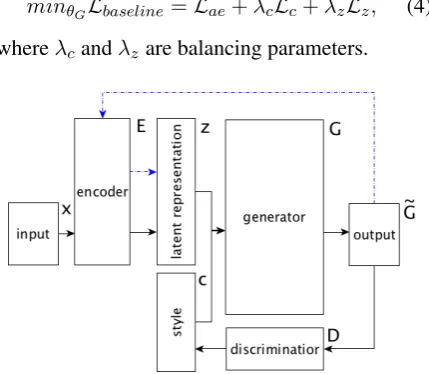
In this work we experiment with extensions of a model, described in (Hu et al.,2017a), using Texar (Hu et al.,2018) framework. To generate plausi-ble sentences with specific semantic and stylistic features every sentence is conditioned on a rep-resentation vector z which is concatenated with a particular codecthat specifies desired attribute, see Figure1. Under notation introduced in (Hu et al.,2017a) the base autoencoder (AE) includes a conditional probabilistic encoderE defined with parametersθE to infer the latent representationz given inputx
z∼E(x) =qE(z, c|x).
GeneratorGdefined with parametersθGis a GRU-RNN for generating and outputxˆdefined as a se-quence of tokensxˆ= ˆx1, ...,xˆT conditioned on the latent representationzand a stylistic componentc
that are concatenated and give rise to a generative distribution
ˆ
x∼G(z, c) =pG(ˆx|z, c).
These encoder and generator form an AE with the following loss
Lae(θG, θE;x, c) =−EqE(z,c|x)[logqG(x|z, c)].
(1) This standard reconstruction loss that drives the generator to produce realistic sentences is com-bined with two additional losses. The first discrimi-nator provides extra learning signals which enforce the generator to produce coherent attributes that match the structured code inc. Since it is impossi-ble to propagate gradients from the discriminator through the discrete samplexˆ, we use a determin-istic continuous approximation a ”soft” generated sentence, denoted asG˜ = ˜Gτ(z, c)with ”temper-ature”τ set toτ → 0 as training proceeds. The resulting soft generated sentence is fed into the
discriminator to measure the fitness to the target attribute, leading to the following loss
Lc(θG, θE;x) =−EqE(z,c|x)
h
logqD(c|G˜) i
.
(2) Finally, under the assumption that each struc-tured attribute of generated sentences is controlled through the corresponding code incand is inde-pendent fromzone would like to control that other not explicitly modelled attributes do not entangle withc. This is addressed by the dedicated loss
Lz(θG;x) =−EqE(z,c|x)qD(c|x)
h
logqE(z|G˜) i
.
(3) The training objective for the baseline, shown in Figure 1, is therefore a sum of the losses from Equations (1) – (3) defined as
minθGLbaseline=Lae+λcLc+λzLz, (4)
whereλcandλzare balancing parameters.
Figure 1: The generative model, where style is a struc-tured code targeting sentence attributes to control. Blue dashed arrows denote the proposed independence con-straint of latent representation and controlled attribute, see (Hu et al.,2017a) for the details.
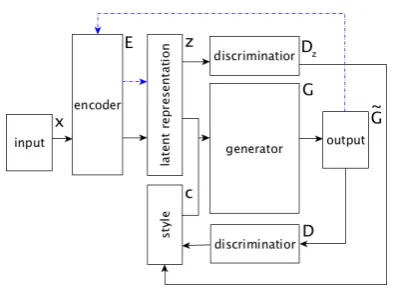
Let us propose two further extensions of this baseline architecture. To improve reproducibility of the research the code of the studied models is open1. Both extensions aim to improve the qual-ity of information decomposition within the latent representation. In the first one, shown in Figure2, a special dedicated discriminator is added to the model to control that the latent representation does not contain stylistic information. The loss of this discriminator is defined as
LDz(θG;x, c) =−EqE(z|x)[logqDz(c|z)]. (5)
[image:3.595.309.524.302.489.2]Here a discriminator denoted asDz is trying to predict codecusing representationz. Combining the loss defined by Equation (4) with the adversar-ial component defined in Equation (5) the following learning objective is formed
minθGL=Lbaseline−λDzLDz, (6)
whereLbaseline is a sum defined in Equation (4),
[image:4.595.312.520.65.214.2]λDz is a balancing parameter.
Figure 2: The generative model with dedicated discrim-inator introduced to ensure that semantic part of the latent representation does not have information on the style of the text.
The second extension of the baseline architec-ture does not use an adversarial componentDzthat is trying to eradicate information oncfrom com-ponentz. Instead, the system, shown in Figure3
feeds the ”soft” generated sentenceG˜ into encoder
Eand checks how close is the representationE( ˜G)
to the original representationz=E(x)in terms of the cosine distance. We further refer to it asshifted autoencoderor SAE. Ideally, bothE( ˜G(E(x), c))
and E( ˜G(E(x),¯c)), where c¯denotes an inverse style code, should be both equal to E(x)2. The loss of the shifted autoencoder is
minθGL=Lbaseline+λcosLcos+λcos−Lcos−,
(7) whereλcosand λcos− are two balancing
parame-ters, with two additional terms in the loss, namely, cosine distances between the softened output pro-cessed by the encoder and the encoded original input, defined as
Lcos(x, c) = cosE( ˜G(E(x), c)), E(x),
Lcos−(x, c) = cos
E( ˜G(E(x),c¯)), E(x)
. (8)
2This notation is valid under the assumption that every
[image:4.595.74.271.193.338.2]stylistic attribute is a binary feature
Figure 3: The generative model with a dedicated loss added to control that semantic representation of the out-put, when processed by the encoder, is close to the se-mantic representation of the input.
We also study a combination of both approaches described above, shown on Figure4.
Figure 4: A combination of an additional discriminator used in Figure2with a shifted autoencoder shown in Figure3
Tikhonov et al.(2019) carry out a series of exper-iments for these architectures. In this contribution, we work with the same data set of human-labeled positive and negative reviews but focus solely on the quality of information decomposition.
4 Information decomposition for texts
[image:4.595.311.507.338.482.2]intu-itive and qualitative rather than quantitative nature. Moreover, there are specific arguments against this idea.
In particular, Subramanian et al.(2018) show that information decomposition does not necessar-ily occur in autoencoder-based systems using a method developed in (Fu et al.,2018). Subrama-nian et al.(2018) demonstrate that as training pro-ceeds, the internal discriminator, which was trained adversarially and jointly with the model, gets worse at predicting the sentiment of the input. However, an external classifier that is separately trained on the resulting latent representations easily recovers the sentiment. This is a strong argument in favor of the idea that actual disentanglement does not happen. Instead of decomposing the semantic and stylistic aspects of information, the encoder merely ’tricks’ internal classifier and ’hides’ stylistic in-formation in the semantic component ending up in some local optimum.
4.1 Empirical measure of information decomposition quality
Yelp!3 reviews dataset that was lately enhanced with human written reformulations by (Tian et al.,
2018) is one of the most frequently used baselines for textual style transfer at the moment. It con-sists of restaurant reviews split into two categories, namely, positive and negative. There is a human written reformulation of every review in which the sentiment is changed that is commonly used as a ground truth for the task performance estimation.
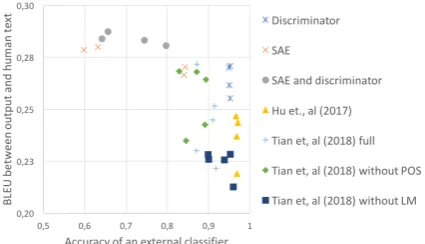
We applied an empirical method to estimate the quality of information decomposition to the archi-tectures described in Section3as well as architec-tures developed by (Tian et al.,2018). An external classifier was trained from scratch to predict a style of a message using componentzof a latent repre-sentation produced by an encoder. If information decomposition does not happen, one would expect that accuracy of an external classifier would be close to1. This would mean that despite intuitive expectations, information about the style of a mes-sage is present inz. If decomposition were effec-tive, the accuracy of an external classifier would be close to0.5; in (Tikhonov et al.,2019) it is shown that style transfer methods show varying results in terms of accuracy and BLEU for different retrains, so in this paper the accuracy of an external clas-sifier and BLEU between the system’s output and
3https://www.yelp.com/dataset
[image:5.595.309.522.121.243.2]human-written reformulations was measured after four independent retrains. On Figure5, one can see the results of these experiments.
Figure 5: BLEU between system’s output and human-written reformulations seems to be higher if accuracy of an external classifier is closer to one half. Systems that decompose information better tend to show higher BLEU.
The fact that the external classifier always pre-dicts style with the probability that is above one half could be partially attributed to the fact that full information decomposition of sentiment and se-mantics is hardly attainable. For example, such ad-jectives as ”delicious” or ”yummy” incorporate pos-itive sentiment with the semantics of taste, whereas ”polite” or ”friendly” in Yelp! reviews are
combin-ing positive sentiment with the semantics of ser-vice. This internal entanglement of sentiment and semantics is discussed in detail in (Tikhonov and Yamshchikov,2018c). It is essential to mention that the very fact that semantics and stylistics are entangled on the level of words does not deny a the-oretical possibility to build a latent representation where they are fully disentangled. Anyway, Figure
5demonstrates that the quality of the disentangle-ment is much better for SAE-type architectures. Since the shifted autoencoder controls the cosine distance between soft output and input, the encoder has to disentangle the semantic component, rather than ”hide” the sentiment information from the dis-criminator.
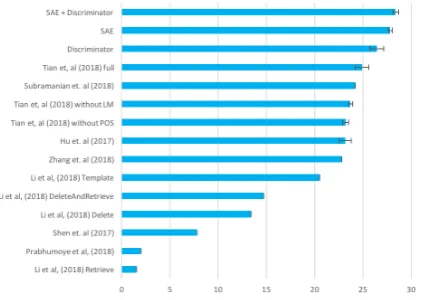
external classifier accuracy. Systems that perform better in terms of information decomposition out-perform system with lower quality of information decomposition. Moreover, the system that does not rely on an idea of disentangled latent representa-tions at all shows weaker results than systems with high information disentanglement. It is important to note that there is a variety of methods to assess the quality of style transfer such as PINC (Para-phrase In N-gram Changes) score (Carlson et al.,
[image:6.595.308.524.323.387.2]2018), POS distance (Tian et al.,2018), language fluency (John et al.,2018), etc. The methodology of style transfer quality assessment is addressed in detail in (Tikhonov et al.,2019), but BLEU be-tween output and input is a very natural all-purpose metric for the task of such type that is common in the style transfer literature.
Figure 6: Overview of the BLEU between output and human-written reformulations of Yelp! reviews. Ar-chitecture with additional discriminator, shifted autoen-coder (SAE) with additional cosine losses, and a com-bination of these two architectures measured after five re-runs outperform the baseline by (Hu et al.,2017a) as well as other state of the art models. Results of ( Ro-manov et al.,2018) are not displayed due to the absence of self-reported BLEU scores
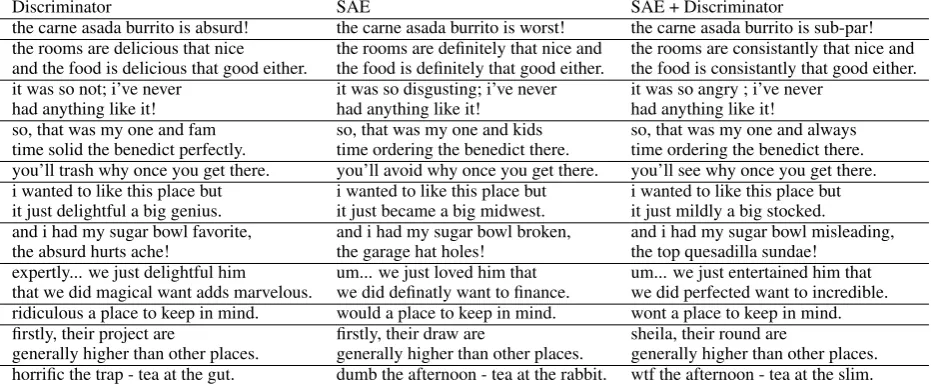
Tables1-2allow to compare random examples for different architectures. Generally, baseline and discriminator perform poorly once the syntax of a review is irregular or if there are some omissions in the text. SAE-based architectures tend to pre-serve the semantic component better. They also add sentimentally charged words at random not as often as the baseline and the discriminator-based architecture.
4.2 Preservation of semantic component
[image:6.595.76.288.330.480.2]Another way to quantify the quality of latent repre-sentations is to calculate cosine distance and KL-divergence between semantic components of latent representations for the inputs and corresponding outputs. If we believe that the latent representation captures the semantics of the input that should be preserved in the output, the ideal behavior of the system is to produce equal latent representation for both the input and the output phrase. Indeed, on Figure7one can see that SAE manages to learn a space of latent representations in which semantic components of inputs and outputs are always equal to each other. Architecture with additional stylis-tic discriminator shows lower cosine distances and lower KL-divergences then the baseline yet. This results are in line with the measurements discussed above in Section4.1.
Figure 7: Comparison of cosine distances and KL-divergences between semantic components of latent representation for inputs and outputs. After 12 epochs of training SAE makes semantic componentzfor ev-ery output equal to the semantic component for a cor-responding input. Discriminator corresponds to lower values of KL-divergence and cosine distance then base-line (Hu et al.,2017a)
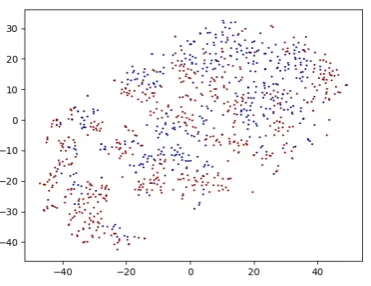
To get an intuition on how the resulting latent space differs for different architectures, one can look at the t-SNE visualizations (Maaten and Hin-ton,2008) for the resulting latent representations of the data that different systems produce. In Figure8, one can see that the baseline latent representations easily allow recovering the sentiment.
In contrast with the baseline, the architecture with additional discriminator obtains better disen-tanglement. Figure9shows that in this case one has a harder time recovering the sentiment of the sentence based on its latent representation.
input Human baseline
the carne asada burrito is awesome! the carne asada burrito is awful! the worst asada burrito is gross! the rooms are not that nice and the rooms were spacious and the rooms are excellent that nice and the food is not that good either. food was very well cooked the food is not that good either. it was so delicious; everything tasted bad, it was so rude;
i’ve never had anything like it! nothing i liked i’ve never had anything like it! so, that was my one and only i will be ordering the so, that was my one and best time ordering the benedict there. benedict again very good meal! time ordering the perfect there. you’ll see why once you get there. you’ll see why i don’t like it you’ll see why once you get there.
once you get there.
i wanted to like this place but a place like this i helped to like this place it just became a big disappointment. is a great value it just became a big hidden. and i had my sugar bowl favorite, my sugar bowl favorite and i had my sugar bowl worst, the top hat sundae! was not in stock. the lackluster hat gross! um... we just told him that um... we just told him, amazing... we just told him that we didn’t want to finance. sure we’d go ahead and finance! we did definitely want to open. definitely a place to keep in mind. not a place i would recommend disappointing a place to keep in mind. firstly, their fees are generally the fees are comparable best, their fees are generally
[image:7.595.86.512.59.280.2]higher than other places. to other places. higher than other places. love the afternoon - hate the aternoon absurd the inappropriate -tea at the phoenician. tea at the phoenician tea at the insult.
Table 1: Several random input lines alongside with human written reformulation and the reformulation generated by the baseline.
Discriminator SAE SAE + Discriminator
the carne asada burrito is absurd! the carne asada burrito is worst! the carne asada burrito is sub-par! the rooms are delicious that nice the rooms are definitely that nice and the rooms are consistantly that nice and and the food is delicious that good either. the food is definitely that good either. the food is consistantly that good either. it was so not; i’ve never it was so disgusting; i’ve never it was so angry ; i’ve never
had anything like it! had anything like it! had anything like it!
so, that was my one and fam so, that was my one and kids so, that was my one and always time solid the benedict perfectly. time ordering the benedict there. time ordering the benedict there. you’ll trash why once you get there. you’ll avoid why once you get there. you’ll see why once you get there. i wanted to like this place but i wanted to like this place but i wanted to like this place but it just delightful a big genius. it just became a big midwest. it just mildly a big stocked.
and i had my sugar bowl favorite, and i had my sugar bowl broken, and i had my sugar bowl misleading, the absurd hurts ache! the garage hat holes! the top quesadilla sundae!
expertly... we just delightful him um... we just loved him that um... we just entertained him that that we did magical want adds marvelous. we did definatly want to finance. we did perfected want to incredible. ridiculous a place to keep in mind. would a place to keep in mind. wont a place to keep in mind. firstly, their project are firstly, their draw are sheila, their round are
generally higher than other places. generally higher than other places. generally higher than other places. horrific the trap - tea at the gut. dumb the afternoon - tea at the rabbit. wtf the afternoon - tea at the slim.
Table 2: Reformulations generated by the baseline with additional discriminator, shifted autoencoder and shifted autoencoder with additional discriminator corresponding to the inputs in Table1.
Aligning results shown on Figures5 -10one can clearly see several crucial things: (1) archi-tectures based on the idea of disentangled latent representations show varying performance in terms of BLEU between output and human written re-formulations; (2) architectures with higher quality of information decomposition in terms of corre-lation or KL-divergence between representations for input and output, show higher performance; (3) architectures that produce equal semantic compo-nents for a given input and corresponding output show the highest performance; (4) these results are aligned with empirical estimation of decomposi-tion quality with external classifiers; it shows that
architectures that are more successfully disentan-gling semantics of the input from its stylistics tend to perform better.
5 Conclusion
[image:7.595.72.538.323.518.2]Figure 8: t-SNE visualisation of the obtained latent rep-resentations for the baseline architecture proposed in (Hu et al.,2017a). Red dots represent positive reviews. Blue dots represent negative reviews. One can clearly see that stylistic information can be recovered from the representation.
Figure 9: t-SNE visualisation of the obtained latent rep-resentations for the architecture with an additional dis-criminator. Red dots represent positive reviews. Blue dots represent negative reviews. One can see that it is harder to recover stylistic information from the repre-sentation.
[image:8.595.320.506.79.220.2]outperform state of the art architectures in terms of BLEU between output and human written re-formulations. An empirical method to assess the quality of information decomposition is proposed. There is a correspondence between higher BLEU between output and human written reformulations and better quality of information decomposition.
Figure 10: t-SNE visualisation of the obtained latent representations for the shifted autoencoder. Red dots represent positive reviews. Blue dots represent negative reviews. One can see that it is harder to recover stylistic information from the representation and the structure of the differs significantly from the latent representation space obtained by the baseline.
References
Mikel Artetxe, Gorka Labaka, Eneko Agirre, and Kyunghyun Cho. 2017. Unsupervised neural ma-chine translation. InarXiv preprint.
Samuel R. Bowman, Gabor Angeli, Christopher Potts, and Christopher D. Manning. 2015. A large anno-tated corpus for learning natural language inference. In Proceedings of the 2015 Conference on Empiri-cal Methods in Natural Language Processing, pages 632–642.
Keith Carlson, Allen Riddell, and Daniel Rockmore. 2018. Evaluating prose style transfer with the bible. Royal Society open science, 5(10):171920.
Jessica Ficler and Yoav Goldberg. 2017. Controlling linguistic style aspects in neural language genera-tion. InProceedings of the Workshop on Stylistic Variation, volume 94-104.
Zhenxin Fu, Xiaoye Tan, Nanyun Peng, Dongyan Zhao, and Rui Yan. 2018. Style transfer in text: Explo-ration and evaluation. AAAI.
Kelvin Guu, Tatsunori B. Hashimoto, Yonatan Oren, and Percy Liang. 2018. Generating sentences by editing prototypes. Transactions of the Association of Computational Linguistics, 6:437–450.
[image:8.595.87.273.371.514.2]Zhiting Hu, Zichao Yang, Xiaodan Liang, Ruslan Salakhutdinov, and Eric P. Xing. 2017a. Toward controlled generation of text. InInternational Con-ference on Machine Learning, pages 1587–1596.
Zhiting Hu, Zichao Yang, Ruslan Salakhutdinov, and Eric Xing. 2017b. On unifying deep generative mod-els. InarXiv preprint.
James M. Hughes, Nicholas J. Foti, David C. Krakauer, and Daniel N. Rockmore. 2012. Quantitative pat-terns of stylistic influence in the evolution of litera-ture. Proceedings of the National Academy of Sci-ences, 109(20):7682–7686.
Harsh Jhamtani, Varun Gangal, Eduard Hovy, and Eric Nyberg. 2017. Shakespearizing modern language using copy-enriched sequence-to-sequence models. In Proceedings of the Workshop on Stylistic Varia-tion, pages 10–19.
Vineet John, Lili Mou, Hareesh Bahuleyan, and Olga Vechtomova. 2018. Disentangled representation learning for text style transfer. InarXiv preprint.
Jad Kabbara and Jackie Chi Kit Cheung. 2016. Stylis-tic transfer in natural language generation systems using recurrent neural networks. Proceedings of the Workshop on Uphill Battles in Language Process-ing: Scaling Early Achievements to Robust Methods, pages 43–47.
Guillaume Lample, Alexis Conneau, Ludovic Denoyer, and Marc’Aurelio Ranzato. 2017. Unsupervised ma-chine translation using monolingual corpora only. InarXiv preprint.
Juncen Li, Robin Jia, He He, and Percy Liang. 2018.
Delete, retrieve, generate: A simple approach to sen-timent and style transfer. InProceedings of the 2018 Conference of the North American Chapter of the Association for Computational Linguistics: Human Language Technologies, volume 1, pages 865–1874.
Laurens van der Maaten and Geoffrey Hinton. 2008.
Visualizing data using t-sne. Journal of machine learning research, 9:2579–2605.
Kishore Papineni, Salim Roukos, Todd Ward, and Wei-Jing Zhu. 2002. Gbleu: a method for automatic eval-uation of machine translation. InProceedings of the 40th Annual Meeting of the Association for Compu-tational Linguistics (ACL), pages 311–318.
Peter Potash, Alexey Romanov, and Anna Rumshisky. 2015. Ghostwriter: Using an lstm for automatic rap lyric generation. In Proceedings of the 2015 Con-ference on Empirical Methods in Natural Language Processing, pages 1919–1924. Association for Com-putational Linguistics.
Shrimai Prabhumoye, Yulia Tsvetkov, Alan W. Black, and Ruslan Salakhutdinov. 2018. Style transfer through back-translation. InarXiv preprint.
Sudha Rao and Joel Tetreault. 2018. Dear sir or madam, may i introduce the gyafc dataset: Corpus, benchmarks and metrics for formality style trans-fer. InProceedings of the Conference of the North American Chapter of the Association for Computa-tional Linguistics: Human Language Technologies, volume 1, pages 129–140.
Alexey Romanov, Anna Rumshisky, Anna Rogers, and David Donahue. 2018. Adversarial decomposition of text representation. InarXiv preprint.
Rico Sennrich, Barry Haddow, and Alexandra Birch. 2016. Controlling politeness in neural machine translation via side constraints. In Proceedings of the 2016 Conference of the North American Chap-ter of the Association for Computational Linguistics: Human Language Technologies, pages 35–40.
Tianxiao Shen, Tao Lei, Regina Barzilay, and Tommi Jaakkola. 2017. Style transfer from non-parallel text by cross-alignment. 31st Conference on Neural In-formation Processing Systems, pages 6833–6844.
Sandeep Subramanian, Guillaume Lample, Eric M. Smith, Ludovic Denoyer, Marc Aurelio Ranzato, and Y-Lan Boureau. 2018. Multiple-attribute text style transfer. InarXiv preprint.
Youzhi Tian, Zhiting Hu, and Zhou Yu. 2018. Struc-tured content preservation for unsupervised text style transfer. InarXiv preprint.
Alexey Tikhonov, Viacheslav Shibaev, Aleksander Na-gaev, Aigul Nugmanova, and Ivan Yamshchikov. 2019. Style transfer for texts: to err is human, but error margins matter. InEMNLP.
Alexey Tikhonov and Ivan P. Yamshchikov. 2018a.
Guess who? Multilingual approach for the auto-mated generation of author-stylized poetry. InIEEE Spoken Language Technology Workshop (SLT), pages 787–794.
Alexey Tikhonov and Ivan P. Yamshchikov. 2018b.
Sounds Wilde. Phonetically extended embeddings for author-stylized poetry generation. In Proceed-ings of the Fifteenth Workshop on Computational Research in Phonetics, Phonology, and Morphology, pages 117–124.
Alexey Tikhonov and Ivan P. Yamshchikov. 2018c.
What is wrong with style transfer for texts? InarXiv preprint.
Olga Vechtomova, Hareesh Bahuleyan, Amirpasha Ghabussi, and Vineet John. 2018. Generating lyrics with variational autoencoder and multi-modal artist embeddings. InarXiv preprint.
Jingjing Xu, Xu Sun, Qi Zeng, Xuancheng Ren, Xi-aodong Zhang, Houfeng Wang, and Wenjie Li. 2018.
Wei Xu. 2017. From shakespeare to twitter: What are language styles all about? Proceedings of the Work-shop on Stylistic Variation, pages 1–9.
Wei Xu, Alan Ritter, William B. Dolan, Ralph Grish-man, and Colin Cherry. 2012. Paraphrasing for style. Proceedings of COLING, pages 2899–2914.