Proceedings of the 2019 Conference on Empirical Methods in Natural Language Processing 1317
Automatically Learning Data Augmentation Policies for Dialogue Tasks
Tong Niu Mohit Bansal
UNC Chapel Hill
{tongn, mbansal}@cs.unc.edu
Abstract
Automatic data augmentation (AutoAug-ment) (Cubuk et al., 2019) searches for optimal perturbation policies via a controller trained using performance rewards of a sam-pled policy on the target task, hence reducing data-level model bias. While being a powerful algorithm, their work has focused on computer vision tasks, where it is comparatively easy to apply imperceptible perturbations without changing an image’s semantic meaning. In our work, we adapt AutoAugment to automatically discover effective perturbation policies for natural language processing (NLP) tasks such as dialogue generation. We start with a pool of atomic operations that ap-ply subtle semantic-preserving perturbations to the source inputs of a dialogue task (e.g., different POS-tag types of stopword dropout, grammatical errors, and paraphrasing). Next, we allow the controller to learn more complex augmentation policies by searching over the space of the various combinations of these atomic operations. Moreover, we also explore conditioning the controller on the source in-puts of the target task, since certain strategies may not apply to inputs that do not contain that strategy’s required linguistic features. Empirically, we demonstrate that both our input-agnostic and input-aware controllers discover useful data augmentation policies, and achieve significant improvements over the previous state-of-the-art, including trained on manually-designed policies.
1 Introduction
Data augmentation aims at teaching invariances to a model so that it generalizes better outside the training set distribution. Recently, there has been substantial progress in Automatic Data Augmen-tation (AutoAugment) for computer vision (Cubuk
et al.,2019). This algorithm searches for optimal
perturbation policies via a controller trained with reinforcement learning, where its reward comes
from training the target model with data perturbed by the sampled augmentation policy. Each pol-icy consists of 5 sub-policies sampled randomly during training, and each sub-policy consists of
2 operations applied in sequence. These oper-ations are semantic-preserving image processing functions such astranslationandrotation.
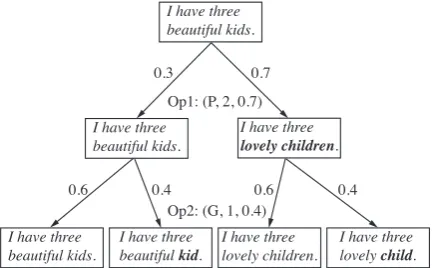
We adapt AutoAugment to NLP tasks, where the operations are subtle, semantic-preserving text perturbations. To collect a pool of such opera-tions, the first challenge we face is that the dis-crete nature of text makes it less straightforward to come up with semantic-preserving perturbations. We thus employ as a starting point Should-Not-Change strategies (equivalent tooperationsin this paper) proposed byNiu and Bansal(2018) which are shown to improve their dialogue task perfor-mance when trained on data perturbed by these strategies. Importantly, we next divide their op-erations into several smaller ones (such as Gram-mar Errors divided into Singular/Plural Errors and Verb Inflection Errors) and also add a new opera-tion Stammer (word repetiopera-tion). This modificaopera-tion provides a much larger space of operation com-binations for the model to explore from, so that it could potentially learn more complex and nu-anced augmentation policies. Figure 1 shows a sub-policy containing two operations. It first para-phrases2tokens with probability0.7and then in-troduces1grammar error with probability0.4.1
We choose the dialogue generation task based on the Ubuntu Dialogue Corpus (Lowe et al.,
2015) because as opposed to Natural Language Inference and Question Answering tasks, real-world dialogue datasets more naturally afford such perturbation-style human errors (i.e., contain more noise), and thus are inherently compatible with
I have three beautiful kids.
I have three
beautiful kids. I have three lovely children.
0.3 0.7
0.6 0.4 0.6 0.4
Op1: (P, 2, 0.7)
Op2: (G, 1, 0.4)
I have three
[image:2.595.72.292.62.196.2]beautiful kids. I have three beautiful kid. I have three lovely children. I have three lovely child.
Figure 1: Example of a sub-policy applied to a source input. The first operation (Paraphrase, 2, 0.7) para-phrases the input twice with probability0.7; the second operation (Grammar Errors,1,0.4) inserts1grammar error with probability 0.4. Thus there are at most 4 possible outcomes from each sub-policy.
a variety of artificial perturbations. Empirically, we show that our controller can self-learn poli-cies that achieve state-of-the-art performance on Ubuntu, even compared with very strong base-lines such as the best manually-designed policy
in Niu and Bansal (2018). We also verify this
result through human evaluation to show that our model indeed learns to generate higher-quality re-sponses. We next analyze the best-learned policies and observe that the controller prefers to sample operations which work well on their own as aug-mentation policies, and then combines them into stronger policy sequences. Lastly, observing that some operations require the source inputs to have certain linguistic features (e.g., we cannot apply Stopword Dropout to inputs that do not contain stopwords), we also explore a controller that con-ditions on the source inputs of the target dataset, via a sequence-to-sequence (seq2seq) controller. We show that this input-aware model performs on par with the input-agnostic one (where the con-troller outputs do not depend on the source inputs), and may need more epochs to expose the model to the many diverse policies it generates. We also present selected best policies to demonstrate that the seq2seq controller can sometimes successfully attend to the source inputs.
2 Related Works
There has been extensive work that employs data augmentation in both computer vision (Simard et al.,2003;Krizhevsky et al.,2012;Cires¸an et al.,
2012;Wan et al.,2013;Sato et al.,2015;DeVries and Taylor,2017;Tran et al.,2017;Lemley et al.,
2017) and NLP (F¨urstenau and Lapata,2009;
Sen-nrich et al., 2016; Wang and Yang,2015; Zhang
et al.,2015;Jia and Liang,2016;Kim and Rush,
2016;Hu et al., 2017;Xu et al.,2017;Xia et al.,
2017;Silfverberg et al., 2017;Kafle et al.,2017;
Hou et al.,2018;Wang et al.,2018).
Automatic data augmentation is addressed via the AutoAugment algorithm proposed by Cubuk
et al. (2019), which uses a hypernetwork (in
our case, a controller) to train the target model, an approach inspired by neural architecture search (Zoph et al., 2017). Previous works have also adopted Generative Adversarial Net-works (Goodfellow et al.,2014) to either directly generate augmented data (Tran et al., 2017; Sixt et al.,2018;Antoniou et al.,2017;Zhu et al.,2017;
Mun et al.,2017;Wang and Perez,2017), or
gen-erate augmentation strategies (Ratner et al.,2017). These approaches produce perturbations through continuous hidden representations. Motivated by the fact that our pool of candidate perturbations are discrete in nature, we identify AutoAugment as a more proper base model to use, and adapt it linguistically to the challenging task of generative dialogue tasks. Our work closely followsNiu and
Bansal (2018) to obtain a pool of candidate
op-erations. Although their work also used combi-nations of operations for data augmentation, their best model is manually designed, training on each operation in sequence, while our model automati-cally discovers more nuanced and detailed policies that have not only the operation types but also the intensity (the number of changes) and probability.
3 Model
Controller sample Policy
Data Aug-data
training
Model
performance reward (R) perturb
[image:3.595.337.493.62.228.2]transform
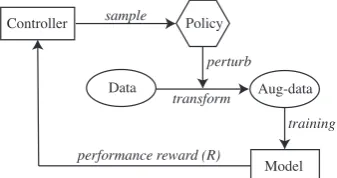
Figure 2: The controller samples a policy which is used to perturb the training data. After training on the aug-mented inputs, the model feeds the performance as re-ward back to the controller.
is a discrete equivalence of the continuous
Magni-tude in (Cubuk et al., 2019)), and the
Probabil-ity of applying that operation. The input-aware controller corresponds to the whole figure, i.e., we novelly add in an encoder that takes as inputs the source of the training data, making it a seq2seq model. Since for each source input, there may be a different set of perturbations that are most suitable to it, our input-aware controller aims at providing customized operations for each training example. Search Space: FollowingNiu and Bansal(2018), our pool of operations contains Random Swap, Stopword Dropout, Paraphrase, Grammar Errors, and Stammer, which cover a substantial enough search space of real-world noise in text.2 To allow the controller to learn more nuanced combinations of operations, we further divide Stopword Dropout into 7 categories: Noun, Adposition, Pronoun, Adverb, Verb, Determiner, and Other, and divide Grammar Errors into Noun (plural/singular con-fusion) and Verb (verb inflected/base form confu-sion). For Stopword Dropout, we chose the first six categories because they are the major universal POS tags in the set closed-class words. We per-form this subdivision also because different cate-gories of an operation can influence the model to different extents. Suppose the original utterance is “What is the offer?”, dropping the interrogative pronoun “what” is more semantic-changing than dropping the determiner “the.” Our pool thus con-sists of 12 operations. For generality, we do not distinguish in advance which operation alone is effective as an augmentation policy on the target dataset, but rather let the controller figure it out. Moreover, it is possible that an operation alone is not effective, but when applied in sequence with another operation, they collectively teach the
2We did not use their Generative Paraphrasing where
number of changes(which signifies the intensity of the pol-icy) does not apply to this operation, because this operation can generate only one possible paraphrase for each input.
S3 S2 S1
Encoder
Decoder Source
Operation Num. of Changes
Op. Type Probability
[image:3.595.89.258.63.152.2]<Start>
Figure 3: AutoAugment controller. An input-agnostic controller corresponds to the lower part of the figure. It samples a list of operations in sequence. An input-aware controller additionally has an encoder (upper part) that takes in the source inputs of the data.
model a new pattern of invariance in the data. Each policy consists of 4 sub-policies chosen randomly during training, each sub-policy consists of2operations,3and each operation has3 hyper-parameters. We discretize the Probability of ap-plying an operation into10uniformly-spaced val-ues starting from 0.1 and let the number of re-places range from 1to4. Thus, the search space size is(12×4×10)(2×4) = 2.82×10²¹. 2 oper-ations allows more perturboper-ations than exerted by a single strategy: in reality a sentence may contain several types of noise.
Search Algorithm: We use REINFORCE, a pol-icy gradient method (Williams,1992;Sutton et al.,
2000) to train the controller. At each step, the de-coder samples a token and feeds it into the next step. Since each policy consists of4sub-policies, each sub-policy contains 2 operations, and each operation is defined by3tokens (Operation Type, Number of Changes, Probability), the total num-ber of steps for each policy is 4×2×3 = 24. Sampling multiple sub-policies to form one pol-icy provides us with a less biased estimation of the controller performance. We sample these 4 sub-policies at once rather than sample the controller4
times to reduce repetition – the controller needs to keep track of what policies it has already sampled. To obtain the reward for the controller, we train the target model with the augmented data and ob-tain its validation set performance. We calculate a weighted average of two F1s (Activity and Entity)
as the rewardRsince both are important comple-mentary measures of an informative response, as discussed inSerban et al.(2017a).4 We use the re-inforcement loss following Ranzato et al. (2016) and an exponential moving average baseline to re-duce training variance. At the end of the search, we use the best policy to train the target model from scratch and evaluate on the test set.
4 Experimental Setup
Dataset and Model: We investigate Variational Hierarchical Encoder-Decoder (VHRED) (Serban
et al., 2017b) on the troubleshooting Ubuntu
Di-alogue task (Lowe et al., 2015).5 For this short paper, we focus on this dataset because it has a well-established F1 metric among dialogue tasks.6 In future work, we plan to apply the idea to other datasets and NLP tasks since the proposed model is not specific to the Ubuntu dataset. We hypothe-size that most web/online datasets that have reg-ular human errors/noise (e.g. Twitter Dialogue Dataset (Serban et al.,2017b) and multiple movie corpora (Serban et al., 2016)) would be suitable for our framework.
Training Details: We employ code7fromNiu and
Bansal(2018) to reproduce the VHRED baseline
results and follow methods described inZoph et al.
(2017) to train the controller. For details, please refer to their Appendix A.2 (Controller Architec-ture) and A.3 (Training of the Controller).
We adopt the following method to speed up con-troller training and hence facilitate scaling.8 We let the target model resume from the converged baseline checkpoint and train on the perturbed data for1 epoch. During testing, we use the pol-icy that achieves the highest weighted average F1 score to train the final model for1epoch. For the All-operations model (which corresponds to the All-Should-Not-Change model inNiu and Bansal
(2018)), we train on each operation (without sub-divisions for Stopword Dropout and Grammar
Er-4
We use the weighted average F1 = Activity F1 +5.94/ 3.52∗Entity F1, where the weights are determined by the baseline results, for balance between the two F1s.
5
http://www.iulianserban.com/Files/ UbuntuDialogueCorpus.zip
6
Serban et al.(2017a) found that F1 is particularly suited for the goal-oriented Ubuntu Dialogue Corpus based on man-ual inspection of the extracted activities and entities.
7https://github.com/WolfNiu/
AdversarialDialogue
8It took us3days with6P100 GPUs to get our reported results for each of the input-aware and input-agnostic models. The VHRED model took1.5days to pre-train.
Activity F1 Entity F1
LSTM 1.18 0.87
HRED 4.34 2.22
VHRED 4.63 2.53
VHRED (w/ attn.) 5.94 3.52
All-operations 6.53 3.79
Input-aware 7.04 3.90
[image:4.595.327.506.61.146.2]Input-agnostic 7.02 4.00
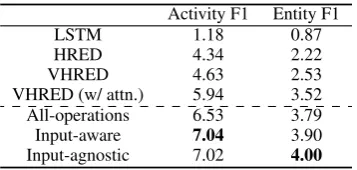
Table 1: Activity, Entity F1 results reported by previous work (rows 1-4 from Serban et al. (2017a)), and the All-operations and AutoAugment models.
W T L W - L
Input-agnostic vs. baseline 48 23 29 19
Input-aware vs. baseline 45 27 28 17
Input-agnostic vs. All-ops 43 27 30 13
Input-aware vs. All-ops 50 13 37 13
Table 2: Human evaluation results on comparisons among the baseline, All-operations, and the two Au-toAugment models.W: Win,T: Tie,L: Loss.
rors) for1epoch in sequence.9
Automatic Evaluation: We follow Serban et al.
(2017a) and evaluate on F1s for both activities
(technical verbs) and entities (technical nouns). Human Evaluation: We conducted human stud-ies on MTurk. We compared each of the input-agnostic/aware models with the VHRED baseline and All-operations from Niu and Bansal (2018), where we followed the same setting. Each study contains100 samples randomly chosen from the test set. The utterances were randomly shuffled and we only allowed US-located human evaluators with approval rate>98%, and at least10,000 ap-proved HITs. More details are in the appendix.
5 Results and Analysis
Automatic Results: Table 1 shows that all data-augmentation approaches (last 3 rows) improve statistically significantly (p < 0.01) 10 over the strongest baseline VHRED (w/ attention). More-over, our input-agnostic AutoAugment is statisti-cally significantly (p < 0.01) better (on Activity and Entity F1) than the strong manual-policy All-operations model, while the input-aware model is stat. signif. (p <0.01) better on Activity F1.11 Human Evaluation: In Table 2, both
AutoAug-9
We do not followCubuk et al.(2019) to train on a small portion of the data for many epochs because we empirically found that this approach decreases our task performance.
10Statistical significance is computed via the bootstrap test (Noreen,1989) over 100K samples.
[image:4.595.313.520.197.251.2]Perturbation Method Policy Source Inputs
Original Context - fresh install of crack of the day : gdm login→“ can’t access ACPI bla bla bla ” eou you don’t want to be me ... eou ah , it happened to you too ?
All-operations (R , 4, 1.0) fresh installcrack ofof the day : gdm login→“ can’tACPI accessbla bla bla ” eou you don’t wantbe tome ... eou ah , it happenedyou totoo ?
Input-agnostic (Dv, 3, 0.2) (R , 1, 0.5)
fresh install of crack of the day :login gdm→“ can’t access ACPI bla bla bla ”
eou youdon’twant tobeme ... eou ah , it happened to you too ?
Input-aware (S , 1, 0.8) (Dv, 2, 0.5)
fresh install of crack of the day : gdm login→“ can’t access ACPI bla blablabla ” eou you don’t want to be me ... eou ah , it happened to you too ?
Table 3: Comparisons of perturbed outputs among the three Augmentation models. Note that only the sam-pled/applied sub-policy is shown for each model. The dashed line separates the original and augmented source inputs. Perturbed tokens are boldfaced.
Sub-policy1 Sub-policy2 Sub-policy3 Sub-policy4 P, 1, 0.5 Dv, 3, 0.2 R, 3, 0.9 Dp, 2, 0.3 Dadv, 4, 0.4 R, 1, 0.5 Dadp, 1, 0.5 Dadp, 2, 0.1
Dn, 1, 0.8 Do, 3, 1.0 P, 4, 0.4 Gn, 3, 0.3 Gv, 1, 0.9 Do, 3, 0.1 S, 3, 0.4 R, 1, 0.2 Dv, 2, 0.5 Dv, 2, 0.7 S, 3, 0.5 P, 1, 1.0 R, 2, 0.2 Gv, 1, 0.9 Do, 1, 0.5 Gn, 2, 0.6
Table 4: Top3policies on the validation set and their test performances. Operations: R=Random Swap, D=Stopword Dropout, P=Paraphrase, G=Grammar Er-rors, S=Stammer. Universal tags: n=noun, v=verb, p=pronoun, adv=adverb, adp=adposition.
ment models obtained significantly more net wins (last column) than the VHRED-attn baseline. They both outperform even the strong manual-policy All-operations model.
Policy Learned by the Input-Agnostic Con-troller: We present 3 best learned policies from the Ubuntu val set (Table 4). Although there is a probability of7/12 = 58.3%to sample one of the Stopword Dropout operations from our pool, all 3 learned policies show much more diversity on the operations they choose. This is also the case for the other two hyperparameters: Number of Changes varies from 1 to 4, and Probability
varies from0.1to0.9, which basically extend their whole search range. Moreover, all best policies in-clude Random Swap, which agrees with the results
inNiu and Bansal(2018).
Example Analysis of Perturbation Procedure in Generated Responses: We also present a se-lected example of perturbed source inputs from the three Augmentation models with their respec-tive best policies in Table 3. First of all, the All-operations model is forced to use an operation (in this case Random Swap) with a fixed number of changes and a probability of 1.0, leading to less variation in the source inputs. On the other hand, our Input-agnostic AutoAugment model samples 3 Verb Dropout’s followed by Random Swap.
Note that although the number of changes for the dropout is 3, there are only 2 verb stopwords in the utterance. Thus, it has to resort back to modi-fying only2tokens. The Input-aware model sam-ples Stammer followed by 2 Verb Dropout’s. In-terestingly, it inserts an extra “bla” around other “bla’s” in the utterance. It also did not sample a policy that drops more than2verb stopwords (this operation is not applied due to its Probability pa-rameter). These two observations indicate that the model can sometimes successfully attend to the source inputs to provide customized policies.
6 Conclusion and Future Work
We adapt AutoAugment to dialogue and extend its controller to a conditioned model. We show via automatic and human evaluations that our AutoAugment models learn useful augmentation policies which lead to state-of-the-art results on the Ubuntu task. Motivated by the promising suc-cess of our model in this short paper, we will apply it to other diverse NLP tasks in future work.
Acknowledgments
We thank the reviewers for their helpful com-ments and discussions. This work was supported by DARPA #YFA17-D17AP00022, ONR Grant #N00014-18-1-2871, and awards from Google, Facebook, Salesforce, and Adobe (plus Amazon and Google GPU cloud credits). The views are those of the authors and not of the funding agency.
References
Antreas Antoniou, Amos Storkey, and Harrison Ed-wards. 2017. Data augmentation generative adver-sarial networks. arXiv preprint arXiv:1711.04340.
International Conference on Learning Representa-tions.
Dan Cires¸an, Ueli Meier, and J¨urgen Schmidhuber. 2012. Multi-column deep neural networks for im-age classification. InProceedings of IEEE Confer-ence on Computer Vision and Pattern Recognition, pages 3642–3649.
Ekin D. Cubuk, Barret Zoph, Dandelion Mane, Vijay Vasudevan, and Quoc V. Le. 2019. AutoAugment: Learning augmentation policies from data. In Pro-ceedings of Conference on Computer Vision and Pat-tern Recognition.
Terrance DeVries and Graham W Taylor. 2017. Dataset augmentation in feature space. arXiv preprint arXiv:1702.05538.
Hagen F¨urstenau and Mirella Lapata. 2009. Semi-supervised semantic role labeling. InProceedings of the 12th Conference of the European Chapter of the Association for Computational Linguistics, pages 220–228. Association for Computational Lin-guistics.
Ian Goodfellow, Jean Pouget-Abadie, Mehdi Mirza, Bing Xu, David Warde-Farley, Sherjil Ozair, Aaron Courville, and Yoshua Bengio. 2014. Generative ad-versarial nets. In Advances in neural information processing systems, pages 2672–2680.
Yutai Hou, Yijia Liu, Wanxiang Che, and Ting Liu. 2018. Sequence-to-sequence data augmentation for dialogue language understanding. InProceedings of COLING.
Zhiting Hu, Zichao Yang, Xiaodan Liang, Ruslan Salakhutdinov, and Eric P. Xing. 2017. Toward con-trolled generation of text. In Proceedings of the 34th International Conference on Machine Learn-ing, PMLR 70, pages 1587–1596.
Robin Jia and Percy Liang. 2016. Data recombination for neural semantic parsing. InProceedings of As-sociation for Computational Linguistics.
Kushal Kafle, Mohammed Yousefhussien, and Christo-pher Kanan. 2017. Data augmentation for visual question answering. InProceedings of the 10th In-ternational Conference on Natural Language Gen-eration, pages 198–202.
Yoon Kim and Alexander M Rush. 2016. Sequence-level knowledge distillation. InProceedings of Em-pirical Methods in Natural Language Processing, pages 1317–1327.
Alex Krizhevsky, Ilya Sutskever, and Geoffrey E Hin-ton. 2012. Imagenet classification with deep con-volutional neural networks. In Proceedings of Ad-vances in neural information processing systems, pages 1097–1105.
Joseph Lemley, Shabab Bazrafkan, and Peter Corco-ran. 2017. Smart augmentation learning an optimal data augmentation strategy. InProceedings of IEEE Access, volume 5, pages 5858–5869.
Ryan Lowe, Nissan Pow, Iulian Serban, and Joelle Pineau. 2015. The ubuntu dialogue corpus: A large dataset for research in unstructured multi-turn dia-logue systems. arXiv preprint arXiv:1506.08909.
Seongkyu Mun, Sangwook Park, David K Han, and Hanseok Ko. 2017. Generative adversarial network based acoustic scene training set augmentation and selection using svm hyper-plane. Detection and Classification of Acoustic Scenes and Events Work-shop, pages 93–97.
Tong Niu and Mohit Bansal. 2018. Adversarial over-sensitivity and over-stability strategies for dialogue models. InProceedings of Conference on Natural Language Learning.
Eric W. Noreen. 1989. Computer-intensive methods for testing hypotheses. Wiley New York.
Marc’Aurelio Ranzato, Sumit Chopra, Michael Auli, and Wojciech Zaremba. 2016. Sequence level train-ing with recurrent neural networks. InProceedings of International Conference on Learning Represen-tations.
Alexander J Ratner, Henry Ehrenberg, Zeshan Hussain, Jared Dunnmon, and Christopher R´e. 2017. Learn-ing to compose domain-specific transformations for data augmentation. InProceedings of Advances in neural information processing systems, pages 3236– 3246.
Ikuro Sato, Hiroki Nishimura, and Kensuke Yokoi. 2015. Apac: Augmented pattern classification with neural networks. arXiv preprint arXiv:1505.03229.
Rico Sennrich, Barry Haddow, and Alexandra Birch. 2016. Improving neural machine translation mod-els with monolingual data. In Proceedings of the 54th Annual Meeting of the Association for Compu-tational Linguistics, pages 86–96.
Iulian Vlad Serban, Tim Klinger, Gerald Tesauro, Kar-tik Talamadupula, Bowen Zhou, Yoshua Bengio, and Aaron C. Courville. 2017a. Multiresolution re-current neural networks: An application to dialogue response generation. InAAAI, pages 3288–3294.
Iulian Vlad Serban, Alessandro Sordoni, Yoshua Ben-gio, Aaron C. Courville, and Joelle Pineau. 2016. Building end-to-end dialogue systems using gener-ative hierarchical neural network models. In The Thirtieth AAAI Conference on Artificial Intelligence (AAAI-16), pages 3776–3784.
Miikka Silfverberg, Adam Wiemerslage, Ling Liu, and Lingshuang Jack Mao. 2017. Data augmentation for morphological reinflection. Proceedings of the CoNLL SIGMORPHON 2017 Shared Task: Univer-sal Morphological Reinflection, pages 90–99.
Patrice Y Simard, Dave Steinkraus, and John C Platt. 2003. Best practices for convolutional neural net-works applied to visual document analysis. In Pro-ceedings of International Conference on Document Analysis and Recognition.
Leon Sixt, Benjamin Wild, and Tim Landgraf. 2018. Rendergan: Generating realistic labeled data. Fron-tiers in Robotics and AI, 5:66.
Richard S. Sutton, David Mcallester, Satinder Singh, and Yishay Mansour. 2000. Policy gradient methods for reinforcement learning with function approxima-tion. InProceedings of Advances in Neural Informa-tion Processing Systems 12, pages 1057–1063. MIT Press.
Toan Tran, Trung Pham, Gustavo Carneiro, Lyle Palmer, and Ian Reid. 2017. A bayesian data aug-mentation approach for learning deep models. In
Proceedings of Advances in Neural Information Pro-cessing Systems, pages 2797–2806.
Li Wan, Matthew Zeiler, Sixin Zhang, Yann Le Cun, and Rob Fergus. 2013. Regularization of neural net-works using dropconnect. InProceedings of Inter-national Conference on Machine Learning, pages 1058–1066.
Jason Wang and Luis Perez. 2017. The effectiveness of data augmentation in image classification using deep learning. Convolutional Neural Networks Vi-sual Recognition.
William Yang Wang and Diyi Yang. 2015. That’s so annoying!!!: A lexical and frame-semantic em-bedding based data augmentation approach to auto-matic categorization of annoying behaviors using# petpeeve tweets. InProceedings of the 2015 Con-ference on Empirical Methods in Natural Language Processing, pages 2557–2563.
Xinyi Wang, Hieu Pham, Zihang Dai, and Graham Neubig. 2018. Switchout: an efficient data augmen-tation algorithm for neural machine translation. In
Proceedings of Empirical Methods in Natural Lan-guage Processing.
Ronald J Williams. 1992. Simple statistical gradient-following algorithms for connectionist reinforce-ment learning. In Proceedings of Reinforcement Learning, pages 5–32. Springer.
Yingce Xia, Tao Qin, Wei Chen, Jiang Bian, Nenghai Yu, and Tie-Yan Liu. 2017. Dual supervised learn-ing. InProceedings of ICML, pages 3789–3798.
Weidi Xu, Haoze Sun, Chao Deng, and Ying Tan. 2017. Variational autoencoder for semi-supervised text classification. In Proceedings of Association
for the Advancement of Artificial Intelligence, pages 3358–3364.
Xiang Zhang, Junbo Zhao, and Yann LeCun. 2015. Character-level convolutional networks for text clas-sification. InProceedings of Advances in neural in-formation processing systems, pages 649–657.
Xinyue Zhu, Yifan Liu, Zengchang Qin, and Jiahong Li. 2017. Data augmentation in emotion classifi-cation using generative adversarial networks. arXiv preprint arXiv:1711.00648.
Barret Zoph, Vijay Vasudevan, Jonathon Shlens, and Quoc V Le. 2017. Learning transferable architec-tures for scalable image recognition. InProceedings of IEEE Conference on Computer Vision and Pattern Recognition.
A Experimental Setup
Dataset and Model: We investigate Variational Hierarchical Encoder-Decoder (VHRED) (Serban et al.,2017b), a state-of-the-art dialogue model on the Ubuntu Dialogue Corpus (Lowe et al.,2015). Ubuntu is a troubleshooting dialogue dataset con-taining 1 million 2-person, multi-turn dialogues extracted from Ubuntu chat. The chat channels are used by customers to provide and receive tech-nical support. We focus on the task of generat-ing fluent, relevant, and goal-oriented responses. FollowingNiu and Bansal(2018), we apply addi-tive attention mechanism (Bahdanau et al.,2015) to the source sequence while keeping the remain-ing VHRED architecture unchanged.
Automatic Evaluation: We follow Serban et al.
(2017a) and evaluate the model on F1’s for both
activities (technical verbs, e.g., “boot”, “delete”) and entities (technical nouns, e.g., “root”, “disk”) computed by mapping the ground-truth and model responses to their corresponding activity-entity representations.
Human Evaluation: We conducted human stud-ies on MTurk to evaluate the dialogue quality of generated responses from the investigated models. We compared each of the input-agnostic/aware models with All-operations and the baseline (i.e.,