ReferItGame: Referring to Objects in Photographs of Natural Scenes
Sahar Kazemzadeh1∗ Vicente Ordonez1∗ Mark Matten2 Tamara L. Berg1
1University of North Carolina at Chapel Hill, Chapel Hill, NC 27599, USA 2The Bishop’s School, San Diego, CA 92037, USA
[email protected],[email protected]
Abstract
In this paper we introduce a new game to crowd-source natural language referring expressions. By designing a two player game, we can both collect and verify refer-ring expressions directly within the game. To date, the game has produced a dataset containing 130,525 expressions, referring to 96,654 distinct objects, in 19,894 pho-tographs of natural scenes. This dataset is larger and more varied than previous REG datasets and allows us to study referring expressions in real-world scenes. We pro-vide an in depth analysis of the resulting dataset. Based on our findings, we design a new optimization based model for gen-erating referring expressions and perform experimental evaluations on 3 test sets.
1 Introduction
Much of everyday language and discourse con-cerns the visual world around us, making under-standing the relationship between objects in the physical world and language describing those ob-jects an important challenge problem for AI. From robotics, to image search, to situated language learning, and natural language grounding, there are a number of research areas that would bene-fit from a better understanding of how people refer to physical entities in the world.
Recent advances in automatic computer vision methods have started to make technologies for rec-ognizing thousands of object categories a near re-ality (Perronnin et al., 2012; Deng et al., 2012; Deng et al., 2010; Krizhevsky et al., 2012). As a result, there has been a spurt of recent work trying to estimate higher level semantics, including ex-citing efforts to automatically produce natural lan-guage descriptions of images and video (Farhadi et
∗Indicates equal author contribution.
al., 2010; Kulkarni et al., 2011; Yang et al., 2011; Ordonez et al., 2011; Kuznetsova et al., 2012; Feng and Lapata, 2013). Common challenges en-countered in these pursuits include the fact that descriptions can be highly task dependent, open-ended, and difficult to evaluate automatically.
Therefore, we look at the related, but more fo-cused problem of referring expression generation (REG). Previous work on REG has made signif-icant progress toward understanding how people generate expressions to refer to objects (a recent survey of techniques is provided in Krahmer and van Deemter (2012)). In this paper, we study the relatively unexplored setting of how people refer to objects in complex photographs of real-world cluttered scenes. One initial stumbling block to examining this scenario is lack of existing rele-vant datasets, as previous collections for studying REG have used relatively focused domains such as graphics generated objects (van Deemter et al., 2006; Viethen and Dale, 2008), crafts (Mitchell et al., 2010), or small everyday (home and office) ob-jects arrayed on a simple background (Mitchell et al., 2013a; FitzGerald et al., 2013).
In this paper, we collect a new large-scale cor-pus, currently containing 130,525 expressions, re-ferring to 96,654 distinct objects, in 19,894 pho-tographs of real world scenes. Some examples from our dataset are shown in Figure 5. To con-struct this corpus efficiently, we design a new two player referring expression game (ReferItGame) to crowd-source the data collection. Popular-ized by efforts like the ESP game (von Ahn and Dabbish, 2004) and Peekaboom (von Ahn et al., 2006b), Human Computation based games can be an effective way to engage users and collect large amounts of data inexpensively. Two player games can also automate verification of human provided annotations.
Our resulting corpus is both more real-world and much bigger than previous datasets, allowing
us to examine referring expression generation in a new setting at large scale. To understand and quantify this new dataset, we perform an exten-sive set of analyses. One significant difference from previous work is that we study how refer-ring expressions vary for different categories. We find that an object’s category greatly influences the types of attributes used in their referring expres-sion (e.g. people use color words to describe cars more often than mountains). Additionally, we find that references to an object are sometimes made with respect to other nearby objects, e.g. “the ball to left of the man”. Interestingly, the types of ref-erence objects (i.e. “the man”) used in referring expressions is also biased toward some categories. Finally, we find that the word used to refer to the object category itself displays consistencies across people. This notion is related to ideas of entry-level categories from Psychology (Rosch, 1978).
Given these findings, we propose an optimiza-tion model for generating referring expressions that jointly selects which attributes to include in the expression, and what attribute values to gener-ate. This model incorporates both visual models for selecting attribute-values and object category specific priors. Experimental evaluations indicate that our proposed model produces reasonable re-sults for REG.
In summary, contributions of our paper include:
• A two player online game to collect and ver-ify natural language referring expressions.
• A new large-scale dataset containing natural language expressions referring to objects in photographs of real world scenes.
• Analyses of the collected dataset, including studying category-specific variations in refer-ring expressions.
• An optimization based model to generate referring expressions for objects in real-world scenes with experimental evaluations on three labeled test sets.
The rest of the paper is organized as follows. First we outline related work from the vision and language communities (§2). Then we describe our online game for collecting referring expressions (§3) and provide an analysis of our new Refer-ItGame Dataset (§4). Finally, we present and eval-uate our model for generating referring expres-sions (§5) and discuss conclusions and future work (§6).
2 Related Work
Referring Expression Generation: There has been a long history of research on understanding how people generate referring expressions, dating back to the 1970s (Winograd, 1972). One com-mon approach is the Incremental Algorithm (Dale and Reiter, 1995; Dale and Reiter, 2000) which uses logical expressions for generation. Much work in REG follows the Gricean maxims (Grice, 1975) which provide principles for how people will behave in conversation.
Recently, there has been progress examining other aspects of the referring expression prob-lem such as understanding what types of attributes are used (Mitchell et al., 2013a), modeling varia-tions between speakers (Viethen and Dale, 2010; Viethen et al., 2013; Van Deemter et al., 2012; Mitchell et al., 2013b), incorporating visual classi-fiers (Mitchell et al., 2011), producing algorithms to refer to object sets (Ren et al., 2010; FitzGerald et al., 2013), or examining impoverished percep-tion REG (Fang et al., 2013). A good survey of work in this area is provided in Krahmer and van Deemter (2012). We build on past work, extending models to generate attributes jointly in a category specific framework.
Referring Expression Datasets: Some initial datasets in REG used graphics engines to pro-duce images of objects (van Deemter et al., 2006; Viethen and Dale, 2008). Recently more realis-tic datasets have been introduced, consisting of craft objects like pipecleaners, ribbons, and feath-ers (Mitchell et al., 2010), or everyday home and office objects such as staplers, combs, or rulers (Mitchell et al., 2013a), arrayed on a sim-ple background. These datasets helped moved re-ferring expression generation research into the do-main of real world objects. We seek to further these pursuits by constructing a dataset of natural objects in photographs of the real world.
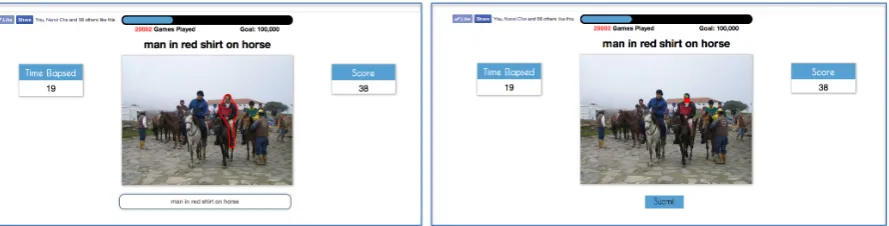
Figure 1: An example game. Player 1 (left) sees an image with an object outlined in red (the man) and provides a referring expression for the object (“man in red shirt on horse”). Player 2 (right) sees the image and the expression from Player 1 and must localize the correct object by clicking on it (click indicated by the red square). Elapsed time and current scores are also provided.
input from natural language statistics. Very re-cently, these ideas have been extended to produce descriptions for videos (Guadarrama et al., 2013; Barbu et al., 2012). Like these methods, we gen-erate descriptions for natural scenes, but focus on referring to particular objects rather than provid-ing an overall description of an image or video. Human Computation Games: Games can be a useful tool for collecting large amounts of la-beled data quickly. Human Computation Games were first introduced by Luis von Ahn in the ESP game (von Ahn and Dabbish, 2004) for image la-beling, and later extended to segment objects (von Ahn et al., 2006b), collect common-sense knowl-edge (von Ahn et al., 2006a), or disambiguate words (Seemakurty et al., 2010). Recently, crowd games have also been introduced into the com-puter vision community for tasks like fine grained category recognition (Deng et al., 2013). These games can be released publicly on the web or used on Mechanical Turk to enhance and encour-age turker participation (Deng et al., 2013). In-spired by the success of previous games, we cre-ate a game to collect and verify natural language expressions referring to objects in natural scenes.
3 Referring Expression Game (ReferItGame)
In this section we describe our referring expres-sion game (ReferItGame∗), a simple two player game where players alternate between generating expressions referring to objects in images of nat-ural scenes, and clicking on the locations of de-scribed objects. An example game is shown in Figure 1.
∗Available online at http://referitgame.com
3.1 Game Play
Player 1: is shown an image with an object out-lined in red and provided with a text box in which to write a referring expression.Player 2:is shown the same image and the referring expression writ-ten by Player 1 and must click on the location of the described object (note, Player 2 does not see the object segmentation). If Player 2 clicks on the correct object, then both players receive game points and the Player 1 and Player 2 roles swap for the next image. If Player 2 does not click on the correct object then no points are received and the players remain in their current roles.
This provides us with referring expressions for our dataset and verification that the expressions are valid since they led to correct object localiza-tions. Expressions written for games where the object was not correctly localized are kept and re-leased with the dataset for future study, but are not included in our final dataset analyses or statistics. A game timer encourages players to write sions quickly, resulting in more natural expres-sions. Also, IP addresses are filtered to prevent people from simultaneously playing both roles.
3.2 Playing Against the Computer
To promote engagement, we implement a single player version of the game. When a player con-nects, if there is another player online then the two people are paired. If there are currently no other available players, then the person plays a “canned” game against the computer. If at any point another person connects, the canned game ends and the player is paired with the new person.
for each of 1000 objects) collected using Ama-zon’s Mechanical Turk service. Implementing an automated version of Player 1 is simple; we just show the person one of the pre-collected referring expressions and they click as usual.
Automating the role of Player 2 is a bit more complicated. In this case, we compare the per-son’s written expression against the pre-recorded expressions for the same object. For this compar-ison we use a parser to lemmatize the words in an expression and then compute cosine similarity be-tween expressions with a bag of words representa-tion. Based on this measure the closest matching expression is determined. If there is no similarity between the newly generated expression and the canned expressions, the expression is deemed in-correct and a random click location (outside of the object) is generated. If there is a successful match with a previously generated expression, then the canned click from the most similar pre-recorded game is used. More complex similarities could be used, but since we require real-time performance in our game setting we use this simple implemen-tation which works well for our expressions.
4 ReferItGame Dataset
In this section we describe the ReferItGame dataset†, including images and labels, processing the dataset, and analysis of the collection.
4.1 Images and Labels
We build our dataset of referring expressions on top of the ImageCLEF IAPR image retrieval dataset (Grubinger et al., 2006). This dataset is a collection of 20,000 images available free of charge without copyright restrictions, depicting a variety of aspects of everyday life, from sports, to animals, to cities, and landscapes. Crucial for our purposes, the SAIAPR TC-12 expansion (Es-calante et al., 2010) includes segmentations of each image into regions indicating the locations of constituent objects. 238 different object categories are labeled, including animals, people, buildings, objects, and background elements like grass or sky. This provides us with information regarding object category, object location, and object size, as well as the location and categories of other objects present in the same image.
†Available at http://tamaraberg.com/referitgame
4.2 Collecting the Dataset
From the ImageCLEF dataset, we created a total of over 100k distinct games (one per object labeled in the dataset). For the games we imposed an or-dering to allow for collecting the most interesting expressions first. Initially we prioritized games for objects in images with multiple objects of the same category. Once these games were completed, we prioritized ordering based on object category to include a comprehensive range of objects. Finally, after successfully collecting referring expressions from the prioritized games, we posted games for the remaining objects. In order to evaluate consis-tency of expression generation across people, we also include a probability of repeating previously played games during collection.
To date, we have collected 130,525 successfully completed games. This includes 10,431 canned games (a person playing against the computer, not including the initial seed set) and 120,094 real games (two people playing). 96,654 distinct ob-jects from 19,984 photographs are represented in the dataset. This covers almost all of the objects present in the IAPR corpus. The remaining ob-jects from the collection were either too small or too ambiguous to result in successful games.
For data collection, we posted the game online for anyone on the web to play and encouraged par-ticipation through social media and the survey sec-tion of reddit. In this manner we collected over 4 thousand referring expressions over a period of 3 weeks. To speed up data collection, we also posted the game on Mechanical Turk. Turkers were paid upon completion of 10 correct games (games where Player 2 clicks on the correct object of interest). Turkers were pre-screened to have ap-proval ratings above 80% and to be located in the US for language consistency.
4.3 Processing the Dataset
Because of the size of the dataset, hand annotation of all referring expressions is prohibitive. There-fore, similar to past work (FitzGerald et al., 2013), we design an automatic method to pre-process the expressions and extract object and attribute men-tions. These automatically processed expressions are used only for analysis and model training. We also fully hand label portions of the dataset for evaluation (§5.2).
S ::=subject word color word0 ::=rel(S, color word)
color word0=color word|
prep in(S, color word)color word0=color word
size word0 ::=rel(S, size word)
size word0=size word
abs loc word0 ::=rel(S, abs loc word)
abs loc word0=abs loc word|
prep on(S, orientation word) ∧ ¬prep of(S, )abs loc word0=on+orientation word
rel loc word0 ::=RL
RL ::=prep rel loc word(S, object word)RL=rel loc word|
prep on(S, orientation word) ∧ prep of(S, object word)RL=on orientation word| prep to(S, orientation word) ∧ prep of(S, object word)RL=to orientation word| prep at(S, orientation word) ∧ prep of(S, object word)RL=at orientation word generic word0 ::=amod(S, generic word)
Figure 2: Templates for parsing attributes from referring expressions (§4.3).
coverage of the attribute types used in the re-ferring expressions. We define the set of at-tributes for a referring expression as a 7-tupleR=
{r1, r2, r3, r4, r5, r6, r7}:
• r1is an entry-level category attribute,
• r2is a color attribute,
• r3is a size attribute,
• r4is an absolute location attribute,
• r5is a relative location relation attribute,
• r6is a relative location object attribute,
• r7is a generic attribute,
Colorandsizeattributes refer to the object color (e.g. “blue”) and object size (e.g. “tiny”) respec-tively. Absolute location refers to the location of the object in the image (e.g. “top of the image”). Relative location relationandrelative location ob-jectattributes allow for referring expressions that localize the object with respect to another object in the picture (e.g. “the car to the left of the tree”). Generic attributes cover all less frequently ob-served attribute types (e.g. “wooden” or “round”). The entry-level category attribute is related to the concept of entry-level categories first proposed by Psychologists in the 1970s (Rosch, 1978) and recently explored in visual recognition (Ordonez et al., 2013). The idea of entry-level categories is that an object can belong to many different cate-gories; an indigo bunting is an oscine, a bird, a vertebrate, a chordate, and so on. But, a person looking at a picture of one would probably call it a bird (unless they are very familiar with ornithol-ogy). Therefore, we include this attribute to cap-ture how people name object categories in refer-ring expressions.
Parsing the referring expressions: We parse the expressions using the most recent version of the StanfordCoreNLP parser (Socher et al., 2013). We begin by traversing the parse tree in a breadth-first manner and selecting the head noun of the sentence to determine the object of the referring expression, denoted as subject word. We pre-define a dictionary of attribute-values (color word, size word, abs location word,
rel location word) for each of the attributes based on the observed data using a combination of POS-tagging and manual labeling.
We then apply a template-based approach on the collapsed dependency relations to recover the set of attributes (the main template rules are shown in Figure 2). The relationship rel indicates any linguistic binary relationship between the subject wordSand another word, including theamod re-lationship.Orientation wordcaptures the words like left, right, top and bottom. Forgeneric word
we consider any modifier words other than those captured by our other attributes (color, size, loca-tion).
Using this template-based parser we can for instance parse the following expression: “Red flower on top of pedestal”. The first rule would match the prep(S, color word)
relation, effectively recovering the attribute
color word0 as “red”. The second rule would
match the prep on(S, orientation word) ∧ prep of(S, object word) relations, recovering
rel loc word0 as “on top of ” and object word as “pedestal”.
0 0.1 0.2 0.3 0.4 0.5 0.6 0.7 0.8 0.9 1
0 0.2 0.4 0.6 0.8 1
Plot D: Object Locations for Abs-Loc Attributes
Right Left Bottom Middle Top Front
0 2000 4000 6000
sky-blue man group-of-persons ground rock cloud grass woman trees mountain vegetation wall sky window building ocean sky-light tree car person house floor couple-of-persons face-of-person plant hat street hill fabric bed bottle lamp sand-beach chair door child-boy painting palm river bicycle
Plot A: Attribute Breakdown by Category
None Color Size Absolute Location Relative Location Other
0 50% 1
41% 2 9%
Plot C: Number of Attributes Per Expression
0 0.1 0.2 0.3 0.4 0.5 0.6
Non
e
Siz
e
Re
lat
iv
e
Loc
ation
Plot F: Attribute Use Frequencies
Overall Single Multiple 0
0.05 0.1 0.15 0.2 0.25 0.3 0.35
None Small Big Tall Little Tiny Large Short Huge Long
Plot E: Object Area vs Indicated Size
0 200 400 600 people
shirt side guy head tree man corner background building wall woman table bed water hat girl mountain person sign car pic lady window sky foot boat foreground jacket ground hand bike group cloud horse grass rock house
Plot B: Most Frequently Used Relative Objects
Figure 3: Analyses of the ReferItGame Dataset. Plot A shows frequency and attribute occurrence for common object categories.Plot Bshows objects frequently used as reference points, ie “to the left of the man”. Plot Cshows frequencies of using 0, 1 or 2 attributes within the same expression. Plot Dshows object locations vs location words used. Plot Eshows normalized object size vs size words used (bars show1st through3rdquartiles). Plot Fshows the frequency of usage of each attribute type for images
People Man Woman
Car Bottle Street
Color Objects
Beige
Red
Yellow
Blue
[image:7.595.81.522.67.180.2]Black
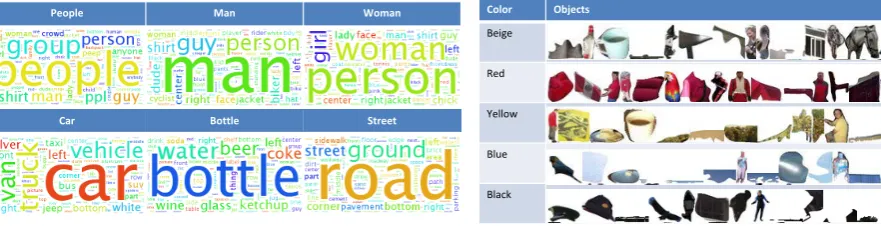
Figure 4: Left: Tag clouds showing entry-Level category words used in referring expressions to name various object categories, with word size indicating frequency. For example, this indicates that “streets” are often called “road”, sometimes “ground”, sometimes “roadway”, etc. Right: example objects pre-dicted to portray some of our color attribute values. Note sometimes our color predictor is quite accurate, and sometimes it makes mistakes (see the man in a red shirt predicted as “yellow”).
that were manually parsed by a human annotator.
4.4 Dataset Analysis
In the resulting dataset, we have a range of cov-erage over objects. For 10,304 of the objects we have 2 or more referring expressions while for the rest of the objects we have collected only one ex-pression. This creates a dataset that emphasizes breadth while also containing enough data to study speaker variation.
Multiple attribute analyses are provided in Fig-ure 3. We find that most expressions use 0, 1, or 2 attributes (in addition to the entry-level attribute object word), with very few expressions contain-ing more than 2 attributes (frequencies are shown in Fig 3c). We also examine what types of at-tributes are used most frequently, according to ob-ject category in Fig 3a, and when associated with single or multiple occurrences of the same object category in an image in Fig 3f. The frequency of attribute usage in images containing multiple objects of the same type increases for all types, compared to single object occurrences. Perhaps more interestingly, the use of different attributes is highly category dependent. People use more at-tribute words overall to describe some categories, like “man”, “woman”, or “plant”, and the distribu-tion of attribute types also varies by category. For example, color attributes are used more frequently for categories like “car” or “woman” than for cat-egories like “sky” or “rock”.
We also examine which objects are most fre-quently used as points of reference, e.g.,“the chair next to theman” in Fig 3b. We observe that peo-ple and some background categories like “tree” or “wall” are often used to help localize objects in
referring expressions. Additionally, we provide plots showing the relationship between object lo-cation in the image and use of absolute lolo-cation words, Fig 3d, as well as size words vs object area, Fig 3e.
Finally, we study entry-level category attribute-values to understand how people name objects in referring expressions. Tag clouds indicating the frequencies of words used to name various ob-ject categories are provided in Fig 4 (left). Ob-jects like “street” are usually referred to as “road”, but sometimes they are called “ground”, “road-way”, etc. “Bottles” are usually called “bottle”, but sometimes referred to as “coke” or “beer”. In-terestingly, “man” is usually called “man” while “woman” is most often called “person” in the re-ferring expressions.
5 Generating Referring Expressions
In this section we describe our proposed genera-tion model and provide experimental evaluagenera-tions on three test sets.
5.1 Generation Model
Given an input tuple I = {P, S}, whereP is a target object and S is a scene (image containing multiple objects), our goal is to generate an output referring expression, R. For instance, the repre-sentationR for the referring expression: The big old white cabin beside the tree would be R =
{cabin, white, big,∅, beside, tree, old}.
To generate referring expressions we construct vocabulariesVriwith candidate values for each
at-tributeri ∈R, where attribute vocabularyVri
Image Human Expressions Generated Expressions
picture on the wall picture picture
Baseline:[picture, white, , right, , , ]
Full: [picture, , , , prep_on, wall, ]
Door
white door middle white door
Baseline:[door, white, , right, , , ]
Full:[door, white, , right, , , ] big gated window on right of
white section black big window right brown railings on right
Baseline:[window, white, , right, , , ]
Full:[window, brown, , right, , , ]
white shirt man white shirt on right man on right
Baseline:[man, white, , right, , , ]
Full:[man, white, , right, , , ]
building on right behind guys blue right building building on right
Baseline:[building, white, , right, , , ]
Full:[building, white, , right, , , ]
Image Human Expressions Generated Expressions
picture santa the santa picture
Baseline:[picture, white, , right, , , ]
Full:[picture, , , , prep_on, plant, ]
right doorway right brown door right door
Baseline:[door, , , right, prep_on, person, ]
Full:[door, , , right, prep_above, person, ]
with flag window top 2nd left 2nd window top left
Baseline:[window, , , right, prep_on, person, ]
Full:[window, , , left, prep_above, door, ]
red guy left sitting left bottom guy red shirt lef
Baseline:[man, , , right, prep_on, wall, ]
Full:[man, , , left, prep_in, woman, ]
buildings buildings buildings
Baseline:[building, white, , right, , , ]
[image:8.595.74.523.64.257.2]Full:[building, brown, , middle, , ,
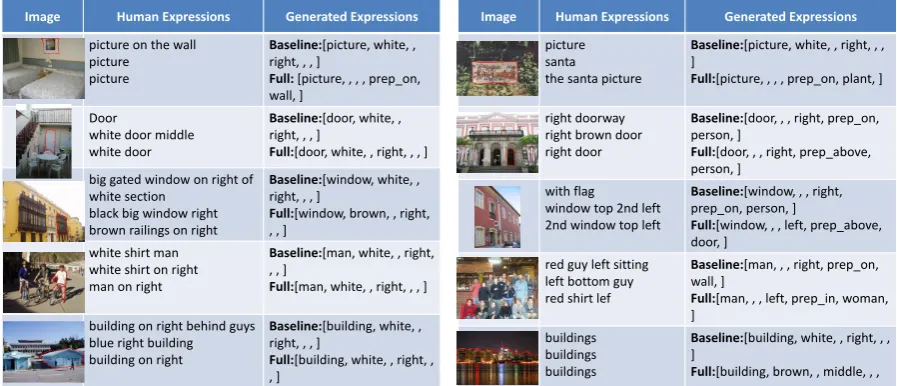
Figure 5: Example results, including human generated expressions, baseline and full model generated expressions. For some images the model does well at mimicking human expressions (left). For others it does not generate the correct attributes (right).
εvalue indicating that the attribute should be om-mited from the referring expression entirely.
In this way, our framework can jointly deter-mine which attributes to include in the expression (e.g.,“size” and “color”) and what attribute values to generate (e.g.,“small” and “blue”) from the list of all possible values. We enforce a constraint to always include an “entry-level category” attribute (e.g. “boy”) so that we always generate a word referring to the object.
We pose our problem as an optimization where we map a tuple {P, S} to a referring expression
R∗as:
R∗ =argmax
R E(R, P, S)
s. t.fi(R)≤bi
(1)
Where the objective functionEis decomposed as:
E(R, P, S) =α
6
X
i=2
φi(ri, P, S)
+β
7
X
i=1
ψi(ri, type(P))
+X
i>j
ψi,j(ri, rj)
(2)
Whereφiis the compatibility function between an
attribute-value forri and the properties of the
ob-served sceneSand objectP(described in§5.1.1). The termsψiandψi,j are unary and pairwise
pri-ors computed based on observed co-occurrence statistics of attribute-values forri with categories
(wheretype(P)denotes the type or category of an
object) and between pairs of attribute-values (de-scribed in§5.1.2). Attributesr1 andr7 are mod-eled only in the priors since we do not have visual models for these attributes.
The constraints fi(R) ≤ bi are restricted to be
linear constraints and are used to impose hard con-straints on the solution. The first such constraint is used to control the verbosity (length) of the gener-ated referring expression using a constraint func-tion that imposes a minimum attribute length re-quirement by restricting the number of entries ri
that can take valueεin the solution. X
i
1[ri=ε]≤7−γ(P, S) (3)
Where1[.]is the indicator function andγ(P, S)is a term that allows us to change the length require-ment based on the object and scene (so that images with a larger number of objects of the same type have a larger length requirement).
Finally we add hard constraints such thatr5=ε
⇐⇒ r6 =ε, so that relative location and relative object attributes are produced together.
5.1.1 Content-based potentials
could also be incorporated for modelingr1, but we leave this as future work.
Color attribute:
φ2(r2 =ck, P, S) =sim(histck, hist(P))
Wherehist(P)is the HSV color histogram of the objectP. We compute similaritysimusing cosine similarity, andhistck is the mean histogram of all
objects in our training data that were referred to with color attribute-valueck∈Vr2.
Size attribute:
φ3(r3=sk, P, S) =
1
σsk
√
2πe
−(size(P)−µsk)2.
2σ2 sk
Wheresize(P)is the size of objectP normalized by image size. We model the probabilities of each size wordsk ∈ Vr3 as a Gaussian learned on our training set.
Absolute-location attribute:
φ4(r4=ak, P, S) =
1
p
(2π)n|Σa
k| e−1
2(loc(P)−µak)TΣak−1(loc(P)−µak)
Where loc(P) are the 2-dimensional coordi-nates of the objectP normalized to be∈ [0−1]. Parameters µak and Σak are estimated from
training data for each absolute location word
ak∈Vr4.
Relative-location and Relative object:
φ5(r5=lk, P, S) =
1[lk=ε]·g(count(type(P), S))
If there are a larger number of objects of the same type in the image we find that the probability of us-ing a relative-location-object increases (e.g., “the car to the right of the man”). For images whereP
was the only object of that category type, the prob-ability of using a relative-location-object is 0.12. This increases to 0.22 when there were two ob-jects of the same type and further increases to 0.26 for additional objects of the same type. There-fore, we model the probability of selecting rela-tive location valuelk∈Vr5 as a functiong, where
count(type(P), S) counts the number of objects
in the scene S of the same category type as the objectP.
φ6(r6 =ok, P, S) =
1[ok∈objectsnear(location(P), S)]
The above expression filters out potential relative objectsok ∈ Vr6 that are not located in sufficient proximity to objectP or are not present in the im-age at all.
5.1.2 Prior statistics-based potentials
Prior statistics-based potentials are modeled for all of the attributesr1-r7. Note that these potentials do not depend on specific attribute-values but only on the given object categorytype(P).
Unary prior potentialsψiare defined as:
ψi(ri, type(P)) =
|D|
P
j=11[(r (j)
i 6=) ∧ (type(P(j)) =type(P))]
|PD|
j=11[type(P
(j)) =type(P)]
+
|D|
P
j=11[r (j)
i 6=]
|D| +λ
Where D = {P(j), S(j), R(j)} is our training dataset andλis a small additive smoothing term. The two terms in the above expression represent category-specificcounts andglobalcounts of the number of times a given attributeri was output in
a referring expression in training data. Pairwise prior potentialsψi,j are defined as:
X
i<j
ψi,j(ri, rj) =
X
i<j
ψi,j(1)(ri, rj) +ψ5(2),6(r5, r6)
ψi,j(1)(ri, rj) =
1 ifri =rj =ε
C+λ o.w.
ψ(2)5,6(r5=a, r6 =b) = |D|
P
t=11[(r (t)
5 =a) ∧ (r6(t)=b)]
|D|
whereC =
|D|
P
t=11[(r (t)
i 6=)∧(rj(t)6=)]
|D| . The pairwise
SOURCE PREC(%) RECALL(%)
Baseline - A 27.92 43.27
Full Model - A 36.28 53.44
Baseline - B 29.87 50.57
Full Model - B 36.68 59.80
Baseline - C 28.85 37.41
[image:10.595.79.283.62.161.2]Full Model - C 37.73 48.54
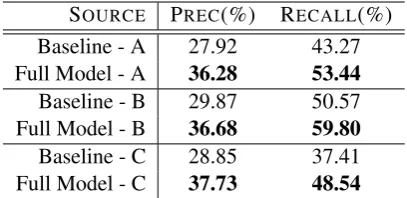
Table 1: Baseline Model & Full Model perfor-mance on the three test sets (A,B,C).
For instance how frequently people use both color and size attributes to refer to an object. The pair-wise potentialψi,j(2)produces a cohesion score be-tween relative-location words and relative-object words based on global dataset statistics.
5.2 Experiments
We implement the proposed model using commer-cial binary integer linear programming software (IBM ILOG CPLEX). This requires introducing a set of indicator variables for each of our multi-valued attributes and another set of indicator vari-ables to model pairwise interactions between our variables, as well as incorporating additional con-sistency constraints between variables. Model pa-rameters (α and β) are tuned on data randomly sampled from the training set.
Test Sets: We evaluate our model on three test sets, each containing 500 objects. For each ob-ject in the test sets we collect 3 referring expres-sions using the ReferItGame and manually label the attributes mentioned in each expression. We find human agreement to be 72.31% on our dataset (where we measure agreement as mean match-ing accuracy of attribute values for pairs of users across images in our test sets). The three test sets are created to evaluate different aspects of our data.
Test Set A contains objects sampled randomly from the entire dataset. This test set is meant to closely resemble the full dataset distribution. The goal of the other two test sets is to sample expres-sions for “interesting” objects. We first identify categories that are mainly related to background content elements, e.g. “sky, ground, floor, sand, sidewalk, etc”. We consider these categories to be potentially less interesting for study than cat-egories like people, animals, cars, etc. Test Set B contains objects sampled from the most frequently occurring object categories in the dataset, selected
to contain a balanced number of objects from each category, excluding the less interesting categories. Test Set C contains objects sampled from images that contain at least 2 objects of the same category, excluding the less interesting categories.
Results: Qualitative examplesare shown in Fig 5 comparing our results to the human produced ex-pressions. For some images (left) we do quite well at predicting the correct attributes and values. For others we do less well (right). We also show exam-ple objects predicted for some color words in Fig 4 (right). We see that our model can fail in several ways, such as generating the wrong attribute-value due to inaccurate predictions by visual models or selecting incorrect attributes to include in the gen-erated expression.
Quantitative results: precision and recall mea-sures for the 3 test sets are reported in Table 1, including evaluation of a baseline version of our model which incorporates only the prior potentials (§5.1.2) without any content based estimates. We see that our model performs reasonably on both measures, and outperforms the baseline by a large margin on all test sets, with highest performance on the broadly sampled interesting category test set. Note that our problem is somewhat differ-ent than traditional REG where the input is often attribute-value pairs and the task is to select which pairs to include in the expression. Our goal is to jointly select which attributes to include and what values to predict from a list of all possible values for the attribute.
6 Conclusions & Future Work
In this paper we have introduced a new game to crowd-source referring expressions for objects in natural scenes. We have used this game to pro-duce a new large-scale dataset with analysis. We have also proposed an optimization based model for REG and performed experimental evaluations. Future work includes developing fully automatic visual recognition methods for REG in real world scenes, and incorporating linguistically inspired models for entry-level category prediction.
Acknowledgments
References
Ahmet Aker and Robert Gaizauskas. 2010. Generating image descriptions using dependency relational pat-terns. InAssociation for Computational Linguistics (ACL).
Andrei Barbu, Alexander Bridge, Zachary Burchill, Dan Coroian, Sven J. Dickinson, Sanja Fi-dler, Aaron Michaux, Sam Mussman, Siddharth Narayanaswamy, Dhaval Salvi, Lara Schmidt, Jiangnan Shangguan, Jeffrey Mark Siskind, Jar-rell W. Waggoner, Song Wang, Jinlian Wei, Yifan Yin, and Zhiqi Zhang. 2012. Video in sentences out. InUncertainty in Artificial Intelligence (UAI).
Robert Dale and Ehud Reiter. 1995. Computational interpretations of the gricean maxims in the gener-ation of referring expressions. Cognitive Science (CogSci), 19:233264.
Robert Dale and Ehud Reiter. 2000. Building natural language generation systems. InCambridge Univer-sity Press.
Jia Deng, Alexander C. Berg, Kai Li, and Fei-Fei Li. 2010. What does classifying more than 10,000 im-age categories tell us? InEuropean Conference on Computer Vision (ECCV).
Jia Deng, Alex Berg, Sanjeev Satheesh, Hao Su, Aditya Khosla, and Fei-Fei Li. 2012. Large scale vi-sual recognition challenge. In http://www.image-net.org/challenges/LSVRC/2012/index.
Jia Deng, Jonathan Krause, and Li Fei-Fei. 2013. Fine-grained crowdsourcing for fine-Fine-grained recognition. InIEEE Conference on Computer Vision and Pattern Recognition (CVPR).
Hugo Jair Escalante, Carlos A. Hernandez, Jesus A. Gonzalez, A. Lopez-Lopez, Manuel Montes, Ed-uardo F. Morales, L. Enrique Sucar, Luis Villasenor, and Michael Grubinger. 2010. The segmented and annotated iapr tc-12 benchmark. Computer Vision and Image Understanding (CVIU).
Rui Fang, Changsong Liu, Lanbo She, and Joyce Chai. 2013. Towards situated dialogue: Revisiting refer-ring expression generation. In Empirical Methods on Natural Language Processing (EMNLP).
Ali Farhadi, Mohsen Hejrati, Mohammad Amin Sadeghi, Peter Young, Cyrus Rashtchian, Julia Hockenmaier, and David Forsyth. 2010. Every picture tells a story: generating sentences for im-ages. InEuropean Conference on Computer Vision (ECCV).
Yansong Feng and Mirella Lapata. 2010. How many words is a picture worth? automatic caption genera-tion for news images. InAssociation for Computa-tional Linguistics (ACL).
Yansong Feng and Mirella Lapata. 2013. Automatic caption generation for news images. IEEE Transac-tions on Pattern Analysis and Machine Intelligence, 35(4):797–812.
Nicholas FitzGerald, Yoav Artzi, and Luke Zettle-moyer. 2013. Learning distributions over logical forms for referring expression generation. In Em-pirical Methods on Natural Language Processing (EMNLP).
H. Paul Grice. 1975. Logic and conversation. page 4158.
Michael Grubinger, Paul D. Clough, Henning Muller, and Thomas Deselaers. 2006. The iapr benchmark: A new evaluation resource for visual information systems. InProceedings of the International Work-shop OntoImage (LREC).
Sergio Guadarrama, Niveda Krishnamoorthy, Girish Malkarnenkar, Subhashini Venugopalan, Raymond Mooney, Trevor Darrell, and Kate Saenko. 2013. Youtube2text: Recognizing and describing arbitrary activities using semantic hierarchies and zero-shot recognition. InInternational Conference on Com-puter Vision (ICCV).
Emiel Krahmer and Kees van Deemter. 2012. Compu-tational generation of referring expressions: A sur-vey. InComputational Linguistics, volume 38, page 173218.
Alex Krizhevsky, Ilya Sutskever, and Geoffrey Hinton. 2012. Imagenet classification with deep convolu-tional neural networks. InNeural Information Pro-cessing Systems (NIPS).
Girish Kulkarni, Visruth Premraj, Sagnik Dhar, Sim-ing Li, Yejin Choi, Alexander C Berg, and Tamara L Berg. 2011. Babytalk: Understanding and generat-ing simple image descriptions. InIEEE Computer Vision and Pattern Recognition (CVPR).
Polina Kuznetsova, Vicente Ordonez, Alex Berg, Tamara L Berg, and Yejin Choi. 2012. Collective generation of natural image descriptions. In Associ-ation for ComputAssoci-ational Linguistics (ACL).
Margaret Mitchell, Kees van Deemter, and Ehud Re-iter. 2010. Natural reference to objects in a visual domain. InInternational Natural Language Gener-ation Conference (INLG).
Margaret Mitchell, Kees van Deemter, and Ehud Reiter. 2011. Two approaches for generating size modifiers. InEuropean Workshop on Natural Language Gener-ation.
Margaret Mitchell, Ehud Reiter, and Kees van Deemter. 2013a. Typicality and object reference. InCognitive Science (CogSci).
Vicente Ordonez, Girish Kulkarni, and Tamara L. Berg. 2011. Im2text: Describing images using 1 million captioned photographs. InNeural Information Pro-cessing Systems (NIPS).
Vicente Ordonez, Jia Deng, Yejin Choi, Alexander C. Berg, and Tamara L. Berg. 2013. From large scale image categorization to entry-level categories. In In-ternational Conference on Computer Vision (ICCV). Florent Perronnin, Zeynep Akata, Zaid Harchaoui, and Cordelia Schmid. 2012. Towards good practice in large-scale learning for image classification. In
Computer Vision and Pattern Recognition (CVPR). Yuan Ren, Kees Van Deemter, and Jeff Z Pan. 2010.
Charting the potential of description logic for the generation of referring expressions. InInternational Natural Language Generation Conference (INLG). Eleanor Rosch. 1978. Principles of categorization.
Cognition and Categorization, page 2748.
Nitin Seemakurty, Jonathan Chu, Luis von Ahn, and Anthony Tomasic. 2010. Word sense disambigua-tion via human computadisambigua-tion. In Human Computa-tion Workshop.
Richard Socher, John Bauer, Christopher D. Manning, and Andrew Y. Ng. 2013. Parsing With Composi-tional Vector Grammars. InAssociation for Compu-tational Linguistics (ACL).
Kees van Deemter, Ielka van der Sluis, and Albert Gatt. 2006. Building a semantically transparent corpus for the generation of referring expressions. In In-ternational Conference on Natural Language Gen-eration (INLG).
Kees Van Deemter, Albert Gatt, Roger PG van Gompel, and Emiel Krahmer. 2012. Toward a computational psycholinguistics of reference production. InTopics in Cognitive Science, volume 4(2), page 166183. Jette Viethen and Robert Dale. 2008. The use of
spa-tial relations in referring expression generation. In
International Natural Language Generation Confer-ence (INLG).
Jette Viethen and Robert Dale. 2010. Speaker-dependent variation in content selection for referring expression generation. In Australasian Language Technology Workshop.
Jette Viethen, Margaret Mitchell, and Emiel Krahmer. 2013. Graphs and spatial relations in the generation of referring expressions. InEuropean Workshop on Natural Language Generation.
Luis von Ahn and Laura Dabbish. 2004. Labeling im-ages with a computer game. InACM Conf. on Hu-man Factors in Computing Systems (CHI).
Luis von Ahn, Mihir Kedia, and Manuel Blum. 2006a. Verbosity: A game for collecting common-sense knowledge. InACM Conference on Human Factors in Computing Systems (CHI).
Luis von Ahn, Ruoran Liu, and Manuel Blum. 2006b. Peekaboom: A game for locating objects in images. InACM Conference on Human Factors in Comput-ing Systems (CHI).
Terry Winograd. 1972. Understanding natural lan-guage. Cognitive Psychology, 3(1):1191.
Yezhou Yang, Ching Lik Teo, Hal Daume III, and Yian-nis Aloimonos. 2011. Corpus-guided sentence gen-eration of natural images. InEmpirical Methods on Natural Language Processing (EMNLP).