Universidad Polit´ecnica de Valencia
{gsanchis,dortiz,jorcisai}@iti.upv.es
Francisco Casacuberta and Enrique Vidal Departamento de Sistemas Inform´aticos y Computaci´on
Universidad Polit´ecnica de Valencia {fcn,evidal}@dsic.upv.es
Hieu Hoang University of Edinburgh [email protected]
Abstract
Although Machine Translation (MT) is a very active research field which is receiving an in-creasing amount of attention from the research community, the results that current MT sys-tems are capable of producing are still quite far away from perfection. Because of this, and in order to build systems that yield correct translations, human knowledge must be inte-grated into the translation process, which will be carried out in our case in an Interactive-Predictive (IP) framework. In this paper, we show that considering Mouse Actions as a sig-nificant information source for the underly-ing system improves the productivity of the human translator involved. In addition, we also show that the initial translations that the MT system provides can be quickly improved by an expert by only performing additional Mouse Actions. In this work, we will be using word graphs as an efficient interface between a phrase-based MT system and the IP engine.
1 Introduction
Information technology advances in modern society have led to the need of more efficient methods of translation. It is important to remark that current MT systems are not able to produce ready-to-use texts (Kay, 1997; Hutchins, 1999; Arnold, 2003). Indeed, MT systems are usually limited to specific semantic domains and the translations provided
re-quire human post-editing in order to achieve a cor-rect high-quality translation.
A way of taking advantage of MT systems is to combine them with the knowledge of a human trans-lator, constituting the so-called Computer-Assisted Translation (CAT) paradigm. CAT offers different approaches in order to benefit from the synergy be-tween humans and MT systems.
An important contribution to interactive CAT technology was carried out around the TransType (TT) project (Langlais et al., 2002; Foster et al., 2002; Foster, 2002; Och et al., 2003). This project entailed an interesting focus shift in which interac-tion directly aimed at the producinterac-tion of the target text, rather than at the disambiguation of the source text, as in former interactive systems. The idea proposed was to embed data driven MT techniques within the interactive translation environment.
Following these TT ideas, (Barrachina and oth-ers, 2008) propose the usage of fully-fledged statis-tical MT (SMT) systems to produce full target sen-tence hypotheses, or portions thereof, which can be partially or completely accepted and amended by a human translator. Each partial correct text segment is then used by the SMT system as additional infor-mation to achieve further, hopefully improved sug-gestions. In this paper, we also focus on the inter-active and predictive, statistical MT (IMT) approach to CAT. The IMT paradigm fits well within the
In-teractive Pattern Recognition framework introduced
in (Vidal and others, 2007).
SOURCE(x): Para encender la impresora:
REFERENCE(y): To power on the printer:
ITER-0 (p) ( )
(ˆsh) To switch on:
ITER-1
(p) To
(sl) switch on: (k) power
(ˆsh) on the printer:
ITER-2
(p) To power on the printer:
(sl) ( )
(k) (#)
(ˆsh) ( )
[image:2.612.195.420.57.221.2]FINAL (p≡y) To power on the printer:
Figure 1: IMT session to translate a Spanish sentence into English. Non-validated hypotheses are displayed in italics, whereas accepted prefixes are printed in normal font.
Figure 1 illustrates a typical IMT session. Ini-tially, the user is given an input sentence x to be translated. The reference y provided is the trans-lation that the user would like to achieve at the end of the IMT session. At iteration0, the user does not supply any correct text prefix to the system, for this reasonpis shown as empty. Therefore, the IMT sys-tem has to provide an initial complete translationsh, as it were a conventional SMT system. At the next iteration, the user validates a prefixp as correct by positioning the cursor in a certain position ofsh. In this case, after the words “To print a”. Implicitly, he is also marking the rest of the sentence, the suffixsl, as potentially incorrect. Next, he introduces a new word k, which is assumed to be different from the first wordsl1in the suffixslwhich was not validated, k6=sl1. This being done, the system suggests a new suffix hypothesisˆsh, subject toˆsh1 =k. Again, the user validates a new prefix, introduces a new word and so forth. The process continues until the whole sentence is correct that is validated introducing the special word “#”.
As the reader could devise from the IMT session described above, IMT aims at reducing the effort and increasing the productivity of translators, while preserving high-quality translation. For instance, in Figure 1, only three interactions were necessary in order to achieve the reference translation.
In this paper, we will show how Mouse Actions performed by the human expert can be taken advan-tage of in order to further reduce this effort.
2 Statistical interactive-predictive MT
In this section we will briefly describe the statistical framework of IMT. IMT can be seen as an evolution of the SMT framework, which has proved to be an efficient framework for building state-of-the-art MT systems with little human effort, whenever adequate corpora are available (Hutchings and Somers, 1992). The fundamental equation of the statistical approach to MT is
ˆ
y=argmax
y
P r(y|x) (1)
=argmax
y
P r(x|y)P r(y) (2)
whereP r(x|y)is the translation model modelling the correlation between source and target sentence andP r(y) is the language model representing the well-formedness of the candidate translationy.
In practise, the direct modelling of the posterior probability P r(y|x) has been widely adopted. To this purpose, different authors (Papineni et al., 1998; Och and Ney, 2002) propose the use of the so-called log-linear models, where the decision rule is given by the expression
ˆ
y=argmax
y
M
X
m=1
λmhm(x,y) (3)
formation to learn translations for whole phrases in-stead of single words. The basic idea of phrase-based translation is to segment the source sentence into phrases, then to translate each source phrase into a target phrase, and finally to reorder the trans-lated target phrases in order to compose the tar-get sentence. Phrase-based models were employed throughout this work.
In log-linear models, the maximisation problem stated in Eq. 3 is solved by means of the beam search algorithm1which was initially introduced in (Low-erre, 1976) for its application in the field of speech recognition. The beam search algorithm attempts to generate partial solutions, called hypotheses, until a complete sentence is found; these hypotheses are stored in a stack and ordered by their score. Such a score is given by the log-linear combination of fea-ture functions.
However, Eq. 1 needs to be modified according to the IMT scenario in order to take into account part of the target sentence that is already translated, that ispandk
ˆ
sh =argmax
sh
P r(sh|x,p, k) (4)
where the maximisation problem is defined over the suffixsh. This allows us to rewrite Eq. 4, by decom-posing the right side appropriately and eliminating constant terms, achieving the equivalent criterion
ˆsh =argmax
sh
P r(p, k,sh|x). (5)
An example of the intuition behind these variables can be seen in Figure 1.
Note that, since(pksh) =y, Eq. 5 is very simi-lar to Eq. 1. The main difference is that the argmax search is now performed over the set of suffixes sh that complete (pk) instead of complete sentences (yin Eq. 1). This implies that we can use the same models if the search procedures are adequately mod-ified (Barrachina and others, 2008).
1
Also known as stack decoding algorithm.
graph that represents possible translations of the given source sentence. The use of word graphs in IMT has been studied in (Barrachina and oth-ers, 2008) in combination with two different trans-lation techniques, namely, the Alignment Templates technique (Och et al., 1999; Och and Ney, 2004), and the Stochastic Finite State Transducers tech-nique (Casacuberta and Vidal, 2007).
3.1 Generation of word graphs
A word graph is a weighted directed acyclic graph, in which each node represents a partial translation hypothesis and each edge is labelled with a word of the target sentence and is weighted according to the scores given by an SMT model (see (Ueffing et al., 2002) for more details). In (Och et al., 2003), the use of a word graph is proposed as interface between an alignment-template SMT model and the IMT en-gine. Analogously, in this work we will be using a word graph built during the search procedure per-formed on a PB SMT model.
During the search process performed by the above mentioned beam search algorithm, it is possible to create a segment graph. In such a graph, each node represents a state of the SMT model, and each edge a weighted transition between states labelled with a sequence of target words. Whenever a hypothesis is extended, we add a new edge connecting the state of that hypothesis with the state of the extended hy-pothesis. The new edge is labelled with the sequence of target words that has been incorporated to the ex-tended hypothesis and is weighted appropriately by means of the score given by the SMT model.
Once the segment graph is generated, it can be easily converted into a word graph by the introduc-tion of artificial states for the words that compose the target phrases associated to the edges.
3.2 IMT using word graphs
SOURCE(x): Para encender la impresora:
REFERENCE(y): To power on the printer:
ITER-0 (p) ( )
(ˆsh) To switch on:
ITER-1
(p) To
(sl) |switch on:
(ˆsh) power on the printer:
ITER-2
(p) To power on the printer:
(sl) ( )
(k) (#)
(ˆsh) ( )
[image:4.612.193.423.55.208.2]FINAL (p≡y) To power on the printer:
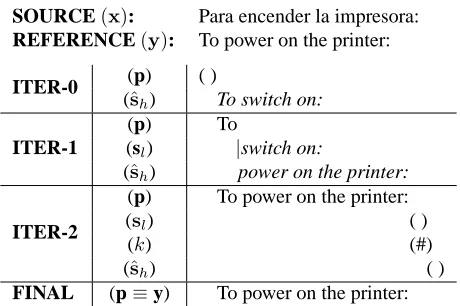
Figure 2: Example of non-explicit positioning MA which solves an error of a missing word. In this case, the system produces the correct suffixshimmediately after the user validates a prefixp, implicitly indicating that we wants the
suffix to be changed, without need of any further action. In ITER-1, character|indicates the position where a MA was performed,slis the suffix which was rejected by that MA, andˆshis the new suffix that the system suggests after observing thatslis to be considered incorrect. Character # is a special character introduced by the user to indicate that the hypothesis is to be accepted.
the system finds the best path in the word graph as-sociated with a given prefix so that it is able to com-plete the target sentence, being capable of providing several completion suggestions for each prefix.
A common problem in IMT arises when the user sets a prefix which cannot be found in the word graph, since in such a situation the system is un-able to find a path through the word graph and pro-vide an appropriate suffix. The common procedure to face this problem is to perform a tolerant search in the word graph. This tolerant search uses the well known concept of Levenshtein distance in order to obtain the most similar string for the given prefix (see (Och et al., 2003) for more details).
4 Enriching user–machine interaction
Although the IMT paradigm has proved to offer in-teresting benefits to potential users, one aspect that has not been reconsidered as of yet is the user– machine interface. Hence, in traditional IMT the system only received feedback whenever the user typed in a new word. In this work, we show how to enrich user–machine interaction by introducing Mouse Actions (MA) as an additional information source for the system. By doing so, we will consider two types of MAs, i.e. non-explicit (or positioning) MAs and interaction-explicit MAs.
4.1 Non-explicit positioning MAs
Before typing in a new word in order to correct a hy-pothesis, the user needs to position the cursor in the place where he wants to type such a word. In this work, we will assume that this is done by perform-ing a MA, although the same idea presented can also be applied when this is done by some other means. It is important to point out that, by doing so, the user is already providing some very useful information to the system: he is validating a prefix up to the posi-tion where he posiposi-tioned the cursor, and, in addiposi-tion, he is signalling that whatever word is located after the cursor is to be considered incorrect. Hence, the system can already capture this fact and provide a new translation hypothesis, in which the prefix re-mains unchanged and the suffix is replaced by a new one in which the first word is different to the first word of the previous suffix. We are aware that this does not mean that the new suffix will be correct, but given that we know that the first word in the previ-ous suffix was incorrect, the worst thing which can happen is that the the first word of the new suffix is incorrect as well. However, if the new suffix hap-pens to be correct, the user will happily find that he does not need to correct that word any more.
replaced. Before typing in anything, the system re-alises that he is going to change the word located after the cursor, and replaces the suffix by another one, which is the one the user had in mind in the first place. Finally, the user only has to accept the final translation.
We are naming this kind of MA non-explicit be-cause it does not require any additional action from the user: he has already performed a MA in order to position the cursor at the place he wants, and we are taking advantage of this fact to suggest a new suffix hypothesis.
Since the user needs to position the cursor before typing in a new word, it is important to point out that any improvement achieved by introducing non-explicit MAs does not require any further effort from the user, and hence is considered to have no cost.
Hence, we are now considering two different situ-ations: the first one, the traditional IMT framework, in which the system needs to find a suffix according to Eq. 5, and a new one, in which the system needs to find a suffix in which the first word does not need to be a givenk, but needs to be different to a given sl1. This constraint can be expressed by the follow-ing equation:
ˆsh = argmax
sh:sh 16=sl1
P r(p,sh|x,sl) (6)
whereslis the suffix generated in the previous iter-ation, already discarded by the user, and sl1 is the first word insl.kis omitted in this formula because the user did not type any word at all.
4.2 Interaction-explicit MAs
If the system is efficient and provides suggestions which are good enough, one could easily picture a situation in which the expert would ask the system to replace a given suffix, without typing in any word. We will be modelling this as another kind of MA,
interaction-explicit MA, since the user needs to
in-dicate explicitly that he wants a given suffix to be replaced, in contrast to the non-explicit positioning MA. However, if the underlying MT engine provid-ing the suffixes is powerful enough, the user would
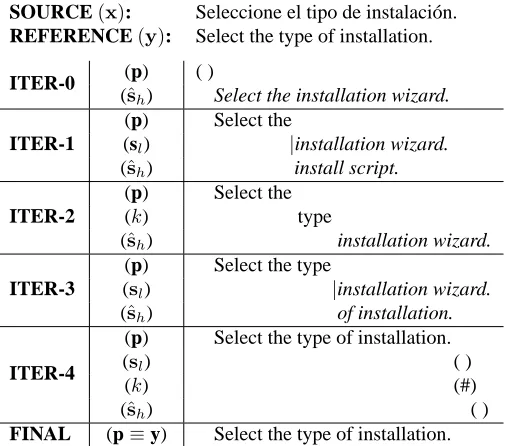
well, we assume that the user clicks before an in-correct word, hence demanding a new suffix whose first word is different, but by doing so he is adopting a more participative and interactive attitude, which was not demanded in the case of non-explicit posi-tioning MAs. An example of such an explicit MA correcting an error can be seen in Figure 3
In this case, however, there is a cost associated to this kind of MAs, since the user does need to per-form additional actions, which may or may not be beneficial. It is very possible that, even after asking for several new hypothesis, the user will even though need to introduce the word he had in mind, hence wasting the additional MAs he had performed.
If we allow the user to performnMAs before in-troducing a word, this problem can be formalised in an analogous way as in the case of non-explicit MAs as follows:
ˆ
sh= argmax
sh:sh 16=s
i
l1∀i∈{1..n}
P r(p,sh|x,s1l,s2l, . . . ,s n
l) (7)
where si
l1 is the first word of the i-th suffix dis-carded ands1l,s2l, . . . ,s
n
l is the set of allnsuffixes discarded.
Note that this kind of MA could also be imple-mented with some other kind of interface, e.g. by typing some special key such asF1orTab. How-ever, the experimental results would not differ, and in our user interface we found it more intuitive to implement it as a MA.
5 Experimental setup
5.1 System evaluation
Automatic evaluation of results is a difficult problem in MT. In fact, it has evolved to a research field with own identity. This is due to the fact that, given an input sentence, a large amount of correct and differ-ent output sdiffer-entences may exist. Hence, there is no sentence which can be considered ground truth, as is the case in speech or text recognition. By extension, this problem is also applicable to IMT.
SOURCE(x): Seleccione el tipo de instalaci´on.
REFERENCE(y): Select the type of installation.
ITER-0 (p) ( )
(ˆsh) Select the installation wizard.
ITER-1
(p) Select the
(sl) |installation wizard. (ˆsh) install script.
ITER-2
(p) Select the
(k) type
(ˆsh) installation wizard.
ITER-3
(p) Select the type
(sl) |installation wizard. (ˆsh) of installation.
ITER-4
(p) Select the type of installation.
(sl) ( )
(k) (#)
(ˆsh) ( )
[image:6.612.182.435.57.280.2]FINAL (p≡y) Select the type of installation.
Figure 3: Example of explicit interactive MA which corrects an erroneous suffix. In this case, a non-explicit MA is performed in ITER-1 with no success. Hence, the user introduces word “type” in ITER-2, which leaves the cursor position located immediately after word “type”. In this situation the user would not need to perform a MA to re-position the cursor and continue typing in order to further correct the remaining errors. However, since he has learnt the potential benefit of MAs, he performs an interaction-explicit MA in order to ask for a new suffix hypothesis, which happens to correct the error.
and others, 2008), which is computed as the quotient between the number of word-strokes a user would need to perform in order to achieve the translation he has in mind and the total number of words in the sentence. In this context, a word-stroke is in-terpreted as a single action, in which the user types a complete word, and is assumed to have constant cost. Moreover, each word-stroke also takes into ac-count the cost incurred by the user when reading the new suffix provided by the system.
In the present work, we decided to use WSR in-stead of Key Stroke Ratio (KSR), which is used in other works on IMT such as (Och et al., 2003). The reason for this is that KSR is clearly an optimistic measure, since in such a scenario the user is often overwhelmed by receiving a great amount of trans-lation options, as much as one per key stroke, and it is not taken into account the time the user would need to read all those hypotheses.
In addition, and because we are also introducing MAs as a new action, we will also present results in terms of Mouse Action Ratio (MAR), which is the quotient between the amount of explicit MAs
per-formed and the number of words of the final trans-lation. Hence, the purpose is to elicit the number of times the user needed to request a new translation (i.e. performed a MA), on a per word basis.
Lastly, we will also present results in terms of uMAR (useful MAR), which indicates the amount of MAs which were useful, i.e. the MAs that actu-ally produced a change in the first word of the suffix and such word was accepted. Formally, uMAR is defined as follows:
uM AR= M AC−n·W SC
M AC (8)
where M AC stands for “Mouse Action Count”, W SC for “Word Stroke Count” andn is the max-imum amount of MAs allowed before the user types in a word. Note thatM AC−n·W SCis the amount of MAs that were useful sinceW SC is the amount of word-strokes the user performed even though he had already performednMAs.
De En Es En Fr En
T
ra
in
in
g Sentences 751K 731K 688K
Run. words 15.3M16.1M 15.7M15.2M 15.6M13.8M Avg. len. 20.3 21.4 21.5 20.8 22.7 20.1 Voc. 195K 66K 103K 64K 80K 62K
D
ev
. SentencesRun. words 55K200059K 61K200059K 67K200059K
Avg. len. 27.6 29.3 30.3 29.3 33.6 29.3 OoV 432 125 208 127 144 138
T
es
t SentencesRun. words 54K200058K 60K200058K 66K200058K
Avg. len. 27.1 29.0 30.2 29.0 33.1 29.3 OoV 377 127 207 125 139 133
translation, which is ”corrected” by the IMT proce-dure into another equivalent translation, increasing WSR and MAR significantly by doing so.
5.2 Corpora
Our experiments were carried out on the Eu-roparl (Koehn, 2005) corpus, which is a corpus widely used in SMT and that has been used in sev-eral MT evaluation campaigns. Moreover, we per-formed our experiments on the partition established for the Workshop on Statistical Machine Translation of the NAACL 2006 (Koehn and Monz, 2006). The Europarl corpus (Koehn, 2005) is built from the pro-ceedings of the European Parliament. Here, we will focus on the German–English, Spanish–English and French–English tasks, since these were the language pairs selected for the cited workshop. The corpus is divided into three separate sets: one for training, one for development, and one for test. The characteris-tics of the corpus can be seen in Table 1.
5.3 Experimental results
As a first step, we built a SMT system for each of the language pairs cited in the previous subsection. This was done by means of the Moses toolkit (Koehn and others, 2007), which is a complete system for building Phrase-Based SMT models. This toolkit in-volves the estimation from the training set of four different translation models, which are in turn
com-Es–En 63.0±0.9 59.2±0.9 6.0±1.4 En–Es 63.8±0.9 60.5±1.0 5.2±1.6 De–En 71.6±0.8 69.0±0.9 3.6±1.3 En–De 75.9±0.8 73.5±0.9 3.2±1.2 Fr–En 62.9±0.9 59.2±1.0 5.9±1.6 En–Fr 63.4±0.9 60.0±0.9 5.4±1.4
bined in a log-linear fashion by adjusting a weight for each of them by means of the MERT (Och, 2003) procedure, optimising the BLEU (Papineni et al., 2002) score obtained on the development partition.
This being done, word graphs were generated for the IMT system. For this purpose, we used a multi-stack phrase-based decoder which will be dis-tributed in the near future together with the Thot toolkit (Ortiz-Mart´ınez et al., 2005). We discarded the use of the Moses decoder because preliminary experiments performed with it revealed that the de-coder by (Ortiz-Mart´ınez et al., 2005) performs clearly better when used to generate word graphs for use in IMT. In addition, we performed an ex-perimental comparison in regular SMT with the Eu-roparl corpus, and found that the performance dif-ference was negligible. The decoder was set to only consider monotonic translation, since in real IMT scenarios considering non-monotonic transla-tion leads to excessive waiting time for the user.
[image:7.612.67.301.128.287.2]40 45 50 55 60 65 70
0 1 2 3 4 5 50 100 150 200 250 300 WSR MAR
max. MAs per incorrect word Spanish -> English
WSR MAR 40 45 50 55 60 65 70
0 1 2 3 4 5 4 6 8 10 12 WSR uMAR
max. MAs per incorrect word Spanish -> English
WSR uMAR 40 45 50 55 60 65 70
0 1 2 3 4 5 50 100 150 200 250 300 WSR MAR
max. MAs per incorrect word German -> English
WSR MAR 40 45 50 55 60 65 70
0 1 2 3 4 5 4 6 8 10 12 WSR uMAR
max. MAs per incorrect word German -> English
WSR uMAR 40 45 50 55 60 65 70
0 1 2 3 4 5 50 100 150 200 250 300 WSR MAR
max. MAs per incorrect word French -> English
WSR MAR 40 45 50 55 60 65 70
0 1 2 3 4 5 4 6 8 10 12 WSR uMAR
max. MAs per incorrect word French -> English
[image:8.612.71.541.64.560.2]WSR uMAR
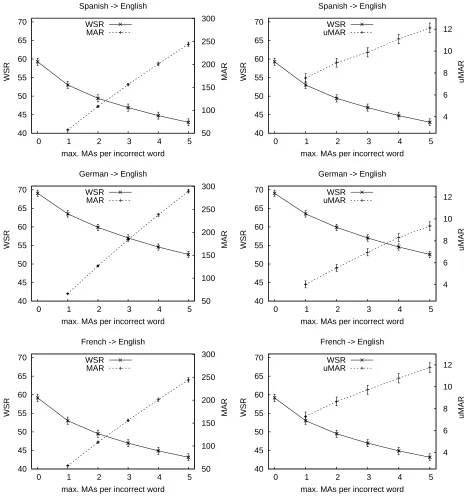
Figure 4: WSR improvement when considering one to five maximum MAs. All figures are given in %. The left column lists WSR improvement versus MAR degradation, and the right column lists WSR improvement versus uMAR. Confidence intervals at 95% confidence level following (Koehn, 2004).
Once the non-explicit MAs were considered and introduced into the system, we analysed the effect of performing up to a maximum of 5 explicit MAs. Here, we modelled the user in such a way that, in case a given word is considered incorrect, he will always ask for another translation hypothesis until
before actually typing in a new word. Nevertheless, just by asking twice for a new suffix before typing in the word he has in mind, the user might be saving about 15% of word-strokes.
Although the results in Figure 4 are only for the translation direction “foreign”→English, the experiments in the opposite direction (i.e. English→“foreign”) were also performed. How-ever, the results were very similar to the ones dis-played here. Because of this, and for clarity pur-poses, we decided to omit them and only display the direction “foreign”→English.
6 Conclusions and future work
In this paper, we have considered new input sources for IMT. By considering Mouse Actions, we have shown that a significant benefit can be obtained, in terms of word-stroke reduction, both when consid-ering only non-explicit MAs and when considconsid-ering MAs as a way of offering the user several suffix hy-potheses. In addition, we have applied these ideas on a state-of-the-art SMT baseline, such as phrase-based models. To achieve this, we have first ob-tained a word graph for each sentence which is to be translated. Experiments were carried out on a refer-ence corpus in SMT.
Note that there are other systems (Esteban and others, 2004) that, for a given prefix, provide n-best lists of suffixes. However, the functionality of our system is slightly (but fundamentally) different, since the suggestions are demanded to be different in their first word, which implies that the n-best list is scanned deeper, going directly to those hypothe-ses that may be of interest to the user. In addition, this can be done “on demand”, which implies that the system’s response is faster and that the user is not confronted with a large list of hypotheses, which often results overwhelming.
As future work, we are planning on performing a human evaluation that assesses the appropriateness of the improvements described.
00018, and by the EC (FEDER) and the Spanish MEC under grant TIN2006-15694-CO2-01.
References
D. J. Arnold, 2003. Computers and Translation: A
trans-lator’s guide, chapter 8, pages 119–142.
S. Barrachina et al. 2008. Statistical approaches to computer-assisted translation. Computational Lin-guistics, page In press.
F. Casacuberta and E. Vidal. 2007. Learning finite-state models for machine translation. Machine Learning, 66(1):69–91.
J. Esteban et al. 2004. Transtype2 - an innovative computer-assisted translation system. In The
Compan-ion Volume to the Proc. ACL’04, pages 94–97.
G. Foster, P. Langlais, and G. Lapalme. 2002. User-friendly text prediction for translators. In Proc. of
EMNLP’02, pages 148–155.
G. Foster. 2002. Text Prediction for Translators. Ph.D. thesis, Universit´e de Montr´eal.
J. Hutchings and H. Somers. 1992. An introduction to machine translation. In Ed. Academic Press.
J. Hutchins. 1999. Retrospect and prospect in computer-based translation. In Proc. of MT Summit VII, pages 30–44.
M. Kay. 1997. It’s still the proper place. Machine
Trans-lation, 12(1-2):35–38.
P. Koehn and C. Monz, editors. 2006. Proc. of the
Work-shop on SMT.
P. Koehn et al. 2007. Moses: Open source toolkit for statistical machine translation. In Proc. of the ACL’07. P. Koehn, F. J. Och, and D. Marcu. 2003. Statistical phrase-based translation. In Proc. HLT/NAACL’03, pages 48–54.
P. Koehn. 2004. Statistical significance tests for machine translation evaluation. In Proc. of EMNLP’04, pages 388–395, Barcelona, Spain.
P. Koehn. 2005. Europarl: A parallel corpus for statisti-cal machine translation. In Proc. of the MT Summit X, pages 79–86.
P. Langlais, G. Lapalme, and M. Loranger. 2002. Transtype: Development-evaluation cycles to boost translator’s productivity. Machine Translation,
15(4):77–98.
Bruce T. Lowerre. 1976. The harpy speech recogni-tion system. Ph.D. thesis, Carnegie Mellon University,
F. Och and H. Ney. 2002. Discriminative training and maximum entropy models for statistical machine translation. In Proc. of the ACL’02, pages 295–302. F.J. Och and H. Ney. 2004. The alignment template
ap-proach to statistical machine translation. Comput.
Lin-guist., 30(4):417–449.
F. Och, C. Tillmann, and H. Ney. 1999. Improved align-ment models for statistical machine translation. In
Proc. of EMNLP/WVLC’99, pages 20–28.
F.J. Och, R. Zens, and H. Ney. 2003. Efficient search for interactive statistical machine translation. In Proc. of
EACL’03, pages 387–393.
F.J. Och. 2003. Minimum error rate training for statis-tical machine translation. In Proc. of ACL’03, pages 160–167.
D. Ortiz-Mart´ınez, I. Garc´ıa-Varea, and F. Casacuberta. 2005. Thot: a toolkit to train phrase-based statisti-cal translation models. In Proc. of the MT Summit X, pages 141–148.
K. Papineni, S. Roukos, and T. Ward. 1998. Maximum likelihood and discriminative training of direct transla-tion models. In Proc. of ICASSP’98, pages 189–192. K. Papineni, S. Roukos, T. Ward, and W.J. Zhu. 2002.
Bleu: A method for automatic evaluation of machine translation. In Proc. of ACL’02.
N. Ueffing, F. Och, and H. Ney. 2002. Generation of word graphs in statistical machine translation. In Proc.
of EMNLP’02, pages 156–163.
E. Vidal et al. 2007. Interactive pattern recognition. In
Proc. of MLMI’07, pages 60–71.