Character-level Analysis of Semi-Structured Documents for Set Expansion
Richard C. Wang
Language Technologies Institute Carnegie Mellon University
William W. Cohen
Machine Learning Department Carnegie Mellon University
Abstract
Set expansion refers to expanding a par-tial set of “seed” objects into a more com-plete set. One system that does set ex-pansion is SEAL (Set Expander for Any Language), which expands entities auto-matically by utilizing resources from the Web in a language-independent fashion. In this paper, we illustrated in detail the construction of character-level wrappers for set expansion implemented in SEAL. We also evaluated several kinds of wrap-pers for set expansion and showed that character-based wrappers perform better than HTML-based wrappers. In addition, we demonstrated a technique that extends SEAL to learn binary relational concepts (e.g., “xis the mayor of the cityy”) from only two seeds. We also show that the extended SEAL has good performance on our evaluation datasets, which includes English and Chinese, thus demonstrating language-independence.
1 Introduction
SEAL1 (Set Expander for Any Language) is a set expansions system that accepts input ele-ments (seeds) of some target set S and automat-ically finds other probable elements ofS in semi-structured documents such as web pages. SEAL is a research system that has shown good perfor-mance in previously published results (Wang and Cohen, 2007). By using only three seeds and top one hundred documents returned by Google, SEAL achieved 90% in mean average precision (MAP), averaged over 36 datasets from three lan-guages: English, Chinese, and Japanese. Un-like other published research work (Etzioni et al., 2005), SEAL focuses on finding small closed sets
1http://rcwang.com/seal
of items (e.g., Disney movies) rather than large and more open sets (e.g., scientists).
In this paper, we explore the impact on perfor-mance of one of the innovations in SEAL, specif-ically, the use of character-level techniques to de-tect candidate regular structures, or wrappers, in web pages. Although some early systems for web-page analysis induce rules at character-level (e.g., such as WIEN (Kushmerick et al., 1997) and DIPRE (Brin, 1998)), most recent approaches for set expansion have used either tokenized and/or parsed free-text (Carlson et al., 2009; Talukdar et al., 2006; Snow et al., 2006; Pantel and Pennac-chiotti, 2006), or have incorporated heuristics for exploiting HTML structures that are likely to en-code lists and tables (Nadeau et al., 2006; Etzioni et al., 2005).
In this paper, we experimentally evaluate SEAL’s performance under two settings: 1) us-ing the character-level page analysis techniques of the original SEAL, and 2) using page analy-sis techniques constrained to identify only HTML-related wrappers. Our conjecture is that the less constrained character-level methods will produce more candidate wrappers than HTML-based tech-niques. We also conjecture that a larger number of candidate wrappers will lead to better performance overall, due to SEAL’s robust methods for ranking candidate wrappers.
The experiments in this paper largely vali-date this conjecture. We show that the HTML-restricted version of SEAL performs less well, losing 13 points in MAP on a dozen Chinese-language benchmark problems, 8 points in MAP on a dozen English-language problems, and 2 points in MAP on a dozen Japanese-language problems.
SEAL currently only handles unary relation-ships (e.g., “x” is a mayor). In this paper, we show that SEAL’s character-level analysis tech-niques can, like HTML-based methods, be
ily extended to handle binary relationships. We then demonstrate that this extension of SEAL can learn binary concepts (e.g., “x is the mayor of the city y”) from a small number of seeds, and show that, as with unary relationships, MAP per-formance is 26 points lower when wrappers are restricted to be HTML-related. Furthermore, we also illustrate that the learning of binary concepts can be bootstrapped to improve its performance.
Section 2.1 explains how SEAL constructs wrappers and rank candidate items for unary re-lations. Section 3 describes the experiments and results for unary relations. Section 4 presents the method for extending SEAL to handle binary re-lationships, as well as their experimental results. Related work is discussed in Section 5, and the paper concludes in Section 6.
2 SEAL
2.1 Identifying Wrappers for Unary Relations
When SEAL performs set expansion, it accepts a small number ofseedsfrom the user (e.g., “Ford”, “Nissan”, and “Toyota”). It then uses a web search engine to retrieve some documents that contain these instances, and then analyzes these documents to findcandidate wrappers(i.e., regu-lar structures on a page that contain the seed in-stances). Strings that are extracted by a candidate wrapper (but are not equivalent to any seed) are called candidate instances. SEAL then statisti-cally ranks the candidate instances (and wrappers), using the techniques outlined below, and outputs a ranked list of instances to the user.
One key step in this process is identifying can-didate wrappers. In SEAL, a cancan-didate wrapper is defined by a pair of left and right character strings,
`andr. A wrapper “extracts” items from a partic-ular document by locating all strings in the docu-ment that are bracketed by the wrapper’s left and right strings, but do not contain either of the two strings. In SEAL, wrappers are always learned from, and applied to, a single document.
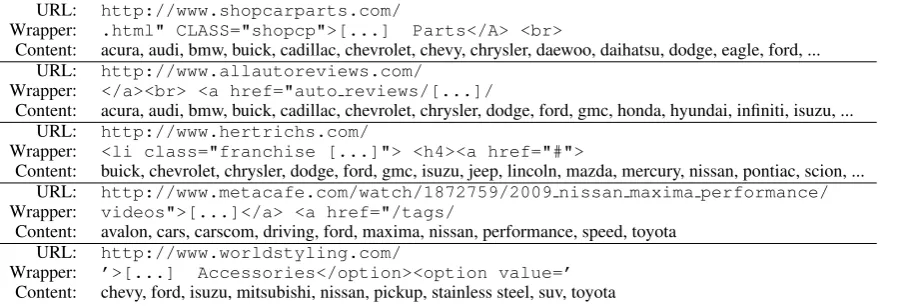
Table 1 illustrates some candidate wrappers learned by SEAL. (Here, a wrapper is written as
`[...]r, with the[...] to be filled by an extracted
string.) Notice that the instances extracted by wrappers can and do appear in surprising places, such as embedded in URLs or in HTML tag at-tributes. Our experience with these character-based wrappers lead us to conjecture that
exist-ing heuristics for identifyexist-ing structure in HTML are fundamentally limited, in that many potentially useful structures will not be identified by analyz-ing HTML structure only.
SEAL uses these rules to find wrappers. Each candidate wrapper`, ris a maximally long pair of strings that bracket at least one occurrence of ev-ery seed in a document: in other words, for each pair`, r, the set of stringsCextracted by`, r has the properties that:
1. For every seeds, there exists somec∈Cthat is equivalent tos; and
2. There are no strings`0, r0that satisfy property
(1) above such that`is a proper suffix of`0
andris a proper prefix ofr0.
SEAL’s wrappers can be found quite efficiently. The algorithm we use has been described previ-ously (Wang and Cohen, 2007), but will be plained again here for completeness. As an ex-ample, below shows a mock document, written in an unknown mark-up language, that has the seeds: Ford, Nissan, and Toyota located (and boldfaced). There are two other car makers hidden inside this document (can you spot them?). In this section, we will show you how to automatically construct wrappers that reveal them.
GtpKxHnIsSaNxjHJglekuDialcLBxKHforDxkrpW NaCMwAAHOFoRduohdEXocUvaGKxHaCuRAxjHjnOx oTOyOTazxKHAUdIxkrOyQKxHToYotAxjHCRdmLxa puRAPprtqOVKxHfoRdxjHaJAScRFrlaFoRDofwNL WxKHtOYotaxkrHxQKlacXlGEKtxKHNisSanxkrEq
Given a set of seeds and a semi-structured doc-ument, the wrapper construction algorithm starts by locating all strings equivalent to a seed in the document; these strings are calledseed instances below. (In SEAL, we always use case-insensitive string matching, so a string is “equivalent to” any case variant of itself.) The algorithm then inserts all the instances into a list and assigns a uniqueid
to each of them by its index in the list (i.e., theid
of an instance is its position in the list.)
URL: http://www.shopcarparts.com/
Wrapper: .html" CLASS="shopcp">[...] Parts</A> <br>
Content: acura, audi, bmw, buick, cadillac, chevrolet, chevy, chrysler, daewoo, daihatsu, dodge, eagle, ford, ... URL: http://www.allautoreviews.com/
Wrapper: </a><br> <a href="auto reviews/[...]/
Content: acura, audi, bmw, buick, cadillac, chevrolet, chrysler, dodge, ford, gmc, honda, hyundai, infiniti, isuzu, ... URL: http://www.hertrichs.com/
Wrapper: <li class="franchise [...]"> <h4><a href="#">
Content: buick, chevrolet, chrysler, dodge, ford, gmc, isuzu, jeep, lincoln, mazda, mercury, nissan, pontiac, scion, ... URL: http://www.metacafe.com/watch/1872759/2009 nissan maxima performance/ Wrapper: videos">[...]</a> <a href="/tags/
Content: avalon, cars, carscom, driving, ford, maxima, nissan, performance, speed, toyota URL: http://www.worldstyling.com/
[image:3.595.80.535.62.216.2]Wrapper: ’>[...] Accessories</option><option value=’ Content: chevy, ford, isuzu, mitsubishi, nissan, pickup, stainless steel, suv, toyota
Table 1: Examples of wrappers constructed from web pages given the seeds: Ford, Nissan, Toyota.
Patricia trie where every node stores a substring.) Every node in the left-context trie maintains a list ofids for keeping track of the seed instances that follow the string associated with that node. Same thing applies to the right-context trie symmetri-cally. Figure 1 shows the two context tries and the list of seed instances when provided the mock document with the seeds: Ford, Nissan, and Toy-ota.
Provided that the left and right context tries are populated with all the contextual strings of ev-ery seed instance, the algorithm then finds maxi-mally long contextual strings that bracket at least one seed instance of every seed. The pseudo-code for finding these strings for building wrappers is illustrated in Table 2, where Seeds is the set of input seeds and ` is the minimum length of the strings. We observed that longer strings produce higher precision but lower recall. This is an in-teresting parameter that is worth exploring, but for this paper, we consider and use only a min-imum length of one throughout the experiments. The basic idea behind the pseudo-code is to first find all the longest possible strings from one trie given some constraints, then for every such string
s, find the longest possible strings0 from another
trie such thatsands0 bracket at least one
occur-rence of every given seed in a document.
The wrappers constructed as well as the items extracted given the mock document and the exam-ple seeds are shown below. Notice that Audi and Acura are uncovered (did you spot them?).
Wrapper: xKH[...]xkr Content: audi, ford, nissan, toyota Wrapper: KxH[...]xjH
Content: acura, ford, nissan, toyota
Wrappers MakeWrappers(Trie`, Trier)
Return Wraps(l, r)∪Wraps(r, l) Wrappers Wraps(Triet1, Triet2)
For eachn1∈TopNodes(t1,`)
For eachn2∈BottomNodes(t2,n1)
For eachn1∈BottomNodes(t1,n2)
Construct a new Wrapper(Text(n1), Text(n2))
Return a union of all wrappers constructed Nodes BottomNodes(Triet1, Noden0)
Find noden∈t1such that:
(1) NumCommonSeeds(n,n0) ==|Seeds|, and
(2) All children nodes ofn(if exist) fail on (1) Return a union of all nodes found
Nodes TopNodes(Triet, int`) Find noden∈tsuch that:
(1) Text(n).length≥`, and
(2) Parent node ofn(if exist) fails on (1) Return a union of all nodes found
String Text(Noden)
Return the textual string represented by the path from root tonin the trie containingn Integer NumCommonSeeds(Noden1, Noden2)
For each indexi∈Intersect(n1,n2):
Find the seed at indexiof seed instance list Return the size of the union of all seeds found Integers Intersect(Noden1, Noden2)
[image:3.595.306.525.278.562.2]Returnn1.indexes∩n2.indexes
Table 2: Pseudo-code for constructing wrappers.
Figure 1: The context tries and the seed instance list constructed given the mock document presented in Section 2.1 and the seeds: Ford, Nissan and Toyota.
2.2 Ranking Wrappers and Candidate Instances
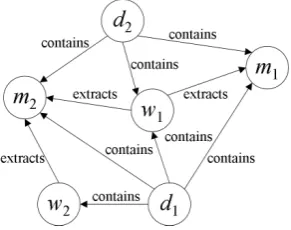
In previous work (Wang and Cohen, 2007), we presented a graph-walk based technique that is effective for ranking sets and wrappers. This model encapsulates the relations between docu-ments, wrappers, and extracted instances (entity mentions). Similarly, our graph also consists of a set of nodes and a set of labeled directed edges. Figure 2 shows an example graph where each node
di represents a document, wi a wrapper, and mi
an extracted entity mention. A directed edge con-nects a nodedi to awi ifdicontainswi, awito a
miifwiextractsmi, and adito amiifdicontains
mi. Although not shown in the figure, every edge
from nodex toy actually has an inverse relation edge from nodeytox(e.g.,miis extracted bywi)
to ensure that the graph is cyclic.
We will use letters such asx,y, andzto denote nodes, and x −→r yto denote an edge from x to
ywith labeled relationr. Each node represents an object (document, wrapper, or mention), and each edgex−→r yasserts that a binary relationr(x, y)
holds. We want to find entity mention nodes that aresimilarto the seed nodes. We define the sim-ilarity between two nodes by random walk with restart (Tong et al., 2006). In this algorithm, to walk away from a source nodex, one first chooses an edge relationr; then givenr, one picks a target nodey such thatx −→r y. When given a source nodex, we assume that the probability of picking an edge relationr is uniformly distributed among the set of all r, where there exist a target node y
[image:4.595.345.491.292.407.2]such thatx−→r y. More specifically,
Figure 2: Example graph built by Random Walk.
P(r|x) = 1
|r:∃y x−→r y| (1)
We also assume that once an edge relation ris chosen, a target nodey is picked uniformly from the set of ally such thatx −→r y. More specifi-cally,
P(y|r, x) = 1
|y:x−→r y| (2)
In order to perform random walk, we will build a transition matrixM where each entry at(x, y)
represents the probability of traveling one step from a source nodexto a target nodey, or more specifically,
Mxy =X
r P(r|x)P(y|r, x) (3)
We will also define a state vector ~vtwhich
rep-resents the probability at each node after iterating through the entire graphttimes, where one itera-tion means to walk one step away from every node. The state vector att+ 1iteration is defined as:
Since we want to start our walk from the seeds, we initialize v0 to have probabilities uniformly
distributed over the seed nodes. In each step of our walk, there is a small probability λ of tele-porting back to the seed nodes, which prevents us from walking too far away from the seeds. We iterate our graph until the state vector converges, and rank the extracted mentions by their probabil-ities in the final state vector. We use a constantλ
of 0.01 in the experiments below.
2.3 Bootstrapping Candidate Instances Bootstrapping refers to iterative unsupervised set expansion. This process requires minimal super-vision, but is very sensitive to the system’s perfor-mance because errors can easily propagate from one iteration to another. As shown in previous work (Wang and Cohen, 2008), carefully designed seeding strategies can minimize the propagated er-rors. Below, we show the pseudo-code for our bootstrapping strategy.
stats←ø, used←inputs
fori= 1 to Mdo
m=min(3,|used|)
seeds←selectm(used)∪top(list)
stats←expand(seeds, stats)
list←rank(stats)
used←used∪seeds
end for
whereM is the total number of iterations,inputs
are the two initial input seeds, selectm(S)
ran-domly selects m different seeds from the set S,
used is a set that contains previously expanded seeds,top(list)returns an item that has the high-est rank in list, expand(seeds, stats) expands the selectedseeds usingstats and outputs accu-mulated statistics, and rank(stats) applies Ran-dom Walk described in Section 2.2 on the accu-mulated stats to produce a list of items. This strategy dumps the highest-ranked item into the
usedbucket after every iteration. It starts by ex-panding two input seeds. For the second iteration, it expands three seeds: two used plus one from last iteration. For every successive iteration, it ex-pands four seeds: three randomly selected used
ones plus one from last iteration.
3 Experiments with Unary Relations
We would like to determine whether character-based or HTML-character-based wrappers are more suited for the task of set expansion. In order to do that,
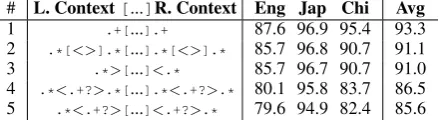
# L. Context[...]R. Context Eng Jap Chi Avg
1 .+[...].+ 87.6 96.9 95.4 93.3
[image:5.595.310.530.63.124.2]2 .*[<>].*[...].*[<>].* 85.7 96.8 90.7 91.1 3 .*>[...]<.* 85.7 96.7 90.7 91.0 4 .*<.+?>.*[...].*<.+?>.* 80.1 95.8 83.7 86.5 5 .*<.+?>[...]<.+?>.* 79.6 94.9 82.4 85.6
Table 3: The performance (MAP) of various types of wrappers on semi-structured web pages.
we introduce five types of wrappers, as illustrated in Table 3. The first type is the character-based wrapper that does not have any restriction on the alphabets of its characters. Starting from the sec-ond type, the allowable alphabets in a wrapper be-come more restrictive. The fifth type requires that an item must be tightly bracketed by two complete HTML tags in order to be extracted.
All pure HTML-based wrappers are type 5, pos-sibly with additional restrictions imposed (Nadeau et al., 2006; Etzioni et al., 2005). SEAL cur-rently does not use an HTML parser (or any other kinds of parser), so restrictions cannot be easily imposed. As far as we know, there isn’t an agree-ment on what restrictions make the most sense or work the best. Therefore, we evaluate perfor-mance for varying wrapper constraints from type 1 (most general) to type 5 (most strict) in our ex-periments.
For set expansion, we use the same evaluation set as in (Wang and Cohen, 2007) which contains 36 manually constructed lists across three differ-ent languages: English, Chinese, and Japanese (12 lists per language). Each list contains all instances of a particular semantic class in a certain language, and each instance contains a set of synonyms (e.g., USA, America).
Since the output of our system is a ranked list of extracted instances, we choose mean average precision (MAP) as our evaluation metric. MAP is commonly used in the field of Information Re-trieval for evaluating ranked lists because it is sen-sitive to the entire ranking and it contains both re-call and precision-oriented aspects. The MAP for multiple ranked lists is simply the mean value of average precisions calculated separately for each ranked list. We define the average precision of a single ranked list as:
AvgP rec(L) =
|L|
X
r=1
Prec(r)×isFresh(r)
whereL is a ranked list of extracted instances, r
is the rank ranging from 1 to |L|, Prec(r) is the precision at rank r, or the percentage of correct synonyms above rank r (inclusively). isFresh(r) is a binary function for ensuring that, if a list con-tains multiple synonyms of the same instance (or instance pair), we do not evaluate that instance (or instance pair) more than once. More specifically, the function returns 1 if a) the synonym atris cor-rect, and b) it is the highest-ranked synonym of its instance in the list; it returns 0 otherwise.
We evaluate the performance of each type of wrapper by conducting set expansion on the 36 datasets across three languages. For each dataset, we randomly select two seeds, expand them by bootstrapping ten iterations (where each iteration retrieves at most 200 web pages only), and evalu-ate the final result. We repeat this process three times for every dataset and report the average MAP for English, Japanese, and Chinese in Ta-ble 3. As illustrated, the more restrictive a wrapper is, the worse it performs. As a result, this indicates that further restrictions on wrappers of type 5 will not improve performance.
4 Set Expansion for Binary Relations
4.1 Identifying Wrappers for Binary Relations
We extend the wrapper construction algorithm de-scribed in Section 2.1 to support relational set ex-pansion. The major difference is that we introduce a third type of context called the middlecontext that occurs between the left and right contexts of a wrapper for separating any two items. We ex-ecute the same algorithm as before, except that a seed instance in the algorithm is now a seed in-stance pair bracketing some middle context (i.e.,
“s1·middle·s2”).
Given some seed pairs (e.g., Ford and USA), the algorithm first locates the seeds in some given documents. For every pair of seeds located, it ex-tracts their left, middle, and right contexts. The left and right contexts are inserted into their corre-sponding tries, while the middle context is inserted into a list. Every middle context is assigned a flag indicating whether the two instances bracketing it were found in the same or reversed order as the input seed pairs. Every entry in the seed instance list described previously now stores a pair of in-stances as one single string (e.g. “Ford/USA”). An
idstored in a node now matches the index of a pair
of instances as well as a middle context.
Shown below is a mock example document of which the seed pairs: Ford and USA, Nissan and Japan, Toyota and Japan are located (and bold-faced).
GtpKxHnIsSaNoKpjaPaNxjHJgleTuoLpBlcLBxKH
forDEFcuSAxkrpWNapnIkAAHOFoRdawHDaUSauoh deQsKxHaCuRAoKpJapANxjHdIjWnOxoTOyOTaVaq
jApaNzxKHAUdIEFcgErmANyxkrOyQKxHToYotAoK pJApaNxjHCRdmtqOVKxHfoRdoKpusAxjHaJASzEi nSfrlaFoRDLMmpuSaofwNLWxKHtOYotaEFcjAPan
xkrHxQKzrHpoKdGEKtxKHNisSanEFcJApAnxkrEq
After performing the abovementioned proce-dures on this mock document, we now have con-text tries that are much more complicated than those illustrated in Figure 1, as well as a list of middle contexts similar to the one shown below:
id Seed Pairs r Middle Context 0 Nissan/Japan No oKp
1 Nissan/Japan No EFc
2 Nissan/Japan Yes xkrHxQKzrHpoKd... 4 Toyota/Japan No oKp
6 Toyota/Japan Yes xjHdIjWnOxo
9 Ford/USA No EFc
13 Ford/USA Yes xkrpWNapnIkAAHO
wherer indicates if the two instances bracketing the middle context were found in the reversed or-der as the input seed pairs. In oror-der to find the maximally long contextual strings, the “Intersect”
function in the set expansion pseudo-code pre-sented in Table 2 needs to be replaced with the following:
Integers Intersect(Noden1, Noden2)
DefineS=n1.indexes∩n2.indexes
Return the largest subsetsofSsuch that:
Every index∈scorresponds to same middle context
which returns those seed pairs that are bracketed by the strings associated with the two input nodes with the same middle context. A wrapper for re-lational set expansion, or relational wrapper, is defined by the left, middle, and right contextual strings. The relational wrappers constructed from the mock document given the example seed pairs are shown below. Notice that Audi/Germany and Acura/Japan are discovered.
Wrapper: xKH[.1.]EFc[.2.]xkr
Content: audi/germany, ford/usa, nissan/japan, toyota/japan
Wrapper: KxH[.1.]oKp[.2.]xjH
Dataset ID Item #1vs.Item #2 Lang. #1 Lang. #2 Size Complete?
US Governor US State/Territory vs. Governor English English 56 Yes
Taiwan Mayor Taiwanese City vs. Mayor Chinese Chinese 26 Yes
NBA Team NBA Team vs. NBA Team Chinese English 30 Yes
[image:7.595.66.532.61.125.2]Fed. Agency US Federal Agency Acronym vs. Full Name English English 387 No Car Maker Car Manufacturer vs. Headquartered Country English English 122 No
Table 4: The five relational datasets for evaluating relational set expansion. Mean Avg. Precision Precision@100 Datasets 1 2 3 4 5 1 2 3 4 5
US Governor 97.4 89.3 89.2 89.3 89.2 55 50 51 50 50 Taiwan Mayor 99.8 95.6 94.3 91.3 90.8 25 25 24 23 23
NBA Team 100.0 99.9 99.9 99.9 99.2 30 30 30 30 30
Fed. Agency 43.7 14.5 5.2 11.1 5.2 96 55 20 40 20
Car Maker 61.7 0.0 0.0 0.0 0.0 74 0 0 0 0
[image:7.595.144.457.155.236.2]Average 80.5 59.9 57.7 58.3 56.9 56 32 25 29 25
Table 5: Performance of various types of wrappers on the five relational datasets after first iteration.
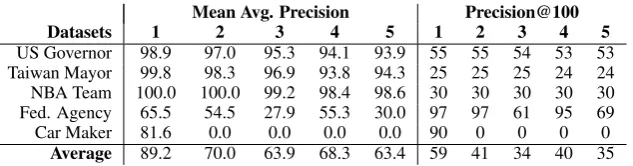
Mean Avg. Precision Precision@100 Datasets 1 2 3 4 5 1 2 3 4 5
US Governor 98.9 97.0 95.3 94.1 93.9 55 55 54 53 53
Taiwan Mayor 99.8 98.3 96.9 93.8 94.3 25 25 25 24 24
NBA Team 100.0 100.0 99.2 98.4 98.6 30 30 30 30 30
Fed. Agency 65.5 54.5 27.9 55.3 30.0 97 97 61 95 69
Car Maker 81.6 0.0 0.0 0.0 0.0 90 0 0 0 0
Average 89.2 70.0 63.9 68.3 63.4 59 41 34 40 35
Table 6: Performance of various types of wrappers on the five relational datasets after10thiteration.
4.2 Experiments with Binary Relations For binary relations, we performed the same ex-periment as with unary relations described in Sec-tion 3. A relaSec-tional wrapper is of type t if the wrapper’s left and right context match t’s con-straint for left and right respectively, and also that the wrapper’s middle context match both con-straints.
For choosing the evaluation datasets for rela-tional set expansion, we surveyed and obtained a dozen relationships, from which we randomly se-lected five of them and present in Table 4. Each dataset was then manually constructed. For the last two datasets, since there are too many items, we tried our best to make the lists as exhaustive as possible.
To evaluate relational wrappers, we performed relational set expansion on randomly selected seeds from the five relational datasets. For every dataset, we select two seeds randomly and boot-strap the relational set expansion ten times. The results after the first iteration are shown in Table 5 and after the tenth iteration in Table 6. When com-puting precision at 100 for each resulting list, we kept only the top-most-ranked synonym of every
instance and remove all other synonyms from the list; this ensures that every instance is unique. No-tice that for the “Car Maker” dataset, there exists no wrappers of types 2 to 5; thus resulting in zero performance for those wrapper types. In each ta-ble, the results indicate that character-based wrap-pers perform the best, while those HTML-based wrappers that require tight HTML bracketing of items (type 3 and 5) perform the worse.
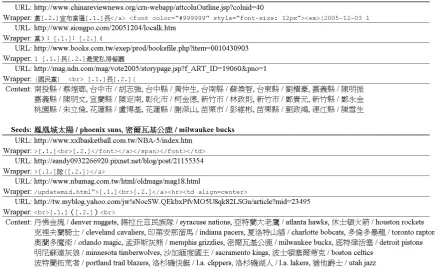
[image:7.595.143.460.267.350.2]Seeds:kentucky / steve beshear, north dakota / john hoeven
URL: http://wikifoia.pbworks.com/Alaska-Governor-Sarah-Palin Wrapper:Governor [.2.]">[.1.] Governor
URL: http://blogs.suntimes.com/sweet/2008/02/sweet state dinner for governo.html Wrapper:<br /> <br /> The Honorable [.2.], Governor of [.1.] <br /> <br />
URL: http://en.wikipedia.org/wiki/United States Senate elections, 2010
Wrapper:" title="Governor of [.1.]">Governor</a> <a href="/wiki/[.2.]" title=" URL: http://ballotbox.governing.com/2008/07/index.html
Wrapper:, [.1.]’s [.2.],
Content: alabama / bob riley, alaska / sarah palin, arizona / janet napolitano, arkansas / mike huckabee, california / arnold schwarzenegger, colorado / bill ritter, connecticut / mary jodi rell, delaware / ruth ann minner, florida / charlie crist, georgia / sonny perdue, hawaii / linda lingle, idaho / butch otter, illinois / rod blagojevich. . .
Seeds:cia / central intelligence agency, usps / united states postal service
URL: http://www1.american.edu/dccampus/links/whitehouse.html
Wrapper:<a href="http://www.[.1.].gov" class="Links2nd">[.2.]</a><span class="Links2nd"> URL: http://www.usembassy.at/en/us/gov.htm
Wrapper:/" target=" blank">[.2.] ([.1.])</a>
-URL: http://www.nationmaster.com/encyclopedia/List-of-United-States-federal-agencies Wrapper:The [.2.] ([.1.]) is
URL: http://www.nationmaster.com/encyclopedia/List-of-United-States-federal-agencies Wrapper:</li> <li>[.1.]-<a href="/encyclopedia/[.2.]" onmouseover="pv(event, 2
Content: achp / advisory council on historic preservation, arc / appalachian regional commission, cftc / commod-ity futures trading commission, cia / central intelligence agency, cms / centers for medicare and medicaid services, exim bank / export import bank of the united states, ntrc / national transportation research center. . .
Seeds:mazda / japan, venturi / france
URL: http://www.jrfilters.com/filtres/index.php?lng=en
Wrapper:&page=filtres&lng=en">[.1.] ([.2.])</option><option value="index.php? URL: http://www.jrfilters.com/suspensions/index.php?famille=1&lng=en
Wrapper:&lng=en">[.1.] ([.2.])</option><option value="index.php?famille=1&rubrique1 URL: http://www.street-car.net/forums/forumdisplay.php?f=10
Wrapper:"><strong>[.1.]</strong></a> </div> <div class="smallfont">Country of origin:[.2.]. URL: http://www.allcarcentral.com/
Wrapper:file.html">[.1.],[.2.]</a><br />
[image:8.595.78.514.72.349.2]Content: abarth / italy, acura / japan, alfa romeo / italy, aston martin / england, auburn / usa, audi / germany, austin healey / england, austin / england, auto union / germany, balwin / usa, bandini / italy, bentley / england, bmw / germany, brabham / england, bricklin / usa, bristol / england, brm / england, bucciali / france. . .
5 Related Work
In recent years, many research has been done on extracting relations from free text (e.g., (Pan-tel and Pennacchiotti, 2006; Agichtein and Gra-vano, 2000; Snow et al., 2006)); however, al-most all of them require some language-dependent parsers or taggers for English, which restrict the language of their extractions to English only (or languages that have these parsers). There has also been work done on extracting relations from HTML-structured tables (e.g., (Etzioni et al., 2005; Nadeau et al., 2006; Cafarella et al., 2008)); however, they all incorporated heuristics for ex-ploiting HTML structures; thus, they cannot han-dle documents written in other mark-up languages. Extracting relations at character-level from semi-structured documents has been proposed (e.g., (Kushmerick et al., 1997),(Brin, 1998)). In particular, Brin’s approach (DIPRE) is the most similar to ours in terms of expanding rela-tional items. One difference is that it requires maximally-long contextual strings to bracket all seed occurrences. This technique has been experi-mentally illustrated to perform worse than SEAL’s approach on unary relations (Wang and Cohen, 2007). Brin presented five seed pairs of author names and book titles that he used in the exper-iment (unfortunately, he did not provide detailed results). We input the top two seed pairs listed in his paper into the relational SEAL, performed ten bootstrapping iterations (took about 3 minutes), and obtained 26,000 author name/book title pairs of which the precision at 100 is perfect (100%).
6 Conclusions
In this paper, we have described in detail an al-gorithm for constructing document-specific wrap-pers automatically for set expansion. In the exper-imental results, we have illustrated that character-based wrappers are better suited than HTML-based wrappers for the task of set expansion. We also presented a method that utilizes an additional middle context for constructing relational wrap-pers. We also showed that our relational set ex-pansion approach is language-independent; it can be applied to non-English and even cross-lingual seeds and documents. Furthermore, we have il-lustrated that bootstrapping improves the perfor-mance of relational set expansion. In the future, we will explore automatic mining of binary con-cepts given only the relation (e.g., “mayor of”).
7 Acknowledgments
This work was supported by the Google Research Awards program.
References
Eugene Agichtein and Luis Gravano. 2000. Snow-ball: Extracting relations from large plain-text
col-lections. In In Proceedings of the 5th ACM
Inter-national Conference on Digital Libraries, pages 85– 94.
Sergey Brin. 1998. Extracting patterns and relations
from the world wide web. In In WebDB
Work-shop at 6th International Conference on Extending Database Technology, EDBT98, pages 172–183. Michael J. Cafarella, Alon Y. Halevy, Daisy Z. Wang,
Eugene W. 0002, and Yang Zhang. 2008. Webta-bles: exploring the power of tables on the web.
PVLDB, 1(1):538–549.
A. Carlson, J. Betteridge, E.R. Hruschka Junior, and T.M. Mitchell. 2009. Coupling semi-supervised
learning of categories and relations. InNAACL HLT
Workshop on Semi-supervised Learning for Natural Language Processing, pages 1–9. Association for Computational Linguistics.
Oren Etzioni, Michael J. Cafarella, Doug Downey, Ana-Maria Popescu, Tal Shaked, Stephen Soder-land, Daniel S. Weld, and Alexander Yates. 2005. Unsupervised named-entity extraction from the
web: An experimental study. Artif. Intell.,
165(1):91–134.
N. Kushmerick, D. Weld, and B. Doorenbos. 1997. Wrapper induction for information extraction. In
Proc. Int. Joint Conf. Artificial Intelligence. David Nadeau, Peter D. Turney, and Stan Matwin.
2006. Unsupervised named-entity recognition:
Generating gazetteers and resolving ambiguity. In Luc Lamontagne and Mario Marchand, editors,
Canadian Conference on AI, volume 4013 of Lec-ture Notes in Computer Science, pages 266–277. Springer.
Patrick Pantel and Marco Pennacchiotti. 2006.
Espresso: leveraging generic patterns for
automat-ically harvesting semantic relations. In ACL-44:
Proceedings of the 21st International Conference on Computational Linguistics and the 44th annual meeting of the Association for Computational Lin-guistics, pages 113–120, Morristown, NJ, USA. As-sociation for Computational Linguistics.
Partha P. Talukdar, Thorsten Brants, Mark Liberman, and Fernando Pereira. 2006. A context pattern induction method for named entity extraction. In
Tenth Conference on Computational Natural Lan-guage Learning (CoNLL-X).
Hanghang Tong, Christos Faloutsos, and Jia-Yu Pan. 2006. Fast random walk with restart and its
appli-cations. InICDM, pages 613–622. IEEE Computer
Society.
Richard C. Wang and William W. Cohen. 2007.
Language-independent set expansion of named
enti-ties using the web. InICDM, pages 342–350. IEEE
Computer Society.
Richard C. Wang and William W. Cohen. 2008. Iter-ative set expansion of named entities using the web.
InICDM, pages 1091–1096. IEEE Computer