Proceedings of the Third Conference on Machine Translation (WMT), Volume 1: Research Papers, pages 261–271
Parameter Sharing Methods for
Multilingual Self-Attentional Translation Models
Devendra Singh Sachan
Data Solutions Team Petuum Inc. Pittsburgh, USA
Graham Neubig
Language Technologies Institute Carnegie Mellon University
Pittsburgh, USA
Abstract
In multilingual neural machine translation, it has been shown that sharing a single trans-lation model between multiple languages can achieve competitive performance, sometimes even leading to performance gains over bilin-gually trained models. However, these im-provements are not uniform; often multilin-gual parameter sharing results in a decrease in accuracy due to translation models not be-ing able to accommodate different languages in their limited parameter space. In this work, we examine parameter sharing techniques that strike a happy medium between full sharing and individual training, specifically focusing on the self-attentionalTransformermodel. We find that the full parameter sharing approach leads to increases in BLEU scores mainly when the target languages are from a similar language family. However, even in the case where target languages are from different fam-ilies where full parameter sharing leads to a noticeable drop in BLEU scores, our proposed methods for partial sharing of parameters can lead to substantial improvements in translation accuracy.1
1 Introduction
Neural machine translation (NMT;Sutskever et al.
(2014);Cho et al.(2014)) is now the de-facto stan-dard in MT research due to its relative simplicity of implementation, ability to perform end-to-end training, and high translation accuracy. Early ap-proaches to NMT used recurrent neural networks (RNNs), usually LSTMs (Hochreiter and Schmid-huber,1997), in their encoder and decoder layers, with the addition of an attention mechanism ( Bah-danau et al., 2014; Luong et al., 2015) to focus more on specific encoded source words when de-ciding the next translation target output. Recently,
1Data and code of this paper is available at: https://github.com/DevSinghSachan/multilingual_nmt
Shared Encoder
Decoder 2
Source Language: "En"
Target Language 2: "Nl"
Decoder 1
Target Language 1: "De"
(a)Shared encoder, separate decoder (Dong et al.,2015).
Shared Encoder
Source Language: "En" Target Language 2: "Nl"
Shared Decoder
Target Language 1: "De"
(b)Shared encoder and decoder (Johnson et al.,2017).
Shared Encoder
Decoder 2
Source Language: "En"
Target Language 2: "Nl" Target Language 1: "De"
Decoder 1
Shareable Parameters
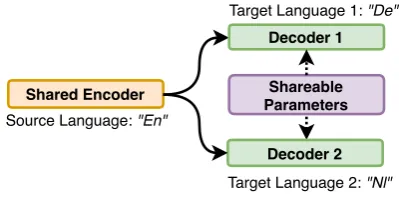
[image:1.595.310.510.383.486.2](c)Proposed shared decoder with partial parameter sharing. Figure 1: Examples of MTL frameworks for the translation of one source language (for example
“En”) to two target languages (for example“De”,
“Nl”). The principle remains the same with more than two target languages. Best viewed in color.
the NMT research community has been transition-ing from RNNs to an alternative method for encod-ing sentences usencod-ing self-attention (Vaswani et al.,
2017), represented by the so-called “Transformer” model, which both improves the speed of process-ing sentences on computational hardware such as GPUs due to its lack of recurrence, and achieves impressive results.
In parallel to this transition to self-attentional models, there has also been an active interest in the multilingual training of NMT systems ( Fi-rat et al., 2016; Johnson et al., 2017; Ha et al.,
2016). In contrast to the standard bilingual mod-els, multilingual models follow the multi-task train-ing paradigm (Caruana,1997) where models are
jointly trained on training data from several lan-guage pairs, with some degree ofparameter shar-ing. The objective of this is two-fold: First, com-pared to individually training separate models for each language pair of interest, this maintains com-petitive translation accuracy while reducing the total number of models that need to be stored, a considerable advantage when deploying practical systems. Second, by utilizing data from multiple language pairs simultaneously, it becomes possi-ble to improve the translation accuracy for each language pair.
In multilingual translation,one-to-many transla-tion —translatransla-tion from a common source language (for example English) to multiple target languages (for example German and Dutch) — is considered particularly difficult. Previous multi-task learning (MTL) models for this task broadly consist of two approaches as shown in Figure1: (a) a model with a shared encoder and one decoder per target lan-guage (Dong et al.(2015), shown in Figure 1a). This approach has the advantage of being able to model each target separately but comes with the cost of slower training and increased memory re-quirements. (b) a singleunifiedmodel consisting of a shared encoder and a shared decoder for all the language pairs (Johnson et al.(2017), shown in Figure1b). This simple approach is trivially im-plementable using a standard bilingual translation model and has the advantage of having a constant number of trainable parameters regardless of the number of languages, but has the caveat that the decoder’s ability to model multiple languages can be significantly reduced.
In this paper, we propose a third alternative: (c) a model with a shared encoder and multiple decoders such that some decoder parameters are shared (shown in Figure1c). This hybrid approach combines the advantages from both the approaches mentioned above. It carefully moderates the types of parameters that are shared between the multi-ple languages to provide the flexibility necessary to decode two different languages, but still shares as many parameters as possible to take advantage of information sharing across multiple languages. Specifically, we focus on the aforementioned self-attentional Transformer models, with the set of shareable parameters consisting of the various
at-tention weights, linear layer weights, or embedding weights contained therein. The full sharingand
no sharingof decoder parameters used in previous work are special cases (refer to Section2.2for a detailed description).
To empirically examine the utility of this ap-proach, we examine the case of translation from a common source language to multiple target lan-guages, where the target languages can be either related or unrelated. Our work reveals that while full parameter sharing works reasonably well when using target languages from the same family, par-tial parameter sharing is essenpar-tial to achieve the best accuracy when translating into multiple dis-tant languages.
2 Method
In this section, we will first briefly describe the key elements of the Transformer model followed by our proposed approach of parameter sharing.
2.1 Transformer Architecture
As is common in sequence-to-sequence (seq2seq) models for NMT, the self-attentional Transformer model (Figure2;Vaswani et al.(2017)) consists of an embedding layer, multiple encoder-decoder layers, and an output generation layer. Each en-coder layer consists of two sublayers in sequence: self-attentional and feed-forward networks. Each decoder layer consists of three sublayers: masked self-attention, encoder-decoder attention, and feed-forward networks. The core building blocks in all these layers consist of different sets of weight matrices that compute affine transforms.
First, an embedding layer obtains the source and target word vectors from the input words: WE ∈ Rdm×V, wheredm is model size, andVis
vocabulary size. After the embedding lookup step, word vectors are multiplied by a scaling factor of√
dm. To capture the relative position of a word
in the input sequence,position encodingsdefined in terms of sinusoids of different frequencies are added to the scaled word vectors of the source and target.
The encoder layer maps the input word vectors to continuous hidden state representations. As men-tioned earlier, it consists of two sublayers. The first sublayer performsmulti-head dot-product self-attention. In the single-head case, defining the input to the sublayer asx= (x1, . . . , xT)and the
Enc-Dec Inter Attention
ki vi qi
ai
Layer Norm Layer Norm ReLU
Masked Self-Attention
Layer Norm
xi
W1
F
W1
K WV1
ki
W1
Q
vi qi
ai
W2
K WV2 WQ2
W2
F
WL1
WL2
Self-Attention Sublayer Encoder-Decoder Attention Sublayer Feed-Forward Network
Sublayer
zi
hi
Encoder Hidden State
zi Layer Norm
WE
Embedding Layer Position Encoding
WE⊺
Tied Linear Layer
[image:3.595.89.274.66.522.2]N×
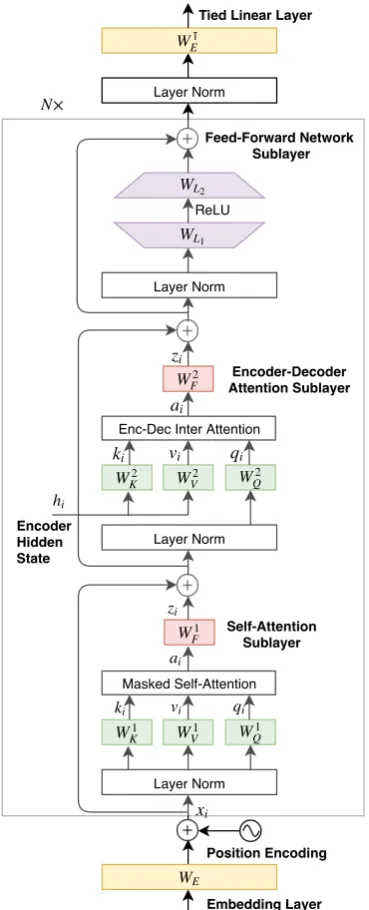
Figure 2: Block diagram illustrating the Trans-former decoder’s shareable parameters (in color) that includes embedding layer weights (WE), tied
linear layer weights (WET), transformation weights as a part of self-attention (W1
K,WV1,WQ1,WF1),
encoder-decoder attention (W2
K,WV2,WQ2,WF2),
and feed-forward network (WL1,WL2) sublayers. Best viewed in color.
the input is linearly transformed to obtain key (ki),
value (vi), and query (qi) vectors
ki =xiWK, vi =xiWV, qi=xiWQ.
Next, similarity scores (eij) between query and
key vectors are computed by performing a scaled
dot-product
eij = 1
√
dmqik T
j.
Next, attention coefficients (αij) are computed by
applying softmax function over these similarity values.
αij =
expeij
PT
l=1expeil
Self-attention output (zi) is computed by the
con-vex combination of attention weights with value vectors followed by a linear transformation
zi = ( T X
j=1
αijvj)WF.
In the above equations, WK,WV,WQ,WF are
learnable transformation matrices of shapeRdm×dm.
To extend to multi-head attention (`), one can split the key, value, and query vectors into`vectors, per-form the attention computation in parallel for each of the`vectors followed by concatenating before the final linear transformation byWF. The second
sublayer consists of a two-layer deepposition-wise feed-forward network (FFN) with ReLU
activa-tion (Glorot et al.,2011).
FFN(zi) = max(0, ziWL1 +b1)WL2+b2
whereWL1 ∈ Rdm×dh,WL2 ∈Rdh×dm,b1 andb2 are biases, anddhis hidden size. TheFFNsublayer
outputs are subsequently given as input to the next encoder layer.
The decoder layer consists of three sublayers. The first sublayer, similar to the encoder, performs masked self-attention where masks are used to pre-vent positions from attending to subsequent po-sitions. The second sublayer performs encoder-decoder inter-attentionwhere the input to the query vector comes from the decoder layer while the in-put to the key and value vectors comes from the encoder’s last layer. To denote parameters in these two sublayers, the transformation weights of the masked self-attention sublayer are referenced as W1
K,WV1,WQ1,WF1 and encoder-decoder
atten-tion sublayer asWK2,WV2,WQ2,WF2, which is also indicated in Figure2. The third sublayer consists of anFFN. To generate predictions for the next word,
Embedding Layer Masked Self-Attention
Enc-Dec Attention Feed-Forward Network
Embedding Layer Masked Self-Attention
Enc-Dec Attention Feed-Forward Network
Decoder 1 Shareable
Parameters Decoder 2
Embedding Layer Self-Attention Feed-Forward Network
Encoder
[image:4.595.118.478.61.214.2]Source Language: ''En" Target Language 1: "De" Target Language 2: "Nl" Tied Linear Layer Tied Linear Layer
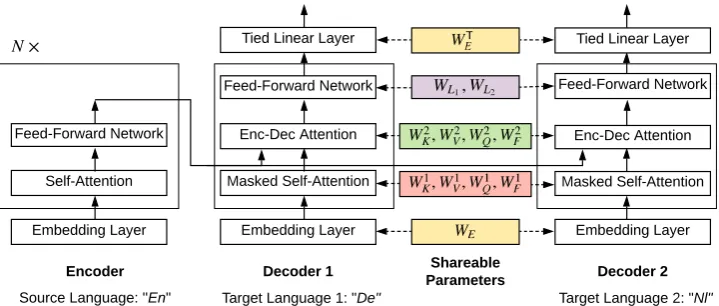
Figure 3: Block diagram illustrating our MTL approach forone-to-manymultilingual translation task that is based on the partial sharing of parameters between the multiple decoders. Best viewed in color.
Residual connections (He et al.,2016) and layer normalization (Ba et al.,2016) are applied on each sublayer and to the output vector from the final encoder and decoder layers.
2.2 Parameter Sharing Strategies
In this paper, our objective is to investigate effective parameter sharing strategies for the Transformer model using MTL, mainly forone-to-many multi-lingual translation. Here, we will use the symbolΘ to denote the set of shared parameters in our model. These parameter sharing strategies are described below:
• The base case consists of separate bilingual translation models for each language pair
Θ=∅.
• Use of a common embedding layer for all the bilingual models Θ= {WE}. This will
result in a significant reduction of the total parameters by sharing parameters across com-mon words present in the source and target sentences (Wu et al.,2016).
• Use of a common encoder for the source lan-guage and a separate decoder for each target language Θ= {WE,θENC}. This has the
advantage that the encoder will now see more source language training data (Dong et al.,
2015).
Next, we also include the decoder parameters among the set of shared parameters. While do-ing so, we will assume that the embedddo-ing and the encoder parameters are always shared between the
bilingual models. Because there can be exponen-tially many combinations considering all the dif-ferent feasible sets of shared parameters between the multiple decoders, we only select a subset of these combinations based on our preliminary re-sults. These selected weights are shared in all the layers of the decoder unless stated otherwise. A schematic diagram illustrating the various possi-ble parameter matrices that can be shared in each sublayer of our MTL model is shown in Figure3.
• We share only theFFNsublayer parameters Θ=WE,θENC,WL1,WL2 .
• Sharing the weights of the self-attention sub-layer Θ = WE, θENC, WK1, WQ1, WV1,
WF1 .
• Sharing the weights of the encoder-decoder attention sublayer Θ = WE, θENC, WK2,
WQ2,WV2,WF2 .
• We limit the attention parameters that are shared to only include either the key and query weights Θ=WE,θENC,WK1,WQ1,
WK2, WQ2 or the key and value weights Θ=WE,θENC,WK1,WV1,WK2,WV2 .
The motivation for doing so is so that the shared attention sublayer weights can model the common aspects of the target languages while the individual FFNsublayer weights
can model the distinctive or unique aspects of each language.
Language Pair Training Dev Test
EN−RO 180,484 3,904 4,631
EN−FR 192,304 4,320 4,866
EN−NL 183,767 4,459 5,006
EN−DE 167,888 4,148 4,491
EN−JA 204,090 4,429 5,565
[image:5.595.78.285.63.168.2]EN−TR 182,470 4,045 5,029
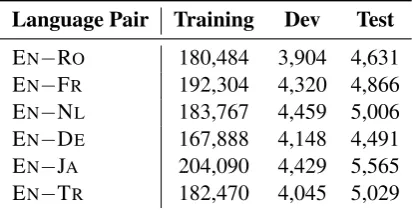
Table 1:Number of sentences in the training, dev, and test splits for each language pair used in our ex-periments. The languages are represented by their ISO 639-1 codesEn:English,Fr:French,Nl:Dutch,
De:German,Ja:Japanese,Tr:Turkish.
θDEC . Fewer parameters in the decoder
in-dicates limited modeling ability, and we ex-pect this method to obtain good translation accuracy mainly when the target languages are related (Johnson et al.,2017).
3 Experimental Setup
In this section, first, we describe the datasets used in this work and the evaluation criteria. Then, we describe the training regimen followed in all our experiments. All of our models were implemented in PyTorch framework (Paszke et al., 2017) and were trained on a single GPU.
3.1 Datasets and Evaluation Metric
To perform multilingual translation experiments, we select six language pairs from the openly avail-able TED talks dataset (Qi et al., 2018) whose statistics are mentioned in Table 1. This dataset already contains predefined splits for training, de-velopment, and test sets. Among these languages, Romanian (RO) and French (FR) areRomance lan-guages, German (DE) and Dutch (NL) are
Ger-maniclanguages while Turkish (TR) and Japanese (JA) are unrelated languages that come from distant language families. For all language pairs, tokeniza-tion was carried out using theMosestokenizer,2
except for Japanese, where word segmentation was performed using the KyTea tokenizer (Neubig et al.,2011). To select training examples, we fil-ter sentences with a maximum length of70tokens.
For evaluation, we report the model’s performance using the standard BLEU score metric (Papineni et al.,2002). We use themtevalv14.plscript
2
https://github.com/moses-smt/mosesdecoder/tree/master/scripts/tokenizer
from theMosestoolkit to compute the tokenized BLEU scores.
3.2 Training Protocols
In this work, we follow the same training process for all the experiments. We jointly encode the source and target language words with subword units by applyingbyte pair encoding(Gage,1994) with 32,000 merge operations (Sennrich et al.,
2016). These subword units restrict the vocabu-lary size and prevent the need for explicitly han-dling out-of-vocabulary symbols as the vocabulary can be used to represent any word. We useLeCun uniform initialization(LeCun et al.,1998) for all the trainable model parameters. Embedding layer weights are randomly initialized according to trun-cated Gaussian distributionWE∼ N(0, dm−1/2).
In all the experiments, we useTransformer base model configuration (Vaswani et al., 2017) that consists of six encoder-decoder layers,dm= 512,
dh = 2,048, and ` = 8. For optimization, we
use SGD with Adam optimizer (Kingma and Ba,
2014) withβ1 = 0.9,β2= 0.997, and= 1e−9.3
The learning rate (lr) schedule is varied at every optimization step (step) according to:
lr= 2d−m0.5min step−0.5,step·16000−1.5
Each mini-batch consists of approximately3,000
source and3,000target tokens such that similar
length sentences are bucketed together. We train the models until convergence and save the best checkpoint using development set performance. For model regularization, we use label smoothing
(= 0.1)(Pereyra et al.,2017) and apply dropout
(withpdrop = 0.1) (Srivastava et al.,2014) to the
word embeddings, attention coefficients, ReLU ac-tivation, and to the output of each sublayer before the residual connection. During decoding, we use beam search with beam width5and length
normal-ization withα= 1(Wu et al.,2016).
3.3 Multilingual Training
During the multilingual model’s training and in-ference, we include an additional token represent-ing the desired target language at the start of each source sentence (Johnson et al.,2017). The pres-ence of this additional token will help the model learn the target language to translate to during de-coding. For preprocessing, we apply byte pair
coding over the combined dataset of all the lan-guage pairs. We perform model training using balanced mini-batchesi.e.it contains roughly an equal number of sentences for every target lan-guage. While training, we compute weighted av-erage cross-entropy loss where the weighting term is proportional to the total word count observed in each of the target language sentences.
4 Results
In this section, we will describe the results of our proposed parameter sharing techniques and later present the broader context by comparing them with bilingual translation models and pre-vious benchmark methods.
4.1 Parameter Sharing
Here, we first analyze the results ofone-to-many
multilingual translation experiments when there are two target languages and both of them belong to the same language family. The first set of experi-ments are onRomancelanguages (EN→RO+FR) and the second set of experiments are onGermanic
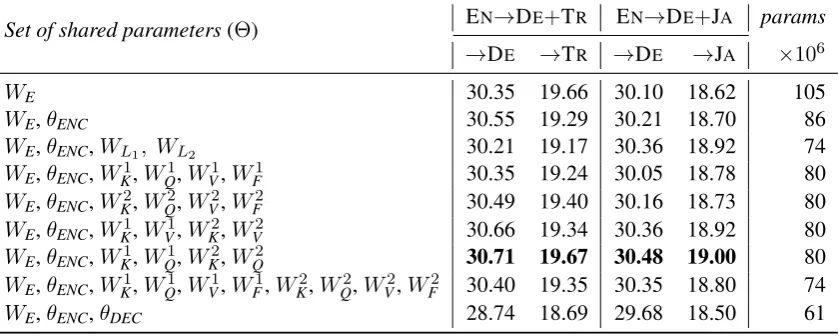
languages (EN→DE+NL). We report the BLEU scores in Table2awhen different sets of parameters are shared in these experiments. We observe that sharing only the embedding layer weight between the multiple models leads to the lowest scores. Sharing the encoder weights results in significant improvement for EN→RO+FRbut leads to a small decrease in EN→DE+NLscores.
We then gradually include both the decoder’s weights to the set of shareable parameters. Specif-ically, we include the parameters of FFN,
self-attention, encoder-decoder self-attention, both the at-tention sublayers, key, query, value weights from both the attention sublayers, and finally all the pa-rameters of the decoder layer. From the results, we note that the sharing of the encoder-decoder attention weights leads to substantial gains. Finally, sharing the entirety of the parameters (i.e. hav-ing one model) leads to the best BLEU scores for EN→RO+FRand sharing only the key and query matrices from both the attention layers leads to the best BLEU scores for EN→DE+NL. One of the reasons for such large increase in BLEU is that en-coder has access to more English language training data and for the decoder, as the target languages be-long to the same family, they may contain common vocabulary, thus improving the generalization error for both the target languages.
Next, we analyze the results of one-to-many
translation experiments when both the target lan-guages belong to distant language families and are unrelated. The first set of experiments are on
Germanic, Turkiclanguages (EN→DE+TR) and the second set of experiments are on Germanic, Japoniclanguages (EN→DE+JA). We present the results in Table2bwhen different sets of parame-ters are shared. Here, we observe that the approach of sharing all the parameters leads to a noticeable drop in the BLEU scores for both the considered language pairs. Similar to the above discussion, sharing the key and query matrices results in a large increase in the BLEU scores. We hypothesize that in this partial parameter sharing strategy, the shar-ing of key and query attention weights effectively models the common linguistic properties while the separateFFNsublayer weights model the unique
characteristics of each target language, thus over-all leading to a large improvement in the BLEU scores. The results of other decoder parameter sharing approaches lie close to the key and query parameter sharing method. As the target languages are from different families, their vocabularies may have some overlap but will be significantly differ-ent from each other. In this scenario, a useful al-ternative is to consider a separate embedding layer for every source-target language pair while sharing all the encoder and decoder parameters. However, we did not experiment with this approach, as the inclusion of separate embedding layers will lead to a large increase in the model parameters and as a result model training will become more mem-ory intensive. We leave the investigation of such parameter sharing strategy to future work.
4.2 Overall Comparison
In Table3, we show an overall performance com-parison of no parameter sharing, full parameter sharing for both GNMT (Wu et al., 2016) and Transformer models, and the best approaches ac-cording to maximum BLEU score from our par-tial parameter sharing strategies. For training the GNMT models, we use its open-source implemen-tation4(Luong et al.,2017) with four layers5and
default parameter settings. First, we note that the BLEU scores of the Transformer model are always better than the GNMT model by a significant mar-gin for both bilingual (no sharing) and multilingual
4https://github.com/tensorflow/nmt
Set of shared parameters(Θ) EN→RO+FR EN→DE+NL params
→RO →FR →DE →NL ×106
WE 27.21 43.36 30.32 33.51 105
WE,θENC 27.82 43.83 29.97 33.33 86
WE,θENC,W1, W2 27.78 43.87 29.95 33.12 74
WE,θENC,WK1,WQ1,WV1,WF1 27.80 43.76 30.68 33.99 80
WE,θENC,WK2,WQ2,WV2,WF2 28.36 44.19 30.50 33.75 80
WE,θENC,WK1,WV1,WK2,WV2 27.77 43.83 30.54 34.00 80
WE,θENC,WK1,WQ1,WK2,WQ2 27.58 43.84 30.70 34.05 80
WE,θENC,WK1,WQ1,WV1,WF1,WK2,WQ2,WV2,WF2 28.14 44.12 30.64 33.92 74
WE,θENC,θDEC 28.52 44.28 30.45 33.69 61
(a)The target languages in thisone-to-manytranslation task belong to the same language family. ROand FRareRomance
languages while DEand NLareGermaniclanguages.
Set of shared parameters(Θ) EN→DE+TR EN→DE+JA params
→DE →TR →DE →JA ×106
WE 30.35 19.66 30.10 18.62 105
WE,θENC 30.55 19.29 30.21 18.70 86
WE,θENC,WL1, WL2 30.21 19.17 30.36 18.92 74
WE,θENC,WK1,WQ1,WV1,WF1 30.35 19.24 30.05 18.78 80
WE,θENC,WK2,WQ2,WV2,WF2 30.49 19.40 30.16 18.73 80
WE,θENC,WK1,WV1,WK2,WV2 30.66 19.34 30.36 18.92 80
WE,θENC,WK1,WQ1,WK2,WQ2 30.71 19.67 30.48 19.00 80
WE,θENC,WK1,WQ1,WV1,WF1,WK2,WQ2,WV2,WF2 30.40 19.35 30.35 18.80 74
WE,θENC,θDEC 28.74 18.69 29.68 18.50 61
(b)The target languages in thisone-to-manytranslation task belong to distant language families. DE, TR, and JAare unrelated
[image:7.595.89.511.67.230.2]as they belong toGermanic,Turkic, andJaponiclanguage families respectively.
Table 2:BLEU scores for various parameter sharing strategies when the target languages either belong to the same family ({RO, FR}, {DE, NL}) or to distant families (DE, TR, JA).θENCdenotes that all the
encoder parameters are shared between the models; θDECdenotes that all the decoder parameters are
shared between the models.
Method EN→DE+TR EN→DE+JA EN→RO+FR EN→DE+NL params →DE →TR →DE →JA →RO →FR →DE →NL ×106
GNMT NS 27.01 16.07 27.01 16.62 24.38 40.50 27.01 30.64 –
GNMT FS 29.07 18.09 28.24 17.33 26.41 42.46 28.52 31.72 –
Transformer NS 29.31 18.62 29.31 17.92 26.81 42.95 29.31 32.43 122
Transformer FS 28.74 18.69 29.68 18.50 28.52 44.28 30.45 33.69 61
Transformer PS 30.71 19.67 30.48 19.00 27.58 43.84 30.70 34.05 80
[image:7.595.91.511.272.440.2](full sharing) translation tasks. This reflects that the Transformer model is well-suited for both mul-tilingual and bilingual translation tasks compared with the GNMT model. We also surprisingly note that the GNMT fully shared model is able to consis-tently obtain higher BLEU scores compared with its bilingual version irrespective of which families the target languages belong to.
However, for the one-to-manytranslation task when the target languages are from distant fam-ilies, we observe that fully shared Transformer model leads to a substantial drop or small gains in the BLEU score compared with the bilingual models. Specifically, for the EN→DE+TRsetting, BLEU drops by 0.6 for EN→DE, while staying even for EN→TR. In contrast, our method of shar-ing embeddshar-ing, encoder, decoder’s key, and query parameters leads to substantial increases in BLEU scores (1.4↑for EN→DE and 1.1↑for EN→TR). Similarly, for EN→DE+JA, using the fully shared Transformer model, we observe small gains of 0.3 and 0.5 BLEU points for EN→DE and EN→JA respectively while our partial parameter sharing method again leads to significant improvements (1.5↑ for EN→DE and 1.1↑ for EN→JA). This demonstrates the utility of our proposed partial pa-rameter sharing method.
We also note that fully shared Transformer mod-els can be an effective strategy only when both the target languages are from the same family. For the task of EN→RO+FR, the fully shared model per-forms surprisingly well and yields significant im-provements of 1.7 and 1.3 BLEU points compared with bilingual models for EN→ROand EN→FR respectively. A similar increase in performance can also be observed for the EN→DE+NL task, although for this task, our partial parameter sharing method (encoder, embedding, decoder’s key, and query weights) obtains even higher BLEU scores. (1.4↑for EN→DEand 1.6↑EN→NL).
4.3 Analysis
Here, we analyze the generated translations of the partial sharing and full sharing approaches for EN→DE when one-to-many multilingual model was trained on unrelated target language pairs EN→DE+TR. These translations were obtained using the test set of EN→DE task. Here partial sharing refers to the specific approach of sharing the embedding, encoder, and decoder’s key and query parameters in the model.
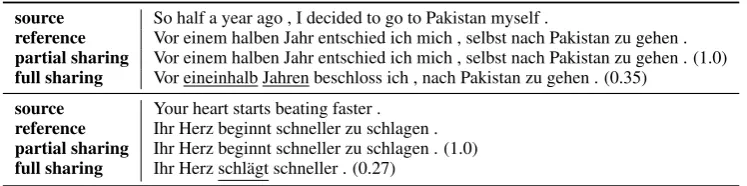
We show example translations in Table4where partial sharing method gets a high BLEU score (shown in parentheses) but the full sharing method does not. We see that sentences generated by partial sharing method are both semantically and grammat-ically correct while the full sharing method gen-erates shorter sentences compared with reference translations. As highlighted in table cells, the par-tial sharing method is able to correctly translate a mention of relative time “half a year” and a co-reference expression “mich”. In contrast, the fully shared model generates incorrect expressions of time mentions “eineinhalb Jahren” (one and half years) and different verb forms (“schlägt” is gener-ated vs “schlagen” in the reference).
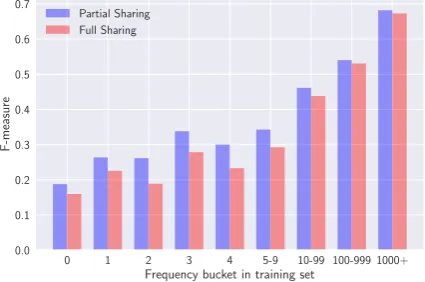
We also perform a comparison of the F-measure of the target words for EN→DE, bucketed by fre-quency in the training set. As displayed in Figure4, this shows that the partial parameter sharing ap-proach improves the translation accuracy for the entire vocabulary, but in particular for words that have low-frequency in the dataset.
0 1 2 3 4 5-9 10-99 100-999 1000+
Frequency bucket in training set 0.0
0.1 0.2 0.3 0.4 0.5 0.6 0.7
F-measure
[image:8.595.310.523.377.518.2]Partial Sharing Full Sharing
Figure 4: The F-measure for the target language (DE) words inone-to-manymultilingual translation task (EN→DE+TR). Best viewed in color.
5 Related Work
In this section, we will review the prior work re-lated to MTL and multilingual translation.
5.1 Multi-task learning
source So half a year ago , I decided to go to Pakistan myself .
reference Vor einem halben Jahr entschied ich mich , selbst nach Pakistan zu gehen . partial sharing Vor einem halben Jahr entschied ich mich , selbst nach Pakistan zu gehen . (1.0) full sharing Vor eineinhalb Jahren beschloss ich , nach Pakistan zu gehen . (0.35)
[image:9.595.113.487.62.155.2]source Your heart starts beating faster . reference Ihr Herz beginnt schneller zu schlagen . partial sharing Ihr Herz beginnt schneller zu schlagen . (1.0) full sharing Ihr Herz schlägt schneller . (0.27)
Table 4: Sample translations from EN→DE when one-to-many multilingual model was trained on unrelated target language pairs EN→DE+TR. In these examples, the method of partial sharing of decoder parameters obtains a very high BLEU score (mentioned in parentheses).
sequence encoder and reported moderate improve-ments in results. Recently, Luong et al. (2016) investigated MTL for a tasks such as parsing, im-age captioning, and translation and observed large gains in the translation task. Similarly, for MT tasks,Niehues and Cho(2017) also leverage MTL by using additional linguistic information to im-prove the translation accuracy of NMT models. They share the encoder representations to perform joint training on translation, POS, and NER tasks. MTL has also been widely applied to multilingual translation that will be discussed next.
5.2 Multilingual Translation
On the multilingual translation task, Dong et al.
(2015) obtained significant performance gains by sharing the encoder parameters of the source lan-guage while having a separate decoder for each target language. Later,Firat et al.(2016) attempted the more challenging task ofmany-to-many trans-lation by training a model that consisted of one shared encoder and decoder per language and a shared attention layer that was common to all languages. This approach obtained competitive BLEU scores on ten European language pairs while substantially reducing the total parameters. Re-cently, Johnson et al.(2017) proposed a unified model with full parameter sharing and obtained comparable or better performance compared with bilingual translation scores. During model train-ing and decodtrain-ing, target language was specified by an additional token at the beginning of the source sentence. Coming to low-resource language trans-lation, Zoph et al. (2016) used a transfer learn-ing approach of fine-tunlearn-ing the model parame-ters learned on a high-resource language pair of French→English and were able to significantly in-crease the translation performance on Turkish and Urdu languages. Recently, Gu et al. (2018)
ad-dresses the many-to-one translation problem for extremely low-resource languages by using a trans-fer learning approach such that all language pairs share the lexical and sentence-level representations. By performing joint training of the model with high-resource languages, large gains in the BLEU scores were reported for low-resource languages.
In this paper, we first experiment with the Trans-former model forone-to-manymultilingual trans-lation on a variety of language pairs and demon-strate that the approach ofJohnson et al. (2017) andDong et al.(2015) is not optimal for all kinds of target-side languages. Motivated by this, we introduce various parameter sharing strategies that strike a happy medium between full sharing and partial sharing and show that it achieves the best translation accuracy.
6 Conclusion
In this work, we explore parameter sharing strate-gies for the task of multilingual machine translation using self-attentional MT models. Specifically, we examine the case when the target languages come from the same or distant language families. We show that the popular approach of full parameter sharing may perform well only when the target lan-guages belong to the same family while a partial pa-rameter sharing approach consisting of shared em-bedding, encoder, decoder’s key and query weights is generally applicable to all kinds of language pairs and achieves the best BLEU scores when the languages are from distant families.
with additional parameter sharing strategies such as sharing the weights of some specific layers (e.g.the first or last layer) as different layers can encode dif-ferent morphological information (Belinkov et al.,
2017) which can be helpful in better multilingual translation.
Acknowledgments
The authors would like to thank Mrinmaya Sachan, Emmanouil Antonios Platanios, and Soumya Wad-hwa for useful comments about this work. We would also like to thank the anonymous reviewers for giving us their valuable feedback that helped to improve the paper.
References
Rie Kubota Ando and Tong Zhang. 2005. A framework for learning predictive structures from multiple tasks
and unlabeled data. Journal Machine Learning
Re-search, 6:1817–1853.
Jimmy Lei Ba, Jamie Ryan Kiros, and Geoffrey E
Hin-ton. 2016. Layer normalization. Computing
Re-search Repository, arXiv:1607.06450.
Dzmitry Bahdanau, Kyunghyun Cho, and Yoshua Ben-gio. 2014. Neural machine translation by jointly learning to align and translate. Computing Research Repository, arXiv:1409.0473.
Yonatan Belinkov, Nadir Durrani, Fahim Dalvi, Has-san Sajjad, and James Glass. 2017. What do neu-ral machine translation models learn about
morphol-ogy? InProceedings of the 55th Annual Meeting of
the Association for Computational Linguistics (Vol-ume 1: Long Papers), pages 861–872. Association for Computational Linguistics.
Rich Caruana. 1997. Multitask learning. Machine
Learning, 28(1):41–75.
Kyunghyun Cho, Bart van Merrienboer, Caglar Gul-cehre, Dzmitry Bahdanau, Fethi Bougares, Holger
Schwenk, and Yoshua Bengio. 2014. Learning
phrase representations using rnn encoder–decoder for statistical machine translation. InProceedings of the 2014 Conference on Empirical Methods in Nat-ural Language Processing (EMNLP), pages 1724– 1734, Doha, Qatar.
Ronan Collobert, Jason Weston, Léon Bottou, Michael Karlen, Koray Kavukcuoglu, and Pavel Kuksa. 2011. Natural language processing (almost) from scratch. Journal of Machine Learning Research, 12:2493– 2537.
Daxiang Dong, Hua Wu, Wei He, Dianhai Yu, and Haifeng Wang. 2015. Multi-task learning for
mul-tiple language translation. In Proceedings of the
53rd Annual Meeting of the Association for Compu-tational Linguistics and the 7th International Joint Conference on Natural Language Processing (Vol-ume 1: Long Papers), pages 1723–1732, Beijing, China.
Orhan Firat, Kyunghyun Cho, and Yoshua Bengio. 2016. Multi-way, multilingual neural machine
trans-lation with a shared attention mechanism. In
Pro-ceedings of the 2016 Conference of the North Amer-ican Chapter of the Association for Computational Linguistics: Human Language Technologies, pages 866–875, San Diego, California.
Philip Gage. 1994. A new algorithm for data compres-sion.The C Users Journal, 12(2):23–38.
Xavier Glorot, Antoine Bordes, and Yoshua Bengio. 2011. Deep sparse rectifier neural networks. In Pro-ceedings of the Fourteenth International Conference on Artificial Intelligence and Statistics, volume 15 of Proceedings of Machine Learning Research, pages 315–323, Fort Lauderdale, FL, USA.
Jiatao Gu, Hany Hassan, Jacob Devlin, and Victor O.K. Li. 2018. Universal neural machine translation for
extremely low resource languages. InProceedings
of the 2018 Conference of the North American Chap-ter of the Association for Computational Linguistics: Human Language Technologies, Volume 1 (Long Pa-pers), pages 344–354.
Thanh-Le Ha, Jan Niehues, and Alexander H. Waibel. 2016. Toward multilingual neural machine transla-tion with universal encoder and decoder. In Interna-tional Workshop on Spoken Language Translation, Da Nang, Vietnam.
K. He, X. Zhang, S. Ren, and J. Sun. 2016. Deep
resid-ual learning for image recognition. In 2016 IEEE
Conference on Computer Vision and Pattern Recog-nition (CVPR), pages 770–778.
Sepp Hochreiter and Jürgen Schmidhuber. 1997.
Long short-term memory. Neural Computation,
9(8):1735–1780.
Hakan Inan, Khashayar Khosravi, and Richard Socher. 2016. Tying word vectors and word classifiers: A
loss framework for language modeling. Computing
Research Repository, arXiv:1611.01462.
Melvin Johnson, Mike Schuster, Quoc Le, Maxim Krikun, Yonghui Wu, Zhifeng Chen, Nikhil Thorat, Fernanda Viégas, Martin Wattenberg, Greg Corrado, Macduff Hughes, and Jeffrey Dean. 2017. Google’s multilingual neural machine translation system: En-abling zero-shot translation. Transactions of the As-sociation for Computational Linguistics, 5:339–351.
Diederik Kingma and Jimmy Ba. 2014. Adam: A
method for stochastic optimization. Computing
Yann LeCun, Léon Bottou, Genevieve B Orr, and Klaus-Robert Müller. 1998. Efficient backprop. In Neural networks: Tricks of the trade, pages 9–50. Springer.
Minh-Thang Luong, Eugene Brevdo, and Rui Zhao. 2017. Neural machine translation (seq2seq) tutorial. https://github.com/tensorflow/nmt.
Minh-Thang Luong, Quoc V. Le, Ilya Sutskever, Oriol Vinyals, and Lukasz Kaiser. 2016. Multi-task se-quence to sese-quence learning. InInternational Con-ference on Learning Representations (ICLR), San Juan, Puerto Rico.
Thang Luong, Hieu Pham, and Christopher D. Man-ning. 2015. Effective approaches to attention-based
neural machine translation. In Proceedings of the
2015 Conference on Empirical Methods in Natu-ral Language Processing, pages 1412–1421, Lisbon, Portugal.
Graham Neubig, Yosuke Nakata, and Shinsuke Mori. 2011. Pointwise prediction for robust, adaptable japanese morphological analysis. InProceedings of the 49th Annual Meeting of the Association for Com-putational Linguistics: Human Language Technolo-gies, pages 529–533, Portland, Oregon, USA.
Jan Niehues and Eunah Cho. 2017. Exploiting linguis-tic resources for neural machine translation using
multi-task learning. In Proceedings of the Second
Conference on Machine Translation, pages 80–89.
Kishore Papineni, Salim Roukos, Todd Ward, and Wei-Jing Zhu. 2002. Bleu: a method for automatic
eval-uation of machine translation. In Proceedings of
40th Annual Meeting of the Association for Com-putational Linguistics, pages 311–318, Philadelphia, Pennsylvania, USA.
Adam Paszke, Sam Gross, Soumith Chintala, Gregory Chanan, Edward Yang, Zachary DeVito, Zeming Lin, Alban Desmaison, Luca Antiga, and Adam Lerer. 2017. Automatic differentiation in pytorch. InNIPS-W.
Gabriel Pereyra, George Tucker, Jan Chorowski, Łukasz Kaiser, and Geoffrey Hinton. 2017. Regular-izing neural networks by penalRegular-izing confident
out-put distributions. Computing Research Repository,
arXiv:1701.06548.
Ye Qi, Devendra Sachan, Matthieu Felix, Sarguna Pad-manabhan, and Graham Neubig. 2018. When and why are pre-trained word embeddings useful for neu-ral machine translation? InProceedings of the 2018 Conference of the North American Chapter of the Association for Computational Linguistics: Human Language Technologies, Volume 2 (Short Papers), pages 529–535.
Rico Sennrich, Barry Haddow, and Alexandra Birch. 2016. Neural machine translation of rare words with
subword units. InProceedings of the 54th Annual
Meeting of the Association for Computational Lin-guistics (Volume 1: Long Papers), pages 1715–1725, Berlin, Germany.
Nitish Srivastava, Geoffrey Hinton, Alex Krizhevsky, Ilya Sutskever, and Ruslan Salakhutdinov. 2014. Dropout: A simple way to prevent neural networks
from overfitting. Journal of Machine Learning
Re-search, 15(1):1929–1958.
Ilya Sutskever, Oriol Vinyals, and Quoc V. Le. 2014. Sequence to sequence learning with neural networks. InProceedings of the 27th International Conference on Neural Information Processing Systems - Vol-ume 2, NIPS’14, pages 3104–3112, Cambridge, MA, USA. MIT Press.
Ashish Vaswani, Noam Shazeer, Niki Parmar, Jakob Uszkoreit, Llion Jones, Aidan N Gomez, Ł ukasz Kaiser, and Illia Polosukhin. 2017. Attention is all you need. In I. Guyon, U. V. Luxburg, S. Bengio, H. Wallach, R. Fergus, S. Vishwanathan, and R. Gar-nett, editors, Advances in Neural Information Pro-cessing Systems 30, pages 5998–6008.
Yonghui Wu, Mike Schuster, Zhifeng Chen, Quoc V Le, Mohammad Norouzi, Wolfgang Macherey, Maxim Krikun, Yuan Cao, Qin Gao, Klaus Macherey, et al. 2016. Google’s neural machine translation system: Bridging the gap between
hu-man and machine translation. Computing Research
Repository, arXiv:1609.08144.
Barret Zoph, Deniz Yuret, Jonathan May, and Kevin Knight. 2016. Transfer learning for low-resource
neural machine translation. In Proceedings of the