THE EFFECT OF DECENTRALIZATION ON EDUCATIONAL OUTCOMES:
REAL AUTONOMY MATTERS!
Paula Salinas
Document de treball de l’IEB
2014/25
Documents de Treball de l’IEB 2014/25
THE EFFECT OF DECENTRALIZATION ON EDUCATIONAL OUTCOMES: REAL AUTONOMY MATTERS!
Paula Salinas
The IEB research program in Fiscal Federalism aims at promoting research in the public finance issues that arise in decentralized countries. Special emphasis is put on applied research and on work that tries to shed light on policy-design issues. Research that is particularly policy-relevant from a Spanish perspective is given special consideration. Disseminating research findings to a broader audience is also an aim of the program. The program enjoys the support from the IEB-Foundation and the IEB-UB Chair in Fiscal Federalism funded by Fundación ICO, Instituto de Estudios Fiscales and Institut d’Estudis Autonòmics.
The Barcelona Institute of Economics (IEB) is a research centre at the University of
Barcelona (UB) which specializes in the field of applied economics. The IEB is a foundation funded by the following institutions: Applus, Abertis, Ajuntament de Barcelona, Diputació de Barcelona, Gas Natural and La Caixa.
Postal Address:
Institut d’Economia de Barcelona Facultat d’Economia i Empresa Universitat de Barcelona
C/ Tinent Coronel Valenzuela, 1-11 (08034) Barcelona, Spain
Tel.: + 34 93 403 46 46 Fax: + 34 93 403 98 32 [email protected]
http://www.ieb.ub.edu
The IEB working papers represent ongoing research that is circulated to encourage discussion and has not undergone a peer review process. Any opinions expressed here are those of the author(s) and not those of IEB.
Documents de Treball de l’IEB 2014/25
THE EFFECT OF DECENTRALIZATION ON EDUCATIONAL OUTCOMES: REAL AUTONOMY MATTERS!
Paula Salinas
ABSTRACT: This paper uses cross-national data to examine the effects of different dimensions of decentralization on the efficiency of educational policies in OECD countries. The results show that the autonomy of subnational governments, both on the expenditure and revenue sides of their activities, is what really matters in determining the effect of decentralization on educational outcomes. The decision-making autonomy of subnational governments with regard to the regulation and management of the educational system has a significant and positive effect on educational attainment, though this varies with the degree to which subnational governments are held accountable for their taxing decisions. These results are robust to the different analyses conducted, thus corroborating that they are not driven by the potential endogeneity of decentralization policies.
JEL Codes: H11, H52, H75, H77, I28
Keywords: Fiscal federalism, decentralization, education, OECD, PISA
Paula Salinas
Universitat de Barcelona & IEB
Avda. Diagonal, 690, Torre 6, 2ª Planta 08034 Barcelona, Spain
1. Introduction
Policies aimed at improving the quality of education are on the agenda of most developed economies. Among the educational reforms currently being discussed in these countries, I focus here on policies of decentralization. An examination of the OECD countries shows considerable variation in the distribution of education responsibilities between the different tiers of government and in the degree of autonomy with which these responsibilities are carried out (OECD, 2008, 2012a). For instance, in Spain the education decentralization process has meant the devolution of most expenditure responsibilities to the regional governments, while the central government has retained the decision-making power with regard to regulating important elements of the educational system, including curriculum design and teachers’ salaries. Elsewhere, in Canada and Switzerland, for example, the central government does not have any decision-making power over the educational system. Variations in the degree of taxing autonomy of subnational governments are also to be found in countries with a similar degree of fiscal decentralization on the expenditure side (Blöchliger and Rabesona, 2009).
Here, drawing on cross-national data, my aim is to examine the effects of decentralization on the efficiency of educational policies, with a particular concern for different dimensions of decentralization. More specifically, I analyze the effects of decentralization on educational outcomes under different decentralization structures, with variables that measure the expenditure and revenue sides of decentralization. On the expenditure side, as well as including variables that take into account the distribution of education responsibilities between levels of government, I also examine the degree of autonomy with which these responsibilities are carried out by subnational governments. More specifically, I include three variables in the analysis that specifically measure decentralization in the
education sector. The first is that of education expenditure decentralization, which takes into
account the division of lower-secondary education responsibilities between different levels of government, although it does not inform us about the degree of autonomy with which
subnational governments spend these resources. The second is that of education conditioned
expenditure, which measures the degree of subnational autonomy to determine and allocate
their lower-secondary education expenditure. And the third is that of education
decision-making decentralization, which measures subnational governments’ responsibility for regulating or deciding on the main features of the education system. On the revenue side,
the variable included (tax decentralization), seeks to measure the autonomy of subnational
governments to raise their own revenues.
The results show that the autonomy of subnational governments, both on the expenditure and revenue sides of their activity, is what really matters in determining the effect of
decentralization on educational outcomes. The decentralization of education expenditure responsibilities has a positive effect on educational attainment, corroborating previous empirical evidence on this question (Barankay and Lockwood, 2007; Falch and Fischer, 2012). However, this effect depends on whether subnational governments can decide with autonomy where to allocate their resources. When subnational education expenditures are financed with conditional grants from upper levels of government, in which case their autonomy to decide on the allocation of funds might be undermined, the effect of expenditure decentralization is lowered.
In addition, I find that the autonomy of subnational governments to take decisions with regard to the regulation and management of the education system has a quantitatively more relevant effect on educational attainment than expenditure decentralization, an impact that depends on subnational governments’ taxing power. Although the effect of decentralizing educational decision-making power is positive or non-significant even when there is no decentralization of taxing decisions, increasing subnational tax autonomy has a positive impact on the efficiency with which educational services are provided by subnational governments. Finally, I find that these results hold both if education responsibilities are decentralized either to the regional or to the local levels of government. These results are robust to the different analyses conducted, thus corroborating that they are not driven by the potential endogeneity of decentralization policies.
I conduct the analysis within the education production function framework, which considers the education process as analogous to a firm’s production process (Hanushek, 1986, 2003), where educational resources or inputs are transformed into educational outputs. Within this framework, the inputs to the educational process include student characteristics, family and school inputs and community and institutional factors, which include the country’s level of decentralization. The output of the educational process is a measure of the achievement of individual students. In this study, the OECD PISA 2009 database provides information both on the achievement level of individual students in three subject areas (mathematics, science and reading) and the different inputs of the educational process for 294,156 students, grouped in 10,871 schools and belonging to 33 OECD countries.
The advantages of using internationally comparable test scores to measure educational achievement have been well documented in the empirical literature. It has been demonstrated that higher achievement on standardised test scores is related to higher labour market returns (Bishop, 1992) and to higher productivity and national growth rates (Hanushek and Kimko, 2000; Hanushek and Woessmann, 2007), and that an additional part of the return to school performance can be attributed to continuation in school
(Bishop, 1991). Since the interest in students performance in the economic literature comes from the well-known theoretical relationship between human capital and growth, students’ test scores seem to be a good measure of educational attainment. In addition, PISA test scores have the advantage of not only capturing differences in curricular achievement, but also of identifying differences in other factors that may be linked with future earnings, even if they do not affect students’ test scores at school (OECD, 2012b). Finally, the use of internationally comparable test score data allows researchers to analyze the effect of different institutional settings on educational attainment, something that is not possible in single country cases studies.
The rest of this chapter is organized as follows. Section 2 offers a review of the literature examining the effects of decentralization. Section 3 describes the methodology I follow in the analysis, including the empirical and identification strategies, the measurement of decentralization and the data I use in the analysis. Section 4 presents the results when regional and local levels of government are jointly analyzed, and section 5 presents the results when I differentiate between decentralization at the regional and local level. Finally, the last section reports the conclusions and policy implications that can be drawn from the analysis.
2. Literature Review
2.1. Theoretical background
According to what has become known as the First Generation Theory of Fiscal Federalism, in the absence of externalities and economies of scale, decentralization will improve allocative efficiency, since it is assumed that subnational governments have a better knowledge than the central government of local preferences and needs, so that the former are better placed to match the provision of public goods and services with these preferences (Oates, 1972). This argument, though, is based on some assumptions that have been called into question by more than one author. First, it is assumed that subnational governments have the same technical and economic capacity as that enjoyed by the central government to manage the delivery of decentralized services (Prud’homme, 1995). Second, it is assumed that governments are benevolent, in the sense that they act in the best interests of their citizens. However, subnational governments may not have the same capabilities as those of the central government and, as underlined by the Second Generation Theory of Fiscal Federalism, governments might very well prioritise their own interests (Oates, 2005; Weingast, 2009) or fall under the sway of lobbies and rent-seeking groups (Redoano, 2010; Bardhan and Mookherjee, 2000, 2006).
Seabright (1996) modelled the way in which decentralization can affect a government’s incentives to act in the best interests of its citizens. This author argues that government’s
incentives depend on the degree of political accountability, defined as the probability that the
welfare of a given region might determine the re-election of the government. Since political
accountability or the electoral control over incumbents is greater at the subnational level, decentralized governments might have more incentives than centralized authorities to act in accordance with the preferences of their population and, therefore, to be less corrupt. Persson and Tabellini (2000) and Hindriks and Lockwood (2005) reach similar conclusions about the relationship between decentralization, political accountability and government
behaviour1. Thus, in the context of education, the shortened distance between
policymakers and parents derived from decentralization is supposed to increase the voice of parents, who can thus more effectively demand better education in return for the taxes they pay.
Problems might arise, however, when taxes are collected at the central level of government, but education services are provided by subnational governments. If subnational governments are highly dependent on intergovernmental fiscal grants to finance their expenditures they are not as accountable as they would be if they were financed by their own revenues, and their incentives to act in the best interests of their citizens could be undermined (Weingast, 2009). It has been demonstrated that this situation of vertical fiscal imbalance encourages subnational governments to overspend and generates unsustainable deficits and bailout demands, since the costs of local programs are not apparent to the local electorate (Bosch and Suárez-Pandiello, 1993; Wildasin, 1997). However, more recent studies show that under such a partial fiscal decentralization setting, the efficiency with which public goods and services are provided at the subnational level can also be superior
to that at the central level of government (Brueckner, 2009; Borge et al., 2014).
Thus, it might be expected that the efficiency with which educational services are provided in decentralized countries is also dependent on how subnational governments are financed. Greater efficiency is not therefore the automatic outcome of decentralization policies, but it will depend on the technical and economic capabilities of subnational governments, and their incentives to act in the best interests of their citizens. Thus, empirical analysis is necessary in order to determine the circumstances under which a decentralization reform might have beneficial or detrimental effects.
1 In these studies political accountability is considered in a broader sense, as the electoral rules and other institutional mechanisms that constrain the rent-seeking activities of office holders, such as taking bribes, favouring of particular interest groups and insufficient innovation and effort.
2.2. Related empirical studies
The general approach adopted in analyzing the effects of decentralization in the provision of educational services has not sought to identify its impact through any of the specific channels discussed above. Rather, previous analyses have tended to examine the relationship between a measure of fiscal decentralization and educational attainment, measured at the individual level or aggregated at the regional or local levels.
Examples include Barankay and Lockwood (2007), who measure decentralization as the ratio between local and total education expenditure, which is argued to correlate highly
with local autonomy in the provision of education in Switzerland; Habibi et al. (2001), who
focus on the revenue side of decentralization in Argentina, measuring it as the ratio of controlled resources to total provincial resources; and Galiani and Schargrodsky (2002) and
Galiani et al. (2008), who analyze the effects of the education decentralization process in
Argentina between 1992 and 1994. The general conclusion reached by these studies is that decentralization is positively related to educational outcomes, and that it is more beneficial when subnational governments have a low fiscal deficit (Barankay and Lockwood, 2007; Galiani and Schargrodsky, 2002), and when schools are located in non-poor municipalities
(Galiani et al., 2008). In the analysis conducted in Chapter 2 for the partial fiscal
decentralization reform in Spain at the beginning of the eighties I find that while decentralization improved educational outcomes of the general programme in regions with a high level of public revenues, it had a negative impact on the outcomes of the vocational programme in regions with a low level of public revenues.
While these single country case studies have generated a good deal of useful information and plausible hypotheses, there are a number of drawbacks that need to be addressed. First, measuring the degree of fiscal decentralization is a complex task that requires identification of subnational autonomy and discretion with regard to expenditure and revenue arrangements (Ebel and Yilmaz, 2002). Thus, measuring the degree of fiscal decentralization with a single variable, such as the share of subnational expenditure or revenues or a dummy that indicates when a decentralization reform has been implemented, falls well short of providing a full picture of this decentralization. In this empirical analysis I seek to overcome this problem by including a set of decentralization variables that measure its different dimensions.
Second, the conclusions in these studies cannot be generalized to other countries. As discussed above, the effects of decentralization in each country will depend on how it is designed. Thus, to analyze whether previous evidence for Switzerland, Argentina and Spain can be generalized to other countries, evidence of how different structures of revenue and
expenditure decentralization could have a differential impact on educational outcomes is needed, and for this, cross-national evidence is necessary. To the best of my knowledge, only a few papers have conducted such a cross-national analysis of decentralization in the
education sector in developed countries (Woessmann, 2001; Falch and Fischer, 2012)2;
however, these analyses are not concerned with analyzing the way in which different decentralization structures have a differential impact on educational outcomes, and thus this question has not been addressed in previous empirical literature.
3. Methodology
3.1. Empirical strategy
The purpose of this paper is to analyze the effect of decentralization on the efficiency of education policy, and to examine the way in which different decentralization structures in the education sector can lead to different educational outcomes. In doing so I turn to international evidence, which encompasses many education systems typified by a wide variety of decentralized structures. I conduct the analysis within the contemporaneous education production function framework, which considers the education process as analogous to that of the firm (Hanushek 1986, 2003), where educational resources or inputs are transformed into educational achievement or outputs.
Within this framework, the inputs to the educational process include school inputs, namely
the school resources (such as class sizes and facilities), teacher characteristics (such as educational level, experience or sex) and factors related to the organization of instruction
(such as term length or educational practices); family inputs, which include both home
resources (such as the financial resources dedicated to education and the time parents spend with their children) and family background variables (such as parental education and
family size); and student characteristics, such as students’ innate ability to learn and their sex.
Some studies also include community factors, peer group characteristics or institutional factors of the
education system (such as the decision-making power of the school or government decentralization). The output of the educational process is typically a measure of the achievement of individual students, in this case student test scores on PISA 2009.
Since the objective of this study is to estimate the total effects of decentralization on educational outcomes, I do not include in the regression equation those inputs that are
2 Some studies have analyzed the impact of the countries’ general level of decentralization on educational outcomes. For instance, Díaz-Serrano and Meix-Llop (2012) conduct a cross-national analysis of the effects of fiscal and political decentralization on educational outcomes, measured with PISA test scores, concluding that fiscal decentralization exerts a positive impact, while the effect of political decentralization is ambiguous.
likely to be affected by decentralization, such as school resources, teachers’ characteristics
or teaching practices3. Thus, I estimate the following expression for a cross-section of
students in different schools and countries:
0 1 2 3 4
ijk k jk ijk ijk ijk
Y DC Sc F St (1)
where Yijk is the test score of student i in school j in country k; 0 is the overall mean;
k
DC is the group of variables that measures the different dimensions of decentralization,
which would represent the institutional factors considered in our model, measured at the
country or regional level; Scjk, measured at the school level, represents the characteristics
of school j in country k; Fijk represents the family inputs of student i in school j in country
k, which are measured at the student level; Stijk represents the characteristics of student i
in school j in country k, which are also measured at the student level; and ijk is the
student-specific error term. Individual and school level data were obtained from the
OECD PISA 2009 database, which is described in Annex I.Table 1 in Annex I defines all
the variables included in the analysis and the expected sign of their coefficients according to theoretical background and previous empirical evidence.
The advantage of the students’ achievement measures provided by PISA is that they do not have a strong curricular focus. Rather, they focus on students’ competencies in the key subject areas of mathematics, science and reading. Thus, what PISA seeks to assess is the extent to which students near the end of compulsory education have acquired the knowledge and skills considered essential to meet real life challenges (OECD, 2012b). Since the interest in, and concern for, the educational performance relate directly to the perceived importance of schooling in affecting the ability of students to perform in, and cope with, society after they leave school (Hanushek, 1986), the PISA test scores seem to be a good measure of educational outcomes.
Estimations are conducted using the weighted least-squares estimation method. Weights are equal to the students’ sampling probability, normalised to give an equal weight to each country. Since students are grouped in schools, and schools are grouped in countries, we need to take into account the dependence between units in the same cluster, even though a considerable number of student, school and country level variables are included. Balanced repeated replication (BRR) with Fay’s modification is used to compute estimates of the sampling variance. In this way, I am able to recognize this clustering of student-level data
3 Otherwise, we would be estimating the direct effects of decentralization without taking into
within schools, and of school-level data within countries (Deaton, 1997), but I do not need to make any assumption about the distribution or the within-cluster dependence of the residuals. In addition, with this method I account for the complex survey data structure of
the PISA dataset4.
3.2. Identification strategy
The main concern in the empirical literature with contemporaneous education production functions is that education is seen as a cumulative process, that is, the entire history of family and school variables may contribute to a student’s current levels of achievement (Hanushek, 1986, 1989). Thus, the history of inputs applied by families and schools and the innate ability of students are seen as omitted variables in this specification. As a consequence, if inputs into the educational process change over a student’s school life, or if they are correlated with the students innate ability (due to the decision-making processes of parents or schools), the estimated parameters might be biased (Todd and Wolpin, 2003). These problems are more likely to arise in the case of school and family resources, since they depend on choices made by parents and schools which, at the same time, are likely to depend on a student’s innate ability and to change over the student’s school life. Instead, the student characteristics, the family background variables and the institutional factors, and, thus, the decentralization variables, are not likely to be affected by such omitted variables bias. Thus, this framework seems appropriate in meeting our objectives.
However, the coefficient of the decentralization variables in such a cross-national contemporaneous specification could be biased for a different reason, namely the potential endogeneity of decentralization (Strumpf and Oberholzer-Gee, 2002). If there were observable or non-observable characteristics of countries that were liable to affect both decentralization decisions and educational attainment, the omission of these variables would make the estimation of the effects of decentralization biased and inconsistent. Likewise, to the extent that countries with lower achievement levels are more likely to centralize or decentralize than countries with higher achievement levels, decentralization coefficients might be biased because of reverse causality.
This question has rarely been addressed in the education decentralization literature. To the best of our knowledge, only Gallego (2010) has examined the endogeneity problem of decentralization in education by using the number of native cultures before colonization as
4 Some studies used multilevel regression methods to estimate education production functions
that do not take into account the sample design information used in PISA to reduce the sampling variance. Thus, the sampling variances estimated with these multilevel models will always be greater than the sampling variances estimated with Fay replicate samples (OECD, 2009). Annex I presents a description of the sampling design of the PISA 2009 database.
an instrument for political decentralization. Falch and Fischer (2012) analyzed the effects of education decentralization with aggregated data for a pooled cross-section of 25 countries and six waves of educational tests for the period 1980-2000. This enabled them to include country fixed effects to control for the time unvarying characteristics of countries that might affect both decentralization and educational outcomes, and thus to deal partially with the potential endogeneity of decentralization. However, when they include such fixed effects they obtain a higher estimated coefficient for the decentralization variable, so that their omission makes the decentralization coefficient to be downwards biased.
In this study, though, by focusing on a cross-section of countries it is possible to use more precise measures of decentralization, which are not available for a long time period and which would not present sufficient time variation to estimate a fixed effects model for a short period. In addition, the inclusion of detailed measures of educational inputs at the individual and the school level, including family inputs and background variables, allows me to control for differences in the non-observable characteristics of countries that might affect educational outcomes via their effect on family inputs (for instance, out-of-school lessons or preferences for private schools) and students’ characteristics (such as their interest in studying or expected level of education), which is the advantage of using student level data. Even though in this way the potential endogeneity of decentralization in such a cross-sectional setting is addressed, I conduct additional analyses to corroborate that the results are not driven by the potential endogeneity of decentralization.
First, I include fixed effects that account for the region to which each country belongs. We might expect most observable and non-observable characteristics of countries with an influence on educational attainment to be common in countries that are close
geographically5. For instance, the importance attached to education might be similar in
Asiatic countries, in Nordic countries or in the South of Europe countries. If these common characteristics correlated with decentralization policies, and their effect on educational attainment was not captured by the variables included in the model, their omission from the regression equation might bias the results.
Second, I run additional regressions controlling for countries’ observable characteristics that might be liable to correlate with both educational attainment and decentralization policies. These characteristics include the level of economic development (measured with per capita GDP) and the perceived corruption in each country (measured using the Transparency International Corruption Perception Index, which ranges between 10, if the
5 I classify countries in eight regions: South of Europe; Centre of Europe; North of Europe;
North America and Pacific; East Asia; Latin America and Caribbean; Eastern Europe (and Israel); and Ireland and the United Kingdom, the latter being the baseline category.
country is highly clean, and 0, if the country is highly corrupt). If countries were likely to decentralize in a systematic way depending on their level of development or corruption, and these variables had a significant effect on educational attainment, their omission in the regression equation might also cause the estimated effect of decentralization to be biased. Although there is not evidence that the level of decentralization depends on the level of development, Shah and Shah (2006) show that in lower-income countries subnational governments tend to rely more on intergovernmental transfers to finance their expenditures than higher-income countries. Finally, in order to corroborate that the results are not driven by any particular country in the sample, I repeat the estimations eliminating one country at a time.
3.3. Measuring decentralization
According to fiscal federalism theory, the positive effects of decentralization derive from the better knowledge subnational governments have of their citizens’ preferences and needs and the greater accountability of subnational governments, which improves the
efficiency with which public services are provided6. Thus, the effects of decentralization on
educational attainment will depend not solely on whether subnational governments are responsible for delivering educational services, but also on whether they have the necessary autonomy to make decisions about different aspects of the provision of the education services and the allocation of educational resources. In addition, the effects of decentralization will also depend on how subnational governments are financed, since this determines both their economic capacity and their incentives to provide educational services with efficiency.
In order to account for these dimensions, I measure decentralization using a set of variables that can be classified according to whether they measure its expenditure or revenue sides. On the expenditure side, I include three variables in the analysis that specifically measure decentralization in lower-secondary education. The first, and the most
commonly used in empirical studies, is that of education expenditure decentralization, that is,
the percentage of direct expenditure dedicated to lower-secondary education by subnational levels of government related to the expenditure dedicated to lower-secondary education by all levels of government.
This measure, which takes into account the division of education responsibilities between different levels of government, has the disadvantage of not telling us anything about the degree of autonomy with which subnational governments spend these resources. It might
6 Efficiency is interpreted here in a broad sense to include inefficiencies such as corruption, waste
be the case that most of the expenditure on education in a certain country is made by the
regional or the local level of government, so that the education expenditure decentralization
variable would be high, but key features of the educational sector continue to be regulated by the central level of government, or decisions about how to spend this money are taken centrally. In this situation, subnational governments might see restricted their capacity to match educational policies with citizens’ needs and demands.
Thus, in order to account for these factors, I define two additional variables. First, that of
education conditioned expenditure, measured as the percentage of subnational direct
expenditure in lower-secondary education that is financed with specific transfers received from upper levels of government. These transfers might be general education transfers, that is, resources that have to be devoted to education but which can be freely allocated to different uses, or earmarked transfers, over which subnational governments have no
autonomy as to how they should be spent. Second, the education decision-making
decentralization variable, measured as the percentage of educational decisions that are taken at the subnational level of government. With this variable I measure who has responsibility for regulating or deciding on the main features of the education system, such as the organization of instruction or personnel management.
Note that even if subnational governments are responsible for expenditure on education, and if they enjoy a high degree of autonomy to decide how to allocate this expenditure or to regulate the educational sector, their autonomy can be undermined if they have no control over their revenues. For instance, their capacity to increase the level of expenditure on a specific education item, without decreasing their expenditure on other areas, can be limited under a partial fiscal decentralization regime. In addition, subnational government incentives to act in the best interests of their citizens will also depend on how they are financed, as discussed above. Thus, the revenue structure of subnational governments has major implications for the outcomes of the fiscal decentralization process and needs to be included in the analysis.
In order to take into account whether revenues are generated and controlled autonomously by subnational governments, and not whether funds can be spent independently, I define the tax decentralization variable. This variable is measured as the ratio of subnational own tax revenues (defined as those taxes over which subnational governments have the power to
define the tax base, the tax rate or both) to general government tax revenues7. The
definition of the decentralization variables described above is summarized in Table 1.
7 Alternative variables have been proposed in the literature for measuring revenue
Table 1. Summary of the decentralization variables.
Expenditure side of decentralization (in lower-secondary education):
Expenditure Decentralization = (SNG educ. expenditure) / (GG educ. expenditure) Conditioned Expenditure = (Conditioned educ. grants) / (SNG educ. expenditure) Decision-Making Decentralization = (SNG educ. Decisions) / (number of decisions)
Revenue side of decentralization:
Tax Decentralization = (SNG own taxes) / (GG taxes)
Notes: SNG denotes Subnational Government; GG denotes General Government.
3.4. Data
I estimate equation (1) by using a huge dataset, which contains personal and academic information for 294,156 students, grouped in 10,871 schools and belonging to 33 OECD countries. Individual and school level data were obtained from the OECD PISA 2009 database, which is described in detail in Annex I. Country level information is also included in the dataset to measure education and tax decentralization variables, and the set of variables required to conduct the robustness analyses. These data were compiled by author based on OECD publications (OECD 2004, 2008, 2012a), the OECD Fiscal Decentralization database and OECD.Stat data.
As we can observe in Table 2 in Annex I, for Belgium and the United Kingdom the information of the PISA database is provided at the regional level. Since decentralization data for these countries are also provided at the regional level, the number of independent observations for decentralization is increased to 35. Each country’s average test scores in the subject areas of mathematics, science and reading are included in this table. As we can see, average test scores on maths range from 418.51 in Mexico to 546.23 in Korea, with an overall mean for OECD countries equal to 495.68. Average test scores on science range from 415.91 in Mexico to 554.08 in Finland, with an overall mean for OECD countries equal to 500.92. Finally, average test scores on reading range from 425.27 in Mexico to 539.27 in Korea, with an overall mean for OECD countries equal to 493.38. Thus, there is considerable variability in average test scores across countries. Although an important part of this can be explained by student, family and school factors, the countries’ institutional factors are also relevant in explaining differences between countries (Fuchs and Woessmann, 2007).
which the basic allocation of revenues is such that “governments at each level can command the financial resources necessary for them to carry out their expenditure and to be held accountable for both spending and taxing decisions” (definition of a fiscally balanced situation according to Hunter,
1974). The subnational fiscal dependency variable, which measures the share of subnational expenditures
(or revenues) that is financed with transfers from other levels of government, has also been proposed in the literature (De Mello, 2000). With these measures, shared taxes and own taxes are treated as equal, although shared taxes are determined by the federal government and are outside subnational control. For a detailed discussion of these issues see Sharma (2012).
There is also considerable variability across countries with regard to the degree of decentralization and the way in which it is implemented. Table 2 below presents the mean and standard deviation of each decentralization variable included in the analysis. As it can
be observed, average education expenditure decentralization in OECD countries is 66.12 per
cent, and it presents considerable variation between countries. Average decision-making
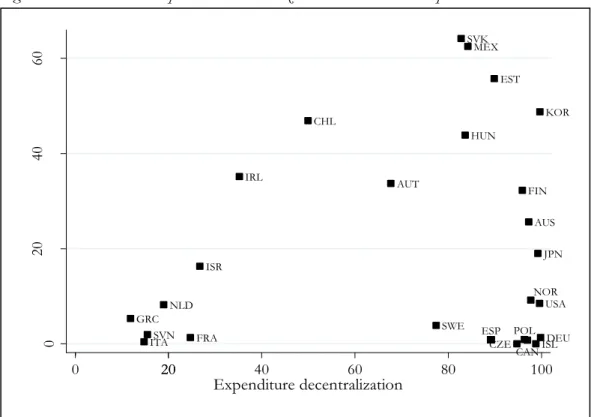
decentralization is significantly lower (35.03 per cent), although it might be partly due to the fact that most countries have decentralized educational decisions to the school level rather than to subnational levels of government. Figure A.1.a. shows the relationship between expenditure decentralization and decision-making centralization. As it can be observed, among
countries with a similar level of education expenditure decentralization (horizontal axis), there is
a wide variability with regard to the percentage of educational decisions that are taken at the central level of government, especially in the case of countries with a low level of expenditure decentralization. This is likely to be explained by the fact that most of these countries, with a low level of fiscal decentralization, have granted schools with a high level of decision-making autonomy.
Table 2. Descriptive analysis of the decentralization variables.
Variable Mean Std. Dev. Min Max
Expenditure decentralization 66.12 36.91 0 100.00
Decision-making decentralization 35.03 24.76 0 80.28
Conditioned expenditure 15.59 21.08 0 64.10
Tax decentralization 11.29 11.82 0 44.27
Notes: decentralization data was compiled by author based on OECD publications (OECD 2004, 2008, 2012a), the OECD Fiscal Decentralization Database and OECD.Stat data.
Figure A.1.b also shows considerable variability in the percentage of educational expenditure that is financed with conditional transfers among countries with similar levels of expenditure decentralization, which ranges between 0 and 64.1%. Finally, tax decentralization also presents considerable variation across countries with a high level of education expenditure decentralization. However, it should be noted that tax decentralization is below 50% for all the countries in the sample, with subnational governments being highly dependent on transfers from upper levels of government or on shared taxes in most
countries. Average tax decentralization in OECD countries is 11.29 per cent, a measure that
contrasts with the average level of education expenditure decentralization, which is 66.12 per
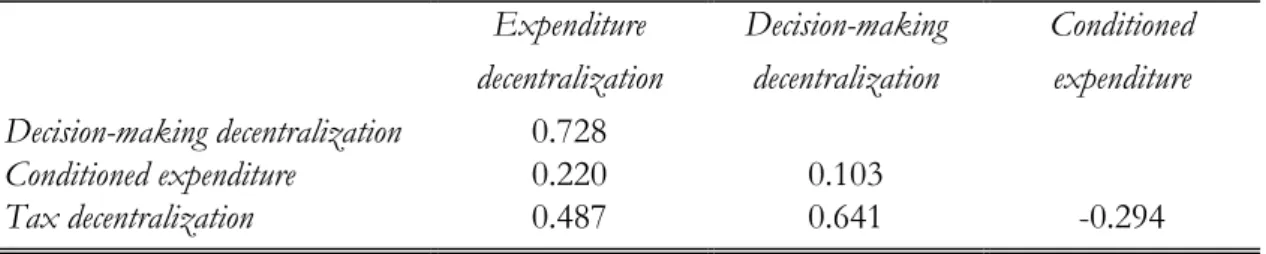
structures, the correlation between these measures of decentralization is quite high, as we
can observe in Table 38.
Table 3. Coefficient of correlation between decentralization variables.
Expenditure decentralization Decision-making decentralization Conditioned expenditure Decision-making decentralization 0.728 Conditioned expenditure 0.220 0.103 Tax decentralization 0.487 0.641 -0.294
Notes: all the coefficients are significant at the 1 per cent level.
4. Empirical findings
4.1. The effect of education policy decentralization
Table 4 presents the results obtained when estimating equation (1) for educational attainment in the subject areas of maths, science and reading. For each subject, I estimate three alternative specifications. In the first specification, decentralization is measured with
the education expenditure decentralization variable, which measures the percentage of
education expenditure in lower-secondary education made at the subnational level of government. This variable tells us which level of government is responsible for spending. In order to take into account the (lack of) autonomy of subnational governments to spend
in the area of education, the second specification also includes the education conditioned
expenditure variable, measured as the percentage of subnational education expenditure that is financed with specific educational transfers. Finally, the third specification measures the
decentralization of education policy with the education decision-making decentralization
variable, which measures the percentage of educational decisions made at the subnational level of government. Thus, this variable accounts both for the responsibility of subnational governments to carry out the educational services and their decision-making autonomy.
8 Since the correlation between education expenditure decentralization and education decision-making
decentralization is above 70 per cent, they cannot be included in the same specification in order to identify their effects. In the specifications in which education decentralization is measured using the
decision-making decentralization variable I also control for the percentage of decisions that are taken at the school level.
Table 4. Education decentralization, autonomy and educational attainment. Maths (1) (2) (3) Expenditure decentralization 0.185*** 0.202*** (0.010) (0.011) Conditioned expenditure -0.136*** (0.019) Decision-making decentralization 0.466*** (0.019) R2 0.426 0.427 0.432 Science (1) (2) (3) Expenditure decentralization 0.131*** 0.138*** (0.012) (0.012) Conditioned expenditure -0.055*** (0.019) Decision-making decentralization 0.421*** (0.022) R2 0.432 0.432 0.439 Reading (1) (2) (3) Expenditure decentralization 0.105*** 0.119*** (0.011) (0.012) Conditioned expenditure -0.111*** (0.017) Decision-making decentralization 0.292*** (0.020) R2 0.476 0.477 0.479 Students 294,156 294,156 294,156 Schools 10,871 10,871 10,871 Regions 35 35 35
Notes: the dependent variable is the PISA 2009 international test score for maths, science and reading. All the regressions control for the school characteristics, family inputs and student characteristics described in Annex I. Missing dummy variables are also included in all the specifications. Least-squares regressions weighted by students’ sampling probability, normalized to give an equal weight to each country. Robust standard errors adjusted for clustering at the country level and school level are in parentheses. *** p<0.01, ** p<0.05, * p<0.1.
The first specification shows that education expenditure decentralization has a positive and
significant effect on educational attainment for all three subjects. More specifically, a country with the 100% of its expenditure having been decentralized to the subnational
government is expected to score 18.5 points more than a non-decentralized country on the
maths assessment, 13.1 points more on science and 10.5 points more on reading9. When
the education conditioned expenditure is also included in the second specification, the
estimated effect of education expenditure decentralization is even higher. However, as
expected, the percentage of educational expenditure that is financed with conditional transfers from upper levels of government is negatively related to the students’ educational achievement.
Thus, based on these results, if additional subnational expenditure is financed with conditioned transfers, subnational autonomy to determine the allocation of funds might be
low, and thus, the effect of expenditure decentralization might not be so great as if it is financed
with general transfers or own revenues. As explained above, the positive effects of decentralization on educational outcomes are due, to some extent, to the better knowledge subnational governments have about local preferences and needs. Thus, if the allocation of funds is decided at the central level of government, with less knowledge about local circumstances and needs, the efficiency with which these resources are used is not as great as if their allocation is decided by the subnational level of government and so the effect of decentralizing educational expenditures is also reduced. In addition, it has been widely demonstrated that the efficiency with which resources received from upper levels of government are used is lower than the efficiency with which own resources are used (Rodden, 2002). As a consequence, the higher the percentage of education expenditures that is financed with specific grants from upper levels of government, the lower the educational outcomes.
The third specification offers an alternative way to capture the autonomy enjoyed by subnational governments in the provision of educational services, by measuring
decentralization with the education decision-making decentralization variable. This variable does
not only capture the making autonomy to allocate funds, but also the decision-making autonomy to regulate the main aspects of the educational process. It can be observed that the effect of decentralizing decision-making power more than doubles the
effect of decentralizing expenditure responsibilities10. Based on these results, a country in
which all the educational decisions are taken at the subnational level of government can be
9 As a benchmark for size comparisons, the difference in performance between 9th and 10th
grades, those with the highest percentage of 15-year-old students, is 14 points on the maths assessment, 12.5 on science and 17.7 on reading. This difference might be interpreted as what a student is expected to learn in a school-year. Alternatively, as PISA test scores were scaled so as to have an international standard deviation for OECD countries of 100 points, these effects can also be interpreted in terms of percentage points of an international standard deviation.
10 Table A.1 in the annex of this chapter reports the estimated coefficients for the whole set of
variables included in this specification. The complete results for the other specifications, which include the same set of explanatory variables, are available upon request.
expected to score 46.6 points more than a country in which all the decisions are centralized on the maths assessment, 42.1 points more on science and 29.2 points more on reading. Thus, the improvement in the educational outcomes as a consequence of decentralization appears to be highly dependent on the autonomy of subnational governments to take their own decisions.
4.2. The effect of revenue decentralization on educational policy outcomes
The previous section has provided an examination of whether the decentralization of educational responsibilities and the level of autonomy of subnational governments to carry out these expenditures affect educational outcomes. The next step logically, therefore, is to examine whether the effects of education decentralization vary according to the degree of autonomy enjoyed by subnational governments to raise their own revenues. As discussed above, subnational government autonomy to raise their own revenues might influence both their economic capacity to carry out their responsibilities and their incentives to act in the best interests of their citizens, given that they can be held more accountable if they are responsible for raising the revenues required to finance their expenditures. I measure
subnational government autonomy to raise their own revenues with the tax decentralization
variable, defined as the percentage of tax revenues over which subnational governments have the power to set the tax base or the tax rate.
Table 5 reports the results obtained in this analysis, when education decentralization is
measured using the decision-making decentralization variable. As above, I present the estimated
effects of decentralization on the tests scores for maths, science and reading, and for each subject I report two alternative models. In the first model, I test independent effects of
education decision-making decentralization and tax decentralization. In the second model, I test
the hypothesis that the effect of education decision-making decentralization depends on the
level of tax decentralization by including a multiplicative interaction term. The
decentralization variables have been centred with respect to their means to facilitate the
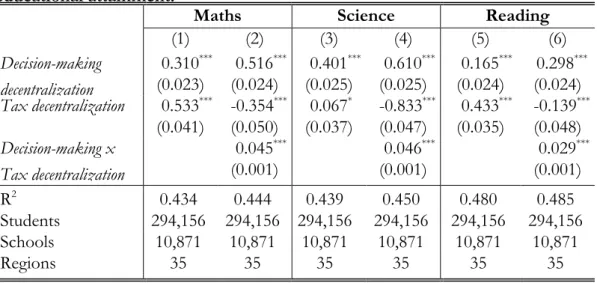
interpretation of their coefficients in this specification. The results show that tax
decentralization is quantitatively significant at explaining educational attainment, especially for maths and reading, and that the effect of the decentralization of the education policy significantly depends on the tax autonomy of subnational governments.
Table 5 shows that when tax decentralization is included in the first specification, it lowers
the predicted effect of education decision-making decentralization. Since both variables of
decentralization are correlated with each other, when tax decentralization was omitted from
the regressions above, the decision-making decentralization variable captured its effect. Despite
and highly significant. Based on the results in this table, if we compare a country in which all educational decisions have been decentralized to the subnational level of government
with a country in which all the decisions are centralized and with a similar level of tax
decentralization, we might expect a difference equal to 31 points on the maths assessment,
40.1 points on science and 16.5 points on reading. As for tax decentralization, if we compare
two countries with a similar degree of subnational autonomy in education, for each
percentage point of difference in tax decentralization we might expect a difference equal to
0.53 points on the maths assessment, 0.06 points on science and 0.43 points on reading.
Table 5. Decision-making decentralization, tax decentralization and educational attainment.
Maths Science Reading
(1) (2) (3) (4) (5) (6) Decision-making decentralization 0.310*** 0.516*** 0.401*** 0.610*** 0.165*** 0.298*** (0.023) (0.024) (0.025) (0.025) (0.024) (0.024) Tax decentralization 0.533*** -0.354*** 0.067* -0.833*** 0.433*** -0.139*** (0.041) (0.050) (0.037) (0.047) (0.035) (0.048) Decision-making x Tax decentralization 0.045*** 0.046*** 0.029*** (0.001) (0.001) (0.001) R2 0.434 0.444 0.439 0.450 0.480 0.485 Students 294,156 294,156 294,156 294,156 294,156 294,156 Schools 10,871 10,871 10,871 10,871 10,871 10,871 Regions 35 35 35 35 35 35
Notes: see Table 4.
When I include the interaction term between the education decision-making decentralization
and tax decentralization variables, the coefficient of the interaction term is positive and
significant. Thus, the effect of education decision-making decentralization on test scores is
greater the higher the percentage of taxes that are collected at the subnational level of government, as can be observed in Figure 1.
When tax decentralization is set to the mean (11.29 percentage points), the effect of a one
percentage point increase in decision-making decentralization is 0.516 points for maths, 0.610
points for science and 0.298 points for reading. For values of tax decentralization below the
mean this effect decreases, while for values of tax decentralization over the mean this effect
increases. When tax decentralization is 11 percentage points below the mean, that is, when
there is no tax decentralization, the effect remains positive for science and non-significant for
maths and reading. When tax decentralization is 30 percentage points over the mean, as it is
decision-making decentralization is 1.86 points for maths, 1.99 points for science and 1.15
points for reading11.
Figure 1. Heterogeneous effects of decision-making decentralization.
Notes: marginal effects of decision-making decentralization on the PISA 2009 international test scores for maths (Figure (a)), science (Figure (b)) and reading (Figure (c)), as a function of tax decentralization. Decentralization variables have been centred with respect to their means. 95% confidence intervals computed with the Delta method.
These results corroborate the hypothesis that the efficiency with which education services are provided by subnational governments depends on their degree of responsibility in raising the revenues required to finance their expenditure, that is, on the accountability with which public services are provided. In addition, these results show that the effects of decentralizing the education policy are positive or zero when subnational governments are not granted powers to raise their own revenues, thus corroborating theoretical prescriptions in Brueckner (2009).
11 Also the marginal effect of increasing tax decentralization on students test scores in the three subjects depend on subnational decision-making autonomy in education. Thus, based on these results, the effect of increasing tax decentralization is positive when decision-making decentralization is above 7.9 per cent for the maths assessment, above 18.1 per cent for science and above 4.8 per cent for reading. -.5 0 .5 1 1. 5 2 De ce ntra liz atio n ef fe cts -15 -10 -5 0 5 10 15 20 25 30 Tax decentralization (a) Maths -.5 0 .5 1 1. 5 2 De ce ntra liz atio n ef fe cts -15 -10 -5 0 5 10 15 20 25 30 Tax decentralization (b) Science -.5 0 .5 1 1. 5 2 De ce ntra liz atio n ef fe cts -15 -10 -5 0 5 10 15 20 25 30 Tax decentralization (c) Reading
4.3. Robustness tests
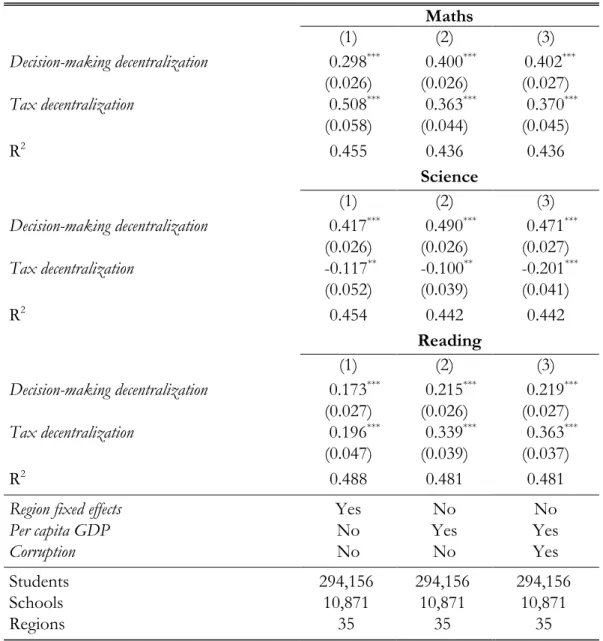
Table 6 reports the results of the additional analyses conducted to check the robustness of the conclusions above. Specifications (1) to (3) include different sets of control variables considered to measure those factors most likely to be correlated both with decentralization
and educational attainment, that is, region fixed effects, GDP per capita and the index of
perceived corruption. As we can observe, these results confirm previous findings about the
positive effects of education decision-making decentralization and tax decentralization on
educational outcomes, with the exception of science, for which a negative coefficient is
found for tax decentralization12.
We can observe that the education decision-making decentralization coefficients remain the
same when region fixed effects are added in specification (1) for the three subjects,
corroborating that the results are not driven by the omission of those characteristics of countries that might affect both educational outcomes and decentralization policies and which might be common among countries in the same region (although these
characteristics are relevant to explain educational attainment). When per capita GDP is
included as a control for the level of development in the different countries in specification
(2), the effect of education decision-making decentralization increases to 0.40 points on the
maths assessment, 0.49 points on science and 0.22 points on reading. Similar results are
obtained when corruption is also included in the regression in specification (3).
Instead, the effect of tax decentralization on educational attainment falls when I include these
control variables for the three subjects. As discussed above, tax decentralization is generally
higher in countries with a higher level of development (Shah and Shah, 2006), so that in the
specifications in which I do not control for the region fixed effects or the per capita GDP the tax
decentralization coefficient might be including also the effect of these omitted characteristics. Nevertheless, we can observe that it remains positive and significant for the maths and reading assessments, although it turns out negative for the science assessment. In addition,
we observe that the effect of tax decentralization on science educational attainment also
decreases when I control for the perceived corruption.
12 Region fixed effects and per capita GDP are statistically significant for the three subjects. The perceived corruption index is only statistically significant for science.
Table 6. Robustness analyses. Maths (1) (2) (3) Decision-making decentralization 0.298*** 0.400*** 0.402*** (0.026) (0.026) (0.027) Tax decentralization 0.508*** 0.363*** 0.370*** (0.058) (0.044) (0.045) R2 0.455 0.436 0.436 Science (1) (2) (3) Decision-making decentralization 0.417*** 0.490*** 0.471*** (0.026) (0.026) (0.027) Tax decentralization -0.117** -0.100** -0.201*** (0.052) (0.039) (0.041) R2 0.454 0.442 0.442 Reading (1) (2) (3) Decision-making decentralization 0.173*** 0.215*** 0.219*** (0.027) (0.026) (0.027) Tax decentralization 0.196*** 0.339*** 0.363*** (0.047) (0.039) (0.037) R2 0.488 0.481 0.481
Region fixed effects Yes No No
Per capita GDP No Yes Yes
Corruption No No Yes
Students 294,156 294,156 294,156
Schools 10,871 10,871 10,871
Regions 35 35 35
Notes: see Table 4.
With the exception of the effect of tax decentralization on science test scores, the general
conclusion to be drawn from this analysis is that the conclusions presented in the previous sections are robust, thus corroborating that they are not driven by the potential
endogeneity of decentralization. Education decision-making decentralization has a clear positive
effect on educational attainment in the three subjects, an effect that even increases once I
control for countries’ characteristics. The effect of tax decentralization decreases when I
control for such characteristics, although it remains positive and significant for maths and science. The results are also robust to the elimination of countries from the sample estimation.
5. Comparison of the effects of decentralization to regional and local governments
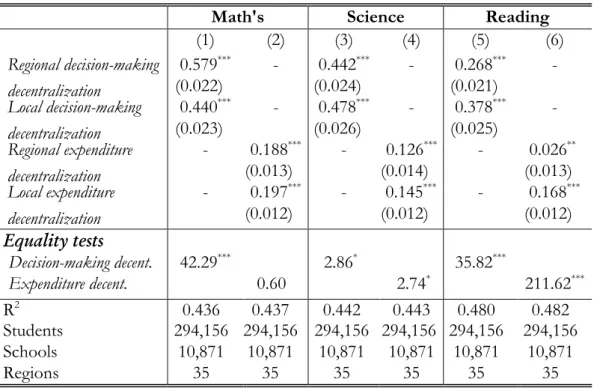
The previous sections examined the effects of decentralization on educational attainment without differentiating as to whether responsibilities are decentralized to the regional or the local levels of government. However, as different levels of government might have different technical and economic capabilities, as well as different incentives to act in the best interests of their citizens, it might be interesting to examine the separate effects of decentralization when the responsibilities are devolved to the regional and the local levels of government. Table 7 provides the results of conducting such an analysis. For each
subject, the first specification measures decentralization with the education decision-making
decentralization variable and the second specification measures it with the education expenditure decentralization variable. Both of them control for the per capita GDP.
The general conclusion to be drawn from this table is similar to that obtained in the previous sections. We can observe a positive and significant effect of education decentralization at both levels of government on educational outcomes for the three
subjects. This is observed both if education decentralization is measured with the
decision-making decentralization variable or the expenditure decentralization variable. As before, the effect
of education decentralization when it is measured with the decision-making decentralization
variable more than doubles the effect captured by the expenditure decentralization variable.
Thus, the improvement in educational outcomes as a consequence of decentralization appears to be highly dependent on the autonomy of subnational governments to take their own decisions, both at the regional and the local level.
The effect of decentralizing education responsibilities to subnational levels of government differ statistically depending on whether they are decentralized to the regional or the local levels of government in some specifications, as indicated by the equality tests presented in
Table 7. For instance, we can observe that the effect of decision-making decentralization on
maths test scores is greater when educational decisions are decentralized to the regional level and the opposite is true for science and reading test scores. The effect of decentralizing expenditure responsibilities is also greater in the science and reading areas when they are decentralized to the local governments, while the difference is non significant for maths.
Table 7. Regional and local decentralization and educational attainment.
Math's Science Reading
(1) (2) (3) (4) (5) (6) Regional decision-making decentralization 0.579*** - 0.442*** - 0.268*** - (0.022) (0.024) (0.021) Local decision-making decentralization 0.440*** - 0.478*** - 0.378*** - (0.023) (0.026) (0.025) Regional expenditure decentralization - 0.188*** - 0.126*** - 0.026** (0.013) (0.014) (0.013) Local expenditure decentralization - 0.197*** - 0.145*** - 0.168*** (0.012) (0.012) (0.012) Equality tests Decision-making decent. 42.29*** 2.86* 35.82*** Expenditure decent. 0.60 2.74* 211.62*** R2 0.436 0.437 0.442 0.443 0.480 0.482 Students 294,156 294,156 294,156 294,156 294,156 294,156 Schools 10,871 10,871 10,871 10,871 10,871 10,871 Regions 35 35 35 35 35 35
Notes: see Table 4. The results from testing whether decentralization coefficients are equal at the regional and local government are included in the table (Null: coefficients are equal). *** p<0.01, ** p<0.05, * p<0.1
6. Summary and concluding remarks
The effects of decentralization on the efficiency of public services provision remains unclear from a theoretical perspective and so empirical analyses are required. However, despite this need, empirical studies of this question are scarce. In the context of education, studies conducted to date conclude that decentralization is positively related to educational attainment, and that it is more beneficial when subnational governments have a low fiscal deficit (Barankay and Lockwood, 2007; Galiani and Schargrodsky, 2002) and when schools
are located in non-poor municipalities (Galiani et al., 2008). These studies, however, focus
their attention on the situation in specific countries, so that their results might not be extrapolable to other contexts, and they are unable to provide evidence on how different structures of expenditure and revenue decentralization can have a differential effect on educational outcomes.
Thus, the aim of this study has been to use cross-national data to examine the effects of decentralization on the efficiency of educational policies, taking into consideration the different dimensions of decentralization. More specifically, variables that measure the expenditure and revenue sides of decentralization were included in the analysis. On the expenditure side, I included variables that take into account the distribution of education