Proceedings of the 2018 EMNLP Workshop SCAI: The 2nd Int’l Workshop on Search-Oriented Conversational AI, pages 81–86 2018 Association for Computational Linguistics
81
Why are Sequence-to-Sequence Models So Dull?
Understanding the Low-Diversity Problem of Chatbots
Shaojie Jiang University of Amsterdam Amsterdam, The Netherlands
Maarten de Rijke University of Amsterdam Amsterdam, The Netherlands
Abstract
Diversity is a long-studied topic in information retrieval that usually refers to the requirement that retrieved results should be non-repetitive and cover different aspects. In a conversational setting, an additional dimension of diversity matters: an engaging response generation sys-tem should be able to output responses that are diverse and interesting. Sequence-to-sequence (Seq2Seq) models have been shown to be very effective for response generation. However, di-alogue responses generated by Seq2Seq mod-els tend to have low diversity. In this pa-per, we review known sources and existing ap-proaches to this low-diversity problem. We also identify a source of low diversity that has been little studied so far, namely model over-confidence. We sketch several direc-tions for tackling model over-confidence and, hence, the low-diversity problem, including confidence penalties and label smoothing.
1 Introduction
Sequence-to-sequence (Seq2Seq) models (Sutskever et al., 2014) have been designed for sequence learning. Generally, a Seq2Seq model consists of two recurrent neural networks (RNN) as its encoder and decoder, respectively, through which the model cannot only deal with inputs and outputs with variable lengths separately, but also be trained end-to-end. Seq2Seq models can use different settings for the encoder and decoder networks, such as the number of input/output units, ways of stacking layers, dictionary, etc. After showing promising results in machine translation (MT) tasks (Sutskever et al., 2014; Wu et al., 2016), Seq2Seq models also proved to be effective for tasks like question answering (Yin et al.,2015), dialogue response generation (Vinyals and Le, 2015), text summarization (Nallapati et al.,2016), constituency parsing (Vinyals et al.,2015a), image captioning (Vinyals et al.,2015b), and so on.
Seq2Seq models form the cornerstone of modern response generation models (Vinyals and Le,2015; Li et al.,2015;Serban et al.,2016,2017;Zhao et al., 2017). Although Seq2Seq models can generate grammatical and fluent responses, it has also been reported that the corpus-level diversity of Seq2Seq models is usually low, as many responses are trivial or non-committal, like “I don’t know”, “I’m sorry” or “I’m OK” (Vinyals and Le,2015;Sordoni et al., 2015;Serban et al.,2016;Li et al.,2015). We refer to this problem as thelow-diversityproblem.
In recent years, there have been several types of approach to diagnosing and addressing the low-diversity problem. The purpose of this paper is to understand the low-diversity problem, to un-derstand what diagnoses and solutions have been proposed so far, and to explore possible new ap-proaches. We first review the theory of Seq2Seq models, then we give an overview of known causes and existing solutions to the low-diversity problem. We then connect the low-diversity problem to the concept ofmodel over-confidence, and propose ap-proaches to address the over-confidence problem and, hence, the low-diversity problem.
2 Sequence-to-Sequence Response Generation
Consider a dataset of message-response pairs (X, Y), whereX = (x1, x2, . . . , x|X|)and Y =
(y1, y2, . . . , y|Y|) are the input and output se-quences, respectively. During training, the goal is to learn the relationships betweenXandY, which can be formulated as maximizing the Seq2Seq model probability ofY givenX:
maxp(Y|X) = max
|Y| Y
t=1
p(yt|y<t, X), (1)
Usually, Seq2Seq models employ Long Short-Term Memory (LSTM) networks as their encoder and decoder. The way a Seq2Seq models realizes (1), is to process the training inputs and outputs separately. On the encoder side, the input sequence Xis encoded step-by-step, e.g., at stept:
henct =fθenc(henct−1, xt), (2)
wherehenc0 = 0is the initial hidden state of the encoder LSTM, andθis the model parameter. The hidden state of the last stephenc|X|is the vector rep-resentation of input sequenceX.
Then, the decoder LSTM is initialized byhdec
0 =
henc|X|so that output tokens can be based on the input:
hdect =fθdec(hdect−1, yt−1), (3)
withy0as a special token (e.g., START ) to indi-cate the decoder to start generation, andyt−1as the ground truth token of the last time step. The hidden statehdect is further used to predict the output dis-tribution by using a multi-layer perceptron (MLP) and softmax function:
P(yt|y<t, X) =
exp(cifθM LP(hdect ))
PN
j=1exp(cjfθM LP(hdect ))
, (4)
wherec∗are possible candidates ofyt, which are
usually represented as word embeddings. After obtaining this distribution, we can calculate the loss compared with the ground-truth distribution by using, e.g., the cross-entropy loss function, and then we can back-propagate the loss to force the Seq2Seq model to maximize (1).
At test time att, the step-wise decoder output distribution is conditioned on the actual model out-puts yˆ<t and X, and the token with the highest
probability is chosen as the output:
ˆ
yt= arg max yt
p(yt|yˆ<t, X), (5)
which is known as the maximum a posteriori
(MAP) objective function.
3 Diagnosing the Low-Diversity Problem
In the literature, three dominant viewpoints on the low-diversity problem have been shared: lack of variability, improper objective function, and weak conditional signal. Below, we review these di-agnoses of the low-diversity problem, with corre-sponding solutions, and we add a fourth diagnosis: model over-confidence.
3.1 Lack of variability
Serban et al.(2017);Zhao et al.(2017) trace the cause of the low-diversity problem in Seq2Seq models back to the lack of model variability. The variability of Seq2Seq models is different from that of retrieval-based chatbots (Fedorenko et al.,2017): in this study, we focus on the lack of variability of system responses, while in (Fedorenko et al.,2017), the authors deal with the low variability between responses and contexts.
To increase variability, Serban et al. (2017); Zhao et al.(2017) propose to introduce variational autoencoders (VAEs) to Seq2Seq models. At gen-eration time, the latent variable z brought by a VAE is used as a conditional signal of the decoder LSTM (Serban et al.,2017):
hdect =fθdec(hdect−1, yt−1, z), (6)
where we omit the contextual hidden states for simplicity.
At test time,zisrandomlysampled from a prior distribution. Although being effective, the improve-ment in the degree of diversity of generated re-sponses brought by this kind of method is actually brought by the randomness ofz. The underlying Seq2Seq model remains sub-optimal in terms of diversity.
3.2 Improper objective function
Li et al.(2015) notice that the MAP objective func-tion may be the cause of the low-diversity prob-lem, since it can favor certain responses by only maximizingp(Y|X). Therefore, they propose to maximize the mutual information betweenX,Y pairs:
log p(X, Y)
p(X)p(Y). (7)
With the help of Bayes’ theorem, they derive two Maximum Mutual Information (MMI) objective functions:
ˆ
Y = arg max
Y
{logp(Y|X)−
λlogp(Y) +γ|Y|}, (8)
and
ˆ
Y = arg max
Y
{(1−λ) logp(Y|X)+
λlogp(X|Y) +γ|Y|}, (9)
and a reverse model, respectively, with the latter trained using response-message pairs:(Y, X). Be-sides the time needed for training a reverse model, it should be noted that both objective functions need the length|Y|of candidate responses, which are maintained in N-best lists generated by beam search. To obtain N-best lists with enough diver-sity,Li et al.(2015) use a beam size of 200 during testing, which is much more time-consuming than the basic Seq2Seq model.
Influenced by the MMI methods, several beam search based approaches (Li et al.,2016; Vijayaku-mar et al.,2016;Shao et al.,2017) focus on im-proving the diversity of N-best lists, in the hope of further enhancing the one-best response diversity. However, there are other faster approaches to the low-diversity problem without using beam search, such as the attention-based model that we describe below.
3.3 Weak conditional signal
Since attention layers (Bahdanau et al.,2014) have been introduced into Seq2Seq models for the MT task, they have also been ade factostandard mod-ule of Seq2Seq models for response generation. The purpose of Seq2Seq attention layers is differ-ent from the purpose of the Transformer model (Vaswani et al., 2017). Transformer proposes to rely only on self-attention and avoid using rec-curence or convolutions, while attention layers of Seq2Seq aim at strengthening the input signal.
Although the introducing of attention layers can bring improvements to the response generation task, Tao et al.(2018) argue that the original at-tention signal often focuses on particular parts of the input sequence, which is not strong enough for the Seq2Seq model to generate specific responses, thus causing the low-diversity problem. The au-thors propose to use multiple attention heads to encourage the model to focus on various aspects of the input, by mapping encoder hidden states toK different semantic spaces:
henct,k =Wpk·henct , (10)
whereWpk∈Rd×dis a learnable projection matrix.
The net effect of the extended attention mechanism is, indeed, improvements in the diversity of gener-ated responses. Readers are referred to (Tao et al., 2018) for more details.
3.4 Model over-confidence
As indicated byHinton et al.(2015), one can think of the knowledge captured in conversation model-ing as a mappmodel-ing from input sequenceXto output sequenceY, i.e., the distributionP(Y|X). There-fore, if responses have a low degree of diversity, the learned distributionP(Y|X) is questionable, as re-confirmed byLi et al.(2015). According to (1), the sequence-level distributionP(Y|X)has a direct relationship with the token-level distribution. Therefore, we hypothesize that the token-level dis-tribution P(yt|y<t, X), produced at the decoder
side, may be the culprit.
The decoder LSTM serves as an RNN language model (RNNLM) conditioned on the input se-quence (Sutskever et al.,2014). With time steps in-creasing, the influence of the input sequenceXwill become weaker according to (3), and if the token-level distributionP(yt|y<t, X)is problematic, it
will have further effects on subsequent outputs (a “snowball effect”). An attention mechanism
(Bah-danau et al.,2014;Tao et al.,2018) can be used to reinforce the influence of the input sequence, but there are still chances that the detrimental effect of P(yt|y<t, X)is stronger than the input signal.
To analyze the problem of P(yt|y<t, X), we
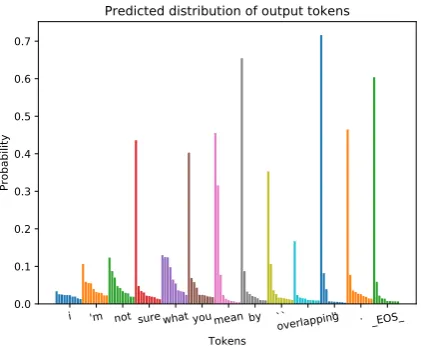
train a Seq2Seq model1 without attention layer, and plot the token-level distribution of generic re-sponses in Figure1. Interestingly, we find that the distributions shown signs of model over-confidence (Pereyra et al.,2017). When an attention mecha-nism is used, similar distributions can still be ob-served, as illustrated in Figure2. From these two figures, we can see a common trend of growing confidence: the highest probabilities at each step keep growing, which confirms our conjecture of a snowball effect. Due to this effect, the final sev-eral tokens are of low quality, e.g., the no-attention model in Figure 1 starts to repeat itself, and the word “overlapping” in the attention model in Fig-ure2is irrelevant for the user input.
A prediction is confident if the entropy of the output distribution is low.Over-confidenceis often a symptom of over-fitting (Szegedy et al.,2016), which suggests that the inputs or outputs share much similarity from unknown aspects. Although it is hard to figure out what causes the over-fitting, maximizing entropy can usually help to regularize the model, making it generalize better. In (Pereyra et al.,2017), the authors propose to add the negative
, i 'm notsurewhatyoumean. i 'm notsurewhatyoumeanby `` i_CUT_
Tokens 0.0
0.2 0.4 0.6 0.8 1.0
Probability
[image:4.595.75.289.64.241.2]Predicted distribution of output tokens
Figure 1: Given the input sequence:how about we recognize the brilliance in everyone, or in mankind as a whole., the predicted distribution of model outputs, and tokens on x axis are MAP predictions. Note that we kept top-10 probabilities at each pre-diction step for simplicity and this output was cut before the EOS token was emitted.
i 'm not surewhat youmean by ``overlapping'' . _EOS_
Tokens 0.0
0.1 0.2 0.3 0.4 0.5 0.6 0.7
Probability
Predicted distribution of output tokens
Figure 2: Predicted distribution of the same input as in Figure1when an attention mechanism is used.
entropy to the negative log-likelihood loss function during training, which can easily be tailored for conversation modeling:
L(θ) =−
N
X
i=1
logp(ci|y<t, X)−
βH(p(ci|y<t, X)),
(11)
where β controls the strength of the confidence penalty, andH(·)is the entropy of the output
dis-tribution:
H(p(ci|y<t, X)) =
−
N
X
i=1
p(ci|y<t, X) log(p(ci|y<t, X)).
(12)
The authors also show that this confidence penalty method is closely related to label smoothing reg-ularization (Szegedy et al.,2016), therefore meth-ods like neighborhood smoothing (Chorowski and Jaitly,2016) may be used to solve the low-diversity problem.
So far, there has been no published work on ana-lyzing the the effectiveness of correcting for model over-confidence on the low-diversity problem. It is important to note the fourth diagnosis of the low-diversity problem, i.e., that the problem is due to model over-confidence, is essentially different from the three types of diagnosis that we described ear-lier in the section. Among diagnoses and methods published previously, the VAE-based approaches actually bypass the low-diversity problem by intro-ducing randomness; MMI-based methods have an elegant theoretical basis, yet they end up relying on many extra modules, like reverse models and beam search, and the newly-introduced hyper-parameters were not even learned from training data (Li et al., 2015); attention-based models offer a complemen-tary approach, since strengthening the conditional signal is likely to make the response more specific, which should in turn improve the corpus-level di-versity. Model over-confidence may offer a sim-pler alternative – we believe that methods such as confidence penalty are likely to alleviate the low-diversity problem in ways that differ from previous approaches.
4 Next Steps
In this paper, we described the low-diversity prob-lem for response generation, which is one of the main issues faced by current Seq2Seq-based con-versation models. We reviewed existing diagnoses and corresponding approaches to this problem and also added a diagnosis that has not been proposed or used so far, i.e., model over-confidence.
[image:4.595.76.287.369.542.2](Li et al.,2017) of Seq2Seq models may also be alleviated since this can reduce the snowball ef-fect and make later outputs more relevant. We also noticed that the low-diversity problem resembles the mode collapse problem of GANs (Goodfellow et al.,2014), therefore inspirations may be drawn from the solutions like (Salimans et al.,2016;Metz et al.,2016).
In addition, since we now have four types of diagnosis of the low-diversity problem, each of which is likely to address part of the problem but not all of the problem, it is natural to systemati-cally compare and combine approaches based on the different types of diagnosis. Understanding how solutions to the low-diversity problem helps to improve the effectiveness of conversational agents for search-oriented tasks is another interesting line of future work.
Acknowledgments
This research was supported by the China Scholar-ship Council.
References
Dzmitry Bahdanau, Kyunghyun Cho, and Yoshua Ben-gio. 2014. Neural machine translation by jointly learning to align and translate. arXiv preprint arXiv:1409.0473.
Jan Chorowski and Navdeep Jaitly. 2016. Towards better decoding and language model integration in sequence to sequence models. arXiv preprint arXiv:1612.02695.
Denis Fedorenko, Nikita Smetanin, and Artem Rodichev. 2017. Avoiding echo-responses in a retrieval-based conversation system. arXiv preprint arXiv:1712.05626.
Ian Goodfellow, Jean Pouget-Abadie, Mehdi Mirza, Bing Xu, David Warde-Farley, Sherjil Ozair, Aaron Courville, and Yoshua Bengio. 2014. Generative ad-versarial nets. InAdvances in neural information processing systems, pages 2672–2680.
Geoffrey Hinton, Oriol Vinyals, and Jeff Dean. 2015. Distilling the knowledge in a neural network. arXiv preprint arXiv:1503.02531.
Jiwei Li, Michel Galley, Chris Brockett, Jianfeng Gao, and Bill Dolan. 2015. A diversity-promoting objec-tive function for neural conversation models. arXiv preprint arXiv:1510.03055.
Jiwei Li, Will Monroe, and Dan Jurafsky. 2016. A sim-ple, fast diverse decoding algorithm for neural gen-eration. arXiv preprint arXiv:1611.08562.
Jiwei Li, Will Monroe, Tianlin Shi, Alan Ritter, and Dan Jurafsky. 2017. Adversarial learning for neural dialogue generation. arXiv preprint arXiv:1701.06547.
Luke Metz, Ben Poole, David Pfau, and Jascha Sohl-Dickstein. 2016. Unrolled generative adversarial networks. arXiv preprint arXiv:1611.02163.
Alexander H Miller, Will Feng, Adam Fisch, Jiasen Lu, Dhruv Batra, Antoine Bordes, Devi Parikh, and Ja-son Weston. 2017. Parlai: A dialog research soft-ware platform.arXiv preprint arXiv:1705.06476.
Ramesh Nallapati, Bowen Zhou, Caglar Gulcehre, Bing Xiang, et al. 2016. Abstractive text summariza-tion using sequence-to-sequence rnns and beyond.
arXiv preprint arXiv:1602.06023.
Gabriel Pereyra, George Tucker, Jan Chorowski, Łukasz Kaiser, and Geoffrey Hinton. 2017. Regular-izing neural networks by penalRegular-izing confident output distributions. arXiv preprint arXiv:1701.06548.
Tim Salimans, Ian Goodfellow, Wojciech Zaremba, Vicki Cheung, Alec Radford, and Xi Chen. 2016. Improved techniques for training gans. InAdvances in Neural Information Processing Systems, pages 2234–2242.
Iulian Vlad Serban, Alessandro Sordoni, Yoshua Ben-gio, Aaron C Courville, and Joelle Pineau. 2016. Building end-to-end dialogue systems using gener-ative hierarchical neural network models. InAAAI, volume 16, pages 3776–3784.
Iulian Vlad Serban, Alessandro Sordoni, Ryan Lowe, Laurent Charlin, Joelle Pineau, Aaron C Courville, and Yoshua Bengio. 2017. A hierarchical latent variable encoder-decoder model for generating dia-logues. InAAAI, pages 3295–3301.
Louis Shao, Stephan Gouws, Denny Britz, Anna Goldie, Brian Strope, and Ray Kurzweil. 2017. Gen-erating high-quality and informative conversation re-sponses with sequence-to-sequence models. arXiv preprint arXiv:1701.03185.
Alessandro Sordoni, Michel Galley, Michael Auli, Chris Brockett, Yangfeng Ji, Margaret Mitchell, Jian-Yun Nie, Jianfeng Gao, and Bill Dolan. 2015. A neural network approach to context-sensitive gen-eration of conversational responses. arXiv preprint arXiv:1506.06714.
Ilya Sutskever, Oriol Vinyals, and Quoc V Le. 2014. Sequence to sequence learning with neural networks. In Advances in neural information processing sys-tems, pages 3104–3112.
Christian Szegedy, Vincent Vanhoucke, Sergey Ioffe, Jon Shlens, and Zbigniew Wojna. 2016. Rethinking the inception architecture for computer vision. In
Chongyang Tao, Shen Gao, Mingyue Shang, Wei Wu, Dongyan Zhao, and Rui Yan. 2018. Get the point of my utterance! learning towards effective responses with multi-head attention mechanism. In IJCAI, pages 4418–4424.
Ashish Vaswani, Noam Shazeer, Niki Parmar, Jakob Uszkoreit, Llion Jones, Aidan N Gomez, Łukasz Kaiser, and Illia Polosukhin. 2017. Attention is all you need. InAdvances in Neural Information Pro-cessing Systems, pages 6000–6010.
Ashwin K Vijayakumar, Michael Cogswell, Ram-prasath R Selvaraju, Qing Sun, Stefan Lee, David Crandall, and Dhruv Batra. 2016. Diverse beam search: Decoding diverse solutions from neural se-quence models. arXiv preprint arXiv:1610.02424.
Oriol Vinyals, Łukasz Kaiser, Terry Koo, Slav Petrov, Ilya Sutskever, and Geoffrey Hinton. 2015a. Gram-mar as a foreign language. InAdvances in Neural Information Processing Systems, pages 2773–2781.
Oriol Vinyals and Quoc Le. 2015. A neural conversa-tional model. arXiv preprint arXiv:1506.05869.
Oriol Vinyals, Alexander Toshev, Samy Bengio, and Dumitru Erhan. 2015b. Show and tell: A neural im-age caption generator. In Proceedings of the IEEE conference on computer vision and pattern recogni-tion, pages 3156–3164.
Yonghui Wu, Mike Schuster, Zhifeng Chen, Quoc V Le, Mohammad Norouzi, Wolfgang Macherey, Maxim Krikun, Yuan Cao, Qin Gao, Klaus Macherey, et al. 2016. Google’s neural machine translation system: Bridging the gap between hu-man and machine translation. arXiv preprint arXiv:1609.08144.
Jun Yin, Xin Jiang, Zhengdong Lu, Lifeng Shang, Hang Li, and Xiaoming Li. 2015. Neural generative question answering. arXiv preprint arXiv:1512.01337.