Proceedings of NAACL-HLT 2019, pages 2862–2872 2862
Improving Distantly-supervised Entity Typing
with Compact Latent Space Clustering
Bo Chen1, Xiaotao Gu2, Yufeng Hu1, Siliang Tang1∗, Guoping Hu3, Yueting Zhuang1 & Xiang Ren4
1Zhejiang University,2University of Illinois at Urbana Champaign
3iFLYTEK Research,4University of Southern California,
{chenbo123, xiaofeem, siliang, yzhuang}@zju.edu.cn,
[email protected],[email protected],[email protected]
Abstract
Recently, distant supervision has gained great success on Fine-grained Entity Typing (FET). Despite its efficiency in reducing manual la-beling efforts, it also brings the challenge of dealing with false entity type labels, as dis-tant supervision assigns labels in a context-agnostic manner. Existing works alleviated this issue with partial-label loss, but usually suffer from confirmation bias, which means the classifier fit a pseudo data distribution given by itself. In this work, we propose to regularize distantly supervised models with Compact Latent Space Clustering (CLSC) to bypass this problem and effectively utilize noisy data yet. Our proposed method first dynamically constructs a similarity graph of different entity mentions; infer the labels of noisy instances via label propagation. Based on the inferred labels, mention embeddings are updated accordingly to encourage entity mentions with close semantics to form a com-pact cluster in the embedding space, thus lead-ing to better classification performance. Ex-tensive experiments on standard benchmarks show that our CLSC model consistently out-performs state-of-the-art distantly supervised entity typing systems by a significant margin.
1 Introduction
Recent years have seen a surge of interests in fine-grained entity typing (FET) as it serves as an important cornerstone of several nature lan-guage processing tasks including relation extrac-tion (Mintz et al., 2009), entity linking (Raiman and Raiman,2018), and knowledge base comple-tion (Dong et al., 2014). To reduce manual ef-forts in labelling training data, distant supervision (Mintz et al., 2009) has been widely adopted by recent FET systems. With the help of an external knowledge base (KB), an entity mention is first
∗
[image:1.595.306.525.233.309.2]Corresponding Author.
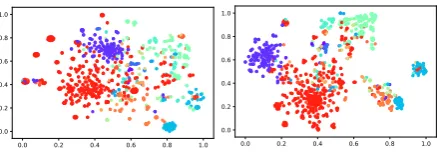
Figure 1: T-SNE visualization of the mention embed-dings generated by NFETC (left) and CLSC (right) on the BBN dataset. Our model (CLSC) clearly groups mentions of the same type into a compact cluster.
linked to an existing entity in KB, and then la-beled with all possible types of the KB entity as supervision. However, despite its efficiency, dis-tant supervision also brings the challenge of
out-of-context noise, as it assigns labels in a context
agnostic manner. Early works usually ignore such noise in supervision (Ling and Weld, 2012; Shi-maoka et al., 2016), which dampens the perfor-mance of distantly supervised models.
Towards overcoming out-of-context noise, two lines of work have been proposed to distantly su-pervised FET. The first kind of work try to fil-ter out noisy labels using heuristic rules (Gillick et al.,2014). However, such heuristic pruning sig-nificantly reduces the amount of training data, and thus cannot make full use of distantly annotated data. In contrast, the other thread of works try to incorporate such imperfect annotation by partial-label loss (PLL). The basic assumption is that,for a noisy mention, the maximum score associated with its candidate types should be greater than the scores associated with any other non-candidate types(Ren et al.,2016a;Abhishek et al.,2017;Xu and Barbosa,2018). Despite their success,PLL -based models still suffer fromConfirmation Bias
CLSC Classifier KL
Regularization
Label
Clean Data ExtractorExtractorFeatureFeature
Noise Data ExtractorExtractorFeatureFeature
Distant Supervision Training Data person
artist root
location
athlete
... legal
director
...
music author
actor Knowledge Base
S1: by Defense Secretary William Cohen and Joint Chiefs chairman General Hugh Shelton
Labeled Corpus
Unlabeled Corpus
sup
L sup L sup L
S2: Defense Secretary William Cohen says if a formal investigation shows it was a
Maine Republican William Cohen said the plan might violate the assassination ban
Candidate Typeφ
/person/artist/actor /person/political_figure
/person/legal
clsc
[image:2.595.84.523.73.238.2]L clsc L
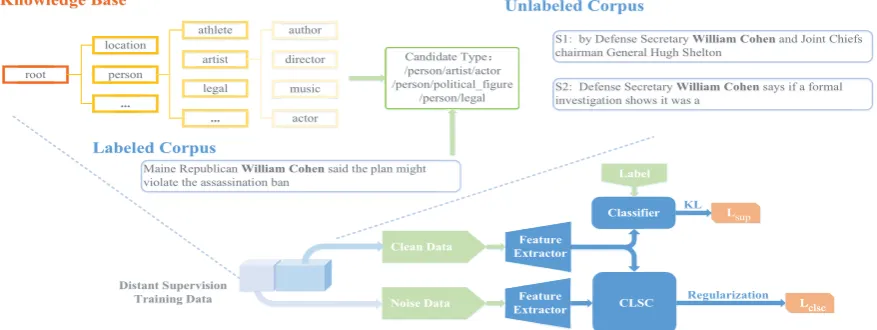
Figure 2: The overall framework of CLSC. We calculate classification loss only on clean data, while regularize the feature extractor with CLSC using both clean and noisy data.
type with the maximum score among all candi-dates, it will try to further maximize the score of the wrong type in following optimization epoches (in order to minimize PLL), thus amplifying the confirmation bias. Such bias starts from the early stage of training, when the typing model is still very suboptimal, and can accumulate in training process. Related discussion can be also found in the setting of semi-supervised learning (Lee et al.,2006;Laine and Aila,2017;Tarvainen and Valpola,2017).
In this paper, we propose a new method for dis-tantly supervised fine-grained entity typing. En-lightened by (Kamnitsas et al., 2018), we pro-pose to effectively utilize imperfect annotation as model regularization via Compact Latent Space
Clustering(CLSC). More specifically, our model encourages the feature extractor to group mentions of the same type as a compact cluster (dense re-gion) in the representation space, which leads to better classification performance. For training data with noisy labels, instead of generating pseudo su-pervision by the typing model itself, we dynam-ically construct a similarity-weighted graph be-tween clean and noisy mentions, and apply label propagation on the graph to help the formation of compact clusters. Figure 1 demonstrates the ef-fectiveness of our method in clustering mentions of different types into dense regions. In contrast toPLL-based models, we do not force the model to fit pseudo supervision generated by itself, but only use noisy data as part of regularization for our feature extractor layer, thus avoiding bias ac-cumulation.
Extensive experiments on standard benchmarks show that our method consistently outperforms state-of-the-art models. Further study reveals that, the advantage of our model over the competitors gets even more significant as the portion of noisy data rises.
2 Problem Definition
Fine-grained entity typing takes a corpus and an external knowledge base (KB) with a type hierar-chyY as input. Given an entity mention (i.e., a sequence of token spans representing an entity) in the corpus, our task is to uncover its corresponding type-path inYbased on the context.
By applying distant supervision, each mention is first linked to an existing entity in KB, and then labeled with all its possible types. For-mally, a labeled corpus can be represented as triples D = {(mi, ci,Yi)}ni=1, where mi is the
i-th mention, ci is the context of mi, Yi is the set of candidate types of mi. Note that types in Yi can form one or more type paths. In addition, we denote all terminal (leaf) types of each type path in Yi as the target type set Yt i (e.g., forYi = {artist, teacher, person}, Yit =
{artist, teacher}). This setting is also adopted by (Xu and Barbosa,2018).
As each entity in KB can have several type paths,out-of-contextnoise may exist whenYi con-tains type paths that are irrelevant to mi in con-text ci. In this work, we argue triples where Yi contains only one type path (i.e., |Yt
i| = 1) as
irrel-formal investigation Defense Secretary [William Cohen] says if
Bi-LSTM Word-level
Attention
Secretary [William Cohen] says
LSTM Encoder Average Encoder
Feature Representation
[William Cohen]
Embedding Context Encoder
[image:3.595.108.523.72.238.2]( )
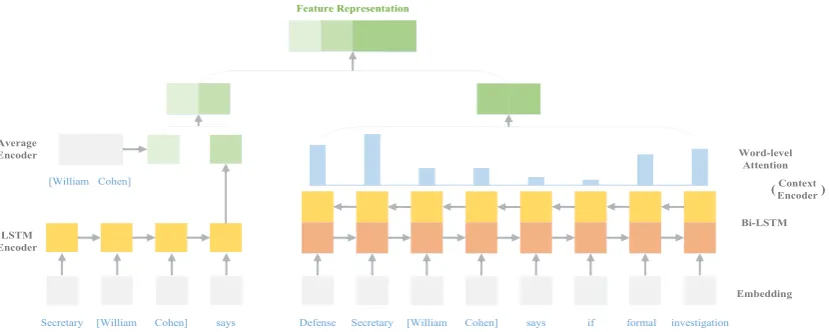
Figure 3: The architecture of feature extractorz((mi, ci);θz)
evant type paths. Noisy data usually takes a con-siderable portion of the entire dataset. The major challenge for distantly supervised typing systems is to incorporate both clean and noisy data to train high-quality type classifiers.
3 The Proposed Approach
Overview.The basic assumptions of our idea are:
(1) all mentions belong to the same type should be close to each other in the representation space be-cause they should have similar context, (2) similar contexts lead to the same type. For clean data, we compact the representation space of the same type to comply (1). For noisy data, given assumption (2), we infer the their type distributions via label propagation and candidate types constrain. Figure2shows the overall framework of the pro-posed method. Clean data is used to train classi-fier and feature extractor end-to-endly, while noisy data is only used in CLSC regularization. For-mally, given a batch of samples{(mi, ci,Yit)}Bi=1, we first convert each sample (mi, ci) into a real-valued vector zi via a feature extractor
z((mi, ci);θz) parameterized by θz. Then a type classifier g(zi;θg) parameterized by θg gives the posteriorP(y|zi;θg). By incorporating CLSC reg-ularization in the objective function, we encourage the feature extractor z to group mentions of the same type into a compact cluster, which facilitates classification as is shown in Figure1. Noisy data enhances the formation of compact clusters with the help of label propagation.
3.1 Feature Extractor
Figure3illustrates our feature extractor. For fair comparison, we adopt the same feature extraction pipeline as used in (Xu and Barbosa,2018). The feature extractor is composed of an embedding layer and two encoders which encode mentions and contexts respectively.
Embedding Layer: The output of this layer is
a concatenation of word embedding and word position embedding. We use the popular 300-dimensional word embedding supplied by ( Pen-nington et al.,2014) to capture the semantic infor-mation and random initialized position embedding (Zeng et al., 2014) to acquire information about the relation between words and the mentions.
Formally, Given a word embedding matrix
Wword of shape dw × |V|, where V is the vo-cabulary and dw is the size of word embedding, each column ofWword represents a specific word
w in V. We map each word wj in (mi, ci) to a word embeddingwdj ∈Rdw. Analogously, we get
the word position embedding wpj ∈ Rdp of each
word according to the relative distance between the word and the mention, we only use a fixed length context here. The final embedding of the j-th word iswEj = [wjd,wjp].
Mention Encoder: To capture lexical level
aver-aging mention representationrai ∈R
dw is :
rai = 1
e−s+ 1
e X
j=s
wdj (1)
By applying a LSTM over an extended men-tion(ws−1, ws, ws+1,· · ·, we, we+1), we get a se-quence (hs−1, hs, hs+1,· · ·, he, he+1). We use
he+1 as LSTM mention representation rli ∈ Rdl. The final mention representation is r
mi = [rai, rli]∈R
dw+dl.
Context Encoder: A bidirectional LSTM withdl
hidden units is employed to encode embedding se-quence(wsE−W,wEs−W+1,· · · ,wEe+W):
− →
hj =LST M(
−−→
hj−1,wEj−1) ←−
hj =LST M(
←−−
hj−1,wEj−1)
hj =[
− →
hj⊕
←−
hj]
(2)
where ⊕ denotes element-wise plus. Then, the word-level attention mechanism computes a score
βi,j over different word j in the contextci to get the final context representationrci:
αj =wTtanh(hj)
βi,j =
exp(αj) P
k
exp(αk)
rci =
X
j
βi,jhi,j
(3)
We useri = [rmi, rci]∈R
dz =Rdw+dl+dl as the
feature representation of(mi, ci)and use a Neural Networksq overri to get the feature vectorzi. q has nlayers with hn hidden units and use ReLu activation.
3.2 Compact Latent Space Clustering for
Distant Supervision
The overview of CLSC regularization is exhib-ited in Figure 4, which includes three steps: dy-namic graph construction (Figure4c), label prop-agation (Figure 4d, e) and Markov chains (Fig-ure4g). The idea of compact clustering for semi-supervised learning is first proposed by ( Kamnit-sas et al., 2018). The basic idea is to encourage mentions of the same type to be clustered into a dense region in the embedding space. We intro-duce more details of CLSC for distantly super-vised FET in following sections.
Dynamic Graph Construction: We start by
cre-ating a fully connected graph G over the batch
of samples Z = {zi}Bi=1, as shown in Figure
4c1. Each node of G is a feature representation
zi, while the distance between nodes is defined by a scaled dot-product distance function (Vaswani et al.,2017):
Aij =exp(
z√iTzj
dz
),∀zi, zj ∈Z
A=exp(Z
TZ
√
dz
)
(4)
Each entryAij measures the similarity betweenzi andzj,A∈RB×Bcan be viewed as the weighted adjacency matrix ofG.
Label Propagation: The end goal of CLSC is to
cluster mentions of the same type to a dense re-gion. For mentions which have more than one la-beled types, we apply label propagation (LP) on
Gto estimate their type distribution. Formally, we denoteΦ∈ RB×K as the label propagation pos-terior of a training batch.
The original label propagation proposed by (Zhu and Ghahramani,2002) uses a transition ma-trixH to model the probability of a nodei prop-agating its type posteriorφi =P(yi|xi) ∈RK to the other nodes. Each entry of the transition ma-trixH∈RB×Bis defined as:
Hij =Aij/ X
b
Aib (5)
The original label propagation algorithm is de-fined as:
1. Propagate the label by transition matrix H,
Φ(t+1)=HΦ(t)
2. Clamp the labeled data to their true labels. Repeat from step 1 untilΦconverges
In this workΦ(0) is randomly initialized2. Unlike
unlabeled data in semi-supervised learning, dis-tantly labeled mentions in FET have a limited set of candidate types. Based on this observation, We assume that(mi, ci)can only transmit and receive probability of types inYt
i no matter it is noisy data or clean data. Formally, define aB×Kindicator matrixM ∈ RB×K, whereM
ij = 1if type j in
Yt
i otherwise0, where B is the batch size andK
1Z={z
i}Bi=1is a small subsample of the entire data, we
didn’t observe significant performance gain when the batch size increases.
2We also explored other initialization (e.g. uniform
(c) Graph (d) Clamp
(f) Compact (g) Separate
(a) Embed Neural
Network
Ă from the Valley on hand because Ă
(e) Propagate
(h) Suboptimal (b) PredictZ
2
Z1
A B
A B
^ ^ B
~
A ~ A
B
A B
A B
[image:5.595.78.528.61.205.2]A B
Figure 4: A demonstration of the CLSC process. (a) represents the feature extraction step; (b)→(h) shows the traditional type classification process (each color represents one candidate type), where suboptimal classifiers make predictions for each mention and misclassifies A into the Blue type; (c)→(d)→(e)→(f)→(g) demonstrates the process of CLSC as described in Section3. Through label propagation and compact clustering, our model is able to group mentions of the same type into a dense region and leaves clear separation boundaries in sparse regions.
is the number of types. Our clamping step relies onM as is shown in Figure4d:
Φ(t+1)ij ←Φ(t+1)ij Mij/ X
k
Φ(t+1)ik Mik (6)
For convenience, we iterate through these two stepsSlptimes,Slpis a hyperparameter.
Compact Clustering: The LP posterior Φ =
Φ(Slp+1) is used to judge the label agreement
be-tween samples. In the desired optimal state, transi-tion probabilities between samples should be uni-form inside the same class, while be zero between different classes. Based on this assumption, the desirable transition matrixT ∈ RB×B is defined as:
Tij = K X
k=1
Φik
Φjk
mk
, mk= B X
b=1
Φbk (7)
mkis a normalization term for classk. Transition matrix H derived from z((mi, ci);θz) should be in keeping with T. Thus we minimize the cross entropy betweenTandH:
L1−step=−
1 B2
B X
i=1 B X
j=1
Tijlog(Hij) (8)
For instance, if Tij is close to 1, Hij needs to be bigger, which results in the growth of Aij and finally optimizeθz (Eq.4). The lossL1−step has largely described the regularization we use in
z((mi, ci);θz)for compression clustering.
In order to keep the structure of existing clus-ters, (Kamnitsas et al.,2018) proposed an exten-sion of L1−step to the case of Markov chains with multiple transitions between samples, which should remain within a single class. The exten-sion maximizes probability of paths that only tra-verse among samples belong to one class. Define
E∈RB×Bas:
E=ΦTΦ (9)
Eij measures the label similarities betweenziand
zj, which is used to mask the transition between different clusters. The extension is given by:
H(1)=H
H(s)=(HE)(s−1)H =(HE)H(s−1),
(10)
where is Hadamard Product, and Hij(s) is the probability of a Markov process to transit from nodeito nodejafters−1steps within the same class. The extended loss function models paths of different lengthsbetween samples on the graph:
Lclsc=− 1
Sm
1 B2
Sm
X
s=1 B X
i=1 B X
j=1
Tijlog(Hij(s)).
(11) For Sm = 1, Lclsc = L1−step. By minimizing
the cross entropy between T and H(s) (Eq.11),
of Markov chain.Lclscis added to the final objec-tive function as regularization to encourage com-pact cluttering.
3.3 Overall Objective
Given the representation of a mention, the type posterior is given by a standard softmax classifier parameterized byθg:
P( ˆyi|zi;θg) =sof tmax(Wczi+bc), (12)
where Wc ∈ RK×dz is a parameter matrix, b ∈
RK is the bias vector, whereK is the number of types. The predicted type is then given by tˆi =
argmaxyiP( ˆyi|zi;θg).
Our loss function consists of two parts. Lsupis supervision loss defined by KL divergence:
Lsup=−
1 Bc
Bc
X
i=1 K X
k=1
yiklog(P(yi|zi;θg))k
(13) Here Bc is the number of clean data in a train-ing batch, K is the number of target types. The regularization term is given byLclsc. Hence, the overall loss function is:
Lf inal =Lsup+λclsc× Lclsc (14)
λclscis a hyper parameter to control the influence of CLSC.
4 Experiments
4.1 Dataset
We evaluate our method on two standard bench-marks: OntoNotes and BBN:
• OntoNotes: The OntoNotes dataset is
com-posed of sentences from the Newswire part of OntoNotes corpus (Weischedel et al.,2013). (Gillick et al., 2014) annotated the train-ing part with the aid of DBpedia spotlight (Daiber et al., 2013), while the test data is manually annotated.
• BBN:The BBN dataset is composed of sen-tences from Wall Street Journal articles and is manually annotated by (Weischedel and Brunstein, 2005). (Ren et al.,2016a) regen-erated the training corpus via distant supervi-sion.
In this work we use the preprocessed datasets pro-vided by (Abhishek et al.,2017;Xu and Barbosa,
2018). Table 2 shows detailed statistics of the datasets.
4.2 Compared Methods
We compare the proposed method with several state-of-the-art FET systems3:
• Attentive(Shimaoka et al.,2016) uses an
at-tention based feature extractor and doesn’t distinguish clean from noisy data;
• AFET(Ren et al.,2016a) trains label embed-ding with partial label loss;
• AAA(Abhishek et al.,2017) learns joint rep-resentation of mentions and type labels;
• PLE+HYENA/FIGER (Ren et al., 2016b)
proposes heterogeneous partial-label embed-ding for label noise reduction to boost typing systems. We compare two PLE models with HYENA (Yogatama et al.,2015) and FIGER (Ling and Weld,2012) as the base typing sys-tem respectively;
• NFETC (Xu and Barbosa, 2018) trains
neural fine-grained typing system with hierarchy-aware loss. We compare the per-formance of the NFETC model with two dif-ferent loss functions: partial-label loss and
PLL+hierarchical loss. We denote the two variants as NFETC and NFETChier re-spectively;
• NFETC-CLSCis the proposed model in this
work. We use the NFETC model as our base model, based on which we apply Com-pact Latent Space Clustering Regularization as described in Section 3.2; Similarly, we report results produced by using both KL-divergense-based loss (NFETC-CLSC) and
KL+hierarchical loss (NFETC-CLSChier).
4.3 Evaluation Settings
For evaluation metrics, we adopt strict accuracy, loose macro, and loose micro F-scores widely used in the FET task (Ling and Weld,2012). To fine tuning the hyper-parameters, we randomly sampled 10% of the test set as a development set for both datasets. With the fine-tuned hyper-parameter as mentioned in4.4, we run the model five times and report the average strict accuracy, macro F1 and micro F1 on the test set.
3The baselines result are reported on (Abhishek et al.,
Method OntoNotes BBN
Strict Acc. Macro F1 Micro F1 Strict Acc. Macro F1 Micro F1
AFET(Ren et al.,2016a) 55.3 71.2 64.6 68.3 74.4 74.7
AAA(Abhishek et al.,2017) 52.2 68.5 63.3 65.5 73.6 75.2
Attentive (Shimaoka et al.,2016) 51.7 71.0 64.91 48.4 73.2 72.4
PLE+HYENA(Ren et al.,2016b) 54.6 69.2 62.5 69.2 73.1 73.2
PLE+FIGER (Ren et al.,2016b) 57.2 71.5 66.1 68.5 77.7 75.0
NFETC clean 54.4±0.3 71.5±0.4 64.9±0.3 71.2±0.2 77.1±0.3 76.9±0.3
+noisy 54.8±0.4 71.8±0.4 65.0±0.4 73.8±0.6 78.4±0.6 78.9±0.6
NFETChier
clean 59.6±0.2 76.1±0.2 69.7±0.2 70.3±0.3 76.8±0.3 76.6±0.2
+noisy 60.2±0.2 76.4±0.1 70.2±0.2 73.9±1.2 78.8±1.2 79.4±1.1
NFETC-CLSC clean 59.1±0.4 75.3±0.3 69.1±0.3 73.0±0.3 79.0±0.3 78.8±0.3
+noisy 59.6±0.2 75.5±0.4 69.3±0.4 74.7±0.3 80.7±0.2 80.5±0.2
NFETC-CLSChier clean 61.5±0.3 77.4±0.3 71.4±0.4 70.5±0.2 78.2±0.2 78.0±0.2
[image:7.595.79.517.60.300.2]+noisy 62.8±0.3 77.8±0.4 72.0±0.4 71.9±0.3 79.8±0.4 79.5±0.3
Table 1: Performance comparision of FET systems on the two datasets.
OntoNotes BBN
#types 89 47
Max hierarchy depth 3 2
#mentions-train 253241 86078
#mentions-test 8963 12845
%clean mentions-train 73.13 75.92
%clean mentions-test 94.00 100
Average|Yt
i| 1.40 1.26
Table 2: Detailed statistics of the two datasets.
4.4 Hyper Parameters
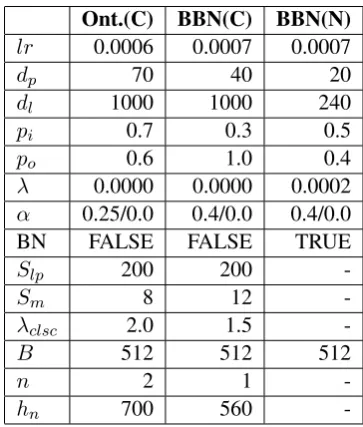
We search the hyper parameter of Ontonotes and BBN respectively via Hyperopt proposed by (Bergstra et al., 2013). Hyper parameters are shown inAppendix A. We optimize the model via Adam Optimizer. The full hyper parameters in-cludes the learning rate lr, the dimension dp of word position embedding, the dimensiondlof the mention encoder’s output (equal to the dimension of the context encoder’s ourput), the input dropout keep probabilitypiand output dropout keep prob-abilitypofor LSTM layers (in context encoder and LSTM mention encoder), the L2 regularization pa-rameterλ, the factor of hierarchical loss normal-izationα (α > 0 means use the normalization), BN (whether using Batch normalization), the max step Slp of the label propagation, the max length
Smof Markov chain, the influence parameterλclsc of CLSC, the batch sizeB, the numbernof hidden layers inq and the number hn of hidden units of the hidden layers. We implement all models using
Tensorflow4.
4.5 Performance comparison and analysis
Table 1 shows performance comparison between the proposed CLSC model and state-of-the-art FET systems. On both benchmarks, the CLSC model achieves the best performance in all three metrics. When focusing on the comparison be-tweenNFETCand CLSC, we have following ob-servation:
• Compact Latent Space Clustering shows its effectiveness on both clean data and noisy data. By applying CLSC regularization on the basicNFETCmodel, we observe consis-tent and significant performance boost;
• Hierarchical-aware loss shows significant ad-vantage on the OntoNotes dataset, while showing insignificant performance boost on the BBN dataset. This is due to different dis-tribution of labels on the test set. The pro-portion of terminal types of the test set is
69%for the BBN dataset, while is only33%
on the OntoNotes dataset. Thus, applying hierarchical-aware loss on the BBN dataset brings little improvement;
• Both algorithms are able to utilize noisy data to improve performance, so we would like to further study their performance in different noisy scenarios in following discussions.
4The code for experiments is available at https://github.
[image:7.595.82.516.65.287.2] [image:7.595.88.276.328.415.2]4.6 How robust are the methods to the proportion of noisy data?
0.300 0.350 0.400 0.450 0.500 0.550
75 80 85 90 95
Proportion of Dcleanbeing removed NFETC(c)
NFETC(c+n)
NFETC-CLSC(c)
NFETC-CLSC(c+n)
0.500 0.550 0.600 0.650 0.700 0.750
75 80 85 90 95 Proportion of Dcleanbeing removed
NFETC(c)
NFETC(c+n)
NFETC-CLSC(c)
[image:8.595.76.256.101.390.2]NFETC-CLSC(c+n)
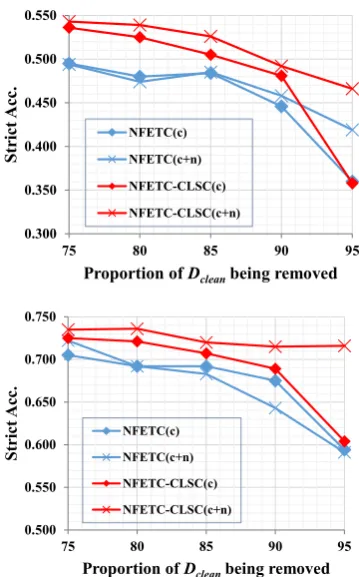
Figure 5: Performance comparison between NFETC-CLSC and NFETC by removing75%-95%clean data.
By principle, with sufficient amount of clean training data, most typing systems can achieve satisfying performance. To further study the robustness of the methods to label noise, we compare their performance with the presence of
25%,20%,15%,10%and5% clean training data and all noisy training data. Figure5shows the per-formance curves as the proportion of clean data drops. As it reveals, the CLSC model consis-tently wins in the comparison. The advantage is especially clear on the BBN dataset, which offers less amount of training data. Note that, with only
27.9% of training data (when only leaving 5%
clean data) on the BBN dataset, the CLSC model yield a comparable result with theNFETCmodel trained on full data. This comparison clearly shows the superiority of our approach in the ef-fectiveness of utilizing noisy data.
4.7 Ablation: Do Markov Chains improve
typing performance?
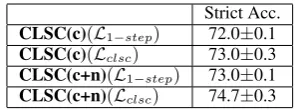
Table3shows the performance of CLSC with one-step transition (L1−step) and with Markov Chains
(Lclsc) as described in Section3.2. Results show
that the use of Markov Chains does bring improve-ment to the overall performance, which is consis-tent with the model intuition.
5 Related Work
Named entity Recognition (NER) has been exca-vated for a long time (Collins and Singer, 1999;
Manning et al., 2014), which classifies coarse-grained types (e.g. person, location). Recently, (Nagesh and Surdeanu, 2018a,b) applied ladder network (Rasmus et al., 2015) to coarse-grained entity classification in a semi-supervised learning fashion. (Ling and Weld, 2012) proposed Fine-Grained Entity Recognition (FET). They used dis-tant supervision to get training corpus for FET. Embedding techniques was applied to learn fea-ture representations since (Yogatama et al.,2015;
Dong et al., 2015). (Shimaoka et al., 2016) in-troduced attention mechanism for FET to capture informative words. (Xin et al., 2018a) used the TransE entity embeddings (Bordes et al.,2013) as the query vector of attention.
Early works ignore the out-of-context noise, (Gillick et al.,2014) proposed context dependent FET and use three heuristics to clean the noisy la-bels with the side effect of losing training data. To utilize noisy data, (Ren et al., 2016a) distin-guished the loss function of noisy data from clean data via partial label loss (PLL). (Abhishek et al.,
2017; Xu and Barbosa, 2018) proposed variants ofPLL, which still suffer from confirmation bias. (Xu and Barbosa,2018) proposed hierarchical loss to handle over-specific noise. On top of AFET, (Ren et al.,2016b) proposed a methodPLEto re-duce the label noise, which lead to a great suc-cess in FET. Because label noise reduction is sep-arated from the learning of FET, there might be error propagation problem. Recently, (Xin et al.,
Strict Acc.
CLSC(c)(L1−step) 72.0±0.1
CLSC(c)(Lclsc) 73.0±0.3
CLSC(c+n)(L1−step) 73.0±0.1
[image:9.595.106.254.61.116.2]CLSC(c+n)(Lclsc) 74.7±0.3
Table 3: The comparison ofL1−stepandLclscon BBN.
6 Conclusion
In this paper, we propose a new method for dis-tantly supervised fine-grained entity typing, which leverages imperfect annotations as model regu-larization via Compact Latent Space Clustering (CLSC). Experiments on two standard bench-marks demonstrate that our method consistently outperforms state-of-the-art models. Further study reveals our method is more robust than the former state-of-the-art approach as the portion of noisy data rises. The proposed method is general for other tasks with imperfect annotation. As a part of future investigation, we plan to apply the ap-proach to other distantly supervised tasks, such as relation extraction.
7 Acknowledgments
This work has been supported in part by NSFC (No.61751209, U1611461), Zhejiang University-iFLYTEK Joint Research Center, Chinese Knowl-edge Center of Engineering Science and Technol-ogy (CKCEST), Engineering Research Center of Digital Library, Ministry of Education. Xiang Ren’s research has been supported in part by Na-tional Science Foundation SMA 18-29268.
References
Abhishek Abhishek, Ashish Anand, and Amit Awekar. 2017. Fine-grained entity type classification by jointly learning representations and label embed-dings. In Proceedings of the 15th Conference of the European Chapter of the Association for Com-putational Linguistics: Volume 1, Long Papers, vol-ume 1, pages 797–807.
Amar Prakash Azad, Balaji Ganesan, Ashish Anand, Amit Awekar, et al. 2018. A unified labeling ap-proach by pooling diverse datasets for entity typing.
arXiv preprint arXiv:1810.08782.
James Bergstra, Dan Yamins, and David D Cox. 2013. Hyperopt: A python library for optimizing the hy-perparameters of machine learning algorithms. In
Proceedings of the 12th Python in Science Confer-ence, pages 13–20. Citeseer.
Antoine Bordes, Nicolas Usunier, Alberto Garcia-Duran, Jason Weston, and Oksana Yakhnenko. 2013. Translating embeddings for modeling multi-relational data. In Advances in neural information processing systems, pages 2787–2795.
Michael Collins and Yoram Singer. 1999. Unsuper-vised models for named entity classification. In
1999 Joint SIGDAT Conference on Empirical Meth-ods in Natural Language Processing and Very Large Corpora.
Joachim Daiber, Max Jakob, Chris Hokamp, and Pablo N Mendes. 2013. Improving efficiency and accuracy in multilingual entity extraction. In Pro-ceedings of the 9th International Conference on Se-mantic Systems, pages 121–124. ACM.
Li Dong, Furu Wei, Hong Sun, Ming Zhou, and Ke Xu. 2015. A hybrid neural model for type classification of entity mentions. InIJCAI, pages 1243–1249.
Xin Dong, Evgeniy Gabrilovich, Geremy Heitz, Wilko Horn, Ni Lao, Kevin Murphy, Thomas Strohmann, Shaohua Sun, and Wei Zhang. 2014. Knowledge vault: A web-scale approach to probabilistic knowl-edge fusion. In Proceedings of the 20th ACM SIGKDD international conference on Knowledge discovery and data mining, pages 601–610. ACM.
Dan Gillick, Nevena Lazic, Kuzman Ganchev, Jesse Kirchner, and David Huynh. 2014. Context-dependent fine-grained entity type tagging. arXiv preprint arXiv:1412.1820.
Sepp Hochreiter and J¨urgen Schmidhuber. 1997. Long short-term memory. Neural computation, 9(8):1735–1780.
Hailong Jin, Lei Hou, Juanzi Li, and Tiansi Dong. 2018. Attributed and predictive entity embedding for fine-grained entity typing in knowledge bases. In
Proceedings of the 27th International Conference on Computational Linguistics, pages 282–292.
Konstantinos Kamnitsas, Daniel Castro, Loic Le Fol-goc, Ian Walker, Ryutaro Tanno, Daniel Rueckert, Ben Glocker, Antonio Criminisi, and Aditya Nori. 2018. Semi-supervised learning via compact latent space clustering. In Proceedings of the 35th In-ternational Conference on Machine Learning, vol-ume 80 of Proceedings of Machine Learning Re-search, pages 2459–2468, Stockholmsmssan, Stock-holm Sweden. PMLR.
Samuli Laine and Timo Aila. 2017. Temporal ensem-bling for semi-supervised learning. InProc. Inter-national Conference on Learning Representations (ICLR).
Xiao Ling and Daniel S Weld. 2012. Fine-grained en-tity recognition. InAAAI, volume 12, pages 94–100.
Christopher Manning, Mihai Surdeanu, John Bauer, Jenny Finkel, Steven Bethard, and David McClosky. 2014. The stanford corenlp natural language pro-cessing toolkit. In Proceedings of 52nd annual meeting of the association for computational lin-guistics: system demonstrations, pages 55–60.
Mike Mintz, Steven Bills, Rion Snow, and Dan Juraf-sky. 2009. Distant supervision for relation extrac-tion without labeled data. In Proceedings of the Joint Conference of the 47th Annual Meeting of the ACL and the 4th International Joint Conference on Natural Language Processing of the AFNLP: Vol-ume 2-VolVol-ume 2, pages 1003–1011. Association for Computational Linguistics.
Ajay Nagesh and Mihai Surdeanu. 2018a. An ex-ploration of three lightly-supervised representation learning approaches for named entity classification. InProceedings of the 27th International Conference on Computational Linguistics, pages 2312–2324.
Ajay Nagesh and Mihai Surdeanu. 2018b. Keep your bearings: Lightly-supervised information extraction with ladder networks that avoids semantic drift. In
Proceedings of the 2018 Conference of the North American Chapter of the Association for Computa-tional Linguistics: Human Language Technologies, Volume 2 (Short Papers), volume 2, pages 352–358.
Jeffrey Pennington, Richard Socher, and Christo-pher D. Manning. 2014. Glove: Global vectors for word representation. InEmpirical Methods in Nat-ural Language Processing (EMNLP), pages 1532– 1543.
Jonathan Raiman and Olivier Raiman. 2018. Deep-type: Multilingual entity linking by neural type sys-tem evolution. InProceedings of the Thirty-Second AAAI Conference on Artificial Intelligence, (AAAI-18), the 30th innovative Applications of Artificial In-telligence (IAAI-18), and the 8th AAAI Symposium on Educational Advances in Artificial Intelligence (EAAI-18), New Orleans, Louisiana, USA, February 2-7, 2018, pages 5406–5413.
Antti Rasmus, Mathias Berglund, Mikko Honkala, Harri Valpola, and Tapani Raiko. 2015. Semi-supervised learning with ladder networks. In Ad-vances in Neural Information Processing Systems, pages 3546–3554.
Xiang Ren, Wenqi He, Meng Qu, Lifu Huang, Heng Ji, and Jiawei Han. 2016a. Afet: Automatic fine-grained entity typing by hierarchical partial-label embedding. InProceedings of the 2016 Conference on Empirical Methods in Natural Language Pro-cessing, pages 1369–1378.
Xiang Ren, Wenqi He, Meng Qu, Clare R Voss, Heng Ji, and Jiawei Han. 2016b. Label noise reduction in
entity typing by heterogeneous partial-label embed-ding. InProceedings of the 22nd ACM SIGKDD in-ternational conference on Knowledge discovery and data mining, pages 1825–1834. ACM.
Sonse Shimaoka, Pontus Stenetorp, Kentaro Inui, and Sebastian Riedel. 2016. An attentive neural ar-chitecture for fine-grained entity type classification. In Proceedings of the 5th Workshop on Automated Knowledge Base Construction, pages 69–74.
Antti Tarvainen and Harri Valpola. 2017. Mean teach-ers are better role models: Weight-averaged consis-tency targets improve semi-supervised deep learning results. InAdvances in neural information process-ing systems, pages 1195–1204.
Ashish Vaswani, Noam Shazeer, Niki Parmar, Jakob Uszkoreit, Llion Jones, Aidan N Gomez, Łukasz Kaiser, and Illia Polosukhin. 2017. Attention is all you need. InAdvances in Neural Information Pro-cessing Systems, pages 5998–6008.
Ralph Weischedel and Ada Brunstein. 2005. Bbn pro-noun coreference and entity type corpus. Linguistic Data Consortium, Philadelphia, 112.
Ralph Weischedel, Martha Palmer, Mitchell Marcus, Eduard Hovy, Sameer Pradhan, Lance Ramshaw, Nianwen Xue, Ann Taylor, Jeff Kaufman, Michelle Franchini, et al. 2013. Ontonotes release 5.0 ldc2013t19. Linguistic Data Consortium, Philadel-phia, PA.
Ji Xin, Yankai Lin, Zhiyuan Liu, and Maosong Sun. 2018a. Improving neural fine-grained entity typing with knowledge attention.
Ji Xin, Hao Zhu, Xu Han, Zhiyuan Liu, and Maosong Sun. 2018b. Put it back: Entity typing with lan-guage model enhancement. In Proceedings of the 2018 Conference on Empirical Methods in Natural Language Processing, pages 993–998.
Peng Xu and Denilson Barbosa. 2018. Neural fine-grained entity type classification with hierarchy-aware loss. InProceedings of the 2018 Conference of the North American Chapter of the Association for Computational Linguistics: Human Language Technologies, Volume 1 (Long Papers), volume 1, pages 16–25.
Yadollah Yaghoobzadeh and Hinrich Sch¨utze. 2015. Corpus-level fine-grained entity typing using con-textual information. In Proceedings of the 2015 Conference on Empirical Methods in Natural Lan-guage Processing, pages 715–725.
Daojian Zeng, Kang Liu, Siwei Lai, Guangyou Zhou, and Jun Zhao. 2014. Relation classification via con-volutional deep neural network. In Proceedings of COLING 2014, the 25th International Conference on Computational Linguistics: Technical Papers, pages 2335–2344.
Xiaojin Zhu and Zoubin Ghahramani. 2002. Learning from labeled and unlabeled data with label propaga-tion.
A Hyper parameters
Ont.(C) BBN(C) BBN(N)
lr 0.0006 0.0007 0.0007
dp 70 40 20
dl 1000 1000 240
pi 0.7 0.3 0.5
po 0.6 1.0 0.4
λ 0.0000 0.0000 0.0002
α 0.25/0.0 0.4/0.0 0.4/0.0
BN FALSE FALSE TRUE
Slp 200 200
-Sm 8 12
-λclsc 2.0 1.5
-B 512 512 512
n 2 1
-hn 700 560
[image:11.595.89.271.213.427.2]