NEAR-INSTANTANEOUSLY ADAPTIVE DECISION FEEDBACK EQUALIZED CODED
MODULATION FOR WIRELESS VIDEO TELEPHONY
P. Cherriman, S. X. Ng, L. Hanzo
Dept. of ECS, Univ. of Southampton, SO17 1BJ, UK.
Tel: +44-1703-593 125, Fax: +44-1703-594 508
Email:[email protected],
http://www-mobile.ecs.soton.ac.uk
ABSTRACT
Decision Feedback Equaliation (DFE) aided wideband Burst-by-Burst (BbB) Adaptive Trellis Coded Modulation (TCM), Turbo Trellis Coded Modulation (TTCM) and Bit-Interleaved Coded Modulation (BICM) are proposed and characterised in performance terms over the COST 207 Typical Urban (TU) wideband fading channel. These schemes are evaluated using a practical modem mode switching regime in the context of wireless video telephony.
1. INTRODUCTION
The radio spectrum is a scarce resource. Therefore, one of the most important objectives in the design of a digital cellular sys-tem is the efficient exploitation of the available spectrum in or-der to accommodate the ever-increasing traffic demands. Trel-lis Coded Modulation (TCM) [1], which is based on combining the functions of coding and modulation, is a bandwidth efficient scheme that has been widely recognized as an excellent error con-trol technique suitable for applications in mobile communications [2, 3]. Turbo Trellis Coded Modulation (TTCM) [4] is a more recent channel coding scheme that has a structure similar to that of the family of power efficient binary turbo codes [5], but em-ploys TCM codes as component codes. TCM and TTCM schemes invoked Set-Partitioning (SP) based modulated symbol labeling, in order to achieve an increased Euclidean distance between the unprotected bits of the constellation. As a consequence, paral-lel trellis transitions can be associated with the unprotected data bits. This reduced the decoding complexity. In the TCM and TTCM schemes investigated random symbol interleaver arrange-ments were utilised for both the turbo interleaver and the channel interleaver.
Another powerful coded modulation scheme utilising bit-based – rather than symbol-based – channel interleaving in conjunction with Gray signal labeling is referred to as Bit-Interleaved Coded Modulation (BICM), which was proposed in [6, 7]. It combines conventional convolutional codes with several independent bit in-terleavers, in order to increase the associated diversity order. In conjunction with bit interleavers, the code diversity order can be increased to the binary Hamming distance of a code, and the num-ber of parallel bit-interleavers equals the numnum-ber of coded bits in a symbol [6]. Recently, iteratively decoded BICM along with SP assisted signal labeling, referred to as BICM-ID has also been pro-posed [8–11]. The philosophy of BICM-ID is to increase the Eu-clidean distance of the BICM code and to exploit the full
advan-Parameter Value
Carrier Frequency 1.9GHz Vehicular Speed 30mph Doppler frequency 85Hz Normalised Doppler frequency 3:2510
5
[image:1.612.313.539.180.282.2]Channel type C0ST 207 Typical Urban (see Figure 1) Number of paths in channel 4 Data modulation Adaptive Coded Modulation (4-QAM, 8-PSK, 16-QAM, 64-QAM) Decision Feedback Equalizer Receiver type Number of Forward Filter Taps = 35 Number of Backward Filter Taps = 7
Table 1: Modulation and channel parameters
0 1 2 3
Path delay ( s)
0.0 0.1 0.2 0.3 0.4 0.5 0.6 0.7 0.8 0.9
Normalized
magnitude
Figure 1: The impulse response of a COST 207 Typical Urban (TU) channel [12].
tage of bit interleaving upon invoking a simple iterative decoding technique.
2. SYSTEM OVERVIEW
Table 1 shows the modulation and channel parameters employed. The multi-path channel model is characterized by its discretised symbol-spaced COST207 Typical Urban (TU) channel impulse re-sponse [12], as shown in Figure 1, where each path is faded in-dependently according to a Rayleigh distribution. The transmis-sion burst structure of the FMA1 non-spread data specified in the FRAMES proposal [13], as shown in Figure 2, was used. The re-maining system paramters are shown in Table 2.
[image:1.612.341.516.314.451.2]Training sequence bits
Tailing
bits Tailing
342 data symbols 49 symbols 342 data symbols
288 microseconds
Non-spread data burst
Data Data
3 3 11
[image:2.612.306.555.21.186.2]Guard
Figure 2: Transmission burst structure of the FMA1 non-spread data as specified in the FRAMES proposal [13].
Features Value
Multiple access TDMA
No. of Slots/Frame 16
TDMA frame length 4.615ms
TDMA slot length 288µs
Data Symbols/TDMA slot 684
User Data Symbol Rate (KBd) 148.2
System Data Symbol Rate (MBd) 2.37
Symbols/TDMA slot 750
User Symbol Rate (KBd) 162.5
System Symbol Rate (MBd) 2.6
System Bandwidth (MHz) 3.9
[image:2.612.75.260.22.100.2]Eff. User Bandwidth (kHz) 244
Table 2: Generic system features of the reconfigurable multi-mode video transceiver, using the non-spread data burst mode of the FRAMES proposal [13] shown in Figure 2.
Figure 2. Secondly, the CIR is time-invariant for the duration of a transmission burst, but varies from burst to burst according to the Doppler frequency, which corresponds to assuming that the CIR is slowly varying. The error propagation of the DFE will degrade the estimated performance, but the effect of error prop-agation is left for further study. The modulation modes that can be invoked by our multimode transceivers are 4QAM, 8PSK, 16QAM and 64QAM [14].
We invoke four encoders, each adding one parity bit to each information symbol, yielding the coding rate of 1=2 in
conjunc-tion with the modulaconjunc-tion mode of 4QAM, 2=3 for 8PSK, 3=4 for
16QAM and 5=6 for 64QAM. The TCM scheme invokes
Unger-boeck’s codes [1], while the TTCM scheme invokes Robertson’s codes [4]. The BICM scheme was constructed using Paaske’s con-volutional codes [15]. The rate 5=6 code of the BICM scheme was
constructed using Paaske’s rate 1=2 code and puncturing,
follow-ing the approach of [16, 17]. Soft decision trellis decodfollow-ing uti-lizing the Log-Maximum A Posteriori (Log-MAP) algorithm [18] was invoked for the decoders. The Log-MAP algorithm is a nu-merically stable version of the MAP algorithm operating in the log-domain, in order to reduce its complexity and to mitigate the numerical problems associated with the MAP algorithm [19].
3. VIDEO OVERVIEW
The proposed video transceiver is based on the H.263 video codec [20]. The video coded bitstream is conveyed by an intelligent burst-by-burst adaptive coded modulation assisted wideband multi-mode multi-modem [14], which can be configured either under network
Features Multi-rate System
Mode 4QAM 8PSK 16QAM 64QAM Transmission Symbols/TDMA slot 684
Bits/Symbol 2 3 4 6 Transmission bits/TDMA slot 1368 2052 2736 4104 Packet Rate 216.7/s
Transmission bitrate (kbit/s) 296.4 444.6 592.8 889.3 Code Termination Symbols 6
Data Symbols/TDMA slot 678
Coding Rate 1/2 2/3 3/4 5/6 Information Bits/Symbol 1 2 3 5 Unprotected bits/TDMA slot 678 1356 2034 3390 Unprotected bitrate (kbit/s) 146.9 293.8 440.7 734.6 Video packet CRC (bits) 16
Feedback protection (bits) 9
Video packet header (bits) 11 12 12 13 Video bits/packet 642 1319 1997 3352 Effective Video-rate (kbit/s) 139.1 285.8 432.7 726.3 Video framerate (Hz) 30
Table 3: Operational-mode specific transceiver parameters for TTCM
control or under transceiver control. This allowed us to support an increased throughput expressed in terms of the average number of bits per symbol, when the instantaneous channel quality was high, leading ultimately to an increased video quality in a constant bandwidth.
The video transceiver operates in close cooperation with the adaptive multi-mode modem, packetising the video bitstream into one packet per transmission burst. The number of bits in the video packet varies, depending on the current operating mode of the multi-mode modem. The video transceiver is informed of the pac-ket’s transmission success and failure by a highly protected feed-back channel, which is integrated into the reverse link. More ex-plicitly, the associated feedback flag is protected with the aid of a repetition code. The use of packet acknowledgement allows the video encoder and the remote decoder to operate on the basis of identical recontruction frame buffer contents without the need of retransmissions, which are wasteful in terms of bandwidth and de-lay.
The transmitted bitrate of all four modes of operation is shown in Table 3 for the TTCM scheme. The associated bitrates are sim-ilar for the other coded modulation schemes. The slight difference is caused by using different numbers of code termination symbols. The unprotected video bitrate before channel coding is also shown in the table. The actual useful bitrate available for video encoding is slightly lower, than the unprotected bitrate due to the bitrate allo-cation required by the strongly protected packet acknowledgement information, and packetisation overhead information. The effec-tive video bitrate is also shown in the table, which varies from 139 to 726 kbit/s.
We have investigated the video system concerned using a wide range of video sequences having different resolutions. However for consizeness we will only show results for the Common Inter-mediate Format (CIF) resolution (352x288 pixels) salesman se-quence at 30 frames per second.
4. EMPLOYING FIXED MODULATION MODES
[image:2.612.76.257.147.300.2]$RCSfile: logber-vs-csnr-bicm-tcm-ttcm-fixed.gle,v $ $Date: 2000/07/05 14:36:56 $
0 5 10 15 20 25 30
Channel SNR (dB)
10-4 2 5
10-3
2 5
10-2
2 5
10-1
2 5
100
Bit
Error
Ratio
4QAM 8PSK 16QAM 64QAM
[image:3.612.72.266.28.178.2]TCM (mem=6) TCM (mem=3) TTCM (mem=3, itr=4) BICM (mem=3) Frames (non-spread)
Figure 3: Bit-error-ratio versus channel SNR for the four fixed mo-dem modes, using the four joint coding/modulation schemes con-sidered, namely BICM, TCM3, TCM6 and TTCM over the chan-nel of Figure 1.
conjunction with a constraint length of three and using four itera-tions, to that of non-iterative TCM along with a constraint length of six, since the associated computational complexity is similar. We also compare these results to TCM using a constraint length of three and to BICM employing a constraint length of three. Fig-ure 3 shows the bit error ratio performance of the four different joint coding and modulation schemes for the four fixed modula-tion modes considered. It can be seen that the TCM schemes have the best performance. The BICM scheme has clearly the worst BER performance in the 8PSK, 16QAM and 64QAM modes.
Again, one video packet is transmitted in each TDMA frame and the receiver calculates, whether the received packet has any bit-errors using the associated Cyclic Redundancy Check (CRC). If the received packet has been corrupted, this acknowledgement message is strongly protected using repetition codes and superim-posed on the reverse link transmission. In these investigations a transmission frame error resulted in a video packet error. We shall characterise the relative frequency of these events by the packet loss ratio (PLR). The PLR of the four joint coding and modulation schemes is shown in Figure 4.
Again, the BICM scheme has the worst performance. How-ever, in terms of the PLR the TCM scheme using a constraint length of six has a significant performance advantage over the TCM scheme employing a constraint length of three. More notice-able is that the TTCM scheme provides the best PLR performance by a considerable margin. This is because turbo decoding of the TTCM scheme is very effective in reducing the number of bit er-rors to zero in packets exhibiting a low number of bit erer-rors before decoding. The performance of BICM is worse, than that of TCM due to the associated limited channel interleaving depth [6, 7] of the BICM scheme in our slow-fading wideband channels.
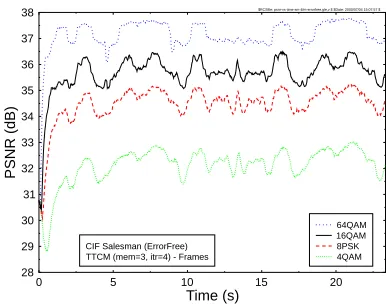
Figure 5 shows the error-free decoded video quality, measured in terms of the video peak signal to noise ratio (PSNR) versus time for the CIF resolution “Salesman” sequence for each of the four fixed modulation modes using the TTCM scheme. As expected, the figure demonstrates that the higher order modulation modes, which have a higher associated bitrate provide a better video qual-ity. This graph will become useful at a later stage, when comparing the PSNR of the various scenarios obtained in an error-impaired
$RCSfile: plr-vs-csnr-bicm-tcm36-ttcm-fixed.gle,v $ $Date: 2000/07/05 14:49:31 $
0 5 10 15 20 25 30
Channel SNR (dB)
10-3 2 5
10-2 2 5
10-1
2 5
100
Packet
Loss
Ratio
4QAM 8PSK 16QAM 64QAM
TTCM (mem=3, itr=4) TCM (mem=6) TCM (mem=3) BICM (mem=3) Frames (non-spread)
[image:3.612.330.526.29.179.2]1% PLR 5% PLR
Figure 4: Packet loss ratio versus channel SNR for the four fixed modem modes, using the four joint coding/modulation schemes considered, namely BICM, TCM3, TCM6 and TTCM over the channel of Figure 1.
$RCSfile: psnr-vs-time-sm-4fm-errorfree.gle,v $ $Date: 2000/07/04 15:07:57 $
0 5 10 15 20
Time (s)
28 29 30 31 32 33 34 35 36 37 38
PSNR
(dB)
4QAM 8PSK 16QAM 64QAM
TTCM (mem=3, itr=4) - Frames CIF Salesman (ErrorFree)
Figure 5: PSNR (video quality) versus time for the four fixed mod-ulation modes, under error-free channel conditions using the CIF resolution “Salesman” video sequence at 30 frame/s. Joint coding and modulation using turbo trellis coding with constraint length three and four iterations was employed.
situation.
5. EMPLOYING TTCM/AQAM
The modem mode switching mechanism of the adaptive schemes is characterised by a set of switching thresholds, by the correspond-ing random TTCM symbol-interleavers and the component codes, as follows:
Mod. Mode=
8 > > <
> > :
4QAM;I0=684;R0=1/2 ifγDFE f1
8PSK;I1=1368;R1=2/3 if f1<γDFEf2
16QAM;I2=2052;R2=3/4 if f2<γDFEf3
64QAM;I3=3420;R3=5/6 ifγDFE> f3,
(1)
where fn;n=1:::3 are the equalizer’s output SNR thresholds, while
Inrepresents the random TTCM symbol-interleaver size expressed
[image:3.612.330.523.254.408.2]$RCSfile: psnr-vs-csnr-sm-ttcm-aqam-3pcet-vs-fixed.gle,v $ $Date: 2000/06/27 13:25:44 $
0 5 10 15 20 25 30 35 40
Channel SNR (dB)
31 32 33 34 35 36 37 38
A
verage
PSNR
(dB)
AQAM 4QAM 8PSK 16QAM 64QAM Frames non-spread
[image:4.612.71.267.28.177.2]CIF Salesman Turbo TCM (mem=3, itr=4)
Figure 6: Average PSNR versus channel SNR for the four fixed TTCM modes and for the four-mode TTCM AQAM scheme using the CIF “Salesman” video sequence at 30 frame/s. A constraint length of three and four iterations were invoked over the COST207 CIR of Figure 1.
$RCSfile: psnr-vs-time-sm-4fm-20db.gle,v $ $Date: 2000/06/29 12:58:21 $
0 5 10 15 20
Time (s)
28 29 30 31 32 33 34 35 36 37 38
PSNR
(dB)
4QAM 8PSK 16QAM 64QAM
TTCM (mem=3, itr=4) - Frames CIF Salesman, CSNR=20dB
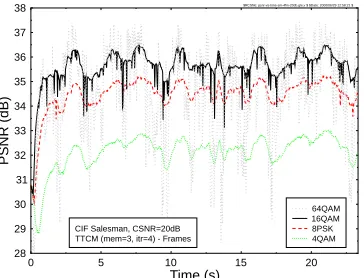
Figure 7: PSNR versus time for the four fixed modulation modes
at a channel SNR of 20dB, using the CIF-resolution “Salesman”
video sequence at 30 frames/s, employing a constraint length three and four iterations over the COST207 CIR of Figure 1.
BICM schemes. The switching thresholds fnwere chosen using a
heuristic algorithm, in order to maintain the required target PLR. The video quality expressed in terms of the average PSNR is closely related to the effective throughput video bitrate, which is shown in Figure 6. As expected, the figure portrays that the AQAM modem’s video performance degrades smoothly, as the channel SNR degrades, while the fixed modem’s video performance de-grades more rapidly, when the channel SNR becomes insufficient for the specific modem mode concerned. The video quality in terms of the PSNR is shown versus time in Figure 7 for the four fixed modulation modes at a channel SNR of 20dB. For further re-search on wireless video communications the interested reader is referred to [21].
6. CONCLUSIONS
In this contribution various burst-by-burst adaptive coded mod-ulation based video transceivers have been studied. The
near-instantaneously adaptive transceiver is capable of operating in four different coded modulation modes, namely 4QAM, 8PSK, 16QAM and 64QAM.
The advantage of using trellis coding in our near-instantaneous-ly adaptive transceivers is that when invoking higher-order modu-lation modes in case of encountering a higher channel quality, the coding rate approaches unity. This allows us to maintain as high a throughput as possible. For example, the bitrate of the 4QAM and 64QAM modes was 296 and 889Kbit/s, repectively. The cod-ing rate of the 4QAM mode was half, while that of the 64QAM mode was 5=6. This in turn allowed us to support effective video
bitrates of 139 and 726Kbit/s in the 4QAM and 64QAM modes, repectively. The ratio of the effective video bitrate to the chan-nel bitrate increased from 47% in the 4QAM mode to 82% in the 64QAM mode. We found that the turbo trellis coding scheme pro-vided the best overall video performance due to its superior PLR performance.
The burst-by-burst adaptive modem guaranteed the same video performance as the lowest- and highest-order fixed-mode modu-lation schemes at extremely low and high channel SNRs, respec-tively. However in between these extreme SNRs the effective video bitrate smoothly increased, as the channel SNR increased, whilst maintaining a near-constant PLR. By controlling the AQAM switch-ing thresholds a near-constant PLR can be maintained.
7. REFERENCES
[1] G. Ungerboeck, “Channel coding with multilevel/phase sig-nals,” IEEE Transactions on Information Theory, vol. IT-28, pp. 55–67, January 1982.
[2] D. Divsalar and M. K. Simon, “The design of trellis coded
mpsk for fading channel: Performance criteria,” IEEE
Transactions on Communications, vol. 36, pp. 1004–1012, September 1988.
[3] D. Divsalar and M. K. Simon, “The design of trellis coded MPSK for fading channel: set partitioning for optimum code design,” IEEE Transactions on Communications, vol. 36, pp. 1013–1021, September 1988.
[4] P. Robertson and T. W¨orz, “Bandwidth efficient turbo trellis-coded modulation using punctured component codes,” vol. 16, pp. 206–218, February 1998.
[5] C. Berrou, A. Glavieux, and P. Thitimajshima, “Near
shan-non limit error-correcting coding and decoding: Turbo
codes,” in Proceedings of the International Conference on Communications, (Geneva, Switzerland), pp. 1064–1070, May 1993.
[6] E. Zehavi, “8-PSK trellis codes for a Rayleigh fading channel,” IEEE Transactions on Communications, vol. 40, pp. 873–883, May 1992.
[7] G. Caire, G. Taricco, and E. Biglieri, “Bit-interleaved coded modulation,” IEEE Transactions on Information Theory, vol. 44, pp. 927–946, May 1998.
[8] X. Li and J. Ritcey, “Bit-interleaved coded modulation with iterative decoding,” IEEE Communications Letters, vol. 1, November 1997.
[image:4.612.79.261.267.406.2]without code concatenation,” in Proceedings of CISS 1998, (Princeton University, USA), March 1998.
[10] X. Li and J. Ritcey, “Trellis-coded modulation with bit in-terleaving and iterative decoding,” IEEE Journal on Selected Areas in Communications, vol. 17, April 1999.
[11] X. Li and J. Ritcey, “Bit-interleaved coded modulation with iterative decoding using soft feedback,” IEE Electronics Let-ters, vol. 34, pp. 942–943, May 1998.
[12] “COST 207: Digital land mobile radio communications, fi-nal report.” Office for Official Publications of the European Communities, 1989. Luxembourg.
[13] A. Klein, R. Pirhonen, J. Skoeld, and R. Suoranta, “FRAMES multiple access mode 1 — wideband TDMA with and without spreading,” in Proceedings of IEEE Inter-national Symposium on Personal, Indoor and Mobile Ra-dio Communications, PIMRC’97, vol. 1, (Marina Congress Centre, Helsinki, Finland), pp. 37–41, IEEE, 1–4 September 1997.
[14] L. Hanzo, W. Webb, and T. Keller, Single- and Multi-carrier Quadrature Amplitude Modulation. New York, USA: IEEE Press-John Wiley, April 2000.
[15] S. Lin and D. Constello Jr., Error Control Coding: Fun-damentals and Applications. Englewood Cliffs, NJ, USA: Prentice-Hall, October 1982. ISBN: 013283796X.
[16] J. Hagenauer, “Rate-compatible puncture convolutional codes (RCPC) and their application,” IEEE Transactions on Communications, vol. 36, pp. 389–400, April 1988.
[17] L. Lee, “New rate-compatible puncture convolutional codes for viterbi decoding,” IEEE Transactions on Communica-tions, vol. 42, pp. 3073–3079, December 1994.
[18] P. Robertson, E. Villebrun, and P. Hoeher, “A comparison of optimal and sub-optimal MAP decoding algorithms operat-ing in the log domain,” in Proceedoperat-ings of the International Conference on Communications, pp. 1009–1013, June 1995.
[19] L. Bahl, J. Cocke, F. Jelinek, and J. Raviv, “Optimal decod-ing of linear codes for minimisdecod-ing symbol error rate,” IEEE Transactions on Information Theory, vol. 20, pp. 284–287, March 1974.
[20] ITU-T, Recommendation H.263: Video Coding for Low Bi-trate communication, March 1996.
[21] L. Hanzo, P. Cherriman, J. Streit: Wireless Video Commu-nications: Second to Third Generation and Beyond, IEEE Press, 1
1For detailed contents please refer to
![Table 1 shows the modulation and channel parameters employed.The multi-path channel model is characterized by its discretisedsymbol-spaced COST207 Typical Urban (TU) channel impulse re-sponse [12], as shown in Figure 1, where each path is faded in-dependen](https://thumb-us.123doks.com/thumbv2/123dok_us/1030959.618485/1.612.313.539.180.282/modulation-channel-parameters-employed-characterized-discretisedsymbol-typical-dependen.webp)
![Figure 2: Transmission burst structure of the FMA1 non-spreaddata as specified in the FRAMES proposal [13].](https://thumb-us.123doks.com/thumbv2/123dok_us/1030959.618485/2.612.75.260.22.100/figure-transmission-burst-structure-spreaddata-specied-frames-proposal.webp)