3201
Connecting Language and Knowledge with Heterogeneous
Representations for Neural Relation Extraction
Peng Xu
Department of Computing Science University of Alberta
Edmonton, Canada [email protected]
Denilson Barbosa
Department of Computing Science University of Alberta
Edmonton, Canada [email protected]
Abstract
Knowledge Bases (KBs) require constant up-dating to reflect changes to the world they rep-resent. For general purpose KBs, this is of-ten done through Relation Extraction (RE), the task of predicting KB relations expressed in text mentioning entities known to the KB. One way to improve RE is to use KB Embeddings (KBE) for link prediction. However, despite clear connections between RE and KBE, lit-tle has been done toward properly unifying these models systematically. We help close the gap with a framework that unifies the learning of RE and KBE models leading to significant improvements over the state-of-the-art in RE. The code is available athttps://github. com/billy-inn/HRERE.
1 Introduction
Knowledge Bases (KBs) contain structured infor-mation about the world and are used in support of many natural language processing applications such as semantic search and question answering. Building KBs is a never-ending challenge because, as the world changes, new knowledge needs to be harvested while old knowledge needs to be re-vised. This motivates the work on the Relation Ex-traction (RE) task, whose goal is to assign a KB relation to aphrase connecting a pair of entities, which in turn can be used for updating the KB. The state-of-the-art in RE builds on neural mod-els using distant (a.k.a. weak) supervision (Mintz et al.,2009) on large-scale corpora for training.
A task related to RE is that of Knowledge Base Embedding (KBE), which is concerned with rep-resenting KB entities and relations in a vector space for predicting missing links in the graph. Aiming to leverage the similarities between these tasks,Weston et al.(2013) were the first to show that combining predictions from RE and KBE models was beneficial for RE. However, the way
in which they combine RE and KBE predictions is rather naive (namely, by adding those scores). To the best of our knowledge, there have been no systematic attempts to further unify RE and KBE, particularly during modeltraining.
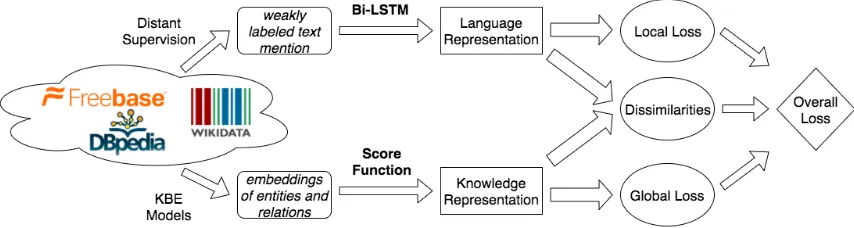
We seek to close this gap with HRERE (Het-erogeneous REpresentations for neural Relation Extraction), a novel neural RE framework that learns language and knowledge representations
jointly. Figure 1 gives an overview. HRERE’s backbone is a bi-directional long short term mem-ory (LSTM) network with multiple levels of atten-tion to learn representaatten-tions of text expressing re-lations. The knowledge representation machinery, borrowed fromComplEx(Trouillon et al.,2016), nudges the language model to agree with facts in the KB. Joint learning is guided by three loss func-tions: one for the language representation, another for the knowledge representation, and a third one to ensure these representations do not diverge. In effect, this contributes to HRERE’s generalization power by preventing over-fitting by either model.
We build on state-of-the-art methods for learn-ing the separate RE and KBE representations and on learning tools that allow us to scale to a mod-erately large training corpus. (We use a subset of Freebase with 3M entities as our KB.) We vali-date our approach on an established benchmark against state-of-the-art methods for RE, observ-ing not only that our base model significantly outperforms previous methods, but also the fact that jointly learning the heterogeneous representa-tions consistently brings in improvements. To the best of our knowledge, ours is the first principled framework to combine and jointly learn hetero-geneous representations from both language and knowledge for the RE task.
Figure 1: Workflow of the proposed framework.
representations for RE and KBE tasks that uses a cross-entropy loss function to ensure both repre-sentations are learned together, resulting in signif-icant improvements over the current state-of-the-art for the RE task.
2 Related Work
Recent neural models have been shown superior to approaches using hand-crafted features for the RE task. Among the pioneers, Zeng et al.(2015) proposed a piecewise convolutional network with multi-instance learning to handle weakly labeled text mentions. Recurrent neural networks (RNN) are another popular architecture (Wu et al.,2017). Similar fast progress has been seen for the KBE task for representing entities and relations in KBs with vectors or matrices. Bordes et al.(2013) in-troduced the influential translation-based embed-dings (TransE), while Yang et al. (2014) lever-aged latent matrix factorization in their DistMult method. We build on ComplEx (Trouillon et al.,
2016), which extends DistMult into the complex space and has been shown significantly better on several benchmarks.
Weston et al. (2013) were the first to connect RE and KBE models for the RE task. Their sim-ple idea was to train the two modelsindependently
and only combine them at inference time. While they showed that combining the two models is ter than using the RE model alone, newer and bet-ter models since then have obviated the net gains of such a simple strategy (Xu and Barbosa,2018). We propose a much tighter integration of RE and KBE models: we not only use them for predic-tion, but also train them together, thus mutually reinforcing one another.
Recently, many methods have been proposed to use information from KBs to facilitate relation ex-traction. Sorokin and Gurevych (2017)
consid-ered other relations in the sentential context while predicting the target relation. Vashishth et al.
(2018) utilized additional side information from KBs for improved RE. However, these methods didn’t leverage KBE method to unify RE and KBE in a principled way. Han et al.(2018) used a mu-tual attention between KBs and text to perform better on both RE and KBE, but their method was still based on TransE (Bordes et al.,2013) which can not fully exploit the advantage of the informa-tion from KBs.
3 Background and Problem
The goal in the task of Relation Extraction is to predict a KB relation that holds for a pair of enti-ties given a set of sentences mentioning them (or
NAif no such relation exists). The input is a KB
Ψ with relation set RΨ, a set of relations of
in-terest R, R ⊆ RΨ, and an automatically la-belled training dataset Dobtained via distant su-pervision. Given a sentence mentioning entities h, t, the output is a relationr ∈ Rthat holds for h, tor the catch-all relationNAif no suchrexists.
Knowledge Base and Distant Supervision. As customary, we denote a KB Ψ with relation schemeRΨ as a set oftriples TΨ = {(h, r, t) ∈ EΨ × RΨ × EΨ}, where EΨ is the set of
enti-ties of interest. Distant supervision exploits the KB to automatically annotate sentences in a cor-pus containing mentions of entities with the re-lations they participate in. Formally, a labeled dataset for relation extraction consists of fact triples{(hi, ri, ti)}Ni=1and a multi-set of extracted
sentences for each triple {Si}Ni=1, such that each
sentences ∈ Si mentions both the head entityhi and the tail entityti.
Problem Statement. Given an entity pair(h, t)
task is to estimate the probability of each relation inR ∪ {NA}. Formally, for each relation r, we want to predictP(r |h, t,S).
In practice, the input set of sentencesScan have arbitrary size. For the sake of computational effi-ciency, we normalize the set size to a fixed number T by splitting large sets and oversampling small ones. We also restrict the length of each sentence in the set by a constantLby truncating long sen-tences and padding short ones.
4 Methodology
We now go over the details of our framework out-lined in Figure 1for unifying the learning of the language and the knowledge representations used for relation extraction. In a nutshell, we use LSTM with attention mechanisms for language represen-tation and we follow the approach of Trouillon et al.(2016) for KB embedding.
4.1 Language Representation
Input Representation. For each word token, we use pretrained word embeddings and randomly initialized position embeddings (Zeng et al.,2014) to project it into (dw + dp)-dimensional space, where dw is the size of word embedding and dp is the size of position embedding.
Sentence Encoder. For each sentencesi, we ap-ply a non-linear transformation to the vector rep-resentation of si to derive a feature vector zi =
f(si;θ)given a set of parametersθ. In this paper, we adopt bidirectional LSTM withdshidden units asf(si;θ)(Zhou et al.,2016).
Multi-level Attention Mechanisms. We em-ploy attention mechanisms at both word-level and sentence-level to allow the model to softly select the most informative words and sentences dur-ing traindur-ing (Zhou et al.,2016;Lin et al.,2016). With the learned language representationsL, the conditional probability p(r|S; Θ(L)) is computed through asoftmaxlayer, whereΘ(L)is the parame-ters of the model to learn language representation.
4.2 Knowledge Representation
Following the score function φand training pro-cedure of Trouillon et al. (2016), we can get the knowledge representations eh, wr, et ∈ Cdk.
With the knowledge representations and the scor-ing function, we can obtain the conditional
proba-bilityp(r|(h, t); Θ(G))for each relationr:
p(r|(h, t); Θ(G)) = e
φ(eh,wr,et)
P
r0∈R∪{NA}eφ(eh,wr0,et)
whereΘ(G) corresponds to the knowledge repre-sentationseh, wr, et ∈Cdk. SinceNA∈ R/
Ψ, we
use a randomized complex vector aswNA.
4.3 Connecting the Pieces
As stated, this paper seeks an elegant way of con-necting language and knowledge representations for the RE task. In order to achieve that, we use separate loss functions (recall Figure 1) to guide the language and knowledge representation learn-ing and a third loss function that ties the predic-tions of these models thus nudging the parameters towards agreement.
The cross-entropy losses based on the language and knowledge representations are defined as:
JL=−1
N
N
X
i=1
logp(ri|Si; Θ(L)) (1)
JG=−
1
N
N
X
i=1
logp(ri|(hi, ti); Θ(G)) (2)
whereN denotes the size of the training set. Fi-nally, we use a cross-entropy loss to measure the dissimilarity between two distributions, thus con-necting them, and formulate model learning as minimizingJD:
JD =−1
N
N
X
i=1
logp(r∗i|Si; Θ(L)) (3)
whereri∗= arg maxr∈R∪{NA}p(r|(hi, ti); Θ(G)).
4.4 Model Learning
Based on Eq.1,2,3, we form the joint optimiza-tion problem for model parameters as
min
Θ J =JL+JG+JD+λkΘk 2 2 (4)
where Θ = Θ(L) ∪Θ(G). The knowledge rep-resentations are first trained on the whole KB in-dependently and then used as the initialization for thejointlearning. We adopt the stochastic gradi-ent descgradi-ent with mini-batches and Adam (Kingma and Ba, 2014) to update Θ, employing different learning rates lr1 and lr2 on Θ(L) and Θ(G)
4.5 Relation Inference
In order to get the conditional probability p(r|(h, t),S; Θ), we use the weighed average to combine the two distribution p(r|S; Θ(L)) and p(r|(h, t); Θ(G)):
p(r|(h, t),S; Θ) =α∗p(r|S; Θ(L))
+(1−α)∗p(r|(h, t); Θ(G)). (5)
whereαis the combining weight of the weighted average. Then, the predicted relationrˆis
ˆ
r = argmax
r∈R∪{NA}
p(r|(h, t),S; Θ). (6)
5 Experiments
Datasets. We evaluate our model on the widely used NYTdataset (Riedel et al.,2010) by align-ing Freebase relations mentioned in the New York Times Corpus. Articles from years 2005-2006 are used for training while articles from 2007 are used for testing. As our KB, we used a Freebase sub-set with the 3M entities with highest degree (i.e., participating in most relations). Moreover, to pre-vent the knowledge representation from memoriz-ing the true relations for entity pairs in the test set, we removed all entity pairs present in the NYT.
Evaluation Protocol: Following previous work (Mintz et al., 2009), we evaluate our model us-ing held-out evaluation which approximately mea-sures the precision without time-consuming man-ual evaluation. We report both Precision/Recall curves and Precision@N (P@N) in our experi-ments, ignoring the probability predicted for the
NArelation. Moreover, to evaluate each sentence in the test set as in previous methods, we append T copies of each sentence intoS for each testing sample.
Word Embeddings: In this paper, we used the freely available 300-dimensional pre-trained word embeddings distributed byPennington et al.
(2014) to help the model generalize to words not appearing in the training set.
Hyperparameter Settings: For hyperparameter tuning, we randonly sampled10%of the training set as a development set. All the hyperparameters were obtained by evaluating the model on the de-velopment set. With the well-tuned hyperparam-eter setting, we run each model five times on the whole training set and report the average P@N. For Precision/Recall curves, we just select the re-sults from the first run of each model. For training,
learning rate onΘ(L) lr1 5×10⁻⁴
learning rate onΘ(K) lr2 1×10⁻⁵
size of word position embedding dp 25
state size for LSTM layers ds 320
input dropout keep probability pi 0.9
output dropout keep probability po 0.7
L2 regularization parameter λ 0.0003
[image:4.595.319.517.60.147.2]combining weight parameter α 0.6
Table 1: Hyperparameter setting
we set the iteration number over all the training data as30. Values of the hyperparameters used in the experiments can be found in Table1.
Figure 2: The Precision/Recall curves of previous state-of-the-art methods and our proposed framework.
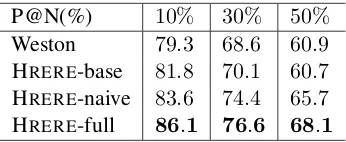
P@N(%) 10% 30% 50%
Weston 79.3 68.6 60.9
HRERE-base 81.8 70.1 60.7
HRERE-naive 83.6 74.4 65.7
HRERE-full 86.1 76.6 68.1
Table 2: P@N ofWestonand variants of our proposed framework.
Methods Evaluated. We study three variants of our framework: (1) HRERE-base: basic neural model with local lossJLonly; (2) HRERE-naive: neural model with both local loss JL and global loss JG but without the dissimilarities JD; (3) HRERE-full: neural model with both local and global loss along with their dissimilarities. We compare against two previous state-of-the-art neu-ral models, CNN+ATT and PCNN+ATT (Lin et al.,2016). We also implement a baseline We-stonbased on the strategy followingWeston et al.
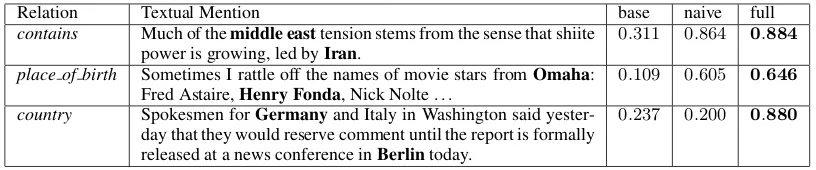
[image:4.595.314.519.249.403.2] [image:4.595.330.503.471.542.2]Relation Textual Mention base naive full contains Much of themiddle easttension stems from the sense that shiite
power is growing, led byIran.
0.311 0.864 0.884
place of birth Sometimes I rattle off the names of movie stars fromOmaha: Fred Astaire,Henry Fonda, Nick Nolte . . .
0.109 0.605 0.646
country Spokesmen forGermanyand Italy in Washington said yester-day that they would reserve comment until the report is formally released at a news conference inBerlintoday.
[image:5.595.95.503.61.146.2]0.237 0.200 0.880
Table 3: Some examples in NYT corpus and the predicted probabilities of the true relations.
with the methods stated in this paper directly with-out joint learning.
Analysis. Figure 2 shows the Precision/Recall curves for all the above methods. As one can see, HRERE-base significantly outperforms pre-vious state-of-the-art neural models and Weston
over the entire range of recall. However, HRERE -base performs worst compared to all other vari-ants, while HRERE-full always performs best as shown in Figure2and Table2. This suggests that introducing knowledge representation consistently results in improvements, which validates our mo-tivating hypothesis. HRERE-naive simply opti-mizes both local and global loss at the same time without attempting to connect them. We can see that HRERE-full is not only consistently superior but also more stable than HRERE-naivewhen the recall is less than 0.1. One possible reason for the instability is that the results may be dominated by one of the representations and biased toward it. This suggests that (1) jointly learning the het-erogeneous representations bring mutual benefits which are out of reach of previous methods that learn each independently; (2) connecting hetero-geneous representations can increase the robust-ness of the framework.
Case Study. Table3shows two examples in the testing data. For each example, we show the re-lation, the sentence along with entity mentions and the corresponding probabilities predicted by HRERE-baseand HRERE-full. The entity pairs in the sentence are highlighted with bold formatting. From the table, we have the following observa-tions: (1) The predicted probabilities of three vari-ants of our model in the table match the observa-tions and corroborate our analysis. (2) From the text of the two sentences, we can easily infer that
middle east contains Iran and Henry Fonda was born in Omaha. However, HRERE-base fails to detect these relations, suggesting that it is hard for models based on language representations alone
to detect implicit relations, which is reasonable to expect. With the help of KBE, the model can ef-fectively identify implicit relations present in the text. (3) It may happen that the relation cannot be inferred by the text as shown in the last example. It’s a common wrong labeled case caused by dis-tant supervision. It is a case of an incorrectly la-beled instance, a typical occurrence in distant su-pervision. However, the fact is obviously true in the KBs. As a result, HRERE-full gives the un-derlying relation according to the KBs. This ob-servation may point to one direction of de-noising weakly labeled textual mentions generated by dis-tant supervision.
6 Conclusion
This paper describes an elegant neural framework for jointly learning heterogeneous representations from text and from facts in an existing knowledge base. Contrary to previous work that learn the two disparate representations independently and use simple schemes to integrate predictions from each model, we introduce a novel framework using an elegant loss function that allows the proper con-nection between the the heterogeneous represen-tations to be learned seamlessly during training. Experimental results demonstrate that the pro-posed framework outperforms previous strategies to combine heterogeneous representations and the state-of-the-art for the RE task. A closer inspec-tion of our results show that our framework en-ables both independent models to enhance each other.
Acknowledgments
References
Antoine Bordes, Nicolas Usunier, Alberto Garcia-Duran, Jason Weston, and Oksana Yakhnenko. 2013. Translating embeddings for modeling multi-relational data. In Advances in neural information processing systems, pages 2787–2795.
Xu Han, Zhiyuan Liu, and Maosong Sun. 2018. Neural knowledge acquisition via mutual attention between knowledge graph and text. InThirty-Second AAAI Conference on Artificial Intelligence.
Diederik Kingma and Jimmy Ba. 2014. Adam: A method for stochastic optimization. arXiv preprint arXiv:1412.6980.
Yankai Lin, Shiqi Shen, Zhiyuan Liu, Huanbo Luan, and Maosong Sun. 2016. Neural relation extraction with selective attention over instances. InACL.
Mike Mintz, Steven Bills, Rion Snow, and Dan Juraf-sky. 2009. Distant supervision for relation extrac-tion without labeled data. In Proceedings of the Joint Conference of the 47th Annual Meeting of the ACL and the 4th International Joint Conference on Natural Language Processing of the AFNLP: Vol-ume 2-VolVol-ume 2, pages 1003–1011. Association for Computational Linguistics.
Jeffrey Pennington, Richard Socher, and Christopher Manning. 2014. Glove: Global vectors for word representation. InProceedings of the 2014 confer-ence on empirical methods in natural language pro-cessing (EMNLP), pages 1532–1543.
Sebastian Riedel, Limin Yao, and Andrew McCallum. 2010. Modeling relations and their mentions with-out labeled text. Machine learning and knowledge discovery in databases, pages 148–163.
Daniil Sorokin and Iryna Gurevych. 2017. Context-aware representations for knowledge base relation extraction. InProceedings of the 2017 Conference on Empirical Methods in Natural Language Pro-cessing, pages 1784–1789.
Th´eo Trouillon, Johannes Welbl, Sebastian Riedel, ´Eric Gaussier, and Guillaume Bouchard. 2016. Com-plex embeddings for simple link prediction. In In-ternational Conference on Machine Learning, pages 2071–2080.
Shikhar Vashishth, Rishabh Joshi, Sai Suman Prayaga, Chiranjib Bhattacharyya, and Partha Talukdar. 2018. Reside: Improving distantly-supervised neural re-lation extraction using side information. arXiv preprint arXiv:1812.04361.
Jason Weston, Antoine Bordes, Oksana Yakhnenko, and Nicolas Usunier. 2013. Connecting language and knowledge bases with embedding models for re-lation extraction. arXiv preprint arXiv:1307.7973.
Yi Wu, David Bamman, and Stuart Russell. 2017. Ad-versarial training for relation extraction. In Proceed-ings of the 2017 Conference on Empirical Methods in Natural Language Processing, pages 1779–1784.
Peng Xu and Denilson Barbosa. 2018. Investi-gations on knowledge base embedding for rela-tion predicrela-tion and extracrela-tion. arXiv preprint arXiv:1802.02114.
Bishan Yang, Wen-tau Yih, Xiaodong He, Jianfeng Gao, and Li Deng. 2014. Embedding entities and relations for learning and inference in knowledge bases. arXiv preprint arXiv:1412.6575.
Daojian Zeng, Kang Liu, Yubo Chen, and Jun Zhao. 2015. Distant supervision for relation extraction via piecewise convolutional neural networks. InEmnlp, pages 1753–1762.
Daojian Zeng, Kang Liu, Siwei Lai, Guangyou Zhou, Jun Zhao, et al. 2014. Relation classification via convolutional deep neural network. In COLING, pages 2335–2344.