666
Deep Structured Neural Network for Event Temporal Relation Extraction
Rujun Han∗, I-Hung Hsu∗, Mu Yang
{rujunhan, ihunghsu, yangmu} @isi.edu
Aram Galstyan, Ralph Weischedel, Nanyun Peng
{galstyan, weisched, npeng} @isi.edu
Information Sciences Institute, University of Southern California
Abstract
We propose a novel deep structured learning framework for event temporal relation extrac-tion. The model consists of 1) a recurrent neural network (RNN) to learn scoring func-tions for pair-wise relafunc-tions, and 2) a struc-tured support vector machine (SSVM) to make joint predictions. The neural network automat-ically learns representations that account for long-term contexts to provide robust features for the structured model, while the SSVM in-corporates domain knowledge such as tran-sitive closure of temporal relations as con-straints to make better globally consistent de-cisions. By jointly training the two com-ponents, our model combines the benefits of both data-driven learning and knowledge ex-ploitation. Experimental results on three high-quality event temporal relation datasets (TCR, MATRES, and TB-Dense) demonstrate that incorporated with pre-trained contextualized embeddings, the proposed model achieves sig-nificantly better performances than the state-of-the-art methods on all three datasets. We also provide thorough ablation studies to in-vestigate our model.
1 Introduction
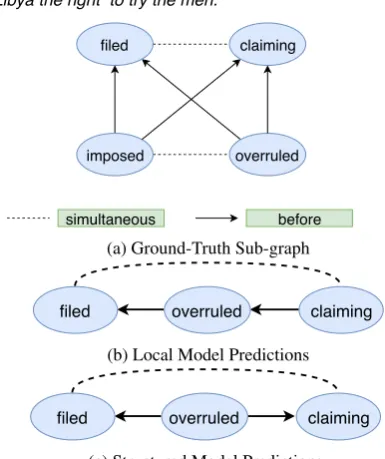
Event temporal relation extraction aims at building a graph where nodes correspond to events within a given text, and edges reflect temporal relations be-tween the events. Figure1aillustrates an example of such graph for the text shown above. Different types of edges specify different temporal relations: the eventfiledisSIMULTANEOUSwithclaiming,
overruledisBEFOREclaiming, andoverruledis
alsoBEFOREfiled. Temporal relation extraction is beneficial for many downstream tasks such as question answering, information retrieval, and nat-ural language generation. An event graph can
po-∗
The authors contribute equally, alphabetical order.
filed
imposed overruled claiming
simultaneous before
Both U.S. and British officials filed objections to the court's jurisdiction in 1995, claiming Security Council resolutions imposed on Lybia to force the suspects' extradition overruled a 1971 Convention which gives Libya the right to try the men.
(a) Ground-Truth Sub-graph
filed overruled claiming
(b) Local Model Predictions
filed overruled claiming
[image:1.595.312.505.284.514.2](c) Structured Model Predictions
Figure 1: An illustration of a paragraph with its partial temporal graph. (a) shows the Ground-Truth tempo-ral graph, in which case tempotempo-ral relation SIMULTA-NEOUS andBEFORE are presented. (b) and (c) are the local and structured predictions, respectively, for three of the event pairs in (a). Local predictions are in-compatible with temporal transitivity rule: overruled has to beBEFOREclaimingifoverruledisBEFORE
filedandfiledisSIMULTANEOUSwithclaiming. The structured model achieves coherence by reversing the temporal order betweenclaimingandoverruled.
tentially be leveraged to help time-series forecast-ing and provide guidances for natural language generation. The CaTeRs dataset (Mostafazadeh et al.,2016) which annotates temporal and causal relations is constructed for this purpose.
predictionproblem. Although a relation graph can be decomposed into individual relations on each event pair, any local model that is not informed by the whole event graph will usually fail to make globally consistent predictions, thus degrading the overall performance. Figure 1b gives an exam-ple where the local model classifies the relation betweenoverruledandclaimingincorrectly as it only considers pairwise predictions: graph tempo-ral transitivity constraint is violated given the rela-tion betweenfiledandclaimingis SIMULTANE-OUS. In Figure1c, the structured modelchanges the prediction of relation between overruledand
claimingfromAFTERtoBEFOREto ensure
com-patibility of all predicted edge types.
Prior works on event temporal relation extrac-tion mostly formulate it as a pairwise classifi-cation problem (Bethard, 2013; Laokulrat et al.,
2013; Chambers, 2013; Chambers et al., 2014) disregarding the global structures. Bramsen et al.
(2006a);Chambers and Jurafsky(2008);Do et al.
(2012); Ning et al. (2018b,a) explore leveraging globalinferenceto ensure consistency for all pair-wise predictions. There are a few prior works that directly model global structure in the train-ing process (Yoshikawa et al., 2009;Ning et al.,
2017; Leeuwenberg and Moens, 2017). How-ever, these structured models rely on hand-crafted features using linguistic rules and local-context, which cannot adequately capture potential long-term dependencies between events. In the exam-ple shown in Figure1,filedoccurs in much earlier context thanoverruled. Thus, incorporating long-term contextual information can be critical for cor-rectly predicting temporal relations.
In this paper, we propose a novel deep struc-tured learning model to address the shortcomings of the previous methods. Specifically, we adapt the structured support vector machine (SSVM) (Finley and Joachims, 2008) to incorporate lin-guistic constraints and domain knowledge for making joint predictions on events temporal rela-tions. Furthermore, we augment this framework with recurrent neural networks (RNNs) to learn long-term contexts. Despite the recent success of employing neural network models for event tem-poral relation extraction (Tourille et al., 2017a;
Cheng and Miyao,2017;Meng et al.,2017;Meng and Rumshisky, 2018), these systems make pair-wise predictions, and do not take advantage of problem structures.
We develop a joint end-to-endtrainingscheme that enables the feedback from global structure to directly guide neural networks to learn representa-tions, and hence allows our deep structured model to combine the benefits of both data-driven learn-ing and knowledge exploitation. In the ablation study, we further demonstrate the importance of each global constraints, the influence of linguis-tic features, as well as the usage of contextualized word representations in the local model.
To summarize, our main contributions are:
• We propose a deep SSVM model for event temporal relation extraction.
• We show strong empirical results and estab-lish new state-of-the-art for three event rela-tion benchmark datasets.
• Extensive ablation studies and thorough error analysis are conducted to understand the ca-pacity and limitations of the proposed model, which provide insights for future research on temporal relation extraction.
2 Related Work
Temporal Relation Data. Temporal relation
corpora such as TimeBank (Pustejovsky et al.,
2003) and RED (O’Gorman et al.,2016) facilitate the research in temporal relation extraction. The common issue in these corpora is missing anno-tation. Collecting densely annotated temporal re-lation corpora with all event pairs fully annotated has been reported to be a challenging task as an-notators could easily overlook some pairs (Cassidy et al.,2014;Bethard et al.,2007;Chambers et al.,
2014). TB-Dense dataset mitigates this issue by forcing annotators to examine all pairs of events within the same or neighboring sentences. Recent data construction efforts such as MATRES (Ning et al., 2018a) and TCR (Ning et al., 2018b) fur-ther enhance the data quality by using a multi-axis annotation scheme and adopting start-point of events to improve inter-annotator agreements. However, densely annotated datasets are relatively small both in terms of number of documents and event pairs, which restricts the complexity of ma-chine learning models used in previous research.
Event Temporal Relation Extraction The
se-ries of TempEval competitions (Verhagen et al.,
Verha-gen et al., 2007; Chambers et al., 2007; Verha-gen and Pustejovsky, 2008) only use local pair-wise classification with hand-engineered features. Later efforts, such as ClearTK (Bethard, 2013), UTTime (Laokulrat et al., 2013), and NavyTime (Chambers,2013) improve earlier work by feature engineering with linguistic and syntactic rules. A noteworthy work, CAEVO (Chambers et al.,
2014), builds a pipeline with ordered sieves. Each sieve is either a rule-based classifier or a machine learning model; sieves are sorted by precision, i.e. decisions from a lower precision classifier cannot contradict those from a higher precision model.
More recently, neural network-based methods have been employed for event temporal rela-tion extracrela-tion (Tourille et al., 2017a;Cheng and Miyao,2017;Meng et al.,2017;Han et al.,2019a) which achieved impressive results. However, they all treat the task as a pairwise classification prob-lem. Meng and Rumshisky(2018) considered in-corporating global context for pairwise relation predictions, but they do not explicitly model the outputgraph structure for event temporal relation. There are a few prior works exploring struc-tured learning for temporal relation extrac-tion (Yoshikawa et al., 2009; Ning et al., 2017;
Leeuwenberg and Moens, 2017). However, their local models use hand-engineered linguistic fea-tures. Despite the effectiveness of hand-crafted features in previous research, the design of fea-tures usually fails to capture long-term context in the discourse. Therefore, we propose to enhance the hand-crafted features with contextual repre-sentations learned through RNN models and de-velop an integrated joint training process.
3 Methods
We adapt the notations from Ning et al.(2018a), whereRdenotes the set of all possible relations;
Edenotes the set of all event entities.
3.1 Deep SSVM
Our deep SSVM model adapts the SSVM loss as
L=
l
X
n=1
1 Mn
max 0,∆(yn,yˆn) + (1)
S(ˆyn;xn)−S(yn;xn)
+C||Φ||2
,
where Φ denotes model parameters, n indexes instances, Mn is the number of event pairs in instance n. yn,yˆn denote the gold and pre-dicted global assignments for instancen, each of
, , , , . . . , , . . . , , . . . ,
,1 ,2 ,3 ,4 , , ,
, , , , . . . , , . . . , , . . . ,
,1 ,2 ,3 ,4 , , ,
1 2 3 4 ... ... ... 1 2 3 4 ... ... ...
Linear Layer
Input Representations
... ... ... ...
1
BiLSTM Layers BiLSTM Output Scoring Layer
[image:3.595.306.525.63.231.2]SSVM
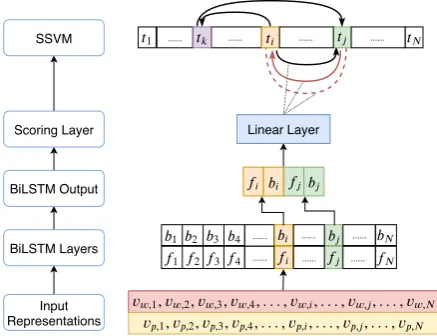
Figure 2: An overview of the proposed deep structured event relation extraction framework. The input repre-sentations consist of BERT reprerepre-sentations (vw,k) and
POS tag embeddings (vp,k). They are concatenated to
pass through BiLSTM layers and classification layers to get pairwise local scores. Incompatible local pair-wise prediction (denoted by red lines) is corrected by the SSVM layer. Edge notation follows Figure1 and
t1, ...tN denote tokens in the input sentence.
which consists ofMnone hot vectorsyni,j,yˆni,j ∈ {0,1}|R| representing true and predicted relation labels for event pairi, jrespectively. ∆(yn,yˆn)is a distance measurement between the gold and the predicted assignments; we simply use hamming distance. C is a hyper-parameter to balance the loss and the regularizer, and S(yn;xn) is a pair-wise scoring function to be learned.
The intuition behind the SSVM loss is that it requires the score of gold output structure yn to be greater than the score of the best output struc-ture under the current model yˆn with a margin ∆(yn,yˆn)1, or else there will be some loss.
The major difference between our deep SSVM and the traditional SSVM model is the scoring function. Traditional SSVM uses a linear function over hand-crafted features to compute the scores, whereas we propose to use a RNN for estimation.
3.2 RNN-Based Scoring Function
We introduce a RNN-based pair-wise scoring function to learn features in a data-driven way and capture long-term context in the input. The lo-cal neural architecture is inspired by prior work in entity relation extraction such as Tourille et al. (2017b). As shown in Figure 2, the input layer consists of word representations and
part-of-1Note that if the best prediction is the same as the gold
speech (POS) tag embeddings of each token in the input sentence, denoted as vw,k and vp,k respec-tively.2 The word representations are obtained via pre-trained BERT (Devlin et al.,2018)3model and are fixed throughout training, while the POS tag embeddings are tuned. The word and POS tag embeddings are concatenated to represent an in-put token, and then fed into a Bi-LSTM layer to get contextualized representations.
We assume the events are labeled in the text and use indices i and j to denote the tokens associ-ated with an event pair (i, j) ∈ EE in the input sentences of length N. For each event pair (i, j), we take the forward and backward hidden vectors corresponding to each event, namelyfi, bi, fj, bj to encode the event tokens. These hidden vectors are then concatenated to form the input to the final linear layer to produce a softmax distribution over all possible pair-wise relations, which we refer to as RNN-basedscoring function.
3.3 Inference
The inference is needed both during training to ob-tainyˆn in the loss function (Equation1), as well as during the test time to get globally compatible assignments. The inference framework is estab-lished by constructing a global objective function using scores from local model and imposing sev-eral global constraints: symmetry and transitivity as in Bramsen et al. (2006b); Chambers and Ju-rafsky(2008);Denis and Muller(2011);Do et al.
(2012);Ning et al.(2017);Han et al. (2019b), as well as linguistic rules and temporal-causal con-straints proposed byNing et al.(2018a) to ensure global consistency. In this work, we incorporate
thesymmetry,transitivity, andtemporal-causal
constraints.
Objective Function. The objective function of
the global inference maximizes the score of global assignments as specified in Equation24.
ˆ
y= arg max X
(i,j)∈EE
X
r∈R yi,jr S(y
r
i,j;x) (2)
s.t.yri,j∈ {0,1},
X
r∈R
yri,j= 1,
2
Following the convention of event relation prediction lit-erature (Chambers et al.,2014;Ning et al.,2018a,b), we only consider event pairs that occur in the same or neighboring sentences, but the architecture can be easily adapted to the case where inputs are longer than two sentences.
3
We use pre-trained bert-base-uncased model from https://github.com/huggingface/pytorch-transformers.
4The objective function is specified on the instance level.
where yri,j is a binary indicator specifying if the global prediction is equal to a certain labelr ∈ R
andS(yi,jr ,x),∀r ∈ Ris the scoring function ob-tained from the local model. The output of the global inferenceyˆis a collection of optimal label assignments for all event pairs in a fixed context. The constraint following immediately from the ob-jective function is that the global inference should only assign one label to each pair of sample inputs.
Symmetry and Transitivity constraint. The
symmetry and transitivity constraints are used across all models and experiments in the paper. They can be specified as follows:
∀(i, j),(j, k)∈ EE, yi,jr =y
¯
r
j,i, (symmetry)
yr1
i,j+y r2
j,k−
X
r3∈T rans(r1,r2)
yr3
i,k≤1.(transitivity)
Intuitively, the symmetry constraint forces two pairs with opposite order to have reversed rela-tions. For example, ifri,j =BEFORE, thenrj,i= AFTER. Transitivity constraint rules that if (i, j), (j, k) and (i, k) pairs exist in the graph, the label (relation) prediction of (i, k) pair has to fall into the transitivity set specifying by (i, j) and (j, k) pairs. The full transitivity table can be found in
Ning et al.(2018a).
Temporal-causal Constraint. The
temporal-causal constraint is used for the TCR dataset which is the only dataset in our experiments that contains causal pairs and it can written as:
yi,jc =y¯cj,i≤yi,jb , ∀(i, j)∈ EE,
where c and¯ccorrespond to the labelCAUSESand CAUSED BY, and b represents the labelBEFORE. This constraint specifies that if event i causes event j, then i has to occur before j. Note that this con-straint only has 91.9% accuracy in TCR data (Ning et al.,2018a), but it can help improve model per-formance based on our experiments.
3.4 Learning
TB-Dense MATRES TCR
# of Documents
Train 22 22 20
Dev 5 5 0
Test 9 9 5
# of Pairs
Train 4032 1098 1992
Dev 629 229 0
[image:5.595.315.517.61.158.2]Test 1427 310 1008
Table 1: Data Overview
re-optimize the network to adjust for global prop-erties5. We denote the local scoring model in the first stage as local model, and the final model as global model in the following sections.
4 Experimental Setup
In this section, we describe the three datasets that are used in the paper. Then we define the evalua-tion metrics. Finally, we provide details regarding our model implementation and experiments.
4.1 Data
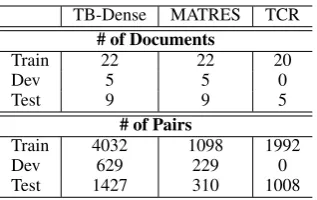
Experiments are conducted on TB-Dense, MA-TRES and TCR datasets and an overview of data statistics are shown in Table1. We focus on event relation, thus, all numbers refer toEEpairs6. Note that in all three datasets, event pairs are always an-notated by their appearance order in text, i.e. given a labeled event pair (i,j), event ialways appears prior to eventjin the text. FollowingMeng et al.
(2017), we augment event pairs with flipped-order pairs. That is, if a pair (i, j) exists, pair (j, i) is also added to our dataset with the opposite label. The augmentation is applied to training and devel-opment split, but test set remains unaugmented7.
TB-Dense (Cassidy et al., 2014) is based on
TimeBank Corpus but addresses the sparse-annotation issue in the original data by introduc-ing the VAGUE label and requiring annotators to label all pairs of events/times in a given window.
MATRES (Ning et al.,2018b) is based on
TB-Dense data, but filters out non-verbal events. The authors project events on multiple axes and only keep those in the main-axis. These two factors ex-plain the large decrease of event pairs in Table1.
5
We experiment with optimizing SSVM loss directly, but model performance degrades significantly. We leave further investigation for future work.
6For TCR, we also include causal pairs in the table. 7It is noted that if symmetric constraint is applied, scores
for testing on augmented or unaugmented set are equal.
TB-Dense MATRES TCR
Local Model
hid size 60 40 30
dropout 0.5 0.7 0.5
BiLSTM layers 1 2 1
learning rate 0.002 0.002 0.002
Structured Learning
learning rate 0.05 0.08 0.08
decay 0.7 0.7 0.9
Table 2: Best hyper-parameters
Start-point temporal scheme is adopted when out-sourcing the annotation task, which contributes to the performance improvement of machine learn-ing models built on this dataset .
TCR (Ning et al.,2018a) follows the same an-notation scheme for temporal pairs in MATRES. It is also annotated with causal pairs. To get causal pairs, the authors select candidates based on EventCausality dataset (Do et al.,2011).
4.2 Evaluation Metrics
To be consistent with the evaluation metrics used in baseline models, we adopt two slightly different calculations of metrics.
Micro-average For all datasets, we compute the
micro-average scores. For densely annotated data, the micro-average metric should share the same precision, recall and F1 scores. However, since VAGUE pairs are excluded in the micro-average calculations of TCR and MATRES for fair com-parisons with the baseline models, the micro-average for precision, recall and F1 scores are dif-ferent when reporting results for the two datasets.
Temporal Awareness (TE3) For TB-Dense
dataset, TE3 evaluation scheme (UzZaman et al.,
2013) is also adopted in previous research (Ning et al., 2017, 2018a). TE3 score not only takes into account of the number of correct pairs but also capture how “useful” a temporal graph is. We report this score for TB-Dense results only. For more details of this metric, please refer to the orig-inal paper (UzZaman et al.,2013).
4.3 Implementation Details
Since our work focuses on event relations, we build our models to predict relations betweenEE
[image:5.595.103.262.63.163.2]Results Overview
5 SOTA for TCR: Ning et. al. ACL 2018a.
SOTA for MATRES: Ning et. al. ACL 2018b. SOTA for TB-Dense: Meng and Rumshisky. ACL 2018.
71.1 69
57 79.7 80.3
62.6 80.9 81.7
63.2
40 45 50 55 60 65 70 75 80 85
TCR MATRES TBDense
Mic
ro
-a
ver
ag
e
F1
(%)
[image:6.595.313.522.61.148.2]Current SOTA Our Local Our Global
Figure 3: Model Performance (F1 Score) Overview. Our local and global models’ performances are aver-aged over 3 different random seeds for robustness.
generally easier to predict using rule-based clas-sifiers or date normalization technique (Do et al.,
2012;Chambers et al., 2014; Mirza and Tonelli,
2016). To be consistent with the baseline models (Ning et al.,2018a,b) for TB-Dense data, we add
ET andT T pairs for TE3 evaluation metric8. In the two-stage learning procedure, the local model is trained by minimizing cross-entropy loss with Adam optimizer. We use pre-trained BERT embedding with 768 dimensions as the input word representations and one-layer MLP as the classifi-cation layer. As for the structured learning stage, we observe performance boost by switching from Adam optimizer to SGD optimizer with decay and momentum9. To solve ILP in the inference process specified in Section3.3, we leverage off-the-shelf solver provided by Gurobi optimizer, i.e. the best solutions from the Gurobi optimizer are inputs to the global training.
The hyper-parameters are chosen by the perfor-mance on the development set10, and the best com-bination of hyper-parameters can be found in Ta-ble2. We run experiments on 3 different random seeds and report the average results.
Note that for TCR data, we need a separate classifier for causal relations. Because of small amount of causal pairs, we simply build an inde-pendent final linear layer apart from the original linear layer in Figure2. In other words, there are two final linear layers: only one of them is active when training temporal or causal pairs.
5 Results and Analysis
Figure3shows an overview of our model perfor-mance on three different datasets. As the chart
8
We rely on annotated data to distinguish different pair types, i.e.EE,ET andT T are assumed to be given.
9
The weight decay in SGD is exactly the valueCin Equa-tion1. We set the momentum in SGD as 0.9 in all datasets.
10We randomly select 4 documents from the training set as
development set for TCR.
Local Model Global Model
P R F1 P R F1
Before 82.1 86.9 84.3 81.3 90.0 85.4
After 67.1 73.2 69.7 70.9 70.9 70.9
Simultaneous 0.0 0.0 0.0 0.0 0.0 0.0
Vague 0.0 0.0 0.0 0.0 0.0 0.0
Micro-average 77.1 82.5 79.7 78.2 83.9 80.9**
[image:6.595.74.291.69.151.2]Ning et al.(2018a) 71.1
Table 3: Model Performance Breakdown for TCR. To make fair comparison, we exclude VAGUE pairs in Micro-average score, which is why P, R and F1 are different. **indicates global model outperforms local model with p-value<0.01per McNemar’s test.
Local Model Global Model
P R F1 P R F1
Before 79.7 88.1 83.6 80.1 89.6 84.6
After 70.5 83.3 76.3 72.3 84.8 78.0
Simultaneous 0.0 0.0 0.0 0.0 0.0 0.0
Vague 0.0 0.0 0.0 0.0 0.0 0.0
Micro-average 76.2 84.9 80.3 77.4 86.4 81.7*
Ning et al.(2018b) 69
Table 4: Model Performance Breakdown for MATRES. Again, we exclude VAGUE pairs in Micro-average score. * indicates global model outperforms local model with p-value<0.05per McNemar’s test.
illustrates, our RNN-based local models outper-form state-of-the-art (SOTA) results and the global models further improve the performance over lo-cal models across all three datasets.
5.1 TCR
Detailed model performances for the TCR dataset are shown in Table3. We only report model per-formance on temporal pairs. Both of our local and global models outperform the baseline. Our global model is able to improve overall model perfor-mance by more than 1.2% over our local model; per McNemar’s test, this improvement is statisti-cally significant (with p-value<0.01).
5.2 MATRES
Detailed model performances for the MATRES dataset performances can be found in Table 4. Similar to TCR, both our local and structured models outperform this baseline and the global model is able to improve overall model perfor-mance by 1.4%; per McNemar’s test, this im-provement is statistically significant (with p-value <0.05).
5.3 TB-Dense
[image:6.595.311.522.227.315.2]Local Model Global Model
P R F1 P R F1
Before 73.5 52.7 61.3 71.1 58.9 64.4 After 71.6 60.8 65.3 75.0 55.6 63.5 Includes 17.5 4.8 7.4 24.6 4.2 6.9 Is Include 69.1 4.4 8.0 57.9 5.7 10.2 Simultaneous 0.0 0.0 0.0 0.0 0.0 0.0 Vague 57.9 81.5 67.7 58.3 81.2 67.8
Micro-average 62.6 63.2
Chambers et al.(2014) 49.4
Cheng and Miyao(2017) 52.9
Meng and Rumshisky(2018) 57.0 TE3 Metrics
EEonly 62.1 61.9 62.2 62.7 58.9 62.5
+ET,T T 58.6 63.6 61.0 59.0 64.0 61.4
[image:7.595.75.291.60.226.2]Ning et al.(2018a) 52.1
Table 5: Model Performance Breakdown for TB-Dense (all values are percentage). Upper Table: for event pairs only, we adopt standard Micro-average score. Lower Table: TE3 refers to the temporal awareness score adopted by TE-3 Workshop. To make fair com-parison withNing et al.(2018a), we add CEAVO pre-dictions onET andT T pairs back into the calculation.
global model by adopting the two-stage structured learning method in TB-Dense dataset. Both our local and global models are able to outperform previous SOTA in micro-average metric (reported byMeng and Rumshisky(2018)) or in TE3 metric (results fromNing et al.(2018a)).
Per McNemar’s test, the improvements from lo-cal to global model only has p-value= 0.126, so we are not able to conclude that the improvement is statistically significant. We think one of the rea-sons is the large share of VAGUE pairs (42.6%). VAGUE pairs make our transitivity rules less con-clusive. For example, ifR(e1, e2)= BEFORE and
R(e2, e3)= VAGUE,R(e1, e3)can be any rela-tion types. Moreover, this impact is magnified by our local model’s prediction bias towards VAGUE pairs. As we can see in Table 5, the recall score for VAGUE pairs are much higher than other re-lation types, whereas precision score is moderate. Our global model leverages local output structure to enforce global prediction consistency, but when local predictions contain many VAGUE pairs, it introduces lots of noise too.
To make fair comparison between our model and the best reported TE3 F1 score from Ning et al. (2018a), we follow their strategy and add CAEVO system’s predictions on T T and ET
pairs in the evaluation. The scores are shown in Table5. Our overall system outperforms the base-line over 10% for both micro-average and TE3 F1 scores.
5.4 Error Analysis
To understand why both the local and structured models make mistakes, we randomly sample 50 pairs from 345 cases where both models’ pre-dictions are incorrect among all 3 random seeds. We analyze these pairs qualitatively and catego-rize them into four cases as shown in Table6, with each case (except other) paired with an example.
The first case illustrates that correct prediction requires broader contextual knowledge. For ex-ample, the gold label fortransition anddiscuss
isBEFORE, where the nominal event transition
refers to a specific era in history that ends before
discuss in the second sentence. Human
annota-tors can easily infer this relation based on their knowledge in history, but it is difficult for ma-chines without prior knowledge. We observe this as a very common mistake especially for pairs with nominal events. As for the second case shows that negation can completely change the temporal order. The gold label for the event pairplanned
and plans is AFTER because the negation token
nopostpones the eventplannedindefinitely. Our models do not pick up this signal and hence pre-dict the relation asVAGUE.
Finally, “intention” events could make temporal relation prediction difficult (Ning et al., 2018b). Case 3 demonstrates that our models could ignore the “intention” tokens such as aimed at in the example and hence make an incorrect prediction VAGUE between doubling and signed, whereas the true label is AFTER because doubling is an intention that has not occurred.
6 Ablation Studies
Although we have presented strong empirical re-sults, the isolated contribution of each component of our model has not been investigated. In this section, we perform a though ablation study to un-derstand the importance of structured constraints, linguistic features, and the BERT representations.
6.1 Effect of the structured constraints
One of our core claims is that our learning ben-efits from modeling the structural constraints of event temporal graph. To study the contribution of structured constraints, we provide an ablation study on two constraints that are applied to all three datasets: Symmetry and Transitivity.
Case 1 (32%):Connection with broader context The program also calls for coordination of economic reforms and joint improvement of social programs in the two countries, where many people have become impoverished during the chaotic post - Soviettransition to capitalism. Kuchma also planned to visit Russian gas giant Gazprom, most likely todiscussUkraine’s DLRS 1.2 billion debt to the company.
Case 2 (20%):Negation
Annan hasnotripplannedso far. Meanwhile, Secretary of State Madeleine Albright, Berger and Defense Secretary William Cohen announcedplansto travel to an unnamed city in the us heartland next week, to explain to the American people just why military force will be necessary if diplomacy fails. Case 3 (14%):Intention Axis
A major goal of Kuchma’s four - day state visit was the signing of a 10-year economic programaimed at doublingthe two nations’ trade turnover, which fell to DLRS 14 billion last year, down DLRS 2.5 billion from 1996. The two presidents on Fridaysignedthe plan, which calls for cooperation in the metallurgy, fuel, energy, aircraft building, missile, space and chemical industries.
[image:8.595.310.526.61.174.2]Case 4: (34%)Other
Table 6: Error Categories and Examples in TB-Dense
step. However, even though we eliminate symmet-ric constraint explicitly in global inference, it is utilized implicitly in our data augmentation steps (Section 4.1). To better understand the benefits of the symmetry constraints, we study both the contribution ofexplicitlyapplying symmetry con-straint in our SSVM as well as itsimplicitimpact in data augmentation.
Hence, in this section, we view a pair with original order and flipped order as different in-stances for learning and evaluation. We denote the pairs with original order as “forward” data, their flipped-order counterparts as “backward” data, and their combinations as “both-way” data.
We train four additional models to study the impacts of symmetry and transitivity constraints: 1) local model trained on forward data; 2) global model with transitivity constraint trained on for-ward data; 3) local model trained on both-way data; 4) global model with transitivity constraint trained on both-way data, denoted asM1,M2,M3, M4 respectively. M1 andM2 are models that do not apply any symmetric property;M3andM4are models that utilize symmetric property implicitly.
Additionally, evaluation setup should be re-scrutinized if we remove the symmetry con-straints. In the standard evaluation setup of prior works, evaluation is only performed on the pairs with their original order (forward data) in text. This evaluation assumes a model will work equally well for both forward and backward
TB-Dense Matres TCR
−−→
T est ←−→T est −−→T est ←−→T est −−→T est ←−→T est
M1:
− →
L 62.9 61.9 80.4 74.7 80.5 75.7
M2:
− →
L+T 63.2 62.0 81.7 75.7 81.0 76.3
M3:
←→
L 62.6 62.7 80.3 80.4 79.7 79.6
M4:
←→
L +T 63.1 63.0 81.4 81.4 80.3 80.2
←→
L +S+T
(Proposed) 63.2 63.2 81.7 81.7 80.9 80.9
Table 7: Ablation over global constraints: Symmetry and Transitivity. Test is conducted on forward test set and both-way test set, which are denoted as−−→T estand
←−→
T estrespectively. The local models trained on forward data and both-way data are denoted as−→Land←→L. Sym-metry and Transitivity constraints are denoted asSand
T. The results demonstrate that symmetry and transi-tivity constraints both improve model’s performance.
data, which certainly holds when we explicitly impose symmetry constraints. However, as we can observe in the later analysis, this assumption fails when we remove symmetry constraints. To demonstrate the improvement of model robustness over backward data, we propose to test the model on both forward and both-way data. If a model is robust, it should perform well on both scenarios.
We summarize our analysis of the results in Ta-ble7(F1 scores) as follows:
• Impact of Transitivity: By comparing M1 withM2andM3withM4, the consistent im-provements across all three datasets demon-strate the effectiveness of global transitivity constraints.
• Impact of Implicit Symmetry (data augmen-tation): Examining the contrast betweenM1 and M3 as well as M2 and M4, we can see significant improvements in both-way evaluation despite slight performance drops in forward evaluation. These comparisons imply that data augmentation can help im-prove model robustness. Note thatMeng and Rumshisky (2018) leveraged this data aug-mentation trick in their model.
• Impact of Explicit Symmetry: By comparing the proposed model withM4, the consistent improvements across all datasets demonstrate the benefit of using explicit symmetry prop-erty.
[image:8.595.79.288.63.308.2]local- global- local- global-w/ feat. w/ feat. w/o feat. w/o feat.
TB-Dense 62.5 63.0 62.6 63.2
MATRES 81.4 81.7 80.3 81.7
TCR 79.5 80.7 79.7 80.9
Table 8: Ablation study on linguistic feature usage. Additional linguistic features do not lead to significant improvement and even hurt performance in 2 out of 3 datasets. The results show that our proposed frame-work is semantic-rich and capable of avoiding the us-age of additional linguistic feature.
significantly in the both-way evaluation. In contrast, the proposed model achieves strong performances in both test scenarios (best F1 scores except for one), and hence proves the robustness of our proposed method.
6.2 Effect of linguistic features
Previous research establish the success of lever-aging linguistic features in event relation predic-tion. One advantage of leveraging contextualized word embedding is to provide rich semantic rep-resentation and could potentially avoid the usage of extra linguistic features. Here, we study the impact of incorporating linguistic features to our model by using simple features provided in the original datasets: token distance, tense and polar-ity of event entities. These features are concate-nated with the Bi-LSTM hidden states before the linear layer (i.e. fi, bi, fj, bj in Figure2). Ta-ble8shows the F1 scores of our local and global model using or not using linguistic features re-spectively. These additional features likely cause over-fitting and hence do not improve model per-formance across all three datasets we test. This set of experiments show that linguistic features do not improve the predicting power of our current framework.
6.3 Effect of BERT representations
In this section, we explore the impact of con-textualized BERT representations under our deep SSVM framework. We replace BERT represen-tations with the GloVe (Pennington et al., 2014) word embeddings. Table 9 shows the F1 scores of our local model and global model using BERT and GloVe11respectively. BERT improves the per-formance with a significant margin. Besides, even without BERT representations, our RNN-based lo-cal model and the deep structured global model
11For GloVe model, additional linguistic features are used.
previous local- global- local-
global-SOTA Glove Glove BERT BERT
TB-Dense 57.0 56.6 57.0 62.6 63.2
MATRES 69.0 71.8 75.6 80.3 81.7
TCR 71.1 73.5 76.5 79.7 80.9
Table 9: Ablation over word representation: BERT vs GloVe. Although BERT representation largely con-tributes to the performance boost, our proposed frame-work remains strong and outperforms current SOTA approaches when GloVe is used.
still outperform (MATRES and TCR) or are com-parable with (TB-Dense) current SOTA. These re-sults confirm the improvements of our method.
7 Conclusion
In this paper, we propose a novel deep structured model based on SSVM that combines the benefits of structured models’ ability to encode structure knowledge, and data-driven deep neural architec-tures’ ability to learn long-range features. Our ex-perimental results exhibit the effectiveness of this approach for event temporal relation extraction.
One interesting future direction is further lever-aging commonsense knowledge, domain knowl-edge in temporal relation, and linguistics infor-mation to create more robust and comprehensive global constraints for structured learning. An-other direction is to improve feature representa-tions by designing novel neural architectures that better capture negation and hypothetical phrases as discussed in error analysis. We plan to leverage large amount of unannotated corpora to help event temporal relation extraction as well.
Acknowledgments
This work is partially funded by DARPA Con-tracts W911NF-15-1-0543 and an NIH R01 (LM012592). The authors thank the anonymous reviewers for their helpful suggestions and mem-bers from USC PLUS lab for early feedbacks. Any opinions, findings, conclusions, or recommenda-tions expressed here are those of the authors and do not necessarily reflect the view of the sponsors.
References
Steven Bethard, James H. Martin, and Sara Klingen-stein. 2007. Timelines from text: Identification of syntactic temporal relations. InProceedings of the International Conference on Semantic Computing, ICSC ’07, pages 11–18, Washington, DC, USA. IEEE Computer Society.
P. Bramsen, P. Deshpande, Y. K. Lee, and R. Barzilay. 2006a. Inducing temporal graphs. InEMNLP, Syd-ney, Australia.
Philip Bramsen, Pawan Deshpande, Yoong Keok Lee, and Regina Barzilay. 2006b. Inducing temporal graphs. InEMNLP, Sydney, Australia.
Taylor Cassidy, Bill McDowell, Nathanael Chambers, and Steven Bethard. 2014. An annotation frame-work for dense event ordering. InProceedings of the 52nd Annual Meeting of the Association for Compu-tational Linguistics (Volume 2: Short Papers), pages 501–506. Association for Computational Linguis-tics.
Nate Chambers. 2013. Navytime: Event and time or-dering from raw text. InSecond Joint Conference on Lexical and Computational Semantics (*SEM), Volume 2: Proceedings of the Seventh International Workshop on Semantic Evaluation (SemEval 2013), pages 73–77, Atlanta, Georgia, USA. Association for Computational Linguistics.
Nathanael Chambers, Taylor Cassidy, Bill McDowell, and Steven Bethard. 2014. Dense event ordering with a multi-pass architecture. InACL.
Nathanael Chambers and Dan Jurafsky. 2008. Jointly combining implicit constraints improves temporal ordering. InEMNLP, Honolulu, United States.
Nathanael Chambers, Shan Wang, and Dan Juraf-sky. 2007. Classifying temporal relations between events. InProceedings of the 45th Annual Meeting of the ACL on Interactive Poster and Demonstra-tion Sessions, ACL ’07, pages 173–176, Strouds-burg, PA, USA. Association for Computational Lin-guistics.
Fei Cheng and Yusuke Miyao. 2017. Classifying tem-poral relations by bidirectional lstm over depen-dency paths. In Proceedings of the 55th Annual Meeting of the Association for Computational Lin-guistics (Volume 2: Short Papers), volume 2, pages 1–6.
Pascal Denis and Philippe Muller. 2011. Predicting globally-coherent temporal structures from texts via endpoint inference and graph decomposition. In IJ-CAI, Barcelone, Spain.
Jacob Devlin, Ming-Wei Chang, Kenton Lee, and Kristina Toutanova. 2018. Bert: Pre-training of deep bidirectional transformers for language understand-ing.
Quang Xuan Do, Yee Seng Chan, and Dan Roth. 2011. Minimally supervised event causality iden-tification. InProceedings of the Conference on Em-pirical Methods in Natural Language Processing, pages 294–303. Association for Computational Lin-guistics.
Quang Xuan Do, Wei Lu, and Dan Roth. 2012.
Joint inference for event timeline construction. In EMNLP, Jeju, Korea.
Thomas Finley and Thorsten Joachims. 2008.Training structural svms when exact inference is intractable. InProceedings of the 25th International Conference on Machine Learning, ICML ’08, pages 304–311, New York, NY, USA. ACM.
Rujun Han, Mengyue Liang, Bashar Alhafni, and Nanyun Peng. 2019a. Contextualized word em-beddings enhanced event temporal relation ex-traction for story understanding. arXiv preprint arXiv:1904.11942.
Rujun Han, Qiang Ning, and Nanyun Peng. 2019b.
Joint event and temporal relation extraction with shared representations and structured prediction.
Natsuda Laokulrat, Makoto Miwa, Yoshimasa Tsu-ruoka, and Takashi Chikayama. 2013. Uttime: Tem-poral relation classification using deep syntactic fea-tures. In Second Joint Conference on Lexical and Computational Semantics (*SEM), Volume 2: Pro-ceedings of the Seventh International Workshop on Semantic Evaluation (SemEval 2013), pages 88–92, Atlanta, Georgia, USA. Association for Computa-tional Linguistics.
Artuur Leeuwenberg and Marie-Francine Moens. 2017. Structured learning for temporal relation ex-traction from clinical records. InProceedings of the 15th Conference of the European Chapter of the As-sociation for Computational Linguistics: Volume 1, Long Papers, volume 1, pages 1150–1158.
Inderjeet Mani, Marc Verhagen, Ben Wellner, Chong Min Lee, and James Pustejovsky. 2006. Ma-chine learning of temporal relations. InProceedings of the 21st International Conference on Compu-tational Linguistics and the 44th Annual Meeting of the Association for Computational Linguistics, ACL-44, pages 753–760, Stroudsburg, PA, USA. Association for Computational Linguistics.
Yuanliang Meng and Anna Rumshisky. 2018. Context-aware neural model for temporal information extrac-tion. InProceedings of the 56th Annual Meeting of the Association for Computational Linguistics (Vol-ume 1: Long Papers).
Paramita Mirza and Sara Tonelli. 2016. Catena: Causal and temporal relation extraction from natural lan-guage texts. InACL, Osaka, Japan.
Nasrin Mostafazadeh, Nathanael Chambers, Xiaodong He, Devi Parikh, Dhruv Batra, Lucy Vanderwende, Pushmeet Kohli, and James Allen. 2016. A corpus and evaluation framework for deeper understanding of commonsense stories. In NAACL, San Diego, USA.
Qiang Ning, Zhili Feng, and Dan Roth. 2017. A struc-tured learning approach to temporal relation extrac-tion. InEMNLP, Copenhagen, Denmark.
Qiang Ning, Zhili Feng, Hao Wu, and Dan Roth. 2018a. Joint reasoning for temporal and causal rela-tions. InProceedings of the 56th Annual Meeting of the Association for Computational Linguistics (Vol-ume 1: Long Papers), pages 2278–2288. Associa-tion for ComputaAssocia-tional Linguistics.
Qiang Ning, Hao Wu, and Dan Roth. 2018b. A multi-axis annotation scheme for event temporal relations. InACL. Association for Computational Linguistics.
Tim O’Gorman, Kristin Wright-Bettner, and Martha Palmer. 2016. Richer event description: Integrating event coreference with temporal, causal and bridg-ing annotation. InProceedings of 2nd Workshop on Computing News Storylines, pages 47–56. Associa-tion for ComputaAssocia-tional Linguistics.
Jeffrey Pennington, Richard Socher, and Christo-pher D. Manning. 2014. Glove: Global vectors for word representation. InIn EMNLP.
James Pustejovsky, Patrick Hanks, Roser Sauri, An-drew See, Robert Gaizauskas, Andrea Setzer, Dragomir Radev, Beth Sundheim, David Day, and Lisa Ferro. 2003. The timebank corpus. InCorpus linguistics, pages 647–656.
Julien Tourille, Olivier Ferret, Aurelie Neveol, and Xavier Tannier. 2017a. Neural architecture for tem-poral relation extraction: a bi-lstm approach for de-tecting narrative containers. In Proceedings of the 55th Annual Meeting of the Association for Compu-tational Linguistics (Volume 2: Short Papers), vol-ume 2, pages 224–230.
Julien Tourille, Olivier Ferret, Xavier Tannier, and Aur´elie N´ev´eol. 2017b. Limsi-cot at semeval-2017 task 12: Neural architecture for temporal informa-tion extracinforma-tion from clinical narratives. In Proceed-ings of the 11th International Workshop on Semantic Evaluation (SemEval-2017), pages 597–602. Asso-ciation for Computational Linguistics.
Naushad UzZaman, Hector Llorens, Leon Derczyn-ski, James Allen, Marc Verhagen, and James Puste-jovsky. 2013. Semeval-2013 task 1: Tempeval-3: Evaluating time expressions, events, and temporal relations. In Second Joint Conference on Lexical and Computational Semantics (*SEM), Volume 2: Proceedings of the Seventh International Workshop
on Semantic Evaluation (SemEval 2013), pages 1–9. Association for Computational Linguistics.
Marc Verhagen, Robert Gaizauskas, Frank Schilder, Mark Hepple, Graham Katz, and James Pustejovsky. 2007. Semeval-2007 task 15: Tempeval temporal relation identification. InProceedings of the 4th In-ternational Workshop on Semantic Evaluations, Se-mEval ’07, pages 75–80, Stroudsburg, PA, USA. As-sociation for Computational Linguistics.
Marc Verhagen and James Pustejovsky. 2008. Tempo-ral processing with the tarsqi toolkit. In22Nd Inter-national Conference on on Computational Linguis-tics: Demonstration Papers, COLING ’08, pages 189–192, Stroudsburg, PA, USA. Association for Computational Linguistics.
Marc Verhagen, Roser Saur´ı, Tommaso Caselli, and James Pustejovsky. 2010. Semeval-2010 task 13: Tempeval-2. InProceedings of the 5th International Workshop on Semantic Evaluation, SemEval ’10, pages 57–62, Stroudsburg, PA, USA. Association for Computational Linguistics.