3509
Bayesian Learning for Neural Dependency Parsing
Ehsan Shareghi,♣Yingzhen Li,♠ Yi Zhu,♣ Roi Reichart,♢Anna Korhonen♣ ♣Language Technology Lab, DTAL, University of Cambridge
♠Microsoft Research Cambridge,♢Technion, IIT ♣{es776, yz568, alk23}@cam.ac.uk
♠[email protected],♢[email protected]
Abstract
While neural dependency parsers provide state-of-the-art accuracy for several languages, they still rely on large amounts of costly labeled training data. We demonstrate that in the small data regime, where uncertainty around param-eter estimation and model prediction matters the most, Bayesian neural modeling is very ef-fective. In order to overcome the computa-tional and statistical costs of the approximate inference step in this framework, we utilize an efficient sampling procedure via stochastic gradient Langevin dynamics to generate sam-ples from the approximated posterior. More-over, we show that our Bayesian neural parser can be further improved when integrated into a multi-task parsing and POS tagging frame-work, designed to minimize task interference via an adversarial procedure. When trained and tested on 6 languages with less than5𝑘 training instances, our parser consistently out-performs the strong BiLSTM baseline ( Kiper-wasser and Goldberg,2016). Compared with the BiAFFINE parser (Dozat et al., 2017) our model achieves an improvement of up to3% for Vietnamese and Irish, while our multi-task model achieves an improvement of up to9% across five languages: Farsi, Russian, Turkish, Vietnamese, and Irish.
1 Introduction
Dependency parsing is essential for many Natural Language Processing (NLP) tasks (Levy and Gold-berg, 2014;Angeli et al.,2015;Toutanova et al., 2016; Hadiwinoto and Ng, 2017; Marcheggiani et al.,2017). While earlier work on dependency parsing required careful feature engineering ( Mc-Donald et al., 2005b; Koo et al., 2008), this has become less of a concern in recent years with the emergence of deep neural networks (Kiperwasser and Goldberg,2016;Dozat et al.,2017). Nonethe-less, an accurate parser still requires a large amount
of labeled data for training, which is costly to ob-tain, while the lack of data often causes overfitting and poor generalization.
Several approaches for parsing in the small data regime have been proposed. These include augmenting input data with pretrained embed-ding (Dozat et al.,2017;Che et al.,2018), lever-aging unannotated data via semi-supervised learn-ing (Corro and Titov,2018), predicting based on a pool of high probability trees (Niculae et al.,2018; Keith et al.,2018), and transferring annotation or model across languages (Agic et al.,2016;Lacroix et al.,2016;Rasooli and Collins,2017). Despite the empirical success of these approaches, an inherent problem still holds: The maximum likelihood pa-rameter estimation (MLE) in deep neural networks (DNNs) introduces statistical challenges at both estimation (training), due to the risk of overfitting, and at test time as the model ignores the uncertainty around the estimated parameters. When training data is small these challenges are more pronounced.
The Bayesian paradigm provides a statistical framework which addresses both challenges by (i) including prior knowledge to guide the learning in the absence of sufficient data, and (ii) predict-ing under the full posterior distribution of model parameters which offers the desired degree of un-certainty by exploring the posterior space during inference. However, this solution comes with a high computational cost, specifically in DNNs, and is often replaced by regularization techniques such as dropout (Srivastava et al.,2014) as well as ensem-ble learning and prediction averaging (Liu et al., 2018;Che et al.,2018).
prediction tasks such as dependency parsing. In this paper we aim to close this gap and pro-pose the first BNN for dependency parsing (BNNP). To address the costs of inference step, we apply an efficient sampling procedure via stochastic gradi-ent Langevin dynamics (SGLD) (Welling and Teh,
2011). At training, samples from the posterior dis-tribution of the parser parameters are generated via controlled noise injection to the maximum a posteriori (MAP) gradient update. The generated samples are then used during the inference step to create multiple viable parses based on which the final dependency parse is generated.
Another means of directing a model towards more accurate predictions in the small data regime is via multi-task learning (Caruana,1997). Such a framework allows models for multiple tasks to reinforce each other towards more accurate joint solutions, which is particularly useful when train-ing data is scarce. We hence present a multi-task framework where our BNNP is integrated with a POS tagger through an adversarial procedure de-signed to guide the two models towards improved joint solutions.
Our experiments with monolingual and delexi-calized cross-lingual parsing using the Universal Dependency treebank (Zeman et al.,2017) demon-strate the effectiveness of our approach. Particu-larly, our BNNP consistently outperforms the sin-gle task BiLSTMbaseline (Kiperwasser and
Gold-berg, 2016), while outperforming the BiAFFINE
parser (Dozat et al., 2017) by up to 3% on Viet-namese and Irish. Additionally, our multi-task model achieves an improvement of up to9%over theBiAFFINEparser for five low-resource languages: Farsi, Russian, Turkish, Vietnamese, and Irish.
2 BiLSTMDependency Parsing
Our parser extends the graph-based BiLSTMparser ofKiperwasser and Goldberg(2016). We briefly review their work and its notable extensions, and then discuss our extension of their architecture and the limitations ofMLEtraining.
Model Given an input word sequence𝑤1∶𝑛,1and its corresponding POS tag sequence𝑝1∶𝑛, each input word is encoded as a𝑑-dimensional representation,
𝑤𝑖=𝑒(𝑤𝑖)◦𝑒(𝑝𝑖)◦𝑒̂(𝑤𝑖),
1We overload the notation𝑤
𝑖, and it refers to both a word
and its𝑑-dimensional representation.
where𝑒(.)denotes trainable embedding,𝑒̂denotes pretrained external embedding, and◦denotes con-catenation. The context dependent representation of each word is generated through a BiLSTM,
𝑣𝑖=LSTM⃗ 𝜁(𝑤1∶𝑖)◦LSTM⃗ 𝜙(𝑤𝑛∶𝑖).
Here,𝜁 and𝜙denote theLSTMs’ parameters. The resulting sequence of𝑙-dimensional vectors,𝑣1∶𝑛, is then used for computing theARC-SCOREmatrix
(𝑛×𝑛) where cellARC-SCORE(𝑖, 𝑗)is computed as,
𝑉 ×tanh
(
𝑊(𝑎𝑟𝑐−ℎ𝑒𝑎𝑑)𝑣𝑖 ⏟⏞⏞⏞⏞⏞⏟⏞⏞⏞⏞⏞⏟ head specialized𝑤𝑖
+ 𝑊(𝑎𝑟𝑐−𝑚𝑜𝑑)𝑣𝑗 ⏟⏞⏞⏞⏞⏞⏟⏞⏞⏞⏞⏞⏟ modifier specialized𝑤𝑗
+𝑏
)
,
indicating the likelihood of having the arc from𝑤𝑖
to𝑤𝑗. Here,𝑉 is(1 ×ℎ),𝑏is(ℎ× 1), and𝑊(.)is a(ℎ×𝑙)matrix used for creating specialized ver-sions of words in𝑤1∶𝑛. Theℎ-dimensional special-ized representation of𝑤𝑖as a head or a modifier is generated via multiplication with𝑊(𝑎𝑟𝑐−ℎ𝑒𝑎𝑑)and
𝑊(𝑎𝑟𝑐−𝑚𝑜𝑑), respectively. Following a first-order dependence assumption between the arcs, the pars-ing is done via a dynamic programmpars-ing solution that finds the dependency parse𝑇∗such that,
𝑇∗= argmax
𝑇
(
SCORE(𝑇) =∑
(𝑖,𝑗)∈𝑇
ARC-SCORE(𝑖, 𝑗) )
.
Next, given 𝑇∗, for each arc (𝑖, 𝑗) ∈ 𝑇∗ the
LABEL-SCORE(𝑖, 𝑗, 𝑟)is computed as:
(
𝑉′×tanh(𝑊′(𝑎𝑟𝑐−ℎ𝑒𝑎𝑑)𝑣𝑖 ⏟⏞⏞⏞⏞⏞⏞⏟⏞⏞⏞⏞⏞⏞⏟ head specialized𝑤𝑖
+𝑊′(𝑎𝑟𝑐−𝑚𝑜𝑑)𝑣𝑗 ⏟⏞⏞⏞⏞⏞⏞⏟⏞⏞⏞⏞⏞⏞⏟
modifier specialized𝑤𝑗
+𝑏′) )
[𝑟],
where𝑟is a dependency relation type,𝑟∈ {𝑟𝑧}𝐫𝑧=1,
𝑉′is(𝐫×ℎ),𝑏′is(𝐫× 1), and𝑊′(.)is(ℎ×𝑙). The label for each dependency arc(𝑖, 𝑗)is then chosen by amaxoperation.
Dozat et al.(2017) proposed an extension of the BiLSTMparser by replacing the non-linear transfor-mation of ARC-SCOREandLABEL-SCOREwith a
linear transformation (BiAFFINE). This was further extended byChe et al.(2018) who utilized contextu-alized word embeddings (Peters et al.,2018). Both extensions showed success in dependency parsing shared tasks (Zeman et al.,2017,2018).
architecture is not the core contribution of this pa-per, we aim to implement our BNNP on a strong architecture. In §5.3we demonstrate the contribu-tion of these addicontribu-tions to our final results.
In our BNNP, each word is represented as,
𝑤𝑖=𝑒(𝑤𝑖)◦𝑒(𝑝𝑖)◦𝑒̂(𝑤𝑖)◦𝑒(𝑐𝑖),
where, similar to the BiAFFINE parser, 𝑒(𝑐𝑖) is a character-level representation of the word𝑤𝑖, gen-erated by a BiLSTM:
𝑒(𝑐𝑖) =LSTM⃗ 𝛼(𝑐1∶|𝑤
𝑖|)◦LSTM⃗ 𝛽(𝑐|𝑤𝑖|∶1).
We consider a maximum of two layers of BiLSTMs, denoted as 1𝑠𝑡 and 2𝑛𝑑.2 The output of the 2𝑛𝑑
BiLSTMis denoted as,
𝑢𝑖=LSTM⃗ 𝜅(𝑣1∶𝑖)◦LSTM⃗ 𝛿(𝑣𝑛∶𝑖),
where𝑣𝑖is the encoding generated by the1𝑠𝑡layer
of the BiLSTMs.
Learning For structured prediction, the objec-tive function is to maximize the margin between the gold structure𝕋 and the other structures. To achieve this, the cost augmented hinge loss is used, where the fixed margin𝑚is replaced by a cost func-tion, COST(𝕋, 𝑇), sensitive to the local mistakes (here, each local mistake has a constant cost of1), and computed as:
𝑎𝑟𝑐= max
(
0,COST(𝕋, 𝑇)+SCORE(𝑇)−SCORE(𝕋)
)
For label prediction, hinge loss with𝑚= 1is used (denoted by𝑟𝑒𝑙). We refer to the parser loss as:
𝑝𝑎𝑟𝑠𝑒 =𝑎𝑟𝑐+𝑟𝑒𝑙.
Beyond MLE Training The point-estimate of DNN parameters is computationally efficient, but ignores the uncertainty around model parameters during learning. This results in an overconfidence over model predictions during the inference phase. A common generic practice to incorporate a de-gree of uncertainty is to consider an ensemble of models. Indeed, for dependency parsing ensemble learning has shown to improve accuracy (Surdeanu and Manning,2010;Kuncoro et al.,2016;Che et al., 2018). However, ensembles are computationally demanding due to the large number of participating models. The de-facto approach to overcome this
2Stacking BiLSTMs is believed to be helpful. In our case,
the addition of a third layer led to overfitting.
has been to randomly perturb the structure of the network for each training instance by switching off connections between the nodes, a practice known as dropConnect (Wan et al.,2013), or eliminating the nodes entirely, which is known as dropout ( Sri-vastava et al.,2014).
Hinton et al.(2012) demonstrated that dropping out a node with probability𝜌from a neural model
at training, and scaling the same node’s out-put at test time (in the fully connected ), per-forms very well in practice. While this scaling trick avoids the need for running multiple models at test time, it lacks theoretical guarantees when applied to DNNs. Gal and Ghahramani(2016) showed that dropout can be casted as integrating out the pos-terior of model parameters, and in this regard is a form of Bayesian approximation. Still, dropout is not as effective when applied to the small data regime (Goodfellow et al.,2016). We hence pro-pose a fully Bayesian approach.
3 Bayesian Neural Parsing
The Bayesian paradigm is appealing in its ability to capture uncertainty around parameters, avoid over-fitting, and incorporate prior knowledge to com-pensate for the lack of sufficient training data in resource lean settings. Dependency parsing may be a natural candidate for Bayesian modeling since a typical sentence can have multiple viable parses cor-responding to different grammatical ambiguities, and considering these possibilities have shown to improve predictive accuracy (Niculae et al.,2018; Keith et al.,2018). In the same spirit, Bayesian in-ference can be interpreted as a statistically grounded means to generate this pool of high quality trees.
In detail, Bayesian inference for parsing com-putes thepredictive distribution𝑃(𝑇|𝑠,)3of the
dependency parse tree 𝑇 for an input sentence𝑠
given the training databyposterior averaging:
𝑃(𝑇|𝑠,) =
∫ 𝑃(𝑇|𝑠, 𝜃)𝑃(𝜃|)𝑑𝜃,
where 𝑃(𝜃|) ∝ 𝑝(|𝜃)𝑝(𝜃) denotes the poste-rior distribution of the BNNP parameters𝜃given observations . Here the prior distribution𝑝(𝜃)
is a standard Gaussian (0, 𝐼), and, by assum-ing i.i.d trainassum-ing datapoints, the likelihood term
3When𝑃(𝑇|𝑠, 𝜃)is replaced by the unnormalized score
is𝑃(|𝜃) =∏𝑥
𝑖∈𝑃(𝑥𝑖|𝜃)where𝑥𝑖 = (𝑠𝑖, 𝑇𝑖)is
a training instance.
The above integral is intractable, however an em-pirical estimate can be computed usingsamples from the posterior,
𝑃(𝑇|𝑠,) ≈ 1
∑
{𝜃𝑘∼𝑃(𝜃|𝐷)} 𝑘=1
𝑃(𝑇|𝑠, 𝜃𝑘). (1)
Therefore, efficient generation of posterior sam-ples is the key for applying the Bayesian treatment. Since the posterior is intractable in DNNs, addi-tional machineries such as Markov Chain Monte Carlo (MCMC) (Robert and Casella,2010) are re-quired for sampling. In this paper we explore an efficient class of Stochastic Gradient Markov Chain Monte Carlo (SG-MCMC) methods, designed for NNs by adjusting stochastic gradient descent with properly scaled Gaussian noise to generate posterior samples.
3.1 Stochastic Gradient Langevin Dynamics
We first consider the Stochastic Gradient Langevin Dynamics (SGLD) (Welling and Teh,2011)
sam-pler to generate posterior samples. Intuitively, this mechanism guidesSGDto explore the posterior dis-tribution rather than finding the maximum a poste-riori (MAP) solution. More concretely, at each time step𝑡we first compute a stochastic estimate of the gradient for the negative log-posterior distribution on a mini-batch𝑏𝑡:
∇𝜃
𝑡≈ −
( ∇𝜃
𝑡log𝑃(𝜃𝑡)+ || |𝑏𝑡|
∑
𝑥𝑖∈𝑏𝑡
∇𝜃
𝑡log𝑃(𝑥𝑖|𝜃𝑡) )
,
and then update the BNNP parameters by SGD with noise injection,
𝜃𝑡+1←𝜃𝑡− 𝜂𝑡
2∇𝜃𝑡+𝜉𝑡, 𝜉𝑡∼(0, 𝜂𝑡𝐈) (2)
Theoretically, the distribution of𝜃𝑡converges to the true posterior𝑝(𝜃|)when 𝑏𝑡 = , 𝑡 → ∞and
𝜂𝑡→0(seeTeh et al.(2016) forSGLDconvergence
rate proofs and analysis).
In practice, the learning rate𝜂𝑡=𝑎(𝑏+𝑡)−𝛾, start-ing high and decaystart-ing, plays a crucial role in eqn.2 dynamics. Intuitively, while the variance of the in-jected noise is𝜂𝑡, the variance of the gradient is of
(𝜂𝑡2). In the earlier stages of the optimization, the
𝜂𝑡
2∇𝜃term is dominant as gradients are of greater
impact and the learning rate is high, simulating stochastic gradient descent. As the optimization
proceeds, the impact of the gradient shrinks and the injected Gaussian noise becomes the dominant term, transitioning fromSGDto Langevin Monte Carlo (Neal,2011).
Since𝜂𝑡 →0might cause slow mixing in prac-tice, we also set a minimum threshold for the learn-ing rate to allow mixlearn-ing at later stages. SGLDand
SGDhave the same time complexity as sampling oc-curs along with parameter updates with a negligible overhead of drawing𝜉𝑡s.
3.2 PreconditionedSGLD
AsSGLDrelies on a single learning rate along all dimensions of 𝜃, it has the same potential ineffi-ciencies ofSGDfor optimizing functions with dif-ferent curvatures along each dimension. Inspired by more advanced optimization techniques that ad-just to the geometry of parameter space,Li et al. (2016) proposed preconditioning of SGLD(similar to RMSprop (Tieleman and Hinton,2012)) which scales the gradients with respect to the weighted average of the gradients along each dimension, such that a unified learning rate is sufficient. The pro-posed preconditioner diagonal matrix is computed as follows,
𝐺(𝜃𝑡) =diag(1⊘(𝜆1 +√𝑉(𝜃𝑡))), 𝑉(𝜃𝑡) =𝛼𝑉(𝜃𝑡−1) + (1 −𝛼)∇𝜃
𝑡⊙∇𝜃𝑡,
where⊙, ⊘are element-wise matrix product and division, and𝜆, 𝛼are hyperparameters controlling the extremes of the curvature, and weighting aver-age of previous and current gradients, respectively. The updated preconditioned eqn.2is,
𝜃𝑡+1←𝜃𝑡− 𝜂𝑡
2𝐺(𝜃𝑡)∇𝜃𝑡+𝜉𝑡, 𝜉𝑡∼(0, 𝜂𝑡𝐺(𝜃𝑡)).
Here, replacing the preconditioner matrix 𝐺(𝜃𝑡)
with an identity matrix will recover theSGLDupdate formulation. In case of a diagonal preconditioner, it has the same time complexity ofSGLD, although the constant factors in the complexity figure can be slightly higher due to additional computations involved in𝐺(𝜃𝑡)and𝑉(𝜃𝑡).
While SGLD is designed to explore different modes of the posterior distribution, we found (§5.4) that in practice we still require dropout to facilitate modes exploration via random perturbation of the model structure.
3.3 Prediction
As this solution is not computationally feasible, we use the sampled parameters and follow a procedure that minimizes the Bayes risk (MBR) (Goodman, 1996). Given each sampled parameter, first we gen-erate the maximum scoring parse using the arc-factored decomposition (McDonald et al.,2005a) and dynamic programming (Eisner, 1996). This can be done concurrently for all samples, result-ing in a runnresult-ing time identical to the non-Bayesian approach. For each labelled edge, we replace its score in theARC-SCOREmatrix with its occurrence count in the collection of sampled trees and infer the final tree using counts as scores. The predicted structure is then passed to the label predictor, which assigns labels to the edges (§2). This decoding ap-proach, while selecting the global structure with the highest probability under the approximate pos-terior, could potentially allow for additional correc-tions of the highest scoring tree in the pool of sam-ples (Shareghi et al.,2015;Kuncoro et al.,2016).
4 Multi-Task Learning
Multi-task learning (Caruana,1997) lends itself as a natural choice for low-resource settings as it aims at leveraging the commonality between tasks to im-prove their performance in the absence of sufficient amount of training data. This framework hence nat-urally complements Bayesian modeling in dealing with the challenges of the small data regime.
We couple our BNNP with POS tagging due to the strong connection between the two tasks (Rush et al.,2010) and the availability of joint training data in several languages (Zeman et al.,2017). While multi-task frameworks have shown success in some areas (Reichart et al.,2008;Finkel and Manning, 2009;Liu et al.,2016;Malca and Reichart,2018), in our case we found that our two tasks interfered with each other and degraded the parser performance (see similar findings for other tasks atSøgaard and Goldberg(2016);Plank and Alonso(2017)).
To minimize task interference, an approach shown effective (Ganin and Lempitsky,2015;Kim et al.,2017;Chen et al.,2017;ZareMoodi and Haf-fari,2018) is to implicitly guide the update signals during training via an adversarial procedure that avoids shared parameters contamination. We adapt this idea to our multi-task learning.
Architecture Given an input word,𝑤𝑖, the score for a POS tag𝑝is computed as tanh(𝑊′′𝑣𝑖+𝑏′′)[𝑝], where𝑝∈ {𝑝𝑧}𝐩𝑧=1,𝑊′′is(𝐩×𝑙), and𝑏′′is(𝐩× 1). To train the POS tagger, the cross-entropy loss is
…
Character BiLSTM Input Representation 1stBiLSTM 2ndBiLSTM
is
s
i
…
Shared BiLSTM
Disc.
…
…
… … … …
…
…
…
…
…
…
…
…
Ta
sk
is
is
is
Character Emb.
W2V Emb.
POS Emb. Word Emb.
[image:5.595.309.523.63.179.2]Concatenation Copy
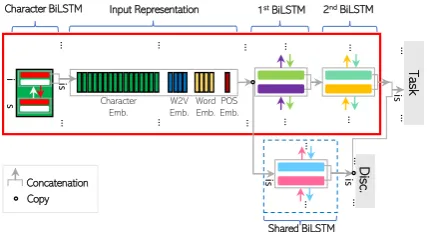
Figure 1: TheMULTI TASKarchitecture flow for a sin-gle word in a sequence.
used (denoted by𝑝𝑜𝑠). Taking𝑤𝑖s as input, the
sharedBiLSTMstrictly encodes a task-agnostic𝑙 -dimensional representation of the input (explained in the next subsection),
𝑠𝑖=LSTM⃗ 𝜌(𝑤1∶𝑖)◦LSTM⃗ 𝜒(𝑤𝑛∶𝑖).
The input to each task is then defined as the concate-nation of task-agnostic and task-specific represen-tations. We considered a basic architecture where both tasks have their separate parameters (identical number of layers, dimensions, etc.) and they only share thesharedBiLSTM(denoted asMULTI TASK
in Table1).4
Adversarial Training ThesharedBiLSTM out-put,𝑠𝑖, is meant to encode a task-agnostic repre-sentation of the input word 𝑤𝑖. In order to en-force this criterion, we apply an adversarial training procedure. The shared representation, 𝑠𝑖, is for-warded to a task discriminator (denoted asDisc.in Figure 1) through a gradient reversal layer. The task discriminator predicts the task identity for each word in the input via a linear transformation
(𝑊′′′𝑠𝑖 + 𝑏′′′)[𝜏] followed by a softmax, where
𝜏 ∈ {parser,tagger}and 𝑊′′′ and 𝑏′′′ are
(2 ×𝑙)and(2 × 1), respectively. To train the dis-criminator, a sum of the cross-entropy losses for
𝑤1∶𝑛is used (denoted by𝑑𝑖𝑠𝑐). As the parameters
of the discriminators are being updated, the gradi-ent signals to minimize the discriminator’s error are backpropagated with an opposite sign to theshared
BiLSTMlayer, which adversarially encourages the
sharedBiLSTMto fool the discriminator.
Our training schedule alternates between the two modes, in one mode optimizing the shared and task-specific parameters based on𝑝𝑎𝑟𝑠𝑒 and 𝑝𝑜𝑠 (in
random order), while in the other mode optimizing
𝑑𝑖𝑠𝑐 which includes the shared and
discriminator-specific parameters.
5 Experiments and Results
We experiment with mono-lingual and cross-lingual dependency parsing using the treebanks of the CoNLL 2017 shared task on parsing to Universal Dependencies (UD) (Zeman et al.,2017).5
5.1 Experimental Setup
We use the UDPipe baseline outputs for segmenta-tion and POS tagging of the raw test data (released along with the raw test data). While segmenta-tion and POS errors substantially impact the qual-ity of the final predicted parse, their exploration is beyond our scope. Our evaluation metric is La-beled Attachment Score (LAS), computed by the shared task evaluation script. Statistical signifi-cance, when mentioned, is computed over 20 runs, via the Kolmogorov-Smirnov test (Reimers and Gurevych,2017;Dror et al.,2018) with𝑝= 0.01.
Mono-Lingual Experiments We experiment with Persian (fa), Korean (ko), Russian (ru), Turk-ish (tr), Vietnamese (vi) and IrTurk-ish (ga), all with less than 5𝑘 training sentences (Table 1). For comparison we report the scores published by the top system of the CoNLL 2017 shared task,
BiAFFINE(Dozat et al.,2017), noting the follow-ing differences between their input and output and ours. TheBiAFFINE parser: (i) uses the UDPipe outputs for segmentation but corrects POS errors before parsing, (ii) includes both language specific and universal POS tags in the input layer while we only include the universal POS tags, and (iii) applies post-process correction for non-projective languages.
Cross-Lingual Experiments We use the En-glish (en), French (fr), Russian (ru), and Persian (fa) datasets of the UD treebanks as our training and test data, with the addition of 3 languages for which we did not have any training data: Kurmanji (kmr), Buriat (bxr), and Northern Sami (sme). We also report the results for each language, where the com-bination of training datasets for the rest of the lan-guages (marked as+) was used for training. The cross-lingual experiments are done on delexicalized
5For train and dev sets (1-1983), test set (1-2184),
and pretrained embeddings (1-1989) see: https: //lindat.mff.cuni.cz/repository/xmlui/ handle/11234/{1-1983,1-2184,1-1989}
parses after replacing the words with their Univer-sal POS tags.
Models and Baselines - Single-Task We con-sider the following models: BASEis the BiLSTM
model of Kiperwasser and Goldberg (2016);
BASE++ extends BASE by having 2 layers of BiLSTMs and using 1 layer of character level
BiLSTM (§2); +SHARED includes an additional
BiLSTM(dashed box in Figure1). We included this to provide a fair comparison (in terms of the number of parameters) with the multi-task experiments but we apply a higher dropout rate to resolve overfitting;
ENSEMBLE denotes a collection of 9 +SHARED
models each randomly initialized (Reimers and Gurevych,2017) and trained forMLE with MBR (§3.3) applied for prediction; MAP denotes the +SHAREDmodel optimized forMAPinstead ofMLE; +SGLDdenotes Bayesian learning and prediction (§3.1), and +PRECOND denotes preconditioned
SGLD(§3.2). +SGLDand+PRECONDare applied
to the +SHAREDmodel.
Models and Baselines - Multi-Task We con-sider the same models as in the single-task setup, with the following changes. BASEMT is the vari-ant ofMULTI TASKarchitecture where theshared
BiLSTM is removed and all components except for decoders are shared between the two tasks.
+SHARED and +ADV denote the results without
and with the adversarial training (§4), respectively.
5.2 Hyperparameters
Training is done for 330 epochs with early stopping, using successive6 mini-batches of 5000 words,7 with drop-out rate 0.33 unless stated otherwise.
SGLDis only applied for learning the parameters of
the parser, with learning rate decaying from0.01
to0.0001(𝛾 = 0.5), and the preconditioned matrix hyperparameters are𝜆= 10−5, 𝛼 = 0.99. The rest of the parameters are updated using Adam (Kingma and Ba,2014) with default DyNet parameters ( Neu-big et al.,2017). The size and selection of the sam-ples used in Bayesian inference are tuned on Irish (see §6.1 of the main paper). In all experiments, training stops based on loss convergence of a single model on the dev set. We also triedGRUs and our results were substantially worse thanLSTMs.
We consider the following sizes within the mod-els: BASEis 1 layer of BiLSTMwith125hidden
6We found that random batches perform slightly worse. 7When the5000words limit lands in the middle of a
units,100-D word embeddings,25-D POS embed-dings, and dropout rate of0.33;BASE++extends
BASEby having 2 layers of BiLSTMs with200-D hidden units,100-D external word embeddings, and using 1 layer of character level BiLSTMwith200 -D hidden units to generate 100-D character em-beddings (§2); +SHARED includes an additional BiLSTM with200-D hidden units in BASE++ to provide a fair comparison (in terms of the number of parameters) with the multi-task experiments but we apply a higher dropout rate of0.66to resolve overfitting.
5.3 Results
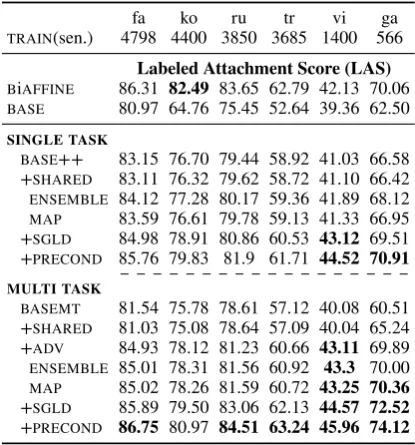
Mono-Lingual Parsing Table1summarizes the training data statistics and the LAS results of the var-ious models, with bold-font marking cases where a model outperforms theBiAFFINEparser.
1. SINGLE TASKComparison betweenBASE++
and +SHAREDreveals that the additional BiLSTM
in the +SHAREDdoes not improve the results. As expected, model averaging inENSEMBLEimproved the results over the +SHAREDmodel. Additionally, theMAP results show slight improvements com-pared with +SHARED. Both of these findings sug-gest that the quality of predictions is likely to im-prove if some notion of uncertainty (via averaging, or prior insertion) is included.
For Bayesian solutions, both +SGLDand +PRE
-CONDconsistently (and in a statistically significant
manner) outperform theENSEMBLEmodels and the strong BiLSTMbaselines on all languages, while
PRECONDoutperformsBiAFFINEby up to3% on
two languages (vi, and ga). The consistency of improvements as we incorporate richer means of capturing the uncertainty suggests that these gains are independent of our specific choice of neural ar-chitecture and that they might also hold for future parsing architectures.
2. MULTI TASKAs explained earlier (§4),
com-paring the parser performances under +SHARED
models in single and multi task settings indicates that parser quality was degraded with the inclu-sion of a POS tagging task, possibly due to interfer-ence between the tasks. This issue was alleviated with the inclusion of task discriminator and the ad-versarial training. The +ADVmodel consistently improves the results (in a statistically significant manner), while outperforming theSINGLE TASK
(+SHARED)by2.2%for Persian (fa), and5.2%for
Irish (ga). This is an indicator that low-resource
lan-fa ko ru tr vi ga
TRAIN(sen.) 4798 4400 3850 3685 1400 566
Labeled Attachment Score (LAS)
BiAFFINE 86.31 82.49 83.65 62.79 42.13 70.06
BASE 80.97 64.76 75.45 52.64 39.36 62.50
SINGLE TASK
BASE++ 83.15 76.70 79.44 58.92 41.03 66.58
+SHARED 83.11 76.32 79.62 58.72 41.10 66.42
ENSEMBLE 84.12 77.28 80.17 59.36 41.89 68.12
MAP 83.59 76.61 79.78 59.13 41.33 66.95 +SGLD 84.98 78.91 80.86 60.53 43.12 69.51
+PRECOND 85.76 79.83 81.9 61.71 44.52 70.91
MULTI TASK
BASEMT 81.54 75.78 78.61 57.12 40.08 60.51
+SHARED 81.03 75.08 78.64 57.09 40.04 65.24
+ADV 84.93 78.12 81.23 60.66 43.11 69.89
ENSEMBLE 85.01 78.31 81.56 60.92 43.3 70.00
MAP 85.02 78.26 81.59 60.72 43.25 70.36
+SGLD 85.89 79.50 83.06 62.13 44.57 72.52
+PRECOND 86.75 80.97 84.51 63.24 45.96 74.12
Table 1: Mono-Lingual results. Models that outper-form theBiAFFINEparser are highlighted in bold.
guages could potentially benefit more from multi-task learning. Other variants of +ADVare also re-ported in Table1and similar patterns to the single task setting are observed.
Next, we test the effectiveness of Bayesian learn-ing and inference uslearn-ing = 9thinned samples (§5.4). For all languages in the multi-task setting the gain from including +SGLDin +ADVis statisti-cally significant. However, the gain decays as the amount of training data increases: from3.8% on Irish (ga) to1.1%on Persian (fa). This verifies our expectation that Bayesian learning helps parameter estimation and prediction in the small data regime. Compared to +SGLD, +PRECONDprovides further improvements (all are statistically significant) of
2.2%on Irish and1%on Persian, showing a similar generic negative correlation with data size.
To summarize our mono-lingual results, the Bayesian framework shows its merit in improv-ing predictive quality, and multi-task learnimprov-ing in-troduces new and informative signal via a related task which allows for better parameter estimation. The integration of a Bayesian parser into a multi-task learning framework outperforms theBiAFFINE
parser on up to 5 languages, while we observe decreasing improvements as the data size grows. Also, since our Bayesian approach builds on the
BASEmodel, it is subject to the shortcomings of
[image:7.595.312.520.62.285.2]sen. Labeled Attachment Score (LAS)
en fr ru fa kmr bxr sme
en13𝑘81.04
+0.94 64+1..3434 44+0..6199 24+1..055727+1..6221 24+1..9739 33+1..4216
fr 15𝑘57.71
+0.89 79+1..1421 47+0..7282 29+1..022328+1..0639 18+1..0402 29+1..7201
ru 3𝑘 52.25
+3.26 62+2..3058 77+3..5541 46+2..614727+3..8014 39+2..2975 32+3..4036
fa 5𝑘 37.53
+1.30 50+1..9497 43+1..4182 78+1..012845+1..2966 21+1..6536 23+1..9441
+ 36𝑘82.79
+0.78 80+1..9216 77+0..1987 78+0..782543+0..2696 20+0..5794 35+0..0082
Table 2: Cross-Lingual Parsing Evaluation. LAS of an ensemble of = 9SINGLE TASK(BASE++) models, and the performance gain by the BayesianMULTI TASK
(+PRECOND), placed as subscript.
or its inputs and outputs.
Cross-Lingual Delexicalized Parsing We tested our most successful mono-lingual model,
MULTI TASK(+PRECOND), in the cross-lingual
setup against an ensemble of = 9 randomly initialized SINGLE TASK (BASE++) models. Table2summarizes the training data size (rounded up) and the LAS results of both models.
As expected, the ensemble models perform best when the training and test data come from the same language or language family (as in Buryat to Rus-sian and Kurmanji to PerRus-sian). Showing a similar pattern to mono-lingual parsing, in all cases the performance gain of the Bayesian MULTI TASK
(+PRECOND) setting, reported as under-text in the
table, consistently outperforming theENSEMBLE
(in a statistically significant manner) and the impact decays with the training set size.
5.4 Ablation Analysis
We aim to answer two questions: (i) how many of the generated samples are used during inference? and (ii) how much the success ofSGLDdepends on other sources of noise during training?
1. UTILIZING SAMPLES Once the training
stops, different strategies could be applied to utilize the collection ofposterior samples to recompute
ARC-SCOREmatrix (see §3.3). An extreme option is including all samples (denoted byAll), another option is to only use the last sample (denoted by
Last). An intermediate alternative is to choose
samples with interval⌊
⌋, an approach known as
Thinning(Gan et al.,2017).
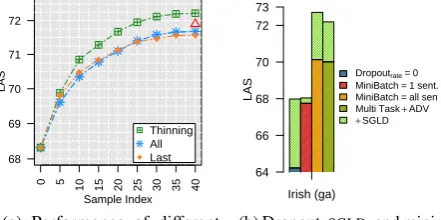
Comparing the results in Figure 2a, Thinning
consistently outperforms the other strategies.
In-0 5 10 15 20 25 30 35 40
68 69 70 71 72
LAS
Sample Index Thinning All Last
(a) Performance of different sampling strategies.
Irish (ga) 64 66 68 70 72 73
Dropoutrate =0 MiniBatch=1 sent. MiniBatch=all sent. MultiTask+ADV
+SGLD
LAS
[image:8.595.306.527.68.178.2](b) Dropout,SGLD, and mini-batch size interdependence.
Figure 2: Ablation analysis for Irish. Similar patterns are observed for the other languages.
terestingly, when we compared Thinning with a variant (denoted byΔin Figure2a) that just uses the last5samples , it appears thatThinningwhich includes earlier samples is still superior. This is likely to be an indicator that a larger (and more diverse) set of trees can potentially improveMBR
decoding. In practice, we useThinnedsamples.
2. DROPOUT, SGLD, AND MINI-BATCH We
would next like to better understand the interdepen-dence betweenSGLDand two existing sources of noise: dropout and mini-batch size. Results are reported in Figure2b. In all four stacked bars, the top segment demonstrates the gain when includ-ing +SGLD. The right-most stacked bar illustrates
the performance of MULTI TASK (+ADV) with-out (bottom part of the bar) and with +SGLD. This is our reference and in the following three experi-ments, we make a single change to this model while keeping everything else fixed.
In the left-most stacked bar, we exclude dropout. This significantly hurts the performance, an indi-cation that the random perturbation of model by dropout can provide a positive complimentary ef-fect for better exploration of the posterior modes via
SGLD. Comparing the top parts of all stacked bars (representing the gain with +SGLD) reveals that this gain is at its maximum when dropout is switched off. An interpretation can be that in the absence of dropout,SGLD becomes the main component for countering overfitting.
value when the gradient is close to zero, giving a better chance for the sampler to mix via𝜉𝑡.
In the second stacked bar from left, parameters are updated for each training sentence. In this set-ting the learning rate,𝜂𝑡, is consumed much faster and can potentially reach zero on the MAP solu-tion, discarding the effect of the injected noise and +SGLD. Hence, the gain for includingSGLDis at its minimum. We speculate that adjusting the decaying speed of the learning rate (which we left untouched) could allow for this extreme case to perform better.
6 Conclusion
We proposed a Bayesian framework for neural de-pendency parsing (BNNP). We employ efficient SG-MCMC approximate inference mechanisms through stochastic gradient Langevin dynamics to generate posterior samples during optimization. The collected samples are then used via a minimum Bayes risk parsing algorithm to generate the final parse tree. In mono-lingual and cross-lingual ex-periments in the small data regime, where Bayesian learning in expected to be most effective, our BNNP consistently outperformed the strong BiLSTM base-lines. Moreover, when integrating the BNNP into a multi-task learning framework, utilized to prevent task interference, we outperformed theBiAFFINE
parser (best system of the CoNLL17 shared task) on 5 low-resource languages by up to9%LAS.
In future work, we intend to investigate other types of priors over the network parameters (e.g., sparse priors (Lobacheva et al.,2017)). We would also like to explicitly quantify the uncertainty cap-tured in our framework under different sampling strategies orMCMC-SGmethods (e.g., similar to Mc-Clure and Kriegeskorte(2016);Teye et al.(2018)).
Acknowledgments
This work is supported by the ERC Consolidator Grant LEXICAL (648909). The first author would like to thank Costanza Conforti, Victor Prokhorov, and Gamal Crichton for their comments on the pre-sentation of this work. The authors would like to thank the anonymous reviewers for their helpful suggestions.
References
Zeljko Agic, Anders Johannsen, Barbara Plank, Héc-tor Martínez Alonso, Natalie Schluter, and Anders Søgaard. 2016. Multilingual projection for parsing truly low-resource languages.TACL.
Gabor Angeli, Melvin Jose Johnson Premkumar, and Christopher D. Manning. 2015. Leveraging linguis-tic structure for open domain information extraction. InProceedings of ACL.
Rich Caruana. 1997. Multitask learning. Machine learning.
Wanxiang Che, Yijia Liu, Yuxuan Wang, Bo Zheng, and Ting Liu. 2018. Towards better UD pars-ing: Deep contextualized word embeddings, ensem-ble, and treebank concatenation. InProceedings of CoNLL.
Xinchi Chen, Zhan Shi, Xipeng Qiu, and Xuanjing Huang. 2017.Adversarial multi-criteria learning for chinese word segmentation. InProceedings of ACL.
Caio Corro and Ivan Titov. 2018. Differentiable perturb-and-parse: Semi-supervised parsing with a structured variational autoencoder. arXiv preprint arXiv:1807.09875.
Timothy Dozat, Peng Qi, and Christopher D. Manning. 2017. Stanford’s graph-based neural dependency parser at the conll 2017 shared task. InProceedings of CoNLL.
Roten Dror, Gili Baumer, Segev Shlomov, and Roi Re-ichart. 2018. The hitchhiker’s guide to testing statis-tical significance in natural language processing. In
Proceedings of ACL.
Jason M Eisner. 1996. Three new probabilistic models for dependency parsing: An exploration. In Proceed-ings of COLING.
Jenny Rose Finkel and Christopher D Manning. 2009.
Joint parsing and named entity recognition. In Pro-ceedings of NAACL.
Yarin Gal and Zoubin Ghahramani. 2016.Dropout as a bayesian approximation: Representing model uncer-tainty in deep learning. InProceedings of ICML.
Zhe Gan, Chunyuan Li, Changyou Chen, Yunchen Pu, Qinliang Su, and Lawrence Carin. 2017. Scalable bayesian learning of recurrent neural networks for language modeling. InProceedings of ACL.
Yaroslav Ganin and Victor S. Lempitsky. 2015. Unsu-pervised domain adaptation by backpropagation. In
Proceedings of ICML.
Wenbo Gong, Yingzhen Li, and José Miguel Hernández-Lobato. 2018. Meta-learning for stochastic gradient MCMC.CoRR.
Ian Goodfellow, Yoshua Bengio, and Aaron Courville. 2016.Deep Learning. MIT Press.
Joshua Goodman. 1996. Parsing algorithms and met-rics. InProceedings of ACL.
Kazuma Hashimoto, Caiming Xiong, Yoshimasa Tsu-ruoka, and Richard Socher. 2017. A joint many-task model: Growing a neural network for multiple NLP tasks. InProceedings of EMNLP.
José Miguel Hernández-Lobato and Ryan P. Adams. 2015. Probabilistic backpropagation for scalable learning of bayesian neural networks. In Proceed-ings of ICML.
Geoffrey E. Hinton, Nitish Srivastava, Alex Krizhevsky, Ilya Sutskever, and Ruslan Salakhutdinov. 2012. Im-proving neural networks by preventing co-adaptation of feature detectors.CoRR.
Katherine A. Keith, Su Lin Blodgett, and Brendan T. O’Connor. 2018. Monte carlo syntax marginals for exploring and using dependency parses. In Proceed-ings of NAACL.
Joo-Kyung Kim, Young-Bum Kim, Ruhi Sarikaya, and Eric Fosler-Lussier. 2017. Cross-lingual transfer learning for POS tagging without cross-lingual re-sources. InProceedings of EMNLP.
Diederik P. Kingma and Jimmy Ba. 2014. Adam: A method for stochastic optimization.CoRR.
Eliyahu Kiperwasser and Yoav Goldberg. 2016.Simple and accurate dependency parsing using bidirectional LSTM feature representations.TACL.
Terry Koo, Xavier Carreras, and Michael Collins. 2008.
Simple semi-supervised dependency parsing. In
Proceedings of ACL.
Adhiguna Kuncoro, Miguel Ballesteros, Lingpeng Kong, Chris Dyer, and Noah A. Smith. 2016. Distill-ing an ensemble of greedy dependency parsers into one MST parser. InProceedings of EMNLP.
Ophélie Lacroix, Lauriane Aufrant, Guillaume Wis-niewski, and François Yvon. 2016. Frustratingly easy cross-lingual transfer for transition-based de-pendency parsing. InProceedings of NAACL.
Omer Levy and Yoav Goldberg. 2014. Dependency-based word embeddings. InProceedings of ACL.
Chunyuan Li, Changyou Chen, David E. Carlson, and Lawrence Carin. 2016. Preconditioned stochastic gradient langevin dynamics for deep neural networks. InProceedings of AAAI.
Pengfei Liu, Xipeng Qiu, and Xuanjing Huang. 2016.
Recurrent neural network for text classification with multi-task learning. InProceedings of IJCAI.
Yijia Liu, Yi Zhu, Wanxiang Che, Bing Qin, Nathan Schneider, and Noah A. Smith. 2018. Parsing tweets into universal dependencies. In Proceedings of NAACL.
Ekaterina Lobacheva, Nadezhda Chirkova, and Dmitry P. Vetrov. 2017. Bayesian sparsification of recurrent neural networks.CoRR.
Rivka Malca and Roi Reichart. 2018.Neural transition based parsing of web queries: An entity based ap-proach. InProceedings of EMNLP.
Diego Marcheggiani, Anton Frolov, and Ivan Titov. 2017.A simple and accurate syntax-agnostic neural model for dependency-based semantic role labeling. InProceedings of CoNLL.
Patrick McClure and Nikolaus Kriegeskorte. 2016.
Representation of uncertainty in deep neural net-works through sampling.CoRR.
Ryan McDonald, Koby Crammer, and Fernando Pereira. 2005a. Online large-margin training of de-pendency parsers. InProceedings of ACL.
Ryan T. McDonald, Koby Crammer, and Fernando C. N. Pereira. 2005b. Online large-margin training of de-pendency parsers. InProceedings of ACL.
Radford M Neal. 2011. MCMC using hamiltonian dy-namics.Handbook of Markov Chain Monte Carlo.
Graham Neubig, Chris Dyer, Yoav Goldberg, Austin Matthews, Waleed Ammar, Antonios Anastasopou-los, Miguel Ballesteros, David Chiang, Daniel Cloth-iaux, Trevor Cohn, et al. 2017. Dynet: The dynamic neural network toolkit. arXiv preprint arXiv:1701.03980.
Vlad Niculae, André F. T. Martins, Mathieu Blondel, and Claire Cardie. 2018. Sparsemap: Differen-tiable sparse structured inference. InProceedings of ICML.
Matthew E. Peters, Mark Neumann, Mohit Iyyer, Matt Gardner, Christopher Clark, Kenton Lee, and Luke Zettlemoyer. 2018.Deep contextualized word repre-sentations. InProceedings of NAACL.
Barbara Plank and Héctor Martínez Alonso. 2017.
When is multitask learning effective? semantic se-quence prediction under varying data conditions. In
Proceedings of EACL.
Mohammad Sadegh Rasooli and Michael Collins. 2017.
Cross-lingual syntactic transfer with limited re-sources.TACL.
Roi Reichart, Katrin Tomanek, Udo Hahn, and Ari Rap-poport. 2008. Multi-task active learning for linguis-tic annotations. InProceedings of ACL.
Nils Reimers and Iryna Gurevych. 2017. Reporting score distributions makes a difference: Performance study of lstm-networks for sequence tagging. In Pro-ceedings of EMNLP.
Christian P. Robert and George Casella. 2010. Monte Carlo Statistical Methods.
Ehsan Shareghi, Gholamreza Haffari, Trevor Cohn, and Ann Nicholson. 2015. Structured prediction of se-quences and trees using infinite contexts. In Pro-ceedings of ECML.
Anders Søgaard and Yoav Goldberg. 2016. Deep multi-task learning with low level multi-tasks supervised at lower layers. InProceedings of ACL.
Nitish Srivastava, Geoffrey Hinton, Alex Krizhevsky, Ilya Sutskever, and Ruslan Salakhutdinov. 2014.
Dropout: A simple way to prevent neural networks from overfitting.JMLR.
Mihai Surdeanu and Christopher D. Manning. 2010.
Ensemble models for dependency parsing: Cheap and good? InProceedings of NAACL.
Yee Whye Teh, Alexandre H. Thiery, and Sebastian J. Vollmer. 2016. Consistency and fluctuations for stochastic gradient langevin dynamics.JMLR.
Mattias Teye, Hossein Azizpour, and Kevin Smith. 2018.Bayesian uncertainty estimation for batch nor-malized deep networks. InProceedings of ICML.
Tijmen Tieleman and Geoffrey Hinton. 2012. Lecture 6.5-rmsprop: Divide the gradient by a running av-erage of its recent magnitude. COURSERA: Neural networks for machine learning.
Kristina Toutanova, Victoria Lin, Wen-tau Yih, Hoi-fung Poon, and Chris Quirk. 2016. Compositional learning of embeddings for relation paths in knowl-edge base and text. InProceedings of ACL.
Li Wan, Matthew D. Zeiler, Sixin Zhang, Yann LeCun, and Rob Fergus. 2013. Regularization of neural net-works using dropconnect. InProceedings of ICML.
Max Welling and Yee W Teh. 2011.Bayesian learning via stochastic gradient langevin dynamics. In Pro-ceedings of ICML.
Poorya ZareMoodi and Gholamreza Haffari. 2018.
Neural machine translation for bilingually scarce sce-narios: a deep multi-task learning approach. In Pro-ceedings of NAACL.
Daniel Zeman, Jan Hajič, Martin Popel, Martin Pot-thast, Milan Straka, Filip Ginter, Joakim Nivre, and Slav Petrov. 2018. Conll 2018 shared task: Multilin-gual parsing from raw text to universal dependencies. InProceedings of the CoNLL.