Using the Output Embedding to Improve Language Models
Ofir Press and Lior Wolf
School of Computer Science Tel-Aviv University, Israel
{ofir.press,wolf}@cs.tau.ac.il
Abstract
We study the topmost weight matrix of neural network language models. We show that this matrix constitutes a valid word embedding. When training language models, we recommend tying the input embedding and this output embedding. We analyze the resulting update rules and show that the tied embedding evolves in a more similar way to the output embed-ding than to the input embedembed-ding in the untied model. We also offer a new method of regularizing the output embedding. Our methods lead to a significant reduction in perplexity, as we are able to show on a va-riety of neural network language models. Finally, we show that weight tying can re-duce the size of neural translation models to less than half of their original size with-out harming their performance.
1 Introduction
In a common family of neural network language models, the current input word is represented as the vector c ∈ IRC and is projected to a dense representation using a word embedding matrixU. Some computation is then performed on the word embeddingU>c, which results in a vector of
ac-tivationsh2. A second matrixV then projectsh2
to a vectorh3containing one score per vocabulary
word:h3 =V h2. The vector of scores is then
con-verted to a vector of probability values p, which represents the models’ prediction of the next word, using the softmax function.
For example, in the LSTM-based language models of (Sundermeyer et al., 2012; Zaremba et al., 2014), for vocabulary of size C, the one-hot encoding is used to represent the inputc and
U ∈IRC×H. An LSTM is then employed, which
results in an activation vectorh2 that similarly to
U>c, is also inIRH. In this case,U andV are of exactly the same size.
We callU the input embedding, andV the out-put embedding. In both matrices, we expect rows that correspond to similar words to be similar: for the input embedding, we would like the network to react similarly to synonyms, while in the out-put embedding, we would like the scores of words that are interchangeable to be similar (Mnih and Teh, 2012).
WhileU andV can both serve as word embed-dings, in the literature, only the former serves this role. In this paper, we compare the quality of the input embedding to that of the output embedding, and we show that the latter can be used to improve neural network language models. Our main results are as follows: (i) We show that in the word2vec skip-gram model, the output embedding is only slightly inferior to the input embedding. This is shown using metrics that are commonly used in or-der to measure embedding quality. (ii) In recurrent neural network based language models, the output embedding outperforms the input embedding. (iii) By tying the two embeddings together, i.e., enforc-ingU =V, the joint embedding evolves in a more similar way to the output embedding than to the in-put embedding of the untied model. (iv) Tying the input and output embeddings leads to an improve-ment in the perplexity of various language mod-els. This is true both when using dropout or when not using it. (v) When not using dropout, we pro-pose adding an additional projectionP beforeV, and apply regularization to P. (vi) Weight tying in neural translation models can reduce their size (number of parameters) to less than half of their original size without harming their performance.
2 Related Work
Neural network language models (NNLMs) assign probabilities to word sequences. Their resurgence was initiated by (Bengio et al., 2003). Recur-rent neural networks were first used for language modeling in (Mikolov et al., 2010) and (Pascanu et al., 2013). The first model that implemented language modeling with LSTMs (Hochreiter and Schmidhuber, 1997) was (Sundermeyer et al., 2012). Following that, (Zaremba et al., 2014) in-troduced a dropout (Srivastava, 2013) augmented NNLM. (Gal, 2015; Gal and Ghahramani, 2016) proposed a new dropout method, which is referred to as Bayesian Dropout below, that improves on the results of (Zaremba et al., 2014).
The skip-gram word2vec model introduced in (Mikolov et al., 2013a; Mikolov et al., 2013b) learns representations of words. This model learns a representation for each word in its vocabulary, both in an input embedding matrix and in an out-put embedding matrix. When training is com-plete, the vectors that are returned are the input embeddings. The output embedding is typically ignored, although (Mitra et al., 2016; Mnih and Kavukcuoglu, 2013) use both the output and input embeddings of words in order to compute word similarity. Recently, (Goldberg and Levy, 2014) argued that the output embedding of the word2vec skip-gram model needs to be different than the in-put embedding.
As we show, tying the input and the output em-beddings is indeed detrimental in word2vec. How-ever, it improves performance in NNLMs.
In neural machine translation (NMT) mod-els (Kalchbrenner and Blunsom, 2013; Cho et al., 2014; Sutskever et al., 2014; Bahdanau et al., 2014), the decoder, which generates the trans-lation of the input sentence in the target lan-guage, is a language model that is conditioned on both the previous words of the output sentence and on the source sentence. State of the art re-sults in NMT have recently been achieved by sys-tems that segment the source and target words into subword units (Sennrich et al., 2016a). One such method (Sennrich et al., 2016b) is based on the byte pair encoding (BPE) compression algo-rithm (Gage, 1994). BPE segments rare words into their more commonly appearing subwords.
Weight tying was previously used in the log-bilinear model of (Mnih and Hinton, 2009), but the decision to use it was not explained, and its effect
on the model’s performance was not tested. In-dependently and concurrently with our work (Inan et al., 2016) presented an explanation for weight tying in NNLMs based on (Hinton et al., 2015).
3 Weight Tying
In this work, we employ three different model cat-egories: NNLMs, the word2vec skip-gram model, and NMT models. Weight tying is applied sim-ilarly in all models. For translation models, we also present a three-way weight tying method.
NNLM models contain an input embedding ma-trix, two LSTM layers (h1 andh2), a third hidden
scores/logits layerh3, and a softmax layer. The
loss used during training is the cross entropy loss without any regularization terms.
Following (Zaremba et al., 2014), we employ two models: large and small. The large model em-ploys dropout for regularization. The small model is not regularized. Therefore, we propose the fol-lowing regularization scheme. A projection matrix
P ∈ IRH×H is inserted before the output embed-ding, i.e., h3 = V P h2. The regularizing term
λkPk2 is then added to the small model’s loss
function. In all of our experiments,λ= 0.15. Projection regularization allows us to use the same embedding (as both the input/output embed-ding) with some adaptation that is under regular-ization. It is, therefore, especially suited for WT.
While training a vanilla untied NNLM, at timestep t, with current input word sequence
i1:t = [i1, ..., it] and current target output word
ot, the negative log likelihood loss is given by:
Lt = −logpt(ot|i1:t), where pt(ot|i1:t) =
exp (V>
oth(2t))
PC
x=1exp(Vx>h(2t)),Uk(Vk) is thekth row ofU (V),
which corresponds to wordk, andh(2t)is the vector of activations of the topmost LSTM layer’s output at time t. For simplicity, we assume that at each timestept,it 6= ot. Optimization of the model is performed using stochastic gradient descent.
The update for rowkof the input embedding is:
∂Lt ∂Uk =
( (PC
x=1pt(x|i1:t)·Vx>−Vo>t)
∂h(2t) ∂Uit k=it
0 k6=it
For the output embedding, rowk’s update is: ∂Lt
∂Vk =
(
(pt(ot|i1:t)−1)h(2t) k=ot pt(k|i1:t)·h(2t) k6=ot
word. This means that vectors representing rare words are updated only a small number of times. The output embedding updates every row at each timestep.
In tied NNLMs, we set U = V = S. The update for each row inSis the sum of the updates obtained for the two roles of S as both an input and output embedding.
The update for row k6= it is similar to the up-date of rowkin the untied NNLM’s output embed-ding (the only difference being that U and V are both replaced by a single matrix S). In this case, there is no update from the input embedding role ofS.
The update for rowk=it, is made up of a term from the input embedding (casek=it) and a term from the output embedding (case k 6= ot). The second term grows linearly withpt(it|i1:t), which is expected to be close to zero, since words sel-dom appear twice in a row (the low probability in the network was also verified experimentally). The update that occurs in this case is, therefore, mostly impacted by the update from the input em-bedding role ofS.
To conclude, in the tied NNLM, every row ofS
is updated during each iteration, and for all rows except one, this update is similar to the update of the output embedding of the untied model. This implies a greater degree of similarity of the tied embedding to the untied model’s output embed-ding than to its input embedembed-ding.
The analysis above focuses on NNLMs for brevity. Inword2vec, the update rules are simi-lar, just that h(2t)is replaced by the identity func-tion. As argued by (Goldberg and Levy, 2014), in this case weight tying is not appropriate, because if pt(it|i1:t) is close to zero then so is the norm of the embedding of it. This argument does not hold for NNLMs, since the LSTM layers cause a decoupling of the input and output embedddings.
Finally, we evaluate the effect of weight ty-ing inneural translation models. In this model:
pt(ot|i1:t, r) = exp(V
>
otG(t))
PCt
x=1exp(Vx>G(t)) where r = (r1, ..., rN)is the set of words in the source sen-tence, U andV are the input and output embed-dings of the decoder and W is the input embed-ding of the encoder (in translation modelsU, V ∈
IRCt×H andW ∈ IRCs×H, whereC
s /Ct is the size of the vocabulary of the source / target). G(t)
is the decoder, which receives the context vector, the embedding of the input word (it) inU, and its
Language Subwords Subwords Subwords pairs only in source only in target in both
EN→FR 2K 7K 85K
EN→DE 3K 11K 80K
Table 1:Shared BPE subwords between pairs of languages.
previous state at each timestep. ct is the context vector at timestept,ct = Pj∈ratjhj, where atj is the weight given to thejth annotation at timet:
atj = Pexp(etj)
k∈rexp(eik), andetj =at(hj), whereais the alignment model.F is the encoder which pro-duces the sequence of annotations(h1, ..., hN).
The output of the decoder is then projected to a vector of scores using the output embedding:
lt=V G(t). The scores are then converted to prob-ability values using the softmax function.
In our weight tied translation model, we tie the input and output embeddings of the decoder.
We observed that when preprocessing the ACL WMT 2014 EN→FR1and WMT 2015 EN→DE2
datasets using BPE, many of the subwords ap-peared in the vocabulary of both the source and the target languages. Tab. 1 shows that up to 90% (85%) of BPE subwords between English and French (German) are shared.
Based on this observation, we propose three-way weight tying (TWWT), where the input em-bedding of the decoder, the output emem-bedding of the decoder and the input embedding of the en-coder are all tied. The single source/target vocab-ulary of this model is the union of both the source and target vocabularies. In this model, both in the encoder and decoder, all subwords are embedded in the same duo-lingual space.
4 Results
Our experiments study the quality of various em-beddings, the similarity between them, and the impact of tying them on the word2vec skip-gram model, NNLMs, and NMT models.
4.1 Quality of Obtained Embeddings
In order to compare the various embeddings, we pooled five embedding evaluation methods from the literature. These evaluation methods involve calculating pairwise (cosine) distances between embeddings and correlating these distances with human judgments of the strength of relationships between concepts. We use: Simlex999 (Hill et al.,
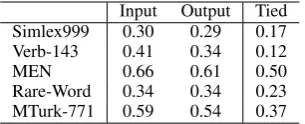
Input Output Tied Simlex999 0.30 0.29 0.17 Verb-143 0.41 0.34 0.12
MEN 0.66 0.61 0.50
[image:4.595.314.518.60.114.2]Rare-Word 0.34 0.34 0.23 MTurk-771 0.59 0.54 0.37
Table 2: Comparison of input and output embeddings learned by a word2vec skip-gram model. Results are also shown for the tied word2vec model. Spearman’s correlationρ is reported for five word embedding evaluation benchmarks.
PTB text8
Embedding In Out Tied In Out Tied Simlex999 0.02 0.13 0.14 0.17 0.27 0.28 Verb143 0.12 0.37 0.32 0.20 0.35 0.42 MEN 0.11 0.21 0.26 0.26 0.50 0.50 Rare-Word 0.28 0.38 0.36 0.14 0.15 0.17 MTurk771 0.17 0.28 0.30 0.26 0.48 0.45
Table 3:Comparison of the input/output embeddings of the small model from (Zaremba et al., 2014) and the embeddings from our weight tied variant. Spearman’s correlationρis pre-sented.
2016), Verb-143 (Baker et al., 2014), MEN (Bruni et al., 2014), Rare-Word (Luong et al., 2013) and MTurk-771 (Halawi et al., 2012).
We begin by training both the tied and untied word2vec models on the text83 dataset, using a
vocabulary consisting only of words that appear at least five times. As can be seen in Tab. 2, the output embedding is almost as good as the input embedding. As expected, the embedding of the tied model is not competitive. The situa-tion is different when training the small NNLM model on either the Penn Treebank (Marcus et al., 1993) or text8 datasets (for PTB, we used the same train/validation/test set split and vocabulary as (Mikolov et al., 2011), while on text8 we used the split/vocabulary from (Mikolov et al., 2014)). These results are presented in Tab. 3. In this case, the input embedding is far inferior to the output embedding. The tied embedding is comparable to the output embedding.
A natural question given these results and the analysis in Sec. 3 is whether the word embedding in the weight tied NNLM model is more similar to the input embedding or to the output embedding of the original model. We, therefore, run the fol-lowing experiment: First, for each embedding, we compute the cosine distances between each pair of words. We then compute Spearman’s rank corre-lation between these vectors of distances. As can be seen in Tab. 4, the results are consistent with
3http://mattmahoney.net/dc/textdata
A B ρ(A, B) ρ(A, B) ρ(A, B) word2vec NNLM(S) NNLM(L)
In Out 0.77 0.13 0.16
In Tied 0.19 0.31 0.45
Out Tied 0.39 0.65 0.77
Table 4:Spearman’s rank correlationρof similarity values between all pairs of words evaluated for the different embed-dings: input/output embeddings (of the untied model) and the embeddings of our tied model. We show the results for both the word2vec models and the small and large NNLM models from (Zaremba et al., 2014).
Model Size Train Val. Test
[image:4.595.106.259.62.124.2]Large (Zaremba et al., 2014) 66M 37.8 82.2 78.4 Large + Weight Tying 51M 48.5 77.7 74.3 Large + BD (Gal, 2015) + WD 66M 24.3 78.1 75.2 Large + BD + WT 51M 28.2 75.8 73.2 RHN (Zilly et al., 2016) + BD 32M 67.4 71.2 68.5 RHN + BD + WT 24M 74.1 68.1 66.0
Table 5: Word level perplexity (lower is better) on PTB and size (number of parameters) of models that use either dropout (baseline model) or Bayesian dropout (BD). WD – weight decay.
our analysis and the results of Tab. 2 and Tab. 3: for word2vec the input and output embeddings are similar to each other and differ from the tied bedding; for the NNLM models, the output em-bedding and the tied emem-beddings are similar, the input embedding is somewhat similar to the tied embedding, and differs considerably from the out-put embedding.
4.2 Neural Network Language Models
We next study the effect of tying the embeddings on the perplexity obtained by the NNLM models. Following (Zaremba et al., 2014), we study two NNLMs. The two models differ mostly in the size of the LSTM layers. In the small model, both LSTM layers contain 200 units and in the large model, both contain 1500 units. In addition, the large model uses three dropout layers, one placed right before the first LSTM layer, one betweenh1
andh2 and one right afterh2. The dropout
proba-bility is0.65. For both the small and large models, we use the same hyperparameters (i.e. weight ini-tialization, learning rate schedule, batch size) as in (Zaremba et al., 2014).
[image:4.595.70.296.191.266.2]Model Size Train Val. Test
KN 5-gram 141
RNN 123
LSTM 117
Stack RNN 8.48M 110
FOFE-FNN 108
Noisy LSTM 4.65M 111.7 108.0
Deep RNN 6.16M 107.5
[image:5.595.77.288.61.182.2]Small model 4.65M 38.0 120.7 114.5 Small + WT 2.65M 36.4 117.5 112.4 Small + PR 4.69M 50.8 116.0 111.7 Small + WT + PR 2.69M 53.5 104.9 100.9
Table 6: Word level perplexity on PTB and size for mod-els that do not use dropout. The compared modmod-els are: KN 5-gram (Mikolov et al., 2011), RNN (Mikolov et al., 2011), LSTM (Graves, 2013), Stack / Deep RNN (Pas-canu et al., 2013), FOFE-FNN (Zhang et al., 2015), Noisy LSTM (G¨ulc¸ehre et al., 2016), and the small model from (Zaremba et al., 2014). The last three models are our models, which extend the small model. PR – projection regulariza-tion.
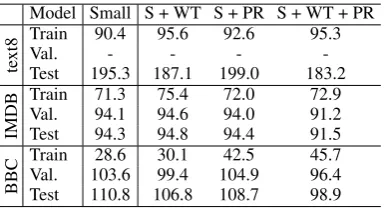
Model Small S + WT S + PR S + WT + PR
te
xt8 TrainVal. 90.4- 95.6- 92.6- 95.3 -Test 195.3 187.1 199.0 183.2
IMDB
Train 71.3 75.4 72.0 72.9 Val. 94.1 94.6 94.0 91.2 Test 94.3 94.8 94.4 91.5
BBC
[image:5.595.307.528.62.135.2]Train 28.6 30.1 42.5 45.7 Val. 103.6 99.4 104.9 96.4 Test 110.8 106.8 108.7 98.9
Table 7: Word level perplexity on the text8, IMDB and BBC datasets. The last three models are our models, which extend the small model (S) of (Zaremba et al., 2014).
split (we use the same vocabularies as (Miyamoto and Cho, 2016)).
In the first experiment, which was conducted on the PTB dataset, we compare the perplexity obtained by the large NNLM model and our ver-sion in which the input and output embeddings are tied. As can be seen in Tab. 5, weight tying sig-nificantly reduces perplexity on both the valida-tion set and the test set, but not on the training set. This indicates less overfitting, as expected due to the reduction in the number of parameters. Re-cently, (Gal and Ghahramani, 2016), proposed a modified model that uses Bayesian dropout and weight decay. They obtained improved perfor-mance. When the embeddings of this model are tied, a similar amount of improvement is gained. We tried this with and without weight decay and got similar results in both cases, with slight im-provement in the latter model. Finally, by re-placing the LSTM with a recurrent highway net-work (Zilly et al., 2016), state of the art results are achieved when applying weight tying. The
contri-Size Validation Test EN→FR Baseline 168M 29.49 33.13
Decoder WT 122M 29.47 33.26
TWWT 80M 29.43 33.46
EN→DE Baseline 165M 20.96 16.79 Decoder WT 119M 21.09 16.54
[image:5.595.86.279.298.403.2]TWWT 79M 21.02 17.15
Table 8: Size (number of parameters) and BLEU score of various translation models. TWWT – three-way weight tying.
bution of WT is also significant in this model. Perplexity results are often reported separately for models with and without dropout. In Tab. 6, we report the results of the small NNLM model, that does not utilize dropout, on PTB. As can be seen, both WT and projection regularization (PR) im-prove the results. When combining both methods together, state of the art results are obtained. An analog table for text8, IMDB and BBC is Tab. 7, which shows a significant reduction in perplexity across these datasets when both PR and WT are used. PR does not help the large models, which employ dropout for regularization.
4.3 Neural Machine Translation
Finally, we study the impact of weight tying in at-tention based NMT models, using the DL4MT4
implementation. We train our EN→FR models on the parallel corpora provided by ACL WMT 2014. We use the data as processed by (Cho et al., 2014) using the data selection method of (Axelrod et al., 2011). For EN→DE we train on data from the translation task of WMT 2015, validate on newstest2013 and test on newstest2014 and new-stest2015. Following (Sennrich et al., 2016b) we learn the BPE segmentation on the union of the vocabularies that we are translating from and to (we use BPE with 89500 merge operations). All models were trained using Adadelta (Zeiler, 2012) for 300K updates, have a hidden layer size of 1000 and all embedding layers are of size 500.
Tab. 8 shows that even though the weight tied models have about 28% fewer parameters than the baseline models, their performance is similar. This is also the case for the three-way weight tied mod-els, even though they have about 52% fewer pa-rameters than their untied counterparts.
References
Amittai Axelrod, Xiaodong He, and Jianfeng Gao. 2011. Domain adaptation via pseudo in-domain data selection. InProceedings of the 2011 Conference on Empirical Methods in Natural Language Process-ing, pages 355–362, Edinburgh, Scotland, UK., July. Association for Computational Linguistics.
Dzmitry Bahdanau, Kyunghyun Cho, and Yoshua Ben-gio. 2014. Neural machine translation by jointly learning to align and translate. arXiv preprint arXiv:1409.0473.
Simon Baker, Roi Reichart, and Anna Korhonen. 2014. An unsupervised model for instance level subcate-gorization acquisition. InProceedings of the 2014 Conference on Empirical Methods in Natural Lan-guage Processing (EMNLP), pages 278–289. Asso-ciation for Computational Linguistics.
Yoshua Bengio, R´ejean Ducharme, Pascal Vincent, and Christian Janvin. 2003. A neural probabilistic lan-guage model. J. Mach. Learn. Res., 3:1137–1155, March.
Elia Bruni, Nam-Khanh Tran, and Marco Baroni. 2014. Multimodal distributional semantics. J. Ar-tif. Intell. Res.(JAIR), 49(1-47).
Kyunghyun Cho, Bart van Merrienboer, Caglar Gul-cehre, Dzmitry Bahdanau, Fethi Bougares, Holger Schwenk, and Yoshua Bengio. 2014. Learning phrase representations using rnn encoder–decoder for statistical machine translation. InProceedings of the 2014 Conference on Empirical Methods in Nat-ural Language Processing (EMNLP), pages 1724– 1734, Doha, Qatar, October. Association for Com-putational Linguistics.
Philip Gage. 1994. A new algorithm for data compres-sion.The C Users Journal, 12(2):23–38.
Yarin Gal and Zoubin Ghahramani. 2016. Dropout as a Bayesian approximation: Representing model uncertainty in deep learning. InProceedings of the 33rd International Conference on Machine Learning (ICML-16).
Yarin Gal. 2015. A Theoretically Grounded Appli-cation of Dropout in Recurrent Neural Networks. arXiv preprint arXiv:1512.05287.
Yoav Goldberg and Omer Levy. 2014. word2vec explained: deriving mikolov et al.’s negative-sampling word-embedding method. arXiv preprint arXiv:1402.3722.
Alex Graves. 2013. Generating sequences with recurrent neural networks. arXiv preprint arXiv:1308.0850.
Derek Greene and P´adraig Cunningham. 2006. Prac-tical solutions to the problem of diagonal dom-inance in kernel document clustering. In Proc. 23rd International Conference on Machine learning (ICML’06), pages 377–384. ACM Press.
C¸aglar G¨ulc¸ehre, Marcin Moczulski, Misha Denil, and Yoshua Bengio. 2016. Noisy activation functions. arXiv preprint arXiv:1603.00391.
Guy Halawi, Gideon Dror, Evgeniy Gabrilovich, and Yehuda Koren. 2012. Large-scale learning of word relatedness with constraints. InProceedings of the 18th ACM SIGKDD international conference on Knowledge discovery and data mining, pages 1406– 1414.
Felix Hill, Roi Reichart, and Anna Korhonen. 2016. Simlex-999: Evaluating semantic models with (gen-uine) similarity estimation. Computational Linguis-tics.
Geoffrey Hinton, Oriol Vinyals, and Jeff Dean. 2015. Distilling the knowledge in a neural network. arXiv preprint arXiv:1503.02531.
Sepp Hochreiter and J¨urgen Schmidhuber. 1997. Long short-term memory. Neural Comput., 9(8):1735– 1780, November.
Hakan Inan, Khashayar Khosravi, and Richard Socher. 2016. Tying word vectors and word classifiers: A loss framework for language modeling. arXiv preprint arXiv:1611.01462.
Nal Kalchbrenner and Phil Blunsom. 2013. Recurrent continuous translation models. In Proceedings of the 2013 Conference on Empirical Methods in Natu-ral Language Processing, pages 1700–1709, Seattle, Washington, USA, October. Association for Compu-tational Linguistics.
Thang Luong, Richard Socher, and Christopher Man-ning, 2013. Proceedings of the Seventeenth Confer-ence on Computational Natural Language Learning, chapter Better Word Representations with Recursive Neural Networks for Morphology, pages 104–113. Association for Computational Linguistics.
L. Andrew Maas, E. Raymond Daly, T. Peter Pham, Dan Huang, Y. Andrew Ng, and Christopher Potts. 2011. Learning word vectors for sentiment analy-sis. InProceedings of the 49th Annual Meeting of the Association for Computational Linguistics: Hu-man Language Technologies, pages 142–150. Asso-ciation for Computational Linguistics.
Mitchell P. Marcus, Mary Ann Marcinkiewicz, and Beatrice Santorini. 1993. Building a large anno-tated corpus of english: The penn treebank. Com-put. Linguist., 19(2):313–330, June.
Tom´aˇs Mikolov, Stefan Kombrink, Luk´aˇs Burget, Jan ˇCernock`y, and Sanjeev Khudanpur. 2011. Exten-sions of recurrent neural network language model. In 2011 IEEE International Conference on Acous-tics, Speech and Signal Processing (ICASSP), pages 5528–5531. IEEE.
Tomas Mikolov, Kai Chen, Greg Corrado, and Jef-frey Dean. 2013a. Efficient estimation of word representations in vector space. arXiv preprint arXiv:1301.3781.
Tomas Mikolov, Ilya Sutskever, Kai Chen, Greg S Cor-rado, and Jeff Dean. 2013b. Distributed representa-tions of words and phrases and their compositional-ity. InAdvances in Neural Information Processing Systems 26, pages 3111–3119.
Tomas Mikolov, Armand Joulin, Sumit Chopra, Micha¨el Mathieu, and Marc’Aurelio Ranzato. 2014. Learning longer memory in recurrent neural net-works. arXiv preprint arXiv:1412.7753.
Bhaskar Mitra, Eric Nalisnick, Nick Craswell, and Rich Caruana. 2016. A dual embedding space model for document ranking. arXiv preprint arXiv:1602.01137.
Yasumasa Miyamoto and Kyunghyun Cho. 2016. Gated word-character recurrent language model. In Proceedings of the 2016 Conference on Empirical Methods in Natural Language Processing, pages 1992–1997. Association for Computational Linguis-tics.
Andriy Mnih and Geoffrey E Hinton. 2009. A scal-able hierarchical distributed language model. In Advances in neural information processing systems, pages 1081–1088.
Andriy Mnih and Koray Kavukcuoglu. 2013. Learning word embeddings efficiently with noise-contrastive estimation. InAdvances in Neural Information Pro-cessing Systems, pages 2265–2273.
Andriy Mnih and Yee Whye Teh. 2012. A fast and simple algorithm for training neural probabilistic language models.arXiv preprint arXiv:1206.6426.
Razvan Pascanu, C¸aglar G¨ulc¸ehre, Kyunghyun Cho, and Yoshua Bengio. 2013. How to construct deep recurrent neural networks. arXiv preprint arXiv:1312.6026.
Rico Sennrich, Barry Haddow, and Alexandra Birch. 2016a. Edinburgh neural machine translation sys-tems for wmt 16. arXiv preprint arXiv:1606.02891. Rico Sennrich, Barry Haddow, and Alexandra Birch. 2016b. Neural Machine Translation of Rare Words with Subword Units. InProceedings of ACL. Nitish Srivastava. 2013. Improving Neural
Net-works with Dropout. Master’s thesis, University of Toronto, Toronto, Canada, January.
Martin Sundermeyer, Ralf Schl¨uter, and Hermann Ney. 2012. Lstm neural networks for language modeling. InInterspeech, pages 194–197, Portland, OR, USA, September.
Ilya Sutskever, Oriol Vinyals, and Quoc V Le. 2014. Sequence to sequence learning with neural net-works. InAdvances in neural information process-ing systems, pages 3104–3112.
Wojciech Zaremba, Ilya Sutskever, and Oriol Vinyals. 2014. Recurrent neural network regularization. arXiv preprint arXiv:1409.2329.
Matthew D Zeiler. 2012. Adadelta: an adaptive learn-ing rate method.arXiv preprint arXiv:1212.5701. Shiliang Zhang, Hui Jiang, Mingbin Xu, Junfeng Hou,
and Li-Rong Dai. 2015. A fixed-size encoding method for variable-length sequences with its ap-plication to neural network language models. arXiv preprint arXiv:1505.01504.