Abstract— A new electroless Ni-B coating, whose formulation is not available commercially, is developed. After doing successful Ni-B coating, nano size diamond particles (UDD-Ultra dispersive diamond) are added to improve hardness and wear resistance properties of the coating. Five different suspensions are prepared and also five different electroless composite Ni-B coatings are obtained. Deposition thicknesses, rates and the microhardness of coatings after in as-plated and heat-treated conditions are measured. The better composite coatings are chosen and then wear test (ball on plate) is done to the nano composite coatings, electroless Ni-B coating and uncoated plain carbon steel. The evaluation of
experimental results is done. Microhardness of the coating greatly increased because of the presence of the nanoparticles. The hardest electroless composite coating (1250 HV100) is 30 times more resistant to wear than steel material, 14 times than electroless Ni-B coatings.
Index Terms—Composite coating, electroless nickel, nano
diamond, wear resistance.
I. INTRODUCTION
Electroless nickel deposition has become commercially important for finishing steel, aluminum, copper, plastics and many other materials. Since the discovery of autocatalytic electroless nickel plating by Brenner and Riddel in 1946, its use has continued to grow because of their remarkable and unique material properties. Major advantages over the electrodeposition process include the formation of a uniform coating whatever the substrate geometry and direct deposition on surface activated nonconductors. Other features are excellent wear resistance with high hardness corrosion resistance, lubricity, solderability, excellent electrical properties [1-7].
Reducing electroless nickel by hypophosphite has received widespread acceptance. But in recent years attention has shifted towards borohydride reduced electroless nickel deposits because the borohydride ions is the most powerful reducing agent and borohydride-reduced electroless nickel deposits have higher hardness and superior wear resistance [6-9].
Manuscript received June 30, 2008.
B. Kaya is with the Department of Mechanical Engineering, Istanbul Technical University, 34437, Gumussuyu, Istanbul, Turkey (phone: +902122931300; fax: +902122450795; e-mail: [email protected]).
T. Gulmez is with the Department of Mechanical Engineering, Istanbul Technical University, 34437, Gumussuyu, Istanbul, Turkey (e-mail: [email protected]).
M. Demirkol is with the Department of Mechanical Engineering, Istanbul Technical University, 34437, Gumussuyu, Istanbul, Turkey (e-mail: [email protected])
When the components of a material are in a nanometer size, it provides important changes on the properties of material, such as mechanical, chemical, optical, magnetic and electrical [10]. In this work, the high lubricity and high heat-tolerant properties of boron with the physical benefits and environmental friendly properties of electroless nickel coatings are combined to provide solutions to many surface-engineering problems. After that, UDD particles are used to prepare electroless Ni-B composite coatings. To suspend these nano diamonds different surfactants are used. Their microstructure and properties were studied by scanning electron microscope (SEM), microhardness testing, and ball on plate wear testing.
II. EXPERIMENTAL PROCEDURE A. Preparation of Test Samples
10x10x60 mm plain carbon steel (AISI 1040) samples were used as the substrate material. The plain carbon steel substrates were grinded (up to 1200 paper) and polished. And then soaked in the trichloroethylene, cleaned with detergent in an ultrasonic bath at 70 0C. Lastly, samples were placed in a % 30 HCl solution for 2 minutes followed by a rinse using distilled water.
B. Electroless Ni-B Bath
A new formulation was formed for electroless Ni-B bath. Any water-soluble borohyride can be used; however sodium borohydride was preferred because of having high degree of water solubility and stability in aqueous solutions [2]. The stabilizer used was lead tungstate. It does not have environmental problems like thallium nitrate [3]. Potassium hydroxide was preferred to establish and maintain bath pH value at 13.5. Any water soluble salts can be added to provide nickel ions into the bath. Nickel chloride was used because its anions are inert with respect to the other ingredients in the alkaline coating bath. To prevent precipitation of nickel hydroxide, complexing agents such as ethlenediamine is required in the bath because of the high alkanity of the coating bath [2, 11]. The bath composition and operating conditions used for preparing electroless Ni-B coatings were given in Table I.
The main solution was heated to about 88-90 0C with agitation using magnetic stirrer. 2.6 mlt reducing solution and 2.6 mlt stabilizing solution were added into the heated bath every 30 minutes during the coating procedure. And then cleaned substrates were placed in the bath.
Preparation and Properties of Electroless Ni-B
and Ni-B Nanocomposite Coatings
C. Electroless Composite Ni-B Bath
Different from electroless Ni-B bath, nano diamond particle suspension solution was added to the bath. UDD particles were codeposited in nickel-boron matrix. The average diameter of diamond particles was 5 nm. However, nano particles addition offers many problems. Large specific surface area of particles cause 800 times larger loading of conventional electroless bath [5]. This extraordinary loading and wetting problems of insoluble particles have been overcome by the addition of surfactants. Therefore, two different surfactants and with different compositions were used to suspend these particles into the Ni-B coating baths. Table I: Composition of the bath and the experimental parameters used for electroless Ni-B coatings
Chemical Compositions Main Solution Reducing
Solution Stabilizing Solution
Conc. Conc. Conc.
NiCl2 24 g/lt NaBH4 120 g/lt NaOH 13 g/lt EDA 60 mlt/lt NaOH 250 g/lt PbWO4 2.6 g/lt
KOH 26.5 g/lt EDA 40 mlt/lt
EDTA 13 gr/lt
Operating Conditions
Temperature 88±1 0C
pH 13.5 Bath loading 0.6–2.5 dm2/lt
1) Suspensions with Nonionic Surfactant-1
Three different suspension prepared with nonionic surfactant-1 (Rhodafac Re-610 nonyl phenoxy (polyethyleneoxy) ethanol, Rhone-Poulenc) is given below. After forming wetted suspension, this mixture was added to the main solution of electroless Ni-B bath, shown in table 1. The other steps of the coating process were same with electroless Ni-B coating.
Example 1: Suspension containing 1 gr nanodiamond, 1 mlt (a little amount of) nonionic surfactant-1, and 100 mlt deionized water. At least one hour, this mixture was mixed in the mechanical mixer until obtaining wetted suspension.
Example 2: Water soluble salt of EDTA and EDA mixture was used as a dispersing agent [11]. Suspension containing 25 gr EDTA, 50 mlt EDA, 25 mlt deionized water, 1 gr nanodiamond, 1 mlt (a little amount of) nonionic surfactant-1 and sufficient amount of sodium hydroxide to raise pH to 11. At least one hour, this mixture was mixed in the mechanical mixer.
Example 3: 2 gr nanodiamond, 1 mlt nonionic surfactant-1, 6.6 mlt EDA and 50 mlt deionized water was mixed by using mechanical mixer during 1 hour [13].
2) Suspensions with Nonionic Surfactant-2
Two different suspension with different composition prepared with nonionic surfactant-2 is given below. After forming wetted suspension, this mixture was added to the main solution of electroless Ni-B bath, shown in table 1. Other coating process steps are same with electroless Ni-B coating.
Example 4: 2 gr nanodiamond, 1 mlt nonionic surfactant-2, and 100 mlt deionized water was mixed by using mechanical mixer during 1 hour.
Example 5: 5 gr nanodiamond, 1 mlt nonionic surfactant-2 and 100 mlt deionized water was mixed in the mechanical mixer for approximately an hour to form a wetted suspension.
D. Analysis of the Deposits
Coating thicknesses were determined by measuring the cross-sections of coatings with optical microscope after cutting the coated substrates.
Several techniques were utilized to characterize the deposited films: the morphology and topography analyses were done with a scanning electron microscope (SEM, Joel JSM-7000F). Energy dispersive x-ray spectroscopy (EDS, INCA x-sight) was used to determine the chemical composition of the film.
Hardness tests were performed using a Shimadzu HMV Micro Hardness Tester. The indentation load was 100 g and the indentation time was 20 s. Ten readings were taken from each deposit and the values were then averaged.
Dry sliding wear performances of the selected coatings were evaluated in ambient atmospheric condition (22±1 0C and 48±5 % RH) by utilizing a pin on flat wear tester. The wear tests were carried out for the total testing time of 55 min by applying the normal load of 6 N with 6 mm diameter ceramic (Al2O3) ball whose average surface roughness (Ra) values were 0.2 µm. The stroke and the sliding speed of the balls on the coatings were 5 mm and 15 mm/s, respectively. After the wear test, the wear tracks formed on the coatings were detected by a profilometer (Mahr Perhen S&P Perthometer) and a scanning electron microscope (SEM, Joel JSM-7000F). The wear of the Al2O3 balls were evaluated by an optical microscope examination of their contact surfaces. Hardness and wear performance of coatings were examined at the heat treated coated substrates. Heat treatment temperature and holding time was determined from literature [11, 12]. Heat treatments were done at 385 0C for 1.5 hour. The structural changes occur when amorphous electroless nickel deposits are heat treated above 300 0C. First, the amorphous structure crystallizes and then completion of crystallization by evaluation of heat [1, 5, 6, 12]. In this way, hardness and wear resistance properties can be improved.
III. EXPERIMENTAL RESULTS AND DISCUSSION
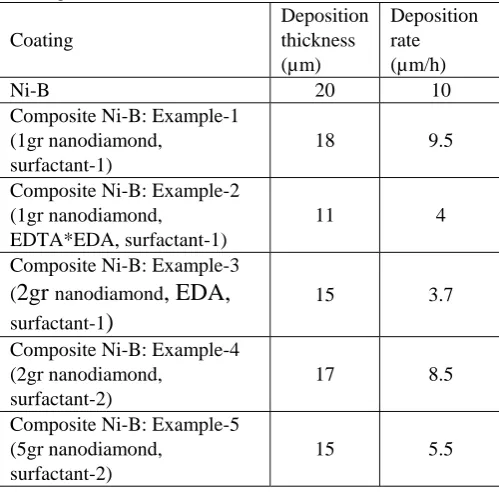
Deposition rates were estimated from the ratio of deposition thickness to coating time. In Table II, the deposition thickness and rates of coatings are shown.
Table II: Deposition thicknesses and rates of electroless coatings
Coating
Deposition thickness (µm)
Deposition rate (µm/h)
Ni-B 20 10
Composite Ni-B: Example-1 (1gr nanodiamond,
surfactant-1)
18 9.5 Composite Ni-B: Example-2
(1gr nanodiamond,
EDTA*EDA, surfactant-1)
11 4 Composite Ni-B: Example-3
(
2gr
nanodiamond, EDA,
surfactant-1)
15 3.7 Composite Ni-B: Example-4
(2gr nanodiamond, surfactant-2)
17 8.5 Composite Ni-B: Example-5
(5gr nanodiamond, surfactant-2)
15 5.5
[image:3.595.39.559.425.742.2]In terms of Micro Vickers hardness, under 100 gf load the obtained value of Ni-B approached 810 HV100 (Table III), which was exceptional microhardness value for as-plated condition. Ni-B coated substrates were 2.7 times harder than steel substrates.
Table III: Microhardness of electroless coatings in their as-plated and heat-treated conditions
Hardness (HV100)
Coatings As-plated Heat treated at 385 0C 1.5 hour Steel (not coated) 300
Ni-B 813 1175
Composite Ni-B: Example-1 (1gr nanodiamond,
surfactant-1)
810 1200 Composite Ni-B: Example-2
(1gr nanodiamond,
EDTA*EDA, surfactant-1)
810 1230 Composite Ni-B: Example-3
(
2gr
nanodiamond, EDA,
surfactant-1)
840 1230 Composite Ni-B: Example-4
(2gr nanodiamond, surfactant-2)
810 1220 Composite Ni-B: Example-5
(5gr nanodiamond, surfactant-2)
810 1250
Especially after heat treatment, the reinforcing effect of nanodiamonds was clear. The hardness of the composites was higher than that of the Ni-B alloy, increasing by 4 to 6%. The heat treated conditions microhardness was also higher at
higher coating particle contents. After certain heat treatment, the alloy contains crystalline nickel and nickel boride. Because of particle dispersion and borides precipitation, the hardness of the composite coating was increased.
From these results interesting coatings were chosen to study. Example 3 was examined because of different suspension composition and Example 5 because of highest hardness and high particle concentration in the bath.
In the Fig. 1, SEM images of the heat treated Ni-B, nano diamond incorporated composite Ni-B: example 3 and example 5 films are seen. Columnar grain growth of the Ni-B deposits formed the surface of the coating nodular (semi-hemispherical) structure as seen in Fig. 1 (a,b). This structure gave to the coating the naturally lubricious properties. Therefore being nodular, reduce surface contact and increase the wear resistance. In the composite coatings, adding particle to the structure made grains coarser. The difference between morphology of the film was the additional deposition time of the composite coatings. Because deposition mechanisms are complicated so deposition rates are slower. However, from SEM images of nano composite coatings, nano particles can not be dispersed homogeneously and agglomerates of diamonds are seen. On the contrary of expected, this heterogeneous structure explains the low increase of the coatings hardness (Table III). Furthermore, the microstructure of Composite Ni-B: example 3, which had more porosity, was different from Composite Ni-B: example 5. Adding EDTA and EDA mixture to the plating bath for dispersion made film microstructure more porosity (Fig. 1 (c-d)).
Coatings Magnification
x500 x20000
Ni-B
a) b)
Composite Ni-B: example 3
c) d)
Composite Ni-B: example 5
e) f)
incorporated composite Ni-B: example 3 (e-f) nano diamond incorporated composite Ni-B: example 5
From EDS analysis results, chemical composition of the electroless Ni-B coating was found 93.62% Ni, 5.09% B, 0.75% O and 0.54% C. In addition, EDS analysis was used to the agglomerated sides of composite coatings. A high amount of carbon content confirmed the nanodiamonds intensity at those sides (wt. 18% C). The EDS analysis results of coatings are given at Table IV.
Table IV: Chemical composition of the coatings Coatings Chemical composition (wt.%)
Ni-B 5.09 B, 93.62 Ni
Composite Ni-B: example 3 4.64 C, 7.25 B, 87.05 Ni Composite Ni-B: example 5 6.31 C, 11.46 B, 79.56 Ni
[image:4.595.305.551.75.288.2] [image:4.595.49.291.348.472.2]The coefficient of friction recorded simultaneously during the wear test clearly reveals the characteristics of the wear process. The average friction coefficient values, µav of steel and heat-treated electroless coated substrates are given in Table V.
Table V: Coefficient of friction and wear track dimensions of coatings in their heat treated conditions
Wear track dimensions Coatings
Avg. Friction
coeff. Width (µm)
Depth (µm)
Wear track area (µm2) Steel (1040) 0.37 425.7 3.8 1265.7
Ni-B 0.38 260 3.9 602
Composite Ni-B:
example 3 0.44 720.3 7.2 4081.2
Composite Ni-B:
example 5 0.36 179.7 0.3 43
Ni-B and composites obtained from electroless method were not effective to reduce friction coefficient. The reason of high friction coefficient is the oxides formed during the wear test. Wear occurs by the removal of the oxide layer as a result of sliding contact at the asperities. However, in between contacts, the oxide regrows on these denuded areas of the surface and is again removed with subsequent asperity engagement. Thus, coefficient of friction increases with oxide contact and after removed from surface, coating contact with alumina ball so the friction coefficient becomes less.
The results of the wear tests conducted by rubbing Al2O3 balls on different electroless coatings and using profilometer developed wear tracks dept and width measured. The depths of the wear tracks were measured (given Table V) which were lower than the thickness of the coatings. The smallest wear track area was observed in composite Ni-B: example 5. Fig. 2 shows the SEM micrographs of the wear tracks (at 100 magnification) produced by Al2O3 ball.
(a) (b)
(c) (d)
Figure 2: SEM micrographs of the wear tracks; (a) steel; (b) Ni-B; (c) Composite Ni-B: example 3; (d) Composite Ni-B: example 5.
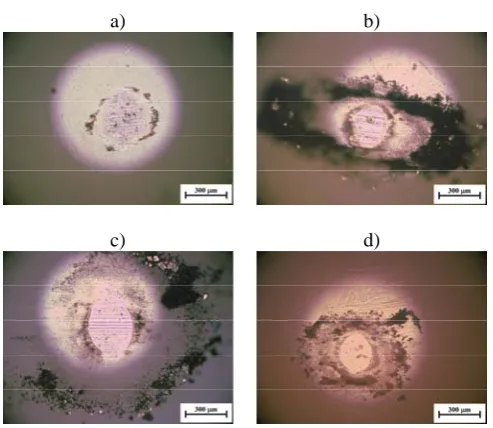
Composite Ni-B: example 5 had the smallest wear track area. After examination on SEM found that, wear created only a polishing effect on the coating surface. EDS examination shows Al2O3 was detected. The wear developed on the balls throughout the testing period, is presented in Fig. 3. The wear scars of the balls examined in optical microscope. The smallest wear scar area of the ball is seen on Composite Ni-B: example 5 coating, as seen in Fig. 3 (d).
a) b)
[image:4.595.304.551.451.665.2]c) d)
Figure 3: Optical micrographs of the wear scars formed on Al2O3 balls during testing of; (a) Steel; (b) Ni-B; (c) Composite Ni-B: example 3; (d) Composite Ni-B: example 5.
If the wear track of Ni-B coating was compared with Composite Ni-B: example 5 one, microcracks and wider oxide area were observed at the edges of the Ni-B wear tracks. It shows the worse adhesion of Ni-B coatings than composite example 5. Therefore, adding nano diamond, like in composite Ni-B: example 5 coatings had capability to slow down tribochemical oxidation on metal surfaces. The oxides around ball wear scars were larger than composite Ni-B: example 5 coatings, Fig. 3 (b).
IV. CONCLUSION
Electroless Ni-B coating whose formulation is not found commercially is developed. Having 5-6 wt% B and 10 µm/saat deposition rate of Ni-B coatings was observed. Particle additions to plating bath reduced the deposition rate to 4-5.5 µm/h levels because of complexity mechanism of composite coatings. Heat treatment (1.5 hour at 385 0C) increased the hardness of the Ni-B coatings at 1175 HV levels. They exhibit nodular structures that improve the wear resistance of deposits. The best resistance to wear was obtained by using nano diamond particle suspension with surfactant 2. Results indicated that, reinforcing Ni-B coatings with nano size diamond using electroless method increased microhardness and wear resistance properties of coated steel substrates.
REFERENCES
[1] W. Riedel, “Electroless Nickel Plating”, ASM International Metals Park, Ohio, USA, 1991.
[2] R.C. Agarwala, V. Agarwala, “ Electroless Alloy/Composite Coatings: A Review”, Sadhana, vol. 28, 2003, pp. 475-493.
[3] F. Delaunois, P. Lienard, “Heat treatments for electroless nickel–boron plating on aluminium alloys”, Surface and Coatings Technology, vol. 160, 2002, pp. 239-248.
[4] T. S. N. Sankara Narayanan, I. Baskaran, K. Krishnaveni, S. Parthiban, “Deposition of Electroless Ni-P Graded Coatings and Evaluation of Their Corrosion Resistance”, Surface and Coatings Technology, vol. 200, 2006, pp. 3438-3445.
[5] G. O. Mallory, J. B. Hajdu, “Electroless Plating: Fundamantals and Applications”, American Electroplaters and Surface Finishers Society, Florida, 1990.
[6] F. Delaunois, J. P. Petitjean, P. Lienard, M. Jacob-Duliere,
“Autocatalytic electroless nickel-boron plating on light alloys, Surface and Coatings Technology”, vol. 124, 2000, 201-209.
[7] H. Zhang, X. J. Zhang, Y. K. Zhang, “Structure and Properties of Electroless Nickel-Boron Alloys, Plating and Surface Finishing”, vol. 80, 1993, pp. 80-84.
[8] W. Y. Riedel, E. C. McComas, “Advances in Electroless Nickel Boron Coatings: Improvements to Lubricity and Wear Resistance on Surfaces of Automotive Components”, SAE Technical Paper Series,
2005-01-0615, Detroit, Michigan, 2005.
[9] W. Y. Riedel, T. O. Bailer , “Friction and Wear Reduction via an Ni-B Electroless Bath Coating for Metal Alloys”, Industrial Insight High Risk Technologies, 2005 April, JOM.
[10] G. Jiaqiang, L. Lei, S. Bin, H. Wenbin, D. Wenjiang, “Surface Nanocomposites Prepared by Electroless Plating”, Plating and Surface Finishing, 2004, pp.74-77.
[11] E. McComas, “Coating Compositions Containing Nickel and Boron and Particles”, United States Patent, No: 6319308 dated 20.11.2001. [12] W. D. Fields, R. N. Duncan, J. R. Zickgraf, and the ASM Committee
on Electroless Nickel Plating, “Electroless Nickel Plating”, pp. 219-243.