Is Machine Translation Getting Better over Time?
Yvette Graham Timothy Baldwin Alistair Moffat Justin Zobel Department of Computing and Information Systems
The University of Melbourne
{ygraham,tbaldwin,ammoffat,jzobel}@unimelb.edu.au
Abstract
Recent human evaluation of machine translation has focused on relative pref-erence judgments of translation quality, making it difficult to track longitudinal im-provements over time. We carry out a large-scale crowd-sourcing experiment to estimate the degree to which state-of-the-art performance in machine translation has increased over the past five years. To fa-cilitate longitudinal evaluation, we move away from relative preference judgments and instead ask human judges to provide direct estimates of the quality of individ-ual translations in isolation from alternate outputs. For seven European language pairs, our evaluation estimates an aver-age10-point improvement to state-of-the-art machine translation between 2007 and 2012, with Czech-to-English translation standing out as the language pair achiev-ing most substantial gains. Our method of human evaluation offers an economi-cally feasible and robust means of per-forming ongoing longitudinal evaluation of machine translation.
1 Introduction
Human evaluation provides the foundation for em-pirical machine translation (MT), whether human judges are employed directly to evaluate system output, or via the use of automatic metrics – validated through correlation with human judg-ments. Achieving consistent human evaluation is not easy, however. Annual evaluation cam-paigns conduct large-scale human assessment but report ever-decreasing levels of judge consistency – when given the same pair of translations to repeat-assess, even expert human judges will wor-ryingly often contradict both the preference
judg-ment of other judges and their own earlier prefer-ence (Bojar et al., 2013). For this reason, human evaluation has been targeted within the commu-nity as an area in need of attention, with increased efforts to develop more reliable methodologies.
One standard platform for human evaluation is WMT shared tasks, where assessments have (since 2007) taken the form of ranking five alternate sys-tem outputs from best to worst (Bojar et al., 2013). This method has been shown to produce more con-sistent judgments compared to fluency and ade-quacy judgments on a five-point scale (Callison-Burch et al., 2007). However, relative preference judgments have been criticized for being a sim-plification of the real differences between trans-lations, not sufficiently taking into account the large number of different types of errors of vary-ing severity that occur in translations (Birch et al., 2013). Relative preference judgments do not take into account the degree to which one translation is better than another – there is no way of knowing if a winning system produces far better translations than all other systems, or if that system would have ranked lower if the severity of its inferior transla-tion outputs were taken into account.
Rather than directly aiming to increase human judge consistency, some methods instead increase the number of reference translations available to automatic metrics. HTER (Snover et al., 2006) employs humans to post-edit each system out-put, creating individual human-targeted reference translations which are then used as the basis for computing the translation error rate. HyTER, on the other hand, is a tool that facilitates creation of very large numbers of reference translations (Dreyer and Marcu, 2012). Although both ap-proaches increase fairness compared to automatic metrics that use a single generic reference transla-tion, even human post-editors will inevitably vary in the way they post-edit translations, and the pro-cess of creating even a single new reference
lation for each system output is often too resource-intensive to be used in practice.
With each method of human evaluation, a trade-off exists between annotation time and the number of judgments collected. At one end of the spec-trum, the WMT human evaluation collects large numbers of quick judgments (approximately 3.5
minutes per screen, or20seconds per label) (Bojar et al., 2013).1 In contrast, HMEANT (Lo and Wu,
2011) uses a more time-consuming fine-grained semantic-role labeling analysis at a rate of approx-imately10sentences per hour (Birch et al., 2013). But even with this detailed evaluation methodol-ogy, human judges are inconsistent (Birch et al., 2013).
Although the trend appears to be toward more fine-grained human evaluation of MT output, it remains to be shown that this approach leads to more reliable system rankings – with a main rea-son to doubt this being that far fewer judgments will inevitably be possible. We take a counter-approach and aim to maintain the speed by which assessments are collected in shared task evalua-tions, but modify the evaluation set-up in two main ways: (1) we structure the judgments as monolin-gual tasks, reducing the cognitive load involved in assessing translation quality; and (2) we ap-ply judge-intrinsic quality control and score stan-dardization, to minimize noise introduced when crowd-sourcing is used to leverage numbers of as-sessments and to allow for the fact that human judges will vary in the way they assess transla-tions. Assessors are regarded as reliable as long as they demonstrate consistent judgments across a range of different quality translations.
We elicit direct estimates of quality from judges, as a quantitative estimate of the magni-tude of each attribute of interest (Steiner and Nor-man, 1989). Since we no longer look for rela-tive preference judgments, we revert back to the original fluency and adequacy criteria last used in WMT 2007 shared task evaluation. Instead of five-point fluency/adequacy scales, however, we use a (100-point) continuous rating scale, as this fa-cilitates more sophisticated statistical analyses of score distributions for judges, including worker-intrinsic quality control for crowd-sourcing. The latter does not depend on agreement with ex-perts, and is made possible by the reduction in
1WMT 2013 reports361hours of labor to collect61,695
labels, with approximately one screen of five pairwise com-parisons each yielding a set of10labels.
information-loss when a continuous scale is used. In addition, translations are assessed in isolation from alternate system outputs, so that judgments collected are no longer relative to a set of five translations. This has the added advantage of elim-inating the criticism made of WMT evaluations that systems sometimes gain advantage from luck-of-the-draw comparison with low quality output, and vice-versa (Bojar et al., 2011).
Based on our proposed evaluation methodology, human judges are able to work quickly, on average spending18and13seconds per single segment ad-equacy and fluency judgment, respectively. Addi-tionally, when sufficiently large volumes of such judgments are collected, mean scores reveal sig-nificant differences between systems. Further-more, since human evaluation takes the form of di-rect estimates instead of relative preference judg-ments, our evaluation introduces the possibility of large-scale longitudinal human evaluation. We demonstrate the value of longitudinal evaluation by investigating the improvement made to state-of-the-art MT over a five year time period (be-tween 2007 and 2012) using the best participating WMT shared task system output. Since it is likely that the test data used for shared tasks has varied in difficulty over this time period, we additionally propose a simple mechanism for scaling system scores relative to task difficulty.
Using the proposed methodology for measur-ing longitudinal change in MT, we conclude that, for the seven European language pairs we evalu-ate, MT has made an average 10% improvement over the past 5 years. Our method uses non-expert monolingual judges via a crowd-sourcing portal, with fast turnaround and at relatively modest cost.
2 Monolingual Human Evaluation
would have generated if they were asked to do the same translation.
The assessment task itself is typically structured as follows: the source segment (a sentence or a phrase), plus five alternative translations and a “reference” translation are displayed. The judge is then asked to assign a rank order to the five translations, from best to worst. A set of pairwise preferences are then inferred, and used to generate system rankings, without any explicit formation of stand-alone system “scores”.
This structure introduces the risk that judges will only compare translations against the refer-ence translation. Certainly, judges will vary in the degree they rely on the reference translation, which will in turn impact on inter-judge inconsis-tency. For instance, even when expert judges do assessments, it is possible that they use the ref-erence translation as a substitute for reading the source input, or do not read the source input at all. And if crowd-sourcing is used, can we really expect high proportions of workers to put the ad-ditional effort into reading and understanding the source input when a reference translation (proba-bly in their native language) is displayed? In re-sponse to this potential variability in how annota-tors go about the assessment task, we trial assess-ments of adequacy in which the source input is not displayed to human judges. We structure assess-ments as a monolingual task and pose them in such a way that the focus is on comparing themeaning
of reference translations and system outputs.2
We therefore ask human judges to assess the de-gree to which the system output conveys the same meaning as the reference translation. In this way, we focus the human judge indirectly on the ques-tion we wish to answer when assessing MT:does the translation convey the meaning of the source?
The fundamental assumption of this approach is that the reference translation accurately captures the meaning of the source; once that assumption is made, it is clear that the source is not required during the evaluation.
Benefits of this change are that the task is both easier to describe to novice judges, and easier to answer, and that it requires only monolingual speakers, opening up the evaluation to a vastly larger pool of genuinely qualified workers.
With this set-up in place for adequacy, we also
2This dimension of the assessment is similar but not
iden-tical to the monolingual adequacy assessment in early NIST evaluation campaigns (NIST, 2002).
re-introduce a fluency assessment. Fluency rat-ings can be carried out without the presence of a reference translation, reducing any remnant bias towards reference translations in the evaluation setup. That is, we propose a judgment regime in which each task is presented as a two-item fluency and adequacy judgment, evaluated separately, and with adequacy restructured into a monolingual “similarity of meaning” task.
When fluency and adequacy were originally used for human evaluation, each rating used a 5-point adjective scale (Callison-Burch et al., 2007). However, adjectival scale labels are problematic and ratings have been shown to be highly depen-dent on the exact wording of descriptors (Seymour et al., 1985). Alexandrov (2010) provides a sum-mary of the extensive problems associated with the use of adjectival scale labels, including bias result-ing from positively- and negatively-worded items not being true opposites of one another, and items intended to have neutral intensity in fact proving to have specific conceptual meanings.
It is often the case, however, that the question could be restructured so that the rating scale no longer requires adjectival labels, by posing the question as a statement such as The text is fluent Englishand asking the human assessor to specify how strongly they agree or disagree with that state-ment. The scale and labels can then be held con-stant across experimental set-ups for all attributes evaluated – meaning that if the scale is still biased in some way it will be equally so across all set-ups.
3 Assessor Consistency
One way of estimating the quality of a human evaluation regime is to measure its consistency: whether or not the same outcome is achieved if the same question is asked a second time. In MT, annotator consistency is commonly measured using Cohen’s kappa coefficient, or some variant thereof (Artstein and Poesio, 2008). Originally de-veloped as a means of establishing assessor inde-pendence, it is now commonly used in the reverse sense, with high numeric values being used as ev-idence of agreement. Two different measurements can be made – whether a judge is consistent with other judgments performed by themselves (intra-annotator agreement), and whether a judge is con-sistent with other judges (inter-annotator agree-ment).
categor-ical judgments, but is also commonly used with five-point adjectival-scale judgments, where the set of categories has an explicit ordering. One particular issue with five-point assessments is that score standardization cannot be applied. As such, a judge who assigns two neighboring intervals is awarded the same “penalty” for being “different” as the judge who chooses the extremities. The kappa coefficient cannot be directly applied to many-valued interval or continuous data.
This raises the question of how we should eval-uate assessor consistency when a continuous rat-ing scale is in place. No judge, when given the same translation to judge twice on a continuous rating scale, can be expected to give precisely the same score for each judgment (where repeat as-sessments are separated by a considerable number of intervening ones). A more flexible tool is thus required. We build such a tool by starting with two core assumptions:
A: When a consistent assessor is presented with a set of repeat judgments, the mean of the initial set of assessments will not be signifi-cantly different from the mean score of repeat assessments.
B: When a consistent judge is presented with a set of judgments for translations from two systems, one of which is known to produce better translations than the other, the mean score for the better system will be signifi-cantly higher than that of the inferior system. Assumption B is the basis of our quality-control mechanism, and allows us to distinguish between Turkers who are working carefully and those who are merely going through the motions. We use a
100-judgment HIT structure to control same-judge repeat items and deliberately-degraded system outputs (bad reference items) used for worker-intrinsic quality control (Graham et al., 2013).
bad reference translations for fluency judgments are created as follows: two words in the translation are randomly selected and randomly re-inserted elsewhere in the sentence (but not as the initial or final words of the sentence).
Since adding duplicate words will not degrade adequacy in the same way, we use an alternate method to createbad referenceitems for adequacy judgments: we randomly delete a short sub-string of length proportional to the length of the origi-nal translation to emulate a missing phrase. Since
total fltrd Assum A total fltrd
wrkrs wrkrs holds segs segs
[image:4.595.354.476.264.365.2]F 557 321 (58%) 314 (98.8%) 122k 78k (64%) A 542 283 (52%) 282 (99.6%) 102k 62k (61%)
Table 1: Total quality control filtered workers and assessments (F = fluency; A = adequacy).
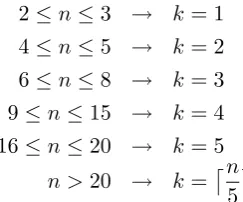
this is effectively a new degradation scheme, we tested against experts. For low-quality transla-tions, deleting just two words from a long sentence often made little difference. The method we even-tually settled on removes a sequence ofkwords, as a function of sentence lengthn:
2≤n≤3 → k= 1
4≤n≤5 → k= 2
6≤n≤8 → k= 3
9≤n≤15 → k= 4
16≤n≤20 → k= 5
n >20 → k=n5
To filter out careless workers, scores for
bad reference pairs are extracted, and a difference-of-means test is used to calculate a worker-reliability estimate in the form of a
p-value. Paired tests are then employed using the raw scores for degraded and corresponding system outputs, using a reliability significance threshold of p < 0.05. If a worker does not demonstrate the ability to reliably distinguish between a bad system and a better one, the judgments from that worker are discarded. This methodology means that careless workers who habitually rate translations either high or low will be detected, as well as (with high probability) those that click (perhaps via robots) randomly. It also has the advantage of not filtering out workers who are internally consistent but whose scores happen not to correspond particularly well to a set of expert assessments.
Si Si+5
1 bad reference its corresponding system output 1 system output a repeat of it
1 reference its corresponding system output Above in reverse for Siand Si+5
[image:5.595.81.282.63.154.2]4 system outputs 4 system outputs
Table 2: Control of repeat item pairs. Si denotes
theithset of 10 translations assessed within a 100
translation HIT.
the vast majority (around 99%) of reliable work-ers have no significant difference between mean scores for repeat items.
4 Five Years of Machine Translation
To estimate the improvement in MT that took place between 2007 and 2012, we asked work-ers on Amazon’s Mechanical Turk (MTurk) to rate the quality of translations produced by the best-reported participating system for each of WMT 2007 and WMT 2012 (Callison-Burch et al., 2007; Callison-Burch et al., 2012). Since it is likely that the test set has changed in difficulty over this time period, we also include in the evaluation the orig-inal test data for 2007 and 2012, translated by a single current MT system. We use the latter to cal-ibrate the results for test set difficulty, by calcu-lating the average difference in rating,∆, between the 2007 and 2012 test sets. This is then added to the difference in rating for the best-reported systems in 2012 and 2007, to arrive at an over-all evaluation of the 5-year gain in MT quality for a given language pair, separately for fluency and adequacy.
Experiments were carried out for each of Ger-man, French and Spanish into and out of English, and also for Czech-to-English. English-to-Czech was omitted because of a low response rate on MTurk. For language pairs where two systems tied for first place in the shared task, a random selec-tion of translaselec-tions from both systems was made.
HIT structure
To facilitate quality control, we construct each HIT on MTurk as an assessment of 100 trans-lations. Each individual translation is rated in isolation from other translations with workers re-quired to iterate through 100 translations without the opportunity to revisit earlier assessments. A 100-translation HIT contains the following items:
70 randomly selected system outputs made up of roughly equal proportions of translations for each evaluated system, 10 bad reference translations (each based on one of the 70 system outputs), 10 exact repeats and 10 reference translations. We di-vide a 100-translation HIT into 10 sets of 10 trans-lations. Table 2 shows how the content of each set is determined. Translations are then randomized onlywithineach set (of 10 translations), with the original sequence order of the sets preserved. In this way, the order of quality control items is un-predictable but controlled so pairs are separated by a minimum of 40 intervening assessments (4 sets of translations). The HIT structure results in 80% of assessed translations corresponding to genuine outputs of a system (including exact repeat assess-ments), which is ultimately what we wish to ob-tain, with 20% of assessments belonging to quality control items (bad reference or reference transla-tions).
Assessment set-up
Separate HITs were provided for evaluation of flu-ency and adequacy. For fluflu-ency, a single system output was displayed per screen, with a worker re-quired to rate the fluency of a translation on a100 -point visual analog scale with no displayed -point scores. A similar set-up was used for adequacy but with the addition of a reference translation (dis-played in gray font to distinguish it from the sys-tem output being assessed). The Likert-type state-ment that framed the judgstate-ment wasRead the text below and rate it by how much you agree that:
• [for fluency]the text is fluent English
• [for adequacy]the black text adequately ex-presses the meaning of the gray text.
In neither case was the source language string pro-vided to the workers.
Tasks were published on MTurk, with no re-gion restriction but the stipulation that only na-tive speakers of the target language should com-plete HITs, and with a qualification of an MTurk prior HIT-approval rate of at least 95%. Instruc-tions were always presented in the target language. Workers were paid US$0.50per fluency HIT, and US$0.60per adequacy HIT.3
3Since insufficient assessments were collected for French
Close to one thousand individual Turkers con-tributed to this experiment (some did both flu-ency and adequacy assessments), providing a to-tal of more than 220,000 translations, of which
140,000 were provided by workers meeting the quality threshold.
In general, it cost approximately US$30 to as-sess each system, with low-quality workers ap-proximately doubling the cost of the annotation. We rejected HITs where it was clear that random-clicking had taken place, but did not reject solely on the basis of having not met the quality control threshold, to avoid penalizing well-intentioned but low-quality workers.
Overall change in performance
Table 3 shows the overall gain made in five years, from WMT 07 to WMT 12. Mean scores for the two top-performing systems from each shared task (BEST07, BEST12) are included, as well as scores
for the benchmark current MT system on the two test sets (CURR07, CURR12). For each language
pair, a 100-translation HIT was constructed by randomly selecting translations from the pool of
(3003 + 2007)×2that were available, and this re-sults in apparently fewer assessments for the 2007 test set. In fact, numbers of evaluated translations are relative to the size of each test set. Averagez
scores for each system are also presented, based on the mean and standard deviation of all assessments provided by an individual worker, with positive values representing deviations above the mean of workers. In addition, we include mean BLEU
(Pa-pineni et al., 2001) and METEOR (Banerjee and
Lavie, 2005) automatic scores for the same system outputs.
The CURR benchmark shows fluency scores
that are5.9points higher on the 2007 data set than they are on the 2012 test data, with a larger dif-ference in adequacy of 8.3 points. As such, the 2012 test data is more challenging than the 2007 test data. Despite this, both fluency and adequacy scores for the best system in 2012 have increased by 4.5 and2.0 points respectively, amounting to estimated average gains of10.4points in fluency and 10.3 points in adequacy for state-of-the-art MT across the seven language pairs.
Looking at the standardized scores, it is appar-ent that the presence of the CURRtranslations for
the 2007 test set pushes the mean score for the 2007 best systems below zero. The presence in the HITs of reference translations also shifts
stan-dardized system evaluations below zero, because they are not attributable to any of the systems be-ing assessed.4
Results for automatic metrics lead to similar conclusions: that the test set has indeed increased in difficulty; and that, in spite of this, substantial improvements have been made according to auto-matic metrics, +13.5 using BLEU, and +7.1 on
average using METEOR.
Language pairs
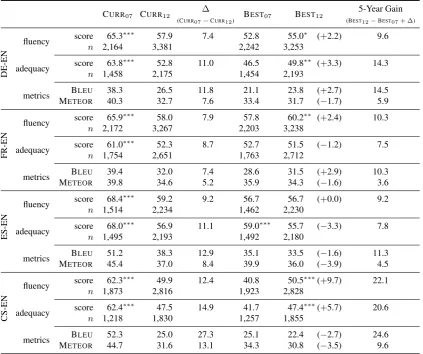
Table 4 shows mean fluency and adequacy scores by language pair for translation into English. Rel-ative gains in both adequacy and fluency for the to-English language pairs are in agreement with the estimates generated through the use of the two au-tomatic metrics. Most notably, Czech-to-English translation appears to have made substantial gains across the board, achieving more than double the gain made by some of the other language pairs; re-sults for best participating 2007 systems show that this may in part be caused by the fact that Czech-to-English translation had a lower 2007 baseline to begin with (BEST07F:40.8; A:41.7) in
compar-ison to, for example, Spanish-to-English transla-tion (BEST07F:56.7; A:59.0).
Another notable result is that although the test data for each year’s shared task is parallel across five languages, test set difficulty increases by dif-ferent degrees according to human judges and au-tomatic metrics, with BLEU scores showing
sub-stantial divergence across the to-English language pairs. Comparing BLEU scores achieved by the
benchmark system for Spanish to English and Czech-to-English, for example, the benchmark system achieves close scores on the 2007 test data with a difference of only |52.3 − 51.2| = 1.1, compared to the score difference for the bench-mark scores for translation of the 2012 test data of |25.0−38.3|= 13.3. This may indicate that the increase in test set difficulty that has taken place over the years has made the shared task dispro-portionately more difficult for some language pairs than for others. It does seem that some language pairs are harder to translate than others, and the differential change may be a consequence of the fact that increasing test set complexity for all lan-guages in parallel has a greater impact on transla-tion difficulty for language pairs that are intrinsi-cally harder to translate between.
4Scores for reference translations can optionally be
CURR07 CURR12 (CURR ∆ BEST07 BEST12 5-Year Gain
07−CURR12) (BEST12−BEST07+ ∆)
fluenc
y score 64.1 58.2 5.9 53.5 58.0 (+4.5) 10.4
z 0.18 0.00 0.18 −0.16 0.00 (+0.16) 0.34
n 12,334 18,654 12,513 18,579
adequac
y score 65.0 56.7 8.3 54.0 56.0 (+2.0) 10.3
z 0.18 −0.07 0.25 −0.16 −0.09 (+0.07) 0.32
n 10,022 14,870 10,049 14,979
metrics
BLEU 41.5 30.0 11.4 25.6 27.7 (+2.1) 13.5
[image:7.595.88.512.281.635.2]METEOR 49.2 41.1 8.1 41.1 40.1 (−1.0) 7.1
Table 3: Average human evaluation results for all language pairs; mean and standardized zscores are computed in each case forntranslations. In this table, and in Tables 4 and 5, all reported fluency and adequacy values are in points relative to the100-point assessment scale.
CURR07 CURR12 ∆ BEST07 BEST12 5-Year Gain
(CURR07−CURR12) (BEST12−BEST07+ ∆)
DE-EN
fluency scoren 2,16465.3∗∗∗ 3,38157.9 7.4 2,24252.8 3,25355.0∗ (+2.2) 9.6
adequacy scoren 1,45863.8∗∗∗ 2,17552.8 11.0 1,45446.5 2,19349.8∗∗ (+3.3) 14.3
metrics METEORBLEU 38.340.3 26.532.7 11.87.6 33.421.1 23.831.7 ((−+1.7)2.7) 14.55.9
FR-EN
fluency scoren 2,17265.9∗∗∗ 3,26758.0 7.9 2,20357.8 3,23860.2∗∗ (+2.4) 10.3
adequacy scoren 1,75461.0∗∗∗ 2,65152.3 8.7 1,76352.7 2,71251.5 (−1.2) 7.5
metrics METEORBLEU 39.839.4 34.632.0 7.45.2 28.635.9 31.534.3 ((+−2.9)1.6) 10.33.6
ES-EN
fluency scoren 1,51468.4∗∗∗ 2,23459.2 9.2 1,46256.7 2,23056.7 (+0.0) 9.2
adequacy scoren 1,49568.0∗∗∗ 2,19356.9 11.1 1,49259.0∗∗∗ 2,18055.7 (−3.3) 7.8
metrics METEORBLEU 45.451.2 37.038.3 12.98.4 35.139.9 33.536.0 ((−−1.6)3.9) 11.34.5
CS-EN
fluency scoren 1,87362.3∗∗∗ 2,81649.9 12.4 1,92340.8 2,82850.5∗∗∗(+9.7) 22.1
adequacy scoren 1,21862.4∗∗∗ 1,83047.5 14.9 1,25741.7 1,85547.4∗∗∗(+5.7) 20.6
metrics METEORBLEU 52.344.7 25.031.6 27.313.1 34.325.1 22.430.8 ((−−3.5)2.7) 24.69.6
Table 4: Human evaluation of WMT 2007 and 2012 best systems for to-English language pairs. Mean scores are computed in each case forntranslations. In this table and in Table 5,∗denotes significance at
p <0.05;∗∗significance atp <0.01; and∗∗∗significance atp <0.001.
Table 5 shows results for translation out-of En-glish, and once again human evaluation scores are in agreement with automatic metrics with English-to-Spanish translation achieving most substantial
gains for the three out-of-English language pairs, an increase of 12.4 points for fluency, and 11.8
CURR07 CURR12 (CURR ∆ BEST07 BEST12 5-Year Gain
07−CURR12) (BEST12−BEST07+ ∆)
EN-ES
fluency scoren 2,28677.2∗∗∗ 3,31873.4 3.8 2,33663.3 3,42071.9∗∗∗(+8.6) 12.4
adequacy scoren 1,41075.2∗∗∗ 2,03968.1 7.1 1,39962.5 2,11267.2 (+4.7) 11.8
metrics METEORBLEU 48.269.9 38.759.6 10.39.5 57.029.1 35.358.1 ((++1.1)6.2) 15.711.4
EN-FR
fluency scoren 1,00857.1 1,64555.2 1.9 1,03949.5 1,58856.4 (+6.9) 8.8
adequacy scoren 1,23464.2∗ 1,87761.9 2.3 1,27457.2 1,77562.3 (+5.1) 7.4
metrics METEORBLEU 37.259.4 30.852.9 6.46.5 50.425.3 29.952.0 ((++1.6)4.6) 11.08.1
EN-DE
fluency scoren 1,31752.3 1,99354.1∗ −1.8 1,30853.7 2,02255.5 (+1.8) 0.0
adequacy scoren 1,45360.3∗∗ 2,10557.4 2.9 1,41058.3 2,15258.3 (+0.0) 2.9
[image:8.595.72.524.68.338.2]metrics METEORBLEU 23.644.7 18.739.1 4.95.6 36.714.6 17.238.0 ((++1.3)2.6) 7.56.9
Table 5: Human evaluation of WMT 2007 and 2012 best systems for out of English language pairs. Mean scores are computed in each case forntranslations.
fluency and 7.4 points for adequacy. English-to-German translation achieves the lowest gain of all languages, with apparently no improvement in fluency, as the human fluency evaluation of the benchmark system on the supposedly easier 2007 data receives a substantially lower score than the same system over the 2012 data. This result demonstrates why fluency, evaluated without a ref-erence translation, should not be used to evalu-ate MT systems without an adequacy assessment, since it is entirely possible for a low-adequacy translation to achieve a high fluency score.
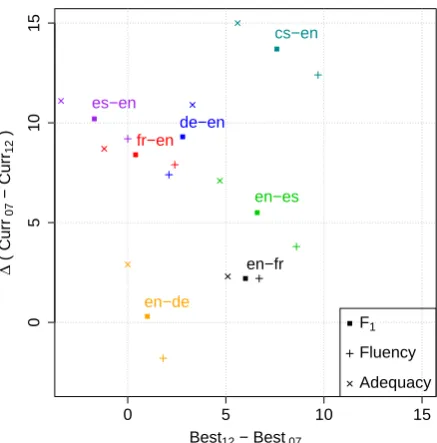
For all language pairs, Figure 1 plots the net gain in fluency, adequacy andF1 against increase
in test data difficulty.
5 Conclusion
We carried out a large-scale human evaluation of best-performing WMT 2007 and 2012 shared task systems in order to estimate the improvement made to state-of-the-art machine translation over this five year time period. Results show significant improvements have been made in machine trans-lation of European language pairs, with Czech-to-English recording the greatest gains. It is also clear from our data that the difficulty of the task has risen over the same period, to varying degrees
0 5 10 15
0
5
10
15
Best12 − Best 07
∆
( Curr
07
− Curr
12
) fr−ende−en
es−en
cs−en
en−de
en−fr en−es
F1
Fluency
Adequacy
Figure 1: Mean fluency, adequacy and combined
F1 scores for language pairs.
for individual language pairs.
Researchers interested in making use of the dataset are invited to contact the first author.
[image:8.595.309.528.392.614.2]References
A. Alexandrov. 2010. Characteristics of single-item measures in Likert scale format. The Electronic
Journal of Business Research Methods, 8:1–12.
R. Artstein and M. Poesio. 2008. Inter-coder agree-ment for computational linguistics. Computational
Linguistics, 34(4):555–596.
S. Banerjee and A. Lavie. 2005. METEOR: An au-tomatic metric for mt evaluation with improved cor-relation with human judgements. InProc. Wkshp. Intrinsic and Extrinsic Evaluation Measures for
Ma-chine Translation and/or Summarization, pages 65–
73, Ann Arbor, MI.
A. Birch, B. Haddow, U. Germann, M. Nadejde, C. Buck, and P. Koehn. 2013. The feasibility of HMEANT as a human MT evaluation metric. In
Proc. 8th Wkshp. Statistical Machine Translation,
pages 52–61, Sofia, Bulgaria. ACL.
O. Bojar, M. Ercegovˇcevic, M. Popel, and O. Zaidan. 2011. A grain of salt for the WMT manual evalua-tion. InProc. 6th Wkshp. Statistical Machine
Trans-lation, pages 1–11, Edinburgh, Scotland. ACL.
O. Bojar, C. Buck, C. Callison-Burch, C. Federmann, B. Haddow, P. Koehn, C. Monz, M. Post, R. Soricut, and L. Specia. 2013. Findings of the 2013 Work-shop on Statistical Machine Translation. In Proc.
8th Wkshp. Statistical Machine Translation, pages
1–44, Sofia, Bulgaria. ACL.
C. Callison-Burch, C. Fordyce, P. Koehn, C. Monz, and J. Schroeder. 2007. (Meta-) evaluation of machine translation. InProc. 2nd Wkshp. Statistical Machine
Translation, pages 136–158, Prague, Czech
Repub-lic. ACL.
C. Callison-Burch, P. Koehn, C. Monz, M. Post, R. Soricut, and L. Specia. 2012. Findings of the 2012 Workshop on Statistical Machine Translation.
InProc. 7th Wkshp. Statistical Machine Translation,
pages 10–51, Montreal, Canada. ACL.
M. Dreyer and D. Marcu. 2012. HyTER: Meaning-equivalent semantics for translation evaluation. In
Proc. 2012 Conf. North American Chapter of the
ACL: Human Language Technologies, pages 162–
171, Montreal, Canada. ACL.
Y. Graham, T. Baldwin, A. Moffat, and J. Zobel. 2013. Continuous measurement scales in human evalua-tion of machine translaevalua-tion. In Proc. 7th Linguis-tic Annotation Wkshp. & Interoperability with
Dis-course, pages 33–41, Sofia, Bulgaria. ACL.
C. Lo and D. Wu. 2011. MEANT: An inexpensive, high-accuracy, semi-automatic metric for evaluating translation utility based on semantic roles. InProc. 49th Annual Meeting of the ACL: Human Language
Techologies, pages 220–229, Portland, OR. ACL.
NIST. 2002. The 2002 NIST machine translation evaluation plan. National Institute of Standards and Technology. http://www.itl.nist.gov/ iad/894.01/tests/mt/2003/doc/mt03_ evalplan.v2.pdf.
K. Papineni, S. Roukos, T. Ward, and W.-J. Zhu. 2001. BLEU: A method for automatic evaluation of machine translation. Technical Report RC22176 (W0109-022), IBM Research, Thomas J. Watson Research Center.
R. A. Seymour, J. M. Simpson, J. E. Charlton, and M. E. Phillips. 1985. An evaluation of length and end-phrase of visual analogue scales in dental pain.
Pain, 21:177–185.
M. Snover, B. Dorr, R. Scwartz, J. Makhoul, and L. Micciula. 2006. A study of translation error rate with targeted human annotation. InProc. 7th Bien-nial Conf. of the Assoc. Machine Translaiton in the
Americas, pages 223–231, Boston, MA.
D. L. Steiner and G. R. Norman. 1989. Health Mea-surement Scales, A Practical Guide to their
Devel-opment and Use. Oxford University Press, Oxford,