Distinguishing Antonyms and Synonyms
in a Pattern-based Neural Network
Kim Anh Nguyen and Sabine Schulte im Walde and Ngoc Thang Vu
Institut f¨ur Maschinelle Sprachverarbeitung Universit¨at Stuttgart
Pfaffenwaldring 5B, 70569 Stuttgart, Germany
{nguyenkh,schulte,thangvu}@ims.uni-stuttgart.de
Abstract
Distinguishing between antonyms and synonyms is a key task to achieve high performance in NLP systems. While they are notoriously difficult to distinguish by distributional co-occurrence models, pattern-based methods have proven effec-tive to differentiate between the relations. In this paper, we present a novel neu-ral network model AntSynNET that ex-ploits lexico-syntactic patterns from syn-tactic parse trees. In addition to the lexi-cal and syntactic information, we success-fully integrate the distance between the re-lated words along the syntactic path as a new pattern feature. The results from clas-sification experiments show that AntSyn-NET improves the performance over prior pattern-based methods.
1 Introduction
Antonymy and synonymy represent lexical se-mantic relations that are central to the organization of the mental lexicon (Miller and Fellbaum, 1991). While antonymy is defined as the oppositeness be-tween words, synonymy refers to words that are similar in meaning (Deese, 1965; Lyons, 1977). From a computational point of view, distinguish-ing between antonymy and synonymy is impor-tant for NLP applications such as Machine Trans-lation and Textual Entailment, which go beyond a general notion of semantic relatedness and require to identify specific semantic relations. However, due to interchangeable substitution, antonyms and synonyms often occur in similar contexts, which makes it challenging to automatically distinguish between them.
Two families of approaches to differentiate be-tween antonyms and synonyms are predominent
in NLP. Both make use of distributional vector representations, relying on the distributional hy-pothesis (Harris, 1954; Firth, 1957), that words with similar distributions have related meanings: co-occurrence models and pattern-based models. These distributional semantic models (DSMs) of-fer a means to represent meaning vectors of words or word pairs, and to determine their semantic re-latedness (Turney and Pantel, 2010).
In co-occurrence models, each word is repre-sented by a weighted feature vector, where fea-tures typically correspond to words that co-occur in particular contexts. When using word embed-dings, these models rely on neural methods to rep-resent words as low-dimensional vectors. To cre-ate the word embeddings, the models either make use of neural-based techniques, such as the skip-gram model (Mikolov et al., 2013), or use matrix factorization (Pennington et al., 2014) that builds word embeddings by factorizing word-context co-occurrence matrices. In comparison to standard co-occurrence vector representations, word em-beddings address the problematic sparsity of word vectors and have achieved impressive results in many NLP tasks such as word similarity (e.g., Pennington et al. (2014)), relation classification (e.g., Vu et al. (2016)), and antonym-synonym dis-tinction (e.g., Nguyen et al. (2016)).
Inpattern-based models, vector representations make use of lexico-syntactic surface patterns to distinguish between the relations of word pairs. For example, Justeson and Katz (1991) suggested that adjectival opposites co-occur with each other in specific linear sequences, such as between X and Y. Hearst (1992) determined surface pat-terns, e.g., X such as Y, to identify nomi-nal hypernyms. Lin et al. (2003) proposed two textual patterns indicating semantic incompatibil-ity, from X to Y and either X or Y, to distinguish opposites from semantically similar
words. Roth and Schulte im Walde (2014) pro-posed a method that combined patterns with dis-course markers for classifying paradigmatic rela-tions including antonymy, synonymy, and hyper-nymy. Recently, Schwartz et al. (2015) used two prominent patterns from Lin et al. (2003) to learn word embeddings that distinguished antonyms from similar words in determining degrees of sim-ilarity and word analogy.
In this paper, we present a novel pattern-based neural method AntSynNET to distinguish antonyms from synonyms. We hypothesize that antonymous word pairs co-occur with each other in lexico-syntactic patterns within a sentence more often than would be expected by synonymous pairs. This hypothesis is inspired by corpus-based studies on antonymy and synonymy. Among oth-ers, Charles and Miller (1989) suggested that ad-jectival opposites co-occur in patterns; Fellbaum (1995) stated that nominal and verbal opposites co-occur in the same sentence significantly more often than chance; Lin et al. (2003) argued that if two words appear in clear antonym patterns, they are unlikely to represent synonymous pair.
We start out by inducing patterns betweenXand Yfrom a large-scale web corpus, where Xand Y represent two words of an antonym or synonym word pair, and the pattern is derived from the sim-ple paths between X and Y in a syntactic parse tree. Each node in the simple path combines lexi-cal and syntactic information; in addition, we sug-gest a novel feature for the patterns, i.e., the dis-tance between the two words along the syntactic path. All pattern features are fed into a recur-rent neural network with long short-term mem-ory (LSTM) units (Hochreiter and Schmidhuber, 1997), which encode the patterns as vector repre-sentations. Afterwards, the vector representations of the patterns are used in a classifier to distin-guish between antonyms and synonyms. The re-sults from experiments show that AntSynNET im-proves the performance over prior pattern-based methods. Furthermore, the implementation of our models is made publicly available1.
The remainder of this paper is organized as fol-lows: In Section 2, we present previous work dis-tinguishing antonyms and synonyms. Section 3 describes our proposed AntSynNET model. We present the induction of the patterns (Section 3.1), describe the recurrent neural network with long
1https://github.com/nguyenkh/AntSynNET
short-term memory units which is used to en-code patterns within a vector representation (Sec-tion 3.2), and describe two models to classify antonyms and synonyms: the pure pattern-based model (Section 3.3.1) and the combined model (Section 3.3.2). After introducing two baselines in Section 4, we describe our dataset, experimental settings, results of our methods, the effects of the newly proposed distance feature, and the effects of the various types of word embeddings. Section 6 concludes the paper.
2 Related Work
Pattern-based methods: Regarding the task of antonym-synonym distinction, there exist a vari-ety of approaches which rely on patterns. Lin et al. (2003) used bilingual dependency triples and patterns to extract distributionally similar words. They relied on clear antonym patterns such as from X to Y and either X or Y in a post-processing step to distinguish antonyms from synonyms. The main idea is that if two wordsX and Y appear in one of these patterns, they are unlikely to represent synonymous pair. Schulte im Walde and K¨oper (2013) proposed a method to distinguish between the paradigmatic relations antonymy, synonymy and hypernymy in German, based on automatically acquired word patterns. Roth and Schulte im Walde (2014) combined gen-eral lexico-syntactic patterns with discourse mark-ers as indicators for the same relations, both for German and for English. They assumed that if two phrases frequently co-occur with a specific discourse marker, then the discourse relation ex-pressed by the corresponding marker should also indicate the relation between the words in the af-fected phrases. By using the raw corpus and a fixed list of discourse markers, the model can eas-ily be extended to other languages. More re-cently, Schwartz et al. (2015) presented a symmet-ric pattern-based model for word vector represen-tation in which antonyms are assigned to dissim-ilar vector representations. Differently to the pre-vious pattern-based methods which used the stan-dard distribution of patterns, Schwartz et al. used patterns to learn word embeddings.
anal-ysis, by assigning signs to the entries in the co-occurrence matrix on which latent semantic anal-ysis operates, such that synonyms would tend to have positive cosine similarities, and antonyms would tend to have negative cosine similarities. Scheible et al. (2013) showed that the distribu-tional difference between antonyms and synonyms can be identified via a simple word space model by using appropriate features. Instead of taking into account all words in a window of a certain size for feature extraction, the authors experimented with only words of a certain part-of-speech, and restricted distributions. Santus et al. (2014) pro-posed a different method to distinguish antonyms from synonyms by identifying the most salient dimensions of meaning in vector representations and reporting a new average-precision-based dis-tributional measure and an entropy-based mea-sure. Ono et al. (2015) trained supervised word embeddings for the task of identifying antonymy. They proposed two models to learn word embed-dings: the first model relied on thesaurus informa-tion; the second model made use of distributional information and thesaurus information. More re-cently, Nguyen et al. (2016) proposed two meth-ods to distinguish antonyms from synonyms: in the first method, the authors improved the qual-ity of weighted feature vectors by strengthening those features that are most salient in the vec-tors, and by putting less emphasis on those that are of minor importance when distinguishing de-grees of similarity between words. In the second method, the lexical contrast information was inte-grated into the skip-gram model (Mikolov et al., 2013) to learn word embeddings. This model suc-cessfully predicted degrees of similarity and iden-tified antonyms and synonyms.
3 AntSynNET: LSTM-based Antonym-Synonym Distinction
In this section, we describe the AntSynNET model, using a pattern-based LSTM for distin-guishing antonyms from synonyms. We first present the induction of patterns from a parsed cor-pus (Section 3.1). Section 3.2 then describes how we utilize the recurrent neural network with long short-term memory units to encode the patterns as vector representation. Finally, we present the AntSynNET model and two approaches to classify antonyms and synonyms (Section 3.3).
3.1 Induction of Patterns
Corpus-based studies on antonymy have sug-gested that opposites co-occur with each other within a sentence significantly more often than would be expected by chance. Our method thus makes use of patterns as the main indicators of word pair co-occurrence, to enforce a distinction between antonyms and synonyms. Figure 1 shows a syntactic parse tree of the sentence “My old village has been provided with the new services”. Following the characterizations of a tree in graph theory, any two nodes (vertices) of a tree are connected by a simple path (or one unique path). The simple path is the shortest path between any two nodes in a tree and does not contain repeated nodes. In the example, the lexico-syntactic tree pattern of the antonymous pairold–new is deter-mined by finding the simple path (in red) from the lemma old to the lemma new. It focuses on the most relevant information and ignores irrelevant information which does not appear in the simple path (i.e., has, been). The example pattern betweenX = oldandY = newin Fig-ure 1 is represented as follows: X/JJ/amod/2 --village/NN/nsubj/1 -- provide/VBN/ROOT/0 -- with/IN/prep/1 -- service/NNS/pobj/2 -- Y/JJ/amod/3.
Node Representation: The path patterns make use of four features to represent each node in the syntax tree: lemma, part-of-speech (POS) tag, de-pendency label and distance label. The lemma fea-ture capfea-tures the lexical information of words in the sentence, while the POS and dependency fea-tures capture the morpho-syntactic information of the sentence. The distance label measures the path distance between the target word nodes in the syn-tactic tree. Each step between a parent and a child node represents a distance of 1; and the ancestor nodes of the remaining nodes in the path are rep-resented by a distance of 0. For example, the node providedis an ancestor node of the simple path from old tonew. The distances from the node providedto the nodesvillageandoldare 1 and 2, respectively.
The vector representation of each node concate-nates the four-feature vectors as follows:
~vnode = [~vlemma⊕~vpos⊕~vdep⊕~vdist]
where ~vlemma,~vpos,~vdep,~vdist represent the
Root
provided/VBN
has/VBZ been/VBN
village/NN with/IN
services/NNS
the/DT My/PRP$ old/JJ
new/JJ ROOT
nsubj 1
prep 1
pobj 2 amo
d 2
[image:4.595.132.468.61.269.2]amod 3
Figure 1: Illustration of the syntactic tree for the sentence“My old village has been provided with the new services”. Red lines indicate the path from the wordoldto the wordnew.
and distance label, respectively; and the⊕denotes the concatenation operation.
Pattern Representation: For a pattern p which is constructed by the sequence of nodes n1, n2, ..., nk, the pattern representation of p is
a sequence of vectors: p = [~n1, ~n2, ..., ~nk]. The
pattern vector~vp is then encoded by applying a
recurrent neural network.
3.2 Recurrent Neural Network with Long Short-Term Memory Units
A recurrent neural network (RNN) is suitable for modeling sequential data by a vector representa-tion. In our methods, we use a long short-term memory (LSTM) network, a variant of a recur-rent neural network to encode patterns, for the following reasons. Given a sequence of words p = [n1, n2, ..., nk] as input data, an RNN
pro-cesses each wordnt at a time, and returns a
vec-tor of state hk for the complete input sequence.
For each time step t, the RNN updates an inter-nal memory statehtwhich depends on the current
inputntand the previous stateht−1. Yet, if the
se-quential input is a long-term dependency, an RNN faces the problem of gradient vanishing or explod-ing, leading to difficulties in training the model.
LSTM units address these problems. The un-derlying idea of an LSTM is to use an adaptive gat-ing mechanism to decide on the degree that LSTM units keep the previous state and memorize the ex-tracted features of the current input. More
specif-ically, an LSTM comprises four components: an input gateit, a forget gate ft, an output gate ot,
and a memory cell ct. The state of an LSTM at
each time steptis formalized as follows: it=σ(Wi·xt+Ui·ht−1+bi)
ft=σ(Wf ·xt+Uf ·ht−1+bf)
ot=σ(Wo·xt+Uo·ht−1+bo)
gt= tanh(Wc·xt+Uc·ht−1+bc)
ct=it⊗gt+ft⊗ct−1
W refers to a matrix of weights that projects in-formation between two layers;bis a layer-specific vector of bias terms;σ denotes the sigmoid func-tion. The output of an LSTM at a time step tis computed as follows:
ht=ot⊗tanh(ct)
where⊗denotes element-wise multiplication. In our methods, we rely on the last statehkto
repre-sent the vector~vpof a patternp= [~n1, ~n2, ..., ~nk].
3.3 The Proposed AntSynNET Model
LSTM LSTM LSTM LSTM LSTM LSTM
~vp ~vp
Mean Pooling Logistic Regression
X/ADJ/amod/0 from/ADP/prep/1 Y/ADJ/pobj/2 Y/ADJ/amod/1 world/NOUN/pobj/0 X/ADJ/conj/1
~vlemma
~vpos
~vdep
[image:5.595.77.524.61.251.2]~vdist
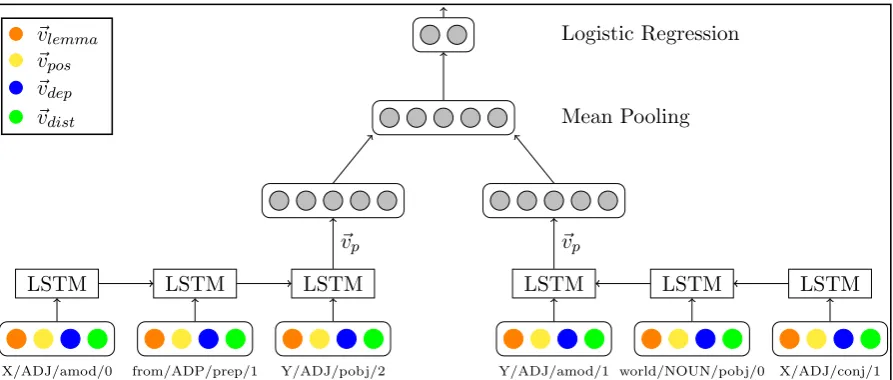
Figure 2: Illustration of theAntSynNET model. Each word pair is represented by several patterns, and each pattern represents a path in the graph of the syntactic tree. Patterns consist of several nodes where each node is represented by a vector with four features: lemma, POS, dependency label, and distance label. The mean pooling of the pattern vectors is the vector representation of each word pair, which is then fed to the logistic regression layer to classify antonyms and synonyms.
3.3.1 Pattern-based AntSynNET
In this model, we make use of a recurrent neural network with LSTM units to encode patterns con-taining a sequence of nodes. Figure 2 illustrates the AntSynNET model. Given a word pair(x, y), we induce patterns for(x, y)from a corpus, where each pattern represents a path fromxtoy(cf. Sec-tion 3.1). We then feed each patternpof the word pair (x, y) into an LSTM to obtain~vp, the vector
representation of the patternp (cf. Section 3.2). For each word pair(x, y), the vector representa-tion of(x, y)is computed as follows:
~vxy = P
p∈P(x,y)~vp·cp P
p∈P(x,y)cp (1)
~vxy refers to the vector of the word pair (x, y);
P(x, y)is the set of patterns corresponding to the pair (x, y); cp is the frequency of the pattern p.
The vector~vxy is then fed into a logistic
regres-sion layer whose target is the class label associ-ated with the pair(x, y). Finally, the pair(x, y)is predicted as positive (i.e., antonymous) word pair if the probability of the prediction for~vxy is larger
than 0.5.
3.3.2 Combined AntSynNET
Inspired by the supervised distributional concate-nation method in Baroni et al. (2012) and the in-tegrated path-based and distributional method for hypernymy detection in Shwartz et al. (2016), we
take into account the patterns and distribution of target pairs to create their combined vector rep-resentations. Given a word pair (x, y), the com-bined vector representation of the pair(x, y)is de-termined by using both the co-occurrence distribu-tion of the words and the syntactic path patterns:
~vcomb(x,y)= [~vx⊕~vxy⊕~vy] (2)
~vcomb(x,y) refers to the combined vector of the
word pair(x, y);~vxand~vyare the vectors of word
xand wordy, respectively;~vxyis the vector of the
pattern that corresponds to the pair(x, y), cf. Sec-tion 3.3.1. Similar to the pattern-based model, the combined vector ~vcomb(x,y) is fed into the
logis-tic regression layer to classify antonyms and syn-onyms.
4 Baseline Models
To compare AntSynNET with baseline models for pattern-based classification of antonyms and syn-onyms, we introduce two pattern-based baseline methods: the distributional method (Section 4.1), and the distributed method (Section 4.2).
4.1 Distributional Baseline
lexico-syntactic patterns and discourse markers. In ad-dition to the patterns, the discourse markers added information to express discourse relations, which in turn may indicate the specific semantic relation between the two words in a word pair. For ex-ample, contrast relations might indicate antonymy, whereas elaborations may indicate synonymy or hyponymy.
Michael Roth, the first author of R&SiW, kindly computed the relation classification results of the pattern–discourse model for our test sets. The weights between marker-based and pattern-based models were tuned on the validation sets; other hy-perparameters were set exactly as described by the R&SiW method.
4.2 Distributed Baseline
TheSPmethod proposed by Schwartz et al. (2015) uses symmetric patterns for generating word em-beddings. In this work, the authors applied an un-supervised algorithm for the automatic extraction of symmetric patterns from plain text. The sym-metric patterns were defined as a sequence of 3-5 tokens consisting of exactly two wildcards and 1-3 words. The patterns were filtered based on their frequencies, such that the resulting pattern set con-tained 11 patterns. For generating word embed-dings, a matrix of co-occurrence counts between patterns and words in the vocabulary was com-puted, using positive point-wise mutual informa-tion. The sparsity problem of vector representa-tions was addressed by smoothing. For antonym representation, the authors relied on two patterns suggested by Lin et al. (2003) to construct word embeddings containing an antonym parameter that can be turned on in order to represent antonyms as dissimilar, and that can be turned off to represent antonyms as similar.
To apply the SP method to our data, we make use of the pre-trained SP embeddings2 with 500
dimensions3. We calculate the cosine similarity
of word pairs and then use a Support Vector Ma-chine with Radial Basis Function kernel to classify antonyms and synonyms.
2http://homes.cs.washington.edu/˜roysch/papers/
sp_embeddings/sp_embeddings.html
3The 500-dimensional embeddings outperformed the 300-dimensional embeddings for our data.
5 Experiments 5.1 Dataset
For training the models, neural networks require a large amount of training data. We use the existing large-scale antonym and synonym pairs previously used by Nguyen et al. (2016). Originally, the data pairs were collected from WordNet (Miller, 1995) and Wordnik4.
In order to induce patterns for the word pairs in the dataset, we identify the sentences in the cor-pus that contain the word pair. Thereafter, we ex-tract all patterns for the word pair. We filter out all patterns which occur less than five times; and we only take into account word pairs that contain at least five patterns for training, validating and test-ing. For the proportion of positive and negative pairs, we keep a ratio of 1:1 positive (antonym) to negative (synonym) pairs in the dataset. In order to create the sets of training, testing and valida-tion data, we perform random splitting with 70% train, 25% test, and 5% validation sets. The final dataset contains the number of word pairs accord-ing to word classes described in Table 1. More-over, Table 2 shows the average number of pat-terns for each word pair in our dataset.
Word Class Train Test Validation Total
Adjective 5562 1986 398 7946 Verb 2534 908 182 3624 Noun 2836 1020 206 4062
Table 1: Our dataset.
Word Class Train Test Validation
Adjective 135 131 141
Verb 364 332 396
Noun 110 132 105
Table 2: Average number of patterns per word pair across word classes.
5.2 Experimental Settings
We use the English Wikipedia dump5 from June
2016 as the corpus resource for our methods and baselines. For parsing the corpus, we rely on spaCy6. For the lemma embeddings,
we rely on the word embeddings of the dLCE 4http://www.wordnik.com
5https://dumps.wikimedia.org/enwiki/latest/
enwiki-latest-pages-articles.xml.bz2
Model P AdjectiveR F Verb Noun
1 P R F1 P R F1
[image:7.595.80.514.61.137.2]SP baseline 0.730 0.706 0.718 0.560 0.609 0.584 0.625 0.393 0.482 R&SiW baseline 0.717 0.717 0.717 0.789 0.787 0.788 0.833 0.831 0.832 Pattern-based AntSynNET 0.764 0.788 0.776∗ 0.741 0.833 0.784 0.804 0.851 0.827 Combined AntSynNET 0.763 0.807 0.784∗ 0.743 0.815 0.777 0.816 0.898 0.855∗∗
Table 3: Performance of the AntSynNET models in comparison to the baseline models.
Feature Model P AdjectiveR F Verb Noun
1 P R F1 P R F1
Direction Pattern-based 0.752 0.755 0.753Combined 0.754 0.784 0.769 0.734 0.819 0.774 0.800 0.825 0.8130.739 0.793 0.765 0.829 0.810 0.819
Distance Pattern-basedCombined 0.7640.763 0.788 0.7760.807 0.784∗∗ 0.7410.743 0.833 0.7840.815 0.777 0.8160.804 0.851 0.8270.898 0.855∗∗
Table 4: Comparing the novel distance feature with Schwarz et al.’s direction feature, across word classes.
model7 (Nguyen et al., 2016) which is the
state-of-the-art vector representation for distinguishing antonyms from synonyms. We re-implemented this cutting-edge model on Wikipedia with 100 di-mensions, and then make use of the dLCE word embeddings for initialization the lemma embed-dings. The embeddings of POS tags, dependency labels, distance labels, and out-of-vocabulary lem-mas are initialized randomly. The number of dimensions is set to 10 for the embeddings of POS tags, dependency labels and distance labels. We use the validation sets to tune the number of dimensions for these labels. For optimization, we rely on the cross-entropy loss function and Stochastic Gradient Descent with the Adadelta up-date rule (Zeiler, 2012). For training, we use the Theanoframework (Theano Development Team, 2016). Regularization is applied by a dropout of 0.5 on each of component’s embeddings (dropout rate is tuned on the validation set). We train the models with 40 epochs and update all embeddings during training.
5.3 Overall Results
Table 3 shows the significant8performance of our
models in comparison to the baselines. Concern-ing adjectives, the two proposed models signif-icantly outperform the two baselines: The per-formance of the baselines is around .72 for F1,
and the corresponding results for the combined AntSynNET model achieve an improvement of >.06. Regarding nouns, the improvement of the new methods is just .02F1 in comparison to the
7https://github.com/nguyenkh/AntSynDistinction 8t-test, *p <0.05, **p <0.1
R&SiW baseline, but we achieve a much better performance in comparison to the SP baseline, an increase of .37 F1. Regarding verbs, we do not
outperform the more advanced R&SiW baseline in terms of theF1 score, but we obtain higher
re-call scores. In comparison to the SP baseline, our models still show a clearF1improvement.
Overall, our proposed models achieve compar-atively high recall scores compared to the two baselines. This strengthens our hypothesis that there is a higher possibility for the co-occurrence of antonymous pairs in patterns over synonymous pairs within a sentence. Because, when the pro-posed models obtain high recall scores, the mod-els are able to retrieve most relevant information (antonymous pairs) corresponding to the patterns. Regarding the low precision in the two proposed models, we sampled randomly 5 pairs in each pop-ulation: true positive, true negative, false positive, false negative. We then compared the overlap of patterns for the true predictions (true positive pairs and true negative pairs) and the false predictions (false positive pairs and false negative pairs). We found out that there is no overlap between patterns of true predictions; and the number overlap be-tween patterns of false predictions is 2, 2, and 4 patterns for noun, adjective, and verb classes, re-spectively. This shows that the low precision of our models stems from the patterns which repre-sent both antonymous and synonymous pairs.
5.4 Effect of the Distance Feature
intu-Model Word Embeddings P AdjectiveR F Verb Noun
1 P R F1 P R F1
Pattern-based Model GloVedLCE 0.763 0.770 0.767 0.705 0.852 0.772 0.789 0.849 0.8180.764 0.788 0.776 0.741 0.833 0.784 0.804 0.851 0.827
[image:8.595.75.518.62.132.2]Combined Model GlovedLCE 0.750 0.798 0.773 0.717 0.826 0.768 0.807 0.827 0.8170.763 0.807 0.784 0.743 0.815 0.777 0.816 0.898 0.855
Table 5: Comparing pre-trained GloVe and dLCE word embeddings.
ition behind the distance feature exploits prop-erties of trees in graph theory, which show that there exist differences in the degree of relation-ship between the parent node and the child nodes (distance = 1) and in the degree of relation-ship between the ancestor node and the descendant nodes (distance >1). Hence, we use the distance feature to effectively capture these relationships.
In order to evaluate the effect of our novel dis-tance feature, we compare the disdis-tance feature to the direction feature proposed by Shwartz et al. (2016). In their approach, the authors combined lemma, POS, dependency, and direction features for the task of hypernym detection. The direc-tion feature represented the direcdirec-tion of the depen-dency label between two nodes in a path fromXto Y.
For evaluation, we make use of the same infor-mation regarding dataset and patterns as in Sec-tion 5.3, and then replace the distance feature by the direction feature. The results are shown in Ta-ble 4. The distance feature enhances the perfor-mance of our proposed models more effectively than the direction feature does, across all word classes.
5.5 Effect of Word Embeddings
Our methods rely on the word embeddings of the dLCE model, state-of-the-art word embeddings for antonym-synonym distinction. Yet, the word embeddings of the dLCE model, i.e., supervised word embeddings, represent information collected from lexical resources. In order to evaluate the ef-fect of these word embeddings on the performance of our models, we replace them by the pre-trained GloVe word embeddings9 with 100 dimensions,
and compare the effects of the GloVe word em-beddings and the dLCE word emem-beddings on the performance of the two proposed models.
Table 5 illustrates the performance of our two models on all word classes. The table shows that the dLCE word embeddings are better than the
9http://www-nlp.stanford.edu/projects/glove/
pre-trained GloVe word embeddings, by around .01 F1 for the pattern-based AntSynNET model
and the combined AntSynNET model regarding adjective and verb pairs. Regarding noun pairs, the improvements of the dLCE word embeddings over pre-trained GloVe word embeddings achieve around .01 and .04F1for the pattern-based model
and the combined model, respectively.
6 Conclusion
In this paper, we presented a novel pattern-based neural method AntSynNET to distinguish antonyms from synonyms. We hypothesized that antonymous word pairs co-occur with each other in lexico-syntactic patterns within a sentence more often than synonymous word pairs.
Acknowledgements
We would like to thank Michael Roth for helping us to compute the results of the R&SiW model on our dataset.
The research was supported by the Ministry of Education and Training of the Socialist Republic of Vietnam (Scholarship 977/QD-BGDDT; Kim-Anh Nguyen), the DFG Collaborative Research Centre SFB 732 (Kim-Anh Nguyen, Ngoc Thang Vu), and the DFG Heisenberg Fellowship SCHU-2580/1 (Sabine Schulte im Walde).
References
Marco Baroni, Raffaella Bernardi, Ngoc-Quynh Do, and Chung chieh Shan. 2012. Entailment above the word level in distributional semantics. In Proceed-ings of the 13th Conference of the European Chap-ter of the Association for Computational Linguistics (EACL), pages 23–32, Avignon, France.
Walter G. Charles and George A. Miller. 1989. Con-texts of antonymous adjectives. Applied Psychol-ogy, 10:357–375.
James Deese. 1965. The Structure of Associations in Language and Thought. The John Hopkins Press, Baltimore, MD.
Christiane Fellbaum. 1995. Co-occurrence and antonymy. International Journal of Lexicography, 8:281–303.
John R. Firth. 1957. Papers in Linguistics 1934-51. Longmans, London, UK.
Zellig S. Harris. 1954. Distributional structure. Word, 10(23):146–162.
Marti Hearst. 1992. Automatic acquisition of hy-ponyms from large text corpora. In In Proceed-ings of the 14th International Conference on Com-putational Linguistics (COLING), pages 539–545, Nantes, France.
Sepp Hochreiter and J¨urgen Schmidhuber. 1997. Long short-term memory. Neural Computation, 9(8):1735–1780.
John S. Justeson and Slava M. Katz. 1991. Co-occurrences of antonymous adjectives and their con-texts.Computational Linguistics, 17:1–19.
Dekang Lin, Shaojun Zhao, Lijuan Qin, and Ming Zhou. 2003. Identifying synonyms among distri-butionally similar words. InProceedings of the 18th International Joint Conference on Artificial Intelli-gence (IJCAI), pages 1492–1493, Acapulco, Mex-ico.
John Lyons. 1977. Semantics, volume 1. Cambridge University Press.
Tomas Mikolov, Wen-tau Yih, and Geoffrey Zweig. 2013. Linguistic regularities in continuous space word representations. InProceedings of the Con-ference of the North American Chapter of the Asso-ciation for Computational Linguistics: Human Lan-guage Technologies (NAACL), pages 746–751, At-lanta, Georgia.
George A. Miller and Christiane Fellbaum. 1991. Se-mantic networks of English. Cognition, 41:197– 229.
George A. Miller. 1995. WordNet: A lexical database for English. Communications of the ACM, 38(11):39–41.
Kim Anh Nguyen, Sabine Schulte im Walde, and Ngoc Thang Vu. 2016. Integrating distributional lexical contrast into word embeddings for antonym-synonym distinction. InProceedings of the 54th An-nual Meeting of the Association for Computational Linguistics (ACL), pages 454–459, Berlin, Germany. Masataka Ono, Makoto Miwa, and Yutaka Sasaki. 2015. Word embedding-based antonym detec-tion using thesauri and distribudetec-tional informadetec-tion. In Proceedings of the Conference of the North American Chapter of the Association for Computa-tional Linguistics: Human Language Technologies (NAACL), pages 984–989, Denver, Colorado. Jeffrey Pennington, Richard Socher, and
Christo-pher D. Manning. 2014. Glove: Global vec-tors for word representation. InProceedings of the 2014 Conference on Empirical Methods in Natural Language Processing (EMNLP), pages 1532–1543, Doha, Qatar.
Michael Roth and Sabine Schulte im Walde. 2014. Combining word patterns and discourse markers for paradigmatic relation classification. InProceedings of the 52nd Annual Meeting of the Association for Computational Linguistics (ACL), pages 524–530, Baltimore, MD.
Enrico Santus, Alessandro Lenci, Qin Lu, and Sabine Schulte im Walde. 2014. Chasing hypernyms in vector spaces with entropy. InProceedings of the 14th Conference of the European Chapter of the Association for Computational Linguistics (EACL), pages 38–42, Gothenburg, Sweden.
Silke Scheible, Sabine Schulte im Walde, and Sylvia Springorum. 2013. Uncovering distributional dif-ferences between synonyms and antonyms in a word space model. In Proceedings of the 6th Interna-tional Joint Conference on Natural Language Pro-cessing (IJCNLP), pages 489–497, Nagoya, Japan. Sabine Schulte im Walde and Maximilian K¨oper. 2013.
Roy Schwartz, Roi Reichart, and Ari Rappoport. 2015. Symmetric pattern based word embeddings for im-proved word similarity prediction. InProceedings of the 19th Conference on Computational Language Learning (CoNLL), pages 258–267, Beijing, China. Vered Shwartz, Yoav Goldberg, and Ido Dagan. 2016. Improving hypernymy detection with an integrated path-based and distributional method. In Proceed-ings of the 54th Annual Meeting of the Association for Computational Linguistics (ACL), pages 2389– 2398, Berlin, Germany.
Theano Development Team. 2016. Theano: A Python framework for fast computation of mathematical ex-pressions. arXiv e-prints, abs/1605.02688.
Peter D. Turney and Patrick Pantel. 2010. From frequency to meaning: Vector space models of se-mantics. Journal of Artificial Intelligence Research, 37:141–188.
Ngoc Thang Vu, Heike Adel, Pankaj Gupta, and Hin-rich Sch¨utze. 2016. Combining recurrent and con-volutional neural networks for relation classifica-tion. In Proceedings of the 2016 Conference of the North American Chapter of the Association for Computational Linguistics: Human Language Tech-nologies (NAACL), pages 534–539.
Wen-tau Yih, Geoffrey Zweig, and John C. Platt. 2012. Polarity inducing latent semantic analysis. In Pro-ceedings of the 2012 Joint Conference on Empirical Methods in Natural Language Processing and Com-putational Natural Language Learning (EMNLP), pages 1212–1222, Jeju Island, Korea.